
Railway Ticket Reservation
System
Software Engineering – Requirement Engineering
Group 6
Group Members
• Ch. Arsalan Ali Daim BSCS14068
• H.M. Abdul Wajid BSCS14054
• Azhar Ali BSCS14058
• Danish Javed BSCS14028
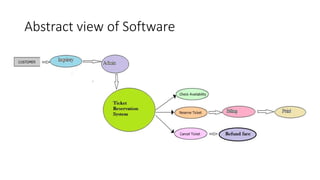
Abstract view of Software
Techniques
• Ethnography
• People come to buy ticket at the station and what is the procedure followed
by the operator?
• Use Case
• Source  Destination  Available Train  Which Coach Passenger wants? 
Amount of seat?  Issued
• What if he wants to cancel?
• Search Record  Found or not?  if yes, Cancel the booking  Record
Deleted  Mark if amount is returned back to passenger?
Functional Requirements (1)
• A Desktop Application
• System will provide “Operator Login” functionality
• System should generate a unique identification No. for each
passenger that is to differentiate between passengers with similar
bio-data.
• System should generate daily report of ticket booking and cancelation
Functional Requirements (2)
• Operator will be able to:
• See available trains and their arrival and departure time.
• Number of seats, coaches, berths, either available or not, in each train.
• Select the train according to the destination of the passenger.
• Search the vacancy of passengers in the train according to the coaches.
• Differentiate the coaches of the train.
• Issue the ticket to passengers according to the ticket’s category or passenger’s
requirement.
• Bill the passenger for the issued ticket and balance the residual amount with return.
• Cancel the ticket according to railway rules, if the passenger asks to do so.
• Fare refund in case of cancellation.
• Monthly report of tickets booking and cancelation
Non-Functional Requirements
Product Requirements
• Response Time of system Transactions and Searching should be less
because it’s a real-time application and its response time depends
upon performance and space. So, in short system should be efficient.
• Also, System should be easy to use and there should be no data
redundancy.
• System shall give a good User Interface to easily see the output.
Non-Functional Requirements
Organizational Requirements
• User or operator should authenticate himself to access the software
by login procedure.
Non-Functional Requirements
External Requirements
• Passenger’s information should be secure in the software. The ways
to access information should be secure and the information shall only
be accessed through the system.
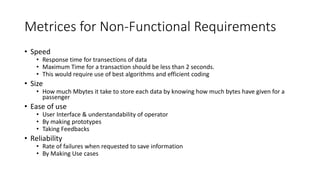
Metrices for Non-Functional Requirements
• Speed
• Response time for transections of data
• Maximum Time for a transaction should be less than 2 seconds.
• This would require use of best algorithms and efficient coding
• Size
• How much Mbytes it take to store each data by knowing how much bytes have given for a
passenger
• Ease of use
• User Interface & understandability of operator
• By making prototypes
• Taking Feedbacks
• Reliability
• Rate of failures when requested to save information
• By Making Use cases
Requirements Validation
• Consistency
• There is no conflict with requirements
• Realism
• All the requirements can be achieved. Using C# Desktop Application will result
us with all requirements
• Verifiability Check
• Prototypes
• Test Case Generation
Railway Reservation System - Requirement Engineering

Railway Reservation System - Requirement Engineering

  • 1.
    Railway Ticket Reservation System SoftwareEngineering – Requirement Engineering Group 6
  • 2.
    Group Members • Ch.Arsalan Ali Daim BSCS14068 • H.M. Abdul Wajid BSCS14054 • Azhar Ali BSCS14058 • Danish Javed BSCS14028
  • 3.
  • 4.
    Techniques • Ethnography • Peoplecome to buy ticket at the station and what is the procedure followed by the operator? • Use Case • Source  Destination  Available Train  Which Coach Passenger wants?  Amount of seat?  Issued • What if he wants to cancel? • Search Record  Found or not?  if yes, Cancel the booking  Record Deleted  Mark if amount is returned back to passenger?
  • 5.
    Functional Requirements (1) •A Desktop Application • System will provide “Operator Login” functionality • System should generate a unique identification No. for each passenger that is to differentiate between passengers with similar bio-data. • System should generate daily report of ticket booking and cancelation
  • 6.
    Functional Requirements (2) •Operator will be able to: • See available trains and their arrival and departure time. • Number of seats, coaches, berths, either available or not, in each train. • Select the train according to the destination of the passenger. • Search the vacancy of passengers in the train according to the coaches. • Differentiate the coaches of the train. • Issue the ticket to passengers according to the ticket’s category or passenger’s requirement. • Bill the passenger for the issued ticket and balance the residual amount with return. • Cancel the ticket according to railway rules, if the passenger asks to do so. • Fare refund in case of cancellation. • Monthly report of tickets booking and cancelation
  • 7.
    Non-Functional Requirements Product Requirements •Response Time of system Transactions and Searching should be less because it’s a real-time application and its response time depends upon performance and space. So, in short system should be efficient. • Also, System should be easy to use and there should be no data redundancy. • System shall give a good User Interface to easily see the output.
  • 8.
    Non-Functional Requirements Organizational Requirements •User or operator should authenticate himself to access the software by login procedure.
  • 9.
    Non-Functional Requirements External Requirements •Passenger’s information should be secure in the software. The ways to access information should be secure and the information shall only be accessed through the system.
  • 10.
    Metrices for Non-FunctionalRequirements • Speed • Response time for transections of data • Maximum Time for a transaction should be less than 2 seconds. • This would require use of best algorithms and efficient coding • Size • How much Mbytes it take to store each data by knowing how much bytes have given for a passenger • Ease of use • User Interface & understandability of operator • By making prototypes • Taking Feedbacks • Reliability • Rate of failures when requested to save information • By Making Use cases
  • 11.
    Requirements Validation • Consistency •There is no conflict with requirements • Realism • All the requirements can be achieved. Using C# Desktop Application will result us with all requirements • Verifiability Check • Prototypes • Test Case Generation