MUSC 1800: Popular Music
Ragtime and Its Afterlife
Dr. Matthew C. Saunders
Lakeland Community College
C-1078
Ragtime
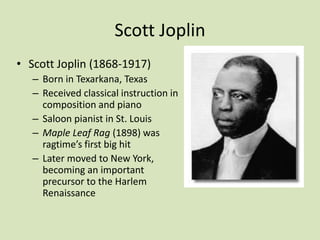
Scott Joplin
• Scott Joplin (1868-1917)
– Born in Texarkana, Texas
– Received classical instruction in
composition and piano
– Saloon pianist in St. Louis
– Maple Leaf Rag (1898) was
ragtime’s first big hit
– Later moved to New York,
becoming an important
precursor to the Harlem
Renaissance
Musical Characteristics of Ragtime
• Joplin, “Maple Leaf Rag,” 1898 (recorded by
composer, 1916)
Ragtime’s Afterlife
• Ragtime craze ended around World War I (1917-18)
– Rationing
– Propaganda
– Phonograph
– Prohibition
• Periodic revivals of interest in the genre
– 1950s: Ragtime accepted into “classical” piano canon
– 1970s: Film: The Sting, 1973
• Seen as one of the roots of jazz
• Tin Pan Alley songs based on ragtime
– Irving Berlin: “Alexander’s Ragtime Band” (1911)
– George M. Cohan: “You’re a Grand Old Flag” (1917)
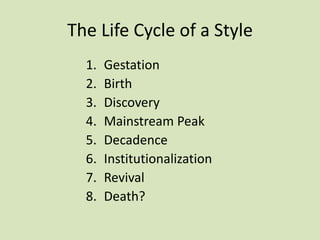
The Life Cycle of a Style
1. Gestation
2. Birth
3. Discovery
4. Mainstream Peak
5. Decadence
6. Institutionalization
7. Revival
8. Death?

Ragtime and Its Afterlife

  • 1.
    MUSC 1800: PopularMusic Ragtime and Its Afterlife Dr. Matthew C. Saunders Lakeland Community College C-1078
  • 2.
  • 3.
    Scott Joplin • ScottJoplin (1868-1917) – Born in Texarkana, Texas – Received classical instruction in composition and piano – Saloon pianist in St. Louis – Maple Leaf Rag (1898) was ragtime’s first big hit – Later moved to New York, becoming an important precursor to the Harlem Renaissance
  • 4.
    Musical Characteristics ofRagtime • Joplin, “Maple Leaf Rag,” 1898 (recorded by composer, 1916)
  • 5.
    Ragtime’s Afterlife • Ragtimecraze ended around World War I (1917-18) – Rationing – Propaganda – Phonograph – Prohibition • Periodic revivals of interest in the genre – 1950s: Ragtime accepted into “classical” piano canon – 1970s: Film: The Sting, 1973 • Seen as one of the roots of jazz • Tin Pan Alley songs based on ragtime – Irving Berlin: “Alexander’s Ragtime Band” (1911) – George M. Cohan: “You’re a Grand Old Flag” (1917)
  • 6.
    The Life Cycleof a Style 1. Gestation 2. Birth 3. Discovery 4. Mainstream Peak 5. Decadence 6. Institutionalization 7. Revival 8. Death?

Editor's Notes

  • #3 Roots and Influences Rhythmic approach similar to that found in minstrel songs Syncopated rhythms derived from cakewalks “to rag” was to enliven a piece of music with syncopated rhythms and textures; often improvisational Influence of habanera and brass band music Variety of titles meant to appeal to interest, not necessarily describe content
  • #4 Scott Joplin (1868-1917) Born in Texarkana, Texas Received classical instruction in composition and piano Saloon pianist in St. Louis Maple Leaf Rag (1898) was ragtime’s first big hit Later moved to New York, becoming an important precursor to the Harlem Renaissance
  • #5 2/4 time (2 beats per measure) Regular phrase lengths (often 16 bars) Repeated phrases and sections “Jump bass” pattern in accompaniment Syncopated melody Performed by a variety of ensembles
  • #6 Ragtime craze ended around World War I (1917-18) Rationing Propaganda Phonograph Prohibition Periodic revivals of interest in the genre 1950s 1970s (The Sting) Widespread acceptance by classical pianists Seen as one of the roots of jazz Used as a cue for “old-fashioned” on television Tin Pan Alley songs based on ragtime Irving Berlin: “Alexander’s Ragtime Band” George M. Cohan: “You’re a Grand Old Flag”