Scott Joplin
•

•

•

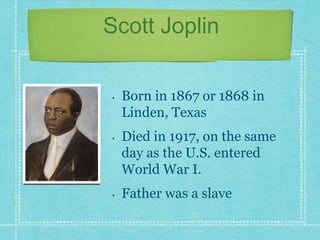
Born in 1867 or 1868 in
Linden, Texas
Died in 1917, on the same
day as the U.S. entered
World War I.
Father was a slave
Scott Joplin
•

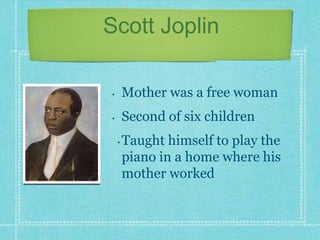
Mother was a free woman

•

Second of six children
•

Taught himself to play the
piano in a home where his
mother worked
Scott Joplin
•

•

•

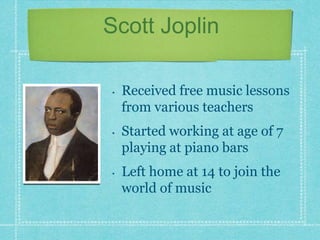
Received free music lessons
from various teachers

Started working at age of 7
playing at piano bars
Left home at 14 to join the
world of music
Scott Joplin
•

•

•

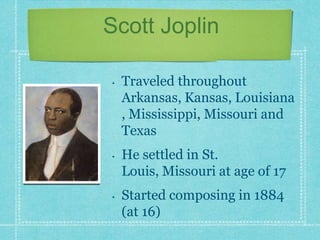
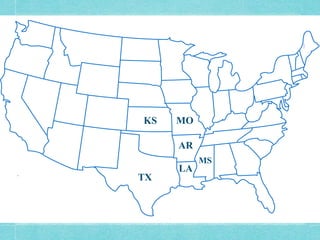
Traveled throughout
Arkansas, Kansas, Louisiana
, Mississippi, Missouri and
Texas

He settled in St.
Louis, Missouri at age of 17
Started composing in 1884
(at 16)
KS

MO
AR

TX

LA

MS
Ragtime Music

Ragtime is a musical genre that was popular
between 1897-1918. It is
syncopated, which means the music
contains unexpected rhythms or accents
where they wouldn't normally occur.
Joplin presentation

Joplin presentation

Editor's Notes

  • #2 Sunflower Slow Rag
  • #3 Nobody knows for sure when Joplin was born. For a while, historians thought it was November 24, 1868, but now they are almost certain it was sometime late in 1867.PASS OUT Timeline figure and paste under Modern
  • #4 Nobody knows for sure when Joplin was born. For a while, historians thought it was November 24, 1868, but now they are almost certain it was sometime late in 1867.PASS OUT Timeline figure and paste under Modern
  • #7 PASS OUT MAPS AND LABEL AND COLOR IN EACH STATE AS LISTED
  • #8 Ragtime pieces are nicknamed, “Rags”“Entertainer” featured in the movie “The Sting” (1973) – made his piece popular againJoplin wrote an opera called: "Treemonisha" that was not successful until many years after his death in 1976, when it won a Pulitzer price.Easy Winners is another popular rag of his.He played at a club called the “Maple Leaf” – he named his most famous rag after it.(continue playing Maple Leaf Rag through slides). This piece made him rich and famous.He wrote pieces mostly for the piano, although he also played the guitar and bugle.
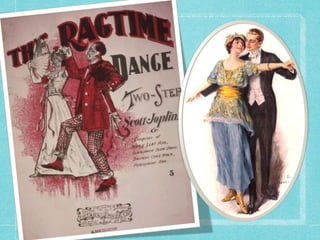
  • #9 Ragtime became a popular form of music because it was lively and people could dance to it.(continue “Maple Leaf Rag”)
  • #10 (… “Maple Leaf Rag”)
  • #11 Do Syncopation ACTIVITYActivity #1: Everyone clap quarter notes. Sing Twinkle Twinkle together. Then teacher sings syncopated melody over top of students' steady quarter clapping (accompaniment). See if students can join you in singing the syncopated rhythms in imitation while they clap a steady beat. Get up and march a steady beat if clapping is too hard.Activity #2: Students tap a steady beat on table top while teacher claps syncopated rhythms on top (use pre-written rhythms and also rhythms from Maple Leaf and The Entertainer). Divide class in 2: half the class tap a steady beat. The others imitate what teacher claps. Switch halves. Variation: Use Rhythm instruments.
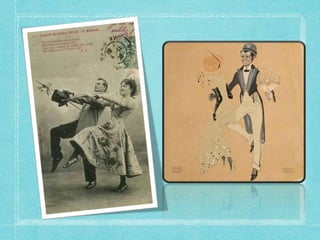
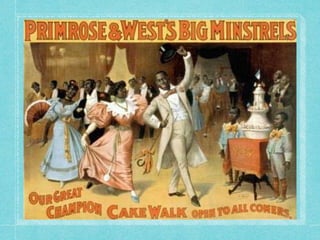
  • #12  Its origins are in Florida by the African-American slaves who got the basic idea from the Seminole Indians.        These "Walkers" as they were called, would walk a straight line and balance buckets of water on their heads. Over time the dance evolved into a exaggerated parody of the white, upper class ballroom dancers who would imitate the mannerismsof their masters’ housemasters house).These slaves would mimic the whites’ dignified walking, prancing, strutting, bowing low, waving canes, doffing hats. The masters and their guests found it amusing, while a few plantation owners frowned upon these shenanigans. For their 'Sunday entertainment', the plantation owners started having contests to prove to the other who had the best slave walker which would give the evolution of the Cake being given as a prize..        Some of the plantation owners would bake a special cake called a hoecake wrapped in cabbage leaf and on Sundays and invite the neighbors over and have a contest of the slaves, different prizes were given but originally it was a Hoecake for the males and molasses pulled candy for the ladies and the name “cakewalk” was now set. This is where the phrases "That Takes The Cake!" and'It's a Cakewalk‘come from.