WRITING FOR THEEAR:
As a broadcast writer, your challenge is to
format that information
• for your listeners’ ear
• so that they can understand it
• the first - and most likely only - time
they’ll hear it.
3.
THE SIX “CS”:
1.Clear
2. Concise
3. Conversational
4. Complete
5. Current
6. Correct
4.
The Six C’s
1.CLEAR
• Write in a simple, understandable style.
• Write to express an idea, not to impress
your audience.
• Basically limit sentences to one
main thought.
5.
THE SIX “CS”:
2.CONCISE
• Broadcast copy is short.
Thomas Jefferson once said,
“The most valuable of all talent is that of never using two
words when one will do.”
• Get to the main point.
• Use only essential words.
• Eliminate wordiness.
• Make your point and move on.
6.
THE SIX “CS”:
3.CONVERSATIONAL:
• We basically “converse” using simple,
common language.
• Write a story much the same way you'd
tell it to a friend.
7.
THE SIX “CS”:
4.COMPLETE:
• Your copy must answer the five Ws (who,
what, when, where, and why), except,
perhaps, “why.” That may be unknown at
airtime.
• But don't raise new questions or leave
old
questions unanswered.
8.
THE SIX “CS”:
5.CURRENT:
• Current copy is timely copy – both in content
and the way it sounds.
• One way you can make your copy sound
much more timely is by using (but not
forcing) one of the present verb tenses
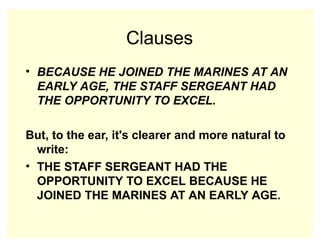
whenever it's possible (and correct)
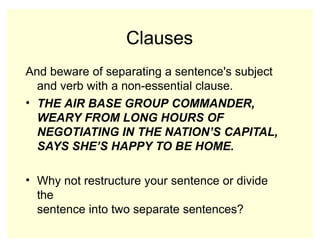
9.
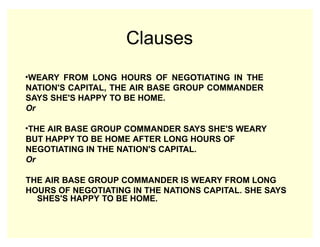
THE SIX “CS”:
6.CORRECT
• The most important “C.”
• One mistake could potentially ruin a career.
• Your copy must be free of factual errors.
Double check for correct names, dates,
times, etc.
• Correct copy also means correct use
of spelling and grammar.
• Use a dictionary.
10.
BROADCAST NEWS
STRUCTURE:
Broadcast newswriting uses a different
structure than print journalism.
• While the print journalist uses the
inverted pyramid style, you'll employ the
upright pyramid style.
11.
BROADCAST NEWS
STRUCTURE:
• Insteadof the summary lead, including
the who, what, when, where, and why of
the story, you'll focus on the central fact
– or news peg – for your lead.
12.
BROADCAST NEWS
STRUCTURE:
• Then,instead of using the print style of the
facts in order of importance, you'll round
out your story by completing the five
“Ws.”
13.
BROADCAST NEWS
STRUCTURE:
• That'sone reason why radio is considered
the “alerting” or “headline” medium,
newspapers the “informing” medium, and
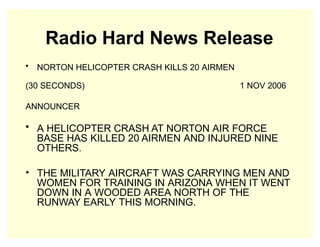
television (the dual-channel medium) the
“involving” or “emotional” medium.
14.
BROADCAST NEWS
STRUCTURE:
• Whilethe newspaper reporter might take
700 words to tell the story, you'll often
have no more than 75 to 80.
15.
CONSTRUCTING THE
BROADCAST SENTENCE:
•You must learn to write in a more direct,
conversational style.
• That means generally NOT starting a
sentence with a long phrase or
subordinate clause – especially your
lead.
16.
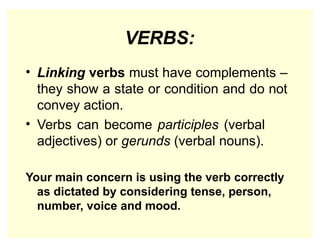
VERBS:
The single mostimportant word in a sentence
is the verb.
A verb is a word that expresses
• action,
• state, or
• condition.
It provides the muscle in your sentence.
17.
Verbs
Verbs come invarious forms.
• There are transitive and intransitive verbs.
• Auxiliary verbs and main verbs combine to
make a verb phrase.
18.
VERBS:
• Linking verbsmust have complements –
they show a state or condition and do not
convey action.
• Verbs can become participles (verbal
adjectives) or gerunds (verbal nouns).
Your main concern is using the verb correctly
as dictated by considering tense, person,
number, voice and mood.
19.
TENSE:
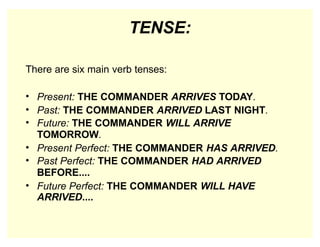
There are sixmain verb tenses:
• Present: THE COMMANDER ARRIVES TODAY.
• Past: THE COMMANDER ARRIVED LAST NIGHT.
• Future: THE COMMANDER WILL ARRIVE
TOMORROW.
• Present Perfect: THE COMMANDER HAS ARRIVED.
• Past Perfect: THE COMMANDER HAD ARRIVED
BEFORE....
• Future Perfect: THE COMMANDER WILL HAVE
ARRIVED....
20.
Present Tense
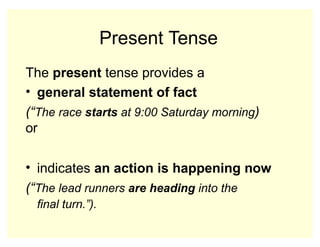
The presenttense provides a
• general statement of fact
(“The race starts at 9:00 Saturday morning)
or
• indicates an action is happening now
(“The lead runners are heading into the
final turn.”).
21.
Present Tense
It isthe preferred tense for use in
broadcast writing … but don't “force” it
by using the “false present”
• (“Last night’s fire injures five reporters.”) or
you'll confuse your audience.
22.
Past Tense
Use thepast tense when you tie an event
to a point in the past,
• but don't confuse past tense with passive
voice, which is caused by sentence
structure.
THE COMMANDER ARRIVED LAST
NIGHT.
23.
Future Tense
The futuretense indicates the event has not
yet taken place.
• THE COMMANDER WILL ARRIVE
TOMORROW.
24.
Tense
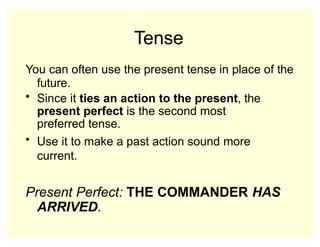
You can oftenuse the present tense in place of the
future.
• Since it ties an action to the present, the
present perfect is the second most
preferred tense.
• Use it to make a past action sound more
current.
Present Perfect: THE COMMANDER HAS
ARRIVED.
25.
Tense
• You willrarely use the past perfect tense,
and the future perfect tense has become
all but obsolete.
26.
VOICE:
Voice refers tothe relationship between the
action, agent/actor, and recipient.
• Is the agent/actor performing the verb's
action or is it being acted upon?
• What is the direction of the verb's
action?
27.
Voice
Consider the followingexamples:
• Active: THE THIEF STOLE THE
HANDBAG.
• Passive: THE HANDBAG WAS STOLEN
BY THE THIEF.
28.
RESTRUCTURING PASSIVE VOICE
SENTENCES:
Active:THE THIEF STOLE THE HANDBAG.
Passive: THE HANDBAG WAS STOLEN BY THE THIEF.
• First, in the active voice example, the
action flows from the thief (agent) to the
handbag (object).
• In the passive voice, the verb is past tense
but has no auxiliary verb.
29.
Voice
In the passiveexample,
• the object becomes the “subject,” and the
actor follows the verb.
• The action flows in the opposite direction.
• A form of the “to be” verb is used as an
auxiliary verb.
• Formed correctly, passive voice always has a
verb phrase consisting of a form of the “to
be” verb and a past participle
30.
Active Voice
ACTIVE VOICEADVANTAGES:
• It is more concise and more
conversational.
• Stronger and clearer in meaning.
• Conversely, passive voice generally
results in wordy, dull sentences.
31.
IDENTIFYING PASSIVE VOICE:
Youmust learn to recognize passive voice before
you can correct it.
Consider the following three step process:
1. Identify the verb.
2. Identify who or what is performing the
verb's action.
3. Identify the direction of the action
32.
From Passive toActive Voice
THE THIEF WAS ARRESTED BY THE
POLICEMAN.
• the verb phrase (was arrested) and
• the actor (policeman
Passive sentence structure doesn't always include
an actor. The above examples might have read:
• THE THIEF WAS ARRESTED.
33.
RESTRUCTURING PASSIVE VOICE
SENTENCES:
Torestructure a passive voice sentence, you must:
1. Identify it!
2.Relocate the actor or identify the missing actor
and insert it into the sentence.
3. Change the verb.
For example:
• THE COLONEL WAS BITTEN BY THE DOG
• THE DOG BIT THE COLONEL.
34.
Note:
Be careful whenyou change the verb – you
might end up changing the meaning of the
sentence, e.g.,
• “The boy was bitten by the dog”; cannot
become, “The boy bit the dog.”
35.
WHEN IT’S OKTO USE PASSIVE VOICE:
There are some instances when passive
voice is preferred over active voice.
For instance,
1. When it's a traditional phrase
normally
spoken in the passive voice:
• HE WAS BORN IN 1952.
36.
WHEN IT’S OKTO USE PASSIVE VOICE:
2. When the “actor” is unknown or you want
to hide the actor’s identity:
• THE BOY WAS RESCUED FROM THE
BURNING CAR.
• THE DOOR WAS LEFT UNLOCKED.
(By me!)
37.
WHEN IT’S OKTO USE PASSIVE VOICE:
3. When the receiver of the action is clearly
more important that the actor:
• THE PRESIDENT HAS BEEN SHOT.
(OR)
• THE WRITING INSTRUCTOR HAS BEEN
FIRED.
38.
Practice recognizing passivevoice
by
evaluating these sentences:
• THE MARATHON WAS WON BY THE
MASTER SERGEANT.
• THE CAR STRUCK THE SAILOR IN
THE LEG.
• THE TRIAL WAS INTERRUPTED BY THE
JUDGE.
• THE FAMILY MEMBERS WERE
NOTIFIED.
• THE INSTRUCTOR HAS LEFT SCHOOL
FOR THE DAY.
• A CROWD OF 20-THOUSAND SPECTATORS
IS EXPECTED.
39.
CHOOSING SIMPLE
WORDS: WRITINGFOR
THE EAR:
Writing for the ear means using words
that are conversational and easily
understood.
For example,
• Would you ask to “utilize” or “use”
the
computer?
40.
CHOOSING SIMPLE WORDS:
WRITINGFOR THE EAR:
• Do YOU ask someone to “consummate” a
form or “complete” it?
• Would you report on a “conflagration” or a
“fire”?
Writing for the ear means using those
simple words when you write for your
audience.
41.
CLICHÉS:
• How manytimes have we heard a newscaster
use the phrase “autopsy to determine the
cause of death”?
• How many wasted words are in the phrase
“in the month of February”?
• Is it really necessary to say “in the city of…”?
42.
OTHER MEANINGLESS WORDS:
•Some other meaningless words include
conjunctive adverbs – like
meanwhile, meantime, and incidentally.
• Don't rely on these crutches as transitions.
43.
OTHER MEANINGLESS WORDS:
•And don't forget to avoid latter, former
and respectively.
Your listener can't refer back to your
original
reference.
Work on a more natural flow of ideas.
44.
JARGON AND SLANG:
•To you “R and R” might mean “rest and
relaxation,” but to someone else it might
be the name of their hometown bowling
alley.
45.
JARGON AND SLANG:
•And which term sounds more professional,
“re- up” or “re-enlistment”?
• Would the civilians in your audience more
easily understand “2100 hours” or “this evening
at 9:00”?
Avoid using jargon, slang, and military time.
46.
FOREIGN PHRASES:
• Bewareof foreign phrases.
• They could also totally confuse your
listener.
• Use better known words or phrases
common to the country.
47.
CONTRACTIONS:
• We usecontractions naturally in day-to-
day conversations. “It's” replaces “it is”
and “there is” becomes “there's.”
• Contractions also add to the
conversational delivery of broadcast
copy.
• There are exceptions.
48.
Exceptions to UsingContractions
• One is the use of it'll, which sounds
awkward in a broadcast sentence.
• Also, remember that contractions tend to
de-emphasize words.
• If you must emphasize a word, do not
contract it.
49.
HERE” AND “THERE”:
•“Where are here and there to your
audience?
• Is here inside the radio studio?
50.
Here And There
•To your listener, isn't here where they are
at that moment?
• The wider your broadcast area, the
greater the possibility of confusion.
• Whether here is Nueva Ecija or there is
Nueva Ecija, just say Nueva Ecija.
51.
ACRONYMS:
• Your audienceno doubt knows what NASA,
NATO, and even OPEC are, but have they ever
heard of DINFOS? Be sure you spell out an
unfamiliar acronym when you use it for the first
time.
• THE DEFENSE INFORMATION SCHOOL, OR
DINFOS....
• This example illustrates one of the few times it's
beneficial to split a sentence's subject with a
clarifying phrase.
52.
INITIALS AND MIDDLENAMES:
• Omit a person's middle initial unless the
letter is part of a well-known name, like
Michael J. Fox, Harry S. Truman, John
F. Kennedy or George C. Scott.
53.
SENTENCE STRUCTURE:
• Keepsentence structure simple – basically
one idea to one sentence.
• Edit your compound-complex sentence
down to two or three simple sentences.
54.
SENTENCE LENGTH:
• Adhereto the 20/25 rule, which limits
hard-news story leads to 20 words and all
other hard-news story sentences to 25
words.
55.
Sentence Structure
But alsoremember to vary your sentence
length.
• If you constantly write short sentences,
your copy will sound choppy.
• If you always write long, wordy sentences,
your copy will drag.
• Try to develop a rhythm by combining
short and long sentences.
56.
PARTICIPIAL PHRASES:
• Avoidstarting a sentence with a participial
phrase, and virtually never start a story
with one.
• It's normally best to establish the subject
at the beginning of your sentence.
57.
PARTICIPIAL PHRASES:
For instance:
•BEGINNING THIS WEEK, THE CHAPEL
WILL START HOLDING SUNDAY EVENING
SERVICES.
• THE CHAPEL WILL START HOLDING
SUNDAY EVENING SERVICES THIS
WEEK.
58.
CLAUSES:
• You mustalso remember to remain clear and
conversational in your use of clauses.
• For instance, normal print sentence structure
often finds a dependent clause preceding an
independent clause.
59.
Clauses
• BECAUSE HEJOINED THE MARINES AT AN
EARLY AGE, THE STAFF SERGEANT HAD
THE OPPORTUNITY TO EXCEL.
But, to the ear, it's clearer and more natural to
write:
• THE STAFF SERGEANT HAD THE
OPPORTUNITY TO EXCEL BECAUSE HE
JOINED THE MARINES AT AN EARLY AGE.
60.
Clauses
And beware ofseparating a sentence's subject
and verb with a non-essential clause.
• THE AIR BASE GROUP COMMANDER,
WEARY FROM LONG HOURS OF
NEGOTIATING IN THE NATION’S CAPITAL,
SAYS SHE’S HAPPY TO BE HOME.
• Why not restructure your sentence or divide
the
sentence into two separate sentences?
61.
Clauses
•WEARY FROM LONGHOURS OF NEGOTIATING IN THE
NATION'S CAPITAL, THE AIR BASE GROUP COMMANDER
SAYS SHE'S HAPPY TO BE HOME.
Or
•THE AIR BASE GROUP COMMANDER SAYS SHE'S WEARY
BUT HAPPY TO BE HOME AFTER LONG HOURS OF
NEGOTIATING IN THE NATION'S CAPITAL.
Or
THE AIR BASE GROUP COMMANDER IS WEARY FROM LONG
HOURS OF NEGOTIATING IN THE NATIONS CAPITAL. SHE SAYS
SHES'S HAPPY TO BE HOME.
62.
Clauses
• Remember thatit's better to use simple,
declarative sentences with simple
subject-verb-object (S-V-O) order.
• Also remember, to avoid confusion,
generally place dependent clauses after
independent clauses.
63.
PUNCTUATION MARKS
• Usepunctuation in your broadcast script
to aid readability and clarify meaning.
• Use “oral punctuation” (breath marks), not
written punctuation, for the best results
with copy interpretation.
64.
• The commais just one of seven different
forms of broadcast punctuation.
• The others include the period, comma,
hyphen, dash, quotation mark,
parenthesis, and ellipsis.
• You may also use the exclamation
point,
but not in a “hard news story.”
65.
Punctuation
• A periodindicates the end of a sentence
or thought. Stop; breathe; move on.
• Be sure to place two spaces after each
period in your broadcast script.
• A comma indicates a pause shorter than a
period.
• Continue to use commas to set off names
of geographical areas and most items in
dates and addresses.
66.
Punctuation
• The hyphenhelps you phrase difficult
words and separate elements.
• RE-APPLY, RE-EVALUATE
67.
Spell out entireword.
• Do not hyphenate or divide words at the
end of a line.
• Spell out the entire word, or move it to
the
next line.
68.
Dash
• Use thedash to set off parenthetical
expressions.
• UNESCO – THE UNITED NATIONS
EDUCATIONAL, SCIENTIFIC, AND
CULTURAL ORGANIZATION – MET....
• Microsoft words will automatically combine
the two hyphens into a slightly longer
dash.
69.
Quotation Marks
• Usequotation marks to indicate quotes, or set
off nicknames, book or movie titles, or any “cute”
phrase that might create a stumble for the
announcer.
For Instance:
THE U-H-ONE “HUEY” IS A VIETNAM-
ERA, UTILITY HELICOPTER USED FOR
TRANSPORTING…
70.
Ellipsis
• The ellipsisis a series of three dots indicating a pause
longer than a comma.
• The pause is for dramatic effect. This Paul Harvey type
pause is part of the colorful writing used in spots and
features.
• SHE NEVER FORGOT HER FAVORITE WRITING
• INSTRUCTOR ... MASTER SERGEANT TERRY
MINTON.
• You'll very rarely use the exclamation point in
broadcast writing. You might use it with the imperative
mood in a selling spo
71.
QUOTATIONS AND
ATTRIBUTION
“I AMNOT A CROOK,” THE PRESIDENT
SAID.
• When your audience first hears that
statement, they have no way of knowing it's
not the announcer claiming not to be a crook.
There's a good chance they'll become confused
and miss part of your story.
72.
Quotations and Attribution
Yourlistener cannot see the quotation marks in
your copy.
If you feel you must use a direct quote, alert
your listener it's coming:
• THE PRESIDENTSAID IN HIS WORDS,
“I'M NOT A CROOK.”
73.
Unless the quoteis very dynamic, you'll
probably want to paraphrase it.
• THE PRESIDENT SAYS HE IS NOT A
CROOK.
Remember to identify the source of your
quote or paraphrase up front.
Alert your audience that a quote is next, and
begin the quote with the source.
74.
Quotation and Attribution
•You'll also want to avoid using long quotes.
• Again, the best move you can make is
to paraphrase.
• And if it's necessary to link a second statement
with the speaker, use a conversational, clarifying
phrase.
THE ADMIRAL ALSO SAID....
75.
Quotation and Attribution
•Some newscasters use “quote” and
“unquote” to lead into and go out of quotes,
a habit that is un-conversational and
unnecessary.
• When you begin your quote with the source,
your listeners will understand who said what.
76.
Quotation and Attribution
Insteadof:
• THE FIRE CHIEF SAID, QUOTE, “THE
BLAZE STARTED IN THE KITCHEN.”
Why not say:
• THE FIRE CHIEF SAYS THE BLAZE
STARTED IN THE KITCHEN.
77.
Quotation and Attribution
•Don't worry about attributing the source if
the facts are obvious or easily verified.
• Remember to place attribution before
assertion and title before name.
78.
TITLES AND NAMES
•Avoid starting a broadcast story with a
person's name.
• Definitely avoid using the name of an
unfamiliar individual unless you're striving
for a special effect – a very rare instance
in news writing.
• When you use names and titles together,
remember to put the title ahead of the
name.
79.
Titles and Names
Forexample
SECRETARY OF DEFENSE DONALD SAYS....
Instead of:
DONALD RUMSFELD, SECRETARY OF
DEFENSE, SAYS....
Notice that when you place the title before the
name, you don't use commas. Your sentence
flows much more naturally and quickly.
80.
CONSTRUCTING THE
BROADCAST NEWSSTORY:
• A broadcast news story differs from
a print story.
• The print story is written in the “inverted
pyramid” style.
• The who, what, when, where, why, and how are
usually included in the summary
lead.
• The print journalist then unfolds the rest of
the facts in descending order of importance.
81.
CONSTRUCTING THE
BROADCAST NEWSSTORY:
• Conversely, you'll write the broadcast
story in the “upright pyramid” style.
• At the peak is the news peg – the single
most important fact (what happened).
• You add the remaining four “W's” and
How to complete the news story.
82.
The Commitment/
Focus Statement
•Before you start to write your news story, pick
the main actor, action, and recipient, and then
use them to shape a focus statement.
• For example, in a public affairs broadcast
release about a plane crash that killed seven
airmen at Dover AFB, Delaware, you decide
the main actor is “crash,” the main action verb
is “kills,” and the recipient is “airmen.”
• Your focus statement becomes
CRASH KILLS AIRMEN
83.
The Commitment/
Focus Statement
•Everything you write about this story
should relate to your focus/commitment
statement.
• If you have written that statement well, you
can maintain the same structure – actor,
action, and recipient – in your slug/tease
and lead
84.
The Slugline/Tease
• Dependingon the policy at your station,
the slugline can vary in length from one to
ten words.
• This allows the slug to double as a
“tease.”
• This also ensures you can not only include
what happened in ten words or less, you
should also be able to include where it
happened if it is a local story.
The Slugline/Tease
• Bothslugs consist of six words. But, notice that
in the first example the slug is localized (Dover
AFB), the “what” is clearly spelled out (air
crash and seven dead airmen), and the non-
essential words (articles and helping verbs) are
omitted.
• Like a newspaper headline, it's common to
write the “hard news” slugline in the simple
present tense.
• Use shorter topical sluglines for feature stories
and spot announcements.
87.
The Lead
Your lead,or first sentence in a broadcast
news release, is designed to
• gain the listener's attention,
• inform them of what happened, and
• prepare them for what's to come.
88.
The Lead
For example:
•A DOVER AIR FORCE BASE PLANE CRASH HAS
KILLED SEVEN AIRMEN AND INJURED TEN
OTHERS.
• This lead is localized (Dover AFB), the “what” is
included (plane crash), and the result is revealed
(killed seven Airmen and injured ten others) ... all in
well under 20 words!
• You've captured your listener's attention with the
impact (military deaths), told them what happened,
and prepared them for the rest of the facts.
89.
The Lead
Notice howwe did NOT write the lead:
• SEVEN AIRMEN WERE KILLED AND TEN
OTHERS INJURED IN A DOVER
AIRFORCE BASE AIRCRAFT CRASH
THIS MORNING.
This structure not only puts the key statistic (seven) in a place where it
might be missed by your listener (who may not be actively listening
for the first word of the story), it is written in the passive voice
(were
killed).
90.
The Lead
• Localizeyour lead. Stating the local tie
brings a greater impact to your audience.
• You generally don't use questions or
quotations in hard news story leads.
• A question lead might make your
copy
read like a public service
announcement,
and a quotation lead is hard for your
listener to tune in to.
91.
The Lead
• Savequestion leads for “soft news” and
feature stories (except for the occasional
rhetorical question as an attention-getting
device), and
• paraphrase quotes important enough for
the lead (unless it's an extremely
important quote like President Nixon's “I
am not a crook” comment).
92.
The Lead
• Questionand quotation leads may alert
the listener to what's ahead, but they
generally lack the depth of a general “what
happened” lead.
• Finally, recognize the difference between
hard and soft leads and when to use
one over the other.
93.
The Lead
• Stronglyconsider using soft leads for
lighter news stories and sports, e.g.,
instead of directly providing the game's
outcome....
THE BREMERSTEIN “BEARCATS”
CONTINUE TO DOMINATE THE ALL-
EUROPE BASKETBALL LEAGUE.
94.
The Body
• Afteryou've written the lead, work on logically
developing the specifics of the story in the body.
• Logical development simply means orderly
continuing of the facts to flow smoothly to
the story's conclusion.
• Remember, you're a storyteller.
• Try asking yourself what your listener wants to
know next.
• Then deliver. Your development may or may not
be in descending order of importance.
95.
The Body
• Learnthe art of transitioning between
ideas without relying on crutches – like
conjunctive adverbs.
• The body of the story must deliver the
goods you've introduced in the lead.
• And, most of all, do not forget that you're
writing for your listener's ear, i.e.,
conversationally.
96.
The “Snapper”
All storieshave a beginning (lead), middle
(body), and an end.
• We call the end of the news story the “snapper.”
The snapper is the last sentence in your story.
• It brings the story to a solid, logical conclusion.
• It may contain a new fact, but a properly written
snapper never raises any new questions.
• Don't underestimate its importance.
• Next to the lead, the snapper is the most
important element in a news story.
97.
The Feature
• Thefeature story provides a change of pace
in newscasts.
• Features are generally longer than “hard”
news stories and most often focus on “soft
generally longer than “hard” news stories and
most often focus on “soft-news” items.
• From the local sports hero or model
airplane buff, to the opera singer, scholar, or
scoutmaster, features concentrate on the
human interest story angle.
98.
The Feature
• Whileyou use very few, if any, modifiers in your “hard”
news writing, features are a great opportunity to let your
creative writing juices flow.
• These stories don't have a hard news peg.
• They depend on your ability to use a kaleidoscope of
description.
• Concentrate on using dynamic, intense, descriptive
words with precise meanings.
• Continue to use action verbs in the active voice as you
paint mental pictures.
99.
Radio Hard NewsRelease
• NORTON HELICOPTER CRASH KILLS 20 AIRMEN
(30 SECONDS) 1 NOV 2006
ANNOUNCER
• A HELICOPTER CRASH AT NORTON AIR FORCE
BASE HAS KILLED 20 AIRMEN AND INJURED NINE
OTHERS.
• THE MILITARY AIRCRAFT WAS CARRYING MEN AND
WOMEN FOR TRAINING IN ARIZONA WHEN IT WENT
DOWN IN A WOODED AREA NORTH OF THE
RUNWAY EARLY THIS MORNING.
100.
Radio Hard NewsRelease
• THE VICTIMS ARE AIR FORCE RESERVISTS
ASSIGNED TO CALIFORNIA'S AIR NATIONAL
GUARD.
• AIR GUARD OFFICIALS WILL RELEASE THE
NAMES OF THE DEAD AND INJURED
AIRMEN AFTER NOTIFYING THEIR FAMILIES.
• THE AIR FORCE IS INVESTIGATING THE
CRASH. # # #
101.
Researched and prepared
by:
MS.SONIA M. CAPIO
Broadcaster and Educator
0917-3589053;sonnet728@yahoo.com
Womantouch Media & Gender Advocates
8F Corporate Suites, Robinson's Galleria, EDSA