RABIES VIRUS
A seminar on
Prepared by: Rupam saikia
In the guidance of Mr.
Manoranjan Barmam
(Assistant professor, B. Voc.
MLT) Chaiduar college
Introduction
what is rabies ?
 Rabies virus is a neurotropic virus that causes rabies in
human and animals.
 Rabies transmission can occur through biting, scratching,
contact of saliva on cut, eyes,nose, mouth by infected or
host animal.
 Generally dog is the primary host but it can also
transmitted by other animals like
foxes,wolves,cat,monkey,jakele etc.
Virus classification
• Order–mononegravirals
• Famly-rhabdoviridae
• Genus-lyssavirus
• Specis-rabies lyssavirus
Structure
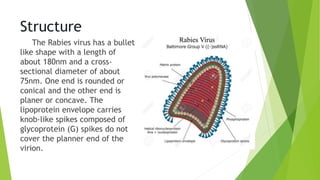
The Rabies virus has a bullet
like shape with a length of
about 180nm and a cross-
sectional diameter of about
75nm. One end is rounded or
conical and the other end is
planer or concave. The
lipoprotein envelope carries
knob-like spikes composed of
glycoprotein (G) spikes do not
cover the planner end of the
virion.
Infection
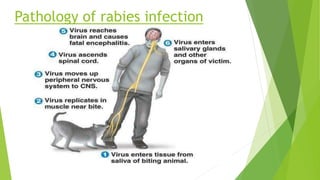
Rabies virus causes ‘Rabies’ in human. After inoculation
the rabies travels quickly along the peripheral nervous
system.The retrograde axonal transport of rabies virus to
the CNS is the key steps of pathogenesis during natural
infection.
From the CNS the virus further spread to other organs.
The salivary gland located in the tissues of the mouth
and cheeks receive high concentration of the virus, thus
allowing it to be further transmitted due to projectile
salivation. Fatality can occur from two days to five years
from the time of initial infection.
Pathology of rabies infection
Clinical spectrum
The clinical spectrum can be divided into three phases-
1. Prodromal phase: the prodrome, lasting 2-10days, may
show any of the following nonspecific symptoms:
malaise, anorexia, headache, photophobia, nausea and
vomiting, sore throat and fever.
2. Acute Neurologic phase: During the acute neurologic
phase, which lasts 2-7days, patients show signs of
nervous system dysfunction such as hervousness,
apprehension, hallucinations and bizarre behaviour.
Hydrophobia is also observed in this phase.
Clinical spectrum
Hydrophobia: The pathognomonic feature is difficulty
in. Drinking, together with intense thirst. Patients
may be able to swallow dry solids but not liquids.
Attempts to drink bring on such painful spasms of the
pharynx and larynx producing choking or gagging that
patients develop a dread of even the sight or sound of
water.
3.Coma: Patients who survive the stage of acute
neurological involvement leps into coma, which may last
for hours or days. Death usually occurs within 1-6 days
due to respiratory arrest during convulsions.
Laboratory Diagnosis
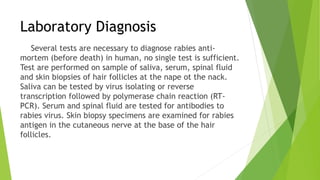
Several tests are necessary to diagnose rabies anti-
mortem (before death) in human, no single test is sufficient.
Test are performed on sample of saliva, serum, spinal fluid
and skin biopsies of hair follicles at the nape ot the nack.
Saliva can be tested by virus isolating or reverse
transcription followed by polymerase chain reaction (RT-
PCR). Serum and spinal fluid are tested for antibodies to
rabies virus. Skin biopsy specimens are examined for rabies
antigen in the cutaneous nerve at the base of the hair
follicles.
Prevention and control
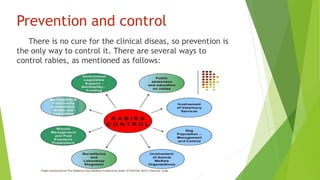
There is no cure for the clinical diseas, so prevention is
the only way to control it. There are several ways to
control rabies, as mentioned as follows:
Prevention and control
The vaccination is also a
important factor to control
rabies. There are a number of
vaccines available that are both
safe and effective. They can be
used to prevent rabies before and
for a period of time after
exposure to the virus such as a
dog or bat bite.
World Rabies Day is an
international awareness campaign
coordinated by the “Global
alliance for rabies control”, US.
THANK YOU

RABIES VIRUS.pptx

  • 1.
    RABIES VIRUS A seminaron Prepared by: Rupam saikia In the guidance of Mr. Manoranjan Barmam (Assistant professor, B. Voc. MLT) Chaiduar college
  • 2.
    Introduction what is rabies?  Rabies virus is a neurotropic virus that causes rabies in human and animals.  Rabies transmission can occur through biting, scratching, contact of saliva on cut, eyes,nose, mouth by infected or host animal.  Generally dog is the primary host but it can also transmitted by other animals like foxes,wolves,cat,monkey,jakele etc.
  • 3.
    Virus classification • Order–mononegravirals •Famly-rhabdoviridae • Genus-lyssavirus • Specis-rabies lyssavirus
  • 4.
    Structure The Rabies virushas a bullet like shape with a length of about 180nm and a cross- sectional diameter of about 75nm. One end is rounded or conical and the other end is planer or concave. The lipoprotein envelope carries knob-like spikes composed of glycoprotein (G) spikes do not cover the planner end of the virion.
  • 5.
    Infection Rabies virus causes‘Rabies’ in human. After inoculation the rabies travels quickly along the peripheral nervous system.The retrograde axonal transport of rabies virus to the CNS is the key steps of pathogenesis during natural infection. From the CNS the virus further spread to other organs. The salivary gland located in the tissues of the mouth and cheeks receive high concentration of the virus, thus allowing it to be further transmitted due to projectile salivation. Fatality can occur from two days to five years from the time of initial infection.
  • 6.
  • 7.
    Clinical spectrum The clinicalspectrum can be divided into three phases- 1. Prodromal phase: the prodrome, lasting 2-10days, may show any of the following nonspecific symptoms: malaise, anorexia, headache, photophobia, nausea and vomiting, sore throat and fever. 2. Acute Neurologic phase: During the acute neurologic phase, which lasts 2-7days, patients show signs of nervous system dysfunction such as hervousness, apprehension, hallucinations and bizarre behaviour. Hydrophobia is also observed in this phase.
  • 8.
    Clinical spectrum Hydrophobia: Thepathognomonic feature is difficulty in. Drinking, together with intense thirst. Patients may be able to swallow dry solids but not liquids. Attempts to drink bring on such painful spasms of the pharynx and larynx producing choking or gagging that patients develop a dread of even the sight or sound of water. 3.Coma: Patients who survive the stage of acute neurological involvement leps into coma, which may last for hours or days. Death usually occurs within 1-6 days due to respiratory arrest during convulsions.
  • 9.
    Laboratory Diagnosis Several testsare necessary to diagnose rabies anti- mortem (before death) in human, no single test is sufficient. Test are performed on sample of saliva, serum, spinal fluid and skin biopsies of hair follicles at the nape ot the nack. Saliva can be tested by virus isolating or reverse transcription followed by polymerase chain reaction (RT- PCR). Serum and spinal fluid are tested for antibodies to rabies virus. Skin biopsy specimens are examined for rabies antigen in the cutaneous nerve at the base of the hair follicles.
  • 10.
    Prevention and control Thereis no cure for the clinical diseas, so prevention is the only way to control it. There are several ways to control rabies, as mentioned as follows:
  • 11.
    Prevention and control Thevaccination is also a important factor to control rabies. There are a number of vaccines available that are both safe and effective. They can be used to prevent rabies before and for a period of time after exposure to the virus such as a dog or bat bite. World Rabies Day is an international awareness campaign coordinated by the “Global alliance for rabies control”, US.
  • 12.