Environmental Engineering (P23CET05)
2024-25
II B Tech I Semester
Civil Engineering
Unit-2: Collection and Conveyance of Water & Water
treatment
Topics:
 Intakes.
 Types of Intakes.
 Factors governing location of intakes.
 Pumps.
 Types of conduits.
 Types of pipes and pipe appurtenances.
 Working principles of water treatment units.
 Screening.
 Plain sedimentation & sedimentation aided with
coagulation.
 Filtration.
 Disinfection.
 Water softening.
Introduction to Intakes
 Intakes are critical structures in water resource
management.
 They facilitate the withdrawal of water from natural sources
for various applications.
 An understanding of intakes is essential for designing
efficient water supply systems.
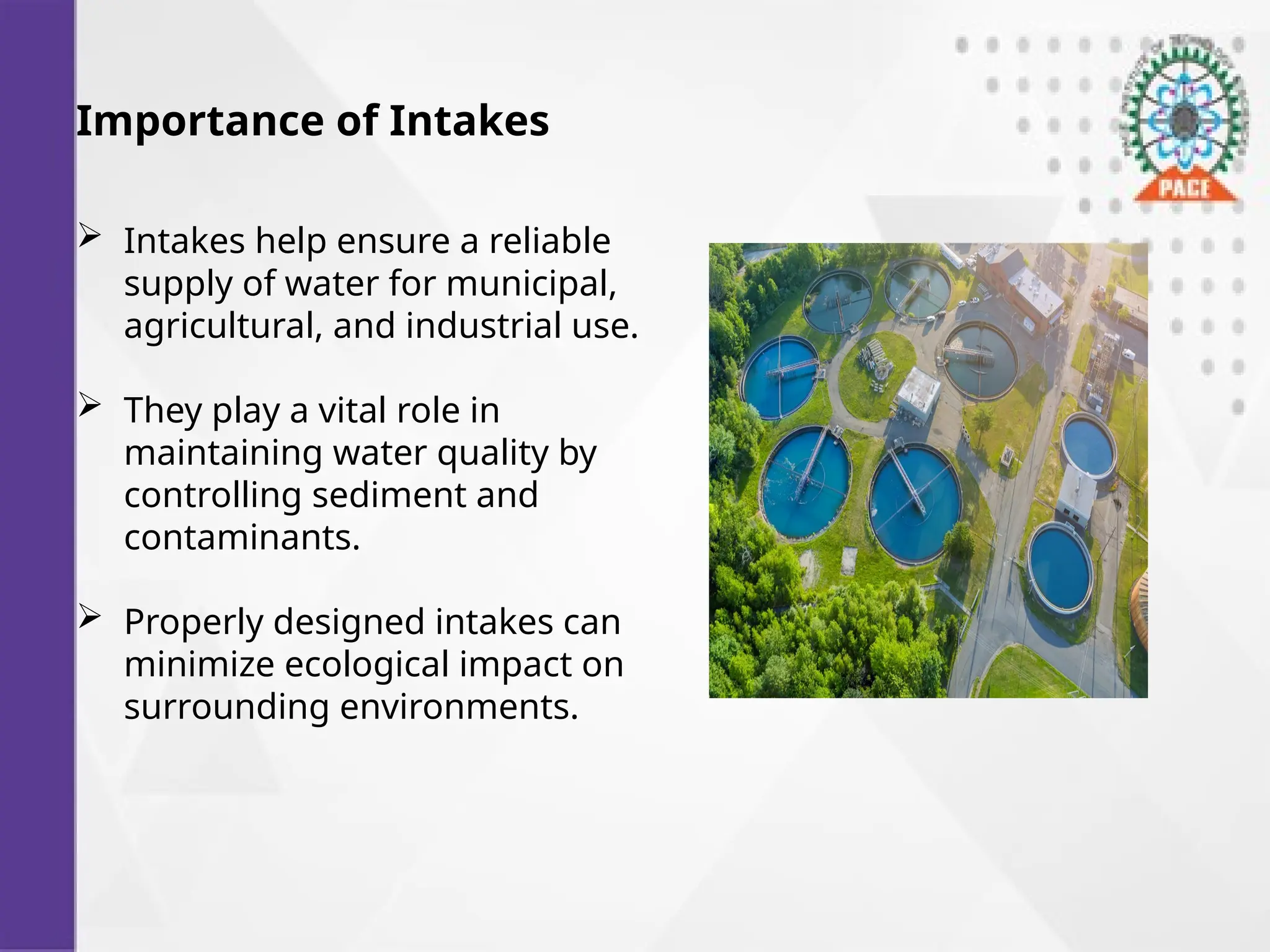
Importance of Intakes
 Intakes help ensure a reliable
supply of water for municipal,
agricultural, and industrial use.
 They play a vital role in
maintaining water quality by
controlling sediment and
contaminants.
 Properly designed intakes can
minimize ecological impact on
surrounding environments.
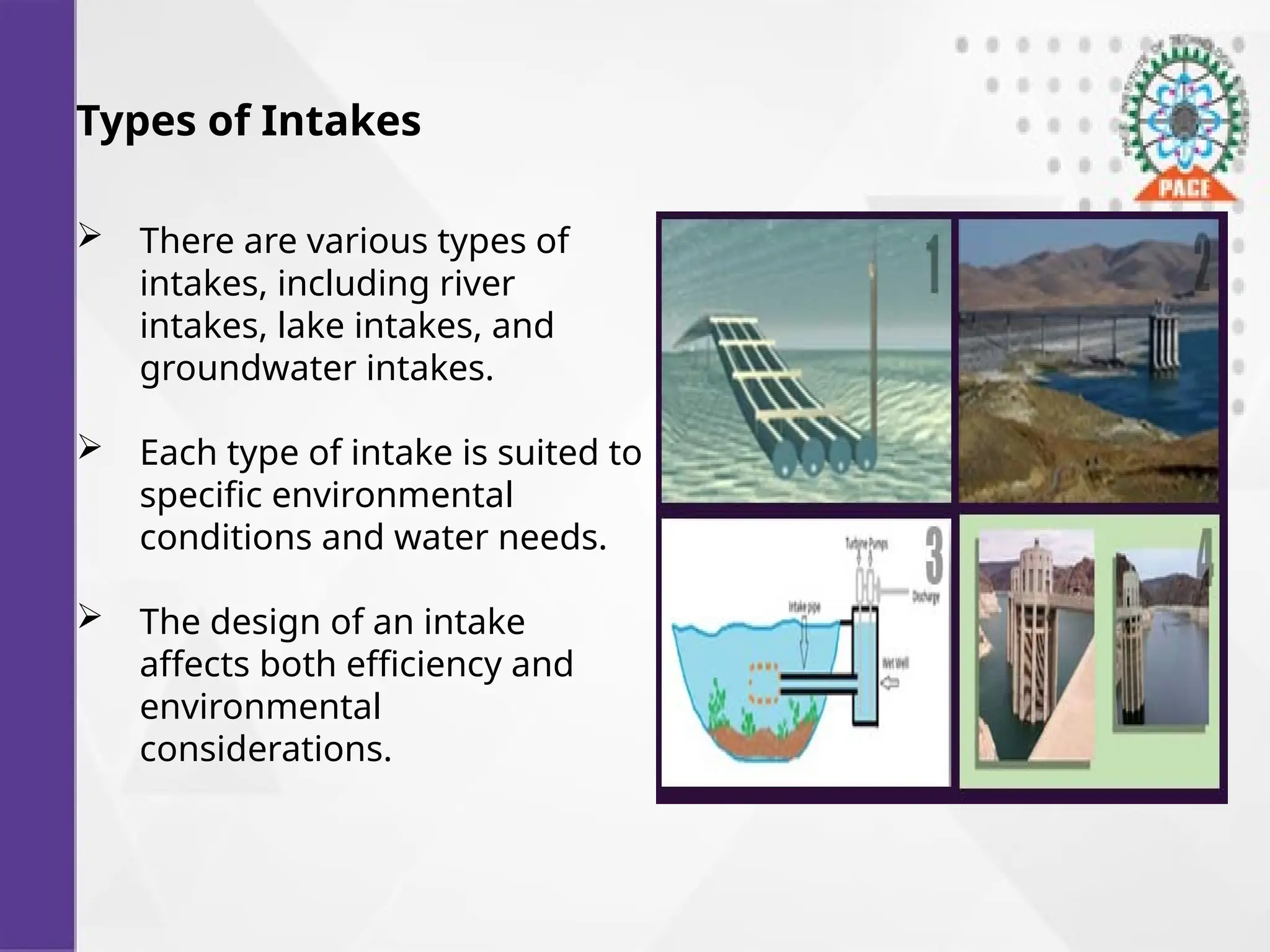
Types of Intakes
 There are various types of
intakes, including river
intakes, lake intakes, and
groundwater intakes.
 Each type of intake is suited to
specific environmental
conditions and water needs.
 The design of an intake
affects both efficiency and
environmental
considerations.
River Intakes
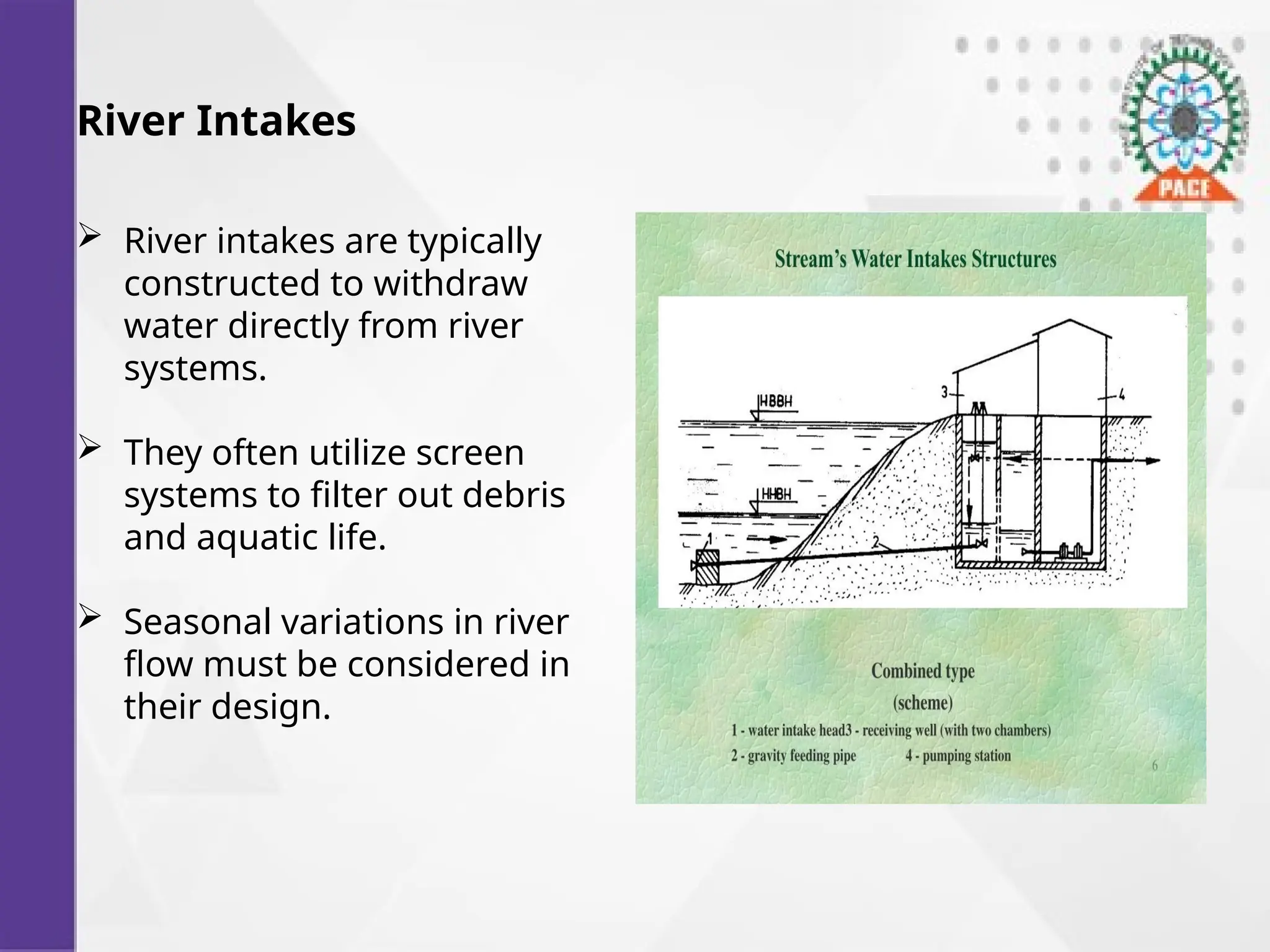
 River intakes are typically
constructed to withdraw
water directly from river
systems.
 They often utilize screen
systems to filter out debris
and aquatic life.
 Seasonal variations in river
flow must be considered in
their design.
Lake Intakes
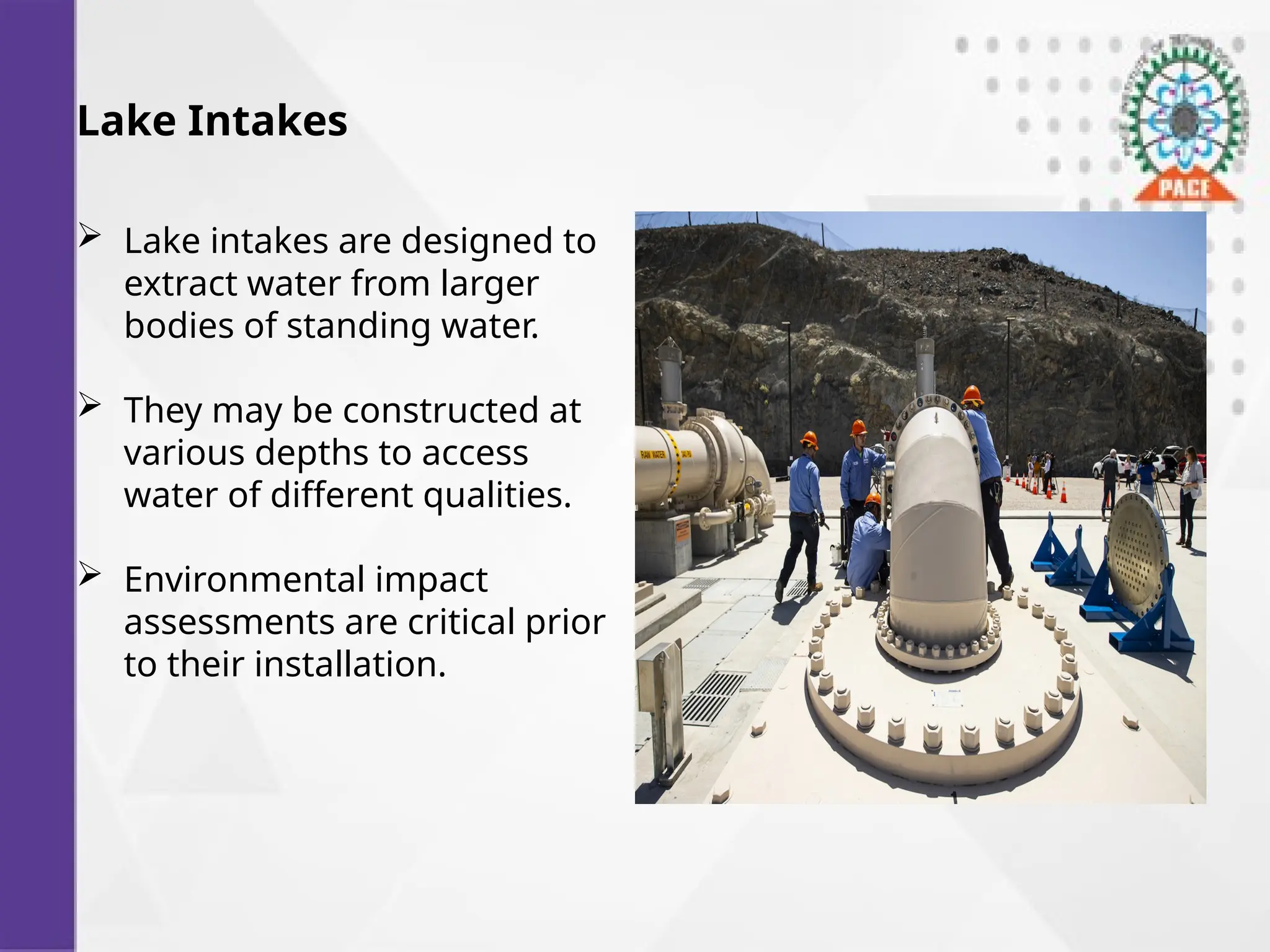
 Lake intakes are designed to
extract water from larger
bodies of standing water.
 They may be constructed at
various depths to access
water of different qualities.
 Environmental impact
assessments are critical prior
to their installation.
Groundwater Intakes
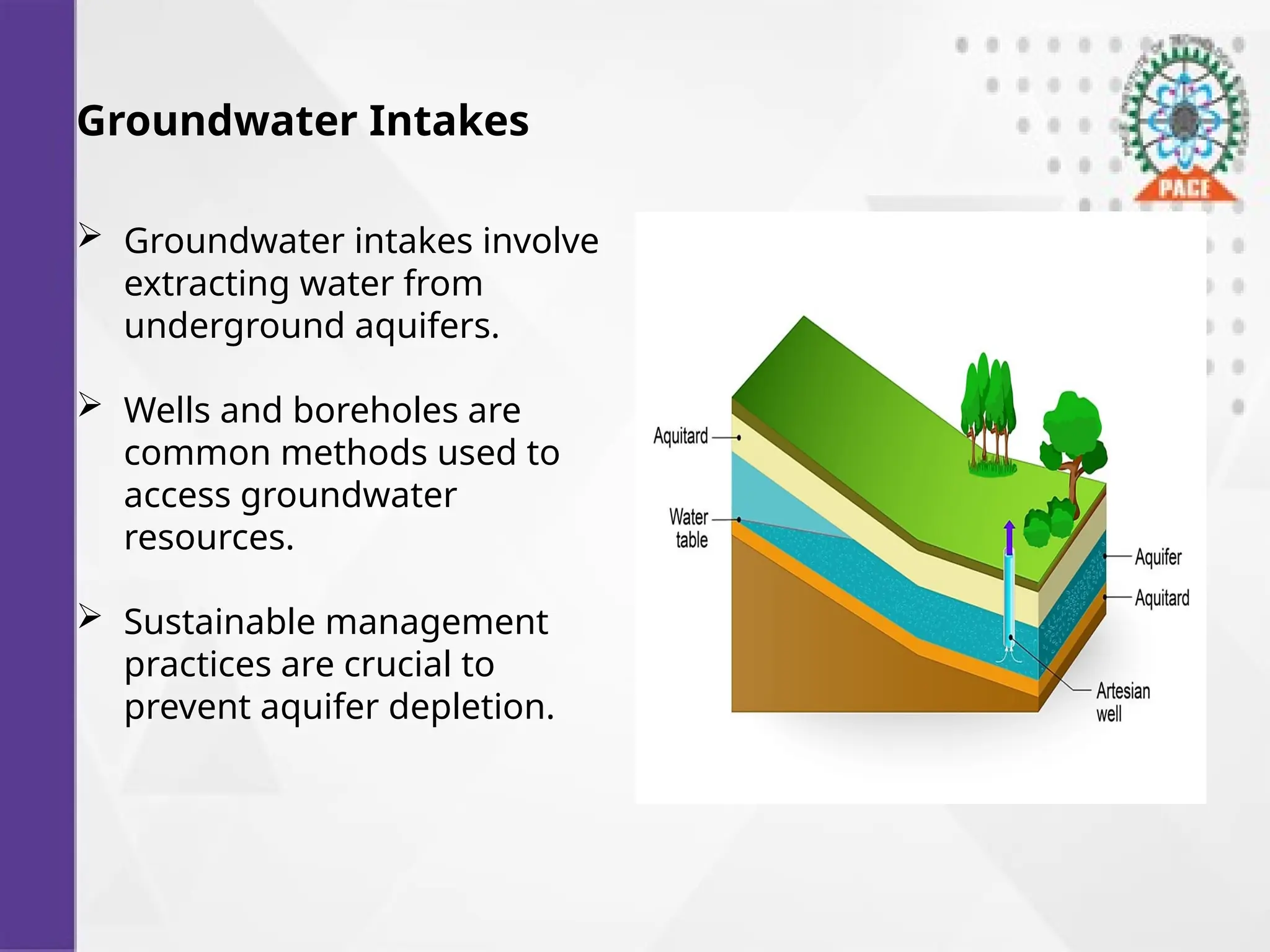
 Groundwater intakes involve
extracting water from
underground aquifers.
 Wells and boreholes are
common methods used to
access groundwater
resources.
 Sustainable management
practices are crucial to
prevent aquifer depletion.
Factors Governing Location of Intakes
 The selection of intake locations is influenced by hydrological
conditions and water quality.
 Environmental considerations, such as habitat protection and
sediment transport, are critical.
 Accessibility for maintenance and operational efficiency also
guides location decisions.
Water Quality Considerations
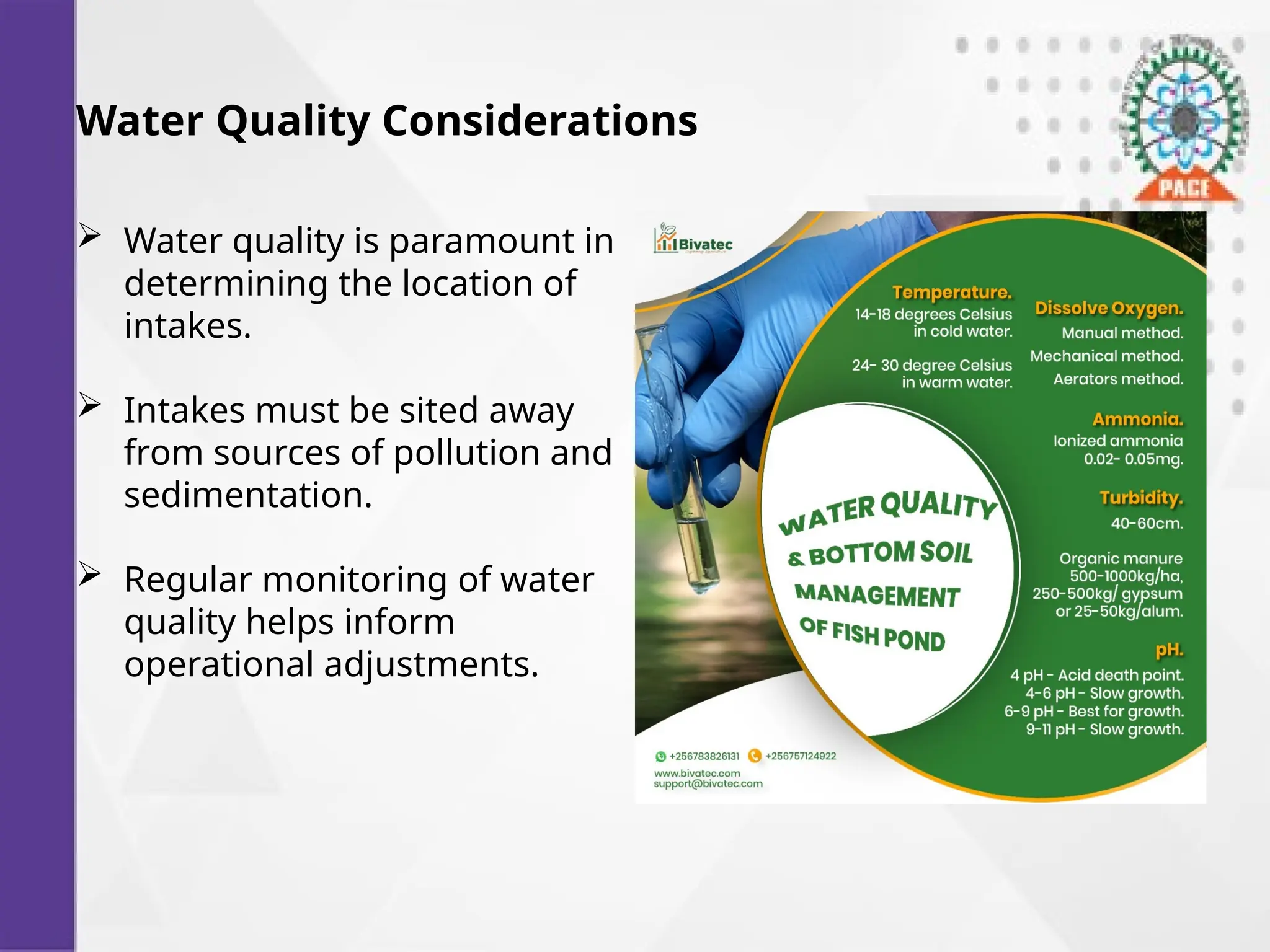
 Water quality is paramount in
determining the location of
intakes.
 Intakes must be sited away
from sources of pollution and
sedimentation.
 Regular monitoring of water
quality helps inform
operational adjustments.
Environmental Impact
 Environmental impact
assessments are essential for
intake location decisions.
 Potential effects on local
ecosystems and wildlife must
be evaluated.
 Mitigation strategies can help
minimize negative impacts
during construction and
operation.
Pumps in Water Systems
 Pumps are critical
components in water supply
systems, moving water from
intakes to treatment facilities.
 They can be classified into
positive displacement and
centrifugal types based on
their operation.
 The selection of pumps is
based on factors like flow
rate, head, and energy
efficiency.
Positive Displacement Pumps
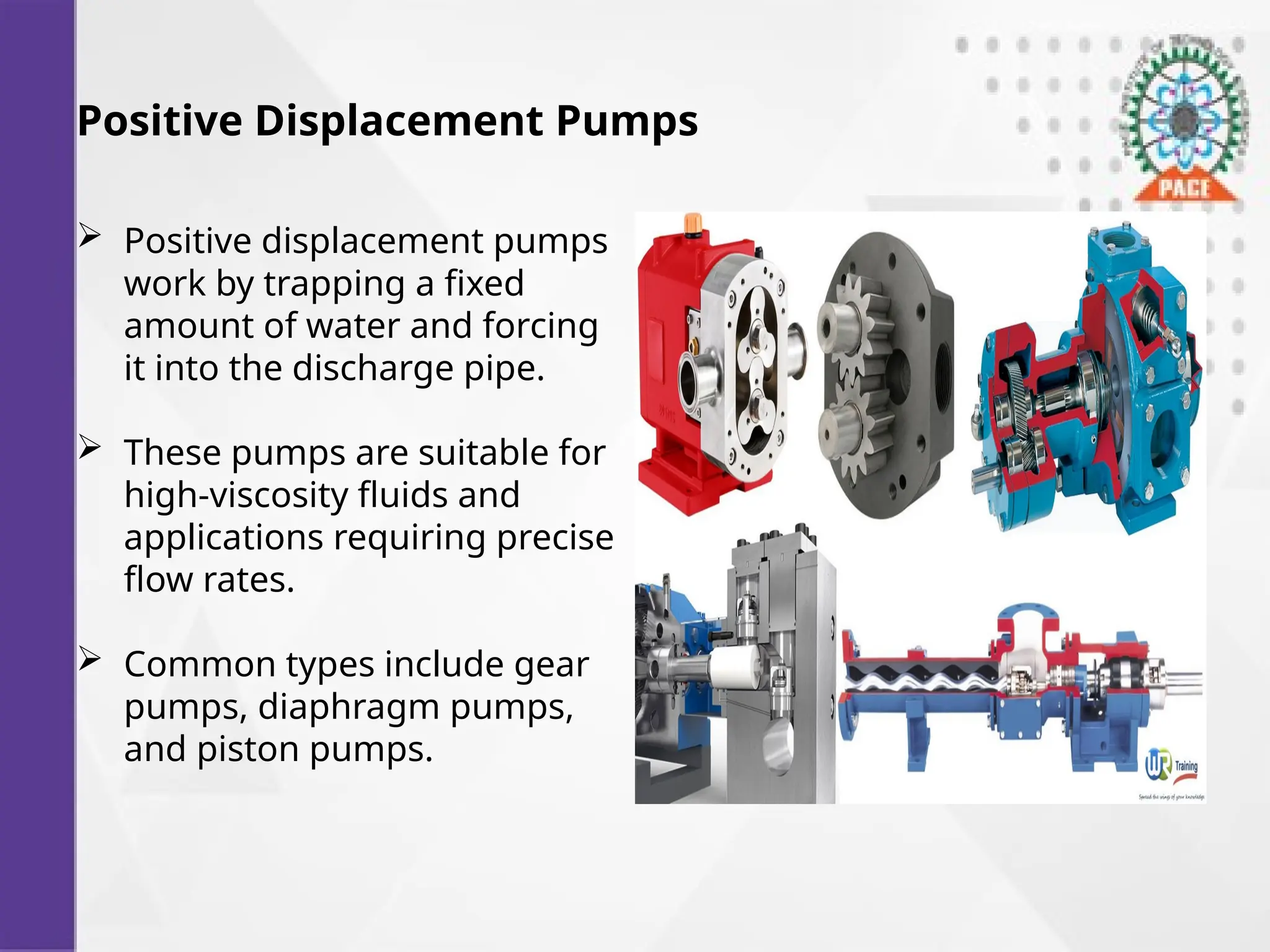
 Positive displacement pumps
work by trapping a fixed
amount of water and forcing
it into the discharge pipe.
 These pumps are suitable for
high-viscosity fluids and
applications requiring precise
flow rates.
 Common types include gear
pumps, diaphragm pumps,
and piston pumps.
Centrifugal Pumps
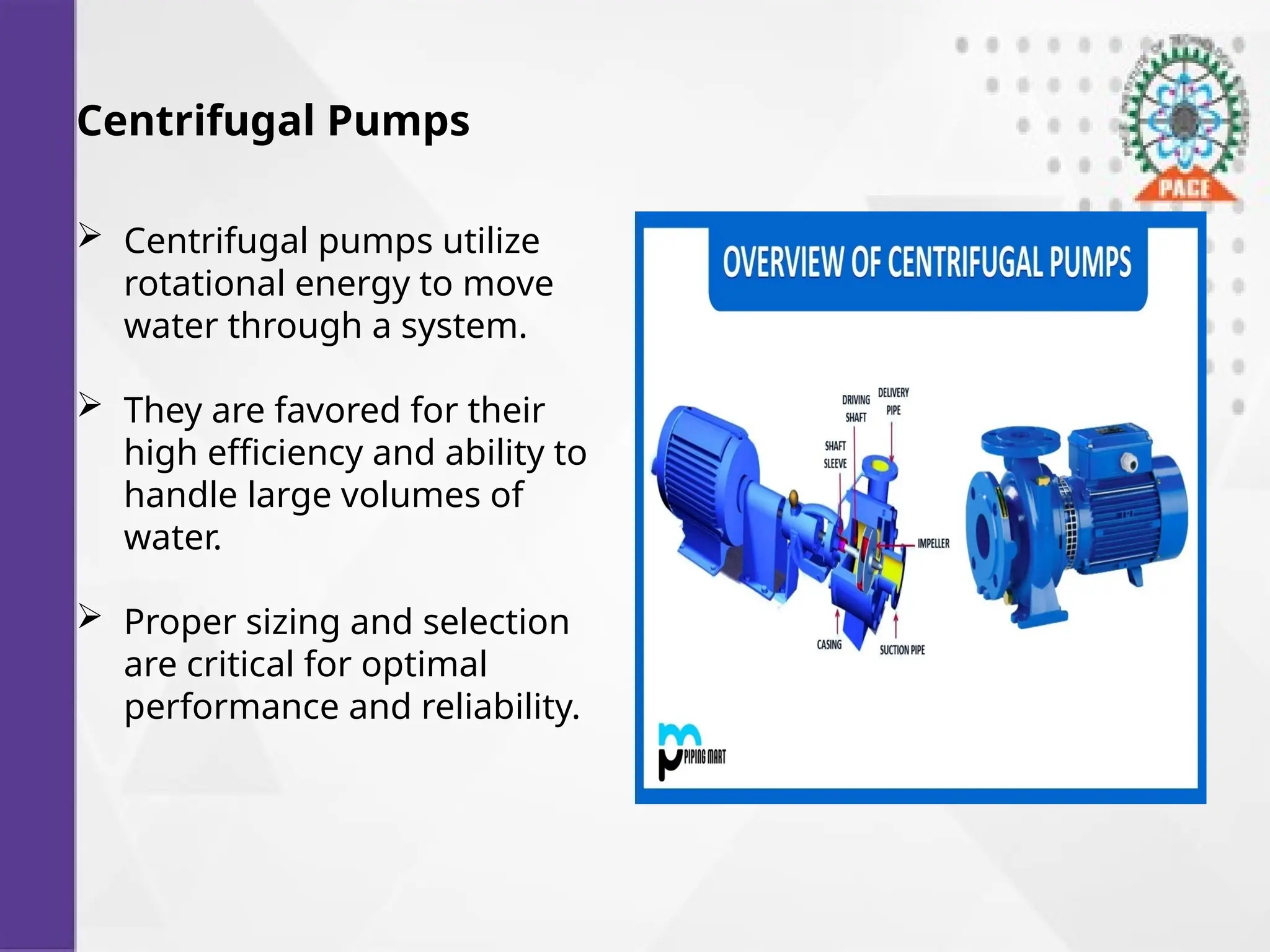
 Centrifugal pumps utilize
rotational energy to move
water through a system.
 They are favored for their
high efficiency and ability to
handle large volumes of
water.
 Proper sizing and selection
are critical for optimal
performance and reliability.
Types of Conduits
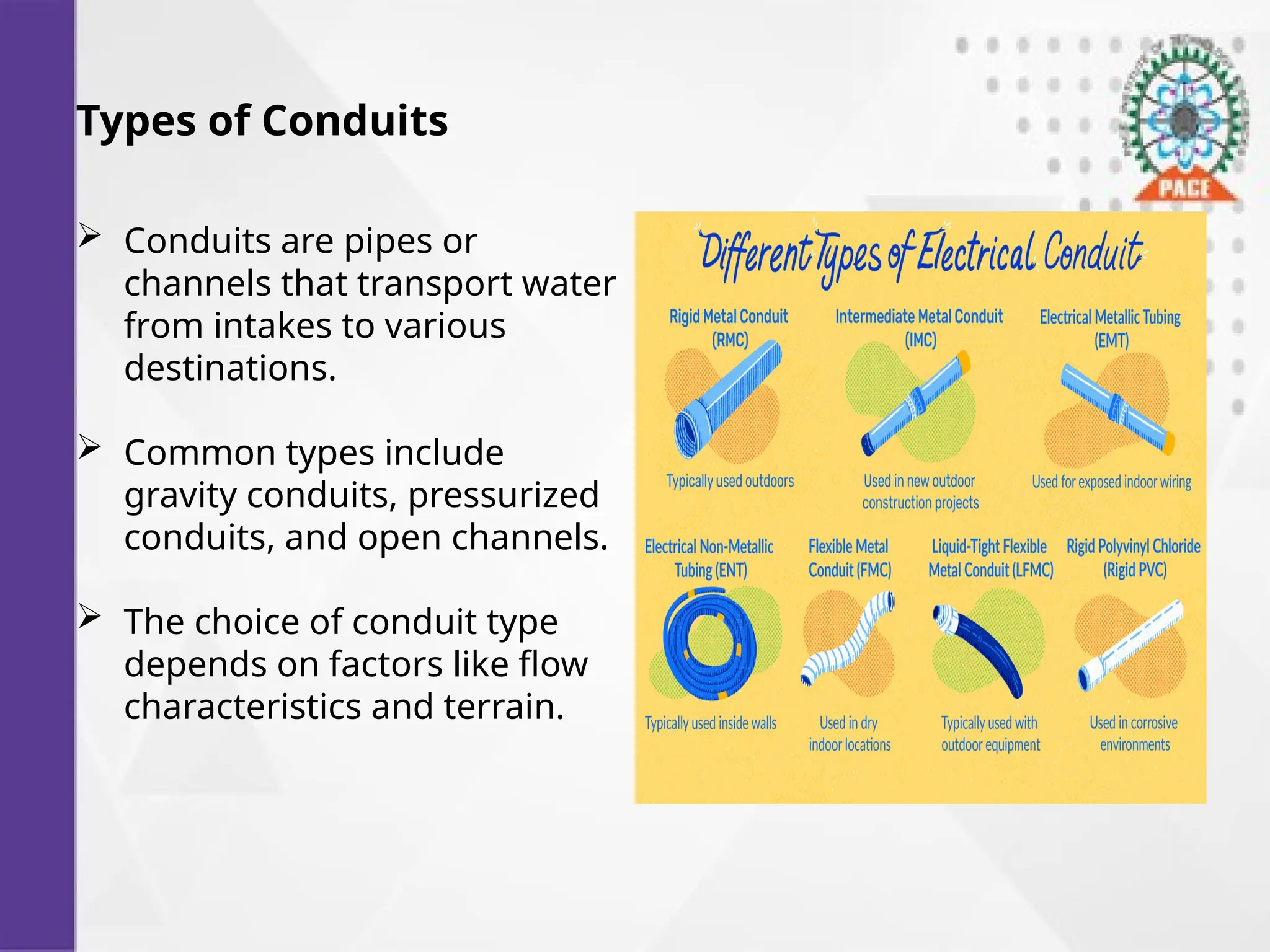
 Conduits are pipes or
channels that transport water
from intakes to various
destinations.
 Common types include
gravity conduits, pressurized
conduits, and open channels.
 The choice of conduit type
depends on factors like flow
characteristics and terrain.
Gravity Conduits
 Gravity conduits rely on gravitational force to transport water
downhill.
 They are often used in gravity-fed systems, minimizing energy
costs.
 Proper slope and material selection are critical to prevent
blockages and ensure flow.
Pressurized Conduits
 Pressurized conduits are designed to carry water under
pressure, allowing for vertical lifts.
 They are commonly used in urban water distribution
systems and irrigation.
 Material strength and leak prevention are important design
considerations for these conduits.
 Feel free to customize the content further or let me know if
you would like additional details on any specific slide!
Types Of Pipes, Pipe Appurtenances
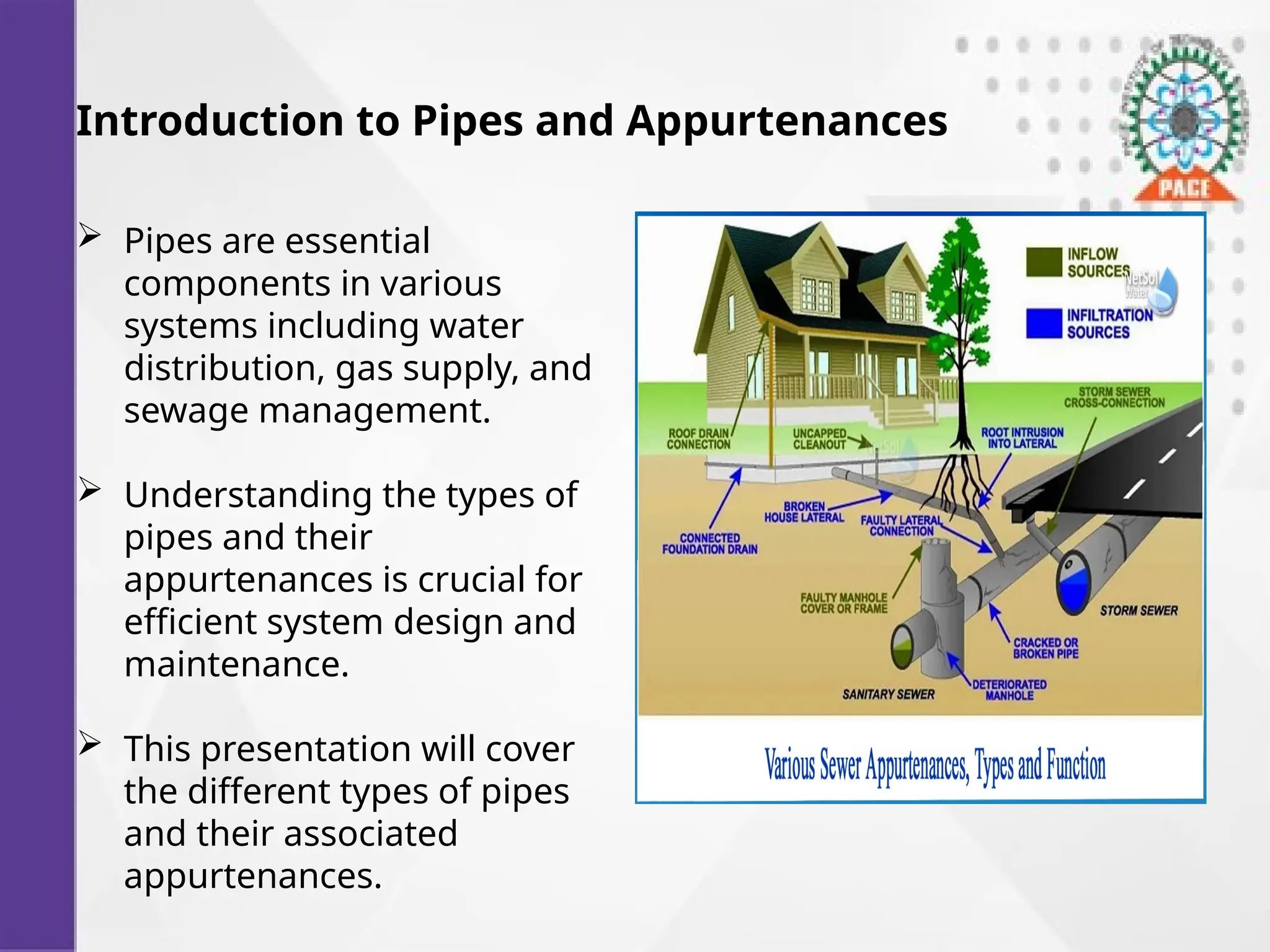
Introduction to Pipes and Appurtenances
 Pipes are essential
components in various
systems including water
distribution, gas supply, and
sewage management.
 Understanding the types of
pipes and their
appurtenances is crucial for
efficient system design and
maintenance.
 This presentation will cover
the different types of pipes
and their associated
appurtenances.
Types of Pipes - Overview
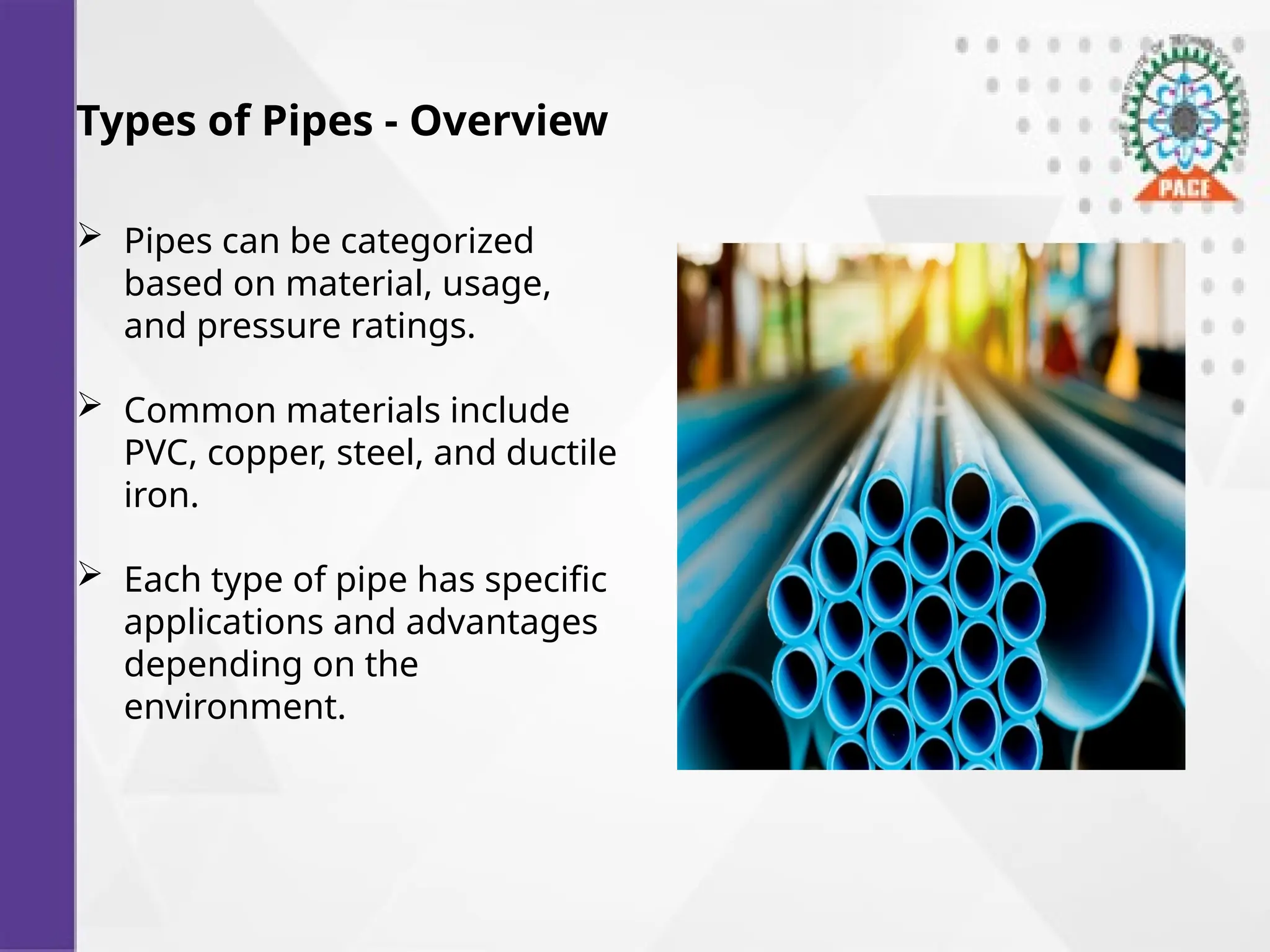
 Pipes can be categorized
based on material, usage,
and pressure ratings.
 Common materials include
PVC, copper, steel, and ductile
iron.
 Each type of pipe has specific
applications and advantages
depending on the
environment.
PVC Pipes
 Polyvinyl Chloride (PVC) pipes are widely used for their
durability and resistance to corrosion.
 They are lightweight, making them easy to transport and
install.
 PVC pipes are commonly utilized in residential plumbing and
irrigation systems.
Copper Pipes
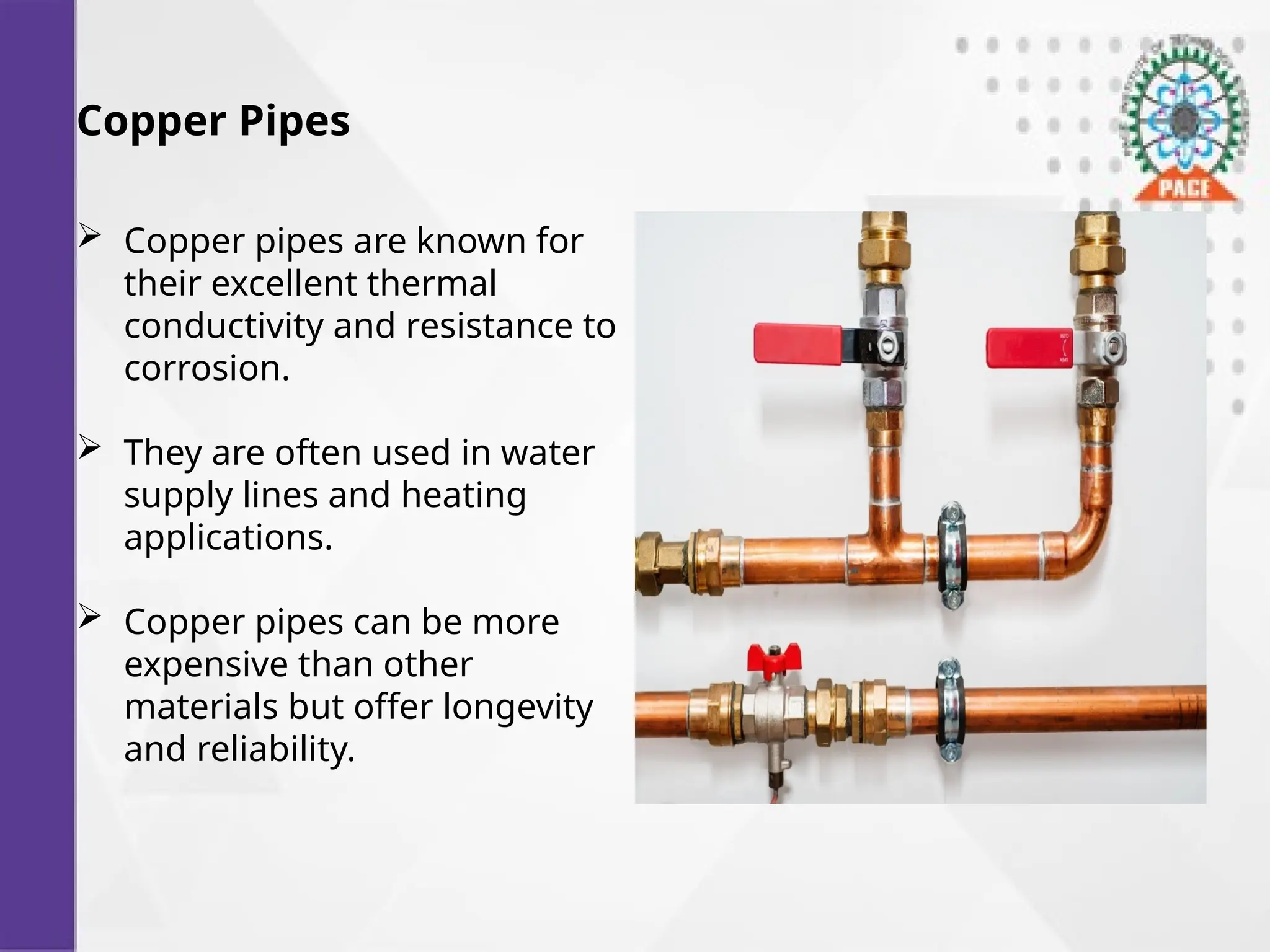
 Copper pipes are known for
their excellent thermal
conductivity and resistance to
corrosion.
 They are often used in water
supply lines and heating
applications.
 Copper pipes can be more
expensive than other
materials but offer longevity
and reliability.
Steel Pipes
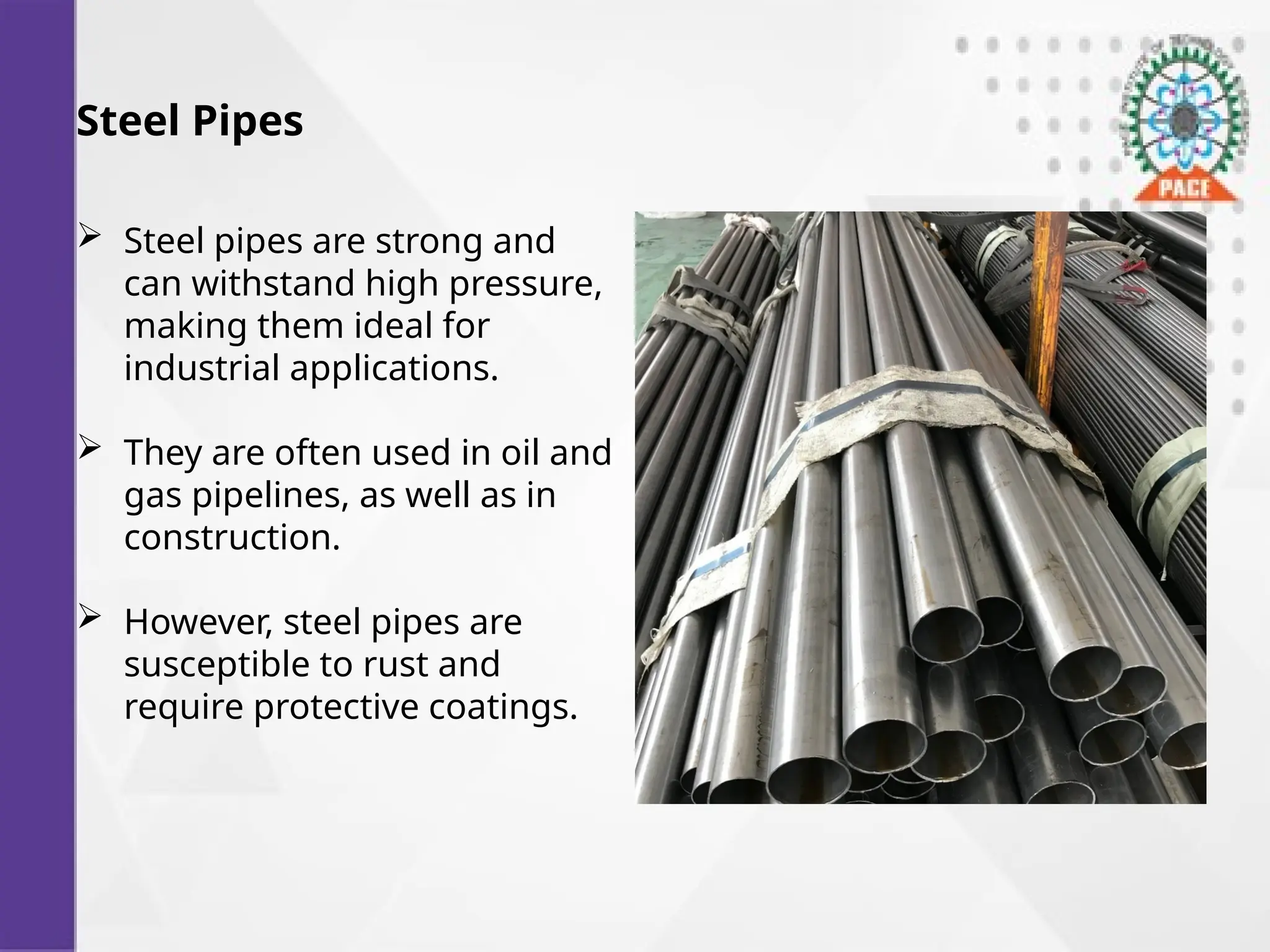
 Steel pipes are strong and
can withstand high pressure,
making them ideal for
industrial applications.
 They are often used in oil and
gas pipelines, as well as in
construction.
 However, steel pipes are
susceptible to rust and
require protective coatings.
Ductile Iron Pipes
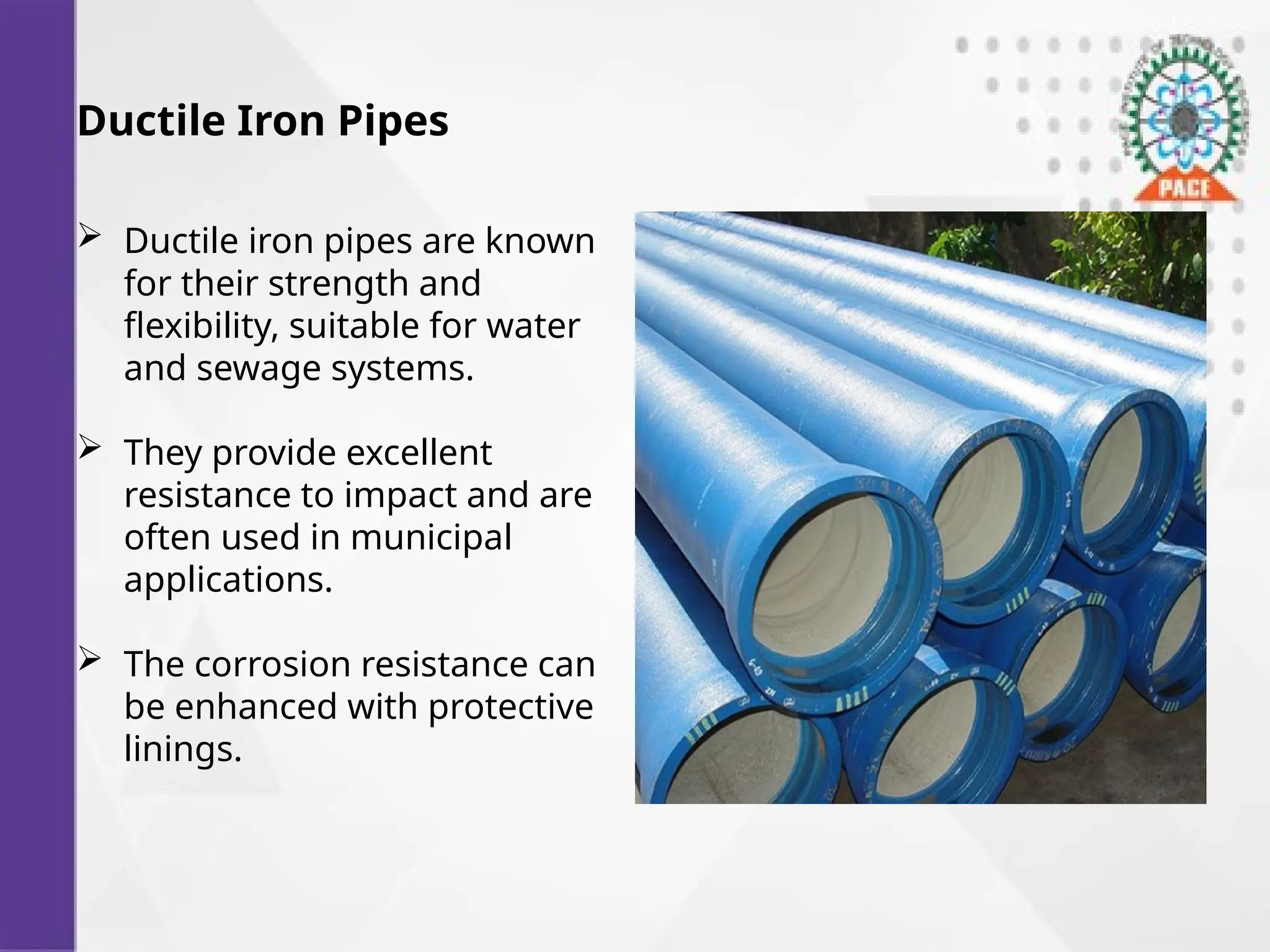
 Ductile iron pipes are known
for their strength and
flexibility, suitable for water
and sewage systems.
 They provide excellent
resistance to impact and are
often used in municipal
applications.
 The corrosion resistance can
be enhanced with protective
linings.
Pipe Appurtenances - Overview
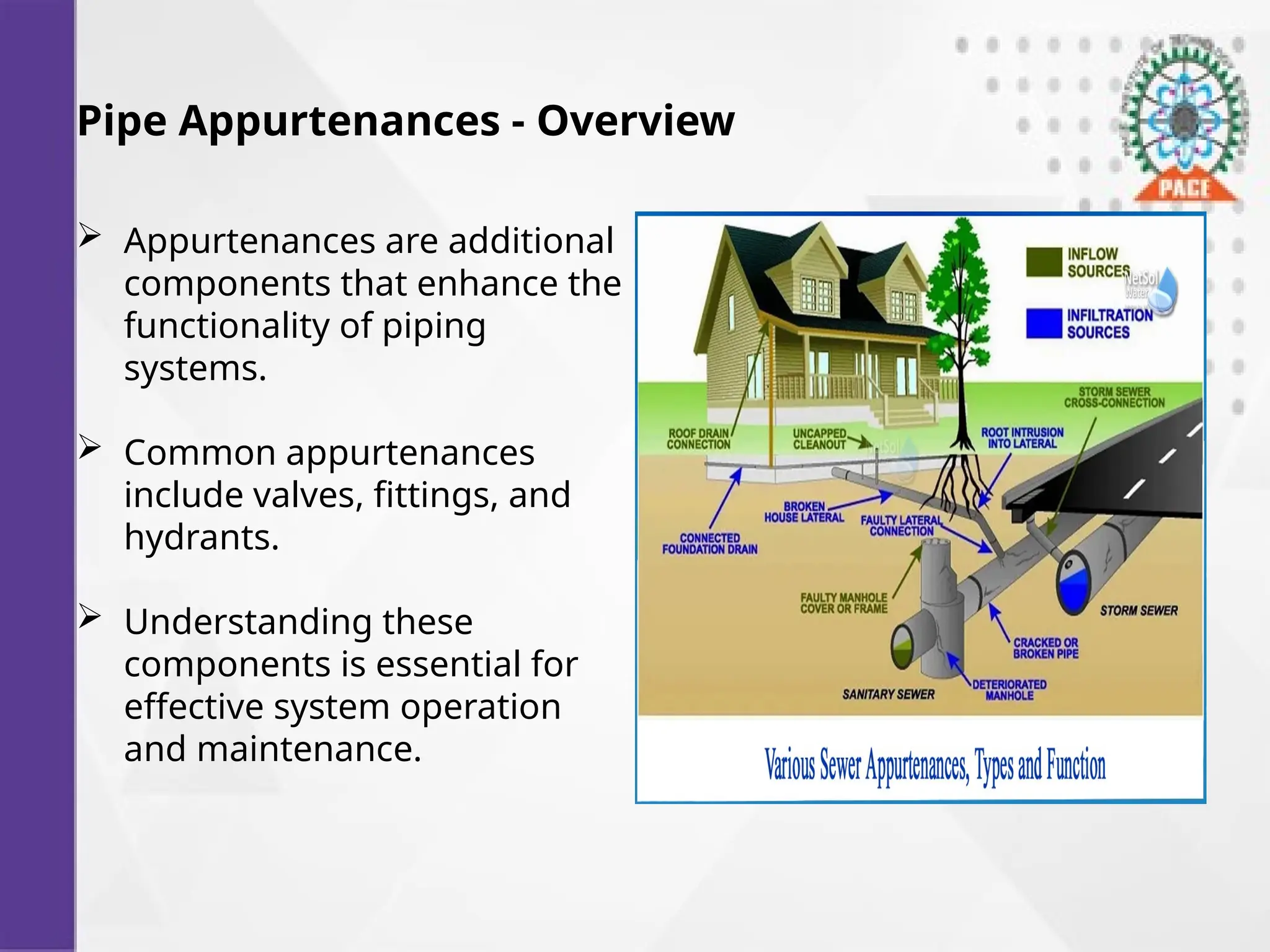
 Appurtenances are additional
components that enhance the
functionality of piping
systems.
 Common appurtenances
include valves, fittings, and
hydrants.
 Understanding these
components is essential for
effective system operation
and maintenance.
Valves
 Valves control the flow of
fluids within a piping system,
allowing for safe operation.
 Types of valves include gate
valves, ball valves, and check
valves, each with its specific
function.
 Proper installation and
maintenance of valves are
critical to prevent leaks and
ensure system integrity.
Fittings and Hydrants
 Fittings connect different sections of piping and can change
the direction or size of the flow.
 Common types of fittings include elbows, tees, and
couplings, each serving unique purposes.
 Fire hydrants serve as critical appurtenances for firefighting,
providing quick access to water supply.
 This presentation provides an overview of various pipe types
and their appurtenances, ensuring a comprehensive
understanding of the subject.
Water Treatment :-
 Working Principles Of Water Treatment Units
 Screening
 Slain Sedimentation
 Sedimentation Aided With Coagulation
 Filtration
 Disinfection
 Water Softening
 Miscellaneous Treatments
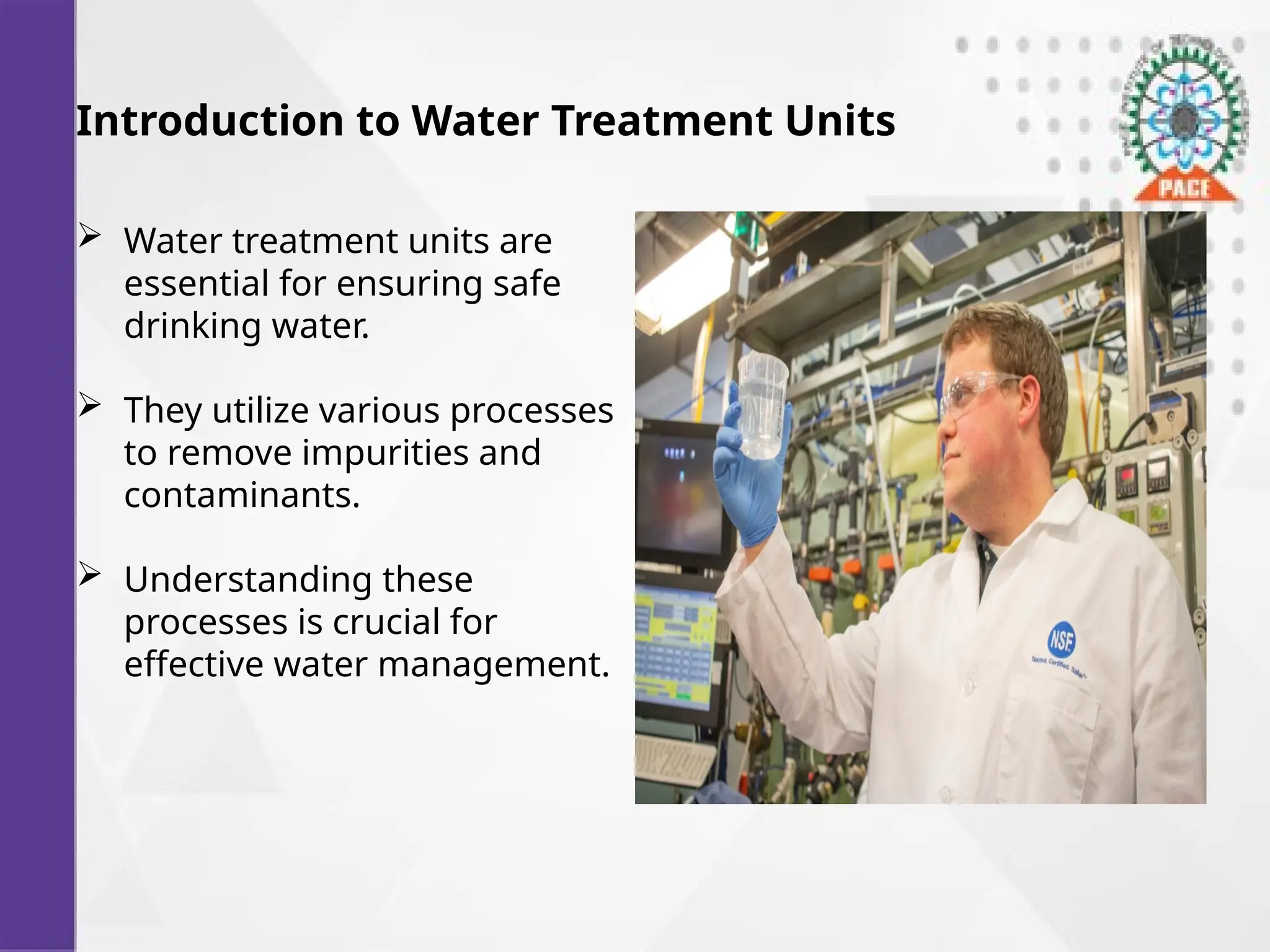
Introduction to Water Treatment Units
 Water treatment units are
essential for ensuring safe
drinking water.
 They utilize various processes
to remove impurities and
contaminants.
 Understanding these
processes is crucial for
effective water management.
Importance of Water Treatment
 Water treatment is vital for public health and
environmental protection.
 Contaminated water can lead to serious health issues and
waterborne diseases.
 Proper treatment ensures compliance with health
regulations and standards.
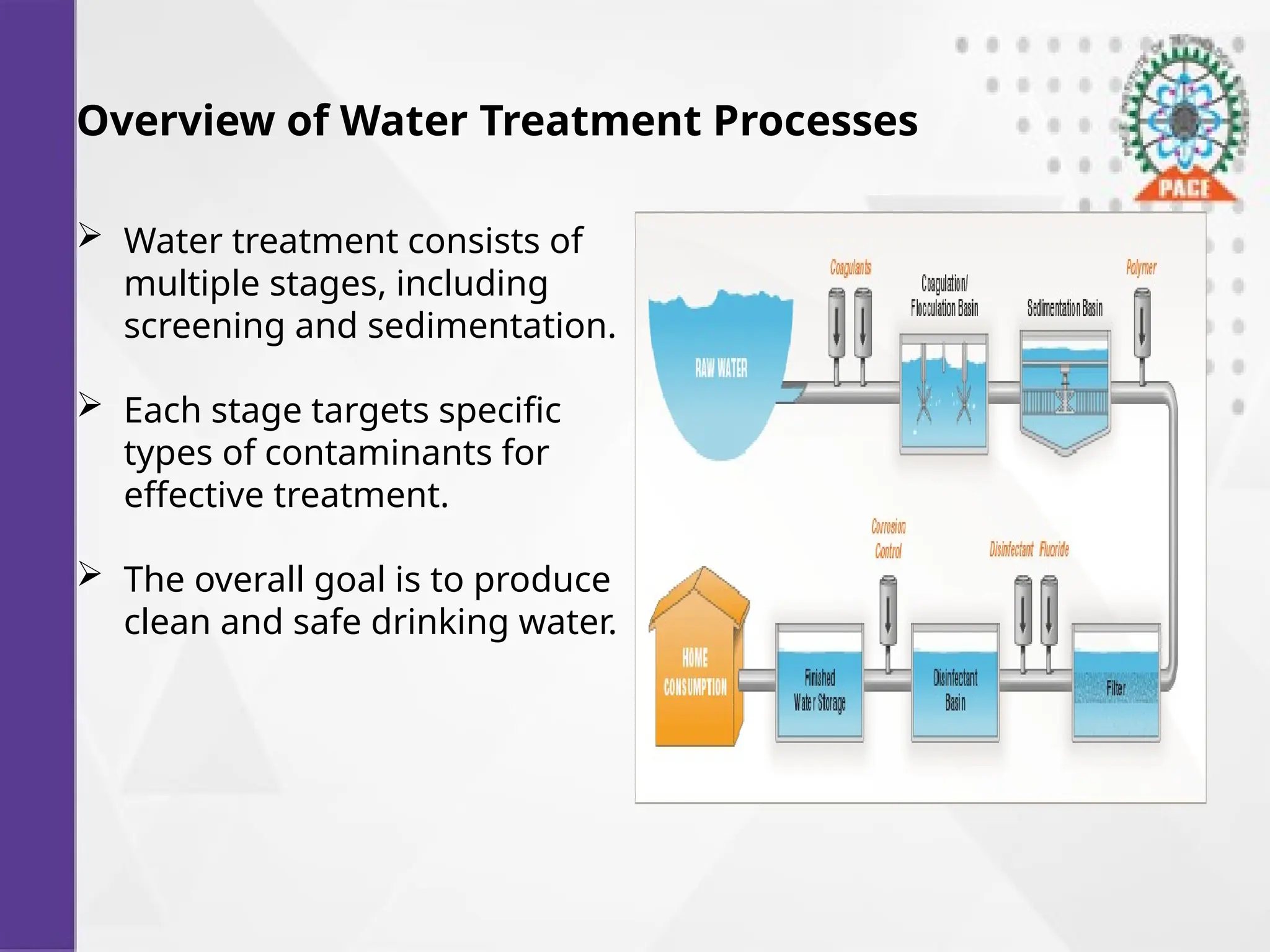
Overview of Water Treatment Processes
 Water treatment consists of
multiple stages, including
screening and sedimentation.
 Each stage targets specific
types of contaminants for
effective treatment.
 The overall goal is to produce
clean and safe drinking water.
What is Screening?
 Screening is the first step in
the water treatment process.
 It involves removing large
debris and particulate matter
from raw water.
 This step protects
downstream equipment and
processes from damage.
Types of Screening Methods
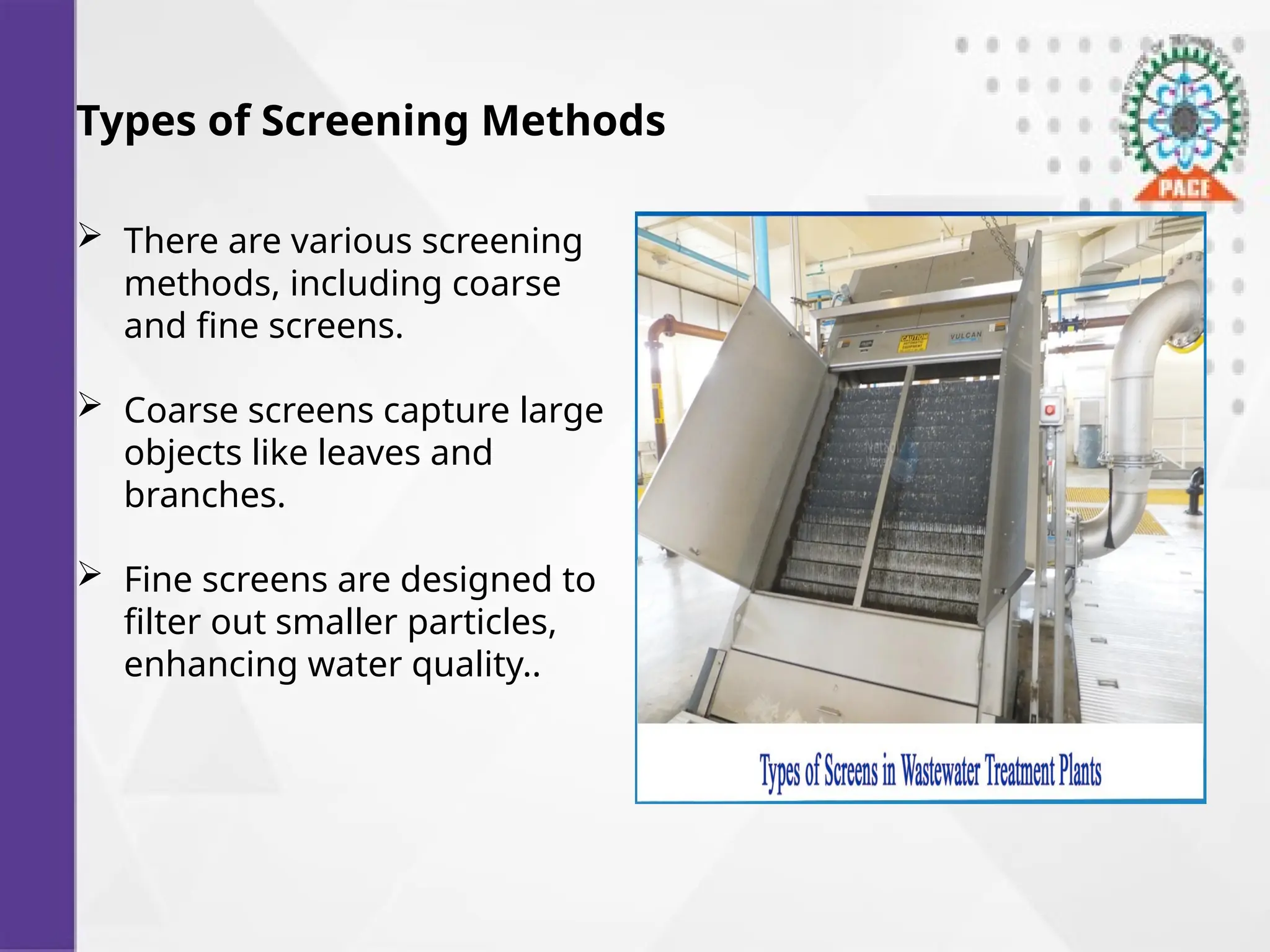
 There are various screening
methods, including coarse
and fine screens.
 Coarse screens capture large
objects like leaves and
branches.
 Fine screens are designed to
filter out smaller particles,
enhancing water quality..
Working Principle of Coarse Screens
 Coarse screens typically
consist of bars or mesh
placed in the water flow.
 As water passes through,
larger items are trapped and
removed.
 This process helps prevent
clogging in subsequent
treatment units.
Working Principle of Fine Screens
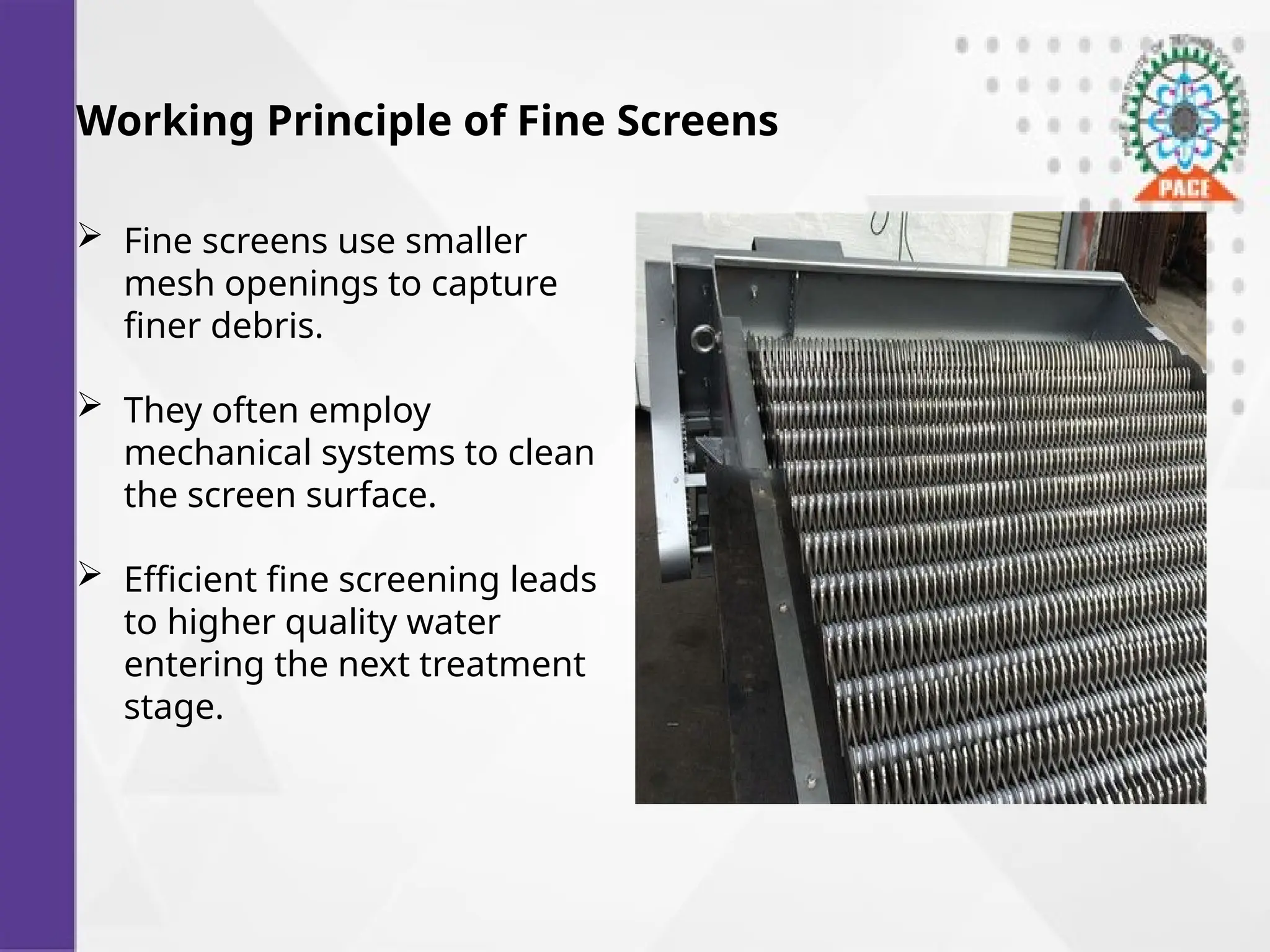
 Fine screens use smaller
mesh openings to capture
finer debris.
 They often employ
mechanical systems to clean
the screen surface.
 Efficient fine screening leads
to higher quality water
entering the next treatment
stage.
Introduction to Plain Sedimentation
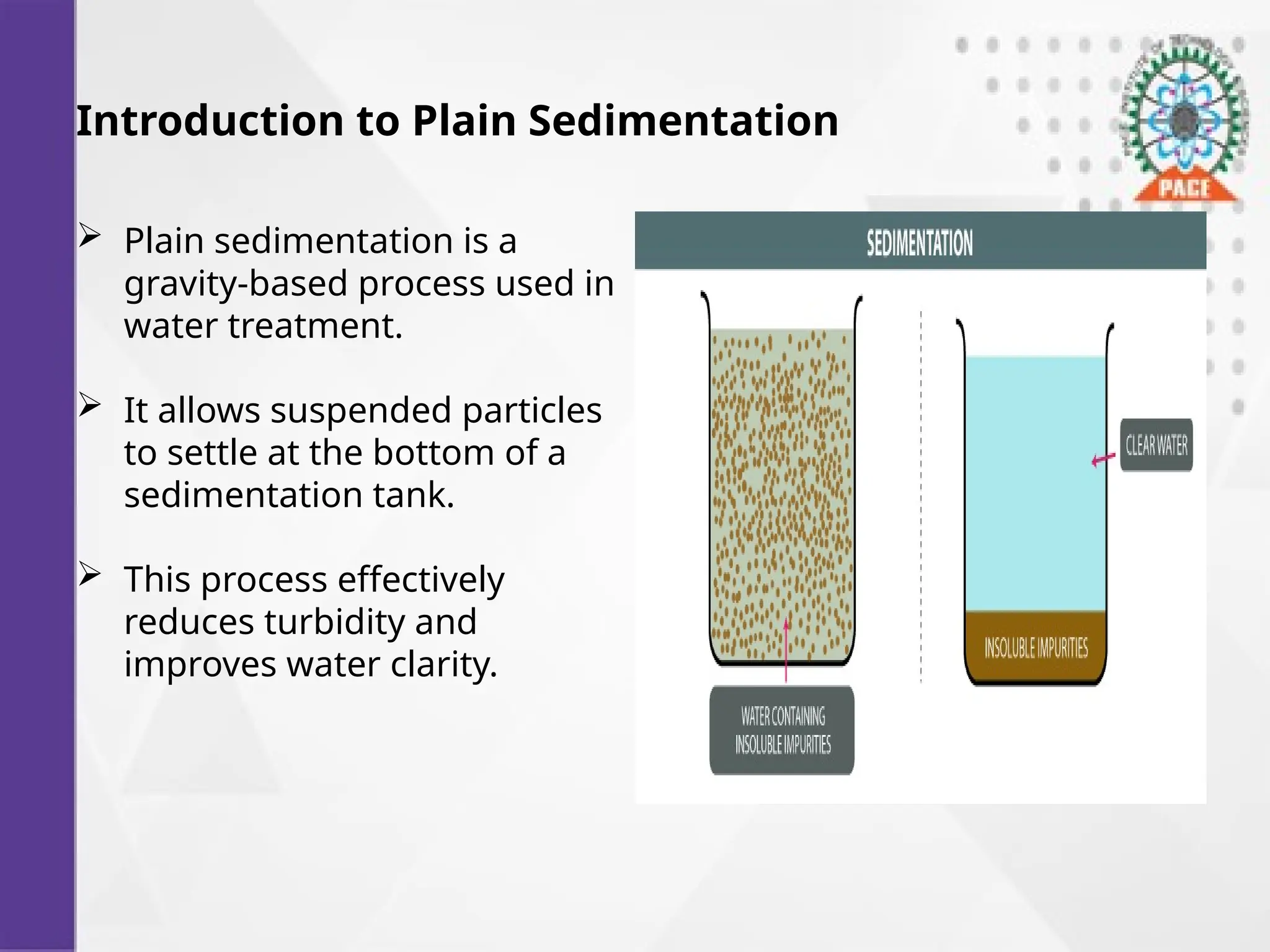
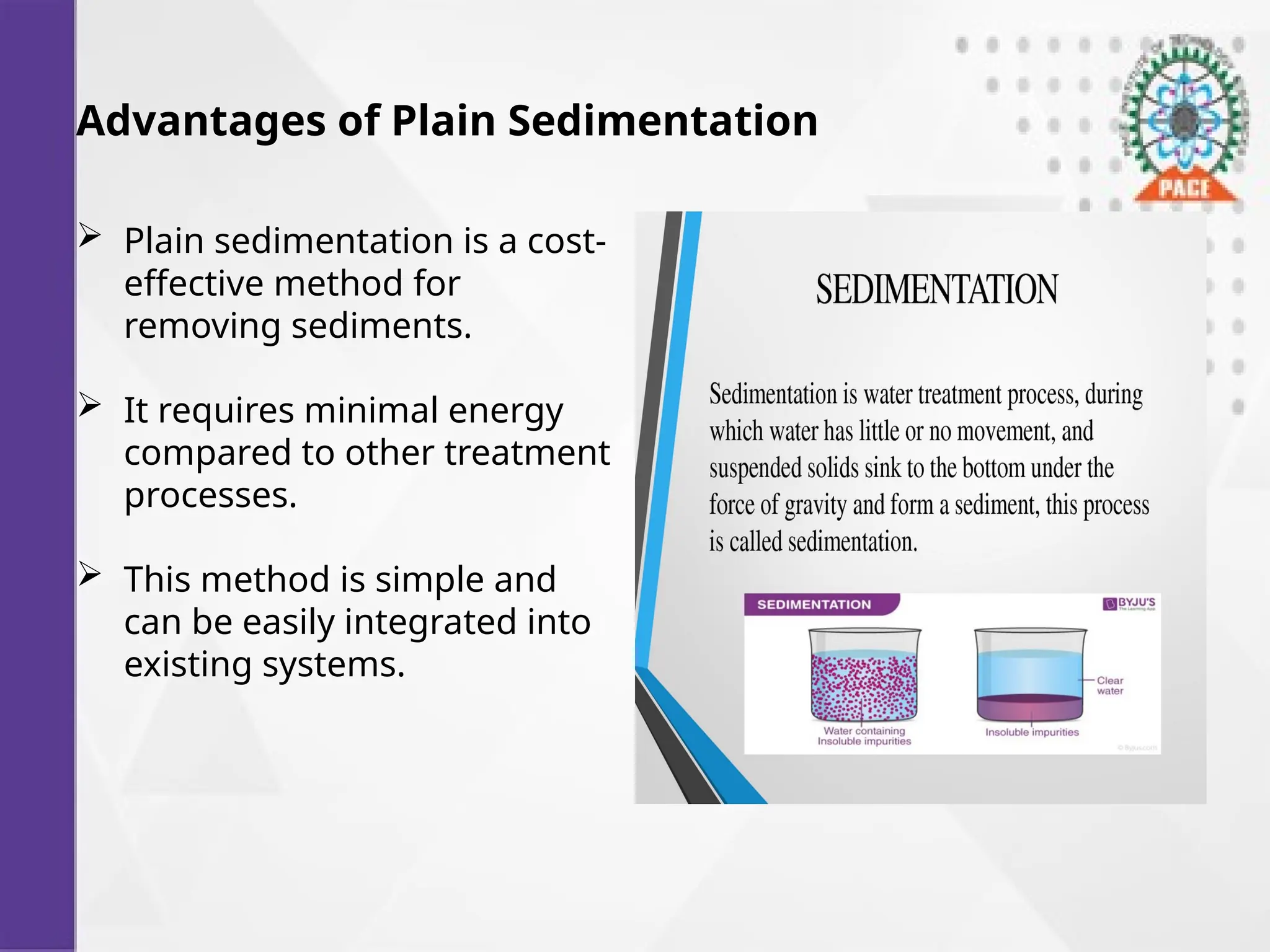
 Plain sedimentation is a
gravity-based process used in
water treatment.
 It allows suspended particles
to settle at the bottom of a
sedimentation tank.
 This process effectively
reduces turbidity and
improves water clarity.
Factors Influencing Sedimentation
 Several factors affect the
efficiency of sedimentation,
including particle size.
 The density of particles and
the flow rate also play
significant roles.
 Understanding these factors
helps optimize sedimentation
performance.
Sedimentation Tank Design
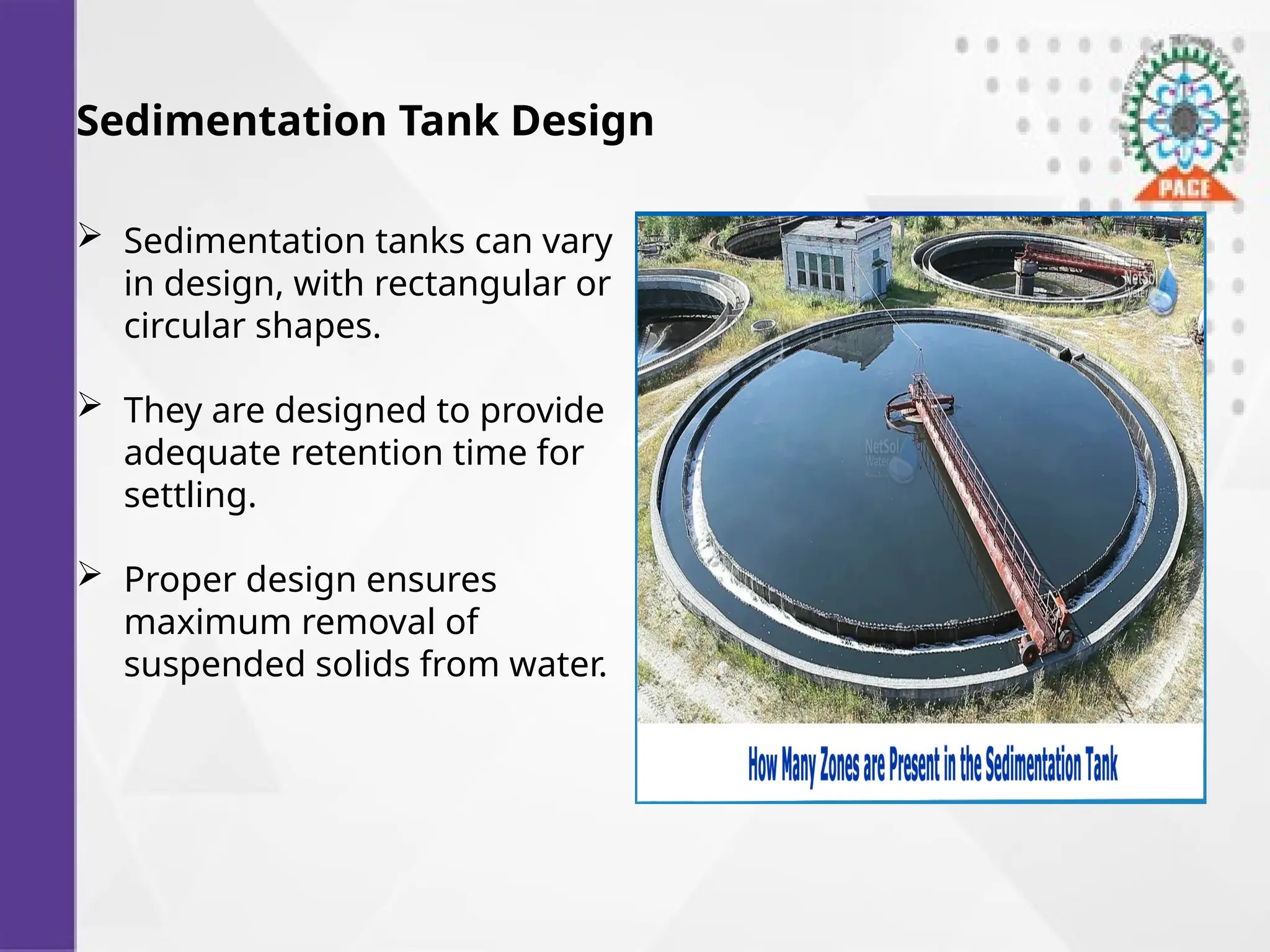
 Sedimentation tanks can vary
in design, with rectangular or
circular shapes.
 They are designed to provide
adequate retention time for
settling.
 Proper design ensures
maximum removal of
suspended solids from water.
The Sedimentation Process
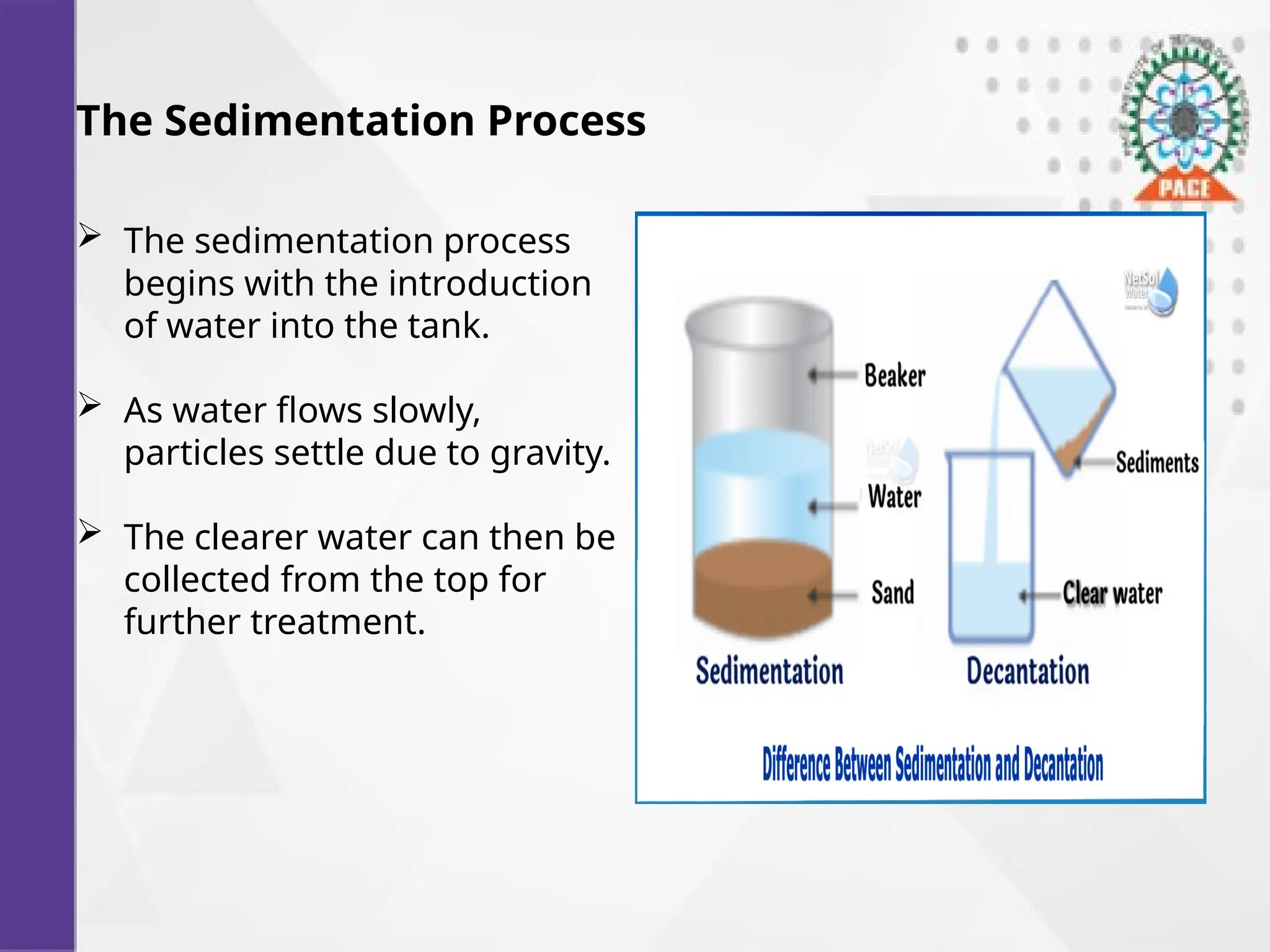
 The sedimentation process
begins with the introduction
of water into the tank.
 As water flows slowly,
particles settle due to gravity.
 The clearer water can then be
collected from the top for
further treatment.
Advantages of Plain Sedimentation
 Plain sedimentation is a cost-
effective method for
removing sediments.
 It requires minimal energy
compared to other treatment
processes.
 This method is simple and
can be easily integrated into
existing systems.
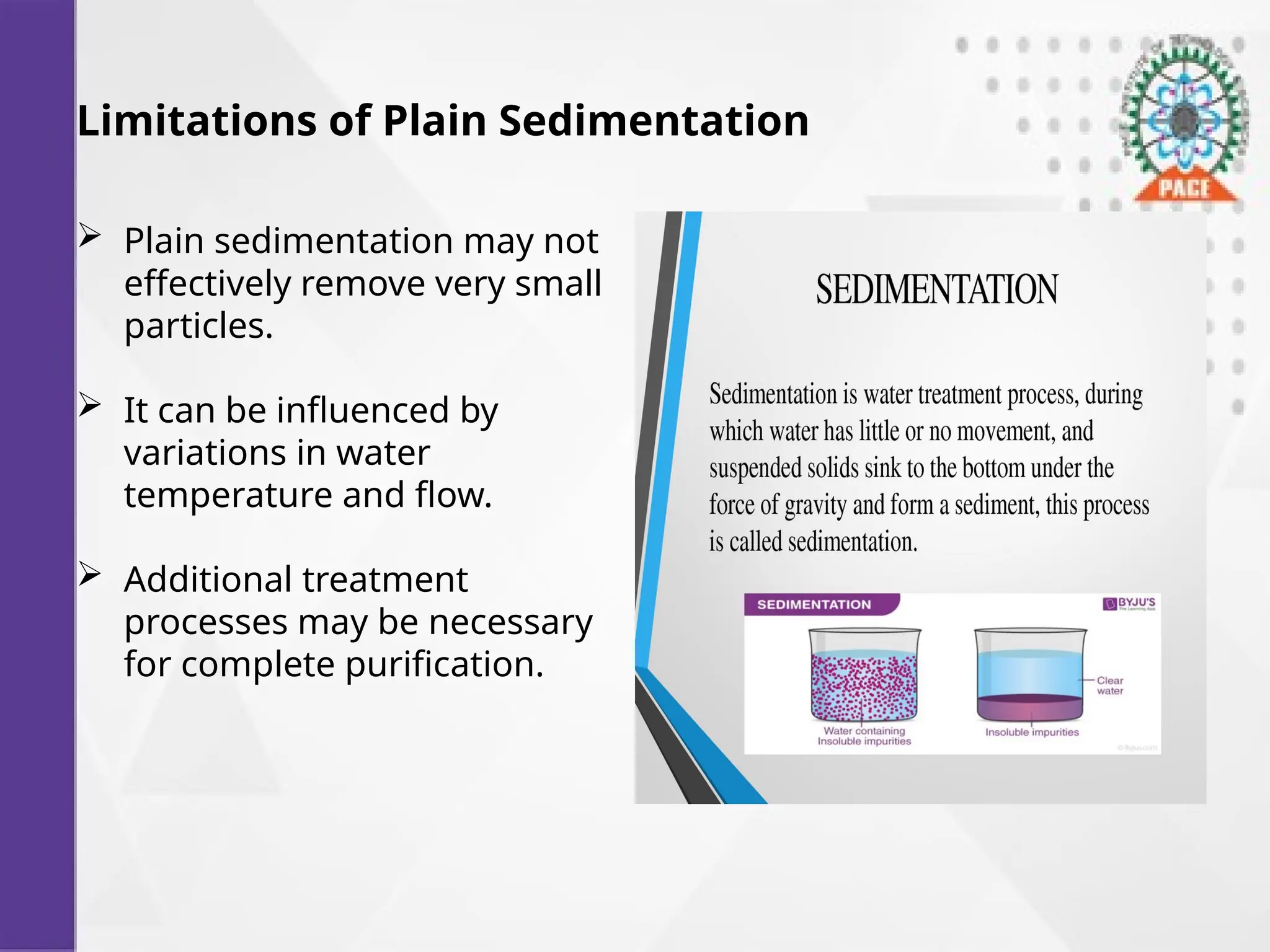
Limitations of Plain Sedimentation
 Plain sedimentation may not
effectively remove very small
particles.
 It can be influenced by
variations in water
temperature and flow.
 Additional treatment
processes may be necessary
for complete purification.
Filtration, Disinfection, Water Softening,
Miscellaneous Treatments.filtration,
Disinfection, Water
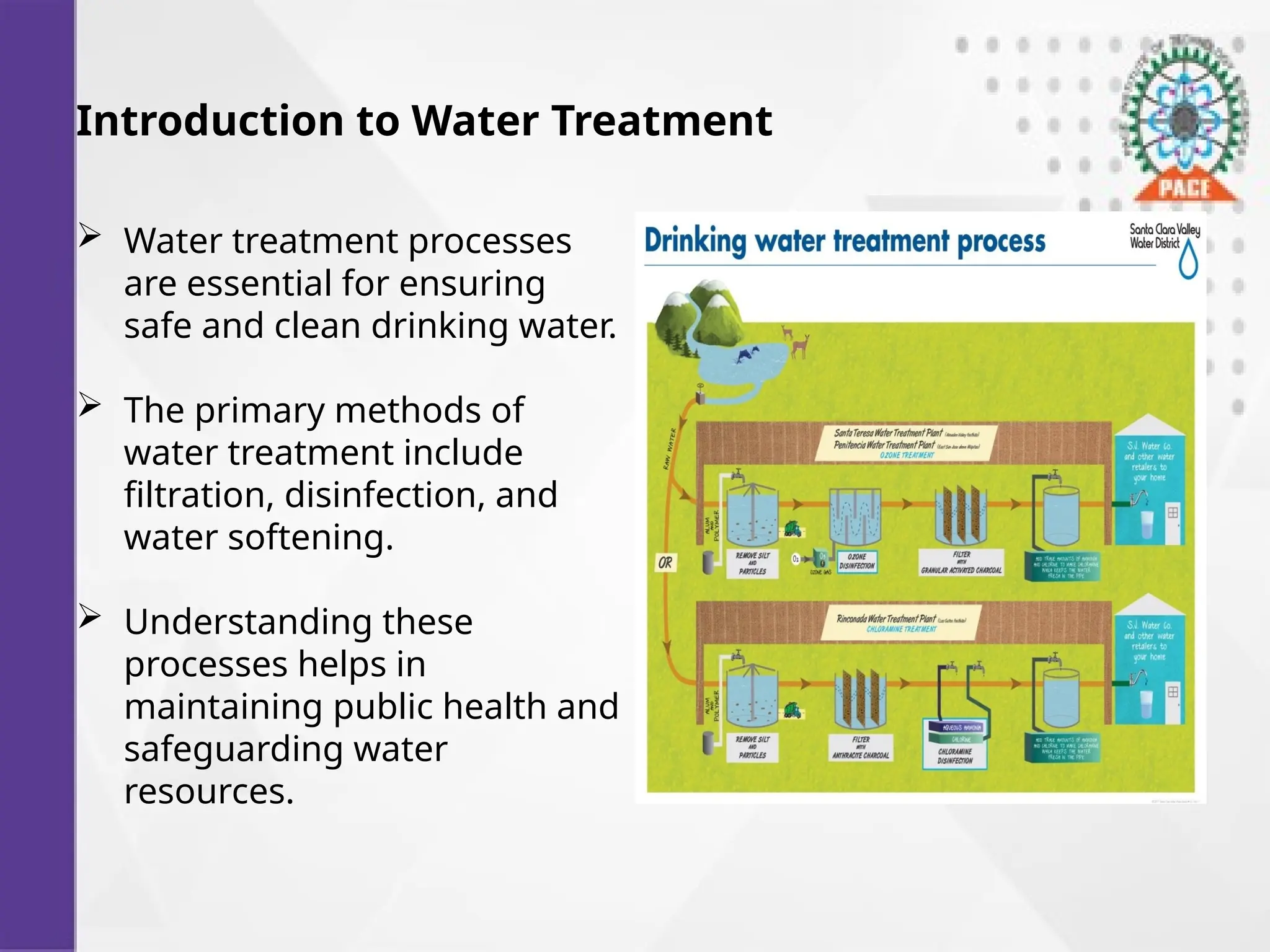
Introduction to Water Treatment
 Water treatment processes
are essential for ensuring
safe and clean drinking water.
 The primary methods of
water treatment include
filtration, disinfection, and
water softening.
 Understanding these
processes helps in
maintaining public health and
safeguarding water
resources.
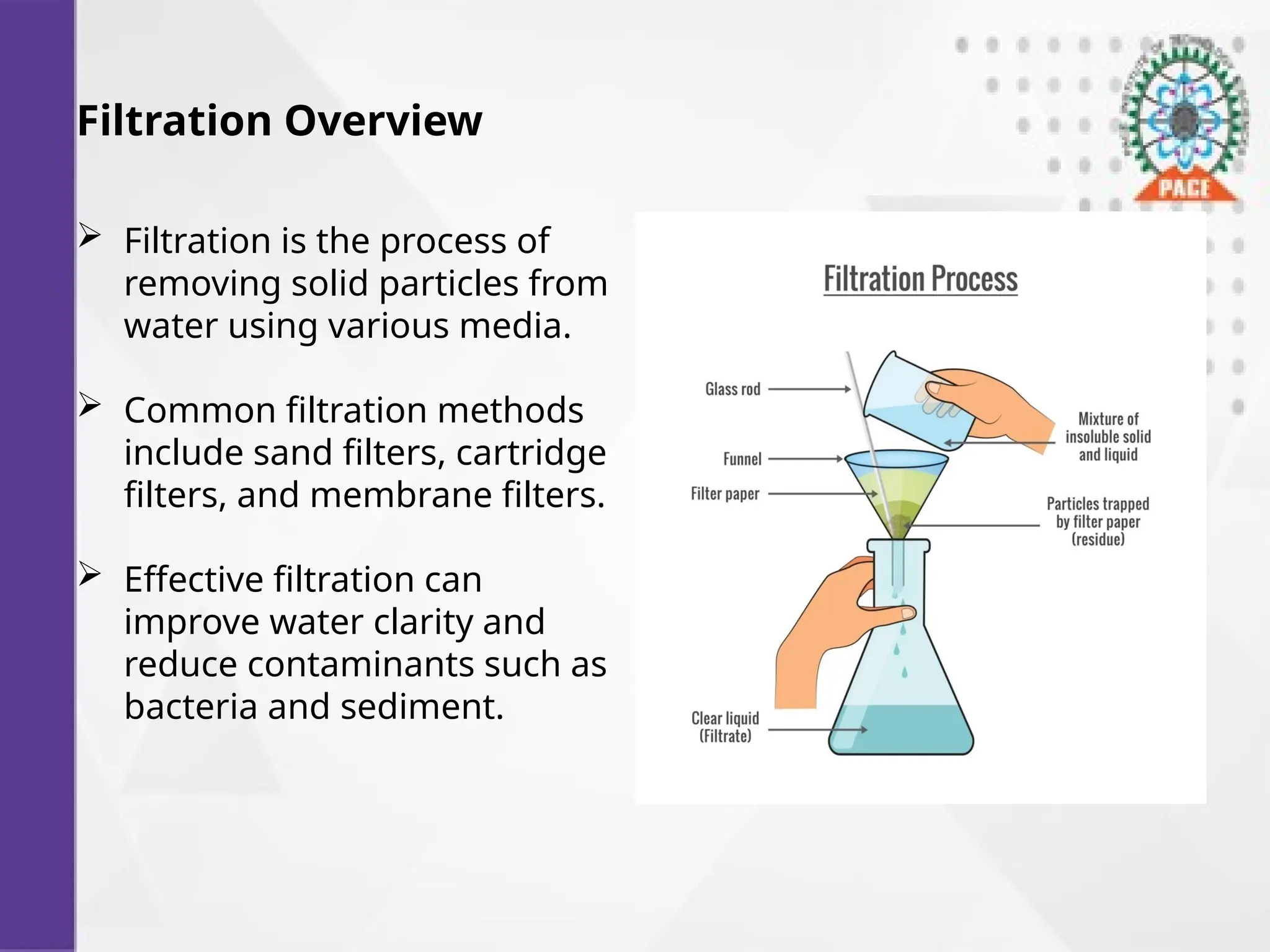
Filtration Overview
 Filtration is the process of
removing solid particles from
water using various media.
 Common filtration methods
include sand filters, cartridge
filters, and membrane filters.
 Effective filtration can
improve water clarity and
reduce contaminants such as
bacteria and sediment.
Types of Filtration
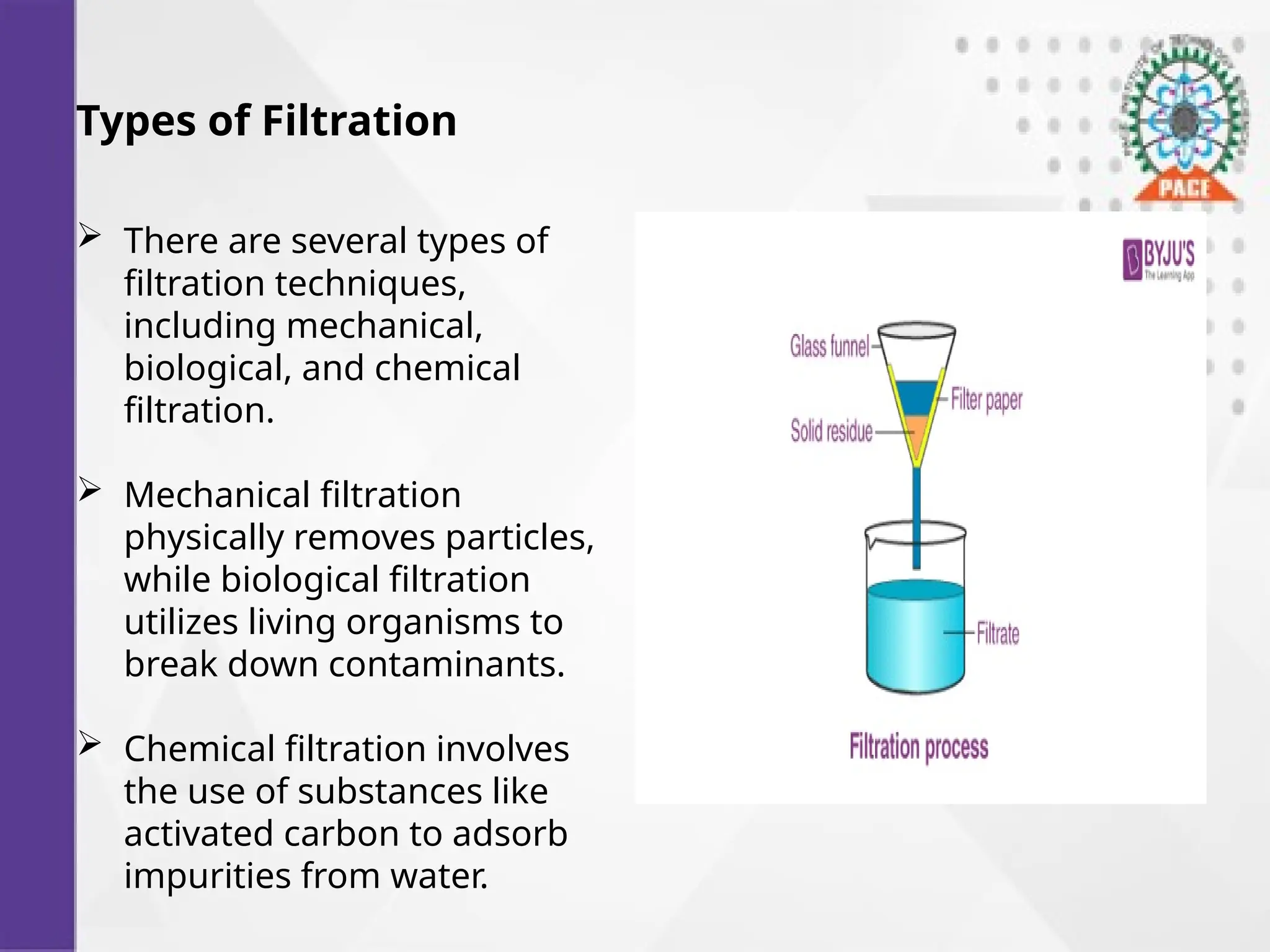
 There are several types of
filtration techniques,
including mechanical,
biological, and chemical
filtration.
 Mechanical filtration
physically removes particles,
while biological filtration
utilizes living organisms to
break down contaminants.
 Chemical filtration involves
the use of substances like
activated carbon to adsorb
impurities from water.
Disinfection Overview
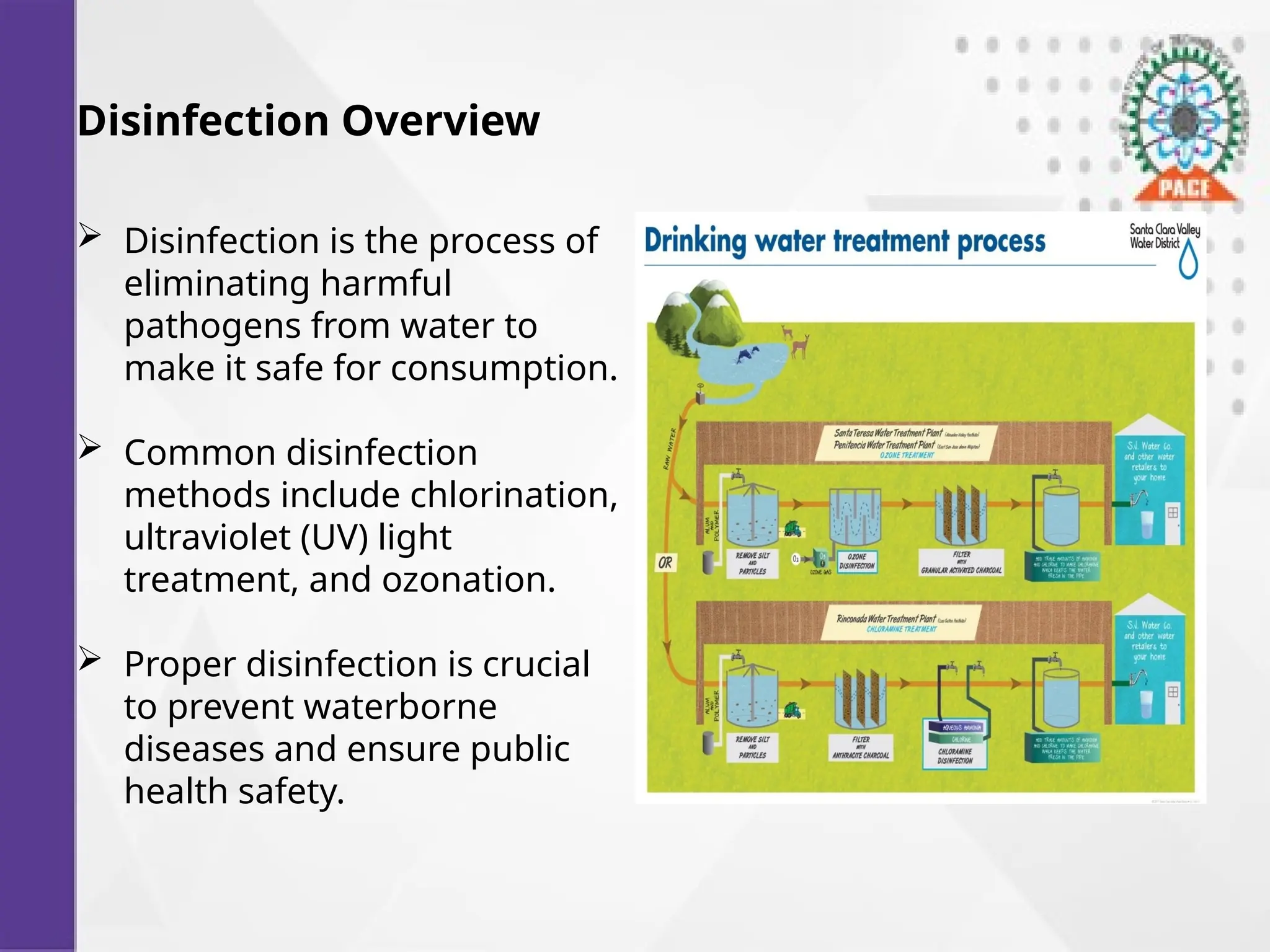
 Disinfection is the process of
eliminating harmful
pathogens from water to
make it safe for consumption.
 Common disinfection
methods include chlorination,
ultraviolet (UV) light
treatment, and ozonation.
 Proper disinfection is crucial
to prevent waterborne
diseases and ensure public
health safety.
Disinfection Methods
 Chlorination is the most widely
used method for disinfecting
drinking water due to its
effectiveness and cost-efficiency.
 UV disinfection is a chemical-free
method that uses ultraviolet
light to kill or inactivate
pathogens.
 Ozone disinfection is another
powerful method that effectively
oxidizes contaminants and
disinfects water without residual
chemicals.
Water Softening Overview
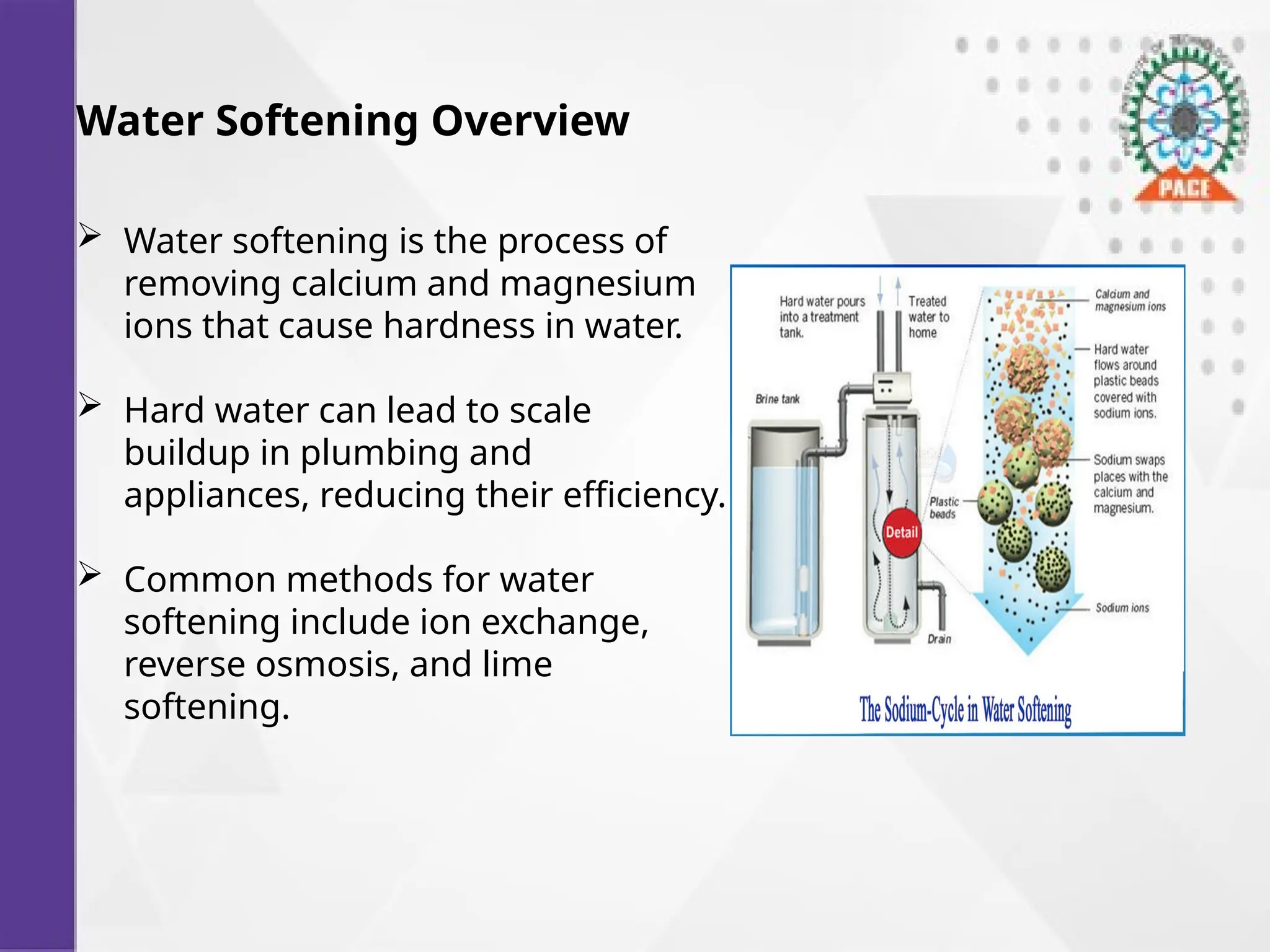
 Water softening is the process of
removing calcium and magnesium
ions that cause hardness in water.
 Hard water can lead to scale
buildup in plumbing and
appliances, reducing their efficiency.
 Common methods for water
softening include ion exchange,
reverse osmosis, and lime
softening.
Ion Exchange Process
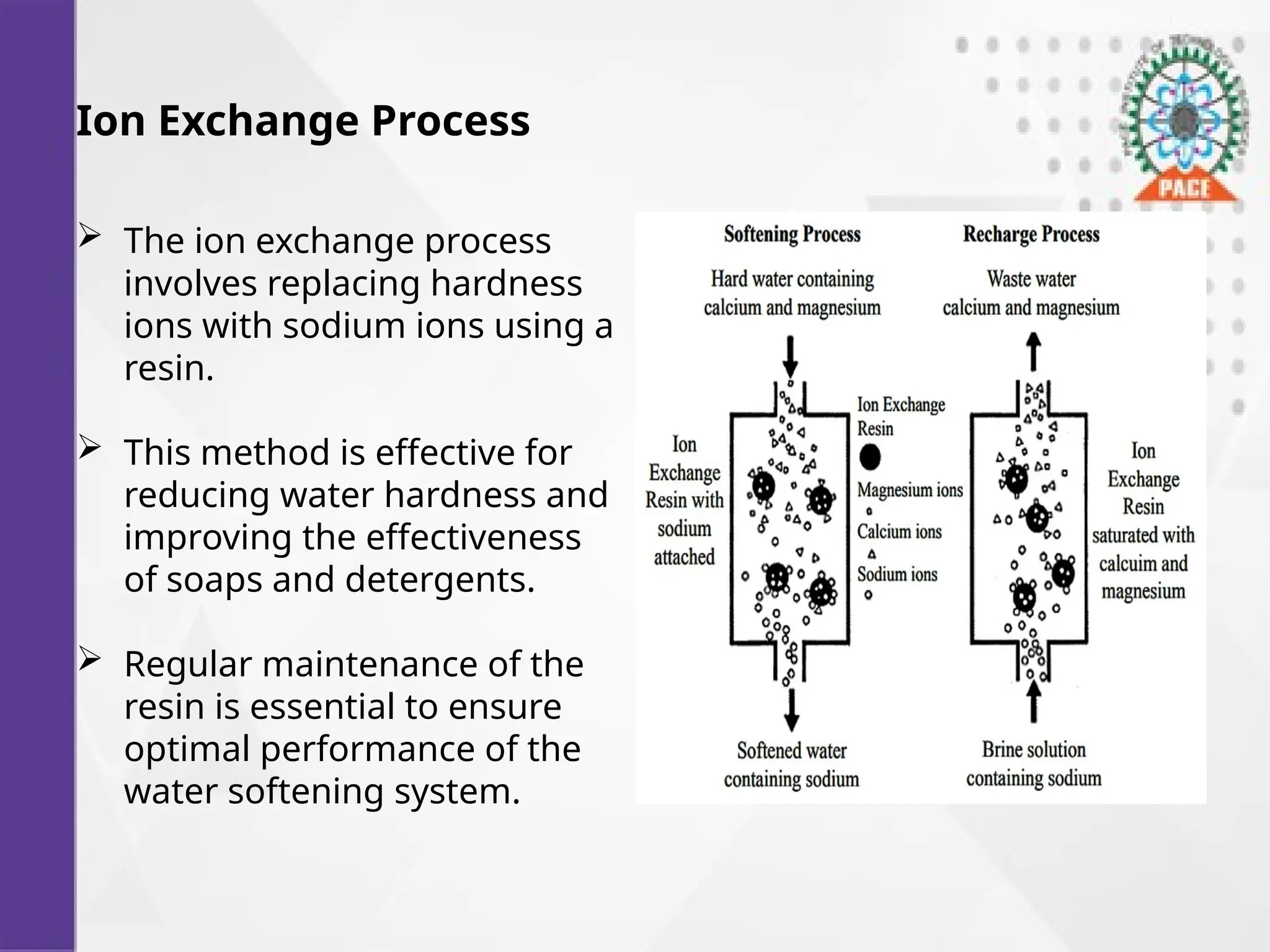
 The ion exchange process
involves replacing hardness
ions with sodium ions using a
resin.
 This method is effective for
reducing water hardness and
improving the effectiveness
of soaps and detergents.
 Regular maintenance of the
resin is essential to ensure
optimal performance of the
water softening system.
Miscellaneous Treatments
 Miscellaneous treatments may include pH adjustment,
corrosion control, and removal of specific contaminants.
 pH adjustment can help optimize water quality and
prevent corrosion in distribution systems.
 Advanced treatments, such as advanced oxidation
processes (AOPs), are used to address specific
contaminants like pharmaceuticals and endocrine
disruptors.
Conclusion and Importance of Water Treatment
 Effective water treatment is vital for protecting public
health and maintaining environmental sustainability.
 Understanding the various methods of filtration,
disinfection, and softening can help consumers make
informed choices.
 Continuous advancements in water treatment
technologies will enhance the safety and quality of our
water supply.

R23 ENVIRONMENTAL ENGINEERING UNIT-2.pptx

  • 1.
    Environmental Engineering (P23CET05) 2024-25 IIB Tech I Semester Civil Engineering Unit-2: Collection and Conveyance of Water & Water treatment Topics:  Intakes.  Types of Intakes.  Factors governing location of intakes.  Pumps.  Types of conduits.  Types of pipes and pipe appurtenances.  Working principles of water treatment units.  Screening.  Plain sedimentation & sedimentation aided with coagulation.  Filtration.  Disinfection.  Water softening.
  • 2.
    Introduction to Intakes Intakes are critical structures in water resource management.  They facilitate the withdrawal of water from natural sources for various applications.  An understanding of intakes is essential for designing efficient water supply systems.
  • 3.
    Importance of Intakes Intakes help ensure a reliable supply of water for municipal, agricultural, and industrial use.  They play a vital role in maintaining water quality by controlling sediment and contaminants.  Properly designed intakes can minimize ecological impact on surrounding environments.
  • 4.
    Types of Intakes There are various types of intakes, including river intakes, lake intakes, and groundwater intakes.  Each type of intake is suited to specific environmental conditions and water needs.  The design of an intake affects both efficiency and environmental considerations.
  • 5.
    River Intakes  Riverintakes are typically constructed to withdraw water directly from river systems.  They often utilize screen systems to filter out debris and aquatic life.  Seasonal variations in river flow must be considered in their design.
  • 6.
    Lake Intakes  Lakeintakes are designed to extract water from larger bodies of standing water.  They may be constructed at various depths to access water of different qualities.  Environmental impact assessments are critical prior to their installation.
  • 7.
    Groundwater Intakes  Groundwaterintakes involve extracting water from underground aquifers.  Wells and boreholes are common methods used to access groundwater resources.  Sustainable management practices are crucial to prevent aquifer depletion.
  • 8.
    Factors Governing Locationof Intakes  The selection of intake locations is influenced by hydrological conditions and water quality.  Environmental considerations, such as habitat protection and sediment transport, are critical.  Accessibility for maintenance and operational efficiency also guides location decisions.
  • 9.
    Water Quality Considerations Water quality is paramount in determining the location of intakes.  Intakes must be sited away from sources of pollution and sedimentation.  Regular monitoring of water quality helps inform operational adjustments.
  • 10.
    Environmental Impact  Environmentalimpact assessments are essential for intake location decisions.  Potential effects on local ecosystems and wildlife must be evaluated.  Mitigation strategies can help minimize negative impacts during construction and operation.
  • 11.
    Pumps in WaterSystems  Pumps are critical components in water supply systems, moving water from intakes to treatment facilities.  They can be classified into positive displacement and centrifugal types based on their operation.  The selection of pumps is based on factors like flow rate, head, and energy efficiency.
  • 12.
    Positive Displacement Pumps Positive displacement pumps work by trapping a fixed amount of water and forcing it into the discharge pipe.  These pumps are suitable for high-viscosity fluids and applications requiring precise flow rates.  Common types include gear pumps, diaphragm pumps, and piston pumps.
  • 13.
    Centrifugal Pumps  Centrifugalpumps utilize rotational energy to move water through a system.  They are favored for their high efficiency and ability to handle large volumes of water.  Proper sizing and selection are critical for optimal performance and reliability.
  • 14.
    Types of Conduits Conduits are pipes or channels that transport water from intakes to various destinations.  Common types include gravity conduits, pressurized conduits, and open channels.  The choice of conduit type depends on factors like flow characteristics and terrain.
  • 15.
    Gravity Conduits  Gravityconduits rely on gravitational force to transport water downhill.  They are often used in gravity-fed systems, minimizing energy costs.  Proper slope and material selection are critical to prevent blockages and ensure flow.
  • 16.
    Pressurized Conduits  Pressurizedconduits are designed to carry water under pressure, allowing for vertical lifts.  They are commonly used in urban water distribution systems and irrigation.  Material strength and leak prevention are important design considerations for these conduits.  Feel free to customize the content further or let me know if you would like additional details on any specific slide!
  • 17.
    Types Of Pipes,Pipe Appurtenances
  • 18.
    Introduction to Pipesand Appurtenances  Pipes are essential components in various systems including water distribution, gas supply, and sewage management.  Understanding the types of pipes and their appurtenances is crucial for efficient system design and maintenance.  This presentation will cover the different types of pipes and their associated appurtenances.
  • 19.
    Types of Pipes- Overview  Pipes can be categorized based on material, usage, and pressure ratings.  Common materials include PVC, copper, steel, and ductile iron.  Each type of pipe has specific applications and advantages depending on the environment.
  • 20.
    PVC Pipes  PolyvinylChloride (PVC) pipes are widely used for their durability and resistance to corrosion.  They are lightweight, making them easy to transport and install.  PVC pipes are commonly utilized in residential plumbing and irrigation systems.
  • 21.
    Copper Pipes  Copperpipes are known for their excellent thermal conductivity and resistance to corrosion.  They are often used in water supply lines and heating applications.  Copper pipes can be more expensive than other materials but offer longevity and reliability.
  • 22.
    Steel Pipes  Steelpipes are strong and can withstand high pressure, making them ideal for industrial applications.  They are often used in oil and gas pipelines, as well as in construction.  However, steel pipes are susceptible to rust and require protective coatings.
  • 23.
    Ductile Iron Pipes Ductile iron pipes are known for their strength and flexibility, suitable for water and sewage systems.  They provide excellent resistance to impact and are often used in municipal applications.  The corrosion resistance can be enhanced with protective linings.
  • 24.
    Pipe Appurtenances -Overview  Appurtenances are additional components that enhance the functionality of piping systems.  Common appurtenances include valves, fittings, and hydrants.  Understanding these components is essential for effective system operation and maintenance.
  • 25.
    Valves  Valves controlthe flow of fluids within a piping system, allowing for safe operation.  Types of valves include gate valves, ball valves, and check valves, each with its specific function.  Proper installation and maintenance of valves are critical to prevent leaks and ensure system integrity.
  • 26.
    Fittings and Hydrants Fittings connect different sections of piping and can change the direction or size of the flow.  Common types of fittings include elbows, tees, and couplings, each serving unique purposes.  Fire hydrants serve as critical appurtenances for firefighting, providing quick access to water supply.  This presentation provides an overview of various pipe types and their appurtenances, ensuring a comprehensive understanding of the subject.
  • 27.
    Water Treatment :- Working Principles Of Water Treatment Units  Screening  Slain Sedimentation  Sedimentation Aided With Coagulation  Filtration  Disinfection  Water Softening  Miscellaneous Treatments
  • 28.
    Introduction to WaterTreatment Units  Water treatment units are essential for ensuring safe drinking water.  They utilize various processes to remove impurities and contaminants.  Understanding these processes is crucial for effective water management.
  • 29.
    Importance of WaterTreatment  Water treatment is vital for public health and environmental protection.  Contaminated water can lead to serious health issues and waterborne diseases.  Proper treatment ensures compliance with health regulations and standards.
  • 30.
    Overview of WaterTreatment Processes  Water treatment consists of multiple stages, including screening and sedimentation.  Each stage targets specific types of contaminants for effective treatment.  The overall goal is to produce clean and safe drinking water.
  • 31.
    What is Screening? Screening is the first step in the water treatment process.  It involves removing large debris and particulate matter from raw water.  This step protects downstream equipment and processes from damage.
  • 32.
    Types of ScreeningMethods  There are various screening methods, including coarse and fine screens.  Coarse screens capture large objects like leaves and branches.  Fine screens are designed to filter out smaller particles, enhancing water quality..
  • 33.
    Working Principle ofCoarse Screens  Coarse screens typically consist of bars or mesh placed in the water flow.  As water passes through, larger items are trapped and removed.  This process helps prevent clogging in subsequent treatment units.
  • 34.
    Working Principle ofFine Screens  Fine screens use smaller mesh openings to capture finer debris.  They often employ mechanical systems to clean the screen surface.  Efficient fine screening leads to higher quality water entering the next treatment stage.
  • 35.
    Introduction to PlainSedimentation  Plain sedimentation is a gravity-based process used in water treatment.  It allows suspended particles to settle at the bottom of a sedimentation tank.  This process effectively reduces turbidity and improves water clarity.
  • 36.
    Factors Influencing Sedimentation Several factors affect the efficiency of sedimentation, including particle size.  The density of particles and the flow rate also play significant roles.  Understanding these factors helps optimize sedimentation performance.
  • 37.
    Sedimentation Tank Design Sedimentation tanks can vary in design, with rectangular or circular shapes.  They are designed to provide adequate retention time for settling.  Proper design ensures maximum removal of suspended solids from water.
  • 38.
    The Sedimentation Process The sedimentation process begins with the introduction of water into the tank.  As water flows slowly, particles settle due to gravity.  The clearer water can then be collected from the top for further treatment.
  • 39.
    Advantages of PlainSedimentation  Plain sedimentation is a cost- effective method for removing sediments.  It requires minimal energy compared to other treatment processes.  This method is simple and can be easily integrated into existing systems.
  • 40.
    Limitations of PlainSedimentation  Plain sedimentation may not effectively remove very small particles.  It can be influenced by variations in water temperature and flow.  Additional treatment processes may be necessary for complete purification.
  • 41.
    Filtration, Disinfection, WaterSoftening, Miscellaneous Treatments.filtration, Disinfection, Water
  • 42.
    Introduction to WaterTreatment  Water treatment processes are essential for ensuring safe and clean drinking water.  The primary methods of water treatment include filtration, disinfection, and water softening.  Understanding these processes helps in maintaining public health and safeguarding water resources.
  • 43.
    Filtration Overview  Filtrationis the process of removing solid particles from water using various media.  Common filtration methods include sand filters, cartridge filters, and membrane filters.  Effective filtration can improve water clarity and reduce contaminants such as bacteria and sediment.
  • 44.
    Types of Filtration There are several types of filtration techniques, including mechanical, biological, and chemical filtration.  Mechanical filtration physically removes particles, while biological filtration utilizes living organisms to break down contaminants.  Chemical filtration involves the use of substances like activated carbon to adsorb impurities from water.
  • 45.
    Disinfection Overview  Disinfectionis the process of eliminating harmful pathogens from water to make it safe for consumption.  Common disinfection methods include chlorination, ultraviolet (UV) light treatment, and ozonation.  Proper disinfection is crucial to prevent waterborne diseases and ensure public health safety.
  • 46.
    Disinfection Methods  Chlorinationis the most widely used method for disinfecting drinking water due to its effectiveness and cost-efficiency.  UV disinfection is a chemical-free method that uses ultraviolet light to kill or inactivate pathogens.  Ozone disinfection is another powerful method that effectively oxidizes contaminants and disinfects water without residual chemicals.
  • 47.
    Water Softening Overview Water softening is the process of removing calcium and magnesium ions that cause hardness in water.  Hard water can lead to scale buildup in plumbing and appliances, reducing their efficiency.  Common methods for water softening include ion exchange, reverse osmosis, and lime softening.
  • 48.
    Ion Exchange Process The ion exchange process involves replacing hardness ions with sodium ions using a resin.  This method is effective for reducing water hardness and improving the effectiveness of soaps and detergents.  Regular maintenance of the resin is essential to ensure optimal performance of the water softening system.
  • 49.
    Miscellaneous Treatments  Miscellaneoustreatments may include pH adjustment, corrosion control, and removal of specific contaminants.  pH adjustment can help optimize water quality and prevent corrosion in distribution systems.  Advanced treatments, such as advanced oxidation processes (AOPs), are used to address specific contaminants like pharmaceuticals and endocrine disruptors.
  • 50.
    Conclusion and Importanceof Water Treatment  Effective water treatment is vital for protecting public health and maintaining environmental sustainability.  Understanding the various methods of filtration, disinfection, and softening can help consumers make informed choices.  Continuous advancements in water treatment technologies will enhance the safety and quality of our water supply.

Editor's Notes

  • #2 Image source: https://www.slidemake.com
  • #3 Image source: https://envocore.com
  • #4 Image source: https://atozbuilding.in
  • #5 Image source: https://image.slideserve.com
  • #6 Image source: https://nevadanewsgroup.media.clients.ellingtoncms.com
  • #7 Image source: https://www.worldatlas.com
  • #8 Image source: https://www.slidemake.com
  • #9 Image source: https://www.bivatec.com
  • #10 Image source: https://am.credit-suisse.com
  • #11 Image source: https://theconstructor.org
  • #12 Image source: https://wrtraining.org
  • #13 Image source: https://cdn.thepipingmart.com
  • #14 Image source: https://www.liveabout.com
  • #15 Image source: https://www.slidemake.com
  • #16 Image source: https://instrumentationtools.com
  • #18 Image source: https://www.netsolwater.com
  • #19 Image source: https://www.vectus.in
  • #20 Image source: https://www.slidemake.com
  • #21 Image source: https://www.fenwickhomeservices.com
  • #22 Image source: https://image.made-in-china.com
  • #23 Image source: https://bilalbros.com
  • #24 Image source: https://www.netsolwater.com
  • #25 Image source: https://engineeringdiscoveries.com
  • #26 Image source: https://whatispiping.com
  • #28 Image source: https://www.mcmorrowreports.com
  • #29 Image source: https://www.aem.com.tr
  • #30 Image source: https://i.pinimg.com
  • #31 Image source: https://www.netsolwater.com
  • #32 Image source: https://www.netsolwater.com
  • #33 Image source: https://www.jcfranceindustrie.fr
  • #34 Image source: https://filtrationchina.com
  • #35 Image source: https://2.bp.blogspot.com
  • #36 Image source: https://i0.wp.com
  • #37 Image source: https://www.netsolwater.com
  • #38 Image source: https://www.netsolwater.com
  • #39 Image source: https://sp-uploads.s3.amazonaws.com
  • #40 Image source: https://sp-uploads.s3.amazonaws.com
  • #42 Image source: https://s3.us-west-1.amazonaws.com
  • #43 Image source: https://static.vecteezy.com
  • #44 Image source: https://cdn1.byjus.com
  • #45 Image source: https://s3.us-west-1.amazonaws.com
  • #46 Image source: https://www.techquintal.com
  • #47 Image source: https://www.netsolwater.com
  • #48 Image source: https://www.deloachindustries.com
  • #49 Image source: https://aosts.com
  • #50 Image source: https://epa-water.com