
College Grads ~ Resume Review


Frank Alaniz
Missouri Workforce Regional Liaison
SLATE Missouri Career Centers
30 Second Resume Test
 ◦ Take your resume and fold the name/contact
   information towards the back of the
   document
 ◦ Fold the employment history section towards
   the back of the document
 ◦ Look at the remaining section of your resume.
   If I as an employer have only 30 seconds to
   determine what skills and accomplishments
   you are bringing to my organization does the
   remaining section of your resume reflect
   those skills?
Job Seekers Toolkit
   Accomplishments Stories
    ◦ Write five or six compelling stories about school or
      work-related tasks that made you proud.


   Positioning Statement.
    ◦ Prepare and practice a “15-second commercial” about
      who you are, what you’ve done in the past
      (academically and professionally, if applicable), and the
      particular strengths you can contribute to an
      employer.
Toolkit
   Professional Biography
    ◦ Write a one-page narrative of your career in the
      “third person” – as though someone else wrote it
      about you


 Target      Company List
    ◦ Make a “wish list” of adjectives that would describe
      your ideal employer, such as size, location, industry,
      culture, and environment. Then research specific
      organizations that meet those criteria and put them
      on a list of 35 to 50 “Target Companies.”
Toolkit
   Contact List
    ◦ Compile a list of all the people you know personally
      and professionally, including their contact information.
      Remember that approximately 80% of new
      opportunities are secured through networking.


   Professional/Academic References
    ◦ List colleagues or professors who would “sing your
      praises” if asked about you. Contact each of them,
      and get approval to use their names on your list of
      references.
Toolkit
   Letters of Recommendation
    ◦ Request letters from four or five respected business
      colleagues or academic associates, which will be
      printed on their professional letterhead.


   Networking Agenda
    ◦ Write out a full networking discussion or script so
      you will know exactly what to say in the networking
      discussion – how it flows, what to expect, how to
      react to the other person’s comments, etc.
Toolkit
   Tracking System
    ◦ Keep a detailed record of your job search activities,
      including phone calls, networking meetings,
      interviews, cover letters, etc. This is essential to
      keeping your process organized and productive.

   Resume
    ◦ It’s the last on the list, but still indispensable. And,
      it has to be GREAT. Be sure your final resume is
      carefully edited and succinct (no more than two
      pages) with a layout that is easy for the eye to
      follow.

       Ford R. Myers, a nationally-known Career Coach – www.careerspecialreport.com
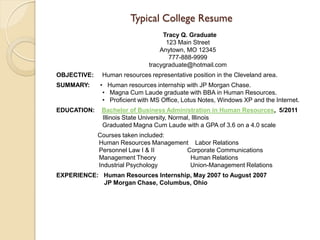
Typical College Resume
                                   Tracy Q. Graduate
                                    123 Main Street
                                  Anytown, MO 12345
                                     777-888-9999
                              tracygraduate@hotmail.com
OBJECTIVE:    Human resources representative position in the Cleveland area.
SUMMARY:     • Human resources internship with JP Morgan Chase.
              • Magna Cum Laude graduate with BBA in Human Resources.
              • Proficient with MS Office, Lotus Notes, Windows XP and the Internet.
EDUCATION:    Bachelor of Business Administration in Human Resources, 5/2011
              Illinois State University, Normal, Illinois
              Graduated Magna Cum Laude with a GPA of 3.6 on a 4.0 scale
             Courses taken included:
             Human Resources Management Labor Relations
             Personnel Law I & II     Corporate Communications
             Management Theory         Human Relations
             Industrial Psychology     Union-Management Relations
EXPERIENCE: Human Resources Internship, May 2007 to August 2007
            JP Morgan Chase, Columbus, Ohio
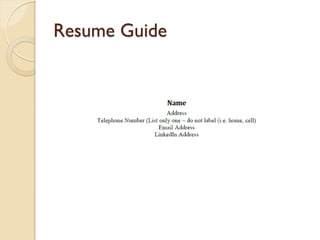
Resume Guide
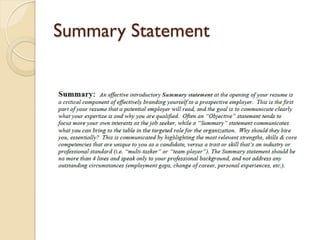
Summary Statement
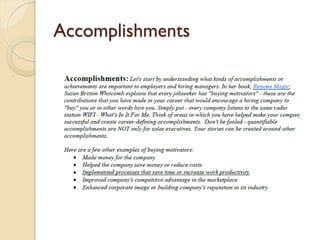
Accomplishments
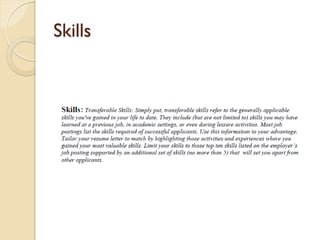
Skills
Experience
Education
Cover Letter
Information
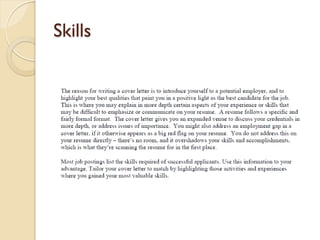
Skills
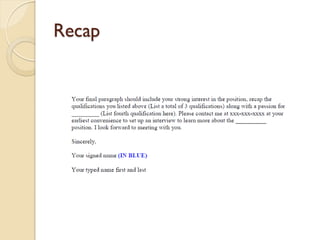
Recap
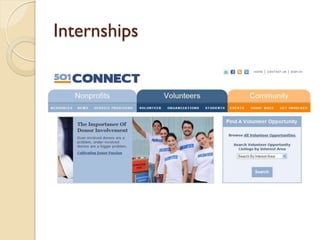
Internships
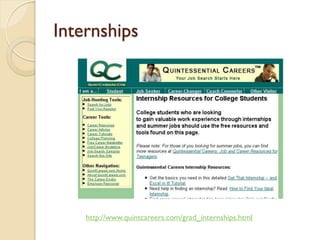
Internships


    http://www.quintcareers.com/grad_internships.html
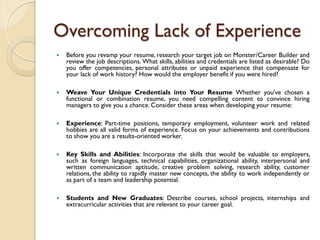
Overcoming Lack of Experience
   Before you revamp your resume, research your target job on Monster/Career Builder and
    review the job descriptions. What skills, abilities and credentials are listed as desirable? Do
    you offer competencies, personal attributes or unpaid experience that compensate for
    your lack of work history? How would the employer benefit if you were hired?

   Weave Your Unique Credentials into Your Resume Whether you've chosen a
    functional or combination resume, you need compelling content to convince hiring
    managers to give you a chance. Consider these areas when developing your resume:

   Experience: Part-time positions, temporary employment, volunteer work and related
    hobbies are all valid forms of experience. Focus on your achievements and contributions
    to show you are a results-oriented worker.

   Key Skills and Abilities: Incorporate the skills that would be valuable to employers,
    such as foreign languages, technical capabilities, organizational ability, interpersonal and
    written communication aptitude, creative problem solving, research ability, customer
    relations, the ability to rapidly master new concepts, the ability to work independently or
    as part of a team and leadership potential.

   Students and New Graduates: Describe courses, school projects, internships and
    extracurricular activities that are relevant to your career goal.
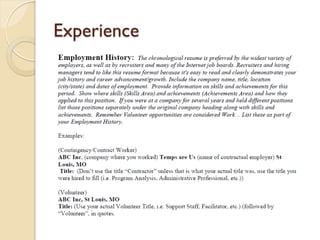
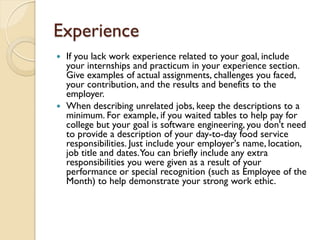
Experience
 If you lack work experience related to your goal, include
  your internships and practicum in your experience section.
  Give examples of actual assignments, challenges you faced,
  your contribution, and the results and benefits to the
  employer.
 When describing unrelated jobs, keep the descriptions to a
  minimum. For example, if you waited tables to help pay for
  college but your goal is software engineering, you don't need
  to provide a description of your day-to-day food service
  responsibilities. Just include your employer's name, location,
  job title and dates. You can briefly include any extra
  responsibilities you were given as a result of your
  performance or special recognition (such as Employee of the
  Month) to help demonstrate your strong work ethic.
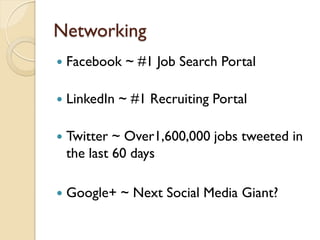
Networking
   Facebook ~ #1 Job Search Portal

   LinkedIn ~ #1 Recruiting Portal

   Twitter ~ Over1,600,000 jobs tweeted in
    the last 60 days

   Google+ ~ Next Social Media Giant?
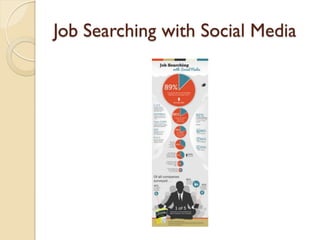
Job Searching with Social Media
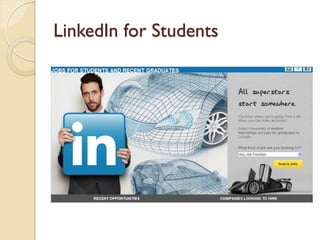
LinkedIn for Students
   A better job search experience for students and graduates
   While anyone can search and view job listings on the public Student Job Portal, Linkedin
    members with a completed profile and connections have a much richer job search
    experience:
   We recommend jobs: Based on your education and interests, we’ll recommend jobs
    specifically targeted to you – right on your home page or with optional email alerts.
   Put your network to work: Each connection you make expands your network, adding
    people who can provide insights into opportunities, or who can even help you land a job.
    Connect to fellow students and see where they’ve found jobs, reach out to alumni whose
    companies are hiring, and leverage the networks of your parents, family friends or
    mentors.
   You can research companies: LinkedIn’s Company Pages provide rich insights to help
    you explore where you want to work. Learn who companies hire, what products and
    services they sell, what professionals are saying about them, and who you know who
    works there.
   Companies find you: At the end of the day, it’s also a great opportunity to be found by
    leading companies. Companies continually comb LinkedIn’s member profiles for the best
    candidates. The more complete your profile, the better your chances of being found.
   Find opportunities worldwide: The Student Job Portal is available in all languages
    currently supported on the site – and you’ll find jobs from top employers in locations
    around the world.
Questions

College grads resume review

  • 1.
    College Grads ~Resume Review Frank Alaniz Missouri Workforce Regional Liaison SLATE Missouri Career Centers
  • 2.
    30 Second ResumeTest ◦ Take your resume and fold the name/contact information towards the back of the document ◦ Fold the employment history section towards the back of the document ◦ Look at the remaining section of your resume. If I as an employer have only 30 seconds to determine what skills and accomplishments you are bringing to my organization does the remaining section of your resume reflect those skills?
  • 3.
    Job Seekers Toolkit  Accomplishments Stories ◦ Write five or six compelling stories about school or work-related tasks that made you proud.  Positioning Statement. ◦ Prepare and practice a “15-second commercial” about who you are, what you’ve done in the past (academically and professionally, if applicable), and the particular strengths you can contribute to an employer.
  • 4.
    Toolkit  Professional Biography ◦ Write a one-page narrative of your career in the “third person” – as though someone else wrote it about you  Target Company List ◦ Make a “wish list” of adjectives that would describe your ideal employer, such as size, location, industry, culture, and environment. Then research specific organizations that meet those criteria and put them on a list of 35 to 50 “Target Companies.”
  • 5.
    Toolkit  Contact List ◦ Compile a list of all the people you know personally and professionally, including their contact information. Remember that approximately 80% of new opportunities are secured through networking.  Professional/Academic References ◦ List colleagues or professors who would “sing your praises” if asked about you. Contact each of them, and get approval to use their names on your list of references.
  • 6.
    Toolkit  Letters of Recommendation ◦ Request letters from four or five respected business colleagues or academic associates, which will be printed on their professional letterhead.  Networking Agenda ◦ Write out a full networking discussion or script so you will know exactly what to say in the networking discussion – how it flows, what to expect, how to react to the other person’s comments, etc.
  • 7.
    Toolkit  Tracking System ◦ Keep a detailed record of your job search activities, including phone calls, networking meetings, interviews, cover letters, etc. This is essential to keeping your process organized and productive.  Resume ◦ It’s the last on the list, but still indispensable. And, it has to be GREAT. Be sure your final resume is carefully edited and succinct (no more than two pages) with a layout that is easy for the eye to follow. Ford R. Myers, a nationally-known Career Coach – www.careerspecialreport.com
  • 8.
    Typical College Resume Tracy Q. Graduate 123 Main Street Anytown, MO 12345 777-888-9999 tracygraduate@hotmail.com OBJECTIVE: Human resources representative position in the Cleveland area. SUMMARY: • Human resources internship with JP Morgan Chase. • Magna Cum Laude graduate with BBA in Human Resources. • Proficient with MS Office, Lotus Notes, Windows XP and the Internet. EDUCATION: Bachelor of Business Administration in Human Resources, 5/2011 Illinois State University, Normal, Illinois Graduated Magna Cum Laude with a GPA of 3.6 on a 4.0 scale Courses taken included: Human Resources Management Labor Relations Personnel Law I & II Corporate Communications Management Theory Human Relations Industrial Psychology Union-Management Relations EXPERIENCE: Human Resources Internship, May 2007 to August 2007 JP Morgan Chase, Columbus, Ohio
  • 9.
  • 10.
  • 11.
  • 12.
  • 13.
  • 14.
  • 15.
  • 16.
  • 17.
  • 18.
  • 19.
  • 20.
    Internships http://www.quintcareers.com/grad_internships.html
  • 21.
    Overcoming Lack ofExperience  Before you revamp your resume, research your target job on Monster/Career Builder and review the job descriptions. What skills, abilities and credentials are listed as desirable? Do you offer competencies, personal attributes or unpaid experience that compensate for your lack of work history? How would the employer benefit if you were hired?  Weave Your Unique Credentials into Your Resume Whether you've chosen a functional or combination resume, you need compelling content to convince hiring managers to give you a chance. Consider these areas when developing your resume:  Experience: Part-time positions, temporary employment, volunteer work and related hobbies are all valid forms of experience. Focus on your achievements and contributions to show you are a results-oriented worker.  Key Skills and Abilities: Incorporate the skills that would be valuable to employers, such as foreign languages, technical capabilities, organizational ability, interpersonal and written communication aptitude, creative problem solving, research ability, customer relations, the ability to rapidly master new concepts, the ability to work independently or as part of a team and leadership potential.  Students and New Graduates: Describe courses, school projects, internships and extracurricular activities that are relevant to your career goal.
  • 22.
    Experience  If youlack work experience related to your goal, include your internships and practicum in your experience section. Give examples of actual assignments, challenges you faced, your contribution, and the results and benefits to the employer.  When describing unrelated jobs, keep the descriptions to a minimum. For example, if you waited tables to help pay for college but your goal is software engineering, you don't need to provide a description of your day-to-day food service responsibilities. Just include your employer's name, location, job title and dates. You can briefly include any extra responsibilities you were given as a result of your performance or special recognition (such as Employee of the Month) to help demonstrate your strong work ethic.
  • 23.
    Networking  Facebook ~ #1 Job Search Portal  LinkedIn ~ #1 Recruiting Portal  Twitter ~ Over1,600,000 jobs tweeted in the last 60 days  Google+ ~ Next Social Media Giant?
  • 24.
    Job Searching withSocial Media
  • 25.
  • 26.
    LinkedIn for Students  A better job search experience for students and graduates  While anyone can search and view job listings on the public Student Job Portal, Linkedin members with a completed profile and connections have a much richer job search experience:  We recommend jobs: Based on your education and interests, we’ll recommend jobs specifically targeted to you – right on your home page or with optional email alerts.  Put your network to work: Each connection you make expands your network, adding people who can provide insights into opportunities, or who can even help you land a job. Connect to fellow students and see where they’ve found jobs, reach out to alumni whose companies are hiring, and leverage the networks of your parents, family friends or mentors.  You can research companies: LinkedIn’s Company Pages provide rich insights to help you explore where you want to work. Learn who companies hire, what products and services they sell, what professionals are saying about them, and who you know who works there.  Companies find you: At the end of the day, it’s also a great opportunity to be found by leading companies. Companies continually comb LinkedIn’s member profiles for the best candidates. The more complete your profile, the better your chances of being found.  Find opportunities worldwide: The Student Job Portal is available in all languages currently supported on the site – and you’ll find jobs from top employers in locations around the world.
  • 27.