Hashing & FileStructure (Hashing) 2
What is Hashing?
Sequential search requires, on the average O(n) comparisons to locate an
element, so many comparisons are not desirable for a large database of
elements.
Binary search requires much fewer comparisons on the average O (log n) but
there is an additional requirement that the data should be sorted. Even with
best sorting algorithm, sorting of elements require O(n log n) comparisons.
There is another widely used technique for storing of data called hashing. It
does away with the requirement of keeping data sorted (as in binary search)
and its best case timing complexity is of constant order O(1). In its worst case,
hashing algorithm starts behaving like linear search.
Best case timing behavior of searching using hashing = O(1)
Worst case timing Behavior of searching using hashing = O(n)
3.
Hashing & FileStructure (Hashing) 3
What is Hashing?
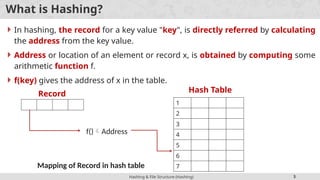
In hashing, the record for a key value "key", is directly referred by calculating
the address from the key value.
Address or location of an element or record x, is obtained by computing some
arithmetic function f.
f(key) gives the address of x in the table.
1
2
3
4
5
6
7
Hash Table
Record
f()Address
Mapping of Record in hash table
4.
Hashing & FileStructure (Hashing) 4
Hash Table Data Structure
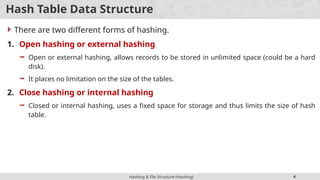
There are two different forms of hashing.
1. Open hashing or external hashing
Open or external hashing, allows records to be stored in unlimited space (could be a hard
disk).
It places no limitation on the size of the tables.
2. Close hashing or internal hashing
Closed or internal hashing, uses a fixed space for storage and thus limits the size of hash
table.
5.
Hashing & FileStructure (Hashing) 5
Open Hashing Data Structure
The basic idea is that the records [elements] are partitioned into B classes,
numbered 0,1,2 … B-1
A Hashing function f(x) maps a record with key x to an integer value between 0
and B-1
Each bucket in the bucket table is the head of the linked list of records
mapped to that bucket
0
1
.
.
.
B-1
Bucket
Table
List of Elements
The open hashing
data organization
6.
Hashing & FileStructure (Hashing) 6
Close Hashing Data Structure
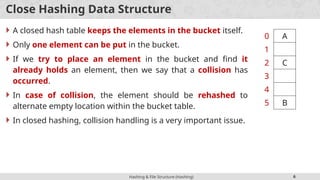
A closed hash table keeps the elements in the bucket itself.
Only one element can be put in the bucket.
If we try to place an element in the bucket and find it
already holds an element, then we say that a collision has
occurred.
In case of collision, the element should be rehashed to
alternate empty location within the bucket table.
In closed hashing, collision handling is a very important issue.
A
C
B
0
1
2
3
4
5
7.
Hashing & FileStructure (Hashing) 7
Hashing Functions
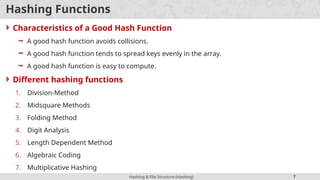
Characteristics of a Good Hash Function
A good hash function avoids collisions.
A good hash function tends to spread keys evenly in the array.
A good hash function is easy to compute.
Different hashing functions
1. Division-Method
2. Midsquare Methods
3. Folding Method
4. Digit Analysis
5. Length Dependent Method
6. Algebraic Coding
7. Multiplicative Hashing
8.
Hashing & FileStructure (Hashing) 8
Division-Method
In this method we use modular arithmetic system to divide the key value by
some integer divisor m (may be table size).
It gives us the location value, where the element can be placed.
We can write, L = (K mod m) + 1,
L = location in table/file
K = key value
m = table size/number of slots in file
Suppose, k = 23, m = 10 then
L = (23 mod 10) + 1= 3 + 1=4
The key whose value is 23 is placed in 4th
location.
9.
Hashing & FileStructure (Hashing) 9
Midsquare Methods
In this case, we square the value of a key and take the number of digits
required to form an address, from the middle position of squared value.
Suppose a key value is 16
Its square is 256
Now if we want address of two digits
We select the address as 56 (i.e. two digits starting from middle of 256)
10.
Hashing & FileStructure (Hashing) 10
Folding Method
Most machines have a small number of primitive data types for which there
are arithmetic instructions
Frequently key to be used will not fit easily in to one of these data types
It is not possible to discard the portion of the key that does not fit into such
an arithmetic data type
The solution is to combine the various parts of the key in such a way that all
parts of the key affect for final result such an operation is termed folding of the
key
That is the key is actually partitioned into number of parts, each part having
the same length as that of the required address
Add the value of each parts, ignoring the final carry to get the required
address
11.
Hashing & FileStructure (Hashing) 11
Folding Method
This is done in two ways
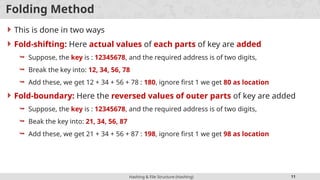
Fold-shifting: Here actual values of each parts of key are added
Suppose, the key is : 12345678, and the required address is of two digits,
Break the key into: 12, 34, 56, 78
Add these, we get 12 + 34 + 56 + 78 : 180, ignore first 1 we get 80 as location
Fold-boundary: Here the reversed values of outer parts of key are added
Suppose, the key is : 12345678, and the required address is of two digits,
Beak the key into: 21, 34, 56, 87
Add these, we get 21 + 34 + 56 + 87 : 198, ignore first 1 we get 98 as location
12.
Hashing & FileStructure (Hashing) 12
Digit Analysis
This hashing function is a distribution-dependent
Here we make a statistical analysis of digits of the key, and select those
digits (of fixed position) which occur quite frequently
Then reverse or shifts the digits to get the address
For example,
The key is : 9861234
If the statistical analysis has revealed the fact that the third and fifth position digits occur
quite frequently,
We choose the digits in these positions from the key
So we get, 62. Reversing it we get 26 as the address
13.
Hashing & FileStructure (Hashing) 13
Length Dependent Method
In this type of hashing function we use the length of the key along with some
portion of the key to produce the address, directly.
In the indirect method, the length of the key along with some portion of the
key is used to obtain intermediate value.
14.
Hashing & FileStructure (Hashing) 14
Algebraic Coding
Here a n bit key value is represented as a polynomial.
The divisor polynomial is then constructed based on the address range
required.
The modular division of key-polynomial by divisor polynomial, to get the
address-polynomial.
Let f(x) = polynomial of n bit key = a1 + a2x + ……. + anxn-1
d(x) = divisor polynomial = d1 + d2x + …. + dnxn-1
Required address polynomial will be f(x) mod d(x)
15.
Hashing & FileStructure (Hashing) 15
Multiplicative Hashing
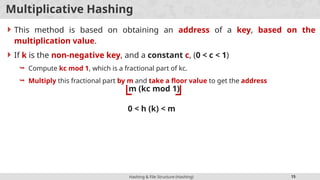
This method is based on obtaining an address of a key, based on the
multiplication value.
If k is the non-negative key, and a constant c, (0 < c < 1)
Compute kc mod 1, which is a fractional part of kc.
Multiply this fractional part by m and take a floor value to get the address
m (kc mod 1)
└ ┘
0 < h (k) < m
16.
Hashing & FileStructure (Hashing) 16
Collision Resolution Strategies
Collision resolution is the main problem in hashing.
If the element to be inserted is mapped to the same location, where an element
is already inserted then we have a collision and it must be resolved.
There are several strategies for collision resolution. The most commonly used
are :
Separate chaining - used with open hashing
Open addressing - used with closed hashing
17.
Hashing & FileStructure (Hashing) 17
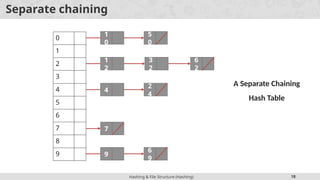
Separate chaining
In this strategy, a separate list of all elements mapped to the same value is
maintained.
Separate chaining is based on collision avoidance.
If memory space is tight, separate chaining should be avoided.
Additional memory space for links is wasted in storing address of linked
elements.
Hashing function should ensure even distribution of elements among
buckets; otherwise the timing behaviour of most operations on hash table will
deteriorate.
19
Example - Separatechaining
Example : The integers given below are to be inserted in a hash table with 5
locations using chaining to resolve collisions. Construct hash table and use
simplest hash function.
1, 2, 3, 4, 5, 10, 21, 22, 33, 34, 15, 32, 31, 48, 49, 50
An element can be mapped to a location in the hash table using the mapping
function key % 10
Hash Table
Location
Mapped elements
0
1
2
3
4
1
2
3
4
, 10
, 21
, 22
, 33
, 34
, 15
, 32
, 31
, 48
, 49
, 50
5
0
1
2
3
4
5
1
5
1
0
5
0
1
3
1
2
1
2
3
2
2
2
3
4
8
3
3
4
4
9
3
4
Hash Table
20.
Hashing & FileStructure (Hashing) 20
Open Addressing
Separate chaining requires additional memory space for pointers.
Open addressing hashing is an alternate method of handling collision.
In open addressing, if a collision occurs, alternate cells are tried until an
empty cell is found.
a. Linear probing
b. Quadratic probing
c. Double hashing.
21.
Hashing & FileStructure (Hashing) 21
Linear Probing
In linear probing, whenever there is a collision, cells are searched sequentially (with
wraparound) for an empty cell.
Fig. shows the result of inserting keys {5,18,55,78,35,15} using the hash function (f(key)=
key%10) and linear probing strategy.
Empty
Table
After 5 After 18 After 55 After 78 After 35 After 15
0
1
2
3
4
5
6
7
8
9
5 5
18
5
18
55
5
18
55
78
5
18
55
78
35
5
18
55
78
35
15
22.
Hashing & FileStructure (Hashing) 22
Linear Probing
Linear probing is easy to implement but it suffers from "primary clustering"
When many keys are mapped to the same location (clustering), linear probing
will not distribute these keys evenly in the hash table.
These keys will be stored in neighbourhood of the location where they are
mapped.
This will lead to clustering of keys around the point of collision
23.
Hashing & FileStructure (Hashing) 23
Quadratic probing
One way of reducing "primary clustering" is to use quadratic probing to
resolve collision.
Suppose the "key" is mapped to the location j and the cell j is already occupied.
In quadratic probing, the location j, (j+1), (j+4), (j+9), ... are examined to find
the first empty cell where the key is to be inserted.
This table reduces primary clustering.
It does not ensure that all cells in the table will be examined to find an empty
cell.
Thus, it may be possible that key will not be inserted even if there is an
empty cell in the table.
24.
Hashing & FileStructure (Hashing) 24
Double Hashing
This method requires two hashing functions f1 (key) and f2 (key).
Problem of clustering can easily be handled through double hashing.
Function f1 (key) is known as primary hash function.
In case the address obtained by f1 (key) is already occupied by a key, the
function f2 (key) is evaluated.
The second function f2 (key) is used to compute the increment to be added to
the address obtained by the first hash function f1 (key) in case of collision.
The search for an empty location is made successively at the addresses
f1(key) + f2(key),
f1(key) + 2 * f2(key),
f1 (key) + 3 * f2(key),...

![Hashing & File Structure (Hashing) 5
Open Hashing Data Structure
The basic idea is that the records [elements] are partitioned into B classes,
numbered 0,1,2 … B-1
A Hashing function f(x) maps a record with key x to an integer value between 0
and B-1
Each bucket in the bucket table is the head of the linked list of records
mapped to that bucket
0
1
.
.
.
B-1
Bucket
Table
List of Elements
The open hashing
data organization](https://image.slidesharecdn.com/9-hashing-250814052351-272ddf7d/85/Hashing-techniques-discussion-and-examples-5-320.jpg)