Questions for knowledge creators


richard j. bookman
rbookman@miami.edu


2012 Bootcamp Course
university of miami
12 September 2012
disclosures

• I have no financial interest in any of the
  content presented today.


• I have no direct experience in translational
  or clinical research
objectives

leave you with questions
How do you pick a problem?
Research is a human activity
http://www.stanford.edu/group/vista/cgi-bin/FOV/wp-content/uploads/2012/02/tables1.png
Which offer do you want?
results


 68%   16%


 32%   84%


             Dan Ariely, Predictably Irrational
Hypothesis-driven vs.
  discovery-driven
      research
Let’s play a game
basic   applied
fundamental


                          useful


?
            D.E. Stokes, Pasteur’s Quadrant, 1997
fundamental


              useful
From G. Dyson, Turing’s Cathedral, 2012
the internet of things


            big bang
every
the internet of things    
                     ^

      big data
http://doi.ieeecomputersociety.org/10.1109/MIS.2009.36
research 3.0
how are these trends
playing out in clinical
research ??
http://www.patientslikeme.com
http://www.pnas.org/content/105/6/2052
Methods


          http://www.pnas.org/content/105/6/2052
http://www.nature.com/nbt/journal/v29/n5/full/nbt.1837.html
Abstract
Patients with serious diseases may experiment with drugs
that have not received regulatory approval. Online patient
communities structured around quantitative outcome data
have the potential to provide an observational environment
to monitor such drug usage and its consequences. Here
we describe an analysis of data reported on the website
PatientsLikeMe by patients with amyotrophic lateral sclerosis (ALS)
who experimented with lithium carbonate treatment.
To reduce potential bias owing to lack of randomization, we
developed an algorithm to match 149 treated patients to multiple
controls (447 total) based on the progression of their disease course.
At 12 months after treatment, we found no effect of lithium on
disease progression. Although observational studies using unblinded
data are not a substitute for double- blind randomized control trials,
this study reached the same conclusion as subsequent randomized
trials,

                                       http://www.nature.com/nbt/journal/v29/n5/pdf/nbt.1837.pdf
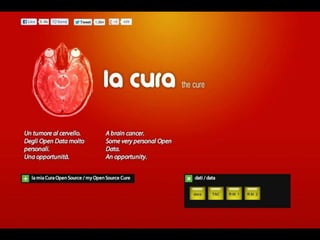
http://artisopensource.net/cure/
Salvatore Iaconesi
Founder, Art is open source
“Patient engagement is the
blockbuster drug of the 21st

         century”
                                 Leonard Kish


              http://www.hl7standards.com/blog/2012/08/28/drug-of-the-century/
summary
What problem do you want to work on?

How does your own brain limit your ability to reason?

Have you fallen in love with your own ideas?

Are you looking for black swans?

In a digitally enabled world, can you think of better ways to
create useful knowledge?

How can you empower patients so as to accelerate discovery?

Questions for knowledge creators

Editor's Notes

  • #2 Image is Gerhard Richter painting.http://www.gerhardrichterpainting.com/wp-content/uploads/2012/01/gerhardrichter_photo3.jpg
  • #5 Translation is supposed to get us across the valley of death…
  • #6 But something Is amiss….
  • #7 This course will probably not turn you all into riders of death valley…
  • #12 Kanisza triangle: http://psychology.wikia.com/wiki/Kanizsa_triangle
  • #16 Scientific method is part of how we try to overcome the limits….
  • #17 falling in love with your own ideas2,4,6 gameblack swansrole of discovery
  • #24 JvN: “I am thinking about something much more important than bombs. I am thinking about computers.”The IAS computer in 1952.Numbers that mean things vs. numbers that do things.Code that can modify code.
  • #29 http://gowers.wordpress.com/2009/02/01/a-combinatorial-approach-to-density-hales-jewett/
  • #30 http://www.galaxyzoo.org/Which types of problems can be attacked with Polymath or Galaxy Zoo type approaches?
  • #31 http://www.kaggle.com/16 July 2012
  • #42 Leave you with 6 questions…