NUMERICAL STUDY ON THE TEMPERATURE
PROFILES AND DEGREE OF BURNS IN HUMAN SKIN
TISSUE DURING COMBINED THERMAL THERAPY
Ik-Tae Im1
, Suk Bum Youn1
, and Kyounghwa Kim2
1
Department of Mechanical Design Engineering, College of Engineering,
Chonbuk National University, Jeonju, Republic of Korea
2
Nano Solution Inc., Jeonju, Republic of Korea
In this study, the temperature distribution in human dermal tissues and possible burns
as a result of local heating of the skin were analyzed numerically. In order to obtain the
temperature profiles of the dermis, fat, and muscle layers, we solved the Pennes bio-heat
equation whose source term was for heat exchange between blood and tissues. The degree
of each burn was predicted by an Arrhenius-type damage function. Two boundary
conditions, namely constant heat flux and constant temperature, were considered as heating
methods. Skin temperature regulation by on/off repetition of heat flux was also considered
as a boundary condition. Time-dependent increases in tissue temperature under constant
heat flux were determined for the skin. Temperature profiles showed different slopes at each
layer due to different thermophysical properties and blood perfusion. Constant temperature
heating up to 320 K for 10 minutes did not cause a burn injury according to our results.
The results also showed that burns can be avoided by controlling the skin temperature under
320 K. Taken together, our results showed that a high heat flux over a short heating period
is safer than a low heat flux over a long heating period.
1. INTRODUCTION
Thermal therapy is a therapeutic method that makes use of thermal sources
such as microwave and infrared energy to improve blood flow by increasing
the temperature of the therapy site, thereby relieving fatigue of nerves and muscles
as well as increasing the metabolism or necrosis of diseased tissues. Methods
that may be called ‘‘thermal therapies’’ are often observed around us, and include
applying a hot compress and far-infrared radiation. These methods are also expected
to improve metabolism by increasing the temperature of the therapy site. Whole-
body hyperthermia [1, 2] is an example of active thermal therapy used for treatment
of tumors and cancer. For example, whole-body hyperthermia for tumor treatment
not only is intended to increase metabolism, but also utilizes the principle in which
Received 17 October 2013; accepted 13 August 2014.
Address correspondence to Ik-Tae Im, Chonbuk National University, 567 Baekjedaero,
Duckjin-gu Jeonju, 561-756 Republic of Korea. E-mail: itim@jbnu.ac.kr
Color versions of one or more of the figures in the article can be found online at www.tandfonline.
com/unht.
Numerical Heat Transfer, Part A, 67: 921–933, 2015
Copyright # Taylor & Francis Group, LLC
ISSN: 1040-7782 print=1521-0634 online
DOI: 10.1080/10407782.2014.955338
921
tumor cells necrotize faster than normal cells at high temperature. The method
is widely used for clinical purposes.
The temperature profile of human tissue heated by thermal therapy is the
subject of medical and engineering interests. For analyses of temperature profiles
in human tissue, most studies utilize the bio-heat equation described by Pennes
[3], who conducted temperature measurement experiments using human forearms.
Although the equation is very simple, studies have obtained relatively satisfactory
solutions using the bio-heat equation [4]. Yuan et al. [5] reported the effect of
perfusion rate on temperature response according to heating of the skin in a study
of heat transfer in human subcutaneous tissue. Several other studies [6–8] have used
the bio-heat equation to show skin tissue temperature response characteristics during
cyclical heating. Importantly, these skin response characteristic can be applied to
identify the positions of subcutaneous tumors [9, 10].
In this study, the temperature profiles and possibility of burns in human skin
tissue with the local heating of the skin were investigated in order to obtain basic
data on the heat transfer phenomenon in human skin tissue necessary for the
development of a combined thermal therapy device using heat and light. Figure 1
shows a photograph of the prototype of a combined therapy device utilizing infrared
NOMENCLATURE
A pre-exponential factor (1=s)
c specific heat (J=kg K)
h enthalpy
k thermal conductivity (W=m K)
qm metabolic heat generation
R universal gas constant
(8.3143 J=mol K)
r radial coordinate
T temperature (
C, K)
t time (s)
x axial coordinate
DE activation energy (J=mol)
q density (kg=m3
)
X damage function
x blood perfusion rate (1=s)
Subscript
b blood
Figure 1. Prototype of the combined heat and light therapy device.
922 I.-T. IM ET AL.
heat and white light. The therapy site was heated by infrared irradiation of
a transparent heating film. In this case, light penetrated through the film to obtain
a therapeutic effect from light. Except for heat transfer analysis, details regarding
the development of therapeutic devices, including device components, have been
described previously [11, 12].
2. COMPUTATION
2.1. Computational Domain and Governing Equations
The computational domain was configured as shown in Figure 2, assuming
that the skin was heated by attaching a heating film with a radius of 2 cm. The depth
of computation in the skin was chosen as 11.6 mm because heat must be able to reach
the muscle layer to obtain a therapeutic effect. As shown in the figure, the domain
consisted of a skin layer with a depth of 1.6 mm, a subcutaneous fat layer with
a depth of 2.0 mm, and a muscle layer. In addition to the area for which heating
was applied, a domain with radius of 4 cm was included to consider the cooling
effects mediated by surrounding air; this radius was determined through numerical
tests to remove the effects of heating on the side edge.
The computational domain was assumed to be two-dimensional axisymmetric,
and each layer had different thermophysical properties as shown in Table 1.
Figure 2. Computational domain for temperature analysis of skin layers.
TEMPERATURE AND BURN INJURY PREDICTION IN SKIN 923
Although the difference in physical properties among layers was not large, a previous
study [13] suggested that the use of the same physical properties fails to show discon-
tinuous changes in temperature between layers. Conversely, the physical properties
were assumed to be constant in each layer with respect to temperature. The blood
perfusion rate was only considered in the muscle layer because it was very small in
other layers. Air temperature, temperature of the bottom edge of the muscle layer
(x ¼ 11.6 mm), and convection heat transfer coefficient [9, 14] were 25
C, 37
C,
and 10.0 W=m2
Á K, respectively. Heating was carried out under constant heat
flux or constant temperature. Adiabatic and symmetry conditions were applied to
the right and left boundaries of the computational domain. The initial temperature
profile of the computational domain was identified by steady-state computation with
the boundary conditions described earlier.
We used the well-known Pennes bio-heat equation, which is a heat conduction
equation for the computational domain that considers blood perfusion [3]. If T is the
temperature of a tissue, the equation can be expressed as
qc
qT
qt
¼ r Á krT þ xbqbcbðTb À TÞ þ qm ð1Þ
where q, c, and k are the density, specific heat, and thermal conductivity,
respectively, and the subscript b refers to the value of blood. In Eq. (1), xb and qm
represent the blood perfusion rate, which accounts for the amount of blood flow
per unit volume of tissue and metabolic heat source. A metabolic heat source was
not included in our computation due to its negligible order of magnitude compared
to other terms.
The degree of burns was predicted using the damage function X shown in the
following equation:
dX
dt
¼ A exp À
DE
RT
 
ð2Þ
where A is a pre-exponential factor with a value of 1.3 Â 1095
1=s, DE is the activation
energy with a value of 6.04 Â 105
J=mol [14, 15], and R is the universal gas constant
(8.3143 J=mol K). The damage function X can be calculated by integrating Eq. (2)
over the time of heat exposure. The value of X defining burn injury severity differs
slightly according to some previous studies [15–19]. In the present study, we defined
first-degree burn as 0.53 and second-degree burn as 1.0 as described by Takada [18]
and Ng and Chua [19].
Table 1. Thickness and material properties for human skin layers used in this study
Dermis Fat Muscle Blood
q (kg=m3
) 1200 1000 1085 1060
c (kJ=kg Á K) 3300 2674 3800 3770
k (W=m Á K) 0.445 0.185 0.51 –
xb (1=s) – – 0.0027 –
Thickness(mm) 1.6 2.0 8.0 –
924 I.-T. IM ET AL.
2.2. Computation
A solution was found using numerical computations of the above equation
with the initial and boundary conditions described earlier. A first-order implicit
method was used for finite differentiation for time and central differentiation
for space. A 300 Â 72 grid system was used after verifying grid-dependence of
the solutions. In order to verify grid-dependence, steady-state computation was
performed using three grid systems of 200 Â 48, 300 Â 72, and 300 Â 120. The result
from the densest 340 Â 120 grid system was almost identical to the result from the
300 Â 72 grid system. For unsteady-state computations, the solution was computed
up to 600.0 s using the variable size of time increment as 1.0–5.0 s.
The source term xbqbcb(Tb–T) in Eq. (1) was expressed in the form of A þ Bh
using enthalpy h during numerical computations [20]. In this case, A and B can be
written as A ¼ qbxbcbTb and B ¼ Àqbxbcb=c.
3. RESULTS AND DISCUSSION
3.1. Verification of Computational Method
The exact solutions for the transient heat conduction problems in human
skin tissue were described previously by Deng and Liu [21]. Solutions from the
computation were compared with the known exact solution in order to verify
whether the source term of the bio-heat equation given as Eq. (1) was considered
correctly in the numerical computations. Figure 3 shows the comparisons between
Figure 3. Comparisons of the transient temperatures obtained from the numerical method and
exact solutions.
TEMPERATURE AND BURN INJURY PREDICTION IN SKIN 925
the exact solutions and computational results with a one-dimensional problem with
the constant heat flux boundary condition considered by Deng and Liu [21]; the
physical properties of the skin tissue were the same as for their study. The two cases
with heat fluxes of 500 W=m2
and 1000 W=m2
were solved. The computational
solutions were approximately the same as the exact solutions in both cases. Therefore,
the numerical method used in this study was deemed appropriate.
3.2. Heating with Constant Heat Flux and Constant Temperature
Computations were carried out on two typical heating methods, one for which
constant heat flux was applied to the heating film and the other for which a constant
film temperature was maintained. First, we computed the case where the skin was
heated on the heating part shown in Figure 2 at constant heat flux from 500 W=m2
to 3000W=m2
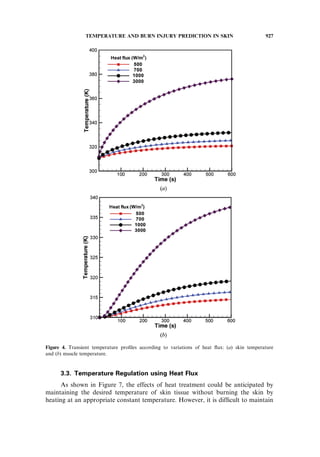
. Figures 4a and 4b show the changes in temperature on the skin surface
and beginning part of the muscle layer according to time. Since the skin was heated
with a constant heat flux, the temperature gradually increased with time. While the
temperature of the heated surface increased simultaneously with heating, the tempera-
ture of the muscle layer was hardly changed during the early stage of heating, but it did
increase after reaching a specific time threshold. Although the temperature curves
exhibited a similar shape for the heat fluxes of 500 and 1000W=m2
, the temperature
difference increased with time. Specifically, with a heat flux of 3000W=m2
, the tem-
peratures of the skin and muscle layer rapidly increased during the early heating stage.
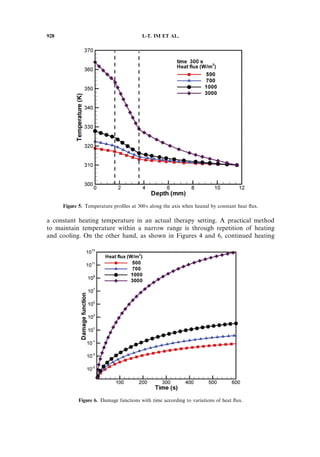
Figure 5 shows the temperature profiles at 300 s along the axis of symmetry of
the center of the heat source in the direction of skin depth. The dotted lines refer
to the part where layers of skin tissue were changed. Temperature profiles showed
discontinuous characteristics at the start of each layer. In particular, the slope of
the temperature profile changed significantly at the start of the muscle layer.
This was likely due to the large cooling effect induced by blood perfusion, which
was taken into consideration for the muscle layer. With a heat flux of 700 W=m2
,
the surface temperature increased to 322 K.
Figure 6 shows the changes in damage functions with time according to
variation of heat flux. The skin did not suffer first-degree burn injury at 600 s when
heated at 500 W=m2
, but did experience first-degree and second-degree burns at 424 s
and 495 s, respectively, when heated at 700 W=m2
. When heated at 1000 W=m2
,
first-degree and second-degree burns were observed at 218 and 242 s, respectively.
Because the damage function is an exponential function that rapidly increases with
increasing temperature, it is necessary to maintain skin temperature lower than
a specific threshold. The damage function had an extremely small value below
10À3
during the early stage of heating when the temperature was lower than 320 K.
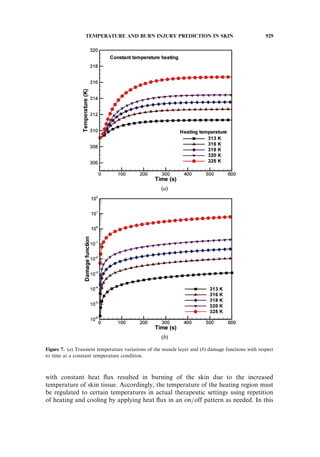
Figure 7 shows the computation results from heating at constant temperature,
where Figure 7a shows the temperature variation of the muscle layer with time and
Figure 7b shows the change in damage functions. When the skin was heated to 313,
316, 318, 320, and 325 K, the temperature of the muscle layer increased to 311.3,
312.6, 313.5, 314.4, and 316.7 K, respectively. According to the damage functions
of Figure 7b, skin burning did not occur until 600 s, at which time the temperature
of the heated region reached 320 K. However, first-degree and second-degree burns
did occur at 57 s and 102 s, respectively, at a heating temperature of 325 K.
926 I.-T. IM ET AL.
3.3. Temperature Regulation using Heat Flux
As shown in Figure 7, the effects of heat treatment could be anticipated by
maintaining the desired temperature of skin tissue without burning the skin by
heating at an appropriate constant temperature. However, it is difficult to maintain
Figure 4. Transient temperature profiles according to variations of heat flux: (a) skin temperature
and (b) muscle temperature.
TEMPERATURE AND BURN INJURY PREDICTION IN SKIN 927
a constant heating temperature in an actual therapy setting. A practical method
to maintain temperature within a narrow range is through repetition of heating
and cooling. On the other hand, as shown in Figures 4 and 6, continued heating
Figure 6. Damage functions with time according to variations of heat flux.
Figure 5. Temperature profiles at 300 s along the axis when heated by constant heat flux.
928 I.-T. IM ET AL.
with constant heat flux resulted in burning of the skin due to the increased
temperature of skin tissue. Accordingly, the temperature of the heating region must
be regulated to certain temperatures in actual therapeutic settings using repetition
of heating and cooling by applying heat flux in an on=off pattern as needed. In this
Figure 7. (a) Transient temperature variations of the muscle layer and (b) damage functions with respect
to time at a constant temperature condition.
TEMPERATURE AND BURN INJURY PREDICTION IN SKIN 929
case, it is necessary to determine the temperature for which heating and cooling
occur. In addition, energy consumption is dependent on heating time and heat flux.
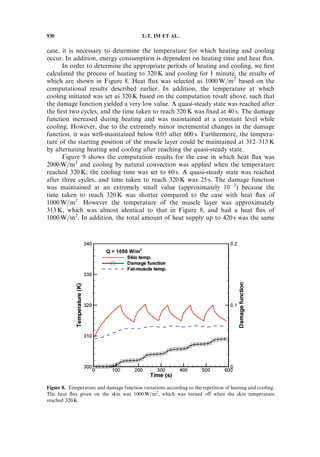
In order to determine the appropriate periods of heating and cooling, we first
calculated the process of heating to 320 K and cooling for 1 minute, the results of
which are shown in Figure 8. Heat flux was selected as 1000 W=m2
based on the
computational results described earlier. In addition, the temperature at which
cooling initiated was set as 320 K based on the computation result above, such that
the damage function yielded a very low value. A quasi-steady state was reached after
the first two cycles, and the time taken to reach 320 K was fixed at 40 s. The damage
function increased during heating and was maintained at a constant level while
cooling. However, due to the extremely minor incremental changes in the damage
function, it was well-maintained below 0.05 after 600 s. Furthermore, the tempera-
ture of the starting position of the muscle layer could be maintained at 312–313 K
by alternating heating and cooling after reaching the quasi-steady state.
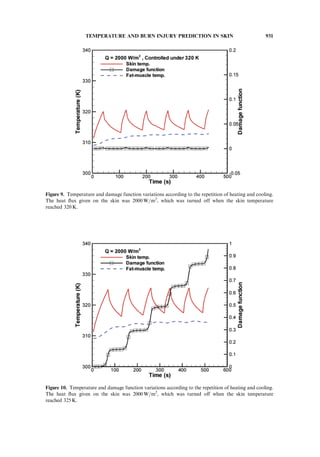
Figure 9 shows the computation results for the case in which heat flux was
2000 W=m2
and cooling by natural convection was applied when the temperature
reached 320 K; the cooling time was set to 60 s. A quasi-steady state was reached
after three cycles, and time taken to reach 320 K was 25 s. The damage function
was maintained at an extremely small value (approximately 10À2
) because the
time taken to reach 320 K was shorter compared to the case with heat flux of
1000 W=m2
. However the temperature of the muscle layer was approximately
313 K, which was almost identical to that in Figure 8, and had a heat flux of
1000 W=m2
. In addition, the total amount of heat supply up to 420 s was the same
Figure 8. Temperature and damage function variations according to the repetition of heating and cooling.
The heat flux given on the skin was 1000 W=m2
, which was turned off when the skin temperature
reached 320 K.
930 I.-T. IM ET AL.
Figure 9. Temperature and damage function variations according to the repetition of heating and cooling.
The heat flux given on the skin was 2000 W=m2
, which was turned off when the skin temperature
reached 320 K.
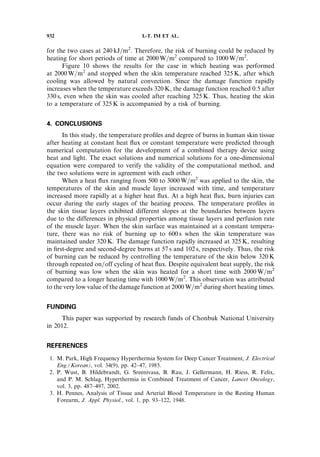
Figure 10. Temperature and damage function variations according to the repetition of heating and cooling.
The heat flux given on the skin was 2000 W=m2
, which was turned off when the skin temperature
reached 325 K.
TEMPERATURE AND BURN INJURY PREDICTION IN SKIN 931
for the two cases at 240 kJ=m2
. Therefore, the risk of burning could be reduced by
heating for short periods of time at 2000 W=m2
compared to 1000 W=m2
.
Figure 10 shows the results for the case in which heating was performed
at 2000 W=m2
and stopped when the skin temperature reached 325 K, after which
cooling was allowed by natural convection. Since the damage function rapidly
increases when the temperature exceeds 320 K, the damage function reached 0.5 after
330 s, even when the skin was cooled after reaching 325 K. Thus, heating the skin
to a temperature of 325 K is accompanied by a risk of burning.
4. CONCLUSIONS
In this study, the temperature profiles and degree of burns in human skin tissue
after heating at constant heat flux or constant temperature were predicted through
numerical computation for the development of a combined therapy device using
heat and light. The exact solutions and numerical solutions for a one-dimensional
equation were compared to verify the validity of the computational method, and
the two solutions were in agreement with each other.
When a heat flux ranging from 500 to 3000 W=m2
was applied to the skin, the
temperatures of the skin and muscle layer increased with time, and temperature
increased more rapidly at a higher heat flux. At a high heat flux, burn injuries can
occur during the early stages of the heating process. The temperature profiles in
the skin tissue layers exhibited different slopes at the boundaries between layers
due to the differences in physical properties among tissue layers and perfusion rate
of the muscle layer. When the skin surface was maintained at a constant tempera-
ture, there was no risk of burning up to 600 s when the skin temperature was
maintained under 320 K. The damage function rapidly increased at 325 K, resulting
in first-degree and second-degree burns at 57 s and 102 s, respectively. Thus, the risk
of burning can be reduced by controlling the temperature of the skin below 320 K
through repeated on=off cycling of heat flux. Despite equivalent heat supply, the risk
of burning was low when the skin was heated for a short time with 2000 W=m2
compared to a longer heating time with 1000 W=m2
. This observation was attributed
to the very low value of the damage function at 2000 W=m2
during short heating times.
FUNDING
This paper was supported by research funds of Chonbuk National University
in 2012.
REFERENCES
1. M. Park, High Frequency Hyperthermia System for Deep Cancer Treatment, J. Electrical
Eng.(Korean), vol. 34(9), pp. 42–47, 1985.
2. P. Wust, B. Hildebrandt, G. Sreenivasa, B. Rau, J. Gellermann, H. Riess, R. Felix,
and P. M. Schlag, Hyperthermia in Combined Treatment of Cancer, Lancet Oncology,
vol. 3, pp. 487–497, 2002.
3. H. Pennes, Analysis of Tissue and Arterial Blood Temperature in the Resting Human
Forearm, J. Appl. Physiol., vol. 1, pp. 93–122, 1948.
932 I.-T. IM ET AL.
4. J. Petrofsky, G. Bains, M. Prowse, S. Gunda, L. Berk, C. Raju, G. Ethiraju, D. Vanarasa,
and P. Madani, Does Skin Moisture Influence the Blood Flow Response to Local Heat?
A Re-evaluation of the Pennes Model, J. Medical Eng. Tech., vol. 33(7), pp. 532–537,
2009.
5. P. Yuan, H. E. Liu, C. W. Chen, and H. S. Kou, Temperature Response in Biological
Tissue by Alternating Heating and Cooling Modalities with Sinusoidal Temperature
Oscillation on the Skin, Int. Commun Heat Mass Transfer, vol. 35, pp. 1091–1096, 2008.
6. J. Liu and L. X. Xu, Estimation of Blood Perfusion using Phase Shift in Temperature
Response to Sinusoidal Heating at the Skin Surface, IEEE Transactions on Biomedical
Engineering, vol. 46(9), pp. 1037–1043, 1999.
7. T. C. Shih, P. Yuan, W. L. Lin, and H. S. Kou, Analytical Analysis of the Pennes Bioheat
Transfer Equation with Sinusoidal Heat Flux Condition on Skin Surface, Med Eng. Phys.,
vol. 29, pp. 946–953, 2007.
8. M. Jaunich, S. Raje, K. H. Kim, K. Mitra, and Z. Guo, Bio-Heat Transfer Analysis
during Short Pulse Laser Irradiation of Tissues, Int. J. Heat Mass Transfer, vol. 51,
pp. 5511–5521, 2008.
9. M. P. C¸ entingu¨l and C. Herman, A Heat Transfer Model of Skin Tissue for Detection of
Lesions: Sensitivity Analysis, Phys. Med. Biol., vol. 55, pp. 5933–5951, 2010.
10. M. P. C¸ entingu¨l, R. M. Alani, and C. Herman, Evaluation of Skin Lesions Using
Transient Thermal Imaging, IHTC14–22465, 14th International Heat Transfer Conference,
vol. 1, Washington, DC, pp. 31–39, 2010.
11. D. Ha, S. J. Kang, C. S. Kim, and I.-T. Im, A Study on the Development of Exothermic
Films using CNT-Polymer Composites, Proceeding of the 2012 Spring Conference of the
KSME Thermal Engineering, Yong Pyong Resort, pp. 262–263, 2012.
12. C. S. Kim and I.-T. Im, Combined Treatment Apparatus Using a Light Therapy, a Fever
Therapy, and an Electromagnetic Stimulation Therapy Capable of Increasing Effects
of a Heat Treatment, Korea Patent No. 10-1180607, 2010.
13. W.-L. Choi, S. D. Moon, S. B. Yun, and I.-T. Im, Analysis of the Bioheat Equation
Considering Tissue Layers with Sinusoidal Temperature Oscillation on the Skin, Trans.
Korean Society Mech. Eng., B, vol. 35(8), pp. 757–762, 2011.
14. D. Fiala, K. J. Lomas, and M. Stohrer, A Computer Model of Human Thermoregulation
for a Wide Range of Environmental Conditions: the Passive System, J. Appl. Physiol.,
vol. 87, pp. 1957–1972, 1999.
15. S. Thomsen and J. A. Pearce, Thermal Damages and Rate Processes in Biological Tissues,
in A. J. Welch and M. J. C. van Gemert (eds.), Optical-Thermal Response of Laser-
Irradiated Tissue, 2nd ed., Chap. 13, Springer Science, New York, 2011.
16. F. C. Henriques, Studies of Thermal Injuries V, The Predictability and the Significance
of Thermally Induced Rate Processes Leading to Irreversible Epidermal Injury,
Arch. Pathol., vol. 43, pp. 489–502, 1947.
17. K. R. Diller, J. A. Pearce, and J. W. Valvano, Bioheat Transfer, in F. Kreith (eds.)
The CRC Handbook of Thermal Engineering, Chap. 4, Sec. 4, Boca Raton, FL, 1999.
18. A. N. Takata, Development of Criterion for Skin Burns, Aerospace Med., vol. 45,
pp. 634–637, 1974.
19. E. Y. K. Ng and L. T. Chua, Comparison of One- and Two-Dimensional Programs
for Predicting the State of Skin Burns, Burns, vol. 28, pp. 27–34, 2002.
20. S. V. Patankar, Numerical Heat Transfer and Fluid Flow, Hemisphere Publishing
Corporation, New York, 1980.
21. Z.-S. Deng, and J. Liu, Analytical Study on Bioheat Transfer Problems with Spatial or
Transient Heating on Skin Surface or Inside Biological Bodies, J. Biomed. Eng., Trans.
ASME, vol. 124, pp. 638–649, 2002.
TEMPERATURE AND BURN INJURY PREDICTION IN SKIN 933
Copyright of Numerical Heat Transfer: Part A -- Applications is the property of Taylor 
Francis Ltd and its content may not be copied or emailed to multiple sites or posted to a
listserv without the copyright holder's express written permission. However, users may print,
download, or email articles for individual use.

Queima pele humana

  • 1.
    NUMERICAL STUDY ONTHE TEMPERATURE PROFILES AND DEGREE OF BURNS IN HUMAN SKIN TISSUE DURING COMBINED THERMAL THERAPY Ik-Tae Im1 , Suk Bum Youn1 , and Kyounghwa Kim2 1 Department of Mechanical Design Engineering, College of Engineering, Chonbuk National University, Jeonju, Republic of Korea 2 Nano Solution Inc., Jeonju, Republic of Korea In this study, the temperature distribution in human dermal tissues and possible burns as a result of local heating of the skin were analyzed numerically. In order to obtain the temperature profiles of the dermis, fat, and muscle layers, we solved the Pennes bio-heat equation whose source term was for heat exchange between blood and tissues. The degree of each burn was predicted by an Arrhenius-type damage function. Two boundary conditions, namely constant heat flux and constant temperature, were considered as heating methods. Skin temperature regulation by on/off repetition of heat flux was also considered as a boundary condition. Time-dependent increases in tissue temperature under constant heat flux were determined for the skin. Temperature profiles showed different slopes at each layer due to different thermophysical properties and blood perfusion. Constant temperature heating up to 320 K for 10 minutes did not cause a burn injury according to our results. The results also showed that burns can be avoided by controlling the skin temperature under 320 K. Taken together, our results showed that a high heat flux over a short heating period is safer than a low heat flux over a long heating period. 1. INTRODUCTION Thermal therapy is a therapeutic method that makes use of thermal sources such as microwave and infrared energy to improve blood flow by increasing the temperature of the therapy site, thereby relieving fatigue of nerves and muscles as well as increasing the metabolism or necrosis of diseased tissues. Methods that may be called ‘‘thermal therapies’’ are often observed around us, and include applying a hot compress and far-infrared radiation. These methods are also expected to improve metabolism by increasing the temperature of the therapy site. Whole- body hyperthermia [1, 2] is an example of active thermal therapy used for treatment of tumors and cancer. For example, whole-body hyperthermia for tumor treatment not only is intended to increase metabolism, but also utilizes the principle in which Received 17 October 2013; accepted 13 August 2014. Address correspondence to Ik-Tae Im, Chonbuk National University, 567 Baekjedaero, Duckjin-gu Jeonju, 561-756 Republic of Korea. E-mail: itim@jbnu.ac.kr Color versions of one or more of the figures in the article can be found online at www.tandfonline. com/unht. Numerical Heat Transfer, Part A, 67: 921–933, 2015 Copyright # Taylor & Francis Group, LLC ISSN: 1040-7782 print=1521-0634 online DOI: 10.1080/10407782.2014.955338 921
  • 2.
    tumor cells necrotizefaster than normal cells at high temperature. The method is widely used for clinical purposes. The temperature profile of human tissue heated by thermal therapy is the subject of medical and engineering interests. For analyses of temperature profiles in human tissue, most studies utilize the bio-heat equation described by Pennes [3], who conducted temperature measurement experiments using human forearms. Although the equation is very simple, studies have obtained relatively satisfactory solutions using the bio-heat equation [4]. Yuan et al. [5] reported the effect of perfusion rate on temperature response according to heating of the skin in a study of heat transfer in human subcutaneous tissue. Several other studies [6–8] have used the bio-heat equation to show skin tissue temperature response characteristics during cyclical heating. Importantly, these skin response characteristic can be applied to identify the positions of subcutaneous tumors [9, 10]. In this study, the temperature profiles and possibility of burns in human skin tissue with the local heating of the skin were investigated in order to obtain basic data on the heat transfer phenomenon in human skin tissue necessary for the development of a combined thermal therapy device using heat and light. Figure 1 shows a photograph of the prototype of a combined therapy device utilizing infrared NOMENCLATURE A pre-exponential factor (1=s) c specific heat (J=kg K) h enthalpy k thermal conductivity (W=m K) qm metabolic heat generation R universal gas constant (8.3143 J=mol K) r radial coordinate T temperature ( C, K) t time (s) x axial coordinate DE activation energy (J=mol) q density (kg=m3 ) X damage function x blood perfusion rate (1=s) Subscript b blood Figure 1. Prototype of the combined heat and light therapy device. 922 I.-T. IM ET AL.
  • 3.
    heat and whitelight. The therapy site was heated by infrared irradiation of a transparent heating film. In this case, light penetrated through the film to obtain a therapeutic effect from light. Except for heat transfer analysis, details regarding the development of therapeutic devices, including device components, have been described previously [11, 12]. 2. COMPUTATION 2.1. Computational Domain and Governing Equations The computational domain was configured as shown in Figure 2, assuming that the skin was heated by attaching a heating film with a radius of 2 cm. The depth of computation in the skin was chosen as 11.6 mm because heat must be able to reach the muscle layer to obtain a therapeutic effect. As shown in the figure, the domain consisted of a skin layer with a depth of 1.6 mm, a subcutaneous fat layer with a depth of 2.0 mm, and a muscle layer. In addition to the area for which heating was applied, a domain with radius of 4 cm was included to consider the cooling effects mediated by surrounding air; this radius was determined through numerical tests to remove the effects of heating on the side edge. The computational domain was assumed to be two-dimensional axisymmetric, and each layer had different thermophysical properties as shown in Table 1. Figure 2. Computational domain for temperature analysis of skin layers. TEMPERATURE AND BURN INJURY PREDICTION IN SKIN 923
  • 4.
    Although the differencein physical properties among layers was not large, a previous study [13] suggested that the use of the same physical properties fails to show discon- tinuous changes in temperature between layers. Conversely, the physical properties were assumed to be constant in each layer with respect to temperature. The blood perfusion rate was only considered in the muscle layer because it was very small in other layers. Air temperature, temperature of the bottom edge of the muscle layer (x ¼ 11.6 mm), and convection heat transfer coefficient [9, 14] were 25 C, 37 C, and 10.0 W=m2 Á K, respectively. Heating was carried out under constant heat flux or constant temperature. Adiabatic and symmetry conditions were applied to the right and left boundaries of the computational domain. The initial temperature profile of the computational domain was identified by steady-state computation with the boundary conditions described earlier. We used the well-known Pennes bio-heat equation, which is a heat conduction equation for the computational domain that considers blood perfusion [3]. If T is the temperature of a tissue, the equation can be expressed as qc qT qt ¼ r Á krT þ xbqbcbðTb À TÞ þ qm ð1Þ where q, c, and k are the density, specific heat, and thermal conductivity, respectively, and the subscript b refers to the value of blood. In Eq. (1), xb and qm represent the blood perfusion rate, which accounts for the amount of blood flow per unit volume of tissue and metabolic heat source. A metabolic heat source was not included in our computation due to its negligible order of magnitude compared to other terms. The degree of burns was predicted using the damage function X shown in the following equation: dX dt ¼ A exp À DE RT ð2Þ where A is a pre-exponential factor with a value of 1.3 Â 1095 1=s, DE is the activation energy with a value of 6.04 Â 105 J=mol [14, 15], and R is the universal gas constant (8.3143 J=mol K). The damage function X can be calculated by integrating Eq. (2) over the time of heat exposure. The value of X defining burn injury severity differs slightly according to some previous studies [15–19]. In the present study, we defined first-degree burn as 0.53 and second-degree burn as 1.0 as described by Takada [18] and Ng and Chua [19]. Table 1. Thickness and material properties for human skin layers used in this study Dermis Fat Muscle Blood q (kg=m3 ) 1200 1000 1085 1060 c (kJ=kg Á K) 3300 2674 3800 3770 k (W=m Á K) 0.445 0.185 0.51 – xb (1=s) – – 0.0027 – Thickness(mm) 1.6 2.0 8.0 – 924 I.-T. IM ET AL.
  • 5.
    2.2. Computation A solutionwas found using numerical computations of the above equation with the initial and boundary conditions described earlier. A first-order implicit method was used for finite differentiation for time and central differentiation for space. A 300 Â 72 grid system was used after verifying grid-dependence of the solutions. In order to verify grid-dependence, steady-state computation was performed using three grid systems of 200 Â 48, 300 Â 72, and 300 Â 120. The result from the densest 340 Â 120 grid system was almost identical to the result from the 300 Â 72 grid system. For unsteady-state computations, the solution was computed up to 600.0 s using the variable size of time increment as 1.0–5.0 s. The source term xbqbcb(Tb–T) in Eq. (1) was expressed in the form of A þ Bh using enthalpy h during numerical computations [20]. In this case, A and B can be written as A ¼ qbxbcbTb and B ¼ Àqbxbcb=c. 3. RESULTS AND DISCUSSION 3.1. Verification of Computational Method The exact solutions for the transient heat conduction problems in human skin tissue were described previously by Deng and Liu [21]. Solutions from the computation were compared with the known exact solution in order to verify whether the source term of the bio-heat equation given as Eq. (1) was considered correctly in the numerical computations. Figure 3 shows the comparisons between Figure 3. Comparisons of the transient temperatures obtained from the numerical method and exact solutions. TEMPERATURE AND BURN INJURY PREDICTION IN SKIN 925
  • 6.
    the exact solutionsand computational results with a one-dimensional problem with the constant heat flux boundary condition considered by Deng and Liu [21]; the physical properties of the skin tissue were the same as for their study. The two cases with heat fluxes of 500 W=m2 and 1000 W=m2 were solved. The computational solutions were approximately the same as the exact solutions in both cases. Therefore, the numerical method used in this study was deemed appropriate. 3.2. Heating with Constant Heat Flux and Constant Temperature Computations were carried out on two typical heating methods, one for which constant heat flux was applied to the heating film and the other for which a constant film temperature was maintained. First, we computed the case where the skin was heated on the heating part shown in Figure 2 at constant heat flux from 500 W=m2 to 3000W=m2 . Figures 4a and 4b show the changes in temperature on the skin surface and beginning part of the muscle layer according to time. Since the skin was heated with a constant heat flux, the temperature gradually increased with time. While the temperature of the heated surface increased simultaneously with heating, the tempera- ture of the muscle layer was hardly changed during the early stage of heating, but it did increase after reaching a specific time threshold. Although the temperature curves exhibited a similar shape for the heat fluxes of 500 and 1000W=m2 , the temperature difference increased with time. Specifically, with a heat flux of 3000W=m2 , the tem- peratures of the skin and muscle layer rapidly increased during the early heating stage. Figure 5 shows the temperature profiles at 300 s along the axis of symmetry of the center of the heat source in the direction of skin depth. The dotted lines refer to the part where layers of skin tissue were changed. Temperature profiles showed discontinuous characteristics at the start of each layer. In particular, the slope of the temperature profile changed significantly at the start of the muscle layer. This was likely due to the large cooling effect induced by blood perfusion, which was taken into consideration for the muscle layer. With a heat flux of 700 W=m2 , the surface temperature increased to 322 K. Figure 6 shows the changes in damage functions with time according to variation of heat flux. The skin did not suffer first-degree burn injury at 600 s when heated at 500 W=m2 , but did experience first-degree and second-degree burns at 424 s and 495 s, respectively, when heated at 700 W=m2 . When heated at 1000 W=m2 , first-degree and second-degree burns were observed at 218 and 242 s, respectively. Because the damage function is an exponential function that rapidly increases with increasing temperature, it is necessary to maintain skin temperature lower than a specific threshold. The damage function had an extremely small value below 10À3 during the early stage of heating when the temperature was lower than 320 K. Figure 7 shows the computation results from heating at constant temperature, where Figure 7a shows the temperature variation of the muscle layer with time and Figure 7b shows the change in damage functions. When the skin was heated to 313, 316, 318, 320, and 325 K, the temperature of the muscle layer increased to 311.3, 312.6, 313.5, 314.4, and 316.7 K, respectively. According to the damage functions of Figure 7b, skin burning did not occur until 600 s, at which time the temperature of the heated region reached 320 K. However, first-degree and second-degree burns did occur at 57 s and 102 s, respectively, at a heating temperature of 325 K. 926 I.-T. IM ET AL.
  • 7.
    3.3. Temperature Regulationusing Heat Flux As shown in Figure 7, the effects of heat treatment could be anticipated by maintaining the desired temperature of skin tissue without burning the skin by heating at an appropriate constant temperature. However, it is difficult to maintain Figure 4. Transient temperature profiles according to variations of heat flux: (a) skin temperature and (b) muscle temperature. TEMPERATURE AND BURN INJURY PREDICTION IN SKIN 927
  • 8.
    a constant heatingtemperature in an actual therapy setting. A practical method to maintain temperature within a narrow range is through repetition of heating and cooling. On the other hand, as shown in Figures 4 and 6, continued heating Figure 6. Damage functions with time according to variations of heat flux. Figure 5. Temperature profiles at 300 s along the axis when heated by constant heat flux. 928 I.-T. IM ET AL.
  • 9.
    with constant heatflux resulted in burning of the skin due to the increased temperature of skin tissue. Accordingly, the temperature of the heating region must be regulated to certain temperatures in actual therapeutic settings using repetition of heating and cooling by applying heat flux in an on=off pattern as needed. In this Figure 7. (a) Transient temperature variations of the muscle layer and (b) damage functions with respect to time at a constant temperature condition. TEMPERATURE AND BURN INJURY PREDICTION IN SKIN 929
  • 10.
    case, it isnecessary to determine the temperature for which heating and cooling occur. In addition, energy consumption is dependent on heating time and heat flux. In order to determine the appropriate periods of heating and cooling, we first calculated the process of heating to 320 K and cooling for 1 minute, the results of which are shown in Figure 8. Heat flux was selected as 1000 W=m2 based on the computational results described earlier. In addition, the temperature at which cooling initiated was set as 320 K based on the computation result above, such that the damage function yielded a very low value. A quasi-steady state was reached after the first two cycles, and the time taken to reach 320 K was fixed at 40 s. The damage function increased during heating and was maintained at a constant level while cooling. However, due to the extremely minor incremental changes in the damage function, it was well-maintained below 0.05 after 600 s. Furthermore, the tempera- ture of the starting position of the muscle layer could be maintained at 312–313 K by alternating heating and cooling after reaching the quasi-steady state. Figure 9 shows the computation results for the case in which heat flux was 2000 W=m2 and cooling by natural convection was applied when the temperature reached 320 K; the cooling time was set to 60 s. A quasi-steady state was reached after three cycles, and time taken to reach 320 K was 25 s. The damage function was maintained at an extremely small value (approximately 10À2 ) because the time taken to reach 320 K was shorter compared to the case with heat flux of 1000 W=m2 . However the temperature of the muscle layer was approximately 313 K, which was almost identical to that in Figure 8, and had a heat flux of 1000 W=m2 . In addition, the total amount of heat supply up to 420 s was the same Figure 8. Temperature and damage function variations according to the repetition of heating and cooling. The heat flux given on the skin was 1000 W=m2 , which was turned off when the skin temperature reached 320 K. 930 I.-T. IM ET AL.
  • 11.
    Figure 9. Temperatureand damage function variations according to the repetition of heating and cooling. The heat flux given on the skin was 2000 W=m2 , which was turned off when the skin temperature reached 320 K. Figure 10. Temperature and damage function variations according to the repetition of heating and cooling. The heat flux given on the skin was 2000 W=m2 , which was turned off when the skin temperature reached 325 K. TEMPERATURE AND BURN INJURY PREDICTION IN SKIN 931
  • 12.
    for the twocases at 240 kJ=m2 . Therefore, the risk of burning could be reduced by heating for short periods of time at 2000 W=m2 compared to 1000 W=m2 . Figure 10 shows the results for the case in which heating was performed at 2000 W=m2 and stopped when the skin temperature reached 325 K, after which cooling was allowed by natural convection. Since the damage function rapidly increases when the temperature exceeds 320 K, the damage function reached 0.5 after 330 s, even when the skin was cooled after reaching 325 K. Thus, heating the skin to a temperature of 325 K is accompanied by a risk of burning. 4. CONCLUSIONS In this study, the temperature profiles and degree of burns in human skin tissue after heating at constant heat flux or constant temperature were predicted through numerical computation for the development of a combined therapy device using heat and light. The exact solutions and numerical solutions for a one-dimensional equation were compared to verify the validity of the computational method, and the two solutions were in agreement with each other. When a heat flux ranging from 500 to 3000 W=m2 was applied to the skin, the temperatures of the skin and muscle layer increased with time, and temperature increased more rapidly at a higher heat flux. At a high heat flux, burn injuries can occur during the early stages of the heating process. The temperature profiles in the skin tissue layers exhibited different slopes at the boundaries between layers due to the differences in physical properties among tissue layers and perfusion rate of the muscle layer. When the skin surface was maintained at a constant tempera- ture, there was no risk of burning up to 600 s when the skin temperature was maintained under 320 K. The damage function rapidly increased at 325 K, resulting in first-degree and second-degree burns at 57 s and 102 s, respectively. Thus, the risk of burning can be reduced by controlling the temperature of the skin below 320 K through repeated on=off cycling of heat flux. Despite equivalent heat supply, the risk of burning was low when the skin was heated for a short time with 2000 W=m2 compared to a longer heating time with 1000 W=m2 . This observation was attributed to the very low value of the damage function at 2000 W=m2 during short heating times. FUNDING This paper was supported by research funds of Chonbuk National University in 2012. REFERENCES 1. M. Park, High Frequency Hyperthermia System for Deep Cancer Treatment, J. Electrical Eng.(Korean), vol. 34(9), pp. 42–47, 1985. 2. P. Wust, B. Hildebrandt, G. Sreenivasa, B. Rau, J. Gellermann, H. Riess, R. Felix, and P. M. Schlag, Hyperthermia in Combined Treatment of Cancer, Lancet Oncology, vol. 3, pp. 487–497, 2002. 3. H. Pennes, Analysis of Tissue and Arterial Blood Temperature in the Resting Human Forearm, J. Appl. Physiol., vol. 1, pp. 93–122, 1948. 932 I.-T. IM ET AL.
  • 13.
    4. J. Petrofsky,G. Bains, M. Prowse, S. Gunda, L. Berk, C. Raju, G. Ethiraju, D. Vanarasa, and P. Madani, Does Skin Moisture Influence the Blood Flow Response to Local Heat? A Re-evaluation of the Pennes Model, J. Medical Eng. Tech., vol. 33(7), pp. 532–537, 2009. 5. P. Yuan, H. E. Liu, C. W. Chen, and H. S. Kou, Temperature Response in Biological Tissue by Alternating Heating and Cooling Modalities with Sinusoidal Temperature Oscillation on the Skin, Int. Commun Heat Mass Transfer, vol. 35, pp. 1091–1096, 2008. 6. J. Liu and L. X. Xu, Estimation of Blood Perfusion using Phase Shift in Temperature Response to Sinusoidal Heating at the Skin Surface, IEEE Transactions on Biomedical Engineering, vol. 46(9), pp. 1037–1043, 1999. 7. T. C. Shih, P. Yuan, W. L. Lin, and H. S. Kou, Analytical Analysis of the Pennes Bioheat Transfer Equation with Sinusoidal Heat Flux Condition on Skin Surface, Med Eng. Phys., vol. 29, pp. 946–953, 2007. 8. M. Jaunich, S. Raje, K. H. Kim, K. Mitra, and Z. Guo, Bio-Heat Transfer Analysis during Short Pulse Laser Irradiation of Tissues, Int. J. Heat Mass Transfer, vol. 51, pp. 5511–5521, 2008. 9. M. P. C¸ entingu¨l and C. Herman, A Heat Transfer Model of Skin Tissue for Detection of Lesions: Sensitivity Analysis, Phys. Med. Biol., vol. 55, pp. 5933–5951, 2010. 10. M. P. C¸ entingu¨l, R. M. Alani, and C. Herman, Evaluation of Skin Lesions Using Transient Thermal Imaging, IHTC14–22465, 14th International Heat Transfer Conference, vol. 1, Washington, DC, pp. 31–39, 2010. 11. D. Ha, S. J. Kang, C. S. Kim, and I.-T. Im, A Study on the Development of Exothermic Films using CNT-Polymer Composites, Proceeding of the 2012 Spring Conference of the KSME Thermal Engineering, Yong Pyong Resort, pp. 262–263, 2012. 12. C. S. Kim and I.-T. Im, Combined Treatment Apparatus Using a Light Therapy, a Fever Therapy, and an Electromagnetic Stimulation Therapy Capable of Increasing Effects of a Heat Treatment, Korea Patent No. 10-1180607, 2010. 13. W.-L. Choi, S. D. Moon, S. B. Yun, and I.-T. Im, Analysis of the Bioheat Equation Considering Tissue Layers with Sinusoidal Temperature Oscillation on the Skin, Trans. Korean Society Mech. Eng., B, vol. 35(8), pp. 757–762, 2011. 14. D. Fiala, K. J. Lomas, and M. Stohrer, A Computer Model of Human Thermoregulation for a Wide Range of Environmental Conditions: the Passive System, J. Appl. Physiol., vol. 87, pp. 1957–1972, 1999. 15. S. Thomsen and J. A. Pearce, Thermal Damages and Rate Processes in Biological Tissues, in A. J. Welch and M. J. C. van Gemert (eds.), Optical-Thermal Response of Laser- Irradiated Tissue, 2nd ed., Chap. 13, Springer Science, New York, 2011. 16. F. C. Henriques, Studies of Thermal Injuries V, The Predictability and the Significance of Thermally Induced Rate Processes Leading to Irreversible Epidermal Injury, Arch. Pathol., vol. 43, pp. 489–502, 1947. 17. K. R. Diller, J. A. Pearce, and J. W. Valvano, Bioheat Transfer, in F. Kreith (eds.) The CRC Handbook of Thermal Engineering, Chap. 4, Sec. 4, Boca Raton, FL, 1999. 18. A. N. Takata, Development of Criterion for Skin Burns, Aerospace Med., vol. 45, pp. 634–637, 1974. 19. E. Y. K. Ng and L. T. Chua, Comparison of One- and Two-Dimensional Programs for Predicting the State of Skin Burns, Burns, vol. 28, pp. 27–34, 2002. 20. S. V. Patankar, Numerical Heat Transfer and Fluid Flow, Hemisphere Publishing Corporation, New York, 1980. 21. Z.-S. Deng, and J. Liu, Analytical Study on Bioheat Transfer Problems with Spatial or Transient Heating on Skin Surface or Inside Biological Bodies, J. Biomed. Eng., Trans. ASME, vol. 124, pp. 638–649, 2002. TEMPERATURE AND BURN INJURY PREDICTION IN SKIN 933
  • 14.
    Copyright of NumericalHeat Transfer: Part A -- Applications is the property of Taylor Francis Ltd and its content may not be copied or emailed to multiple sites or posted to a listserv without the copyright holder's express written permission. However, users may print, download, or email articles for individual use.