Quarterly Tech Talk
October 24, 2017
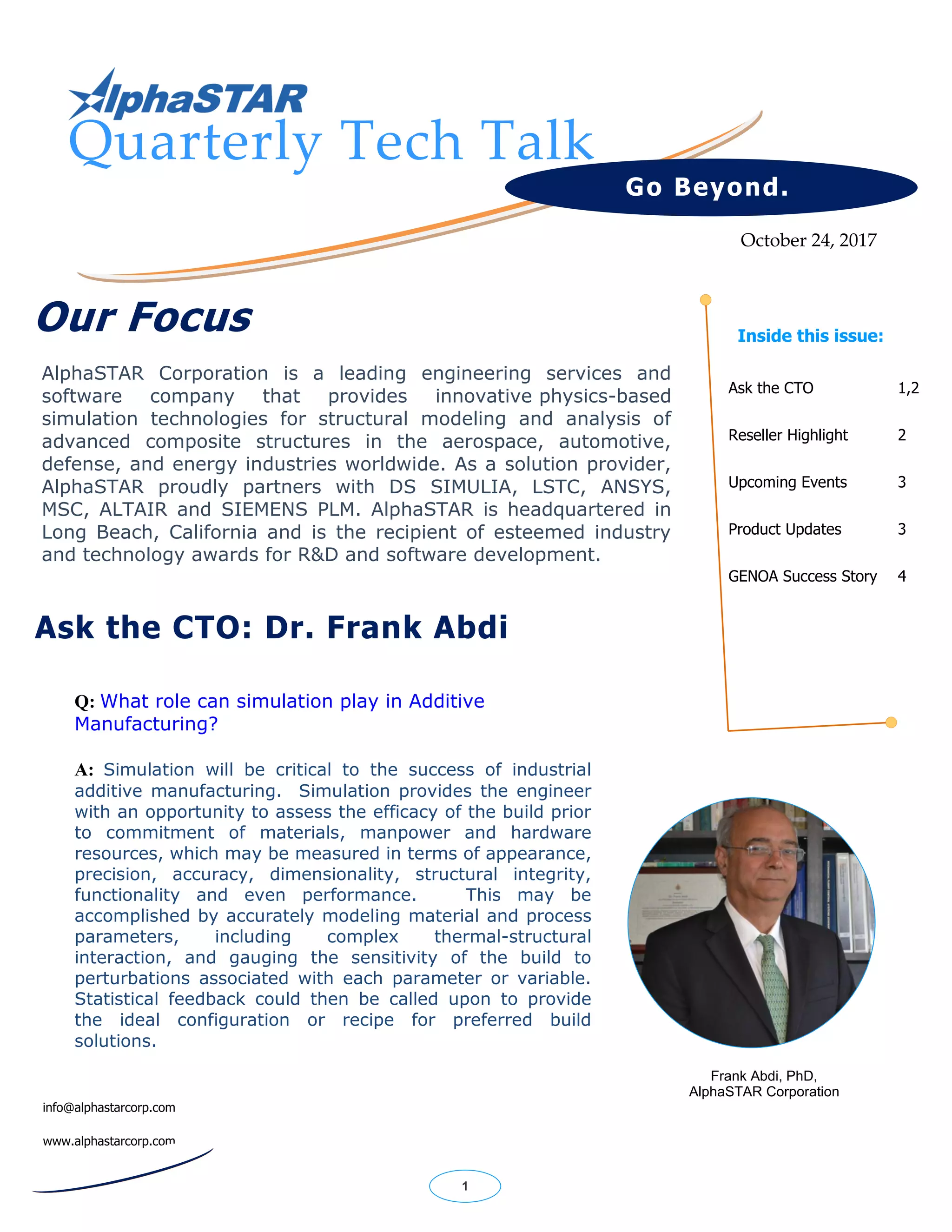
Q: What role can simulation play in Additive
Manufacturing?
A: Simulation will be critical to the success of industrial
additive manufacturing. Simulation provides the engineer
with an opportunity to assess the efficacy of the build prior
to commitment of materials, manpower and hardware
resources, which may be measured in terms of appearance,
precision, accuracy, dimensionality, structural integrity,
functionality and even performance. This may be
accomplished by accurately modeling material and process
parameters, including complex thermal-structural
interaction, and gauging the sensitivity of the build to
perturbations associated with each parameter or variable.
Statistical feedback could then be called upon to provide
the ideal configuration or recipe for preferred build
solutions.
Ask the CTO: Dr. Frank Abdi
Frank Abdi, PhD,
AlphaSTAR Corporation
Inside this issue:
1
Ask the CTO 1,2
Reseller Highlight 2
Upcoming Events 3
Product Updates 3
GENOA Success Story 4
Go Beyond.
info@alphastarcorp.com
www.alphastarcorp.com
Our Focus
AlphaSTAR Corporation is a leading engineering services and
software company that provides innovative physics-based
simulation technologies for structural modeling and analysis of
advanced composite structures in the aerospace, automotive,
defense, and energy industries worldwide. As a solution provider,
AlphaSTAR proudly partners with DS SIMULIA, LSTC, ANSYS,
MSC, ALTAIR and SIEMENS PLM. AlphaSTAR is headquartered in
Long Beach, California and is the recipient of esteemed industry
and technology awards for R&D and software development.
Did You Know?
 With GENOA, you can predict
structural performance considering
the effect
 The MCQ Suite of Softwares can
reduce your testing, leading to cost
savings
 MCQ has a material database for
several validated classes of
Thermoplastic, Elastomer and
Thermoset
 You can identify scatter,
uncertainty, sensitivity for process
and material optimization with
GENOA 3DP Simulation
Meet: MVT Group
Q: Is this a technology for today or a technology for
tomorrow?
A: AM is a technology for now. Science is always evolving and
finding solutions to new problems as we move into the future.
Additive Manufacturing is part of that process. It is growing up in
front of our eyes, discovering new things that it can do, and
identifying old things that it can do better than existing
technology. In this manner it is becoming more and more an
integral part of the manufacturing landscape.
2
Q: What breakthroughs do we need to accelerate the growth
of this technology/industry?
A: If I had to define a resource that is needed to drive the growth of
AM, I would start with advanced and efficient personnel training to
develop an army of young people to utilize the technology while
constantly pushing the envelope. In terms of a list of technologies to
support growth in the industry, I would start with material science
and material modeling because of my academic and professional
bias. After that I would include physics, chemistry, biochemistry, to
understand processes at the lowest level. Advances in printing
technology would help to address variations in performance related
to material, scale and speed, i.e. can we build faster, larger and with
equivalent material properties. Exploitation of advanced computer
hardware, optical precision, and real-time sensor technology with
prognostic/diagnostic feedback would help to perfect the build.
Finally computational modeling coupled with advanced physics to
predict actual outcomes and optimize the results.
Headquartered in Shanghai with branches in Beijing and Chengdu, Multiangle
Virtual Technology (MVT) is committed to providing composite solutions to the
Chinese Aerospace & Automotive markets. From physical testing to simulation
software, MVT offers a full scope of services.
With a long history in the simulation software field, Dolphin Qui, MVT
President, has been able to emphasize the value of ASC products to numerous
Chinese companies, including AVIC Composites and China Commercial Aircraft
Engine Co. Both companies were convinced to bring the technology in house after
the software showed to be superior to what is offered by competitive vendors.
As part of the effort to penetrate the Chinese Market, MVT is conducting
training seminars to increase knowledge of the technology. Most recently, they
conducted a 2 day workshop for a large Aircraft Manufacturer in Shanghai. As
Industry in China becomes cognizant of the value of composite materials, we
foresees a vast application of GENOA & MCQ in solving critical design and analysis
challenges and satisfying their needs across the board.
ABOUT MVT: MVT has been a reseller of AlphaSTAR products since 2014.
Q: Who will lead this technological revolution?
A: Everyone younger than me!
ASIDIC Conference – NIAR 2017 October 17 - 19, 2017
Additive Aerospace Summit 2017 October 18 - 20, 2017
AIRTEC 2017 October 24 - 26, 2017
CAMX 2017 December 12 – 14, 2017
AIAA Scitech 2018 January 8 - 12, 2018
 3D Printing Simulation Supporting
Multiple G-Code Formats
 Integrated with ABAQUS, LS-DYNA &
ANSYS Interface
 Fatigue Analysis for ABAQUS UMAT
 ABAQUS CAE Plug-in. Pre-process with
MCQ. Run PFA subroutine inside ABAQUS
CAE. Post-process with GENOA GUI to
view damage at each iteration
 44 Step-by-Step Tutorials
 31 Test Validation Examples
 37 Code Verification
What’s New with ASC Products?
 Curing Analysis
 Multi-factor Interactive Equations
for Moisture & Temperature Affect
 Enhanced Formulation for Waviness
under Tension & Compression
 52 Test Validation Examples
 6 Step-by-Step Tutorials
 7 ABAQUS CAE Plug-in Tutorials
Find Us at These Upcoming Events:
“2018 is promising to be
a very exciting year for
ASC in light of releasing
our GENOA 3DP
software tool and the
explosive advancements it
brings to the Additive
Manufacturing stage
globally”
Kay Matin
ASC President
 3D Printing Test Validated Material
Modeling
 Micro-mechanics Assisted Nano-
mechanics Fatigue Analysis for
Discontinuous Fibers
 24 Test Validation Examples
 2 Step-by-Step Tutorials
3
As Industry transition to
composite materials, advanced
simulation tools have become
paramount in providing engineers
with accurate analysis of structural &
component performance. As the use
of composite materials has grown,
‘Virtual Testing’ of these materials
has grown with it.
Hindustan Aeronautics Limited,
an Aerospace & Defense organization
fully owned by the Government of
India, began transitioning to
composite materials in 2007. Dr. R.
Vijaya Kumar, Senior Manager Stress
Analysis in the Rotary Wing R&D
Center has the responsibility of
ensuring reliable service life of parts
and structures.
.
GENOA Success Story: Hindustan Aeronautics Limited
4
As Dr. Vijaya Kumar explains,
“…using the GENOA Multi-Scale PFA
software, we were able to gain
valuable insight into damage and
fatigue tolerance of the rotor craft
and able to identify damage and
fracture modes, types of flaws
initiating the fracture modes as well
as propagation of damage at critical
locations”
With test validated software
handling the analysis, end users
have confidence in accurate
computational results that solve their
real world applications.
ABOUT HAL: HAL is an aerospace and defense organization based in Bangalore, Karnataka. Established
in 1940, as Hindustan Aircraft, HAL has evolved into an Indian conglomerate. With a focus on
manufacturing and assembly of aircraft, navigation and equipment operations, HAL has a long history of
collaborating with both domestic and international aerospace agencies. With over 32,000 employees,
HAL continues to serve at the forefront of the Indian Aerospace Industry. For more information, please
visit www.hal-india.com
info@alphastarcorp.com
www.alphastarcorp.com

Quarterly Tech Talk with AlphaSTAR

  • 1.
    Quarterly Tech Talk October24, 2017 Q: What role can simulation play in Additive Manufacturing? A: Simulation will be critical to the success of industrial additive manufacturing. Simulation provides the engineer with an opportunity to assess the efficacy of the build prior to commitment of materials, manpower and hardware resources, which may be measured in terms of appearance, precision, accuracy, dimensionality, structural integrity, functionality and even performance. This may be accomplished by accurately modeling material and process parameters, including complex thermal-structural interaction, and gauging the sensitivity of the build to perturbations associated with each parameter or variable. Statistical feedback could then be called upon to provide the ideal configuration or recipe for preferred build solutions. Ask the CTO: Dr. Frank Abdi Frank Abdi, PhD, AlphaSTAR Corporation Inside this issue: 1 Ask the CTO 1,2 Reseller Highlight 2 Upcoming Events 3 Product Updates 3 GENOA Success Story 4 Go Beyond. info@alphastarcorp.com www.alphastarcorp.com Our Focus AlphaSTAR Corporation is a leading engineering services and software company that provides innovative physics-based simulation technologies for structural modeling and analysis of advanced composite structures in the aerospace, automotive, defense, and energy industries worldwide. As a solution provider, AlphaSTAR proudly partners with DS SIMULIA, LSTC, ANSYS, MSC, ALTAIR and SIEMENS PLM. AlphaSTAR is headquartered in Long Beach, California and is the recipient of esteemed industry and technology awards for R&D and software development.
  • 2.
    Did You Know? With GENOA, you can predict structural performance considering the effect  The MCQ Suite of Softwares can reduce your testing, leading to cost savings  MCQ has a material database for several validated classes of Thermoplastic, Elastomer and Thermoset  You can identify scatter, uncertainty, sensitivity for process and material optimization with GENOA 3DP Simulation Meet: MVT Group Q: Is this a technology for today or a technology for tomorrow? A: AM is a technology for now. Science is always evolving and finding solutions to new problems as we move into the future. Additive Manufacturing is part of that process. It is growing up in front of our eyes, discovering new things that it can do, and identifying old things that it can do better than existing technology. In this manner it is becoming more and more an integral part of the manufacturing landscape. 2 Q: What breakthroughs do we need to accelerate the growth of this technology/industry? A: If I had to define a resource that is needed to drive the growth of AM, I would start with advanced and efficient personnel training to develop an army of young people to utilize the technology while constantly pushing the envelope. In terms of a list of technologies to support growth in the industry, I would start with material science and material modeling because of my academic and professional bias. After that I would include physics, chemistry, biochemistry, to understand processes at the lowest level. Advances in printing technology would help to address variations in performance related to material, scale and speed, i.e. can we build faster, larger and with equivalent material properties. Exploitation of advanced computer hardware, optical precision, and real-time sensor technology with prognostic/diagnostic feedback would help to perfect the build. Finally computational modeling coupled with advanced physics to predict actual outcomes and optimize the results. Headquartered in Shanghai with branches in Beijing and Chengdu, Multiangle Virtual Technology (MVT) is committed to providing composite solutions to the Chinese Aerospace & Automotive markets. From physical testing to simulation software, MVT offers a full scope of services. With a long history in the simulation software field, Dolphin Qui, MVT President, has been able to emphasize the value of ASC products to numerous Chinese companies, including AVIC Composites and China Commercial Aircraft Engine Co. Both companies were convinced to bring the technology in house after the software showed to be superior to what is offered by competitive vendors. As part of the effort to penetrate the Chinese Market, MVT is conducting training seminars to increase knowledge of the technology. Most recently, they conducted a 2 day workshop for a large Aircraft Manufacturer in Shanghai. As Industry in China becomes cognizant of the value of composite materials, we foresees a vast application of GENOA & MCQ in solving critical design and analysis challenges and satisfying their needs across the board. ABOUT MVT: MVT has been a reseller of AlphaSTAR products since 2014. Q: Who will lead this technological revolution? A: Everyone younger than me!
  • 3.
    ASIDIC Conference –NIAR 2017 October 17 - 19, 2017 Additive Aerospace Summit 2017 October 18 - 20, 2017 AIRTEC 2017 October 24 - 26, 2017 CAMX 2017 December 12 – 14, 2017 AIAA Scitech 2018 January 8 - 12, 2018  3D Printing Simulation Supporting Multiple G-Code Formats  Integrated with ABAQUS, LS-DYNA & ANSYS Interface  Fatigue Analysis for ABAQUS UMAT  ABAQUS CAE Plug-in. Pre-process with MCQ. Run PFA subroutine inside ABAQUS CAE. Post-process with GENOA GUI to view damage at each iteration  44 Step-by-Step Tutorials  31 Test Validation Examples  37 Code Verification What’s New with ASC Products?  Curing Analysis  Multi-factor Interactive Equations for Moisture & Temperature Affect  Enhanced Formulation for Waviness under Tension & Compression  52 Test Validation Examples  6 Step-by-Step Tutorials  7 ABAQUS CAE Plug-in Tutorials Find Us at These Upcoming Events: “2018 is promising to be a very exciting year for ASC in light of releasing our GENOA 3DP software tool and the explosive advancements it brings to the Additive Manufacturing stage globally” Kay Matin ASC President  3D Printing Test Validated Material Modeling  Micro-mechanics Assisted Nano- mechanics Fatigue Analysis for Discontinuous Fibers  24 Test Validation Examples  2 Step-by-Step Tutorials 3
  • 4.
    As Industry transitionto composite materials, advanced simulation tools have become paramount in providing engineers with accurate analysis of structural & component performance. As the use of composite materials has grown, ‘Virtual Testing’ of these materials has grown with it. Hindustan Aeronautics Limited, an Aerospace & Defense organization fully owned by the Government of India, began transitioning to composite materials in 2007. Dr. R. Vijaya Kumar, Senior Manager Stress Analysis in the Rotary Wing R&D Center has the responsibility of ensuring reliable service life of parts and structures. . GENOA Success Story: Hindustan Aeronautics Limited 4 As Dr. Vijaya Kumar explains, “…using the GENOA Multi-Scale PFA software, we were able to gain valuable insight into damage and fatigue tolerance of the rotor craft and able to identify damage and fracture modes, types of flaws initiating the fracture modes as well as propagation of damage at critical locations” With test validated software handling the analysis, end users have confidence in accurate computational results that solve their real world applications. ABOUT HAL: HAL is an aerospace and defense organization based in Bangalore, Karnataka. Established in 1940, as Hindustan Aircraft, HAL has evolved into an Indian conglomerate. With a focus on manufacturing and assembly of aircraft, navigation and equipment operations, HAL has a long history of collaborating with both domestic and international aerospace agencies. With over 32,000 employees, HAL continues to serve at the forefront of the Indian Aerospace Industry. For more information, please visit www.hal-india.com info@alphastarcorp.com www.alphastarcorp.com