Lesson 1
Valuing Our Elders’ Wisdom
Your Goals
This lesson allows you to appreciate the
wisdom of our ancestors that continues to
influence our experiences.
Discover how their proverbs serve as
guideposts towards strengthening our
values.
You must aim to:
express whether a statement is true or false
based on what you know.
recognize differences in voice levels and
speech patterns.
determine words or expressions in a
selection that are similar or opposite.
Your Initial Tasks
In your notebook, write T if the
statement is true according to what
you know and F if it is false.
Be ready to explain your answer with
a partner.
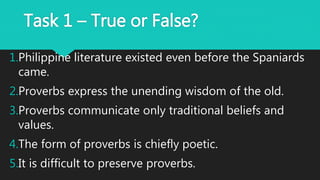
Task 1 – True or False?
1.Philippine literature existed even before the Spaniards
came.
2.Proverbs express the unending wisdom of the old.
3.Proverbs communicate only traditional beliefs and
values.
4.The form of proverbs is chiefly poetic.
5.It is difficult to preserve proverbs.
You have 10 minutes to
discuss your answer with a
partner.
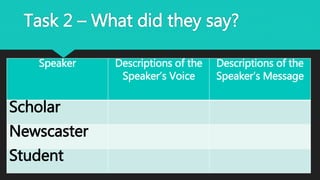
Task 2 – What did they say?
Speaker Descriptions of the
Speaker’s Voice
Descriptions of the
Speaker’s Message
Scholar
Newscaster
Student
Activity
In each group, read the three statements of different
speakers. Read with different levels of voice and
speech patterns.
 Make inferences about what was listened to using the
grid.
Make generalizations that differences in voice levels
and speech patterns affect our understanding of what
we listen to.
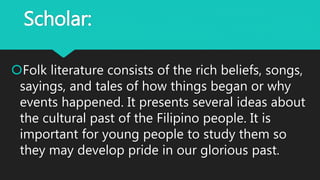
Scholar:
Folk literature consists of the rich beliefs, songs,
sayings, and tales of how things began or why
events happened. It presents several ideas about
the cultural past of the Filipino people. It is
important for young people to study them so
they may develop pride in our glorious past.
Newscaster:
We are here at the launch of a new
book of Philippine folk literature.
Hundreds of scholars and students are
gathered here at the National Library
for this event.
Newscaster:
The phenomenal book was written by
renowned anthropologist Dr. Ishmael
Santos who believes that we need to
preserve the poems and stories of our
ancestors as part of our cultural identity.
Newscaster:
The book is available at all leading
bookstores nationwide for a reasonable
price of one thousand three hundred
forty five pesos only. Hurry and get your
copies now!
Student:
I believe that young people should continue to read
the sayings and stories crafted by our ancestors and
passed on to generations of citizens. It is our gateway
to appreciating their lifestyle, aspirations, and vision. I
am not sure if we would grow up to become good
citizens if we do not have an appreciation and valuing
of these national treasures.
You have 15 minutes to
discuss your answer with your
groupmates.
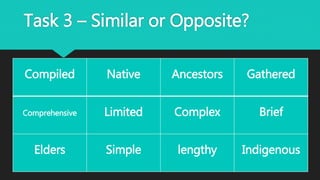
Task 3 – Similar or Opposite?
In terms of meaning, a word may be
synonymous (similar) or antonymous
(opposite) to another. Form the correct
pairs of synonyms and antonyms used in
the following selection.
Task 3 – Similar or Opposite?
Compiled Native Ancestors Gathered
Comprehensive Limited Complex Brief
Elders Simple lengthy Indigenous
Task 3 – Similar or Opposite?
Synonyms Antonyms
You have 5 minutes to
answer this activity with a
partner.
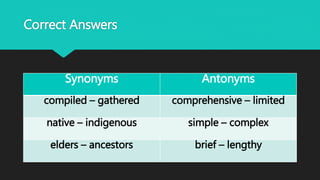
Correct Answers
Synonyms Antonyms
compiled – gathered comprehensive – limited
native – indigenous simple – complex
elders – ancestors brief – lengthy
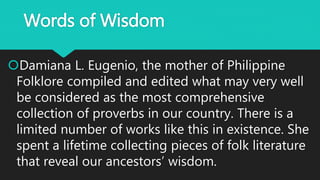
Words of Wisdom
Damiana L. Eugenio, the mother of Philippine
Folklore compiled and edited what may very well
be considered as the most comprehensive
collection of proverbs in our country. There is a
limited number of works like this in existence. She
spent a lifetime collecting pieces of folk literature
that reveal our ancestors’ wisdom.
When she gathered proverbs from various
areas in our country, she declared that our
elders lived by simple, yet very meaningful rules
of righteous living. In fact, she asserted that
even the Spaniards who colonized our country
noticed how proverbs formed part of the native
spirit.
Spanish missionaries were found to have
translated such proverbs and other oral
expressions in Spanish in order for their fellow
religious people to learn our indigenous
languages. By doing so, they were able to
interact with the early Filipinos eventually
introduce the Catholic faith.
Proverbs are brief instructive
expressions that suggest a specific
action, behavior, or judgment.
Referred to by some scholars as “the wisdom of
many and the wit of one”, they are commonly
written in the form of short assertions or poetic
two-liners which have rhyme. It is interesting to
note that people are easily stuck by proverbs
when they are woven in conversations or
writings.
This is perhaps because they have the power to
teach people the more essential truths about life
and the complexity of living. Compared to
lengthy narrations, descriptions, or
argumentations, proverbs are able to effect
quickly a change in view or disposition.
Proverbs are called salawikain or sawikain in
Tagalog or sarsarita in Ilocano. Like most
proverbs the world over, Philippine proverbs
contain sayings which prescribes norms, imparts
a lesson or simply reflects standard norms,
traditions and beliefs in the community.
Professor Damiana Eugenio classifies Philippine
proverbs into six groups according to subject
matter. These are:
(1) proverbs expressing a general attitude towards
life and the laws that govern life;
(2) ethical proverbs recommending certain virtues
and condemning certain vices;
(3) proverbs expressing a system of values;
(4) proverbs expressing general truths and
observations about life and human nature;
(5) humorous proverbs and
(6) miscellaneous proverbs.
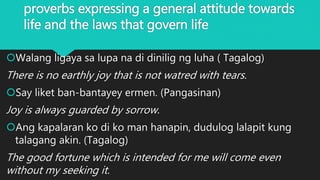
proverbs expressing a general attitude towards
life and the laws that govern life
Walang ligaya sa lupa na di dinilig ng luha ( Tagalog)
There is no earthly joy that is not watred with tears.
Say liket ban-bantayey ermen. (Pangasinan)
Joy is always guarded by sorrow.
Ang kapalaran ko di ko man hanapin, dudulog lalapit kung
talagang akin. (Tagalog)
The good fortune which is intended for me will come even
without my seeking it.
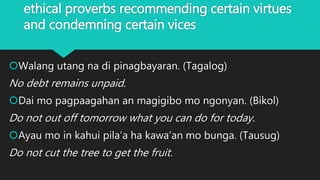
ethical proverbs recommending certain virtues
and condemning certain vices
Walang utang na di pinagbayaran. (Tagalog)
No debt remains unpaid.
Dai mo pagpaagahan an magigibo mo ngonyan. (Bikol)
Do not out off tomorrow what you can do for today.
Ayau mo in kahui pila’a ha kawa’an mo bunga. (Tausug)
Do not cut the tree to get the fruit.
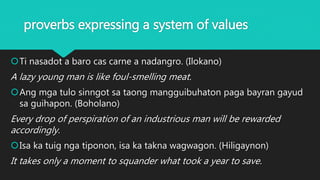
proverbs expressing a system of values
Ti nasadot a baro cas carne a nadangro. (Ilokano)
A lazy young man is like foul-smelling meat.
Ang mga tulo sinngot sa taong mangguibuhaton paga bayran gayud
sa guihapon. (Boholano)
Every drop of perspiration of an industrious man will be rewarded
accordingly.
Isa ka tuig nga tiponon, isa ka takna wagwagon. (Hiligaynon)
It takes only a moment to squander what took a year to save.
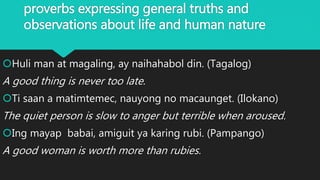
proverbs expressing general truths and
observations about life and human nature
Huli man at magaling, ay naihahabol din. (Tagalog)
A good thing is never too late.
Ti saan a matimtemec, nauyong no macaunget. (Ilokano)
The quiet person is slow to anger but terrible when aroused.
Ing mayap babai, amiguit ya karing rubi. (Pampango)
A good woman is worth more than rubies.
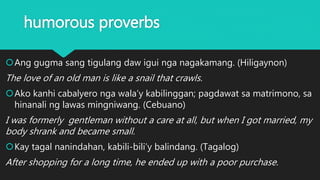
humorous proverbs
Ang gugma sang tigulang daw igui nga nagakamang. (Hiligaynon)
The love of an old man is like a snail that crawls.
Ako kanhi cabalyero nga wala’y kabilinggan; pagdawat sa matrimono, sa
hinanali ng lawas mingniwang. (Cebuano)
I was formerly gentleman without a care at all, but when I got married, my
body shrank and became small.
Kay tagal nanindahan, kabili-bili’y balindang. (Tagalog)
After shopping for a long time, he ended up with a poor purchase.
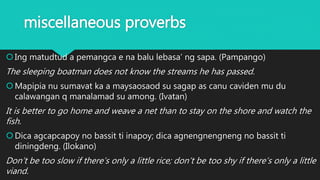
miscellaneous proverbs
Ing matudtud a pemangca e na balu lebasa’ ng sapa. (Pampango)
The sleeping boatman does not know the streams he has passed.
Mapipia nu sumavat ka a maysaosaod su sagap as canu caviden mu du
calawangan q manalamad su among. (Ivatan)
It is better to go home and weave a net than to stay on the shore and watch the
fish.
Dica agcapcapoy no bassit ti inapoy; dica agnengnengneng no bassit ti
diningdeng. (Ilokano)
Don’t be too slow if there’s only a little rice; don’t be too shy if there’s only a little
viand.
Our proverbs are not only witty expressions.
They are also our cultural treasures. As we
continue to use them in various spoken or
written forms and as we explore ways of
representing them in graphic, musical, or
dramatic modes, we facilitate their preservation.
And through these, we strengthen out identity as
a people.

Quarter 1 lesson 1

  • 1.
    Lesson 1 Valuing OurElders’ Wisdom
  • 2.
    Your Goals This lessonallows you to appreciate the wisdom of our ancestors that continues to influence our experiences. Discover how their proverbs serve as guideposts towards strengthening our values.
  • 3.
    You must aimto: express whether a statement is true or false based on what you know. recognize differences in voice levels and speech patterns. determine words or expressions in a selection that are similar or opposite.
  • 4.
    Your Initial Tasks Inyour notebook, write T if the statement is true according to what you know and F if it is false. Be ready to explain your answer with a partner.
  • 5.
    Task 1 –True or False? 1.Philippine literature existed even before the Spaniards came. 2.Proverbs express the unending wisdom of the old. 3.Proverbs communicate only traditional beliefs and values. 4.The form of proverbs is chiefly poetic. 5.It is difficult to preserve proverbs.
  • 6.
    You have 10minutes to discuss your answer with a partner.
  • 7.
    Task 2 –What did they say? Speaker Descriptions of the Speaker’s Voice Descriptions of the Speaker’s Message Scholar Newscaster Student
  • 8.
    Activity In each group,read the three statements of different speakers. Read with different levels of voice and speech patterns.  Make inferences about what was listened to using the grid. Make generalizations that differences in voice levels and speech patterns affect our understanding of what we listen to.
  • 9.
    Scholar: Folk literature consistsof the rich beliefs, songs, sayings, and tales of how things began or why events happened. It presents several ideas about the cultural past of the Filipino people. It is important for young people to study them so they may develop pride in our glorious past.
  • 10.
    Newscaster: We are hereat the launch of a new book of Philippine folk literature. Hundreds of scholars and students are gathered here at the National Library for this event.
  • 11.
    Newscaster: The phenomenal bookwas written by renowned anthropologist Dr. Ishmael Santos who believes that we need to preserve the poems and stories of our ancestors as part of our cultural identity.
  • 12.
    Newscaster: The book isavailable at all leading bookstores nationwide for a reasonable price of one thousand three hundred forty five pesos only. Hurry and get your copies now!
  • 13.
    Student: I believe thatyoung people should continue to read the sayings and stories crafted by our ancestors and passed on to generations of citizens. It is our gateway to appreciating their lifestyle, aspirations, and vision. I am not sure if we would grow up to become good citizens if we do not have an appreciation and valuing of these national treasures.
  • 14.
    You have 15minutes to discuss your answer with your groupmates.
  • 15.
    Task 3 –Similar or Opposite? In terms of meaning, a word may be synonymous (similar) or antonymous (opposite) to another. Form the correct pairs of synonyms and antonyms used in the following selection.
  • 16.
    Task 3 –Similar or Opposite? Compiled Native Ancestors Gathered Comprehensive Limited Complex Brief Elders Simple lengthy Indigenous
  • 17.
    Task 3 –Similar or Opposite? Synonyms Antonyms
  • 18.
    You have 5minutes to answer this activity with a partner.
  • 19.
    Correct Answers Synonyms Antonyms compiled– gathered comprehensive – limited native – indigenous simple – complex elders – ancestors brief – lengthy
  • 20.
    Words of Wisdom DamianaL. Eugenio, the mother of Philippine Folklore compiled and edited what may very well be considered as the most comprehensive collection of proverbs in our country. There is a limited number of works like this in existence. She spent a lifetime collecting pieces of folk literature that reveal our ancestors’ wisdom.
  • 21.
    When she gatheredproverbs from various areas in our country, she declared that our elders lived by simple, yet very meaningful rules of righteous living. In fact, she asserted that even the Spaniards who colonized our country noticed how proverbs formed part of the native spirit.
  • 22.
    Spanish missionaries werefound to have translated such proverbs and other oral expressions in Spanish in order for their fellow religious people to learn our indigenous languages. By doing so, they were able to interact with the early Filipinos eventually introduce the Catholic faith.
  • 23.
    Proverbs are briefinstructive expressions that suggest a specific action, behavior, or judgment.
  • 24.
    Referred to bysome scholars as “the wisdom of many and the wit of one”, they are commonly written in the form of short assertions or poetic two-liners which have rhyme. It is interesting to note that people are easily stuck by proverbs when they are woven in conversations or writings.
  • 25.
    This is perhapsbecause they have the power to teach people the more essential truths about life and the complexity of living. Compared to lengthy narrations, descriptions, or argumentations, proverbs are able to effect quickly a change in view or disposition.
  • 26.
    Proverbs are calledsalawikain or sawikain in Tagalog or sarsarita in Ilocano. Like most proverbs the world over, Philippine proverbs contain sayings which prescribes norms, imparts a lesson or simply reflects standard norms, traditions and beliefs in the community. Professor Damiana Eugenio classifies Philippine proverbs into six groups according to subject matter. These are:
  • 27.
    (1) proverbs expressinga general attitude towards life and the laws that govern life; (2) ethical proverbs recommending certain virtues and condemning certain vices; (3) proverbs expressing a system of values;
  • 28.
    (4) proverbs expressinggeneral truths and observations about life and human nature; (5) humorous proverbs and (6) miscellaneous proverbs.
  • 29.
    proverbs expressing ageneral attitude towards life and the laws that govern life Walang ligaya sa lupa na di dinilig ng luha ( Tagalog) There is no earthly joy that is not watred with tears. Say liket ban-bantayey ermen. (Pangasinan) Joy is always guarded by sorrow. Ang kapalaran ko di ko man hanapin, dudulog lalapit kung talagang akin. (Tagalog) The good fortune which is intended for me will come even without my seeking it.
  • 30.
    ethical proverbs recommendingcertain virtues and condemning certain vices Walang utang na di pinagbayaran. (Tagalog) No debt remains unpaid. Dai mo pagpaagahan an magigibo mo ngonyan. (Bikol) Do not out off tomorrow what you can do for today. Ayau mo in kahui pila’a ha kawa’an mo bunga. (Tausug) Do not cut the tree to get the fruit.
  • 31.
    proverbs expressing asystem of values Ti nasadot a baro cas carne a nadangro. (Ilokano) A lazy young man is like foul-smelling meat. Ang mga tulo sinngot sa taong mangguibuhaton paga bayran gayud sa guihapon. (Boholano) Every drop of perspiration of an industrious man will be rewarded accordingly. Isa ka tuig nga tiponon, isa ka takna wagwagon. (Hiligaynon) It takes only a moment to squander what took a year to save.
  • 32.
    proverbs expressing generaltruths and observations about life and human nature Huli man at magaling, ay naihahabol din. (Tagalog) A good thing is never too late. Ti saan a matimtemec, nauyong no macaunget. (Ilokano) The quiet person is slow to anger but terrible when aroused. Ing mayap babai, amiguit ya karing rubi. (Pampango) A good woman is worth more than rubies.
  • 33.
    humorous proverbs Ang gugmasang tigulang daw igui nga nagakamang. (Hiligaynon) The love of an old man is like a snail that crawls. Ako kanhi cabalyero nga wala’y kabilinggan; pagdawat sa matrimono, sa hinanali ng lawas mingniwang. (Cebuano) I was formerly gentleman without a care at all, but when I got married, my body shrank and became small. Kay tagal nanindahan, kabili-bili’y balindang. (Tagalog) After shopping for a long time, he ended up with a poor purchase.
  • 34.
    miscellaneous proverbs Ing matudtuda pemangca e na balu lebasa’ ng sapa. (Pampango) The sleeping boatman does not know the streams he has passed. Mapipia nu sumavat ka a maysaosaod su sagap as canu caviden mu du calawangan q manalamad su among. (Ivatan) It is better to go home and weave a net than to stay on the shore and watch the fish. Dica agcapcapoy no bassit ti inapoy; dica agnengnengneng no bassit ti diningdeng. (Ilokano) Don’t be too slow if there’s only a little rice; don’t be too shy if there’s only a little viand.
  • 35.
    Our proverbs arenot only witty expressions. They are also our cultural treasures. As we continue to use them in various spoken or written forms and as we explore ways of representing them in graphic, musical, or dramatic modes, we facilitate their preservation. And through these, we strengthen out identity as a people.