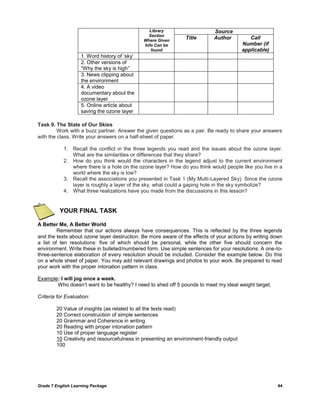
Learning Package
                              Grade 7 English
                               First Quarter


Grade 7 English Learning Package                1
To our dear learners,

        Welcome to a new year of discoveries and explorations!

     This package is intended to assist you in your journey into
using English in making and transferring meanings. This set of
materials will help you:

        1.   explore real-life themes, tasks, and situations;
        2.   expose you to a balance of literary and informative texts;
        3.   engage you in an interplay of print and non-print resources;
        4.   enrich your grammar awareness; and
        5.   enhance your information management skills.

     We encourage you to take good care of this material. Your
responsibility in using and maintaining it will be appreciated by the
succeeding generations of learners.

        Have a meaningful journey!


                                              The Learning Area Team
                                     for Languages and Multiliteracies


Grade 7 English Learning Package                                        2
Lesson 1
                                                   Valuing Our Elders’ Wisdom


             YOUR GOALS

          This lesson allows you to appreciate the wisdom of our ancestors that
continues to influence our experiences. Discover how their proverbs serve as
guideposts towards strengthening our values. You must aim to:

    1.   Express whether a statement is true or false based on what you know.
    2.   Recognize differences in voice levels and speech patterns.
    3.   Determine words or expressions in a selection that are similar or opposite.
    4.   Use information presented in an article to infer, to evaluate, and to express
         critical ideas.
    5.   Discuss the features of proverbs, their intended purpose, and the setting during
         which they were produced.
    6.   Use appropriate volume and enunciation in a given communication situation.
    7.   Identify the unique features and properties of oral language.
    8.   Observe rules on subject-verb agreement.
    9.   Recognize the features and codes of the library‘s information sources.


           YOUR INITIAL TASKS


Task 1. True or False?

      On a half-sheet of paper, write T if the statement is true according to what you
know and F if it is false. Be ready to explain your answer with a partner.


_____ 1. Philippine literature existed even before the Spaniards came.

_____ 2. Proverbs express the unending wisdom of the old.

_____ 3. Proverbs communicate only traditional beliefs and values.

_____ 4. The form of proverbs is chiefly poetic.

_____ 5. It is difficult to preserve proverbs.


Grade 7 English Learning Package                                                        3
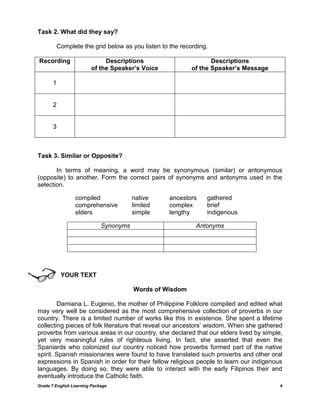
Task 2. What did they say?

        Complete the grid below as you listen to the recording.

Recording                    Descriptions                        Descriptions
                        of the Speaker’s Voice            of the Speaker’s Message

       1


       2


       3


Task 3. Similar or Opposite?

       In terms of meaning, a word may be synonymous (similar) or antonymous
(opposite) to another. Form the correct pairs of synonyms and antonyms used in the
selection.

                 compiled               native    ancestors   gathered
                 comprehensive          limited   complex     brief
                 elders                 simple    lengthy     indigenous

                             Synonyms                      Antonyms


           YOUR TEXT

                                        Words of Wisdom

        Damiana L. Eugenio, the mother of Philippine Folklore compiled and edited what
may very well be considered as the most comprehensive collection of proverbs in our
country. There is a limited number of works like this in existence. She spent a lifetime
collecting pieces of folk literature that reveal our ancestors‘ wisdom. When she gathered
proverbs from various areas in our country, she declared that our elders lived by simple,
yet very meaningful rules of righteous living. In fact, she asserted that even the
Spaniards who colonized our country noticed how proverbs formed part of the native
spirit. Spanish missionaries were found to have translated such proverbs and other oral
expressions in Spanish in order for their fellow religious people to learn our indigenous
languages. By doing so, they were able to interact with the early Filipinos their and
eventually introduce the Catholic faith.
Grade 7 English Learning Package                                                        4
Proverbs are brief instructive expressions that suggest a specific action,
behavior, or judgment. Referred to by some scholars as ―the wisdom of many and the
wit of one‖, they are commonly written in the form of short assertions or poetic two-liners
which have rhyme. It is interesting to note that people are easily struck by proverbs
when they are woven in conversations or writings. This is perhaps because they have
the power to teach people the more essential truths about life and the complexity of
living. Compared to lengthy narrations, descriptions, or argumentations, proverbs are
able to effect quickly a change in view or disposition.

       In Filipino, proverbs are called salawikain or sawikain. They prescribe norms,
impart a lesson, or emphasize traditions and beliefs in a community. In the anthology of
Damiana L. Eugenio, she classified proverbs into six categories: (1) proverbs
expressing a general attitude towards life and the laws that govern life; (2) ethical
proverbs recommending certain virtues and condemning certain vices; (3) proverbs
expressing a system of values; (4) proverbs expressing general truths and observations
about life and human nature; (5) humorous proverbs and (6) miscellaneous proverbs.
Below are examples of each category.


    1. Proverbs expressing a general attitude towards life and the laws that govern life

        Walang ligaya sa lupa na di dinilig ng luha. (Tagalog)
        There is no earthly joy that is not watered with tears.

        Say liket ban-bantayey ermen. (Pangasinan)
        Joy is always guarded by sorrow.

        Ang kapalaran ko di ko man hanapin, dudulog lalapit kung talagang akin.
        (Tagalog)
        The good fortune which is intended for me will come even without my seeking it.

    2. Ethical proverbs recommending certain virtues and condemning certain vices

        Walang utang na di pinagbayaran. (Tagalog)
        No debt remains unpaid.

        Dai mo pagpaagahan an magigibo mo ngonyan. (Bikol)
        Do not put off for tomorrow what you can do for today.

        Ayau mo in kahui pila‟a ha kawa‟an mo bunga. (Tausug)
        Do not cut the tree to get the fruit.

    3. Proverbs expressing a system of values

        Ti nasadot a baro cas carne a nadangro. (Ilokano)
        A lazy young man is like foul-smelling meat.

        Ang mga tulo singgot sa taong mangguibuhaton paga bayran gayud sa
        guihapon. (Boholano)
Grade 7 English Learning Package                                                           5
Every drop of perspiration of an industrious man will be rewarded accordingly.

        Isa ka tuig nga tiponon, isa ka takna wagwagon. (Hiligaynon)
        It takes only a moment to squander what took a year to save.

    4. Proverbs expressing general truths and observations about life and human
       nature

        Huli man at magaling, ay naihahabol din. (Tagalog)
        A good thing is never too late.

        Ti saan a matimtemec, nauyong no macaunget. (Ilokano)
        The quite person is slow to anger but terrible when aroused.

        Ing mayap a babai, maiguit ya karing rubi. (Pampango)
        A good woman is worth more than rubies.

    5. Humorous proverbs

        Ang gugma sang tigulang daw igui nga nagakamang. (Hiligaynon)
        The love of an old man is like a snail that crawls.

        Ako kanhi cabalyero nga wala‟y kabilinggan; pagdawat sa matrimonio, sa
        hinanali ng lawas mingniwang. (Cebuano)
        I was formerly a gentleman without a care at all, but when I got married, my body
        shrank and became small.

        Kay tagal nanindahan, kabili-bili‟y balindang. (Tagalog)
        After shopping for a long time, he ended up with a poor purchase.

    6. Miscellaneous proverbs (typically expressive of specific realities to a certain
       area)

        Ing matudtud a pemangca e na balu lebasa‟ ng sapa. (Pampango)
        The sleeping boatman does not know the streams he has passed.

        Mapipia nu sumavat ka a maysaosaod su sagap as canu caviden mu du
        calawangan q manalamad su among. (Ivatan)
        It is better to go home and weave a net than to stay on the shore and watch the
        fish.

        Dica agcapcapoy no bassit ti inapoy; dica agnengnengneng no bassit ti
        diningdeng. (Ilokano)
        Don‘t be too slow if there‘s only a little rice; don‘t be too shy if there‘s only a little
        viand.


Grade 7 English Learning Package                                                                 6
Our proverbs are not only witty expressions. They are also our cultural treasures.
As we continue to use them in various spoken or written forms and as we explore ways
of representing them in graphic, musical, or dramatic modes, we facilitate their
preservation. And through these, we strengthen our identity as a people.


               YOUR DISCOVERY TASKS


Task 1. Locate, Reflect, Evaluate!

        Locate information in the selection to determine whether each statement is true
(T) or false (F).

         _____ 1. Only a few people work on compiling folk literature.
         _____ 2. Proverbs and other forms of folk literature were introduced
                  by the Spaniards.
         _____ 3. Our ancestors‘ proverbs served as guideposts for upright living.
         _____ 4. All proverbs are poetic and figurative in nature.
         _____ 5. Proverbs may have geographical origins.
         _____ 6. People react to the meaning of proverbs quite quickly.
         _____ 7. Proverbs are more superior than other literary forms
                  in expressing messages.
         _____ 8. If proverbs can instruct, they can definitely prescribe.
         _____ 9. It is impossible to classify and categorize our numerous proverbs.
         _____ 10. Our proverbs reflect a lot of things about our culture and identity.


Task 2. Classify!

         Use Damiana Eugenio‘s system to classify the following proverbs. Use the given
codes.

         G       –        proverbs expressing a general attitude towards life and the laws that govern life
         E       –        ethical proverbs recommending certain virtues and condemning certain vices
         V       –        proverbs expressing a system of values
         T       –        proverbs expressing general truths/observations about life and human nature
         H       –        humorous proverbs
         M       –        miscellaneous proverbs


         ____ 1. Matibay ang walis, palibhasa'y magkabigkis.
                 A broom is sturdy because its strands are tightly bound.

         ____ 2. Sa taong walang takot, walang mataas na bakod.
                 To a fearless person, no fence is high enough.

Grade 7 English Learning Package                                                                              7
____ 3. Kung ano ang puno, siya ang bunga.
                Whatever the tree, so is the fruit.

        ____ 4. Aanhin pa ang damo, kung patay na ang kabayo.
                What good is the grass if the horse is already dead.

        ____ 5. Kung may isinuksok, may madudukot.
                If you save, you have something to withdraw.

        ____ 6. Ang magalang na sagot, nakakapawi ng pagod.
                A respectful retort wipes away weariness.

        ____ 7. Ang hindi marunong magmahal sa sariling wika, daig pa ang
                malangsang isda.
                He who does not love the national language is worse than a smelly
                fish.

        ____ 8. Ang mabigat ay gumagaan, kung pinagtutulungan.
                A heavy burden is lightened if everyone participates in carrying it.

        ____ 9. Ang buhay ay parang gulong, minsang nasa ibabaw, minsang nasa
                ilalim.
                Life is like a wheel; sometimes you are on top, sometimes you are in
                the bottom.

        ___ 10. Ang pili ng pili, natatapat sa bungi.
                One who is choosy ends up with the least attractive choice.


Task 3. Tune in!

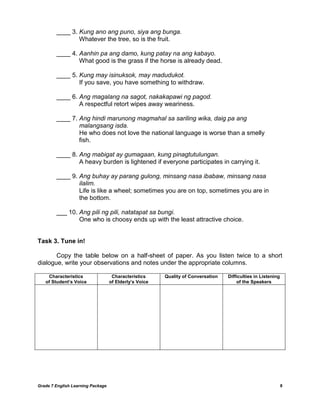
       Copy the table below on a half-sheet of paper. As you listen twice to a short
dialogue, write your observations and notes under the appropriate columns.

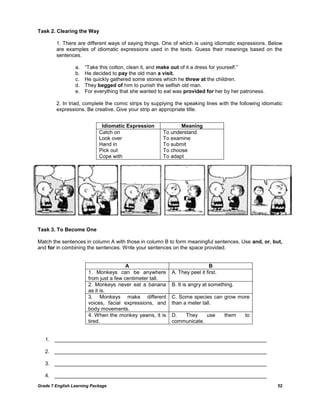
    Characteristics                 Characteristics     Quality of Conversation   Difficulties in Listening
   of Student’s Voice              of Elderly’s Voice                                 of the Speakers


Grade 7 English Learning Package                                                                              8
Task 4. Are You Sure?

        Study each sentence below. If Leo, a student, said it is grammatical and you are
sure it is true, write ‗correct‘. If he said it is ungrammatical and it is indeed true, rewrite
the sentence. Do the same if Leo said it is grammatical but actually, it is not.
                                          Sentence                                            Leo said, it is…      Your Analysis
1. Folk literary forms from our regions are varied.                                         grammatical
2. The researcher with all his assistants explain such claim to be true.                    ungrammatical
3. It was emphasized that the number of folk literary forms have increased.                 ungrammatical
4. The research center which published related reports supports the observation.            grammatical
5. The researcher, accompanied by local translators were able to gather proverbs.           grammatical
6. There are still many questions about folk literature that need to be answered.           grammatical
7. Folk literature, including oral forms remain a source of ethnic knowledge.               ungrammatical
8. The translations of folk literature helps us overcome difficulties in understanding.     grammatical
9. A compilation that contain folk literature has to be given recognition.                  ungrammatical
10. The government with the help of private groups promotes folk literature research.       grammatical


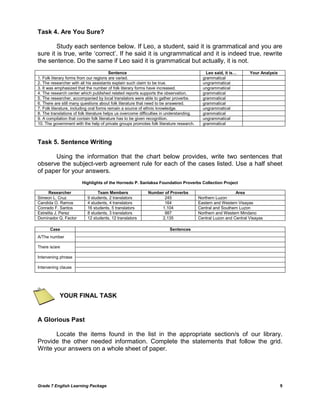
Task 5. Sentence Writing

      Using the information that the chart below provides, write two sentences that
observe the subject-verb agreement rule for each of the cases listed. Use a half sheet
of paper for your answers.
                        Highlights of the Hornedo P. Sanlaksa Foundation Proverbs Collection Project

      Researcher                Team Members                 Number of Proverbs                              Area
Simeon L. Cruz             9 students, 2 translators                245                   Northern Luzon
Candida O. Ramos           4 students, 4 translators                164                   Eastern and Western Visayas
Conrado F. Santos          16 students, 5 translators             1,104                   Central and Southern Luzon
Estrelita J. Perez         8 students, 3 translators                987                   Northern and Western Mindano
Dominador Q. Factor        12 students, 12 translators            2,135                   Central Luzon and Central Visayas

      Case                                                               Sentences
A/The number

There is/are

Intervening phrase

Intervening clause


            YOUR FINAL TASK


A Glorious Past

       Locate the items found in the list in the appropriate section/s of our library.
Provide the other needed information. Complete the statements that follow the grid.
Write your answers on a whole sheet of paper.


Grade 7 English Learning Package                                                                                                    9
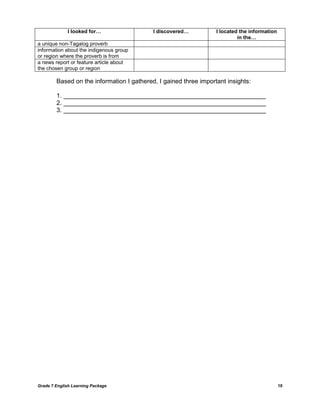
I looked for…                 I discovered…          I located the information
                                                                           in the…
a unique non-Tagalog proverb
information about the indigenous group
or region where the proverb is from
a news report or feature article about
the chosen group or region

        Based on the information I gathered, I gained three important insights:

        1. __________________________________________________________
        2. __________________________________________________________
        3. __________________________________________________________


Grade 7 English Learning Package                                                              10
Lesson 2
                                                    Searching for Our Beginnings


             YOUR GOALS

           This lesson prepares you to appreciate diversity in our culture. Discover how
stories from varied regions in our country reveal ideals, customs, and beliefs regarding
our place in the world. You must aim to:

    1.   Express your awareness of diversity in our culture.
    2.   Enhance your production of critical vowel and consonant sounds.
    3.   Classify words to associate its meaning with another word.
    4.   Use information presented in a creation story to infer, to evaluate, and to express
         critical ideas.
    5.   Use a variety of tones for an oral interpretation of a literary text.
    6.   Determine the use of precise words to create objectivity in written language.
    7.   Observe rules on subject-verb agreement.
    8.   Assign meanings to verbal geography or landmarks of a myth.
    9.   Locate information through the school library‘s catalogue system.


            YOUR INITIAL TASKS


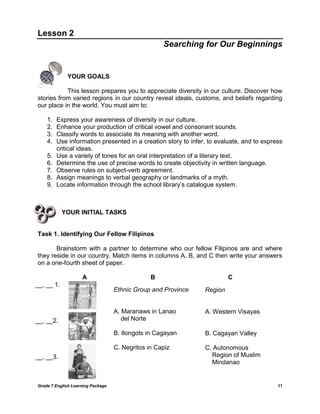
Task 1. Identifying Our Fellow Filipinos

       Brainstorm with a partner to determine who our fellow Filipinos are and where
they reside in our country. Match items in columns A, B, and C then write your answers
on a one-fourth sheet of paper.

                    A                           B                       C
__, __ 1.
                                   Ethnic Group and Province   Region


                                   A. Maranaws in Lanao        A. Western Visayas
__, __2.                              del Norte

                                   B. Ilongots in Cagayan      B. Cagayan Valley

                                   C. Negritos in Capiz        C. Autonomous
__, __3.                                                         Region of Muslim
                                                                 Mindanao


Grade 7 English Learning Package                                                          11
Task 2. Knowing Further Our Fellow Filipinos

        Complete the chart below. Use a whole sheet of paper.

              WHAT I KNOW                                   WHAT I WANT TO KNOW
        What do you know about the…                 What else do you want to know about them?
Maranaws?


Negritos?


Ilongots?


Task 3. Our Unique People

      Read quietly the short article below to locate information that will help you
determine whether you will agree or disagree to the following statements.

    1. The Filipinos are uniquely diversified.
    2. The Filipinos are religious in nature.
    3. The diversity of the Filipinos in culture, language, and religion is a hindrance to
       the country‘s unity and progress.
    4. The strength of the Filipino culture lies in the resiliency of its people who
       overcame the colonizers‘ oppressive rule.
    5. Acceptance of differences in culture, belief, and language can only start with
       awareness.


                                  The People of the Philippines
                            by the Philippine Tourism Promotions Board
        1
          The Filipino is basically of Malay stock with a sprinkling of Chinese, American,
Spanish and Arab blood. The Philippines has a population of 70 million, and it is hard to
distinguish accurately the lines between stocks. From a long history of Western colonial
rule, interspersed with the visits of merchants and traders evolved a people of a unique
blend of east and west, both in appearance and culture.
        2
         The Filipino character is actually a little bit of all the cultures put together. The
bayanihan or spirit of kinship and camaraderie that Filipinos are famous for is said to be
taken from Malay forefathers. The close family relations are said to have been inherited
from the Chinese. The piousness comes from the Spaniards who introduced Christianity
in the 16th century. Hospitality is a common denominator in the Filipino character and
this is what distinguishes the Filipino. Filipinos are probably one of the few, if not the


Grade 7 English Learning Package                                                                12
only, English-proficient Oriental people today. Pilipino is the official national language,
with English considered as the country's unofficial one.
        3
         The Filipinos are divided geographically and culturally into regions, and each
regional group is recognizable by distinct traits and dialects – the sturdy and frugal
llocanos of the north, the industrious Tagalogs of the central plains, the carefree
Visayans from the central islands and the colorful tribesmen and religious Moslems of
Mindanao. Tribal communities can be found scattered across the archipelago. The
Philippines has more than 111 dialects spoken, owing to the subdivisions of these basic
regional and cultural groups.
        4
        Some 80 percent of the population is Catholic, Spain's lasting legacy. About 15
percent is Moslem and these people can be found basically in Mindanao. The rest of the
population is made up mostly of smaller Christian denominations and Buddhist.
        5
       The country is marked by a true blend of cultures; truly in the Philippines, East
meets West. The background of the people is Indonesian and Malay. There are
Chinese and Spanish elements as well. The history of American rule and contact with
merchants and traders culminated in a unique blend of East and West, both in the
appearance and culture of the people of the Filipinos, or people of the Philippines.

Task 4. Loud and Clear!

      Enhance your pronunciation of a few critical vowel and consonant sounds based
on some parts of the article. You will be guided by your teacher.

Set A: Words

                  [I]                             [i]
                 bit                              unique
                 kinship                          east
                 basic                            appearance
                 archipelago                      camaraderie
                 Philippines                      fifteen

                  [s]                             [ʃ]
                 spirit                           Spanish
                 stock                            population
                 sturdy                           Indonesian
                 scattered                        distinguishes
                 some                             kinship

Set B: Phrases

                 1.   a little bit of all the cultures
                 2.   spirit of kinship
                 3.   East meets West
                 4.   Chinese and Spanish
                 5.   people of the Philippines
Grade 7 English Learning Package                                                         13
Set C: Sentences

    1. The Filipino character is actually a little bit of all the cultures put together

    2. The bayanihan or spirit of kinship and camaraderie that Filipinos are famous for
       is said to be taken from Malay forefathers.

    3. Each regional group is recognizable by distinct traits and dialects – the sturdy
       and frugal llocanos of the north, the industrious Tagalogs of the central plains,
       the carefree Visayans from the central islands and the colorful tribesmen and
       religious Moslems of Mindanao.

    4. Some 80 percent of the population is Catholic, Spain's lasting legacy.

    5. The history of American rule and contact with merchants and traders culminated
       in a unique blend of East and West, both in the appearance and culture of the
       people of the Filipinos.


            YOUR TEXT

                            The Origin of This World (Maranao)
                from the Anthology of Philippine Myths by Damiana L. Eugenio


        1
        According to Maranaw folklore, this world was created by a great Being. It is not
known, however, who exactly is this great Being. Or how many days it took him to
create this world.
        2
          This world is divided into seven layers.
The earth has also seven layers. Each layer is
inhabited by a different kind of being. The
uppermost layer, for example, is the place we
are inhabiting. The second layer is being
inhabited by dwarfs. These dwarfs are short,
plump, and long-haired. They are locally known
as Karibanga. The Karibanga are said to
possess magical powers. They are usually
invisible to the human eye. The third layer of the earth which is found under the sea or
lake is inhabited by nymphs. These nymphs also possess certain magical powers. It is
stated in the story of Rajah Indarapatra that he met and fell in love with the princess-
nymph with whom he had a child.
        3
        The sky also consists of seven layers. Each layer has a door which is guarded
day and night by huge mythical birds called garoda. The seventh layer of the sky is the
seat of heaven which is also divided into seven layers. Every layer in the sky is
inhabited by angels. Maranaws believe that angels do not need food. They all possess
wings with which they fly.
Grade 7 English Learning Package                                                           14
4
         Heaven which is found on the seventh layer of the sky is where good people‘s
spirits go after death. Saints are assigned to the seventh layer while persons who
―barely made it‖ are confined to the lower most layer which is found at the bottom of
heaven.
                                          5
                                            It is in heaven where we find the tree-of-life. On
                                   each leaf of the tree-of-life is written the name of every
                                   person living on earth. As soon as a leaf ripens or dries
                                   and falls, the person whose name it carries also dies.
                                          6
                                            The soul of every person is found in tightly
                                   covered jars kept in one section of heaven. This
                                   particular section of heaven is closely guarded by a
                                   monster with a thousand eyes, named Walo. Walo, in
                                   addition to his thousand eyes, has also eight hairy
                                   heads. The epic Darangan speaks of Madale,
                                   Bantugan‘s brother and, Mabaning, Husband of
                                   Lawanen, entering this section and retrieving the soul
                                   of Bantugan.


               YOUR DISCOVERY TASKS


Task 1. Word Webs

       Attach as many words you can find in the selection which you could associate
with each idea featured in each box. Use a whole sheet of paper for your webs.


                                               heaven


                                                earth


                                              tree of life


Grade 7 English Learning Package                                                            15
Task 2. Locate, Reflect, Evaluate!

        Locate information in the selection to determine whether each statement is true
(T) or false (F). Write your answer on a one-whole sheet of paper.

        _____ 1. Everything has its own place in heaven or on earth.
        _____ 2. Even monsters have a place in heaven.
        _____ 3. The nymphs, unlike the Karibanga, have magical powers.
        _____ 4. The number seven is a significant detail in the narrative.
        _____ 5. Angels can fly.
        _____ 6. The heaven in the selection accommodates saints and sinners.
        _____ 7. There is a reward for good people in heaven.
        _____ 8. The narrative is close to the accounts of other stories of origin of the
                 world.
        _____ 9. Death as explained in the narrative is a natural occurrence.
        _____ 10. The Maranaw story of the origin of the world is unique.


Task 3. Show It, Say It!

        Reflect on the following series of questions:

                        What is it that you found puzzling,
                 interesting, intriguing, or strange in the
                 story? Is it similar to your belief of how
                 the world began? Why or why not?


              Illustrate and color the puzzling, interesting, intriguing, or strange part that
        you found in the story then explain your answer in not more than five sentences
        on a whole sheet of paper. In your explanation, consider:

                      1. avoiding informal expressions;
                      2. using facts from your recall of information; and
                      3. using more nouns and adjectives than verbs and adverbs.

                 Be guided by the rubrics below.


              Way to go! (11-15 points)                  Just fine! (6-10 points)                Nice try! (1-5 points)
        The illustration shows an interesting    The illustration shows an interesting   The illustration is not as interesting
        and orderly play of images and colors.   but not so orderly play of images and   and orderly. The images and colors
        The explanation observed the three       colors. The explanation observed only   seem unrelated. The explanation
        considerations and demonstrated          two of the three considerations very    observed only one of the three
        careful and correct language use and     adequately. A few lapses in language    considerations very adequately. A
        mechanics.                               use and mechanics can be seen.          number of lapses in language use and
                                                                                         mechanics can be seen.


Grade 7 English Learning Package                                                                                            16
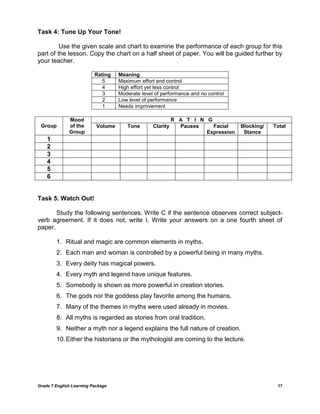
Task 4: Tune Up Your Tone!

         Use the given scale and chart to examine the performance of each group for this
part of the lesson. Copy the chart on a half sheet of paper. You will be guided further by
your teacher.

                          Rating    Meaning
                             5      Maximum effort and control
                             4      High effort yet less control
                             3      Moderate level of performance and no control
                             2      Low level of performance
                             1      Needs improvement

              Mood                                          R A T I N G
 Group        of the       Volume      Tone       Clarity     Pauses    Facial     Blocking/   Total
              Group                                                   Expression    Stance
    1
    2
    3
    4
    5
    6


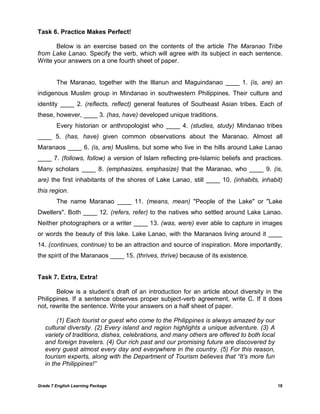
Task 5. Watch Out!

       Study the following sentences. Write C if the sentence observes correct subject-
verb agreement. If it does not, write I. Write your answers on a one fourth sheet of
paper.

        1. Ritual and magic are common elements in myths.
        2. Each man and woman is controlled by a powerful being in many myths.
        3. Every deity has magical powers.
        4. Every myth and legend have unique features.
        5. Somebody is shown as more powerful in creation stories.
        6. The gods nor the goddess play favorite among the humans.
        7. Many of the themes in myths were used already in movies.
        8. All myths is regarded as stories from oral tradition.
        9. Neither a myth nor a legend explains the full nature of creation.
        10. Either the historians or the mythologist are coming to the lecture.


Grade 7 English Learning Package                                                                17
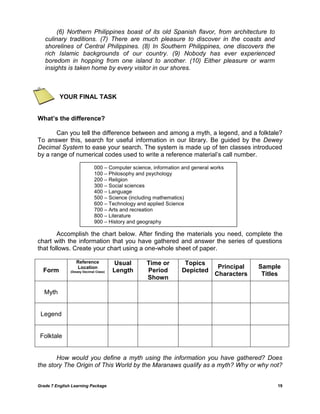
Task 6. Practice Makes Perfect!

       Below is an exercise based on the contents of the article The Maranao Tribe
from Lake Lanao. Specify the verb, which will agree with its subject in each sentence.
Write your answers on a one fourth sheet of paper.


        The Maranao, together with the Illanun and Maguindanao ____ 1. (is, are) an
indigenous Muslim group in Mindanao in southwestern Philippines. Their culture and
identity ____ 2. (reflects, reflect) general features of Southeast Asian tribes. Each of
these, however, ____ 3. (has, have) developed unique traditions.
        Every historian or anthropologist who ____ 4. (studies, study) Mindanao tribes
____ 5. (has, have) given common observations about the Maranao. Almost all
Maranaos ____ 6. (is, are) Muslims, but some who live in the hills around Lake Lanao
____ 7. (follows, follow) a version of Islam reflecting pre-Islamic beliefs and practices.
Many scholars ____ 8. (emphasizes, emphasize) that the Maranao, who ____ 9. (is,
are) the first inhabitants of the shores of Lake Lanao, still ____ 10. (inhabits, inhabit)
this region.
        The name Maranao ____ 11. (means, mean) "People of the Lake" or "Lake
Dwellers". Both ____ 12. (refers, refer) to the natives who settled around Lake Lanao.
Neither photographers or a writer ____ 13. (was, were) ever able to capture in images
or words the beauty of this lake. Lake Lanao, with the Maranaos living around it ____
14. (continues, continue) to be an attraction and source of inspiration. More importantly,
the spirit of the Maranaos ____ 15. (thrives, thrive) because of its existence.


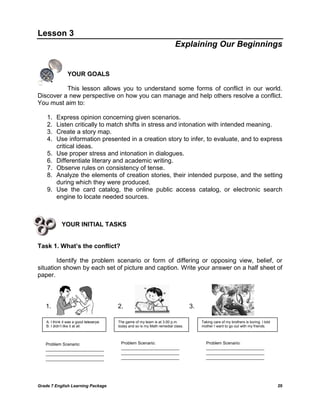
Task 7. Extra, Extra!

       Below is a student‘s draft of an introduction for an article about diversity in the
Philippines. If a sentence observes proper subject-verb agreement, write C. If it does
not, rewrite the sentence. Write your answers on a half sheet of paper.

        (1) Each tourist or guest who come to the Philippines is always amazed by our
   cultural diversity. (2) Every island and region highlights a unique adventure. (3) A
   variety of traditions, dishes, celebrations, and many others are offered to both local
   and foreign travelers. (4) Our rich past and our promising future are discovered by
   every guest almost every day and everywhere in the country. (5) For this reason,
   tourism experts, along with the Department of Tourism believes that “It‟s more fun
   in the Philippines!”


Grade 7 English Learning Package                                                            18
(6) Northern Philippines boast of its old Spanish flavor, from architecture to
   culinary traditions. (7) There are much pleasure to discover in the coasts and
   shorelines of Central Philippines. (8) In Southern Philippines, one discovers the
   rich Islamic backgrounds of our country. (9) Nobody has ever experienced
   boredom in hopping from one island to another. (10) Either pleasure or warm
   insights is taken home by every visitor in our shores.


          YOUR FINAL TASK


What’s the difference?

       Can you tell the difference between and among a myth, a legend, and a folktale?
To answer this, search for useful information in our library. Be guided by the Dewey
Decimal System to ease your search. The system is made up of ten classes introduced
by a range of numerical codes used to write a reference material‘s call number.

                             000 – Computer science, information and general works
                             100 – Philosophy and psychology
                             200 – Religion
                             300 – Social sciences
                             400 – Language
                             500 – Science (including mathematics)
                             600 – Technology and applied Science
                             700 – Arts and recreation
                             800 – Literature
                             900 – History and geography

        Accomplish the chart below. After finding the materials you need, complete the
chart with the information that you have gathered and answer the series of questions
that follows. Create your chart using a one-whole sheet of paper.

                  Reference            Usual      Time or        Topics
                  Location                                                     Principal   Sample
  Form         (Dewey Decimal Class)   Length     Period        Depicted
                                                                              Characters    Titles
                                                  Shown

   Myth


 Legend


 Folktale


       How would you define a myth using the information you have gathered? Does
the story The Origin of This World by the Maranaws qualify as a myth? Why or why not?


Grade 7 English Learning Package                                                                 19
Lesson 3
                                                                            Explaining Our Beginnings


                 YOUR GOALS

          This lesson allows you to understand some forms of conflict in our world.
Discover a new perspective on how you can manage and help others resolve a conflict.
You must aim to:

    1.    Express opinion concerning given scenarios.
    2.    Listen critically to match shifts in stress and intonation with intended meaning.
    3.    Create a story map.
    4.    Use information presented in a creation story to infer, to evaluate, and to express
          critical ideas.
    5.    Use proper stress and intonation in dialogues.
    6.    Differentiate literary and academic writing.
    7.    Observe rules on consistency of tense.
    8.    Analyze the elements of creation stories, their intended purpose, and the setting
          during which they were produced.
    9.    Use the card catalog, the online public access catalog, or electronic search
          engine to locate needed sources.


              YOUR INITIAL TASKS


Task 1. What’s the conflict?

        Identify the problem scenario or form of differing or opposing view, belief, or
situation shown by each set of picture and caption. Write your answer on a half sheet of
paper.


   1.                                     2.                                        3.

    A: I think it was a good teleserye.   The game of my team is at 3:00 p.m.            Taking care of my brothers is boring. I told
    B: I didn‘t like it at all.           today and so is my Math remedial class.        mother I want to go out with my friends.


   Problem Scenario:                       Problem Scenario:                               Problem Scenario:
   _________________________               _________________________                       _________________________
   _________________________               _________________________                       _________________________
   _________________________               _________________________                       _________________________


Grade 7 English Learning Package                                                                                                        20
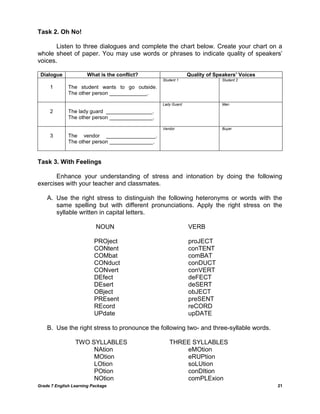
Task 2. Oh No!

       Listen to three dialogues and complete the chart below. Create your chart on a
whole sheet of paper. You may use words or phrases to indicate quality of speakers‘
voices.

 Dialogue             What is the conflict?                    Quality of Speakers’ Voices
                                                  Student 1                 Student 2

     1        The student wants to go outside.
              The other person _____________.

                                                  Lady Guard                Man

     2        The lady guard ________________.
              The other person _______________.

                                                  Vendor                    Buyer

     3        The vendor _________________.
              The other person _______________.


Task 3. With Feelings

       Enhance your understanding of stress and intonation by doing the following
exercises with your teacher and classmates.

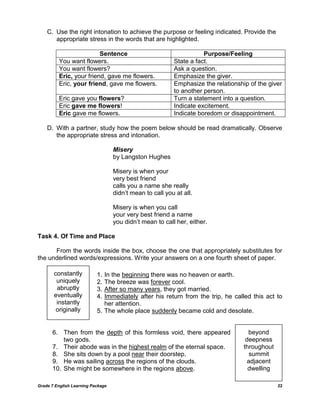
    A. Use the right stress to distinguish the following heteronyms or words with the
       same spelling but with different pronunciations. Apply the right stress on the
       syllable written in capital letters.

                           NOUN                                VERB

                          PROject                              proJECT
                          CONtent                              conTENT
                          COMbat                               comBAT
                          CONduct                              conDUCT
                          CONvert                              conVERT
                          DEfect                               deFECT
                          DEsert                               deSERT
                          OBject                               obJECT
                          PREsent                              preSENT
                          REcord                               reCORD
                          UPdate                               upDATE

    B. Use the right stress to pronounce the following two- and three-syllable words.

                 TWO SYLLABLES                       THREE SYLLABLES
                      NAtion                             eMOtion
                      MOtion                             eRUPtion
                      LOtion                             soLUtion
                      POtion                             conDItion
                      NOtion                             comPLExion
Grade 7 English Learning Package                                                             21
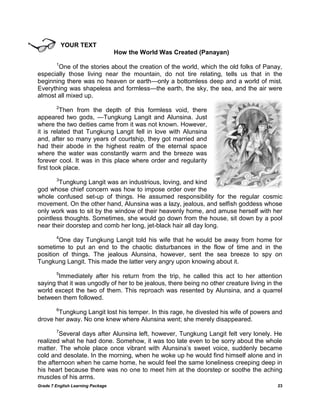
C. Use the right intonation to achieve the purpose or feeling indicated. Provide the
       appropriate stress in the words that are highlighted.

                         Sentence                                    Purpose/Feeling
         You want flowers.                                State a fact.
         You want flowers?                                Ask a question.
         Eric, your friend, gave me flowers.              Emphasize the giver.
         Eric, your friend, gave me flowers.              Emphasize the relationship of the giver
                                                          to another person.
         Eric gave you flowers?                           Turn a statement into a question.
         Eric gave me flowers!                            Indicate excitement.
         Eric gave me flowers.                            Indicate boredom or disappointment.

    D. With a partner, study how the poem below should be read dramatically. Observe
       the appropriate stress and intonation.

                                   Misery
                                   by Langston Hughes

                                   Misery is when your
                                   very best friend
                                   calls you a name she really
                                   didn‘t mean to call you at all.

                                   Misery is when you call
                                   your very best friend a name
                                   you didn‘t mean to call her, either.

Task 4. Of Time and Place

      From the words inside the box, choose the one that appropriately substitutes for
the underlined words/expressions. Write your answers on a one fourth sheet of paper.

       constantly          1. In the beginning there was no heaven or earth.
        uniquely           2. The breeze was forever cool.
        abruptly           3. After so many years, they got married.
       eventually          4. Immediately after his return from the trip, he called this act to
        instantly             her attention.
        originally         5. The whole place suddenly became cold and desolate.


      6. Then from the depth of this formless void, there appeared                   beyond
          two gods.                                                                 deepness
      7. Their abode was in the highest realm of the eternal space.                throughout
      8. She sits down by a pool near their doorstep.                                 summit
      9. He was sailing across the regions of the clouds.                            adjacent
      10. She might be somewhere in the regions above.                               dwelling

Grade 7 English Learning Package                                                                22
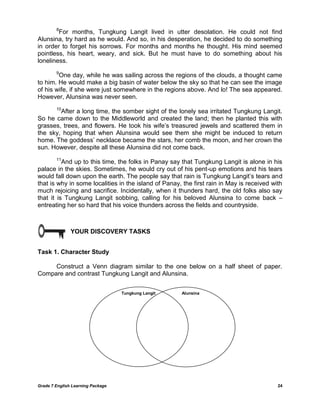
YOUR TEXT
                                   How the World Was Created (Panayan)
        1
       One of the stories about the creation of the world, which the old folks of Panay,
especially those living near the mountain, do not tire relating, tells us that in the
beginning there was no heaven or earth—only a bottomless deep and a world of mist.
Everything was shapeless and formless—the earth, the sky, the sea, and the air were
almost all mixed up.
        2
         Then from the depth of this formless void, there
appeared two gods, —Tungkung Langit and Alunsina. Just
where the two deities came from it was not known. However,
it is related that Tungkung Langit fell in love with Alunsina
and, after so many years of courtship, they got married and
had their abode in the highest realm of the eternal space
where the water was constantly warm and the breeze was
forever cool. It was in this place where order and regularity
first took place.
        3
        Tungkung Langit was an industrious, loving, and kind
god whose chief concern was how to impose order over the
whole confused set-up of things. He assumed responsibility for the regular cosmic
movement. On the other hand, Alunsina was a lazy, jealous, and selfish goddess whose
only work was to sit by the window of their heavenly home, and amuse herself with her
pointless thoughts. Sometimes, she would go down from the house, sit down by a pool
near their doorstep and comb her long, jet-black hair all day long.
        4
        One day Tungkung Langit told his wife that he would be away from home for
sometime to put an end to the chaotic disturbances in the flow of time and in the
position of things. The jealous Alunsina, however, sent the sea breeze to spy on
Tungkung Langit. This made the latter very angry upon knowing about it.
        5
        Immediately after his return from the trip, he called this act to her attention
saying that it was ungodly of her to be jealous, there being no other creature living in the
world except the two of them. This reproach was resented by Alunsina, and a quarrel
between them followed.
        6
       Tungkung Langit lost his temper. In this rage, he divested his wife of powers and
drove her away. No one knew where Alunsina went; she merely disappeared.
        7
        Several days after Alunsina left, however, Tungkung Langit felt very lonely. He
realized what he had done. Somehow, it was too late even to be sorry about the whole
matter. The whole place once vibrant with Alunsina‘s sweet voice, suddenly became
cold and desolate. In the morning, when he woke up he would find himself alone and in
the afternoon when he came home, he would feel the same loneliness creeping deep in
his heart because there was no one to meet him at the doorstep or soothe the aching
muscles of his arms.
Grade 7 English Learning Package                                                          23
8
        For months, Tungkung Langit lived in utter desolation. He could not find
Alunsina, try hard as he would. And so, in his desperation, he decided to do something
in order to forget his sorrows. For months and months he thought. His mind seemed
pointless, his heart, weary, and sick. But he must have to do something about his
loneliness.
        9
        One day, while he was sailing across the regions of the clouds, a thought came
to him. He would make a big basin of water below the sky so that he can see the image
of his wife, if she were just somewhere in the regions above. And lo! The sea appeared.
However, Alunsina was never seen.
        10
        After a long time, the somber sight of the lonely sea irritated Tungkung Langit.
So he came down to the Middleworld and created the land; then he planted this with
grasses, trees, and flowers. He took his wife‘s treasured jewels and scattered them in
the sky, hoping that when Alunsina would see them she might be induced to return
home. The goddess‘ necklace became the stars, her comb the moon, and her crown the
sun. However, despite all these Alunsina did not come back.
        11
          And up to this time, the folks in Panay say that Tungkung Langit is alone in his
palace in the skies. Sometimes, he would cry out of his pent-up emotions and his tears
would fall down upon the earth. The people say that rain is Tungkung Langit‘s tears and
that is why in some localities in the island of Panay, the first rain in May is received with
much rejoicing and sacrifice. Incidentally, when it thunders hard, the old folks also say
that it is Tungkung Langit sobbing, calling for his beloved Alunsina to come back –
entreating her so hard that his voice thunders across the fields and countryside.


               YOUR DISCOVERY TASKS


Task 1. Character Study

     Construct a Venn diagram similar to the one below on a half sheet of paper.
Compare and contrast Tungkung Langit and Alunsina.


                                   Tungkung Langit    Alunsina


Grade 7 English Learning Package                                                           24
Task 2. Locate, Reflect, Evaluate!

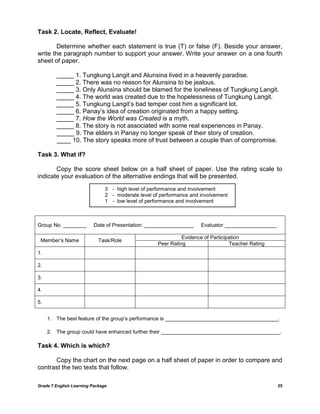
        Determine whether each statement is true (T) or false (F). Beside your answer,
write the paragraph number to support your answer. Write your answer on a one fourth
sheet of paper.

        _____ 1. Tungkung Langit and Alunsina lived in a heavenly paradise.
        _____ 2. There was no reason for Alunsina to be jealous.
        _____ 3. Only Alunsina should be blamed for the loneliness of Tungkung Langit.
        _____ 4. The world was created due to the hopelessness of Tungkung Langit.
        _____ 5. Tungkung Langit‘s bad temper cost him a significant lot.
        _____ 6. Panay‘s idea of creation originated from a happy setting.
        _____ 7. How the World was Created is a myth.
        _____ 8. The story is not associated with some real experiences in Panay.
        _____ 9. The elders in Panay no longer speak of their story of creation.
        ____ 10. The story speaks more of trust between a couple than of compromise.

Task 3. What if?

       Copy the score sheet below on a half sheet of paper. Use the rating scale to
indicate your evaluation of the alternative endings that will be presented.
                               3 - high level of performance and involvement
                               2 - moderate level of performance and involvement
                               1 - low level of performance and involvement


Group No. ________        Date of Presentation: _________________    Evaluator __________________

                                                              Evidence of Participation
 Member‘s Name              Task/Role
                                                    Peer Rating                   Teacher Rating
1.

2.

3.

4.

5.


     1. The best feature of the group‘s performance is _______________________________________.

     2. The group could have enhanced further their _________________________________________.

Task 4. Which is which?

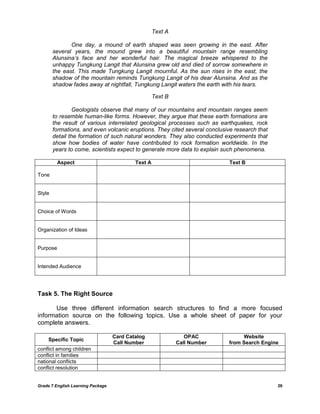
      Copy the chart on the next page on a half sheet of paper in order to compare and
contrast the two texts that follow.

Grade 7 English Learning Package                                                                    25
Text A

               One day, a mound of earth shaped was seen growing in the east. After
        several years, the mound grew into a beautiful mountain range resembling
        Alunsina‟s face and her wonderful hair. The magical breeze whispered to the
        unhappy Tungkung Langit that Alunsina grew old and died of sorrow somewhere in
        the east. This made Tungkung Langit mournful. As the sun rises in the east, the
        shadow of the mountain reminds Tungkung Langit of his dear Alunsina. And as the
        shadow fades away at nightfall, Tungkung Langit waters the earth with his tears.

                                                    Text B

                Geologists observe that many of our mountains and mountain ranges seem
        to resemble human-like forms. However, they argue that these earth formations are
        the result of various interrelated geological processes such as earthquakes, rock
        formations, and even volcanic eruptions. They cited several conclusive research that
        detail the formation of such natural wonders. They also conducted experiments that
        show how bodies of water have contributed to rock formation worldwide. In the
        years to come, scientists expect to generate more data to explain such phenomena.

          Aspect                           Text A                            Text B

Tone


Style


Choice of Words


Organization of Ideas


Purpose


Intended Audience


Task 5. The Right Source

      Use three different information search structures to find a more focused
information source on the following topics. Use a whole sheet of paper for your
complete answers.

                                   Card Catalog                 OPAC             Website
    Specific Topic
                                   Call Number               Call Number    from Search Engine
conflict among children
conflict in families
national conflicts
conflict resolution


Grade 7 English Learning Package                                                               26
Task 6. Practice Makes Perfect!

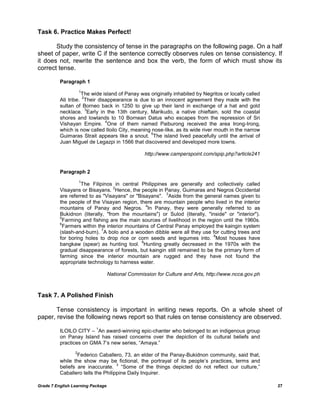
       Study the consistency of tense in the paragraphs on the following page. On a half
sheet of paper, write C if the sentence correctly observes rules on tense consistency. If
it does not, rewrite the sentence and box the verb, the form of which must show its
correct tense.

          Paragraph 1
                     1
                    The wide island of Panay was originally inhabited by Negritos or locally called
                     2
          Ati tribe. Their disappearance is due to an innocent agreement they made with the
          sultan of Borneo back in 1250 to give up their land in exchange of a hat and gold
                       3
          necklace. Early in the 13th century, Marikudo, a native chieftain, sold the coastal
          shores and lowlands to 10 Bornean Datus who escapes from the repression of Sri
                              4
          Vishayan Empire. One of them named Paiburong received the area Irong-Irong,
          which is now called Iloilo City, meaning nose-like, as its wide river mouth in the narrow
                                                  5
          Guimaras Strait appears like a snout. The island lived peacefully until the arrival of
          Juan Miguel de Legazpi in 1566 that discovered and developed more towns.

                                                  http://www.camperspoint.com/spip.php?article241


          Paragraph 2
                     1
                   The Filipinos in central Philippines are generally and collectively called
                                  2
          Visayans or Bisayans. Hence, the people in Panay, Guimaras and Negros Occidental
                                                       3
          are referred to as "Visayans" or "Bisayans". Aside from the general names given to
          the people of the Visayan region, there are mountain people who lived in the interior
                                               4
          mountains of Panay and Negros. In Panay, they were generally referred to as
          Bukidnon (literally, "from the mountains") or Sulod (literally, "inside" or "interior").
          5
           Farming and fishing are the main sources of livelihood in the region until the 1960s.
          6
           Farmers within the interior mountains of Central Panay employed the kaingin system
                             7
          (slash-and-burn). A bolo and a wooden dibble were all they use for cutting trees and
                                                                             8
          for boring holes to drop rice or corn seeds and legumes into. Most houses have
                                             9
          bangkaw (spear) as hunting tool. Hunting greatly decreased in the 1970s with the
          gradual disappearance of forests, but kaingin still remained to be the primary form of
          farming since the interior mountain are rugged and they have not found the
          appropriate technology to harness water.

                                   National Commission for Culture and Arts, http://www.ncca.gov.ph


Task 7. A Polished Finish

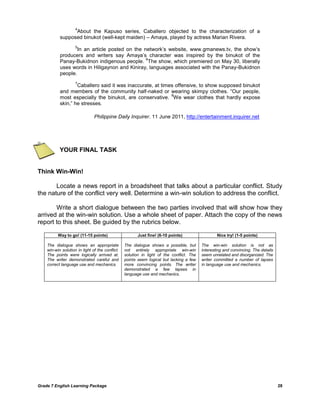
       Tense consistency is important in writing news reports. On a whole sheet of
paper, revise the following news report so that rules on tense consistency are observed.
                           1
          ILOILO CITY – An award-winning epic-chanter who belonged to an indigenous group
          on Panay Island has raised concerns over the depiction of its cultural beliefs and
          practices on GMA 7‘s new series, ―Amaya.‖
                 2
                  Federico Caballero, 73, an elder of the Panay-Bukidnon community, said that,
          while the show may be fictional, the portrayal of its people‘s practices, terms and
                                    3
          beliefs are inaccurate. ―Some of the things depicted do not reflect our culture,‖
          Caballero tells the Philippine Daily Inquirer.

Grade 7 English Learning Package                                                                      27
4
                 About the Kapuso series, Caballero objected to the characterization of a
           supposed binukot (well-kept maiden) – Amaya, played by actress Marian Rivera.
                    5
                   In an article posted on the network‘s website, www.gmanews.tv, the show‘s
           producers and writers say Amaya‘s character was inspired by the binukot of the
                                                6
           Panay-Bukidnon indigenous people. The show, which premiered on May 30, liberally
           uses words in Hiligaynon and Kiniray, languages associated with the Panay-Bukidnon
           people.
                    7
                   Caballero said it was inaccurate, at times offensive, to show supposed binukot
           and members of the community half-naked or wearing skimpy clothes. ―Our people,
                                                            8
           most especially the binukot, are conservative. We wear clothes that hardly expose
           skin,‖ he stresses.

                               Philippine Daily Inquirer. 11 June 2011, http://entertainment.inquirer.net


           YOUR FINAL TASK


Think Win-Win!

       Locate a news report in a broadsheet that talks about a particular conflict. Study
the nature of the conflict very well. Determine a win-win solution to address the conflict.

       Write a short dialogue between the two parties involved that will show how they
arrived at the win-win solution. Use a whole sheet of paper. Attach the copy of the news
report to this sheet. Be guided by the rubrics below.

          Way to go! (11-15 points)                     Just fine! (6-10 points)                  Nice try! (1-5 points)

    The dialogue shows an appropriate            The dialogue shows a possible, but       The win-win solution is not as
    win-win solution in light of the conflict.   not entirely appropriate win-win         interesting and convincing. The details
    The points were logically arrived at.        solution in light of the conflict. The   seem unrelated and disorganized. The
    The writer demonstrated careful and          points seem logical but lacking a few    writer committed a number of lapses
    correct language use and mechanics.          more convincing points. The writer       in language use and mechanics.
                                                 demonstrated a few lapses in
                                                 language use and mechanics.


Grade 7 English Learning Package                                                                                                    28
Lesson 4
                                                        Learning from Our Beginnings


             YOUR GOALS

             This lesson helps you understand the value of knowing how things came to be in the eyes of
our ancestors. Everything on earth, good or bad, has its beginnings. Be perceptive, and let the stories of
the past inspire your future. For this lesson, these are your goals:

           1. Use definitions to guess given words.
           2. Create a graphic organizer for a text read.
           3. Observe rules on pronoun-antecedent agreement.
           4. Listen to shifts in stress and intonation in identifying important information based on a text.
           5. Observe correct sentence stress in reading a text.
           6. Use colloquial and informal expressions appropriately in conversations.
           7. Locate data using library resources.
           8. Write a family genesis using the elements and themes of myths.
           9. Give different reasons for writing.


          YOUR INITIAL TASKS


Task 1. The K-W-L Way

          The word, ‗genesis‘ plays a central role in this lesson. Hence, it is important that you identify what
you know about this idea by filling out a K-W-L Table. Copy the table on a half-sheet of paper. Under the
first column, write down all the ideas you have about ‗genesis‘. On the second column, write what you
want to know about it. The third column will be completed at the end of the lesson.


                                                ‘GENESIS’
                  What I Know             What I Want to Know              What I Learned


Grade 7 English Learning Package                                                                                29
Task 2. Begin with ‘BEGINNINGS’

         Another meaning of the word ‗genesis‘ is the one spelled in the puzzle below. Let the provided
definitions and letter-boxes help you in completing the words. Write your answers on a half-sheet of
paper. After checking, review the word list. Remember what the words mean, because they appear in the
story you are about to read.


                                   A      B     O     D     E                                  1. a place of residence
                 C     U     R     S      E     D                                              2. said hurtful words
                 H     O     M     A     G      E                                              3. special honor or respect shown publicly
                       R     A     D      I     A     N     C      E                           4. light or heat reflected by something
                                   E      N     T     R     E      A     T     Y               5. a humble request
                 D     I     S      I     N     T     E     G      R     A     T   E       D   6. broke up into small parts
                       C     A     L      I     P     H                                        7. a title that refers to a successor of Muhammad
    E     X      I     S     T     E      N     T                                              8. having reality
                                         G      A     N      T     A                           9. a form of measurement
                             A     S      S     E     R      T     E     D                     10. caused others to recognize one‘s authority or
                                                                                                  right by confident and forceful behavior


                YOUR TEXT

                           How does this myth explain the creation of the world and the root of evil?
                                                                                       1
                                                                  Samal Genesis

1             In the beginning, when there were no creatures yet, there was only the
        sea. Floating on this sea was a thing resembling a ball. This was the abode of
        God the Most High. When he wanted to bring out his creations, the ball split;
        one half of it rose and became heaven (with seven levels) and the lower half
        remained and became the earth (with seven levels). Now the sea on which
        the ball was floating was called Baharun Nur [Bahar, great waters, mighty
        rivers; Nur, light], meaning, this was the ancestor of all which floated on it.
        Symbolically, the part which was lifted up was the father, and the grandfather
        was the sea on which it floated. Now at the same time of the splitting of the
        ball, and as God willed it, all men and all the creatures on earth have already
        been believed as being in it.

2           From the time of our ancestors up to the present, the original content of that thing is what we
        have been looking for.


        Pre-Existent Soul

3            And Nur Muhammad [technical term for the pre-existence of the soul of the Prophet] was then
        already risen. When Allah the Most High was already in the highest heaven, he willed and his radiance
        scattered and became a man---Nur Muhammad. Now, when the latter became aware of himself, he
        asserted that he was God. Looking left and right, he saw that he was alone. So he said to himself,
        ―There is nobody but me, so I must be God.‖ He then went around, and after walking some distance

1
    Domingo, Eugenia. 1999. Philippine folk literature: The myths. p. 98-99.
Grade 7 English Learning Package                                                                                                     30
he said, ―Arastum Murabbikum,‖ meaning, ―I am God.‖ Then all of a sudden, a voice answered, ―Kahal
    Bala,” and Nur disintegrated.

4        When Nur disintegrated, all the elements contained in the earth and the heavens were drawn out
    of him. All creatures then appeared. From the single light [Nur] was taken the elements that became
    the moon, the sun, the stars, the trees, and all living things. They were all there. And this was begun
    on a Sunday and was completed on a Friday.


    Why God is Hidden

5        After all things had been drawn out of Nur Muhammad, he was made man once again, and God
    said to him, ―Don‘t assert that you are God. It is I. But if you don‘t believe, let us play hide and seek.
    You hide and I will look for you. Then I will hide and you will look for me. If I can find you and you
    cannot find me, then surely I am God.‖ And so they commenced the trial. No matter how hard Nur
    Muhammad hid, God always pinpointed him. Then God said, ―Now I will hide.‖ And Nur Muhammad
    could not find him. [This is said to be the reason why we cannot see God.]

6        God then summoned the angel, Jibra‘il [Gabriel]. God then said to him, ―Go on to earth and get a
    handful of soil.‖ When Jibra‘il descended and tried to pick up some earth. The earth cursed and
    refused to be taken, Jibra‘il returned empty-handed, and God said to another angel, Mika‘il, ―You go.‖
    When Mikail reached the earth, the same refusal met him. Then the angel, Israfil, took his turn, but the
    earth likewise refused. Then the fourth angel, Idjara‘il [Izra‘il or Azra‘el], immediately went down and
    forthwith grabbed the earth. One of his fingers was on the west, another on the east, a third one on the
    south, and a fourth one on the earth. And he scooped a handful.

7        Then God said to Jibra‘il, ―Make it into a man.‖ When it had assumed the form of a man, Jibra‘il
    said, ―My Lord, the man is here, but it cannot speak, and his joints are no t connected.‖

                                   8                 Then God said, ―Get a ganta of rice and grind it into
                                   powder and apply it to him.‖ Then the joints were connected and the man
                                   became whole, but he still could not speak. Then God commanded Nur
                                   Muhammad, ―Go inside Adam‖ (for that was the name of the man). But
                                   Nur Muhammad said, ―I refuse. You created Adam from the four elements
                                   (fire, water, wind, and earth), whereas I came from Your light.‖ Then God
                                   said to Nur Muhammad, ―Be willing, for you and I are one, and you can
                                   meet me five times a day during prayer.‖ So Nur Muhammad went inside
                                   Adam through his forehead and Adam became a living man.

9         And God made Adam into a Caliph and commanded all creatures including angels to pay
    homage to him. And every creature did, except Iblis (the Evil One) who said to God, ―How can I
    worship Adam seeing he was created of four elements whereas I have served you for hundreds of
    years.‖ In spite of God‘s entreaty, Iblis continued to refuse. Then, Iblis asked God to grant him four
    wishes. First, that he would be the richest of all; second, that he would be the most exalted of all; third,
    that he can steal the riches of those who have; and fourth, that those riches he cannot steal, he kills.
    And this is the origin of the evil desire for material goods and for worldly fame which leads to envy and
    killing. Those whom Iblis enters are led to evil. For he had an agreement with God that those he can
    mislead are his and those he cannot are God‘s.


Grade 7 English Learning Package                                                                             31
YOUR DISCOVERY TASKS


Task 1. The Illustrated Genesis

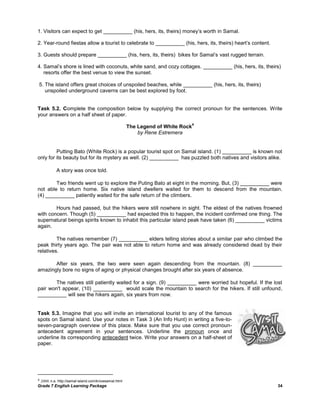
          Illustrations such as the graphic organizers featured below supplement explanations for related
ideas and processes. In drawings like these, lines and arrows present the direction that a process takes.
Illustrations could start from top to bottom or vice versa if the process is linear, whereas a circular design
is more appropriate for cycles. Shapes represent different ideas. Their sizes could symbolize their
importance, while their variations could pertain to their different natures.


        The Samal version of the genesis can also be further explained by a graphic organizer. On a
whole sheet of paper, design a graphic organizer that will show the transformation involving the following:
Adam, all elements and living things, ball (God‘s house), God, Nur (as man), and Nur (as light). Use other
appropriate materials to make your work unique and creative.


Task 2. Confirm or Disconfirm

      Which of the following information is presented by the text? In your notebook, write the paragraph
numbers that provide the mentioned information.

        1. Iblis is a fallen angel.
        2. Man originated from Nur.
        3. Man originated from God.
        4. Iblis originated from God.
        5. Nur originated from God‘s light.
        6. Evil will continue until the end of the world.
        7. All beings on earth came from the house of God.
        8. Nur is originally a higher being than Man.
        9. Man eventually challenged God because of Iblis‘s evil deeds.
        10. Man came to be through the compromise of God and Nur.

Grade 7 English Learning Package                                                                           32
Task 3. An Info Hunt
                                                                    2
           Read the following excerpt about the history of Samal.

                                                    The Municipality of Samal derived its
                                                    name from the Isamals who were its first
                                                    inhabitants. The Isamals were brought by
                                                    the first and second waves of migration
                                                    from the Malay Region of Southeast
                                                    Asia, dynastically ruled by a Datu up to
                                                    the early part of the American Regime.
                                                    The latest ruling tribal Chieftain was Datu
                                                    Taganiog who died on January 28, 1948.
                      Discovery revealed that the latter lived at "Malibasa" (now known as
                      Peñaplata, the poblacion) where he exercised his general supervision.
                      The word "Malibasa" meant honorable. The Isamals lived in perfect
                      harmony as peace-loving people.

           What new information does the above text present you?
           What about Samal history do you want to know more of?

        Learn more about the beginnings of Samal island and its people by using the card catalogue, the
online public access catalogue, or electronic search engine of our school library or any nearby library.
Locate specific resources about the topics, then note down the information that you will get. Be ready to
share this with the class.


Task 4. Exploring the English Language

       Read the following sentences. For every number, note the words highlighted through boldface
and underscore. What relationship do the words have?


           1. Floating on this sea was a thing resembling a ball. This was the abode of God the Most High.

           2. Now at the time of the splitting of the ball, all creatures have already been believed as being in
              it.

           3. From the single light [Nur] was taken the elements that became the moon, the sun, the stars,
              the trees, and all living things. They were all there.

           4. Nur was already risen. He then went around.

           5. God wanted to bring out his creations.

           6. Allah scattered his radiance.

           7. The Man is here, but his joints are not connected.


Task 5. Practice Makes Perfect!

Task 5.1. On a half sheet of paper, write the correct pronoun that agrees with the antecedent in the
                   3
following sentences . Choose from options provided in the parentheses.


2 2008. n.a. http://samal-island.com/knowsamal.html
3 Born to be IGaCoS. http://samal-island.com/knowsamal.html
Grade 7 English Learning Package                                                                              33
1. Visitors can expect to get __________ (his, hers, its, theirs) money‘s worth in Samal.

2. Year-round fiestas allow a tourist to celebrate to __________ (his, hers, its, theirs) heart‘s content.

3. Guests should prepare __________ (his, hers, its, theirs) bikes for Samal‘s vast rugged terrain.

4. Samal‘s shore is lined with coconuts, white sand, and cozy cottages. __________ (his, hers, its, theirs)
   resorts offer the best venue to view the sunset.

5. The island offers great choices of unspoiled beaches, while __________ (his, hers, its, theirs)
   unspoiled underground caverns can be best explored by foot.


Task 5.2. Complete the composition below by supplying the correct pronoun for the sentences. Write
your answers on a half sheet of paper.
                                                                                 4
                                                      The Legend of White Rock
                                                          by Rene Estremera


         Putting Bato (White Rock) is a popular tourist spot on Samal island. (1) __________ is known not
only for its beauty but for its mystery as well. (2) __________ has puzzled both natives and visitors alike.

           A story was once told.

        Two friends went up to explore the Puting Bato at eight in the morning. But, (3) __________ were
not able to return home. Six native island dwellers waited for them to descend from the mountain.
(4) __________ patiently waited for the safe return of the climbers.

        Hours had passed, but the hikers were still nowhere in sight. The eldest of the natives frowned
with concern. Though (5) __________ had expected this to happen, the incident confirmed one thing. The
supernatural beings spirits known to inhabit this particular island peak have taken (6) __________ victims
again.

         The natives remember (7) __________ elders telling stories about a similar pair who climbed the
peak thirty years ago. The pair was not able to return home and was already considered dead by their
relatives.

       After six years, the two were seen again descending from the mountain. (8) __________
amazingly bore no signs of aging or physical changes brought after six years of absence.

        The natives still patiently waited for a sign. (9) __________ were worried but hopeful. If the lost
pair won't appear, (10) __________ would scale the mountain to search for the hikers. If still unfound,
__________ will see the hikers again, six years from now.


Task 5.3. Imagine that you will invite an international tourist to any of the famous
spots on Samal island. Use your notes in Task 3 (An Info Hunt) in writing a five-to-
seven-paragraph overview of this place. Make sure that you use correct pronoun-
antecedent agreement in your sentences. Underline the pronoun once and
underline its corresponding antecedent twice. Write your answers on a half-sheet of
paper.


4 2008. n.a. http://samal-island.com/knowsamal.html
Grade 7 English Learning Package                                                                             34
Task 6. Samal Tripping

         Listen intently as your teacher demonstrates how stress and intonation affect the presentation of
meaning. Next, listen to recording about Samal Island. On a half-sheet of paper, write down important
pieces of information that are signaled by shifts in stress and intonation. You will listen to the recording
thrice, so make sure that you review your answers through careful listening.


Task 7. Read Out (Home Work)

         Use what you have learned from the discussion and listening activity on sentence stress and
                                                                                                    5
intonation. Observe the rhythm rule guidelines in reading the text below. Practice reading this text at
home, in front of friends or family members, or in the presence of a mentor who can guide you.
Remember to follow the discussed guidelines as you practice. Be ready to present this to class on the
day specified by your teacher.

                               Generally, Samal Municipality is characterized by uneven
                      distribution of lowlands, wide expanse of mountain ranges and few
                      isolated hills. Tayapoc, renowned for its "Puting Bato" or White Stone is
                      Samal range's highest peak towering at 162 meters above the sea level.
                      The Sopsopon Plateau lies on its top with an approximate area of 400
                      hectares.

                              A number of waterways can also be found in the municipality,
                      though none of them is navigable. The Hagimit Falls which is
                      approximately 15 feet high, the Binoling River and several other natural
                      springs, namely: Supa, Alibungog, Tagbitinao, Tagbitan-ag, Aundanao,
                      Licup, San Jose and Tagdaliao Springs are among the few popular sites
                      found in the island.

                               The historical traces of the name of this developing island town
                      came to surface from information gathered through investigations and
                      personal interviews with some native chieftains on how the place got its
                      name. Based on unrecorded history, the place was sparsely populated
                      by few farming natives called Isamals who first settled the coastal areas
                      of the island. There were no known surveyed roads then except for a few
                      trails and pathways criss-crossing the lowland areas. Thick forest and
                      green land still covered the island's virgin soil.


Task 8. Know Your Words

        Our conversations carry words with different formality levels known as register. Two of these are
colloquial and familiar. Study the definitions below.

                   Colloquial refers to the level language is used
           in everyday speech. This presents a neutral tone, not
           so much informal or formal. This is the level used in
           ordinary conversations. This is the level used in
           speaking with classmates, teachers, visitors, etc.

                   Familiar is a level of language that reflects the close relationship of the
           people speaking. This intimacy is observed in the use of details and personal
           references in speech. The authority that a speaker may have on others may also
           be observed in familiar language. This is the level used when speaking with
           people who are close to us.


5 2008. n.a. http://samal-island.com/knowsamal.html
Grade 7 English Learning Package                                                                         35
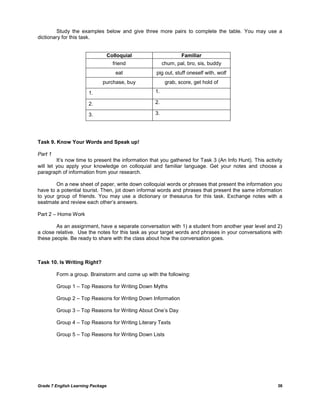
Study the examples below and give three more pairs to complete the table. You may use a
dictionary for this task.


                                   Colloquial                   Familiar
                                     friend             chum, pal, bro, sis, buddy
                                      eat           pig out, stuff oneself with, wolf
                              purchase, buy              grab, score, get hold of

                       1.                          1.

                       2.                          2.

                       3.                          3.


Task 9. Know Your Words and Speak up!

Part 1
         It‘s now time to present the information that you gathered for Task 3 (An Info Hunt). This activity
will let you apply your knowledge on colloquial and familiar language. Get your notes and choose a
paragraph of information from your research.

        On a new sheet of paper, write down colloquial words or phrases that present the information you
have to a potential tourist. Then, jot down informal words and phrases that present the same information
to your group of friends. You may use a dictionary or thesaurus for this task. Exchange notes with a
seatmate and review each other‘s answers.

Part 2 – Home Work

        As an assignment, have a separate conversation with 1) a student from another year level and 2)
a close relative. Use the notes for this task as your target words and phrases in your conversations with
these people. Be ready to share with the class about how the conversation goes.


Task 10. Is Writing Right?

         Form a group. Brainstorm and come up with the following:

         Group 1 – Top Reasons for Writing Down Myths

         Group 2 – Top Reasons for Writing Down Information

         Group 3 – Top Reasons for Writing About One‘s Day

         Group 4 – Top Reasons for Writing Literary Texts

         Group 5 – Top Reasons for Writing Down Lists


Grade 7 English Learning Package                                                                          36
YOUR FINAL TASK

        My Family’s Genesis

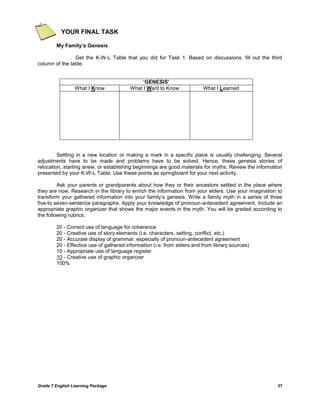
                Get the K-W-L Table that you did for Task 1. Based on discussions, fill out the third
column of the table.


                                             ‘GENESIS’
                 What I Know            What I Want to Know              What I Learned


         Settling in a new location or making a mark in a specific place is usually challenging. Several
adjustments have to be made and problems have to be solved. Hence, these genesis stories of
relocation, starting anew, or establishing beginnings are good materials for myths. Review the information
presented by your K-W-L Table. Use these points as springboard for your next activity.

         Ask your parents or grandparents about how they or their ancestors settled in the place where
they are now. Research in the library to enrich the information from your elders. Use your imagination to
transform your gathered information into your family‘s genesis. Write a family myth in a series of three
five-to seven-sentence paragraphs. Apply your knowledge of pronoun-antecedent agreement. Include an
appropriate graphic organizer that shows the major events in the myth. You will be graded according to
the following rubrics.

        20 - Correct use of language for coherence
        20 - Creative use of story elements (i.e. characters, setting, conflict, etc.)
        20 - Accurate display of grammar, especially of pronoun-antecedent agreement
        20 - Effective use of gathered information (i.e. from elders and from library sources)
        10 - Appropriate use of language register
        10 - Creative use of graphic organizer
        100%


Grade 7 English Learning Package                                                                        37
Lesson 5
                                                   Recalling Our Ancestors’ Beliefs


             YOUR GOALS

               Lesson 5 will help you discover how your ancestors explained the world around them. You
will relate these olden stories with the current situation in your world. Consequently, you will realize that
the stories of before remain relevant in today‘s modern world. For this lesson, you must aim to:

    1. Deduce the advantages and disadvantages of a given situation through the help of various
        graphic organizers
    2. Infer the meaning of symbols from the text
    3. Use context clues to get the meaning of given words
    4. Compare and contrast the three legends
    5. Explain the value of knowing the consequences of one‘s actions
    6. Distinguish between colloquial language and slang
    7. Read texts using the appropriate intonation pattern
    8. Present resolutions in correct simple sentences
    9. Locate information in different sections of the library
    10. Respond to ideas, issues, and concerns presented in the reading selections


          YOUR INITIAL TASKS


Task 1. My Multi-Layered Sky

       On a half sheet of paper, write all the ideas that you associate with the word ‗sky.‘ Write your
answers around the drawing. Draw lines to connect them to the cloud. Copy the model below.


                                                    Sky


Grade 7 English Learning Package                                                                          38
Task 2. What would life be like?

        Imagine how life would be like if we have a sky that is low. Copy the graphic organizer below on a
sheet of paper. List the advantages and disadvantages inside the corresponding arrows.


                                       1.
                                       2.
                                       3.

                             Disadvantages                                        Advantages
                                                                   Sky

                                                                                          1.
                                                                                          2.
                                                                                          3.


          YOUR TEXT

                       In all these stories, what is the reason that made the sky rise?

                                            Why the Sky Is High
                                                 (Tagalog)

        In the early days, when the sky was still low, two brothers named Ingat and Daskol lived with their
parents on earth.
        As their names indicate, Ingat was careful in everything he did and was therefore his father‘s right
hand man. He was always helping with the work in the field and his parents were very pleased with him.
        On the other hand, Daskol did his work sloppily. In the absence of a daughter in the family, the
house work came to be Daskol‘s responsibility. He fetched water, cleaned the house, and did the
cooking. He also did the pounding of the palay that his father and Ingat harvested. Even in pounding,
Daskol lived up to his name. Half of the grain he pounded scattered and fell to the ground. Being naturally
lazy and impatient, he did not like the work of pounding rice.
        One day, Daskol had to pound a greater quantity of palay than usual. He was irritated because
every time he raised the pestle higher, and every time it hit the sky, the sky would be raised. In his hurry,
Daskol did not notice that the sky was rising. When he finished pounding the rice, he looked up and
discovered that the sky had risen and it is where it is today.


                                            Why the Sky Is High
                                                  (Iloko)

         In the olden days, the only people on earth were a man and a woman. One day, they ate venison
which the man had brought home from hunting. But because the bones were very big and they wanted to
eat the marrow, they thought of pounding the bones. The woman removed her comb and necklace and
hung them on the low sky. But whenever she pounded, she would hit the sky. So she requested the sky
to rise higher. It thundered and the sky rose higher. Still the pestle hit the sky. So the woman again asked
the sky to go higher. It thundered and the sky rose higher. Still the pestle hit the sky. So the woman
again asked the sky to go higher. Again it thundered and the sky rose as high as could be. When the
woman remembered what she had hung, it was too late. They became the moon and the stars.
Grade 7 English Learning Package                                                                          39
Why the Sky Is High
                                             (Hiligaynon)

         In the olden days the sky was so low---so low that it could be reached by a stick of ordinary
length. The people in those days said that God had created the sky in such a way that he could hear his
people when they called to him. In turn, God could send his blessings to earth as soon as men needed
them. Because of this close connection between God and his subjects, the people were provided for, and
they did not need to work.
         Whenever they wanted to eat, they could simply call God. Before their request was made, almost,
the food would be on the table; but after the expulsion of Adam and Eve, God made men work for their
own living. With this change in their condition came the custom of holding feasts, when the men would
rest from their labors.
         One day one of the chiefs, Abing by name, held a feast. Many people came to enjoy it. A sayao,
or native war-dance, was given in honor of the men belonging to the chief, and it was acted by men
brandishing spears. While acting, one of the actors, who was drunk, tried to show his skill, but he forgot
that the sky was so low. When he darted his spear, he happened to pierce the sky, and one of the gods
was wounded. This angered God the Father: so he raised the sky as we have it today far from the earth.


                YOUR DISCOVERY TASKS


Task 1. Guess Through Context

        Below are some of the words in the selection. Copy the table on a half-sheet of paper. Guess the
meaning of each word. Do this by going back to the text and searching for context clues (i.e. other words
or phrases that point to the meaning of a word). Write your inferred definition on the column labeled „My
Guess‟ and write down helpful context clues under Column 3. When you‘re done, wait for the signal to
confirm your guesses through the help of a dictionary. Write the dictionary definition on Column 3. Write
an insightful sentence related to the text read on Column 4.


                   My Guess          Context Clues          Dictionary Definition      Sample Sentence
 1. sloppily

 2. pestle

 3. venison

 4. marrow

 5. expulsion


Grade 7 English Learning Package                                                                       40
Task 2. Before and After

       Review the lives of the characters before and after the sky rose. Copy the graphic organizer
below on a half-sheet of paper. Then, list down your observations inside the arrows.


                                   Before the Sky Rose           After the Sky Rose
                             1.                             1.
                             2.                             2.
                             3.                             3.


Task 3. Compare and Contrast

         Form groups. Copy the Venn diagram below on a whole sheet of paper. This will help you
compare and contrast the three versions of the legend. Write the similarities on the overlapping areas of
the circles and write the differences on the part outside the overlap. Be ready to present your work.


                                                  Tagalog
                                                  Version


                                     Hiligaynon              Iloko
                                      Version               Version


Task 4. Share Your Insights

        Find a group. Take out the semantic map you made for Task 1 (My Multi-Layered Sky) and the
graphic organizer you made for Task 2 (Before and After). Bring your semantic map with you as you join
your group. Answer the following questions and be ready to present your answer to the class. Write your
group‘s answers on a half-sheet of paper.

        1. What does the sky symbolize in the three selections?
        2. Is the rising of the sky a punishment? Why or why not?
        3. What are the consequences of having a high sky?


Grade 7 English Learning Package                                                                       41
Task 5. What Say You?

Part 1
         In Lesson 4, you learned to distinguish between colloquial language and familiar language. For
this task, use your background knowledge on colloquial language to determine its difference with slang.
On a half sheet of paper, classify the items below under the two given categories. Review your answers.
Then, give a definition of slang language based on the entries you have classified under it.

                          friend         chum            bro              sis
                          best friend    mate            classmate        ally
                          sidekick       buddy           main man         associate


Part 2 (Home Work)
        Compose a pair of sentences for every given guideline. One sentence should use colloquial
language and the other should use slang. Write your answer on the back of the sheet you used for Part 1.

         Compose a/n:
         1. Request made by a character to the sky
         2. Statement expressing a complaint about a low sky
         3. Offensive question that could force the sky rise
         4. Exclamatory statement expressing a character‘s reaction upon seeing a high sky

Task 6. Listen Up

Part 1
        Listen to the recording that will be played. Answer the questions that the teacher will post on the
board. Write your answer on a half sheet of paper.

Part 2
        Listen as your teacher models two intonation patterns. Listen to the recording for the second time.
Take note of the intonation patterns observed by the speaker on the sentences. Identify the intonation
pattern used for every statement that your teacher will identify. Use the symbols below. Write your
answers on the same sheet of paper you used for Part 1.


                                    Rising intonation                     Falling intonation
         Listen as the teacher plays the recording one last time. Review your answers. Remember how
the intonation patterns sound.

Task 7. Ozone Press-Con

        Your teacher will play the role of United Nations Representative for Ozone Protection. You will
simulate a press conference where students like you get to express their ideas about the destruction of
the ozone layer.

Part 1-Preparation
        On a sheet of paper, formulate three short sentences : 1) a sentence that asks a question, 2) a
sentence that expresses a reaction, and 3) a sentence that offers an encouragement. Review your
sentences. Practice reading them aloud with the proper intonation pattern. Work with a partner. Check
each other‘s sentences and intonation patterns.

Part 2-Press Conference
        Participate in the press conference. Raise your hand and say an appropriate sentence when it is
relevant in the discussion. Deliver your sentence naturally.
Grade 7 English Learning Package                                                                         42
Task 8. Save the Ozone!

        Read the text below.

                                    How to Protect the Ozone Layer

        ―Any long trip begins with a first step.‖ To raise consciousness is the first step to protect our
damaged ozone layer. You should be responsible. Do simple ways to save our ozone layer. This will
reduce levels of pollution and money. Consider the following tips.

                Buy energy saving gadgets and bulbs.
                Maintain clean air-conditioning. Malfunctioning air-conditioning emits CFCs.
                Use alternative means of transport. Try riding buses or bicycles. Try walking.
                Opt to buy a refrigerator or an air-conditioning unit without CFC.
                Reduce the use of your car and other gadgets.
                Buy energy saving gadgets and bulbs.

       The text above presents tips to protect the ozone layer. The concise presentation of information
makes the tips easy to understand and remember. The structure of the sentences also aids you in
remembering the message. This is because the message is presented using simple sentences.

        Answer the following questions on a half sheet of paper.
        1. What are the main parts of a simple sentence?
        2. When is it appropriate to use simple sentences?
        3. Which two sentences in the text would you consider as good
           examples of simple sentences?


Task 7. Grammar Review

Exercise 7.1
        Below are some more tips to protect the ozone layer. Rewrite them to simple sentences. Write
your answers on a half-sheet of paper.

1. Avoid using fire extinguishers with halogenated hydrocarbon since it is very aggressive substance for
the ozone layer.
2. Avoid buying insulating material made up of CFC. Instead you can use dark chipboard cork that
performs the same function and does not contaminate the environment.
3. Report whether you know that products with bromomethane are used in some sown fields and crops
because these substances are contaminating.

Exercise 7.2 (Home Work)

        Research at the library on the consequences on the ozone layer destruction. Compose a five-to-
seven-sentence paragraph that presents four to five harmful effects of a damaged ozone layer. Make
sure that your work has all the parts of a simple paragraph. Write this on a half sheet of paper.

Task 8. A Library Trip

         Know more about the sky and the ozone layer by exploring the different areas of your library.
Copy the table below on a half-sheet of paper. Go to the library. Identify the library section/area where
you can find the information on Column 1. Take down the source title, author, and call number. Work
quietly.


Grade 7 English Learning Package                                                                       43
Library                   Source
                                                 Section
                                               Where Given
                                                               Title       Author           Call
                                               Info Can be                               Number (if
                                                  found                                  applicable)
                    1. Word history of ‗sky‘
                    2. Other versions of
                    ―Why the sky is high‖
                    3. News clipping about
                    the environment
                    4. A video
                    documentary about the
                    ozone layer
                    5. Online article about
                    saving the ozone layer

Task 9. The State of Our Skies
         Work with a buzz partner. Answer the given questions as a pair. Be ready to share your answers
with the class. Write your answers on a half-sheet of paper.

            1. Recall the conflict in the three legends you read and the issues about the ozone layer.
               What are the similarities or differences that they share?
            2. How do you think would the characters in the legend adjust to the current environment
               where there is a hole on the ozone layer? How do you think would people like you live in a
               world where the sky is low?
            3. Recall the associations you presented in Task 1 (My Multi-Layered Sky). Since the ozone
               layer is roughly a layer of the sky, what could a gaping hole in the sky symbolize?
            4. What three realizations have you made from the discussions in this lesson?


          YOUR FINAL TASK

A Better Me, A Better World
         Remember that our actions always have consequences. This is reflected by the three legends
and the texts about ozone layer destruction. Be more aware of the effects of your actions by writing down
a list of ten resolutions: five of which should be personal, while the other five should concern the
environment. Write these in bulleted/numbered form. Use simple sentences for your resolutions. A one-to-
three-sentence elaboration of every resolution should be included. Consider the example below. Do this
on a whole sheet of paper. You may add relevant drawings and photos to your work. Be prepared to read
your work with the proper intonation pattern in class.

Example: I will jog once a week.
       Who doesn‘t want to be healthy? I need to shed off 5 pounds to meet my ideal weight target.

Criteria for Evaluation:

        20 Value of insights (as related to all the texts read)
        20 Correct construction of simple sentences
        20 Grammar and Coherence in writing
        20 Reading with proper intonation pattern
        10 Use of proper language register
        10 Creativity and resourcefulness in presenting an environment-friendly output
        100


Grade 7 English Learning Package                                                                       44
Lesson 6
                                                                          Revisiting My Past

             YOUR GOALS

             This lesson takes you to the experiences of the past that determines our present. Discover
this past by knowing the origin of things and how it affects us as a people. After revisiting the past, you
must be able to:

        1. Use pictures and context clues to get meanings of words and phrases
        2. Determine how pitch, phrasing, and pacing affect understanding of a message
        3. Observe the right pitch, phrasing, and pacing when reading texts or passages aloud or
           participating in conversations
        4. Use appropriate idiomatic expressions in a variety of basic interpersonal communicative
           situations
        5. To organize ideas in the myths using comparison-contrast chart
        6. Formulate correct simple sentences
        7. Recognize the various sections of the library
        8. Use materials in the different sections in the library
        9. Write a five-to-seven sentence paragraph on information gathered


           YOUR INITIAL TASKS


Task 1. Word of Mouth

    a. Below is a group of related words. What image do these words create? Draw it in the box.

              famine     drought              parched          sear
                   barren


Grade 7 English Learning Package                                                                         45
b. This is a breechclout. Who
       usually wears it? What
       material is it made of?


    c.   Corrupt government officials, who are accused of usurpation of power, are not trusted by people.
         What are examples of actions showing usurpation of power?

    d. People express remonstrances against this usurpation of power by corrupt officials. How do
       people show their objections or oppositions to this practice?

    e. Justice is tarried when the filing of cases is delayed. What word in the sentence is synonymous
       with tarried?

Task 2. Memory Lane

        What are the different colors of rice? Listen to the teacher as he or she reads ―The Rice Myth‖
(Bohol). While listening, take note of the following:

         1. events that explain why rice is white and red
         2. pitch, phrasing, and pacing demonstrated by the teacher


          YOUR TEXT

                                             The Rice Myth
                                                (Bohol)


Task 1. Check It Up

Answer the following questions:

    1. What was the condition of Bohol during that time?
    2. What did Sappia do to help the hungry people of Bohol?
    3. How did the white and red rice come to be?

Task 2. Mean What You Say

    1. Form small groups with at least six members.
    2. Discuss the lines by identifying the emotions felt by the characters and by describing the
       conditions of things in the story.
    3. Assign members who will read paragraphs 1-3, 4, and 5-6.
    4. Practice reading your parts.
    5. Present a choral reading of the text to the class.


Grade 7 English Learning Package                                                                       46
Task 3. Filling the Gaps

          Read silently the Ibaloi, Tagalog, and Nabaloi versions of ―The Origins of Rice.‖ Take note of the
similarities and differences among these versions (including the Bohol version).


               YOUR DISCOVERY TASKS


Task 1. Establishing Links

    1. Complete the table on the different versions of ―The Origin of Rice.‖


                                     Bohol               Ibaloi            Tagalog             Nabaloi
          Situation of things
          in the beginning

          Gods/goddesses

          Humans

          Purpose of creation

          Manner of creation

          Results of creation


    2. Answer the questions below.

        a.   In what aspects are the four versions similar and different?
        b.   What traits did the gods/goddesses show?
        c.   What do the stories say about the relationship between humans and their gods/goddesses?
        d.   Share your answers with the class. Support your answers by reading lines from the versions.
        e.   Make use of appropriate pitch, phrasing, and pacing for your class to understand more your
             message.

Task 2. Finding Meaning

        1. Idiomatic expressions are common phrases or sayings whose meanings cannot be
           understood by the individual words or parts. One kind of idiomatic expressions is the phrasal
           verb. Below are examples of these expressions and their meanings.

               Idiomatic expressions (phrasal verbs)                            Meanings
             Care for                                        To show likeness or fondness
             Carry out                                       To do, to practice
             Go on                                           To continue
             Take part                                       To participate
             Take pity                                       To show compassion or kindness for
             Win over                                        To gain support


        2. Use the given idiomatic expressions in meaningful sentences.
        3. As a homework, look for at least five idiomatic expressions and their meanings. Also, use
           each expression in a sentence. Use a table for your answer.


Grade 7 English Learning Package                                                                          47
Idiomatic                     Meanings                                Sentences
                  Expressions


         4. Form groups of five.
         5. Using your assignment, make a pictionary of idiomatic expressions. Be creative.


Task 3. Making It Simple

    Below are sentences about the myths you have read. Underline the simple subject and encircle the
simple predicate in each sentence.

     1. The people hunted fruit and fish for their food.
     2. ―All the fires in the village shall be extinguished.‖
     3. Sappia bared her bosom and squeezed a drop of milk into the weeds.
     4. Kabunian and Bugan enjoyed the canyao in their magnificent house.
     5. ―I am weak and old and cannot find my food.‖

Task 4. Supply and Demand

       Read through the passage. Fill in the blanks with appropriate subjects or verbs to complete it.
Choose your answers from the box.
                       the world         they               Filipino          have reduced
                       spends            minimize           adds              it

                        THE SIGNIFICANCE OF RICE IN THE PHILIPPINE SETTING
                                          (an adaptation)


         Rice is the staple food of the Filipinos.
1.__________ consume about 33,000 tons of rice daily.
Approximately, 80% of the total population
2. __________ almost 1/4 of their income on rice
alone. Thus, a slight 3. __________ in the price of this
commodity will greatly affect the standard of living for
most Filipinos.
         Currently, 4. __________ is experiencing a
global food crisis. There has been an increase in
demand for rice all over the world especially in China, Africa, the Middle East and India. Because of this,
the top exporting countries of rice 5. __________ their exports significantly to keep domestic prices low
and to counter inflation. The Philippines, being the world‘s top importer of rice, is directly affected by the
global crisis.

Source: Academics, Research and Development Department of Ateneo Economics Association, 2008 May 31. ―THE
SIGNIFICANCE OF RICE IN THE PHILIPPINE SETTING”. Analyzing the Rice Crisis in the Philippines. Retrieved January 22,
2012 from http://ateneoeconomics.wordpress.com
Grade 7 English Learning Package                                                                                       48
Task 5. Talk of the Town

    1. Choose a topic from the list.
       a. Rice varieties
       b. Rice dishes
       c. Fast food chains offering unlimited rice
       d. Rice in every Filipino meal
       e. Rice and Filipino superstitions
    2. Write down ideas you want to share about your chosen topic. To make these ideas clear, use
       simple sentences.
    3. Share your ideas by doing the following:
       a. Form a small group of five members.
       b. Give every member a time to share his/her ideas.
       c. After each sharing, ask questions for clarifications or give additional information.


          YOUR FINAL TASK


Task 1. Library Visit
        With your group mates, work on the task assigned to you.

        Group 1: a. Go to the General Reference Section of the library.
                 b. Using the atlas, locate at least seven rice-producing countries.
                 c. Find out what is common among these countries.
                 d. Make a visual presentation of your answers.

        Group 2: a. Go to the Filipiniana Section of the library.
                 b. Research on popular dishes in the Philippines.
                 c. Write the names of these dishes and the provinces and regions they are from.
                 d. Find out what makes these dishes popular.
                 e. Make a poster promoting these dishes.

        Group 3: a. Go to the Serials Section of the library.
                 b. Go through newspapers and magazines and look for exotic dishes.
                 c. Determine if these dishes will be appealing to Filipinos‘ taste buds.
                 d. Create a menu featuring these exotic dishes.

Task 2: The Living Past
        1. After doing the research activities, what have you learned about our values as a people and
           the richness of Filipino culture?
        2. Write your answers in a well-written five-to-seven sentence paragraph. Express your ideas in
           simple sentences.
        3. Give your paragraph a title.


Grade 7 English Learning Package                                                                     49
Lesson 7
                                                                  Connecting to My Past

                 YOUR GOALS

             This lesson makes you understand how our ancestors lived in the past as well as makes us
appreciate the richness of our own culture. As you relate to the past, you must be able to:


         1. Use pictures and context clues to get meanings of words and phrases
         2. Determine the effects of facial expressions and eye contact in understanding a message
         3. Observe the right oral language conventions when inquiring about, summarizing, or reacting
            to what has been listened to, read, or observed
         4. Use appropriate idiomatic expressions in a variety of basic interpersonal communicative
            situations
         5. To organize ideas in the legends using comparison-contrast chart
         6. Formulate compound sentences
         7. Use archives, vertical files, and electronic databases to locate information
         8. Write a five-to-seven sentence paragraph on information gathered


           YOUR INITIAL TASKS


Task 1. More Than Words

    a. An orchard is a place where fruit trees are grown.
       Inside the box, draw fruit trees that can be seen in an
       orchard.

    b. Give the meaning of the words in bold letters in the
       following sentences.

           i.     The little children are cautioned not to play near
                  the construction site.
           ii.    Children who usually misbehave are called rascals.
          iii.    As a penalty for their disobedience, the children
                  are asked to help planting seedlings.
                                                                                 An orchard
    c.   Underline the word synonymous to goddess.

         The goddess of the mountain provided the people with all their needs. She was their (hostess,
         patroness, priestess).


Task 2. Do You Remember?

        Have you heard of or read legends about how monkeys came to be? Listen to the teacher as he
or she reads ―The First Monkey‖ (Iloko). While listening, take note of the following:
        a. characters
        b. setting
        c. plot
        d. facial expressions and eye contact shown by the teacher
        e. pitch, volume, phrasing, intonation, and stress used in the oral reading
Grade 7 English Learning Package                                                                    50
YOUR TEXT


                                               The First Monkey
                                                    (Iloko)

Task 1. Get It Right

Answer the following questions:

    1. What did the goddess ask the girl to do?
    2. Why was the girl punished by the goddess?
    3. What does the story explain?


Task 2. Say What You Mean
   1. Find a partner.
   2. Discuss the lines by identifying the emotions felt by the characters in the story.
   3. Take turns in reading aloud the speaking lines in the text.
   4. Use appropriate facial expressions and eye contact in delivering the lines.


Task 3. Making Links

         Read silently the Maranao and Tagalog versions of ―The First Monkey.‖ Look for the similarities
and differences among these versions (including the Iloko version).


               YOUR DISCOVERY TASKS


Task 1. Finding Connections

    1. Complete the table on the different versions of The First Monkey.


                                       Iloko               Maranao               Tagalog
          Main character/s

          Characteristics

          Problem/Conflict

          Resolution


    2. Answer the questions below.

        a. What are the similarities and differences among the stories of ―The First Monkey‖?
        b. What characteristics of humans are shown in the three stories? Do you believe that humans
           have these characteristics?
        c. Share your answers with the class. Make sure that they understand your message by stating
           clear ideas, supporting your arguments, and making use of appropriate facial expressions,
           eye contact, and effective oral language.

Grade 7 English Learning Package                                                                      51
Task 2. Clearing the Way

        1. There are different ways of saying things. One of which is using idiomatic expressions. Below
        are examples of idiomatic expressions used in the texts. Guess their meanings based on the
        sentences.

                 a.   ―Take this cotton, clean it, and make out of it a dress for yourself.‖
                 b.   He decided to pay the old man a visit.
                 c.   He quickly gathered some stones which he threw at the children.
                 d.   They begged of him to punish the selfish old man.
                 e.   For everything that she wanted to eat was provided for her by her patroness.

        2. In triad, complete the comic strips by supplying the speaking lines with the following idiomatic
        expressions. Be creative. Give your strip an appropriate title.


                             Idiomatic Expression             Meaning
                            Catch on                   To understand
                            Look over                  To examine
                            Hand in                    To submit
                            Pick out                   To choose
                            Cope with                  To adapt


Task 3. To Become One

Match the sentences in column A with those in column B to form meaningful sentences. Use and, or, but,
and for in combining the sentences. Write your sentences on the space provided.


                                        A                                   B
                       1. Monkeys can be anywhere         A. They peel it first.
                       from just a few centimeter tall.
                       2. Monkeys never eat a banana      B. It is angry at something.
                       as it is.
                       3. Monkeys make different          C. Some species can grow more
                       voices, facial expressions, and    than a meter tall.
                       body movements.
                       4. When the monkey yawns, it is    D.  They     use         them   to
                       tired.                             communicate.


   1. _________________________________________________________________________

   2. _________________________________________________________________________

   3. _________________________________________________________________________

   4. _________________________________________________________________________
Grade 7 English Learning Package                                                                        52
Task 4. Complete Me


Read through the passage. Supply the blanks with and, or, or but to complete its thought.

                                                                Animals in Mythology
                                                                   (an adaptation)

                                            Since the beginning of human history, people have lived in close
                                   contact with animals and have developed myths and legends about them.
                                   All kinds of creatures play important roles in mythology. A myth can give
                                   special meaning or extraordinary qualities to common animals such as
                                   frogs and bears, 1. ____other creatures found in myths like dragons and
                                   unicorns never existed in the real world.

        Animals may serve as substitute for humans or human characteristics. In some legends, animals
perform heroic deeds 2. _____ they may also be the source of wisdom and power.

        Animals often have a dualistic quality in mythology. They can be both helpful and harmful to
humans. They provide people with food,3. _____, they can be dangerous. As sources and symbols,
animals represent the mystery and power of the natural world, which can create or destroy

Source: ―Animals in Mythology‖. Myths Encyclopedia. Retrieved January 21, 2012 from http://www.mythencyclopedia.com/Am-
Ar/Animals-in-Mythology.html#b


Task 5. Let’s Talk

    1. Work with a partner.
    2. Choose one topic from the list that interests you.
       a. Animals as humans
       b. Scientific view on origin of humans
       c. Reward and punishment
    3. Take turns in sharing your ideas and in giving your reactions whether you agree or disagree in
       what is shared.


          YOUR FINAL TASK


Task 1. Digging Up
   1. Look for different versions of a legend or a myth.
   2. Use library resources such as archives, vertical files, and electronic sources in your research.
   3. Summarize the legends or myths using a comparison-contrast chart.


Task 2. Treasuring My Past
   1. After reading these texts, what have you realized about our ancestors as creators of these myths
        and legends, our values as a people, and the richness of Filipino culture?
   2. Write your answers in a well-written five-to-seven sentence paragraph. You may use compound
        sentences in expressing your ideas.
   3. Give your paragraph an appropriate title.


Grade 7 English Learning Package                                                                                    53
Lesson 8
                                                   Meeting and Being Heroes

             YOUR GOALS

           This lesson allows you to discover how heroes are made. Know who the
heroes are and what they do in the eyes of our ancestors --- and compare them to the
heroes of today. You must aim to:

    1. Explain the effect of posture and bodily gestures in understanding a message
    2. Observe rules on proper speaking when inquiring about, summarizing, or
        reacting to what has been listened to/read or observed
    3. Use appropriate idiomatic expressions in different communication situations
    4. Use what you already know to understand what you read/hear
    5. Use information presented in an epic to infer, to evaluate, and to express critical
        ideas
    6. Analyze the elements of epics, their intended purpose, and the setting during
        which they were produced
    7. Identify the parts of an informative text that make it effective in carrying its
        message to the intended audience
    8. Respond to ideas, issues, and concerns presented in an epic in a creative form
    9. Retell a chosen myth or legend in a series of three five-to-seven-sentence
        paragraphs
    10. Make compound sentences
    11. Use the special collections in the library such as archives, vertical files, and
        electronic databases to locate information


          YOUR INITIAL TASKS


Task 1. What Do You Think?

        Choose a partner. Take turns sharing your answers to the following questions:
                   1. Who are heroes?
                   2. What are the qualities of heroes?
                   3. What are the powers of heroes?

Be ready to explain your answers to the class.

Task 2. Who Are They?

       Watch and listen to the speaker carefully. On a half sheet of paper, complete the
table on the next page as you do this.


Grade 7 English Learning Package                                                        54
Heroes                         Speaker‘s Gestures


Task 3. Can You Guess?

       Fill in the boxes below to form a word from the given story about a heroic brother.
The meaning of the word and the paragraph number where it can be found are provided
to help you accomplish this task. Write your answer on a half sheet of paper.

                    ACROSS                                       DOWN
          1   lead into error (paragraph 2)    2 put under a spell (paragraph 2)
          4   defeated, won over (paragraph 3) 3 wild (paragraph 1)
          5   courage, bravery (paragraph 3)
          6   very violent (paragraph 1)

                                           The Heroic Brother
1
       Everyone in the land of Barogan feared the deep dark woods. The people were afraid not only of
savage animals that lived there but of fierce monsters and giants that walked around the forest as well.
2
      There were also stories about creatures that could change their appearance to deceive people. One
of these was a serpent that could change into a lady. It had enchanted many of those who explored the
woods. Some of them were turned into stone while the others were put to sleep forever.
3
        One day, a man with extraordinary strength went into the forest in search of his missing brother.
Unafraid, he fought every monster and giant with gallantry, until all of them were vanquished. The man
returned home with his brother and the people of Barogan never had to fear the deep dark woods again.


                                             1               2

                          3


                          4


                                   5


                                                   6


Grade 7 English Learning Package                                                                       55
YOUR TEXT

                                                  Ibalon
                                      (Three Heroes of the Bicol Epic)

1
         When the hero Baltog came to the rich land of
Ibalon, many monsters still roamed around in its very dark
forest. Baltog, born in Baltavara to the brave clan of Lipod,
was the first to cultivate the fields in the rich land of Ibalon.
2
         Then the Tandayag attacked and destroyed
Baltog‘s fields and crops. The Tandayag was a monstrous
wild boar but the hero Baltog was not afraid. One night, he
waited for the Tandayag and wrestled with it with all his
might. The Tandayag had very long fangs. The earth shook
at the Tandayag‘s step. But Baltog was strong and brave.
He was able to pin down the monstrous wild boar and tear
out its mouth.
3
         Baltog carried the Tandayag and hung it on a talisay tree in front of his house in Tondol. The
people celebrated when they learned of the victory of their king Baltog. The clans of Panicuason and
Asog came over to marvel at the monstrous wild boar in Ibalon.
4
        At that time the hero Handiong came with a band of warriors to the land of Ibalon. Handiong and
his men had to fight thousands of battles, and face many dangers to defeat the monsters. They first
fought the one-eyed giants in the land of Ponon. They fought without rest for ten months until all the one-
eyed giants were killed.
5
        They went to the lair of the giant flying fishes called Tiburon which had slimy, scaly, and hardy
flesh and sawlike teeth that could crush rocks. Handiong and his men did not stop until they vanquished
every Tiburon.
6
        They tamed the fierce tamaraws. They drove away the giant Sarimaw which was larger than an
elephant and very fierce. They used their spears and arrows to kill all the crocodiles which were bigger
than boats. The savage monkeys were frightened and hid when they
saw the rivers and swamps of Ibalon turn red with blood.
7
        Oriol was the hardest to kill. A serpent with a beautiful voice, Oriol could change its image to
deceive enemies. Oriol had escaped every trap and disappeared.
8
         All by himself, Handiong looked for Oriol in the heart of the forest. He followed the beautiful voice
and was almost enchanted by it in his pursuit. It is said that Oriol admired Handiong‘s bravery and
gallantry. Thus, the serpent taught the hero how to conquer the monsters until peace came to the whole
Ibalon.
9
        Handiong built a town in Isarog and a season of progress followed. Under Handiong‘s leadership,
the people planted rice which they named after him. He built the first boat to ride the waves of Ibalon
seas. Because of his good example, inventors came forth from his people. Ginantong made the plow,
harrow, and other farming tools. Hablom invented the first loom for weaving abaca clothes. Dinahon, an
Aeta, created the stove, cooking pot, earthen jar, and other kitchen utensils. The brilliant Sural thought of
the alphabet and started to write on white rock. It was a golden period in Ibalon when even slaves were
respected under the laws of Handiong.
10
        But there came the big flood freed by Unos, with earthquakes and the eruption of the volcanoes
of Hantik, Kolasi, and Isarog. Rivers dried up and the seas receded. The earth parted, mountains sank,
and many towns in Ibalon were destroyed.
11
        Then appeared the giant Rabot, half-man half-beast, with terrible powers.
Grade 7 English Learning Package                                                                           56
12
         Bantong, Handiong‘s good friend, was ordered to kill the new monster in Ibalon. He took with him
a thousand warriors to attack Rabot‘s den. Bantong used his wisdom against Rabot. He did not attack the
giant‘s den right away but instead observed Rabot‘s ways. He saw many rocks around the den. They
were people turned into rock by Rabot.
13
        He also learned that Rabot loved to sleep. When Rabot slept very soundly, Bantong was able to
go near him. The giant died with a single stab by the brave and wise Bantong. Ibalon was at peace once
more.


          YOUR DISCOVERY TASKS


Task 1. I Know It!

       Complete the following table as you read the selection. Do this on a half sheet of
paper. Be ready to explain your answers to your classmates.

     Hero           Enemy/ies        How he won over           What else he did           Traits
                                      his enemy/ies              for Ibalon               shown


Task 2. Make the Grade!

       On a half sheet of paper, make a report card for each hero. Using the given
guide, grade how well each one saved Ibalon. Remark on the heroism of each and
choose the most heroic among them. You may refer to your answers in the previous
task (Task 1, ‗I Know It!‘) to help you do this. Be ready to explain your answers to your
classmates.


                                            GRADE

                                   A – Outstanding
                                   B – Excellent
                                   C – Satisfactory
                                   D – Needs Improvement


Grade 7 English Learning Package                                                                       57
Report Card for:
                                   ____________________
                                        Name of Hero
                                                                Grade
                             Strength
                             Courage
                             Intelligence
                             Perseverance
                             Other Traits

                             Remarks
                               He is ________ heroic because
                             ________________________________
                             ________________________________
                             ________________________________.


Task 3. Say You, Say Me

       Based on your answers in the previous task (Task 2, ‗Make the Grade!‘), discuss
with your group mates who you think is the most heroic among the three characters and
why. After the discussion, rate how well you participated in the task by accomplishing
the given scale on a half sheet of paper.

Action                                                   Very much   Somehow   Not really
I presented my ideas clearly.
I waited for my turn to speak.
I chose the right words to express my
preferences and opinions.
I used appropriate words to agree or
disagree.
I used proper expressions when inquiring.
I chose appropriate words when giving
reasons and explanations.
I used proper expressions to summarize my
ideas.
I used appropriate gestures and posture
when speaking.
I listened to the one speaking.
I paid attention to the speaker‘s posture and
gestures.


Grade 7 English Learning Package                                                            58
Task 4. Then and Now

       Read the following text. Fill in the table to show the similarities and differences
between this text and ―Ibalon‖ in terms of topic, setting, purpose, intended audience,
and relevance today. Do this on a half sheet of paper.


              Overseas Filipino Workers as Everyday Heroes

1
        Overseas Filipino Workers take a huge risk when they travel and work
abroad. OFWs sacrifice a lot in order to give a better life for their families.
They are heroes in their own right because they live to help their families and
sometimes even other people they do not even know, but are in need of their
help and support.

2
        Heroes think of other people first before they think of themselves. Heroes are unique individuals
that sacrifice themselves for the sake of others. OFWs face great challenges head on with only their faith,
hope, and determination to carry them through. They strive hard to ensure that their children‘s future
would be bright and that they would live a life that they have dreamed of.

3
         What are OFWs made of? They are made of determination, courage, a risk-taking attitude, a
heart of gold, and other qualities that make them everyday heroes to a lot of people. They go beyond
their call of duty to help their families, to help their country and sometimes people in need, even if it
means putting themselves in danger.

4
        You do not have to be an OFW to be a hero. You are a hero if you sacrifice a part of yourself to
help other people who are in need. You are a hero if you can make someone else smile despite the trials
and challenges he has. You are a hero if you can make others feel better about themselves. If you do any
of these, then you are a hero in a person‘s heart.

                                         “Ibalon”                     “OFWs as Everyday Heroes”

Topic

Setting

Purpose

Intended audience

Relevance today


Task 5. Here and There
Grade 7 English Learning Package                                                                        59
Read the given excerpt from an earlier retelling in verse of the Bicol epic ―Ibalon‖.
Take note of the underlined phrase.

                                   Sing and tell us of the kings
                                            of… courage
                                   and the war that took place
                                     until the defeat of Oriol.

       ―Took place‖ in the stanza means ―happened‖. It is an idiomatic expression or
idiom. Its meaning is different from what the individual words literally mean. Idioms are
used for different purposes and in varied situations.

       Read the following idioms and their meanings. With a partner, use each idiom in
a sentence. Then identify to whom you will say it and in what situation. Do this on one
half sheet of paper.

    1. grab a seat                           (sit down)
    2. zip it                                (stop talking)
    3. at your earliest convenience          (as soon as possible)
    4. look up to                            (admire)
    5. on cloud nine                         (very happy)
    6. on the ball                           (alert)
    7. a piece of cake                       (very easy)
    8. in a nutshell                         (as briefly as possible)
    9. once in a blue moon                   (rarely)
    10. an act of God                        (a natural and unavoidable event
                                             that results in great loss)

  Sentence with Idiom                  Person/s                    Situation
                                       Spoken to


Grade 7 English Learning Package                                                         60
Task 6. Match me!

       Make a compound sentence by matching the independent clause in Column A
with the appropriate clause in Column B. To help you do this task, coordinating
conjunctions in bold face have been added at the start of the clauses in Column B.
       Do this task on your notebook.

                       Column A                                  Column B


_____1. Overseas Filipino workers sacrifice          a. but not too many are reading
a lot when they work abroad,                            them.

_____2. Heroes are born every day,                   b. nor do you have to die to
                                                        become a hero.

_____3. Many stories about            Philippine     c. yet only a few appreciate their
heroes can be found in books,                           efforts.

_____4. Many Filipinos go overseas to work           d. so you can have rice to eat.


_____5. You don't have to be in the front            e. and you may be one of them.
page of the news,

_____6. The poor farmer works long and               f. or we can start caring more for
hard in the fields                                      others.

_____7. We can keep thinking only of                 g. for they want to give their families
ourselves,                                              a better future.


Task 7. More, please!

      Add an appropriate conjunction and independent clause to make a compound
sentence. Be guided by the given description of the situation or relationship in the target
sentence. Do this with a partner. Write your answers on a half sheet of paper.

             1. Reading Filipino epic stories allows the reader to discover a lost culture
                rich in magnificence, magic, and bravery. (cause and effect)

                 ___________________________________________________________

                 ___________________________________________________________


Grade 7 English Learning Package                                                          61
2. Philippine epics are usually named after the hero of the story.(addition)

                 ___________________________________________________________

                 ___________________________________________________________


             3. Some Filipinos don‘t know about their rich cultural heritage. (negation)

                 ___________________________________________________________

                 ___________________________________________________________


             4. A lot of people think that the Spaniards erased all traces of our epics.
                (contrast)

                 ___________________________________________________________

                 ___________________________________________________________


             5. We should look back at the past. (alternative)

                 ___________________________________________________________

                 ___________________________________________________________


             6. The Spaniards successfully spread their faith and culture. (surprise)

                 ___________________________________________________________

                 ___________________________________________________________


             7. Our epics show us where we came from and what we were like before the
                coming of the colonizers. (cause and effect)

                 ___________________________________________________________

                 ___________________________________________________________


Grade 7 English Learning Package                                                            62
Task 8. Ready, get set, write!

       Recall the myths and legends you have read. Choose one and retell it in three
paragraphs. Each paragraph should have three to five sentences. Box the compound
sentences and encircle the coordinating conjunctions in them. Use the given rubric as a
guide.

   CATEGORY                     4                      3                       2                    1
 Accuracy of           The retelling          The retelling          The retelling        The retelling does
 Retelling             includes all major     includes all major     includes all major   not include major
                       points and several     points and 1-2         points in the        points in the
                       significant details    significant details    myth/legend.         myth/legend.
                       in the myth/           in the myth/
                       legend.                legend.

 Sequence              The retelling          The retelling          The retelling        The retelling of the
                       captures the           captures the           captures the         myth/legend is out
                       myth/legend in         myth/legend            myth/legend with     of sequence.
                       correct sequence       in correct             several omissions,
                       with all important     sequence with 2-3      but maintains
                       parts.                 omissions.             sequence of those
                                                                     told.

 Connections/          Connections            Connections            Connections          The retelling
 Transitions           between events,        between events,        between events,      seems very
                       ideas, and             ideas, and             ideas, and           disconnected and
                       feelings in the        feelings in the        feelings in the      it is very difficult to
                       retelling are          retelling are          retelling are        figure out the
                       creative, clearly      clearly expressed      sometimes hard to    narrative. Most
                       expressed and          and appropriate.       figure out. More     clauses are
                       appropriate.           Most independent       detail or better     incorrectly
                       Independent            clauses in             transitions are      connected.
                       clauses in             compound               needed.
                       compound               sentences are          Few independent
                       sentences are all      correctly              clauses in
                       correctly              connected by           compound
                       connected by           appropriate            sentences are
                       appropriate            conjunctions.          correctly
                       conjunctions.                                 connected by
                                                                     appropriate
                                                                     conjunctions.

 Setting               Lots of vivid,         Some vivid,            The reader can       The reader has
                       descriptive words      descriptive words      figure out when      trouble telling
                       are used to tell the   are used to tell the   and where the        when and where
                       reader when and        reader when and        myth/legend takes    the myth/legend
                       where the myth/        where the myth/        place, but there     takes place.
                       legend takes           legend takes           isn't much detail
                       place.                 place.                 (e.g., once upon a
                                                                     time in a land
                                                                     far,far away).


Grade 7 English Learning Package                                                                                63
Character             The main                The main                The main                It is hard to tell
                       character is            character is            character is            who the main
                       named and clearly       named and               named. The              character is.
                       described               described               reader knows very
                       (through words          (through words          little about the
                       and/or actions).        and/or actions).        main character.
                       The reader knows        The reader has a
                       and can describe        fairly good idea of
                       what the character      what the character
                       looks like and how      looks like.
                       s/he typically
                       behaves.

 Problem               It is very easy for     It is fairly easy for   It is fairly easy for   It is not clear what
                       the reader to           the reader to           the reader to           problem the main
                       understand what         understand what         understand what         character faces.
                       problem the main        problem the main        problem the main
                       character faces         character faces         character faces
                       and why it is a         and why it is a         but it is not clear
                       problem.                problem.                why it is a
                                                                       problem.

 Solution to           The solution to the     The solution to the     The solution to the     No solution is
 Problem               problem is easy-        problem is easy-        problem is a little     attempted or it is
                       to-understand and       to-understand and       hard to                 impossible to
                       is logical. There       is somewhat             understand.             understand.
                       are no loose ends.      logical.

 Characteristics of    The retelling           The retelling           The retelling           The retelling does
 a Myth/Legend         reflects in             reflects in some        reflects in little      not have any
                       sufficient detail the   detail some             detail a few of the     detailed reflection
                       important beliefs       beliefs about life,     beliefs about life,     of the important
                       about life, the         the natural world,      the natural world,      beliefs about life,
                       natural world,          human beings,           human beings,           the natural world,
                       human beings,           and other               and other               human beings,
                       and other               creatures, of the       creatures, of the       and other
                       creatures, of the       creators of the         creators of the         creatures, of the
                       creators of the         myth/legend.            myth/legend.            creators of the
                       myth/legend.                                                            myth/legend.
                       .


           YOUR FINAL TASK


Wanted: Hero for All Seasons

       Go to the library and look for another retelling of a Philippine epic. Read it well
and find out the following:

    1. what makes the main character heroic
    2. what s/he would do about our country‘s problems if s/he were alive today
    3. how young people like you can help him/her do so

Grade 7 English Learning Package                                                                                     64
Summarize all the important information in a cartolina-size poster promoting heroism
among teenagers. Be guided by the following rubric.


CATEGORY          4                      3                        2                        1
Required          The poster includes All required                Most of the required     Some required
Information       all required        information is on the       information is on the    information is
                  information as well poster.                     poster.                  missing.
                  as additional ones.
Labels            All items of           Almost all items of      Many items of            Labels are too small
                  importance on the      importance on the        importance on the        to view OR no
                  poster are clearly     poster are clearly       poster are clearly       important items are
                  labeled with labels    labeled with labels      labeled with labels      labeled.
                  that can be read       that can be read from    that can be read from
                  from at least 3 ft.    at least 3 ft. away.     at least 3 ft. away.
                  away.
Graphics -        All graphics are       All graphics are         All graphics relate to   Graphics do not
Relevance         related to the topic   related to the topic     the topic. One or two    relate to the topic OR
                  and make it easier     and most make it         borrowed graphics        several borrowed
                  to understand. All     easier to understand.    have a source            graphics do not have
                  borrowed graphics      Some borrowed            citation.                a source citation.
                  have a source          graphics have a
                  citation.              source citation.
Attractiveness The poster is             The poster is            The poster is            The poster is
               exceptionally             attractive in terms of   acceptably attractive    distractingly messy
               attractive in terms       design, layout and       though it may be a bit   or very poorly
               of design, layout,        neatness.                messy.                   designed. It is not
               and neatness.                                                               attractive.
Grammar           There are no           There are 1-2            There are 3-4            There are more than
                  grammatical/           grammatical/             grammatical/             4 grammatical
                  mechanical             mechanical mistakes      mechanical mistakes      /mechanical mistakes
                  mistakes on the        on the poster.           on the poster.           on the poster.
                  poster.


Grade 7 English Learning Package                                                                                 65
Lesson 9
                                           Celebrating My Heroes’ Beliefs

             YOUR GOALS

           This lesson allows you to discover the motivations of heroes when they go on
adventures. Understand that being a hero doesn‘t simply mean doing great deeds. The
intention behind the deed is more important. You must aim to:

    1.  Explain how people become recognized as heroes.
    2.  Express your opinion on why seemingly ordinary people do great acts.
    3.  Show how monsters are symbols of the problems society faces.
    4.  Decipher the expressions and techniques used in conducting interviews, or even
        holding casual conversations.
    5. Determine which words do not belong to a set.
    6. Decode and use idiomatic expressions.
    7. Link the actions and motives of the characters in the given selection.
    8. Use non-verbal cues in delivering dialogues.
    9. Compose a short but well-written dialogue.
    10. Differentiate simple and compound sentences.
    11. Use coordinating conjunctions in forming compound sentences.
    12. Document your sources when researching for your projects.


           YOUR INITIAL TASKS


Task 1. Heroes and Monsters

       On a half-sheet of paper, choose a hero based on the pictures to be shown to
you by your teacher. Explain what that hero is known for. Think of reasons why that
hero committed acts of heroism. Be ready to share your answers.
       Next, you will be shown pictures of mythological monsters. Choose a monster
and on the same half-sheet of paper, explain what you know about that monster. Be
ready to share your answers.


Grade 7 English Learning Package                                                     66
Task 2. An Interview

       Listen to a recording of an interview on monsters and epic heroes. Complete the
grid below:

What questions did the host ask to get his
guest to give more information?


What did the host say to signal that the
interview is about to move on to another
topic?


What did the guest say to summarize his
main points?


          YOUR TEXT
                                                                     2
                                       Indarapatra and Sulayman
                                            (A Maranao Epic)

          A long, long time ago, Mindanao was covered with water, and the sea covered all the lowlands so
that nothing could be seen but the mountains jutting from it. There were many people living in the country
and all the highlands were dotted with villages and settlements. For many years the people prospered,
living in peace and contentment. Suddenly there appeared in the land four horrible monsters which, in a
short time, devoured every human being they could find.

         Kurita, a terrible creature with many limbs, lived partly on land and partly on sea, but its favorite
haunt was the mountain where the rattan palm grew and here it brought utter destruction on every living
thing. The second monster, Tarabusaw, an ugly creature in the form of a man, lived on Mt. Matutum, and
far and wide from that place he devoured the people, laying waste to the land. The third, an enormous
bird called Pah, was so large that, when on the wing, it covered the sun and brought darkness to the
earth. Its egg was as large as a house. Mt. Bita was its haunt; and there the only people who escaped its
voracity were those who hid in the mountain caves. The fourth monster was also a dreadful bird, having
seven heads and the power to see in all directions at the same time. Mt. Gurayan was its home and like
the others, it wrought havoc to its region.

       So great was the death and destruction caused by these terrible creatures that at length, the
news spread even to the most distant lands – and all nations grieved to hear the sad fate of Mindanao.

       Now far across the sea, in the land of the golden sunset, was a city so great that to look at its
many people would injure the eyes of men. When tidings of these great disasters reached this distant city,
the heart of King Indarapatra was filled with compassion, and he called his brother, Sulayman, and
begged him to save the land of Mindanao from the monsters.


2
 Ida Y. Patron, Interactive Reading: Responding to and Writing about Philippine Literature, 2002, pp 9-
12.
Grade 7 English Learning Package                                                                           67
Sulayman listened to the story and as he heard it, was moved with pity.

        ―I will go,‖ zeal and enthusiasm adding to his strength, ―and the land shall be avenged,‖ said he.
        King Indarapatra, proud of his brother‘s courage, gave him a ring and a sword as he wished him
success and safety. Then he placed a young sapling by his window and said to Sulayman, ―By this tree I
shall know your fate from the hour you depart from here, for if you live, it will live; but if you die, it will die
also.‖

        So Sulayman departed for Mindanao, and he neither waded nor used a boat, but went through
the air and landed on the mountain where the rattan grew. There he stood on the summit and gazed
about on all sides. He looked on the land and the villages, but he could see no living thing. He became
very sorrowful and cried out: ―Alas, how pitiful and dreadful is this devastation.‖

        No sooner had Sulayman uttered those words when the whole mountain began to move and
shake. Suddenly, out of the ground came the horrible creature, Kurita. It sprang at the man and sank its
claws into his flesh. But Sulayman, knowing at once that this was the scourge of the land, drew his sword
and cut Kurita to pieces.

        Encouraged by his first success, Sulayman went on to Mt. Matutum where conditions were even
worse. As he stood on the heights viewing the great devastation, there was a noise in the forest and a
movement in the trees. With a loud yell, Tarabusaw leaped forth. For a moment they looked at each
other, neither showing any sign of fear. Then Tarabusaw used all his powers to try to devour Sulayman
who fought back. For a long time, the battle continued, until at last, the monster fell exhausted to the
ground and Sulayman killed him with his sword.

       The next place visited by Sulayman was Mt. Bita. Here havoc was present everywhere, and
though he passed by many homes, he saw that not a single soul was left. As he walked, sudden
darkness fell over the land, startling him. As he looked toward the sky he saw a great bird that was
swooping down on him. Immediately, he struck, and the bird fell dead at his feet; but the wing fell on
Sulayman and he was crushed.

           Now at this very moment, King Indarapatra was sitting at his window, and looking out he saw the
little tree wither and dry up.

        ―Alas!‖ he cried, ―my little brother is dead,‖ and he wept bitterly.

         Then, although he was very sad, he was filled with a desire for revenge. Putting on his sword and
belt, he started for Mindanao in search for his brother.

        He, too, traveled through the air with great speed until he came to the mountain where the rattan
grew. There he looked about, awed at the great destruction, and when he saw the bones of Kurita, he
knew that his brother had been there. He went on until he came to Matutum, and when he saw the bones
of Tarabusaw, he knew that this too, was the work of Sulayman.

        Still searching for his brother, he arrived at Mt. Bita, where the dead bird lay on the ground, and
when he lifted the severed wing, he beheld the bones of Sulayman with his sword by his side. His grief
now so overwhelmed Indarapatra that he wept for some time. Upon looking up, he beheld a small jar of
water by his side. This, he knew had been sent from heaven, and he poured the water over the bones,
and Sulayman came to life again. They greeted each other and talked animatedly for a great length of
time. Sulayman declared that he had not been dead but asleep, and their hearts were full of joy.

         After some time, Sulayman returned to his distant home, but Indarapatra continued his journey to
Mt. Gurayan where he killed the dreadful bird with the seven heads. After these monsters had all been
killed, peace and safety had been restored to the land. Indarapatra began searching everywhere to see if
some of the people who hid in the earth were still alive.

       One day, in the course of his search, he caught sight of a beautiful woman. When he hastened
toward her, she disappeared through a hole in the ground where she stood. Disappointed and tired,
Indarapatra sat down on a rock when, looking about, he saw near him a pot of uncooked rice with a big
Grade 7 English Learning Package                                                                                68
fire on the ground in front of it. This revived him and he proceeded to cook the rice. As he did so,
however, he heard someone laugh nearby, and turning around, he beheld an old woman who was
watching him. As he greeted her, she drew near and talked to him while he ate the rice.

        Of all the people in the land, the woman told him, only few were left, and they hid in a cave in the
ground from where they never ventured to come out. As for herself and her old husband, she went on,
they had hidden in a hollow tree, and this they had never dared to leave until after Sulayman killed the
voracious bird Pah.

         At Indarapatra‘s request, the old woman led him to one such cave. There he met the headman
with his family and some people. They all gathered around the stranger, asking many questions, for this
was the first time they had heard about the death of the monsters. When they found out what Indarapatra
had done for them, the headman gave his daughter to Indarapatra in marriage, and she proved to be the
beautiful girl whom he had seen at the mouth of the cave.

        Then the people all came out of their hiding places and returned to their homes where they lived
in peace and happiness. And the sea withdrew from the land and gave the lowlands to the people.


               YOUR DISCOVERY TASKS


Task 1. Word Sets

      Determine which the word which does not belong to each set. Cross out that
word. Be prepared to explain what the rest of words have in common.

        1.   ate, consumed, devoured, gobbled, harassed
        2.   chaos, disaster, havoc, order, mayhem
        3.   news, reports, tidings, word, values
        4.   apex, nadir, peak, summit, zenith
        5.   awful, dreadful, ghastly, indescribable, shocking
        6.   restored, reawakened, renewed, reneged, revived

Task 2. Say What?

      Each sentence has an underlined idiomatic expression. Idioms are words which
have fixed expressions and non-literal meanings. Decide what each idiomatic
expression means.
      1. When news about the plight of Mindanao reached King Indarapatra, he did
         not beat around the bush. He immediately sent his brother to fight the
         monsters.
      2. Sulayman, despite being of noble birth, did not hesitate to get his hands dirty.
      3. Upon reaching Mindanao and killing the first monster, Sulayman realized that
         he had barely scratched the surface of Mindanao‘s problems.
      4. Had the monsters closed ranks, they would have been able to defeat
         Sulayman.
      5. Despite being a king, Indarapatra remained down to earth when he met the
         people who hid in the caves.


Grade 7 English Learning Package                                                                         69
Task 3. Locate, Reflect, Evaluate!

       Complete the table below by writing down the actions taken by the characters in
the story. After filling out the second column, decide what these characters‘ motives
were for taking those particular actions. The first set has been done for you.

    Characters                  Actions                            Motives
1. The         four The monsters wreaked havoc          The monsters probably saw the
   monsters         all throughout Mindanao and         humans as sources of food,
                    their actions drove the people      and the attacks that followed
                    from their homes.                   made sure that the people
                                                        would be too scattered to resist
                                                        them.
2. Sulayman


3. Indarapatra


4. The people in the
   caves


Task 3. Watch Out!

        A. Study the following sentences. Write C if the sentence is a compound
           sentence and write S if it is a simple sentence.

        1. The epic does not state where the monsters which ravaged Mindanao came
           from.
        2. The epic also doesn‘t state where Indarapatra and Sulayman came from
           either.
        3. Some experts say that Indarapatra and Sulayman came from Borneo, and
           their arrival represented the Indones wave of migrants to the Philippine
           islands.
        4. Mindanao was depicted as a troubled land in the epic, and this depiction
           seems true even to this age.
        5. The people of Mindanao initially fought the monsters, but the monsters were
           just too powerful for them to overcome.
        6. Sulayman‘s revival is seen as proof of his supernatural heritage.
        7. Epic heroes often have supernatural abilities, but they too have weaknesses.
        8. The heroes in this epic simply wanted to help people in distress.
        9. Indarapatra‘s marriage to the headman‘s daughter explains how his people
           came to Mindanao.

Grade 7 English Learning Package                                                      70
10. Many of us see epics as fiction, yet reading an epic often reveals a lot of
            truths about the people who created them.

        B. Study the sentences below. Each sentence is missing a coordinating
           conjunction that will turn it into a compound sentence. Fill in that blank with
           appropriate coordinating conjunction.

        1. The four monsters came out of nowhere, ____ they began to attack the
           people of Mindanao.
        2. The people of Mindanao were either devoured by the monsters, ____ they
           fled to the caves for sanctuary.
        3. The Philippines during this time did not have a central government, ____ nor
           did it have a national force.
        4. King Indarapatra was a foreigner, ____ he showed a lot of sympathy for the
           people of Mindanao.
        5. Sulayman managed to kill the giant bird, ____ the bird‘s wing managed to
           crush him in the process.


          YOUR FINAL TASK


My Hero
        Choose a local hero (mythical or real) whom you wish to study more. Go to the
library, conduct interviews, or look for historical markers to get more information about
this hero. Complete the grid below:

           The Hero                His/Her Great Acts              His/Her Motives


I gathered the information about the hero by:
       1. ______________________________________________________

        2. ______________________________________________________

        3. ______________________________________________________


Grade 7 English Learning Package                                                        71
Lesson 10
                                                         Becoming a Real Hero

             YOUR GOALS

          This lesson allows you to continue with your journey into understanding the
          rich and colorful Filipino culture as reflected in our local literature. Find out
how the pre-Hispanic Filipinos characterized the epic hero and succeeded in nurturing
the beginnings of Philippine literature. You must aim to:

    1. Distinguish between and among the functions of verbal cues such as: repetition,
       contradiction, substitution, complementation, and accentuation
    2. Use the right oral language conventions when inquiring about, summarizing, or
       reacting to what has been listened to, read, or observed
    3. Note and explain the use of familiar, colloquial, and idiomatic expressions in oral
       communication
    4. Identify the characteristics of the epic as a literary form
    5. Use information presented in a narrative poem in inferring, evaluating, and
       expressing critical ideas
    6. Comparing and contrasting the verse and prose versions of a narrative poem
    7. Construct simple and compound sentences and organize them into a coherent
       text
    8. Accomplish appropriate library forms to locate, process, and document resource
       information


           YOUR INITIAL TASKS


Task 1. Meet my Heroes

Complete the following table. Pair off and tell your partner about the qualities of your
favorite heroes. Ask each other questions for clarifications.

       My Heroes                   Who they are         What they ‘re like

My national hero

My superhero

My day-to-day hero

The modern day hero


Grade 7 English Learning Package                                                         72
Task 2. Meet another hero

Listen carefully to the short text to be played / read to you and be able to identify still
another type of hero.

        First listening : Listen for general understanding.
        Second listening : Listen for specific details and take down notes.

Now complete the following statement to identify and describe another type of hero.

     An ________ hero is the _________character of a _______________ poem.
     A narrative poem or an ________ tells of the exploits of the story‟s main
     character who possesses _______________ powers which allow him to win
     over his opponents and triumph even against monsters and other evil forces.


Task 3. Spot the difference or the similarity

Arrive at the meaning of the italicized word by noting the difference or the similarity
among the words in the set.

1. Clams, snails, shrimps, and lobsters are examples of shellfish except _________.
      A shellfish is a creature that lives in the _________ and has a ___________.

2. Sharks, whales, dolphins, and porpoises are all large ocean and sea creatures.
      Sharks are most dangerous to man because they are _______-eaters.


Study the following sets of words and their common prefix then guess the meaning of
the italicized words.

1. Overjoyed, overacting, overprotected, overwhelmed
      Over- is a prefix which suggests ―too much of something‖. When we say
      Cannoyan was overwhelmed with sorrow, we mean she was _____________.

2. Exported, expanded, extended, expelled
      Ex- is a prefix indicating ―an outward movement‖. The shark expelled Lam-ang‘s
      bones. This means that Lam-ang‘s bones were ______________ by the shark.


Grade 7 English Learning Package                                                         73
YOUR TEXT


An Excerpt from The Life of Lam-ang
          (An Iloko epic)3

When the Captain had left,                              And the signs came to pass:
This is what the brave-man Lam-ang                      The stairs danced;
Said with a sigh:                                       The kitchen collapsed;

        “My wife Cannoyan                               The stove broke to pieces.
        I have been chosen                              The woman Cannoyan
        To dive for shellfish called rarang.            The wept.

        I have dreamt                                          “My husband Don Lam-ang,
        That I shall doubtless be eaten                        Where can you be now.
        By the shark tioan-tioan.                              There is none I can hire

        I shall give you a sign;                               To look for you.”
        The stairs shall dance;
        The kitchen shall collapse;                     The woman Cannoyan then sought help
                                                        And found Marcos, the diver.
     The stove shall break to pieces.”
When morning came,                                      She then tied the white rooster,
Lam-ang prepared to leave.                              The yellow-legged hen,
                                                        The woman Cannoyan.
Reaching an ideal spot,
He undressed and swam                                   She also leashed the hairy dog
To where the rarang abounds.                            With the curly locks
                                                        Then cradled the white rooster.
He looked through the crystal waters
Then dived for the shellfish                            She left and soon reached the spot
But failed in his first try.                            Where his clothes were.
                                                        There at the spot where Lam-ang was,
Surfacing, he tried once more to locate
them                                                    Cannoyan cried,
And having seen some                                    Overwhelmed by sorrow.
Dived once more—                                        The cock comforted her thus:

Right into the mouth                                           “Mistress, don‟t you worry.
Of the fish,                                                   Master Lam-ang certainly shall
A big tioan-tioan shark,                                       live
                                                               If they can locate his bones.”

                                                        The diver, old man Marcos,
3Eugenio, Damiana L. (2007). Philippine Folk
                                                        Dived then.
Literature Series, Vol. 1. Quezon City: UP Press, pp.   But he failed to find the bones.
55-57.
Grade 7 English Learning Package                                                                74
The second time he dived,
He found the bones
Where the shark had expelled them.

The cock said:
  “Sir, take all the bones and beach
them:
   None should be missing.”

And when no more bones could be
found,
The cock examined the bones closely.
He found nothing missing.

The bones of Lam-ang
Having been completed,
This is what he said:

 “I shall turn my back
 While you cover the bones
 With your skirt.”

The yellow-legged hen crowed;
The rooster shook its wings.
And the bones started to move.

The dog with the curly locks
Howled twice
Then clawed the ground

As though to bury the bones of Lam-
ang.
Then the man Lam-ang
Got-up at once.

 “How soundly I slept, my wife
Canoyan.
  It‟s been seven nights
 Since we last slept together.”


Grade 7 English Learning Package       75
YOUR DISCOVERY TASKS


Task 1. Meet them; know them

Pair off then complete the grid below for you to learn more about the characters and
their story through their actions. Be guided by the given example.

Character             Character’s          Purpose of           Result of             Character’s
                        action               action              action                quality/ies
                                                                                    reflected by the
                                                                                         action
Lam-ang           He dived into the To gather               He was eaten          He was daring and
                  water despite the shellfish               by the tioan-         brave but rather
                  danger.                                   tioan shark.          careless.


Task 2. Meet Lam-ang, the child

The excerpted text you just read only tells you about the ending of Lam-ang‘s story.
Meet him again as a child by reading the following prose version summarizing his story.

                                The Story of Lam-ang (A Summary)4

       Don Juan and his wife Namongan lived in Nalbuan, now part of La Union in the
northern part of the Philippines. They had a son named Lam-ang. Before Lam-ang was
born, Don Juan went to the mountains in order to punish a group of their Igorot
enemies. While he was away, his son Lam-ang was born. It took four people to help
Namongan give birth. As soon as the baby boy popped out, he spoke and asked that he
be given the name Lam-ang. He also chose his godparents and asked where his father
was.

        After nine months of waiting for his father to return, Lam-ang decided he would
go look for him. Namongan thought Lam-ang was up to the challenge but she was sad
to let him go. During his exhausting journey, he decided to rest for awhile. He fell asleep
and had a dream about his father's head being stuck on a pole by the Igorot. Lam-ang
was furious when he learned what had happened to his father. He rushed to their village


4   http://tagaloglang.com/Philippine-Literature/Filipino-Epics/biag-ni-lam-ang-buod.html
Grade 7 English Learning Package                                                                       76
and killed them all, except for one whom he let go so that he could tell other people
about Lam-ang's greatness.

     Upon returning to Nalbuan in triumph, he was bathed by women in the
Amburayan river. All the fish died because of the dirt and odor from Lam-ang's body.

        There was a young woman named Ines Kannoyan whom Lam-ang wanted to
woo. She lived in Calanutian and he brought along his white rooster and gray dog to
visit her. On the way, Lam-ang met his enemy Sumarang, another suitor of Ines whom
he fought and readily defeated.

        Lam-ang found the house of Ines surrounded by many suitors all of whom were
trying to catch her attention. He had his rooster crow, which caused a nearby house to
fall. This made Ines look out. He had his dog bark and in an instant the fallen house
rose up again. The girl's parents witnessed this and called for him. The rooster
expressed the love of Lam-ang. The parents agreed to a marriage with their daughter if
Lam-ang would give them a dowry valued at double their wealth. Lam-ang had no
problem fulfilling this condition and he and Ines were married.

       It was a tradition to have a newly married man swim in the river for the rarang
fish. Unfortunately, Lam-ang dove straight into the mouth of the water monster
Berkakan. Ines had Marcos get his bones, which she covered with a piece of cloth. His
rooster crowed and his dog barked and slowly the bones started to move. Back alive,
Lam-ang and his wife lived happily ever after with his white rooster and gray dog.


                                   Lam-ang, the child


Task 3. Spot the Differences

Recall the events as narrated in the excerpted verse and compare them with how they
were told in the prose version. Explain why there are differences.


Grade 7 English Learning Package                                                    77
According to the verse excerpt:                    According to the prose summary:


                                         L

                                         A

                                         M


                                         A

                                         N

                                         G


Task 4. Match and check your understanding

Match each question with its answer.

_____ 1a. Who were Lam-ang‘s parents?              a. to search for treasure

_____ 1b. Where did they live?                     b. No, the dog didn‘t express
                                                       Lam-ang‘s love for Ines.

_____ 2a. Why did Don Juan go to the mountains? c. Don Juan and Namongan

_____ 2b. What did his enemies do to him?          d. He let go of someone.

_____ 3a. Were Don Juan‘s enemies forgiven         e. to punish their Igorot enemies
           by Lam-ang?

_____ 3b. Were all the enemies killed?             f. The enemies were not forgiven.

_____ 4a. Did the dog express Lam-ang‘s            g. The dog didn‘t cause the
           love for Ines?                               nearby house to fall.

_____ 4b. Did it cause the nearby house to fall?   h. No, they weren‘t all killed.

                                                   i. They killed him.

                                                   j. Nalbuan
Grade 7 English Learning Package                                                     78
Task 5. Express ideas completely

Copy or construct complete sentences that answer each pair of the above questions.

1a. _______________________________________________________________

1b. _______________________________________________________________

2a. _______________________________________________________________

2b. _______________________________________________________________

3a. _______________________________________________________________

3b. _______________________________________________________________

4a. _______________________________________________________________

4b. _______________________________________________________________


Task 6. Combine ideas

Now combine each pair of statements above using the appropriate connector. Choose
from the following: yet, but, nor, and.

Example:        What did Lam-ang do after nine months of waiting?
                What did the Igorots do to Don Juan?

                Lam-ang looked for his father after nine months of waiting.
                The Igorots killed him.

               Lam-ang looked for his father after nine months of waiting, but the
                  Igorots had killed him.

1. _______________________________________________________________

2. _______________________________________________________________

3. _______________________________________________________________

4. _______________________________________________________________


Grade 7 English Learning Package                                                     79
Task 7. The Story of Lam-ang . . . the epic

Find out if The Story of Lam-ang has the qualities of an epic. Go back to the notes you
took down as you listened to the text in Task 2 of Your Initial Tasks and use them to
complete the semantic web below. Support your answers by citing details from the
story. Follow the example and the given legend.


Legend:


                                                           Details from the story
               Characteristic of an epic                  indicating the identified
                                                               characteristic


                                                                        Lam-ang’s hen,
                                                                        rooster, & dog
                                                                        restored him back
                                                                        to life.

                                                                           Has tremendous
                                                                           vitality, color &
                                                                           imagination


                                                The Story
                                                of Lam-ang


Grade 7 English Learning Package                                                        80
YOUR FINAL TASKS


Task 1. Meet More Epic Heroes

Did you know that there is a rich collection of Philippine epics? Learn more about them
and enjoy reading the stories and exploits of other Filipino epic heroes. Visit the
Filipiniana section of the library and borrow materials that contain other Filipino epics
such as the Ibalon, a Bicol epic poetry and the Darangan, a Mindanaoan epic. Read
and compare them with The Story of Lam-Ang on the basis of the following:


  Title of           Place of      The epic   Epic hero’s unique        Epic hero’s
 the epic             origin         hero      characteristics          adventures


Feel free to expand our list of Philippine epics. Remember to cite your source/s.


Task 2. Retell your favorite epic

Options:

1. Be a modern day bard. Find two classmates whose favorite epic is the same as
   yours. Together, retell your favorite epic in class.

2. Retell your favorite epic by summarizing it in two to three paragraphs.

3. Do a 5- or 6-frame comic strip of the epic you enjoyed most.


Grade 7 English Learning Package                                                       81

Lpfirstquartergrade7english 120603050825-phpapp02

  • 1.
    Learning Package Grade 7 English First Quarter Grade 7 English Learning Package 1
  • 2.
    To our dearlearners, Welcome to a new year of discoveries and explorations! This package is intended to assist you in your journey into using English in making and transferring meanings. This set of materials will help you: 1. explore real-life themes, tasks, and situations; 2. expose you to a balance of literary and informative texts; 3. engage you in an interplay of print and non-print resources; 4. enrich your grammar awareness; and 5. enhance your information management skills. We encourage you to take good care of this material. Your responsibility in using and maintaining it will be appreciated by the succeeding generations of learners. Have a meaningful journey! The Learning Area Team for Languages and Multiliteracies Grade 7 English Learning Package 2
  • 3.
    Lesson 1 Valuing Our Elders’ Wisdom YOUR GOALS This lesson allows you to appreciate the wisdom of our ancestors that continues to influence our experiences. Discover how their proverbs serve as guideposts towards strengthening our values. You must aim to: 1. Express whether a statement is true or false based on what you know. 2. Recognize differences in voice levels and speech patterns. 3. Determine words or expressions in a selection that are similar or opposite. 4. Use information presented in an article to infer, to evaluate, and to express critical ideas. 5. Discuss the features of proverbs, their intended purpose, and the setting during which they were produced. 6. Use appropriate volume and enunciation in a given communication situation. 7. Identify the unique features and properties of oral language. 8. Observe rules on subject-verb agreement. 9. Recognize the features and codes of the library‘s information sources. YOUR INITIAL TASKS Task 1. True or False? On a half-sheet of paper, write T if the statement is true according to what you know and F if it is false. Be ready to explain your answer with a partner. _____ 1. Philippine literature existed even before the Spaniards came. _____ 2. Proverbs express the unending wisdom of the old. _____ 3. Proverbs communicate only traditional beliefs and values. _____ 4. The form of proverbs is chiefly poetic. _____ 5. It is difficult to preserve proverbs. Grade 7 English Learning Package 3
  • 4.
    Task 2. Whatdid they say? Complete the grid below as you listen to the recording. Recording Descriptions Descriptions of the Speaker’s Voice of the Speaker’s Message 1 2 3 Task 3. Similar or Opposite? In terms of meaning, a word may be synonymous (similar) or antonymous (opposite) to another. Form the correct pairs of synonyms and antonyms used in the selection. compiled native ancestors gathered comprehensive limited complex brief elders simple lengthy indigenous Synonyms Antonyms YOUR TEXT Words of Wisdom Damiana L. Eugenio, the mother of Philippine Folklore compiled and edited what may very well be considered as the most comprehensive collection of proverbs in our country. There is a limited number of works like this in existence. She spent a lifetime collecting pieces of folk literature that reveal our ancestors‘ wisdom. When she gathered proverbs from various areas in our country, she declared that our elders lived by simple, yet very meaningful rules of righteous living. In fact, she asserted that even the Spaniards who colonized our country noticed how proverbs formed part of the native spirit. Spanish missionaries were found to have translated such proverbs and other oral expressions in Spanish in order for their fellow religious people to learn our indigenous languages. By doing so, they were able to interact with the early Filipinos their and eventually introduce the Catholic faith. Grade 7 English Learning Package 4
  • 5.
    Proverbs are briefinstructive expressions that suggest a specific action, behavior, or judgment. Referred to by some scholars as ―the wisdom of many and the wit of one‖, they are commonly written in the form of short assertions or poetic two-liners which have rhyme. It is interesting to note that people are easily struck by proverbs when they are woven in conversations or writings. This is perhaps because they have the power to teach people the more essential truths about life and the complexity of living. Compared to lengthy narrations, descriptions, or argumentations, proverbs are able to effect quickly a change in view or disposition. In Filipino, proverbs are called salawikain or sawikain. They prescribe norms, impart a lesson, or emphasize traditions and beliefs in a community. In the anthology of Damiana L. Eugenio, she classified proverbs into six categories: (1) proverbs expressing a general attitude towards life and the laws that govern life; (2) ethical proverbs recommending certain virtues and condemning certain vices; (3) proverbs expressing a system of values; (4) proverbs expressing general truths and observations about life and human nature; (5) humorous proverbs and (6) miscellaneous proverbs. Below are examples of each category. 1. Proverbs expressing a general attitude towards life and the laws that govern life Walang ligaya sa lupa na di dinilig ng luha. (Tagalog) There is no earthly joy that is not watered with tears. Say liket ban-bantayey ermen. (Pangasinan) Joy is always guarded by sorrow. Ang kapalaran ko di ko man hanapin, dudulog lalapit kung talagang akin. (Tagalog) The good fortune which is intended for me will come even without my seeking it. 2. Ethical proverbs recommending certain virtues and condemning certain vices Walang utang na di pinagbayaran. (Tagalog) No debt remains unpaid. Dai mo pagpaagahan an magigibo mo ngonyan. (Bikol) Do not put off for tomorrow what you can do for today. Ayau mo in kahui pila‟a ha kawa‟an mo bunga. (Tausug) Do not cut the tree to get the fruit. 3. Proverbs expressing a system of values Ti nasadot a baro cas carne a nadangro. (Ilokano) A lazy young man is like foul-smelling meat. Ang mga tulo singgot sa taong mangguibuhaton paga bayran gayud sa guihapon. (Boholano) Grade 7 English Learning Package 5
  • 6.
    Every drop ofperspiration of an industrious man will be rewarded accordingly. Isa ka tuig nga tiponon, isa ka takna wagwagon. (Hiligaynon) It takes only a moment to squander what took a year to save. 4. Proverbs expressing general truths and observations about life and human nature Huli man at magaling, ay naihahabol din. (Tagalog) A good thing is never too late. Ti saan a matimtemec, nauyong no macaunget. (Ilokano) The quite person is slow to anger but terrible when aroused. Ing mayap a babai, maiguit ya karing rubi. (Pampango) A good woman is worth more than rubies. 5. Humorous proverbs Ang gugma sang tigulang daw igui nga nagakamang. (Hiligaynon) The love of an old man is like a snail that crawls. Ako kanhi cabalyero nga wala‟y kabilinggan; pagdawat sa matrimonio, sa hinanali ng lawas mingniwang. (Cebuano) I was formerly a gentleman without a care at all, but when I got married, my body shrank and became small. Kay tagal nanindahan, kabili-bili‟y balindang. (Tagalog) After shopping for a long time, he ended up with a poor purchase. 6. Miscellaneous proverbs (typically expressive of specific realities to a certain area) Ing matudtud a pemangca e na balu lebasa‟ ng sapa. (Pampango) The sleeping boatman does not know the streams he has passed. Mapipia nu sumavat ka a maysaosaod su sagap as canu caviden mu du calawangan q manalamad su among. (Ivatan) It is better to go home and weave a net than to stay on the shore and watch the fish. Dica agcapcapoy no bassit ti inapoy; dica agnengnengneng no bassit ti diningdeng. (Ilokano) Don‘t be too slow if there‘s only a little rice; don‘t be too shy if there‘s only a little viand. Grade 7 English Learning Package 6
  • 7.
    Our proverbs arenot only witty expressions. They are also our cultural treasures. As we continue to use them in various spoken or written forms and as we explore ways of representing them in graphic, musical, or dramatic modes, we facilitate their preservation. And through these, we strengthen our identity as a people. YOUR DISCOVERY TASKS Task 1. Locate, Reflect, Evaluate! Locate information in the selection to determine whether each statement is true (T) or false (F). _____ 1. Only a few people work on compiling folk literature. _____ 2. Proverbs and other forms of folk literature were introduced by the Spaniards. _____ 3. Our ancestors‘ proverbs served as guideposts for upright living. _____ 4. All proverbs are poetic and figurative in nature. _____ 5. Proverbs may have geographical origins. _____ 6. People react to the meaning of proverbs quite quickly. _____ 7. Proverbs are more superior than other literary forms in expressing messages. _____ 8. If proverbs can instruct, they can definitely prescribe. _____ 9. It is impossible to classify and categorize our numerous proverbs. _____ 10. Our proverbs reflect a lot of things about our culture and identity. Task 2. Classify! Use Damiana Eugenio‘s system to classify the following proverbs. Use the given codes. G – proverbs expressing a general attitude towards life and the laws that govern life E – ethical proverbs recommending certain virtues and condemning certain vices V – proverbs expressing a system of values T – proverbs expressing general truths/observations about life and human nature H – humorous proverbs M – miscellaneous proverbs ____ 1. Matibay ang walis, palibhasa'y magkabigkis. A broom is sturdy because its strands are tightly bound. ____ 2. Sa taong walang takot, walang mataas na bakod. To a fearless person, no fence is high enough. Grade 7 English Learning Package 7
  • 8.
    ____ 3. Kungano ang puno, siya ang bunga. Whatever the tree, so is the fruit. ____ 4. Aanhin pa ang damo, kung patay na ang kabayo. What good is the grass if the horse is already dead. ____ 5. Kung may isinuksok, may madudukot. If you save, you have something to withdraw. ____ 6. Ang magalang na sagot, nakakapawi ng pagod. A respectful retort wipes away weariness. ____ 7. Ang hindi marunong magmahal sa sariling wika, daig pa ang malangsang isda. He who does not love the national language is worse than a smelly fish. ____ 8. Ang mabigat ay gumagaan, kung pinagtutulungan. A heavy burden is lightened if everyone participates in carrying it. ____ 9. Ang buhay ay parang gulong, minsang nasa ibabaw, minsang nasa ilalim. Life is like a wheel; sometimes you are on top, sometimes you are in the bottom. ___ 10. Ang pili ng pili, natatapat sa bungi. One who is choosy ends up with the least attractive choice. Task 3. Tune in! Copy the table below on a half-sheet of paper. As you listen twice to a short dialogue, write your observations and notes under the appropriate columns. Characteristics Characteristics Quality of Conversation Difficulties in Listening of Student’s Voice of Elderly’s Voice of the Speakers Grade 7 English Learning Package 8
  • 9.
    Task 4. AreYou Sure? Study each sentence below. If Leo, a student, said it is grammatical and you are sure it is true, write ‗correct‘. If he said it is ungrammatical and it is indeed true, rewrite the sentence. Do the same if Leo said it is grammatical but actually, it is not. Sentence Leo said, it is… Your Analysis 1. Folk literary forms from our regions are varied. grammatical 2. The researcher with all his assistants explain such claim to be true. ungrammatical 3. It was emphasized that the number of folk literary forms have increased. ungrammatical 4. The research center which published related reports supports the observation. grammatical 5. The researcher, accompanied by local translators were able to gather proverbs. grammatical 6. There are still many questions about folk literature that need to be answered. grammatical 7. Folk literature, including oral forms remain a source of ethnic knowledge. ungrammatical 8. The translations of folk literature helps us overcome difficulties in understanding. grammatical 9. A compilation that contain folk literature has to be given recognition. ungrammatical 10. The government with the help of private groups promotes folk literature research. grammatical Task 5. Sentence Writing Using the information that the chart below provides, write two sentences that observe the subject-verb agreement rule for each of the cases listed. Use a half sheet of paper for your answers. Highlights of the Hornedo P. Sanlaksa Foundation Proverbs Collection Project Researcher Team Members Number of Proverbs Area Simeon L. Cruz 9 students, 2 translators 245 Northern Luzon Candida O. Ramos 4 students, 4 translators 164 Eastern and Western Visayas Conrado F. Santos 16 students, 5 translators 1,104 Central and Southern Luzon Estrelita J. Perez 8 students, 3 translators 987 Northern and Western Mindano Dominador Q. Factor 12 students, 12 translators 2,135 Central Luzon and Central Visayas Case Sentences A/The number There is/are Intervening phrase Intervening clause YOUR FINAL TASK A Glorious Past Locate the items found in the list in the appropriate section/s of our library. Provide the other needed information. Complete the statements that follow the grid. Write your answers on a whole sheet of paper. Grade 7 English Learning Package 9
  • 10.
    I looked for… I discovered… I located the information in the… a unique non-Tagalog proverb information about the indigenous group or region where the proverb is from a news report or feature article about the chosen group or region Based on the information I gathered, I gained three important insights: 1. __________________________________________________________ 2. __________________________________________________________ 3. __________________________________________________________ Grade 7 English Learning Package 10
  • 11.
    Lesson 2 Searching for Our Beginnings YOUR GOALS This lesson prepares you to appreciate diversity in our culture. Discover how stories from varied regions in our country reveal ideals, customs, and beliefs regarding our place in the world. You must aim to: 1. Express your awareness of diversity in our culture. 2. Enhance your production of critical vowel and consonant sounds. 3. Classify words to associate its meaning with another word. 4. Use information presented in a creation story to infer, to evaluate, and to express critical ideas. 5. Use a variety of tones for an oral interpretation of a literary text. 6. Determine the use of precise words to create objectivity in written language. 7. Observe rules on subject-verb agreement. 8. Assign meanings to verbal geography or landmarks of a myth. 9. Locate information through the school library‘s catalogue system. YOUR INITIAL TASKS Task 1. Identifying Our Fellow Filipinos Brainstorm with a partner to determine who our fellow Filipinos are and where they reside in our country. Match items in columns A, B, and C then write your answers on a one-fourth sheet of paper. A B C __, __ 1. Ethnic Group and Province Region A. Maranaws in Lanao A. Western Visayas __, __2. del Norte B. Ilongots in Cagayan B. Cagayan Valley C. Negritos in Capiz C. Autonomous __, __3. Region of Muslim Mindanao Grade 7 English Learning Package 11
  • 12.
    Task 2. KnowingFurther Our Fellow Filipinos Complete the chart below. Use a whole sheet of paper. WHAT I KNOW WHAT I WANT TO KNOW What do you know about the… What else do you want to know about them? Maranaws? Negritos? Ilongots? Task 3. Our Unique People Read quietly the short article below to locate information that will help you determine whether you will agree or disagree to the following statements. 1. The Filipinos are uniquely diversified. 2. The Filipinos are religious in nature. 3. The diversity of the Filipinos in culture, language, and religion is a hindrance to the country‘s unity and progress. 4. The strength of the Filipino culture lies in the resiliency of its people who overcame the colonizers‘ oppressive rule. 5. Acceptance of differences in culture, belief, and language can only start with awareness. The People of the Philippines by the Philippine Tourism Promotions Board 1 The Filipino is basically of Malay stock with a sprinkling of Chinese, American, Spanish and Arab blood. The Philippines has a population of 70 million, and it is hard to distinguish accurately the lines between stocks. From a long history of Western colonial rule, interspersed with the visits of merchants and traders evolved a people of a unique blend of east and west, both in appearance and culture. 2 The Filipino character is actually a little bit of all the cultures put together. The bayanihan or spirit of kinship and camaraderie that Filipinos are famous for is said to be taken from Malay forefathers. The close family relations are said to have been inherited from the Chinese. The piousness comes from the Spaniards who introduced Christianity in the 16th century. Hospitality is a common denominator in the Filipino character and this is what distinguishes the Filipino. Filipinos are probably one of the few, if not the Grade 7 English Learning Package 12
  • 13.
    only, English-proficient Orientalpeople today. Pilipino is the official national language, with English considered as the country's unofficial one. 3 The Filipinos are divided geographically and culturally into regions, and each regional group is recognizable by distinct traits and dialects – the sturdy and frugal llocanos of the north, the industrious Tagalogs of the central plains, the carefree Visayans from the central islands and the colorful tribesmen and religious Moslems of Mindanao. Tribal communities can be found scattered across the archipelago. The Philippines has more than 111 dialects spoken, owing to the subdivisions of these basic regional and cultural groups. 4 Some 80 percent of the population is Catholic, Spain's lasting legacy. About 15 percent is Moslem and these people can be found basically in Mindanao. The rest of the population is made up mostly of smaller Christian denominations and Buddhist. 5 The country is marked by a true blend of cultures; truly in the Philippines, East meets West. The background of the people is Indonesian and Malay. There are Chinese and Spanish elements as well. The history of American rule and contact with merchants and traders culminated in a unique blend of East and West, both in the appearance and culture of the people of the Filipinos, or people of the Philippines. Task 4. Loud and Clear! Enhance your pronunciation of a few critical vowel and consonant sounds based on some parts of the article. You will be guided by your teacher. Set A: Words [I] [i] bit unique kinship east basic appearance archipelago camaraderie Philippines fifteen [s] [ʃ] spirit Spanish stock population sturdy Indonesian scattered distinguishes some kinship Set B: Phrases 1. a little bit of all the cultures 2. spirit of kinship 3. East meets West 4. Chinese and Spanish 5. people of the Philippines Grade 7 English Learning Package 13
  • 14.
    Set C: Sentences 1. The Filipino character is actually a little bit of all the cultures put together 2. The bayanihan or spirit of kinship and camaraderie that Filipinos are famous for is said to be taken from Malay forefathers. 3. Each regional group is recognizable by distinct traits and dialects – the sturdy and frugal llocanos of the north, the industrious Tagalogs of the central plains, the carefree Visayans from the central islands and the colorful tribesmen and religious Moslems of Mindanao. 4. Some 80 percent of the population is Catholic, Spain's lasting legacy. 5. The history of American rule and contact with merchants and traders culminated in a unique blend of East and West, both in the appearance and culture of the people of the Filipinos. YOUR TEXT The Origin of This World (Maranao) from the Anthology of Philippine Myths by Damiana L. Eugenio 1 According to Maranaw folklore, this world was created by a great Being. It is not known, however, who exactly is this great Being. Or how many days it took him to create this world. 2 This world is divided into seven layers. The earth has also seven layers. Each layer is inhabited by a different kind of being. The uppermost layer, for example, is the place we are inhabiting. The second layer is being inhabited by dwarfs. These dwarfs are short, plump, and long-haired. They are locally known as Karibanga. The Karibanga are said to possess magical powers. They are usually invisible to the human eye. The third layer of the earth which is found under the sea or lake is inhabited by nymphs. These nymphs also possess certain magical powers. It is stated in the story of Rajah Indarapatra that he met and fell in love with the princess- nymph with whom he had a child. 3 The sky also consists of seven layers. Each layer has a door which is guarded day and night by huge mythical birds called garoda. The seventh layer of the sky is the seat of heaven which is also divided into seven layers. Every layer in the sky is inhabited by angels. Maranaws believe that angels do not need food. They all possess wings with which they fly. Grade 7 English Learning Package 14
  • 15.
    4 Heaven which is found on the seventh layer of the sky is where good people‘s spirits go after death. Saints are assigned to the seventh layer while persons who ―barely made it‖ are confined to the lower most layer which is found at the bottom of heaven. 5 It is in heaven where we find the tree-of-life. On each leaf of the tree-of-life is written the name of every person living on earth. As soon as a leaf ripens or dries and falls, the person whose name it carries also dies. 6 The soul of every person is found in tightly covered jars kept in one section of heaven. This particular section of heaven is closely guarded by a monster with a thousand eyes, named Walo. Walo, in addition to his thousand eyes, has also eight hairy heads. The epic Darangan speaks of Madale, Bantugan‘s brother and, Mabaning, Husband of Lawanen, entering this section and retrieving the soul of Bantugan. YOUR DISCOVERY TASKS Task 1. Word Webs Attach as many words you can find in the selection which you could associate with each idea featured in each box. Use a whole sheet of paper for your webs. heaven earth tree of life Grade 7 English Learning Package 15
  • 16.
    Task 2. Locate,Reflect, Evaluate! Locate information in the selection to determine whether each statement is true (T) or false (F). Write your answer on a one-whole sheet of paper. _____ 1. Everything has its own place in heaven or on earth. _____ 2. Even monsters have a place in heaven. _____ 3. The nymphs, unlike the Karibanga, have magical powers. _____ 4. The number seven is a significant detail in the narrative. _____ 5. Angels can fly. _____ 6. The heaven in the selection accommodates saints and sinners. _____ 7. There is a reward for good people in heaven. _____ 8. The narrative is close to the accounts of other stories of origin of the world. _____ 9. Death as explained in the narrative is a natural occurrence. _____ 10. The Maranaw story of the origin of the world is unique. Task 3. Show It, Say It! Reflect on the following series of questions: What is it that you found puzzling, interesting, intriguing, or strange in the story? Is it similar to your belief of how the world began? Why or why not? Illustrate and color the puzzling, interesting, intriguing, or strange part that you found in the story then explain your answer in not more than five sentences on a whole sheet of paper. In your explanation, consider: 1. avoiding informal expressions; 2. using facts from your recall of information; and 3. using more nouns and adjectives than verbs and adverbs. Be guided by the rubrics below. Way to go! (11-15 points) Just fine! (6-10 points) Nice try! (1-5 points) The illustration shows an interesting The illustration shows an interesting The illustration is not as interesting and orderly play of images and colors. but not so orderly play of images and and orderly. The images and colors The explanation observed the three colors. The explanation observed only seem unrelated. The explanation considerations and demonstrated two of the three considerations very observed only one of the three careful and correct language use and adequately. A few lapses in language considerations very adequately. A mechanics. use and mechanics can be seen. number of lapses in language use and mechanics can be seen. Grade 7 English Learning Package 16
  • 17.
    Task 4: TuneUp Your Tone! Use the given scale and chart to examine the performance of each group for this part of the lesson. Copy the chart on a half sheet of paper. You will be guided further by your teacher. Rating Meaning 5 Maximum effort and control 4 High effort yet less control 3 Moderate level of performance and no control 2 Low level of performance 1 Needs improvement Mood R A T I N G Group of the Volume Tone Clarity Pauses Facial Blocking/ Total Group Expression Stance 1 2 3 4 5 6 Task 5. Watch Out! Study the following sentences. Write C if the sentence observes correct subject- verb agreement. If it does not, write I. Write your answers on a one fourth sheet of paper. 1. Ritual and magic are common elements in myths. 2. Each man and woman is controlled by a powerful being in many myths. 3. Every deity has magical powers. 4. Every myth and legend have unique features. 5. Somebody is shown as more powerful in creation stories. 6. The gods nor the goddess play favorite among the humans. 7. Many of the themes in myths were used already in movies. 8. All myths is regarded as stories from oral tradition. 9. Neither a myth nor a legend explains the full nature of creation. 10. Either the historians or the mythologist are coming to the lecture. Grade 7 English Learning Package 17
  • 18.
    Task 6. PracticeMakes Perfect! Below is an exercise based on the contents of the article The Maranao Tribe from Lake Lanao. Specify the verb, which will agree with its subject in each sentence. Write your answers on a one fourth sheet of paper. The Maranao, together with the Illanun and Maguindanao ____ 1. (is, are) an indigenous Muslim group in Mindanao in southwestern Philippines. Their culture and identity ____ 2. (reflects, reflect) general features of Southeast Asian tribes. Each of these, however, ____ 3. (has, have) developed unique traditions. Every historian or anthropologist who ____ 4. (studies, study) Mindanao tribes ____ 5. (has, have) given common observations about the Maranao. Almost all Maranaos ____ 6. (is, are) Muslims, but some who live in the hills around Lake Lanao ____ 7. (follows, follow) a version of Islam reflecting pre-Islamic beliefs and practices. Many scholars ____ 8. (emphasizes, emphasize) that the Maranao, who ____ 9. (is, are) the first inhabitants of the shores of Lake Lanao, still ____ 10. (inhabits, inhabit) this region. The name Maranao ____ 11. (means, mean) "People of the Lake" or "Lake Dwellers". Both ____ 12. (refers, refer) to the natives who settled around Lake Lanao. Neither photographers or a writer ____ 13. (was, were) ever able to capture in images or words the beauty of this lake. Lake Lanao, with the Maranaos living around it ____ 14. (continues, continue) to be an attraction and source of inspiration. More importantly, the spirit of the Maranaos ____ 15. (thrives, thrive) because of its existence. Task 7. Extra, Extra! Below is a student‘s draft of an introduction for an article about diversity in the Philippines. If a sentence observes proper subject-verb agreement, write C. If it does not, rewrite the sentence. Write your answers on a half sheet of paper. (1) Each tourist or guest who come to the Philippines is always amazed by our cultural diversity. (2) Every island and region highlights a unique adventure. (3) A variety of traditions, dishes, celebrations, and many others are offered to both local and foreign travelers. (4) Our rich past and our promising future are discovered by every guest almost every day and everywhere in the country. (5) For this reason, tourism experts, along with the Department of Tourism believes that “It‟s more fun in the Philippines!” Grade 7 English Learning Package 18
  • 19.
    (6) Northern Philippinesboast of its old Spanish flavor, from architecture to culinary traditions. (7) There are much pleasure to discover in the coasts and shorelines of Central Philippines. (8) In Southern Philippines, one discovers the rich Islamic backgrounds of our country. (9) Nobody has ever experienced boredom in hopping from one island to another. (10) Either pleasure or warm insights is taken home by every visitor in our shores. YOUR FINAL TASK What’s the difference? Can you tell the difference between and among a myth, a legend, and a folktale? To answer this, search for useful information in our library. Be guided by the Dewey Decimal System to ease your search. The system is made up of ten classes introduced by a range of numerical codes used to write a reference material‘s call number. 000 – Computer science, information and general works 100 – Philosophy and psychology 200 – Religion 300 – Social sciences 400 – Language 500 – Science (including mathematics) 600 – Technology and applied Science 700 – Arts and recreation 800 – Literature 900 – History and geography Accomplish the chart below. After finding the materials you need, complete the chart with the information that you have gathered and answer the series of questions that follows. Create your chart using a one-whole sheet of paper. Reference Usual Time or Topics Location Principal Sample Form (Dewey Decimal Class) Length Period Depicted Characters Titles Shown Myth Legend Folktale How would you define a myth using the information you have gathered? Does the story The Origin of This World by the Maranaws qualify as a myth? Why or why not? Grade 7 English Learning Package 19
  • 20.
    Lesson 3 Explaining Our Beginnings YOUR GOALS This lesson allows you to understand some forms of conflict in our world. Discover a new perspective on how you can manage and help others resolve a conflict. You must aim to: 1. Express opinion concerning given scenarios. 2. Listen critically to match shifts in stress and intonation with intended meaning. 3. Create a story map. 4. Use information presented in a creation story to infer, to evaluate, and to express critical ideas. 5. Use proper stress and intonation in dialogues. 6. Differentiate literary and academic writing. 7. Observe rules on consistency of tense. 8. Analyze the elements of creation stories, their intended purpose, and the setting during which they were produced. 9. Use the card catalog, the online public access catalog, or electronic search engine to locate needed sources. YOUR INITIAL TASKS Task 1. What’s the conflict? Identify the problem scenario or form of differing or opposing view, belief, or situation shown by each set of picture and caption. Write your answer on a half sheet of paper. 1. 2. 3. A: I think it was a good teleserye. The game of my team is at 3:00 p.m. Taking care of my brothers is boring. I told B: I didn‘t like it at all. today and so is my Math remedial class. mother I want to go out with my friends. Problem Scenario: Problem Scenario: Problem Scenario: _________________________ _________________________ _________________________ _________________________ _________________________ _________________________ _________________________ _________________________ _________________________ Grade 7 English Learning Package 20
  • 21.
    Task 2. OhNo! Listen to three dialogues and complete the chart below. Create your chart on a whole sheet of paper. You may use words or phrases to indicate quality of speakers‘ voices. Dialogue What is the conflict? Quality of Speakers’ Voices Student 1 Student 2 1 The student wants to go outside. The other person _____________. Lady Guard Man 2 The lady guard ________________. The other person _______________. Vendor Buyer 3 The vendor _________________. The other person _______________. Task 3. With Feelings Enhance your understanding of stress and intonation by doing the following exercises with your teacher and classmates. A. Use the right stress to distinguish the following heteronyms or words with the same spelling but with different pronunciations. Apply the right stress on the syllable written in capital letters. NOUN VERB PROject proJECT CONtent conTENT COMbat comBAT CONduct conDUCT CONvert conVERT DEfect deFECT DEsert deSERT OBject obJECT PREsent preSENT REcord reCORD UPdate upDATE B. Use the right stress to pronounce the following two- and three-syllable words. TWO SYLLABLES THREE SYLLABLES NAtion eMOtion MOtion eRUPtion LOtion soLUtion POtion conDItion NOtion comPLExion Grade 7 English Learning Package 21
  • 22.
    C. Use theright intonation to achieve the purpose or feeling indicated. Provide the appropriate stress in the words that are highlighted. Sentence Purpose/Feeling You want flowers. State a fact. You want flowers? Ask a question. Eric, your friend, gave me flowers. Emphasize the giver. Eric, your friend, gave me flowers. Emphasize the relationship of the giver to another person. Eric gave you flowers? Turn a statement into a question. Eric gave me flowers! Indicate excitement. Eric gave me flowers. Indicate boredom or disappointment. D. With a partner, study how the poem below should be read dramatically. Observe the appropriate stress and intonation. Misery by Langston Hughes Misery is when your very best friend calls you a name she really didn‘t mean to call you at all. Misery is when you call your very best friend a name you didn‘t mean to call her, either. Task 4. Of Time and Place From the words inside the box, choose the one that appropriately substitutes for the underlined words/expressions. Write your answers on a one fourth sheet of paper. constantly 1. In the beginning there was no heaven or earth. uniquely 2. The breeze was forever cool. abruptly 3. After so many years, they got married. eventually 4. Immediately after his return from the trip, he called this act to instantly her attention. originally 5. The whole place suddenly became cold and desolate. 6. Then from the depth of this formless void, there appeared beyond two gods. deepness 7. Their abode was in the highest realm of the eternal space. throughout 8. She sits down by a pool near their doorstep. summit 9. He was sailing across the regions of the clouds. adjacent 10. She might be somewhere in the regions above. dwelling Grade 7 English Learning Package 22
  • 23.
    YOUR TEXT How the World Was Created (Panayan) 1 One of the stories about the creation of the world, which the old folks of Panay, especially those living near the mountain, do not tire relating, tells us that in the beginning there was no heaven or earth—only a bottomless deep and a world of mist. Everything was shapeless and formless—the earth, the sky, the sea, and the air were almost all mixed up. 2 Then from the depth of this formless void, there appeared two gods, —Tungkung Langit and Alunsina. Just where the two deities came from it was not known. However, it is related that Tungkung Langit fell in love with Alunsina and, after so many years of courtship, they got married and had their abode in the highest realm of the eternal space where the water was constantly warm and the breeze was forever cool. It was in this place where order and regularity first took place. 3 Tungkung Langit was an industrious, loving, and kind god whose chief concern was how to impose order over the whole confused set-up of things. He assumed responsibility for the regular cosmic movement. On the other hand, Alunsina was a lazy, jealous, and selfish goddess whose only work was to sit by the window of their heavenly home, and amuse herself with her pointless thoughts. Sometimes, she would go down from the house, sit down by a pool near their doorstep and comb her long, jet-black hair all day long. 4 One day Tungkung Langit told his wife that he would be away from home for sometime to put an end to the chaotic disturbances in the flow of time and in the position of things. The jealous Alunsina, however, sent the sea breeze to spy on Tungkung Langit. This made the latter very angry upon knowing about it. 5 Immediately after his return from the trip, he called this act to her attention saying that it was ungodly of her to be jealous, there being no other creature living in the world except the two of them. This reproach was resented by Alunsina, and a quarrel between them followed. 6 Tungkung Langit lost his temper. In this rage, he divested his wife of powers and drove her away. No one knew where Alunsina went; she merely disappeared. 7 Several days after Alunsina left, however, Tungkung Langit felt very lonely. He realized what he had done. Somehow, it was too late even to be sorry about the whole matter. The whole place once vibrant with Alunsina‘s sweet voice, suddenly became cold and desolate. In the morning, when he woke up he would find himself alone and in the afternoon when he came home, he would feel the same loneliness creeping deep in his heart because there was no one to meet him at the doorstep or soothe the aching muscles of his arms. Grade 7 English Learning Package 23
  • 24.
    8 For months, Tungkung Langit lived in utter desolation. He could not find Alunsina, try hard as he would. And so, in his desperation, he decided to do something in order to forget his sorrows. For months and months he thought. His mind seemed pointless, his heart, weary, and sick. But he must have to do something about his loneliness. 9 One day, while he was sailing across the regions of the clouds, a thought came to him. He would make a big basin of water below the sky so that he can see the image of his wife, if she were just somewhere in the regions above. And lo! The sea appeared. However, Alunsina was never seen. 10 After a long time, the somber sight of the lonely sea irritated Tungkung Langit. So he came down to the Middleworld and created the land; then he planted this with grasses, trees, and flowers. He took his wife‘s treasured jewels and scattered them in the sky, hoping that when Alunsina would see them she might be induced to return home. The goddess‘ necklace became the stars, her comb the moon, and her crown the sun. However, despite all these Alunsina did not come back. 11 And up to this time, the folks in Panay say that Tungkung Langit is alone in his palace in the skies. Sometimes, he would cry out of his pent-up emotions and his tears would fall down upon the earth. The people say that rain is Tungkung Langit‘s tears and that is why in some localities in the island of Panay, the first rain in May is received with much rejoicing and sacrifice. Incidentally, when it thunders hard, the old folks also say that it is Tungkung Langit sobbing, calling for his beloved Alunsina to come back – entreating her so hard that his voice thunders across the fields and countryside. YOUR DISCOVERY TASKS Task 1. Character Study Construct a Venn diagram similar to the one below on a half sheet of paper. Compare and contrast Tungkung Langit and Alunsina. Tungkung Langit Alunsina Grade 7 English Learning Package 24
  • 25.
    Task 2. Locate,Reflect, Evaluate! Determine whether each statement is true (T) or false (F). Beside your answer, write the paragraph number to support your answer. Write your answer on a one fourth sheet of paper. _____ 1. Tungkung Langit and Alunsina lived in a heavenly paradise. _____ 2. There was no reason for Alunsina to be jealous. _____ 3. Only Alunsina should be blamed for the loneliness of Tungkung Langit. _____ 4. The world was created due to the hopelessness of Tungkung Langit. _____ 5. Tungkung Langit‘s bad temper cost him a significant lot. _____ 6. Panay‘s idea of creation originated from a happy setting. _____ 7. How the World was Created is a myth. _____ 8. The story is not associated with some real experiences in Panay. _____ 9. The elders in Panay no longer speak of their story of creation. ____ 10. The story speaks more of trust between a couple than of compromise. Task 3. What if? Copy the score sheet below on a half sheet of paper. Use the rating scale to indicate your evaluation of the alternative endings that will be presented. 3 - high level of performance and involvement 2 - moderate level of performance and involvement 1 - low level of performance and involvement Group No. ________ Date of Presentation: _________________ Evaluator __________________ Evidence of Participation Member‘s Name Task/Role Peer Rating Teacher Rating 1. 2. 3. 4. 5. 1. The best feature of the group‘s performance is _______________________________________. 2. The group could have enhanced further their _________________________________________. Task 4. Which is which? Copy the chart on the next page on a half sheet of paper in order to compare and contrast the two texts that follow. Grade 7 English Learning Package 25
  • 26.
    Text A One day, a mound of earth shaped was seen growing in the east. After several years, the mound grew into a beautiful mountain range resembling Alunsina‟s face and her wonderful hair. The magical breeze whispered to the unhappy Tungkung Langit that Alunsina grew old and died of sorrow somewhere in the east. This made Tungkung Langit mournful. As the sun rises in the east, the shadow of the mountain reminds Tungkung Langit of his dear Alunsina. And as the shadow fades away at nightfall, Tungkung Langit waters the earth with his tears. Text B Geologists observe that many of our mountains and mountain ranges seem to resemble human-like forms. However, they argue that these earth formations are the result of various interrelated geological processes such as earthquakes, rock formations, and even volcanic eruptions. They cited several conclusive research that detail the formation of such natural wonders. They also conducted experiments that show how bodies of water have contributed to rock formation worldwide. In the years to come, scientists expect to generate more data to explain such phenomena. Aspect Text A Text B Tone Style Choice of Words Organization of Ideas Purpose Intended Audience Task 5. The Right Source Use three different information search structures to find a more focused information source on the following topics. Use a whole sheet of paper for your complete answers. Card Catalog OPAC Website Specific Topic Call Number Call Number from Search Engine conflict among children conflict in families national conflicts conflict resolution Grade 7 English Learning Package 26
  • 27.
    Task 6. PracticeMakes Perfect! Study the consistency of tense in the paragraphs on the following page. On a half sheet of paper, write C if the sentence correctly observes rules on tense consistency. If it does not, rewrite the sentence and box the verb, the form of which must show its correct tense. Paragraph 1 1 The wide island of Panay was originally inhabited by Negritos or locally called 2 Ati tribe. Their disappearance is due to an innocent agreement they made with the sultan of Borneo back in 1250 to give up their land in exchange of a hat and gold 3 necklace. Early in the 13th century, Marikudo, a native chieftain, sold the coastal shores and lowlands to 10 Bornean Datus who escapes from the repression of Sri 4 Vishayan Empire. One of them named Paiburong received the area Irong-Irong, which is now called Iloilo City, meaning nose-like, as its wide river mouth in the narrow 5 Guimaras Strait appears like a snout. The island lived peacefully until the arrival of Juan Miguel de Legazpi in 1566 that discovered and developed more towns. http://www.camperspoint.com/spip.php?article241 Paragraph 2 1 The Filipinos in central Philippines are generally and collectively called 2 Visayans or Bisayans. Hence, the people in Panay, Guimaras and Negros Occidental 3 are referred to as "Visayans" or "Bisayans". Aside from the general names given to the people of the Visayan region, there are mountain people who lived in the interior 4 mountains of Panay and Negros. In Panay, they were generally referred to as Bukidnon (literally, "from the mountains") or Sulod (literally, "inside" or "interior"). 5 Farming and fishing are the main sources of livelihood in the region until the 1960s. 6 Farmers within the interior mountains of Central Panay employed the kaingin system 7 (slash-and-burn). A bolo and a wooden dibble were all they use for cutting trees and 8 for boring holes to drop rice or corn seeds and legumes into. Most houses have 9 bangkaw (spear) as hunting tool. Hunting greatly decreased in the 1970s with the gradual disappearance of forests, but kaingin still remained to be the primary form of farming since the interior mountain are rugged and they have not found the appropriate technology to harness water. National Commission for Culture and Arts, http://www.ncca.gov.ph Task 7. A Polished Finish Tense consistency is important in writing news reports. On a whole sheet of paper, revise the following news report so that rules on tense consistency are observed. 1 ILOILO CITY – An award-winning epic-chanter who belonged to an indigenous group on Panay Island has raised concerns over the depiction of its cultural beliefs and practices on GMA 7‘s new series, ―Amaya.‖ 2 Federico Caballero, 73, an elder of the Panay-Bukidnon community, said that, while the show may be fictional, the portrayal of its people‘s practices, terms and 3 beliefs are inaccurate. ―Some of the things depicted do not reflect our culture,‖ Caballero tells the Philippine Daily Inquirer. Grade 7 English Learning Package 27
  • 28.
    4 About the Kapuso series, Caballero objected to the characterization of a supposed binukot (well-kept maiden) – Amaya, played by actress Marian Rivera. 5 In an article posted on the network‘s website, www.gmanews.tv, the show‘s producers and writers say Amaya‘s character was inspired by the binukot of the 6 Panay-Bukidnon indigenous people. The show, which premiered on May 30, liberally uses words in Hiligaynon and Kiniray, languages associated with the Panay-Bukidnon people. 7 Caballero said it was inaccurate, at times offensive, to show supposed binukot and members of the community half-naked or wearing skimpy clothes. ―Our people, 8 most especially the binukot, are conservative. We wear clothes that hardly expose skin,‖ he stresses. Philippine Daily Inquirer. 11 June 2011, http://entertainment.inquirer.net YOUR FINAL TASK Think Win-Win! Locate a news report in a broadsheet that talks about a particular conflict. Study the nature of the conflict very well. Determine a win-win solution to address the conflict. Write a short dialogue between the two parties involved that will show how they arrived at the win-win solution. Use a whole sheet of paper. Attach the copy of the news report to this sheet. Be guided by the rubrics below. Way to go! (11-15 points) Just fine! (6-10 points) Nice try! (1-5 points) The dialogue shows an appropriate The dialogue shows a possible, but The win-win solution is not as win-win solution in light of the conflict. not entirely appropriate win-win interesting and convincing. The details The points were logically arrived at. solution in light of the conflict. The seem unrelated and disorganized. The The writer demonstrated careful and points seem logical but lacking a few writer committed a number of lapses correct language use and mechanics. more convincing points. The writer in language use and mechanics. demonstrated a few lapses in language use and mechanics. Grade 7 English Learning Package 28
  • 29.
    Lesson 4 Learning from Our Beginnings YOUR GOALS This lesson helps you understand the value of knowing how things came to be in the eyes of our ancestors. Everything on earth, good or bad, has its beginnings. Be perceptive, and let the stories of the past inspire your future. For this lesson, these are your goals: 1. Use definitions to guess given words. 2. Create a graphic organizer for a text read. 3. Observe rules on pronoun-antecedent agreement. 4. Listen to shifts in stress and intonation in identifying important information based on a text. 5. Observe correct sentence stress in reading a text. 6. Use colloquial and informal expressions appropriately in conversations. 7. Locate data using library resources. 8. Write a family genesis using the elements and themes of myths. 9. Give different reasons for writing. YOUR INITIAL TASKS Task 1. The K-W-L Way The word, ‗genesis‘ plays a central role in this lesson. Hence, it is important that you identify what you know about this idea by filling out a K-W-L Table. Copy the table on a half-sheet of paper. Under the first column, write down all the ideas you have about ‗genesis‘. On the second column, write what you want to know about it. The third column will be completed at the end of the lesson. ‘GENESIS’ What I Know What I Want to Know What I Learned Grade 7 English Learning Package 29
  • 30.
    Task 2. Beginwith ‘BEGINNINGS’ Another meaning of the word ‗genesis‘ is the one spelled in the puzzle below. Let the provided definitions and letter-boxes help you in completing the words. Write your answers on a half-sheet of paper. After checking, review the word list. Remember what the words mean, because they appear in the story you are about to read. A B O D E 1. a place of residence C U R S E D 2. said hurtful words H O M A G E 3. special honor or respect shown publicly R A D I A N C E 4. light or heat reflected by something E N T R E A T Y 5. a humble request D I S I N T E G R A T E D 6. broke up into small parts C A L I P H 7. a title that refers to a successor of Muhammad E X I S T E N T 8. having reality G A N T A 9. a form of measurement A S S E R T E D 10. caused others to recognize one‘s authority or right by confident and forceful behavior YOUR TEXT How does this myth explain the creation of the world and the root of evil? 1 Samal Genesis 1 In the beginning, when there were no creatures yet, there was only the sea. Floating on this sea was a thing resembling a ball. This was the abode of God the Most High. When he wanted to bring out his creations, the ball split; one half of it rose and became heaven (with seven levels) and the lower half remained and became the earth (with seven levels). Now the sea on which the ball was floating was called Baharun Nur [Bahar, great waters, mighty rivers; Nur, light], meaning, this was the ancestor of all which floated on it. Symbolically, the part which was lifted up was the father, and the grandfather was the sea on which it floated. Now at the same time of the splitting of the ball, and as God willed it, all men and all the creatures on earth have already been believed as being in it. 2 From the time of our ancestors up to the present, the original content of that thing is what we have been looking for. Pre-Existent Soul 3 And Nur Muhammad [technical term for the pre-existence of the soul of the Prophet] was then already risen. When Allah the Most High was already in the highest heaven, he willed and his radiance scattered and became a man---Nur Muhammad. Now, when the latter became aware of himself, he asserted that he was God. Looking left and right, he saw that he was alone. So he said to himself, ―There is nobody but me, so I must be God.‖ He then went around, and after walking some distance 1 Domingo, Eugenia. 1999. Philippine folk literature: The myths. p. 98-99. Grade 7 English Learning Package 30
  • 31.
    he said, ―ArastumMurabbikum,‖ meaning, ―I am God.‖ Then all of a sudden, a voice answered, ―Kahal Bala,” and Nur disintegrated. 4 When Nur disintegrated, all the elements contained in the earth and the heavens were drawn out of him. All creatures then appeared. From the single light [Nur] was taken the elements that became the moon, the sun, the stars, the trees, and all living things. They were all there. And this was begun on a Sunday and was completed on a Friday. Why God is Hidden 5 After all things had been drawn out of Nur Muhammad, he was made man once again, and God said to him, ―Don‘t assert that you are God. It is I. But if you don‘t believe, let us play hide and seek. You hide and I will look for you. Then I will hide and you will look for me. If I can find you and you cannot find me, then surely I am God.‖ And so they commenced the trial. No matter how hard Nur Muhammad hid, God always pinpointed him. Then God said, ―Now I will hide.‖ And Nur Muhammad could not find him. [This is said to be the reason why we cannot see God.] 6 God then summoned the angel, Jibra‘il [Gabriel]. God then said to him, ―Go on to earth and get a handful of soil.‖ When Jibra‘il descended and tried to pick up some earth. The earth cursed and refused to be taken, Jibra‘il returned empty-handed, and God said to another angel, Mika‘il, ―You go.‖ When Mikail reached the earth, the same refusal met him. Then the angel, Israfil, took his turn, but the earth likewise refused. Then the fourth angel, Idjara‘il [Izra‘il or Azra‘el], immediately went down and forthwith grabbed the earth. One of his fingers was on the west, another on the east, a third one on the south, and a fourth one on the earth. And he scooped a handful. 7 Then God said to Jibra‘il, ―Make it into a man.‖ When it had assumed the form of a man, Jibra‘il said, ―My Lord, the man is here, but it cannot speak, and his joints are no t connected.‖ 8 Then God said, ―Get a ganta of rice and grind it into powder and apply it to him.‖ Then the joints were connected and the man became whole, but he still could not speak. Then God commanded Nur Muhammad, ―Go inside Adam‖ (for that was the name of the man). But Nur Muhammad said, ―I refuse. You created Adam from the four elements (fire, water, wind, and earth), whereas I came from Your light.‖ Then God said to Nur Muhammad, ―Be willing, for you and I are one, and you can meet me five times a day during prayer.‖ So Nur Muhammad went inside Adam through his forehead and Adam became a living man. 9 And God made Adam into a Caliph and commanded all creatures including angels to pay homage to him. And every creature did, except Iblis (the Evil One) who said to God, ―How can I worship Adam seeing he was created of four elements whereas I have served you for hundreds of years.‖ In spite of God‘s entreaty, Iblis continued to refuse. Then, Iblis asked God to grant him four wishes. First, that he would be the richest of all; second, that he would be the most exalted of all; third, that he can steal the riches of those who have; and fourth, that those riches he cannot steal, he kills. And this is the origin of the evil desire for material goods and for worldly fame which leads to envy and killing. Those whom Iblis enters are led to evil. For he had an agreement with God that those he can mislead are his and those he cannot are God‘s. Grade 7 English Learning Package 31
  • 32.
    YOUR DISCOVERY TASKS Task1. The Illustrated Genesis Illustrations such as the graphic organizers featured below supplement explanations for related ideas and processes. In drawings like these, lines and arrows present the direction that a process takes. Illustrations could start from top to bottom or vice versa if the process is linear, whereas a circular design is more appropriate for cycles. Shapes represent different ideas. Their sizes could symbolize their importance, while their variations could pertain to their different natures. The Samal version of the genesis can also be further explained by a graphic organizer. On a whole sheet of paper, design a graphic organizer that will show the transformation involving the following: Adam, all elements and living things, ball (God‘s house), God, Nur (as man), and Nur (as light). Use other appropriate materials to make your work unique and creative. Task 2. Confirm or Disconfirm Which of the following information is presented by the text? In your notebook, write the paragraph numbers that provide the mentioned information. 1. Iblis is a fallen angel. 2. Man originated from Nur. 3. Man originated from God. 4. Iblis originated from God. 5. Nur originated from God‘s light. 6. Evil will continue until the end of the world. 7. All beings on earth came from the house of God. 8. Nur is originally a higher being than Man. 9. Man eventually challenged God because of Iblis‘s evil deeds. 10. Man came to be through the compromise of God and Nur. Grade 7 English Learning Package 32
  • 33.
    Task 3. AnInfo Hunt 2 Read the following excerpt about the history of Samal. The Municipality of Samal derived its name from the Isamals who were its first inhabitants. The Isamals were brought by the first and second waves of migration from the Malay Region of Southeast Asia, dynastically ruled by a Datu up to the early part of the American Regime. The latest ruling tribal Chieftain was Datu Taganiog who died on January 28, 1948. Discovery revealed that the latter lived at "Malibasa" (now known as Peñaplata, the poblacion) where he exercised his general supervision. The word "Malibasa" meant honorable. The Isamals lived in perfect harmony as peace-loving people. What new information does the above text present you? What about Samal history do you want to know more of? Learn more about the beginnings of Samal island and its people by using the card catalogue, the online public access catalogue, or electronic search engine of our school library or any nearby library. Locate specific resources about the topics, then note down the information that you will get. Be ready to share this with the class. Task 4. Exploring the English Language Read the following sentences. For every number, note the words highlighted through boldface and underscore. What relationship do the words have? 1. Floating on this sea was a thing resembling a ball. This was the abode of God the Most High. 2. Now at the time of the splitting of the ball, all creatures have already been believed as being in it. 3. From the single light [Nur] was taken the elements that became the moon, the sun, the stars, the trees, and all living things. They were all there. 4. Nur was already risen. He then went around. 5. God wanted to bring out his creations. 6. Allah scattered his radiance. 7. The Man is here, but his joints are not connected. Task 5. Practice Makes Perfect! Task 5.1. On a half sheet of paper, write the correct pronoun that agrees with the antecedent in the 3 following sentences . Choose from options provided in the parentheses. 2 2008. n.a. http://samal-island.com/knowsamal.html 3 Born to be IGaCoS. http://samal-island.com/knowsamal.html Grade 7 English Learning Package 33
  • 34.
    1. Visitors canexpect to get __________ (his, hers, its, theirs) money‘s worth in Samal. 2. Year-round fiestas allow a tourist to celebrate to __________ (his, hers, its, theirs) heart‘s content. 3. Guests should prepare __________ (his, hers, its, theirs) bikes for Samal‘s vast rugged terrain. 4. Samal‘s shore is lined with coconuts, white sand, and cozy cottages. __________ (his, hers, its, theirs) resorts offer the best venue to view the sunset. 5. The island offers great choices of unspoiled beaches, while __________ (his, hers, its, theirs) unspoiled underground caverns can be best explored by foot. Task 5.2. Complete the composition below by supplying the correct pronoun for the sentences. Write your answers on a half sheet of paper. 4 The Legend of White Rock by Rene Estremera Putting Bato (White Rock) is a popular tourist spot on Samal island. (1) __________ is known not only for its beauty but for its mystery as well. (2) __________ has puzzled both natives and visitors alike. A story was once told. Two friends went up to explore the Puting Bato at eight in the morning. But, (3) __________ were not able to return home. Six native island dwellers waited for them to descend from the mountain. (4) __________ patiently waited for the safe return of the climbers. Hours had passed, but the hikers were still nowhere in sight. The eldest of the natives frowned with concern. Though (5) __________ had expected this to happen, the incident confirmed one thing. The supernatural beings spirits known to inhabit this particular island peak have taken (6) __________ victims again. The natives remember (7) __________ elders telling stories about a similar pair who climbed the peak thirty years ago. The pair was not able to return home and was already considered dead by their relatives. After six years, the two were seen again descending from the mountain. (8) __________ amazingly bore no signs of aging or physical changes brought after six years of absence. The natives still patiently waited for a sign. (9) __________ were worried but hopeful. If the lost pair won't appear, (10) __________ would scale the mountain to search for the hikers. If still unfound, __________ will see the hikers again, six years from now. Task 5.3. Imagine that you will invite an international tourist to any of the famous spots on Samal island. Use your notes in Task 3 (An Info Hunt) in writing a five-to- seven-paragraph overview of this place. Make sure that you use correct pronoun- antecedent agreement in your sentences. Underline the pronoun once and underline its corresponding antecedent twice. Write your answers on a half-sheet of paper. 4 2008. n.a. http://samal-island.com/knowsamal.html Grade 7 English Learning Package 34
  • 35.
    Task 6. SamalTripping Listen intently as your teacher demonstrates how stress and intonation affect the presentation of meaning. Next, listen to recording about Samal Island. On a half-sheet of paper, write down important pieces of information that are signaled by shifts in stress and intonation. You will listen to the recording thrice, so make sure that you review your answers through careful listening. Task 7. Read Out (Home Work) Use what you have learned from the discussion and listening activity on sentence stress and 5 intonation. Observe the rhythm rule guidelines in reading the text below. Practice reading this text at home, in front of friends or family members, or in the presence of a mentor who can guide you. Remember to follow the discussed guidelines as you practice. Be ready to present this to class on the day specified by your teacher. Generally, Samal Municipality is characterized by uneven distribution of lowlands, wide expanse of mountain ranges and few isolated hills. Tayapoc, renowned for its "Puting Bato" or White Stone is Samal range's highest peak towering at 162 meters above the sea level. The Sopsopon Plateau lies on its top with an approximate area of 400 hectares. A number of waterways can also be found in the municipality, though none of them is navigable. The Hagimit Falls which is approximately 15 feet high, the Binoling River and several other natural springs, namely: Supa, Alibungog, Tagbitinao, Tagbitan-ag, Aundanao, Licup, San Jose and Tagdaliao Springs are among the few popular sites found in the island. The historical traces of the name of this developing island town came to surface from information gathered through investigations and personal interviews with some native chieftains on how the place got its name. Based on unrecorded history, the place was sparsely populated by few farming natives called Isamals who first settled the coastal areas of the island. There were no known surveyed roads then except for a few trails and pathways criss-crossing the lowland areas. Thick forest and green land still covered the island's virgin soil. Task 8. Know Your Words Our conversations carry words with different formality levels known as register. Two of these are colloquial and familiar. Study the definitions below. Colloquial refers to the level language is used in everyday speech. This presents a neutral tone, not so much informal or formal. This is the level used in ordinary conversations. This is the level used in speaking with classmates, teachers, visitors, etc. Familiar is a level of language that reflects the close relationship of the people speaking. This intimacy is observed in the use of details and personal references in speech. The authority that a speaker may have on others may also be observed in familiar language. This is the level used when speaking with people who are close to us. 5 2008. n.a. http://samal-island.com/knowsamal.html Grade 7 English Learning Package 35
  • 36.
    Study the examplesbelow and give three more pairs to complete the table. You may use a dictionary for this task. Colloquial Familiar friend chum, pal, bro, sis, buddy eat pig out, stuff oneself with, wolf purchase, buy grab, score, get hold of 1. 1. 2. 2. 3. 3. Task 9. Know Your Words and Speak up! Part 1 It‘s now time to present the information that you gathered for Task 3 (An Info Hunt). This activity will let you apply your knowledge on colloquial and familiar language. Get your notes and choose a paragraph of information from your research. On a new sheet of paper, write down colloquial words or phrases that present the information you have to a potential tourist. Then, jot down informal words and phrases that present the same information to your group of friends. You may use a dictionary or thesaurus for this task. Exchange notes with a seatmate and review each other‘s answers. Part 2 – Home Work As an assignment, have a separate conversation with 1) a student from another year level and 2) a close relative. Use the notes for this task as your target words and phrases in your conversations with these people. Be ready to share with the class about how the conversation goes. Task 10. Is Writing Right? Form a group. Brainstorm and come up with the following: Group 1 – Top Reasons for Writing Down Myths Group 2 – Top Reasons for Writing Down Information Group 3 – Top Reasons for Writing About One‘s Day Group 4 – Top Reasons for Writing Literary Texts Group 5 – Top Reasons for Writing Down Lists Grade 7 English Learning Package 36
  • 37.
    YOUR FINAL TASK My Family’s Genesis Get the K-W-L Table that you did for Task 1. Based on discussions, fill out the third column of the table. ‘GENESIS’ What I Know What I Want to Know What I Learned Settling in a new location or making a mark in a specific place is usually challenging. Several adjustments have to be made and problems have to be solved. Hence, these genesis stories of relocation, starting anew, or establishing beginnings are good materials for myths. Review the information presented by your K-W-L Table. Use these points as springboard for your next activity. Ask your parents or grandparents about how they or their ancestors settled in the place where they are now. Research in the library to enrich the information from your elders. Use your imagination to transform your gathered information into your family‘s genesis. Write a family myth in a series of three five-to seven-sentence paragraphs. Apply your knowledge of pronoun-antecedent agreement. Include an appropriate graphic organizer that shows the major events in the myth. You will be graded according to the following rubrics. 20 - Correct use of language for coherence 20 - Creative use of story elements (i.e. characters, setting, conflict, etc.) 20 - Accurate display of grammar, especially of pronoun-antecedent agreement 20 - Effective use of gathered information (i.e. from elders and from library sources) 10 - Appropriate use of language register 10 - Creative use of graphic organizer 100% Grade 7 English Learning Package 37
  • 38.
    Lesson 5 Recalling Our Ancestors’ Beliefs YOUR GOALS Lesson 5 will help you discover how your ancestors explained the world around them. You will relate these olden stories with the current situation in your world. Consequently, you will realize that the stories of before remain relevant in today‘s modern world. For this lesson, you must aim to: 1. Deduce the advantages and disadvantages of a given situation through the help of various graphic organizers 2. Infer the meaning of symbols from the text 3. Use context clues to get the meaning of given words 4. Compare and contrast the three legends 5. Explain the value of knowing the consequences of one‘s actions 6. Distinguish between colloquial language and slang 7. Read texts using the appropriate intonation pattern 8. Present resolutions in correct simple sentences 9. Locate information in different sections of the library 10. Respond to ideas, issues, and concerns presented in the reading selections YOUR INITIAL TASKS Task 1. My Multi-Layered Sky On a half sheet of paper, write all the ideas that you associate with the word ‗sky.‘ Write your answers around the drawing. Draw lines to connect them to the cloud. Copy the model below. Sky Grade 7 English Learning Package 38
  • 39.
    Task 2. Whatwould life be like? Imagine how life would be like if we have a sky that is low. Copy the graphic organizer below on a sheet of paper. List the advantages and disadvantages inside the corresponding arrows. 1. 2. 3. Disadvantages Advantages Sky 1. 2. 3. YOUR TEXT In all these stories, what is the reason that made the sky rise? Why the Sky Is High (Tagalog) In the early days, when the sky was still low, two brothers named Ingat and Daskol lived with their parents on earth. As their names indicate, Ingat was careful in everything he did and was therefore his father‘s right hand man. He was always helping with the work in the field and his parents were very pleased with him. On the other hand, Daskol did his work sloppily. In the absence of a daughter in the family, the house work came to be Daskol‘s responsibility. He fetched water, cleaned the house, and did the cooking. He also did the pounding of the palay that his father and Ingat harvested. Even in pounding, Daskol lived up to his name. Half of the grain he pounded scattered and fell to the ground. Being naturally lazy and impatient, he did not like the work of pounding rice. One day, Daskol had to pound a greater quantity of palay than usual. He was irritated because every time he raised the pestle higher, and every time it hit the sky, the sky would be raised. In his hurry, Daskol did not notice that the sky was rising. When he finished pounding the rice, he looked up and discovered that the sky had risen and it is where it is today. Why the Sky Is High (Iloko) In the olden days, the only people on earth were a man and a woman. One day, they ate venison which the man had brought home from hunting. But because the bones were very big and they wanted to eat the marrow, they thought of pounding the bones. The woman removed her comb and necklace and hung them on the low sky. But whenever she pounded, she would hit the sky. So she requested the sky to rise higher. It thundered and the sky rose higher. Still the pestle hit the sky. So the woman again asked the sky to go higher. It thundered and the sky rose higher. Still the pestle hit the sky. So the woman again asked the sky to go higher. Again it thundered and the sky rose as high as could be. When the woman remembered what she had hung, it was too late. They became the moon and the stars. Grade 7 English Learning Package 39
  • 40.
    Why the SkyIs High (Hiligaynon) In the olden days the sky was so low---so low that it could be reached by a stick of ordinary length. The people in those days said that God had created the sky in such a way that he could hear his people when they called to him. In turn, God could send his blessings to earth as soon as men needed them. Because of this close connection between God and his subjects, the people were provided for, and they did not need to work. Whenever they wanted to eat, they could simply call God. Before their request was made, almost, the food would be on the table; but after the expulsion of Adam and Eve, God made men work for their own living. With this change in their condition came the custom of holding feasts, when the men would rest from their labors. One day one of the chiefs, Abing by name, held a feast. Many people came to enjoy it. A sayao, or native war-dance, was given in honor of the men belonging to the chief, and it was acted by men brandishing spears. While acting, one of the actors, who was drunk, tried to show his skill, but he forgot that the sky was so low. When he darted his spear, he happened to pierce the sky, and one of the gods was wounded. This angered God the Father: so he raised the sky as we have it today far from the earth. YOUR DISCOVERY TASKS Task 1. Guess Through Context Below are some of the words in the selection. Copy the table on a half-sheet of paper. Guess the meaning of each word. Do this by going back to the text and searching for context clues (i.e. other words or phrases that point to the meaning of a word). Write your inferred definition on the column labeled „My Guess‟ and write down helpful context clues under Column 3. When you‘re done, wait for the signal to confirm your guesses through the help of a dictionary. Write the dictionary definition on Column 3. Write an insightful sentence related to the text read on Column 4. My Guess Context Clues Dictionary Definition Sample Sentence 1. sloppily 2. pestle 3. venison 4. marrow 5. expulsion Grade 7 English Learning Package 40
  • 41.
    Task 2. Beforeand After Review the lives of the characters before and after the sky rose. Copy the graphic organizer below on a half-sheet of paper. Then, list down your observations inside the arrows. Before the Sky Rose After the Sky Rose 1. 1. 2. 2. 3. 3. Task 3. Compare and Contrast Form groups. Copy the Venn diagram below on a whole sheet of paper. This will help you compare and contrast the three versions of the legend. Write the similarities on the overlapping areas of the circles and write the differences on the part outside the overlap. Be ready to present your work. Tagalog Version Hiligaynon Iloko Version Version Task 4. Share Your Insights Find a group. Take out the semantic map you made for Task 1 (My Multi-Layered Sky) and the graphic organizer you made for Task 2 (Before and After). Bring your semantic map with you as you join your group. Answer the following questions and be ready to present your answer to the class. Write your group‘s answers on a half-sheet of paper. 1. What does the sky symbolize in the three selections? 2. Is the rising of the sky a punishment? Why or why not? 3. What are the consequences of having a high sky? Grade 7 English Learning Package 41
  • 42.
    Task 5. WhatSay You? Part 1 In Lesson 4, you learned to distinguish between colloquial language and familiar language. For this task, use your background knowledge on colloquial language to determine its difference with slang. On a half sheet of paper, classify the items below under the two given categories. Review your answers. Then, give a definition of slang language based on the entries you have classified under it. friend chum bro sis best friend mate classmate ally sidekick buddy main man associate Part 2 (Home Work) Compose a pair of sentences for every given guideline. One sentence should use colloquial language and the other should use slang. Write your answer on the back of the sheet you used for Part 1. Compose a/n: 1. Request made by a character to the sky 2. Statement expressing a complaint about a low sky 3. Offensive question that could force the sky rise 4. Exclamatory statement expressing a character‘s reaction upon seeing a high sky Task 6. Listen Up Part 1 Listen to the recording that will be played. Answer the questions that the teacher will post on the board. Write your answer on a half sheet of paper. Part 2 Listen as your teacher models two intonation patterns. Listen to the recording for the second time. Take note of the intonation patterns observed by the speaker on the sentences. Identify the intonation pattern used for every statement that your teacher will identify. Use the symbols below. Write your answers on the same sheet of paper you used for Part 1.  Rising intonation  Falling intonation Listen as the teacher plays the recording one last time. Review your answers. Remember how the intonation patterns sound. Task 7. Ozone Press-Con Your teacher will play the role of United Nations Representative for Ozone Protection. You will simulate a press conference where students like you get to express their ideas about the destruction of the ozone layer. Part 1-Preparation On a sheet of paper, formulate three short sentences : 1) a sentence that asks a question, 2) a sentence that expresses a reaction, and 3) a sentence that offers an encouragement. Review your sentences. Practice reading them aloud with the proper intonation pattern. Work with a partner. Check each other‘s sentences and intonation patterns. Part 2-Press Conference Participate in the press conference. Raise your hand and say an appropriate sentence when it is relevant in the discussion. Deliver your sentence naturally. Grade 7 English Learning Package 42
  • 43.
    Task 8. Savethe Ozone! Read the text below. How to Protect the Ozone Layer ―Any long trip begins with a first step.‖ To raise consciousness is the first step to protect our damaged ozone layer. You should be responsible. Do simple ways to save our ozone layer. This will reduce levels of pollution and money. Consider the following tips.  Buy energy saving gadgets and bulbs.  Maintain clean air-conditioning. Malfunctioning air-conditioning emits CFCs.  Use alternative means of transport. Try riding buses or bicycles. Try walking.  Opt to buy a refrigerator or an air-conditioning unit without CFC.  Reduce the use of your car and other gadgets.  Buy energy saving gadgets and bulbs. The text above presents tips to protect the ozone layer. The concise presentation of information makes the tips easy to understand and remember. The structure of the sentences also aids you in remembering the message. This is because the message is presented using simple sentences. Answer the following questions on a half sheet of paper. 1. What are the main parts of a simple sentence? 2. When is it appropriate to use simple sentences? 3. Which two sentences in the text would you consider as good examples of simple sentences? Task 7. Grammar Review Exercise 7.1 Below are some more tips to protect the ozone layer. Rewrite them to simple sentences. Write your answers on a half-sheet of paper. 1. Avoid using fire extinguishers with halogenated hydrocarbon since it is very aggressive substance for the ozone layer. 2. Avoid buying insulating material made up of CFC. Instead you can use dark chipboard cork that performs the same function and does not contaminate the environment. 3. Report whether you know that products with bromomethane are used in some sown fields and crops because these substances are contaminating. Exercise 7.2 (Home Work) Research at the library on the consequences on the ozone layer destruction. Compose a five-to- seven-sentence paragraph that presents four to five harmful effects of a damaged ozone layer. Make sure that your work has all the parts of a simple paragraph. Write this on a half sheet of paper. Task 8. A Library Trip Know more about the sky and the ozone layer by exploring the different areas of your library. Copy the table below on a half-sheet of paper. Go to the library. Identify the library section/area where you can find the information on Column 1. Take down the source title, author, and call number. Work quietly. Grade 7 English Learning Package 43
  • 44.
    Library Source Section Where Given Title Author Call Info Can be Number (if found applicable) 1. Word history of ‗sky‘ 2. Other versions of ―Why the sky is high‖ 3. News clipping about the environment 4. A video documentary about the ozone layer 5. Online article about saving the ozone layer Task 9. The State of Our Skies Work with a buzz partner. Answer the given questions as a pair. Be ready to share your answers with the class. Write your answers on a half-sheet of paper. 1. Recall the conflict in the three legends you read and the issues about the ozone layer. What are the similarities or differences that they share? 2. How do you think would the characters in the legend adjust to the current environment where there is a hole on the ozone layer? How do you think would people like you live in a world where the sky is low? 3. Recall the associations you presented in Task 1 (My Multi-Layered Sky). Since the ozone layer is roughly a layer of the sky, what could a gaping hole in the sky symbolize? 4. What three realizations have you made from the discussions in this lesson? YOUR FINAL TASK A Better Me, A Better World Remember that our actions always have consequences. This is reflected by the three legends and the texts about ozone layer destruction. Be more aware of the effects of your actions by writing down a list of ten resolutions: five of which should be personal, while the other five should concern the environment. Write these in bulleted/numbered form. Use simple sentences for your resolutions. A one-to- three-sentence elaboration of every resolution should be included. Consider the example below. Do this on a whole sheet of paper. You may add relevant drawings and photos to your work. Be prepared to read your work with the proper intonation pattern in class. Example: I will jog once a week. Who doesn‘t want to be healthy? I need to shed off 5 pounds to meet my ideal weight target. Criteria for Evaluation: 20 Value of insights (as related to all the texts read) 20 Correct construction of simple sentences 20 Grammar and Coherence in writing 20 Reading with proper intonation pattern 10 Use of proper language register 10 Creativity and resourcefulness in presenting an environment-friendly output 100 Grade 7 English Learning Package 44
  • 45.
    Lesson 6 Revisiting My Past YOUR GOALS This lesson takes you to the experiences of the past that determines our present. Discover this past by knowing the origin of things and how it affects us as a people. After revisiting the past, you must be able to: 1. Use pictures and context clues to get meanings of words and phrases 2. Determine how pitch, phrasing, and pacing affect understanding of a message 3. Observe the right pitch, phrasing, and pacing when reading texts or passages aloud or participating in conversations 4. Use appropriate idiomatic expressions in a variety of basic interpersonal communicative situations 5. To organize ideas in the myths using comparison-contrast chart 6. Formulate correct simple sentences 7. Recognize the various sections of the library 8. Use materials in the different sections in the library 9. Write a five-to-seven sentence paragraph on information gathered YOUR INITIAL TASKS Task 1. Word of Mouth a. Below is a group of related words. What image do these words create? Draw it in the box. famine drought parched sear barren Grade 7 English Learning Package 45
  • 46.
    b. This isa breechclout. Who usually wears it? What material is it made of? c. Corrupt government officials, who are accused of usurpation of power, are not trusted by people. What are examples of actions showing usurpation of power? d. People express remonstrances against this usurpation of power by corrupt officials. How do people show their objections or oppositions to this practice? e. Justice is tarried when the filing of cases is delayed. What word in the sentence is synonymous with tarried? Task 2. Memory Lane What are the different colors of rice? Listen to the teacher as he or she reads ―The Rice Myth‖ (Bohol). While listening, take note of the following: 1. events that explain why rice is white and red 2. pitch, phrasing, and pacing demonstrated by the teacher YOUR TEXT The Rice Myth (Bohol) Task 1. Check It Up Answer the following questions: 1. What was the condition of Bohol during that time? 2. What did Sappia do to help the hungry people of Bohol? 3. How did the white and red rice come to be? Task 2. Mean What You Say 1. Form small groups with at least six members. 2. Discuss the lines by identifying the emotions felt by the characters and by describing the conditions of things in the story. 3. Assign members who will read paragraphs 1-3, 4, and 5-6. 4. Practice reading your parts. 5. Present a choral reading of the text to the class. Grade 7 English Learning Package 46
  • 47.
    Task 3. Fillingthe Gaps Read silently the Ibaloi, Tagalog, and Nabaloi versions of ―The Origins of Rice.‖ Take note of the similarities and differences among these versions (including the Bohol version). YOUR DISCOVERY TASKS Task 1. Establishing Links 1. Complete the table on the different versions of ―The Origin of Rice.‖ Bohol Ibaloi Tagalog Nabaloi Situation of things in the beginning Gods/goddesses Humans Purpose of creation Manner of creation Results of creation 2. Answer the questions below. a. In what aspects are the four versions similar and different? b. What traits did the gods/goddesses show? c. What do the stories say about the relationship between humans and their gods/goddesses? d. Share your answers with the class. Support your answers by reading lines from the versions. e. Make use of appropriate pitch, phrasing, and pacing for your class to understand more your message. Task 2. Finding Meaning 1. Idiomatic expressions are common phrases or sayings whose meanings cannot be understood by the individual words or parts. One kind of idiomatic expressions is the phrasal verb. Below are examples of these expressions and their meanings. Idiomatic expressions (phrasal verbs) Meanings Care for To show likeness or fondness Carry out To do, to practice Go on To continue Take part To participate Take pity To show compassion or kindness for Win over To gain support 2. Use the given idiomatic expressions in meaningful sentences. 3. As a homework, look for at least five idiomatic expressions and their meanings. Also, use each expression in a sentence. Use a table for your answer. Grade 7 English Learning Package 47
  • 48.
    Idiomatic Meanings Sentences Expressions 4. Form groups of five. 5. Using your assignment, make a pictionary of idiomatic expressions. Be creative. Task 3. Making It Simple Below are sentences about the myths you have read. Underline the simple subject and encircle the simple predicate in each sentence. 1. The people hunted fruit and fish for their food. 2. ―All the fires in the village shall be extinguished.‖ 3. Sappia bared her bosom and squeezed a drop of milk into the weeds. 4. Kabunian and Bugan enjoyed the canyao in their magnificent house. 5. ―I am weak and old and cannot find my food.‖ Task 4. Supply and Demand Read through the passage. Fill in the blanks with appropriate subjects or verbs to complete it. Choose your answers from the box. the world they Filipino have reduced spends minimize adds it THE SIGNIFICANCE OF RICE IN THE PHILIPPINE SETTING (an adaptation) Rice is the staple food of the Filipinos. 1.__________ consume about 33,000 tons of rice daily. Approximately, 80% of the total population 2. __________ almost 1/4 of their income on rice alone. Thus, a slight 3. __________ in the price of this commodity will greatly affect the standard of living for most Filipinos. Currently, 4. __________ is experiencing a global food crisis. There has been an increase in demand for rice all over the world especially in China, Africa, the Middle East and India. Because of this, the top exporting countries of rice 5. __________ their exports significantly to keep domestic prices low and to counter inflation. The Philippines, being the world‘s top importer of rice, is directly affected by the global crisis. Source: Academics, Research and Development Department of Ateneo Economics Association, 2008 May 31. ―THE SIGNIFICANCE OF RICE IN THE PHILIPPINE SETTING”. Analyzing the Rice Crisis in the Philippines. Retrieved January 22, 2012 from http://ateneoeconomics.wordpress.com Grade 7 English Learning Package 48
  • 49.
    Task 5. Talkof the Town 1. Choose a topic from the list. a. Rice varieties b. Rice dishes c. Fast food chains offering unlimited rice d. Rice in every Filipino meal e. Rice and Filipino superstitions 2. Write down ideas you want to share about your chosen topic. To make these ideas clear, use simple sentences. 3. Share your ideas by doing the following: a. Form a small group of five members. b. Give every member a time to share his/her ideas. c. After each sharing, ask questions for clarifications or give additional information. YOUR FINAL TASK Task 1. Library Visit With your group mates, work on the task assigned to you. Group 1: a. Go to the General Reference Section of the library. b. Using the atlas, locate at least seven rice-producing countries. c. Find out what is common among these countries. d. Make a visual presentation of your answers. Group 2: a. Go to the Filipiniana Section of the library. b. Research on popular dishes in the Philippines. c. Write the names of these dishes and the provinces and regions they are from. d. Find out what makes these dishes popular. e. Make a poster promoting these dishes. Group 3: a. Go to the Serials Section of the library. b. Go through newspapers and magazines and look for exotic dishes. c. Determine if these dishes will be appealing to Filipinos‘ taste buds. d. Create a menu featuring these exotic dishes. Task 2: The Living Past 1. After doing the research activities, what have you learned about our values as a people and the richness of Filipino culture? 2. Write your answers in a well-written five-to-seven sentence paragraph. Express your ideas in simple sentences. 3. Give your paragraph a title. Grade 7 English Learning Package 49
  • 50.
    Lesson 7 Connecting to My Past YOUR GOALS This lesson makes you understand how our ancestors lived in the past as well as makes us appreciate the richness of our own culture. As you relate to the past, you must be able to: 1. Use pictures and context clues to get meanings of words and phrases 2. Determine the effects of facial expressions and eye contact in understanding a message 3. Observe the right oral language conventions when inquiring about, summarizing, or reacting to what has been listened to, read, or observed 4. Use appropriate idiomatic expressions in a variety of basic interpersonal communicative situations 5. To organize ideas in the legends using comparison-contrast chart 6. Formulate compound sentences 7. Use archives, vertical files, and electronic databases to locate information 8. Write a five-to-seven sentence paragraph on information gathered YOUR INITIAL TASKS Task 1. More Than Words a. An orchard is a place where fruit trees are grown. Inside the box, draw fruit trees that can be seen in an orchard. b. Give the meaning of the words in bold letters in the following sentences. i. The little children are cautioned not to play near the construction site. ii. Children who usually misbehave are called rascals. iii. As a penalty for their disobedience, the children are asked to help planting seedlings. An orchard c. Underline the word synonymous to goddess. The goddess of the mountain provided the people with all their needs. She was their (hostess, patroness, priestess). Task 2. Do You Remember? Have you heard of or read legends about how monkeys came to be? Listen to the teacher as he or she reads ―The First Monkey‖ (Iloko). While listening, take note of the following: a. characters b. setting c. plot d. facial expressions and eye contact shown by the teacher e. pitch, volume, phrasing, intonation, and stress used in the oral reading Grade 7 English Learning Package 50
  • 51.
    YOUR TEXT The First Monkey (Iloko) Task 1. Get It Right Answer the following questions: 1. What did the goddess ask the girl to do? 2. Why was the girl punished by the goddess? 3. What does the story explain? Task 2. Say What You Mean 1. Find a partner. 2. Discuss the lines by identifying the emotions felt by the characters in the story. 3. Take turns in reading aloud the speaking lines in the text. 4. Use appropriate facial expressions and eye contact in delivering the lines. Task 3. Making Links Read silently the Maranao and Tagalog versions of ―The First Monkey.‖ Look for the similarities and differences among these versions (including the Iloko version). YOUR DISCOVERY TASKS Task 1. Finding Connections 1. Complete the table on the different versions of The First Monkey. Iloko Maranao Tagalog Main character/s Characteristics Problem/Conflict Resolution 2. Answer the questions below. a. What are the similarities and differences among the stories of ―The First Monkey‖? b. What characteristics of humans are shown in the three stories? Do you believe that humans have these characteristics? c. Share your answers with the class. Make sure that they understand your message by stating clear ideas, supporting your arguments, and making use of appropriate facial expressions, eye contact, and effective oral language. Grade 7 English Learning Package 51
  • 52.
    Task 2. Clearingthe Way 1. There are different ways of saying things. One of which is using idiomatic expressions. Below are examples of idiomatic expressions used in the texts. Guess their meanings based on the sentences. a. ―Take this cotton, clean it, and make out of it a dress for yourself.‖ b. He decided to pay the old man a visit. c. He quickly gathered some stones which he threw at the children. d. They begged of him to punish the selfish old man. e. For everything that she wanted to eat was provided for her by her patroness. 2. In triad, complete the comic strips by supplying the speaking lines with the following idiomatic expressions. Be creative. Give your strip an appropriate title. Idiomatic Expression Meaning Catch on To understand Look over To examine Hand in To submit Pick out To choose Cope with To adapt Task 3. To Become One Match the sentences in column A with those in column B to form meaningful sentences. Use and, or, but, and for in combining the sentences. Write your sentences on the space provided. A B 1. Monkeys can be anywhere A. They peel it first. from just a few centimeter tall. 2. Monkeys never eat a banana B. It is angry at something. as it is. 3. Monkeys make different C. Some species can grow more voices, facial expressions, and than a meter tall. body movements. 4. When the monkey yawns, it is D. They use them to tired. communicate. 1. _________________________________________________________________________ 2. _________________________________________________________________________ 3. _________________________________________________________________________ 4. _________________________________________________________________________ Grade 7 English Learning Package 52
  • 53.
    Task 4. CompleteMe Read through the passage. Supply the blanks with and, or, or but to complete its thought. Animals in Mythology (an adaptation) Since the beginning of human history, people have lived in close contact with animals and have developed myths and legends about them. All kinds of creatures play important roles in mythology. A myth can give special meaning or extraordinary qualities to common animals such as frogs and bears, 1. ____other creatures found in myths like dragons and unicorns never existed in the real world. Animals may serve as substitute for humans or human characteristics. In some legends, animals perform heroic deeds 2. _____ they may also be the source of wisdom and power. Animals often have a dualistic quality in mythology. They can be both helpful and harmful to humans. They provide people with food,3. _____, they can be dangerous. As sources and symbols, animals represent the mystery and power of the natural world, which can create or destroy Source: ―Animals in Mythology‖. Myths Encyclopedia. Retrieved January 21, 2012 from http://www.mythencyclopedia.com/Am- Ar/Animals-in-Mythology.html#b Task 5. Let’s Talk 1. Work with a partner. 2. Choose one topic from the list that interests you. a. Animals as humans b. Scientific view on origin of humans c. Reward and punishment 3. Take turns in sharing your ideas and in giving your reactions whether you agree or disagree in what is shared. YOUR FINAL TASK Task 1. Digging Up 1. Look for different versions of a legend or a myth. 2. Use library resources such as archives, vertical files, and electronic sources in your research. 3. Summarize the legends or myths using a comparison-contrast chart. Task 2. Treasuring My Past 1. After reading these texts, what have you realized about our ancestors as creators of these myths and legends, our values as a people, and the richness of Filipino culture? 2. Write your answers in a well-written five-to-seven sentence paragraph. You may use compound sentences in expressing your ideas. 3. Give your paragraph an appropriate title. Grade 7 English Learning Package 53
  • 54.
    Lesson 8 Meeting and Being Heroes YOUR GOALS This lesson allows you to discover how heroes are made. Know who the heroes are and what they do in the eyes of our ancestors --- and compare them to the heroes of today. You must aim to: 1. Explain the effect of posture and bodily gestures in understanding a message 2. Observe rules on proper speaking when inquiring about, summarizing, or reacting to what has been listened to/read or observed 3. Use appropriate idiomatic expressions in different communication situations 4. Use what you already know to understand what you read/hear 5. Use information presented in an epic to infer, to evaluate, and to express critical ideas 6. Analyze the elements of epics, their intended purpose, and the setting during which they were produced 7. Identify the parts of an informative text that make it effective in carrying its message to the intended audience 8. Respond to ideas, issues, and concerns presented in an epic in a creative form 9. Retell a chosen myth or legend in a series of three five-to-seven-sentence paragraphs 10. Make compound sentences 11. Use the special collections in the library such as archives, vertical files, and electronic databases to locate information YOUR INITIAL TASKS Task 1. What Do You Think? Choose a partner. Take turns sharing your answers to the following questions: 1. Who are heroes? 2. What are the qualities of heroes? 3. What are the powers of heroes? Be ready to explain your answers to the class. Task 2. Who Are They? Watch and listen to the speaker carefully. On a half sheet of paper, complete the table on the next page as you do this. Grade 7 English Learning Package 54
  • 55.
    Heroes Speaker‘s Gestures Task 3. Can You Guess? Fill in the boxes below to form a word from the given story about a heroic brother. The meaning of the word and the paragraph number where it can be found are provided to help you accomplish this task. Write your answer on a half sheet of paper. ACROSS DOWN 1 lead into error (paragraph 2) 2 put under a spell (paragraph 2) 4 defeated, won over (paragraph 3) 3 wild (paragraph 1) 5 courage, bravery (paragraph 3) 6 very violent (paragraph 1) The Heroic Brother 1 Everyone in the land of Barogan feared the deep dark woods. The people were afraid not only of savage animals that lived there but of fierce monsters and giants that walked around the forest as well. 2 There were also stories about creatures that could change their appearance to deceive people. One of these was a serpent that could change into a lady. It had enchanted many of those who explored the woods. Some of them were turned into stone while the others were put to sleep forever. 3 One day, a man with extraordinary strength went into the forest in search of his missing brother. Unafraid, he fought every monster and giant with gallantry, until all of them were vanquished. The man returned home with his brother and the people of Barogan never had to fear the deep dark woods again. 1 2 3 4 5 6 Grade 7 English Learning Package 55
  • 56.
    YOUR TEXT Ibalon (Three Heroes of the Bicol Epic) 1 When the hero Baltog came to the rich land of Ibalon, many monsters still roamed around in its very dark forest. Baltog, born in Baltavara to the brave clan of Lipod, was the first to cultivate the fields in the rich land of Ibalon. 2 Then the Tandayag attacked and destroyed Baltog‘s fields and crops. The Tandayag was a monstrous wild boar but the hero Baltog was not afraid. One night, he waited for the Tandayag and wrestled with it with all his might. The Tandayag had very long fangs. The earth shook at the Tandayag‘s step. But Baltog was strong and brave. He was able to pin down the monstrous wild boar and tear out its mouth. 3 Baltog carried the Tandayag and hung it on a talisay tree in front of his house in Tondol. The people celebrated when they learned of the victory of their king Baltog. The clans of Panicuason and Asog came over to marvel at the monstrous wild boar in Ibalon. 4 At that time the hero Handiong came with a band of warriors to the land of Ibalon. Handiong and his men had to fight thousands of battles, and face many dangers to defeat the monsters. They first fought the one-eyed giants in the land of Ponon. They fought without rest for ten months until all the one- eyed giants were killed. 5 They went to the lair of the giant flying fishes called Tiburon which had slimy, scaly, and hardy flesh and sawlike teeth that could crush rocks. Handiong and his men did not stop until they vanquished every Tiburon. 6 They tamed the fierce tamaraws. They drove away the giant Sarimaw which was larger than an elephant and very fierce. They used their spears and arrows to kill all the crocodiles which were bigger than boats. The savage monkeys were frightened and hid when they saw the rivers and swamps of Ibalon turn red with blood. 7 Oriol was the hardest to kill. A serpent with a beautiful voice, Oriol could change its image to deceive enemies. Oriol had escaped every trap and disappeared. 8 All by himself, Handiong looked for Oriol in the heart of the forest. He followed the beautiful voice and was almost enchanted by it in his pursuit. It is said that Oriol admired Handiong‘s bravery and gallantry. Thus, the serpent taught the hero how to conquer the monsters until peace came to the whole Ibalon. 9 Handiong built a town in Isarog and a season of progress followed. Under Handiong‘s leadership, the people planted rice which they named after him. He built the first boat to ride the waves of Ibalon seas. Because of his good example, inventors came forth from his people. Ginantong made the plow, harrow, and other farming tools. Hablom invented the first loom for weaving abaca clothes. Dinahon, an Aeta, created the stove, cooking pot, earthen jar, and other kitchen utensils. The brilliant Sural thought of the alphabet and started to write on white rock. It was a golden period in Ibalon when even slaves were respected under the laws of Handiong. 10 But there came the big flood freed by Unos, with earthquakes and the eruption of the volcanoes of Hantik, Kolasi, and Isarog. Rivers dried up and the seas receded. The earth parted, mountains sank, and many towns in Ibalon were destroyed. 11 Then appeared the giant Rabot, half-man half-beast, with terrible powers. Grade 7 English Learning Package 56
  • 57.
    12 Bantong, Handiong‘s good friend, was ordered to kill the new monster in Ibalon. He took with him a thousand warriors to attack Rabot‘s den. Bantong used his wisdom against Rabot. He did not attack the giant‘s den right away but instead observed Rabot‘s ways. He saw many rocks around the den. They were people turned into rock by Rabot. 13 He also learned that Rabot loved to sleep. When Rabot slept very soundly, Bantong was able to go near him. The giant died with a single stab by the brave and wise Bantong. Ibalon was at peace once more. YOUR DISCOVERY TASKS Task 1. I Know It! Complete the following table as you read the selection. Do this on a half sheet of paper. Be ready to explain your answers to your classmates. Hero Enemy/ies How he won over What else he did Traits his enemy/ies for Ibalon shown Task 2. Make the Grade! On a half sheet of paper, make a report card for each hero. Using the given guide, grade how well each one saved Ibalon. Remark on the heroism of each and choose the most heroic among them. You may refer to your answers in the previous task (Task 1, ‗I Know It!‘) to help you do this. Be ready to explain your answers to your classmates. GRADE A – Outstanding B – Excellent C – Satisfactory D – Needs Improvement Grade 7 English Learning Package 57
  • 58.
    Report Card for: ____________________ Name of Hero Grade Strength Courage Intelligence Perseverance Other Traits Remarks He is ________ heroic because ________________________________ ________________________________ ________________________________. Task 3. Say You, Say Me Based on your answers in the previous task (Task 2, ‗Make the Grade!‘), discuss with your group mates who you think is the most heroic among the three characters and why. After the discussion, rate how well you participated in the task by accomplishing the given scale on a half sheet of paper. Action Very much Somehow Not really I presented my ideas clearly. I waited for my turn to speak. I chose the right words to express my preferences and opinions. I used appropriate words to agree or disagree. I used proper expressions when inquiring. I chose appropriate words when giving reasons and explanations. I used proper expressions to summarize my ideas. I used appropriate gestures and posture when speaking. I listened to the one speaking. I paid attention to the speaker‘s posture and gestures. Grade 7 English Learning Package 58
  • 59.
    Task 4. Thenand Now Read the following text. Fill in the table to show the similarities and differences between this text and ―Ibalon‖ in terms of topic, setting, purpose, intended audience, and relevance today. Do this on a half sheet of paper. Overseas Filipino Workers as Everyday Heroes 1 Overseas Filipino Workers take a huge risk when they travel and work abroad. OFWs sacrifice a lot in order to give a better life for their families. They are heroes in their own right because they live to help their families and sometimes even other people they do not even know, but are in need of their help and support. 2 Heroes think of other people first before they think of themselves. Heroes are unique individuals that sacrifice themselves for the sake of others. OFWs face great challenges head on with only their faith, hope, and determination to carry them through. They strive hard to ensure that their children‘s future would be bright and that they would live a life that they have dreamed of. 3 What are OFWs made of? They are made of determination, courage, a risk-taking attitude, a heart of gold, and other qualities that make them everyday heroes to a lot of people. They go beyond their call of duty to help their families, to help their country and sometimes people in need, even if it means putting themselves in danger. 4 You do not have to be an OFW to be a hero. You are a hero if you sacrifice a part of yourself to help other people who are in need. You are a hero if you can make someone else smile despite the trials and challenges he has. You are a hero if you can make others feel better about themselves. If you do any of these, then you are a hero in a person‘s heart. “Ibalon” “OFWs as Everyday Heroes” Topic Setting Purpose Intended audience Relevance today Task 5. Here and There Grade 7 English Learning Package 59
  • 60.
    Read the givenexcerpt from an earlier retelling in verse of the Bicol epic ―Ibalon‖. Take note of the underlined phrase. Sing and tell us of the kings of… courage and the war that took place until the defeat of Oriol. ―Took place‖ in the stanza means ―happened‖. It is an idiomatic expression or idiom. Its meaning is different from what the individual words literally mean. Idioms are used for different purposes and in varied situations. Read the following idioms and their meanings. With a partner, use each idiom in a sentence. Then identify to whom you will say it and in what situation. Do this on one half sheet of paper. 1. grab a seat (sit down) 2. zip it (stop talking) 3. at your earliest convenience (as soon as possible) 4. look up to (admire) 5. on cloud nine (very happy) 6. on the ball (alert) 7. a piece of cake (very easy) 8. in a nutshell (as briefly as possible) 9. once in a blue moon (rarely) 10. an act of God (a natural and unavoidable event that results in great loss) Sentence with Idiom Person/s Situation Spoken to Grade 7 English Learning Package 60
  • 61.
    Task 6. Matchme! Make a compound sentence by matching the independent clause in Column A with the appropriate clause in Column B. To help you do this task, coordinating conjunctions in bold face have been added at the start of the clauses in Column B. Do this task on your notebook. Column A Column B _____1. Overseas Filipino workers sacrifice a. but not too many are reading a lot when they work abroad, them. _____2. Heroes are born every day, b. nor do you have to die to become a hero. _____3. Many stories about Philippine c. yet only a few appreciate their heroes can be found in books, efforts. _____4. Many Filipinos go overseas to work d. so you can have rice to eat. _____5. You don't have to be in the front e. and you may be one of them. page of the news, _____6. The poor farmer works long and f. or we can start caring more for hard in the fields others. _____7. We can keep thinking only of g. for they want to give their families ourselves, a better future. Task 7. More, please! Add an appropriate conjunction and independent clause to make a compound sentence. Be guided by the given description of the situation or relationship in the target sentence. Do this with a partner. Write your answers on a half sheet of paper. 1. Reading Filipino epic stories allows the reader to discover a lost culture rich in magnificence, magic, and bravery. (cause and effect) ___________________________________________________________ ___________________________________________________________ Grade 7 English Learning Package 61
  • 62.
    2. Philippine epicsare usually named after the hero of the story.(addition) ___________________________________________________________ ___________________________________________________________ 3. Some Filipinos don‘t know about their rich cultural heritage. (negation) ___________________________________________________________ ___________________________________________________________ 4. A lot of people think that the Spaniards erased all traces of our epics. (contrast) ___________________________________________________________ ___________________________________________________________ 5. We should look back at the past. (alternative) ___________________________________________________________ ___________________________________________________________ 6. The Spaniards successfully spread their faith and culture. (surprise) ___________________________________________________________ ___________________________________________________________ 7. Our epics show us where we came from and what we were like before the coming of the colonizers. (cause and effect) ___________________________________________________________ ___________________________________________________________ Grade 7 English Learning Package 62
  • 63.
    Task 8. Ready,get set, write! Recall the myths and legends you have read. Choose one and retell it in three paragraphs. Each paragraph should have three to five sentences. Box the compound sentences and encircle the coordinating conjunctions in them. Use the given rubric as a guide. CATEGORY 4 3 2 1 Accuracy of The retelling The retelling The retelling The retelling does Retelling includes all major includes all major includes all major not include major points and several points and 1-2 points in the points in the significant details significant details myth/legend. myth/legend. in the myth/ in the myth/ legend. legend. Sequence The retelling The retelling The retelling The retelling of the captures the captures the captures the myth/legend is out myth/legend in myth/legend myth/legend with of sequence. correct sequence in correct several omissions, with all important sequence with 2-3 but maintains parts. omissions. sequence of those told. Connections/ Connections Connections Connections The retelling Transitions between events, between events, between events, seems very ideas, and ideas, and ideas, and disconnected and feelings in the feelings in the feelings in the it is very difficult to retelling are retelling are retelling are figure out the creative, clearly clearly expressed sometimes hard to narrative. Most expressed and and appropriate. figure out. More clauses are appropriate. Most independent detail or better incorrectly Independent clauses in transitions are connected. clauses in compound needed. compound sentences are Few independent sentences are all correctly clauses in correctly connected by compound connected by appropriate sentences are appropriate conjunctions. correctly conjunctions. connected by appropriate conjunctions. Setting Lots of vivid, Some vivid, The reader can The reader has descriptive words descriptive words figure out when trouble telling are used to tell the are used to tell the and where the when and where reader when and reader when and myth/legend takes the myth/legend where the myth/ where the myth/ place, but there takes place. legend takes legend takes isn't much detail place. place. (e.g., once upon a time in a land far,far away). Grade 7 English Learning Package 63
  • 64.
    Character The main The main The main It is hard to tell character is character is character is who the main named and clearly named and named. The character is. described described reader knows very (through words (through words little about the and/or actions). and/or actions). main character. The reader knows The reader has a and can describe fairly good idea of what the character what the character looks like and how looks like. s/he typically behaves. Problem It is very easy for It is fairly easy for It is fairly easy for It is not clear what the reader to the reader to the reader to problem the main understand what understand what understand what character faces. problem the main problem the main problem the main character faces character faces character faces and why it is a and why it is a but it is not clear problem. problem. why it is a problem. Solution to The solution to the The solution to the The solution to the No solution is Problem problem is easy- problem is easy- problem is a little attempted or it is to-understand and to-understand and hard to impossible to is logical. There is somewhat understand. understand. are no loose ends. logical. Characteristics of The retelling The retelling The retelling The retelling does a Myth/Legend reflects in reflects in some reflects in little not have any sufficient detail the detail some detail a few of the detailed reflection important beliefs beliefs about life, beliefs about life, of the important about life, the the natural world, the natural world, beliefs about life, natural world, human beings, human beings, the natural world, human beings, and other and other human beings, and other creatures, of the creatures, of the and other creatures, of the creators of the creators of the creatures, of the creators of the myth/legend. myth/legend. creators of the myth/legend. myth/legend. . YOUR FINAL TASK Wanted: Hero for All Seasons Go to the library and look for another retelling of a Philippine epic. Read it well and find out the following: 1. what makes the main character heroic 2. what s/he would do about our country‘s problems if s/he were alive today 3. how young people like you can help him/her do so Grade 7 English Learning Package 64
  • 65.
    Summarize all theimportant information in a cartolina-size poster promoting heroism among teenagers. Be guided by the following rubric. CATEGORY 4 3 2 1 Required The poster includes All required Most of the required Some required Information all required information is on the information is on the information is information as well poster. poster. missing. as additional ones. Labels All items of Almost all items of Many items of Labels are too small importance on the importance on the importance on the to view OR no poster are clearly poster are clearly poster are clearly important items are labeled with labels labeled with labels labeled with labels labeled. that can be read that can be read from that can be read from from at least 3 ft. at least 3 ft. away. at least 3 ft. away. away. Graphics - All graphics are All graphics are All graphics relate to Graphics do not Relevance related to the topic related to the topic the topic. One or two relate to the topic OR and make it easier and most make it borrowed graphics several borrowed to understand. All easier to understand. have a source graphics do not have borrowed graphics Some borrowed citation. a source citation. have a source graphics have a citation. source citation. Attractiveness The poster is The poster is The poster is The poster is exceptionally attractive in terms of acceptably attractive distractingly messy attractive in terms design, layout and though it may be a bit or very poorly of design, layout, neatness. messy. designed. It is not and neatness. attractive. Grammar There are no There are 1-2 There are 3-4 There are more than grammatical/ grammatical/ grammatical/ 4 grammatical mechanical mechanical mistakes mechanical mistakes /mechanical mistakes mistakes on the on the poster. on the poster. on the poster. poster. Grade 7 English Learning Package 65
  • 66.
    Lesson 9 Celebrating My Heroes’ Beliefs YOUR GOALS This lesson allows you to discover the motivations of heroes when they go on adventures. Understand that being a hero doesn‘t simply mean doing great deeds. The intention behind the deed is more important. You must aim to: 1. Explain how people become recognized as heroes. 2. Express your opinion on why seemingly ordinary people do great acts. 3. Show how monsters are symbols of the problems society faces. 4. Decipher the expressions and techniques used in conducting interviews, or even holding casual conversations. 5. Determine which words do not belong to a set. 6. Decode and use idiomatic expressions. 7. Link the actions and motives of the characters in the given selection. 8. Use non-verbal cues in delivering dialogues. 9. Compose a short but well-written dialogue. 10. Differentiate simple and compound sentences. 11. Use coordinating conjunctions in forming compound sentences. 12. Document your sources when researching for your projects. YOUR INITIAL TASKS Task 1. Heroes and Monsters On a half-sheet of paper, choose a hero based on the pictures to be shown to you by your teacher. Explain what that hero is known for. Think of reasons why that hero committed acts of heroism. Be ready to share your answers. Next, you will be shown pictures of mythological monsters. Choose a monster and on the same half-sheet of paper, explain what you know about that monster. Be ready to share your answers. Grade 7 English Learning Package 66
  • 67.
    Task 2. AnInterview Listen to a recording of an interview on monsters and epic heroes. Complete the grid below: What questions did the host ask to get his guest to give more information? What did the host say to signal that the interview is about to move on to another topic? What did the guest say to summarize his main points? YOUR TEXT 2 Indarapatra and Sulayman (A Maranao Epic) A long, long time ago, Mindanao was covered with water, and the sea covered all the lowlands so that nothing could be seen but the mountains jutting from it. There were many people living in the country and all the highlands were dotted with villages and settlements. For many years the people prospered, living in peace and contentment. Suddenly there appeared in the land four horrible monsters which, in a short time, devoured every human being they could find. Kurita, a terrible creature with many limbs, lived partly on land and partly on sea, but its favorite haunt was the mountain where the rattan palm grew and here it brought utter destruction on every living thing. The second monster, Tarabusaw, an ugly creature in the form of a man, lived on Mt. Matutum, and far and wide from that place he devoured the people, laying waste to the land. The third, an enormous bird called Pah, was so large that, when on the wing, it covered the sun and brought darkness to the earth. Its egg was as large as a house. Mt. Bita was its haunt; and there the only people who escaped its voracity were those who hid in the mountain caves. The fourth monster was also a dreadful bird, having seven heads and the power to see in all directions at the same time. Mt. Gurayan was its home and like the others, it wrought havoc to its region. So great was the death and destruction caused by these terrible creatures that at length, the news spread even to the most distant lands – and all nations grieved to hear the sad fate of Mindanao. Now far across the sea, in the land of the golden sunset, was a city so great that to look at its many people would injure the eyes of men. When tidings of these great disasters reached this distant city, the heart of King Indarapatra was filled with compassion, and he called his brother, Sulayman, and begged him to save the land of Mindanao from the monsters. 2 Ida Y. Patron, Interactive Reading: Responding to and Writing about Philippine Literature, 2002, pp 9- 12. Grade 7 English Learning Package 67
  • 68.
    Sulayman listened tothe story and as he heard it, was moved with pity. ―I will go,‖ zeal and enthusiasm adding to his strength, ―and the land shall be avenged,‖ said he. King Indarapatra, proud of his brother‘s courage, gave him a ring and a sword as he wished him success and safety. Then he placed a young sapling by his window and said to Sulayman, ―By this tree I shall know your fate from the hour you depart from here, for if you live, it will live; but if you die, it will die also.‖ So Sulayman departed for Mindanao, and he neither waded nor used a boat, but went through the air and landed on the mountain where the rattan grew. There he stood on the summit and gazed about on all sides. He looked on the land and the villages, but he could see no living thing. He became very sorrowful and cried out: ―Alas, how pitiful and dreadful is this devastation.‖ No sooner had Sulayman uttered those words when the whole mountain began to move and shake. Suddenly, out of the ground came the horrible creature, Kurita. It sprang at the man and sank its claws into his flesh. But Sulayman, knowing at once that this was the scourge of the land, drew his sword and cut Kurita to pieces. Encouraged by his first success, Sulayman went on to Mt. Matutum where conditions were even worse. As he stood on the heights viewing the great devastation, there was a noise in the forest and a movement in the trees. With a loud yell, Tarabusaw leaped forth. For a moment they looked at each other, neither showing any sign of fear. Then Tarabusaw used all his powers to try to devour Sulayman who fought back. For a long time, the battle continued, until at last, the monster fell exhausted to the ground and Sulayman killed him with his sword. The next place visited by Sulayman was Mt. Bita. Here havoc was present everywhere, and though he passed by many homes, he saw that not a single soul was left. As he walked, sudden darkness fell over the land, startling him. As he looked toward the sky he saw a great bird that was swooping down on him. Immediately, he struck, and the bird fell dead at his feet; but the wing fell on Sulayman and he was crushed. Now at this very moment, King Indarapatra was sitting at his window, and looking out he saw the little tree wither and dry up. ―Alas!‖ he cried, ―my little brother is dead,‖ and he wept bitterly. Then, although he was very sad, he was filled with a desire for revenge. Putting on his sword and belt, he started for Mindanao in search for his brother. He, too, traveled through the air with great speed until he came to the mountain where the rattan grew. There he looked about, awed at the great destruction, and when he saw the bones of Kurita, he knew that his brother had been there. He went on until he came to Matutum, and when he saw the bones of Tarabusaw, he knew that this too, was the work of Sulayman. Still searching for his brother, he arrived at Mt. Bita, where the dead bird lay on the ground, and when he lifted the severed wing, he beheld the bones of Sulayman with his sword by his side. His grief now so overwhelmed Indarapatra that he wept for some time. Upon looking up, he beheld a small jar of water by his side. This, he knew had been sent from heaven, and he poured the water over the bones, and Sulayman came to life again. They greeted each other and talked animatedly for a great length of time. Sulayman declared that he had not been dead but asleep, and their hearts were full of joy. After some time, Sulayman returned to his distant home, but Indarapatra continued his journey to Mt. Gurayan where he killed the dreadful bird with the seven heads. After these monsters had all been killed, peace and safety had been restored to the land. Indarapatra began searching everywhere to see if some of the people who hid in the earth were still alive. One day, in the course of his search, he caught sight of a beautiful woman. When he hastened toward her, she disappeared through a hole in the ground where she stood. Disappointed and tired, Indarapatra sat down on a rock when, looking about, he saw near him a pot of uncooked rice with a big Grade 7 English Learning Package 68
  • 69.
    fire on theground in front of it. This revived him and he proceeded to cook the rice. As he did so, however, he heard someone laugh nearby, and turning around, he beheld an old woman who was watching him. As he greeted her, she drew near and talked to him while he ate the rice. Of all the people in the land, the woman told him, only few were left, and they hid in a cave in the ground from where they never ventured to come out. As for herself and her old husband, she went on, they had hidden in a hollow tree, and this they had never dared to leave until after Sulayman killed the voracious bird Pah. At Indarapatra‘s request, the old woman led him to one such cave. There he met the headman with his family and some people. They all gathered around the stranger, asking many questions, for this was the first time they had heard about the death of the monsters. When they found out what Indarapatra had done for them, the headman gave his daughter to Indarapatra in marriage, and she proved to be the beautiful girl whom he had seen at the mouth of the cave. Then the people all came out of their hiding places and returned to their homes where they lived in peace and happiness. And the sea withdrew from the land and gave the lowlands to the people. YOUR DISCOVERY TASKS Task 1. Word Sets Determine which the word which does not belong to each set. Cross out that word. Be prepared to explain what the rest of words have in common. 1. ate, consumed, devoured, gobbled, harassed 2. chaos, disaster, havoc, order, mayhem 3. news, reports, tidings, word, values 4. apex, nadir, peak, summit, zenith 5. awful, dreadful, ghastly, indescribable, shocking 6. restored, reawakened, renewed, reneged, revived Task 2. Say What? Each sentence has an underlined idiomatic expression. Idioms are words which have fixed expressions and non-literal meanings. Decide what each idiomatic expression means. 1. When news about the plight of Mindanao reached King Indarapatra, he did not beat around the bush. He immediately sent his brother to fight the monsters. 2. Sulayman, despite being of noble birth, did not hesitate to get his hands dirty. 3. Upon reaching Mindanao and killing the first monster, Sulayman realized that he had barely scratched the surface of Mindanao‘s problems. 4. Had the monsters closed ranks, they would have been able to defeat Sulayman. 5. Despite being a king, Indarapatra remained down to earth when he met the people who hid in the caves. Grade 7 English Learning Package 69
  • 70.
    Task 3. Locate,Reflect, Evaluate! Complete the table below by writing down the actions taken by the characters in the story. After filling out the second column, decide what these characters‘ motives were for taking those particular actions. The first set has been done for you. Characters Actions Motives 1. The four The monsters wreaked havoc The monsters probably saw the monsters all throughout Mindanao and humans as sources of food, their actions drove the people and the attacks that followed from their homes. made sure that the people would be too scattered to resist them. 2. Sulayman 3. Indarapatra 4. The people in the caves Task 3. Watch Out! A. Study the following sentences. Write C if the sentence is a compound sentence and write S if it is a simple sentence. 1. The epic does not state where the monsters which ravaged Mindanao came from. 2. The epic also doesn‘t state where Indarapatra and Sulayman came from either. 3. Some experts say that Indarapatra and Sulayman came from Borneo, and their arrival represented the Indones wave of migrants to the Philippine islands. 4. Mindanao was depicted as a troubled land in the epic, and this depiction seems true even to this age. 5. The people of Mindanao initially fought the monsters, but the monsters were just too powerful for them to overcome. 6. Sulayman‘s revival is seen as proof of his supernatural heritage. 7. Epic heroes often have supernatural abilities, but they too have weaknesses. 8. The heroes in this epic simply wanted to help people in distress. 9. Indarapatra‘s marriage to the headman‘s daughter explains how his people came to Mindanao. Grade 7 English Learning Package 70
  • 71.
    10. Many ofus see epics as fiction, yet reading an epic often reveals a lot of truths about the people who created them. B. Study the sentences below. Each sentence is missing a coordinating conjunction that will turn it into a compound sentence. Fill in that blank with appropriate coordinating conjunction. 1. The four monsters came out of nowhere, ____ they began to attack the people of Mindanao. 2. The people of Mindanao were either devoured by the monsters, ____ they fled to the caves for sanctuary. 3. The Philippines during this time did not have a central government, ____ nor did it have a national force. 4. King Indarapatra was a foreigner, ____ he showed a lot of sympathy for the people of Mindanao. 5. Sulayman managed to kill the giant bird, ____ the bird‘s wing managed to crush him in the process. YOUR FINAL TASK My Hero Choose a local hero (mythical or real) whom you wish to study more. Go to the library, conduct interviews, or look for historical markers to get more information about this hero. Complete the grid below: The Hero His/Her Great Acts His/Her Motives I gathered the information about the hero by: 1. ______________________________________________________ 2. ______________________________________________________ 3. ______________________________________________________ Grade 7 English Learning Package 71
  • 72.
    Lesson 10 Becoming a Real Hero YOUR GOALS This lesson allows you to continue with your journey into understanding the rich and colorful Filipino culture as reflected in our local literature. Find out how the pre-Hispanic Filipinos characterized the epic hero and succeeded in nurturing the beginnings of Philippine literature. You must aim to: 1. Distinguish between and among the functions of verbal cues such as: repetition, contradiction, substitution, complementation, and accentuation 2. Use the right oral language conventions when inquiring about, summarizing, or reacting to what has been listened to, read, or observed 3. Note and explain the use of familiar, colloquial, and idiomatic expressions in oral communication 4. Identify the characteristics of the epic as a literary form 5. Use information presented in a narrative poem in inferring, evaluating, and expressing critical ideas 6. Comparing and contrasting the verse and prose versions of a narrative poem 7. Construct simple and compound sentences and organize them into a coherent text 8. Accomplish appropriate library forms to locate, process, and document resource information YOUR INITIAL TASKS Task 1. Meet my Heroes Complete the following table. Pair off and tell your partner about the qualities of your favorite heroes. Ask each other questions for clarifications. My Heroes Who they are What they ‘re like My national hero My superhero My day-to-day hero The modern day hero Grade 7 English Learning Package 72
  • 73.
    Task 2. Meetanother hero Listen carefully to the short text to be played / read to you and be able to identify still another type of hero. First listening : Listen for general understanding. Second listening : Listen for specific details and take down notes. Now complete the following statement to identify and describe another type of hero. An ________ hero is the _________character of a _______________ poem. A narrative poem or an ________ tells of the exploits of the story‟s main character who possesses _______________ powers which allow him to win over his opponents and triumph even against monsters and other evil forces. Task 3. Spot the difference or the similarity Arrive at the meaning of the italicized word by noting the difference or the similarity among the words in the set. 1. Clams, snails, shrimps, and lobsters are examples of shellfish except _________. A shellfish is a creature that lives in the _________ and has a ___________. 2. Sharks, whales, dolphins, and porpoises are all large ocean and sea creatures. Sharks are most dangerous to man because they are _______-eaters. Study the following sets of words and their common prefix then guess the meaning of the italicized words. 1. Overjoyed, overacting, overprotected, overwhelmed Over- is a prefix which suggests ―too much of something‖. When we say Cannoyan was overwhelmed with sorrow, we mean she was _____________. 2. Exported, expanded, extended, expelled Ex- is a prefix indicating ―an outward movement‖. The shark expelled Lam-ang‘s bones. This means that Lam-ang‘s bones were ______________ by the shark. Grade 7 English Learning Package 73
  • 74.
    YOUR TEXT An Excerptfrom The Life of Lam-ang (An Iloko epic)3 When the Captain had left, And the signs came to pass: This is what the brave-man Lam-ang The stairs danced; Said with a sigh: The kitchen collapsed; “My wife Cannoyan The stove broke to pieces. I have been chosen The woman Cannoyan To dive for shellfish called rarang. The wept. I have dreamt “My husband Don Lam-ang, That I shall doubtless be eaten Where can you be now. By the shark tioan-tioan. There is none I can hire I shall give you a sign; To look for you.” The stairs shall dance; The kitchen shall collapse; The woman Cannoyan then sought help And found Marcos, the diver. The stove shall break to pieces.” When morning came, She then tied the white rooster, Lam-ang prepared to leave. The yellow-legged hen, The woman Cannoyan. Reaching an ideal spot, He undressed and swam She also leashed the hairy dog To where the rarang abounds. With the curly locks Then cradled the white rooster. He looked through the crystal waters Then dived for the shellfish She left and soon reached the spot But failed in his first try. Where his clothes were. There at the spot where Lam-ang was, Surfacing, he tried once more to locate them Cannoyan cried, And having seen some Overwhelmed by sorrow. Dived once more— The cock comforted her thus: Right into the mouth “Mistress, don‟t you worry. Of the fish, Master Lam-ang certainly shall A big tioan-tioan shark, live If they can locate his bones.” The diver, old man Marcos, 3Eugenio, Damiana L. (2007). Philippine Folk Dived then. Literature Series, Vol. 1. Quezon City: UP Press, pp. But he failed to find the bones. 55-57. Grade 7 English Learning Package 74
  • 75.
    The second timehe dived, He found the bones Where the shark had expelled them. The cock said: “Sir, take all the bones and beach them: None should be missing.” And when no more bones could be found, The cock examined the bones closely. He found nothing missing. The bones of Lam-ang Having been completed, This is what he said: “I shall turn my back While you cover the bones With your skirt.” The yellow-legged hen crowed; The rooster shook its wings. And the bones started to move. The dog with the curly locks Howled twice Then clawed the ground As though to bury the bones of Lam- ang. Then the man Lam-ang Got-up at once. “How soundly I slept, my wife Canoyan. It‟s been seven nights Since we last slept together.” Grade 7 English Learning Package 75
  • 76.
    YOUR DISCOVERY TASKS Task1. Meet them; know them Pair off then complete the grid below for you to learn more about the characters and their story through their actions. Be guided by the given example. Character Character’s Purpose of Result of Character’s action action action quality/ies reflected by the action Lam-ang He dived into the To gather He was eaten He was daring and water despite the shellfish by the tioan- brave but rather danger. tioan shark. careless. Task 2. Meet Lam-ang, the child The excerpted text you just read only tells you about the ending of Lam-ang‘s story. Meet him again as a child by reading the following prose version summarizing his story. The Story of Lam-ang (A Summary)4 Don Juan and his wife Namongan lived in Nalbuan, now part of La Union in the northern part of the Philippines. They had a son named Lam-ang. Before Lam-ang was born, Don Juan went to the mountains in order to punish a group of their Igorot enemies. While he was away, his son Lam-ang was born. It took four people to help Namongan give birth. As soon as the baby boy popped out, he spoke and asked that he be given the name Lam-ang. He also chose his godparents and asked where his father was. After nine months of waiting for his father to return, Lam-ang decided he would go look for him. Namongan thought Lam-ang was up to the challenge but she was sad to let him go. During his exhausting journey, he decided to rest for awhile. He fell asleep and had a dream about his father's head being stuck on a pole by the Igorot. Lam-ang was furious when he learned what had happened to his father. He rushed to their village 4 http://tagaloglang.com/Philippine-Literature/Filipino-Epics/biag-ni-lam-ang-buod.html Grade 7 English Learning Package 76
  • 77.
    and killed themall, except for one whom he let go so that he could tell other people about Lam-ang's greatness. Upon returning to Nalbuan in triumph, he was bathed by women in the Amburayan river. All the fish died because of the dirt and odor from Lam-ang's body. There was a young woman named Ines Kannoyan whom Lam-ang wanted to woo. She lived in Calanutian and he brought along his white rooster and gray dog to visit her. On the way, Lam-ang met his enemy Sumarang, another suitor of Ines whom he fought and readily defeated. Lam-ang found the house of Ines surrounded by many suitors all of whom were trying to catch her attention. He had his rooster crow, which caused a nearby house to fall. This made Ines look out. He had his dog bark and in an instant the fallen house rose up again. The girl's parents witnessed this and called for him. The rooster expressed the love of Lam-ang. The parents agreed to a marriage with their daughter if Lam-ang would give them a dowry valued at double their wealth. Lam-ang had no problem fulfilling this condition and he and Ines were married. It was a tradition to have a newly married man swim in the river for the rarang fish. Unfortunately, Lam-ang dove straight into the mouth of the water monster Berkakan. Ines had Marcos get his bones, which she covered with a piece of cloth. His rooster crowed and his dog barked and slowly the bones started to move. Back alive, Lam-ang and his wife lived happily ever after with his white rooster and gray dog. Lam-ang, the child Task 3. Spot the Differences Recall the events as narrated in the excerpted verse and compare them with how they were told in the prose version. Explain why there are differences. Grade 7 English Learning Package 77
  • 78.
    According to theverse excerpt: According to the prose summary: L A M A N G Task 4. Match and check your understanding Match each question with its answer. _____ 1a. Who were Lam-ang‘s parents? a. to search for treasure _____ 1b. Where did they live? b. No, the dog didn‘t express Lam-ang‘s love for Ines. _____ 2a. Why did Don Juan go to the mountains? c. Don Juan and Namongan _____ 2b. What did his enemies do to him? d. He let go of someone. _____ 3a. Were Don Juan‘s enemies forgiven e. to punish their Igorot enemies by Lam-ang? _____ 3b. Were all the enemies killed? f. The enemies were not forgiven. _____ 4a. Did the dog express Lam-ang‘s g. The dog didn‘t cause the love for Ines? nearby house to fall. _____ 4b. Did it cause the nearby house to fall? h. No, they weren‘t all killed. i. They killed him. j. Nalbuan Grade 7 English Learning Package 78
  • 79.
    Task 5. Expressideas completely Copy or construct complete sentences that answer each pair of the above questions. 1a. _______________________________________________________________ 1b. _______________________________________________________________ 2a. _______________________________________________________________ 2b. _______________________________________________________________ 3a. _______________________________________________________________ 3b. _______________________________________________________________ 4a. _______________________________________________________________ 4b. _______________________________________________________________ Task 6. Combine ideas Now combine each pair of statements above using the appropriate connector. Choose from the following: yet, but, nor, and. Example: What did Lam-ang do after nine months of waiting? What did the Igorots do to Don Juan? Lam-ang looked for his father after nine months of waiting. The Igorots killed him. Lam-ang looked for his father after nine months of waiting, but the Igorots had killed him. 1. _______________________________________________________________ 2. _______________________________________________________________ 3. _______________________________________________________________ 4. _______________________________________________________________ Grade 7 English Learning Package 79
  • 80.
    Task 7. TheStory of Lam-ang . . . the epic Find out if The Story of Lam-ang has the qualities of an epic. Go back to the notes you took down as you listened to the text in Task 2 of Your Initial Tasks and use them to complete the semantic web below. Support your answers by citing details from the story. Follow the example and the given legend. Legend: Details from the story Characteristic of an epic indicating the identified characteristic Lam-ang’s hen, rooster, & dog restored him back to life. Has tremendous vitality, color & imagination The Story of Lam-ang Grade 7 English Learning Package 80
  • 81.
    YOUR FINAL TASKS Task1. Meet More Epic Heroes Did you know that there is a rich collection of Philippine epics? Learn more about them and enjoy reading the stories and exploits of other Filipino epic heroes. Visit the Filipiniana section of the library and borrow materials that contain other Filipino epics such as the Ibalon, a Bicol epic poetry and the Darangan, a Mindanaoan epic. Read and compare them with The Story of Lam-Ang on the basis of the following: Title of Place of The epic Epic hero’s unique Epic hero’s the epic origin hero characteristics adventures Feel free to expand our list of Philippine epics. Remember to cite your source/s. Task 2. Retell your favorite epic Options: 1. Be a modern day bard. Find two classmates whose favorite epic is the same as yours. Together, retell your favorite epic in class. 2. Retell your favorite epic by summarizing it in two to three paragraphs. 3. Do a 5- or 6-frame comic strip of the epic you enjoyed most. Grade 7 English Learning Package 81