Agenda 16:00  Begrüßung 16:10 P2P in der Elektrotechnik und Informationstechnik Prof. Dr.-Ing. V.Hinrichsen, Dekan FB 18 16:15 P2P in der Informatik Prof. Dr.-Ing. K.Weihe, Dekan FB 20 16:20 Das P2P Paradigma & Qualität in P2P Systemen Prof. Dr.-Ing. R.Steinmetz, Sprecher Forschergruppe 16:40 P2P in der Praxis PD Dr.-Ing. G.Hasslinger 17:00 Vorstellung der Forschungsthemen Moderation N.Liebau 17:30 Empfang - Beer-to-Beer
Verbesserung der Qualität von  Peer-to-Peer-Systemen (QuaP2P) Improving the Quality of P2P-Systems 31. Oktober 2006 Eröffnung  der DFG Forschergruppe Prof. Dr.rer.nat. Max Mühlhäuser Prof. Dr.rer.nat. Andy Schürr Prof. Dr.-Ing. Ralf Steinmetz (Sprecher) Prof. Alejandro Buchmann, Ph.D. Prof. Dr.rer.nat. Claudia Eckert Dr.-Ing. Oliver Heckmann Prof. Dr. Jussi Kangasharju
 
 
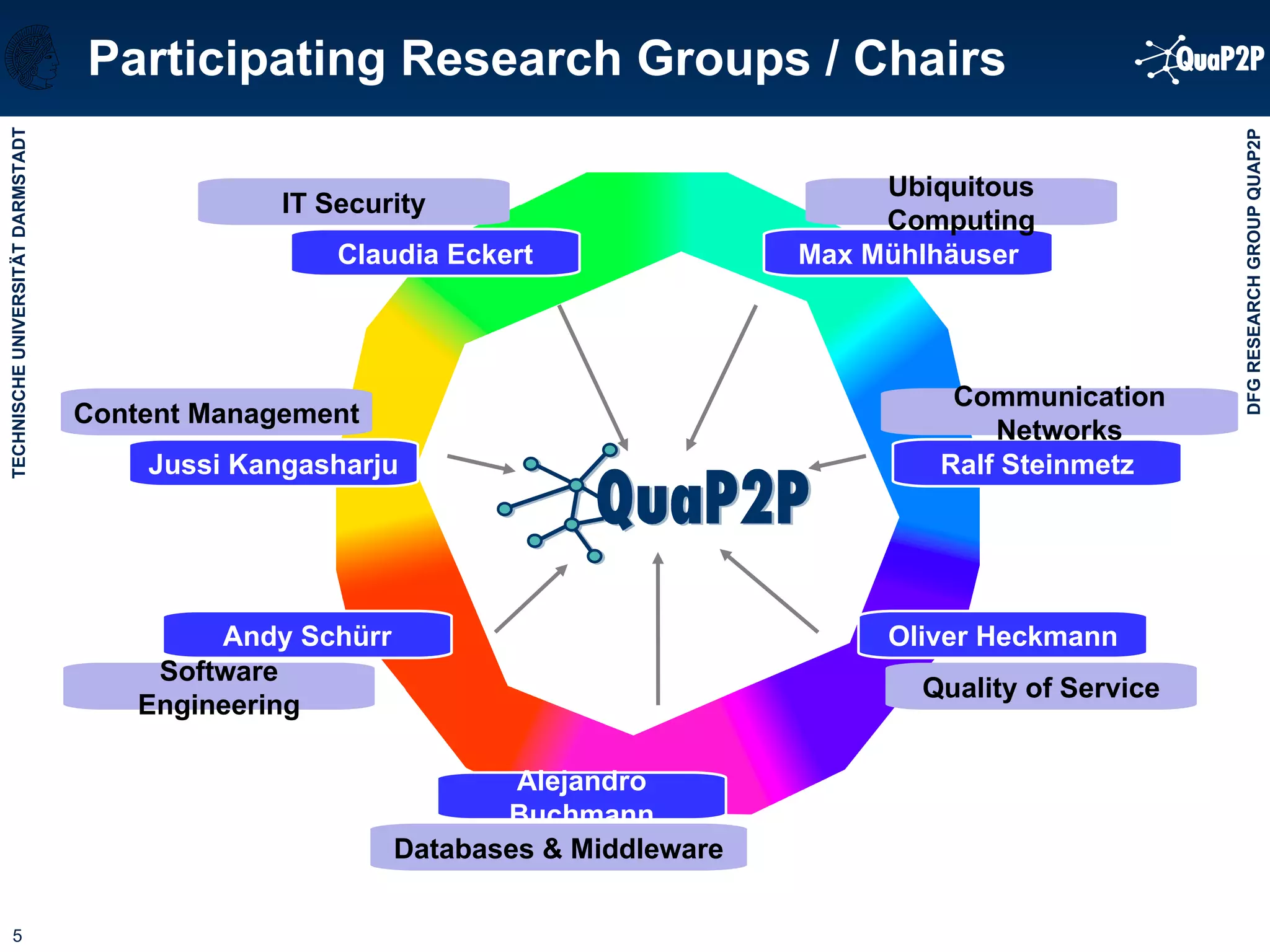
Participating Research Groups / Chairs Alejandro Buchmann Jussi Kangasharju Oliver Heckmann Ralf Steinmetz Claudia Eckert Andy Schürr Max Mühlhäuser Content Management Software Engineering IT Security Ubiquitous Computing Communication Networks Quality of Service Databases & Middleware QuaP2P QuaP2P
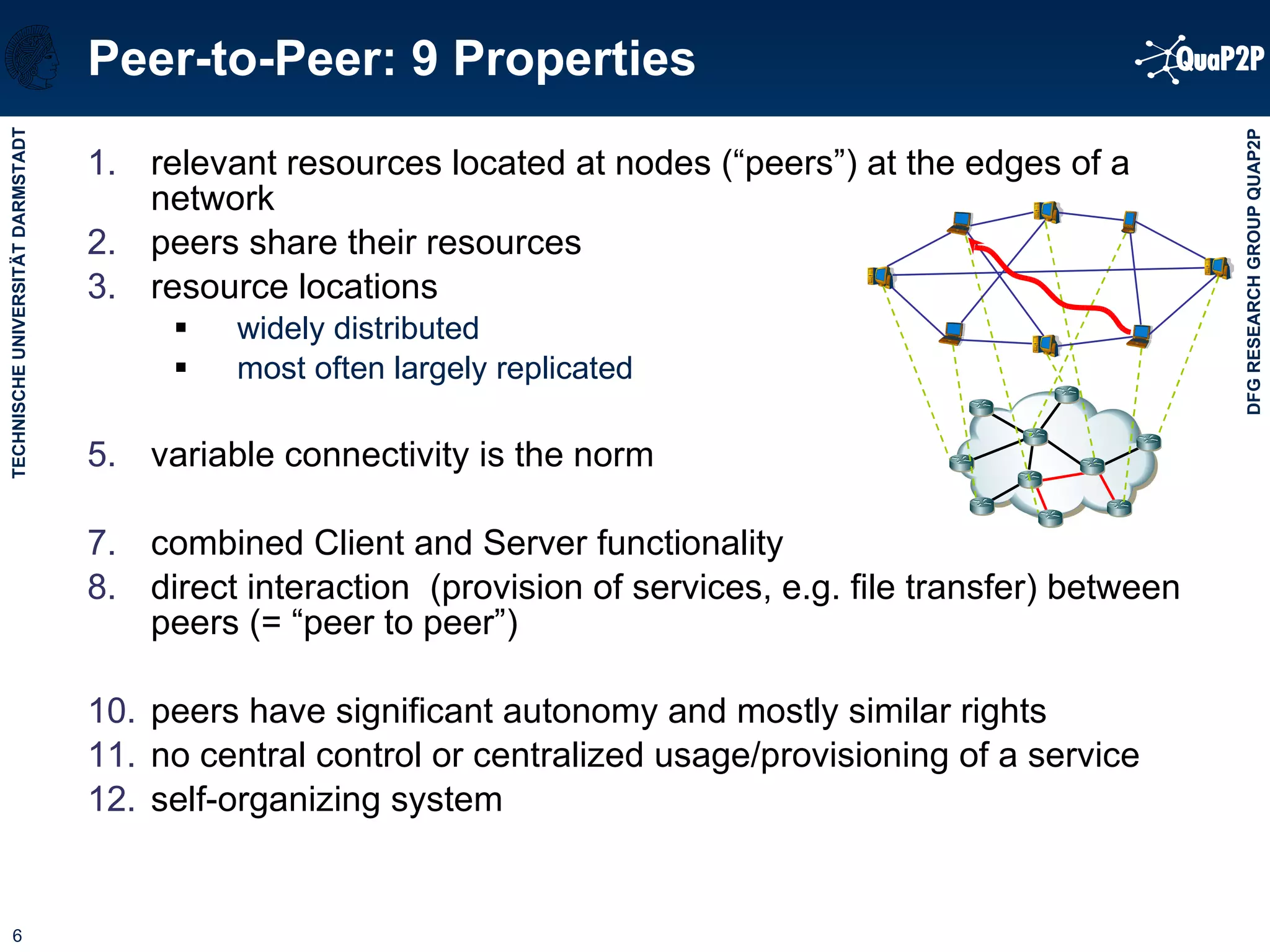
Peer-to-Peer: 9 Properties relevant resources located at nodes (“peers”) at the edges of a network  peers share their resources  resource locations  widely distributed most often largely replicated variable connectivity is the norm combined Client and Server functionality direct interaction  (provision of services, e.g. file transfer) between peers (= “peer to peer”) peers have significant autonomy and mostly similar rights no central control or centralized usage/provisioning of a service self-organizing system
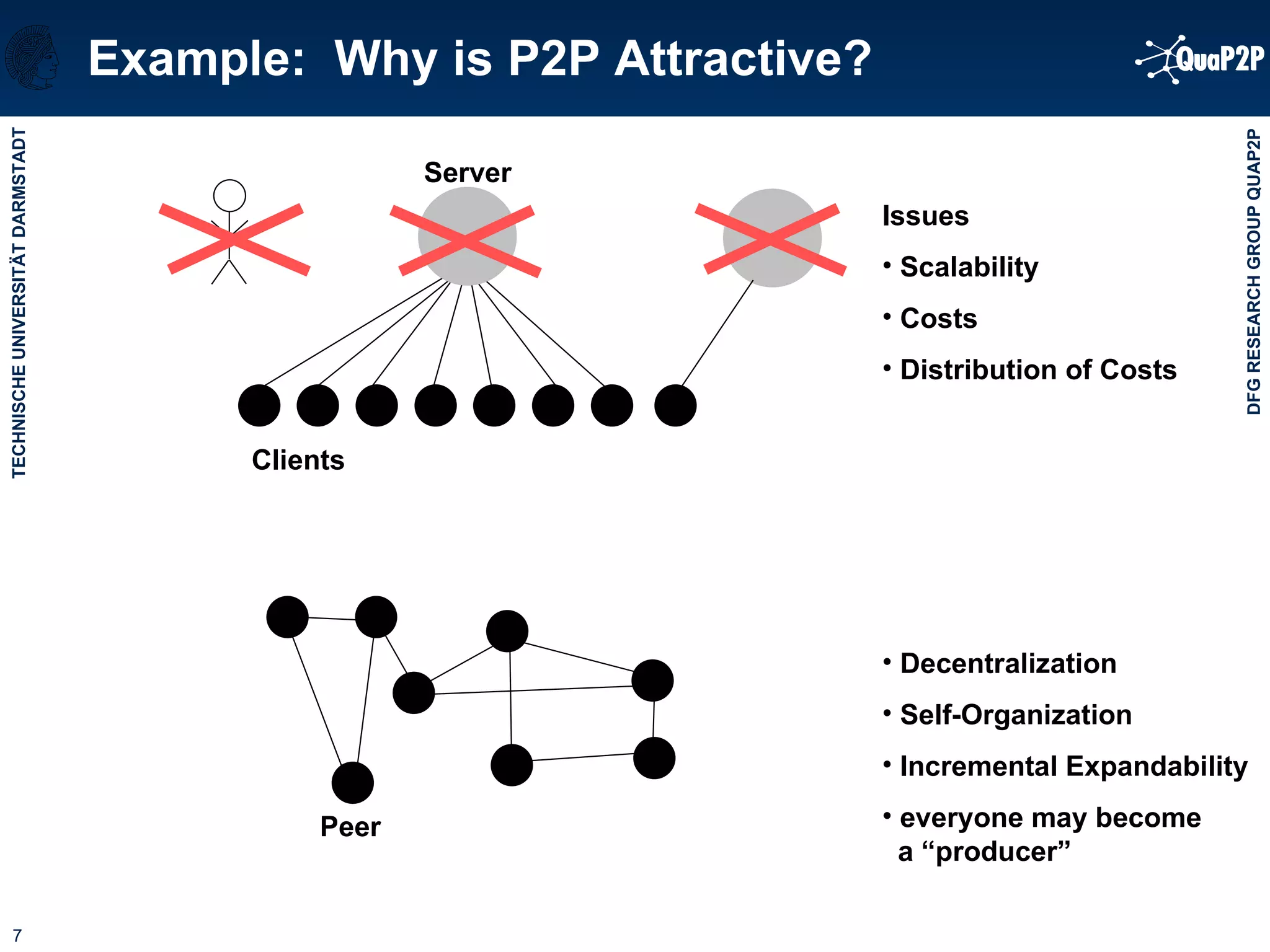
Example:  Why is P2P Attractive? Issues Scalability Costs Distribution of Costs Decentralization Self-Organization Incremental Expandability everyone may become   a “producer” Server Clients Peer
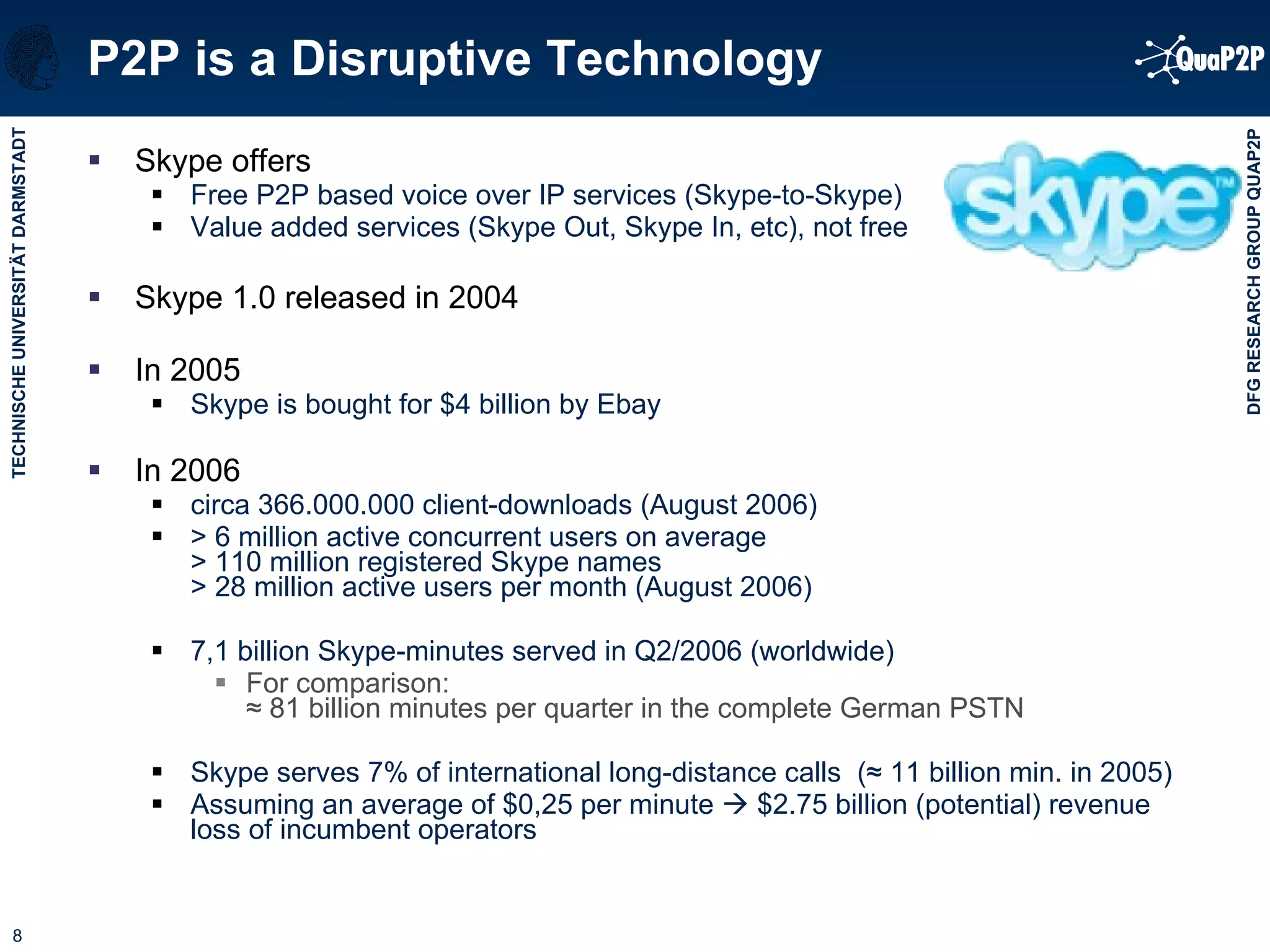
P2P is a Disruptive Technology Skype offers  Free P2P based voice over IP services (Skype-to-Skype) Value added services (Skype Out, Skype In, etc), not free  Skype 1.0 released in 2004 In 2005 Skype is bought for $4 billion by Ebay In 2006 circa 366.000.000 client-downloads (August 2006) > 6 million active concurrent users on average > 110 million registered Skype names > 28 million active users per month (August 2006) 7,1 billion Skype-minutes served in Q2/2006 (worldwide) For comparison:  ≈  81 billion minutes per quarter in the complete German PSTN Skype serves 7% of international long-distance calls  ( ≈  11 billion min. in 2005)  Assuming an average of $0,25 per minute    $2.75 billion (potential) revenue loss of incumbent operators
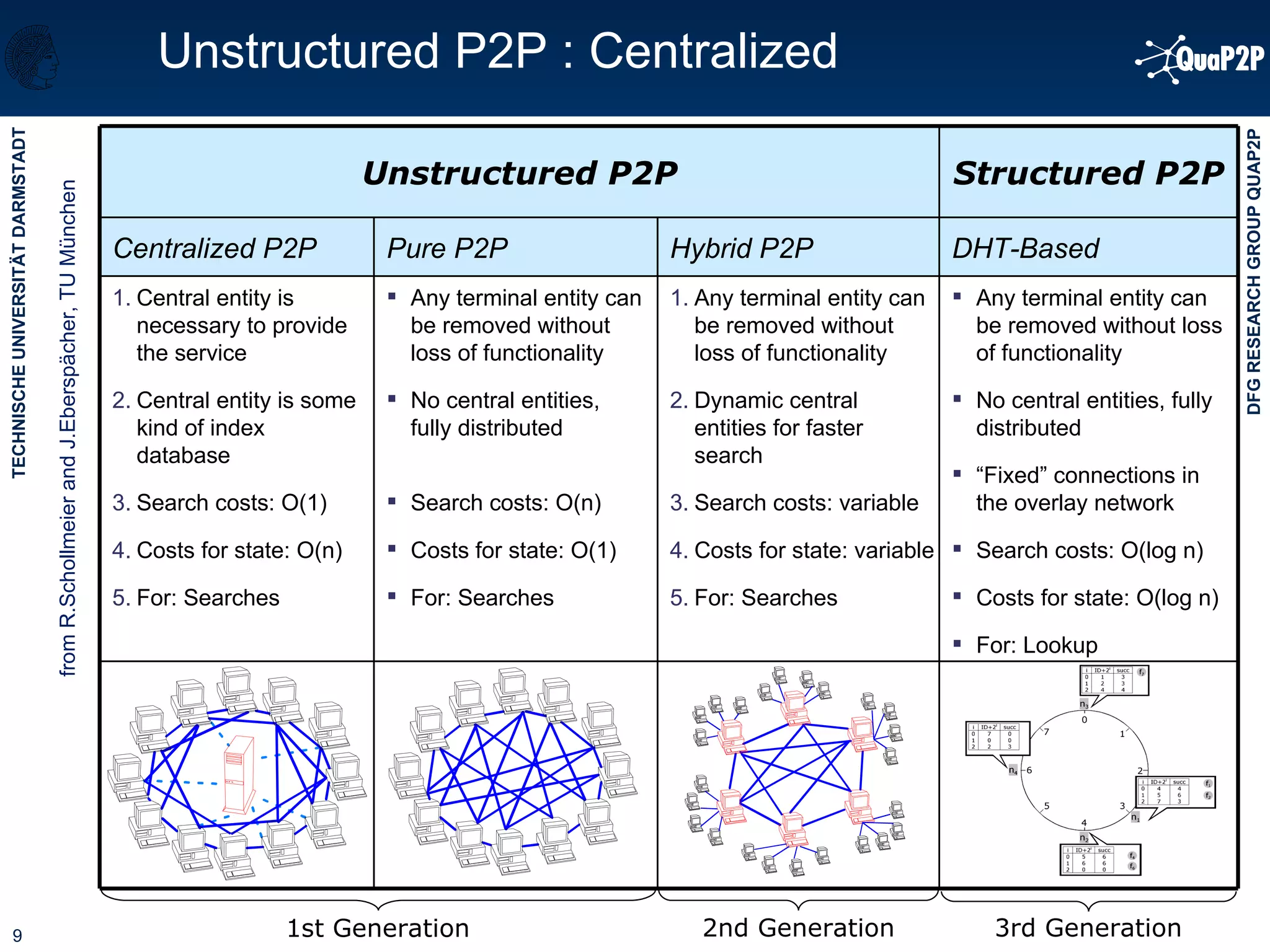
2nd Generation Unstructured P2P : Centralized 1st Generation 3rd Generation from R.Schollmeier and J.Eberspächer, TU München DHT-Based Pure P2P Hybrid P2P Centralized P2P Any terminal entity can be removed without loss of functionality No central entities, fully distributed “ Fixed” connections in the overlay network Search costs: O(log n) Costs for state: O(log n) For: Lookup Any terminal entity can be removed without loss of functionality Dynamic central entities for faster search Search costs: variable Costs for state: variable For: Searches Any terminal entity can be removed without loss of functionality No central entities, fully distributed Search costs: O(n) Costs for state: O(1) For: Searches Central entity is necessary to provide the service Central entity is some kind of index database Search costs: O(1) Costs for state: O(n) For: Searches Structured P2P Unstructured P2P
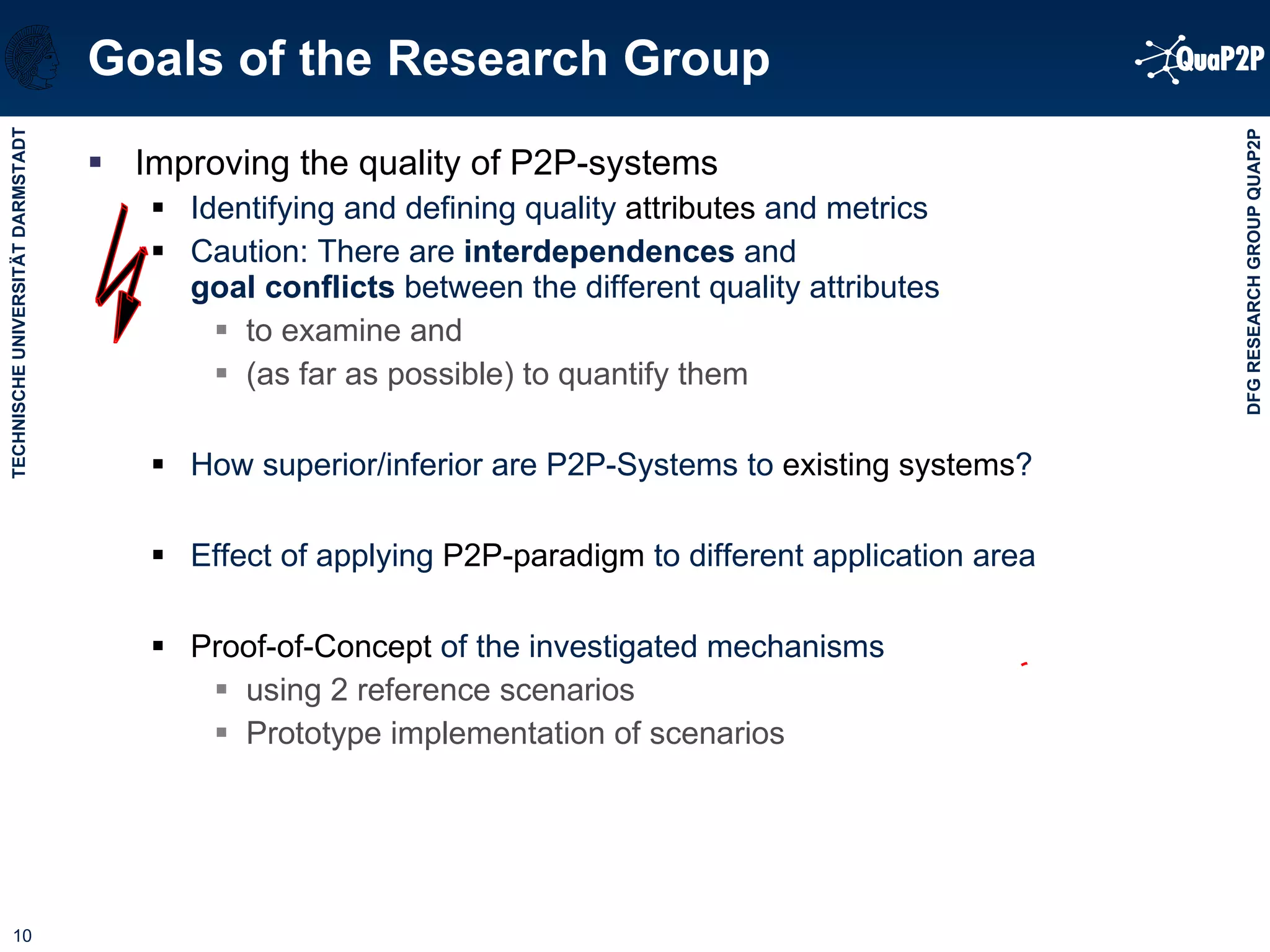
Goals of the Research Group Improving the quality of P2P-systems Identifying and defining quality  attributes  and metrics Caution: There are  interdependences  and  goal conflicts  between the different quality attributes to examine and  (as far as possible) to quantify them  How superior/inferior are P2P-Systems to  existing systems ?  Effect of applying  P2P-paradigm  to different application area  Proof-of-Concept  of the investigated mechanisms using 2 reference scenarios Prototype implementation of scenarios
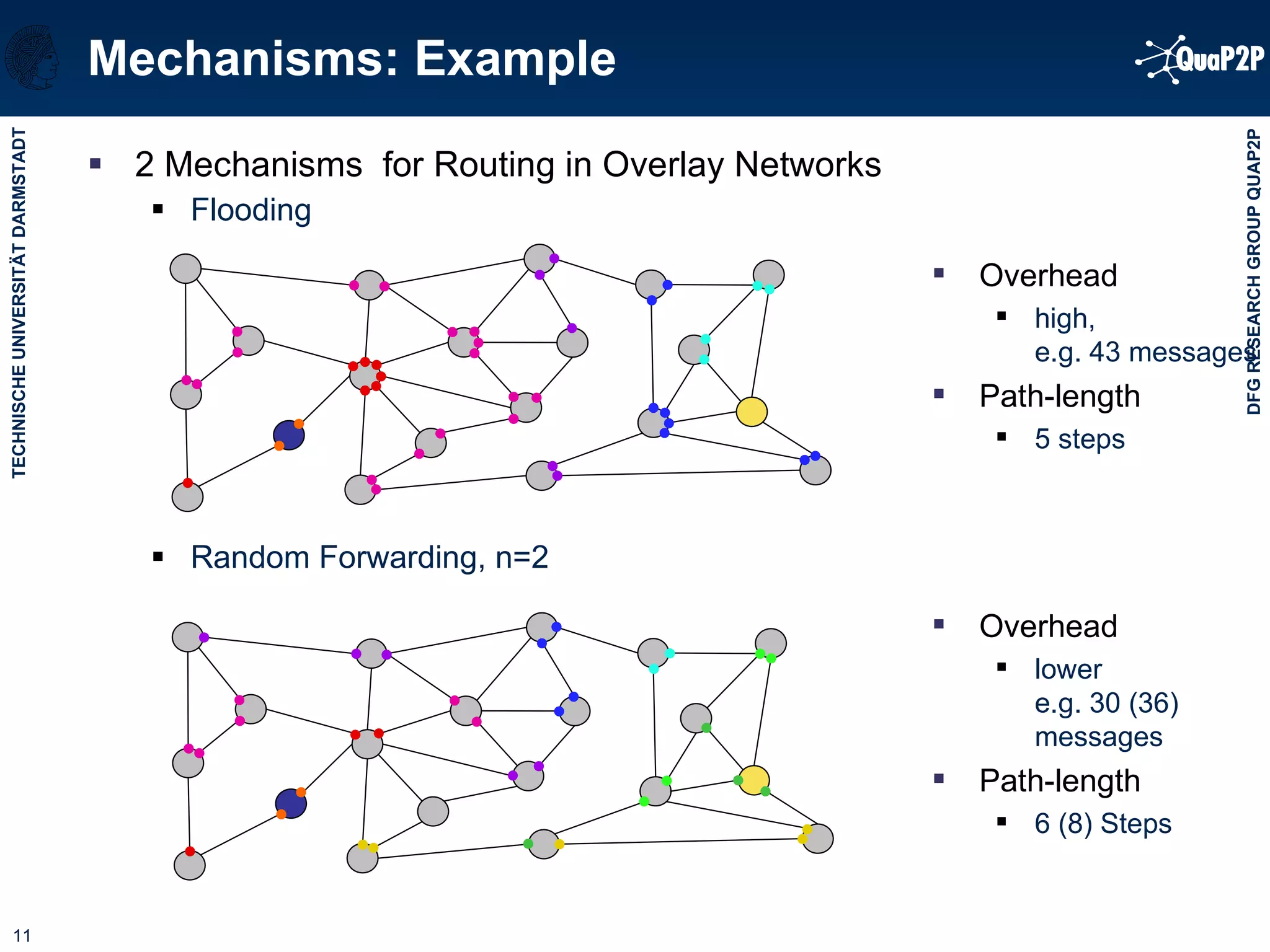
Mechanisms: Example 2 Mechanisms  for Routing in Overlay Networks Flooding Random Forwarding, n=2 Overhead high, e.g. 43 messages Path-length 5 steps Overhead lower e.g. 30 (36) messages Path-length 6 (8) Steps
Quality Attributes Costs Security Quality of P2P Systems Retrievability Coherence Consistency Correctness Performance Scalability Flexibility Stability Dependability Service Provisioning Overlay Operations Individual Node Complete System IP Infrastructure Availability Reliability Robustness/ Fault tolerance Integrity Confidentiality Authentication Non-repudiation Trust Validity Efficiency Adaptability [Heckmann et.al. 2006 a]
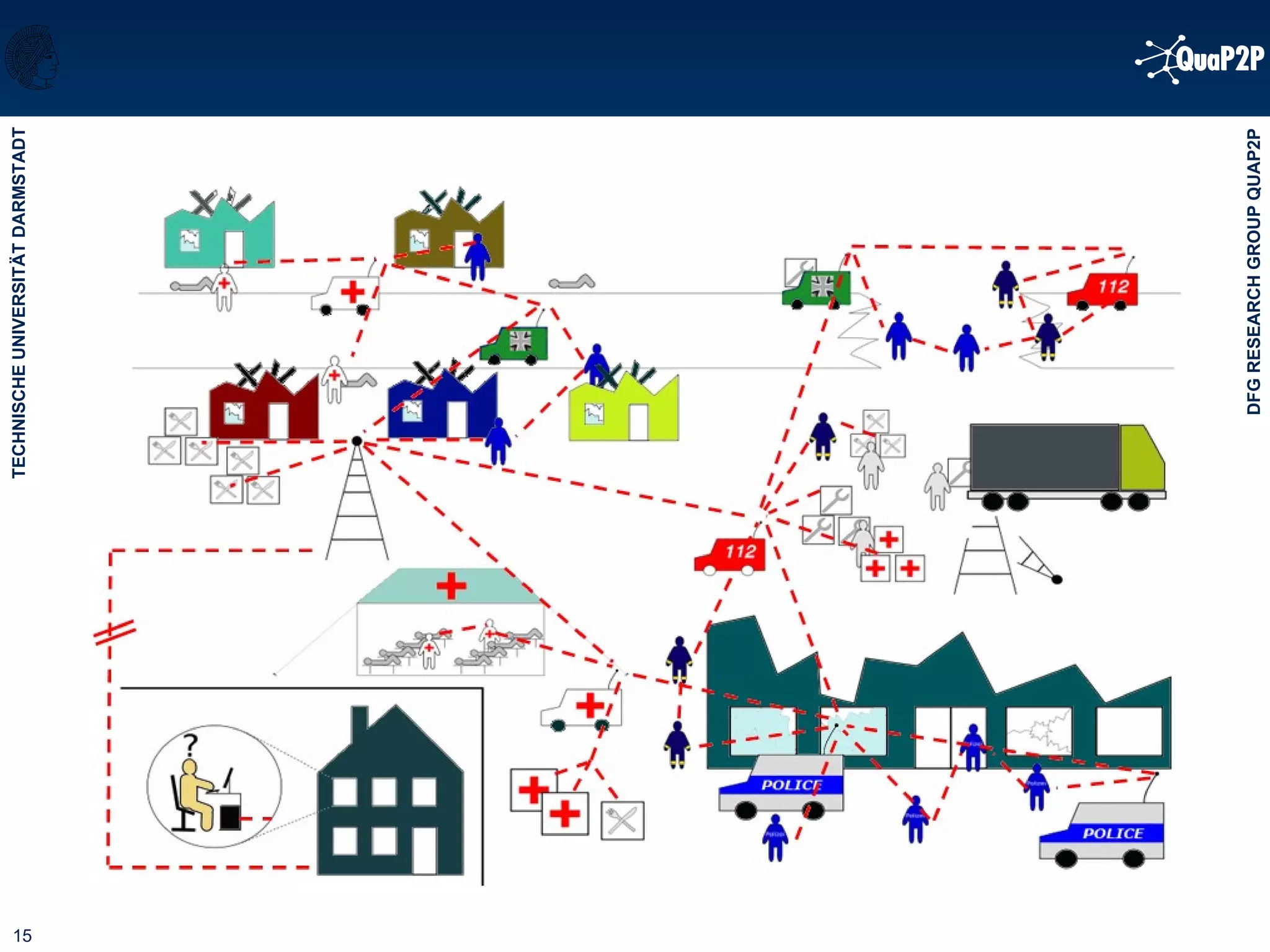
Reference Scenario A: Disaster Recovery [Steinmetz et.al. 2006] Haben Sie oder der Herr?? Ein besseres Bild dazu oder soll dies bleiben?  NL: Ich versuche bis Montag ein besseres zu bekommen.
Reference Scenario A: Disaster Recovery [Steinmetz et.al. 2006]
 
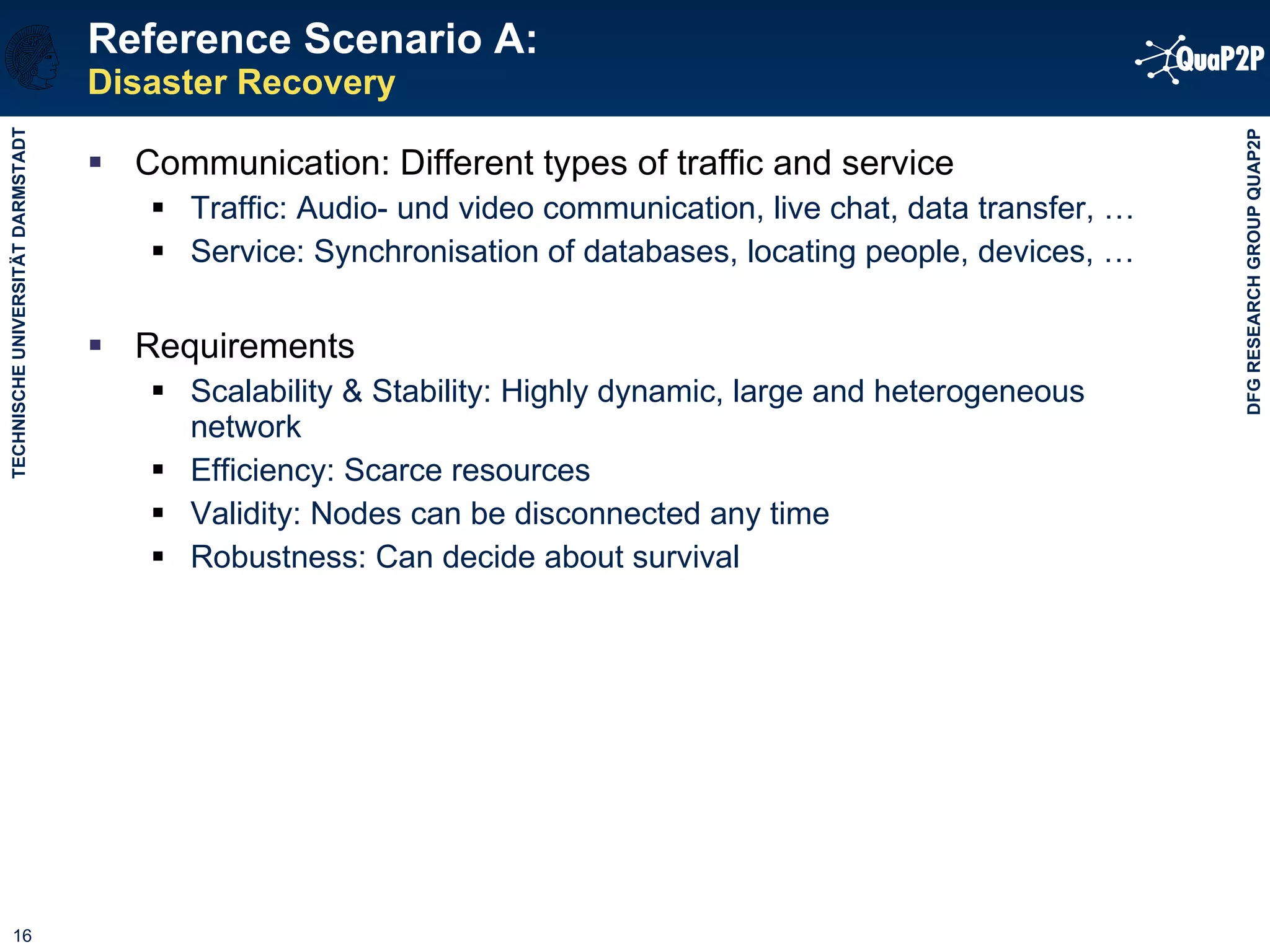
Reference Scenario A: Disaster Recovery Communication: Different types of traffic and service Traffic: Audio- und video communication, live chat, data transfer, … Service: Synchronisation of databases, locating people, devices, … Requirements Scalability & Stability: Highly dynamic, large and heterogeneous network Efficiency: Scarce resources Validity: Nodes can be disconnected any time Robustness: Can decide about survival
Scenario B:  Globally Distributed Software Development „ nomadic" developers (team work on site) Abbreviations: RM  = Resource Management CM  = Content Management DB  = Database [Steinmetz et.al. 2006] RM-System Trace-DB Modeling tool CM-System Programming  environment Developers  in Intranet Project Leader RM-System Trace-DB Modeling tool CM-System Programming  environment Developers  in Intranet Subcontractors CM-System Programming  environment „ nomadic" developers Open-Source Projects Bugtracker Feature-tracker Sourceforge … „ nomadic" developers … …
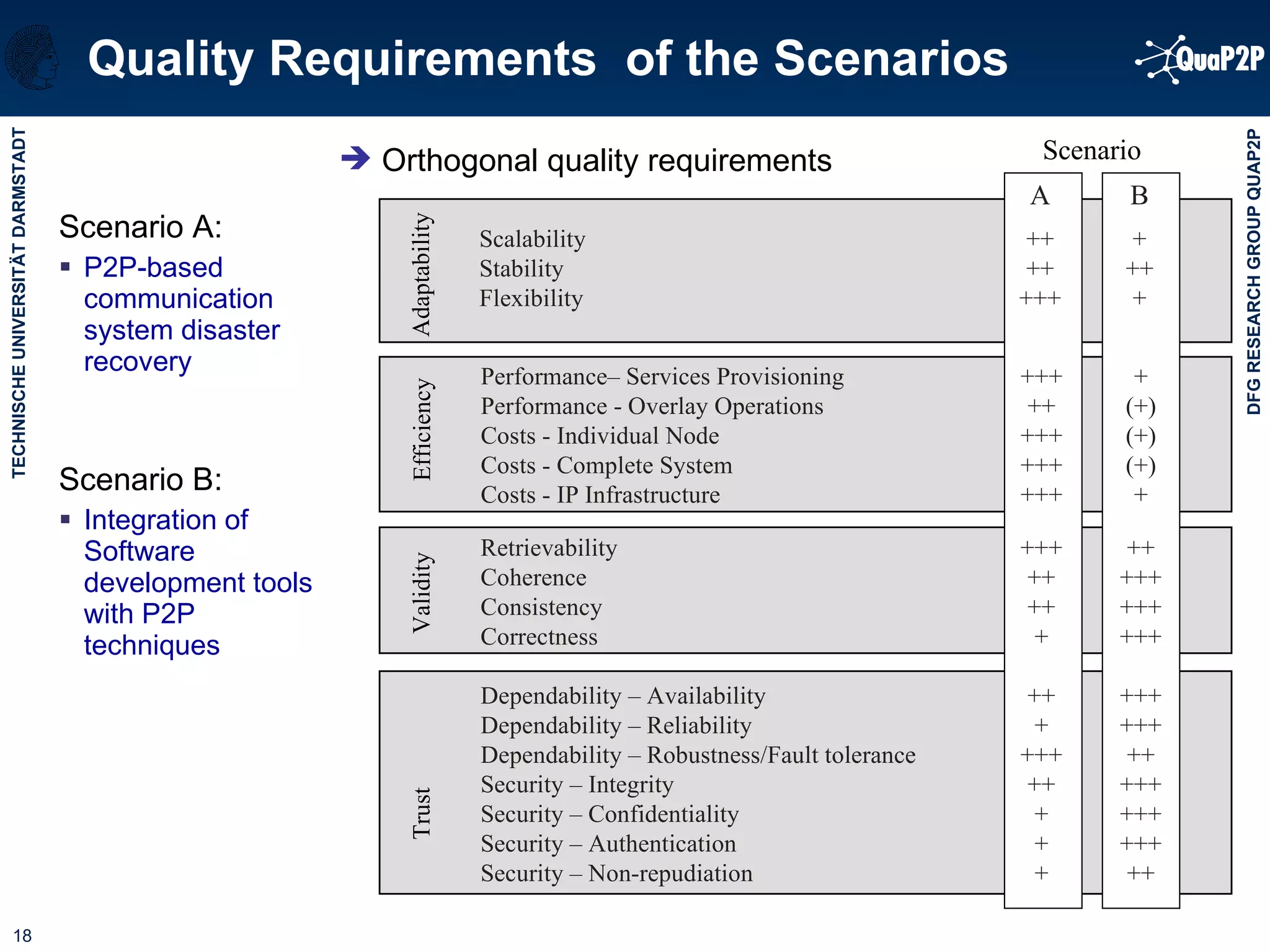
Quality Requirements  of the Scenarios Scenario A:  P2P-based communication system disaster recovery Scenario B:  Integration of Software development tools with P2P techniques Adaptability Efficiency Validity Trust Scenario Performance– Services Provisioning +++ + Performance - Overlay Operations ++ (+) Costs - Individual Node +++ (+) Costs - Complete System +++ (+) Costs - IP Infrastructure +++ + Scalability ++ + Stability ++ ++ Flexibility +++ + A B Retrievability +++ ++ Coherence ++ +++ Consistency ++ +++ Correctness + +++ Dependability – Availability ++ +++ Dependability – Reliability + +++ Dependability – Robustness/Fault tolerance +++ ++ Security – Integrity ++ +++ Security – Confidentiality + +++ Security – Authentication + +++ Security – Non-repudiation + ++ Orthogonal quality requirements
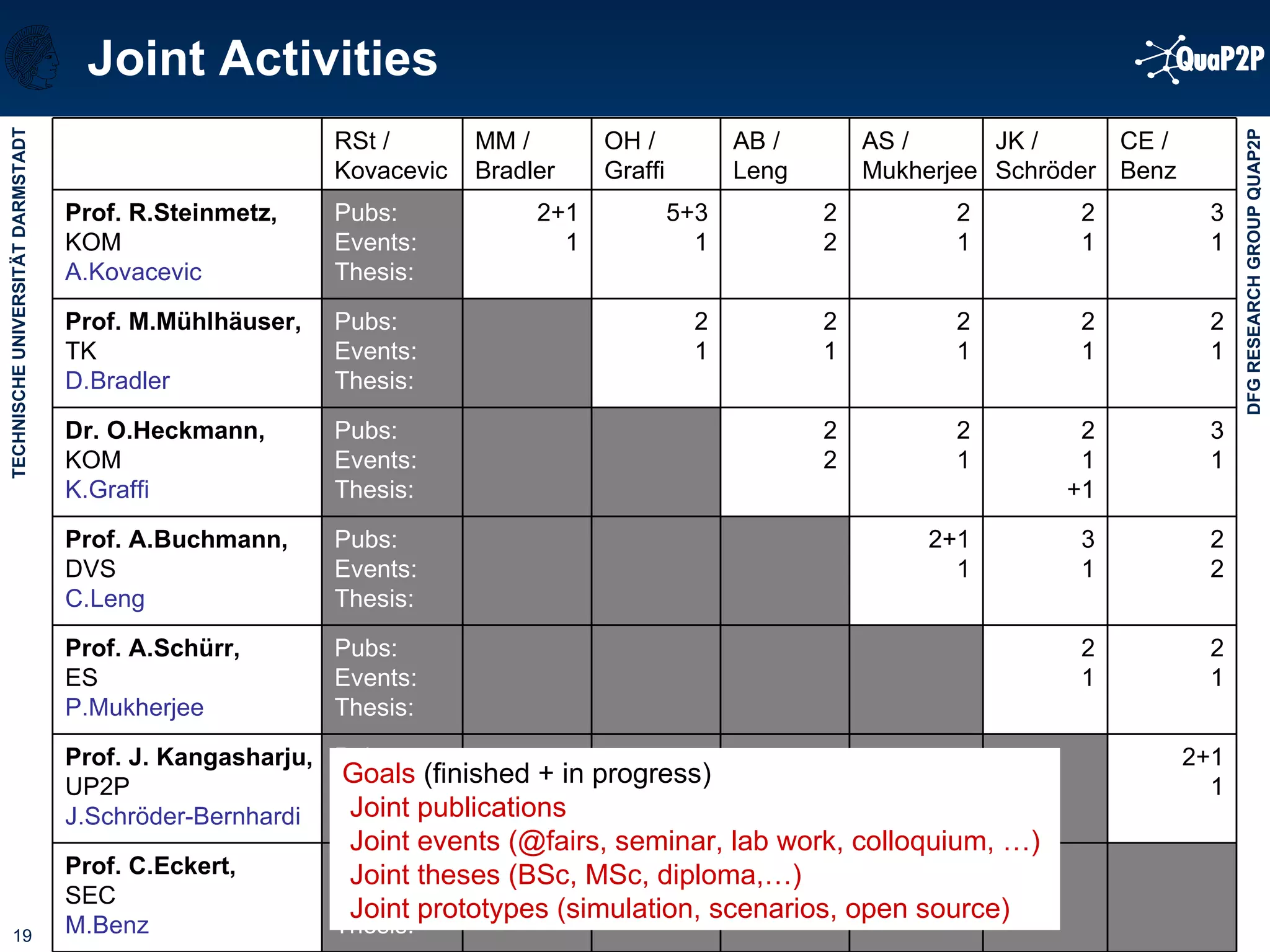
Joint Activities Goals  (finished + in progress)    Joint publications   Joint events (@fairs, seminar, lab work, colloquium, …)  Joint theses (BSc, MSc, diploma,…)  Joint prototypes (simulation, scenarios, open source) Pubs: Events: Thesis: Prof. C.Eckert,  SEC M.Benz 2+1 1 MM / Bradler 2 1 5+3 1 OH / Graffi Pubs: Events: Thesis: Pubs: Events: Thesis: Pubs: Events: Thesis: Pubs: Events: Thesis: Pubs: Events: Thesis: Pubs: Events: Thesis: RSt / Kovacevic 2+1 1 2 1 2 1 2 1 AS / Mukherjee 2 2 2 1 2 2 AB / Leng JK / Schröder 2 1 3 1 2 1 +1 2 1 2 1 2+1 1 Prof. J. Kangasharju,  UP2P J.Schröder-Bernhardi 2 1 Prof. A.Schürr,  ES P.Mukherjee 2 2 Prof. A.Buchmann, DVS C.Leng 3 1 Dr. O.Heckmann, KOM K.Graffi 2 1 Prof. M.Mühlhäuser, TK D.Bradler 3 1 Prof. R.Steinmetz, KOM A.Kovacevic CE / Benz
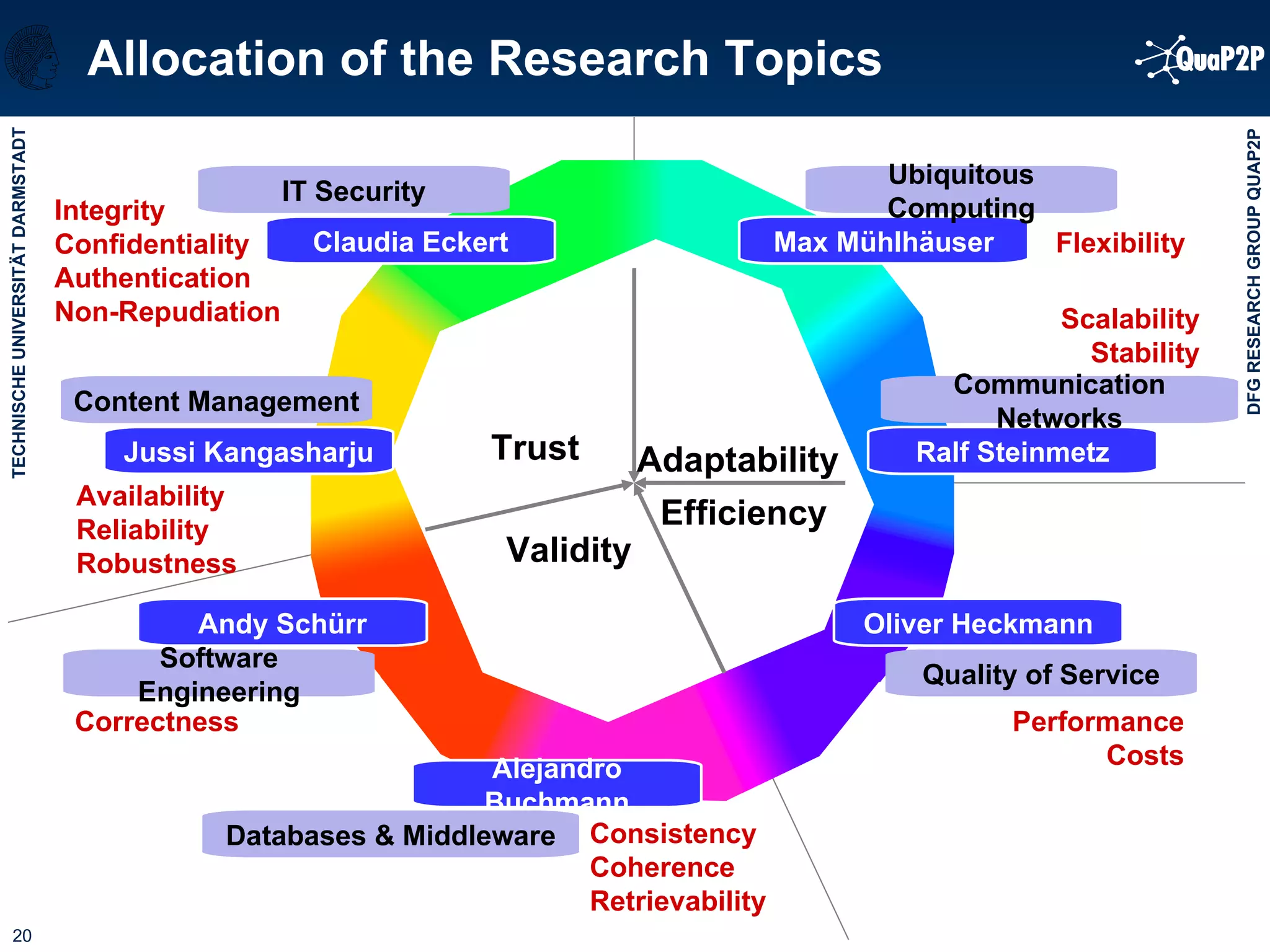
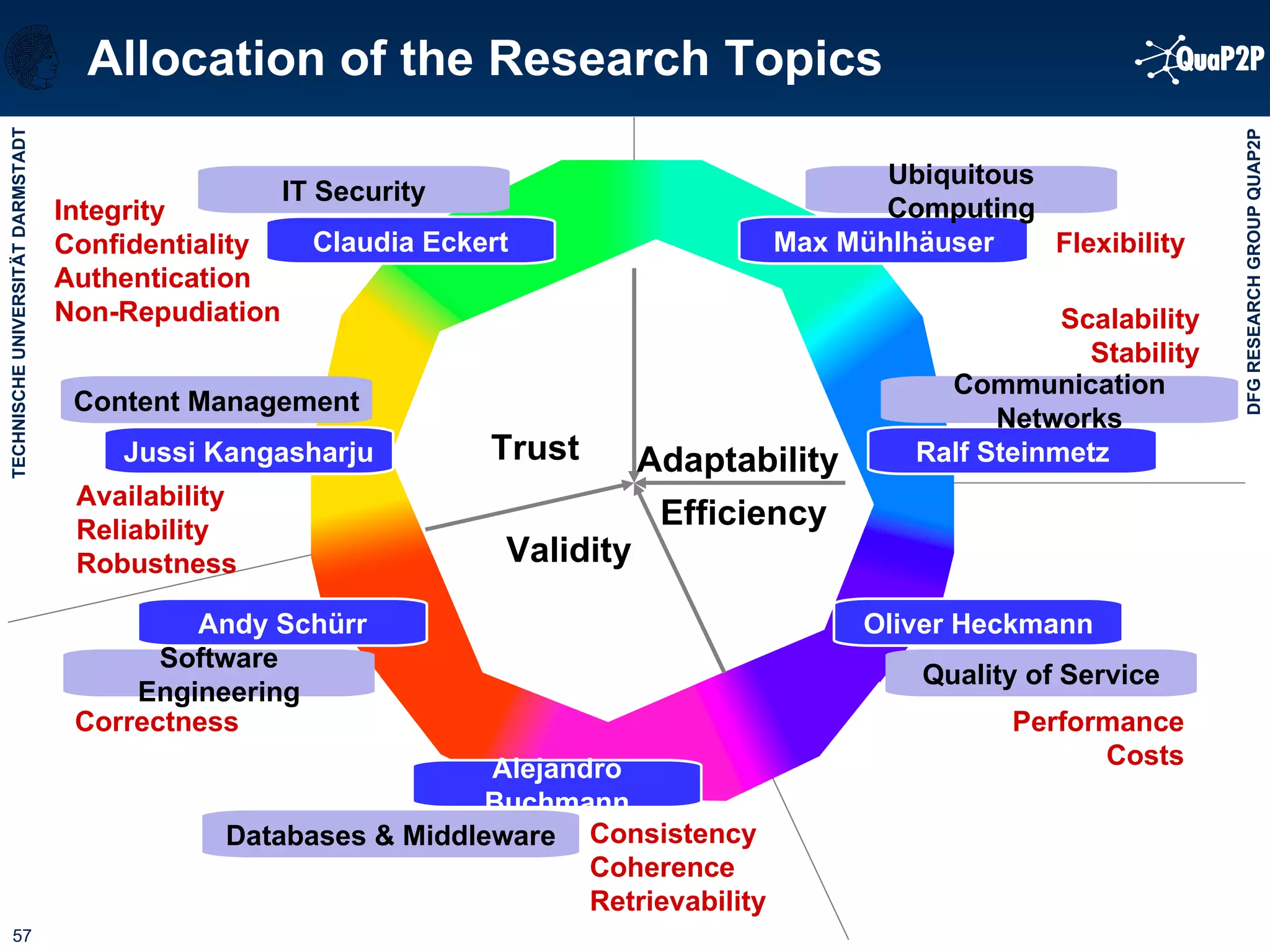
Allocation of the Research Topics Alejandro Buchmann Jussi Kangasharju Oliver Heckmann Ralf Steinmetz Claudia Eckert Andy Schürr Max Mühlhäuser Content Management Software Engineering IT Security Ubiquitous Computing Communication Networks Quality of Service Databases & Middleware Flexibility Scalability Stability Performance Costs Efficiency Adaptability Validity Trust Correctness Consistency Coherence Retrievability Integrity Confidentiality Authentication Non-Repudiation Availability Reliability Robustness
 
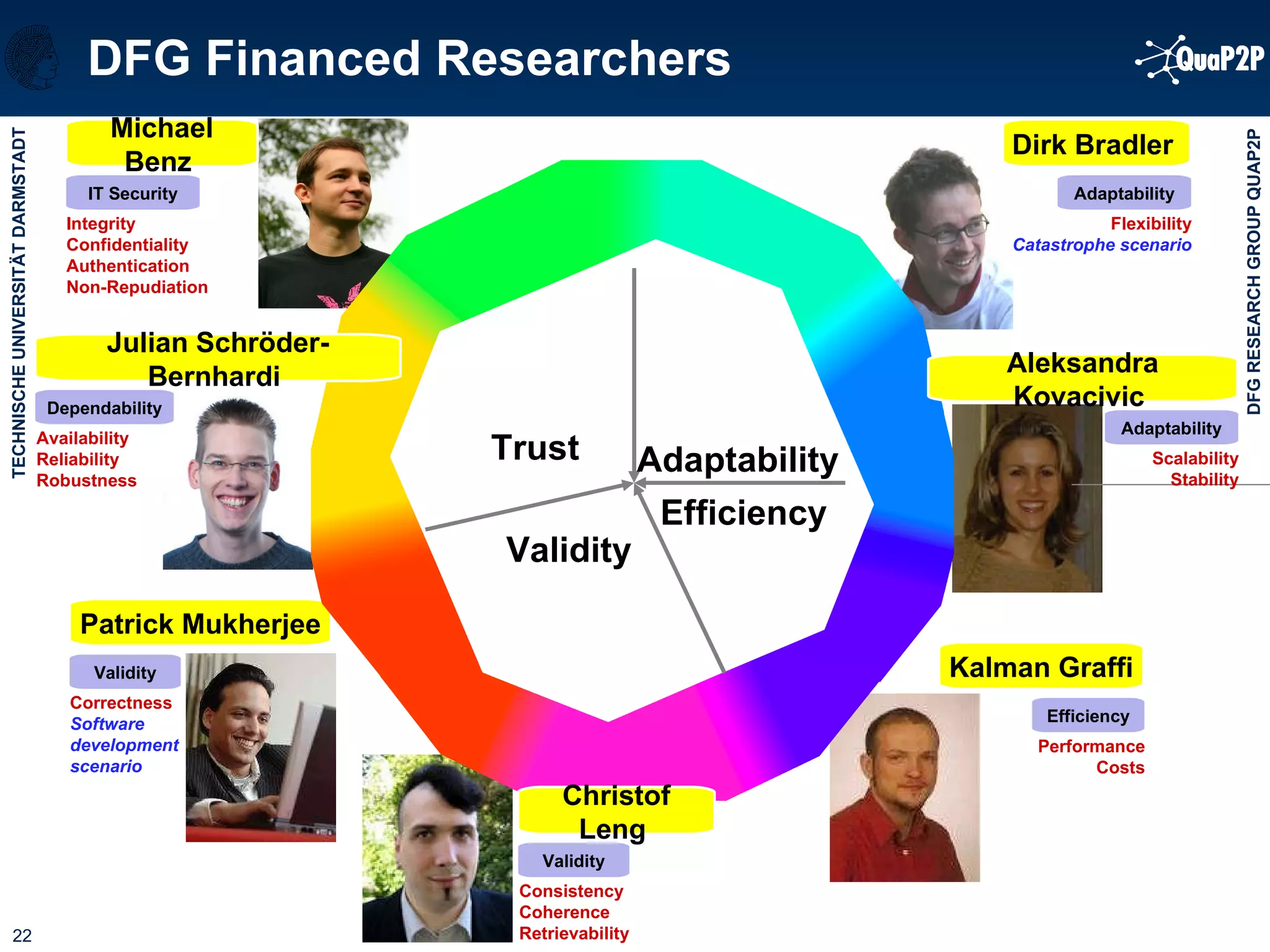
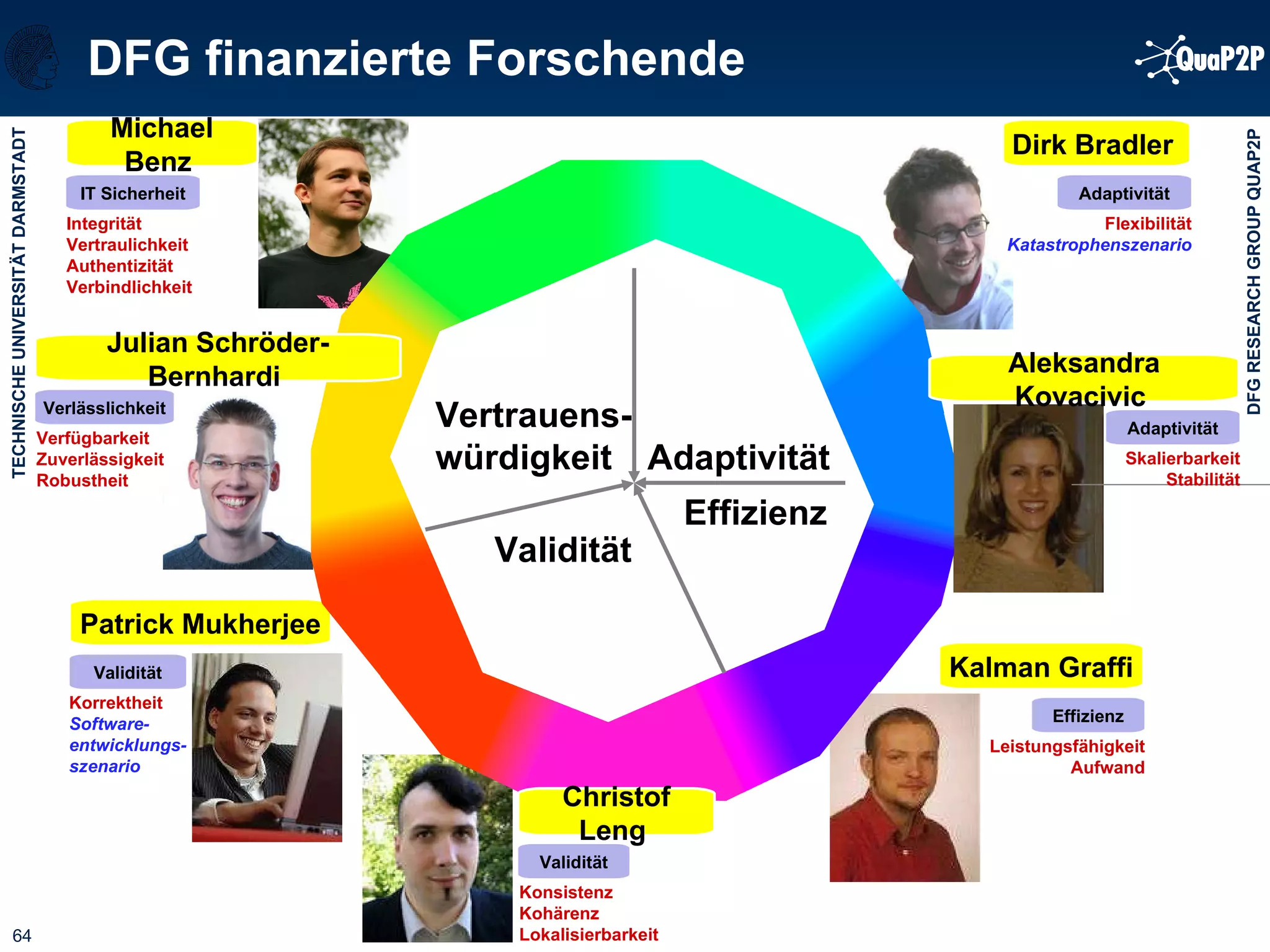
DFG Financed Researchers Efficiency Performance Costs Kalman Graffi  Adaptability Scalability Stability Adaptability Flexibility Catastrophe scenario Dirk Bradler  IT Security Integrity Confidentiality Authentication Non-Repudiation Michael Benz  Dependability Availability Reliability Robustness Validity Correctness Software development scenario Patrick Mukherjee  Validity Consistency Coherence Retrievability Julian Schröder-Bernhardi  Efficiency Adaptability Validity Trust Aleksandra Kovacivic  Christof Leng
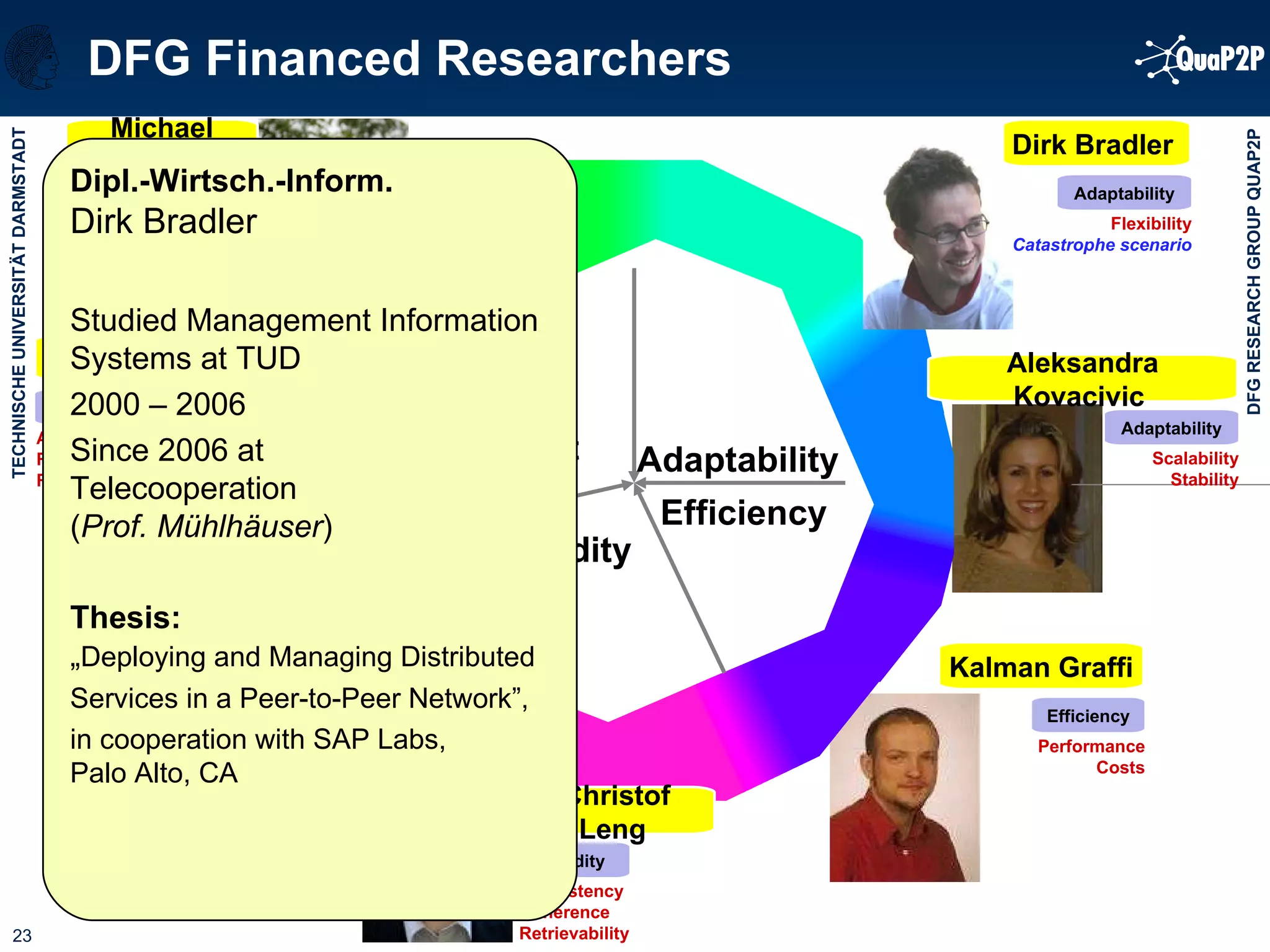
DFG Financed Researchers Efficiency Performance Costs Kalman Graffi  Adaptability Scalability Stability IT Security Integrity Confidentiality Authentication Non-Repudiation Michael Benz  Dependability Availability Reliability Robustness Validity Correctness Software development scenario Patrick Mukherjee  Validity Consistency Coherence Retrievability Julian Schröder-Bernhardi  Efficiency Adaptability Validity Trust Aleksandra Kovacivic  Christof Leng  Dipl.-Wirtsch.-Inform.   Dirk Bradler  Studied  Management Information Systems  at TUD 2000 – 2006 Since 2006 at  Telecooperation  ( Prof. Mühlhäuser ) Thesis: „ Deploying and Managing Distributed Services in a Peer-to-Peer Network”, in cooperation with  SAP Labs,  Palo Alto, CA  Adaptability Flexibility Catastrophe scenario Dirk Bradler
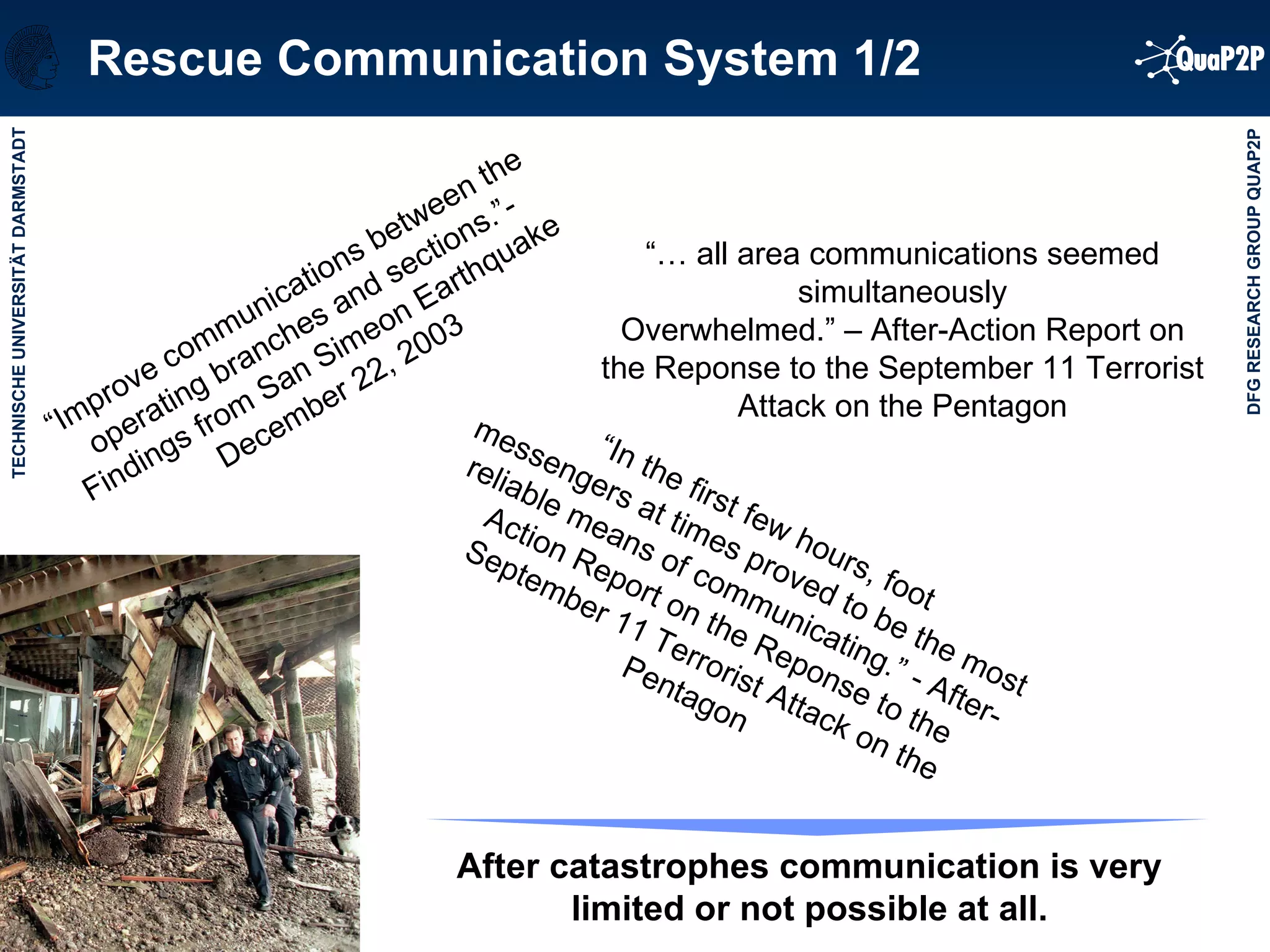
Rescue Communication System 1/2 “…  all area communications seemed simultaneously Overwhelmed.” – After-Action Report on the Reponse to the September 11 Terrorist Attack on the Pentagon “ In the first few hours, foot messengers at times proved to be the most reliable means of communicating.” - After-Action Report on the Reponse to the September 11 Terrorist Attack on the Pentagon “ Improve communications between the operating branches and sections.”- Findings from San Simeon Earthquake December 22, 2003 After catastrophes communication is very limited or not possible at all.
Rescue Communication System 2/2 “ It's expensive to serve, but it's easy to use P2P to share.” - Greg Bildson, COO of LimeWire  P2P systems can improve communication after catastrophes. “ We believe P2P networks […] do indeed represent the next distribution channel for digital media.” - Michael Weiss, CEO StreamCast  “ These networks scale indefinitely without increasing search time and without the need for costly centralized resources.” - Skype
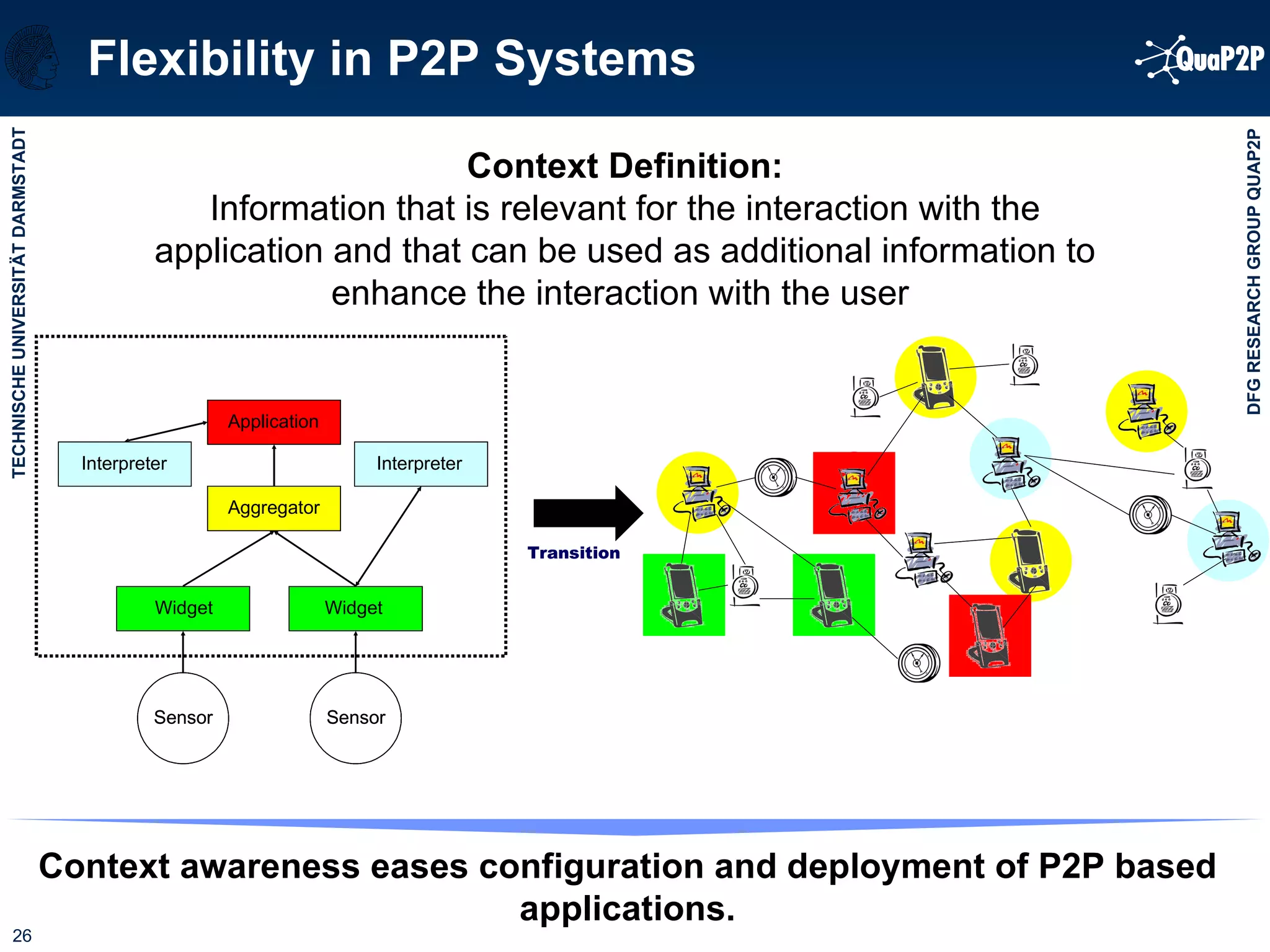
Flexibility in P2P Systems Context awareness eases configuration and deployment of P2P based applications. Context Definition: Information that is relevant for the interaction with the application and that can be used as additional information to enhance the interaction with the user
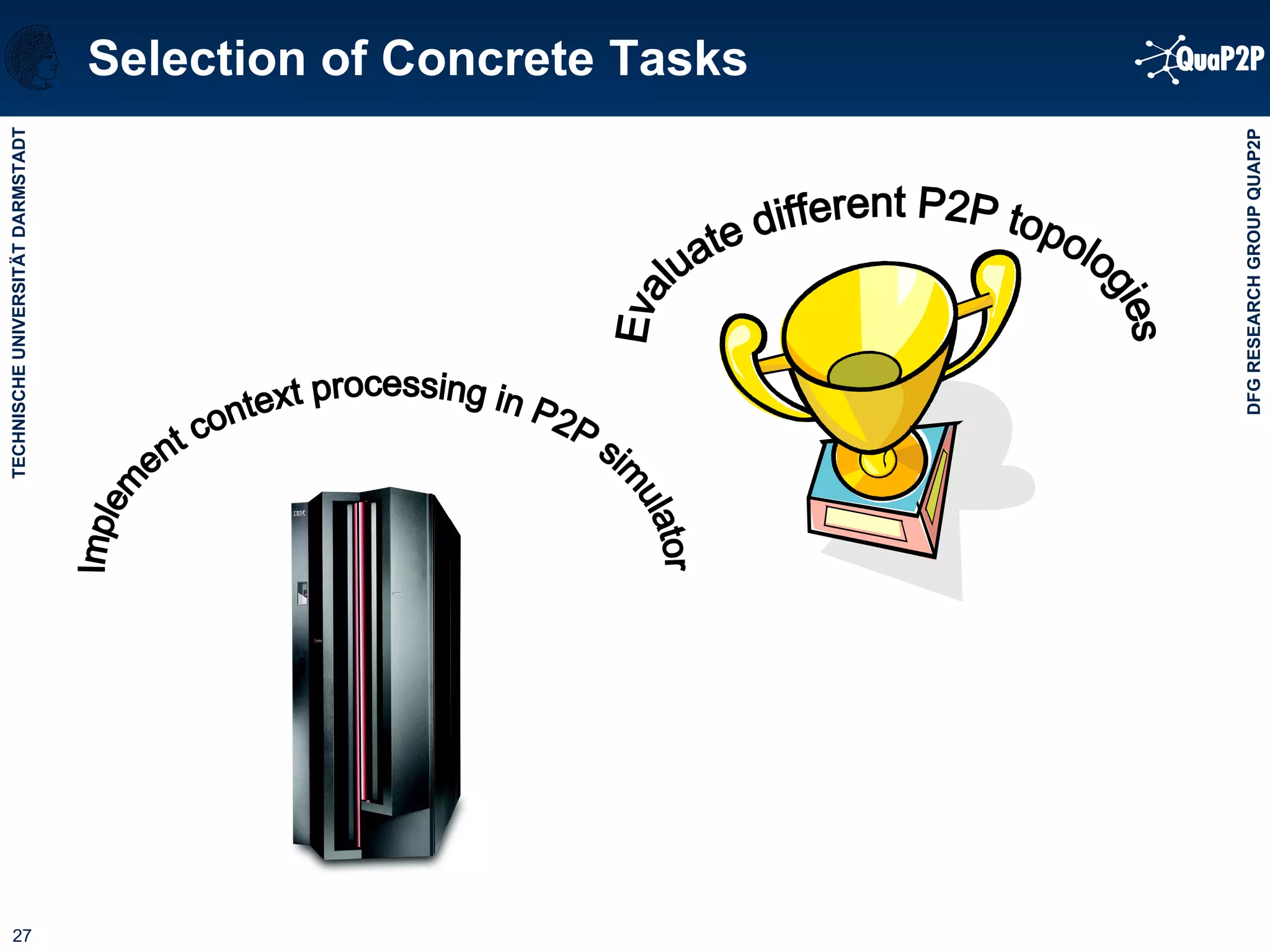
Selection of Concrete Tasks Implement context processing in P2P simulator Evaluate different P2P topologies
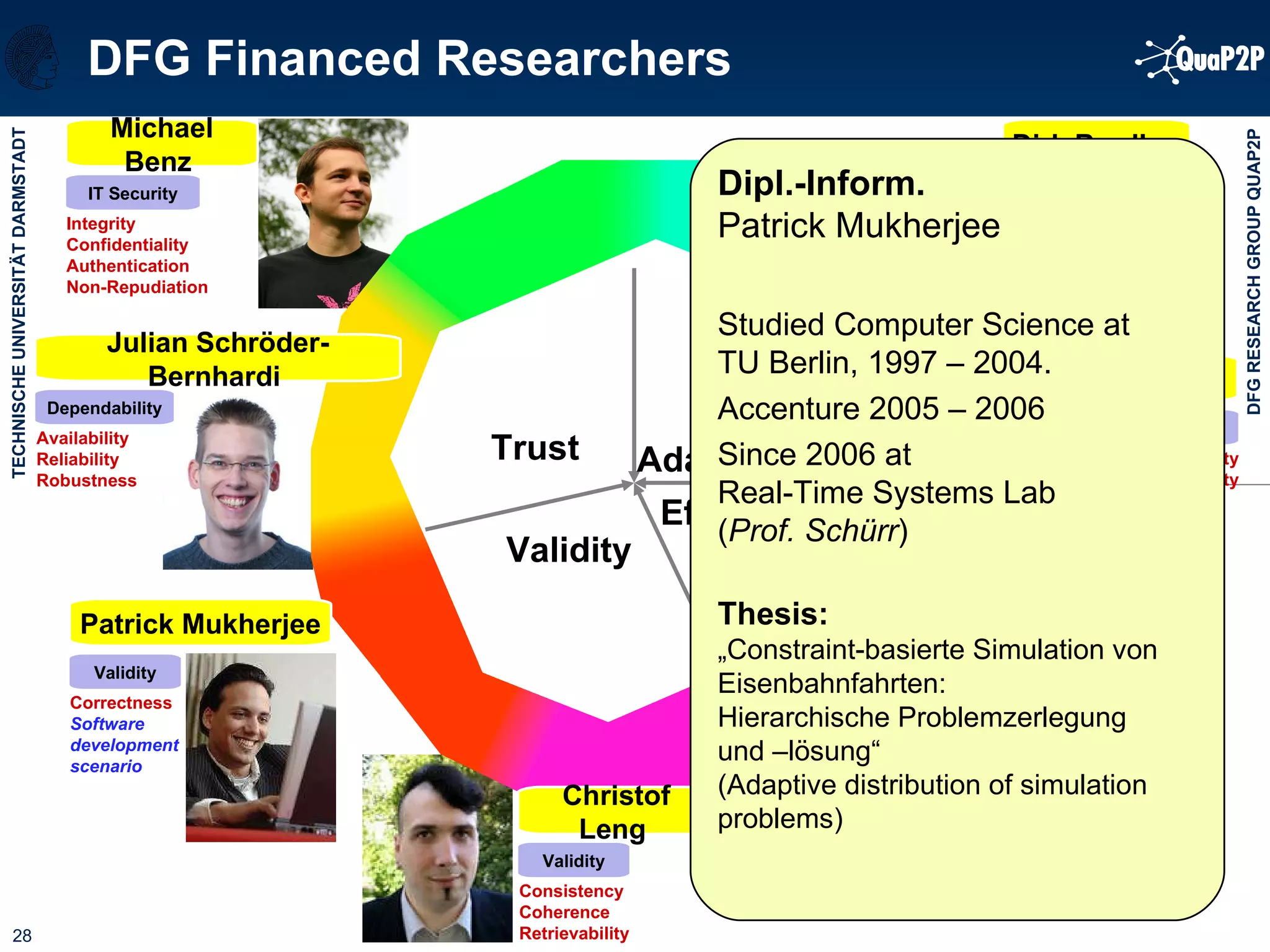
DFG Financed Researchers Efficiency Performance Costs Kalman Graffi  Adaptability Scalability Stability Adaptability Flexibility Catastrophe scenario Dirk Bradler  IT Security Integrity Confidentiality Authentication Non-Repudiation Michael Benz  Dependability Availability Reliability Robustness Validity Consistency Coherence Retrievability Julian Schröder-Bernhardi  Efficiency Adaptability Validity Trust Aleksandra Kovacivic  Christof Leng  Dipl.-Inform.   Patrick Mukherjee  Studied Computer Science at  TU Berlin, 1997 – 2004. Accenture 2005 – 2006 Since 2006 at  Real-Time Systems Lab ( Prof. Schürr ) Thesis: „Constraint-basierte Simulation von Eisenbahnfahrten:  Hierarchische Problemzerlegung  und –lösung“  (Adaptive distribution of simulation  problems) Validity Correctness Software development scenario Patrick Mukherjee
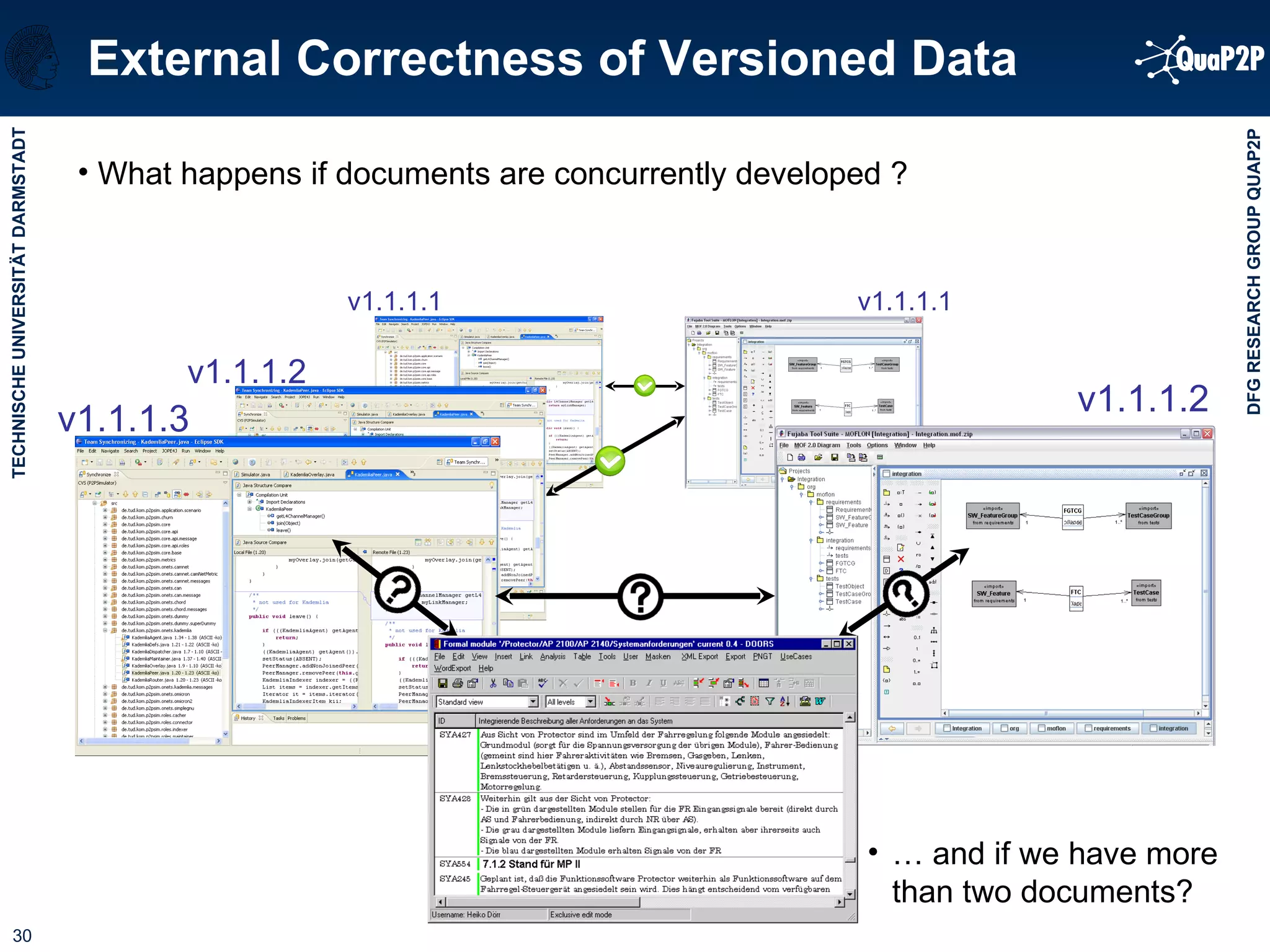
Validity: Correctness Data objects are correct according to a specification integrity constraints versioned data objects Data objects are internal correct =  realized  according to its specification  can be locally checked (i.e. Hoare-logic)  external correct = specified  relations  are valid
External Correctness of Versioned Data v1.1.1.1 v1.1.1.2 v1.1.1.3 v1.1.1.2 What happens if documents are concurrently developed ? …  and if we have more than two documents? v1.1.1.1
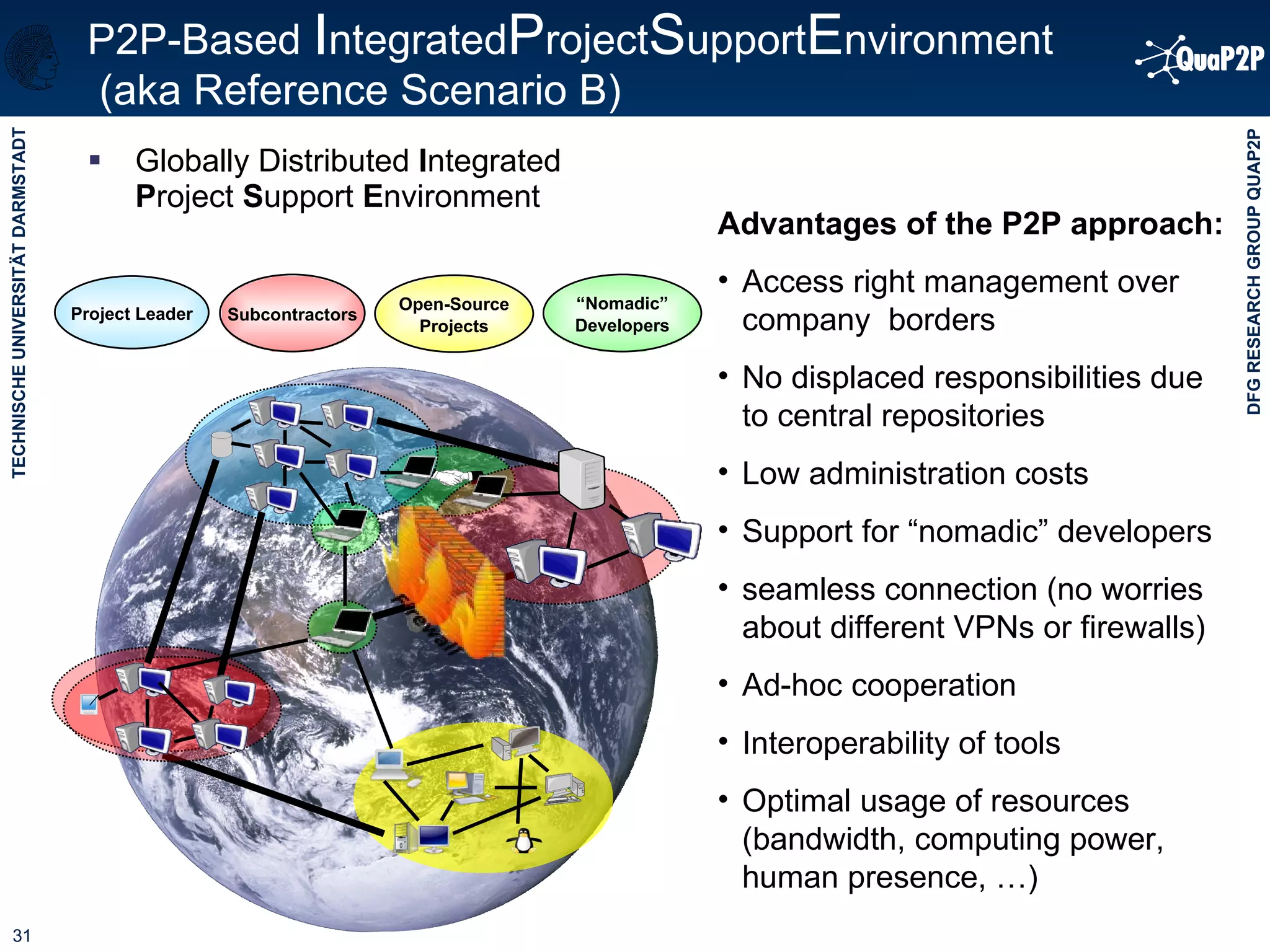
P2P-Based  I ntegrated P roject S upport E nvironment  (aka Reference Scenario B) Globally Distributed  I ntegrated  P roject  S upport  E nvironment Advantages of the P2P approach: Access right management over company  borders No displaced responsibilities due to central repositories Low administration costs Support for “nomadic” developers seamless connection (no worries about different VPNs or firewalls) Ad-hoc cooperation Interoperability of tools Optimal usage of resources (bandwidth, computing power, human presence, …) Subcontractors Project Leader Open-Source Projects “ Nomadic” Developers
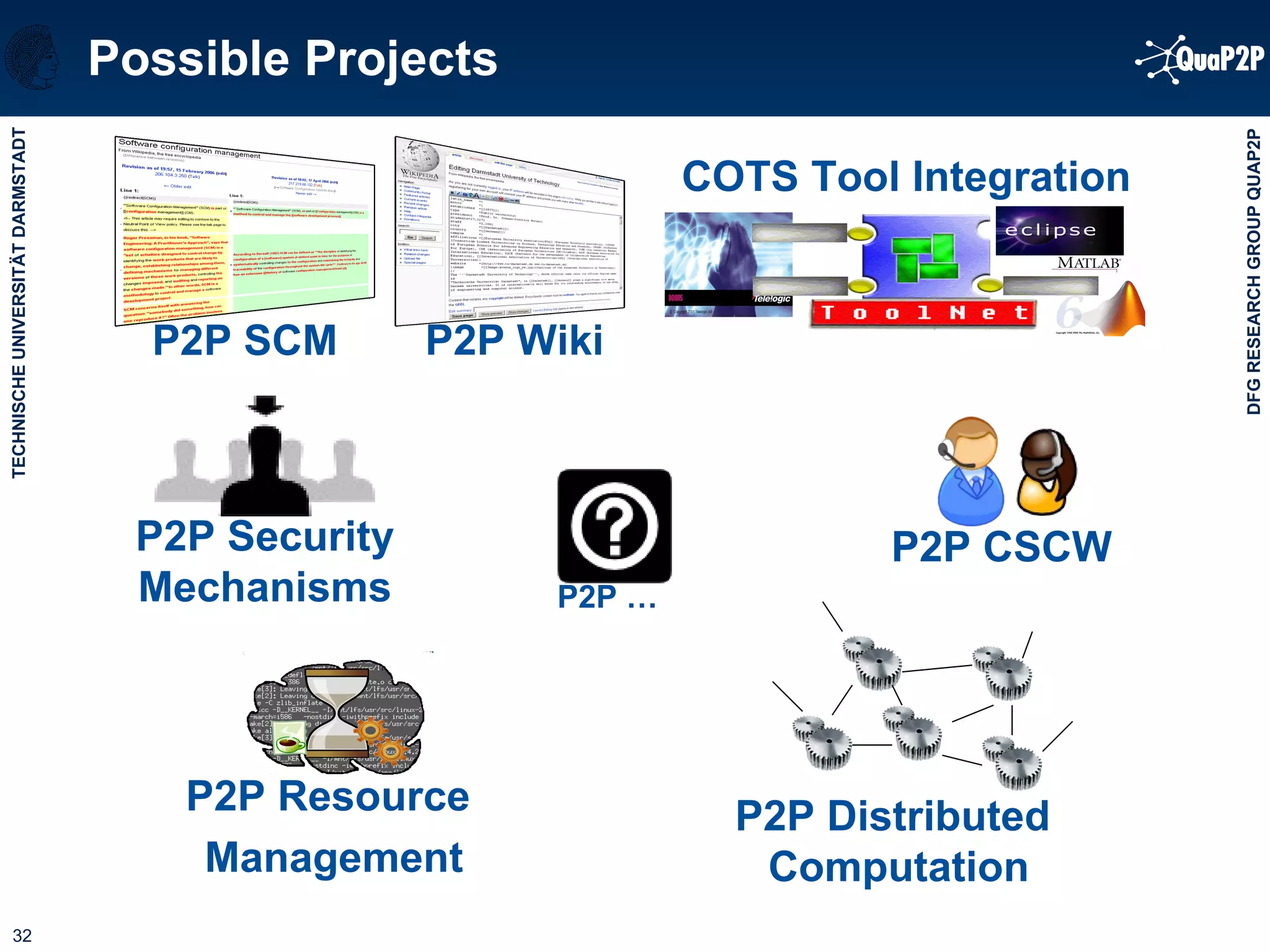
Possible Projects P2P … P2P SCM P2P Wiki COTS Tool Integration P2P Security Mechanisms P2P Resource  Management P2P Distributed  Computation P2P CSCW
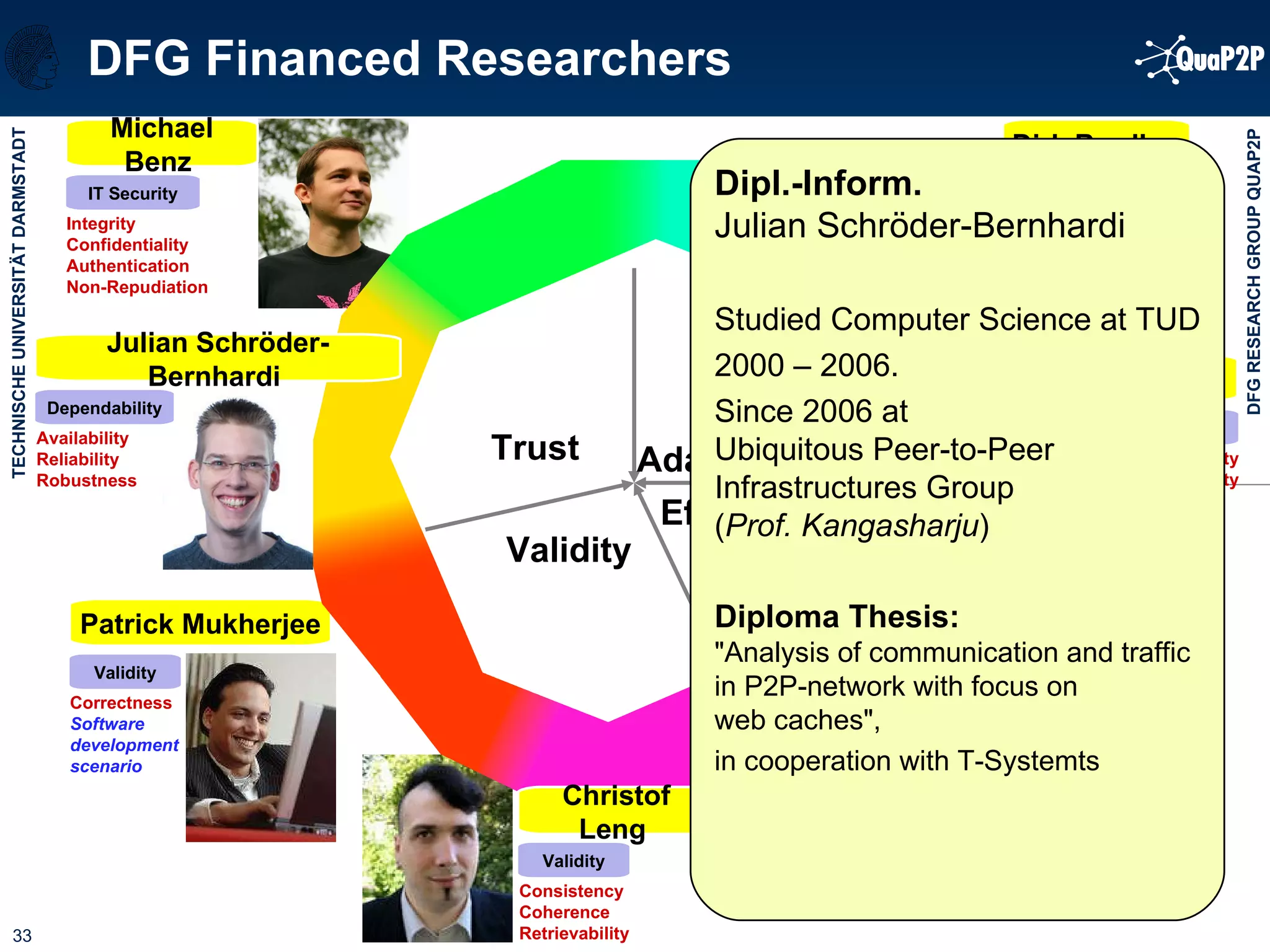
DFG Financed Researchers Efficiency Performance Costs Kalman Graffi  Adaptability Scalability Stability Adaptability Flexibility Catastrophe scenario Dirk Bradler  IT Security Integrity Confidentiality Authentication Non-Repudiation Michael Benz  Validity Correctness Software development scenario Patrick Mukherjee  Validity Consistency Coherence Retrievability Efficiency Adaptability Validity Trust Aleksandra Kovacivic  Christof Leng  Julian Schröder-Bernhardi  Dipl.-Inform.   Julian Schröder-Bernhardi Studied Computer Science at TUD 2000 – 2006. Since 2006 at Ubiquitous Peer-to-Peer Infrastructures Group ( Prof. Kangasharju ) Diploma Thesis: "Analysis of communication and traffic in P2P-network with focus on  web caches",  in cooperation with T-Systemts Dependability Availability Reliability Robustness
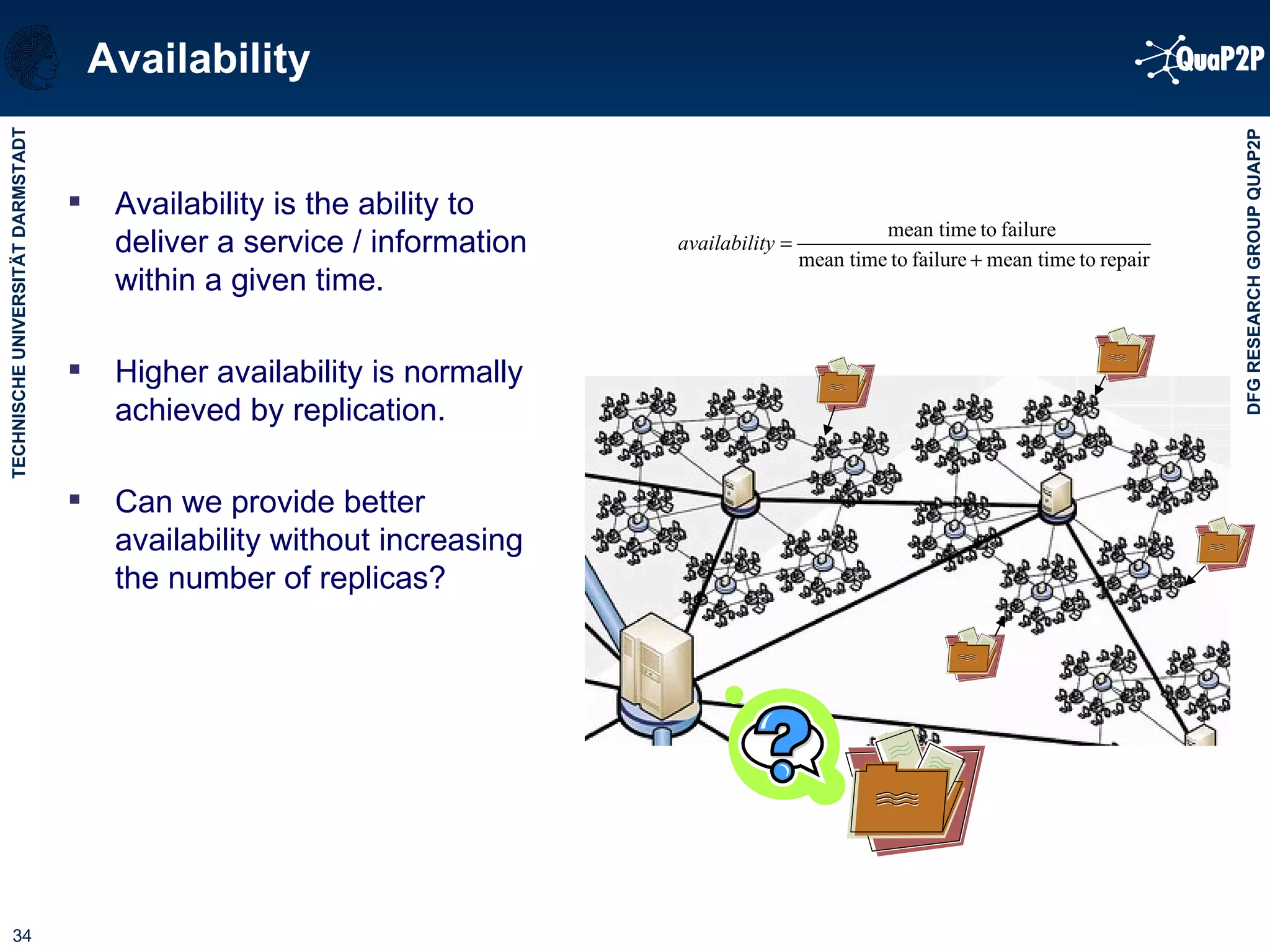
Availability Availability is the ability to deliver a service / information within a given time. Higher availability is normally achieved by replication. Can we provide better availability without increasing the number of replicas?
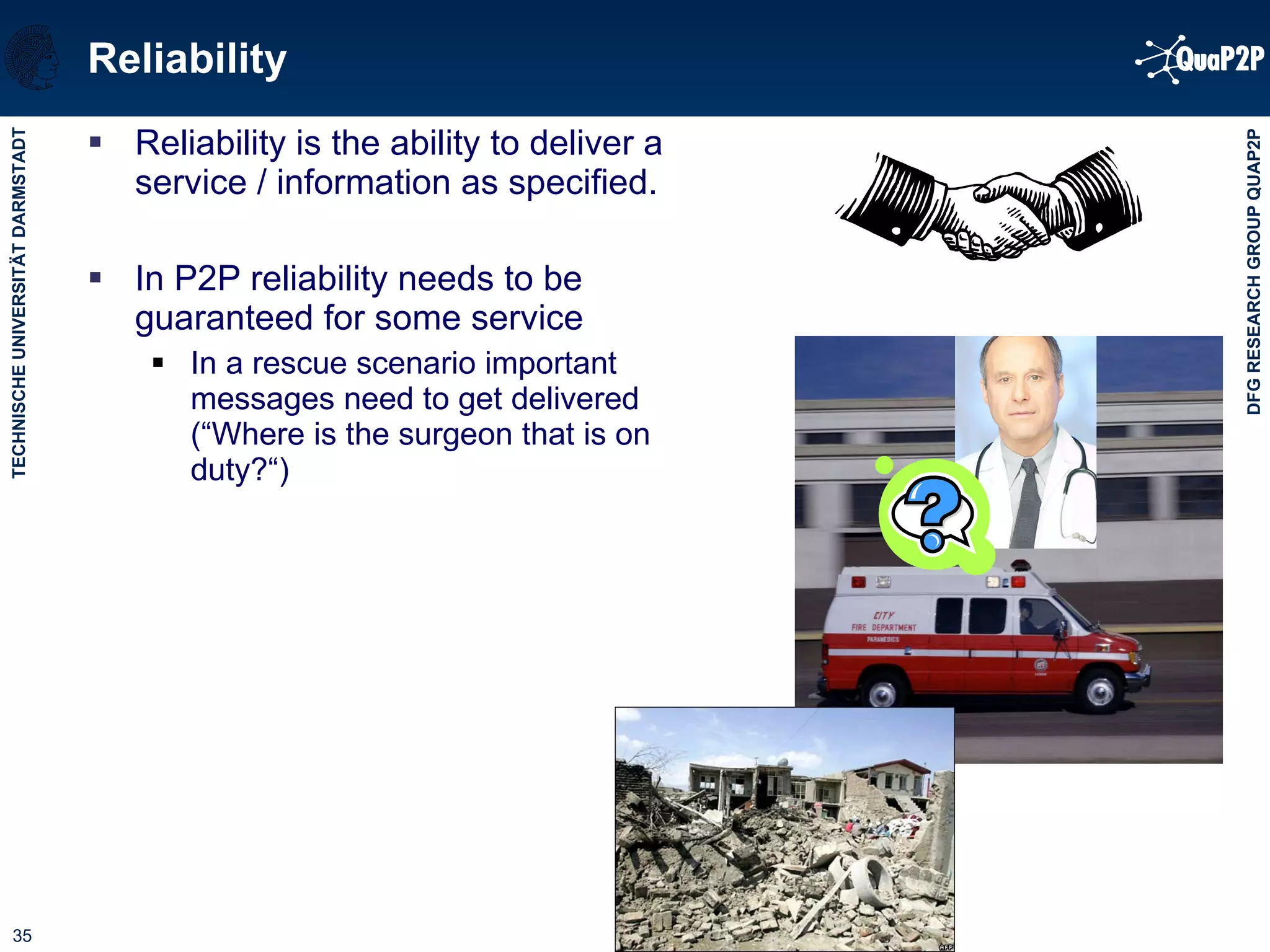
Reliability Reliability is the ability to deliver a service / information as specified. In P2P reliability needs to be guaranteed for some service In a rescue scenario important messages need to get delivered (“Where is the surgeon that is on duty?“)
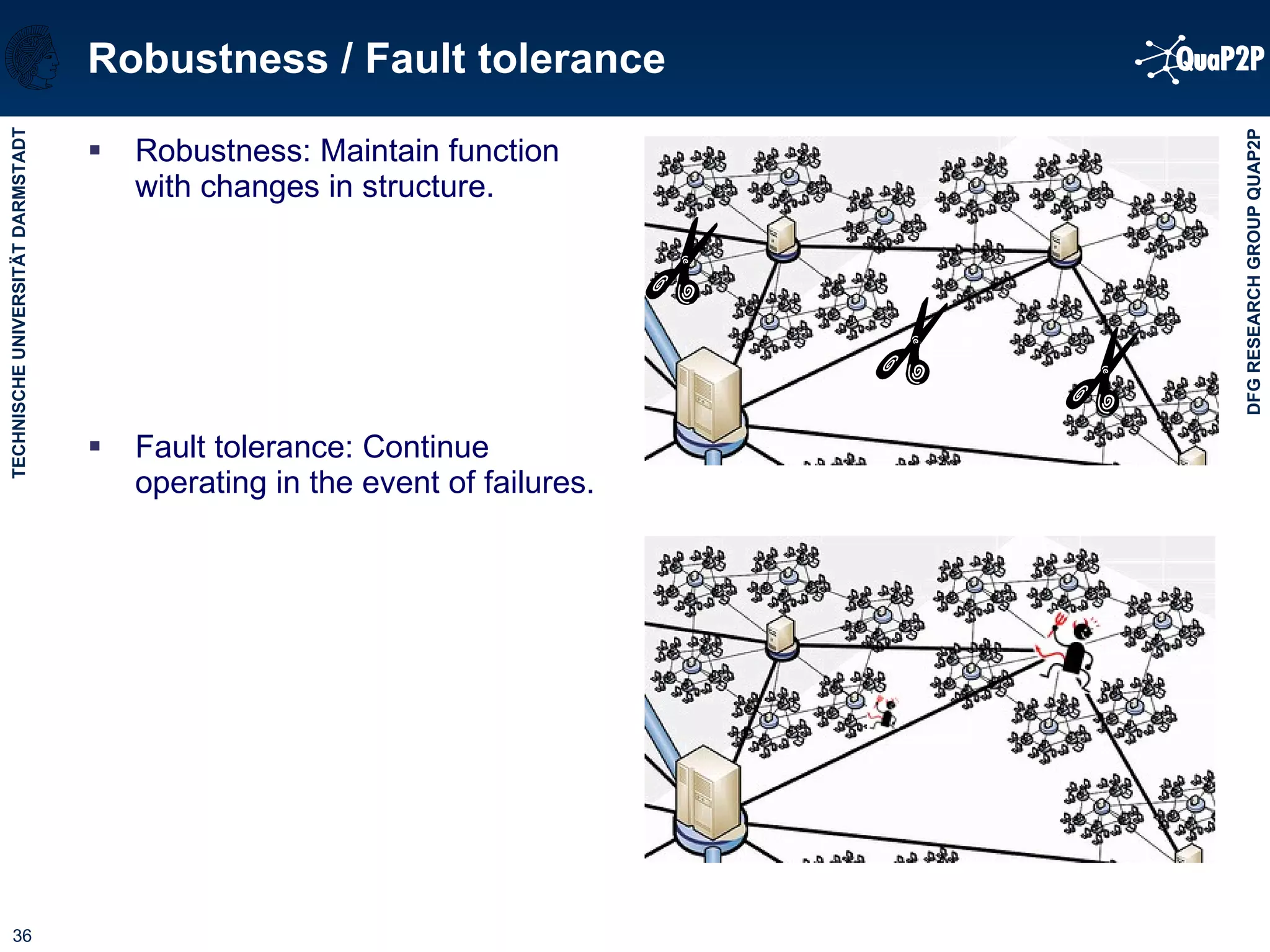
Robustness / Fault tolerance Robustness: Maintain function with changes in structure. Fault tolerance: Continue operating in the event of failures.
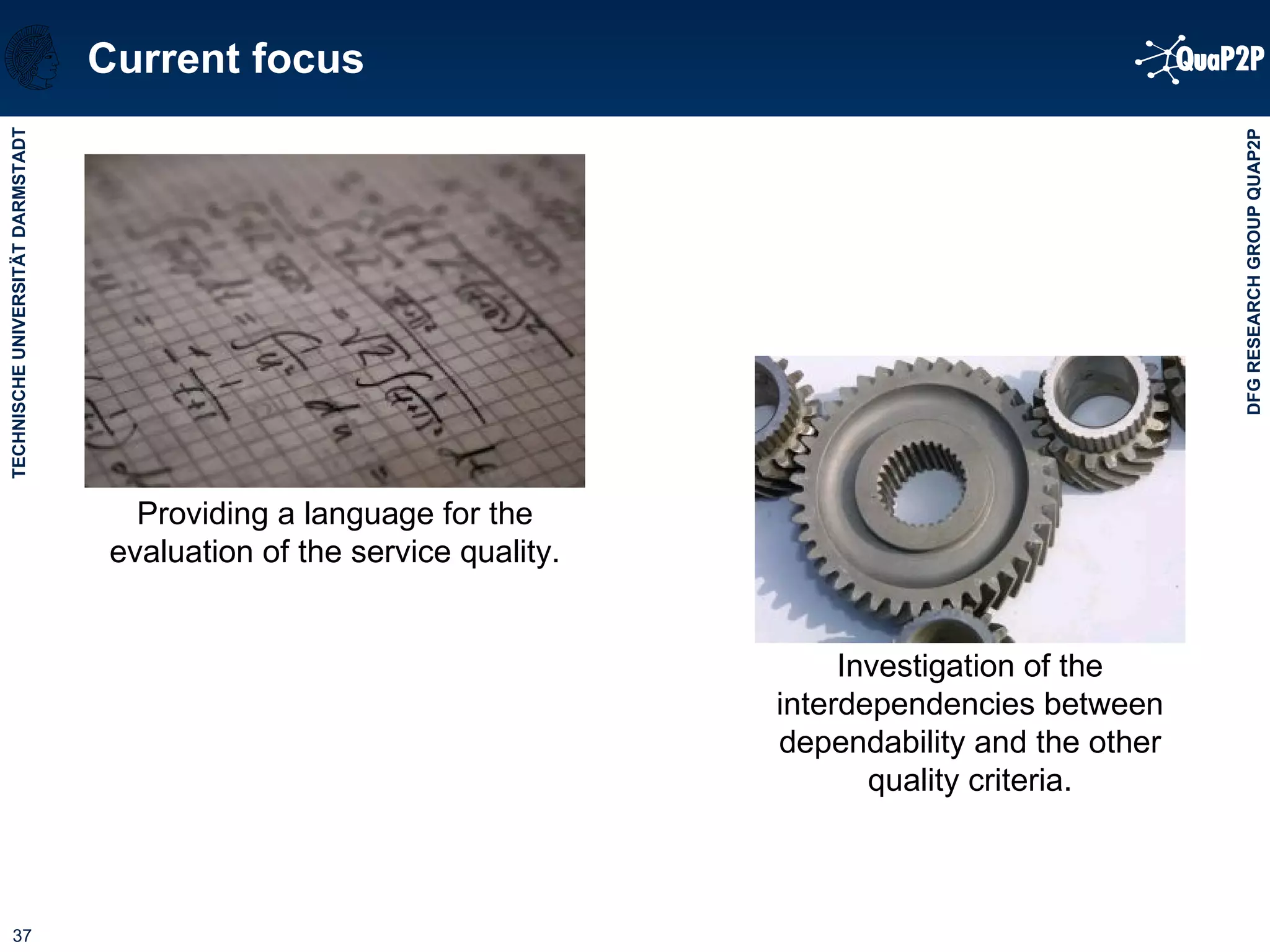
Current focus Investigation of the interdependencies between dependability and the other quality criteria. Providing a language for the evaluation of the service quality.
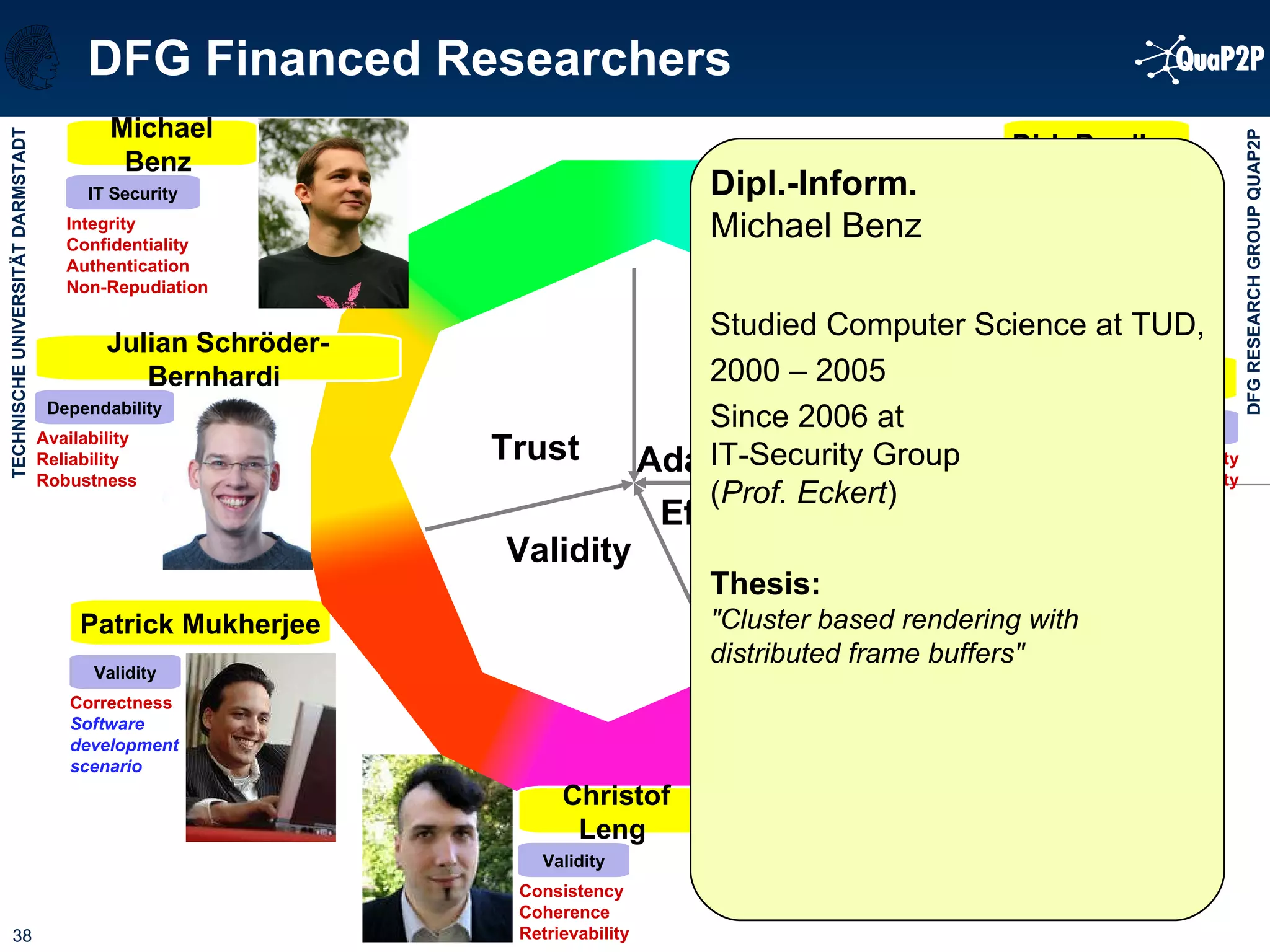
DFG Financed Researchers Efficiency Performance Costs Kalman Graffi  Adaptability Scalability Stability Adaptability Flexibility Catastrophe scenario Dirk Bradler  Dependability Availability Reliability Robustness Validity Correctness Software development scenario Patrick Mukherjee  Validity Consistency Coherence Retrievability Julian Schröder-Bernhardi  Efficiency Adaptability Validity Trust Aleksandra Kovacivic  Christof Leng  Dipl.-Inform.   Michael Benz  Studied Computer Science at TUD, 2000 – 2005 Since 2006 at  IT-Security Group ( Prof. Eckert ) Thesis: "Cluster based rendering with  distributed frame buffers" IT Security Integrity Confidentiality Authentication Non-Repudiation Michael Benz
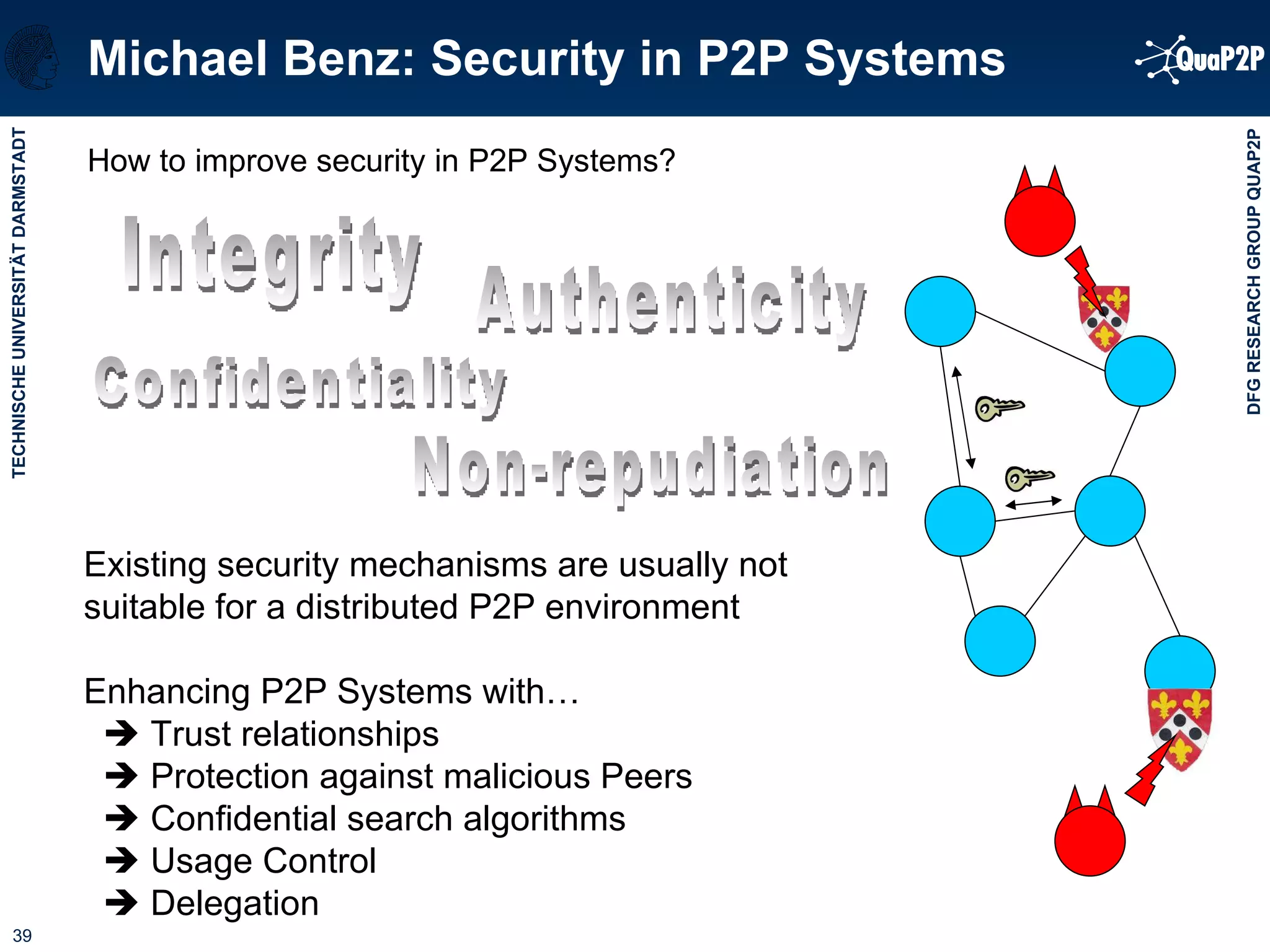
How to improve security in P2P Systems? Michael Benz: Security in P2P Systems Existing security mechanisms are usually not suitable for a distributed P2P environment Enhancing P2P Systems with…    Trust relationships    Protection against malicious Peers    Confidential search algorithms    Usage Control    Delegation Integrity Confidentiality Authenticity Non-repudiation
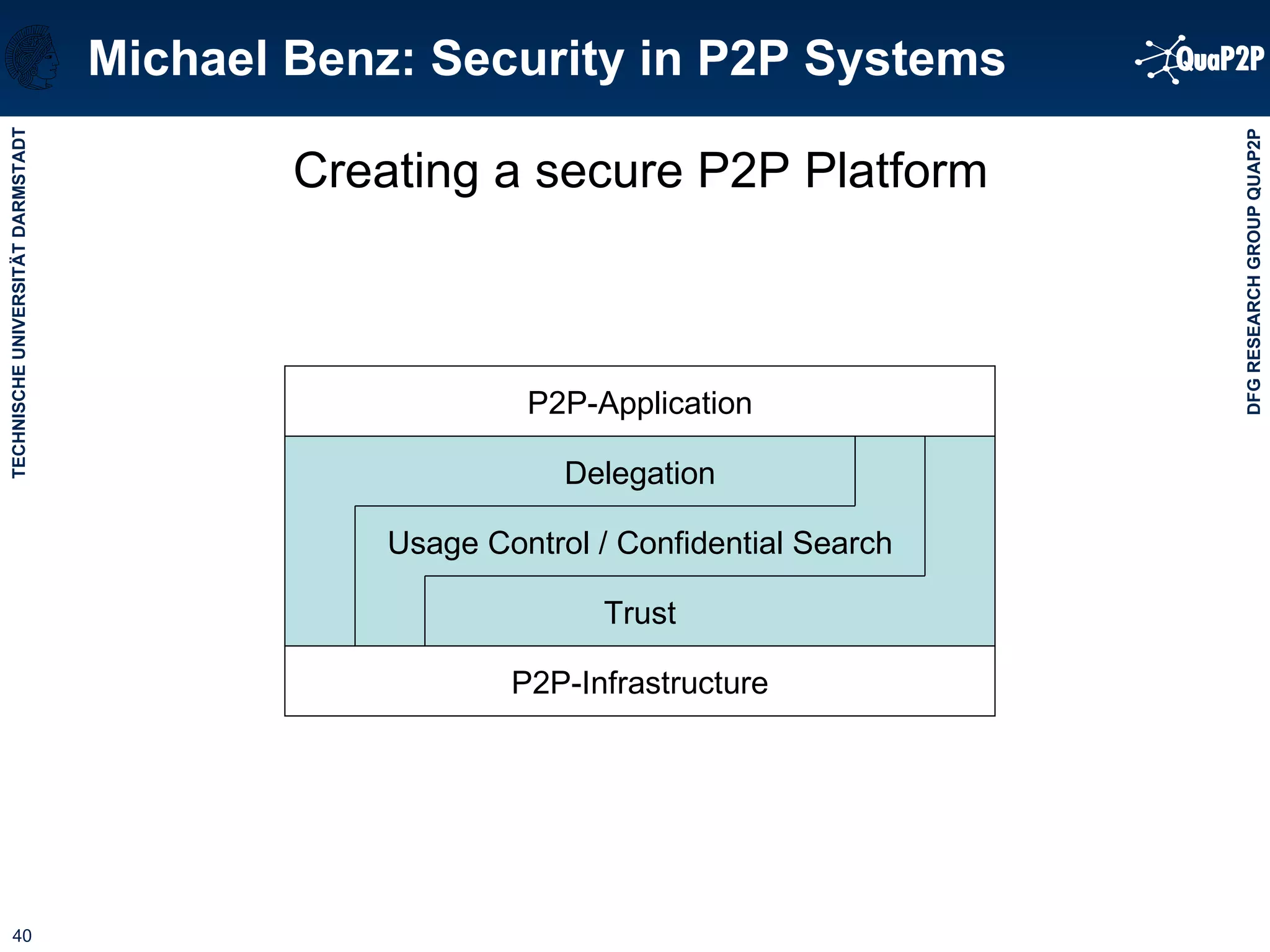
Michael Benz: Security in P2P Systems Creating a secure P2P Platform Trust Usage Control / Confidential Search Delegation P2P-Application P2P-Infrastructure
 
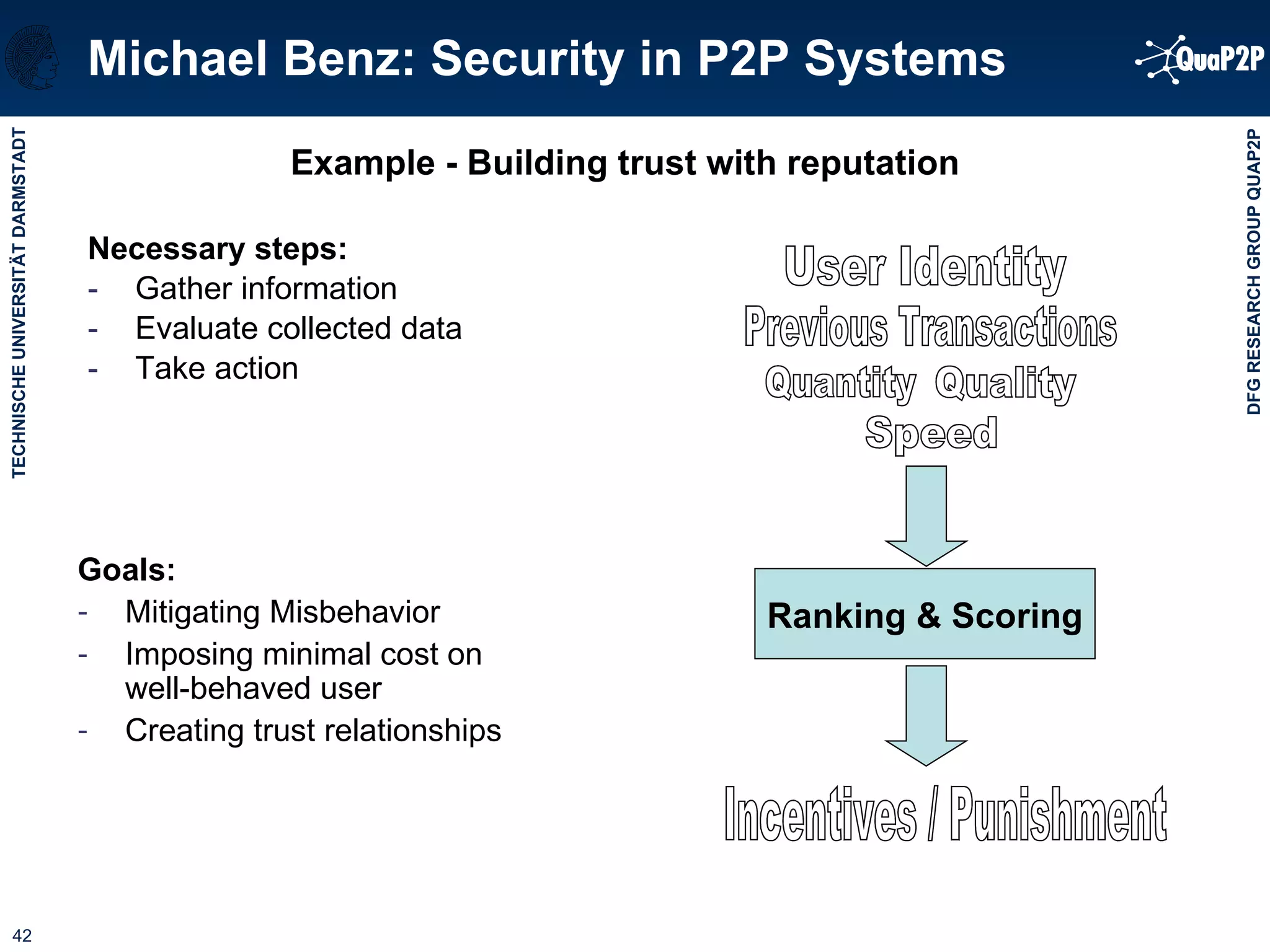
Michael Benz: Security in P2P Systems Example - Building trust with reputation Necessary steps: Gather information Evaluate collected data Take action Goals: Mitigating Misbehavior Imposing minimal cost on  well-behaved user Creating trust relationships User Identity Previous Transactions Quantity Quality Speed Ranking & Scoring Incentives / Punishment
 
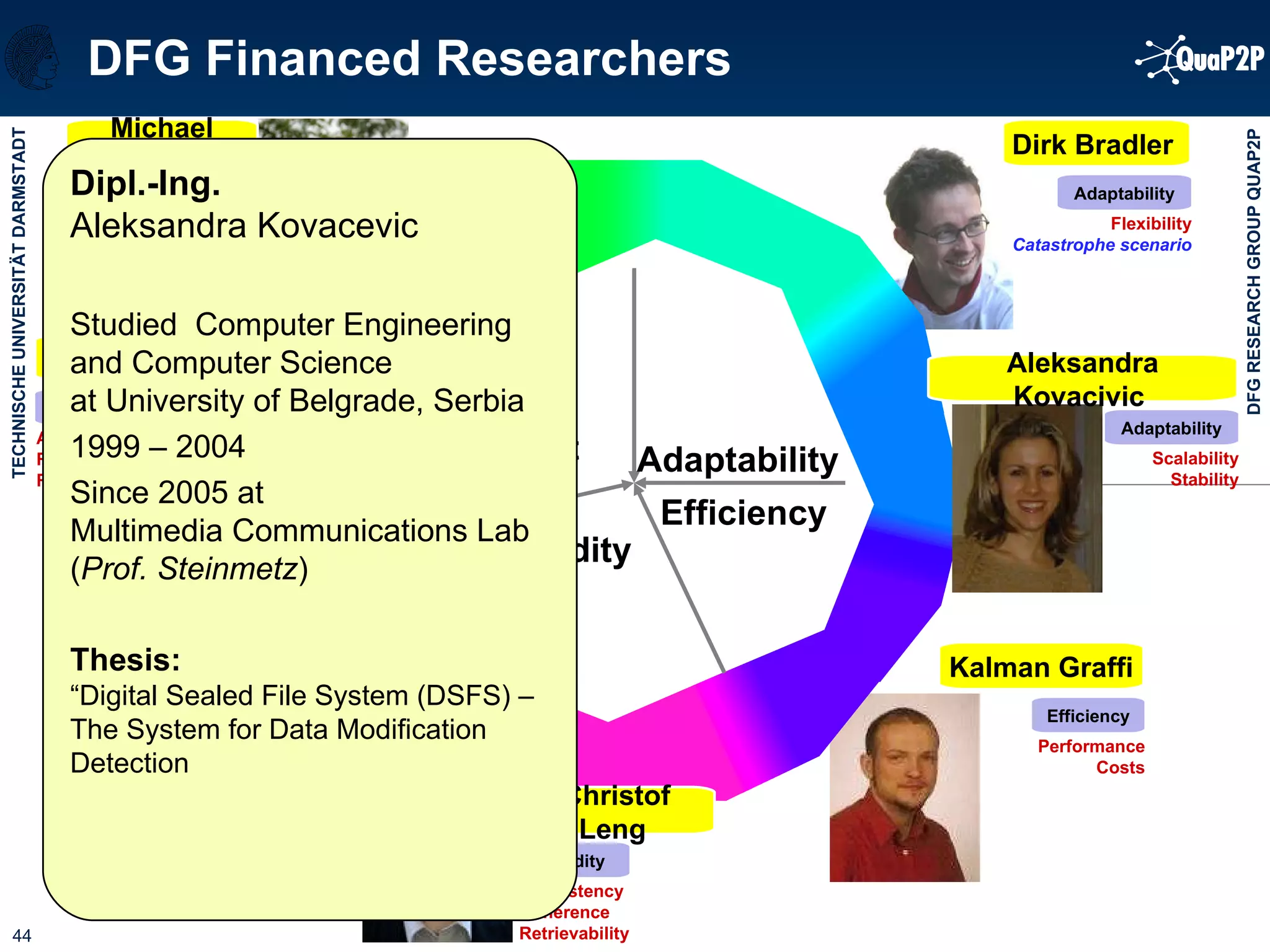
DFG Financed Researchers Efficiency Performance Costs Kalman Graffi  Adaptability Flexibility Catastrophe scenario Dirk Bradler  IT Security Integrity Confidentiality Authentication Non-Repudiation Michael Benz  Dependability Availability Reliability Robustness Validity Correctness Software development scenario Patrick Mukherjee  Validity Consistency Coherence Retrievability Julian Schröder-Bernhardi  Efficiency Adaptability Validity Trust Christof Leng  Dipl.-Ing.   Aleksandra Kovacevic  Studied  Computer Engineering  and Computer Science at University of Belgrade, Serbia 1999 – 2004 Since 2005 at  Multimedia Communications Lab  ( Prof. Steinmetz ) Thesis: “Digital Sealed File System (DSFS) –  The System for Data Modification  Detection Adaptability Scalability Stability Aleksandra Kovacivic
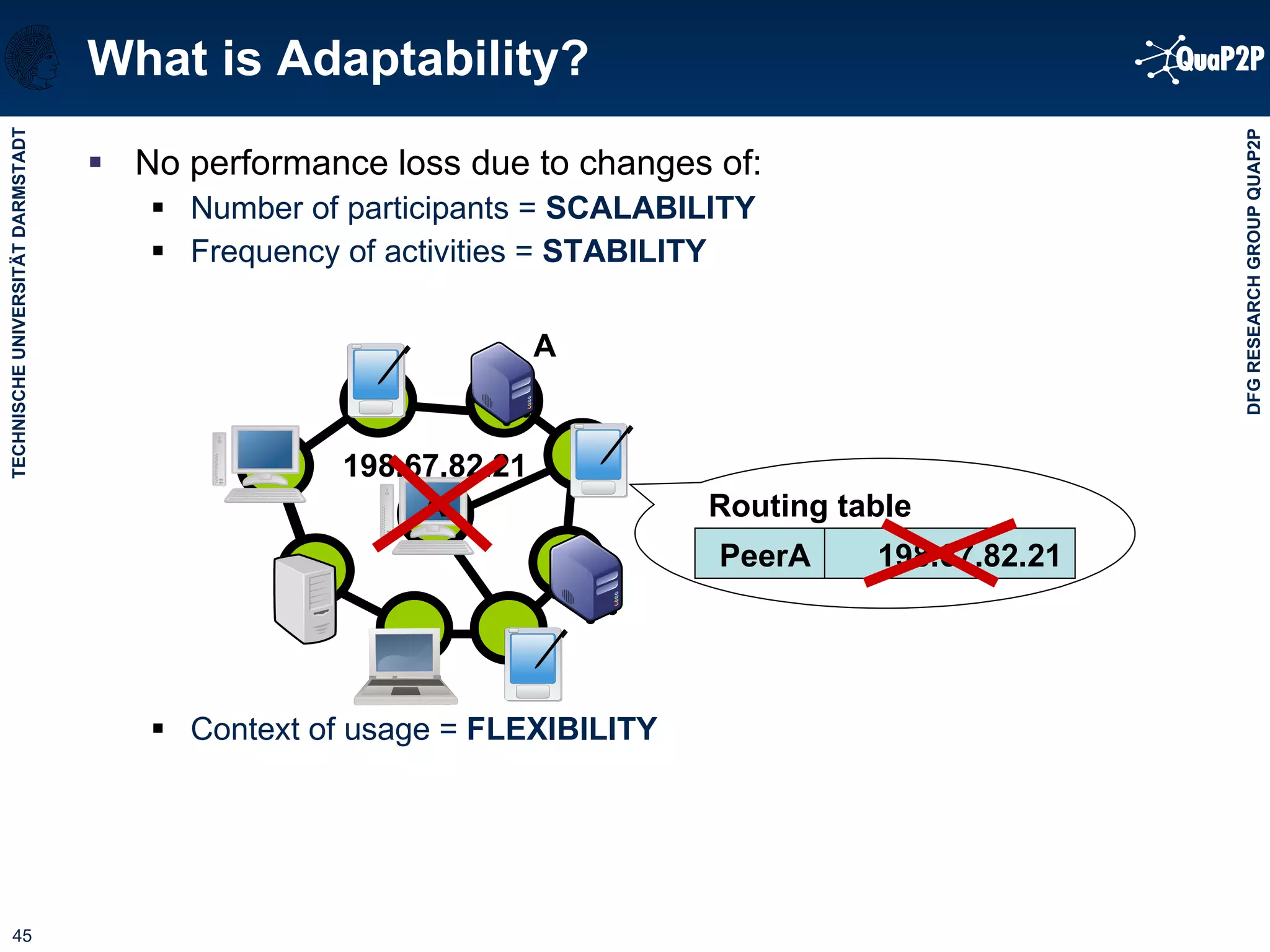
What is Adaptability? No performance loss due to changes of: Number of participants =  SCALABILITY Frequency of activities =  STABILITY Context of usage =  FLEXIBILITY 198.67.82.21 PeerA 198.67.82.21 Routing table A A
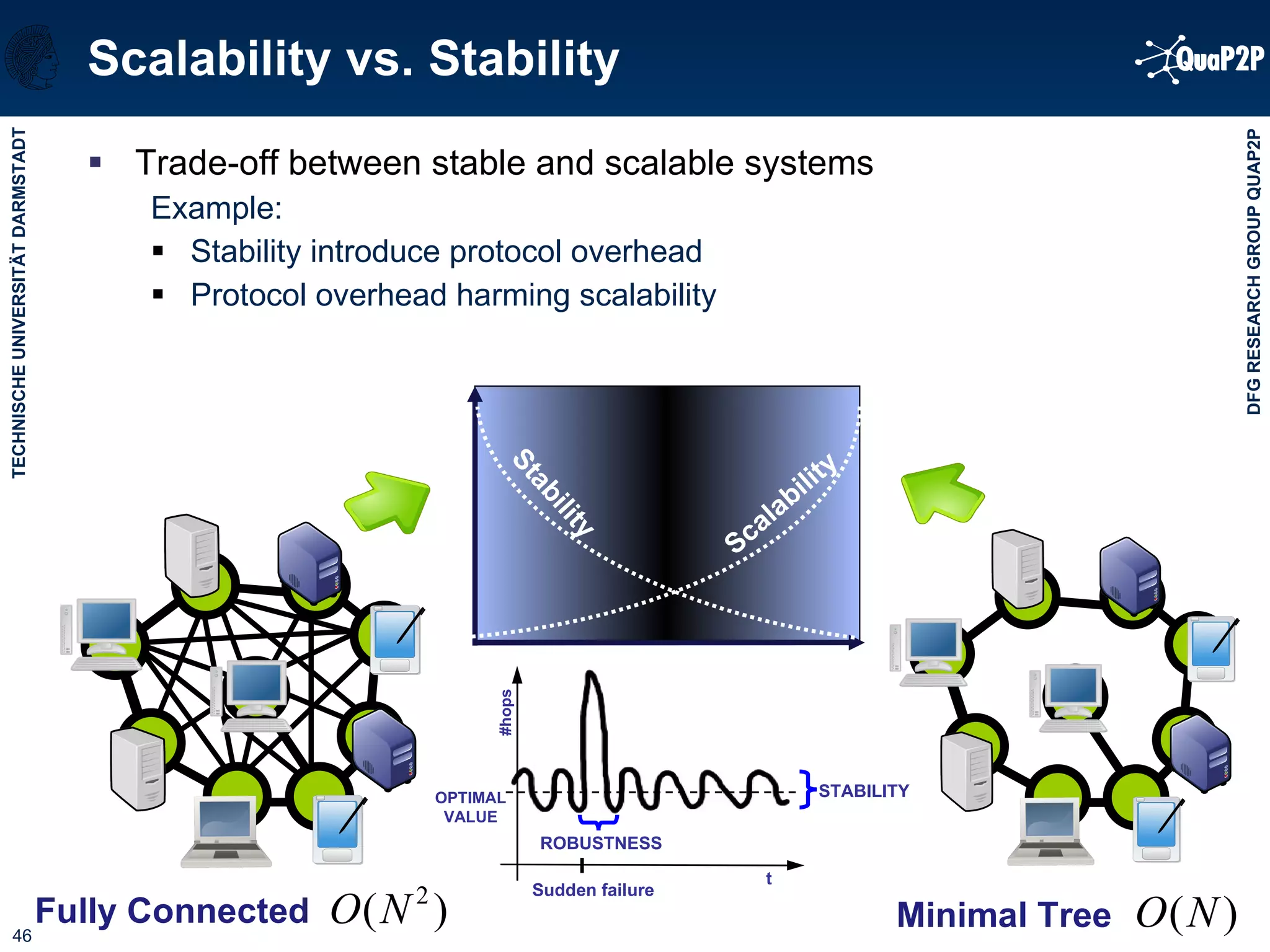
Scalability vs. Stability Trade-off between stable and scalable systems Example: Stability introduce protocol overhead Protocol overhead harming scalability Fully Connected Minimal Tree   Stability Scalability Sudden failure #hops t STABILITY ROBUSTNESS OPTIMAL VALUE
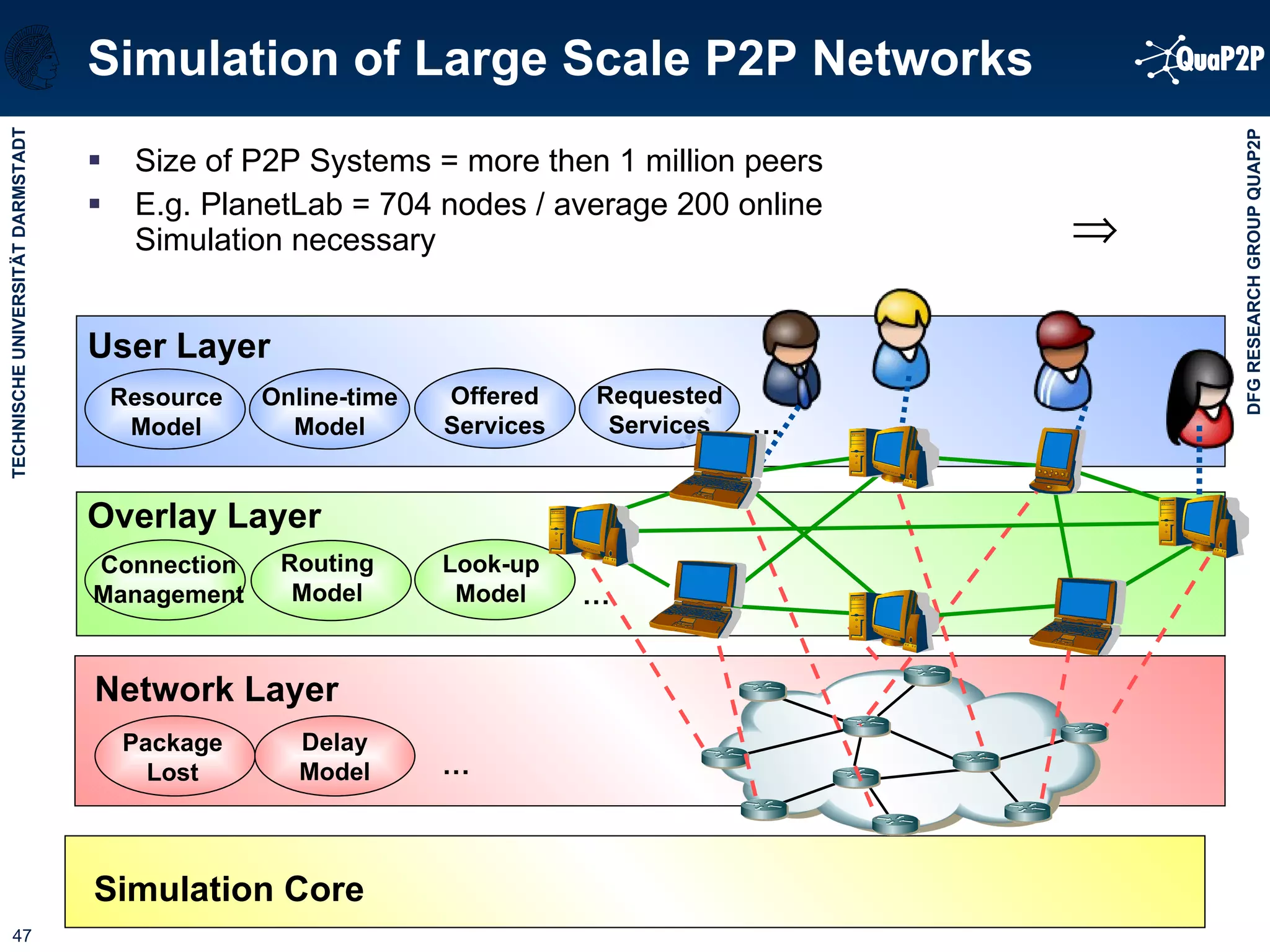
Simulation of Large Scale P2P Networks Size of P2P Systems = more then 1 million peers E.g. PlanetLab = 704 nodes / average 200 online  Simulation necessary User Layer Overlay Layer Simulation Core Network Layer Package  Lost … … … Delay  Model Connection Management Routing Model Resource Model Online-time Model Requested Services Offered Services Look-up Model
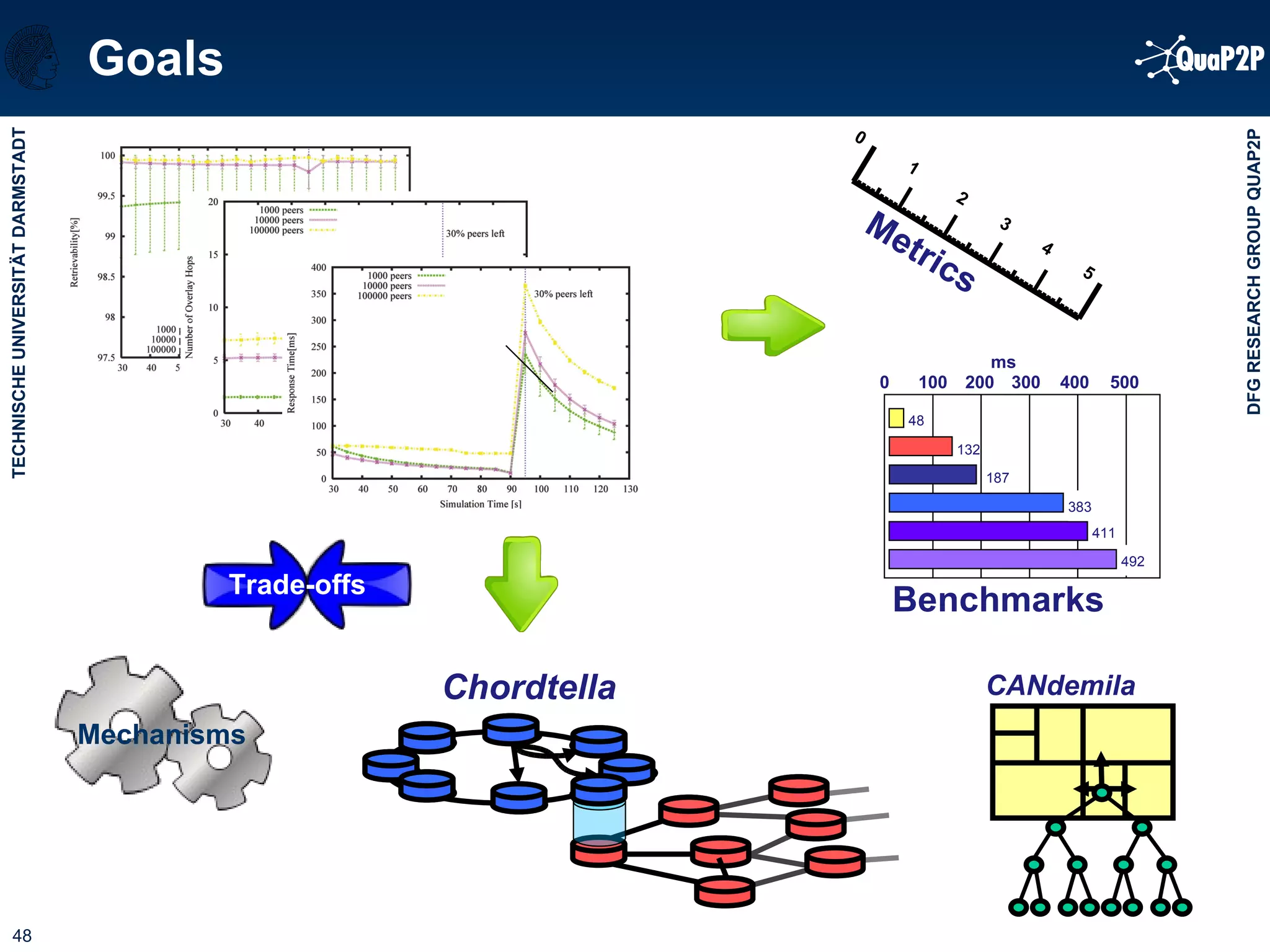
Goals Trade-offs Mechanisms CANdemila Metrics 0 1 2 3 4 5 100 0 200 300 500 400 ms 48 132 187 383 411 492 Benchmarks Chordtella
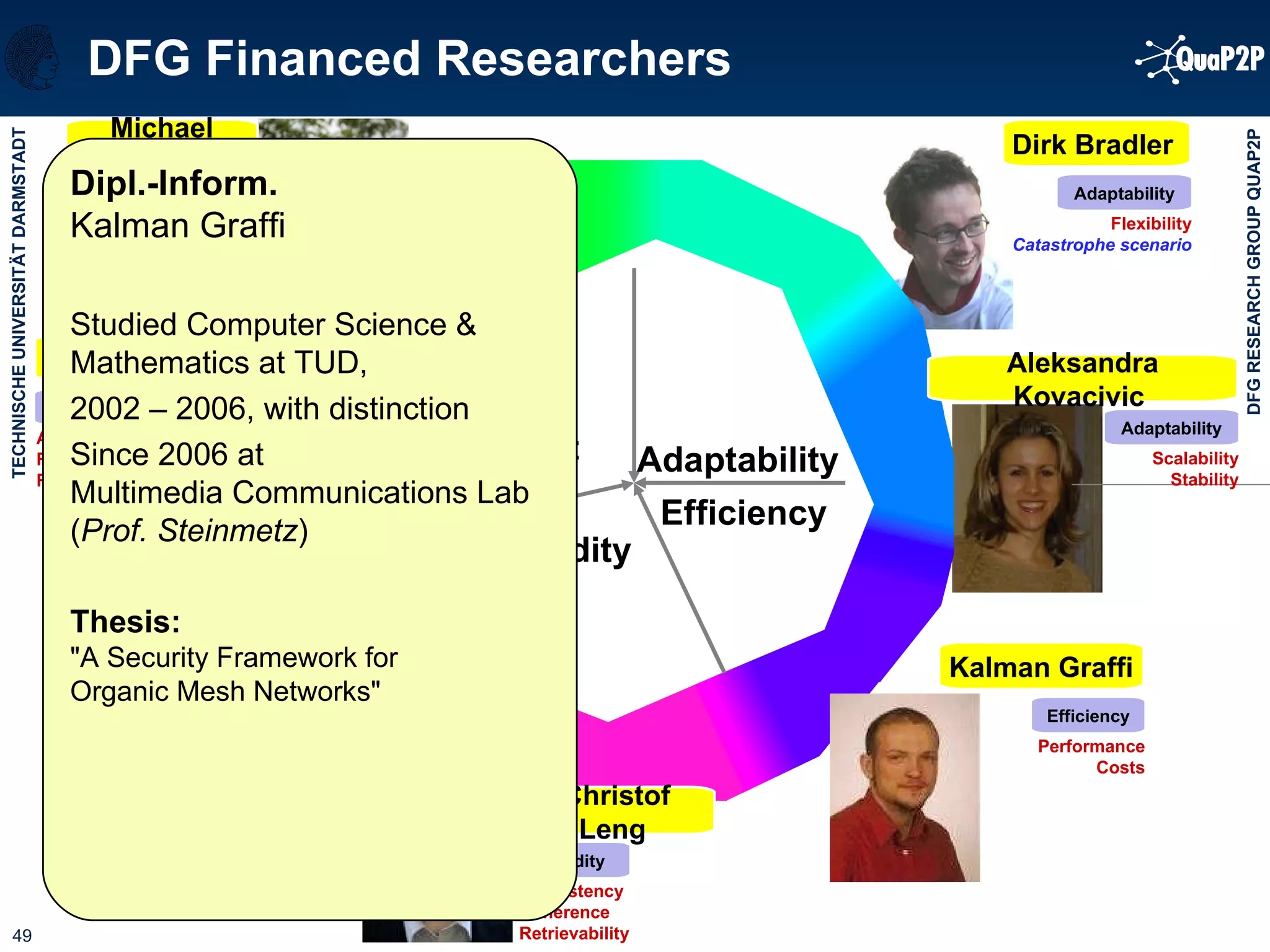
DFG Financed Researchers Adaptability Scalability Stability Adaptability Flexibility Catastrophe scenario Dirk Bradler  IT Security Integrity Confidentiality Authentication Non-Repudiation Michael Benz  Dependability Availability Reliability Robustness Validity Correctness Software development scenario Patrick Mukherjee  Validity Consistency Coherence Retrievability Julian Schröder-Bernhardi  Efficiency Adaptability Validity Trust Aleksandra Kovacivic  Christof Leng  Dipl.-Inform.   Kalman Graffi  Studied Computer Science & Mathematics at TUD, 2002 – 2006, with distinction Since 2006 at  Multimedia Communications Lab  ( Prof. Steinmetz ) Thesis: "A Security Framework for  Organic Mesh Networks" Efficiency Performance Costs Kalman Graffi
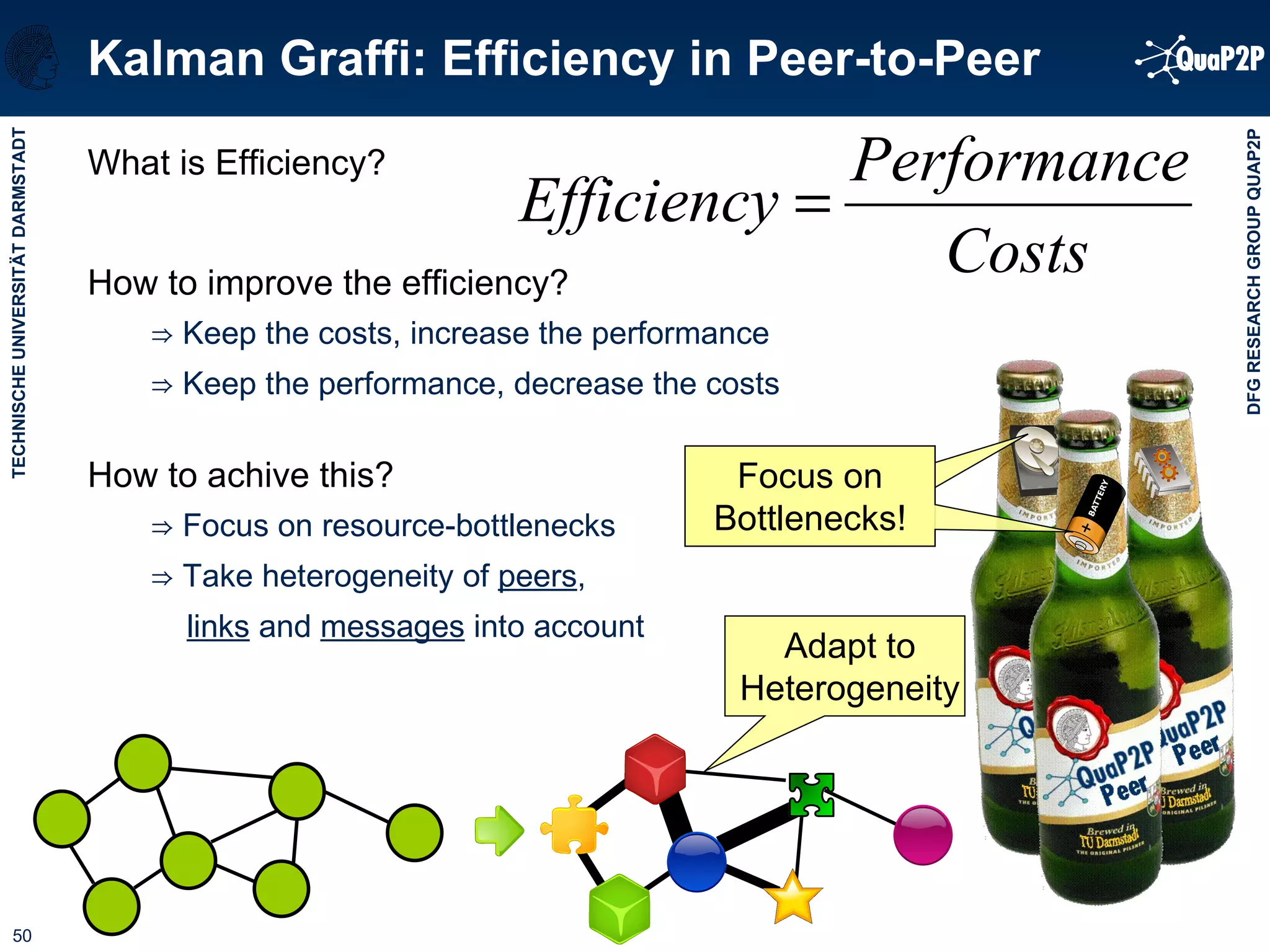
Kalman Graffi: Efficiency in Peer-to-Peer What is Efficiency? How to improve the efficiency? ⇒   Keep the costs, increase the performance ⇒   Keep the performance, decrease the costs How to achive this? ⇒   Focus on resource-bottlenecks ⇒  Take heterogeneity of  peers ,  links  and  messages  into account Adapt to Heterogeneity Focus on Bottlenecks!
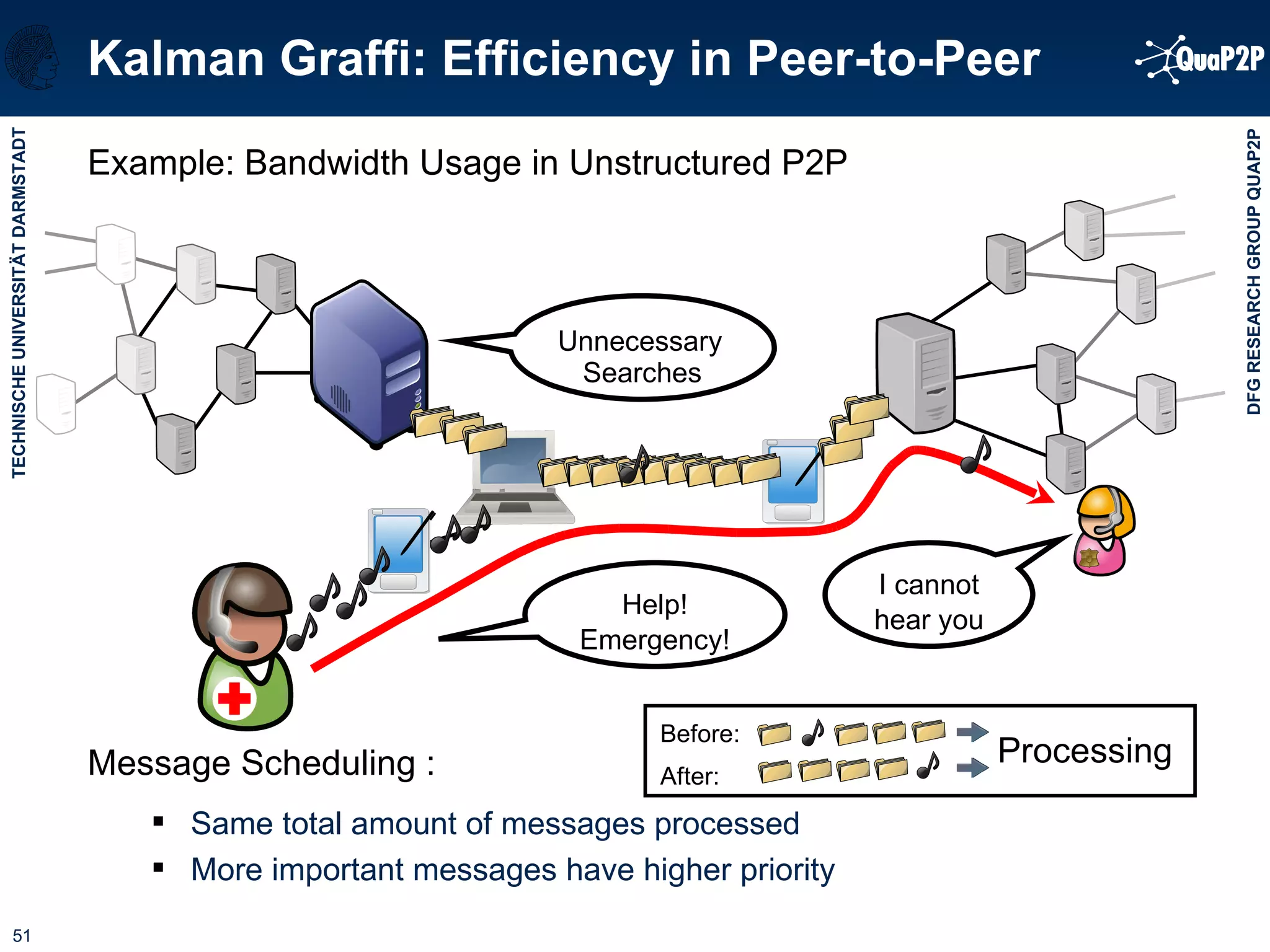
Example: Bandwidth Usage in Unstructured P2P Kalman Graffi: Efficiency in Peer-to-Peer Searches I cannot hear you Help! Emergency! Unnecessary Message Scheduling : Same total amount of messages processed More important messages have higher priority Processing Before: After:
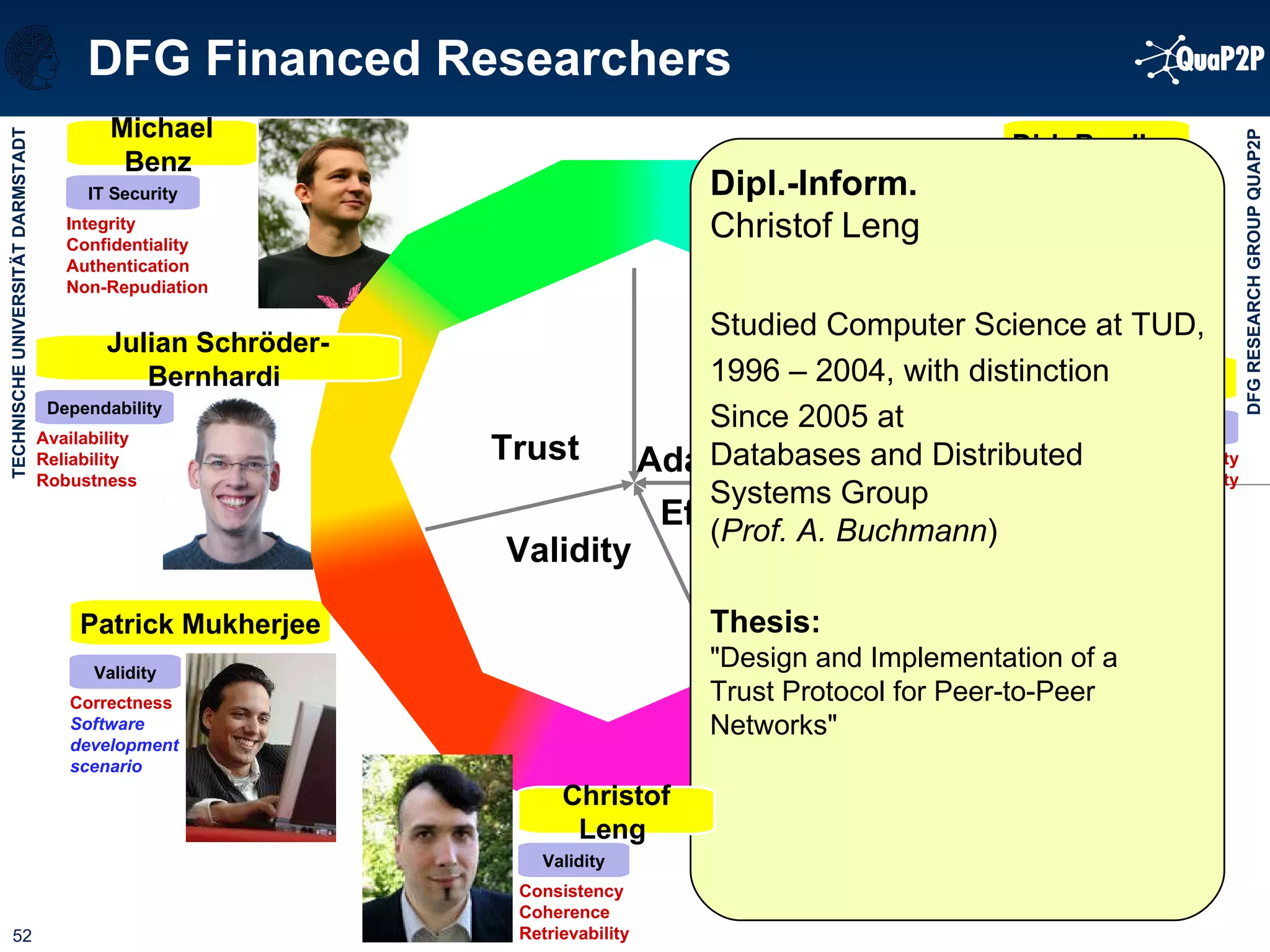
DFG Financed Researchers Efficiency Performance Costs Kalman Graffi  Adaptability Scalability Stability Adaptability Flexibility Catastrophe scenario Dirk Bradler  IT Security Integrity Confidentiality Authentication Non-Repudiation Michael Benz  Dependability Availability Reliability Robustness Validity Correctness Software development scenario Patrick Mukherjee  Julian Schröder-Bernhardi  Efficiency Adaptability Validity Trust Aleksandra Kovacivic  Dipl.-Inform.   Christof Leng  Studied Computer Science at TUD, 1996 – 2004, with distinction Since 2005 at  Databases and Distributed  Systems Group  ( Prof. A. Buchmann ) Thesis: "Design and Implementation of a  Trust Protocol for Peer-to-Peer  Networks" Validity Consistency Coherence Retrievability Christof Leng
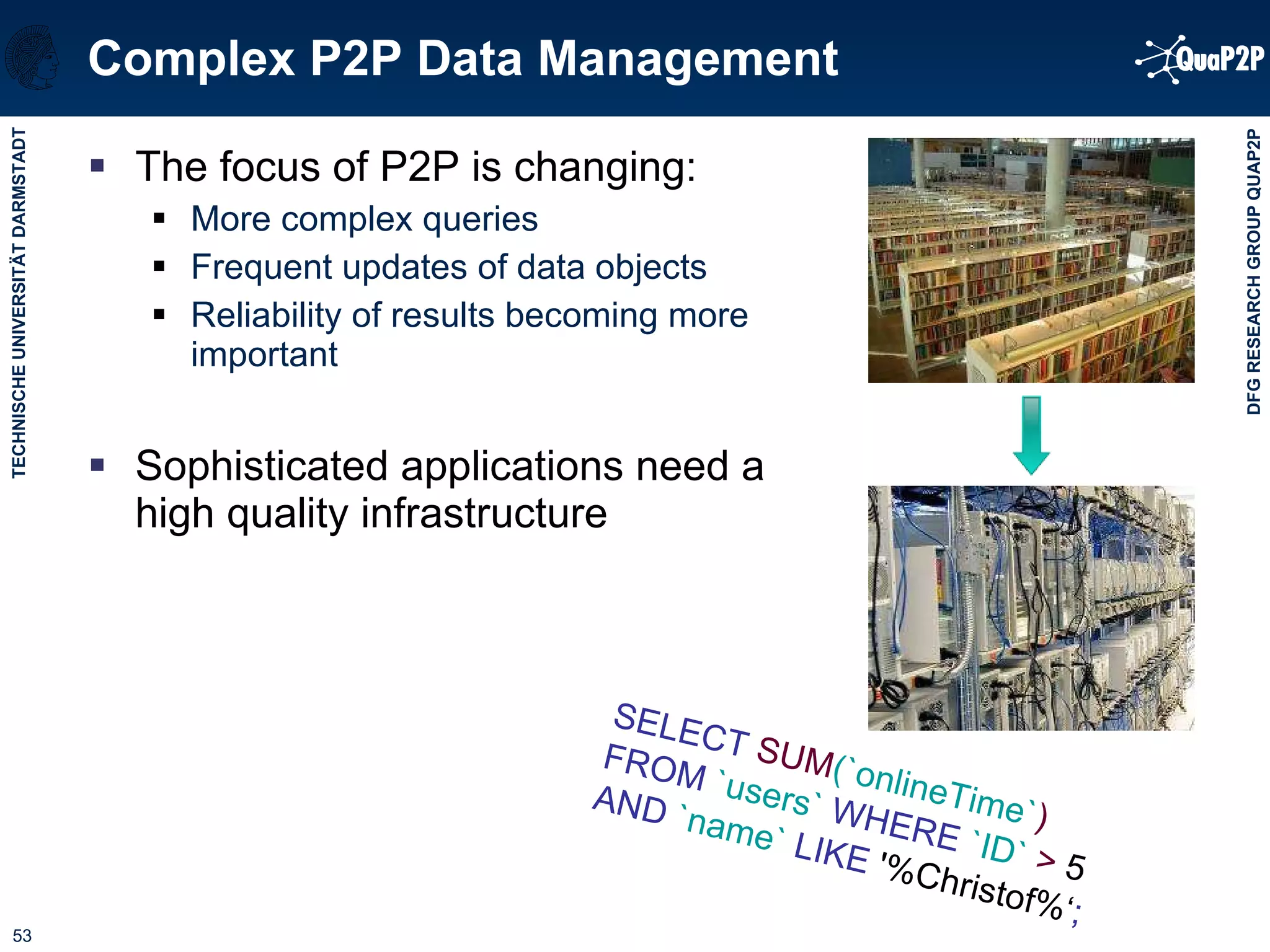
Complex P2P Data Management The focus of P2P is changing: More complex queries Frequent updates of data objects Reliability of results becoming more important Sophisticated applications need a high quality infrastructure SELECT  SUM (`onlineTime` )   FROM  `users`   WHERE   `ID`  >  5  AND   `name`   LIKE  '%Christof%‘ ;
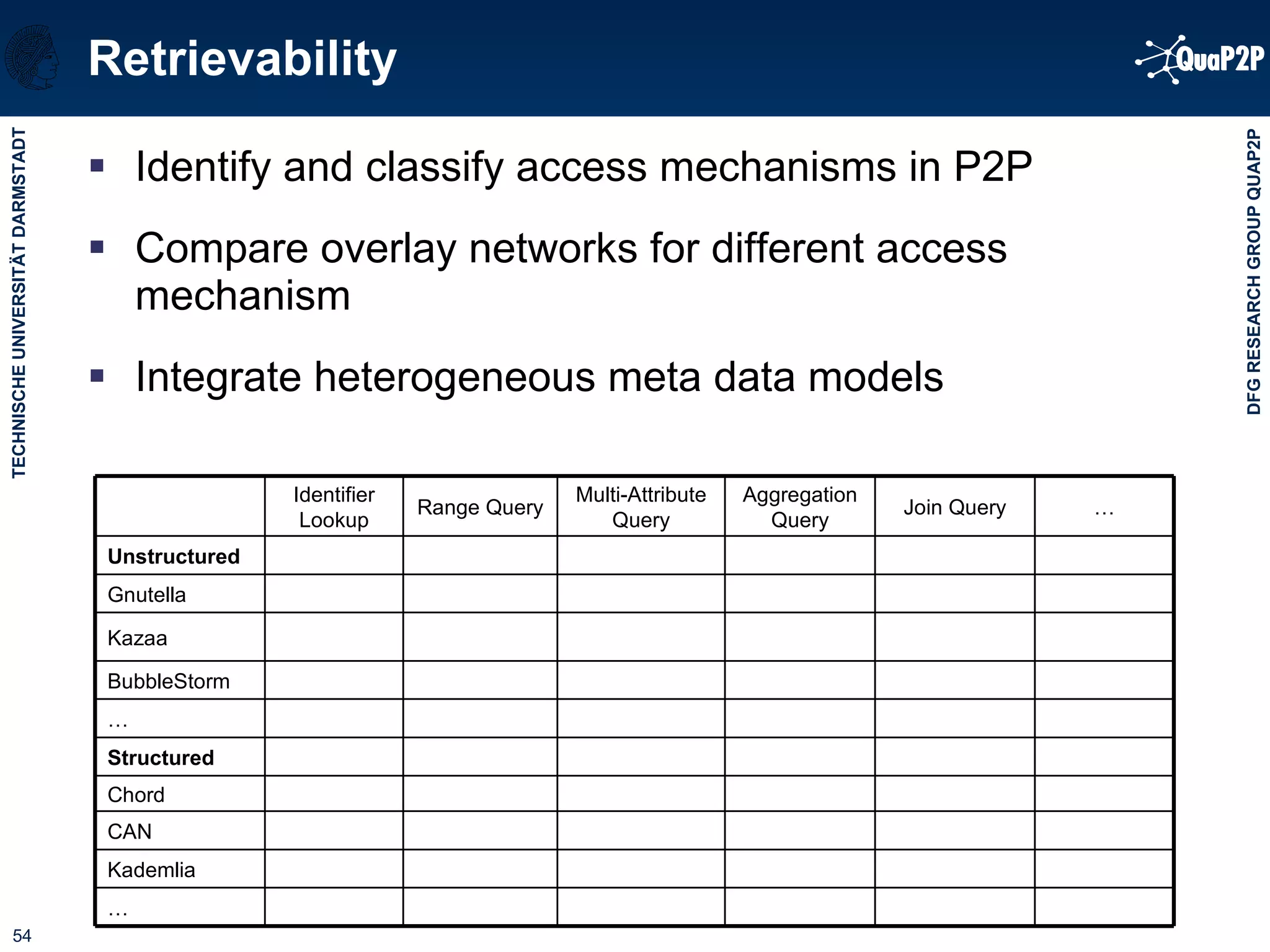
Retrievability Identify and classify access mechanisms in P2P Compare overlay networks for different access mechanism Integrate heterogeneous meta data models Join Query … … Kademlia CAN Chord Structured BubbleStorm Kazaa Gnutella Unstructured … Aggregation Query Multi-Attribute Query Range Query Identifier Lookup
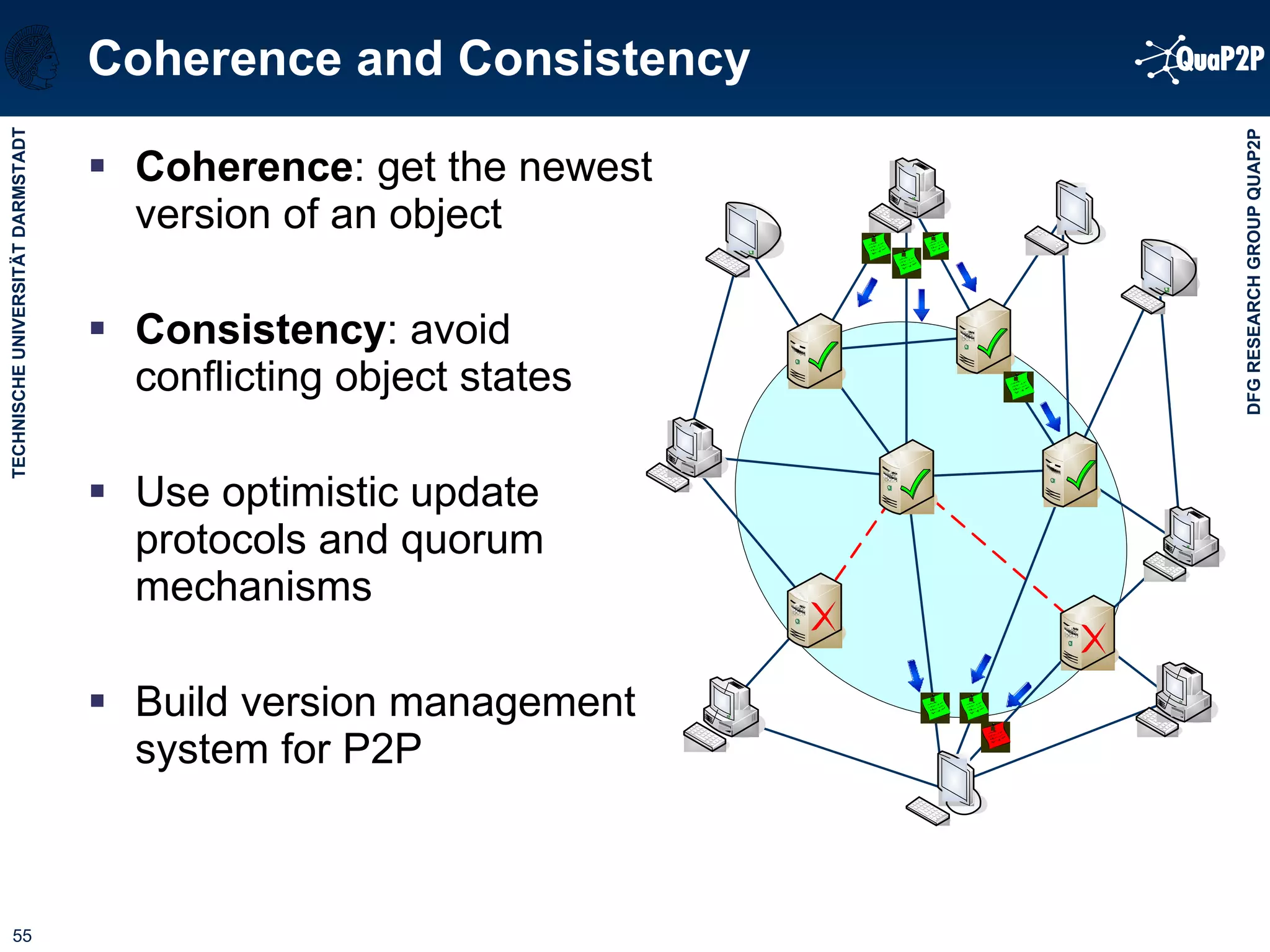
Coherence and Consistency Coherence : get the newest version of an object Consistency : avoid  conflicting object states Use optimistic update protocols and quorum mechanisms Build version management system for P2P
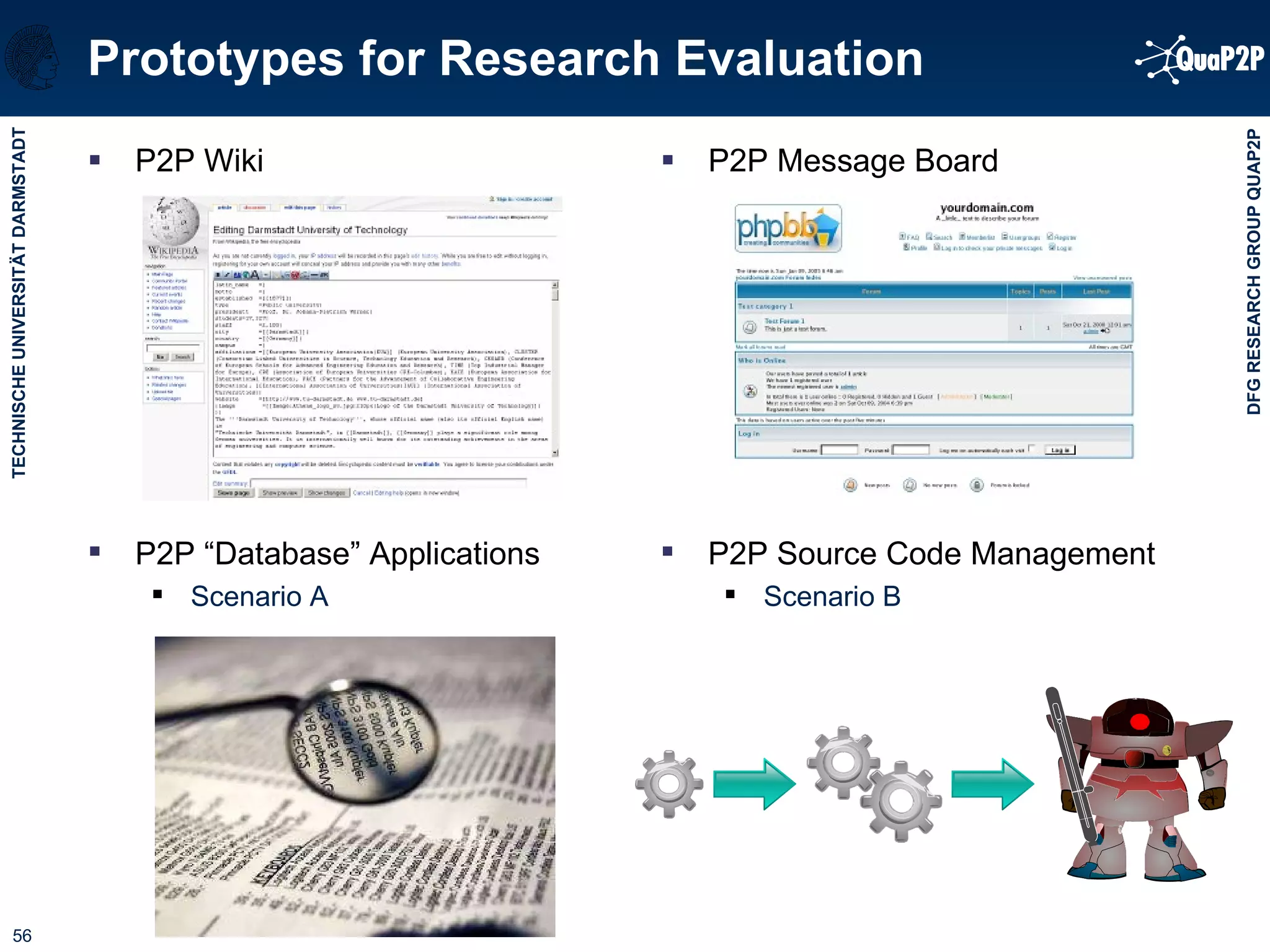
Prototypes for Research Evaluation P2P Wiki P2P Message Board P2P “Database” Applications Scenario A P2P Source Code Management Scenario B
Allocation of the Research Topics Alejandro Buchmann Jussi Kangasharju Oliver Heckmann Ralf Steinmetz Claudia Eckert Andy Schürr Max Mühlhäuser Content Management Software Engineering IT Security Ubiquitous Computing Communication Networks Quality of Service Databases & Middleware Flexibility Scalability Stability Performance Costs Efficiency Adaptability Validity Trust Correctness Consistency Coherence Retrievability Integrity Confidentiality Authentication Non-Repudiation Availability Reliability Robustness
click me …  zum   Ablauf
Anhang
 
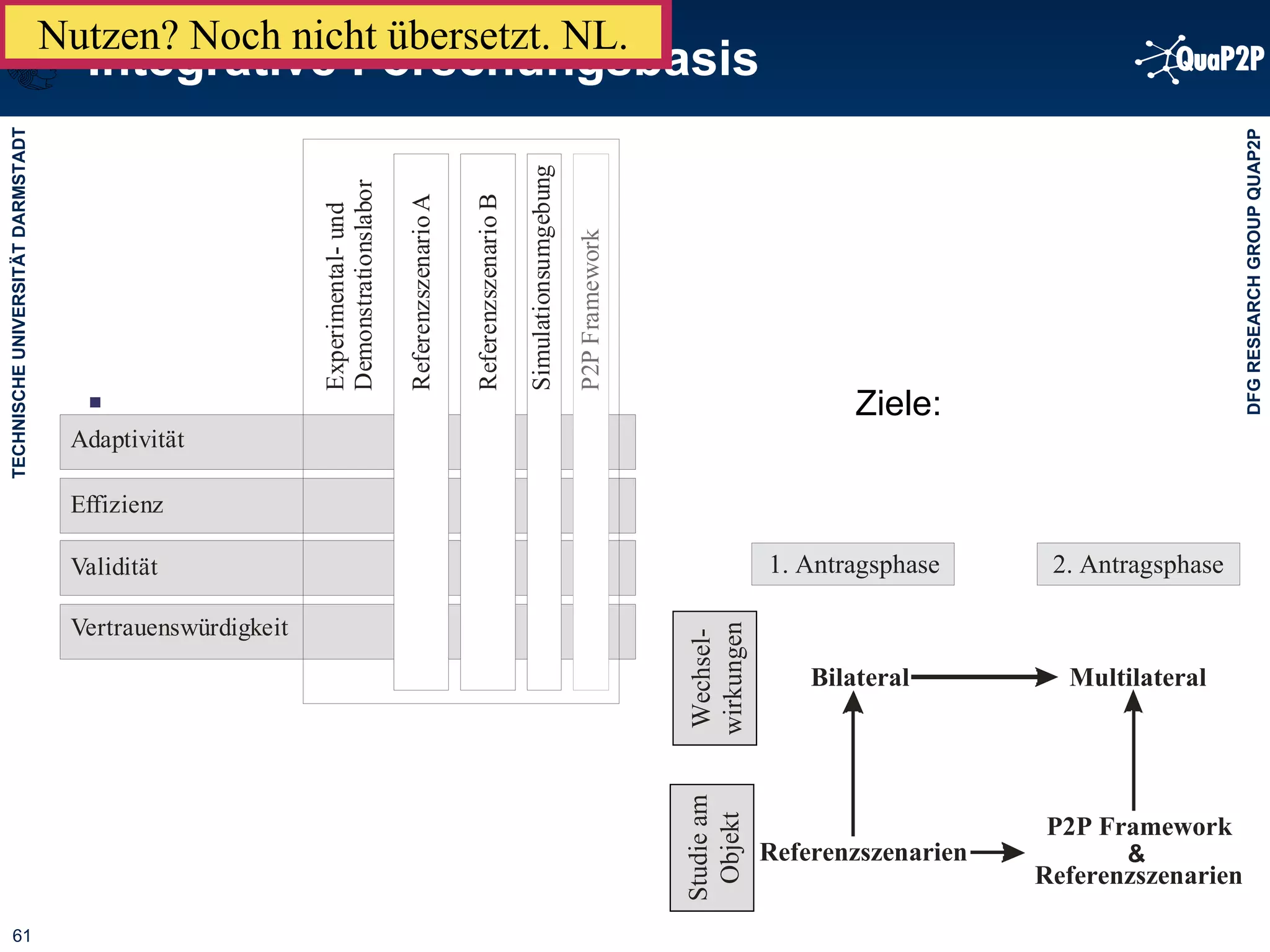
Integrative Forschungsbasis Ziele: Nutzen? Noch nicht übersetzt. NL. 1. Antragsphase 2. Antragsphase Bilateral Multilateral Referenzszenarien P2P Framework Wechsel- wirkungen Studie am Objekt Referenzszenarien &
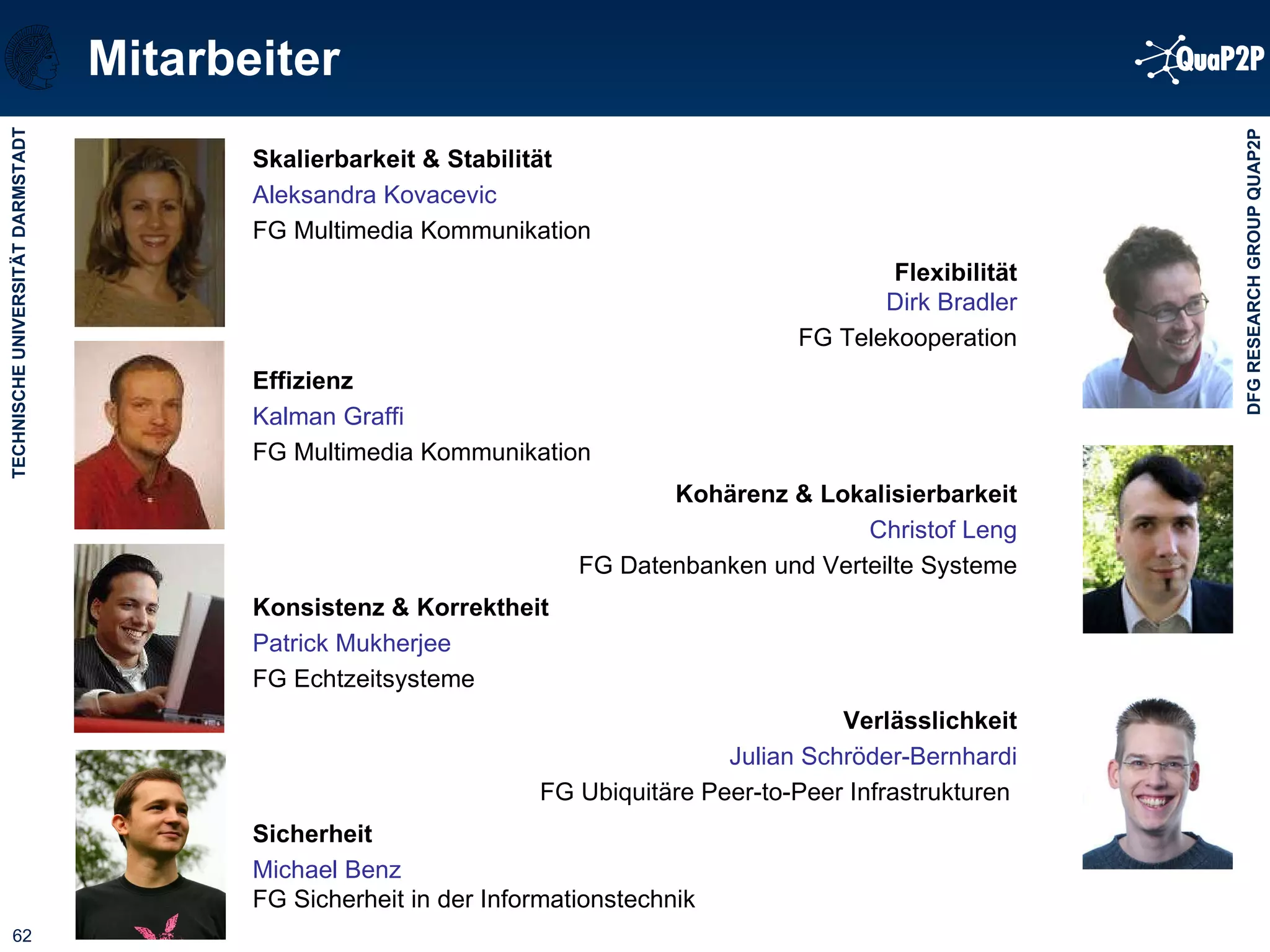
Mitarbeiter Skalierbarkeit & Stabilität Aleksandra Kovacevic FG Multimedia Kommunikation Sicherheit Michael Benz FG Sicherheit in der Informationstechnik  Verlässlichkeit Julian Schröder-Bernhardi FG Ubiquitäre Peer-to-Peer Infrastrukturen  Konsistenz & Korrektheit Patrick Mukherjee FG Echtzeitsysteme Kohärenz & Lokalisierbarkeit Christof Leng FG Datenbanken und Verteilte Systeme Effizienz Kalman Graffi FG Multimedia Kommunikation Flexibilität Dirk Bradler FG Telekooperation
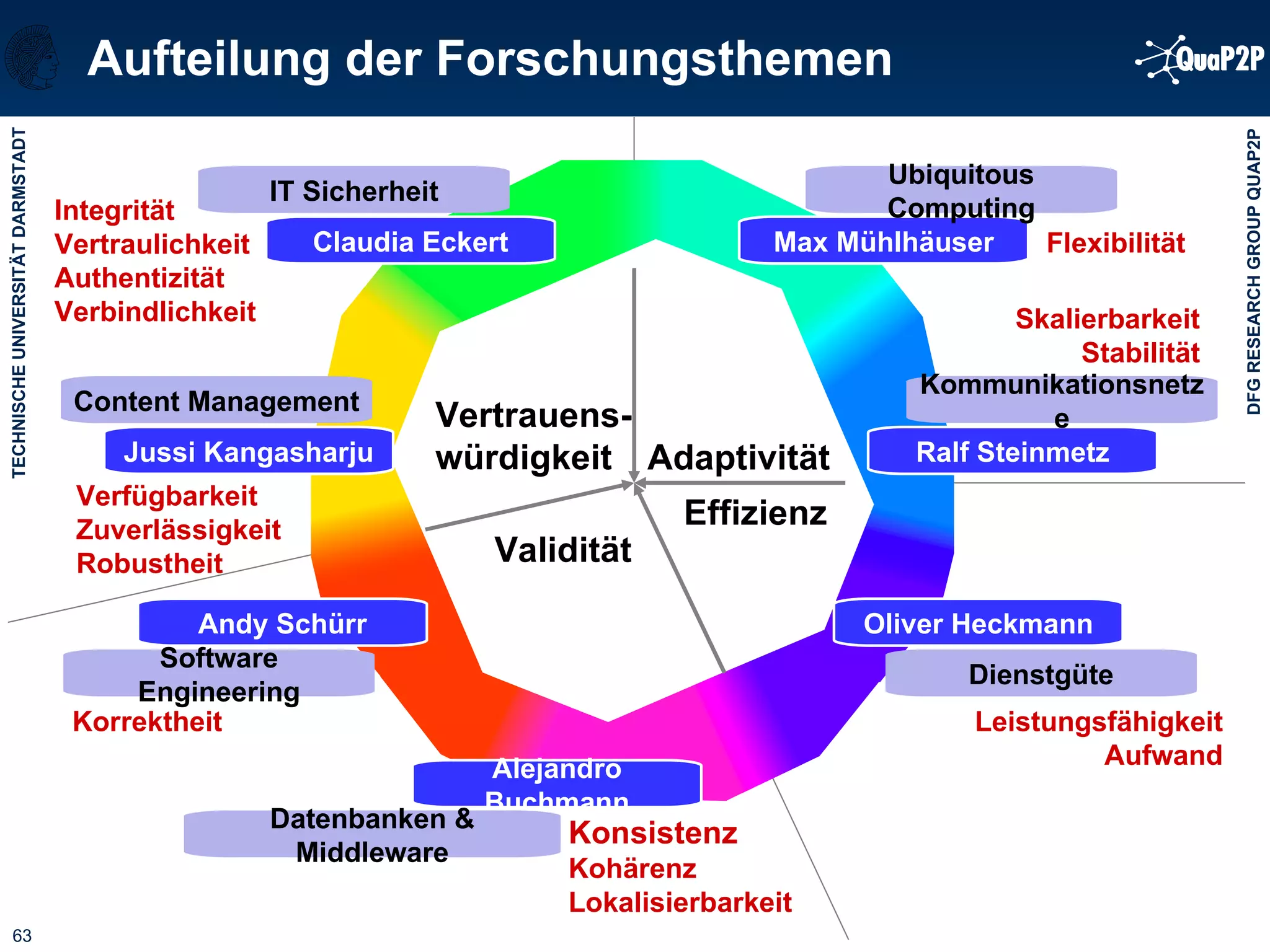
Aufteilung der Forschungsthemen Alejandro Buchmann Jussi Kangasharju Oliver Heckmann Ralf Steinmetz Claudia Eckert Andy Schürr Max Mühlhäuser Content Management Software Engineering IT Sicherheit Ubiquitous Computing Kommunikationsnetze Dienstgüte Datenbanken & Middleware Flexibilität Skalierbarkeit Stabilität Leistungsfähigkeit Aufwand Effizienz Adaptivität Validität Vertrauens-würdigkeit Korrektheit Konsistenz   Kohärenz Lokalisierbarkeit Integrität Vertraulichkeit Authentizität Verbindlichkeit Verfügbarkeit Zuverlässigkeit Robustheit
DFG finanzierte Forschende Effizienz Leistungsfähigkeit Aufwand Kalman Graffi  Adaptivität Skalierbarkeit Stabilität Adaptivität Flexibilität Katastrophenszenario Dirk Bradler  IT Sicherheit Integrität Vertraulichkeit Authentizität Verbindlichkeit Michael Benz  Verlässlichkeit Verfügbarkeit Zuverlässigkeit Robustheit Validität Korrektheit Software- entwicklungs- szenario Patrick Mukherjee  Effizienz Adaptivität Validität Vertrauens-würdigkeit Julian Schröder-Bernhardi  Aleksandra Kovacivic  Validität Konsistenz   Kohärenz Lokalisierbarkeit Christof Leng
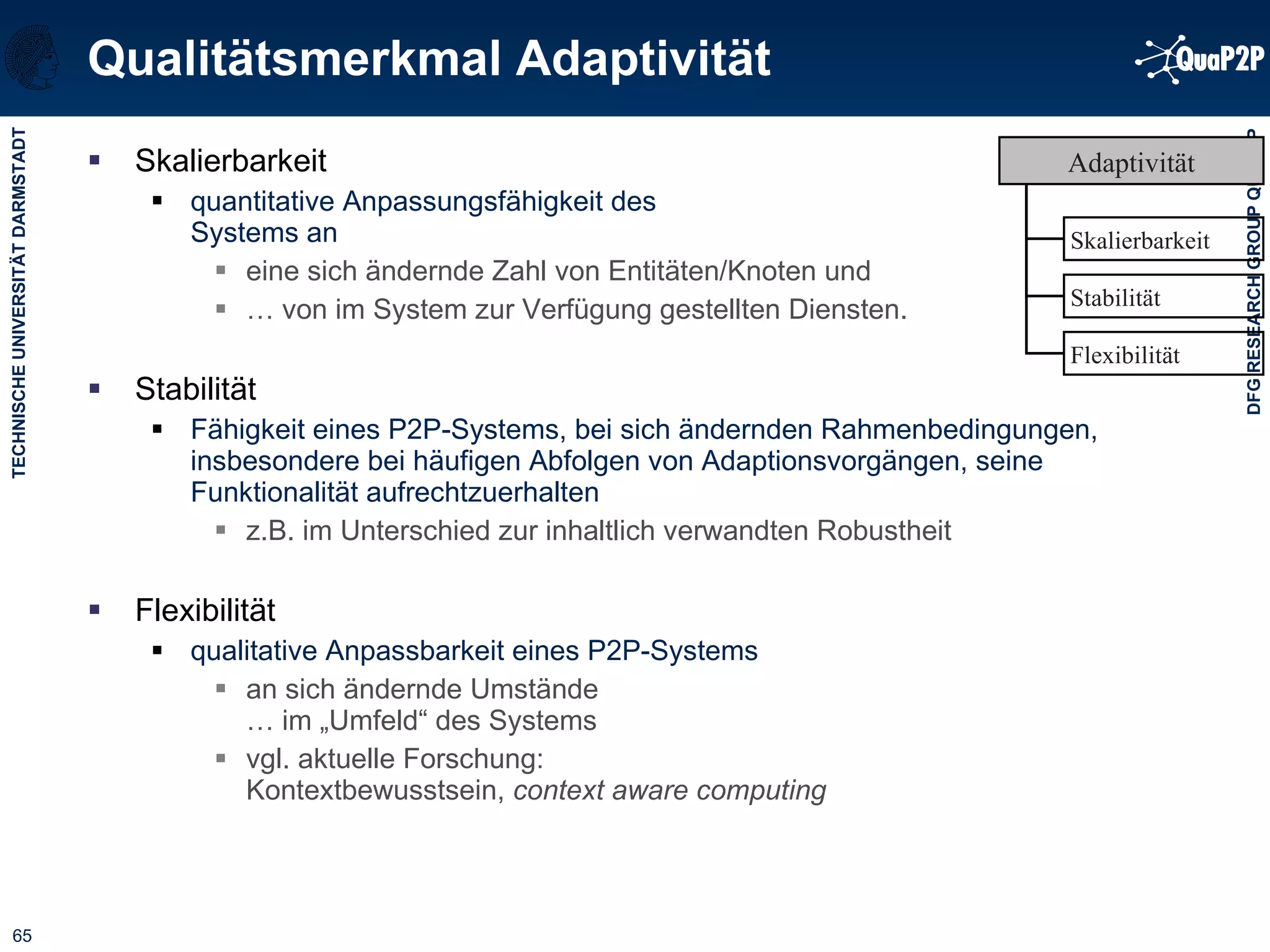
Qualitätsmerkmal Adaptivität Skalierbarkeit quantitative Anpassungsfähigkeit des  Systems an  eine sich ändernde Zahl von Entitäten/Knoten und  …  von im System zur Verfügung gestellten Diensten. Stabilität Fähigkeit eines P2P-Systems, bei sich ändernden Rahmenbedingungen, insbesondere bei häufigen Abfolgen von Adaptionsvorgängen, seine Funktionalität aufrechtzuerhalten z.B. im Unterschied zur inhaltlich verwandten Robustheit Flexibilität qualitative Anpassbarkeit eines P2P-Systems  an sich ändernde Umstände  … im „Umfeld“ des Systems vgl. aktuelle Forschung:  Kontextbewusstsein,  context aware computing Skalierbarkeit Flexibilität Stabilität Adaptivität
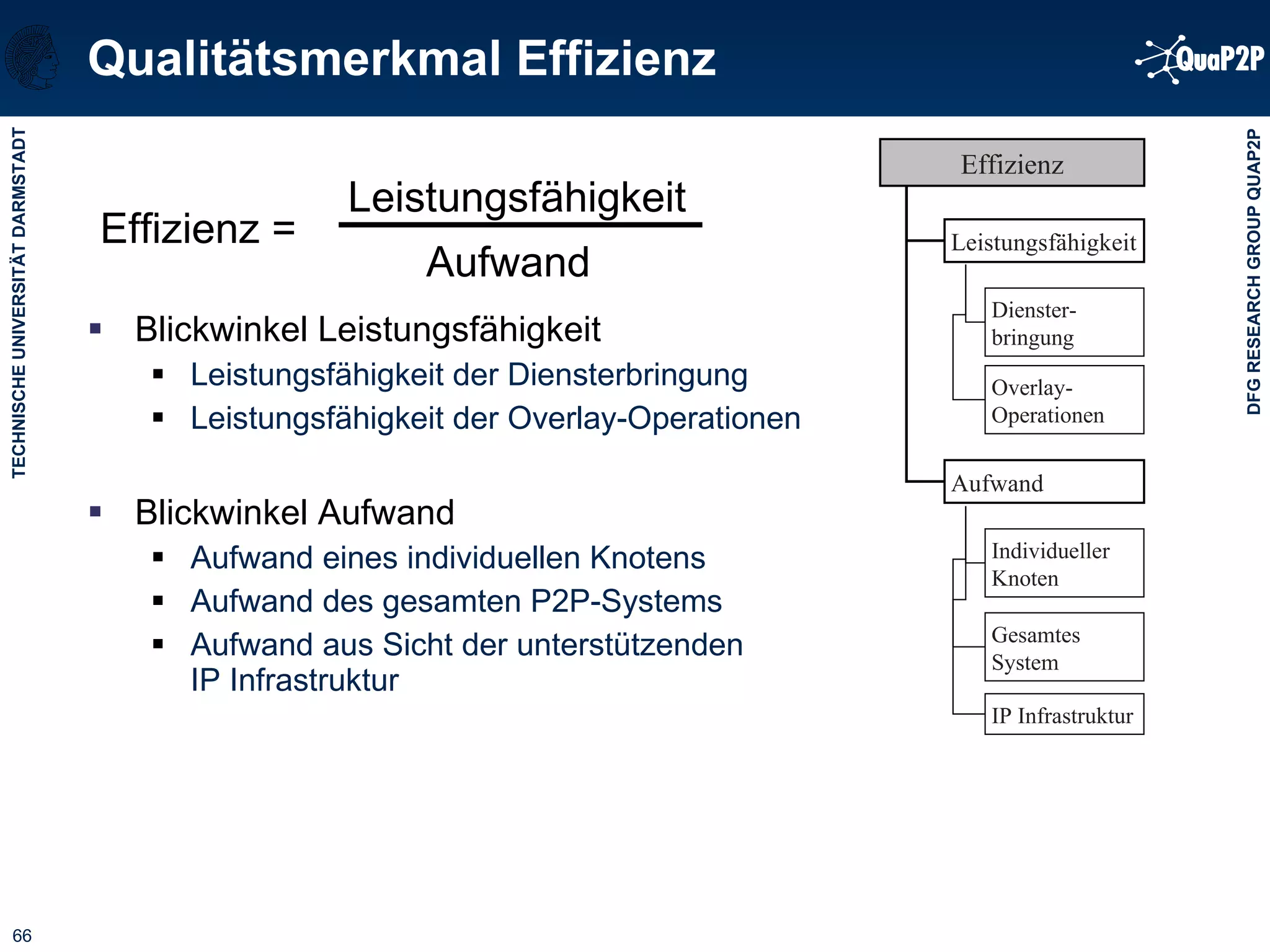
Qualitätsmerkmal Effizienz Blickwinkel Leistungsfähigkeit Leistungsfähigkeit der Diensterbringung Leistungsfähigkeit der Overlay-Operationen Blickwinkel Aufwand Aufwand eines individuellen Knotens Aufwand des gesamten P2P-Systems Aufwand aus Sicht der unterstützenden  IP Infrastruktur Leistungsfähigkeit Aufwand Effizienz = Aufwand Leistungsfähigkeit Dienster-bringung Overlay-Operationen Individueller Knoten Gesamtes System IP Infrastruktur Effizienz
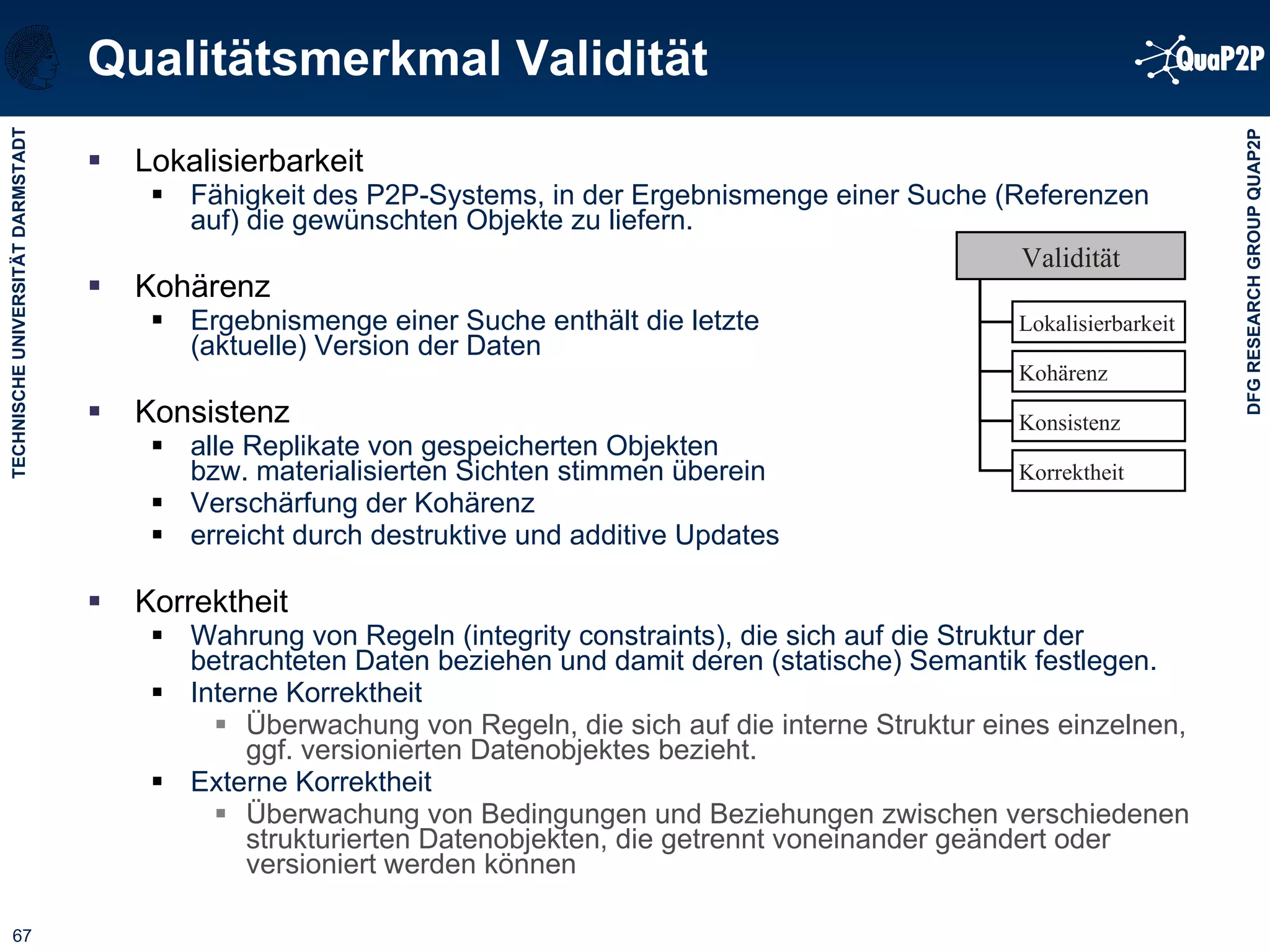
Qualitätsmerkmal Validität Lokalisierbarkeit Fähigkeit des P2P-Systems, in der Ergebnismenge einer Suche (Referenzen auf) die gewünschten Objekte zu liefern. Kohärenz Ergebnismenge einer Suche enthält die letzte  (aktuelle) Version der Daten Konsistenz alle Replikate von gespeicherten Objekten  bzw. materialisierten Sichten stimmen überein Verschärfung der Kohärenz erreicht durch destruktive und additive Updates Korrektheit Wahrung von Regeln (integrity constraints), die sich auf die Struktur der betrachteten Daten beziehen und damit deren (statische) Semantik festlegen. Interne Korrektheit Überwachung von Regeln, die sich auf die interne Struktur eines einzelnen, ggf. versionierten Datenobjektes bezieht. Externe Korrektheit Überwachung von Bedingungen und Beziehungen zwischen verschiedenen strukturierten Datenobjekten, die getrennt voneinander geändert oder versioniert werden können Lokalisierbarkeit Kohärenz Konsistenz Korrektheit Validität
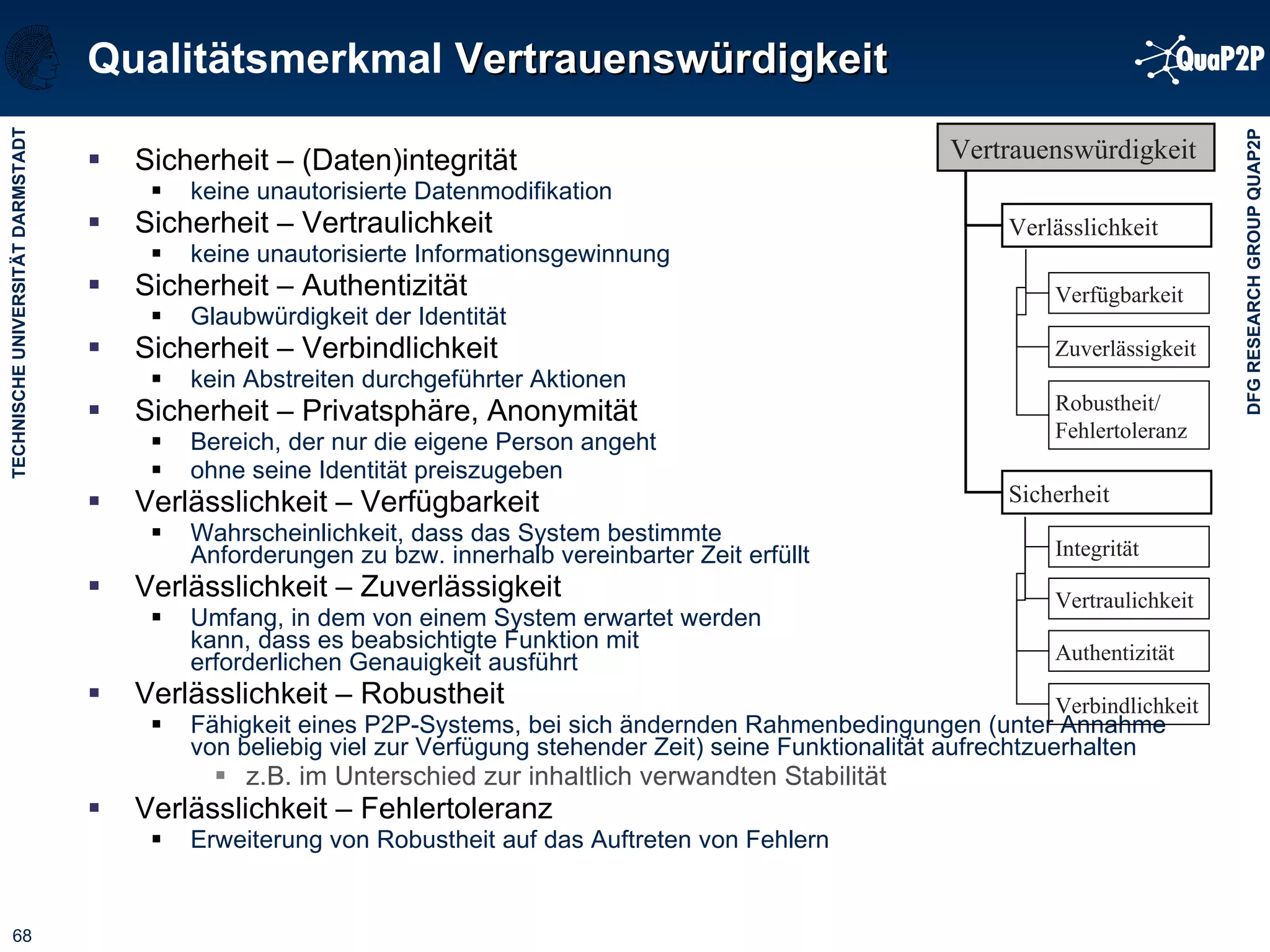
Qualitätsmerkmal  Vertrauenswürdigkeit Sicherheit – (Daten)integrität keine unautorisierte Datenmodifikation Sicherheit – Vertraulichkeit keine unautorisierte Informationsgewinnung Sicherheit – Authentizität Glaubwürdigkeit der Identität Sicherheit – Verbindlichkeit kein Abstreiten durchgeführter Aktionen Sicherheit – Privatsphäre, Anonymität Bereich, der nur die eigene Person angeht ohne seine Identität preiszugeben Verlässlichkeit – Verfügbarkeit Wahrscheinlichkeit, dass das System bestimmte  Anforderungen zu bzw. innerhalb vereinbarter Zeit erfüllt Verlässlichkeit – Zuverlässigkeit Umfang, in dem von einem System erwartet werden kann, dass es beabsichtigte Funktion mit  erforderlichen Genauigkeit ausführt Verlässlichkeit – Robustheit Fähigkeit eines P2P-Systems, bei sich ändernden Rahmenbedingungen (unter Annahme von beliebig viel zur Verfügung stehender Zeit) seine Funktionalität aufrechtzuerhalten z.B. im Unterschied zur inhaltlich verwandten Stabilität Verlässlichkeit – Fehlertoleranz Erweiterung von Robustheit auf das Auftreten von Fehlern Sicherheit Verlässlichkeit Verfügbarkeit Zuverlässigkeit Robustheit/ Fehlertoleranz Integrität Vertraulichkeit Authentizität Verbindlichkeit Vertrauenswürdigkeit
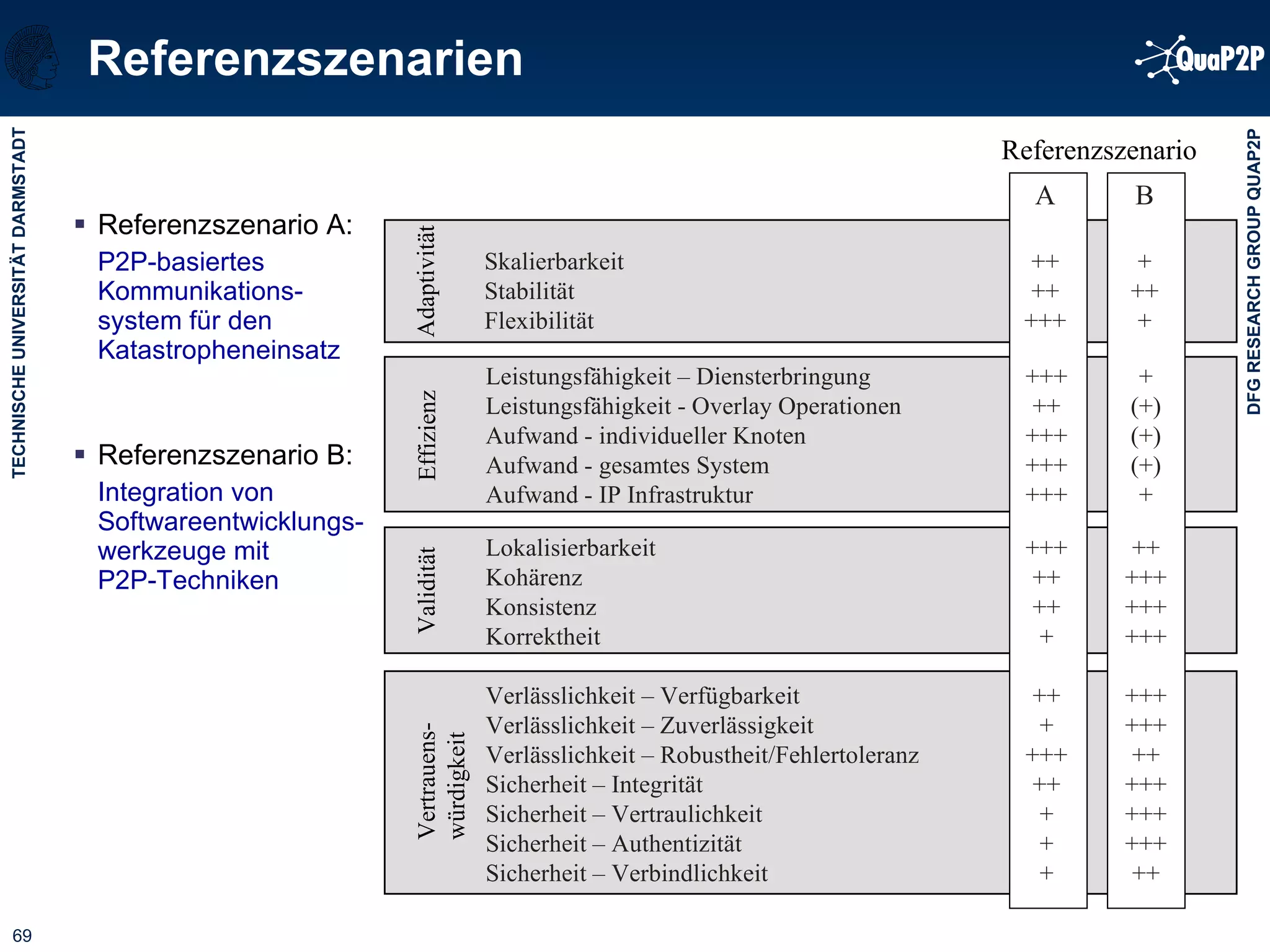
Referenzszenarien Referenzszenario A:  P2P-basiertes Kommunikations-system für den  Katastropheneinsatz Referenzszenario B:  Integration von  Softwareentwicklungs-werkzeuge mit  P2P-Techniken Adaptivität Effizienz Validität Vertrauens- würdigkeit Referenzszenario Leistungsfähigkeit – Diensterbringung +++ + Leistungsfähigkeit - Overlay Operationen ++ (+) Aufwand - individueller Knoten +++ (+) Aufwand - gesamtes System +++ (+) Aufwand - IP Infrastruktur +++ + Skalierbarkeit ++ + Stabilität ++ ++ Flexibilität +++ + A B Lokalisierbarkeit +++ ++ Kohärenz ++ +++ Konsistenz ++ +++ Korrektheit + +++ Verlässlichkeit – Verfügbarkeit ++ +++ Verlässlichkeit – Zuverlässigkeit + +++ Verlässlichkeit – Robustheit/Fehlertoleranz +++ ++ Sicherheit – Integrität ++ +++ Sicherheit – Vertraulichkeit + +++ Sicherheit – Authentizität + +++ Sicherheit – Verbindlichkeit + ++
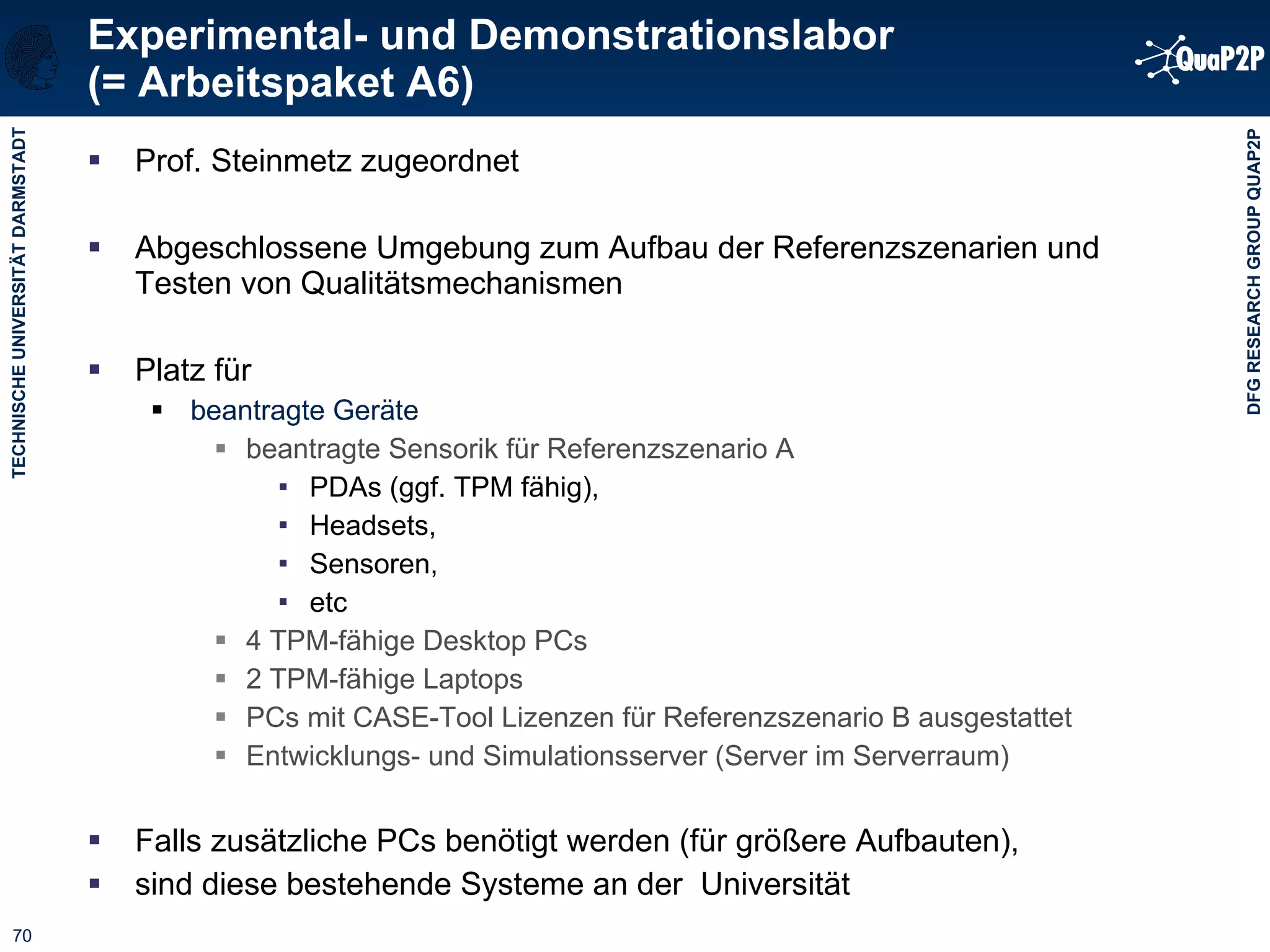
Experimental- und Demonstrationslabor (= Arbeitspaket A6) Prof. Steinmetz zugeordnet  Abgeschlossene Umgebung zum Aufbau der Referenzszenarien und Testen von Qualitätsmechanismen Platz für beantragte Geräte beantragte Sensorik für Referenzszenario A PDAs (ggf. TPM fähig), Headsets, Sensoren, etc 4 TPM-fähige Desktop PCs 2 TPM-fähige Laptops PCs mit CASE-Tool Lizenzen für Referenzszenario B ausgestattet Entwicklungs- und Simulationsserver (Server im Serverraum) Falls zusätzliche PCs benötigt werden (für größere Aufbauten),  sind diese bestehende Systeme an der  Universität

QuaP2P Kickoff Slides 2006

  • 1.
    Agenda 16:00 Begrüßung 16:10 P2P in der Elektrotechnik und Informationstechnik Prof. Dr.-Ing. V.Hinrichsen, Dekan FB 18 16:15 P2P in der Informatik Prof. Dr.-Ing. K.Weihe, Dekan FB 20 16:20 Das P2P Paradigma & Qualität in P2P Systemen Prof. Dr.-Ing. R.Steinmetz, Sprecher Forschergruppe 16:40 P2P in der Praxis PD Dr.-Ing. G.Hasslinger 17:00 Vorstellung der Forschungsthemen Moderation N.Liebau 17:30 Empfang - Beer-to-Beer
  • 2.
    Verbesserung der Qualitätvon Peer-to-Peer-Systemen (QuaP2P) Improving the Quality of P2P-Systems 31. Oktober 2006 Eröffnung der DFG Forschergruppe Prof. Dr.rer.nat. Max Mühlhäuser Prof. Dr.rer.nat. Andy Schürr Prof. Dr.-Ing. Ralf Steinmetz (Sprecher) Prof. Alejandro Buchmann, Ph.D. Prof. Dr.rer.nat. Claudia Eckert Dr.-Ing. Oliver Heckmann Prof. Dr. Jussi Kangasharju
  • 3.
  • 4.
  • 5.
    Participating Research Groups/ Chairs Alejandro Buchmann Jussi Kangasharju Oliver Heckmann Ralf Steinmetz Claudia Eckert Andy Schürr Max Mühlhäuser Content Management Software Engineering IT Security Ubiquitous Computing Communication Networks Quality of Service Databases & Middleware QuaP2P QuaP2P
  • 6.
    Peer-to-Peer: 9 Propertiesrelevant resources located at nodes (“peers”) at the edges of a network peers share their resources resource locations widely distributed most often largely replicated variable connectivity is the norm combined Client and Server functionality direct interaction (provision of services, e.g. file transfer) between peers (= “peer to peer”) peers have significant autonomy and mostly similar rights no central control or centralized usage/provisioning of a service self-organizing system
  • 7.
    Example: Whyis P2P Attractive? Issues Scalability Costs Distribution of Costs Decentralization Self-Organization Incremental Expandability everyone may become a “producer” Server Clients Peer
  • 8.
    P2P is aDisruptive Technology Skype offers Free P2P based voice over IP services (Skype-to-Skype) Value added services (Skype Out, Skype In, etc), not free Skype 1.0 released in 2004 In 2005 Skype is bought for $4 billion by Ebay In 2006 circa 366.000.000 client-downloads (August 2006) > 6 million active concurrent users on average > 110 million registered Skype names > 28 million active users per month (August 2006) 7,1 billion Skype-minutes served in Q2/2006 (worldwide) For comparison: ≈ 81 billion minutes per quarter in the complete German PSTN Skype serves 7% of international long-distance calls ( ≈ 11 billion min. in 2005) Assuming an average of $0,25 per minute  $2.75 billion (potential) revenue loss of incumbent operators
  • 9.
    2nd Generation UnstructuredP2P : Centralized 1st Generation 3rd Generation from R.Schollmeier and J.Eberspächer, TU München DHT-Based Pure P2P Hybrid P2P Centralized P2P Any terminal entity can be removed without loss of functionality No central entities, fully distributed “ Fixed” connections in the overlay network Search costs: O(log n) Costs for state: O(log n) For: Lookup Any terminal entity can be removed without loss of functionality Dynamic central entities for faster search Search costs: variable Costs for state: variable For: Searches Any terminal entity can be removed without loss of functionality No central entities, fully distributed Search costs: O(n) Costs for state: O(1) For: Searches Central entity is necessary to provide the service Central entity is some kind of index database Search costs: O(1) Costs for state: O(n) For: Searches Structured P2P Unstructured P2P
  • 10.
    Goals of theResearch Group Improving the quality of P2P-systems Identifying and defining quality attributes and metrics Caution: There are interdependences and goal conflicts between the different quality attributes to examine and (as far as possible) to quantify them How superior/inferior are P2P-Systems to existing systems ? Effect of applying P2P-paradigm to different application area Proof-of-Concept of the investigated mechanisms using 2 reference scenarios Prototype implementation of scenarios
  • 11.
    Mechanisms: Example 2Mechanisms for Routing in Overlay Networks Flooding Random Forwarding, n=2 Overhead high, e.g. 43 messages Path-length 5 steps Overhead lower e.g. 30 (36) messages Path-length 6 (8) Steps
  • 12.
    Quality Attributes CostsSecurity Quality of P2P Systems Retrievability Coherence Consistency Correctness Performance Scalability Flexibility Stability Dependability Service Provisioning Overlay Operations Individual Node Complete System IP Infrastructure Availability Reliability Robustness/ Fault tolerance Integrity Confidentiality Authentication Non-repudiation Trust Validity Efficiency Adaptability [Heckmann et.al. 2006 a]
  • 13.
    Reference Scenario A:Disaster Recovery [Steinmetz et.al. 2006] Haben Sie oder der Herr?? Ein besseres Bild dazu oder soll dies bleiben? NL: Ich versuche bis Montag ein besseres zu bekommen.
  • 14.
    Reference Scenario A:Disaster Recovery [Steinmetz et.al. 2006]
  • 15.
  • 16.
    Reference Scenario A:Disaster Recovery Communication: Different types of traffic and service Traffic: Audio- und video communication, live chat, data transfer, … Service: Synchronisation of databases, locating people, devices, … Requirements Scalability & Stability: Highly dynamic, large and heterogeneous network Efficiency: Scarce resources Validity: Nodes can be disconnected any time Robustness: Can decide about survival
  • 17.
    Scenario B: Globally Distributed Software Development „ nomadic" developers (team work on site) Abbreviations: RM = Resource Management CM = Content Management DB = Database [Steinmetz et.al. 2006] RM-System Trace-DB Modeling tool CM-System Programming environment Developers in Intranet Project Leader RM-System Trace-DB Modeling tool CM-System Programming environment Developers in Intranet Subcontractors CM-System Programming environment „ nomadic" developers Open-Source Projects Bugtracker Feature-tracker Sourceforge … „ nomadic" developers … …
  • 18.
    Quality Requirements of the Scenarios Scenario A: P2P-based communication system disaster recovery Scenario B: Integration of Software development tools with P2P techniques Adaptability Efficiency Validity Trust Scenario Performance– Services Provisioning +++ + Performance - Overlay Operations ++ (+) Costs - Individual Node +++ (+) Costs - Complete System +++ (+) Costs - IP Infrastructure +++ + Scalability ++ + Stability ++ ++ Flexibility +++ + A B Retrievability +++ ++ Coherence ++ +++ Consistency ++ +++ Correctness + +++ Dependability – Availability ++ +++ Dependability – Reliability + +++ Dependability – Robustness/Fault tolerance +++ ++ Security – Integrity ++ +++ Security – Confidentiality + +++ Security – Authentication + +++ Security – Non-repudiation + ++ Orthogonal quality requirements
  • 19.
    Joint Activities Goals (finished + in progress) Joint publications Joint events (@fairs, seminar, lab work, colloquium, …) Joint theses (BSc, MSc, diploma,…) Joint prototypes (simulation, scenarios, open source) Pubs: Events: Thesis: Prof. C.Eckert, SEC M.Benz 2+1 1 MM / Bradler 2 1 5+3 1 OH / Graffi Pubs: Events: Thesis: Pubs: Events: Thesis: Pubs: Events: Thesis: Pubs: Events: Thesis: Pubs: Events: Thesis: Pubs: Events: Thesis: RSt / Kovacevic 2+1 1 2 1 2 1 2 1 AS / Mukherjee 2 2 2 1 2 2 AB / Leng JK / Schröder 2 1 3 1 2 1 +1 2 1 2 1 2+1 1 Prof. J. Kangasharju, UP2P J.Schröder-Bernhardi 2 1 Prof. A.Schürr, ES P.Mukherjee 2 2 Prof. A.Buchmann, DVS C.Leng 3 1 Dr. O.Heckmann, KOM K.Graffi 2 1 Prof. M.Mühlhäuser, TK D.Bradler 3 1 Prof. R.Steinmetz, KOM A.Kovacevic CE / Benz
  • 20.
    Allocation of theResearch Topics Alejandro Buchmann Jussi Kangasharju Oliver Heckmann Ralf Steinmetz Claudia Eckert Andy Schürr Max Mühlhäuser Content Management Software Engineering IT Security Ubiquitous Computing Communication Networks Quality of Service Databases & Middleware Flexibility Scalability Stability Performance Costs Efficiency Adaptability Validity Trust Correctness Consistency Coherence Retrievability Integrity Confidentiality Authentication Non-Repudiation Availability Reliability Robustness
  • 21.
  • 22.
    DFG Financed ResearchersEfficiency Performance Costs Kalman Graffi Adaptability Scalability Stability Adaptability Flexibility Catastrophe scenario Dirk Bradler IT Security Integrity Confidentiality Authentication Non-Repudiation Michael Benz Dependability Availability Reliability Robustness Validity Correctness Software development scenario Patrick Mukherjee Validity Consistency Coherence Retrievability Julian Schröder-Bernhardi Efficiency Adaptability Validity Trust Aleksandra Kovacivic Christof Leng
  • 23.
    DFG Financed ResearchersEfficiency Performance Costs Kalman Graffi Adaptability Scalability Stability IT Security Integrity Confidentiality Authentication Non-Repudiation Michael Benz Dependability Availability Reliability Robustness Validity Correctness Software development scenario Patrick Mukherjee Validity Consistency Coherence Retrievability Julian Schröder-Bernhardi Efficiency Adaptability Validity Trust Aleksandra Kovacivic Christof Leng Dipl.-Wirtsch.-Inform. Dirk Bradler Studied Management Information Systems at TUD 2000 – 2006 Since 2006 at Telecooperation ( Prof. Mühlhäuser ) Thesis: „ Deploying and Managing Distributed Services in a Peer-to-Peer Network”, in cooperation with SAP Labs, Palo Alto, CA Adaptability Flexibility Catastrophe scenario Dirk Bradler
  • 24.
    Rescue Communication System1/2 “… all area communications seemed simultaneously Overwhelmed.” – After-Action Report on the Reponse to the September 11 Terrorist Attack on the Pentagon “ In the first few hours, foot messengers at times proved to be the most reliable means of communicating.” - After-Action Report on the Reponse to the September 11 Terrorist Attack on the Pentagon “ Improve communications between the operating branches and sections.”- Findings from San Simeon Earthquake December 22, 2003 After catastrophes communication is very limited or not possible at all.
  • 25.
    Rescue Communication System2/2 “ It's expensive to serve, but it's easy to use P2P to share.” - Greg Bildson, COO of LimeWire P2P systems can improve communication after catastrophes. “ We believe P2P networks […] do indeed represent the next distribution channel for digital media.” - Michael Weiss, CEO StreamCast “ These networks scale indefinitely without increasing search time and without the need for costly centralized resources.” - Skype
  • 26.
    Flexibility in P2PSystems Context awareness eases configuration and deployment of P2P based applications. Context Definition: Information that is relevant for the interaction with the application and that can be used as additional information to enhance the interaction with the user
  • 27.
    Selection of ConcreteTasks Implement context processing in P2P simulator Evaluate different P2P topologies
  • 28.
    DFG Financed ResearchersEfficiency Performance Costs Kalman Graffi Adaptability Scalability Stability Adaptability Flexibility Catastrophe scenario Dirk Bradler IT Security Integrity Confidentiality Authentication Non-Repudiation Michael Benz Dependability Availability Reliability Robustness Validity Consistency Coherence Retrievability Julian Schröder-Bernhardi Efficiency Adaptability Validity Trust Aleksandra Kovacivic Christof Leng Dipl.-Inform. Patrick Mukherjee Studied Computer Science at TU Berlin, 1997 – 2004. Accenture 2005 – 2006 Since 2006 at Real-Time Systems Lab ( Prof. Schürr ) Thesis: „Constraint-basierte Simulation von Eisenbahnfahrten: Hierarchische Problemzerlegung und –lösung“ (Adaptive distribution of simulation problems) Validity Correctness Software development scenario Patrick Mukherjee
  • 29.
    Validity: Correctness Dataobjects are correct according to a specification integrity constraints versioned data objects Data objects are internal correct = realized according to its specification can be locally checked (i.e. Hoare-logic) external correct = specified relations are valid
  • 30.
    External Correctness ofVersioned Data v1.1.1.1 v1.1.1.2 v1.1.1.3 v1.1.1.2 What happens if documents are concurrently developed ? … and if we have more than two documents? v1.1.1.1
  • 31.
    P2P-Based Integrated P roject S upport E nvironment (aka Reference Scenario B) Globally Distributed I ntegrated P roject S upport E nvironment Advantages of the P2P approach: Access right management over company borders No displaced responsibilities due to central repositories Low administration costs Support for “nomadic” developers seamless connection (no worries about different VPNs or firewalls) Ad-hoc cooperation Interoperability of tools Optimal usage of resources (bandwidth, computing power, human presence, …) Subcontractors Project Leader Open-Source Projects “ Nomadic” Developers
  • 32.
    Possible Projects P2P… P2P SCM P2P Wiki COTS Tool Integration P2P Security Mechanisms P2P Resource Management P2P Distributed Computation P2P CSCW
  • 33.
    DFG Financed ResearchersEfficiency Performance Costs Kalman Graffi Adaptability Scalability Stability Adaptability Flexibility Catastrophe scenario Dirk Bradler IT Security Integrity Confidentiality Authentication Non-Repudiation Michael Benz Validity Correctness Software development scenario Patrick Mukherjee Validity Consistency Coherence Retrievability Efficiency Adaptability Validity Trust Aleksandra Kovacivic Christof Leng Julian Schröder-Bernhardi Dipl.-Inform. Julian Schröder-Bernhardi Studied Computer Science at TUD 2000 – 2006. Since 2006 at Ubiquitous Peer-to-Peer Infrastructures Group ( Prof. Kangasharju ) Diploma Thesis: "Analysis of communication and traffic in P2P-network with focus on web caches", in cooperation with T-Systemts Dependability Availability Reliability Robustness
  • 34.
    Availability Availability isthe ability to deliver a service / information within a given time. Higher availability is normally achieved by replication. Can we provide better availability without increasing the number of replicas?
  • 35.
    Reliability Reliability isthe ability to deliver a service / information as specified. In P2P reliability needs to be guaranteed for some service In a rescue scenario important messages need to get delivered (“Where is the surgeon that is on duty?“)
  • 36.
    Robustness / Faulttolerance Robustness: Maintain function with changes in structure. Fault tolerance: Continue operating in the event of failures.
  • 37.
    Current focus Investigationof the interdependencies between dependability and the other quality criteria. Providing a language for the evaluation of the service quality.
  • 38.
    DFG Financed ResearchersEfficiency Performance Costs Kalman Graffi Adaptability Scalability Stability Adaptability Flexibility Catastrophe scenario Dirk Bradler Dependability Availability Reliability Robustness Validity Correctness Software development scenario Patrick Mukherjee Validity Consistency Coherence Retrievability Julian Schröder-Bernhardi Efficiency Adaptability Validity Trust Aleksandra Kovacivic Christof Leng Dipl.-Inform. Michael Benz Studied Computer Science at TUD, 2000 – 2005 Since 2006 at IT-Security Group ( Prof. Eckert ) Thesis: "Cluster based rendering with distributed frame buffers" IT Security Integrity Confidentiality Authentication Non-Repudiation Michael Benz
  • 39.
    How to improvesecurity in P2P Systems? Michael Benz: Security in P2P Systems Existing security mechanisms are usually not suitable for a distributed P2P environment Enhancing P2P Systems with…  Trust relationships  Protection against malicious Peers  Confidential search algorithms  Usage Control  Delegation Integrity Confidentiality Authenticity Non-repudiation
  • 40.
    Michael Benz: Securityin P2P Systems Creating a secure P2P Platform Trust Usage Control / Confidential Search Delegation P2P-Application P2P-Infrastructure
  • 41.
  • 42.
    Michael Benz: Securityin P2P Systems Example - Building trust with reputation Necessary steps: Gather information Evaluate collected data Take action Goals: Mitigating Misbehavior Imposing minimal cost on well-behaved user Creating trust relationships User Identity Previous Transactions Quantity Quality Speed Ranking & Scoring Incentives / Punishment
  • 43.
  • 44.
    DFG Financed ResearchersEfficiency Performance Costs Kalman Graffi Adaptability Flexibility Catastrophe scenario Dirk Bradler IT Security Integrity Confidentiality Authentication Non-Repudiation Michael Benz Dependability Availability Reliability Robustness Validity Correctness Software development scenario Patrick Mukherjee Validity Consistency Coherence Retrievability Julian Schröder-Bernhardi Efficiency Adaptability Validity Trust Christof Leng Dipl.-Ing. Aleksandra Kovacevic Studied Computer Engineering and Computer Science at University of Belgrade, Serbia 1999 – 2004 Since 2005 at Multimedia Communications Lab ( Prof. Steinmetz ) Thesis: “Digital Sealed File System (DSFS) – The System for Data Modification Detection Adaptability Scalability Stability Aleksandra Kovacivic
  • 45.
    What is Adaptability?No performance loss due to changes of: Number of participants = SCALABILITY Frequency of activities = STABILITY Context of usage = FLEXIBILITY 198.67.82.21 PeerA 198.67.82.21 Routing table A A
  • 46.
    Scalability vs. StabilityTrade-off between stable and scalable systems Example: Stability introduce protocol overhead Protocol overhead harming scalability Fully Connected Minimal Tree Stability Scalability Sudden failure #hops t STABILITY ROBUSTNESS OPTIMAL VALUE
  • 47.
    Simulation of LargeScale P2P Networks Size of P2P Systems = more then 1 million peers E.g. PlanetLab = 704 nodes / average 200 online Simulation necessary User Layer Overlay Layer Simulation Core Network Layer Package Lost … … … Delay Model Connection Management Routing Model Resource Model Online-time Model Requested Services Offered Services Look-up Model
  • 48.
    Goals Trade-offs MechanismsCANdemila Metrics 0 1 2 3 4 5 100 0 200 300 500 400 ms 48 132 187 383 411 492 Benchmarks Chordtella
  • 49.
    DFG Financed ResearchersAdaptability Scalability Stability Adaptability Flexibility Catastrophe scenario Dirk Bradler IT Security Integrity Confidentiality Authentication Non-Repudiation Michael Benz Dependability Availability Reliability Robustness Validity Correctness Software development scenario Patrick Mukherjee Validity Consistency Coherence Retrievability Julian Schröder-Bernhardi Efficiency Adaptability Validity Trust Aleksandra Kovacivic Christof Leng Dipl.-Inform. Kalman Graffi Studied Computer Science & Mathematics at TUD, 2002 – 2006, with distinction Since 2006 at Multimedia Communications Lab ( Prof. Steinmetz ) Thesis: "A Security Framework for Organic Mesh Networks" Efficiency Performance Costs Kalman Graffi
  • 50.
    Kalman Graffi: Efficiencyin Peer-to-Peer What is Efficiency? How to improve the efficiency? ⇒ Keep the costs, increase the performance ⇒ Keep the performance, decrease the costs How to achive this? ⇒ Focus on resource-bottlenecks ⇒ Take heterogeneity of peers , links and messages into account Adapt to Heterogeneity Focus on Bottlenecks!
  • 51.
    Example: Bandwidth Usagein Unstructured P2P Kalman Graffi: Efficiency in Peer-to-Peer Searches I cannot hear you Help! Emergency! Unnecessary Message Scheduling : Same total amount of messages processed More important messages have higher priority Processing Before: After:
  • 52.
    DFG Financed ResearchersEfficiency Performance Costs Kalman Graffi Adaptability Scalability Stability Adaptability Flexibility Catastrophe scenario Dirk Bradler IT Security Integrity Confidentiality Authentication Non-Repudiation Michael Benz Dependability Availability Reliability Robustness Validity Correctness Software development scenario Patrick Mukherjee Julian Schröder-Bernhardi Efficiency Adaptability Validity Trust Aleksandra Kovacivic Dipl.-Inform. Christof Leng Studied Computer Science at TUD, 1996 – 2004, with distinction Since 2005 at Databases and Distributed Systems Group ( Prof. A. Buchmann ) Thesis: "Design and Implementation of a Trust Protocol for Peer-to-Peer Networks" Validity Consistency Coherence Retrievability Christof Leng
  • 53.
    Complex P2P DataManagement The focus of P2P is changing: More complex queries Frequent updates of data objects Reliability of results becoming more important Sophisticated applications need a high quality infrastructure SELECT SUM (`onlineTime` ) FROM `users` WHERE `ID` > 5 AND `name` LIKE '%Christof%‘ ;
  • 54.
    Retrievability Identify andclassify access mechanisms in P2P Compare overlay networks for different access mechanism Integrate heterogeneous meta data models Join Query … … Kademlia CAN Chord Structured BubbleStorm Kazaa Gnutella Unstructured … Aggregation Query Multi-Attribute Query Range Query Identifier Lookup
  • 55.
    Coherence and ConsistencyCoherence : get the newest version of an object Consistency : avoid conflicting object states Use optimistic update protocols and quorum mechanisms Build version management system for P2P
  • 56.
    Prototypes for ResearchEvaluation P2P Wiki P2P Message Board P2P “Database” Applications Scenario A P2P Source Code Management Scenario B
  • 57.
    Allocation of theResearch Topics Alejandro Buchmann Jussi Kangasharju Oliver Heckmann Ralf Steinmetz Claudia Eckert Andy Schürr Max Mühlhäuser Content Management Software Engineering IT Security Ubiquitous Computing Communication Networks Quality of Service Databases & Middleware Flexibility Scalability Stability Performance Costs Efficiency Adaptability Validity Trust Correctness Consistency Coherence Retrievability Integrity Confidentiality Authentication Non-Repudiation Availability Reliability Robustness
  • 58.
    click me … zum Ablauf
  • 59.
  • 60.
  • 61.
    Integrative Forschungsbasis Ziele:Nutzen? Noch nicht übersetzt. NL. 1. Antragsphase 2. Antragsphase Bilateral Multilateral Referenzszenarien P2P Framework Wechsel- wirkungen Studie am Objekt Referenzszenarien &
  • 62.
    Mitarbeiter Skalierbarkeit &Stabilität Aleksandra Kovacevic FG Multimedia Kommunikation Sicherheit Michael Benz FG Sicherheit in der Informationstechnik Verlässlichkeit Julian Schröder-Bernhardi FG Ubiquitäre Peer-to-Peer Infrastrukturen Konsistenz & Korrektheit Patrick Mukherjee FG Echtzeitsysteme Kohärenz & Lokalisierbarkeit Christof Leng FG Datenbanken und Verteilte Systeme Effizienz Kalman Graffi FG Multimedia Kommunikation Flexibilität Dirk Bradler FG Telekooperation
  • 63.
    Aufteilung der ForschungsthemenAlejandro Buchmann Jussi Kangasharju Oliver Heckmann Ralf Steinmetz Claudia Eckert Andy Schürr Max Mühlhäuser Content Management Software Engineering IT Sicherheit Ubiquitous Computing Kommunikationsnetze Dienstgüte Datenbanken & Middleware Flexibilität Skalierbarkeit Stabilität Leistungsfähigkeit Aufwand Effizienz Adaptivität Validität Vertrauens-würdigkeit Korrektheit Konsistenz Kohärenz Lokalisierbarkeit Integrität Vertraulichkeit Authentizität Verbindlichkeit Verfügbarkeit Zuverlässigkeit Robustheit
  • 64.
    DFG finanzierte ForschendeEffizienz Leistungsfähigkeit Aufwand Kalman Graffi Adaptivität Skalierbarkeit Stabilität Adaptivität Flexibilität Katastrophenszenario Dirk Bradler IT Sicherheit Integrität Vertraulichkeit Authentizität Verbindlichkeit Michael Benz Verlässlichkeit Verfügbarkeit Zuverlässigkeit Robustheit Validität Korrektheit Software- entwicklungs- szenario Patrick Mukherjee Effizienz Adaptivität Validität Vertrauens-würdigkeit Julian Schröder-Bernhardi Aleksandra Kovacivic Validität Konsistenz Kohärenz Lokalisierbarkeit Christof Leng
  • 65.
    Qualitätsmerkmal Adaptivität Skalierbarkeitquantitative Anpassungsfähigkeit des Systems an eine sich ändernde Zahl von Entitäten/Knoten und … von im System zur Verfügung gestellten Diensten. Stabilität Fähigkeit eines P2P-Systems, bei sich ändernden Rahmenbedingungen, insbesondere bei häufigen Abfolgen von Adaptionsvorgängen, seine Funktionalität aufrechtzuerhalten z.B. im Unterschied zur inhaltlich verwandten Robustheit Flexibilität qualitative Anpassbarkeit eines P2P-Systems an sich ändernde Umstände … im „Umfeld“ des Systems vgl. aktuelle Forschung: Kontextbewusstsein, context aware computing Skalierbarkeit Flexibilität Stabilität Adaptivität
  • 66.
    Qualitätsmerkmal Effizienz BlickwinkelLeistungsfähigkeit Leistungsfähigkeit der Diensterbringung Leistungsfähigkeit der Overlay-Operationen Blickwinkel Aufwand Aufwand eines individuellen Knotens Aufwand des gesamten P2P-Systems Aufwand aus Sicht der unterstützenden IP Infrastruktur Leistungsfähigkeit Aufwand Effizienz = Aufwand Leistungsfähigkeit Dienster-bringung Overlay-Operationen Individueller Knoten Gesamtes System IP Infrastruktur Effizienz
  • 67.
    Qualitätsmerkmal Validität LokalisierbarkeitFähigkeit des P2P-Systems, in der Ergebnismenge einer Suche (Referenzen auf) die gewünschten Objekte zu liefern. Kohärenz Ergebnismenge einer Suche enthält die letzte (aktuelle) Version der Daten Konsistenz alle Replikate von gespeicherten Objekten bzw. materialisierten Sichten stimmen überein Verschärfung der Kohärenz erreicht durch destruktive und additive Updates Korrektheit Wahrung von Regeln (integrity constraints), die sich auf die Struktur der betrachteten Daten beziehen und damit deren (statische) Semantik festlegen. Interne Korrektheit Überwachung von Regeln, die sich auf die interne Struktur eines einzelnen, ggf. versionierten Datenobjektes bezieht. Externe Korrektheit Überwachung von Bedingungen und Beziehungen zwischen verschiedenen strukturierten Datenobjekten, die getrennt voneinander geändert oder versioniert werden können Lokalisierbarkeit Kohärenz Konsistenz Korrektheit Validität
  • 68.
    Qualitätsmerkmal VertrauenswürdigkeitSicherheit – (Daten)integrität keine unautorisierte Datenmodifikation Sicherheit – Vertraulichkeit keine unautorisierte Informationsgewinnung Sicherheit – Authentizität Glaubwürdigkeit der Identität Sicherheit – Verbindlichkeit kein Abstreiten durchgeführter Aktionen Sicherheit – Privatsphäre, Anonymität Bereich, der nur die eigene Person angeht ohne seine Identität preiszugeben Verlässlichkeit – Verfügbarkeit Wahrscheinlichkeit, dass das System bestimmte Anforderungen zu bzw. innerhalb vereinbarter Zeit erfüllt Verlässlichkeit – Zuverlässigkeit Umfang, in dem von einem System erwartet werden kann, dass es beabsichtigte Funktion mit erforderlichen Genauigkeit ausführt Verlässlichkeit – Robustheit Fähigkeit eines P2P-Systems, bei sich ändernden Rahmenbedingungen (unter Annahme von beliebig viel zur Verfügung stehender Zeit) seine Funktionalität aufrechtzuerhalten z.B. im Unterschied zur inhaltlich verwandten Stabilität Verlässlichkeit – Fehlertoleranz Erweiterung von Robustheit auf das Auftreten von Fehlern Sicherheit Verlässlichkeit Verfügbarkeit Zuverlässigkeit Robustheit/ Fehlertoleranz Integrität Vertraulichkeit Authentizität Verbindlichkeit Vertrauenswürdigkeit
  • 69.
    Referenzszenarien Referenzszenario A: P2P-basiertes Kommunikations-system für den Katastropheneinsatz Referenzszenario B: Integration von Softwareentwicklungs-werkzeuge mit P2P-Techniken Adaptivität Effizienz Validität Vertrauens- würdigkeit Referenzszenario Leistungsfähigkeit – Diensterbringung +++ + Leistungsfähigkeit - Overlay Operationen ++ (+) Aufwand - individueller Knoten +++ (+) Aufwand - gesamtes System +++ (+) Aufwand - IP Infrastruktur +++ + Skalierbarkeit ++ + Stabilität ++ ++ Flexibilität +++ + A B Lokalisierbarkeit +++ ++ Kohärenz ++ +++ Konsistenz ++ +++ Korrektheit + +++ Verlässlichkeit – Verfügbarkeit ++ +++ Verlässlichkeit – Zuverlässigkeit + +++ Verlässlichkeit – Robustheit/Fehlertoleranz +++ ++ Sicherheit – Integrität ++ +++ Sicherheit – Vertraulichkeit + +++ Sicherheit – Authentizität + +++ Sicherheit – Verbindlichkeit + ++
  • 70.
    Experimental- und Demonstrationslabor(= Arbeitspaket A6) Prof. Steinmetz zugeordnet Abgeschlossene Umgebung zum Aufbau der Referenzszenarien und Testen von Qualitätsmechanismen Platz für beantragte Geräte beantragte Sensorik für Referenzszenario A PDAs (ggf. TPM fähig), Headsets, Sensoren, etc 4 TPM-fähige Desktop PCs 2 TPM-fähige Laptops PCs mit CASE-Tool Lizenzen für Referenzszenario B ausgestattet Entwicklungs- und Simulationsserver (Server im Serverraum) Falls zusätzliche PCs benötigt werden (für größere Aufbauten), sind diese bestehende Systeme an der Universität

Editor's Notes

  • #17 Relevanz für P2P Flexibilität Lokalität ist einer der wichtigsten Faktoren bei der Bearbeitung des Szenarios Ort der Helfer, Sanitätsstationen, etc. Skalierbarkeit & Stabilität Kein strukturiertes Netz vorhanden Provisorische Infrastruktur vorhanden Unbekannte, sich ändernde Netzwerktopologie während das neue Netz aufgebaut wird Verschiedene Organisationen beteiligt Große, schnell ansteigende Anzahl an heterogenen Knoten Effizienz Knappe Ressourcen Verkehrs- und Diensttypen müssen priorisiert werden Lokalisierbarkeit Finden aller verfügbaren Ressourcen/Meldungen/Dienste Robustheit/Fehlertoleranz Die essentiellen Informationen dürfen nicht verändert oder verloren gehen
  • #20 2 TR + KolloquWS05/06 + AMCIS06 + in Planung 2 Pubs Sandra & kalman, + in Planung die gemeinsamen Meilensteine BitZipper (JK + AB), Studienstiftungsseminar (AB + OH), WSN Seminar (CE + AB + RST)
  • #32 geographische Verteilung von komplex strukturierten Entwicklungsdaten mit Metadaten (Modelle, Quelldateien, Tabellen, … ) 􀂾 Gewährleistung der Lokalisierbarkeit, Verfügbarkeit • paralleler lesender und schreibender Zugriff auf versionierte Entwicklungsdaten 􀂾 Gewährleistung der Kohärenz, Konsistenz • vielfältige Abhängigkeiten zwischen Entwicklungsdaten (Traceability- Links) 􀂾 Gewährleistung der Korrektheit • Entwickler müssen jederzeit auf alle Versionen aller (benötigten) Entwicklungsdaten zugreifen können 􀂾 Gewährleistung der Zuverlässigkeit, Robustheit • Entwicklungsprozesse und –organisationen legen Zugriffsrechte für sicherheitskritische Datenbestände (im Sinne von Safety und Security) fest 􀂾 Gewährleistung der Integrität, Vertraulichkeit, Authentizität
  • #35 Availability is the ability to deliver a service / information within a given time. Higher availability is normaly achieved by replication. How many replicas do we need? Is a file availably, if you can download it at 2.3 kB/s? Is the service still there, if node X leaves? Can we provide better availability without increasing the number of replicas? Where to store the replicas?
  • #36 Reliability is the ability to deliver a service / information as specified. Availability is necessary for reliability. In P2P reliability needs to be guaranteed for some service In a rescue scenario important messages need to get delivered (“Where is the surgeon that is on duty?“) In other cases reliability is to expansive, e.g. for video-streaming (re-transmission costs bandwidth + time…)
  • #37 Robustness is the ability of a system to maintain function even with changes in internal structure or external environment. How many nodes may leave, without bringing the network down. Fault-tolerance is the property that enables a system to continue operating properly in the event of the failure of some of its components. How many „bad nodes“ can be part of the network, without bringing the network down.
  • #51 Wenn wir über Effizienz reden, stellt sich zuallererst die Frage: Was eigentlich ist Effizienz? Effizienz ist definiert als die erbrachte Leistung im Verhältnis zu dem Aufwand, der benötigt wurde, um die Leistung zu erfüllen. Wenn wir nun die Effizienz verbessern/erhöhen wollen, haben wir 2 Möglichkeiten: Zum einen können wir versuchen für den selben Arbeitsaufwand noch mehr Leistung zu erbringen. Das schaffen wir indem wir bestehende Resourcen intelligenter nutzen. Zum anderen haben wir aber auch die Möglichkeit, eine Leistung / eine Funktionalität mit weniger Aufwand als bisher zu verwirklichen. Was heißt das aber genau auf Peer-to-Peer Netze bezogen? Wie können wir also höhere Effizienz erreichen? Als Informatiker kennen wir die Lösung: * Peerflaschen einblenden * -> haha Wie die Grafik ausführlich veranschaulicht: Wir betrachten die Bottlenecks im System, die Engpässe die dazu führen, dass die Resourcen nicht optimal genutzt werden können. Peers unterscheiden sich in ihrer Rechenkraft, ihrem verfügbaren Speicher, ihrer Verfügbarkeit, und weiteren Faktoren die berücksichtigt werden müssen. Zusätzlich betrachten wir die Heterogenität der Verbindungen und der Nachrichtentypen. Schwache Geräte sollen nur den Anteil leisten den sie können, kommt es dennoch zu Engpässen, so muss der Zugriff auf die Ressource bestmöglich verwaltet werden. Dazu betrachten wir ein Beispiel.
  • #52 Wir haben ein unstrukturiertes P2P Netz gegeben. Ein Rechner tätigt für sein Subnetz, das an ihm angeschlossen ist, mehrere Anfragen über eine Verbindung mit relative wenig Bandbreite. Kommt nun ein weiterer Nutzer hinzu, der diese Verbindung ebenfalls nutzen möchte, aber dessen Anfrage an das Netzwerk weitaus wichtiger ist, da es z.B. ein Notruf ist. So werden seine Messages zwar bis zum Engpass gut weitergeleitet, doch ohne gesonderte Strategie für den Umgang mit Engpässen werden die Messages nach ihrer Eingangsreihenfolge abgearbeitet. Dabei verzögern die vielen unwichtigen Anfragen des blauen Servers, die wichtige Anfrage von dem Nutzer. Bis die Nachricht vom Nutzer an der Reihe ist, ist wertvolle Zeit vergangen. Geschieht das in jedem Schritt, so ist die Qualität mit der die Anfrage bearbeitet wird, für viele Anwendungen nicht mehr ausreichend. Als Lösung bietet sich an, Scheduling Mechanismen einzusetzen, um wichtigere Nachrichten höher priorisiert zu bearbeiten. Dadurch erreicht man, dass zeitkritische Anwendungen ebenso zufriedenstellend bearbeitet werden wie Durchsatzfokusierte. In diesem Fall haben wir bei gleichem Aufwand, das heißt bei gleicher Anzahl an Nachrichten die pro Zeiteinheit bearbeitet werden, eine höherwertige Leistung erbracht. Durch Forschung über die Effizienz von Peer-to-Peer Systemen können wir zum einen die Leistung erhöhen und dadurch mehr Nutzer für P2P begeistern aber auch die Kosten senken und damit mehr Geräten die Teilnahme an P2P Netzen ermöglichen. Ich danke fürs zuhören und hoffe das spannende Thema der Effizienz etwas zugänglicher gemacht zu haben.
  • #67 Blickwinkel Leistungsfähigkeit Leistungsfähigkeit der Diensterbringung Leistungsfähigkeit der Overlay-Operationen Blickwinkel Aufwand Aufwand eines individuellen Knotens Aufwand des gesamten P2P-Systems Aufwand aus Sicht der unterstützenden IP Infrastruktur