Preamble Superoperators Quantum channels Preparation and Measurement Channels Postscript
Introduction to quantum information processing
Quantum Channels
Brad Lackey
1 November 2016
QUANTUM CHANNELS 1 of 19
Preamble Superoperators Quantum channels Preparation and Measurement Channels Postscript
OUTLINE
1 Superoperators
2 Quantum channels
3 Preparation and Measurement Channels
QUANTUM CHANNELS 2 of 19
Preamble Superoperators Quantum channels Preparation and Measurement Channels Postscript
LAST TIME...
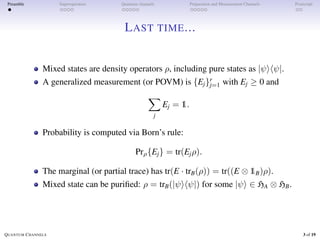
Mixed states are density operators ρ, including pure states as |ψihψ|.
A generalized measurement (or POVM) is {Ej}r
j=1 with Ej ≥ 0 and
X
j
Ej = 1.
Probability is computed via Born’s rule:
Prρ{Ej} = tr(Ejρ).
The marginal (or partial trace) has tr(E · trB(ρ)) = tr((E ⊗ 1B)ρ).
Mixed state can be purified: ρ = trB(|ψihψ|) for some |ψi ∈ HA ⊗ HB.
QUANTUM CHANNELS 3 of 19
Preamble Superoperators Quantum channels Preparation and Measurement Channels Postscript
OUTLINE
1 Superoperators
2 Quantum channels
3 Preparation and Measurement Channels
QUANTUM CHANNELS 4 of 19
Preamble Superoperators Quantum channels Preparation and Measurement Channels Postscript
UNITARY EVOLUTION
Dynamics of a pure state is given by unitary maps U : H → H.
Writing a pure state as a mixed state ρ = |ψihψ| unitary maps act as
|ψihψ| 7→ (U|ψi)(hψ|U†
) = U(|ψihψ|)U†
.
And so on general density matrices, we can define unitary action by
ρ 7→ UρU†
.
This is consistent with writing mixed states as ensembles.
Note this is not an operator on the Hilbert space H,
it is a linear map on the space of operators (or matrices) on H.
Some call these superoperators, but we’ll use the term “channel.”
But are there more general forms of dynamics for mixed states?
QUANTUM CHANNELS 5 of 19
Preamble Superoperators Quantum channels Preparation and Measurement Channels Postscript
EIN ANDERE GEDANKENEXPERIMENT
Alice has a new idea. Now we give her a qubit and she flips two coins:
on HH she just gives us the qubit back,
on HT she applies X and then returns the result,
on TH she applies Y and then returns the result,
on TT she applies Z and then returns the result.
However she does not tell us the result of the coins. What do we get?
If ρ is the state we give Alice, then she returns the state:
ρ0
= 1
4 ρ + 1
4 XρX + 1
4 YρY + 1
4 ZρZ.
(HH) (HT) (TH) (TT)
Okay, what did this actually do to our state?
QUANTUM CHANNELS 6 of 19
Preamble Superoperators Quantum channels Preparation and Measurement Channels Postscript
EIN ANDERE GEDANKENEXPERIMENT
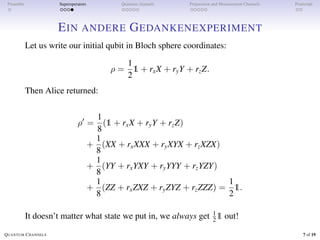
Let us write our initial qubit in Bloch sphere coordinates:
ρ =
1
2
1 + rxX + ryY + rzZ.
Then Alice returned:
ρ0
=
1
8
(1 + rxX + ryY + rzZ)
+
1
8
(XX + rxXXX + ryXYX + rzXZX)
+
1
8
(YY + rxYXY + ryYYY + rzYZY)
+
1
8
(ZZ + rxZXZ + ryZYZ + rzZZZ) =
1
2
1.
It doesn’t matter what state we put in, we always get 1
2 1 out!
QUANTUM CHANNELS 7 of 19
Preamble Superoperators Quantum channels Preparation and Measurement Channels Postscript
OUTLINE
1 Superoperators
2 Quantum channels
3 Preparation and Measurement Channels
QUANTUM CHANNELS 8 of 19
Preamble Superoperators Quantum channels Preparation and Measurement Channels Postscript
QUANTUM CHANNELS
We use the idea “purifying” the dynamics:
Given a mixed state ρ, we add an ancilla ρ ⊗ |ψihψ|.
The “pure” dynamics is unitary: U(ρ ⊗ |ψihψ|)U†
.
Finally we trace out the ancillary space C(ρ) = trB[U(ρ ⊗ |ψihψ|)U†
].
Let {|χji} be a basis of the ancillary space HB.
Define a linear map as follows: for |φi ∈ HA.
Aj|φi = hχj|U(|φi ⊗ |ψi) ∈ HA.
Take the spectral decomposition ρ =
P
µ λµ|φµihφµ|.
Compute:
C(ρ) = trB[U(ρ ⊗ |ψihψ|)U†
] =
X
jµ
λµhχj|U(|φµihφµ| ⊗ |ψihψ|)U†
|χji
=
X
jµ
λµAj|φµihφµ|A†
j =
X
j
AjρA†
j .
QUANTUM CHANNELS 9 of 19
Preamble Superoperators Quantum channels Preparation and Measurement Channels Postscript
QUANTUM CHANNELS
A quantum channel is the analogue of a unitary map for mixed states.
The channel is defined by the “superoperator” C(ρ) =
P
j AjρA†
j ;
this is always positive, but we need
P
j A†
j Aj = 1 to preserve traces.
The Aj are called Kraus, or Kraus-Choi, operators.
Note: quantum channels can map between different Hilbert spaces:
if Aj : H → K then A†
j : K → H; then AjρA†
j is an operator on K.
So C maps densities on H to densities on K.
Note that if dim H 6= dim K then “purifying” the dynamics doesn’t work:
we can’t have unitaries between different dimensional spaces,
however we can still find Kraus operators by a different means.
This is called Stinespring dilation (it’s in the appendix to these notes).
QUANTUM CHANNELS 10 of 19
Preamble Superoperators Quantum channels Preparation and Measurement Channels Postscript
UNITARY FREEDOM OF KRAUS MATRICES
A channel is defined by the formula C(ρ) =
P
j AjρA†
j .
The Kraus operators Aj are not unique!
Recall the motivation: if {|χji} is an orthonormal basis
Aj|φi = hχj|U(|φi ⊗ |ψi).
So the Kraus operators really depend on this basis.
Let (ujk) be the components of an arbitrary unitary matrix.
Define Âj =
P
k ujkAk. Then we have Aj =
P
k u∗
kjÂk.
We compute:
C(ρ) =
X
j
AjρA†
j =
X
jk`
u∗
kju`jÂkρÂ` =
X
k
ÂkρÂk
(Note: for this computation, we really only needed
P
j u∗
kju`j = δkl.)
QUANTUM CHANNELS 11 of 19
Preamble Superoperators Quantum channels Preparation and Measurement Channels Postscript
PROCESS MATRICES
When building devices, we try to explain what happens using channels.
Consider a quantum channel C on densities on H.
Let L(H) be all linear maps on the Hilbert space H.
It has dimension n2
where n = dim H.
Let {Eα}n2
α=1 be a basis for L(H).
Expand any Kraus operator in term of this basis Aj =
P
α cjαEα.
Then every quantum channel also has the form
C(ρ) =
X
j
AjρA†
j =
X
αβ
χαβEαρE†
β
where χαβ =
P
j cjαc∗
jβ is the process matrix of the channel.
One often sees empirically estimates the process matrix to describe the
dynamics of a quantum system. This is called “process tomography.”
QUANTUM CHANNELS 12 of 19
Preamble Superoperators Quantum channels Preparation and Measurement Channels Postscript
OUTLINE
1 Superoperators
2 Quantum channels
3 Preparation and Measurement Channels
QUANTUM CHANNELS 13 of 19
Preamble Superoperators Quantum channels Preparation and Measurement Channels Postscript
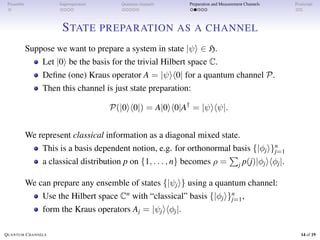
STATE PREPARATION AS A CHANNEL
Suppose we want to prepare a system in state |ψi ∈ H.
Let |0i be the basis for the trivial Hilbert space C.
Define (one) Kraus operator A = |ψih0| for a quantum channel P.
Then this channel is just state preparation:
P(|0ih0|) = A|0ih0|A†
= |ψihψ|.
We represent classical information as a diagonal mixed state.
This is a basis dependent notion, e.g. for orthonormal basis {|φji}n
j=1
a classical distribution p on {1, . . . , n} becomes ρ =
P
j p(j)|φjihφj|.
We can prepare any ensemble of states {|ψji} using a quantum channel:
Use the Hilbert space Cn
with “classical” basis {|φji}n
j=1,
form the Kraus operators Aj = |ψjihφj|.
QUANTUM CHANNELS 14 of 19
Preamble Superoperators Quantum channels Preparation and Measurement Channels Postscript
MEASUREMENT REDUX
State preparation is a quantum channel with classical domain.
So what about a quantum channel with classical range.
I.e. the channel converts quantum states into classical probabilities.
We claim this is great way to view measurements.
Let H be a Hilbert space and {|φji} our measurement basis.
Define a channel M using Kraus operators Πj = |φjihφj|.
Then we compute:
M(ρ) =
X
j
ΠjρΠj =
X
j
|φjihφj|ρ|φjihφj| =
X
j
p(j)|φjihφj|
where p(j) = hφj|ρ|φji = tr(Πjρ).
The channel M encodes what will happen if a measurement is performed.
QUANTUM CHANNELS 15 of 19
Preamble Superoperators Quantum channels Preparation and Measurement Channels Postscript
POVMS AS QUANTUM CHANNELS
This works for any set of vectors {|φji}r
j=1 with
Pr
j=1 |φjihφj| = 1.
Write {|ji}r
j=1 be an orthonormal basis of Cr
.
Define Aj = |jihφj|. Then
Pr
j=1 A†
j Aj =
Pr
j=1 |φjihj|jihφj| = 1.
Therefore G(ρ) =
Pr
j=1 AjρA†
j is a quantum channel.
But as with our previous computation:
G(ρ) =
r
X
j=1
|jihφj|ρ|φjihj| =
r
X
j=1
tr(|φjihφj|ρ) · |jihj|.
So Ej = |φjihφj| is a POVM, and G is its “generalized” measurement.
But what happens when our measurements are not just projectors?
Then some quantum information remains after the measurement.
In other words, the channel is a partial measurement.
QUANTUM CHANNELS 16 of 19
Preamble Superoperators Quantum channels Preparation and Measurement Channels Postscript
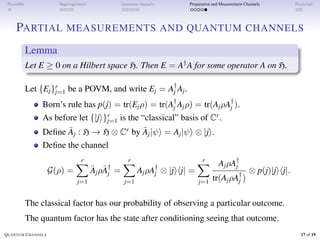
PARTIAL MEASUREMENTS AND QUANTUM CHANNELS
Lemma
Let E ≥ 0 on a Hilbert space H. Then E = A†
A for some operator A on H.
Let {Ej}r
j=1 be a POVM, and write Ej = A†
j Aj.
Born’s rule has p(j) = tr(Ejρ) = tr(A†
j Ajρ) = tr(AjρA†
j ).
As before let {|ji}r
j=1 is the “classical” basis of Cr
.
Define Āj : H → H ⊗ Cr
by Āj|ψi = Aj|ψi ⊗ |ji.
Define the channel
G(ρ) =
r
X
j=1
Ājρ†
j =
r
X
j=1
AjρA†
j ⊗ |jihj| =
r
X
j=1
AjρA†
j
tr(AjρA†
j )
⊗ p(j)|jihj|.
The classical factor has our probability of observing a particular outcome.
The quantum factor has the state after conditioning seeing that outcome.
QUANTUM CHANNELS 17 of 19
Preamble Superoperators Quantum channels Preparation and Measurement Channels Postscript
THE STINESPRING DILATION THEOREM
We defined a quantum channel by purifying. But there is an axiomatic way:
(Convexity) C(
P
j pjρj) =
P
j C(ρj) whenever pj > 0 with
P
j pj = 1.
(Trace-preserving) tr(C(ρ)) = tr(ρ) = 1.
(Completely positive) For all m > 0, we have (C ⊗ 1Cm )(ρ) ≥ 0
whenever ρ ≥ 0 on H ⊗ Cm
.
Theorem (Stinespring)
Let C map densities on H to densities on K be convex, trace-preserving, and
completely positive. Then there exists a linear map V : H → K ⊗ Cr
so that
C(ρ) = trCr (VρV†
).
In general V is not unitary (dimensions don’t match), but this form is enough
to compute Kraus operators and so get a quantum channel.
Note that V, and even r, is not unique. However different Stinespring
dilations are equivalent under “partial isometry” (the analogue of unitary
between different dimensional spaces).
QUANTUM CHANNELS 18 of 19
Preamble Superoperators Quantum channels Preparation and Measurement Channels Postscript
NEXT TIME...
Noise channels and process tomography.
Fidelity.
Trace distance.
QUANTUM CHANNELS 19 of 19

QuantumChannels.pdf

  • 1.
    Preamble Superoperators Quantumchannels Preparation and Measurement Channels Postscript Introduction to quantum information processing Quantum Channels Brad Lackey 1 November 2016 QUANTUM CHANNELS 1 of 19
  • 2.
    Preamble Superoperators Quantumchannels Preparation and Measurement Channels Postscript OUTLINE 1 Superoperators 2 Quantum channels 3 Preparation and Measurement Channels QUANTUM CHANNELS 2 of 19
  • 3.
    Preamble Superoperators Quantumchannels Preparation and Measurement Channels Postscript LAST TIME... Mixed states are density operators ρ, including pure states as |ψihψ|. A generalized measurement (or POVM) is {Ej}r j=1 with Ej ≥ 0 and X j Ej = 1. Probability is computed via Born’s rule: Prρ{Ej} = tr(Ejρ). The marginal (or partial trace) has tr(E · trB(ρ)) = tr((E ⊗ 1B)ρ). Mixed state can be purified: ρ = trB(|ψihψ|) for some |ψi ∈ HA ⊗ HB. QUANTUM CHANNELS 3 of 19
  • 4.
    Preamble Superoperators Quantumchannels Preparation and Measurement Channels Postscript OUTLINE 1 Superoperators 2 Quantum channels 3 Preparation and Measurement Channels QUANTUM CHANNELS 4 of 19
  • 5.
    Preamble Superoperators Quantumchannels Preparation and Measurement Channels Postscript UNITARY EVOLUTION Dynamics of a pure state is given by unitary maps U : H → H. Writing a pure state as a mixed state ρ = |ψihψ| unitary maps act as |ψihψ| 7→ (U|ψi)(hψ|U† ) = U(|ψihψ|)U† . And so on general density matrices, we can define unitary action by ρ 7→ UρU† . This is consistent with writing mixed states as ensembles. Note this is not an operator on the Hilbert space H, it is a linear map on the space of operators (or matrices) on H. Some call these superoperators, but we’ll use the term “channel.” But are there more general forms of dynamics for mixed states? QUANTUM CHANNELS 5 of 19
  • 6.
    Preamble Superoperators Quantumchannels Preparation and Measurement Channels Postscript EIN ANDERE GEDANKENEXPERIMENT Alice has a new idea. Now we give her a qubit and she flips two coins: on HH she just gives us the qubit back, on HT she applies X and then returns the result, on TH she applies Y and then returns the result, on TT she applies Z and then returns the result. However she does not tell us the result of the coins. What do we get? If ρ is the state we give Alice, then she returns the state: ρ0 = 1 4 ρ + 1 4 XρX + 1 4 YρY + 1 4 ZρZ. (HH) (HT) (TH) (TT) Okay, what did this actually do to our state? QUANTUM CHANNELS 6 of 19
  • 7.
    Preamble Superoperators Quantumchannels Preparation and Measurement Channels Postscript EIN ANDERE GEDANKENEXPERIMENT Let us write our initial qubit in Bloch sphere coordinates: ρ = 1 2 1 + rxX + ryY + rzZ. Then Alice returned: ρ0 = 1 8 (1 + rxX + ryY + rzZ) + 1 8 (XX + rxXXX + ryXYX + rzXZX) + 1 8 (YY + rxYXY + ryYYY + rzYZY) + 1 8 (ZZ + rxZXZ + ryZYZ + rzZZZ) = 1 2 1. It doesn’t matter what state we put in, we always get 1 2 1 out! QUANTUM CHANNELS 7 of 19
  • 8.
    Preamble Superoperators Quantumchannels Preparation and Measurement Channels Postscript OUTLINE 1 Superoperators 2 Quantum channels 3 Preparation and Measurement Channels QUANTUM CHANNELS 8 of 19
  • 9.
    Preamble Superoperators Quantumchannels Preparation and Measurement Channels Postscript QUANTUM CHANNELS We use the idea “purifying” the dynamics: Given a mixed state ρ, we add an ancilla ρ ⊗ |ψihψ|. The “pure” dynamics is unitary: U(ρ ⊗ |ψihψ|)U† . Finally we trace out the ancillary space C(ρ) = trB[U(ρ ⊗ |ψihψ|)U† ]. Let {|χji} be a basis of the ancillary space HB. Define a linear map as follows: for |φi ∈ HA. Aj|φi = hχj|U(|φi ⊗ |ψi) ∈ HA. Take the spectral decomposition ρ = P µ λµ|φµihφµ|. Compute: C(ρ) = trB[U(ρ ⊗ |ψihψ|)U† ] = X jµ λµhχj|U(|φµihφµ| ⊗ |ψihψ|)U† |χji = X jµ λµAj|φµihφµ|A† j = X j AjρA† j . QUANTUM CHANNELS 9 of 19
  • 10.
    Preamble Superoperators Quantumchannels Preparation and Measurement Channels Postscript QUANTUM CHANNELS A quantum channel is the analogue of a unitary map for mixed states. The channel is defined by the “superoperator” C(ρ) = P j AjρA† j ; this is always positive, but we need P j A† j Aj = 1 to preserve traces. The Aj are called Kraus, or Kraus-Choi, operators. Note: quantum channels can map between different Hilbert spaces: if Aj : H → K then A† j : K → H; then AjρA† j is an operator on K. So C maps densities on H to densities on K. Note that if dim H 6= dim K then “purifying” the dynamics doesn’t work: we can’t have unitaries between different dimensional spaces, however we can still find Kraus operators by a different means. This is called Stinespring dilation (it’s in the appendix to these notes). QUANTUM CHANNELS 10 of 19
  • 11.
    Preamble Superoperators Quantumchannels Preparation and Measurement Channels Postscript UNITARY FREEDOM OF KRAUS MATRICES A channel is defined by the formula C(ρ) = P j AjρA† j . The Kraus operators Aj are not unique! Recall the motivation: if {|χji} is an orthonormal basis Aj|φi = hχj|U(|φi ⊗ |ψi). So the Kraus operators really depend on this basis. Let (ujk) be the components of an arbitrary unitary matrix. Define Âj = P k ujkAk. Then we have Aj = P k u∗ kjÂk. We compute: C(ρ) = X j AjρA† j = X jk` u∗ kju`jÂkρÂ` = X k ÂkρÂk (Note: for this computation, we really only needed P j u∗ kju`j = δkl.) QUANTUM CHANNELS 11 of 19
  • 12.
    Preamble Superoperators Quantumchannels Preparation and Measurement Channels Postscript PROCESS MATRICES When building devices, we try to explain what happens using channels. Consider a quantum channel C on densities on H. Let L(H) be all linear maps on the Hilbert space H. It has dimension n2 where n = dim H. Let {Eα}n2 α=1 be a basis for L(H). Expand any Kraus operator in term of this basis Aj = P α cjαEα. Then every quantum channel also has the form C(ρ) = X j AjρA† j = X αβ χαβEαρE† β where χαβ = P j cjαc∗ jβ is the process matrix of the channel. One often sees empirically estimates the process matrix to describe the dynamics of a quantum system. This is called “process tomography.” QUANTUM CHANNELS 12 of 19
  • 13.
    Preamble Superoperators Quantumchannels Preparation and Measurement Channels Postscript OUTLINE 1 Superoperators 2 Quantum channels 3 Preparation and Measurement Channels QUANTUM CHANNELS 13 of 19
  • 14.
    Preamble Superoperators Quantumchannels Preparation and Measurement Channels Postscript STATE PREPARATION AS A CHANNEL Suppose we want to prepare a system in state |ψi ∈ H. Let |0i be the basis for the trivial Hilbert space C. Define (one) Kraus operator A = |ψih0| for a quantum channel P. Then this channel is just state preparation: P(|0ih0|) = A|0ih0|A† = |ψihψ|. We represent classical information as a diagonal mixed state. This is a basis dependent notion, e.g. for orthonormal basis {|φji}n j=1 a classical distribution p on {1, . . . , n} becomes ρ = P j p(j)|φjihφj|. We can prepare any ensemble of states {|ψji} using a quantum channel: Use the Hilbert space Cn with “classical” basis {|φji}n j=1, form the Kraus operators Aj = |ψjihφj|. QUANTUM CHANNELS 14 of 19
  • 15.
    Preamble Superoperators Quantumchannels Preparation and Measurement Channels Postscript MEASUREMENT REDUX State preparation is a quantum channel with classical domain. So what about a quantum channel with classical range. I.e. the channel converts quantum states into classical probabilities. We claim this is great way to view measurements. Let H be a Hilbert space and {|φji} our measurement basis. Define a channel M using Kraus operators Πj = |φjihφj|. Then we compute: M(ρ) = X j ΠjρΠj = X j |φjihφj|ρ|φjihφj| = X j p(j)|φjihφj| where p(j) = hφj|ρ|φji = tr(Πjρ). The channel M encodes what will happen if a measurement is performed. QUANTUM CHANNELS 15 of 19
  • 16.
    Preamble Superoperators Quantumchannels Preparation and Measurement Channels Postscript POVMS AS QUANTUM CHANNELS This works for any set of vectors {|φji}r j=1 with Pr j=1 |φjihφj| = 1. Write {|ji}r j=1 be an orthonormal basis of Cr . Define Aj = |jihφj|. Then Pr j=1 A† j Aj = Pr j=1 |φjihj|jihφj| = 1. Therefore G(ρ) = Pr j=1 AjρA† j is a quantum channel. But as with our previous computation: G(ρ) = r X j=1 |jihφj|ρ|φjihj| = r X j=1 tr(|φjihφj|ρ) · |jihj|. So Ej = |φjihφj| is a POVM, and G is its “generalized” measurement. But what happens when our measurements are not just projectors? Then some quantum information remains after the measurement. In other words, the channel is a partial measurement. QUANTUM CHANNELS 16 of 19
  • 17.
    Preamble Superoperators Quantumchannels Preparation and Measurement Channels Postscript PARTIAL MEASUREMENTS AND QUANTUM CHANNELS Lemma Let E ≥ 0 on a Hilbert space H. Then E = A† A for some operator A on H. Let {Ej}r j=1 be a POVM, and write Ej = A† j Aj. Born’s rule has p(j) = tr(Ejρ) = tr(A† j Ajρ) = tr(AjρA† j ). As before let {|ji}r j=1 is the “classical” basis of Cr . Define Āj : H → H ⊗ Cr by Āj|ψi = Aj|ψi ⊗ |ji. Define the channel G(ρ) = r X j=1 Ājρ† j = r X j=1 AjρA† j ⊗ |jihj| = r X j=1 AjρA† j tr(AjρA† j ) ⊗ p(j)|jihj|. The classical factor has our probability of observing a particular outcome. The quantum factor has the state after conditioning seeing that outcome. QUANTUM CHANNELS 17 of 19
  • 18.
    Preamble Superoperators Quantumchannels Preparation and Measurement Channels Postscript THE STINESPRING DILATION THEOREM We defined a quantum channel by purifying. But there is an axiomatic way: (Convexity) C( P j pjρj) = P j C(ρj) whenever pj > 0 with P j pj = 1. (Trace-preserving) tr(C(ρ)) = tr(ρ) = 1. (Completely positive) For all m > 0, we have (C ⊗ 1Cm )(ρ) ≥ 0 whenever ρ ≥ 0 on H ⊗ Cm . Theorem (Stinespring) Let C map densities on H to densities on K be convex, trace-preserving, and completely positive. Then there exists a linear map V : H → K ⊗ Cr so that C(ρ) = trCr (VρV† ). In general V is not unitary (dimensions don’t match), but this form is enough to compute Kraus operators and so get a quantum channel. Note that V, and even r, is not unique. However different Stinespring dilations are equivalent under “partial isometry” (the analogue of unitary between different dimensional spaces). QUANTUM CHANNELS 18 of 19
  • 19.
    Preamble Superoperators Quantumchannels Preparation and Measurement Channels Postscript NEXT TIME... Noise channels and process tomography. Fidelity. Trace distance. QUANTUM CHANNELS 19 of 19