+
Topic 5
Approaches in Quantitative Research
Prepared by
Dr.Yasmin Sultana-Muchindu
+
Overview
 Research Methodology
 Research designs
 Qualitative research design
 Quantitative research design
 Mixed research design
Prepared by Dr. Yasmin Muchindu
+What is Research Methodology?
 A research methodology encompasses the way in
which you intend to carry out your research.This
includes how you plan to tackle things like collection
methods, statistical analysis, participant observations,
and more.
 You can think of your research methodology as being a
formula. One part will be how you plan on putting your
research into practice and another will be why you feel
this is the best way to approach it.Your research
methodology is ultimately a methodological and
systematic plan to resolve your research problem.
Prepared by Dr. Yasmin Muchindu
+Why do you need a research methodology?
 The purpose of a research methodology is to explain the
reasoning behind your approach to your research - you'll
need to support your collection methods, methods of
analysis, and other key points of your work.
 Think of it like writing a plan or an outline for you what you
intend to do.
 When carrying out research, it can be easy to go off-track or
depart from your standard methodology.
 Having a methodology keeps you accountable and on
track with your original aims and objectives, and gives you a
suitable and sound plan to keep your research project
manageable, smooth, and effective.
Prepared by Dr. Yasmin Muchindu
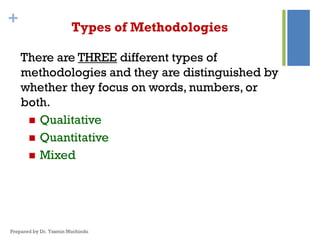
+ Types of Methodologies
There are THREE different types of
methodologies and they are distinguished by
whether they focus on words, numbers, or
both.
 Qualitative
 Quantitative
 Mixed
Prepared by Dr. Yasmin Muchindu
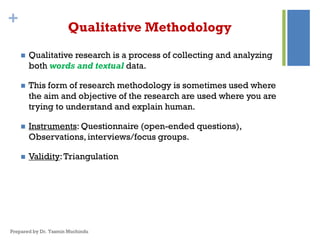
+ Qualitative Methodology
 Qualitative research is a process of collecting and analyzing
both words and textual data.
 This form of research methodology is sometimes used where
the aim and objective of the research are used where you are
trying to understand and explain human.
 Instruments: Questionnaire (open-ended questions),
Observations, interviews/focus groups.
 Validity:Triangulation
Prepared by Dr. Yasmin Muchindu
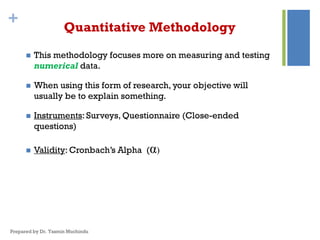
+ Quantitative Methodology
 This methodology focuses more on measuring and testing
numerical data.
 When using this form of research, your objective will
usually be to explain something.
 Instruments: Surveys, Questionnaire (Close-ended
questions)
 Validity: Cronbach’s Alpha (α)
Prepared by Dr. Yasmin Muchindu
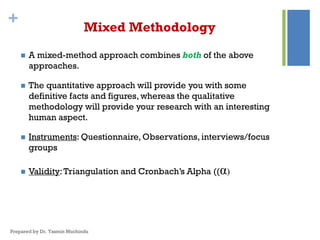
+ Mixed Methodology
 A mixed-method approach combines both of the above
approaches.
 The quantitative approach will provide you with some
definitive facts and figures, whereas the qualitative
methodology will provide your research with an interesting
human aspect.
 Instruments: Questionnaire, Observations,interviews/focus
groups
 Validity:Triangulation and Cronbach’s Alpha ((α)
Prepared by Dr. Yasmin Muchindu
+ What is Research Design?
 Fred N Kerlinger (2018) : Research design is the
plan, structure of investigation conceived so as to
obtain answers to research questions and to
control variance.
 Bernard Philips (2016): Research design is a blue
print for the collection, measurement and analysis
of data.”
Prepared by Dr. Yasmin Muchindu
+ Types of Qualitative Research Designs:
 Phenomenological Studies
 Ethnographic Studies
 Grounded Theory Studies
 Historical Studies
 Case Studies
Prepared by Dr. Yasmin Muchindu
+
 Descriptive,
 Correlational,
 Causal-Comparative/Quasi-Experimental, and
 Experimental
Prepared by Dr. Yasmin Muchindu
Types of Qualitative Research Designs:
+ Descriptive research design
 Descriptive research seeks to describe the current status
of an identified variable.
 These research projects are designed to provide
systematic information about a phenomenon.
 The analysis and synthesis of the data provide the test of
the hypothesis.
 Systematic collection of information requires careful
selection of the units studied and careful measurement of
each variable.
Prepared by Dr. Yasmin Muchindu
+
Examples of Descriptive Research:
 A description of trends and patterns of regional
development
 A description of the factors of growing mental
health issues among employees in service based
industries
 A description of the impact of digitalization on tax
transparency
Prepared by Dr. Yasmin Muchindu
+ Correlational Research
 Correlational research attempts to determine the extent of a relationship
between two or more variables using statistical data.
 In this type of design, relationships between and among a number of facts are
sought and interpreted.
 This type of research will recognize trends and patterns in data, but it does not
go so far in its analysis to prove causes for these observed patterns.
 Cause and effect is not the basis of this type of observational research.The data,
relationships, and distributions of variables are studied only.Variables are not
manipulated; they are only identified and are studied as they occur in a natural
setting.
*Sometimes correlational research is considered a type of descriptive research,
and not as its own type of research, as no variables are manipulated in the study.
Prepared by Dr. Yasmin Muchindu
+
Examples of Correlational Research:
 The relationship between emotional
intelligence and job performance
 The relationship between diet and anxiety
 The relationship between OCB and job
performance
 The covariance of FOREX and construction
cost
Prepared by Dr. Yasmin Muchindu
+ Causal-comparative/ Quasi- experimental
research
 Causal-comparative/quasi- experimental research
attempts to establish cause- effect relationships among the
variables.
 These types of design are very similar to true experiments,
but with some key differences.
 An independent variable is identified but not manipulated by
the experimenter, and effects of the independent variable on
the dependent variable are measured.
 The researcher does not randomly assign groups and must
use ones that are naturally formed or pre-existing groups.
Identified control groups exposed to the treatment variable
are studied and compared to groups who are not.
Prepared by Dr. Yasmin Muchindu
+
Examples of Causal-comparative/quasi- experimental
research:
 The effect of corporate social responsibility on
sustainable development
 The effect of performance evaluation on workers
productivity
 The effect of Emotional intelligence of project
managers on project outcomes
Prepared by Dr. Yasmin Muchindu
+ Experimental Research
 Experimental research, often called true experimentation,
uses the scientific method to establish the cause-effect
relationship among a group of variables that make up a
study.
 An independent variable is manipulated to determine the
effects on the dependent variables.
 Subjects are randomly assigned to experimental
treatments rather than identified in naturally occurring
groups.
Prepared by Dr. Yasmin Muchindu
+
Examples of Experimental Research:
 The effect of employee engagement on
customer loyalty in service based industry
 The effect of employee involvement in
decision making on employee productivity
 The effect of Supervision on project
completion
Prepared by Dr. Yasmin Muchindu
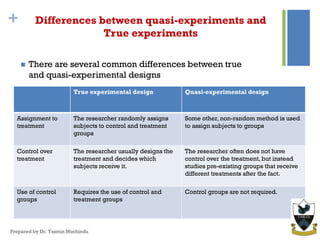
+ Differences between quasi-experiments and
True experiments
 There are several common differences between true
and quasi-experimental designs
True experimental design Quasi-experimental design
Assignment to
treatment
The researcher randomly assigns
subjects to control and treatment
groups
Some other, non-random method is used
to assign subjects to groups
Control over
treatment
The researcher usually designs the
treatment and decides which
subjects receive it.
The researcher often does not have
control over the treatment, but instead
studies pre-existing groups that receive
different treatments after the fact.
Use of control
groups
Requires the use of control and
treatment groups
Control groups are not required.
Prepared by Dr. Yasmin Muchindu
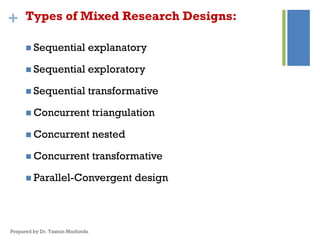
+ Types of Mixed Research Designs:
 Sequential explanatory
 Sequential exploratory
 Sequential transformative
 Concurrent triangulation
 Concurrent nested
 Concurrent transformative
 Parallel-Convergent design
Prepared by Dr. Yasmin Muchindu
+
End of the Topic
Prepared by Dr. Yasmin Muchindu

QUANTITATIVE RESEARCH -LEC 5.pdf

  • 1.
    + Topic 5 Approaches inQuantitative Research Prepared by Dr.Yasmin Sultana-Muchindu
  • 2.
    + Overview  Research Methodology Research designs  Qualitative research design  Quantitative research design  Mixed research design Prepared by Dr. Yasmin Muchindu
  • 4.
    +What is ResearchMethodology?  A research methodology encompasses the way in which you intend to carry out your research.This includes how you plan to tackle things like collection methods, statistical analysis, participant observations, and more.  You can think of your research methodology as being a formula. One part will be how you plan on putting your research into practice and another will be why you feel this is the best way to approach it.Your research methodology is ultimately a methodological and systematic plan to resolve your research problem. Prepared by Dr. Yasmin Muchindu
  • 5.
    +Why do youneed a research methodology?  The purpose of a research methodology is to explain the reasoning behind your approach to your research - you'll need to support your collection methods, methods of analysis, and other key points of your work.  Think of it like writing a plan or an outline for you what you intend to do.  When carrying out research, it can be easy to go off-track or depart from your standard methodology.  Having a methodology keeps you accountable and on track with your original aims and objectives, and gives you a suitable and sound plan to keep your research project manageable, smooth, and effective. Prepared by Dr. Yasmin Muchindu
  • 6.
    + Types ofMethodologies There are THREE different types of methodologies and they are distinguished by whether they focus on words, numbers, or both.  Qualitative  Quantitative  Mixed Prepared by Dr. Yasmin Muchindu
  • 7.
    + Qualitative Methodology Qualitative research is a process of collecting and analyzing both words and textual data.  This form of research methodology is sometimes used where the aim and objective of the research are used where you are trying to understand and explain human.  Instruments: Questionnaire (open-ended questions), Observations, interviews/focus groups.  Validity:Triangulation Prepared by Dr. Yasmin Muchindu
  • 8.
    + Quantitative Methodology This methodology focuses more on measuring and testing numerical data.  When using this form of research, your objective will usually be to explain something.  Instruments: Surveys, Questionnaire (Close-ended questions)  Validity: Cronbach’s Alpha (α) Prepared by Dr. Yasmin Muchindu
  • 9.
    + Mixed Methodology A mixed-method approach combines both of the above approaches.  The quantitative approach will provide you with some definitive facts and figures, whereas the qualitative methodology will provide your research with an interesting human aspect.  Instruments: Questionnaire, Observations,interviews/focus groups  Validity:Triangulation and Cronbach’s Alpha ((α) Prepared by Dr. Yasmin Muchindu
  • 10.
    + What isResearch Design?  Fred N Kerlinger (2018) : Research design is the plan, structure of investigation conceived so as to obtain answers to research questions and to control variance.  Bernard Philips (2016): Research design is a blue print for the collection, measurement and analysis of data.” Prepared by Dr. Yasmin Muchindu
  • 11.
    + Types ofQualitative Research Designs:  Phenomenological Studies  Ethnographic Studies  Grounded Theory Studies  Historical Studies  Case Studies Prepared by Dr. Yasmin Muchindu
  • 12.
    +  Descriptive,  Correlational, Causal-Comparative/Quasi-Experimental, and  Experimental Prepared by Dr. Yasmin Muchindu Types of Qualitative Research Designs:
  • 13.
    + Descriptive researchdesign  Descriptive research seeks to describe the current status of an identified variable.  These research projects are designed to provide systematic information about a phenomenon.  The analysis and synthesis of the data provide the test of the hypothesis.  Systematic collection of information requires careful selection of the units studied and careful measurement of each variable. Prepared by Dr. Yasmin Muchindu
  • 14.
    + Examples of DescriptiveResearch:  A description of trends and patterns of regional development  A description of the factors of growing mental health issues among employees in service based industries  A description of the impact of digitalization on tax transparency Prepared by Dr. Yasmin Muchindu
  • 15.
    + Correlational Research Correlational research attempts to determine the extent of a relationship between two or more variables using statistical data.  In this type of design, relationships between and among a number of facts are sought and interpreted.  This type of research will recognize trends and patterns in data, but it does not go so far in its analysis to prove causes for these observed patterns.  Cause and effect is not the basis of this type of observational research.The data, relationships, and distributions of variables are studied only.Variables are not manipulated; they are only identified and are studied as they occur in a natural setting. *Sometimes correlational research is considered a type of descriptive research, and not as its own type of research, as no variables are manipulated in the study. Prepared by Dr. Yasmin Muchindu
  • 16.
    + Examples of CorrelationalResearch:  The relationship between emotional intelligence and job performance  The relationship between diet and anxiety  The relationship between OCB and job performance  The covariance of FOREX and construction cost Prepared by Dr. Yasmin Muchindu
  • 17.
    + Causal-comparative/ Quasi-experimental research  Causal-comparative/quasi- experimental research attempts to establish cause- effect relationships among the variables.  These types of design are very similar to true experiments, but with some key differences.  An independent variable is identified but not manipulated by the experimenter, and effects of the independent variable on the dependent variable are measured.  The researcher does not randomly assign groups and must use ones that are naturally formed or pre-existing groups. Identified control groups exposed to the treatment variable are studied and compared to groups who are not. Prepared by Dr. Yasmin Muchindu
  • 18.
    + Examples of Causal-comparative/quasi-experimental research:  The effect of corporate social responsibility on sustainable development  The effect of performance evaluation on workers productivity  The effect of Emotional intelligence of project managers on project outcomes Prepared by Dr. Yasmin Muchindu
  • 19.
    + Experimental Research Experimental research, often called true experimentation, uses the scientific method to establish the cause-effect relationship among a group of variables that make up a study.  An independent variable is manipulated to determine the effects on the dependent variables.  Subjects are randomly assigned to experimental treatments rather than identified in naturally occurring groups. Prepared by Dr. Yasmin Muchindu
  • 20.
    + Examples of ExperimentalResearch:  The effect of employee engagement on customer loyalty in service based industry  The effect of employee involvement in decision making on employee productivity  The effect of Supervision on project completion Prepared by Dr. Yasmin Muchindu
  • 21.
    + Differences betweenquasi-experiments and True experiments  There are several common differences between true and quasi-experimental designs True experimental design Quasi-experimental design Assignment to treatment The researcher randomly assigns subjects to control and treatment groups Some other, non-random method is used to assign subjects to groups Control over treatment The researcher usually designs the treatment and decides which subjects receive it. The researcher often does not have control over the treatment, but instead studies pre-existing groups that receive different treatments after the fact. Use of control groups Requires the use of control and treatment groups Control groups are not required. Prepared by Dr. Yasmin Muchindu
  • 22.
    + Types ofMixed Research Designs:  Sequential explanatory  Sequential exploratory  Sequential transformative  Concurrent triangulation  Concurrent nested  Concurrent transformative  Parallel-Convergent design Prepared by Dr. Yasmin Muchindu
  • 23.
    + End of theTopic Prepared by Dr. Yasmin Muchindu