2nd QUARTER:
QUADRILATERALS
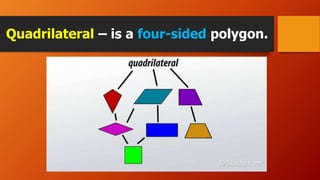
Quadrilateral – is a four-sided polygon.
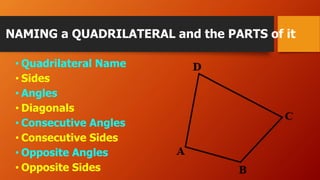
NAMING a QUADRILATERAL and the PARTS of it
‱ Quadrilateral Name
‱ Sides
‱ Angles
‱ Diagonals
‱ Consecutive Angles
‱ Consecutive Sides
‱ Opposite Angles
‱ Opposite Sides
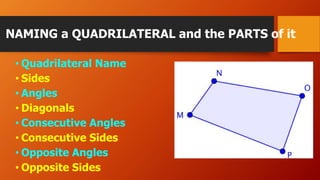
NAMING a QUADRILATERAL and the PARTS of it
‱ Quadrilateral Name
‱ Sides
‱ Angles
‱ Diagonals
‱ Consecutive Angles
‱ Consecutive Sides
‱ Opposite Angles
‱ Opposite Sides
QUADRILATERALS : FAMILY TREE
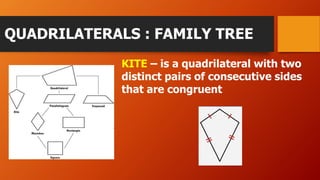
KITE – is a quadrilateral with two
distinct pairs of consecutive sides
that are congruent
QUADRILATERALS : FAMILY TREE
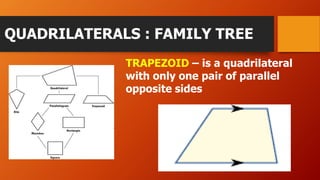
TRAPEZOID – is a quadrilateral
with only one pair of parallel
opposite sides
QUADRILATERALS : FAMILY TREE
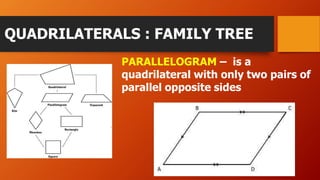
PARALLELOGRAM – is a
quadrilateral with only two pairs of
parallel opposite sides
QUADRILATERALS : FAMILY TREE
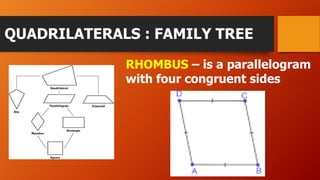
RHOMBUS – is a parallelogram
with four congruent sides
QUADRILATERALS : FAMILY TREE
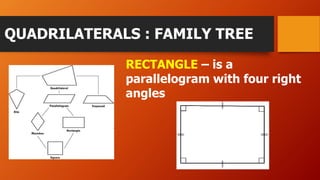
RECTANGLE – is a
parallelogram with four right
angles
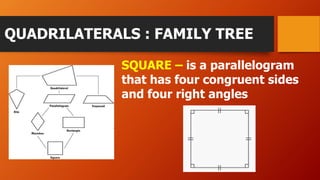
QUADRILATERALS : FAMILY TREE
SQUARE – is a parallelogram
that has four congruent sides
and four right angles
QUADRILATERALS : FAMILY TREE
1. A rectangle is a parallelogram.
2. A square is a rhombus.
3. A square is a parallelogram.
4. A square is a quadrilateral.
5. A rhombus is a square.
6. A rectangle is a square.
7. A trapezoid is a quadrilateral.
8. A kite is a trapezoid.
9. A square is a rectangle.
10. A trapezoid is a parallelogram.
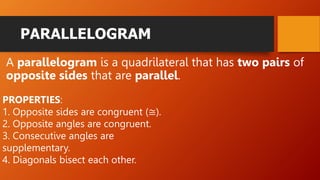
PARALLELOGRAM
A parallelogram is a quadrilateral that has two pairs of
opposite sides that are parallel.
PROPERTIES:
1. Opposite sides are congruent (≅).
2. Opposite angles are congruent.
3. Consecutive angles are
supplementary.
4. Diagonals bisect each other.
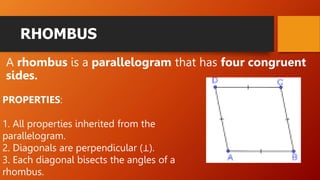
RHOMBUS
A rhombus is a parallelogram that has four congruent
sides.
PROPERTIES:
1. All properties inherited from the
parallelogram.
2. Diagonals are perpendicular (⊄).
3. Each diagonal bisects the angles of a
rhombus.
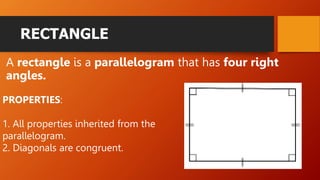
RECTANGLE
A rectangle is a parallelogram that has four right
angles.
PROPERTIES:
1. All properties inherited from the
parallelogram.
2. Diagonals are congruent.
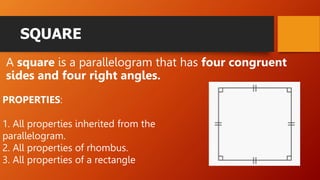
SQUARE
A square is a parallelogram that has four congruent
sides and four right angles.
PROPERTIES:
1. All properties inherited from the
parallelogram.
2. All properties of rhombus.
3. All properties of a rectangle
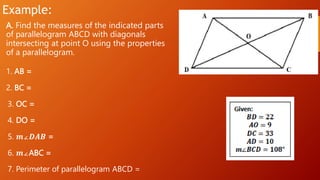
Example:
A. Find the measures of the indicated parts
of parallelogram ABCD with diagonals
intersecting at point O using the properties
of a parallelogram.
1. AB =
2. BC =
3. OC =
4. DO =
5. đ’Žâˆ đ‘«đ‘šđ‘© =
6. 𝒎∠ABC =
7. Perimeter of parallelogram ABCD =

Q2M1-4.pptx

  • 1.
  • 2.
    Quadrilateral – isa four-sided polygon.
  • 3.
    NAMING a QUADRILATERALand the PARTS of it ‱ Quadrilateral Name ‱ Sides ‱ Angles ‱ Diagonals ‱ Consecutive Angles ‱ Consecutive Sides ‱ Opposite Angles ‱ Opposite Sides
  • 4.
    NAMING a QUADRILATERALand the PARTS of it ‱ Quadrilateral Name ‱ Sides ‱ Angles ‱ Diagonals ‱ Consecutive Angles ‱ Consecutive Sides ‱ Opposite Angles ‱ Opposite Sides
  • 5.
  • 6.
    QUADRILATERALS : FAMILYTREE KITE – is a quadrilateral with two distinct pairs of consecutive sides that are congruent
  • 7.
    QUADRILATERALS : FAMILYTREE TRAPEZOID – is a quadrilateral with only one pair of parallel opposite sides
  • 8.
    QUADRILATERALS : FAMILYTREE PARALLELOGRAM – is a quadrilateral with only two pairs of parallel opposite sides
  • 9.
    QUADRILATERALS : FAMILYTREE RHOMBUS – is a parallelogram with four congruent sides
  • 10.
    QUADRILATERALS : FAMILYTREE RECTANGLE – is a parallelogram with four right angles
  • 11.
    QUADRILATERALS : FAMILYTREE SQUARE – is a parallelogram that has four congruent sides and four right angles
  • 12.
    QUADRILATERALS : FAMILYTREE 1. A rectangle is a parallelogram. 2. A square is a rhombus. 3. A square is a parallelogram. 4. A square is a quadrilateral. 5. A rhombus is a square. 6. A rectangle is a square. 7. A trapezoid is a quadrilateral. 8. A kite is a trapezoid. 9. A square is a rectangle. 10. A trapezoid is a parallelogram.
  • 13.
    PARALLELOGRAM A parallelogram isa quadrilateral that has two pairs of opposite sides that are parallel. PROPERTIES: 1. Opposite sides are congruent (≅). 2. Opposite angles are congruent. 3. Consecutive angles are supplementary. 4. Diagonals bisect each other.
  • 14.
    RHOMBUS A rhombus isa parallelogram that has four congruent sides. PROPERTIES: 1. All properties inherited from the parallelogram. 2. Diagonals are perpendicular (⊄). 3. Each diagonal bisects the angles of a rhombus.
  • 15.
    RECTANGLE A rectangle isa parallelogram that has four right angles. PROPERTIES: 1. All properties inherited from the parallelogram. 2. Diagonals are congruent.
  • 16.
    SQUARE A square isa parallelogram that has four congruent sides and four right angles. PROPERTIES: 1. All properties inherited from the parallelogram. 2. All properties of rhombus. 3. All properties of a rectangle
  • 17.
    Example: A. Find themeasures of the indicated parts of parallelogram ABCD with diagonals intersecting at point O using the properties of a parallelogram. 1. AB = 2. BC = 3. OC = 4. DO = 5. đ’Žâˆ đ‘«đ‘šđ‘© = 6. 𝒎∠ABC = 7. Perimeter of parallelogram ABCD =

Editor's Notes

  • #4 SIDES: ABCD is a quadrilateral with four sides namely đ‘šđ‘©Ì…Ì…Ì…Ì…, đ‘©đ‘Ș̅̅̅̅, đ‘Șđ‘«Ì…Ì…Ì…Ì… and đ‘«đ‘šÌ…Ì…Ì…Ì…. It has four vertices A, B, C and D. In naming a quadrilateral you may start at any vertex and move with the next vertex clockwise or counterclockwise. ANGLES: The angle between two adjacent sides is an angle of the quadrilateral. So, a quadrilateral has four angles that is, ∠DAB or ∠A, ∠ABC or ∠B, ∠BCD or ∠C and ∠CDA and ∠D. Note: You may name an angle using a single letter/vertex if one angle shares that vertex. A line segment joining a pair of opposite vertices is called a diagonal. So, there are two diagonals namely 𝑹đ‘Ș̅̅̅̅ and đ‘©đ‘«Ì…Ì…Ì…Ì…Ì….
  • #5 QUADRILATERAL NAME MNOP, NOPM, OPMN, PMNO, MPON, NMPO, ONMP, PONM SIDES đ‘Žđ‘”Ì…Ì…Ì…Ì…Ì…, đ‘”đ‘¶Ì…Ì…Ì…Ì…Ì…, đ‘Žđ‘·Ì…Ì…Ì…Ì…Ì…, đ‘·đ‘¶Ì…Ì…Ì… ANGLES ∠𝑮, âˆ đ‘”, âˆ đ‘¶, âˆ đ‘· DIAGONALS đ‘Žđ‘¶Ì…Ì…Ì…Ì…Ì…, đ‘”đ‘·Ì…Ì…Ì…Ì…Ì… Pairs of Consecutive Sides đ‘Žđ‘”Ì…Ì…Ì…Ì…Ì… and đ‘”đ‘¶Ì…Ì…Ì…Ì…Ì… đ‘”đ‘¶Ì…Ì…Ì…Ì…Ì… and đ‘·đ‘¶Ì…Ì…Ì…Ì… đ‘·đ‘¶Ì…Ì…Ì…Ì… and đ‘Žđ‘·Ì…Ì…Ì…Ì…Ì… đ‘Žđ‘·Ì…Ì…Ì…Ì…Ì… and đ‘Žđ‘”Ì…Ì…Ì…Ì…Ì… Pairs of Opposite Sides đ‘Žđ‘”Ì…Ì…Ì…Ì…Ì… and đ‘·đ‘¶Ì…Ì…Ì…Ì… đ‘”đ‘¶Ì…Ì…Ì…Ì…Ì… and đ‘Žđ‘·Ì…Ì…Ì…Ì… Pairs of Consecutive Angles ∠𝑮 and âˆ đ‘” âˆ đ‘” and âˆ đ‘¶ âˆ đ‘¶ and âˆ đ‘· âˆ đ‘· and ∠𝑮 Pairs of Opposite Angles ∠𝑮 and âˆ đ‘¶ âˆ đ‘” and âˆ đ‘·
  • #18 1. đ‘šđ‘©=? Answer: đ‘šđ‘©=𝟑𝟑, opposite sides are of a parallelogram are congruent, đ‘šđ‘©Ì…Ì…Ì…Ì… is the opposite side of đ‘«đ‘Ș̅̅̅̅. 2. đ‘©đ‘Ș=? Answer: đ‘šđ‘©=𝟏𝟎, opposite sides are of a parallelogram are congruent, đ‘©đ‘Ș̅̅̅̅ is the opposite side of đ‘šđ‘«Ì…Ì…Ì…Ì…. 3. đ‘¶đ‘Ș=? Answer: đ‘¶đ‘Ș=𝟗, diagonals of a parallelogram bisect each other, đ‘šđ‘¶Ì…Ì…Ì…Ì…â‰…đ‘¶đ‘Ș̅̅̅̅. 4. đ‘«đ‘¶=? Answer: đ‘«đ‘¶=𝟏𝟏, diagonals of a parallelogram bisect each other, đ‘«đ‘¶ is half the measurement of đ‘©đ‘«. 5. đ’Žâˆ đ‘«đ‘šđ‘©=? Answer: đ’Žâˆ đ‘«đ‘šđ‘©=𝟏𝟎𝟖°, opposite angles are congruent, âˆ đ‘©đ‘Șđ‘«â‰…âˆ đ‘«đ‘šđ‘©. 6. đ’Žâˆ đ‘šđ‘©đ‘Ș=? Answer: đ’Žâˆ đ‘šđ‘©đ‘Ș=𝟕𝟐°, consecutive angles are supplementary, the sum of đ’Žâˆ đ‘©đ‘Șđ‘« and đ’Žâˆ đ‘šđ‘©đ‘Ș is 𝟏𝟖𝟎°. 7. Perimeter of parallelogram ABCD = ? Answer: Perimeter of parallelogram ABCD =𝟔𝟒, perimeter is the sum of all sides, 32+10+32+10=64.