SCIENCE 7
second QUARTER- lc 7.3
Matatag curriculum
Lesson 3:
Comparing Sexual from
Asexual Reproduction
Comparing Sexual from Asexual
Reproduction
CONTENT
Fertilization occurs when
a male reproductive cell
fuses with a female
reproductive cell.
LEARNING
STANDARD
Explain that genetic information is
passed on to offspring from both
parents by
the process of meiosis and fertilization;
LEARNING
COMPETENCY
By the end of the lesson, the 80 percent of
the learners will be able to:
1. Compare asexual and sexual reproductions.
2. Classify organisms according to the type of reproduction
they exhibit.
3. Appreciate the asexual and sexual reproductions by
using Venn diagram.
OBJECTIVES
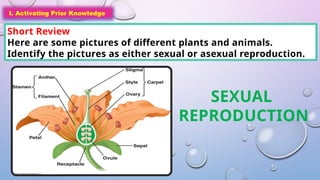
I. Activating Prior Knowledge
Short Review
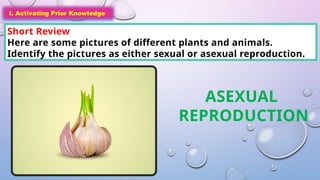
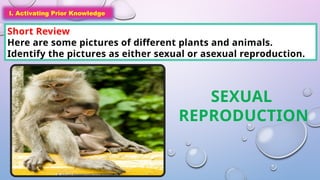
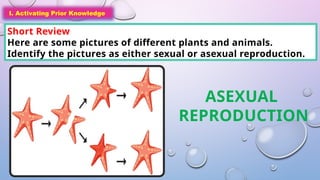
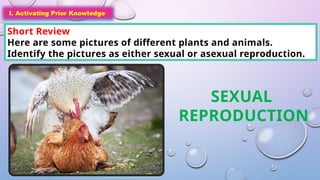
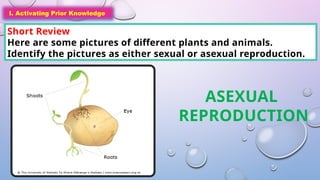
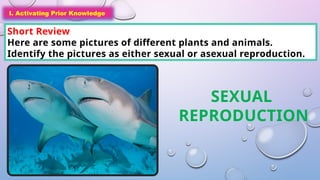
Here are some pictures of different plants and animals.
Identify the pictures as either sexual or asexual reproduction.
I. Activating Prior Knowledge
SEXUAL
REPRODUCTION
I. Activating Prior Knowledge
Short Review
Here are some pictures of different plants and animals.
Identify the pictures as either sexual or asexual reproduction.
I. Activating Prior Knowledge
ASEXUAL
REPRODUCTION
I. Activating Prior Knowledge
Short Review
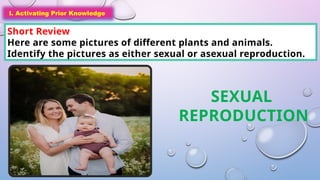
Here are some pictures of different plants and animals.
Identify the pictures as either sexual or asexual reproduction.
I. Activating Prior Knowledge
SEXUAL
REPRODUCTION
I. Activating Prior Knowledge
Short Review
Here are some pictures of different plants and animals.
Identify the pictures as either sexual or asexual reproduction.
I. Activating Prior Knowledge
ASEXUAL
REPRODUCTION
I. Activating Prior Knowledge
Short Review
Here are some pictures of different plants and animals.
Identify the pictures as either sexual or asexual reproduction.
I. Activating Prior Knowledge
SEXUAL
REPRODUCTION
I. Activating Prior Knowledge
Short Review
Here are some pictures of different plants and animals.
Identify the pictures as either sexual or asexual reproduction.
I. Activating Prior Knowledge
ASEXUAL
REPRODUCTION
I. Activating Prior Knowledge
Short Review
Here are some pictures of different plants and animals.
Identify the pictures as either sexual or asexual reproduction.
I. Activating Prior Knowledge
SEXUAL
REPRODUCTION
I. Activating Prior Knowledge
Short Review
Here are some pictures of different plants and animals.
Identify the pictures as either sexual or asexual reproduction.
I. Activating Prior Knowledge
SEXUAL
REPRODUCTION
1. Compare asexual and sexual reproductions.
2. Classify organisms according to the type of
reproduction they exhibit.
3. Appreciate the asexual and sexual reproductions by
using Venn diagram.
B. Establishing Purpose of the Lesson
1. LESSON PURPOSE
B. Establishing Purpose of the Lesson
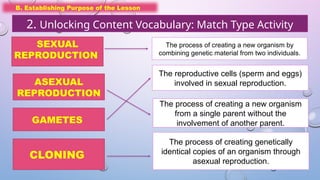
2. Unlocking Content Vocabulary: Match Type Activity
ASEXUAL
REPRODUCTION
GAMETES
CLONING
The process of creating a new organism
from a single parent without the
involvement of another parent.
The reproductive cells (sperm and eggs)
involved in sexual reproduction.
The process of creating genetically
identical copies of an organism through
asexual reproduction.
SEXUAL
REPRODUCTION
The process of creating a new organism by
combining genetic material from two individuals.
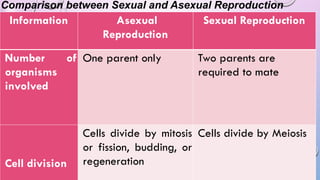
Information Asexual
Reproduction
Sexual Reproduction
Number of
organisms
involved
One parent only Two parents are
required to mate
Cell division
Cells divide by mitosis
or fission, budding, or
regeneration
Cells divide by Meiosis
Comparison between Sexual and Asexual Reproduction
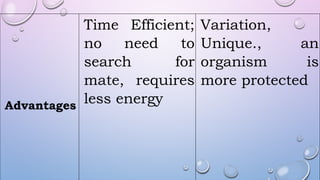
Advantages
Time Efficient;
no need to
search for
mate, requires
less energy
Variation,
Unique., an
organism is
more protected
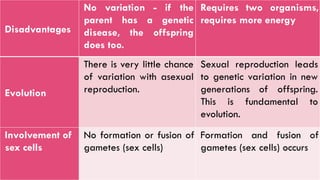
Disadvantages
No variation - if the
parent has a genetic
disease, the offspring
does too.
Requires two organisms,
requires more energy
Evolution
There is very little chance
of variation with asexual
reproduction.
Sexual reproduction leads
to genetic variation in new
generations of offspring.
This is fundamental to
evolution.
Involvement of
sex cells
No formation or fusion of
gametes (sex cells)
Formation and fusion of
gametes (sex cells) occurs
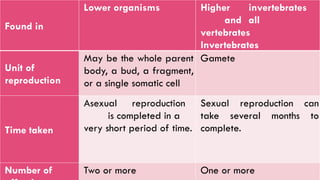
Found in
Lower organisms Higher invertebrates
and all
vertebrates
Invertebrates
Unit of
reproduction
May be the whole parent
body, a bud, a fragment,
or a single somatic cell
Gamete
Time taken
Asexual reproduction
is completed in a
very short period of time.
Sexual reproduction can
take several months to
complete.
Number of Two or more One or more
C. Developing and Deepening Understanding
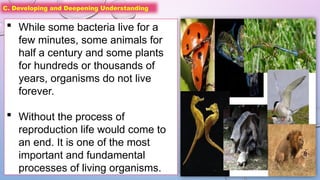
ď‚§ While some bacteria live for a
few minutes, some animals for
half a century and some plants
for hundreds or thousands of
years, organisms do not live
forever.
ď‚§ Without the process of
reproduction life would come to
an end. It is one of the most
important and fundamental
processes of living organisms.
C. Developing and Deepening Understanding
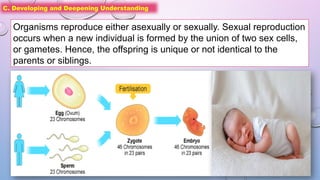
Organisms reproduce either asexually or sexually. Sexual reproduction
occurs when a new individual is formed by the union of two sex cells,
or gametes. Hence, the offspring is unique or not identical to the
parents or siblings.
C. Developing and Deepening Understanding
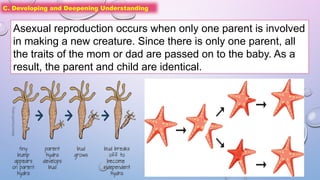
Asexual reproduction occurs when only one parent is involved
in making a new creature. Since there is only one parent, all
the traits of the mom or dad are passed on to the baby. As a
result, the parent and child are identical.
C. Developing and Deepening Understanding
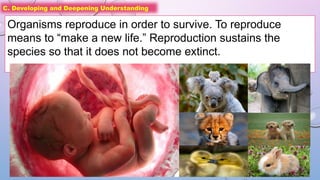
Organisms reproduce in order to survive. To reproduce
means to “make a new life.” Reproduction sustains the
species so that it does not become extinct.
C. Developing and Deepening Understanding
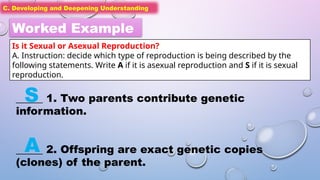
Worked Example
Is it Sexual or Asexual Reproduction?
A. Instruction: decide which type of reproduction is being described by the
following statements. Write A if it is asexual reproduction and S if it is sexual
reproduction.
_____ 1. Two parents contribute genetic
information.
_____ 2. Offspring are exact genetic copies
(clones) of the parent.
S
A
C. Developing and Deepening Understanding
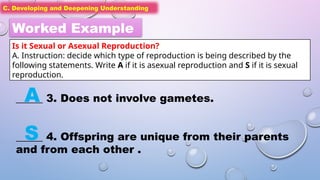
Worked Example
Is it Sexual or Asexual Reproduction?
A. Instruction: decide which type of reproduction is being described by the
following statements. Write A if it is asexual reproduction and S if it is sexual
reproduction.
_____ 3. Does not involve gametes.
_____ 4. Offspring are unique from their parents
and from each other .
A
S
C. Developing and Deepening Understanding
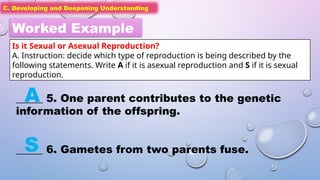
Worked Example
Is it Sexual or Asexual Reproduction?
A. Instruction: decide which type of reproduction is being described by the
following statements. Write A if it is asexual reproduction and S if it is sexual
reproduction.
_____ 5. One parent contributes to the genetic
information of the offspring.
_____ 6. Gametes from two parents fuse.
A
S
C. Developing and Deepening Understanding
Worked Example
Is it Sexual or Asexual Reproduction?
A. Instruction: decide which type of reproduction is being described by the
following statements. Write A if it is asexual reproduction and S if it is sexual
reproduction.
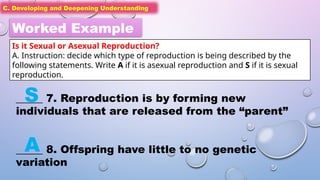
_____ 7. Reproduction is by forming new
individuals that are released from the “parent”
_____ 8. Offspring have little to no genetic
variation
S
A
C. Developing and Deepening Understanding
Worked Example
Is it Sexual or Asexual Reproduction?
A. Instruction: decide which type of reproduction is being described by the
following statements. Write A if it is asexual reproduction and S if it is sexual
reproduction.
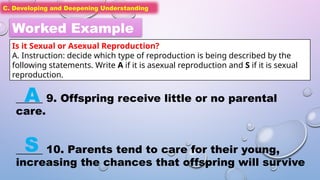
_____ 9. Offspring receive little or no parental
care.
_____ 10. Parents tend to care for their young,
increasing the chances that offspring will survive
A
S
C. Developing and Deepening Understanding
Worked Example
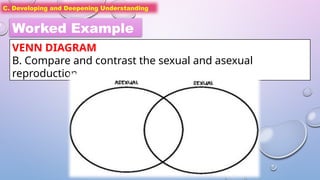
VENN DIAGRAM
B. Compare and contrast the sexual and asexual
reproduction.
C. Developing and Deepening Understanding
Worked Example
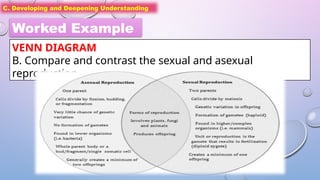
VENN DIAGRAM
B. Compare and contrast the sexual and asexual
reproduction.
D. MAKING GENERALIZATION
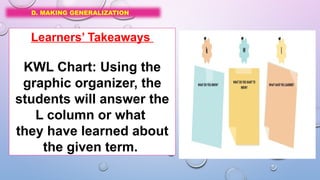
Learners’ Takeaways
KWL Chart: Using the
graphic organizer, the
students will answer the
L column or what
they have learned about
the given term.
E. EVALUATING LEARNING
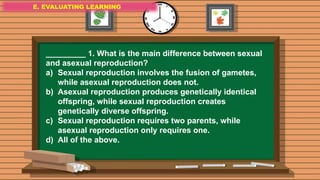
_________ 1. What is the main difference between sexual
and asexual reproduction?
a) Sexual reproduction involves the fusion of gametes,
while asexual reproduction does not.
b) Asexual reproduction produces genetically identical
offspring, while sexual reproduction creates
genetically diverse offspring.
c) Sexual reproduction requires two parents, while
asexual reproduction only requires one.
d) All of the above.
E. EVALUATING LEARNING
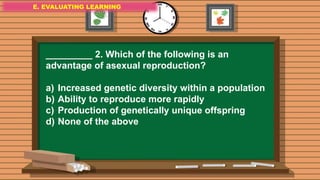
_________ 2. Which of the following is an
advantage of asexual reproduction?
a) Increased genetic diversity within a population
b) Ability to reproduce more rapidly
c) Production of genetically unique offspring
d) None of the above
E. EVALUATING LEARNING
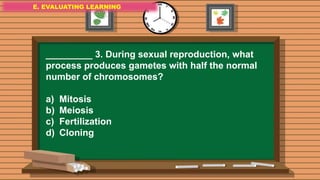
_________ 3. During sexual reproduction, what
process produces gametes with half the normal
number of chromosomes?
a) Mitosis
b) Meiosis
c) Fertilization
d) Cloning
E. EVALUATING LEARNING
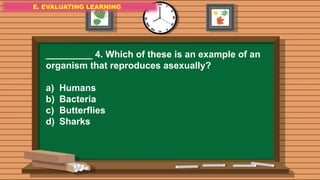
_________ 4. Which of these is an example of an
organism that reproduces asexually?
a) Humans
b) Bacteria
c) Butterflies
d) Sharks
E. EVALUATING LEARNING
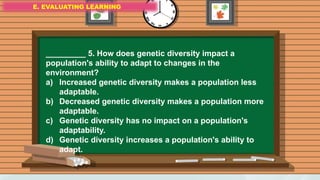
_________ 5. How does genetic diversity impact a
population's ability to adapt to changes in the
environment?
a) Increased genetic diversity makes a population less
adaptable.
b) Decreased genetic diversity makes a population more
adaptable.
c) Genetic diversity has no impact on a population's
adaptability.
d) Genetic diversity increases a population's ability to
adapt.
E. EVALUATING LEARNING
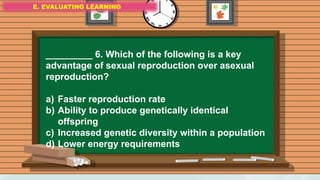
_________ 6. Which of the following is a key
advantage of sexual reproduction over asexual
reproduction?
a) Faster reproduction rate
b) Ability to produce genetically identical
offspring
c) Increased genetic diversity within a population
d) Lower energy requirements
E. EVALUATING LEARNING
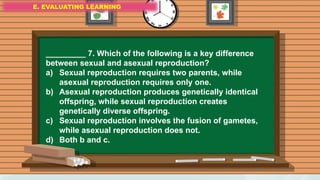
_________ 7. Which of the following is a key difference
between sexual and asexual reproduction?
a) Sexual reproduction requires two parents, while
asexual reproduction requires only one.
b) Asexual reproduction produces genetically identical
offspring, while sexual reproduction creates
genetically diverse offspring.
c) Sexual reproduction involves the fusion of gametes,
while asexual reproduction does not.
d) Both b and c.
E. EVALUATING LEARNING
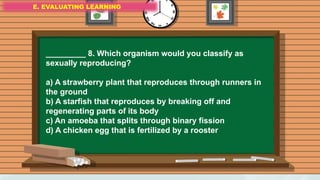
_________ 8. Which organism would you classify as
sexually reproducing?
a) A strawberry plant that reproduces through runners in
the ground
b) A starfish that reproduces by breaking off and
regenerating parts of its body
c) An amoeba that splits through binary fission
d) A chicken egg that is fertilized by a rooster
E. EVALUATING LEARNING
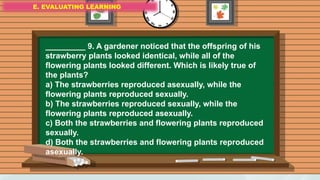
_________ 9. A gardener noticed that the offspring of his
strawberry plants looked identical, while all of the
flowering plants looked different. Which is likely true of
the plants?
a) The strawberries reproduced asexually, while the
flowering plants reproduced sexually.
b) The strawberries reproduced sexually, while the
flowering plants reproduced asexually.
c) Both the strawberries and flowering plants reproduced
sexually.
d) Both the strawberries and flowering plants reproduced
asexually.
E. EVALUATING LEARNING
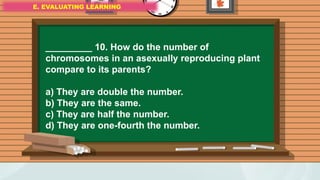
_________ 10. How do the number of
chromosomes in an asexually reproducing plant
compare to its parents?
a) They are double the number.
b) They are the same.
c) They are half the number.
d) They are one-fourth the number.
E. EVALUATING LEARNING
Answers key:
1. D
2. D
3. B
4. B
5. D
6. C
7. D
8. D
9. A
10.B
Reference :
•SCIENCE 7 LESSON EXEMPLAR
Textbook References:
Asuncion., et al., Science Learners Material for Grade 7. Department of
Education. 2017.Biology II Textbook, Department of Education., 2004., Book
Media
Press, Inc. & Printwell Inc.,Caviles, G.C., Asexual Reproduction-. Cross-
Specialization Training of Grades 7 – 10 Science Teachers on their Non-Major
Science Subjects
Manual., 2018.Fabunan, M.F., Sexual Reproduction and Fertilization-.
CrossSpecialization Training of Grades 7 – 10 Science Teachers on their
NonMajor Science Subjects Manual., 2018.
SEDP Series, Science and Technology II Textbook. 1990. Instructional Materials


Q2-SCIENCE 7-LC7 LESSON 3.pptx science7less

  • 2.
    SCIENCE 7 second QUARTER-lc 7.3 Matatag curriculum Lesson 3: Comparing Sexual from Asexual Reproduction
  • 3.
    Comparing Sexual fromAsexual Reproduction CONTENT Fertilization occurs when a male reproductive cell fuses with a female reproductive cell. LEARNING STANDARD Explain that genetic information is passed on to offspring from both parents by the process of meiosis and fertilization; LEARNING COMPETENCY
  • 4.
    By the endof the lesson, the 80 percent of the learners will be able to: 1. Compare asexual and sexual reproductions. 2. Classify organisms according to the type of reproduction they exhibit. 3. Appreciate the asexual and sexual reproductions by using Venn diagram. OBJECTIVES
  • 5.
    I. Activating PriorKnowledge Short Review Here are some pictures of different plants and animals. Identify the pictures as either sexual or asexual reproduction. I. Activating Prior Knowledge SEXUAL REPRODUCTION
  • 6.
    I. Activating PriorKnowledge Short Review Here are some pictures of different plants and animals. Identify the pictures as either sexual or asexual reproduction. I. Activating Prior Knowledge ASEXUAL REPRODUCTION
  • 7.
    I. Activating PriorKnowledge Short Review Here are some pictures of different plants and animals. Identify the pictures as either sexual or asexual reproduction. I. Activating Prior Knowledge SEXUAL REPRODUCTION
  • 8.
    I. Activating PriorKnowledge Short Review Here are some pictures of different plants and animals. Identify the pictures as either sexual or asexual reproduction. I. Activating Prior Knowledge ASEXUAL REPRODUCTION
  • 9.
    I. Activating PriorKnowledge Short Review Here are some pictures of different plants and animals. Identify the pictures as either sexual or asexual reproduction. I. Activating Prior Knowledge SEXUAL REPRODUCTION
  • 10.
    I. Activating PriorKnowledge Short Review Here are some pictures of different plants and animals. Identify the pictures as either sexual or asexual reproduction. I. Activating Prior Knowledge ASEXUAL REPRODUCTION
  • 11.
    I. Activating PriorKnowledge Short Review Here are some pictures of different plants and animals. Identify the pictures as either sexual or asexual reproduction. I. Activating Prior Knowledge SEXUAL REPRODUCTION
  • 12.
    I. Activating PriorKnowledge Short Review Here are some pictures of different plants and animals. Identify the pictures as either sexual or asexual reproduction. I. Activating Prior Knowledge SEXUAL REPRODUCTION
  • 13.
    1. Compare asexualand sexual reproductions. 2. Classify organisms according to the type of reproduction they exhibit. 3. Appreciate the asexual and sexual reproductions by using Venn diagram. B. Establishing Purpose of the Lesson 1. LESSON PURPOSE
  • 14.
    B. Establishing Purposeof the Lesson 2. Unlocking Content Vocabulary: Match Type Activity ASEXUAL REPRODUCTION GAMETES CLONING The process of creating a new organism from a single parent without the involvement of another parent. The reproductive cells (sperm and eggs) involved in sexual reproduction. The process of creating genetically identical copies of an organism through asexual reproduction. SEXUAL REPRODUCTION The process of creating a new organism by combining genetic material from two individuals.
  • 15.
    Information Asexual Reproduction Sexual Reproduction Numberof organisms involved One parent only Two parents are required to mate Cell division Cells divide by mitosis or fission, budding, or regeneration Cells divide by Meiosis Comparison between Sexual and Asexual Reproduction
  • 16.
    Advantages Time Efficient; no needto search for mate, requires less energy Variation, Unique., an organism is more protected
  • 17.
    Disadvantages No variation -if the parent has a genetic disease, the offspring does too. Requires two organisms, requires more energy Evolution There is very little chance of variation with asexual reproduction. Sexual reproduction leads to genetic variation in new generations of offspring. This is fundamental to evolution. Involvement of sex cells No formation or fusion of gametes (sex cells) Formation and fusion of gametes (sex cells) occurs
  • 18.
    Found in Lower organismsHigher invertebrates and all vertebrates Invertebrates Unit of reproduction May be the whole parent body, a bud, a fragment, or a single somatic cell Gamete Time taken Asexual reproduction is completed in a very short period of time. Sexual reproduction can take several months to complete. Number of Two or more One or more
  • 19.
    C. Developing andDeepening Understanding ď‚§ While some bacteria live for a few minutes, some animals for half a century and some plants for hundreds or thousands of years, organisms do not live forever. ď‚§ Without the process of reproduction life would come to an end. It is one of the most important and fundamental processes of living organisms.
  • 20.
    C. Developing andDeepening Understanding Organisms reproduce either asexually or sexually. Sexual reproduction occurs when a new individual is formed by the union of two sex cells, or gametes. Hence, the offspring is unique or not identical to the parents or siblings.
  • 21.
    C. Developing andDeepening Understanding Asexual reproduction occurs when only one parent is involved in making a new creature. Since there is only one parent, all the traits of the mom or dad are passed on to the baby. As a result, the parent and child are identical.
  • 22.
    C. Developing andDeepening Understanding Organisms reproduce in order to survive. To reproduce means to “make a new life.” Reproduction sustains the species so that it does not become extinct.
  • 23.
    C. Developing andDeepening Understanding C. Developing and Deepening Understanding Worked Example Is it Sexual or Asexual Reproduction? A. Instruction: decide which type of reproduction is being described by the following statements. Write A if it is asexual reproduction and S if it is sexual reproduction. _____ 1. Two parents contribute genetic information. _____ 2. Offspring are exact genetic copies (clones) of the parent. S A
  • 24.
    C. Developing andDeepening Understanding C. Developing and Deepening Understanding Worked Example Is it Sexual or Asexual Reproduction? A. Instruction: decide which type of reproduction is being described by the following statements. Write A if it is asexual reproduction and S if it is sexual reproduction. _____ 3. Does not involve gametes. _____ 4. Offspring are unique from their parents and from each other . A S
  • 25.
    C. Developing andDeepening Understanding C. Developing and Deepening Understanding Worked Example Is it Sexual or Asexual Reproduction? A. Instruction: decide which type of reproduction is being described by the following statements. Write A if it is asexual reproduction and S if it is sexual reproduction. _____ 5. One parent contributes to the genetic information of the offspring. _____ 6. Gametes from two parents fuse. A S
  • 26.
    C. Developing andDeepening Understanding C. Developing and Deepening Understanding Worked Example Is it Sexual or Asexual Reproduction? A. Instruction: decide which type of reproduction is being described by the following statements. Write A if it is asexual reproduction and S if it is sexual reproduction. _____ 7. Reproduction is by forming new individuals that are released from the “parent” _____ 8. Offspring have little to no genetic variation S A
  • 27.
    C. Developing andDeepening Understanding C. Developing and Deepening Understanding Worked Example Is it Sexual or Asexual Reproduction? A. Instruction: decide which type of reproduction is being described by the following statements. Write A if it is asexual reproduction and S if it is sexual reproduction. _____ 9. Offspring receive little or no parental care. _____ 10. Parents tend to care for their young, increasing the chances that offspring will survive A S
  • 28.
    C. Developing andDeepening Understanding Worked Example VENN DIAGRAM B. Compare and contrast the sexual and asexual reproduction.
  • 29.
    C. Developing andDeepening Understanding Worked Example VENN DIAGRAM B. Compare and contrast the sexual and asexual reproduction.
  • 30.
    D. MAKING GENERALIZATION Learners’Takeaways KWL Chart: Using the graphic organizer, the students will answer the L column or what they have learned about the given term.
  • 31.
    E. EVALUATING LEARNING E.EVALUATING LEARNING E. EVALUATING LEARNING _________ 1. What is the main difference between sexual and asexual reproduction? a) Sexual reproduction involves the fusion of gametes, while asexual reproduction does not. b) Asexual reproduction produces genetically identical offspring, while sexual reproduction creates genetically diverse offspring. c) Sexual reproduction requires two parents, while asexual reproduction only requires one. d) All of the above.
  • 32.
    E. EVALUATING LEARNING E.EVALUATING LEARNING E. EVALUATING LEARNING _________ 2. Which of the following is an advantage of asexual reproduction? a) Increased genetic diversity within a population b) Ability to reproduce more rapidly c) Production of genetically unique offspring d) None of the above
  • 33.
    E. EVALUATING LEARNING E.EVALUATING LEARNING E. EVALUATING LEARNING _________ 3. During sexual reproduction, what process produces gametes with half the normal number of chromosomes? a) Mitosis b) Meiosis c) Fertilization d) Cloning
  • 34.
    E. EVALUATING LEARNING E.EVALUATING LEARNING E. EVALUATING LEARNING _________ 4. Which of these is an example of an organism that reproduces asexually? a) Humans b) Bacteria c) Butterflies d) Sharks
  • 35.
    E. EVALUATING LEARNING E.EVALUATING LEARNING E. EVALUATING LEARNING _________ 5. How does genetic diversity impact a population's ability to adapt to changes in the environment? a) Increased genetic diversity makes a population less adaptable. b) Decreased genetic diversity makes a population more adaptable. c) Genetic diversity has no impact on a population's adaptability. d) Genetic diversity increases a population's ability to adapt.
  • 36.
    E. EVALUATING LEARNING E.EVALUATING LEARNING E. EVALUATING LEARNING _________ 6. Which of the following is a key advantage of sexual reproduction over asexual reproduction? a) Faster reproduction rate b) Ability to produce genetically identical offspring c) Increased genetic diversity within a population d) Lower energy requirements
  • 37.
    E. EVALUATING LEARNING E.EVALUATING LEARNING E. EVALUATING LEARNING _________ 7. Which of the following is a key difference between sexual and asexual reproduction? a) Sexual reproduction requires two parents, while asexual reproduction requires only one. b) Asexual reproduction produces genetically identical offspring, while sexual reproduction creates genetically diverse offspring. c) Sexual reproduction involves the fusion of gametes, while asexual reproduction does not. d) Both b and c.
  • 38.
    E. EVALUATING LEARNING E.EVALUATING LEARNING E. EVALUATING LEARNING _________ 8. Which organism would you classify as sexually reproducing? a) A strawberry plant that reproduces through runners in the ground b) A starfish that reproduces by breaking off and regenerating parts of its body c) An amoeba that splits through binary fission d) A chicken egg that is fertilized by a rooster
  • 39.
    E. EVALUATING LEARNING E.EVALUATING LEARNING E. EVALUATING LEARNING _________ 9. A gardener noticed that the offspring of his strawberry plants looked identical, while all of the flowering plants looked different. Which is likely true of the plants? a) The strawberries reproduced asexually, while the flowering plants reproduced sexually. b) The strawberries reproduced sexually, while the flowering plants reproduced asexually. c) Both the strawberries and flowering plants reproduced sexually. d) Both the strawberries and flowering plants reproduced asexually.
  • 40.
    E. EVALUATING LEARNING E.EVALUATING LEARNING E. EVALUATING LEARNING _________ 10. How do the number of chromosomes in an asexually reproducing plant compare to its parents? a) They are double the number. b) They are the same. c) They are half the number. d) They are one-fourth the number.
  • 41.
    E. EVALUATING LEARNING E.EVALUATING LEARNING E. EVALUATING LEARNING Answers key: 1. D 2. D 3. B 4. B 5. D 6. C 7. D 8. D 9. A 10.B
  • 42.
    Reference : •SCIENCE 7LESSON EXEMPLAR Textbook References: Asuncion., et al., Science Learners Material for Grade 7. Department of Education. 2017.Biology II Textbook, Department of Education., 2004., Book Media Press, Inc. & Printwell Inc.,Caviles, G.C., Asexual Reproduction-. Cross- Specialization Training of Grades 7 – 10 Science Teachers on their Non-Major Science Subjects Manual., 2018.Fabunan, M.F., Sexual Reproduction and Fertilization-. CrossSpecialization Training of Grades 7 – 10 Science Teachers on their NonMajor Science Subjects Manual., 2018. SEDP Series, Science and Technology II Textbook. 1990. Instructional Materials