WESTERN CLASSICAL ART
TRADITIONS
OBJECTIVE
 ANALYZE THE ART ELEMETNTS IN THE
PRODUCTION OF WORK FOLLOWING THE
STYLE OF ANCIENT ART, CLASSICAL ART AND
MEDIEVAL ART.
BASIC ELEMENTS OF ARTS
 Line – vertical, horizontal, parallel, contour lines,
gestures lines,
 Color – primary, secondary, tertiary colors,
neutral colors, warm, colors, colors
 Shape – circles, ovals, triangles, rectangles, free
flowing, geometric shapes
 Texture – smooth, rough
 Form – 2d or 3d
 Space - one form or two form perspective,
overlapping
 Balance – symmetrical, asymmetrical, radial
 Pattern – repetition of design
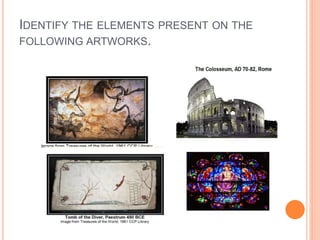
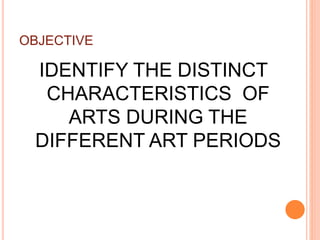
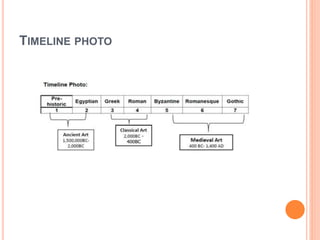
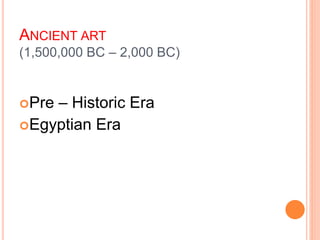
IDENTIFY THE ELEMENTS PRESENT ON THE
FOLLOWING ARTWORKS.
OBJECTIVE
IDENTIFY THE DISTINCT
CHARACTERISTICS OF
ARTS DURING THE
DIFFERENT ART PERIODS
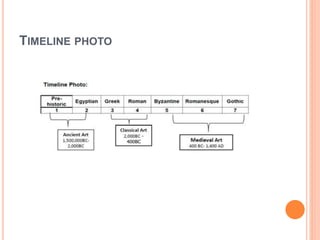
TIMELINE PHOTO
ANCIENT ART
(1,500,000 BC – 2,000 BC)
Pre – Historic Era
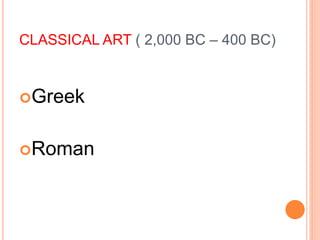
Egyptian Era
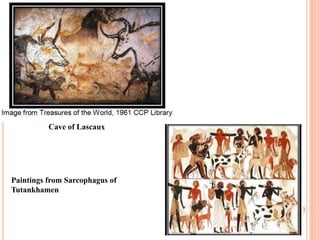
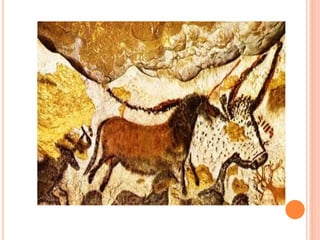
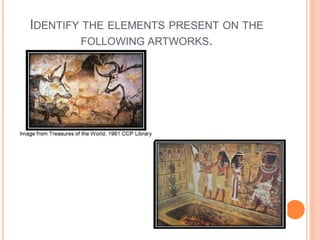
Cave of Lascaux
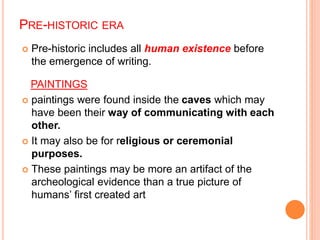
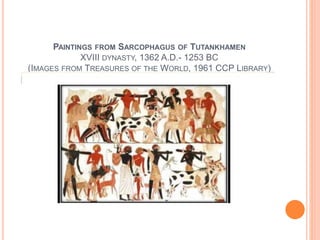
Paintings from Sarcophagus of
Tutankhamen
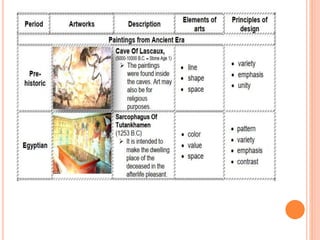
PRE-HISTORIC ERA
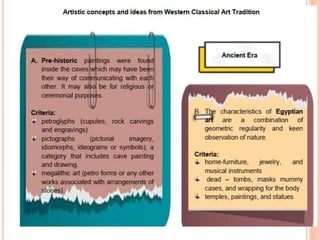
 Pre-historic includes all human existence before
the emergence of writing.
PAINTINGS
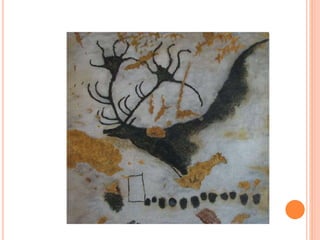
 paintings were found inside the caves which may
have been their way of communicating with each
other.
 It may also be for religious or ceremonial
purposes.
 These paintings may be more an artifact of the
archeological evidence than a true picture of
humans’ first created art
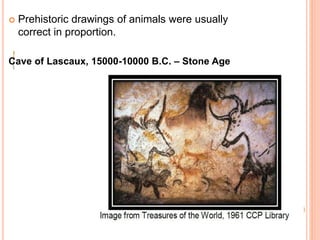
 Prehistoric drawings of animals were usually
correct in proportion.
Cave of Lascaux, 15000-10000 B.C. – Stone Age
PAINTINGS FROM ANCIENT EGYPT
 The purpose of Egyptian paintings is to make the
deceased afterlife place pleasant.
 It emphasizes the importance of life after death and
the preservation of the knowledge of the past.
 Most paintings were highly stylize, symbolic, and
shows profile view of an animal or a person.
 The main colors used were red, black, blue , gold and
green taken derived from mineral pigments that can
withstand strong sunlight without fading.
PAINTINGS FROM SARCOPHAGUS OF TUTANKHAMEN
XVIII DYNASTY, 1362 A.D.- 1253 BC
(IMAGES FROM TREASURES OF THE WORLD, 1961 CCP LIBRARY)
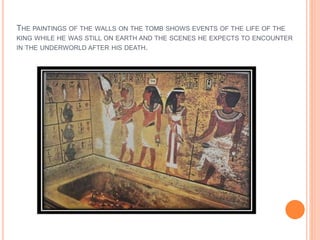
THE PAINTINGS OF THE WALLS ON THE TOMB SHOWS EVENTS OF THE LIFE OF THE
KING WHILE HE WAS STILL ON EARTH AND THE SCENES HE EXPECTS TO ENCOUNTER
IN THE UNDERWORLD AFTER HIS DEATH.
IDENTIFY THE ELEMENTS PRESENT ON THE
FOLLOWING ARTWORKS.
CLASSICAL ART ( 2,000 BC – 400 BC)
Greek
Roman
PAINTING FROM CLASSICAL GREEK ERA
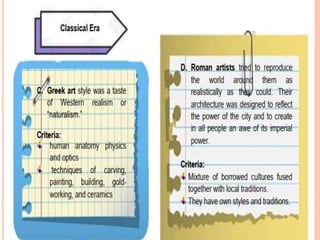
 Paintings during the classical era were most commonly
found in vases, panels and tomb.
 It depicts natural figures with dynamic compositions.
 Most of the subjects were battle scenes, mythological
figures, and everyday scenes.
MOST COMMON METHODS OF GREEK
PAINTING:
1. Fresco- method of painting water-based pigments
on a freshly applied plaster usually on a wall
surfaces. Colors are made with grind powder
pigments in pure water, dry and set with a plaster to
become a permanent part of the wall. Ideal for
murals, durable and has a matte style.
2. Encaustic– developed to use by Greek ship builders,
who used the hot wax to fill the cracks of the ship.
Soon pigments (colors) was added and used to paint
a wax hull.
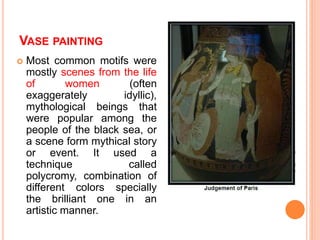
VASE PAINTING
 Most common motifs were
mostly scenes from the life
of women (often
exaggerately idyllic),
mythological beings that
were popular among the
people of the black sea, or
a scene form mythical story
or event. It used a
technique called
polycromy, combination of
different colors specially
the brilliant one in an
artistic manner.
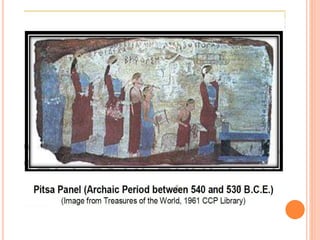
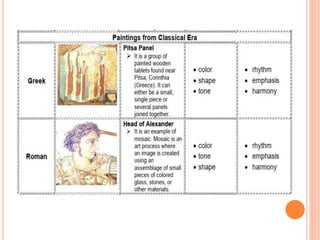
PANEL PAINTING
• paintings on flat panels of wood, can be either a
small, single piece or several panels joined together.
• Most of the panel paintings no longer exist
because of its organic composition.
• The earliest known panel painting is the Pitsa
Panel (Archaic Period between 540 and 530
B.C.E.)
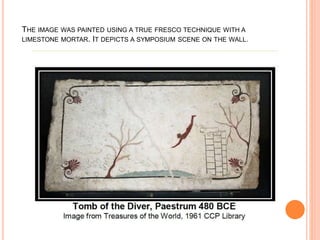
TOMB/WALL PAINTING
 very popular during the classical period
 uses the method frescos either tempera (water-
base) or encaustic (wax).
 has a sharp, flatly outlined style of painting and
because it uses water-based materials, very few
samples survived.
 in tomb paintings, artists rely on the shade and
hues of paint to create depth and life-like feeling.
THE IMAGE WAS PAINTED USING A TRUE FRESCO TECHNIQUE WITH A
LIMESTONE MORTAR. IT DEPICTS A SYMPOSIUM SCENE ON THE WALL.
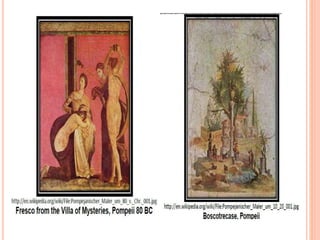
PAINTINGS FROM THE ROMAN ERA
 Most of the paintings in this era were copied or
imitated from Hellenic Greek paintings.
 Fresco technique was used in brightly colored
backgrounds; division of the wall into a multiple
rectangular areas (tic-tac-toe design)
 a style of painting in which things are painted in a way
that makes them look like real objects
 paintings have a wide variety of subjects, animals,
everyday life, still life, mythological subjects,
portraits and landscapes.
 The development of landscape painting is the main
innovation of Roman painting from Greek painting.
MOSAIC
 It is an art process where an image is created using
an assemblage of small pieces of colored glass,
stones, or other materials.
 This technique use for decorative art or interior
decorations.
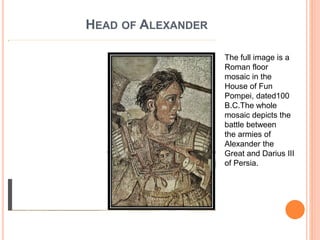
HEAD OF ALEXANDER
The full image is a
Roman floor
mosaic in the
House of Fun
Pompei, dated100
B.C.The whole
mosaic depicts the
battle between
the armies of
Alexander the
Great and Darius III
of Persia.
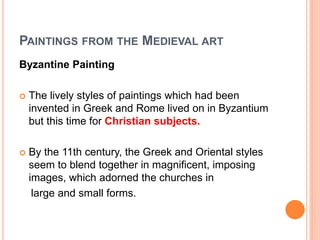
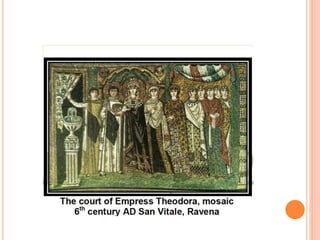
PAINTINGS FROM THE MEDIEVAL ART
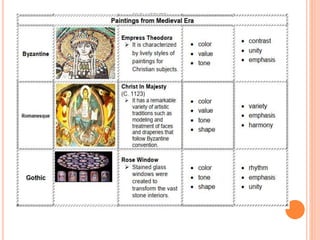
Byzantine Painting
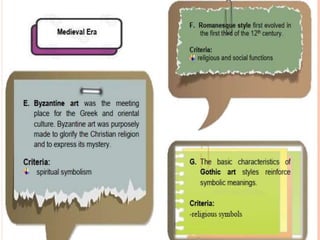
 The lively styles of paintings which had been
invented in Greek and Rome lived on in Byzantium
but this time for Christian subjects.
 By the 11th century, the Greek and Oriental styles
seem to blend together in magnificent, imposing
images, which adorned the churches in
large and small forms.
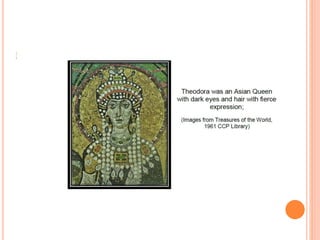
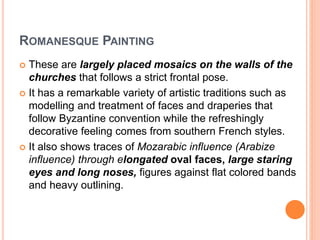
ROMANESQUE PAINTING
 These are largely placed mosaics on the walls of the
churches that follows a strict frontal pose.
 It has a remarkable variety of artistic traditions such as
modelling and treatment of faces and draperies that
follow Byzantine convention while the refreshingly
decorative feeling comes from southern French styles.
 It also shows traces of Mozarabic influence (Arabize
influence) through elongated oval faces, large staring
eyes and long noses, figures against flat colored bands
and heavy outlining.
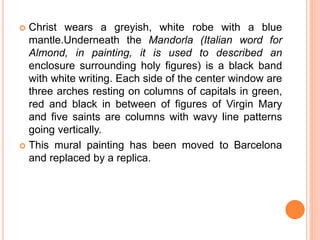
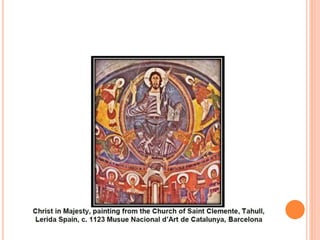
 Christ wears a greyish, white robe with a blue
mantle.Underneath the Mandorla (Italian word for
Almond, in painting, it is used to described an
enclosure surrounding holy figures) is a black band
with white writing. Each side of the center window are
three arches resting on columns of capitals in green,
red and black in between of figures of Virgin Mary
and five saints are columns with wavy line patterns
going vertically.
 This mural painting has been moved to Barcelona
and replaced by a replica.
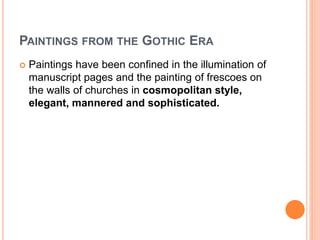
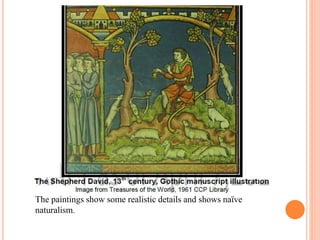
PAINTINGS FROM THE GOTHIC ERA
 Paintings have been confined in the illumination of
manuscript pages and the painting of frescoes on
the walls of churches in cosmopolitan style,
elegant, mannered and sophisticated.
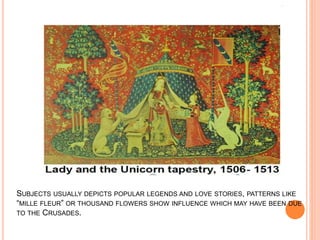
SUBJECTS USUALLY DEPICTS POPULAR LEGENDS AND LOVE STORIES, PATTERNS LIKE
“MILLE FLEUR” OR THOUSAND FLOWERS SHOW INFLUENCE WHICH MAY HAVE BEEN DUE
TO THE CRUSADES.
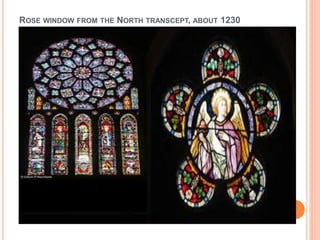
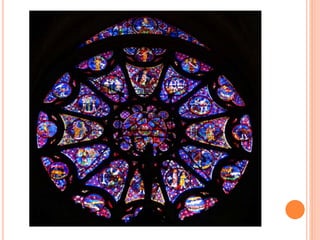
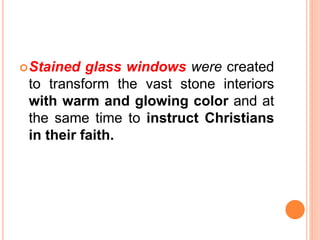
ROSE WINDOW FROM THE NORTH TRANSCEPT, ABOUT 1230
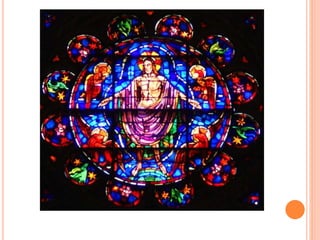
Stained glass windows were created
to transform the vast stone interiors
with warm and glowing color and at
the same time to instruct Christians
in their faith.
The paintings show some realistic details and shows naïve
naturalism.
OBJECTIVE
IDENTIFY THE DISTINCT
CHARACTERISTICS OF
ARTS DURING THE
DIFFERENT ART PERIODS
SCULPTURE
A piece of art or the process
that is made by carving or
molding clay stone, metal etc.
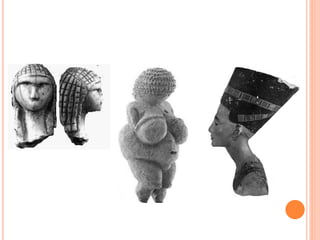
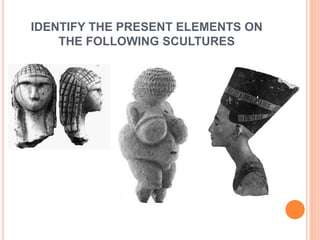
IDENTIFY THE PRESENT ELEMENTS ON
THE FOLLOWING SCULTURES
TIMELINE PHOTO
SCULPTURES FROM THE EARLY AGE
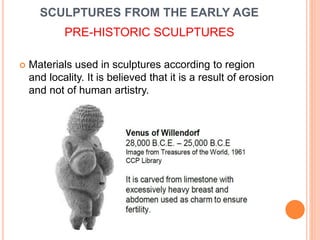
PRE-HISTORIC SCULPTURES
 Materials used in sculptures according to region
and locality. It is believed that it is a result of erosion
and not of human artistry.
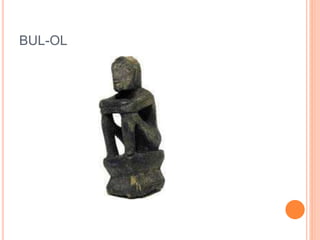
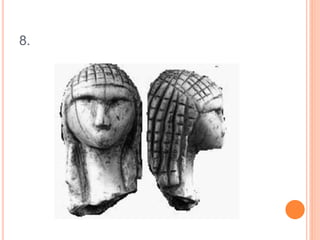
BUL-OL
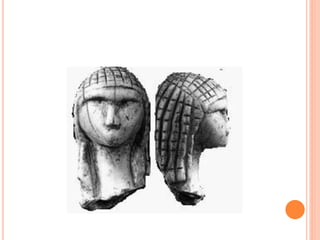
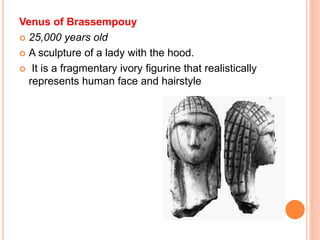
Venus of Brassempouy
 25,000 years old
 A sculpture of a lady with the hood.
 It is a fragmentary ivory figurine that realistically
represents human face and hairstyle
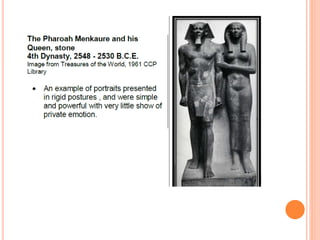
SCULPTURES FROM THE EGYPTIAN ERA
 Symbolic elements were widely used such as forms, hieroglyphics
relative size, location, materials, color, actions and gestures. Their
tombs required the most extensive used of sculpture.
 The most common materials used for sculptures are wood, ivory and
stones.
Characteristics of the sculptures:
1. Symbolisms were heavily used to represent the gods. They were
represented as composite creature with animal heads on human bodies
2. Relief compositions were arranged in horizontal lines to record an event
or represent an action.
3. Most of the time the gods were shown larger than humans, the kings
larger than their followers, the dead larger than the living.
4. Empty space were filled with figures or hieroglyphics
All individual components were all brought to the plane of representation
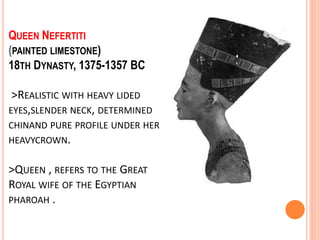
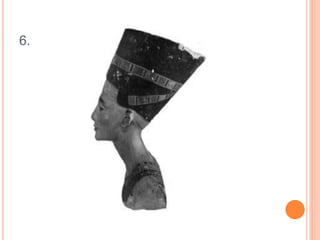
QUEEN NEFERTITI
(PAINTED LIMESTONE)
18TH DYNASTY, 1375-1357 BC
>REALISTIC WITH HEAVY LIDED
EYES,SLENDER NECK, DETERMINED
CHINAND PURE PROFILE UNDER HER
HEAVYCROWN.
>QUEEN , REFERS TO THE GREAT
ROYAL WIFE OF THE EGYPTIAN
PHAROAH .
SCULPTURES FROM THE CLASSICAL PERIOD
Greek Sculptures
Early Greek sculptures were tense and stiff, their bodies
were hidden within enfolding robes. After three centuries of
experiments, Greek sculptures had finally evolved and
showed all the points of human anatomy and proportion.
One of the most popular styles of the Greek sculptures
was the Hellenistic style. Hellenistic denotes a preference in
sculpture for more elaborated patterns, mannered
arrangement of figures and groups, and an emphasis on the
representation of movement for dramatic effects.
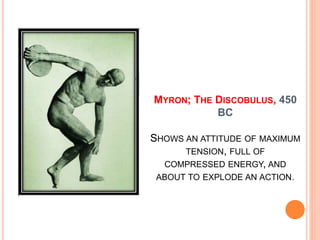
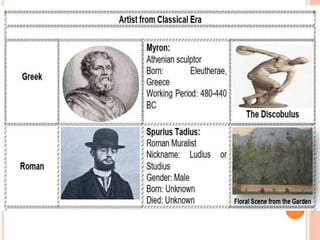
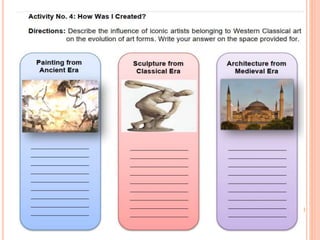
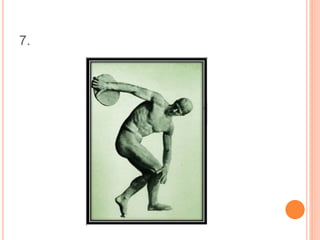
MYRON; THE DISCOBULUS, 450
BC
SHOWS AN ATTITUDE OF MAXIMUM
TENSION, FULL OF
COMPRESSED ENERGY, AND
ABOUT TO EXPLODE AN ACTION.
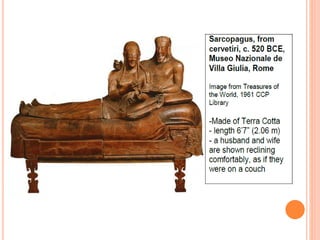
ROMAN SCULPTURES
 Most Roman sculptures are made of monumental
terra-cotta. They did not attempt to compete with the
free standing Greek works of history or mythology but
rather they produced reliefs in the Great Roman
triumphal columns with continuous narrative reliefs
around.
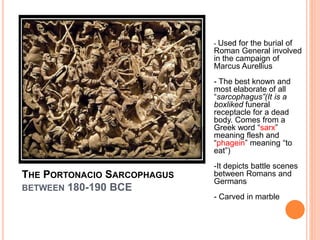
THE PORTONACIO SARCOPHAGUS
BETWEEN 180-190 BCE
- Used for the burial of
Roman General involved
in the campaign of
Marcus Aurellius
- The best known and
most elaborate of all
“sarcophagus”(It is a
boxliked funeral
receptacle for a dead
body. Comes from a
Greek word “sarx”
meaning flesh and
“phagein” meaning “to
eat”)
-It depicts battle scenes
between Romans and
Germans
- Carved in marble
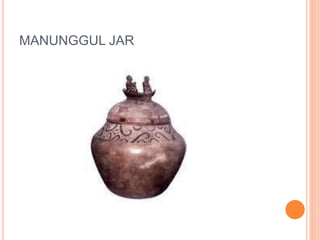
MANUNGGUL JAR
IDENTIFY FROM WHAT ART SCULPTURES DO THE
FOLLOWING CHARACTERISTICS BELONG.
 1. Sculptures are made of monumental terra-cotta.
 2. Sculptures had finally evolved and showed all the
points of human anatomy and proportion.
 3. Sculptures is a result of erosion and not of
human artistry.
 4. The most common materials used for sculptures
are wood, ivory and stones.
OBJECTIVE
IDENTIFY THE DISTINCT
CHARACTERISTICS OF
ARTS DURING THE
DIFFERENT ART PERIODS
BYZANTINESCULPTURES
 The dominant themes in Byzantine sculptures are
religious, everyday life scenes, and motifs from nature.
 Animals were used as symbols (dove, deer, peafowl)
while some had acrostic signs (form of writing in which
taking the first letter; syllable or word of different lines
and putting them together it can be read a message)
that contained a great theological significance.
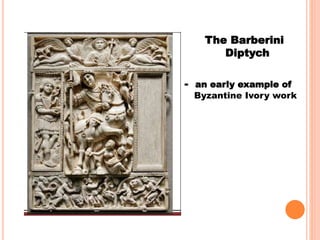
The Barberini
Diptych
- an early example of
Byzantine Ivory work
ROMANESQUE SCULPTURES
Some of the famous sculptural pieces are
reliquaries, altar frontals, crucifixes, and
devotional images. Small individual works of
art were generally made of costly materials
for royal and aristocratic patrons. These
lightweight devotional images were usually
carried in the processions both inside and
outside the churches.
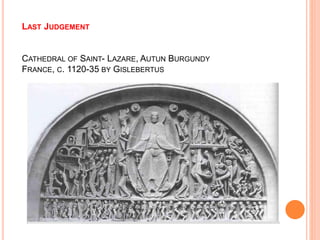
LAST JUDGEMENT
TYMAPNUM (AN ARCHITECTURAL ELEMENT WITH IN THE ARCH OR
PEDIMENT) OF THE WEST PORTAL
CATHEDRAL OF SAINT- LAZARE, AUTUN BURGUNDY
FRANCE, C. 1120-35 BY GISLEBERTUS
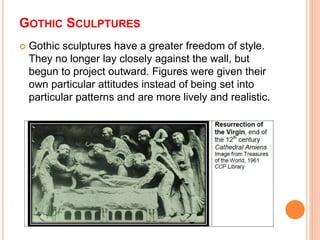
GOTHIC SCULPTURES
 Gothic sculptures have a greater freedom of style.
They no longer lay closely against the wall, but
begun to project outward. Figures were given their
own particular attitudes instead of being set into
particular patterns and are more lively and realistic.
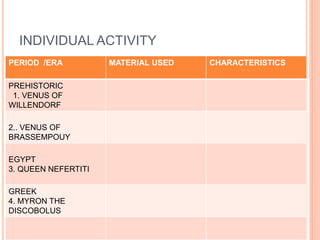
INDIVIDUAL ACTIVITY
PERIOD /ERA MATERIAL USED CHARACTERISTICS
BYZANTINE
1. THE BARBENI
DIPTYCH
ROMANESQUE
2. LAST JUDGEMENT
GOTHIC
3. RESURRECTION OF
THE VIRGIN
INDIVIDUAL ACTIVITY
PERIOD /ERA MATERIAL USED CHARACTERISTICS
PREHISTORIC
1. VENUS OF
WILLENDORF
2.. VENUS OF
BRASSEMPOUY
EGYPT
3. QUEEN NEFERTITI
GREEK
4. MYRON THE
DISCOBOLUS
OBJECTIVE
IDENTIFY THE DISTINCT
CHARACTERISTICS OF
ARTS DURING THE
DIFFERENT ART PERIODS
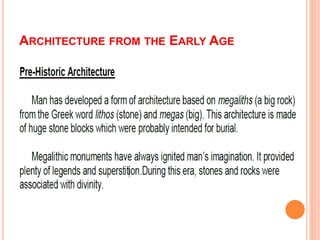
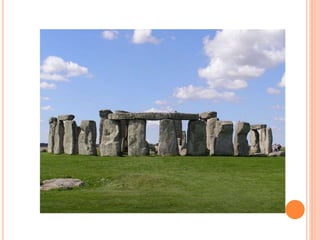
ARCHITECTURE FROM THE EARLY AGE
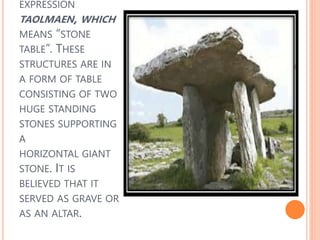
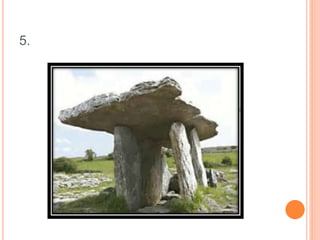
EXPRESSION
TAOLMAEN, WHICH
MEANS “STONE
TABLE”. THESE
STRUCTURES ARE IN
A FORM OF TABLE
CONSISTING OF TWO
HUGE STANDING
STONES SUPPORTING
A
HORIZONTAL GIANT
STONE. IT IS
BELIEVED THAT IT
SERVED AS GRAVE OR
AS AN ALTAR.
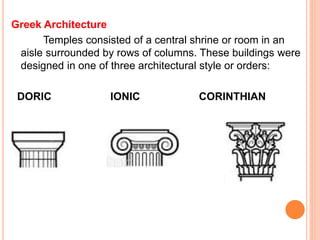
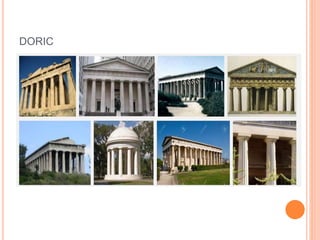
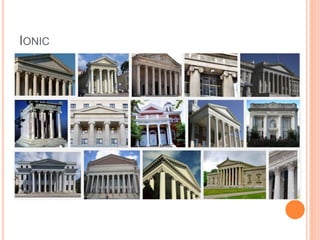
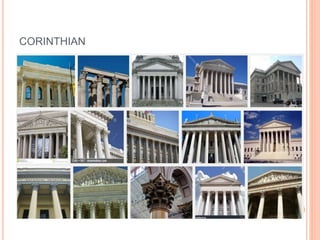
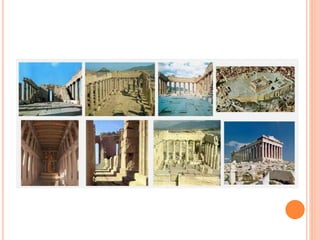
Greek Architecture
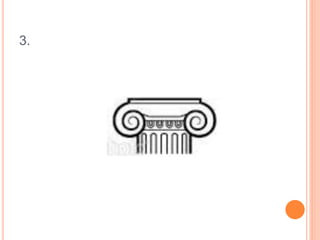
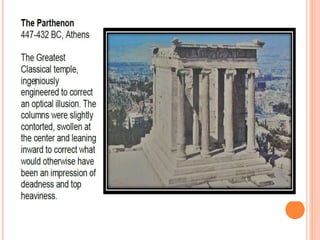
Temples consisted of a central shrine or room in an
aisle surrounded by rows of columns. These buildings were
designed in one of three architectural style or orders:
DORIC IONIC CORINTHIAN
DORIC
IONIC
CORINTHIAN
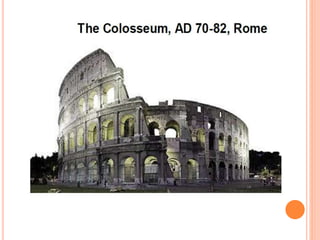
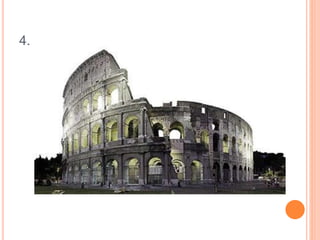
ROMAN ARCHITECTURE
 They built sturdy stone structures both for use and to
perpetuate their glory.
 The emperor erected huge halls and arenas for public
games, baths and processions They built them of
gigantic arches of stone, bricks and concrete or with
barrel vaults.
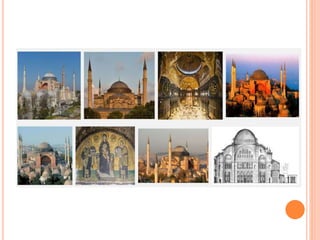
BYZANTINE ARCHITECTURE
 It has a lot in common with the early Christian
architecture.
 Mosaic decoration was perfected by the Byzantines, as
was the use of clerestory to bring light in from high
windows.
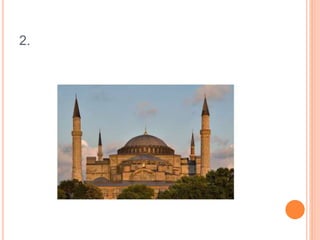
 Byzantine's advancement in developing the dome
created a new style in global architecture.
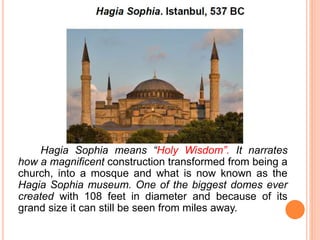
Hagia Sophia means “Holy Wisdom”. It narrates
how a magnificent construction transformed from being a
church, into a mosque and what is now known as the
Hagia Sophia museum. One of the biggest domes ever
created with 108 feet in diameter and because of its
grand size it can still be seen from miles away.
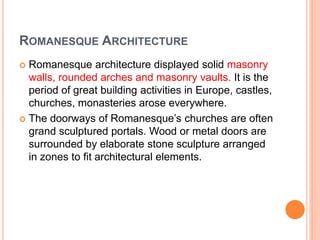
ROMANESQUE ARCHITECTURE
 Romanesque architecture displayed solid masonry
walls, rounded arches and masonry vaults. It is the
period of great building activities in Europe, castles,
churches, monasteries arose everywhere.
 The doorways of Romanesque’s churches are often
grand sculptured portals. Wood or metal doors are
surrounded by elaborate stone sculpture arranged
in zones to fit architectural elements.
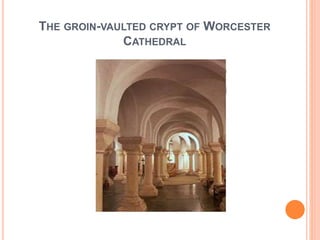
THE GROIN-VAULTED CRYPT OF WORCESTER
CATHEDRAL
GOTHIC ARCHITECTURE
 This design included two new devices: pointed
arch which enabled builders to construct much
higher ceiling vaults and stone vaulting borne on a
network of stone ribs supported by piers and
clustered pillars.
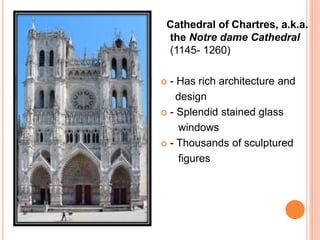
Cathedral of Chartres, a.k.a.
the Notre dame Cathedral
(1145- 1260)
 - Has rich architecture and
design
 - Splendid stained glass
windows
 - Thousands of sculptured
figures
GRADE 9....
Are you
ready for a
quiz???
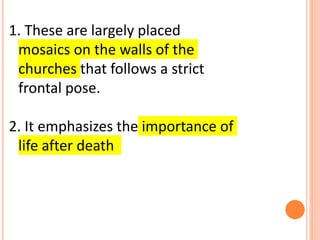
1. These are largely placed
mosaics on the walls of the
churches that follows a strict
frontal pose.
2. It emphasizes the importance of
life after death
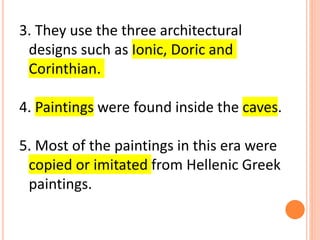
3. They use the three architectural
designs such as Ionic, Doric and
Corinthian.
4. Paintings were found inside the caves.
5. Most of the paintings in this era were
copied or imitated from Hellenic Greek
paintings.
6. Paintings during the classical era
were most commonly found in vases,
panels and tomb.
7. The lively styles of paintings which
had been invented in Greek and
Rome lived on in Byzantium but this
time for Christian subjects
.
8. Drawings of animals were found in Cave
of Lascaux
9. The purpose of this paintings is to make
the deceased afterlife place pleasant
10. These paintings were the first who used
the encaustic and fresco method.
IDENTIFICATION
1. created to transform the vast stone interiors
with warm and glowing color and at the
same time to instruct Christians in their faith.
2. It is a picture or a diagram made with pencil,
pen, or crayon rather than paint.
3. It is the practice of applying paint, pigment,
color or other medium to a solid surface.
4. It is an art process where an image is
created using an assemblage of small
pieces of colored glass, stones, or
other materials.
5. paintings on flat panels of wood, can
be either a small, single piece or
several panels joined together.
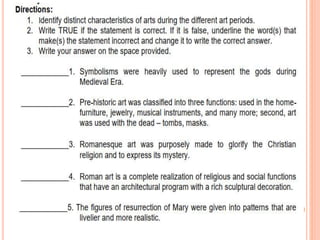
1. Symbolisms were heavily used to represent the gods
during Medieval Era.
2. Pre-historic art was classified into three functions: used in
the home furniture, jewelry, musical instruments, and many
more; second, art was used with the dead – tombs, masks.
3. Romanesque art was purposely made to glorify the
Christian
religion and to express its mystery.
4. Roman art is a complete realization of religious and social
functions that have an architectural program with a rich
sculptural decoration.
5. The figures of resurrection of Mary were given into
patterns that are livelier and more realistic.
TRUE
OR
FALSE
1. They used pointed arch which enabled builders to construct
much higher ceiling vaults in Romanesque Architecture.
2. The emperors of Egypt erected huge halls & arenas for
public games, baths & procession .
3. Romanesque sculpture are famous sculptural pieces are
reliquaries, altar frontals, crucifixes, and devotional images.
4. Gothic sculpture have a greater freedom of style.
5. Dominant features were large animals native to the region in
Byzantine Painting.
6. Romans imitated or copied the Hellenic Greek Paintings
of Greek Art.
7. The structure of Egyptian architecture has thick sloping walls
with several openings to obtain stability.
8. Greek paintings can be in found in vase, panel and
tomb/wall.
9. They show profile of an animal or person in Pre Historic
Painting.
10. Megaliths are made of huge stone blocks which were
probably intended for burial.
.
IDENTIFICATION
1. created to transform the vast stone interiors with warm
and glowing color and at the same time to instruct
Christians in their faith.
2. also referred to as Kerch Vases are red-figured pottery
named after the place where it was found.
3. developed to use by Greek ship builders, who used
the hot wax to fill the cracks of the ship. Soon pigments
(colors) was added and used to paint a wax hull.
4. It is an art process where an image is created using an
assemblage of small pieces of colored glass, stones,
or other materials.
5. paintings on flat panels of wood, can be either a small,
single piece or several panels joined together.
SCULPTURE
6. Their sculptures had finally evolved and showed all the
points of human anatomy and proportion.
7. Empty spaces were filled with figures or hieroglyphics.
8. Most of the sculptures are made of monumental terra-
cotta.
9. Some of the famous sculptural pieces are reliquaries,
altar frontals, crucifixes, and devotional images
10. Sculptures no longer lay closely against the wall, but
begun to project outward.
ARCHITECTURE
11. They developed the dome, a new style in global
architecture.
12. They use the three architectural designs such as
Ionic, Doric and Corinthian.
13. Man developed a new form of architecture by
using megaliths.
14. The structure has thick sloping walls with few
openings to obtain stability.
15. They built sturdy stone structures both for use and
to perpetuate their glory.
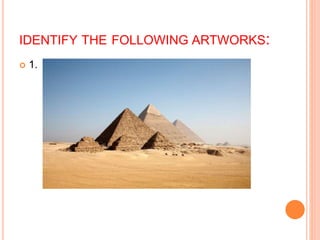
IDENTIFY THE FOLLOWING ARTWORKS:
 1.
2.
3.
4.
5.
6.
7.
8.
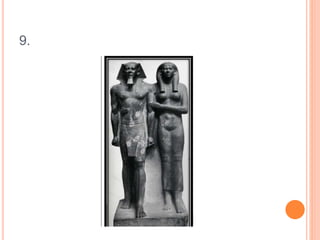
9.
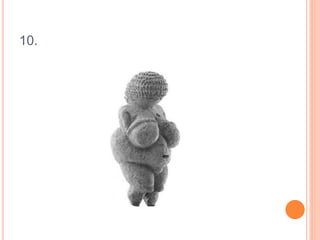
10.

Q1_ARTS Western classical art.ppt

  • 1.
  • 2.
    OBJECTIVE  ANALYZE THEART ELEMETNTS IN THE PRODUCTION OF WORK FOLLOWING THE STYLE OF ANCIENT ART, CLASSICAL ART AND MEDIEVAL ART.
  • 3.
  • 4.
    BASIC ELEMENTS OFARTS  Line – vertical, horizontal, parallel, contour lines, gestures lines,  Color – primary, secondary, tertiary colors, neutral colors, warm, colors, colors  Shape – circles, ovals, triangles, rectangles, free flowing, geometric shapes  Texture – smooth, rough  Form – 2d or 3d  Space - one form or two form perspective, overlapping  Balance – symmetrical, asymmetrical, radial  Pattern – repetition of design
  • 6.
    IDENTIFY THE ELEMENTSPRESENT ON THE FOLLOWING ARTWORKS.
  • 8.
    OBJECTIVE IDENTIFY THE DISTINCT CHARACTERISTICSOF ARTS DURING THE DIFFERENT ART PERIODS
  • 9.
  • 10.
    ANCIENT ART (1,500,000 BC– 2,000 BC) Pre – Historic Era Egyptian Era
  • 11.
    Cave of Lascaux Paintingsfrom Sarcophagus of Tutankhamen
  • 12.
    PRE-HISTORIC ERA  Pre-historicincludes all human existence before the emergence of writing. PAINTINGS  paintings were found inside the caves which may have been their way of communicating with each other.  It may also be for religious or ceremonial purposes.  These paintings may be more an artifact of the archeological evidence than a true picture of humans’ first created art
  • 13.
     Prehistoric drawingsof animals were usually correct in proportion. Cave of Lascaux, 15000-10000 B.C. – Stone Age
  • 17.
    PAINTINGS FROM ANCIENTEGYPT  The purpose of Egyptian paintings is to make the deceased afterlife place pleasant.  It emphasizes the importance of life after death and the preservation of the knowledge of the past.  Most paintings were highly stylize, symbolic, and shows profile view of an animal or a person.  The main colors used were red, black, blue , gold and green taken derived from mineral pigments that can withstand strong sunlight without fading.
  • 18.
    PAINTINGS FROM SARCOPHAGUSOF TUTANKHAMEN XVIII DYNASTY, 1362 A.D.- 1253 BC (IMAGES FROM TREASURES OF THE WORLD, 1961 CCP LIBRARY)
  • 19.
    THE PAINTINGS OFTHE WALLS ON THE TOMB SHOWS EVENTS OF THE LIFE OF THE KING WHILE HE WAS STILL ON EARTH AND THE SCENES HE EXPECTS TO ENCOUNTER IN THE UNDERWORLD AFTER HIS DEATH.
  • 21.
    IDENTIFY THE ELEMENTSPRESENT ON THE FOLLOWING ARTWORKS.
  • 22.
    CLASSICAL ART (2,000 BC – 400 BC) Greek Roman
  • 23.
    PAINTING FROM CLASSICALGREEK ERA  Paintings during the classical era were most commonly found in vases, panels and tomb.  It depicts natural figures with dynamic compositions.  Most of the subjects were battle scenes, mythological figures, and everyday scenes.
  • 24.
    MOST COMMON METHODSOF GREEK PAINTING: 1. Fresco- method of painting water-based pigments on a freshly applied plaster usually on a wall surfaces. Colors are made with grind powder pigments in pure water, dry and set with a plaster to become a permanent part of the wall. Ideal for murals, durable and has a matte style. 2. Encaustic– developed to use by Greek ship builders, who used the hot wax to fill the cracks of the ship. Soon pigments (colors) was added and used to paint a wax hull.
  • 25.
    VASE PAINTING  Mostcommon motifs were mostly scenes from the life of women (often exaggerately idyllic), mythological beings that were popular among the people of the black sea, or a scene form mythical story or event. It used a technique called polycromy, combination of different colors specially the brilliant one in an artistic manner.
  • 26.
    PANEL PAINTING • paintingson flat panels of wood, can be either a small, single piece or several panels joined together. • Most of the panel paintings no longer exist because of its organic composition. • The earliest known panel painting is the Pitsa Panel (Archaic Period between 540 and 530 B.C.E.)
  • 28.
    TOMB/WALL PAINTING  verypopular during the classical period  uses the method frescos either tempera (water- base) or encaustic (wax).  has a sharp, flatly outlined style of painting and because it uses water-based materials, very few samples survived.  in tomb paintings, artists rely on the shade and hues of paint to create depth and life-like feeling.
  • 29.
    THE IMAGE WASPAINTED USING A TRUE FRESCO TECHNIQUE WITH A LIMESTONE MORTAR. IT DEPICTS A SYMPOSIUM SCENE ON THE WALL.
  • 30.
    PAINTINGS FROM THEROMAN ERA  Most of the paintings in this era were copied or imitated from Hellenic Greek paintings.  Fresco technique was used in brightly colored backgrounds; division of the wall into a multiple rectangular areas (tic-tac-toe design)  a style of painting in which things are painted in a way that makes them look like real objects  paintings have a wide variety of subjects, animals, everyday life, still life, mythological subjects, portraits and landscapes.  The development of landscape painting is the main innovation of Roman painting from Greek painting.
  • 32.
    MOSAIC  It isan art process where an image is created using an assemblage of small pieces of colored glass, stones, or other materials.  This technique use for decorative art or interior decorations.
  • 33.
    HEAD OF ALEXANDER Thefull image is a Roman floor mosaic in the House of Fun Pompei, dated100 B.C.The whole mosaic depicts the battle between the armies of Alexander the Great and Darius III of Persia.
  • 34.
    PAINTINGS FROM THEMEDIEVAL ART Byzantine Painting  The lively styles of paintings which had been invented in Greek and Rome lived on in Byzantium but this time for Christian subjects.  By the 11th century, the Greek and Oriental styles seem to blend together in magnificent, imposing images, which adorned the churches in large and small forms.
  • 37.
    ROMANESQUE PAINTING  Theseare largely placed mosaics on the walls of the churches that follows a strict frontal pose.  It has a remarkable variety of artistic traditions such as modelling and treatment of faces and draperies that follow Byzantine convention while the refreshingly decorative feeling comes from southern French styles.  It also shows traces of Mozarabic influence (Arabize influence) through elongated oval faces, large staring eyes and long noses, figures against flat colored bands and heavy outlining.
  • 39.
     Christ wearsa greyish, white robe with a blue mantle.Underneath the Mandorla (Italian word for Almond, in painting, it is used to described an enclosure surrounding holy figures) is a black band with white writing. Each side of the center window are three arches resting on columns of capitals in green, red and black in between of figures of Virgin Mary and five saints are columns with wavy line patterns going vertically.  This mural painting has been moved to Barcelona and replaced by a replica.
  • 40.
    PAINTINGS FROM THEGOTHIC ERA  Paintings have been confined in the illumination of manuscript pages and the painting of frescoes on the walls of churches in cosmopolitan style, elegant, mannered and sophisticated.
  • 41.
    SUBJECTS USUALLY DEPICTSPOPULAR LEGENDS AND LOVE STORIES, PATTERNS LIKE “MILLE FLEUR” OR THOUSAND FLOWERS SHOW INFLUENCE WHICH MAY HAVE BEEN DUE TO THE CRUSADES.
  • 42.
    ROSE WINDOW FROMTHE NORTH TRANSCEPT, ABOUT 1230
  • 45.
    Stained glass windowswere created to transform the vast stone interiors with warm and glowing color and at the same time to instruct Christians in their faith.
  • 46.
    The paintings showsome realistic details and shows naïve naturalism.
  • 53.
    OBJECTIVE IDENTIFY THE DISTINCT CHARACTERISTICSOF ARTS DURING THE DIFFERENT ART PERIODS
  • 54.
    SCULPTURE A piece ofart or the process that is made by carving or molding clay stone, metal etc.
  • 56.
    IDENTIFY THE PRESENTELEMENTS ON THE FOLLOWING SCULTURES
  • 57.
  • 58.
    SCULPTURES FROM THEEARLY AGE PRE-HISTORIC SCULPTURES  Materials used in sculptures according to region and locality. It is believed that it is a result of erosion and not of human artistry.
  • 59.
  • 60.
    Venus of Brassempouy 25,000 years old  A sculpture of a lady with the hood.  It is a fragmentary ivory figurine that realistically represents human face and hairstyle
  • 61.
    SCULPTURES FROM THEEGYPTIAN ERA  Symbolic elements were widely used such as forms, hieroglyphics relative size, location, materials, color, actions and gestures. Their tombs required the most extensive used of sculpture.  The most common materials used for sculptures are wood, ivory and stones. Characteristics of the sculptures: 1. Symbolisms were heavily used to represent the gods. They were represented as composite creature with animal heads on human bodies 2. Relief compositions were arranged in horizontal lines to record an event or represent an action. 3. Most of the time the gods were shown larger than humans, the kings larger than their followers, the dead larger than the living. 4. Empty space were filled with figures or hieroglyphics All individual components were all brought to the plane of representation
  • 62.
    QUEEN NEFERTITI (PAINTED LIMESTONE) 18THDYNASTY, 1375-1357 BC >REALISTIC WITH HEAVY LIDED EYES,SLENDER NECK, DETERMINED CHINAND PURE PROFILE UNDER HER HEAVYCROWN. >QUEEN , REFERS TO THE GREAT ROYAL WIFE OF THE EGYPTIAN PHAROAH .
  • 64.
    SCULPTURES FROM THECLASSICAL PERIOD Greek Sculptures Early Greek sculptures were tense and stiff, their bodies were hidden within enfolding robes. After three centuries of experiments, Greek sculptures had finally evolved and showed all the points of human anatomy and proportion. One of the most popular styles of the Greek sculptures was the Hellenistic style. Hellenistic denotes a preference in sculpture for more elaborated patterns, mannered arrangement of figures and groups, and an emphasis on the representation of movement for dramatic effects.
  • 65.
    MYRON; THE DISCOBULUS,450 BC SHOWS AN ATTITUDE OF MAXIMUM TENSION, FULL OF COMPRESSED ENERGY, AND ABOUT TO EXPLODE AN ACTION.
  • 66.
    ROMAN SCULPTURES  MostRoman sculptures are made of monumental terra-cotta. They did not attempt to compete with the free standing Greek works of history or mythology but rather they produced reliefs in the Great Roman triumphal columns with continuous narrative reliefs around.
  • 67.
    THE PORTONACIO SARCOPHAGUS BETWEEN180-190 BCE - Used for the burial of Roman General involved in the campaign of Marcus Aurellius - The best known and most elaborate of all “sarcophagus”(It is a boxliked funeral receptacle for a dead body. Comes from a Greek word “sarx” meaning flesh and “phagein” meaning “to eat”) -It depicts battle scenes between Romans and Germans - Carved in marble
  • 69.
  • 70.
    IDENTIFY FROM WHATART SCULPTURES DO THE FOLLOWING CHARACTERISTICS BELONG.  1. Sculptures are made of monumental terra-cotta.  2. Sculptures had finally evolved and showed all the points of human anatomy and proportion.  3. Sculptures is a result of erosion and not of human artistry.  4. The most common materials used for sculptures are wood, ivory and stones.
  • 71.
    OBJECTIVE IDENTIFY THE DISTINCT CHARACTERISTICSOF ARTS DURING THE DIFFERENT ART PERIODS
  • 72.
    BYZANTINESCULPTURES  The dominantthemes in Byzantine sculptures are religious, everyday life scenes, and motifs from nature.  Animals were used as symbols (dove, deer, peafowl) while some had acrostic signs (form of writing in which taking the first letter; syllable or word of different lines and putting them together it can be read a message) that contained a great theological significance.
  • 73.
    The Barberini Diptych - anearly example of Byzantine Ivory work
  • 74.
    ROMANESQUE SCULPTURES Some ofthe famous sculptural pieces are reliquaries, altar frontals, crucifixes, and devotional images. Small individual works of art were generally made of costly materials for royal and aristocratic patrons. These lightweight devotional images were usually carried in the processions both inside and outside the churches.
  • 75.
    LAST JUDGEMENT TYMAPNUM (ANARCHITECTURAL ELEMENT WITH IN THE ARCH OR PEDIMENT) OF THE WEST PORTAL CATHEDRAL OF SAINT- LAZARE, AUTUN BURGUNDY FRANCE, C. 1120-35 BY GISLEBERTUS
  • 76.
    GOTHIC SCULPTURES  Gothicsculptures have a greater freedom of style. They no longer lay closely against the wall, but begun to project outward. Figures were given their own particular attitudes instead of being set into particular patterns and are more lively and realistic.
  • 77.
    INDIVIDUAL ACTIVITY PERIOD /ERAMATERIAL USED CHARACTERISTICS BYZANTINE 1. THE BARBENI DIPTYCH ROMANESQUE 2. LAST JUDGEMENT GOTHIC 3. RESURRECTION OF THE VIRGIN
  • 78.
    INDIVIDUAL ACTIVITY PERIOD /ERAMATERIAL USED CHARACTERISTICS PREHISTORIC 1. VENUS OF WILLENDORF 2.. VENUS OF BRASSEMPOUY EGYPT 3. QUEEN NEFERTITI GREEK 4. MYRON THE DISCOBOLUS
  • 79.
    OBJECTIVE IDENTIFY THE DISTINCT CHARACTERISTICSOF ARTS DURING THE DIFFERENT ART PERIODS
  • 81.
  • 83.
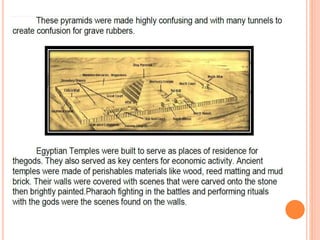
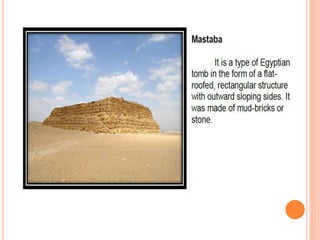
    EXPRESSION TAOLMAEN, WHICH MEANS “STONE TABLE”.THESE STRUCTURES ARE IN A FORM OF TABLE CONSISTING OF TWO HUGE STANDING STONES SUPPORTING A HORIZONTAL GIANT STONE. IT IS BELIEVED THAT IT SERVED AS GRAVE OR AS AN ALTAR.
  • 92.
    Greek Architecture Temples consistedof a central shrine or room in an aisle surrounded by rows of columns. These buildings were designed in one of three architectural style or orders: DORIC IONIC CORINTHIAN
  • 93.
  • 94.
  • 95.
  • 98.
    ROMAN ARCHITECTURE  Theybuilt sturdy stone structures both for use and to perpetuate their glory.  The emperor erected huge halls and arenas for public games, baths and processions They built them of gigantic arches of stone, bricks and concrete or with barrel vaults.
  • 102.
    BYZANTINE ARCHITECTURE  Ithas a lot in common with the early Christian architecture.  Mosaic decoration was perfected by the Byzantines, as was the use of clerestory to bring light in from high windows.  Byzantine's advancement in developing the dome created a new style in global architecture.
  • 103.
    Hagia Sophia means“Holy Wisdom”. It narrates how a magnificent construction transformed from being a church, into a mosque and what is now known as the Hagia Sophia museum. One of the biggest domes ever created with 108 feet in diameter and because of its grand size it can still be seen from miles away.
  • 105.
    ROMANESQUE ARCHITECTURE  Romanesquearchitecture displayed solid masonry walls, rounded arches and masonry vaults. It is the period of great building activities in Europe, castles, churches, monasteries arose everywhere.  The doorways of Romanesque’s churches are often grand sculptured portals. Wood or metal doors are surrounded by elaborate stone sculpture arranged in zones to fit architectural elements.
  • 106.
    THE GROIN-VAULTED CRYPTOF WORCESTER CATHEDRAL
  • 107.
    GOTHIC ARCHITECTURE  Thisdesign included two new devices: pointed arch which enabled builders to construct much higher ceiling vaults and stone vaulting borne on a network of stone ribs supported by piers and clustered pillars.
  • 108.
    Cathedral of Chartres,a.k.a. the Notre dame Cathedral (1145- 1260)  - Has rich architecture and design  - Splendid stained glass windows  - Thousands of sculptured figures
  • 127.
  • 129.
    1. These arelargely placed mosaics on the walls of the churches that follows a strict frontal pose. 2. It emphasizes the importance of life after death
  • 130.
    3. They usethe three architectural designs such as Ionic, Doric and Corinthian. 4. Paintings were found inside the caves. 5. Most of the paintings in this era were copied or imitated from Hellenic Greek paintings.
  • 131.
    6. Paintings duringthe classical era were most commonly found in vases, panels and tomb. 7. The lively styles of paintings which had been invented in Greek and Rome lived on in Byzantium but this time for Christian subjects
  • 132.
    . 8. Drawings ofanimals were found in Cave of Lascaux 9. The purpose of this paintings is to make the deceased afterlife place pleasant 10. These paintings were the first who used the encaustic and fresco method.
  • 133.
    IDENTIFICATION 1. created totransform the vast stone interiors with warm and glowing color and at the same time to instruct Christians in their faith. 2. It is a picture or a diagram made with pencil, pen, or crayon rather than paint. 3. It is the practice of applying paint, pigment, color or other medium to a solid surface.
  • 134.
    4. It isan art process where an image is created using an assemblage of small pieces of colored glass, stones, or other materials. 5. paintings on flat panels of wood, can be either a small, single piece or several panels joined together.
  • 136.
    1. Symbolisms wereheavily used to represent the gods during Medieval Era. 2. Pre-historic art was classified into three functions: used in the home furniture, jewelry, musical instruments, and many more; second, art was used with the dead – tombs, masks. 3. Romanesque art was purposely made to glorify the Christian religion and to express its mystery. 4. Roman art is a complete realization of religious and social functions that have an architectural program with a rich sculptural decoration. 5. The figures of resurrection of Mary were given into patterns that are livelier and more realistic.
  • 138.
    TRUE OR FALSE 1. They usedpointed arch which enabled builders to construct much higher ceiling vaults in Romanesque Architecture. 2. The emperors of Egypt erected huge halls & arenas for public games, baths & procession . 3. Romanesque sculpture are famous sculptural pieces are reliquaries, altar frontals, crucifixes, and devotional images. 4. Gothic sculpture have a greater freedom of style. 5. Dominant features were large animals native to the region in Byzantine Painting. 6. Romans imitated or copied the Hellenic Greek Paintings of Greek Art. 7. The structure of Egyptian architecture has thick sloping walls with several openings to obtain stability. 8. Greek paintings can be in found in vase, panel and tomb/wall. 9. They show profile of an animal or person in Pre Historic Painting. 10. Megaliths are made of huge stone blocks which were probably intended for burial. .
  • 149.
    IDENTIFICATION 1. created totransform the vast stone interiors with warm and glowing color and at the same time to instruct Christians in their faith. 2. also referred to as Kerch Vases are red-figured pottery named after the place where it was found. 3. developed to use by Greek ship builders, who used the hot wax to fill the cracks of the ship. Soon pigments (colors) was added and used to paint a wax hull. 4. It is an art process where an image is created using an assemblage of small pieces of colored glass, stones, or other materials. 5. paintings on flat panels of wood, can be either a small, single piece or several panels joined together.
  • 150.
    SCULPTURE 6. Their sculptureshad finally evolved and showed all the points of human anatomy and proportion. 7. Empty spaces were filled with figures or hieroglyphics. 8. Most of the sculptures are made of monumental terra- cotta. 9. Some of the famous sculptural pieces are reliquaries, altar frontals, crucifixes, and devotional images 10. Sculptures no longer lay closely against the wall, but begun to project outward.
  • 151.
    ARCHITECTURE 11. They developedthe dome, a new style in global architecture. 12. They use the three architectural designs such as Ionic, Doric and Corinthian. 13. Man developed a new form of architecture by using megaliths. 14. The structure has thick sloping walls with few openings to obtain stability. 15. They built sturdy stone structures both for use and to perpetuate their glory.
  • 152.
    IDENTIFY THE FOLLOWINGARTWORKS:  1.
  • 153.
  • 154.
  • 155.
  • 156.
  • 157.
  • 158.
  • 159.
  • 160.
  • 161.