Pre-Test
Instructions:
Choose the best answer for
each question.
Write the letter of your choice
on the provided answer sheet.
Pre-Test
1. Which part of a news report
contains the most important
information?
a) Headline c) Body
b) Lead Paragraph d) Tail
Pre-Test
2. What does the 'WHO' in the 5Ws
of news reporting refer to?
a) The location of the event
b) The person involved
c) The reason it happened
d) The time it occurred
Pre-Test
3. What type of speech is designed
to convince the audience to take
action?
a) Informative c) Entertainment
b) Demonstrative d) Persuasive
Pre-Test
4. Which type of speech provides a
step-by-step guide on how to do
something?
a) Persuasive c) Informative
b) Demonstrative d) Entertainment
Pre-Test
5) Which of the following is an
example of an informative speech
topic?
a) How to cook spaghetti
b) The importance of recycling
c) A funny story from school
d) Why you should vote
Pre-Test
6. In a panel discussion, which of the
following should be avoided?
a) Planning questions ahead of time
b) Keeping the panel small and focused
c) Ensuring everyone has a chance to
speak
d) Dominating the discussion with your
own views
Pre-Test
7. What is the main purpose of a news
headline?
a) To provide detailed information
b) To capture the reader’s attention
c) To conclude the article
d) To give background information
Pre-Test
8. Which speech purpose is most
likely used at a comedy show?
a) Persuasive
b) Informative
c) Entertainment
d) Demonstrative
Pre-Test
9.Which of the following best describes
the 'Body' of a news report?
a) It gives the headline
b) It contains the most important
information
c) It provides more details and
explanations
d) It concludes the story
Pre-Test
10. Which of the following questions should a
persuasive speech answer?
a) What is the speaker trying to convince the
audience to do?
b) What happened and when?
c) Who is involved and where did it take
place?
d) How can the information be verified?
Pre-Test
11) What type of speech aims to
teach the audience something?
a) Persuasive c) Entertainment
b) Demonstrative d) Informative
Pre-Test
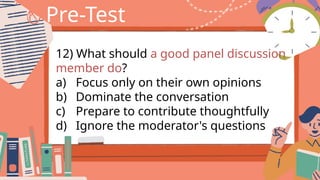
12) What should a good panel discussion
member do?
a) Focus only on their own opinions
b) Dominate the conversation
c) Prepare to contribute thoughtfully
d) Ignore the moderator's questions
Pre-Test
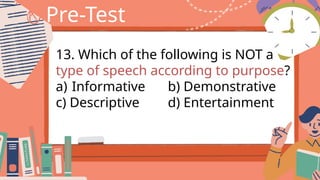
13. Which of the following is NOT a
type of speech according to purpose?
a) Informative b) Demonstrative
c) Descriptive d) Entertainment
Pre-Test
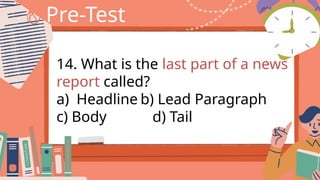
14. What is the last part of a news
report called?
a) Headline b) Lead Paragraph
c) Body d) Tail
Pre-Test
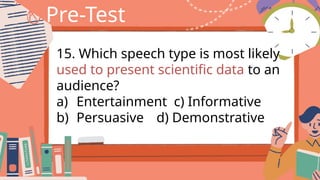
15. Which speech type is most likely
used to present scientific data to an
audience?
a) Entertainment c) Informative
b) Persuasive d) Demonstrative
Pre-Test
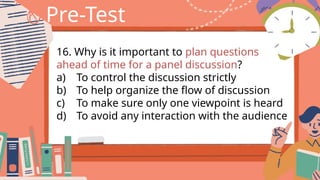
16. Why is it important to plan questions
ahead of time for a panel discussion?
a) To control the discussion strictly
b) To help organize the flow of discussion
c) To make sure only one viewpoint is heard
d) To avoid any interaction with the audience
Pre-Test
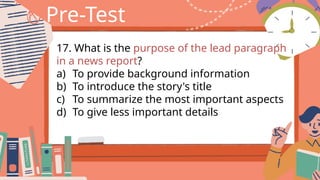
17. What is the purpose of the lead paragraph
in a news report?
a) To provide background information
b) To introduce the story's title
c) To summarize the most important aspects
d) To give less important details
Pre-Test
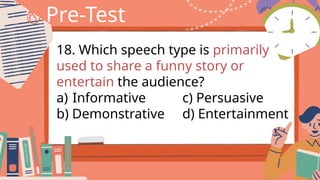
18. Which speech type is primarily
used to share a funny story or
entertain the audience?
a) Informative c) Persuasive
b) Demonstrative d) Entertainment
Pre-Test
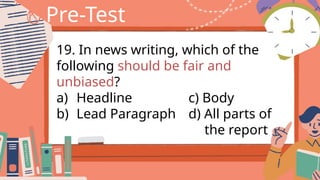
19. In news writing, which of the
following should be fair and
unbiased?
a) Headline c) Body
b) Lead Paragraph d) All parts of
the report
Pre-Test
20) What is a panel discussion?
a) A one-on-one interview
b) A meeting where only one person speaks
c) A discussion with multiple people sharing
views on a topic
d) A monologue presented to an audience
Answer for Pre-Test
Here is the answer key for the
20-item multiple-choice
diagnostic test:
Answer for Pre-Test
1. b) Lead Paragraph
2. b) The person involved
3. d) Persuasive
4. b) Demonstrative
5. b) The importance of recycling
Answer for Pre-Test
6. d) Dominating the discussion with your own
views
7. b) To capture the reader’s attention
8. c) Entertainment
9. c) It provides more details and explanations
10. a) What is the speaker trying to convince the
audience to do?
Answer for Pre-Test
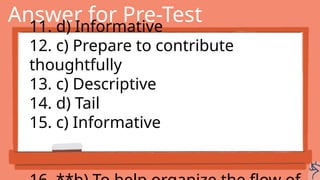
11. d) Informative
12. c) Prepare to contribute
thoughtfully
13. c) Descriptive
14. d) Tail
15. c) Informative
Answer for Pre-Test
15. c) Informative
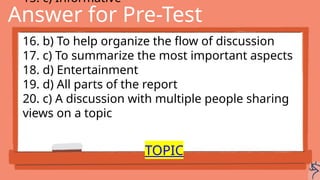
16. b) To help organize the flow of discussion
17. c) To summarize the most important aspects
18. d) Entertainment
19. d) All parts of the report
20. c) A discussion with multiple people sharing
views on a topic
TOPIC
z
INFORMATION FROM
VARIOUS SOURCES
ENGLISH 10
QUARTER 1
LESSON 1
PRE-TEST
OBJECTIVES
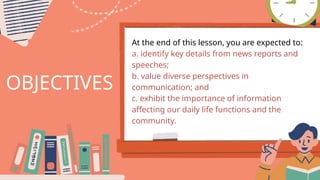
At the end of this lesson, you are expected to:
a. identify key details from news reports and
speeches;
b. value diverse perspectives in
communication; and
c. exhibit the importance of information
affecting our daily life functions and the
community.
Reading
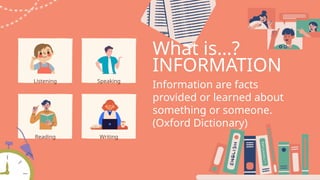
What is…?
INFORMATION
Information are facts
provided or learned about
something or someone.
(Oxford Dictionary)
Listening Speaking
Writing
INFORMATION
Students like you can get
relevant information from
different sources, such as NEWS
REPORT, SPEECHES,
INFORMATIVE TALKS, & PANEL
DISCUSSIONS
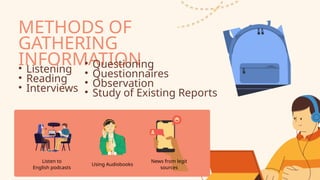
METHODS OF
GATHERING
INFORMATION
• Listening
• Reading
• Interviews
Listen to
English podcasts
Using Audiobooks
News from legit
sources
• Questioning
• Questionnaires
• Observation
• Study of Existing Reports
NEWS
REPORT
News Reports are found in
newspaper, television, or radios
which aim to inform the readers of
what is happening in the world
around them
NEWS
REPORT
News Reports are found
in newspaper, television,
or radios which aim to
inform the readers of
what is happening in the
world around them
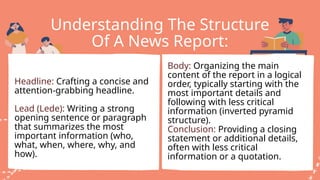
Understanding The Structure
Of A News Report:
Headline: Crafting a concise and
attention-grabbing headline.
Lead (Lede): Writing a strong
opening sentence or paragraph
that summarizes the most
important information (who,
what, when, where, why, and
how).
Body: Organizing the main
content of the report in a logical
order, typically starting with the
most important details and
following with less critical
information (inverted pyramid
structure).
Conclusion: Providing a closing
statement or additional details,
often with less critical
information or a quotation.
Here are some examples of headlines from Philippine news outlets:
1. Typhoon Egay batters Northern Luzon, thousands evacuated
- This type of headline reports on a natural disaster affecting a
specific region in the Philippines.
2. "PH economy grows by 7.6% in Q2, outpaces ASEAN peers"
- This headline discusses economic performance, comparing the
Philippines to neighboring countries.
3. "PBBM urges Filipinos to cooperate in fight against illegal drugs"

- A headline featuring a statement or call to action from the
President of the Philippines.
4. "Senate approves P5.3-trillion 2024 national budget on final
reading"
- This headline reports on legislative activities, specifically the
approval of the national budget.
5. "Metro Manila traffic worsens as schools reopen for in-person
classes"
- A headline highlighting a social issue, such as traffic congestion
due to school reopening.
6. "Pinay gymnast captures gold in Asian Games, makes history"
- A sports-related headline celebrating a Filipino athlete's
achievement.
achievement.
7. "COMELEC releases official list of candidates for 2025 elections"
- This headline is about electoral preparations and upcoming
political events.
These headlines are concise and focus on delivering the main point
of the news story, typical of Philippine journalism.
Bregman, S. (2024,
August 3). Carlos Yulo
delivers clutch
routine for historic
floor exercise gold
medal. Olympics.
https://olympics.com/
en/news/carlos-yulo-
delivers-clutch-
routine-for-historic-
floor-exercise-gold-
medal
FACTS
Facts are statements that can
be proven true or false based
on evidence or observation.
They are objective and
verifiable.
OPINIONS
Opinions are statements that
reflect personal beliefs, feelings,
or thoughts, and cannot be
proven true or false. They are
subjective and based on
individual perspectives.
Example:
Fact: Carlos Yulo won a gold
medal in the floor exercise at the
2024 Paris Olympics.
Opinion: Carlos Yulo is the most
talented gymnast in the world.
Explanation:
The fact can be verified by
checking official Olympic
records, while the opinion is a
personal judgment that others
may or may not agree with.
DEVELOPING NEWS
GATHERING SKILLS:
- Learning how to research and
gather credible information
from various sources (e.g.,
interviews, press releases,
official documents).
- Verifying the accuracy and
reliability of sources.
WRITING WITH CLARITY AND
PRECISION
- Using clear, concise
language that is free
from jargon.
- Ensuring that the writing
is easily understandable
by the general public.
HOW TO CREATE NEWS
REPORT
Creating a news report involves several key steps:
1. Choose a Newsworthy Topic
- Identify a recent event or issue that is relevant and
interesting to your audience.
2. Research and Gather Information
- Collect facts, quotes, statistics, and any relevant
details from reliable sources.
HOW TO CREATE NEWS
REPORT
details from reliable sources.
3. Structure Your Report
1. Headline
• What: A brief, attention-grabbing title that
summarizes the main point of the report.
2. Byline
• Who: The name of the author or journalist who wrote
the article.
HOW TO CREATE NEWS
REPORT
3. Lead (or Lede)
• What: The opening sentence or paragraph that
summarizes the most important information of the
news story. It should answer the basic questions:
Who? What? Where? When? Why? and How?
HOW TO CREATE NEWS
REPORT
4. Body
• Details: This is where the story is fleshed out with
more details and background information. The body
should be organized in descending order of
importance (the inverted pyramid structure).
Supporting Information: This includes quotes from
witnesses, experts, or involved parties; additional
facts, statistics, and context.
HOW TO CREATE NEWS
REPORT
5. Quotes
• Who: Direct statements from people involved in or
knowledgeable about the event. Quotes provide a
human perspective and add credibility.
6. Attribution
• Who: The source of any information or quotes. It's
important to credit where information comes from to
maintain transparency and trustworthiness.
HOW TO CREATE NEWS
REPORT
maintain transparency and trustworthiness.
7. Context
• Why: Explanation of why the event or information is
important, providing background to help readers
understand the significance of the report.
8. Conclusion
• What: Often a wrap-up of the story, sometimes
including what might happen next or the current
status of the situation.
HOW TO CREATE NEWS
REPORT
9. Photos or Images (if applicable)Visuals: Images
related to the news event that can help illustrate the
story or provide additional context.
10. Caption
• What: A brief description accompanying a photo,
explaining what the image shows.
HOW TO CREATE NEWS
REPORT
11. Date and Time
• When: When the event happened and when the
report was published. This is important for the
timeliness of the news.
12. Location
• Where: Where the event took place. This helps readers
understand the geographic context of the news.
HOW TO CREATE NEWS
REPORT
4. Use Clear and Objective Language
- Stick to the facts and avoid inserting personal opinions.
5. Edit and Revise
- Review your report for clarity, accuracy, and
conciseness.
Example Outline:
HOW TO CREATE NEWS
REPORT
Example Outline:
- Headline: Typhoon Egay Strikes Northern Luzon,
Thousands Evacuated
- Lead: Typhoon Egay made landfall in Northern Luzon
early Monday morning, prompting the evacuation of
over 10,000 residents.
- Body: The storm, classified as a Category 4 typhoon,
brought winds of up to 180 kph and heavy rainfall,
HOW TO CREATE NEWS
REPORT
- Body: The storm, classified as a Category 4 typhoon,
brought winds of up to 180 kph and heavy rainfall,
leading to widespread flooding and power outages.
Local authorities have set up evacuation centers...
- Conclusion: With more storms predicted to hit the
region this season, authorities are urging residents to
stay prepared.
This outline helps ensure that the news report is
HOW TO CREATE NEWS
REPORT
This outline helps ensure that the news report is
informative, clear, and well-organized.
DO YOU HAVE
ANY
QUESTIONS?
ALL ANSWER SHOULD BE IN SENTENCE
FORM. (Learn to construct a sentence)
1. Define News Report?
2. What are the key details of news report?
3. Give the characteristics of a Headline.
4. Why is factual information important in
writing news report?
QUIZ: Short Essay: ½ CW
Research a recent event and write a complete news
report, including a headline, head, body, and
conclusion. (1 whole, clean paper or yellow paper)
• Write your news report on a long sheet of paper.
(Printed or Handwritten will both be accepted)
• Do not copy from the internet
• If photos are included, provide proper citation.
• AI-generated answers shall be recognized.
ASSIGNMENT: Deadline - WEDNESDAY
SPEECH
A speech is a formal address
or discourse delivered to an
audience. It is a way of
communicating ideas,
opinions, or information
orally.
SPEECH
Speeches are often
structured and follow a
specific format to
effectively convey the
speaker’s message.
Components of a Speech
Introduction: This is where the
speaker grabs the audience's
attention, introduces the
topic, and provides a preview
of what will be discussed.
Body: The main part of the
speech, where the speaker
elaborates on key points,
provides evidence, and
develops the argument or
narrative.
Conclusion: The closing part,
where the speaker
summarizes the main points
and leaves the audience with
a lasting impression or a call
to action.
Key Details of Speeches
Thesis Statement: The
central idea or message of
the speech.
Supporting Details:
Evidence, examples, and
explanations that back up
the thesis.
Transition: Words or phrases
that help the speech flow
smoothly from one point to
the next.
Rhetorical Devices:
Techniques like metaphors,
repetition, and rhetorical
questions used to enhance
the speech and make it more
impactful.
Examples of Thesis Statement
Informative Speech: "Today, I
will explain the importance of
renewable energy and how it
can help combat climate
change.”
Persuasive Speech: "We must
adopt a plant-based diet not
only for our health but also to
protect the environment and
reduce animal suffering."
Entertaining Speech: "The
quirks and challenges of
growing up in a large family
have taught me valuable life
lessons that I’ll share with you
today.”
Inspirational Speech: "No
matter how many times life
knocks you down, resilience
and perseverance are the keys
to achieving your dreams."
Types of Speech
Informative: To provide
information and educate
the audience on a particular
topic.
Persuasive: To convince the
audience to adopt a
particular viewpoint or take
a specific action.
Entertaining: To amuse and
engage the audience, often
using humor or storytelling.
Inspirational: To motivate
and inspire the audience,
often through sharing
personal experiences or
powerful messages.
THANK
YOU!

Q1 L1 Information from Various Sources.pptx

  • 1.
    Pre-Test Instructions: Choose the bestanswer for each question. Write the letter of your choice on the provided answer sheet.
  • 2.
    Pre-Test 1. Which partof a news report contains the most important information? a) Headline c) Body b) Lead Paragraph d) Tail
  • 3.
    Pre-Test 2. What doesthe 'WHO' in the 5Ws of news reporting refer to? a) The location of the event b) The person involved c) The reason it happened d) The time it occurred
  • 4.
    Pre-Test 3. What typeof speech is designed to convince the audience to take action? a) Informative c) Entertainment b) Demonstrative d) Persuasive
  • 5.
    Pre-Test 4. Which typeof speech provides a step-by-step guide on how to do something? a) Persuasive c) Informative b) Demonstrative d) Entertainment
  • 6.
    Pre-Test 5) Which ofthe following is an example of an informative speech topic? a) How to cook spaghetti b) The importance of recycling c) A funny story from school d) Why you should vote
  • 7.
    Pre-Test 6. In apanel discussion, which of the following should be avoided? a) Planning questions ahead of time b) Keeping the panel small and focused c) Ensuring everyone has a chance to speak d) Dominating the discussion with your own views
  • 8.
    Pre-Test 7. What isthe main purpose of a news headline? a) To provide detailed information b) To capture the reader’s attention c) To conclude the article d) To give background information
  • 9.
    Pre-Test 8. Which speechpurpose is most likely used at a comedy show? a) Persuasive b) Informative c) Entertainment d) Demonstrative
  • 10.
    Pre-Test 9.Which of thefollowing best describes the 'Body' of a news report? a) It gives the headline b) It contains the most important information c) It provides more details and explanations d) It concludes the story
  • 11.
    Pre-Test 10. Which ofthe following questions should a persuasive speech answer? a) What is the speaker trying to convince the audience to do? b) What happened and when? c) Who is involved and where did it take place? d) How can the information be verified?
  • 12.
    Pre-Test 11) What typeof speech aims to teach the audience something? a) Persuasive c) Entertainment b) Demonstrative d) Informative
  • 13.
    Pre-Test 12) What shoulda good panel discussion member do? a) Focus only on their own opinions b) Dominate the conversation c) Prepare to contribute thoughtfully d) Ignore the moderator's questions
  • 14.
    Pre-Test 13. Which ofthe following is NOT a type of speech according to purpose? a) Informative b) Demonstrative c) Descriptive d) Entertainment
  • 15.
    Pre-Test 14. What isthe last part of a news report called? a) Headline b) Lead Paragraph c) Body d) Tail
  • 16.
    Pre-Test 15. Which speechtype is most likely used to present scientific data to an audience? a) Entertainment c) Informative b) Persuasive d) Demonstrative
  • 17.
    Pre-Test 16. Why isit important to plan questions ahead of time for a panel discussion? a) To control the discussion strictly b) To help organize the flow of discussion c) To make sure only one viewpoint is heard d) To avoid any interaction with the audience
  • 18.
    Pre-Test 17. What isthe purpose of the lead paragraph in a news report? a) To provide background information b) To introduce the story's title c) To summarize the most important aspects d) To give less important details
  • 19.
    Pre-Test 18. Which speechtype is primarily used to share a funny story or entertain the audience? a) Informative c) Persuasive b) Demonstrative d) Entertainment
  • 20.
    Pre-Test 19. In newswriting, which of the following should be fair and unbiased? a) Headline c) Body b) Lead Paragraph d) All parts of the report
  • 21.
    Pre-Test 20) What isa panel discussion? a) A one-on-one interview b) A meeting where only one person speaks c) A discussion with multiple people sharing views on a topic d) A monologue presented to an audience
  • 22.
    Answer for Pre-Test Hereis the answer key for the 20-item multiple-choice diagnostic test:
  • 23.
    Answer for Pre-Test 1.b) Lead Paragraph 2. b) The person involved 3. d) Persuasive 4. b) Demonstrative 5. b) The importance of recycling
  • 24.
    Answer for Pre-Test 6.d) Dominating the discussion with your own views 7. b) To capture the reader’s attention 8. c) Entertainment 9. c) It provides more details and explanations 10. a) What is the speaker trying to convince the audience to do?
  • 25.
    Answer for Pre-Test 11.d) Informative 12. c) Prepare to contribute thoughtfully 13. c) Descriptive 14. d) Tail 15. c) Informative
  • 26.
    Answer for Pre-Test 15.c) Informative 16. b) To help organize the flow of discussion 17. c) To summarize the most important aspects 18. d) Entertainment 19. d) All parts of the report 20. c) A discussion with multiple people sharing views on a topic TOPIC
  • 27.
    z INFORMATION FROM VARIOUS SOURCES ENGLISH10 QUARTER 1 LESSON 1 PRE-TEST
  • 28.
    OBJECTIVES At the endof this lesson, you are expected to: a. identify key details from news reports and speeches; b. value diverse perspectives in communication; and c. exhibit the importance of information affecting our daily life functions and the community.
  • 29.
    Reading What is…? INFORMATION Information arefacts provided or learned about something or someone. (Oxford Dictionary) Listening Speaking Writing
  • 30.
    INFORMATION Students like youcan get relevant information from different sources, such as NEWS REPORT, SPEECHES, INFORMATIVE TALKS, & PANEL DISCUSSIONS
  • 31.
    METHODS OF GATHERING INFORMATION • Listening •Reading • Interviews Listen to English podcasts Using Audiobooks News from legit sources • Questioning • Questionnaires • Observation • Study of Existing Reports
  • 32.
    NEWS REPORT News Reports arefound in newspaper, television, or radios which aim to inform the readers of what is happening in the world around them
  • 33.
    NEWS REPORT News Reports arefound in newspaper, television, or radios which aim to inform the readers of what is happening in the world around them
  • 34.
    Understanding The Structure OfA News Report: Headline: Crafting a concise and attention-grabbing headline. Lead (Lede): Writing a strong opening sentence or paragraph that summarizes the most important information (who, what, when, where, why, and how). Body: Organizing the main content of the report in a logical order, typically starting with the most important details and following with less critical information (inverted pyramid structure). Conclusion: Providing a closing statement or additional details, often with less critical information or a quotation.
  • 35.
    Here are someexamples of headlines from Philippine news outlets: 1. Typhoon Egay batters Northern Luzon, thousands evacuated - This type of headline reports on a natural disaster affecting a specific region in the Philippines. 2. "PH economy grows by 7.6% in Q2, outpaces ASEAN peers" - This headline discusses economic performance, comparing the Philippines to neighboring countries. 3. "PBBM urges Filipinos to cooperate in fight against illegal drugs" - A headline featuring a statement or call to action from the President of the Philippines.
  • 36.
    4. "Senate approvesP5.3-trillion 2024 national budget on final reading" - This headline reports on legislative activities, specifically the approval of the national budget. 5. "Metro Manila traffic worsens as schools reopen for in-person classes" - A headline highlighting a social issue, such as traffic congestion due to school reopening. 6. "Pinay gymnast captures gold in Asian Games, makes history" - A sports-related headline celebrating a Filipino athlete's achievement.
  • 37.
    achievement. 7. "COMELEC releasesofficial list of candidates for 2025 elections" - This headline is about electoral preparations and upcoming political events. These headlines are concise and focus on delivering the main point of the news story, typical of Philippine journalism.
  • 38.
    Bregman, S. (2024, August3). Carlos Yulo delivers clutch routine for historic floor exercise gold medal. Olympics. https://olympics.com/ en/news/carlos-yulo- delivers-clutch- routine-for-historic- floor-exercise-gold- medal
  • 42.
    FACTS Facts are statementsthat can be proven true or false based on evidence or observation. They are objective and verifiable.
  • 43.
    OPINIONS Opinions are statementsthat reflect personal beliefs, feelings, or thoughts, and cannot be proven true or false. They are subjective and based on individual perspectives.
  • 44.
    Example: Fact: Carlos Yulowon a gold medal in the floor exercise at the 2024 Paris Olympics. Opinion: Carlos Yulo is the most talented gymnast in the world.
  • 45.
    Explanation: The fact canbe verified by checking official Olympic records, while the opinion is a personal judgment that others may or may not agree with.
  • 46.
    DEVELOPING NEWS GATHERING SKILLS: -Learning how to research and gather credible information from various sources (e.g., interviews, press releases, official documents). - Verifying the accuracy and reliability of sources.
  • 47.
    WRITING WITH CLARITYAND PRECISION - Using clear, concise language that is free from jargon. - Ensuring that the writing is easily understandable by the general public.
  • 48.
    HOW TO CREATENEWS REPORT Creating a news report involves several key steps: 1. Choose a Newsworthy Topic - Identify a recent event or issue that is relevant and interesting to your audience. 2. Research and Gather Information - Collect facts, quotes, statistics, and any relevant details from reliable sources.
  • 49.
    HOW TO CREATENEWS REPORT details from reliable sources. 3. Structure Your Report 1. Headline • What: A brief, attention-grabbing title that summarizes the main point of the report. 2. Byline • Who: The name of the author or journalist who wrote the article.
  • 50.
    HOW TO CREATENEWS REPORT 3. Lead (or Lede) • What: The opening sentence or paragraph that summarizes the most important information of the news story. It should answer the basic questions: Who? What? Where? When? Why? and How?
  • 51.
    HOW TO CREATENEWS REPORT 4. Body • Details: This is where the story is fleshed out with more details and background information. The body should be organized in descending order of importance (the inverted pyramid structure). Supporting Information: This includes quotes from witnesses, experts, or involved parties; additional facts, statistics, and context.
  • 52.
    HOW TO CREATENEWS REPORT 5. Quotes • Who: Direct statements from people involved in or knowledgeable about the event. Quotes provide a human perspective and add credibility. 6. Attribution • Who: The source of any information or quotes. It's important to credit where information comes from to maintain transparency and trustworthiness.
  • 53.
    HOW TO CREATENEWS REPORT maintain transparency and trustworthiness. 7. Context • Why: Explanation of why the event or information is important, providing background to help readers understand the significance of the report. 8. Conclusion • What: Often a wrap-up of the story, sometimes including what might happen next or the current status of the situation.
  • 54.
    HOW TO CREATENEWS REPORT 9. Photos or Images (if applicable)Visuals: Images related to the news event that can help illustrate the story or provide additional context. 10. Caption • What: A brief description accompanying a photo, explaining what the image shows.
  • 55.
    HOW TO CREATENEWS REPORT 11. Date and Time • When: When the event happened and when the report was published. This is important for the timeliness of the news. 12. Location • Where: Where the event took place. This helps readers understand the geographic context of the news.
  • 56.
    HOW TO CREATENEWS REPORT 4. Use Clear and Objective Language - Stick to the facts and avoid inserting personal opinions. 5. Edit and Revise - Review your report for clarity, accuracy, and conciseness. Example Outline:
  • 57.
    HOW TO CREATENEWS REPORT Example Outline: - Headline: Typhoon Egay Strikes Northern Luzon, Thousands Evacuated - Lead: Typhoon Egay made landfall in Northern Luzon early Monday morning, prompting the evacuation of over 10,000 residents. - Body: The storm, classified as a Category 4 typhoon, brought winds of up to 180 kph and heavy rainfall,
  • 58.
    HOW TO CREATENEWS REPORT - Body: The storm, classified as a Category 4 typhoon, brought winds of up to 180 kph and heavy rainfall, leading to widespread flooding and power outages. Local authorities have set up evacuation centers... - Conclusion: With more storms predicted to hit the region this season, authorities are urging residents to stay prepared. This outline helps ensure that the news report is
  • 59.
    HOW TO CREATENEWS REPORT This outline helps ensure that the news report is informative, clear, and well-organized.
  • 60.
  • 61.
    ALL ANSWER SHOULDBE IN SENTENCE FORM. (Learn to construct a sentence) 1. Define News Report? 2. What are the key details of news report? 3. Give the characteristics of a Headline. 4. Why is factual information important in writing news report? QUIZ: Short Essay: ½ CW
  • 62.
    Research a recentevent and write a complete news report, including a headline, head, body, and conclusion. (1 whole, clean paper or yellow paper) • Write your news report on a long sheet of paper. (Printed or Handwritten will both be accepted) • Do not copy from the internet • If photos are included, provide proper citation. • AI-generated answers shall be recognized. ASSIGNMENT: Deadline - WEDNESDAY
  • 63.
    SPEECH A speech isa formal address or discourse delivered to an audience. It is a way of communicating ideas, opinions, or information orally.
  • 64.
    SPEECH Speeches are often structuredand follow a specific format to effectively convey the speaker’s message.
  • 65.
    Components of aSpeech Introduction: This is where the speaker grabs the audience's attention, introduces the topic, and provides a preview of what will be discussed. Body: The main part of the speech, where the speaker elaborates on key points, provides evidence, and develops the argument or narrative. Conclusion: The closing part, where the speaker summarizes the main points and leaves the audience with a lasting impression or a call to action.
  • 66.
    Key Details ofSpeeches Thesis Statement: The central idea or message of the speech. Supporting Details: Evidence, examples, and explanations that back up the thesis. Transition: Words or phrases that help the speech flow smoothly from one point to the next. Rhetorical Devices: Techniques like metaphors, repetition, and rhetorical questions used to enhance the speech and make it more impactful.
  • 67.
    Examples of ThesisStatement Informative Speech: "Today, I will explain the importance of renewable energy and how it can help combat climate change.” Persuasive Speech: "We must adopt a plant-based diet not only for our health but also to protect the environment and reduce animal suffering." Entertaining Speech: "The quirks and challenges of growing up in a large family have taught me valuable life lessons that I’ll share with you today.” Inspirational Speech: "No matter how many times life knocks you down, resilience and perseverance are the keys to achieving your dreams."
  • 68.
    Types of Speech Informative:To provide information and educate the audience on a particular topic. Persuasive: To convince the audience to adopt a particular viewpoint or take a specific action. Entertaining: To amuse and engage the audience, often using humor or storytelling. Inspirational: To motivate and inspire the audience, often through sharing personal experiences or powerful messages.
  • 69.

Editor's Notes

  • #27 A.
  • #68 Speeches can be categorized based on their purpose, content, and delivery style. Here are some common types of speeches: ### 1. **Informative Speech** - **Purpose:** To educate the audience about a specific topic by presenting facts, data, and explanations. - **Examples:** Lectures, demonstrations, business presentations, or informational talks about new technology. ### 2. **Persuasive Speech** - **Purpose:** To convince the audience to accept a particular viewpoint or take a specific action. - **Examples:** Political speeches, sales pitches, debates, or motivational talks. ### 3. **Entertaining Speech** - **Purpose:** To amuse or entertain the audience while often conveying a message or point. - **Examples:** After-dinner speeches, comedic monologues, or speeches at weddings and social events. ### 4. **Inspirational Speech** - **Purpose:** To motivate or inspire the audience by sharing experiences, insights, or powerful messages. - **Examples:** Commencement addresses, motivational talks, or keynote speeches at conferences. ### 5. **Demonstrative Speech** - **Purpose:** To show the audience how to do something through step-by-step instructions. - **Examples:** Cooking demonstrations, how-to tutorials, or workshops. ### 6. **Special Occasion Speech** - **Purpose:** To commemorate or honor a particular event, person, or occasion. - **Examples:** Toasts, eulogies, award acceptance speeches, or speeches at inaugurations. ### 7. **Impromptu Speech** - **Purpose:** Delivered without prior preparation, usually in response to an unexpected situation or question. - **Examples:** Responses during a Q&A session, sudden requests to speak at a meeting, or speaking at a social gathering. ### 8. **Expository Speech** - **Purpose:** To explain a concept, theory, or process in a detailed and clear manner. - **Examples:** Scientific presentations, technical briefings, or educational talks on complex subjects. ### 9. **Debate Speech** - **Purpose:** To argue a position on a specific issue, often against an opposing viewpoint, using evidence and reasoning. - **Examples:** Formal debate competitions, panel discussions, or parliamentary debates. ### 10. **Extemporaneous Speech** - **Purpose:** Delivered with some preparation but without a fully written script, allowing for flexibility in delivery. - **Examples:** Business presentations, classroom presentations, or speeches at community events. Each type of speech requires different preparation and delivery techniques, depending on the audience, occasion, and desired outcome.