What is aNews Report?
- News reports are found in newspapers
and their purpose is to inform readers of what
is happening in the world around them. News
reports have a certain structure that you
need to follow.
3.
What is aNews Report?
- News reports are found in newspapers
and their purpose is to inform readers of what
is happening in the world around them. News
reports have a certain structure that you
need to follow.
6.
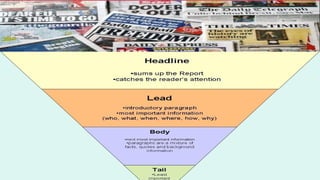
HEADLINE
- is theheading at the top of an
article or page in a newspaper or
magazine
LEAD / LEADPARAGRAPH
- informs the reader of the most
important aspects of the story as
soon as possible.
9.
LEAD / LEADPARAGRAPH
- Use the 5Ws rule:
• WHO (is involved)
• WHAT (took place)
• WHEN (did it take place)
• WHERE (did it take place)
• WHY (did it happen)
• HOW (did it happen) – only include this if there is space
11.
BODY
- gives moredetails and provides
more information about the WHY
and HOW of the story.
12.
TAIL
- contains theless important
information which is often omitted by
the newspaper editor if there is not
enough space left in the newspaper.
Key Components ofa Good News Story
- Organization of the news
(presenting information from
most to least important)
21.
Some key elementswhen considering
“newsworthiness” are:
Timing:
if it happened today, it’s news, if
it happened last week, it’s not;
with 24-hour news access,
“breaking” news is important
22.
Some key elementswhen considering
“newsworthiness” are:
Significance:
how many people are affected
23.
Some key elementswhen considering
“newsworthiness” are:
Proximity:
the closer a story hits to home,
the more newsworthy it is
24.
Some key elementswhen considering
“newsworthiness” are:
Prominence:
when famous people are affected,
the story matters (i.e. car accident
involving your family vs. a car
accident involving the President)
25.
Some key elementswhen considering
“newsworthiness” are:
Human Interest: because these stories are
based on emotional appeal, they are meant
to be amusing or to generate empathy or
other emotions. They often appear in special
sections of the newspaper or at the end of the
newscast as a “feel good” story or to draw
attention to something particularly amusing,
quirky, or offbeat
26.
ACTIVITY #2: Readthe following part of the news
story. Identify what part is it.
1. “The million-to-one shot came in. Hell froze
over. A month of Sundays hit
the calendar. Don Larsen today pitched a no-
hit, no-run, no-man-reachfirst
game in a World Series.”
2.Dead Body Found at the Museum: Curator
Suspected
27.
ACTIVITY #2: Readthe following part of the news
story. Identify what part is it.
For items 3-5, briefly describe the factual
content of the story related to the number 1
Write your answer on the answer sheet
provided for you.
3.Who (is involved)?
4.What (took place)?
5.When (did it take place)?
28.
Tips on PresentingYour News:
Use an introduction.
Make sure these sentences are
easy to understand and should
be delivered no longer than 30
seconds.
29.
Tips on PresentingYour News:
Check if you are saying the
names of people and places
correctly.
30.
Tips on PresentingYour News:
When you read your introduction,
speak clearly and be
enthusiastic.
31.
Tips on PresentingYour News:
You can emphasize important
words by pausing before you say
them or saying them a little
louder. Mark these words on your
script so you will not forget.
32.
Tips on PresentingYour News:
Speak in a normal voice.
You don’t have to shout, and you
shouldn’t whisper.
33.
Tips on PresentingYour News:
Stand or sit up straight. Be natural.
Try not to move too much or it will
distract your audience.
34.
Tips on PresentingYour News:
Practice with the camera and
microphone to get used to what it
feels like to present news
Have fun