Python Operators andType
Conversion
Learn key Python operators and type conversion for better coding.
Enhance your program's flow and data handling skills with these
fundamentals.
2.
Arithmetic Operators
Addition (+)
Addstwo values: x + y
Subtraction (-)
Subtracts: x - y
Multiplication (*)
Multiplies: x * y
Division (/)
Divides and returns float: x / y
Floor Division (//)
Integer division: x // y
Modulus (%)
Remainder: x % y
Exponentiation (**)
Power of x: x ** y
3.
Assignment and
Comparison Operators
Assignment(= and +=)
Assign or update variable values
Comparison (==, !=, >, <)
Compare values for conditional logic
• Greater than or equal (>=)
• Less than or equal (<=)
4.
Logical and IdentityOperators
Logical Operators
• and: Returns true if both conditions are true
• or: True if either condition is true
• not: Reverses the truth value
Identity Operators
• is: Checks if objects are the same in memory
• is not: Checks if objects differ
5.
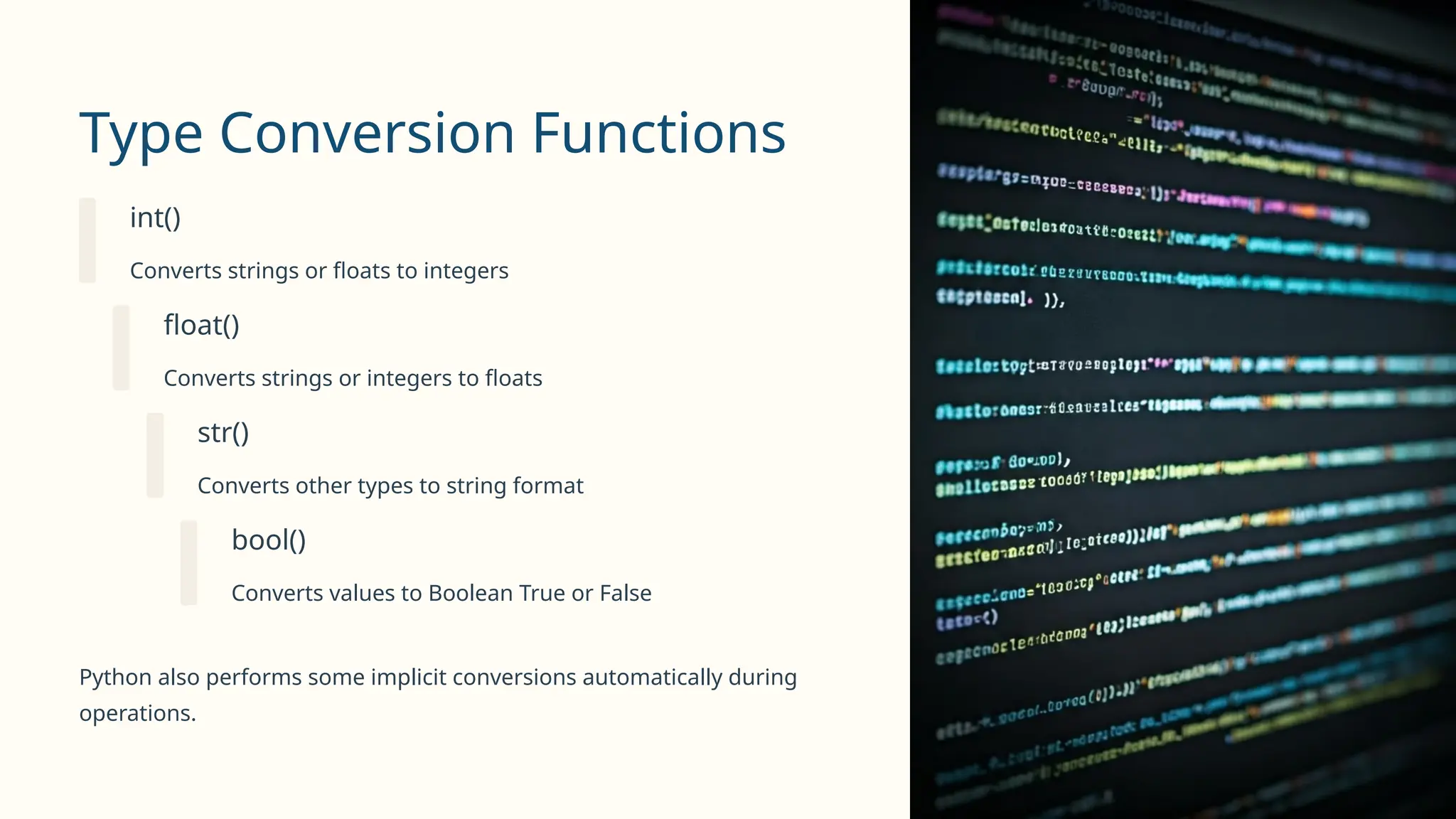
Type Conversion Functions
int()
Convertsstrings or floats to integers
float()
Converts strings or integers to floats
str()
Converts other types to string format
bool()
Converts values to Boolean True or False
Python also performs some implicit conversions automatically during
operations.
6.
Implications and BestPractices
Choose Operators Wisely
Ensure readability and efficiency
Use Explicit Conversion
Clarifies data type changes
Avoid Implicit Pitfalls
Prevents unexpected bugs
Understand Precedence
Write correct expressions
Handle Errors Gracefully
Prevent crashes from type issues


![Coded Agents – with UiPath SDK + LangGraph [Virtual Hands-on Workshop]](https://cdn.slidesharecdn.com/ss_thumbnails/codedagentsdeck-251215155422-5497c599-thumbnail.jpg?width=640&height=640&fit=bounds)


