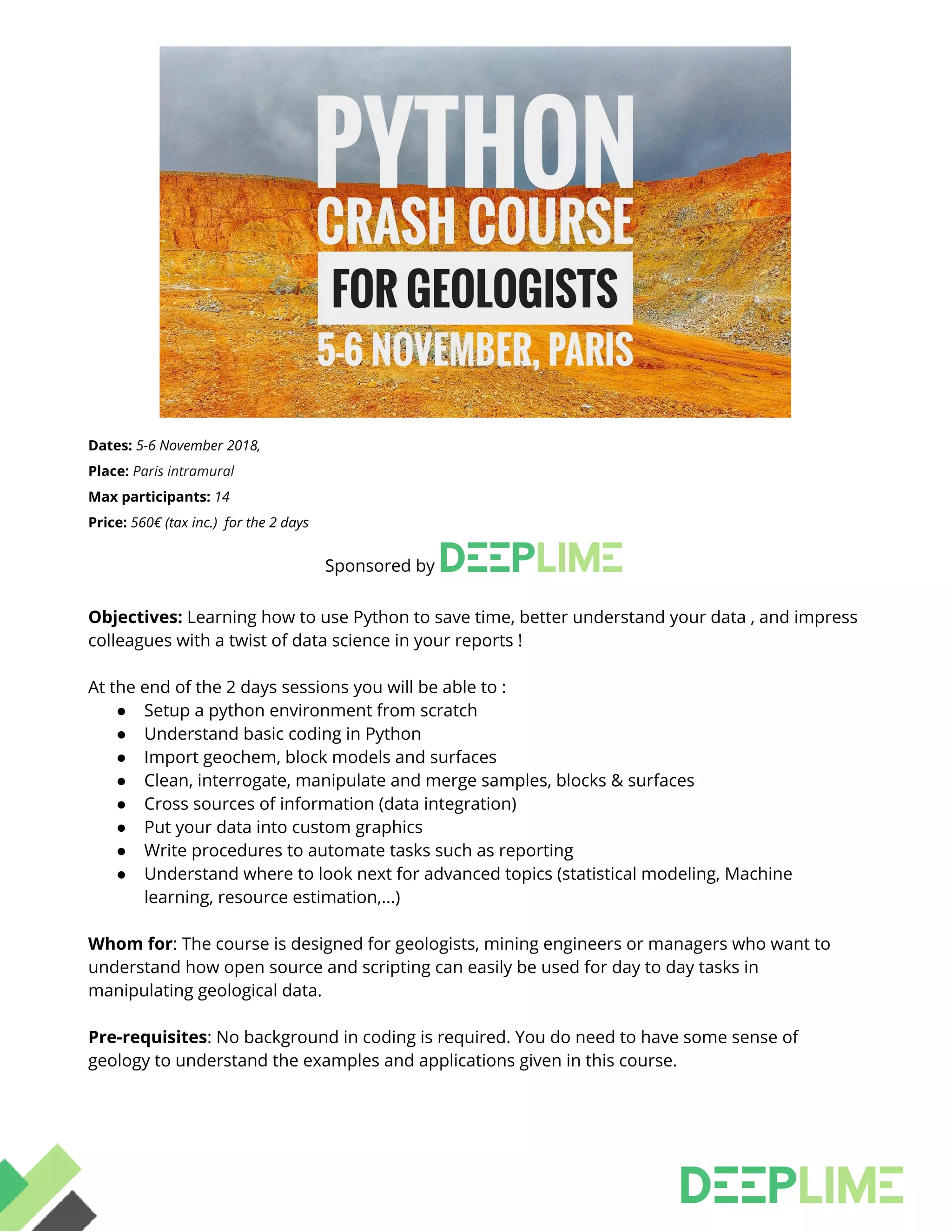
Dates: ​5-6 November 2018, 
Place:​ ​Paris intramural 
Max participants: ​14 
Price: ​560€ (tax inc.) for the 2 days
Sponsored by  
 
Objectives: ​Learning how to use Python to save time, better understand your data , and impress 
colleagues with a twist of data science in your reports !  
 
At the end of the 2 days sessions you will be able to :  
● Setup a python environment from scratch 
● Understand basic coding in Python 
● Import geochem, block models and surfaces 
● Clean, interrogate, manipulate and merge samples, blocks & surfaces 
● Cross sources of information (data integration) 
● Put your data into custom graphics 
● Write procedures to automate tasks such as reporting 
● Understand where to look next for advanced topics (statistical modeling, Machine 
learning, resource estimation,...) 
 
Whom for​: The course is designed for geologists, mining engineers or managers who want to 
understand how open source and scripting can easily be used for day to day tasks in 
manipulating geological data. 
 
Pre-requisites​: No background in coding is required. You do need to have some sense of 
geology to understand the examples and applications given in this course. 
 
 
Lecturers:  
● Laurent Wagner: +10-year in mining industry, MSc. in geostatistics 
● Daniel Hahne: +10-year in Python, PhD in Quantum Physics, Researcher in Machine Learning 
 
 
Agenda 
 
Day 1 - Introduction to Python 
● 9am - 9.30am: Introduction to Python coding 
○ How open source is going to change the mining industry 
○ Why use Python when you are a geologist 
○ Python vs R 
● 9.30am - 10.30am: Before you start coding 
○ Overview of useful libraries 
○ How to set up your computer environment to start coding 
● 10.45m - 12pm: Programming in Python 
○ Loop, if else, try, ... 
○ Dictionary, list…  
○ Pandas dataframe 
○ Deal with geological domain 
● 1pm - 2pm: Getting data in 
○ Load a file and read it 
○ Example on XYZ csv file 
○ Use basic plots using Pandas to QC: histogram, swath-plot, cross-plot, variogram, 
basic 3D. 
● 2pm - 3pm: Your first program - Transforming data 
○ How to deal with drillholes, block models, wireframes & surfaces 
○ Basic data manipulation 
○ Merging files 
○ Data cleaning 
● 3pm-5pm: Open discussions and custom exercises 
 
Day 2 - Data exploration and plotting using Python 
● 9am - 10.30am: Explore a Drillhole file   
○ Clean and select the relevant information 
○ Merge data 
● 10.30am - 12.30pm: Interrogate your data 
○ Understand data through general statistics 
○ Going further with graphics using Seaborn 
● 1.30pm - 3pm: Applications to Model Validation 
○ Writing procedure for automatic reporting: Generates a PDF report with graph and 
texts from a csv data file 
● 3pm-5pm: Open discussions and custom exercises  

Python crash course for geologists in the mining industry

  • 1.
      Dates: ​5-6 November2018,  Place:​ ​Paris intramural  Max participants: ​14  Price: ​560€ (tax inc.) for the 2 days Sponsored by     Objectives: ​Learning how to use Python to save time, better understand your data , and impress  colleagues with a twist of data science in your reports !     At the end of the 2 days sessions you will be able to :   ● Setup a python environment from scratch  ● Understand basic coding in Python  ● Import geochem, block models and surfaces  ● Clean, interrogate, manipulate and merge samples, blocks & surfaces  ● Cross sources of information (data integration)  ● Put your data into custom graphics  ● Write procedures to automate tasks such as reporting  ● Understand where to look next for advanced topics (statistical modeling, Machine  learning, resource estimation,...)    Whom for​: The course is designed for geologists, mining engineers or managers who want to  understand how open source and scripting can easily be used for day to day tasks in  manipulating geological data.    Pre-requisites​: No background in coding is required. You do need to have some sense of  geology to understand the examples and applications given in this course.     
  • 2.
    Lecturers:   ● Laurent Wagner:+10-year in mining industry, MSc. in geostatistics  ● Daniel Hahne: +10-year in Python, PhD in Quantum Physics, Researcher in Machine Learning      Agenda    Day 1 - Introduction to Python  ● 9am - 9.30am: Introduction to Python coding  ○ How open source is going to change the mining industry  ○ Why use Python when you are a geologist  ○ Python vs R  ● 9.30am - 10.30am: Before you start coding  ○ Overview of useful libraries  ○ How to set up your computer environment to start coding  ● 10.45m - 12pm: Programming in Python  ○ Loop, if else, try, ...  ○ Dictionary, list…   ○ Pandas dataframe  ○ Deal with geological domain  ● 1pm - 2pm: Getting data in  ○ Load a file and read it  ○ Example on XYZ csv file  ○ Use basic plots using Pandas to QC: histogram, swath-plot, cross-plot, variogram,  basic 3D.  ● 2pm - 3pm: Your first program - Transforming data  ○ How to deal with drillholes, block models, wireframes & surfaces  ○ Basic data manipulation  ○ Merging files  ○ Data cleaning  ● 3pm-5pm: Open discussions and custom exercises    Day 2 - Data exploration and plotting using Python  ● 9am - 10.30am: Explore a Drillhole file    ○ Clean and select the relevant information  ○ Merge data  ● 10.30am - 12.30pm: Interrogate your data  ○ Understand data through general statistics  ○ Going further with graphics using Seaborn  ● 1.30pm - 3pm: Applications to Model Validation  ○ Writing procedure for automatic reporting: Generates a PDF report with graph and  texts from a csv data file  ● 3pm-5pm: Open discussions and custom exercises