Data Analysis Python For Environmental Science Hayden Van Der Post
Data Analysis Python For Environmental Science Hayden Van Der Post
Data Analysis Python For Environmental Science Hayden Van Der Post
Data Analysis Python For Environmental Science Hayden Van Der Post
Data Analysis Python For Environmental Science Hayden Van Der Post
1.
Data Analysis PythonFor Environmental Science
Hayden Van Der Post download
https://ebookbell.com/product/data-analysis-python-for-
environmental-science-hayden-van-der-post-57813392
Explore and download more ebooks at ebookbell.com
2.
Here are somerecommended products that we believe you will be
interested in. You can click the link to download.
Python For Excel A Modern Environment For Automation And Data Analysis
1st Edition Felix Zumstein
https://ebookbell.com/product/python-for-excel-a-modern-environment-
for-automation-and-data-analysis-1st-edition-felix-zumstein-24683090
Data Analysis Python Excel For Natural Resource Extraction An Applied
Comprehensive Data Science Guide For 2024 Publishing
https://ebookbell.com/product/data-analysis-python-excel-for-natural-
resource-extraction-an-applied-comprehensive-data-science-guide-
for-2024-publishing-57813116
Data Analysis Python Excel For Supply Chain The Ultimate Analytics
Guide For Supply Chain 2024 Supply Chain Analytica Hayden Van Der Post
https://ebookbell.com/product/data-analysis-python-excel-for-supply-
chain-the-ultimate-analytics-guide-for-supply-chain-2024-supply-chain-
analytica-hayden-van-der-post-57813224
Python For Data Analysis Master The Basics Of Data Analysis In Python
Using Numpy Pandas And Ipython Stepbystep Tutorial For Beginners
Samuel Burns Chenjin5com
https://ebookbell.com/product/python-for-data-analysis-master-the-
basics-of-data-analysis-in-python-using-numpy-pandas-and-ipython-
stepbystep-tutorial-for-beginners-samuel-burns-chenjin5com-36752196
3.
Python Programming ForBeginners And Python For Data Analysis Master
The Basics Of Data Analysis In Python Using Numpy Pandas Answers All
Your Ques Ryshith Doyle Doyle
https://ebookbell.com/product/python-programming-for-beginners-and-
python-for-data-analysis-master-the-basics-of-data-analysis-in-python-
using-numpy-pandas-answers-all-your-ques-ryshith-doyle-doyle-28686492
Python 3 Books In 1 Your Complete Guide To Python Programming With
Python For Beginners Python Data Analysis And Python Machine Learning
Brady Ellison
https://ebookbell.com/product/python-3-books-in-1-your-complete-guide-
to-python-programming-with-python-for-beginners-python-data-analysis-
and-python-machine-learning-brady-ellison-50622032
Python For Data Analysis 3rd Wes Mckinney
https://ebookbell.com/product/python-for-data-analysis-3rd-wes-
mckinney-46540276
Python For Geospatial Data Analysis Theory Tools And Practice For
Location Intelligence Bonny P Mcclain
https://ebookbell.com/product/python-for-geospatial-data-analysis-
theory-tools-and-practice-for-location-intelligence-bonny-p-
mcclain-52564954
Python Data Analytics Mastering Python For Effective Data Analysis And
Visualization Floyd Bax
https://ebookbell.com/product/python-data-analytics-mastering-python-
for-effective-data-analysis-and-visualization-floyd-bax-55924086
CONTENTS
Title Page
Copyright
Dedication
Preface
How toLearn Python Programming
Chapter 1: Data Types and Structures in Python
Chapter 2: Data Collection and Acquisition
Chapter 3: Data Cleaning and Preparation
Chapter 4: Exploratory Data Analysis
Chapter 5: Statistical Analysis of Environmental
Chapter 6: Machine Learning for Environmental
Chapter 7: Geospatial Analysis
Chapter 8: Environmental Data analysis Applications
Tutorial: Data Analysis for Environmental Science with
Python
Additional Resources
10.
I
PREFACE
n an erawhere the health of our planet is more critical
than ever, the importance of understanding and
addressing environmental challenges cannot be
overstated. As we navigate through the complexities of
climate change, pollution, biodiversity loss, and sustainable
development, the role of data analysis becomes pivotal.
This book, "Data Analysis for Environmental Science with
Python," aims to empower environmental scientists,
researchers, and enthusiasts with the skills and tools
necessary to harness the power of data in their work.
The motivation behind writing this book stems from a desire
to bridge the gap between environmental science and data
science. Traditionally, these fields have operated somewhat
independently, yet the integration of data analysis
techniques into environmental science has the potential to
revolutionize our understanding and management of natural
resources. Providing a comprehensive guide to using Python
for environmental data analysis, we hope to make these
powerful tools accessible to a broader audience.
Python has emerged as a leading programming language in
the realm of data science due to its simplicity, versatility,
and robust ecosystem of libraries. This book leverages these
strengths to guide readers through the entire data analysis
11.
process—from acquiring andcleaning data to performing
complex statistical analyses and creating informative
visualizations. Whether you are a seasoned professional or a
beginner in the field, the step-by-step tutorials and practical
examples provided in this book will equip you with the
knowledge and confidence to tackle real-world
environmental data challenges.
Environmental science is inherently interdisciplinary, and so
is this book. We cover a wide range of topics, including data
acquisition, preprocessing, exploratory data analysis,
advanced visualization techniques, and statistical analysis,
all tailored to the unique needs of environmental research.
Additionally, we provide case studies that demonstrate how
these techniques can be applied to actual environmental
datasets, offering insights into air quality, climate change,
and other critical issues.
The journey of writing this book has been both challenging
and rewarding. It has involved extensive research, countless
hours of coding, and collaboration with experts in both
environmental science and data science. Our goal has been
to create a resource that is not only informative but also
engaging and practical. We hope that readers will find this
book a valuable companion in their efforts to analyze and
interpret environmental data, ultimately contributing to the
broader goal of sustaining our planet for future generations.
I would like to extend my gratitude to everyone who has
supported and contributed to this project. Your insights,
feedback, and encouragement have been invaluable. To the
readers, I hope this book inspires you to explore the
fascinating world of data analysis and its application to
environmental science. Together, we can harness the power
12.
of data tobetter understand our environment and drive
meaningful change.
Thank you for embarking on this journey with us.
13.
HOW TO LEARN
PYTHONPROGRAMMING
Learning Python programming is an exciting journey that
opens doors to a multitude of applications, from web
development to data analysis and scientific computing.
Python is renowned for its simplicity and readability, making
it an excellent choice for both beginners and experienced
programmers. Here, we will outline a roadmap to get you
started with Python and provide some tips to enhance your
learning experience.
Getting Started
1. Install Python: Begin by installing Python on your
computer. You can download the latest version from
the official Python website. Follow the installation
instructions specific to your operating system.
2. Set Up Your Development Environment: While
Python comes with a basic Integrated Development
Environment (IDE) called IDLE, you might find it
beneficial to use more advanced IDEs such as
PyCharm, VS Code, or Jupyter Notebooks. These
tools provide additional features that make coding
easier and more efficient.
3. Learn the Basics: Start with the fundamentals of
Python programming. Focus on understanding
variables, data types, operators, control structures
(if-else statements, loops), functions, and basic data
14.
structures (lists, tuples,dictionaries). Online
tutorials, books, and courses can be very helpful at
this stage.
4. Practice Coding: The key to mastering Python is
practice. Try to solve simple problems and gradually
move to more complex ones. Websites like
LeetCode, HackerRank, and CodeSignal offer coding
challenges that can help you improve your skills.
5. Explore Python Libraries: Once you're
comfortable with the basics, start exploring
Python's extensive libraries. For data analysis,
libraries like NumPy, Pandas, and Matplotlib are
essential. Learn how to install these libraries using
pip and how to import them into your projects.
6. Work on Projects: Applying your knowledge to
real-world projects is one of the best ways to learn.
Start with small projects, such as creating a simple
calculator, and then move on to more complex
projects, such as data analysis projects or web
applications.
7. Join a Community: Engage with the Python
community through forums, social media, and local
meetups. Websites like Stack Overflow and Reddit
are great places to ask questions and share
knowledge.
Special Note on Code Indenting
One of the unique features of Python is its use of
indentation to define the structure of the code. Unlike many
other programming languages that use braces or keywords,
Python relies on indentation levels to signify blocks of code.
Proper indentation is crucial as it determines the flow and
execution of your program. Here are some tips to help you
with code indentation:
15.
Consistent Indentation: Useeither spaces or
tabs for indentation, but do not mix them. The
recommended practice is to use four spaces per
indentation level.
Indentation Levels: Ensure that all lines of code
within the same block are indented to the same
level. This helps maintain the readability and logical
structure of your code.
Code Editors: Most modern code editors and IDEs
automatically handle indentation for you. They can
also highlight indentation errors, making it easier to
write correctly formatted code.
Illustrative Code Snippets
Throughout this book, you will encounter numerous code
snippets designed to illustrate key concepts and techniques.
These snippets are for illustrative purposes only and may
not include all the error handling and best practices you
would use in a production environment. When you type out
or adapt these code examples, pay close attention to the
indentation and structure to ensure they run correctly.
16.
I
CHAPTER 1: DATA
TYPESAND
STRUCTURES IN
PYTHON
n environmental data analysis, understanding the
fundamental data types and structures in Python is
crucial. This knowledge forms the bedrock upon which
sophisticated data manipulations and analyses are built,
allowing us to convert raw data into actionable insights.
Let’s embark on a detailed exploration of Python’s data
types and structures, illustrating their relevance and
application through examples and narratives drawn from
environmental science.
The Basics: Data Types in
Python
Data types in Python dictate what kind of value a variable
can hold. They are the fundamental building blocks of any
data processing task. Here, we will delve into the core data
types that every environmental data scientist must master:
17.
1. Integers (int):These are whole numbers without a
fractional component. They are used extensively
when dealing with counts, such as the number of
species in a habitat or the days of data recordings.
```python tree_count = 1500 # Number of trees in
a forest plot
```
1. Floats (float): These represent real numbers and
are used for measurements that require precision,
like pH levels of water or temperature readings in a
climate study.
```python average_temperature = 23.5 # Average
temperature in degrees Celsius
```
1. Strings (str): Strings are sequences of characters
and are used to represent text data. They are
essential for handling categorical data, such as
species names or environmental site descriptions.
```python species_name = "Panthera leo" #
Scientific name for Lion
```
1. Booleans (bool): These are binary values
representing True or False, often used in logical
operations and control flow.
```python is_protected_area = True # Status of a
conservation area
```
18.
1. Lists: Listsare ordered collections of items. They
are incredibly versatile and can store multiple data
types. Lists are perfect for handling sequences of
data, such as daily temperature readings or species
observations.
```python daily_temperatures = [23.5, 24.1, 22.8,
21.9, 20.3] # Temperature readings over five days
```
1. Tuples: Like lists, tuples are ordered collections but
are immutable, meaning they cannot be changed
after creation. Tuples are useful for storing data that
should not be altered, such as geographic
coordinates.
```python location_coords = (49.2827, -123.1207)
# Latitude and Longitude of Vancouver, Canada
```
Structured Data: Python
Collections
Beyond basic data types, Python offers specialized data
structures optimized for complex data manipulations. Here’s
how they can be harnessed in environmental data science:
1. Dictionaries (dict): Dictionaries are key-value
pairs, making them perfect for creating mappings,
such as linking species names to their attributes.
```python species_info = { "Panthera leo":
{"status": "Vulnerable", "habitat": "Savannah"}, "Gorilla
gorilla": {"status": "Endangered", "habitat": "Tropical
forest"} }
19.
```
1. Sets: Setsare collections of unique elements. They
are ideal for handling unique items and performing
set operations like union and intersection, which
can be useful in biodiversity studies.
```python observed_species = {"Panthera leo",
"Gorilla gorilla", "Loxodonta africana"}
```
Advanced Data Structures
1. Arrays (NumPy): Arrays are similar to lists but
more efficient for numerical computations and are
provided by the NumPy library. Arrays are essential
for handling large datasets, such as satellite
imagery or climate model outputs.
```python import numpy as np temperature_array
= np.array([23.5, 24.1, 22.8, 21.9, 20.3])
```
1. DataFrames (Pandas): DataFrames are two-
dimensional labeled data structures, similar to
spreadsheets, and are provided by the Pandas
library. They are indispensable for structured data
analysis, such as environmental monitoring data.
```python import pandas as pd data = { "Date":
["2023-01-01", "2023-01-02", "2023-01-03"],
"Temperature": [23.5, 24.1, 22.8], "Precipitation": [5.1,
3.2, 4.0] } df = pd.DataFrame(data)
```
20.
Practical Walkthrough:
Analyzing EnvironmentalData
Let’s walk through a practical scenario where understanding
these data types and structures becomes critical. Consider a
project where we are monitoring air quality in Vancouver.
We have data on various pollutants recorded daily.
1. Loading the Data: We use Pandas to load the
dataset into a DataFrame.
```python air_quality_data =
pd.read_csv('vancouver_air_quality.csv')
```
1. Inspecting the Data: We inspect the first few rows
to understand its structure.
```python print(air_quality_data.head())
```
1. Data Cleaning: We detect and handle missing
values.
```python air_quality_data =
air_quality_data.dropna()
```
1. Data Transformation: We might convert date
strings to datetime objects for time-series analysis.
```python air_quality_data['Date'] =
pd.to_datetime(air_quality_data['Date'])
```
21.
1. Visualizing Trends:Using Matplotlib, we visualize
pollutant levels over time.
```python import matplotlib.pyplot as plt
plt.plot(air_quality_data['Date'],
air_quality_data['PM2.5'], label='PM2.5')
plt.xlabel('Date') plt.ylabel('PM2.5 Concentration')
plt.title('Daily PM2.5 Levels in Vancouver') plt.legend()
plt.show()
```
By understanding and utilizing these data types and
structures, we can transform raw environmental data into
meaningful stories and actionable insights. This
foundational knowledge empowers us to tackle complex
environmental problems with precision and creativity,
driving us towards a sustainable future.
Setting Up the Python Environment
1. Installing Python
Before diving into coding, you must install Python on your
machine. Python is an open-source language, and you can
download it from the official Python website
(https://www.python.org/). Here’s a step-by-step guide:
1. Download Python Installer: Visit the Python
Downloads page and select the appropriate installer
for your operating system (Windows, macOS, or
Linux).
2. Run the Installer: Follow the installation prompts.
Ensure you check the option to "Add Python to
PATH" during installation. This will make it easier to
run Python from the command line.
22.
3. Verify Installation:Open your command line
interface (Terminal on macOS/Linux, Command
Prompt on Windows) and type:
```bash python --version
```
You should see the installed Python version number, confirming a successful
installation.
2. Setting Up a Virtual
Environment
A virtual environment is a self-contained directory that
contains a Python installation for a particular version of
Python, plus a number of additional packages. Using virtual
environments is crucial as they allow you to manage
dependencies for different projects independently.
1. Install Virtualenv: Use the following command to
install the virtualenv package:
```bash pip install virtualenv
```
1. Create a Virtual Environment: Navigate to your
project directory and create a virtual environment:
```bash python -m venv env
```
This will create a directory named `env` containing the virtual environment.
1. Activate the Virtual Environment: Activate the
environment using the following commands:
On Windows:
```bash .envScriptsactivate
23.
```
- On macOS/Linux:
```bash
sourceenv/bin/activate
```
After activation, your command line prompt will reflect the active environment.
1. Deactivate the Virtual Environment: To
deactivate the environment, simply use:
```bash deactivate
```
3. Installing Essential Libraries
With the virtual environment set up, the next step involves
installing key libraries that are quintessential for
environmental data science. These libraries include Pandas,
NumPy, Matplotlib, and others.
1. Installing Pandas: Pandas is essential for data
manipulation and analysis.
```bash pip install pandas
```
1. Installing NumPy: NumPy is fundamental for
numerical computations.
```bash pip install numpy
```
1. Installing Matplotlib and Seaborn: These
libraries are crucial for data visualization.
```bash pip install matplotlib seaborn
24.
```
1. Installing JupyterNotebook: Jupyter Notebook
provides an interactive computing environment,
ideal for developing data analysis projects.
```bash pip install jupyter
```
1. Installing GeoPandas: GeoPandas is
indispensable for working with geospatial data.
```bash pip install geopandas
```
4. Configuring Jupyter
Notebook
Jupyter Notebook is a powerful tool for developing and
sharing code and data analyses. Here’s how to get started:
1. Launching Jupyter Notebook: Run the following
command to start Jupyter Notebook:
```bash jupyter notebook
```
This will open a new tab in your web browser, displaying the Jupyter Notebook
interface.
1. Creating a New Notebook: In the Jupyter
interface, click "New" and select "Python 3" to
create a new notebook. You can now start writing
and executing Python code interactively.
25.
5. Installing andUsing
Integrated Development
Environments (IDEs)
IDEs provide a comprehensive environment to write, test,
and debug your code. Popular choices for Python include
PyCharm, Visual Studio Code (VS Code), and Spyder.
1. Installing VS Code:
Download VS Code from its official website.
Follow the installation instructions for your
operating system.
Install the Python extension for VS Code to
enhance your coding experience.
2. Configuring VS Code:
Launch VS Code and open your project
directory.
Open the Extensions view by clicking the
Extensions icon in the Activity Bar or by
pressing Ctrl+Shift+X.
Search for "Python" and install the Python
extension.
Select the Python interpreter by clicking on
the Python version in the bottom left of the
window or by pressing Ctrl+Shift+P and
selecting "Python: Select Interpreter".
6. Best Practices for
Environment Management
To ensure a smooth workflow, consider these best practices:
26.
1. Requirements File:Maintain a requirements.txt file
listing all project dependencies. This ensures
reproducibility and makes it easier to set up the
environment on different machines.
```bash pip freeze > requirements.txt
```
To install dependencies from this file, use:
```bash
pip install -r requirements.txt
```
1. Version Control: Use version control systems like
Git to manage your project code. This allows you to
track changes, collaborate with others, and revert
to previous states if needed.
```bash git init git add . git commit -m "Initial
commit"
```
1. Documentation: Document your code and
environment setup steps comprehensively. This
helps in maintaining the project over time and
ensures that others can understand and reproduce
your work.
Setting up the Python environment is the foundational step
in your journey through environmental data science.
First Steps: Writing and Running Python Scripts
1. Understanding Python
Scripts
27.
A Python scriptis a file containing Python code that can be
executed to perform a specific task. Scripts are typically
saved with a .py extension. Unlike interactive sessions in
Jupyter Notebooks, scripts allow you to write more complex
and reusable code stored in files.
2. Creating Your First Python
Script
Let’s start by creating a simple Python script. Follow these
steps:
1. Open Your Text Editor or IDE: Use any text editor
(such as Notepad++) or an Integrated
Development Environment (IDE) like Visual Studio
Code, PyCharm, or even the built-in editor in Jupyter
Notebook.
2. Write Your Code: In your editor, type the following
code:
```python # This is a simple Python script to print a
greeting message def greet(): print("Hello,
Environmental Data Scientist!")
if __name__ == "__main__":
greet()
```
1. Save the Script: Save this file with the name
greet.py. Ensure you save it with the .py extension.
3. Running Your Python Script
Now that you have written your first script, it’s time to run
it.
28.
1. Open theCommand Line: Open your command
line interface (Terminal on macOS/Linux, Command
Prompt on Windows).
2. Navigate to the Script Directory: Use the cd
command to navigate to the directory where your
script is saved. For example:
```bash cd path/to/your/script
```
1. Execute the Script: Run the script by typing:
```bash python greet.py
```
You should see the output:
```bash
Hello, Environmental Data Scientist!
```
This simple exercise demonstrates the basics of writing and
running a Python script. While this example is
straightforward, the same principles apply as you develop
more complex scripts to analyze environmental data.
4. Adding Functionality to
Your Script
Let’s expand our script by adding more functionality. We will
create a script that reads environmental data from a file and
performs basic analysis.
1. Prepare a Sample Data File: Create a CSV file
named data.csv with the following content:
29.
```csv location,temperature,humidity
Vancouver,15,80 Calgary,10,70Toronto,20,60
```
1. Modify the Script: Update greet.py to read and
process this CSV file:
```python import pandas as pd
def greet():
print("Hello, Environmental Data Scientist!")
def read_data(file_path):
data = pd.read_csv(file_path)
return data
def analyze_data(data):
print("Data Analysis:")
print(data.describe())
if __name__ == "__main__":
greet()
data = read_data("data.csv")
analyze_data(data)
```
1. Install Pandas: Ensure you have Pandas installed
in your environment:
```bash pip install pandas
```
1. Run the Updated Script: Execute the script
again:
```bash python greet.py
```
You should see the output:
```bash
Hello, Environmental Data Scientist!
Data Analysis:
30.
temperature humidity
count 3.0000003.0
mean 15.000000 70.0
std 5.000000 10.0
min 10.000000 60.0
25% 12.500000 65.0
50% 15.000000 70.0
75% 17.500000 75.0
max 20.000000 80.0
```
This enhanced script demonstrates how to read data from a
file and perform basic statistical analysis. Pandas, a
powerful library for data manipulation, makes such tasks
straightforward and efficient.
5. Debugging Your Python
Script
Debugging is an essential part of writing scripts. Errors can
occur due to various reasons such as syntax issues, logical
errors, or missing files. Here are a few tips for effective
debugging:
1. Read Error Messages: When an error occurs, read
the error message carefully. It usually provides
valuable information about what went wrong and
where.
2. Use Print Statements: Insert print statements in
your code to check the values of variables at
different stages. This can help identify where the
script is not behaving as expected.
3. Use a Debugger: Many IDEs have built-in
debuggers that allow you to step through your code
line by line, inspect variables, and understand the
31.
program flow. Forexample, in VS Code, you can set
breakpoints and run the debugger by pressing F5.
4. Check Documentation: Refer to the
documentation for the libraries you are using.
Understanding the functions and their expected
inputs can help resolve many issues.
6. Best Practices for Writing
Python Scripts
To ensure your scripts are maintainable and efficient, follow
these best practices:
1. Write Clear and Descriptive Code: Use
meaningful variable and function names. Add
comments to explain what each part of the code
does.
```python def
calculate_average_temperature(data): """ Calculate the
average temperature from the data. """ return
data['temperature'].mean()
```
1. Modularize Your Code: Break your code into
functions or classes to make it more organized and
reusable.
2. Handle Exceptions: Use try-except blocks to
handle potential errors gracefully.
```python try: data = read_data("data.csv") except
FileNotFoundError as e: print(f"Error: {e}")
```
32.
1. Use VersionControl: Track changes to your
scripts using a version control system like Git. This
helps manage different versions of your code and
collaborate with others.
2. Test Your Code: Write tests for your functions to
ensure they work as expected. You can use testing
frameworks like unittest or pytest.
```python import unittest
class TestEnvironmentalDataAnalysis(unittest.TestCase):
def test_average_temperature(self):
data = pd.DataFrame({
'temperature': [15, 10, 20],
'humidity': [80, 70, 60]
})
self.assertEqual(calculate_average_temperature(data), 15)
if __name__ == "__main__":
unittest.main()
```
This foundation will support your progress through the
subsequent chapters, where we will explore advanced data
manipulation, machine learning, and geospatial analysis.
With these skills at your disposal, you are equipped to
contribute to the global efforts in understanding and
addressing environmental challenges through the power of
data analysis.
33.
A
CHAPTER 2: DATA
COLLECTIONAND
ACQUISITION
tmospheric data encompasses a wide range of
information about the Earth's atmosphere, crucial for
understanding weather patterns, climate change, and
air quality.
Temperature and Humidity: Recorded through
weather stations, satellites, and remote sensing
devices, these variables provide insights into local
and global climate conditions.
Air Quality Measurements: Sensors placed in
urban and rural settings monitor pollutants such as
carbon monoxide (CO), nitrogen dioxide (NO2),
sulfur dioxide (SO2), particulate matter (PM2.5 and
PM10), and ozone (O3). These measurements are
vital for assessing public health risks and
formulating regulatory policies.
Precipitation and Wind Speed: Collected via
weather radars and anemometers, these data
points help in predicting weather events and
studying their impacts on ecosystems and human
activities.
34.
2. Hydrological Data
Hydrologicaldata is essential for managing water resources,
predicting floods, and understanding the impacts of climate
change on water cycles.
Streamflow and River Discharge: Measurements
of the volume of water flowing in rivers and streams
are collected using gauging stations. These data
help in water resource management, flood
forecasting, and ecological studies.
Groundwater Levels: Collected from wells and
boreholes, groundwater data is critical for
understanding the availability and sustainability of
water resources, especially in arid regions.
Water Quality Parameters: Data on parameters
such as pH, dissolved oxygen, nitrates, phosphates,
and heavy metals are gathered from water bodies
to assess pollution levels and the health of aquatic
ecosystems.
3. Biological Data
Biological data encompasses information about living
organisms and their interactions within ecosystems, playing
a crucial role in biodiversity conservation and ecosystem
management.
Species Distribution: Mapping the occurrence
and abundance of species across different regions
helps in understanding biodiversity patterns and
identifying areas that need conservation efforts.
Population Dynamics: Studies on the population
size, growth rates, and genetic diversity of species
35.
provide insights intotheir health and resilience,
aiding in conservation strategies.
Phenological Data: Observations on the timing of
biological events such as flowering, migration, and
breeding are vital for studying the impacts of
climate change on ecosystems.
4. Geophysical Data
Geophysical data includes information about the Earth's
physical properties, which is essential for understanding
natural hazards, resource management, and environmental
monitoring.
Topography and Elevation: Digital Elevation
Models (DEMs) and topographic maps provide
detailed information on the Earth's surface
features, aiding in land-use planning, erosion
studies, and habitat modeling.
Soil Properties: Data on soil composition,
moisture content, and nutrient levels are critical for
agricultural planning, ecosystem studies, and
assessing the impacts of land-use changes.
Geological Data: Information on rock types, fault
lines, and mineral resources helps in understanding
geological processes and managing natural
resources.
5. Remote Sensing Data
Remote sensing data refers to information collected from
satellites, drones, and aircraft, providing a comprehensive
view of the Earth's surface and atmosphere.
36.
Satellite Imagery: High-resolutionimages from
satellites such as Landsat, Sentinel, and MODIS are
used for monitoring land cover changes,
deforestation, urbanization, and natural disasters.
LiDAR Data: Light Detection and Ranging (LiDAR)
technology provides precise 3D information on
surface elevation and vegetation structure, useful
for forest inventory, flood modeling, and habitat
mapping.
Thermal and Hyperspectral Data: These sensors
capture data on surface temperature and spectral
signatures of materials, aiding in detecting
vegetation health, water quality, and geological
features.
6. Socio-Economic and
Anthropogenic Data
These data sets encompass information on human activities
and their impacts on the environment, crucial for
sustainable development and policy-making.
Land Use and Land Cover: Mapping of urban
areas, agricultural fields, forests, and other land
cover types helps in understanding human impacts
on natural landscapes and planning sustainable
land use.
Demographic Data: Information on population
density, growth rates, and socio-economic factors
assists in assessing human pressures on the
environment and planning for sustainable
development.
37.
Pollution and WasteManagement: Data on
industrial emissions, waste generation, and
recycling rates are vital for developing policies to
mitigate environmental pollution and promote
sustainable waste management practices.
7. Climate Data
Climate data includes long-term records of atmospheric
conditions, essential for studying climate change and its
impacts on natural and human systems.
Historical Climate Records: Data from weather
stations, tree rings, ice cores, and other sources
provide insights into past climate conditions and
trends, helping to predict future climate scenarios.
Climate Models: Outputs from climate models
simulate future climate conditions based on
different greenhouse gas emission scenarios, aiding
in planning for climate change adaptation and
mitigation.
Extreme Weather Events: Data on hurricanes,
droughts, heatwaves, and other extreme weather
events are critical for assessing climate risks and
improving disaster resilience.
Real-World Example: Monitoring Air Quality in
Vancouver
In thecity of Vancouver, air quality monitoring stations are
strategically placed to collect data on pollutants such as
NO2, O3, and PM2.5. This data is analyzed to identify
pollution hotspots, assess the effectiveness of pollution
control measures, and inform public health advisories.
38.
For instance, duringa summer heatwave, increased levels
of ground-level ozone were detected in downtown
Vancouver. Using Python, environmental data scientists
analyzed the data to correlate temperature, traffic patterns,
and industrial activities with the observed ozone levels. The
insights gained from this analysis helped city planners
implement measures to reduce emissions and protect public
health during future heatwaves.
Sources of Environmental Data
1. Field Observations
Field observations are perhaps the most direct and
traditional source of environmental data. Scientists and
environmentalists have long ventured into the wilderness,
equipped with notepads, sensors, and sampling kits to
gather firsthand information.
Ecological Surveys: Ecologists conduct surveys to
document species presence, population sizes, and
habitat conditions. For example, biologists in the
Amazon rainforest might record sightings of jaguars
or catalog the diversity of plant species in a specific
area. These surveys provide invaluable baseline
data for long-term ecological studies and
conservation planning.
Soil Sampling: Soil scientists collect samples to
analyze properties such as pH, nutrient content,
and microbial activity. This data is crucial for
understanding soil health, agricultural potential,
and ecosystem dynamics. In the agricultural
heartlands of North America, soil samples help
farmers optimize crop yields and manage soil
sustainability.
39.
Water Sampling: Hydrologistssample water from
rivers, lakes, and oceans to measure parameters
like salinity, nutrient levels, and pollutants. In
Vancouver, for instance, water samples from the
Fraser River are analyzed to monitor pollution levels
and assess the health of aquatic ecosystems.
2. Remote Sensing
Remote sensing has revolutionized environmental data
collection, offering a bird's-eye view of the Earth's surface
and atmosphere. Satellites, drones, and aircraft equipped
with sensors capture data over vast areas, providing
insights into large-scale environmental processes.
Satellite Imagery: Satellites like Landsat,
Sentinel, and MODIS capture high-resolution images
that are used for monitoring land cover changes,
deforestation, urban sprawl, and natural disasters.
For instance, satellite imagery can track the retreat
of glaciers in the Arctic, providing crucial data for
climate change studies.
Drones: Unmanned aerial vehicles (UAVs) or
drones are increasingly used for environmental
monitoring, offering flexibility and high-resolution
data collection. In agricultural settings, drones can
survey crop health, detect pest infestations, and
assess irrigation needs with precision.
LiDAR (Light Detection and Ranging): LiDAR
technology uses laser pulses to create detailed 3D
maps of terrain and vegetation. This data is
essential for forest inventory, flood modeling, and
habitat mapping. In the Pacific Northwest, LiDAR is
used to map forest structure and assess wildfire
risks.
40.
3. Sensor Networks
Sensornetworks provide continuous, real-time data on
various environmental parameters, enabling prompt
detection of changes and trends.
Weather Stations: Networks of weather stations
record temperature, humidity, wind speed, and
precipitation. These data are crucial for weather
forecasting, climate monitoring, and agricultural
planning. In the plains of Saskatchewan, weather
stations help farmers make informed decisions
about planting and irrigation.
Air Quality Sensors: Sensors placed in urban and
industrial areas monitor pollutants such as NO2,
SO2, CO, and particulate matter. Real-time data
from these sensors helps cities like Beijing and Los
Angeles manage air quality and issue health
advisories during pollution peaks.
Water Quality Sensors: Deployed in rivers, lakes,
and coastal areas, these sensors measure
parameters like pH, conductivity, and contaminant
levels. In the Great Lakes region, water quality
sensors track pollution and support efforts to
restore and protect these vital freshwater
resources.
4. Government and NGO
Databases
Government agencies and non-governmental organizations
(NGOs) maintain extensive databases of environmental
41.
data, making itaccessible for research, policy-making, and
public awareness.
National Aeronautics and Space
Administration (NASA): NASA's Earth Observing
System Data and Information System (EOSDIS)
provides access to a vast repository of satellite
imagery and environmental data. Researchers use
this data to study climate change, land use, and
natural disasters.
National Oceanic and Atmospheric
Administration (NOAA): NOAA offers a wealth of
data on weather, oceans, fisheries, and climate. For
instance, NOAA's National Centers for
Environmental Information (NCEI) archive records of
ocean temperatures, hurricane tracks, and
atmospheric CO2 levels.
Environmental Protection Agency (EPA): The
EPA provides data on air and water quality,
hazardous waste sites, and environmental health.
The EPA's Toxics Release Inventory (TRI) tracks the
management of toxic chemicals that may pose a
threat to human health and the environment.
World Wildlife Fund (WWF): The WWF's
databases on biodiversity, protected areas, and
species conservation are invaluable for global
conservation efforts. Data from WWF supports
initiatives to protect endangered species and their
habitats.
5. Citizen Science
Citizen science initiatives harness the power of the public to
collect and contribute environmental data. Engaging local
42.
communities in datacollection not only enriches datasets
but also fosters environmental stewardship.
eBird: Managed by the Cornell Lab of Ornithology,
eBird is a global database where birdwatchers
submit observations of bird species. This citizen
science project has amassed an extensive dataset
on bird distribution and migration patterns, aiding
conservation efforts worldwide.
iNaturalist: A joint initiative of the California
Academy of Sciences and National Geographic
Society, iNaturalist allows naturalists to share
observations of plants, animals, and fungi. These
crowd-sourced observations contribute to
biodiversity research and environmental education.
Air Quality Egg: This initiative empowers
individuals to monitor air quality in their
neighborhoods using low-cost sensors. Data
collected by participants help create a
decentralized network of air quality monitoring,
providing hyper-local insights into pollution levels.
6. Academic and Research
Institutions
Universities and research institutions generate and curate
vast amounts of environmental data through scientific
studies and projects.
Long Term Ecological Research (LTER)
Network: Supported by the National Science
Foundation, the LTER Network comprises research
sites across diverse ecosystems. Data collected
43.
from these sitesprovide long-term insights into
ecological processes and environmental change.
Global Biodiversity Information Facility
(GBIF): GBIF is an international network that
provides access to data on biodiversity from around
the world. Researchers use GBIF data to study
species distributions, track invasive species, and
assess the impacts of climate change on
biodiversity.
7. Industry and Private Sector
Companies in sectors such as agriculture, energy, and
technology collect environmental data as part of their
operations. This data can be valuable for environmental
monitoring and sustainability efforts.
Agricultural Data: Agribusinesses collect data on
soil conditions, crop health, and weather to
optimize farming practices. Companies like John
Deere and Monsanto use precision agriculture
technologies to gather and analyze this data,
improving efficiency and sustainability.
Energy Sector Data: Energy companies monitor
environmental impacts, such as emissions and
water usage, to adhere to regulations and improve
sustainability. Data from oil and gas operations,
renewable energy projects, and power plants
contribute to environmental assessments and
reporting.
Tech Companies: Companies like Google and
Microsoft collect and analyze environmental data to
support sustainability initiatives. Google Earth
Engine, for example, provides access to satellite
44.
imagery and geospatialdata for environmental
research and monitoring.
Real-World Example: Tracking Deforestation in the
Amazon
The Amazon rainforest, often referred to as the "lungs of the
Earth," faces significant threats from deforestation. To
monitor and combat this, a combination of remote sensing,
field observations, and citizen science is employed.
Satellites like Landsat and Sentinel capture high-resolution
images of the Amazon, allowing scientists to detect changes
in forest cover. These images are analyzed using machine
learning algorithms to identify areas of deforestation. On the
ground, field teams conduct surveys to validate satellite
data and assess the impacts of logging and agricultural
expansion.
Citizen science initiatives, such as Rainforest Connection,
empower local communities to report illegal logging
activities using smartphone apps. These reports provide
real-time alerts to authorities and conservation
organizations, enabling rapid response to protect the
rainforest.
The multitude of sources for environmental data reflects the
complexity and interconnectedness of our natural world.
From traditional field observations to cutting-edge remote
sensing technologies, each source contributes unique
insights that enhance our understanding and management
of environmental challenges.
Techniques for Data Collection
1. Field Sampling Techniques
Field sampling is the bedrock of environmental data
collection, offering direct, hands-on interaction with nature.
45.
It involves systematicallygathering samples or observations
from specific locations to study various environmental
parameters.
Quadrat Sampling: Often used in ecological
studies, quadrat sampling involves marking off a
square plot (quadrat) in the study area and
cataloging all the species within it. This method
helps in estimating species abundance and
diversity. For example, ecologists in British
Columbia might use quadrats to study the plant
species diversity in Garry Oak ecosystems.
Transect Sampling: Transects, or linear sampling
plots, are used to study changes in environmental
parameters across a gradient. A transect line is laid
out, and samples are collected at regular intervals
along its length. In coastal areas, scientists might
use transects to study the zonation of plant species
from the high tide line to the dunes.
Grab Sampling: This technique involves collecting
a single sample from a specific location at a specific
time. It is commonly used in water quality studies
to measure parameters like nutrient levels, pH, and
pollutant concentrations. For instance, hydrologists
might use grab sampling to monitor the water
quality of Vancouver's False Creek.
Core Sampling: Core samples are cylindrical
sections drilled out of sediments, ice, or soil. These
cores provide historical records of environmental
conditions. In the Arctic, ice cores are extracted to
study past climate changes by analyzing trapped
air bubbles.
2. Automated Data Collection
46.
Automation has revolutionizedthe field of environmental
data collection, enabling continuous monitoring and
minimizing human error.
Data Loggers: Data loggers are electronic devices
that record environmental parameters at set
intervals. They are deployed in various settings,
from rivers to forests, to monitor conditions over
time. For instance, temperature data loggers might
be used in British Columbia's old-growth forests to
study microclimate variations.
Automated Weather Stations (AWS): AWS are
equipped with sensors to measure and record
weather parameters such as temperature,
humidity, wind speed, and rainfall. These stations
provide real-time data essential for weather
forecasting and climate studies. In remote areas of
the Yukon, AWS help track extreme weather
conditions and contribute to climate models.
Buoys and Floats: In marine environments, buoys
and floats equipped with sensors collect data on
oceanographic conditions, such as temperature,
salinity, and currents. The Argo program, for
example, uses a global network of floats to monitor
the upper 2,000 meters of the ocean, providing
critical data for climate and weather prediction
models.
3. Remote Sensing
Techniques
Remote sensing allows for the collection of data over large
areas and inaccessible regions, making it an indispensable
tool in environmental data science.
47.
Multispectral and HyperspectralImaging:
These imaging techniques capture data across
multiple wavelengths of light, revealing details
about vegetation health, water quality, and land
use changes. Satellites like Landsat and Sentinel
provide multispectral images that help monitor
deforestation, urbanization, and agricultural
practices.
Radar and Microwave Sensing: Radar sensors,
such as those on the Sentinel-1 satellite, penetrate
clouds and provide data on land surface changes,
ice movements, and soil moisture. Microwave
sensors measure sea surface temperatures, critical
for studying ocean circulation and climate change.
Thermal Imaging: Thermal sensors detect heat
emitted by objects, offering insights into
temperature variations across landscapes. This
technique is used in wildfire monitoring, urban heat
island studies, and geothermal activity assessment.
4. Citizen Science and
Crowdsourcing
Involving the public in data collection not only expands the
geographical and temporal scope of data but also fosters
environmental stewardship.
BioBlitz Events: BioBlitzes are intense, short-term
surveys where volunteers catalog as many species
as possible within a designated area. They provide
snapshots of biodiversity and help identify species
distribution trends. For example, BioBlitz events in
Vancouver's Stanley Park engage citizens in
recording plant, animal, and fungi species.
48.
Mobile Apps andOnline Platforms: Apps like
iNaturalist and eBird enable citizens to record and
share their observations of wildlife. These platforms
use crowd-sourced data to create extensive
databases that support ecological research and
conservation efforts.
Community-Based Monitoring: Local
communities often monitor environmental
parameters, such as water quality or air pollution,
using low-cost sensors. In the Global South,
community-based monitoring projects gather data
on environmental health issues, empowering
residents to advocate for sustainable practices and
policies.
5. Use of Drones (UAVs)
Unmanned aerial vehicles (UAVs), or drones, offer flexible
and high-resolution data collection capabilities, particularly
useful for hard-to-reach areas.
Aerial Surveys: Drones equipped with cameras
and sensors conduct aerial surveys to map
vegetation, monitor wildlife, and assess
environmental impacts. In British Columbia, drones
are used to survey caribou populations and track
changes in their habitats.
Precision Agriculture: In agriculture, drones
provide detailed images of crops, detecting stress,
disease, and nutrient deficiencies. This data helps
farmers optimize their practices, reducing inputs
and improving yields. Vineyards in the Okanagan
Valley use drones to monitor vine health and
manage irrigation efficiently.
49.
Thermal and MultispectralSensors: Drones
equipped with thermal and multispectral sensors
detect heat patterns and reflectance properties of
vegetation. These sensors help in assessing plant
health, soil moisture, and water stress, crucial for
precision agriculture and conservation projects.
Real-World Example: Monitoring Coral Reefs with
Drones and Remote Sensing
Coral reefs, vital to marine biodiversity, face threats from
climate change, pollution, and overfishing. Monitoring these
ecosystems is challenging due to their underwater nature
and vast distribution. Combining drones and remote sensing
offers a solution.
Drones equipped with high-resolution cameras and sensors
capture detailed images of coral reefs, providing data on
coral health, bleaching events, and structural changes.
These images are analyzed using machine learning
algorithms to identify stressed or damaged areas.
Satellites like Sentinel-2 complement drone data by
providing broader spatial coverage. Multispectral images
from satellites detect changes in water quality and
temperature, helping to monitor large-scale environmental
impacts on reefs.
Research institutions and NGOs, such as the Great Barrier
Reef Marine Park Authority, use these technologies to
develop conservation strategies and restoration plans.
Citizen science initiatives, like CoralWatch, empower divers
and snorkelers to contribute data through underwater
surveys, enriching the dataset and engaging the public in
coral reef conservation.
The array of techniques for data collection in environmental
science reflects the multifaceted nature of our planet. From
traditional field sampling to cutting-edge remote sensing
50.
and citizen science,each method provides unique insights
that drive our understanding of environmental processes. By
harnessing these diverse techniques, environmental
scientists can address complex challenges, develop
sustainable solutions, and guide policy decisions.
Use of Sensors and Remote Sensing for Data
Acquisition
Types of Sensors in
Environmental Data
Acquisition
1. Ground-Based Sensors
Ground-based sensors are deployed at specific locations to
continuously monitor environmental parameters. They are
indispensable in providing localized, high-frequency data.
Weather Sensors: These include anemometers
(for wind speed), barometers (for atmospheric
pressure), and hygrometers (for humidity). For
instance, weather stations across Vancouver utilize
these sensors to provide real-time data crucial for
weather forecasting and climate studies.
Soil Moisture Sensors: These sensors measure
the volumetric water content in soil. They are vital
for agricultural applications, helping farmers in
British Columbia's Fraser Valley optimize irrigation
practices to enhance crop yields and conserve
water.
Air Quality Sensors: Devices like particulate
matter sensors (PM2.5 and PM10), NOx sensors,
51.
and ozone monitorsmeasure air pollutants. Urban
centers, such as Toronto, deploy these sensors to
monitor air quality, identify pollution sources, and
develop mitigation strategies.
2. Water-Based Sensors
These sensors are designed to operate in aquatic
environments, providing critical data on water quality and
aquatic ecosystems.
Conductivity, Temperature, and Depth (CTD)
Sensors: CTD sensors measure the conductivity,
temperature, and depth of water bodies. Marine
researchers in the Pacific Northwest use them to
study oceanographic conditions, track changes in
marine habitats, and monitor climate change
impacts.
Dissolved Oxygen Sensors: These sensors
measure the oxygen levels in water, essential for
assessing aquatic health. For instance, dissolved
oxygen sensors in the Great Lakes help monitor the
effects of eutrophication and guide conservation
efforts.
pH and Nutrient Sensors: These sensors
measure the acidity/alkalinity and nutrient
concentrations (e.g., nitrates, phosphates) in water.
Hydrologists use them to monitor freshwater
systems' health, such as the Okanagan Lake,
ensuring the water quality meets ecological and
human needs.
52.
3. Remote Sensing
Technologies
Remotesensing involves collecting data from a distance,
typically using satellites or airborne platforms. These
technologies provide extensive spatial coverage and enable
monitoring of large-scale environmental phenomena.
Multispectral and Hyperspectral Sensors:
These sensors capture data across multiple
wavelengths, allowing for detailed analysis of land
cover, vegetation health, and water quality.
Satellites like Landsat and Sentinel-2 provide
multispectral imagery used in monitoring
deforestation rates in the Amazon or mapping coral
reef health in the Great Barrier Reef.
Synthetic Aperture Radar (SAR): SAR sensors,
such as those on the Sentinel-1 satellite, use radar
waves to penetrate clouds and provide high-
resolution data on surface changes. They are
instrumental in monitoring glacier movements, land
subsidence, and forest structure.
LiDAR (Light Detection and Ranging): LiDAR
sensors emit laser pulses to measure the distance
to the Earth's surface, creating detailed 3D
topographic maps. Environmental scientists use
LiDAR to study forest canopy structures, map
floodplains, and assess coastal erosion.
Applications of Sensors and
Remote Sensing
53.
The applications ofthese technologies are vast and varied,
offering insights into numerous environmental processes
and aiding in sustainable management practices.
1. Climate Monitoring and
Modeling
Temperature and Precipitation Patterns:
Remote sensing data from satellites such as MODIS
(Moderate Resolution Imaging Spectroradiometer)
help track temperature and precipitation patterns
globally. This data is crucial for climate models
predicting future climate scenarios and assessing
the impacts of global warming.
Glacier and Ice Sheet Dynamics: SAR and
optical remote sensing are used to monitor glacier
and ice sheet movements. Researchers in the Arctic
and Antarctic regions rely on these technologies to
understand ice dynamics and their contributions to
sea-level rise.
2. Forest and Vegetation
Monitoring
Deforestation Monitoring: Multispectral imagery
from satellites like Landsat helps detect
deforestation activities and assess their impacts on
biodiversity. Conservationists use this data to
implement reforestation projects and combat illegal
logging.
54.
Vegetation Health Assessment:Hyperspectral
sensors provide detailed information on vegetation
health, detecting stress factors such as drought,
disease, and pest infestations. Farmers in the
Canadian Prairies use this data to manage crop
health and improve agricultural productivity.
3. Water Resource
Management
Water Quality Monitoring: Remote sensing
technologies, such as MODIS and Sentinel-2,
monitor water bodies for parameters like
chlorophyll concentration, turbidity, and surface
temperature. Environmental agencies in Ontario
use this data to manage water quality in the Great
Lakes and ensure safe drinking water supplies.
Flood Risk Assessment: LiDAR and SAR data help
create detailed floodplain maps, identify flood-
prone areas, and develop mitigation strategies. This
information is vital for communities along the Red
River in Manitoba, where seasonal flooding poses
significant risks.
4. Disaster Management
Earthquake and Landslide Monitoring: SAR
sensors detect ground deformations caused by
earthquakes and landslides, providing early
warnings and aiding in disaster response. In British
Columbia, SAR data helps monitor seismic activity
along the Cascadia Subduction Zone.
3. Use theapostrophe to indicate the omission of one or more
letters in a contracted word, or the omission of figures in a number:
e.g., That’s ’ow ’twas; The spirit of ’76; High o’er our heads; I’ll for
I will; Don’t for do not, sha’n’t, etc.
4. The custom of substituting the apostrophe for the letter e in
poetry, at one time common, is now obsolete: e.g., At ev’ry word a
reputation dies. This rule is disregarded when the letter is omitted
for metrical reasons.
THE HYPHEN
The hyphen is employed to join words together which have not
become single words through general usage, and where words are
necessarily broken at the end of a line. It is also used to separate
the syllables of words, in showing the correct pronunciation. (See
Compound Words.)
57.
{20}
CAPITALIZATION
THE original useof capitals in early manuscripts was for the
purpose of variety and ornamentation, and their position was
naturally subject to each writer’s individual taste. Good form now
prescribes certain definite rules of capitalization as follows:
RELIGIOUS TERMS
Capitalize:
1. Titles of parables: e.g., the parable of the Prodigal Son, etc.
2. The books and divisions of the Bible and of other sacred books:
e.g., Old Testament, Book of Job, etc.
3. Versions of the Bible: e.g., King James Version, Revised
Version, etc.
4. The names of monastic orders and their members: e.g., the
Jesuits, the Black Friars, etc.
5. The word Church when it stands for the Church universal, or
when part of a name: e.g., the Church, the First Congregational
Church, the Church of Rome; but use lower case when referring to
church history.
6. The word Gospel when it refers to a book of the Bible, as the
Gospel of John, or {21} the Gospels; but use lower case when
referring to the gospel message.
7. Pronouns referring to God or Christ when used in direct
address, or whenever the reference might otherwise be mistaken.
58.
8. General biblicalterms: e.g., Priestly Code, Apostles’ Creed,
Lord’s Prayer, Lord’s Supper, The Prophets, and Major and Minor
Prophets, when the collection of prophetical books is intended; but
use lower case for the adjectives biblical and scriptural.
9. Names applied to the Evil One, except when used as an
expletive, or as a general name for any demon: e.g.,
“When the Devil was sick, the Devil a monk would be;
When the Devil was well, the devil a monk was he.”
10. The word Holy in the Holy place and the Holy of holies.
11. The title of a psalm: e.g., the Twenty-fourth Psalm.
12. Capitalize the following:
Almighty Authorized Version Common Version Creator
Deity Father God Holy Bible Holy Spirit Holy Writ
Jehovah Jesus Christ King Logos Lord Messiahship
Messiah Messianic Passover Pentecost Redeemer
Revised Version Sabbath Saviour Scriptures Son of Man
Son Spirit The Trinity The Virgin Mary Word
{22}
Do not capitalize:
1. Words like epistle, book (as the book of Ruth), psalm, or
psalms when not used distinctively, or psalmist when the author of
a single psalm is intended.
2. Words like heaven, heavenly, hell.
3. The words fatherhood and sonship, god when a pagan deity is
referred to, temple.
PROPER NAMES
Capitalize:
1. Epithets employed as substitutes for or affixes to proper names:
e.g., Peter the Great, the Pretender, etc.
59.
2. The wordsPilgrim Fathers and Early Fathers (referring to the
Early Church), etc.
3. The word Revolutionary when referring to the Revolution of
1776: e.g., a Revolutionary soldier.
4. The words river, creek, brook, mountain, mine, district,
county, channel, when used as a part of a title: e.g., Hudson River,
Clear Brook, Rocky Mountains; but use lower case when preceded
by the: e.g., the Hudson river, etc.
5. Nouns designating definite geographical portions of the country
or divisions of the world: e.g., the North, the South, the West, the
Old World; and in the division of the Jewish Commonwealth, the
Northern Kingdom, the Southern Kingdom. Also capitalize the
adjectival nouns derived from them: e.g., Northerner, Southerner,
Oriental, {23} Occidental. Use lower case for adjectives: e.g., He is
now in southern California, etc.
6. Abstract ideas or terms when personified; e.g., Pride flaunts
herself; Nature gives willingly of her abundance.
7. Names of streets, squares, parks, buildings, etc.: e.g., Beacon
Street, Copley Square, Franklin Park, Tremont Building, etc.
8. Abbreviations of names of corporations and firms: e.g., N.Y.C. &
H.R.R.R.
9. The abbreviation Co. (Company) in firm or corporation names.
10. The scientific names of divisions, orders, families, and genera
in all botanical, geological, or zoölogical copy: e.g., Ichneumon Fly
(Thalessa lunator), Reptilia, Vertebrata, etc.
11. The days of the week and the months of the year, but use
lower case for the seasons, unless personified or referred to
specifically: e.g., It was a bright spring day; but, Spring, beautiful
Spring; the Spring of 1911, etc.
12. The popular names of the bodies of the solar system (except
sun, moon, stars, earth): e.g., the Dipper, the Milky Way, Venus,
etc.
60.
13. In botanicaland zoölogical copy, the names of species if
derived from proper names or from generic names, but in geological
and medical matter use lower case for the names of species, even
though derived from proper names: e.g., Clover-root Borer,
Hylesinus trifolii, Pterygomatopus schmidti. {24}
14. Capitalize the following:
Articles of Confederation Bill of Rights Commonwealth
(Cromwell’s) Commune Constitution Crusades Hundred
Years’ War Inquisition Magna Charta Middle Ages
Reformation Renaissance Restoration Revolution of July
Seven Years’ War Stone Age
Do not capitalize:
1. Words derived from proper names and their derivatives when
such words are so familiarly used as to lose the significance and
personality of their origin: e.g., fletcherize, macadamize, quixotic,
italicize, etc.
2. Nouns and adjectives when they merely fix a point of the
compass: e.g., He came from the north, western New York, upper
Canada, etc.
3. The words father, mother, mamma, and all other family
appellations, except when used with the proper name of the person
or without a possessive pronoun: e.g., I expect to meet my mother,
but, I have received a telegram from Mother; My aunt gave me this,
but, It is a present from Aunt Mary.
TITLES
Capitalize:
1. The word State when it refers to a political division of the
Union: e.g., the State {25} of Massachusetts; but use lower case
when the word is employed as an adjective.
2. The words Federal, Government, Constitution, Cabinet,
Administration when they refer to United States Government, and
61.
President when referringto the President of the United States.
3. All titles of honor, nobility, and respect: e.g., His Excellency, Her
Majesty, Father William, Mother Hubbard, Cousin John, Deacon
Smith.
4. Civil and military titles when they are used specifically: e.g.,
President Taft, King George, the Governor, General Grant, etc.; but
do not capitalize the titles of offices actually existing when following
the name: e.g., William H. Taft, president of the United States.
5. The names of societies: e.g., Young People’s Society of Christian
Endeavor, Boston Congregational Club, Second Church Parish.
6. Names of expositions, conventions, etc.: e.g., Brockton Fair,
Congress of Physiology, etc.
7. Abbreviations of degrees: e.g., Ph.D., LL.D., Litt.D., omitting
space between the letters.
8. Such titles as von, in German, le, la, du, de, or d’, in French,
da, della, di, or de’, etc., in Italian, when the forename is not given:
e.g., Von Humboldt, Da Ponte; but when the article or preposition is
preceded by {26} a forename the title should not be capitalized: e.g.,
Lorenzo de’ Medici. Van in Dutch is always capitalized.
9. After Whereas and Resolved, followed by a comma, begin the
first word with a capital; e.g., WHEREAS, It has pleased Almighty
God . . . ; therefore be it Resolved, That . . .
10. After a colon, capitalize the first word only when followed by a
complete independent sentence or passage or where preceded by
such introductory phrases as namely, as follows, for instance, the
point is this, my conclusion is this, etc.
11. In titles of books or essays all words except unimportant
adjectives, prepositions, and conjunctions: e.g., The Fall of the
House of Usher.
Do not capitalize:
1. Adjectives compounded with an inseparable prefix with proper
names; e.g., transatlantic, unamerican.
62.
2. The wordsapostle, pope, bishop, canon, rector, chaplain,
minister, etc., when separated from names or used descriptively:
e.g., the apostle Paul; but in direct address they should be
capitalized: e.g., “O Apostle Paul.”
INSTITUTIONAL TERMS
Capitalize:
1. Thanksgiving Day, Lord’s Day, New Year’s Day, the Fourth
(referring to the {27} Fourth of July), Children’s Day, Easter,
Founder’s Day, etc.
2. The word College or University only when part of the title: e.g.,
Amherst College, Harvard University.
3. Political alliances and terms which have acquired similar
significance: e.g., the Dreibund, the Insurgents.
4. Titles of treaties, laws, and acts: e.g., the Treaty of Portsmouth,
the Declaration of Independence, the Edict of Nantes.
5. Names of political parties: e.g., Republican, Democrat, etc.; but
use lower case for republican form of government, a true democrat,
etc., where reference is not made to members of political parties.
6. Names and epithets of races, tribes, and peoples: e.g.,
Hottentots, Celestials, etc.; but use lower case for negro, colored
people, the blacks, the whites, poor whites, etc.
7. Generic parts of names of political divisions (a) when the term
is an organic part of the name, directly following the proper name:
e.g., the Russian Empire, Norfolk County, etc.; (b) when it is used
with the preposition of as an integral part of the name indicating
administrative subdivisions of the United States: e.g.,
Commonwealth of Massachusetts; (c) when it is used singly as
designation for a specific division: e.g., the Dominion (of Canada),
the Union; (d) when it is used as part of an appellation as though
{28} a real geographical name: e.g., the Pine Tree State, the
Promised Land; but use lower case for such terms when standing
63.
alone or precedingthe specific name: e.g., the empire of Germany,
the county of Norfolk.
8. Numbered political divisions: e.g., Ward Eleven, Fifth Precinct,
Eleventh Congressional District, etc.
Do not capitalize:
1. The words legislature, circuit court, district court, city council,
supreme court, senate, and house of representatives except when
specifically applied: e.g., the legislature of the State, the circuit
court, etc.; but Congress, the Circuit Court of Suffolk County, the
House of Representatives of the United States.
2. The words high school, grammar school, except as part of title:
e.g., the Dorchester High School; but the high school of Dorchester.
REFERENCES
Capitalize:
1. Nouns followed by a capitalized roman numeral: e.g., Act I, Vol.
VIII, etc. In references the nouns and the roman numerals are often
lower-cased.
Do not capitalize:
1. Minor subdivisions and their abbreviations of literary references:
e.g., line, verse, note, section, chapter, page, etc. {29}
ORDINALS
Capitalize:
1. Sessions of Congress, dynasties, names of regiments, etc.: e.g.,
the Fifty-fourth Congress, the Sixteenth Dynasty, the Forty-fourth
Massachusetts.
IN GENERAL
Capitalize:
1. The first word of a sentence and the first word of each line of
poetry.
64.
2. The wordsI and O.
3. The first word after a colon when introducing a sentence having
an independent meaning: e.g., My explanation is: Competition forces
each manufacturer to study economies.
4. Words having special meanings: e.g., the Referee’s decision, a
Bachelor’s degree.
5. The first word of every direct quotation.
6. In side-heads capitalize only the first word and proper names.
7. In a letter, the first word after the address. In the address, sir,
friend, father, brother, sister, etc.
Do not capitalize:
1. Words used in forming parts of hyphenated compounds: e.g.,
The speed of the Twentieth-century Limited, West Twenty-third
Street, etc.
2. Units of measurement and their {30} abbreviations: e.g.,
second, minute, hour, ounce, pound, foot, yard, etc.
3. The first word of a quotation following a colon (a) if it is closely
connected with what precedes it; (b) if the phrase is dependent
upon the preceding clause; or (c) if the words following the colon
contain comment: e.g., These explanations occur to me: either the
manufacturers are unaware of the situation, or they have become
indifferent.
4. The definite article as a part of the title in mentioning
newspapers or magazines: e.g., the Boston Herald, the Review of
Reviews.
¶ When a date is at the end of a letter or paper, it is to be placed
at the left of page, using roman caps and lower case if above
signature; caps, small caps, and italic if below signature.
¶ On title-pages and in headings certain words may be capitalized
which in paragraphed matter would be made lower case: e.g.,
Queen Maria Sophia, a Forgotten Heroine.
65.
¶ In MS.,two lines drawn underneath a word or words indicate
SMALL CAPITALS; three lines, CAPITALS.
SMALL CAPITALS
1. B.C. and A.D., A.M. and P.M. should be set in small caps, with no
spacing between the letters: e.g., B.C. 480.
66.
{31}
SPELLING
THE difficulties whicha writer encounters who has not firmly
anchored himself to some recognized authority are many, and for
those who have found this refuge to remain consistent is almost an
impossibility. To the complications occasioned by variations in
spelling certain words given authority by the different recognized
dictionaries, there has been added more recently the bewilderment
of the “reformed” spelling. To lay down hard-and-fast rules,
therefore, would be an act of folly, but a safe guide to follow is to
note that when two or more forms exist in any good usage,
including good minority usage, or recent usage among
bibliographers, scientists, and other systematic writers, the following
rules are observed:
(a) Prefer the form most correct etymologically
(b) Prefer the shortest and simplest
(c) Prefer the more phonetic form
(d) Prefer English spelling rather than foreign.
With this as a basis, the following rules may be formulated:
NUMBERS
1. Percentage should always take figures: e.g., 1
⁄
2 of 1 per cent.
{32}
2. Spell out references to specific decades: e.g., Back in the
eighties.
67.
3. Spell outyears and months in stating ages: e.g., Edward is five
years and four months old.
4. Spell out numbers of centuries, dynasties, military bodies,
streets and thoroughfares, sessions of Congress.
5. In statistical or technical matter figures should be used: e.g.,
The paper to be used is 33 × 44 inches, and weighs 120 pounds to
the ream.
6. Spell out, in ordinary reading matter, all numbers of less than
three digits: e.g., We have twenty-five titles, amounting to 250,000
volumes in all.
7. If, in a group of numbers, some consist of three digits and
others of less, use figures for all: e.g., The packages contain,
respectively, 50, 85, and 128 sheets, not fifty, eighty-five, and 128.
8. Spell out round numbers, but use figures for specific, even
though approximate statements: e.g., The population of the United
States is about one hundred millions; but, The population of the
United States is 92,000,000.
9. Always spell out a figure, whatever its size, when it begins a
sentence. If for any reason this is impracticable the sentence must
be reconstructed.
10. In ordinary reading matter spell out the time of day, but in
enumerations, and {33} always in connection with A.M. and P.M., use
figures, omitting the word o’clock: e.g., The doors open at 7:30 P.M.
DIPHTHONGS
1. Avoid all diphthongs, especially æ and œ, but retain æ and œ
in Latin words and in nominal English forms like formulæ and other
plurals, arbor vitæ, etc. Established English words having now or
formerly the ligature æ or œ are generally written with the simple
e.
68.
SIMPLE RULES OFORTHOGRAPHY
1. Monosyllablic words which end in f, l, or s, when preceded by a
single vowel, double their final letter: e.g., muff, still, lass.
Exceptions: clef, of, if, bul, nul, sal, sol, as, gas, has, was, yes,
gris, is, his, this, pus, us, thus.
2. Monosyllabic words which end in consonants other than f, l, or
s do not double their final letter. Exceptions: abb, add, ebb, odd,
mumm, inn, bunn, err, purr, burr, butt, mitt, fizz, fuzz, buzz.
3. Monosyllabic words ending in a consonant immediately
following a diphthong or a double vowel do not double their final
letter. Exception: guess.
4. In monosyllables and words accented on the final syllable
ending with a single consonant (excepting h or x) preceded by a
single vowel, or by qu and a vowel, the final consonant is doubled
before an added {34} termination beginning with a vowel,
irrespective of the addition of another syllable: e.g., stop, stopped;
regret, regretting. When, however, the place of the accent is
changed by the added termination, the final consonant is not
doubled: e.g., prefer´, pref´erable.
5. In monosyllables and words not accented on the last syllable,
an added termination does not double the final consonant when it is
preceded by a diphthong or by two vowels: e.g., profit, profited;
cancel, canceled; benefit, benefited; equal, equality, novel, novelist,
and all the derivatives of parallel.
6. Words which end in any double letters retain the double with a
termination not beginning with the same letter. This rule also holds
for derivatives formed by means of prefixes: e.g., agreeing, calling,
recall. Exceptions: instalment, enrolment, skilful, wilful,
enthralment, pontific, withal, until, and similar derivatives.
7. Words ending in -our, the u being unsounded, are spelled -or,
with the exception of Saviour and glamour. The English custom is to
retain the -our in most words having this ending.
69.
8. Words derivedfrom words ending in silent e after a consonant
retain the e when the added termination begins with a consonant:
e.g., state, statement, stately; pale, paleness; move, movement.
Exceptions: abridgment, {35} acknowledgment, judgment,
lodgment, nursling, wholly, wisdom.
When another vowel (except e or i) immediately precedes the
final e, the final e is usually dropped before a consonant: e.g.,
argue, argument; awe, awful; true, truly, etc. There are, however,
many exceptions to this rule: e.g., eye, eyesight, etc.
When the termination begins with a vowel, the final e is omitted:
e.g., sale, salable; bride, bridal; force, forcible. Exceptions:
mileage, etc.
9. When words end in ce or ge the final e is retained before
added terminations beginning with a or o: e.g., change,
changeable; courage, courageous.
10. In participles the final e is sometimes retained for the purpose
of distinguishing them from other words pronounced the same but
having a different meaning: e.g., singe, singeing, to distinguish from
singing; dye, dyeing, to distinguish from dying, etc. The e is also
retained in hoeing, toeing, and shoeing.3
3 See list on page 37.
11. Words ending in ie change their termination to y upon adding
ing: e.g., die, dying; vie, vying.
12. Words ending in y preceded by a consonant change the y to i
before any added termination not beginning with i: e.g., {36} merry,
merriment; happy, happiness. Exceptions: adjectives of one
syllable: e.g., dry, dryly; sly, slyness. Also except derivatives formed
by adding ship and hood: e.g., suretyship, babyhood; but
hardihood.
When the final y is preceded by a vowel, the y is usually changed
to i: e.g., gay, gaiety; day, daily; pay, paid; lay, laid, etc.
70.
13. The Frenchending -re in theater, center, meager, sepulcher,
etc., is not now generally considered good usage.
14. The possessive of proper nouns ending in s or other sibilant is
formed by adding the apostrophe and s if the word is of one
syllable: e.g., James’s apple; but add the apostrophe alone if the
word is of more than one syllable: e.g., For Jesus’ sake.4
15. Words which in their shortest form end in -d, -de, -ge, -mit,
-rt, -se, -ss take the ending -sion: e.g., abscind, abscission;
seclude, seclusion; emerge, emersion; admit, admission; revert,
reversion; confuse, confusion; impress, impression. Other words
take the ending -tion.5
4 See page 19.
5 See list of irregular forms, and departures from rule on
page 39.
ACCENTED WORDS
The following is a partial list of words in common use in which
accented letters occur: {37}
attaché chargé d’affaires confrère coup d’état coup de
grâce crèche débris en arrière en échelon en règle
entrée entrepôt exposé façade faïence habitué lèse
majesté matériel matinée mêlée née papier-maché
procès verbal protégé régime résumé rôle señor
soirée tête-à-tête vis-à-vis visé
PARTICIPLES
These participles should be spelled as follows:
acknowledging agreeing awing bluing dyeing
encouraging gluing grudging hieing hoeing icing
judging owing shoeing singeing tingeing trudging
truing
71.
VARIABLE ENDINGS
1. Thefollowing words are spelled with the termination ize:
aggrandize agonize analyze anatomize anglicize
apologize apostrophize apprize (to value) authorize
baptize brutalize canonize catechize catholicize
cauterize centralize characterize christianize civilize
colonize criticize crystallize demoralize dogmatize
economize emphasize epitomize equalize eulogize
evangelize extemporize familiarize fertilize fossilize
fraternize galvanize generalize gormandize harmonize
immortalize italicize jeopardize legalize liberalize
localize magnetize memorialize mesmerize
metamorphize methodize minimize modernize
monopolize moralize nationalize naturalize neutralize
organize ostracize paralyze particularize pasteurize
patronize philosophize plagiarize pulverize realize
recognize reorganize revolutionize satirize scandalize
scrutinize signalize solemnize soliloquize specialize
spiritualize standardize stigmatize subsidize summarize
syllogize symbolize sympathize tantalize temporize
tranquilize tyrannize universalize utilize vaporize
vitalize vocalize vulcanize vulgarize
2. The following words are spelled with the termination ise:
advertise advise appraise apprise (to inform) arise
chastise circumcise comprise compromise demise
devise disfranchise disguise emprise enfranchise
enterprise exercise exorcise franchise improvise
incise manuprise merchandise premise reprise revise
rise supervise surmise surprise
3. The following words have the termination -ible; words not
included in this list {39} end in -able6
, except a few words
pronounced similarly, but spelled differently.
72.
accessible admissible appetibleapprehensible audible
cessible coercible compatible competible
comprehensible compressible conceptible contemptible
contractible controvertible convertible convincible
corrigible corrosible corruptible credible decoctible
deducible defeasible defensible descendible
destructible digestible discernible distensible divisible
docible edible effectible eligible eludible enforcible
evincible expansible expressible extendible extensible
fallible feasible fencible flexible forcible francible
fusible gullible horrible illegible immiscible
impassible7
intelligible irascible legible miscible
negligible partible passible7
perceptible permissible
persuasible pervertible plausible possible productible
reducible reflexible refrangible remissible reprehensible
resistible responsible reversible revertible risible
seductible sensible tangible terrible transmissible
visible
6 RULE: Derivations of the first conjugation in Latin take a;
those of the other conjugations, i.
7 See page 42.
4. These are the irregular forms of the endings -sion and -tion.
adhesion assertion attention coercion cohesion
crucifixion declension dimension dissension distortion
divulsion expulsion impulsion insertion intention
occasion propulsion recursion repulsion revulsion
scansion suspicion tension version
5. The following words are pronounced similarly, but the meaning
changes with the spelling:
Advice counsel
advise to counsel
albumen white of egg
albumin viscous substance
73.
alegar ale vinegar
alegercheerful, sprightly
ante preceding
anti against
apprise to inform
apprize to value
auger tool
augur to predict by signs
Base bottom, vile
bass lowest tone
bask to lie in warmth
basque apparel
berth place to sleep
birth coming into life
breach gap
breech hinder part of a gun
Cannon gun
canon law or rule
canyon gorge
cannot denial of power
can not affirmation of power
canvas cloth
canvass to solicit
capital chief, money, stock
capitol building
caster vial
castor rodent
censer incense-pan
censor critic
cere to wax
sear to burn the surface
seer prophet
sere dry, withered
claimant one who claims
clamant beseeching
74.
complement fulness
compliment praise
conveyerone who conveys
conveyor contrivance for conveying objects
coquet to trifle in love
coquette flirt
council deliberative body
counsel to advise
consular pertaining to a counsel
councilor member of a council
counselor adviser
corespondent one who answers jointly with another
correspondent one who corresponds by letter
Depositary receiver
depository place of deposit
discreet prudent
discrete distinct
dyeing coloring
dying expiring
Emigrant one who moves out of a country
immigrant one who moves into a country
emigration moving out
immigration moving in
empirical experimentative
empyrical combustible principle of coal
Faker cheat, swindler
fakir Oriental religious ascetic
farther as applied to distance
further signifying additional
Galipot resin or pitch
gallipot medicine pot
gantlet “running the gantlet”
gauntlet glove
grisly horrible
75.
grizzly grayish
Hoard accumulate
hordetroop
Immanent inherent
imminent impending
impassible incapable of emotion
impassable not passable
incipient commencing
insipient stupid, foolish
indict charge with crime
indite compose, write
indiscreet imprudent
indiscrete compact
intension stretching
intention determination
Lessen to reduce
lesson something to be studied
Maize corn
maze labyrinth
marten animal
martin bird
meat flesh
meet to join, proper
mete to measure
miner digger
minor under age
mucous slimy
mucus viscid fluid
O wish, imprecation
oh! an exclamation
Panel sunken plane with raised margins
pannel rustic saddle
parol oral declaration
76.
parole word ofhonor
passable admitting passage
passible unfeeling
pendant ornament
pendent hanging
premices first-fruits
premises property
principal adjective
principle noun
prophecy prediction
prophesy to foretell
Rabbet groove in edge of boards
rabbit small animal
resin semi-liquid exudation of the pine
rosin solid product of turpentine
rigger a fitter of ships’ rigging
rigor muscular rigidity
riot tumult
ryot tiller of the soil
Saver one who saves
savor flavor
subtle sly, artful
suttle net weight
sheath scabbard
sheathe to cover
sleight artful trick
slight small
Theocracy government by direction of God
theocrasy mixture of worship of different gods
ton measure of weight
tun large cask
Vertical perpendicular
verticle axis, hinge
{45}
COMPOUND WORDS
THE generaltheory of compounding is that when two words are
used together with but a single meaning, the hyphen is employed if
the emphasis of pronunciation falls upon the first word, but omitted
if it is the second word which requires the emphasis. Practice,
however, has shown that this theory is not sufficiently specific in its
expression to guide the student who is desirous of making consistent
use of the hyphen, and recourse to the various dictionaries adds to
his confusion because of the many variations. Good usage,
therefore, becomes his only refuge, and the rules which are
formulated and collated here are based wholly upon what appears to
the present writer to come within this definition. Many words
originally compounded or written as two words are now written as
one; on the other hand, modern usage now compounds or breaks
into two words many words which were originally written as one.
¶ In general, hyphens should always be omitted when the
meaning can be equally well expressed by using the same words
separately. {46}
Use the hyphen:
1. With the prefix mid, except in cases of words in common use:
e.g., mid-channel, but midsummer, midday, etc.
2. When two or more words (except proper names which form a
unity in themselves) are combined, preceding a noun: e.g., the well-
known financier, up-to-date equipment, go-as-you-please race; but
a quaint old English tea-room.
79.
In applying thisrule be careful not to hyphenate adjectives and
participles with adverbs which end in ly, nor with combinations such
as those referred to when following a noun or qualifying a predicate:
e.g., possessed of highly developed intelligence, a lawyer well
thought of in his own city.
3. In such words as attorney-general, vice-president, rear-
admiral, etc.; but not in viceroy, vicegerent, etc.
4. Compounds of color: e.g., olive-green, silver-gray, lemon-
yellow, red-hot, etc. But in simple cases of adjective and noun, as
brownish yellow or yellowish white the words are not compounded.
5. In nouns which stand in objective relation to each other, one of
whose components is derived from a transitive verb: e.g., I am your
well-wisher, He is a large property-holder, hero-worship, but not in
bookkeeper, bookmaker, copyholder, dressmaker, lawgiver,
proofreader, {47} taxpayer, and similar common short compounds.8
8 See page 50, Sec. 5.
6. In compounds of fellow: e.g., play-fellow, fellow-creatures,
etc.; but bedfellow.
7. In compounds of father, mother, brother, sister, daughter,
parent, and foster: e.g., father-feeling, mother-country, brother-
love, sister-empire, foster-father, great-grandfather, etc.; but
fatherland, fatherhead, grandfather.
8. In compounds of world and life: e.g., life-story, world-
influence, etc.; but lifetime.
9. In compounds of master: e.g., master-painter, etc.; but
masterpiece.
10. In compounds of god: e.g., sun-god, rain-god, etc.; but
godson.
11. When half or quarter, etc., is combined with a noun: e.g.,
half-circle, half-title, quarter-mile, etc.; but quartermaster,
headquarters, etc.
80.
Welcome to ourwebsite – the perfect destination for book lovers and
knowledge seekers. We believe that every book holds a new world,
offering opportunities for learning, discovery, and personal growth.
That’s why we are dedicated to bringing you a diverse collection of
books, ranging from classic literature and specialized publications to
self-development guides and children's books.
More than just a book-buying platform, we strive to be a bridge
connecting you with timeless cultural and intellectual values. With an
elegant, user-friendly interface and a smart search system, you can
quickly find the books that best suit your interests. Additionally,
our special promotions and home delivery services help you save time
and fully enjoy the joy of reading.
Join us on a journey of knowledge exploration, passion nurturing, and
personal growth every day!
ebookbell.com

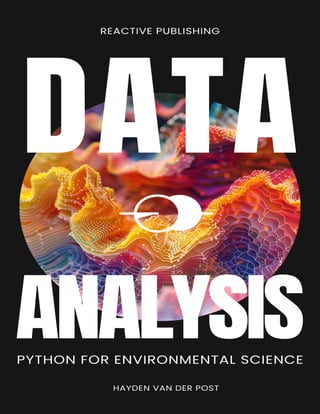



![1. Lists: Lists are ordered collections of items. They
are incredibly versatile and can store multiple data
types. Lists are perfect for handling sequences of
data, such as daily temperature readings or species
observations.
```python daily_temperatures = [23.5, 24.1, 22.8,
21.9, 20.3] # Temperature readings over five days
```
1. Tuples: Like lists, tuples are ordered collections but
are immutable, meaning they cannot be changed
after creation. Tuples are useful for storing data that
should not be altered, such as geographic
coordinates.
```python location_coords = (49.2827, -123.1207)
# Latitude and Longitude of Vancouver, Canada
```
Structured Data: Python
Collections
Beyond basic data types, Python offers specialized data
structures optimized for complex data manipulations. Here’s
how they can be harnessed in environmental data science:
1. Dictionaries (dict): Dictionaries are key-value
pairs, making them perfect for creating mappings,
such as linking species names to their attributes.
```python species_info = { "Panthera leo":
{"status": "Vulnerable", "habitat": "Savannah"}, "Gorilla
gorilla": {"status": "Endangered", "habitat": "Tropical
forest"} }](https://image.slidesharecdn.com/28906696-250521134044-f6eff59d/85/Data-Analysis-Python-For-Environmental-Science-Hayden-Van-Der-Post-18-320.jpg)
![```
1. Sets: Sets are collections of unique elements. They
are ideal for handling unique items and performing
set operations like union and intersection, which
can be useful in biodiversity studies.
```python observed_species = {"Panthera leo",
"Gorilla gorilla", "Loxodonta africana"}
```
Advanced Data Structures
1. Arrays (NumPy): Arrays are similar to lists but
more efficient for numerical computations and are
provided by the NumPy library. Arrays are essential
for handling large datasets, such as satellite
imagery or climate model outputs.
```python import numpy as np temperature_array
= np.array([23.5, 24.1, 22.8, 21.9, 20.3])
```
1. DataFrames (Pandas): DataFrames are two-
dimensional labeled data structures, similar to
spreadsheets, and are provided by the Pandas
library. They are indispensable for structured data
analysis, such as environmental monitoring data.
```python import pandas as pd data = { "Date":
["2023-01-01", "2023-01-02", "2023-01-03"],
"Temperature": [23.5, 24.1, 22.8], "Precipitation": [5.1,
3.2, 4.0] } df = pd.DataFrame(data)
```](https://image.slidesharecdn.com/28906696-250521134044-f6eff59d/85/Data-Analysis-Python-For-Environmental-Science-Hayden-Van-Der-Post-19-320.jpg)
![Practical Walkthrough:
Analyzing Environmental Data
Let’s walk through a practical scenario where understanding
these data types and structures becomes critical. Consider a
project where we are monitoring air quality in Vancouver.
We have data on various pollutants recorded daily.
1. Loading the Data: We use Pandas to load the
dataset into a DataFrame.
```python air_quality_data =
pd.read_csv('vancouver_air_quality.csv')
```
1. Inspecting the Data: We inspect the first few rows
to understand its structure.
```python print(air_quality_data.head())
```
1. Data Cleaning: We detect and handle missing
values.
```python air_quality_data =
air_quality_data.dropna()
```
1. Data Transformation: We might convert date
strings to datetime objects for time-series analysis.
```python air_quality_data['Date'] =
pd.to_datetime(air_quality_data['Date'])
```](https://image.slidesharecdn.com/28906696-250521134044-f6eff59d/85/Data-Analysis-Python-For-Environmental-Science-Hayden-Van-Der-Post-20-320.jpg)
![1. Visualizing Trends: Using Matplotlib, we visualize
pollutant levels over time.
```python import matplotlib.pyplot as plt
plt.plot(air_quality_data['Date'],
air_quality_data['PM2.5'], label='PM2.5')
plt.xlabel('Date') plt.ylabel('PM2.5 Concentration')
plt.title('Daily PM2.5 Levels in Vancouver') plt.legend()
plt.show()
```
By understanding and utilizing these data types and
structures, we can transform raw environmental data into
meaningful stories and actionable insights. This
foundational knowledge empowers us to tackle complex
environmental problems with precision and creativity,
driving us towards a sustainable future.
Setting Up the Python Environment
1. Installing Python
Before diving into coding, you must install Python on your
machine. Python is an open-source language, and you can
download it from the official Python website
(https://www.python.org/). Here’s a step-by-step guide:
1. Download Python Installer: Visit the Python
Downloads page and select the appropriate installer
for your operating system (Windows, macOS, or
Linux).
2. Run the Installer: Follow the installation prompts.
Ensure you check the option to "Add Python to
PATH" during installation. This will make it easier to
run Python from the command line.](https://image.slidesharecdn.com/28906696-250521134044-f6eff59d/85/Data-Analysis-Python-For-Environmental-Science-Hayden-Van-Der-Post-21-320.jpg)
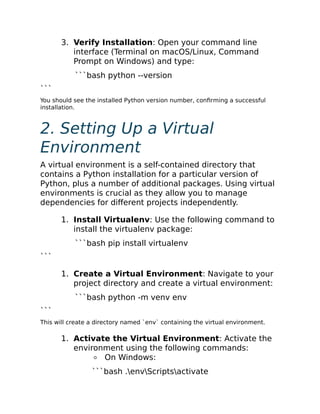
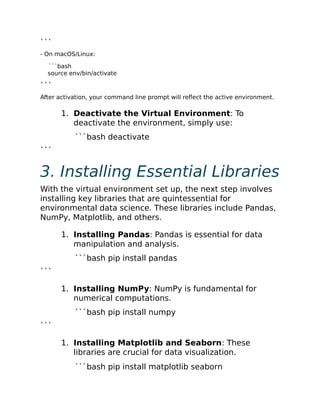
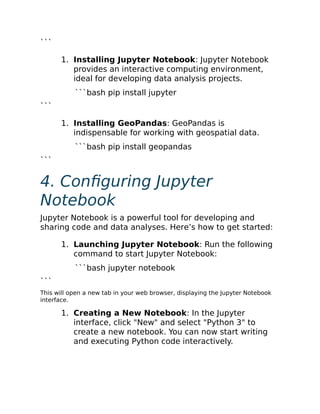
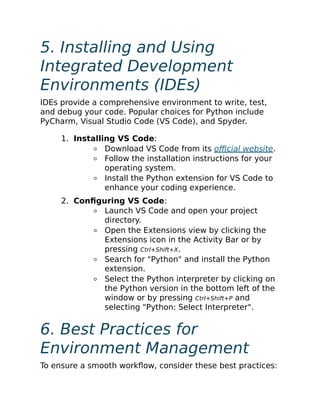
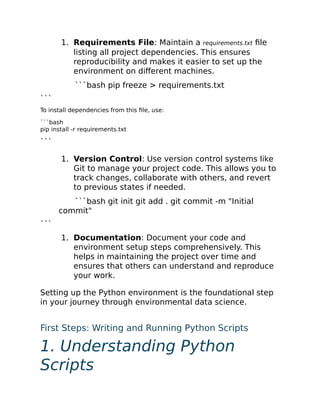
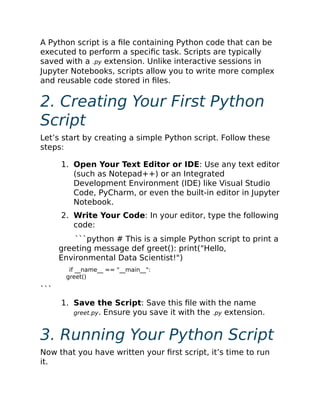
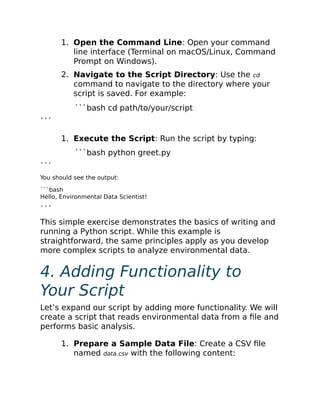
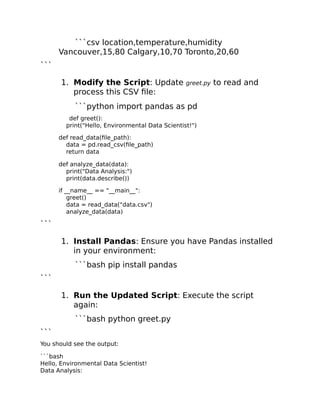
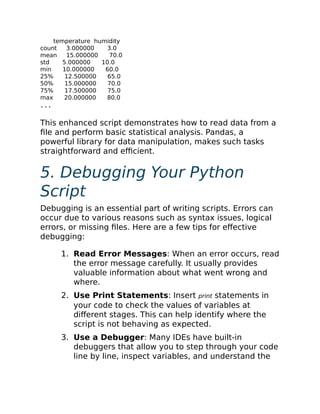
![program flow. For example, in VS Code, you can set
breakpoints and run the debugger by pressing F5.
4. Check Documentation: Refer to the
documentation for the libraries you are using.
Understanding the functions and their expected
inputs can help resolve many issues.
6. Best Practices for Writing
Python Scripts
To ensure your scripts are maintainable and efficient, follow
these best practices:
1. Write Clear and Descriptive Code: Use
meaningful variable and function names. Add
comments to explain what each part of the code
does.
```python def
calculate_average_temperature(data): """ Calculate the
average temperature from the data. """ return
data['temperature'].mean()
```
1. Modularize Your Code: Break your code into
functions or classes to make it more organized and
reusable.
2. Handle Exceptions: Use try-except blocks to
handle potential errors gracefully.
```python try: data = read_data("data.csv") except
FileNotFoundError as e: print(f"Error: {e}")
```](https://image.slidesharecdn.com/28906696-250521134044-f6eff59d/85/Data-Analysis-Python-For-Environmental-Science-Hayden-Van-Der-Post-31-320.jpg)
![1. Use Version Control: Track changes to your
scripts using a version control system like Git. This
helps manage different versions of your code and
collaborate with others.
2. Test Your Code: Write tests for your functions to
ensure they work as expected. You can use testing
frameworks like unittest or pytest.
```python import unittest
class TestEnvironmentalDataAnalysis(unittest.TestCase):
def test_average_temperature(self):
data = pd.DataFrame({
'temperature': [15, 10, 20],
'humidity': [80, 70, 60]
})
self.assertEqual(calculate_average_temperature(data), 15)
if __name__ == "__main__":
unittest.main()
```
This foundation will support your progress through the
subsequent chapters, where we will explore advanced data
manipulation, machine learning, and geospatial analysis.
With these skills at your disposal, you are equipped to
contribute to the global efforts in understanding and
addressing environmental challenges through the power of
data analysis.](https://image.slidesharecdn.com/28906696-250521134044-f6eff59d/85/Data-Analysis-Python-For-Environmental-Science-Hayden-Van-Der-Post-32-320.jpg)