Caribbean Examinations Council for internal use only
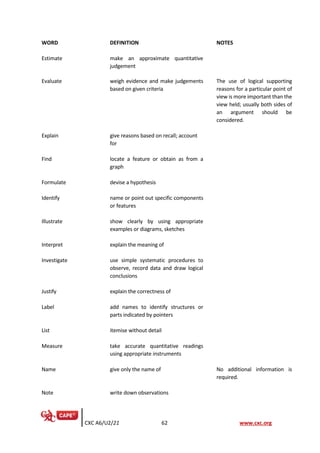
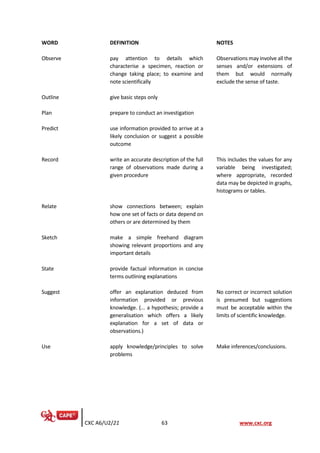
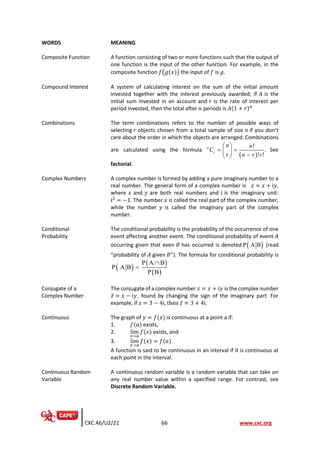
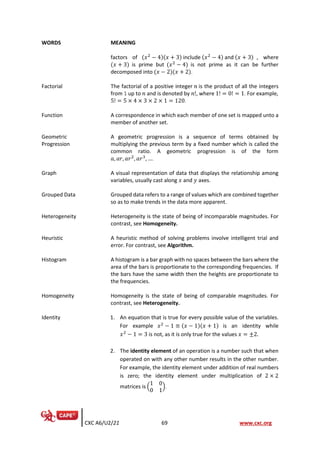
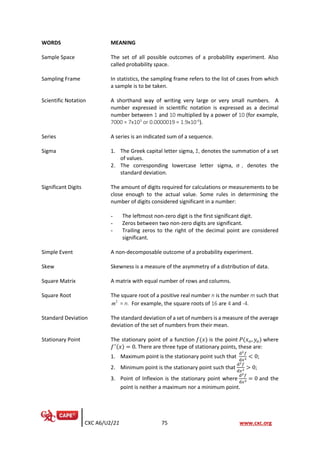
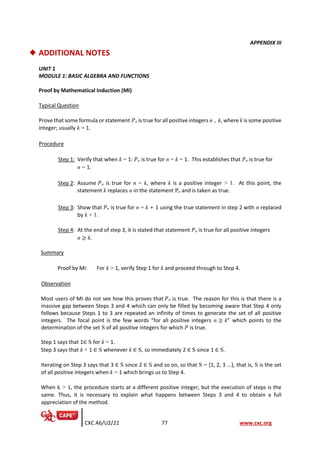
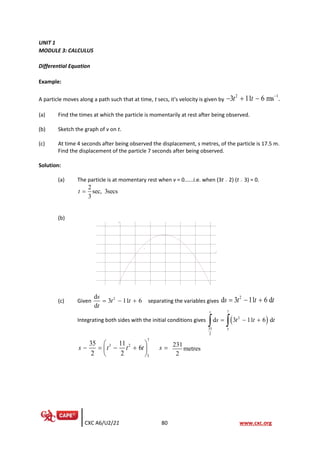
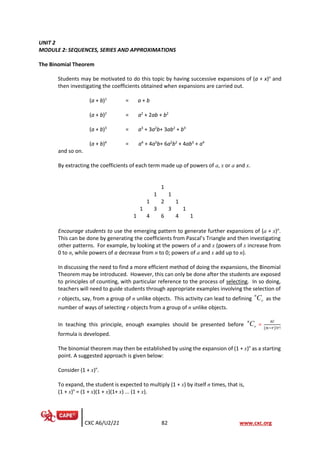
Effective for examinations from May–June 2023
SYLLABUS
PURE MATHEMATICS
CXC A6/U2/21
SYLLABUS
PHYSICAL EDUCATION AND
SPORT
CXC A32/U2/22
SYLLABUS
PHYSICAL EDUCATION AND
SPORT
CXC A32/U2/22
SYLLABUS
Caribbean Advanced
Proficiency Examination
®
Caribbean Advanced
Proficiency Examination
®
Caribbean Advanced
Proficiency Examination
®
Caribbean Advanced
Proficiency Examination
®
Caribbean Advanced
Proficiency Examination
®
Caribbean Advanced
Proficiency Examination
®
Caribbean Advanced
Proficiency Examination
®
Caribbean Advanced
CXC A6/U2/21 www.cxc.org
Correspondence related to the syllabus should be addressed to:
The Pro-Registrar
Caribbean Examinations Council
Caenwood Centre
37 Arnold Road, Kingston 5, Jamaica
Telephone Number: + 1 (876) 630-5200
Facsimile Number: + 1 (876) 967-4972
E-mail Address: cxcwzo@cxc.org
Website: www.cxc.org
Copyright © 2021 by Caribbean Examinations Council
Prince Road, Pine Plantation Road, St Michael BB11091
CXC A6/U2/21 www.cxc.org
INTRODUCTION........................................................................................................................................i
RATIONALE..............................................................................................................................................1
AIMS…….. ................................................................................................................................................2
SKILLS AND ABILITIES TO BE ASSESSED...................................................................................................2
PREREQUISITES OF THE SYLLABUS..........................................................................................................3
STRUCTURE OF THE SYLLABUS................................................................................................................3
APPROACHES TO TEACHING THE SYLLABUS ...........................................................................................3
RECOMMENDED 2-UNIT OPTIONS..........................................................................................................3
UNIT 1: ALGEBRA, GEOMETRY AND CALCULUS.....................................................................................7
MODULE 1: BASIC ALGEBRA AND FUNCTIONS .........................................................................7
MODULE 2: TRIGONOMETRY, COORDINATE GEOMETRY AND VECTORS...............................15
MODULE 3: CALCULUS I...........................................................................................................21
UNIT 2: COMPLEX NUMBERS, ANALYSIS AND MATRICES.....................................................................28
MODULE 1: COMPLEX NUMBERS AND CALCULUS II...............................................................28
MODULE 2: SEQUENCES, SERIES AND APPROXIMATIONS......................................................34
MODULE 3: COUNTING, MATRICES AND DIFFERENTIAL EQUATIONS ....................................38
OUTLINE OF ASSESSMENT ....................................................................................................................45
ASSESSMENT CRITERIA........................................................................................................................51
REGULATIONS FOR PRIVATE CANDIDATES ...........................................................................................55
REGULATIONS FOR RESIT CANDIDATES................................................................................................56
ASSESSMENT GRID................................................................................................................................56
MATHEMATICAL NOTATION.................................................................................................................57
APPENDIX I: GLOSSARY OF EXAMINATION TERMS...............................................................................60
APPENDIX II: GLOSSARY OF MATHEMATICAL TERMS...........................................................................64
APPENDIX III: ADDITIONAL NOTES……………………………………………………………………………………………………77
Contents
IntroductionContents
Contents
IntroductionContents
Contents
CXC A6/U2/21 www.cxc.org
NOTE TO TEACHERS AND LEARNERS
This document CXC A6/U2/21 replaces CXC A6/U2/12 issued in 2012.
Please note that the syllabus has been revised and amendments are indicated by italics.
First issued 1999
Revised 2004
Revised 2007
Amended 2012
Revised 2021
Please check the website www.cxc.org for updates on CXC®’s syllabuses.
Please access relevant curated resources to support teaching and learning of the syllabus at
https://learninghub.cxc.org/
For access to short courses, training opportunities and teacher orientation webinars and workshops
go to our Learning Institute at https://cxclearninginstitute.org/
PLEASE NOTE
This icon is used throughout the syllabus to represent key features which teachers and
learners may find useful.
CXC A6/U2/21 i www.cxc.org
he Caribbean Advanced Proficiency Examination® (CAPE®) is designed to provide certification of
the academic, vocational and technical achievement of students in the Caribbean who, having
completed a minimum of five years of secondary education, wish to further their studies. The
examinations address the skills and knowledge acquired by students under a flexible and articulated
system where subjects are organised in 1-Unit or 2-Unit courses with each Unit containing three
Modules. Subjects examined under CAPE® may be studied concurrently or singly.
The Caribbean Examinations Council offers three types of certification at the CAPE® level. The first is
the award of a certificate showing each CAPE® Unit completed. The second is the CAPE® Diploma,
awarded to candidates who have satisfactorily completed at least six Units, including Caribbean
Studies. The third is the CXC® Associate Degree, awarded for the satisfactory completion of a
prescribed cluster of ten CAPE® Units including Caribbean Studies, Communication Studies and
Integrated Mathematics. Integrated Mathematics is not a requirement for the CXC® Associate Degree
in Mathematics. The complete list of Associate Degrees may be found in the CXC® Associate Degree
Handbook.
For the CAPE® Diploma and the CXC® Associate Degree, candidates must complete the cluster of
required Units within a maximum period of five years. To be eligible for a CXC® Associate Degree, the
educational institution presenting the candidates for the award, must select the Associate Degree of
choice at the time of registration at the sitting (year) the candidates are expected to qualify for the
award. Candidates will not be awarded an Associate Degree for which they were not registered.
T
Introduction
CXC A6/U2/21 1 www.cxc.org
◆ RATIONALE
The Caribbean society is an integral part of an ever-changing world. The impact of globalisation on
most societies encourages this diverse Caribbean region to revisit the education and career
opportunities of our current and future citizens. A common denominator is for Caribbean societies to
create among its citizens a plethora of quality leadership with the acumen required to make
meaningful projections and innovations for further development. Further, learning appropriate
problem-solving techniques, inherent to the study of mathematics, is vital for such leaders.
Mathematics promotes intellectual development, is utilitarian and applicable to all disciplines.
Additionally, its aesthetics and epistemological approaches provide solutions fit for any purpose.
Therefore, Mathematics is the essential tool to empower people with the knowledge, competencies
and attitudes that are required for academia as well as quality leadership for sustainability in this
dynamic world.
Students doing this syllabus will have already been exposed to Mathematics in some form mainly
through courses that emphasise skills in using mathematics as a tool, rather than giving insight into
the underlying concepts. This course of study is designed to utilise learner-centered approaches to
teaching, learning and assessment to expand students’ mathematical knowledge by exposing them to
more advanced mathematical ideas, skills, and techniques, and to enhance their understanding of why
and how the concepts are interconnected and can be utilised. This approach will minimise the fear
associated with having to learn a multiplicity of seemingly unconnected facts, procedures and
formulae. In addition, this course will show them that mathematical concepts lend themselves to
generalisations, and that there is enormous scope for applications to solving real-world problems.
This course of study incorporates the features of the Science, Technology, Engineering, and
Mathematics (STEM) principles. On completion of this syllabus, students will be able to make a smooth
transition to further studies in Mathematics and other related subject areas or move on to career
choices where a deeper knowledge of the general concepts of Mathematics is required. It will enable
students to develop and enhance twenty-first century skills including critical and creative thinking,
problem solving, logical reasoning, modelling, collaboration, decision making, research, information
and communications technological competencies which are integral to everyday life and for life-long
learning. Students will be exposed to the underlying concepts of Mathematics to foster a deeper
understanding and greater appreciation of the subject. This course provides insight into the exciting
world of advanced mathematics, thereby equipping students with the tools necessary to approach any
mathematical situation with confidence.
This Syllabus will contribute to the development of the Ideal Caribbean Person as articulated by the
CARICOM Heads of Government. This person will demonstrate multiple literacies, independent and
critical thinking; and question the beliefs and practices of the past and present bringing this to bear on
the innovative application of science and technology to problem solving. Such a person should also
demonstrate a positive work ethic and values and displays creative imagination and entrepreneurship.
In keeping with the UNESCO Pillars of Learning, on completion of this course of study, students will
learn to know, learn to do, learn to be, learn to live together, and learn to transform themselves and
society.
Pure Mathematics Syllabus
CXC A6/U2/21 2 www.cxc.org
◆ AIMS
The syllabus aims to:
1. provide understanding of mathematical concepts and structures, their development and the
relationships between them;
2. enable the development of skills in the use of mathematical tools;
3. make Mathematics fun, interesting, and recognizable;
4. develop an appreciation of the idea of mathematical proof, the internal logical coherence of
Mathematics, and its consequent universal applicability;
5. develop the ability to make connections between distinct concepts in Mathematics, and
between mathematical ideas and those pertaining to other disciplines;
6. develop skills such as, critical and creative thinking, problem solving, logical reasoning,
modelling, collaboration, decision making, research, information communication and
technological competences which are integral to everyday life and for life-long learning;
7. develop positive intrinsic mathematical values, such as, accuracy and rigour;
8. develop the skills of recognising essential aspects of concrete, real-world problems,
formulating these problems into relevant and solvable mathematical problems and
mathematical modelling;
9. integrate Information and Communications Technology (ICT) tools and skills in the teaching
and learning processes; and,
10. prepare students for advanced courses in Mathematics and related areas.
◆ SKILLS AND ABILITIES TO BE ASSESSED
The assessment will test candidates’ skills and abilities in relation to three cognitive levels.
1. Conceptual knowledge - the ability to recall and understand appropriate facts, concepts and
principles in a variety of contexts.
2. Algorithmic knowledge - the ability to manipulate mathematical expressions and procedures
using appropriate symbols and language, logical deduction and inferences.
3. Reasoning - the ability to select appropriate strategy or select, use and evaluate mathematical
models and interpret the results of a mathematical solution in terms of a given real-world
problem and engage in problem-solving.
CXC A6/U2/21 3 www.cxc.org
◆ PREREQUISITES OF THE SYLLABUS
Any person with a good grasp of the contents of the syllabus of the Caribbean Secondary Education
Certificate (CSEC®) course in Mathematics, or equivalent, should be able to undertake the course.
However, persons with a good grasp of the contents of the syllabus of the Caribbean Secondary
Education Certificate (CSEC®) course in Additional Mathematics would be better prepared to pursue
this course of study. Successful participation in the course will also depend on the possession of good
verbal and written communication skills.
◆ STRUCTURE OF THE SYLLABUS
The syllabus is arranged into two (2) Units, Unit 1 which will lay the foundation, and Unit 2 which
expands on, and applies, the concepts formulated in Unit 1.
It is therefore recommended that Unit 2 be taken after satisfactory completion of Unit 1 or a similar
course. Completion of each Unit will be separately certified.
Each Unit consists of three Modules.
Unit 1: Algebra, Geometry and Calculus, contains three Modules each requiring approximately 50
hours. The total teaching time is therefore approximately 150 hours.
Module 1 - Basic Algebra and Functions
Module 2 - Trigonometry, Coordinate Geometry and Vectors
Module 3 - Calculus I
Unit 2: Complex Numbers, Analysis and Matrices, contains three Modules, each requiring
approximately 50 hours. The total teaching time is therefore approximately 150 hours.
Module 1 - Complex Numbers and Calculus II
Module 2 - Sequences, Series and Approximations
Module 3 - Counting, Matrices and Differential Equations
◆ APPROACHES TO TEACHING THE SYLLABUS
The Specific Objectives indicate the scope of the content and activities that should be covered. Teachers
are encouraged to utilise a learner-centered approach to teaching and learning. They are also
encouraged to model the process for completing, solving, and calculating mathematical problems. It
is recommended that activities to develop these skills be incorporated in every lesson using
collaborative, integrative and practical teaching strategies. Note as well that additional notes and the
formulae sheet are included in the syllabus.
◆ RECOMMENDED 2-UNIT OPTIONS
1. Pure Mathematics Unit 1 AND Pure Mathematics Unit 2.
2. Applied Mathematics Unit 1 AND Applied Mathematics Unit 2.
3. Pure Mathematics Unit 1 AND Applied Mathematics Unit 2.
CXC A6/U2/21 4 www.cxc.org
◆ MATHEMATICAL MODELLING
Mathematical Modelling should be used in both Units 1 and 2 to solve real-world problems.
A. The topic Mathematical Modelling involves the following steps:
1. identify a real-world situation to which modelling is applicable;
2. carry out the modelling process for a chosen situation to which modelling is
applicable; and,
3. discuss and evaluate the findings of a mathematical model in a written report.
B. The Modelling process requires:
1. a clear statement posed in a real-world situation, and identification of its essential
features;
2. translation or abstraction of the problem, giving a representation of the essential
features of the real-world;
3. solution of the mathematical problem (analytic, numerical, approximate);
4. testing the appropriateness and the accuracy of the solution against behaviour in the
real-world; and,
5. refinement of the model as necessary.
C. Consider the two situations given below.
1. A weather forecaster needs to be able to calculate the possible effects of atmospheric
pressure changes on temperature.
2. An economic adviser to the Central Bank Governor needs to be able to calculate the
likely effect on the employment rate of altering the Central Bank’s interest rate.
In each case, people are expected to predict something that is likely to happen in the future.
Furthermore, in each instance, these persons may save lives, time, and money or change their
actions in some way as a result of their predictions.
One method of predicting is to set up a mathematical model of the situation. A mathematical
model is not usually a model in the sense of a scale model motor car. A mathematical model
is a way of describing an underlying situation mathematically, perhaps with equations, with
rules or with diagrams.
CXC A6/U2/21 5 www.cxc.org
Some examples of mathematical models are:
1. Equations
(a) Business
A recording studio invests $25 000 to produce a master CD of a singing
group. It costs $50.00 to make each copy from the master and covers the
operating expenses. We can model this situation by the equation or
mathematical model,
C = 50.00 x + 25 000
where C is the cost of producing 𝑥 CDs. With this model, one can predict the
cost of producing 60 CDs or 6 000 CDs.
Is the equation x + 2 = 5 a mathematical model? Justify your answer.
(b) Banking
Suppose you invest $100.00 with a commercial bank which pays interest
at 12% per annum. You may leave the interest in the account to
accumulate. The equation A = 100(1.12) n
can be used to model the
amount of money in your account after n years.
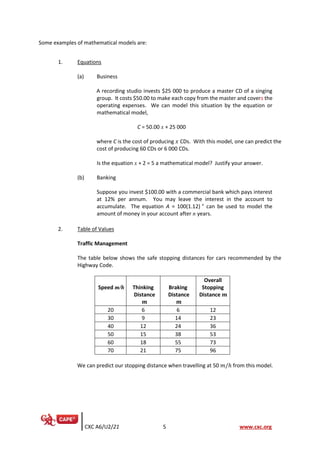
2. Table of Values
Traffic Management
The table below shows the safe stopping distances for cars recommended by the
Highway Code.
Speed m/h Thinking
Distance
𝒎
Braking
Distance
𝒎
Overall
Stopping
Distance 𝒎
20 6 6 12
30 9 14 23
40 12 24 36
50 15 38 53
60 18 55 73
70 21 75 96
We can predict our stopping distance when travelling at 50 𝑚/ℎ from this model.
CXC A6/U2/21 6 www.cxc.org
3. Rules of Thumb
You might have used some mathematical models of your own without realising it;
perhaps you think of them as “rules of thumb”. For example, in the baking of hams,
most cooks use the rule of thumb, “bake ham fat side up in roasting pan in a moderate
oven (160ºC) ensuring 25 to 40 minutes per ½ kg”. The cook is able to predict how long
it takes to bake the ham without burning it.
4. Graphs
Not all models are symbolic in nature; they may be graphical. For example, the graph
below shows the population at different years for a certain country.
RESOURCE
Hartzler, J. S. and Swetz, F. Mathematical Modelling in the Secondary School Curriculum,
A Resource Guide of Classroom Exercises, Vancouver, United
States of America: National Council of Teachers of
Mathematics, Incorporated, Reston, 1991.
0
5
10
15
20
25
30
1960 1970 1980 1990 2000 2010 2020
Population
(millions)
Years
CXC A6/U2/21 7 www.cxc.org
◆ UNIT 1: ALGEBRA, GEOMETRY AND CALCULUS
MODULE 1: BASIC ALGEBRA AND FUNCTIONS
GENERAL OBJECTIVES
On completion of this Module, students should:
1. develop the ability to construct simple proofs of mathematical assertions;
2. understand the concept of a function;
3. be confident in the manipulation of algebraic expressions and the solutions of equations and
inequalities;
4. understand the properties and significance of the exponential and logarithm functions; and,
5. develop the ability to use concepts to model and solve real-world problems.
SPECIFIC OBJECTIVES CONTENT
Students should be able to:
1. Reasoning and Logic
1.1 identify simple and compound
propositions;
Simple propositions, compound propositions,
and connectives (disjunction, negation,
conditional, bi-conditional).
1.2 establish the truth value of
compound statements using truth
tables;
Truth tables for compound statements.
1.3 state the converse, contrapositive
and inverse of statements; and,
Converse, contrapositive and inverse of:
(a) conditional statements; and,
(b) bi-conditional statements.
1.4 determine whether two statements
are logically equivalent.
Logical equivalence, including tautology and
contradiction.
Identities involving propositions.
CXC A6/U2/21 8 www.cxc.org
UNIT 1
MODULE 1: BASIC ALGEBRA AND FUNCTIONS (cont’d)
SPECIFIC OBJECTIVES CONTENT
Students should be able to:
2. The Real Number System – ℝ
2.1 use the concepts of arithmetic
operations;
Applications of the concepts of identity,
closure, inverse, commutativity, associativity,
distributivity addition, multiplication and other
simple binary operations.
Axioms of the system - including commutative,
associative and distributive laws; non-existence
of the multiplicative inverse of zero.
2.2 perform binary operations; Binary operations.
2.3 perform basic operations involving
surds;
Surds.
Basic operations (addition, subtraction,
multiplication and rationalization) involving
surds.
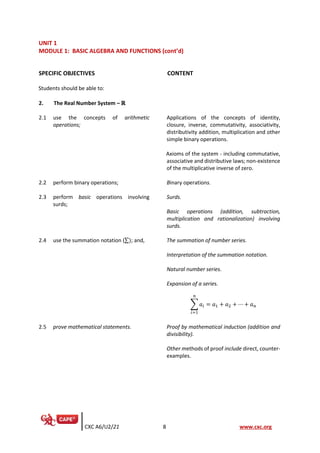
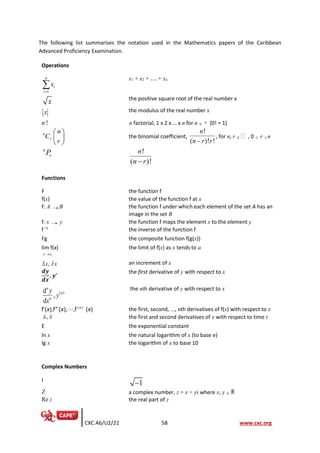
2.4 use the summation notation (∑); and, The summation of number series.
Interpretation of the summation notation.
Natural number series.
Expansion of a series.
∑ 𝑎𝑖
𝑛
𝑖=1
= 𝑎1 + 𝑎2 + ⋯ + 𝑎𝑛
2.5 prove mathematical statements. Proof by mathematical induction (addition and
divisibility).
Other methods of proof include direct, counter-
examples.
CXC A6/U2/21 9 www.cxc.org
UNIT 1
MODULE 1: BASIC ALGEBRA AND FUNCTIONS (cont’d)
SPECIFIC OBJECTIVES CONTENT
Students should be able to:
3. Algebraic Operations
3.1 use the Factor Theorem; Using Factor Theorem to:
(a) find factors; and,
(b) evaluate unknown coefficients.
3.2 use the Remainder Theorem; 3.2
Using Remainder Theorem to find the
remainder.
3.3 extract all factors of n n
a b
− for
positive integers n ≤ 6; and,
Factorisation.
3.4 use the order of polynomial
expressions.
Order of Polynomial expressions.
4. Functions
4.1 define mathematical notations and
terms related to functions;
Terms: function, ordered pairs, domain, range,
one-to-one function (injective function), into
function, onto function (surjective function),
many-to-one, one-to-one and onto function
(bijective function), composition and inverse of
functions.
4.2 determine whether or not a given
simple function is into, onto or one-
to-one;
Functions:
(a) injective;
(b) surjective;
(c) bijective; and,
(d) inverse.
4.3 determine if an inverse exists for a
function;
4.4 determine the inverse of the function
𝑓; and,
Composite inverse.
If 𝑔 is the inverse function of 𝑓 , then
𝑓[𝑔 (𝑥)] = 𝑥, for all x, in the domain of 𝑔.
4.5 draw graphs to show the relationship
between a function and its inverse.
Transformation of a graph and its inverse.
Graphs to show relationship between the
function of 𝑦 = 𝑓(𝑥) given in graphical form
and the inverse of 𝑓(𝑥), that is,
𝑦 = 𝑓−1
(𝑥).
CXC A6/U2/21 10 www.cxc.org
UNIT 1
MODULE 1: BASIC ALGEBRA AND FUNCTIONS (cont’d)
SPECIFIC OBJECTIVES CONTENT
Students should be able to:
5. Exponential and Logarithmic Functions
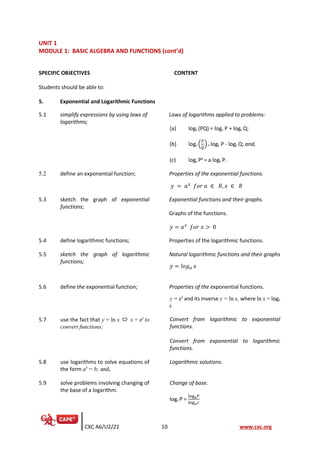
5.1 simplify expressions by using laws of
logarithms;
Laws of logarithms applied to problems:
(a) logc (PQ) = logc P + logc Q;
(b) logc (
𝑃
𝑄
)= logc P - logc Q; and,
(c) logc Pa
= a logc P.
5.2 define an exponential function; Properties of the exponential functions.
𝑦 = 𝑎𝑥
𝑓𝑜𝑟 𝑎 ∈ 𝑅, 𝑥 ∈ 𝑅
5.3 sketch the graph of exponential
functions;
Exponential functions and their graphs.
Graphs of the functions.
𝑦 = 𝑎𝑥
𝑓𝑜𝑟 𝑥 > 0
5.4 define logarithmic functions; Properties of the logarithmic functions.
5.5 sketch the graph of logarithmic
functions;
Natural logarithmic functions and their graphs
𝑦 = 𝑙𝑜𝑔𝑎 𝑥
5.6 define the exponential function; Properties of the exponential functions.
y = ex
and its inverse y = ln x, where ln x = loge
x
5.7 use the fact that y = ln x  x = ey
to
convert functions;
Convert from logarithmic to exponential
functions.
Convert from exponential to logarithmic
functions.
5.8 use logarithms to solve equations of
the form ax
= b; and,
Logarithmic solutions.
5.9 solve problems involving changing of
the base of a logarithm.
Change of base.
logc P =
loga𝑃
log𝑎𝑐
CXC A6/U2/21 11 www.cxc.org
UNIT 1
MODULE 1: BASIC ALGEBRA AND FUNCTIONS (cont’d)
SPECIFIC OBJECTIVES CONTENT
Students should be able to:
6. The Modulus Function
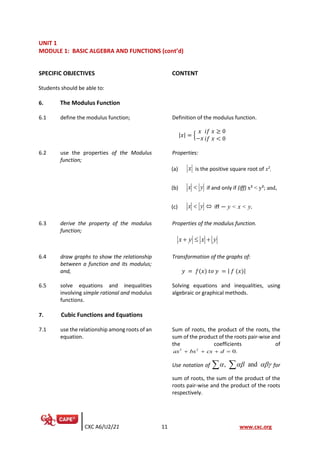
6.1 define the modulus function; Definition of the modulus function.
|𝑥| = {
𝑥
−𝑥
𝑖𝑓 𝑥 ≥ 0
𝑖𝑓 𝑥 < 0
6.2 use the properties of the Modulus
function;
Properties:
(a) x is the positive square root of x2
;
(b) x y
 if and only if (iff) x² < y²; and,
(c) x y
  iff − y < x < y.
6.3 derive the property of the modulus
function;
Properties of the modulus function.
x y x y
+  +
6.4 draw graphs to show the relationship
between a function and its modulus;
and,
Transformation of the graphs of:
𝑦 = 𝑓(𝑥) 𝑡𝑜 𝑦 = | 𝑓 (𝑥)|
6.5 solve equations and inequalities
involving simple rational and modulus
functions.
Solving equations and inequalities, using
algebraic or graphical methods.
7. Cubic Functions and Equations
7.1 use the relationship among roots of an
equation.
Sum of roots, the product of the roots, the
sum of the product of the roots pair-wise and
the coefficients of
3 2
0.
ax bx cx d
+ + + =
Use notation of , and
  
  for
sum of roots, the sum of the product of the
roots pair-wise and the product of the roots
respectively.
CXC A6/U2/21 12 www.cxc.org
UNIT 1
MODULE 1: BASIC ALGEBRA AND FUNCTIONS (cont’d)
Suggested Teaching and Learning Activities
To facilitate students’ attainment of the objectives of this Module, teachers are advised to engage
students in the teaching and learning activities listed below.
1. Teachers are encouraged to incorporate the use of PowerPoint Presentations or YouTube
Videos to engage students in a brief review of the number systems.
2. Students should be encouraged to practice different methods of proof, for example, to prove
that the product of two consecutive integers is an even integer and to disprove by counter-
example the statement
2
1
n n
+ − is prime  𝑛  𝑍.
3. Students should be encouraged to work in groups to solve practice questions, using the
information below. Students should explore mapping properties of quadratic functions which:
(a) will, or will not, be injective, depending on which subset of the real line is chosen as
the domain;
(b) will be surjective if its range is taken as the co-domain (completion of the square is
useful here); and,
(c) if both injective and surjective, will have an inverse function which can be constructed
by solving a quadratic equation.
Example: Use the function 𝑓 : 𝐴 → 𝐵 given by 𝑓 (x) = 3x2
+ 6x + 5, where the
domain A is alternatively the whole of the real line, or the set
{x ∈ ℝ 1
x  − }, and the co-domain 𝐵 is ℝ or the set { y ∈ ℝ 2
y  }.
4. Students should conduct an internet search on the theory of the quadratic equation and the
nature of its roots. A class discussion should be initiated, and students asked to creatively
present their findings. Teacher can also use the responses as an introduction to the lesson
topic.
5. Guide students to apply their understanding of reasoning and logic by completing the following
activity. Let p be the statement “it is cold” and let q be the statement “it is raining”,
Write each of the following statements in symbolic form using p and q.
(a) It is cold and it is raining.
(b) It is cold but it is not raining.
(c) It is false that it is cold, or it is raining.
(d) It is neither cold nor raining.
(e) It is not true that it is not cold or not raining.
CXC A6/U2/21 13 www.cxc.org
UNIT 1
MODULE 1: BASIC ALGEBRA AND FUNCTIONS (cont’d)
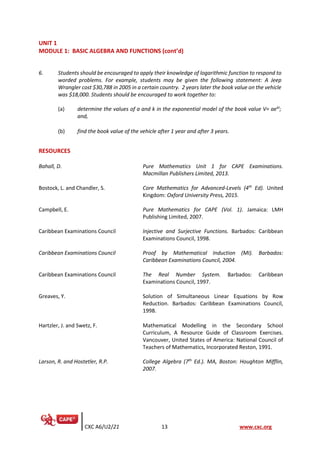
6. Students should be encouraged to apply their knowledge of logarithmic function to respond to
worded problems. For example, students may be given the following statement: A Jeep
Wrangler cost $30,788 in 2005 in a certain country. 2 years later the book value on the vehicle
was $18,000. Students should be encouraged to work together to:
(a) determine the values of a and k in the exponential model of the book value V= aekt
;
and,
(b) find the book value of the vehicle after 1 year and after 3 years.
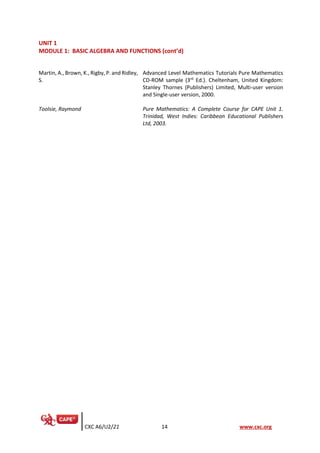
RESOURCES
Bahall, D. Pure Mathematics Unit 1 for CAPE Examinations.
Macmillan Publishers Limited, 2013.
Bostock, L. and Chandler, S. Core Mathematics for Advanced-Levels (4th
Ed). United
Kingdom: Oxford University Press, 2015.
Campbell, E. Pure Mathematics for CAPE (Vol. 1). Jamaica: LMH
Publishing Limited, 2007.
Caribbean Examinations Council Injective and Surjective Functions. Barbados: Caribbean
Examinations Council, 1998.
Caribbean Examinations Council Proof by Mathematical Induction (MI). Barbados:
Caribbean Examinations Council, 2004.
Caribbean Examinations Council The Real Number System. Barbados: Caribbean
Examinations Council, 1997.
Greaves, Y. Solution of Simultaneous Linear Equations by Row
Reduction. Barbados: Caribbean Examinations Council,
1998.
Hartzler, J. and Swetz, F. Mathematical Modelling in the Secondary School
Curriculum, A Resource Guide of Classroom Exercises.
Vancouver, United States of America: National Council of
Teachers of Mathematics, Incorporated Reston, 1991.
Larson, R. and Hostetler, R.P. College Algebra (7th
Ed.). MA, Boston: Houghton Mifflin,
2007.
CXC A6/U2/21 14 www.cxc.org
UNIT 1
MODULE 1: BASIC ALGEBRA AND FUNCTIONS (cont’d)
Martin, A., Brown, K., Rigby, P. and Ridley,
S.
Advanced Level Mathematics Tutorials Pure Mathematics
CD-ROM sample (3rd
Ed.). Cheltenham, United Kingdom:
Stanley Thornes (Publishers) Limited, Multi-user version
and Single-user version, 2000.
Toolsie, Raymond Pure Mathematics: A Complete Course for CAPE Unit 1.
Trinidad, West Indies: Caribbean Educational Publishers
Ltd, 2003.
CXC A6/U2/21 15 www.cxc.org
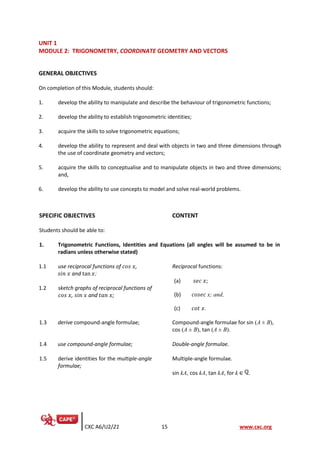
UNIT 1
MODULE 2: TRIGONOMETRY, COORDINATE GEOMETRY AND VECTORS
GENERAL OBJECTIVES
On completion of this Module, students should:
1. develop the ability to manipulate and describe the behaviour of trigonometric functions;
2. develop the ability to establish trigonometric identities;
3. acquire the skills to solve trigonometric equations;
4. develop the ability to represent and deal with objects in two and three dimensions through
the use of coordinate geometry and vectors;
5. acquire the skills to conceptualise and to manipulate objects in two and three dimensions;
and,
6. develop the ability to use concepts to model and solve real-world problems.
SPECIFIC OBJECTIVES CONTENT
Students should be able to:
1. Trigonometric Functions, Identities and Equations (all angles will be assumed to be in
radians unless otherwise stated)
1.1 use reciprocal functions of 𝑐𝑜𝑠 𝑥,
𝑠𝑖𝑛 𝑥 and tan 𝑥;
Reciprocal functions:
(a) 𝑠𝑒𝑐 𝑥;
(b) 𝑐𝑜𝑠𝑒𝑐 x; and,
(c) 𝑐𝑜𝑡 𝑥.
1.2 sketch graphs of reciprocal functions of
𝑐𝑜𝑠 𝑥, 𝑠𝑖𝑛 𝑥 and 𝑡𝑎𝑛 𝑥;
1.3 derive compound-angle formulae; Compound-angle formulae for sin (A ± B),
cos (A ± B), tan (A ± B).
Double-angle formulae.
1.4 use compound-angle formulae;
1.5 derive identities for the multiple-angle
formulae;
Multiple-angle formulae.
sin kA, cos kA, tan kA, for k ∈ .
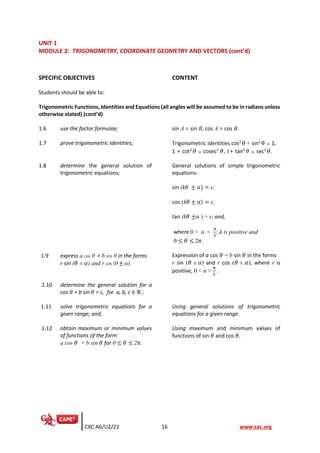
CXC A6/U2/21 16 www.cxc.org
UNIT 1
MODULE 2: TRIGONOMETRY, COORDINATE GEOMETRY AND VECTORS (cont’d)
SPECIFIC OBJECTIVES CONTENT
Students should be able to:
Trigonometric Functions, Identities and Equations (all angles will be assumed to be in radians unless
otherwise stated) (cont’d)
1.6 use the factor formulae; sin A ± sin B, cos A ± cos B.
1.7 prove trigonometric identities; Trigonometric identities cos2
θ + sin2
θ  1,
1 + cot2
𝜃  cosec2
𝜃, 1+ tan2
𝜃  sec2
𝜃.
1.8 determine the general solution of
trigonometric equations;
General solutions of simple trigonometric
equations:
sin (k𝜃 ± 𝛼) = s;
cos (k𝜃 ± 𝛼) = s;
tan (k𝜃 ±𝛼 ) = s; and,
where 0 < α <
𝜋
2
; k is positive and
0 ≤ 𝜃 ≤ 2𝜋.
1.9 express a cos θ + b sin θ in the forms
r sin (𝜃 ± 𝛼) and r cos (θ ± α);
Expression of a cos 𝜃 + b sin 𝜃 in the forms
r sin (𝜃 ± α) and r cos (𝜃 ± 𝛼), where r is
positive, 0 < α <
π
2
.
1.10 determine the general solution for a
cos 𝜃 + b sin 𝜃 = c, for a, b, c ∈ ;
1.11 solve trigonometric equations for a
given range; and,
Using general solutions of trigonometric
equations for a given range.
1.12 obtain maximum or minimum values
of functions of the form
a cos 𝜃 + b sin 𝜃 for 0 ≤ 𝜃 ≤ 2𝜋.
Using maximum and minimum values of
functions of sin 𝜃 and cos 𝜃.
CXC A6/U2/21 17 www.cxc.org
UNIT 1
MODULE 2: TRIGONOMETRY, COORDINATE GEOMETRY AND VECTORS (cont’d)
SPECIFIC OBJECTIVES CONTENT
Students should be able to:
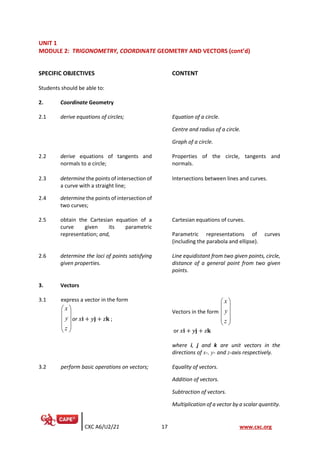
2. Coordinate Geometry
2.1 derive equations of circles; Equation of a circle.
Centre and radius of a circle.
Graph of a circle.
2.2 derive equations of tangents and
normals to a circle;
Properties of the circle, tangents and
normals.
2.3 determine the points of intersection of
a curve with a straight line;
Intersections between lines and curves.
2.4 determine the points of intersection of
two curves;
2.5 obtain the Cartesian equation of a
curve given its parametric
representation; and,
Cartesian equations of curves.
Parametric representations of curves
(including the parabola and ellipse).
2.6 determine the loci of points satisfying
given properties.
Line equidistant from two given points, circle,
distance of a general point from two given
points.
3. Vectors
3.1 express a vector in the form
x
y
z
 
 
 
 
 
or 𝑥𝐢 + 𝑦𝐣 + 𝑧𝐤 ;
Vectors in the form
x
y
z
 
 
 
 
 
or 𝑥𝐢 + 𝑦𝐣 + 𝑧𝐤
where i, j and k are unit vectors in the
directions of x-, y- and z-axis respectively.
3.2 perform basic operations on vectors; Equality of vectors.
Addition of vectors.
Subtraction of vectors.
Multiplication of a vector by a scalar quantity.
CXC A6/U2/21 18 www.cxc.org
UNIT 1
MODULE 2: TRIGONOMETRY, COORDINATE GEOMETRY AND VECTORS (cont’d)
SPECIFIC OBJECTIVES CONTENT
Students should be able to:
Vectors (cont’d)
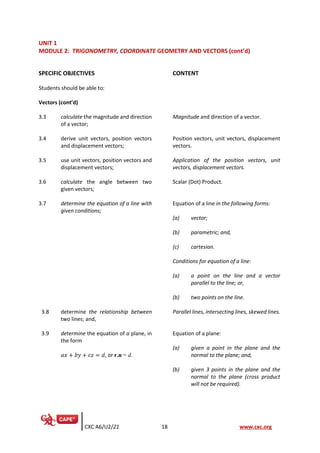
3.3 calculate the magnitude and direction
of a vector;
Magnitude and direction of a vector.
3.4 derive unit vectors, position vectors
and displacement vectors;
Position vectors, unit vectors, displacement
vectors.
3.5 use unit vectors, position vectors and
displacement vectors;
Application of the position vectors, unit
vectors, displacement vectors.
3.6 calculate the angle between two
given vectors;
Scalar (Dot) Product.
3.7 determine the equation of a line with
given conditions;
Equation of a line in the following forms:
(a) vector;
(b) parametric; and,
(c) cartesian.
Conditions for equation of a line:
(a) a point on the line and a vector
parallel to the line; or,
(b) two points on the line.
3.8 determine the relationship between
two lines; and,
Parallel lines, intersecting lines, skewed lines.
3.9 determine the equation of a plane, in
the form
𝑎𝑥 + 𝑏𝑦 + 𝑐𝑧 = 𝑑, or r.n = d.
Equation of a plane:
(a) given a point in the plane and the
normal to the plane; and,
(b) given 3 points in the plane and the
normal to the plane (cross product
will not be required).
CXC A6/U2/21 19 www.cxc.org
UNIT 1
MODULE 2: TRIGONOMETRY, COORDINATE GEOMETRY AND VECTORS (cont’d)
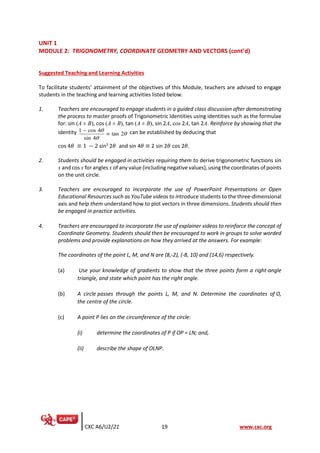
Suggested Teaching and Learning Activities
To facilitate students’ attainment of the objectives of this Module, teachers are advised to engage
students in the teaching and learning activities listed below.
1. Teachers are encouraged to engage students in a guided class discussion after demonstrating
the process to master proofs of Trigonometric Identities using identities such as the formulae
for: sin (A ± B), cos (A ± B), tan (A ± B), sin 2A, cos 2A, tan 2A. Reinforce by showing that the
identity 1 cos 4
tan 2
sin 4



−
 can be established by deducing that
cos 4𝜃 ≡ 1 − 2 sin2
2𝜃 and sin 4𝜃 ≡ 2 sin 2𝜃 cos 2𝜃.
2. Students should be engaged in activities requiring them to derive trigonometric functions sin
x and cos x for angles x of any value (including negative values), using the coordinates of points
on the unit circle.
3. Teachers are encouraged to incorporate the use of PowerPoint Presentations or Open
Educational Resources such as YouTube videos to introduce students to the three-dimensional
axis and help them understand how to plot vectors in three dimensions. Students should then
be engaged in practice activities.
4. Teachers are encouraged to incorporate the use of explainer videos to reinforce the concept of
Coordinate Geometry. Students should then be encouraged to work in groups to solve worded
problems and provide explanations on how they arrived at the answers. For example:
The coordinates of the point L, M, and N are (8,-2), (-8, 10) and (14,6) respectively.
(a) Use your knowledge of gradients to show that the three points form a right-angle
triangle, and state which point has the right angle.
(b) A circle passes through the points L, M, and N. Determine the coordinates of O,
the centre of the circle.
(c) A point P lies on the circumference of the circle:
(i) determine the coordinates of P if OP = LN; and,
(ii) describe the shape of OLNP.
CXC A6/U2/21 20 www.cxc.org
UNIT 1
MODULE 2: TRIGONOMETRY, COORDINATE GEOMETRY AND VECTORS (cont’d)
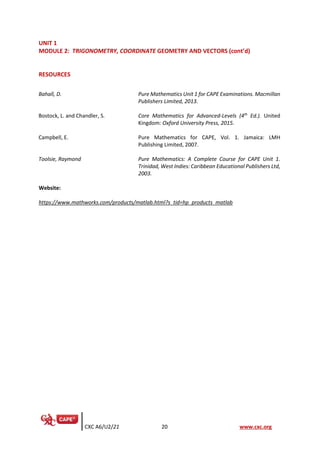
RESOURCES
Website:
https://www.mathworks.com/products/matlab.html?s_tid=hp_products_matlab
Bahall, D. Pure Mathematics Unit 1 for CAPE Examinations. Macmillan
Publishers Limited, 2013.
Bostock, L. and Chandler, S. Core Mathematics for Advanced-Levels (4th
Ed.). United
Kingdom: Oxford University Press, 2015.
Campbell, E. Pure Mathematics for CAPE, Vol. 1. Jamaica: LMH
Publishing Limited, 2007.
Toolsie, Raymond Pure Mathematics: A Complete Course for CAPE Unit 1.
Trinidad, West Indies: Caribbean Educational Publishers Ltd,
2003.
CXC A6/U2/21 21 www.cxc.org
UNIT 1
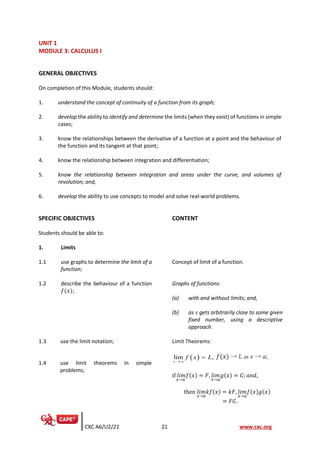
MODULE 3: CALCULUS I
GENERAL OBJECTIVES
On completion of this Module, students should:
1. understand the concept of continuity of a function from its graph;
2. develop the ability to identify and determine the limits (when they exist) of functions in simple
cases;
3. know the relationships between the derivative of a function at a point and the behaviour of
the function and its tangent at that point;
4. know the relationship between integration and differentiation;
5. know the relationship between integration and areas under the curve, and volumes of
revolution; and,
6. develop the ability to use concepts to model and solve real-world problems.
SPECIFIC OBJECTIVES CONTENT
Students should be able to:
1. Limits
1.1 use graphs to determine the limit of a
function;
Concept of limit of a function.
Graphs of functions:
(a) with and without limits; and,
(b) as x gets arbitrarily close to some given
fixed number, using a descriptive
approach.
1.2 describe the behaviour of a function
𝑓(𝑥);
1.3 use the limit notation; Limit Theorems:
( )
lim ,
x a
f x L
→
= 𝑓(𝑥) → L as x → a;
if 𝑙𝑖𝑚
𝑥→𝑎
𝑓(𝑥) = 𝐹, 𝑙𝑖𝑚
𝑥→𝑎
𝑔(𝑥) = 𝐺; 𝑎𝑛𝑑,
then 𝑙𝑖𝑚
𝑥→𝑎
𝑘𝑓(𝑥) = 𝑘𝐹, 𝑙𝑖𝑚
𝑥→𝑎
𝑓(𝑥)𝑔(𝑥)
= 𝐹𝐺.
1.4 use limit theorems in simple
problems;
CXC A6/U2/21 22 www.cxc.org
UNIT 1
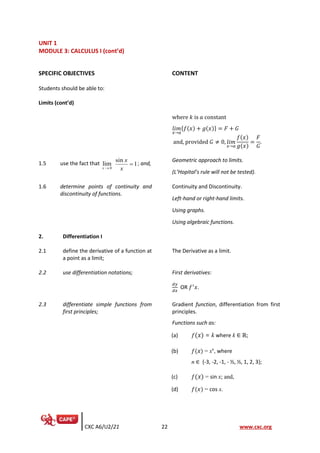
MODULE 3: CALCULUS I (cont’d)
SPECIFIC OBJECTIVES CONTENT
Students should be able to:
Limits (cont’d)
where 𝑘 is 𝑎 constant
𝑙𝑖𝑚
𝑥→𝑎
{𝑓(𝑥) + 𝑔(𝑥)} = 𝐹 + 𝐺
and, provided 𝐺 ≠ 0, 𝑙𝑖𝑚
𝑥→𝑎
𝑓(𝑥)
𝑔(𝑥)
=
𝐹
𝐺
.
1.5 use the fact that
0
lim
x →
sin
1
x
x
= ; and,
Geometric approach to limits.
(L’Hopital’s rule will not be tested).
1.6 determine points of continuity and
discontinuity of functions.
Continuity and Discontinuity.
Left-hand or right-hand limits.
Using graphs.
Using algebraic functions.
2. Differentiation I
2.1 define the derivative of a function at
a point as a limit;
The Derivative as a limit.
2.2 use differentiation notations; First derivatives:
𝑑𝑦
𝑑𝑥
OR 𝑓′
𝑥.
2.3 differentiate simple functions from
first principles;
Gradient function, differentiation from first
principles.
Functions such as:
(a) 𝑓(𝑥) = k where k ∈ ℝ;
(b) 𝑓(𝑥) = xn
, where
n ∈ {-3, -2, -1, - ½, ½, 1, 2, 3};
(c) 𝑓(𝑥) = sin x; and,
(d) 𝑓(𝑥) = cos x.
CXC A6/U2/21 23 www.cxc.org
UNIT 1
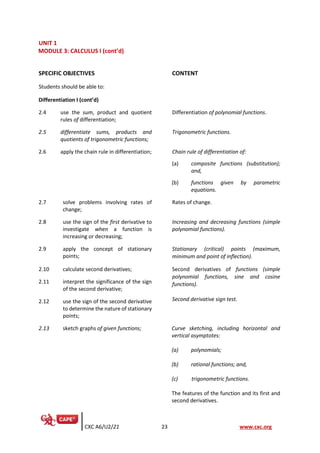
MODULE 3: CALCULUS I (cont’d)
SPECIFIC OBJECTIVES CONTENT
Students should be able to:
Differentiation I (cont’d)
2.4 use the sum, product and quotient
rules of differentiation;
Differentiation of polynomial functions.
2.5 differentiate sums, products and
quotients of trigonometric functions;
Trigonometric functions.
2.6 apply the chain rule in differentiation; Chain rule of differentiation of:
(a) composite functions (substitution);
and,
(b) functions given by parametric
equations.
2.7 solve problems involving rates of
change;
Rates of change.
2.8 use the sign of the first derivative to
investigate when a function is
increasing or decreasing;
Increasing and decreasing functions (simple
polynomial functions).
2.9 apply the concept of stationary
points;
Stationary (critical) points (maximum,
minimum and point of inflection).
2.10 calculate second derivatives; Second derivatives of functions (simple
polynomial functions, sine and cosine
functions).
Second derivative sign test.
2.11 interpret the significance of the sign
of the second derivative;
2.12 use the sign of the second derivative
to determine the nature of stationary
points;
2.13 sketch graphs of given functions; Curve sketching, including horizontal and
vertical asymptotes:
(a) polynomials;
(b) rational functions; and,
(c) trigonometric functions.
The features of the function and its first and
second derivatives.
CXC A6/U2/21 24 www.cxc.org
UNIT 1
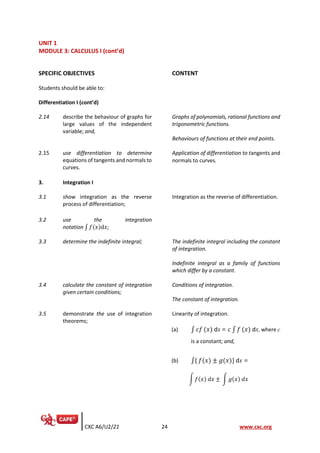
MODULE 3: CALCULUS I (cont’d)
SPECIFIC OBJECTIVES CONTENT
Students should be able to:
Differentiation I (cont’d)
2.14 describe the behaviour of graphs for
large values of the independent
variable; and,
Graphs of polynomials, rational functions and
trigonometric functions.
Behaviours of functions at their end points.
2.15 use differentiation to determine
equations of tangents and normals to
curves.
Application of differentiation to tangents and
normals to curves.
3. Integration I
3.1 show integration as the reverse
process of differentiation;
Integration as the reverse of differentiation.
3.2 use the integration
notation ∫ 𝑓(𝑥)d𝑥;
3.3 determine the indefinite integral; The indefinite integral including the constant
of integration.
Indefinite integral as a family of functions
which differ by a constant.
3.4 calculate the constant of integration
given certain conditions;
Conditions of integration.
The constant of integration.
3.5 demonstrate the use of integration
theorems;
Linearity of integration.
(a) ∫ 𝑐𝑓 (𝑥) dx = 𝑐 ∫ 𝑓 (𝑥) dx, where c
is a constant; and,
(b) ∫{ 𝑓(𝑥) ± 𝑔(𝑥)} dx =
∫ 𝑓(𝑥) 𝑑𝑥 ± ∫ 𝑔(𝑥) 𝑑𝑥
CXC A6/U2/21 25 www.cxc.org
UNIT 1
MODULE 3: CALCULUS I (cont’d)
SPECIFIC OBJECTIVES CONTENT
Students should be able to:
Integration I (cont’d)
3.6 determine indefinite integrals using
integration theorems;
Polynomial functions.
Simple trigonometric functions:
𝑠𝑖𝑛(𝑎𝑥 + 𝑏), 𝑐𝑜𝑠(𝑎𝑥 + 𝑏)
3.7 integrate using given substitution; Integration using the method of substitution.
3.8 use the results of definite integrals; Definite integrals.
(a) ( ) d ( ) d
b b
a a
f x x f t t
=
  ;
(b)
0 0
( ) d ( ) d
a a
f x x f a x x
= −
  for 𝑎 >
0; and,
(c) ( ) d ( ) ( )
b
a
f x x F b F a
= −

where 𝐹’(𝑥) = 𝑓(𝑥).
3.9 apply integration to areas under the
curve;
Applications of integration to areas:
(a) bounded by the curve and one or more
lines; and,
(b) between two curves.
3.10 calculate volumes of revolutions; Applications of integration to volumes of
revolution.
Rotating regions about the x-axis or y-axis
and a line.
CXC A6/U2/21 26 www.cxc.org
UNIT 1
MODULE 3: CALCULUS I (cont’d)
SPECIFIC OBJECTIVES CONTENTS
Students should be able to:
Integration I (cont’d)
3.11 formulate a differential equation of the
form y’ = 𝑓(𝑥);
Simple first order differential equations of the
type y’ = 𝑓(𝑥), where 𝑓(𝑥) is a polynomial or
a trigonometric function, with or without
initial boundary conditions.
3.12 solve differential equations of the form
𝑦′
= 𝑓(𝑥); and,
3.13 interpret solutions from differential
equations of the form
𝑦′
= 𝑓(𝑥).
Suggested Teaching and Learning Activities
To facilitate students’ attainment of the objectives of this Module, teachers are advised to engage
students in the teaching and learning activities listed below.
1. Students should be encouraged to work in small groups. Each group should be given the
following worded problem. Teachers are also encouraged to utilise similar problems to
reinforce concepts.
A certain chemical substance dissolves in water at a rate proportional to the product of the
amount (in grams) undissolved and (1/2 – D), where D is the ratio of the amount (in grams)
dissolved to the amount (in grams) of water. When 30 grams of the substance are agitated
initially with 100 grams of water, it is discovered that 10 grams of the substance are
dissolved after 2 hours.
Students should be encouraged to discuss the problem and respond to the questions below.
Once completed each group can be asked to explain how they arrive at their answer:
(a) develop a differential equation showing this information;
(b) solve, completely, this differential equation; and,
(c) calculate the approximate amount of grams of the chemical that would have been
dissolved after 5 hours.
CXC A6/U2/21 27 www.cxc.org
UNIT 1
MODULE 3: CALCULUS I (cont’d)
2. Incorporate the use of real-world problems that require students to analyse data and propose
solutions.
3. The following statement can be projected or written for students to read, ‘A hemispherical
bowl of radius r centimetres is being filled with molten lead at a constant rate’. Students should
then be encouraged to:
(a) obtain an expression for the volume of lead in the bowl when the depth of the lead in
the bowl is h centimetres;
(b) show that between the time when the molten lead is halfway to the top of the bowl,
and the time when the bowl is about to overflow, the rate at which the depth is rising
has fallen by a quarter (1/4).; and,
(c) recommend why the rate will be reducing.
Selected students or groups can be asked to respond to the questions and explain how they
arrived at their answer.
4. Students should be encouraged to work in groups. Each group should be given a topic to guide
their research, for example one group can be asked to look at differentiation and another
integration. Groups should be encouraged to gather data on definitions, formulas, and the
importance of each area of study. Students should also creatively present their findings to the
class.
RESOURCES
Bahall, D. Pure Mathematics Unit 1 for CAPE Examinations. Macmillan
Publishers Limited, 2013.
Bostock, L., and Chandler, S. Core Mathematics for Advanced-Levels (4th
Ed). United Kingdom:
Oxford University Press, 2015.
Campbell, E. Pure Mathematics for CAPE (Vol. 1). Jamaica: LMH Publishing
Limited, 2007.
Caribbean Examinations Council Area under the Graph of a Continuous Function. Barbados:
Caribbean Examinations Council, 1998.
Toolsie, Raymond Pure Mathematics: A Complete Course for CAPE Unit 1. Trinidad
West Indies: Caribbean Educational Publishers Ltd, 2003.
CXC A6/U2/21 28 www.cxc.org
◆ UNIT 2: COMPLEX NUMBERS, ANALYSIS AND MATRICES
MODULE 1: COMPLEX NUMBERS AND CALCULUS II
GENERAL OBJECTIVES
On completion of this Module, students should:
1. understand how to write complex roots of quadratic equations;
2. develop the ability to represent objects geometrically through the use of complex numbers;
3. be confident in using the techniques of differentiation and integration; and,
4. develop the ability to use concepts to model and solve real-world problems.
SPECIFIC OBJECTIVES CONTENT
Students should be able to:
1. Complex Numbers
1.1 express complex numbers in the
form a + bi where a and b are real
numbers;
Real and imaginary parts of a complex number.
Rectangular form of a complex number.
1.2 perform the arithmetic processes
on complex numbers in the form a
+ bi, where a and b are real
numbers;
Addition of complex numbers in the form
a + bi where a and b are the real and imaginary
parts, respectively, of the complex number.
Subtraction of complex numbers in the form
a + bi where a and b are the real and imaginary
parts, respectively, of the complex number.
Multiplication of complex numbers in the form
a + bi where a and b are the real and imaginary
parts, respectively, of the complex number.
Division of complex numbers in the form
a + bi where a and b are the real and imaginary
parts, respectively, of the complex number.
1.3 compute the roots of the general
quadratic equation using complex
numbers;
Nature of roots of a quadratic equation,
imaginary roots, sums and products of roots.
ax2
+ bx + c = 0, when b2
− 4ac < 0
CXC A6/U2/21 29 www.cxc.org
UNIT 2
MODULE 1: COMPLEX NUMBERS AND CALCULUS II (cont’d)
SPECIFIC OBJECTIVES CONTENT
Students should be able to:
Complex Numbers (cont’d)
1.4 use the concept that complex roots of
equations with constant coefficients
occur in conjugate pairs;
Conjugate pairs of complex roots.
1.5 calculate the square root of a complex
number;
Square root of a complex number.
1.6 calculate the modulus of a given
complex number;
The modulus of a complex number.
1.7 calculate the principal value of the
argument 𝜃 of a non-zero complex
number where −𝜋 < 𝜃 ≤ 𝜋;
The argument of a complex number.
1.8 represent complex numbers on an
Argand diagram;
Representation of complex numbers (their
sums, differences, and product) on an
Argand diagram.
1.9 interpret modulus and argument of
complex numbers on an Argand
diagram;
1.10 determine the locus of z on the Argand
diagram;
Locus of a point.
The set of all points z (locus of z) on the
Argand diagram such that z satisfies given
properties.
Description of the locus 𝑧 satisfying the
equations:
(a) |𝑧 − 𝑎| = 𝑘;
(b) |𝑧 − 𝑎| = |𝑧 − 𝑏|; and,
(c) 𝑎𝑟𝑔(𝑧 − 𝑎) = 𝛼
where 𝑎 and 𝑏 are complex numbers, 𝑘 is a
constant and −𝜋 < 𝛼 < 𝜋.
1.11 apply De Moivre’s theorem for integral
values of n; and,
De Moivre’s theorem for integral values of n.
1.12 use eix
= cos x + i sin x, for real x. Polar-argument and exponential forms of
complex numbers.
CXC A6/U2/21 30 www.cxc.org
UNIT 2
MODULE 1: COMPLEX NUMBERS AND CALCULUS II (cont’d)
SPECIFIC OBJECTIVES CONTENT
Students should be able to:
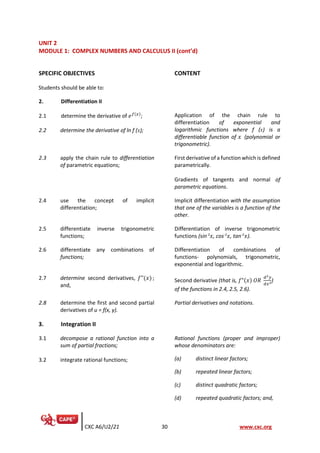
2. Differentiation II
2.1 determine the derivative of 𝑒𝑓(𝑥)
; Application of the chain rule to
differentiation of exponential and
logarithmic functions where f (x) is a
differentiable function of 𝑥 (polynomial or
trigonometric).
2.2 determine the derivative of ln f (x);
2.3 apply the chain rule to differentiation
of parametric equations;
First derivative of a function which is defined
parametrically.
Gradients of tangents and normal of
parametric equations.
2.4 use the concept of implicit
differentiation;
Implicit differentiation with the assumption
that one of the variables is a function of the
other.
2.5 differentiate inverse trigonometric
functions;
Differentiation of inverse trigonometric
functions (sin-1
𝑥, cos-1
𝑥, tan-1
𝑥).
2.6 differentiate any combinations of
functions;
Differentiation of combinations of
functions- polynomials, trigonometric,
exponential and logarithmic.
2.7 determine second derivatives, 𝑓’’(𝑥) ;
and,
Second derivative (that is, 𝑓“(𝑥) 𝑂𝑅
𝑑2𝑦
𝑑𝑥2)
of the functions in 2.4, 2.5, 2.6).
2.8 determine the first and second partial
derivatives of u = f(x, y).
Partial derivatives and notations.
3. Integration II
3.1 decompose a rational function into a
sum of partial fractions;
Rational functions (proper and improper)
whose denominators are:
(a) distinct linear factors;
(b) repeated linear factors;
(c) distinct quadratic factors;
(d) repeated quadratic factors; and,
3.2 integrate rational functions;
CXC A6/U2/21 31 www.cxc.org
UNIT 2
MODULE 1: COMPLEX NUMBERS AND CALCULUS II (cont’d)
SPECIFIC OBJECTIVES CONTENT
Students should be able to:
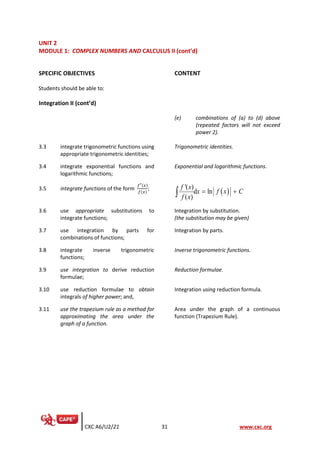
Integration II (cont’d)
(e) combinations of (a) to (d) above
(repeated factors will not exceed
power 2).
3.3 integrate trigonometric functions using
appropriate trigonometric identities;
Trigonometric identities.
3.4 integrate exponential functions and
logarithmic functions;
Exponential and logarithmic functions.
3.5 integrate functions of the form
𝑓′(𝑥)
𝑓(𝑥)
;
( )
'( )
d ln
( )
f x
x f x C
f x
= +

3.6 use appropriate substitutions to
integrate functions;
Integration by substitution.
(the substitution may be given)
3.7 use integration by parts for
combinations of functions;
Integration by parts.
3.8 integrate inverse trigonometric
functions;
Inverse trigonometric functions.
3.9 use integration to derive reduction
formulae;
Reduction formulae.
3.10 use reduction formulae to obtain
integrals of higher power; and,
Integration using reduction formula.
3.11 use the trapezium rule as a method for
approximating the area under the
graph of a function.
Area under the graph of a continuous
function (Trapezium Rule).
CXC A6/U2/21 32 www.cxc.org
UNIT 2
MODULE 1: COMPLEX NUMBERS AND CALCULUS II (cont’d)
Suggested Teaching and Learning Activities
To facilitate students’ attainment of the objectives of this Module, teachers are advised to engage
students in the teaching and learning activities listed below.
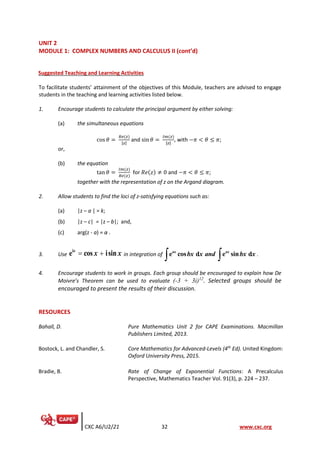
1. Encourage students to calculate the principal argument by either solving:
(a) the simultaneous equations
cos 𝜃 =
𝑅𝑒(𝑧)
|𝑧|
and sin 𝜃 =
𝐼𝑚(𝑧)
|𝑧|
, with −𝜋 < 𝜃 ≤ 𝜋;
or,
(b) the equation
tan 𝜃 =
𝐼𝑚(𝑧)
𝑅𝑒(𝑧)
for 𝑅𝑒(𝑧) ≠ 0 and −𝜋 < 𝜃 ≤ 𝜋;
together with the representation of z on the Argand diagram.
2. Allow students to find the loci of z-satisfying equations such as:
(a) |z – a | = k;
(b) |z – c| = |z – b|; and,
(c) arg(z - a) = α .
3. Use = +
i
e cos isin
x
x x in integration of
 
e cos d e sin d
ax ax
bx x and bx x .
4. Encourage students to work in groups. Each group should be encouraged to explain how De
Moivre’s Theorem can be used to evaluate (-3 + 3i)12
. Selected groups should be
encouraged to present the results of their discussion.
RESOURCES
Bahall, D. Pure Mathematics Unit 2 for CAPE Examinations. Macmillan
Publishers Limited, 2013.
Bostock, L. and Chandler, S. Core Mathematics for Advanced-Levels (4th
Ed). United Kingdom:
Oxford University Press, 2015.
Bradie, B. Rate of Change of Exponential Functions: A Precalculus
Perspective, Mathematics Teacher Vol. 91(3), p. 224 – 237.
CXC A6/U2/21 33 www.cxc.org
UNIT 2
MODULE 1: COMPLEX NUMBERS AND CALCULUS II (cont’d)
Campbell, E. Pure Mathematics for CAPE, Vol. 2. Jamaica: LMH Publishing
Limited, 2007.
Caribbean Examinations Council The Exponential and Logarithmic Functions – An
Investigation. Barbados: Caribbean Examinations Council,
1998.
Martin, A., Brown, K., Rigby, P. and
Ridley, S.
Pure Mathematics. Cheltenham, United Kingdom: Stanley
Thornes (Publishers) Limited, 2000.
Toolsie, Raymond Pure Mathematics: A Complete Course for CAPE Unit 2.
Trinidad West Indies: Caribbean Educational Publishers Ltd,
2003.
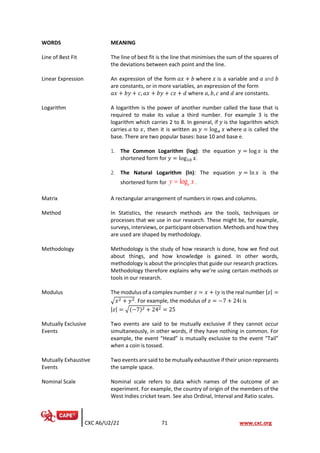
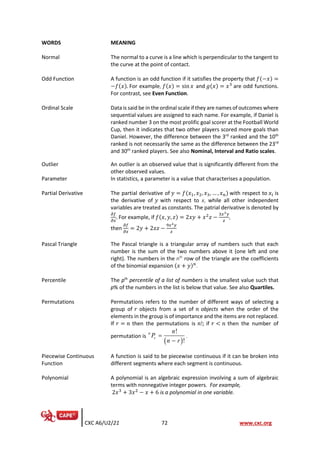
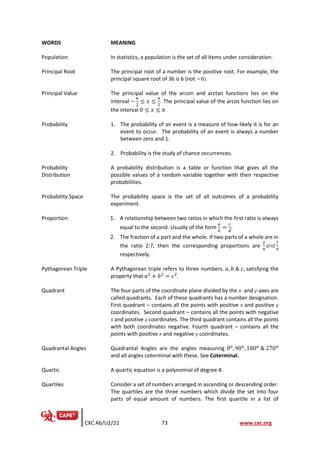
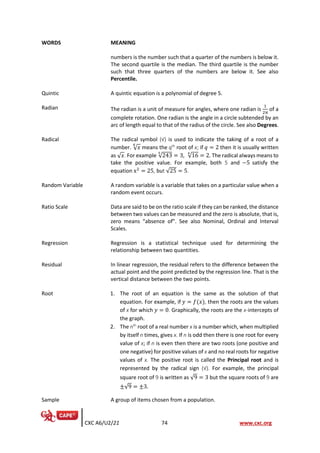
CXC A6/U2/2021
34
UNIT 2
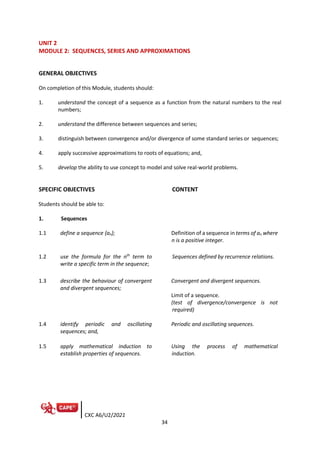
MODULE 2: SEQUENCES, SERIES AND APPROXIMATIONS
GENERAL OBJECTIVES
On completion of this Module, students should:
1. understand the concept of a sequence as a function from the natural numbers to the real
numbers;
2. understand the difference between sequences and series;
3. distinguish between convergence and/or divergence of some standard series or sequences;
4. apply successive approximations to roots of equations; and,
5. develop the ability to use concept to model and solve real-world problems.
SPECIFIC OBJECTIVES CONTENT
Students should be able to:
1. Sequences
1.1 define a sequence {an}; Definition of a sequence in terms of an where
n is a positive integer.
1.2 use the formula for the nth
term to
write a specific term in the sequence;
Sequences defined by recurrence relations.
1.3 describe the behaviour of convergent
and divergent sequences;
Convergent and divergent sequences.
Limit of a sequence.
(test of divergence/convergence is not
required)
1.4 identify periodic and oscillating
sequences; and,
Periodic and oscillating sequences.
1.5 apply mathematical induction to
establish properties of sequences.
Using the process of mathematical
induction.
CXC A6/U2/21 35 www.cxc.org
UNIT 2
MODULE 2: SEQUENCES, SERIES AND APPROXIMATIONS (cont’d)
SPECIFIC OBJECTIVES CONTENT
Students should be able to:
2. Series
2.1 distinguish between series and
sequences;
Definition of a series, as the sum of the terms
of a sequence.
Differences between series and sequences.
2.2 write the general term of a series,
using the summation notation;
Arithmetic and Geometric series.
Making distinctions between arithmetic and
geometric series.
2.3 calculate the mth
partial sum Sm as the
sum of the first m terms of a given
series;
Series.
Use of summation notation
 .
1
;
m
m r
r
S a
=
= 
2.4 apply mathematical induction to
establish properties of sequences and
series;
Further applications of mathematical
induction to sequences and series.
2.5 find the sum to infinity of a
convergent series;
Convergence and/or divergence of series to
which the method of differences can be
applied.
2.6 apply the method of differences to
appropriate series, and find their
sums;
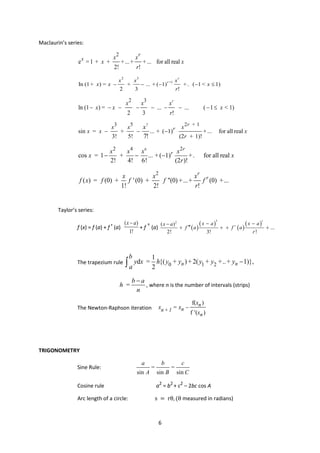
2.7 use the Maclaurin theorem for the
expansion of series; and,
The Maclaurin series.
2.8 use the Taylor theorem for the
expansion of series.
The Taylor series.
CXC A6/U2/21 36 www.cxc.org
UNIT 2
MODULE 2: SEQUENCES, SERIES AND APPROXIMATIONS (cont’d)
SPECIFIC OBJECTIVES CONTENT
Students should be able to:
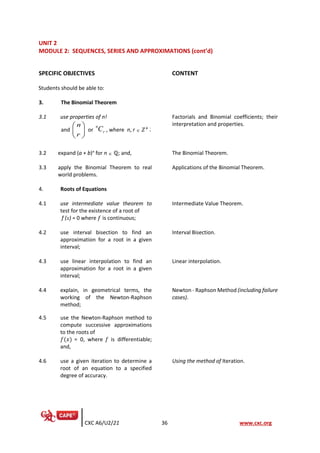
3. The Binomial Theorem
3.1 use properties of n!
and
n
r
 
 
 
or
n
r
C , where n, r  𝑍+
;
Factorials and Binomial coefficients; their
interpretation and properties.
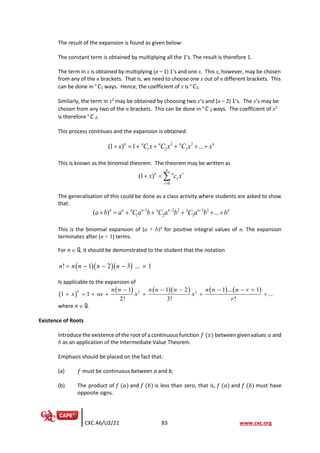
3.2 expand (a + b)n
for n  ℚ; and, The Binomial Theorem.
3.3 apply the Binomial Theorem to real
world problems.
Applications of the Binomial Theorem.
4. Roots of Equations
4.1 use intermediate value theorem to
test for the existence of a root of
f (x) = 0 where 𝑓 is continuous;
Intermediate Value Theorem.
4.2 use interval bisection to find an
approximation for a root in a given
interval;
Interval Bisection.
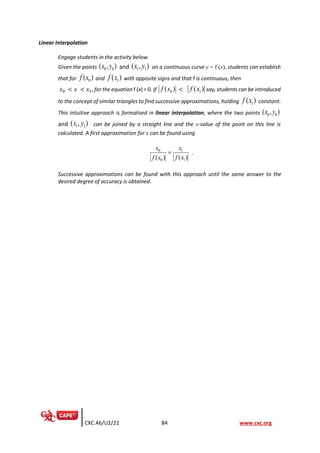
4.3 use linear interpolation to find an
approximation for a root in a given
interval;
Linear interpolation.
4.4 explain, in geometrical terms, the
working of the Newton-Raphson
method;
Newton - Raphson Method (including failure
cases).
4.5 use the Newton-Raphson method to
compute successive approximations
to the roots of
𝑓(𝑥) = 0, where 𝑓 is differentiable;
and,
4.6 use a given iteration to determine a
root of an equation to a specified
degree of accuracy.
Using the method of Iteration.
CXC A6/U2/21 37 www.cxc.org
UNIT 2
MODULE 2: SEQUENCES, SERIES AND APPROXIMATIONS (cont’d)
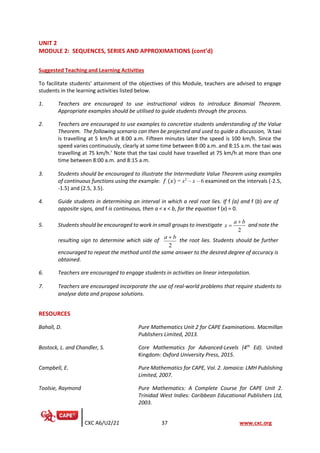
Suggested Teaching and Learning Activities
To facilitate students’ attainment of the objectives of this Module, teachers are advised to engage
students in the learning activities listed below.
1. Teachers are encouraged to use instructional videos to introduce Binomial Theorem.
Appropriate examples should be utilised to guide students through the process.
2. Teachers are encouraged to use examples to concretize students understanding of the Value
Theorem. The following scenario can then be projected and used to guide a discussion, ‘A taxi
is travelling at 5 km/h at 8:00 a.m. Fifteen minutes later the speed is 100 km/h. Since the
speed varies continuously, clearly at some time between 8:00 a.m. and 8:15 a.m. the taxi was
travelling at 75 km/h.’ Note that the taxi could have travelled at 75 km/h at more than one
time between 8:00 a.m. and 8:15 a.m.
3. Students should be encouraged to illustrate the Intermediate Value Theorem using examples
of continuous functions using the example: 𝑓 (𝑥) = x2
– x – 6 examined on the intervals (-2.5,
-1.5) and (2.5, 3.5).
4. Guide students in determining an interval in which a real root lies. If f (a) and f (b) are of
opposite signs, and f is continuous, then a < x < b, for the equation f (x) = 0.
5. Students should be encouraged to work in small groups to investigate
2
a b
x
+
= and note the
resulting sign to determine which side of
2
a b
+
the root lies. Students should be further
encouraged to repeat the method until the same answer to the desired degree of accuracy is
obtained.
6. Teachers are encouraged to engage students in activities on linear interpolation.
7. Teachers are encouraged incorporate the use of real-world problems that require students to
analyse data and propose solutions.
RESOURCES
Bahall, D. Pure Mathematics Unit 2 for CAPE Examinations. Macmillan
Publishers Limited, 2013.
Bostock, L. and Chandler, S. Core Mathematics for Advanced-Levels (4th
Ed). United
Kingdom: Oxford University Press, 2015.
Campbell, E. Pure Mathematics for CAPE, Vol. 2. Jamaica: LMH Publishing
Limited, 2007.
Toolsie, Raymond Pure Mathematics: A Complete Course for CAPE Unit 2.
Trinidad West Indies: Caribbean Educational Publishers Ltd,
2003.
CXC A6/U2/21 38 www.cxc.org
UNIT 2
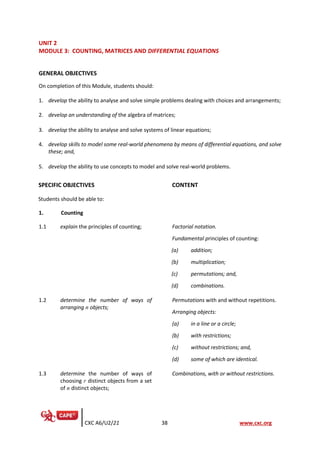
MODULE 3: COUNTING, MATRICES AND DIFFERENTIAL EQUATIONS
GENERAL OBJECTIVES
On completion of this Module, students should:
1. develop the ability to analyse and solve simple problems dealing with choices and arrangements;
2. develop an understanding of the algebra of matrices;
3. develop the ability to analyse and solve systems of linear equations;
4. develop skills to model some real-world phenomena by means of differential equations, and solve
these; and,
5. develop the ability to use concepts to model and solve real-world problems.
SPECIFIC OBJECTIVES CONTENT
Students should be able to:
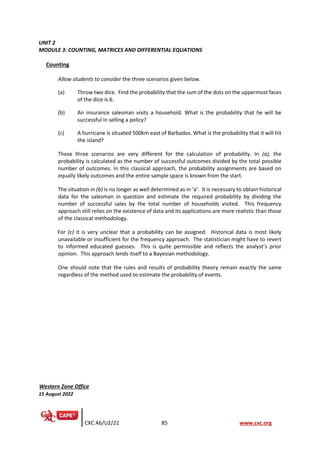
1. Counting
1.1 explain the principles of counting; Factorial notation.
Fundamental principles of counting:
(a) addition;
(b) multiplication;
(c) permutations; and,
(d) combinations.
1.2 determine the number of ways of
arranging n objects;
Permutations with and without repetitions.
Arranging objects:
(a) in a line or a circle;
(b) with restrictions;
(c) without restrictions; and,
(d) some of which are identical.
1.3 determine the number of ways of
choosing r distinct objects from a set
of n distinct objects;
Combinations, with or without restrictions.
CXC A6/U2/21 39 www.cxc.org
UNIT 2
MODULE 3: COUNTING, MATRICES AND DIFFERENTIAL EQUATIONS (cont’d)
SPECIFIC OBJECTIVES CONTENT
Students should be able to:
Counting (cont’d)
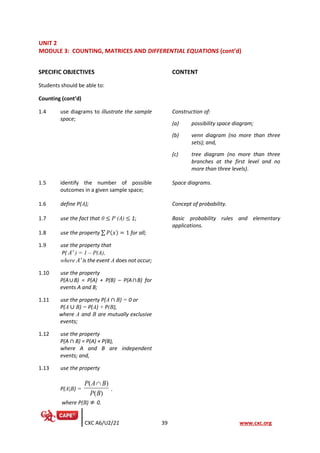
1.4 use diagrams to illustrate the sample
space;
Construction of:
(a) possibility space diagram;
(b) venn diagram (no more than three
sets); and,
(c) tree diagram (no more than three
branches at the first level and no
more than three levels).
1.5 identify the number of possible
outcomes in a given sample space;
Space diagrams.
1.6 define P(A); Concept of probability.
1.7 use the fact that 0 ≤ P (A) ≤ 1; Basic probability rules and elementary
applications.
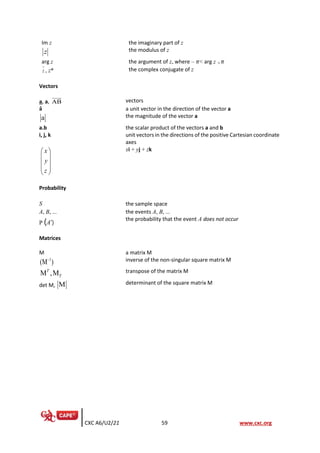
1.8 use the property ∑ 𝑃(𝑥) = 1 for all;
1.9 use the property that
P( A' ) = 1 – P(A),
where A' is the event A does not occur;
1.10 use the property
P(A∪B) = P(A) + P(B) – P(A∩B) for
events A and B;
1.11 use the property P(A ∩ B) = 0 or
P(A ∪ B) = P(A) + P(B),
where A and B are mutually exclusive
events;
1.12 use the property
P(A ∩ B) = P(A) × P(B),
where A and B are independent
events; and,
1.13 use the property
P(A|B) =
( )
( )
P A B
P B

,
where P(B) ≠ 0.
CXC A6/U2/21 40 www.cxc.org
UNIT 2
MODULE 3: COUNTING, MATRICES AND DIFFERENTIAL EQUATIONS (cont’d)
SPECIFIC OBJECTIVES CONTENT
Students should be able to:
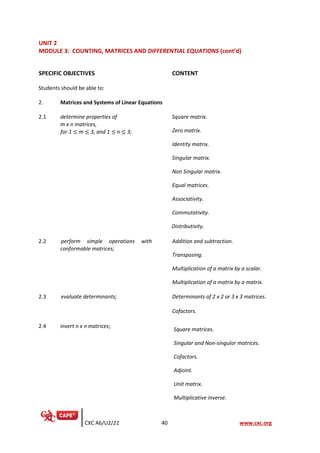
2. Matrices and Systems of Linear Equations
2.1 determine properties of
m x n matrices,
for 1 ≤ m ≤ 3, and 1 ≤ n ≤ 3;
Square matrix.
Zero matrix.
Identity matrix.
Singular matrix.
Non Singular matrix.
Equal matrices.
Associativity.
Commutativity.
Distributivity.
2.2 perform simple operations with
conformable matrices;
Addition and subtraction.
Transposing.
Multiplication of a matrix by a scalar.
Multiplication of a matrix by a matrix.
2.3 evaluate determinants; Determinants of 2 x 2 or 3 x 3 matrices.
Cofactors.
2.4 invert n x n matrices;
Square matrices.
Singular and Non-singular matrices.
Cofactors.
Adjoint.
Unit matrix.
Multiplicative inverse.
CXC A6/U2/21 41 www.cxc.org
UNIT 2
MODULE 3: COUNTING, MATRICES AND DIFFERENTIAL EQUATIONS (cont’d)
SPECIFIC OBJECTIVES CONTENT
Students should be able to:
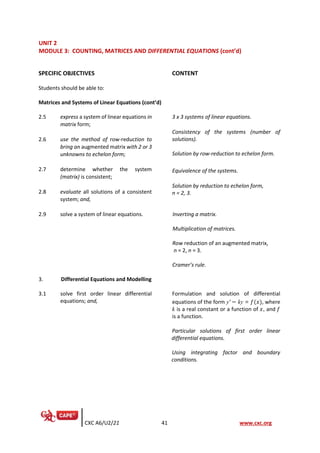
Matrices and Systems of Linear Equations (cont’d)
2.5 express a system of linear equations in
matrix form;
3 x 3 systems of linear equations.
Consistency of the systems (number of
solutions).
Solution by row-reduction to echelon form.
Equivalence of the systems.
Solution by reduction to echelon form,
n = 2, 3.
2.6 use the method of row-reduction to
bring an augmented matrix with 2 or 3
unknowns to echelon form;
2.7 determine whether the system
(matrix) is consistent;
2.8 evaluate all solutions of a consistent
system; and,
2.9 solve a system of linear equations. Inverting a matrix.
Multiplication of matrices.
Row reduction of an augmented matrix,
n = 2, n = 3.
Cramer’s rule.
3. Differential Equations and Modelling
3.1 solve first order linear differential
equations; and,
Formulation and solution of differential
equations of the form y' − ky = 𝑓(𝑥), where
k is a real constant or a function of 𝑥, and 𝑓
is a function.
Particular solutions of first order linear
differential equations.
Using integrating factor and boundary
conditions.
CXC A6/U2/21 42 www.cxc.org
UNIT 2
MODULE 3: COUNTING, MATRICES AND DIFFERENTIAL EQUATIONS (cont’d)
SPECIFIC OBJECTIVES CONTENT
Students should be able to:
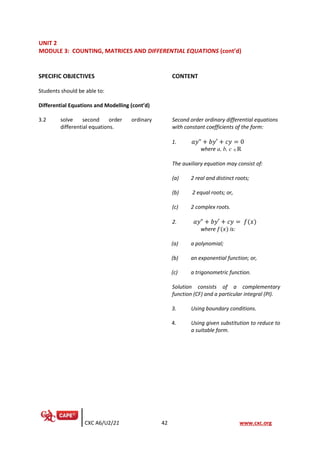
Differential Equations and Modelling (cont’d)
3.2 solve second order ordinary
differential equations.
Second order ordinary differential equations
with constant coefficients of the form:
1. 𝑎𝑦" + 𝑏𝑦′ + 𝑐𝑦 = 0
where a, b, c 
The auxiliary equation may consist of:
(a) 2 real and distinct roots;
(b) 2 equal roots; or,
(c) 2 complex roots.
2. 𝑎𝑦" + 𝑏𝑦′ + 𝑐𝑦 = 𝑓(𝑥)
where 𝑓(𝑥) is:
(a) a polynomial;
(b) an exponential function; or,
(c) a trigonometric function.
Solution consists of a complementary
function (CF) and a particular integral (PI).
3. Using boundary conditions.
4. Using given substitution to reduce to
a suitable form.
CXC A6/U2/21 43 www.cxc.org
UNIT 2
MODULE 3: COUNTING, MATRICES AND DIFFERENTIAL EQUATIONS (cont’d)
Suggested Teaching and Learning Activities
To facilitate students’ attainment of the objectives of this Module, teachers are advised to engage
students in the teaching and learning activities listed below.
Systems of Linear Equations in Two Unknowns
1. Students should be encouraged to plot on graph paper the pair of straight lines represented
by a given pair of linear equations in two unknowns, and to examine the relationship between
the pair of straight lines in the cases where the system of equations has been shown to have:
(a) one solution;
(b) many solutions; and,
(c) no solutions.
2. Teachers are encouraged to utilise explainer videos and/or PowerPoint presentations to
demonstrate to students that given a system of equations with a unique solution, there exist
equivalent systems, obtained by row-reduction, having the same solution. Teachers should
then ask students to plot on the same piece of graph paper all the straight lines represented
by the successive pairs of linear equations which result from each of the row operations used
to obtain the solution.
3. Students should be encouraged to work in groups to respond to similar scenarios as seen in
the following: ‘A police department uses a computer imaging app to create digital
photographs of alleged suspects of a crime from eyewitness accounts. One software
package contains 180 hairlines, 90 sets of eyes and eyebrows, 75 noses, 100 mouths,
and 70 chins and cheek structures.’ Students should then be encouraged to provide
responses to the following questions with explanations of how they arrived at their
answers or solutions.
(a) How many different faces can the software package create?
(b) The suspect was wearing a face mask and as a result the eyewitness can only describe
the hairline, eyes, and eyebrows of the suspect. How many different faces can be
produced with this information?
(c) Calculate the probability that the digital photograph produced is the actual
photograph of the suspect.
4. Teachers are encouraged to incorporate the use of real-world problems that require students
to analyse data and propose solutions.
CXC A6/U2/21 44 www.cxc.org
UNIT 2
MODULE 3: COUNTING, MATRICES AND DIFFERENTIAL EQUATIONS (cont’d)
RESOURCES
Bahall, Dipchand. Pure Mathematics Unit 2 for CAPE Examinations.
Mcmillan Publishers Limited, 2013.
Bolt, B. and Hobbs, D. 101 Mathematical Projects: A Resource Book. United
Kingdom: Cambridge University Press, 1994.
Bostock, L. and Chandler, S. Core Mathematics for Advanced-Levels (4th
Ed.). United
Kingdom: Oxford University Press, 2015.
Campbell, E. Pure Mathematics for CAPE, Vol. 2. Jamaica: LMH
Publishing Limited, 2007.
Crawshaw, J. and Chambers, J. A Concise Course in A-Level Statistics. Cheltenham,
United Kingdom: Stanley Thornes (Publishers) Limited,
1999.
Mann, P.S. Introductory Statistics (9th
Ed.). New Jersey: Wiley, 2016.
Toolsie, Raymond Pure Mathematics: A Complete Course for CAPE Unit 2.
Trinidad West Indies: Caribbean Educational Publishers
Ltd, 2003.
Websites:
https://www.mathworks.com/help/matlab/examples/basic-matrix-operations.html
CXC A6/U2/21 45 www.cxc.org
◆ OUTLINE OF ASSESSMENT
Each Unit of the syllabus is assessed separately. The scheme of assessment for each Unit is the same.
A candidate’s performance on each Unit is reported as an overall grade and a grade on each Module
of the Unit. The assessment comprises two components, one external and one internal.
EXTERNAL ASSESSMENT (80 per cent)
The candidate is required to sit two written papers for a total of 4 hrs.
Paper 01
(1 hour 30 minutes)
This paper comprises forty-five,
compulsory multiple-choice items, 15
from each module. Each item is worth 1
mark.
30 per cent
Paper 02
(2 hours 30 minutes)
This paper comprises six, compulsory
extended-response questions.
50 per cent
SCHOOL-BASED ASSESSMENT (20 per cent)
School-Based Assessment in respect of each Unit will contribute 20 percent to the total assessment of
a candidate’s performance on that Unit.
Paper 031 (20 per cent of the Total Assessment)
This paper is intended for candidates registered through schools or other approved institutions.
The School-Based Assessment comprises a project designed and internally assessed by the teacher and
externally moderated by CXC®. This paper comprises a single project requiring candidates to
demonstrate the practical application of Mathematics in everyday life. In essence, it should allow
candidates to probe, describe and explain a mathematical area of interest and communicate the
findings using mathematical symbols, language and tools. The topic chosen may be from any module
or combination of different modules of the syllabus.
The project will primarily be theory based requiring the solution of a chosen problem, applying
mathematical concepts and procedures from any Module in the syllabus in order to understand,
describe or explain a real-world phenomenon. The candidate may include secondary data to support
the theoretical concepts.
Paper 032 (Alternative to Paper 031) (2 hours)
This paper is an alternative to Paper 031, the School-Based Assessment and is intended for private
candidates. This paper comprises three compulsory questions based on any of the modules or
combination of different modules of the syllabus. The paper tests skills similar to those assessed in the
School-Based Assessment.
MODERATION OF SCHOOL-BASED ASSESSMENT (PAPER 031)
School-Based Assessment Record Sheets are available online via the CXC®’s website www.cxc.org.
All School-Based Assessment Record of marks must be submitted online using the SBA data capture
CXC A6/U2/21 46 www.cxc.org
module of the Online Registration System (ORS). Assignments will be requested by CXC® for
moderation purposes. These assignments will be reassessed by CXC® Examiners who moderate the
School-Based Assessment. Teachers’ marks may be adjusted as a result of moderation. The Examiners’
comments will be sent to schools. All assignments must be submitted by the stipulated deadlines.
Copies of the students’ assignments that are not submitted must be retained by the school until three
months after publication by CXC® of the examination results.
ASSESSMENT DETAILS FOR EACH UNIT
External Assessment by Written Papers (80 per cent of Total Assessment)
Paper 01 (1 hour 30 minutes – 30 per cent of Total Assessment)
1. Composition of the Paper
(a) This paper consists of forty-five multiple-choice items, with fifteen items based on
each Module.
(b) All items are compulsory.
2. Syllabus Coverage
(a) Knowledge of the entire syllabus is required.
(b) The paper is designed to test a candidate’s knowledge across the breadth of the
syllabus.
3. Question Type
Questions may be presented using words, symbols, tables, diagrams or a combination of
these.
4. Mark Allocation
(a) Each item is allocated 1 mark.
(b) Each Module is allocated 15 marks.
(c) The total marks available for this paper is 45.
(d) This paper contributes 30 per cent towards the final assessment.
5. Award of Marks
Marks will be awarded for conceptual knowledge, algorithmic knowledge and reasoning.
Conceptual Knowledge: Recall or selection of facts or principles.
CXC A6/U2/21 47 www.cxc.org
Algorithmic Knowledge: Evidence of knowledge, ability to apply concepts and skills,
and to analyse a problem in a logical manner; computational
skill, numerical accuracy, and acceptable tolerance limits in
drawing diagrams.
Reasoning: Selection of appropriate strategy, evidence of clear thinking,
explanation and/or logical argument.
6. Use of Calculators
(a) Each candidate is required to have a silent, non-programmable calculator for the
duration of the examination, and is entirely responsible for its functioning.
(b) The use of calculators with graphical displays will not be permitted.
(c) Answers found by using a calculator, without relevant working shown, may not be
awarded full marks.
(d) Calculators must not be shared during the examination.
7. Use of Mathematical Tables
A booklet of mathematical formulae and tables will be provided.
Paper 02 (2 hours 30 minutes – 50 per cent of Total Assessment)
1. Composition of Paper
(a) The paper consists of six questions. Two questions are based on each Module
(Module 1, Module 2 and Module 3).
(b) All questions are compulsory.
2. Syllabus Coverage
(a) Each question may be based on one or more than one topic in the Module from which
the question is taken.
(b) Each question may develop a single theme or unconnected themes.
3. Question Type
(a) Questions may require an extended response.
(b) Questions may be presented using words, symbols, tables, diagrams or a combination
of these.
4. Mark Allocation
(a) Each question is worth 25 marks.
CXC A6/U2/21 48 www.cxc.org
(b) The number of marks allocated to each sub-question will appear in brackets on the
examination paper.
(c) Each Module is allocated 50 marks.
(d) The total marks available for this paper is 150.
(e) This paper contributes 50 per cent towards the final assessment.
5. Award of Marks
(a) Marks will be awarded for conceptual knowledge, algorithmic knowledge and
reasoning.
Conceptual Knowledge: Recall and understand facts or principles.
Algorithmic Knowledge: Evidence of knowledge, ability to apply concepts and
skills, and to analyse a problem in a logical manner;
computational skill, numerical accuracy, and
acceptable tolerance limits in drawing diagrams.
Reasoning: Selection of appropriate strategy, evidence of clear
thinking, explanation and/or logical argument.
(b) Full marks will be awarded for correct answers and presence of appropriate working.
(c) Where an incorrect answer is given, credit may be awarded for correct method
provided that the working is shown.
(d) If an incorrect answer in a previous question or part-question is used later in a section
or a question, then marks may be awarded in the latter part even though the original
answer is incorrect. In this way, a candidate is not penalised twice for the same
mistake.
(e) A correct answer given with no indication of the method used (in the form of written
working) will receive no marks. Candidates are, therefore, advised to show all
relevant working.
6. Use of Calculators
(a) Each candidate is required to have a silent, non-programmable calculator for the
duration of the examination, and is responsible for its functioning.
(b) The use of calculators with graphical displays will not be permitted.
(c) Answers found by using a calculator, without relevant working shown, may not be
awarded full marks.
(d) Calculators must not be shared during the examination.
CXC A6/U2/21 49 www.cxc.org
7. Use of Mathematical Tables
A booklet of mathematical formulae and tables will be provided.
SCHOOL-BASED ASSESSMENT
School-Based Assessment is an integral part of student assessment in the course covered by this
syllabus. It is intended to assist students in acquiring certain knowledge, skills, and attitudes that are
associated with the subject. The activities for the School-Based Assessment are linked to the syllabus
and should form part of the learning activities to enable the student to achieve the objectives of the
syllabus. Group work should be encouraged.
During the course of study for the subject, students obtain marks for the competence they develop
and demonstrate in undertaking their School-Based Assessment assignments. These marks contribute
to the final marks and grades that are awarded to students for their performance in the examination.
The guidelines provided in this syllabus for selecting appropriate tasks are intended to assist teachers
and students in selecting assignments that are valid for the purpose of School-Based Assessment.
The guidelines provided for the assessment of these assignments are intended to assist teachers in
awarding marks that are reliable estimates of the achievement of students in the School-Based
Assessment component of the course. In order to ensure that the scores awarded by teachers are
in line with the CXC® standards, the Council undertakes the moderation of a sample of the School-
Based Assessment assignments marked by each teacher.
School-Based Assessment provides an opportunity to individualise a part of the curriculum to meet the
needs of students. It facilitates feedback to the student at various stages of the experience. This
helps to build the self- confidence of students as they proceed with their studies. School-Based
Assessment also facilitates the development of the critical skills and abilities emphasised by this
CAPE® subject and enhance the validity of the examination on which candidate performance is
reported. School-Based Assessment, therefore, makes a significant and unique contribution to both
the development of relevant skills and the testing and rewarding of students for the development of
those skills.
The Caribbean Examinations Council seeks to ensure that the School-Based Assessment scores are
valid and reliable estimates of accomplishment. The guidelines provided in this syllabus are intended
to assist in doing so.
Paper 031 (20 per cent of the Total Assessment)
This paper is intended for candidates registered through schools or other approved institutions.
This paper comprises a project requiring candidates to demonstrate the practical application of
Mathematics in everyday life. In essence, it should allow candidates to probe, describe and explain a
mathematical area of interest and communicate the findings using mathematical symbols, language
and tools.
The topic chosen will be determined largely by the candidate in consultation with the teacher and
may be from any module or combination of different modules of the syllabus.
CXC A6/U2/21 50 www.cxc.org
The project is based on applying mathematical concepts, skills and procedures from any topic(s) in
order to understand, describe or explain a real world phenomenon. The project is theory based and
no data collection is required. However, secondary data may be presented to support the theoretical
concepts.
CRITERIA FOR THE SCHOOL-BASED ASSESSMENT (SBA) (Paper 031)
This paper is compulsory and consists of a project. Candidates have the option to work in small groups
(maximum 5 members) to complete their SBAs.
1. The aims of the project are to:
(a) promote self-learning;
(b) allow teachers the opportunity to engage in formative assessment of their students;
(c) provide opportunities for all candidates to show, with confidence, that they have
mastered the syllabus;
(d) enable candidates to use the methods and procedures of statistical analysis to
describe or explain real-life phenomena; and,
(e) foster the development of critical thinking skills among students.
2. Requirements of the project
(a) The project will be presented in the form of a report and should include the following:
(i) a project title;
(ii) a problem statement which provides the purpose of the project;
(iii) identification of important elements of the problem;
(iv) the solution of the problem; and,
(v) discussion of findings.
(b) Teachers are expected to guide candidates in choosing appropriate projects that
relate to their interests and mathematical expertise.
(c) Candidates should make use of mathematical skills and theories from any of the
Modules.
3. Integration of Project into the Course
(a) The activities related to project work should be integrated into the course so as to
enable candidates to learn and practise the skills of undertaking a successful project.
(b) Some time in class should be allocated for general discussion of project work. For
example, discussion of which specific objectives should be selected, how the
CXC A6/U2/21 51 www.cxc.org
information should be presented and analysed.
(c) Class time should also be allocated for discussion between teacher and student,
and student and student.
4. Management of Project
(a) Planning
An early start to planning project work is highly recommended and the schedule
of the dates for submission should be developed by teachers and candidates.
(b) Length
The project must not exceed 1,500 words. The word count does not include: Tables,
References, Table of contents, Appendices and Figures. Two marks will be deducted
for exceeding the word limit by more than 200 words.
(c) Guidance
Each candidate should know the requirements of the project and its assessment
process.
Although candidates may consult with resource persons besides the teacher the
candidates’ submission should be their own work.
Candidates are not expected to work on their own. The teacher is expected to give
appropriate guidance at all stages of project work, for example, chapters to read,
alternative procedures to follow and other sources of information.
(d) Authenticity
Teachers are required to ensure that all projects are the candidates’ work.
The recommended procedures are to:
(i) engage candidates in discussion;
(ii) ask candidates to describe procedures used and summarise findings either
orally or written; and,
(iii) ask candidates to explain specific aspects of the analysis.
◆ ASSESSMENT CRITERIA
The project will be presented in the form of a report and will be assessed on the following aspects:
(a) project title;
(b) problem statement;
(c) mathematical formulation;
(d) the solution of the problem;
(e) discussion of findings; and,
(f) overall presentation.
CXC A6/U2/21 52 www.cxc.org
Project Descriptors Marks Total
1. Project Title
• Title is clear and concise, and relates to real world problem
Award 1 mark for titles presented and not related to real world
problems.
2
2
2. Problem Statement
• Problem is clearly stated and is appropriate in level of difficulty 1
• Purpose is clearly stated and relates to a real-world problem
Award 1 mark for purpose presented and not related to real
world problems.
2
3
3. Mathematical Formulation
• Identifies all the important elements of the problem and shows a
complete understanding of the relationships between them
2
• Shows understanding of the problem’s mathematical concepts
and principles
2
• Uses appropriate mathematical terminology and notations to
model the problem mathematically
2
• Uses appropriate Mathematical methods for the problem/task 2
8
4. The Problem Solution
• Assumptions are clearly identified and explained 1
• Proofs are clearly stated 1
• Diagrams are appropriate and clearly labelled 2
• Explanations are sufficient and clearly expressed 2
• Theorems are appropriate and/or Formulae are relevant to the
solutions and are correctly applied
2
• Calculations are accurate without errors 2
• Solutions are clearly stated 2
• Interpretation of results is appropriate given the purpose 2
• Applies the solution or proof to the given real-world problem 2
16
5. Discussion of Findings
• Discussion is coherent, concise and relates to the purpose of the
project
2
• Recommendations are relevant and practical 2
• Conclusion is succinct, fully reflects the objectives and is
supported by evidence
2
6
6. Overall Presentation
• Communicates information in a logical way using correct
grammar, and appropriate mathematical jargon all the time.
2
• Appropriate citing of sources 1
• Inclusion of bibliography 2
5
Total marks 40
CXC A6/U2/21 53 www.cxc.org
Procedures for Reporting and Submitting School-Based Assessment
(i) Teachers are required to record the mark awarded to each candidate on the mark sheet
provided by CXC®. The completed mark sheets should be submitted to CXC® no later than April
30 of the year of the examination.
Note: The school is advised to keep a copy of the project for each candidate as well as copies of the
mark sheets.
(ii) Teachers will be required to submit to CXC® the projects of candidates according to the
guidelines provided. The projects will be re-marked by CXC® for moderation purposes.
Moderation of School Based Assessment
The candidate’s performance on the project will be moderated. The standard and range of marks
awarded by the teacher will be adjusted where appropriate. However, the rank order assigned by the
teacher will be adjusted only in special circumstances and then only after consideration of the data
provided by the sample of marked projects submitted by the teacher and re-marked by CXC®.
Paper 032 (20 per cent of Total Assessment)
1. Composition of Paper
(a) This paper consists of three questions, based on any of the modules or combination
of different modules of the syllabus.
(b) All questions are compulsory.
2. Question Type
(a) Each question may require an extended response.
(b) A part of or an entire question may focus on mathematical modelling.
(c) A question may be presented using words, symbols, tables, diagrams or a combination
of these.
3. Mark Allocation
(a) Each question carries a maximum of 20 marks.
(b) The Paper carries a maximum of 60 marks.
(c) For each question, marks should be allocated for the skills outlined on page 3 of this
Syllabus.
4. Award of Marks
(a) Marks will be awarded for reasoning, algorithmic knowledge and conceptual
knowledge.
CXC A6/U2/21 54 www.cxc.org
For each question, the 20 marks will be awarded as follows:
Conceptual
Knowledge:
Recall and understand facts or principles.
Algorithmic
Knowledge:
Evidence of knowledge, ability to apply concepts and skills,
and to analyse a problem in a logical manner.
Computational skill, numerical accuracy, and acceptable
tolerance limits in drawing diagrams.
Reasoning: Selection of appropriate strategy, evidence of clear
reasoning, explanation and/or logical argument.
(b) Full marks will be awarded for correct answers and presence of appropriate working.
(c) Where an incorrect answer is given, credit may be awarded for correct method
provided that the working is shown.
(d) If an incorrect answer in a previous question or part-question is used later in a section
or a question, then marks may be awarded in the later part even though the original
answer is incorrect. In this way, a candidate is not penalised twice for the same
mistake.
(e) A correct answer given with no indication of the method used (in the form of written
working) will receive no marks. Candidates should be advised to show all relevant
working.
5. Use of Calculators
Each candidate is required to have a silent, non-programmable calculator for the duration of
the examination, and is responsible for its functioning.
(a) The use of calculators with graphical displays will not be permitted.
(b) Answers found by using a calculator, without relevant working shown, may not be
awarded full marks.
(c) Calculators must not be shared during the examination.
(d) Cell phones should not be used as an alternative to calculators.
6. Use of Mathematical Tables
A booklet of mathematical formulae and tables will be provided.
CXC A6/U2/21 55 www.cxc.org
GENERAL GUIDELINES FOR TEACHERS
1. Teachers should note that the reliability of marks awarded is a significant factor in the School-
Based Assessment, and has far-reaching implications for the candidate’s final grade.
2. Candidates who do not fulfil the requirements of the School-Based Assessment will be
considered absent from the whole examination.
3. Teachers are asked to note the following:
(a) the relationship between the marks for the assignment and those submitted to CXC®
on the School-Based Assessment form should be clearly shown;
(b) marks for the Project will be allocated across Modules in the ratio 1:1:1. The project
will be marked out of a total of 40 marks. The marks earned by a student are assigned
to each Module. For example, if a student earns 35 out of 40 for his School-Based
Assessment, 35 marks will be assigned to Module 1, 35 marks to Module 2 and 35
marks to Module 3. The total score will be 35+35+35= 105 out of 120; and,
(c) the standard of marking should be consistent.
◆ REGULATIONS FOR PRIVATE CANDIDATES
Candidates who are registered privately will be required to sit Paper 01, Paper 02 and Paper 032.
Paper 032 takes the form of a written examination and will be 2 hours’ duration and will consist of
three questions, each worth 20 marks. Each question will be based on the objectives and content of
one of the three Modules of the Unit. Paper 032 will contribute 20 per cent of the total assessment
of a candidate’s performance on that Unit and will test the same skills as the School-Based
Assessment.
Paper 032 (2 hours)
The paper consists of three questions. Each question based on any of the modules or combination of
different modules of the syllabus and tests candidates’ skills and abilities to:
1. recall, select and use appropriate facts, concepts and principles in a variety of contexts;
2. manipulate mathematical expressions and procedures using appropriate symbols and
language, logical deduction and inferences;
3. select and use a simple mathematical model to describe a real-world situation;
4. simplify and solve mathematical models; and,
5. interpret mathematical results and their application in a real-world problem.
CXC A6/U2/21 56 www.cxc.org
◆ REGULATIONS FOR RESIT CANDIDATES
CAPE® candidates may reuse any moderated SBA score within a two-year period. In order to assist
candidates in making decisions about whether or not to reuse a moderated SBA score, the Council will
continue to indicate on the preliminary results if a candidate’s moderated SBA score is less than 50 per
cent in a particular Unit. Candidates re-using SBA scores should register as “Re-sit candidates” and
must provide the previous candidate number when registering.
◆ ASSESSMENT GRID
The Assessment Grid for each Unit contains marks assigned to papers and to Modules and percentage
contributions of each paper to total scores.
Units 1 and 2
Papers Module 1 Module 2 Module 3 Total (%)
External Assessment
Paper 01
(1 hour 30 minutes)
15
(30 weighted)
15
(30 weighted)
15
(30 weighted)
45
(90 weighted)
(30)
Paper 02
(2 hours 30 minutes)
50 50 50 150 (50)
School-Based
Assessment
Paper 031 or
Paper 032
(2 hours)
40
(20 weighted)
40
(20 weighted)
40
(20 weighted)
120
(60 weighted)
(20)
Total 100 100 100 300 (100)
CXC A6/U2/21 57 www.cxc.org
◆ MATHEMATICAL NOTATION
Set Notation
 is an element of
 is not an element of
{x: …} the set of all x such that ...
n(A) the number of elements in set A
 the empty set
U the universal set
A' the complement of the set A
the set of whole numbers {0, 1, 2, 3, …}
the set of natural numbers {1, 2, 3, …}
the set of integers
the set of rational numbers
the set of irrational numbers
the set of real numbers
the set of complex numbers
 is a proper subset of
 is not a proper subset of
 is a subset of
 is not a subset of
 union
 intersection
[a, b] the closed interval {x ℝ: a  x  b}
(a, b) the open interval {x  ℝ: a < x < b}
[a, b) the interval {x  ℝ: a  x < b}
(a, b] the interval {x  ℝ: a < x  b}
Logic
 conjunction
 (inclusive) injunction
 exclusive disjunction
negation
→ conditionality
 bi-conditionality
 implication
 equivalence
Miscellaneous Symbols
 is identical to
 is approximately equal to
 is proportional to
 infinity
CXC A6/U2/21 58 www.cxc.org
The following list summarises the notation used in the Mathematics papers of the Caribbean
Advanced Proficiency Examination.
Operations
1
n
i
i
x
=

x1 + x2 + + xn
x the positive square root of the real number x
x the modulus of the real number x
n ! n factorial, 1 x 2 x … x n for n  (0! = 1)
n
r
n
C
r
 
 
 
the binomial coefficient,
!
( )! !
n
n r r
−
, for n, r  , 0  r  n
n
r
P !
( )!
n
n r
−
Functions
F the function f
f(x) the value of the function f at x
f: A → B the function f under which each element of the set A has an
image in the set B
f: x → y the function f maps the element x to the element y
f–1
the inverse of the function f
Fg the composite function f(g(x))
lim f(x)
x a
→
the limit of f(x) as x tends to a
x,  x an increment of x
𝒅𝒚
𝒅𝒙
, 𝒚′ the first derivative of y with respect to x
( )
d
,
d
n
n
n
y
y
x
the nth derivative of y with respect to x
f’(x),f'' (x),,f ( )
n
(x) the first, second, …, nth derivatives of f(x) with respect to x
,
x x the first and second derivatives of x with respect to time t
E the exponential constant
ln x the natural logarithm of x (to base e)
lg x the logarithm of x to base 10
Complex Numbers
I
1
−
Z a complex number, z = x + yi where x, y  R
Re z the real part of z
CXC A6/U2/21 59 www.cxc.org
Im z the imaginary part of z
z the modulus of z
arg z the argument of z, where – 𝜋< arg z  𝜋
z , z* the complex conjugate of z
Vectors
a, a, AB vectors
â a unit vector in the direction of the vector a
a the magnitude of the vector a
a.b the scalar product of the vectors a and b
i, j, k unit vectors in the directions of the positive Cartesian coordinate
axes
x
y
z
 
 
 
 
 
xi + yj + zk
Probability
S the sample space
A, B, … the events A, B, …
P (A’)
the probability that the event A does not occur
Matrices
M a matrix M
1
(M )
− inverse of the non-singular square matrix M
M ,M
T
T
transpose of the matrix M
det M, M determinant of the square matrix M
CXC A6/U2/21 60 www.cxc.org
APPENDIX I
◆ GLOSSARY OF EXAMINATION TERMS
WORD DEFINITION NOTES
Analyse examine in detail
Annotate add a brief note to a label Simple phrase or a few words
only.
Apply use knowledge/principles to solve
problems
Make inferences/conclusions.
Assess present reasons for the importance of
particular structures, relationships or
processes
Compare the advantages and
disadvantages or the merits and
demerits of a particular
structure, relationship or
process.
Calculate arrive at the solution to a numerical
problem
Steps should be shown; units
must be included.
Classify divide into groups according to
observable characteristics
Comment state opinion or view with supporting
reasons
Compare state similarities and differences An explanation of the
significance of each similarity
and difference stated may be
required for comparisons which
are other than structural.
Construct use a specific format to make and/or
draw a graph, histogram, pie chart or
other representation using data or
material provided or drawn from
practical investigations, build (for
example, a model), draw scale diagram
Such representations should
normally bear a title,
appropriate headings and
legend.
Deduce make a logical connection between two
or more pieces of information; use data
to arrive at a conclusion
CXC A6/U2/21 61 www.cxc.org
WORD DEFINITION NOTES
Define state concisely the meaning of a wordor
term
This should include the defining
equation/formula where
relevant.
Demonstrate show; direct attention to...
Derive to deduce, determine or extract from
data by a set of logical steps some
relationship, formula or result
This relationship may be general
or specific.
Describe provide detailed factual information of
the appearance or arrangement of a
specific structure or a sequence of a
specific process
Description may be in words,
drawings or diagrams or any
appropriate combination.
Drawings or diagrams should be
annotated to show appropriate
detail where necessary.
Determine find the value of a physical quantity
Design plan and present with appropriate
practical detail
Where hypotheses are stated or
when tests are to be conducted,
possible outcomes should be
clearly stated and/or the way in
which data will be analysed and
presented.
Develop expand or elaborate an idea or
argument with supporting reasons
Diagram simplified representation showing the
relationship between components
Differentiate/Distinguish
(between/among)
state or explain briefly those differences
between or among items which can be
used to define the items or place them
into separate categories
Discuss present reasoned argument; consider
points both for and against; explain the
relative merits of a case
Draw make a line representation from
specimens or apparatus which shows an
accurate relation between the parts
In the case of drawings from
specimens, the magnification
must always be stated.
CXC A6/U2/21 62 www.cxc.org
WORD DEFINITION NOTES
Estimate make an approximate quantitative
judgement
Evaluate weigh evidence and make judgements
based on given criteria
The use of logical supporting
reasons for a particular point of
view is more important than the
view held; usually both sides of
an argument should be
considered.
Explain give reasons based on recall; account
for
Find locate a feature or obtain as from a
graph
Formulate devise a hypothesis
Identify name or point out specific components
or features
Illustrate show clearly by using appropriate
examples or diagrams, sketches
Interpret explain the meaning of
Investigate use simple systematic procedures to
observe, record data and draw logical
conclusions
Justify explain the correctness of
Label add names to identify structures or
parts indicated by pointers
List itemise without detail
Measure take accurate quantitative readings
using appropriate instruments
Name give only the name of No additional information is
required.
Note write down observations
CXC A6/U2/21 63 www.cxc.org
WORD DEFINITION NOTES
Observe pay attention to details which
characterise a specimen, reaction or
change taking place; to examine and
note scientifically
Observations may involve all the
senses and/or extensions of
them but would normally
exclude the sense of taste.
Outline give basic steps only
Plan prepare to conduct an investigation
Predict use information provided to arrive at a
likely conclusion or suggest a possible
outcome
Record write an accurate description of the full
range of observations made during a
given procedure
This includes the values for any
variable being investigated;
where appropriate, recorded
data may be depicted in graphs,
histograms or tables.
Relate show connections between; explain
how one set of facts or data depend on
others or are determined by them
Sketch make a simple freehand diagram
showing relevant proportions and any
important details
State provide factual information in concise
terms outlining explanations
Suggest offer an explanation deduced from
information provided or previous
knowledge. (... a hypothesis; provide a
generalisation which offers a likely
explanation for a set of data or
observations.)
No correct or incorrect solution
is presumed but suggestions
must be acceptable within the
limits of scientific knowledge.
Use apply knowledge/principles to solve
problems
Make inferences/conclusions.
CXC A6/U2/21 64 www.cxc.org
APPENDIX II
◆ GLOSSARY OF MATHEMATICAL TERMS
WORDS MEANING
Absolute Value The absolute value of a real number 𝑥, denoted by |𝑥|, is defined by
|𝑥| = 𝑥 if 𝑥 > 0 and |𝑥| = −𝑥 if 𝑥 < 0. For example, |−4| = 4.
Algorithm A process consisting of a specific sequence of operations to solve a
certain types of problems. See Heuristic.
Argand Diagram An Argand diagram is a rectangular coordinate system where the
complex number 𝑥 + i𝑦 is represented by the point whose
coordinates are 𝑥 and 𝑦. The 𝑥-axis is called the real axis and the
𝑦-axis is called the imaginary axis.
Argument of a
Complex Number
The angle, 𝜃 = 𝑡𝑎𝑛−1
(
𝑦
𝑥
), is called the argument of a complex number
𝑧 = 𝑥 + i𝑦.
Arithmetic Mean The average of a set of values found by dividing the sum of the values
by the amount of values.
Arithmetic
Progression
An arithmetic progression is a sequence of elements, 1 2 3
, , ,...,
a a a
such that there is a common difference of successive terms. For
example, the sequence {2, 5, 8, 11, 14, …} has common difference,
𝑑 = 3.
Asymptotes A straight line is said to be an asymptote of a curve if the curve has the
property of becoming and staying arbitrarily close to the line as the
distance from the origin increases to infinity.
Augmented Matrix If a system of linear equations is written in matrix form 𝐴𝑥 = 𝑏, then
the matrix [𝐴|𝑏] is called the augmented matrix.
Average The average of a set of values is the number which represents the
usual or typical value in that set. Average is synonymous with
measures of central tendency. These include the mean, mode and
median.
Axis of symmetry A line that passes through a figure such that the portion of the figure
on one side of the line is the mirror image of the portion on the other
side of the line.
Bar Chart A bar chart is a diagram which is used to represent the frequency of
each category of a set of data in such a way that the height of each bar
if proportionate to the frequency of the category it represents. Equal
space should be left between consecutive bars to indicate it is not a
histogram.
CXC A6/U2/21 65 www.cxc.org
WORDS MEANING
Base In the equation 𝑦 = 𝑙𝑜𝑔𝑎𝑥, the quantity 𝑎 is called the base.
The base of a polygon is one of its sides; for example, a side of a
triangle.
The base of a solid is one of its faces; for example, the flat face of a
cylinder.
The base of a number system is the number of digits it contains; for
example, the base of the binary system is two.
Bias Bias is systematically misestimating the characteristics of a population
(parameters) with the corresponding characteristics of the sample
(statistics).
Biased Sample A biased sample is a sample produced by methods which ensures that
the statistics is systematically different from the corresponding
parameters.
Bijective A function is bijective if it is both injective and surjective; that is, both
one-to-one, into and unto.
Bimodal Bimodal refers to a set of data with two equally common modes.
Binomial An algebraic expression consisting of the sum or difference of two
terms. For example, (𝑎𝑥 + 𝑏) is a binomial.
Binomial Coefficients The coefficients of the expansion (𝑥 + 𝑦)𝑛
are called binomial
coefficients. For example, the coefficients of (𝑥 + 𝑦)3
are 1, 3, 3 and
1.
Box-and-whiskers Plot A box-and-whiskers plot is a diagram which displays the distribution of
a set of data using the five number summary. Lines perpendicular to
the axis are used to represent the five number summary. Single lines
parallel to the x-axis are used to connect the lowest and highest values
to the first and third quartiles respectively and double lines parallel to
the x-axis form a box with the inner three values.
Categorical Variable A categorical variable is a variable measured in terms possession of
quality and not in terms of quantity.
Class Intervals Non-overlapping intervals, which together contain every piece of
data in a survey.
Closed Interval A closed interval is an interval that contains its end points; it is denoted
with square brackets [𝑎, 𝑏]. For example, the interval [−1,2] contains
−1 and 2. For contrast see open interval.
CXC A6/U2/21 66 www.cxc.org
WORDS MEANING
Composite Function A function consisting of two or more functions such that the output of
one function is the input of the other function. For example, in the
composite function 𝑓(𝑔(𝑥)) the input of 𝑓 is 𝑔.
Compound Interest A system of calculating interest on the sum of the initial amount
invested together with the interest previously awarded; if 𝐴 is the
initial sum invested in an account and 𝑟 is the rate of interest per
period invested, then the total after 𝑛 periods is 𝐴(1 + 𝑟)𝑛
.
Combinations The term combinations refers to the number of possible ways of
selecting 𝑟 objects chosen from a total sample of size 𝑛 if you don’t
care about the order in which the objects are arranged. Combinations
are calculated using the formula
( )
!
.
! !
n
r
n n
C
r n r r
 
= =
 
−
 
See
factorial.
Complex Numbers A complex number is formed by adding a pure imaginary number to a
real number. The general form of a complex number is 𝑧 = 𝑥 + i𝑦,
where 𝑥 and 𝑦 are both real numbers and i is the imaginary unit:
i2
= −1. The number 𝑥 is called the real part of the complex number,
while the number 𝑦 is called the imaginary part of the complex
number.
Conditional
Probability
The conditional probability is the probability of the occurrence of one
event affecting another event. The conditional probability of event 𝐴
occurring given that even 𝐵 has occurred is denoted ( )
P A B (read
“probability of 𝐴 given 𝐵”). The formula for conditional probability is
( )
( )
( )
P A B
P A B
P B

=
Conjugate of a
Complex Number
The conjugate of a complex number 𝑧 = 𝑥 + i𝑦 is the complex number
𝑧̅ = 𝑥 − i𝑦, found by changing the sign of the imaginary part. For
example, if 𝑧 = 3 − 4i, then 𝑧̅ = 3 + 4i.
Continuous The graph of 𝑦 = 𝑓(𝑥) is continuous at a point a if:
1. 𝑓(𝑎) exists,
2. lim
𝑥→𝑎
𝑓(𝑥) exists, and
3. lim
𝑥→𝑎
𝑓(𝑥) = 𝑓(𝑎).
A function is said to be continuous in an interval if it is continuous at
each point in the interval.
Continuous Random
Variable
A continuous random variable is a random variable that can take on
any real number value within a specified range. For contrast, see
Discrete Random Variable.
CXC A6/U2/21 67 www.cxc.org
WORDS MEANING
Coterminal Two angles are said to be coterminal if they have the same initial and
terminal arms. For example, 𝜃 = 30𝑜
is coterminal with 𝛼 = 390𝑜
.
Critical Point A critical point of a function 𝑓(𝑥) is the point 𝑃(𝑥, y) where the first
derivative, 𝑓′(𝑥) is zero. See also stationary points.
Data Data (plural of datum) are the facts about something. For example, the
height of a building.
Degree 1. The degree is a unit of measure for angles. One degree is
1
360
of a
complete rotation. See also Radian.
2. The degree of a polynomial is the highest power of the variable
that appears in the polynomial. For example, the polynomial
𝑝(𝑥) = 2 + 3𝑥 − 𝑥2
+ 7𝑥3
has degree 3.
Delta The Greek capital letter delta, which has the shape of a triangle: ∆, is
used to represent “change in”. For example ∆𝑥 represents “change in
𝑥”.
Dependent Events In Statistics, two events 𝐴 and 𝐵 are said to be dependent if the
occurrence of one event affects the probability of the occurrence of
the other event. For contrast, see Independent Events.
Derivative The derivative of a function 𝑦 = 𝑓(𝑥) is the rate of change of that
function. The notations used for derivative include:
( )
( ) ( )
0
d
lim .
d x
f x x f x
y
y f x
x x
 →
+  −
 
= = =

Descriptive Statistics Descriptive statistics refers to a variety of techniques that allows for
general description of the characteristics of the data collected. It also
refers to the study of ways to describe data. For example, the mean,
median, variance and standard deviation are descriptive statistics. For
contrast, see Inferential Statistics.
Determinant The determinant of a matrix is a number that is useful for describing
the characteristics of the matrix. For example if the determinant is zero
then the matrix has no inverse.
Differentiable A continuous function is said to be differentiable over an interval if its
derivative exists for every point in that interval. That means that the
graph of the function is smooth with no kinks, cusps or breaks.
Differential Equation A differential equation is an equation involving the derivatives of a
function of one or more variables. For example, the equation
d
0
d
y
y
x
− = is a differential equation.
CXC A6/U2/21 68 www.cxc.org
WORDS MEANING
Differentiation Differentiation is the process of finding the derivative.
Discrete A set of values are said to be discrete if they are all distinct and
separated from each other. For example the set of shoe sizes where
the elements of this set can only take on a limited and distinct set of
values. See Discrete Random Variables.
Discrete Random
Variable
A discrete random variable is a random variable that can only take on
values from a discrete list. For contrast, see Continuous Random
Variables.
Estimate The best guess for an unknown quantity arrived at after considering all
the information given in a problem.
Even Function A function 𝑦 = 𝑓(𝑥) is said to be even if it satisfies the property that
𝑓(𝑥) = 𝑓(−𝑥). For example, 𝑓(𝑥) = cos 𝑥 and 𝑔(𝑥) = 𝑥2
are even
functions. For contrast, see Odd Function.
Event In probability, an event is a set of outcomes of an experiment. For
example, the event 𝐴 may be defined as obtaining two heads from
tossing a coin twice.
Expected Value The average amount that is predicted if an experiment is repeated
many times. The expected value of a random variable X is denoted by
𝐸[𝑋]. The expected value of a discrete random variable is found by
taking the sum of the product of each outcome and its associated
probability. In short,
𝐸[𝑋] = ∑ 𝑥𝑖𝑝(𝑥𝑖).
𝑛
𝑖=1
Experimental
Probability
Experimental probability is the chance of something happening, based
on repeated testing and observing results. It is the ratio of the number
of times an event occurred to the number of times tested. For
example, to find the experimental probability of winning a game, one
must play the game many times, then divide the number of games won
by the total number of games played.
Exponent An exponent is a symbol or a number written above and to the right of
another number. It indicates the operation of repeated multiplication.
Exponential Function A function that has the form 𝑦 = 𝑎𝑥
, where 𝑎 is any real number and
a is called the base.
Extrapolation An extrapolation is a predicted value that is outside the range of
previously observed values. For contrast, see Interpolation.
Factor A factor is one of two or more expressions which are multiplied
together. A prime factor is an indecomposable factor. For example, the
CXC A6/U2/21 69 www.cxc.org
WORDS MEANING
factors of (𝑥2
− 4)(𝑥 + 3) include (𝑥2
− 4) and (𝑥 + 3) , where
(𝑥 + 3) is prime but (𝑥2
− 4) is not prime as it can be further
decomposed into (𝑥 − 2)(𝑥 + 2).
Factorial The factorial of a positive integer 𝑛 is the product of all the integers
from 1 up to 𝑛 and is denoted by 𝑛!, where 1! = 0! = 1. For example,
5! = 5 × 4 × 3 × 2 × 1 = 120.
Function A correspondence in which each member of one set is mapped unto a
member of another set.
Geometric
Progression
A geometric progression is a sequence of terms obtained by
multiplying the previous term by a fixed number which is called the
common ratio. A geometric progression is of the form
𝑎, 𝑎𝑟, 𝑎𝑟2
, 𝑎𝑟3
, ….
Graph A visual representation of data that displays the relationship among
variables, usually cast along 𝑥 and 𝑦 axes.
Grouped Data Grouped data refers to a range of values which are combined together
so as to make trends in the data more apparent.
Heterogeneity Heterogeneity is the state of being of incomparable magnitudes. For
contrast, see Homogeneity.
Heuristic A heuristic method of solving problems involve intelligent trial and
error. For contrast, see Algorithm.
Histogram A histogram is a bar graph with no spaces between the bars where the
area of the bars is proportionate to the corresponding frequencies. If
the bars have the same width then the heights are proportionate to
the frequencies.
Homogeneity Homogeneity is the state of being of comparable magnitudes. For
contrast, see Heterogeneity.
Identity 1. An equation that is true for every possible value of the variables.
For example 𝑥2
− 1 ≡ (𝑥 − 1)(𝑥 + 1) is an identity while
𝑥2
− 1 = 3 is not, as it is only true for the values 𝑥 = ±2.
2. The identity element of an operation is a number such that when
operated on with any other number results in the other number.
For example, the identity element under addition of real numbers
is zero; the identity element under multiplication of 2 × 2
matrices is (
1 0
0 1
).
CXC A6/U2/21 70 www.cxc.org
WORDS MEANING
Independent Events In Statistics, two events are said to be independent if they do not affect
each other. That is, the occurrence of one event does not depend on
whether or not the other event occurred.
Inferential Statistics Inferential Statistics is the branch of mathematics which deals with the
generalisations of samples to the population of values.
Infinity The symbol ∞ indicating a limitless quantity. For example, the result
of a nonzero number divided by zero is infinity.
Integration Integration is the process of finding the integral which is the
antiderivative of a function.
Interpolation An interpolation is an estimate of an unknown value which is within
the range of previously observed values. For contrast, see
Extrapolation.
Interval An interval on a number line is a continuum of points bounded by two
limits (end points).
An Open Interval refers to an interval that excludes the end points and
is denoted (𝑎, 𝑏). For example, (0,1).
A Closed Interval in an interval which includes the end points and is
denoted [𝑎, 𝑏]. For example [−1,3].
A Half-Open Interval is an interval which includes one end point and
excludes the other. For example, [0, ∞).
Interval Scale Interval scale refers to data where the difference between values can
be quantified in absolute terms and any zero value is arbitrary. Finding
a ratio of data values on this scale gives meaningless results. For
example, temperature is measured on the interval scale: the
difference between 19𝑜
𝐶 and 38𝑜
𝐶 is 19𝑜
𝐶 , however, 38𝑜
𝐶 is not
twice as warm as 19𝑜
𝐶 and a temperature of 0𝑜
𝐶 does not mean
there is no temperature. See also Nominal, Ordinal and Ratio scales.
Inverse 1. The inverse of an element under an operation is another element
which when operated on with the first element results in the
identity. For example, the inverse of a real number under addition
is the negative of that number.
2. The inverse of a function 𝑓(𝑥) is another function denoted
𝑓−1(𝑥), which is such that 𝑓[𝑓−1(𝑥)] = 𝑓−1[𝑓(𝑥)] = 𝑥.
Irrational Number A number that cannot be represented as an exact ratio of two integers.
For example, 𝜋 or the square root of 2.
Limit The limit of a function is the value which the dependent variable
approaches as the independent variable approaches some fixed value.
CXC A6/U2/21 71 www.cxc.org
WORDS MEANING
Line of Best Fit The line of best fit is the line that minimises the sum of the squares of
the deviations between each point and the line.
Linear Expression An expression of the form 𝑎𝑥 + 𝑏 where 𝑥 is a variable and 𝑎 and 𝑏
are constants, or in more variables, an expression of the form
𝑎𝑥 + 𝑏𝑦 + 𝑐, 𝑎𝑥 + 𝑏𝑦 + 𝑐𝑧 + 𝑑 where 𝑎, 𝑏, 𝑐 and 𝑑 are constants.
Logarithm A logarithm is the power of another number called the base that is
required to make its value a third number. For example 3 is the
logarithm which carries 2 to 8. In general, if 𝑦 is the logarithm which
carries 𝑎 to 𝑥, then it is written as 𝑦 = log𝑎 𝑥 where 𝑎 is called the
base. There are two popular bases: base 10 and base e.
1. The Common Logarithm (log): the equation 𝑦 = log 𝑥 is the
shortened form for 𝑦 = log10 𝑥.
2. The Natural Logarithm (ln): The equation 𝑦 = ln 𝑥 is the
shortened form for e
log
y x
= .
Matrix A rectangular arrangement of numbers in rows and columns.
Method In Statistics, the research methods are the tools, techniques or
processes that we use in our research. These might be, for example,
surveys, interviews, or participant observation. Methods and how they
are used are shaped by methodology.
Methodology Methodology is the study of how research is done, how we find out
about things, and how knowledge is gained. In other words,
methodology is about the principles that guide our research practices.
Methodology therefore explains why we’re using certain methods or
tools in our research.
Modulus The modulus of a complex number 𝑧 = 𝑥 + i𝑦 is the real number |𝑧| =
√𝑥2 + 𝑦2. For example, the modulus of 𝑧 = −7 + 24i is
|𝑧| = √(−7)2 + 242 = 25
Mutually Exclusive
Events
Two events are said to be mutually exclusive if they cannot occur
simultaneously, in other words, if they have nothing in common. For
example, the event “Head” is mutually exclusive to the event “Tail”
when a coin is tossed.
Mutually Exhaustive
Events
Two events are said to be mutually exhaustive if their union represents
the sample space.
Nominal Scale Nominal scale refers to data which names of the outcome of an
experiment. For example, the country of origin of the members of the
West Indies cricket team. See also Ordinal, Interval and Ratio scales.
CXC A6/U2/21 72 www.cxc.org
WORDS MEANING
Normal The normal to a curve is a line which is perpendicular to the tangent to
the curve at the point of contact.
Odd Function A function is an odd function if it satisfies the property that 𝑓(−𝑥) =
−𝑓(𝑥). For example, 𝑓(𝑥) = sin 𝑥 and 𝑔(𝑥) = 𝑥3
are odd functions.
For contrast, see Even Function.
Ordinal Scale Data is said be in the ordinal scale if they are names of outcomes where
sequential values are assigned to each name. For example, if Daniel is
ranked number 3 on the most prolific goal scorer at the Football World
Cup, then it indicates that two other players scored more goals than
Daniel. However, the difference between the 3rd
ranked and the 10th
ranked is not necessarily the same as the difference between the 23rd
and 30th
ranked players. See also Nominal, Interval and Ratio scales.
Outlier An outlier is an observed value that is significantly different from the
other observed values.
Parameter In statistics, a parameter is a value that characterises a population.
Partial Derivative The partial derivative of 𝑦 = 𝑓(𝑥1, 𝑥2, 𝑥3, … , 𝑥𝑛) with respect to 𝑥𝑖 is
the derivative of 𝑦 with respect to x, while all other independent
variables are treated as constants. The patrial derivative is denoted by
𝜕𝑓
𝜕𝑥
. For example, if 𝑓(𝑥, 𝑦, 𝑧) = 2𝑥𝑦 + 𝑥2
𝑧 −
3𝑥3𝑦
𝑧
,
then
𝜕𝑓
𝜕𝑥
= 2𝑦 + 2𝑥𝑧 −
9𝑥2𝑦
𝑧
Pascal Triangle The Pascal triangle is a triangular array of numbers such that each
number is the sum of the two numbers above it (one left and one
right). The numbers in the nth
row of the triangle are the coefficients
of the binomial expansion (𝑥 + 𝑦)𝑛
.
Percentile The pth
percentile of a list of numbers is the smallest value such that
p% of the numbers in the list is below that value. See also Quartiles.
Permutations Permutations refers to the number of different ways of selecting a
group of 𝑟 objects from a set of 𝑛 objects when the order of the
elements in the group is of importance and the items are not replaced.
If 𝑟 = 𝑛 then the permutations is 𝑛!; if 𝑟 < 𝑛 then the number of
permutation is
( )
!
!
n
r
n
P
n r
=
−
.
Piecewise Continuous
Function
A function is said to be piecewise continuous if it can be broken into
different segments where each segment is continuous.
Polynomial A polynomial is an algebraic expression involving a sum of algebraic
terms with nonnegative integer powers. For example,
2𝑥3
+ 3𝑥2
− 𝑥 + 6 is a polynomial in one variable.
CXC A6/U2/21 73 www.cxc.org
WORDS MEANING
Population In statistics, a population is the set of all items under consideration.
Principal Root The principal root of a number is the positive root. For example, the
principal square root of 36 is 6 (not −6).
Principal Value The principal value of the arcsin and arctan functions lies on the
interval −
𝜋
2
≤ 𝑥 ≤
𝜋
2
. The principal value of the arcos function lies on
the interval 0 ≤ 𝑥 ≤ 𝜋.
Probability 1. The probability of an event is a measure of how likely it is for an
event to occur. The probability of an event is always a number
between zero and 1.
2. Probability is the study of chance occurrences.
Probability
Distribution
A probability distribution is a table or function that gives all the
possible values of a random variable together with their respective
probabilities.
Probability Space The probability space is the set of all outcomes of a probability
experiment.
Proportion 1. A relationship between two ratios in which the first ratio is always
equal to the second. Usually of the form
𝑎
𝑏
=
𝑐
𝑑
.
2. The fraction of a part and the whole. If two parts of a whole are in
the ratio 2:7, then the corresponding proportions are
2
9
and
7
9
respectively.
Pythagorean Triple A Pythagorean triple refers to three numbers, 𝑎, 𝑏 & 𝑐, satisfying the
property that 𝑎2
+ 𝑏2
= 𝑐2
.
Quadrant The four parts of the coordinate plane divided by the x- and y-axes are
called quadrants. Each of these quadrants has a number designation.
First quadrant – contains all the points with positive x and positive y
coordinates. Second quadrant – contains all the points with negative
x and positive y coordinates. The third quadrant contains all the points
with both coordinates negative. Fourth quadrant – contains all the
points with positive x and negative y coordinates.
Quadrantal Angles Quadrantal Angles are the angles measuring 0o
, 90o
, 180o
& 270o
and all angles coterminal with these. See Coterminal.
Quartic A quartic equation is a polynomial of degree 4.
Quartiles Consider a set of numbers arranged in ascending or descending order.
The quartiles are the three numbers which divide the set into four
parts of equal amount of numbers. The first quartile in a list of
CXC A6/U2/21 74 www.cxc.org
WORDS MEANING
numbers is the number such that a quarter of the numbers is below it.
The second quartile is the median. The third quartile is the number
such that three quarters of the numbers are below it. See also
Percentile.
Quintic A quintic equation is a polynomial of degree 5.
Radian The radian is a unit of measure for angles, where one radian is
1
2π
of a
complete rotation. One radian is the angle in a circle subtended by an
arc of length equal to that of the radius of the circle. See also Degrees.
Radical The radical symbol (√) is used to indicate the taking of a root of a
number. √𝑥
𝑞
means the qth
root of x; if 𝑞 = 2 then it is usually written
as √𝑥. For example √243
5
= 3, √16
4
= 2. The radical always means to
take the positive value. For example, both 5 and −5 satisfy the
equation x2
= 25, but √25 = 5.
Random Variable A random variable is a variable that takes on a particular value when a
random event occurs.
Ratio Scale Data are said to be on the ratio scale if they can be ranked, the distance
between two values can be measured and the zero is absolute, that is,
zero means “absence of”. See also Nominal, Ordinal and Interval
Scales.
Regression Regression is a statistical technique used for determining the
relationship between two quantities.
Residual In linear regression, the residual refers to the difference between the
actual point and the point predicted by the regression line. That is the
vertical distance between the two points.
Root 1. The root of an equation is the same as the solution of that
equation. For example, if 𝑦 = 𝑓(𝑥), then the roots are the values
of x for which 𝑦 = 0. Graphically, the roots are the x-intercepts of
the graph.
2. The nth
root of a real number x is a number which, when multiplied
by itself n times, gives x. If n is odd then there is one root for every
value of x; if n is even then there are two roots (one positive and
one negative) for positive values of x and no real roots for negative
values of x. The positive root is called the Principal root and is
represented by the radical sign (√). For example, the principal
square root of 9 is written as √9 = 3 but the square roots of 9 are
±√9 = ±3.
Sample A group of items chosen from a population.
CXC A6/U2/21 75 www.cxc.org
WORDS MEANING
Sample Space The set of all possible outcomes of a probability experiment. Also
called probability space.
Sampling Frame In statistics, the sampling frame refers to the list of cases from which
a sample is to be taken.
Scientific Notation A shorthand way of writing very large or very small numbers. A
number expressed in scientific notation is expressed as a decimal
number between 1 and 10 multiplied by a power of 10 (for example,
7000 = 7x10³
or 0.0000019 = 1.9x10⁻⁶
).
Series A series is an indicated sum of a sequence.
Sigma 1. The Greek capital letter sigma, Ʃ, denotes the summation of a set
of values.
2. The corresponding lowercase letter sigma, σ , denotes the
standard deviation.
Significant Digits The amount of digits required for calculations or measurements to be
close enough to the actual value. Some rules in determining the
number of digits considered significant in a number:
- The leftmost non-zero digit is the first significant digit.
- Zeros between two non-zero digits are significant.
- Trailing zeros to the right of the decimal point are considered
significant.
Simple Event A non-decomposable outcome of a probability experiment.
Skew Skewness is a measure of the asymmetry of a distribution of data.
Square Matrix A matrix with equal number of rows and columns.
Square Root The square root of a positive real number n is the number m such that
= n. For example, the square roots of 16 are 4 and -4.
Standard Deviation The standard deviation of a set of numbers is a measure of the average
deviation of the set of numbers from their mean.
Stationary Point The stationary point of a function 𝑓(𝑥) is the point 𝑃(𝑥𝑜, 𝑦𝑜) where
𝑓′(𝑥) = 0. There are three type of stationary points, these are:
1. Maximum point is the stationary point such that
d2𝑓
d𝑥2 < 0;
2. Minimum point is the stationary point such that
d2𝑓
d𝑥2 > 0;
3. Point of Inflexion is the stationary point where
d2𝑓
d𝑥2 = 0 and the
point is neither a maximum nor a minimum point.
2
m
CXC A6/U2/21 76 www.cxc.org
WORDS MEANING
Statistic A statistic is a quantity calculated from among the set of items in a
sample.
Statistical Inference The process of estimating unobservable characteristics of a population
by using information obtained from a sample.
Symmetry Two points A and B are symmetric with respect to a line if the line is a
perpendicular bisector of the segment AB.
Tangent A line is a tangent to a curve at a point A if it just touches the curve at
A in such a way that it remains on one side of the curve at A. A tangent
to a circle intersects the circle only once.
Theoretical
Probability
The chances of events happening as determined by calculating results
that would occur under ideal circumstances. For example, the
theoretical probability of rolling a 4 on a fair four-sided die is ¼ or 25%,
because there is one chance in four to roll a 4, and under ideal
circumstances one out of every four rolls would be a 4.
Trigonometry The study of triangles. Three trigonometric functions defined for either
acute angles in the right-angled triangle are:
Sine of the angle x is the ratio of the side opposite the angle and the
hypotenuse. In short, sin 𝑥 =
𝑂
𝐻
;
Cosine of the angle x is the ratio of the short side adjacent to the angle
and the hypotenuse. In short, cos 𝑥 =
𝐴
𝐻
;
Tangent of the angle x is the ratio of the side opposite the angle and
the short side adjacent to the angle. In short tan 𝑥 =
𝑂
𝐴
.
Z-Score The z-score of a value 𝑥 is the number of standard deviations it is away
from the mean of the set of all values, .
score
x x
z

−
=
CXC A6/U2/21 77 www.cxc.org
APPENDIX III
◆ ADDITIONAL NOTES
UNIT 1
MODULE 1: BASIC ALGEBRA AND FUNCTIONS
Proof by Mathematical Induction (MI)
Typical Question
Prove that some formula or statement 𝑃n is true for all positive integers n  k, where k is some positive
integer; usually k = 1.
Procedure
Step 1: Verify that when k = 1: 𝑃n is true for n = k = 1. This establishes that 𝑃n is true for
n = 1.
Step 2: Assume 𝑃n is true for n = k, where k is a positive integer > 1. At this point, the
statement k replaces n in the statement Pn and is taken as true.
Step 3: Show that 𝑃n is true for n = k + 1 using the true statement in step 2 with n replaced
by k + 1.
Step 4: At the end of step 3, it is stated that statement 𝑃n is true for all positive integers
n ≥ k.
Summary
Proof by MI: For k > 1, verify Step 1 for k and proceed through to Step 4.
Observation
Most users of MI do not see how this proves that 𝑃n is true. The reason for this is that there is a
massive gap between Steps 3 and 4 which can only be filled by becoming aware that Step 4 only
follows because Steps 1 to 3 are repeated an infinity of times to generate the set of all positive
integers. The focal point is the few words “for all positive integers n ≥ k” which points to the
determination of the set S of all positive integers for which 𝑃 is true.
Step 1 says that 1∈ S for k = 1.
Step 3 says that k + 1 ∈ S whenever k ∈ S, so immediately 2 ∈ S since 1 ∈ S.
Iterating on Step 3 says that 3 ∈ S since 2 ∈ S and so on, so that S = {1, 2, 3 ...}, that is, S is the set
of all positive integers when k = 1 which brings us to Step 4.
When k > 1, the procedure starts at a different positive integer, but the execution of steps is the
same. Thus, it is necessary to explain what happens between Steps 3 and 4 to obtain a full
appreciation of the method.
CXC A6/U2/21 78 www.cxc.org
Example 1: Use Mathematical Induction to prove that n3
– n is divisible by 3, whenever n
is a positive integer.
Solution: Let 𝑃n be the proposition that “n3
– n is divisible by 3”.
Basic Step: 𝑃1 is true, since 13
- 1 = 0 which is divisible by 3.
Inductive Step: Assume 𝑃k is true, k  𝑁, k > 1: that is, k3
– k is divisible by
3.
We must show that 𝑃k + 1 is true, if 𝑃k is true. That is,
(k + 1)3
– (k + 1) is divisible by 3.
Now, (k +1)3
- (k + 1) = (k3
+3k2
+ 3k + 1) – (k + 1)
= (k3
- k) + 3(k2
+ k)
Both terms are divisible by 3 since (k3
- k) is divisible by 3 by the assumption
and 3(k2
+ k) is a multiple of 3. Hence, 𝑃k + 1 is true whenever 𝑃k is true.
Thus, n3
– n is divisible by 3 whenever n is a positive integer.
Example 2:
Prove by Mathematical Induction that 7 1
n
− is divisible by 3 for  𝑛  𝑁.
Solution:
Let 𝑃n be the statement " 7 1
n
− is divisible by 3 for  n  𝑁
For 𝑛 = 1, 𝑃 is true, for 𝑛 = 2, P is true. Hence Pn = 3a, for a  𝑁
Assuming that, 𝑃k is true for 𝑘 = 𝑛, where 𝑛 > 2, 𝑃k + 1 = 3b for b  𝑁 .
( ) ( ) ( )
1
1 7 1 7 1 7 7 1 3 2 7
k k k k
k k
P P +
+ − = − − − = − = 
` ( )
1 3 .
k
P b a
+ = −
By the assumption for 𝑃k for 𝑘  𝑁 then 𝑃k is true  𝑛  𝑁
Example 3: Prove by Mathematical Induction that the sum Sn of the first n odd positive
integers is n2
.
Solution: Let 𝑃n be the proposition that the sum Sn of the first n odd positive integers
is n2
.
Basic Step: For n = 1 the first odd positive integer is 1, so S1 = 1, that is:
S1 = 1 = 12
, hence 𝑃1 is true.
CXC A6/U2/21 79 www.cxc.org
Inductive Step: Assume 𝑃k is true, 𝑘  𝑁, 𝑘 > 1. That is, Sn = 1 + 3 + 5 + ….
+
(2k – 1) = k2
.
Now, Sk + 1 = 1 + 3 + 5 +…+ (2k – 1) + (2k + 1)
= [1 + 3 + 5 +…+ (2k – 1)] + (2k + 1)
= k2
+ (2k + 1), by the assumption,
= (k + 1)2
Thus, 𝑃n+1 is true whenever 𝑃k is true.
Since 𝑃1 is true and 𝑃k + 1 → 𝑃n + 1 is true, the proposition
𝑃n is true for all positive integers n.
Example 4: Prove by Mathematical Induction that ( ) ( )( )
1
1 1 2 .
3
n
r
n
r r n n
=
+ = + +

Solution: Let the statement ( ) ( )( )
1
1 1 2
3
n
r
n
r r n n
=
+ = + +
 be 𝑃n.
For 𝑛 = 1 and 𝑛 = 2, 𝑃n is true.
Assuming that for 𝑘 = 𝑛, 𝑃k = ( ) ( )( )
1
1 1 2
3
k
r
k
r r k k
=
+ = + +

Adding the (𝑘 + 1)th
term gives
( )( )
( )( ) ( )( )
( ) ( )
1 1 2
1 2 1 2
3
1
1 1 2 1
3
k k
P P k k
k
k k k k
k
k k
+ = + + +
= + + + + +
+
= + + + +
   
   
By the assumption for 𝑘 = 𝑛 then 𝑃n is true  𝑛  𝑁.
Functions (Injective, surjective, bijective, inverse)
Mathematical proof that a function is one-to-one (injective), onto (surjective) or (one-to-one and onto
function) bijective should be introduced at this stage.
CXC A6/U2/21 80 www.cxc.org
UNIT 1
MODULE 3: CALCULUS
Differential Equation
Example:
A particle moves along a path such that at time, t secs, it's velocity is given by
2 1
3 11 6 ms .
t t −
− + −
(a) Find the times at which the particle is momentarily at rest after being observed.
(b) Sketch the graph of v on t.
(c) At time 4 seconds after being observed the displacement, s metres, of the particle is 17.5 m.
Find the displacement of the particle 7 seconds after being observed.
Solution:
(a) The particle is at momentary rest when v = 0......i.e. when (3t − 2) (t − 3) = 0.
2
sec, 3secs
3
t =
(b)
(c) Given 2
d
3 11 6
d
s
t t
t
= − + separating the variables gives
2
d 3 11 6 d
s t t t
= − +
Integrating both sides with the initial conditions gives ( )
7
2
35 5
2
d 3 11 6 d
s
s t t t
= − +
 
7
3 2
5
35 11
6
2 2
s t t t s
 
− = − + =
 
 
231
metres
2
CXC A6/U2/21 81 www.cxc.org
UNIT 2
MODULE 1: COMPLEX NUMBERS AND CALCULUS II
Principal Argument of a Complex Number
The representation of the complex number z = 1 + i on the Argand diagram may be used to introduce
this topic. Encourage students to indicate and evaluate the argument of z. The students’ answers
should be displayed on the chalkboard.
Indicate that the location of z on the Argand diagram is unique, and therefore only one value of the
argument is needed to position z. That argument is called the principal argument, arg z, where:
−𝜋 < principal argument ≤ 𝜋.
De Moivre's theorem to evaluate e cos d e sin d
ax ax
bx x bx x
 
 
 
  by expressing for example
( ) ( )
( )
i i
Re e d Im e d
a b x a b x
x x
+ +
 
( ) ( )
( )
( )
( )
i i
2 2
2 2 2 2
2 2
1 i
Re e d Re e cos sin
i
i
e cos isin
e
cos cos
a b x a b x ax
ax
ax
a b
x C e x i bx C
a b a b
a b
bx bx C
a b a b
a bx b bx C
a b
+ +
  −
= + = + +
 
+ +
 
= − + +
+ +
= − +
+

The same approach can be used for ( )
i
e sin d Im e d
ax
a b x
bx x x
+
=
  . This is very useful in
reducing the repeated integration by parts of say
2 2
e cos 4 d e sin 4 d
x x
x x x x
 
 
 
 
CXC A6/U2/21 82 www.cxc.org
UNIT 2
MODULE 2: SEQUENCES, SERIES AND APPROXIMATIONS
The Binomial Theorem
Students may be motivated to do this topic by having successive expansions of (a + x)n
and
then investigating the coefficients obtained when expansions are carried out.
(a + b)1
= a + b
(a + b)2
= a2
+ 2ab + b2
(a + b)3
= a3
+ 3a2
b+ 3ab2
+ b3
(a + b)4
= a4
+ 4a3
b+ 6a2
b2
+ 4ab3
+ a4
and so on.
By extracting the coefficients of each term made up of powers of a, x or a and x.
1
1 1
1 2 1
1 3 3 1
1 4 6 4 1
Encourage students to use the emerging pattern to generate further expansions of (a + x)n
.
This can be done by generating the coefficients from Pascal’s Triangle and then investigating
other patterns. For example, by looking at the powers of a and x (powers of x increase from
0 to n, while powers of a decrease from n to 0; powers of a and x add up to n).
In discussing the need to find a more efficient method of doing the expansions, the Binomial
Theorem may be introduced. However, this can only be done after the students are exposed
to principles of counting, with particular reference to the process of selecting. In so doing,
teachers will need to guide students through appropriate examples involving the selection of
r objects, say, from a group of n unlike objects. This activity can lead to defining
n
r
C as the
number of ways of selecting r objects from a group of n unlike objects.
In teaching this principle, enough examples should be presented before
n
r
C =
𝑛!
(𝑛−𝑟)!𝑟!
formula is developed.
The binomial theorem may then be established by using the expansion of (1 + x)n
as a starting
point. A suggested approach is given below:
Consider (1 + x)n
.
To expand, the student is expected to multiply (1 + x) by itself n times, that is,
(1 + x)n
= (1 + x)(1 + x)(1+ x) ... (1 + x).
CXC A6/U2/21 83 www.cxc.org
The result of the expansion is found as given below:
The constant term is obtained by multiplying all the 1’s. The result is therefore 1.
The term in x is obtained by multiplying (n – 1) 1’s and one x. This x, however, may be chosen
from any of the n brackets. That is, we need to choose one x out of n different brackets. This
can be done in n
C1 ways. Hence, the coefficient of x is n
C1.
Similarly, the term in x2
may be obtained by choosing two x’s and (n – 2) 1’s. The x’s may be
chosen from any two of the n brackets. This can be done in n
C 2 ways. The coefficient of x2
is therefore n
C 2.
This process continues and the expansion is obtained:
2 3
1 2 3
(1 ) 1 ...
n n n n n
x C x C x C x x
+ = + + + + +
This is known as the binomial theorem. The theorem may be written as
0
(1 )
n
n n r
r
r
x c x
=
+ = 
The generalisation of this could be done as a class activity where students are asked to show
that:
1 2 2 3 3
1 2 3
( ) ...
n n n n n n n n n
a b a C a b C a b C a b b
− − −
+ = + + + + +
This is the binomial expansion of (a + b)n
for positive integral values of n. The expansion
terminates after (n + 1) terms.
For n  Q, it should be demonstrated to the student that the notation
( )( )( )
! 1 2 3 ... 1
n n n n n
= − − − 
Is applicable to the expansion of
( )
( ) ( )( ) ( ) ( )
2 3
1 1 2 1 ... 1
1 1 ...
2! 3! !
n n n n n n n n n r
x nx x x
r
− − − − − +
+ = + + + + +
where n  Q.
Existence of Roots
Introduce the existence of the root of a continuous function 𝑓 (𝑥) between given values 𝑎 and
b as an application of the Intermediate Value Theorem.
Emphasis should be placed on the fact that:
(a) 𝑓 must be continuous between a and b;
(b) The product of 𝑓 (𝑎) and 𝑓 (𝑏) is less than zero, that is, 𝑓 (𝑎) and 𝑓 (𝑏) must have
opposite signs.
CXC A6/U2/21 84 www.cxc.org
Linear Interpolation
Engage students in the activity below.
Given the points 0 0
( , )
x y and 1 1
( , )
x y on a continuous curve y = f (x), students can establish
that for 0
( )
f x and 1
( )
f x with opposite signs and that f is continuous, then
𝑥0 < 𝑥 < 𝑥1, for the equation f (x) = 0. If 0
( )
f x < 1
( )
f x say, students can be introduced
to the concept of similar triangles to find successive approximations, holding 1
( )
f x constant.
This intuitive approach is formalised in linear interpolation, where the two points 0 0
( , )
x y
and 1 1
( , )
x y can be joined by a straight line and the x-value of the point on this line is
calculated. A first approximation for x can be found using
0 1
0 1
( ) ( )
x x
f x f x
= .
Successive approximations can be found with this approach until the same answer to the
desired degree of accuracy is obtained.
CXC A6/U2/21 85 www.cxc.org
UNIT 2
MODULE 3: COUNTING, MATRICES AND DIFFERENTIAL EQUATIONS
Counting
Allow students to consider the three scenarios given below.
(a) Throw two dice. Find the probability that the sum of the dots on the uppermost faces
of the dice is 6.
(b) An insurance salesman visits a household. What is the probability that he will be
successful in selling a policy?
(c) A hurricane is situated 500km east of Barbados. What is the probability that it will hit
the island?
These three scenarios are very different for the calculation of probability. In (a), the
probability is calculated as the number of successful outcomes divided by the total possible
number of outcomes. In this classical approach, the probability assignments are based on
equally likely outcomes and the entire sample space is known from the start.
The situation in (b) is no longer as well determined as in ‘a’. It is necessary to obtain historical
data for the salesman in question and estimate the required probability by dividing the
number of successful sales by the total number of households visited. This frequency
approach still relies on the existence of data and its applications are more realistic than those
of the classical methodology.
For (c) it is very unclear that a probability can be assigned. Historical data is most likely
unavailable or insufficient for the frequency approach. The statistician might have to revert
to informed educated guesses. This is quite permissible and reflects the analyst’s prior
opinion. This approach lends itself to a Bayesian methodology.
One should note that the rules and results of probability theory remain exactly the same
regardless of the method used to estimate the probability of events.
Western Zone Office
15 August 2022
CARIBBEAN EXAMINATIONS COUNCIL
Caribbean Advanced Proficiency Examination®
CAPE®
PURE MATHEMATICS
Specimen Papers and
Mark Schemes/Keys
Specimen Papers, Mark Schemes and Keys:
Unit 1 Paper 01
Unit 1 Paper 02
Unit 1 Paper 032
Unit 2 Paper 01
Unit 2 Paper 02
Unit 2 Paper 032
TEST CODE 02134010
SPECIMEN 2022
C A R I B B E A N E X A M I N A T I O N S C O U N C I L
ADVANCED PROFICIENCY EXAMINATION®
ALGEBRA, GEOMETRY AND CALCULUS
PURE MATHEMATICS
UNIT 1 – Paper 01
90 minutes
READ THE FOLLOWING INSTRUCTIONS CAREFULLY.
1. This test consists of 45 items. You will have 90 minutes to answer them.
2. Each item in this test has four suggested answers lettered (A), (B), (C), (D). Read each item
you are about to answer and decide which choice is best.
3. Look at the simple item below.
Sample Item
The lines 2y – 3x – 13 = 0 and y + x + 1 = 0
intersect at the point Sample Answer
(A) (–3, –2) A B C D
(B) (–3, 2)
(C) (3, –2)
(D) (3, 2)
The best answer to this item is “(–3, 2)”, so answer space (B) has been shaded.
4. You may do any rough work in this booklet.
5. The use of silent, non-programmable calculators is allowed
Examination Materials Permitted
A list of mathematical formulae and tables (provided) – Revised 2010
DO NOT TURN THIS PAGE UNTIL YOU ARE TOLD TO DO SO.
Copyright © 2021 Caribbean Examinations Council
All rights reserved.
021324010/CAPE/SPEC 2022
- 2 -
GO ON TO THE NEXT PAGE
021324010/CAPE/SPEC 2022
1. Let p, q and r be the propositions
p: Students have a driving licence,
q: Students have a passport,
r: Students have an identification card.
The compund proposition, Students have
driving licence or identification card
(but not both) together with a passport is
expressed a
(A) ((p ˄ r) ˅ ~ (p ˄ r)) ˄ q
(B) ((p ˅ r) ˅ ~ (p ˄ r)) ˅ q
(C) ((p ˅ r) ˅ ~ (p ˅ r)) ˄ q
(D) ((p ˅ r) ˄ ~ (p ˄ r)) ˄ q
2. The counpund proposition p ˄ q is true can
be illustrated by the truth table
(A) p q p ˄ q
		 0 0 0
		 0 1 0
		 1 0 0
		 1 1 1
(B) p q p ˄ q
		 0 0 1
		 0 1 0
		 1 0 0
		 1 1 1
(C) p q p ˄ q
0 0 0
0 1 0
1 0 1
1 1 1
(D) p q p ˄ q
		 0 0 1
		 0 1 0
		 1 0 1
		 1 1 0
3. The contrapositive for the conditional
proposition p → q is
(A) q → p
(B) ~ p → q
(C) ~ q → ~ p
(D) p → ~ q
4. The proposition q → p is logically
equivalent to
(A) ~ p ˄ ~ q
(B) p ˅ ~ q
(C) ~ q ˄ p
(D) q ˄ ~ p
5. If a remainder of 7 is obtained when
x 3
− 3x + k is divided by x − 3, then k equals
(A) −11
(B) −1
(C) 1
(D) 11
6. Give that x = 3y
, y > 0 then logx
3 is equal to
(A) y
(B) 3y
(C)
1
y
(D)
3
y
- 3 -
GO ON TO THE NEXT PAGE
021324010/CAPE/SPEC 2022
7. Given that f(x) = 2 − e2x
, the inverse
function, f −1
(x), for x < 2 is
(A) 1n (2 − x)
(B) 1n (2 − 2x)
(C) 2 1n (2 − x)
(D)
1
2
1n (2 − x)
8. Given that fg (x) = x, where g(x) =
2 1
3
x +
,
f(x) =
(A)
3 1
2
x −
(B)
3
2 1
x +
(C)
2
3 1
x +
(D)
3
2 1
x
x +
9. If f(x) = | x |, which of the diagrams below
represents the graph of y = f(x) + 2?
- 4 -
GO ON TO THE NEXT PAGE
021324010/CAPE/SPEC 2022
10. If 32x + 1
− 4(3x
) + 1 = 0 then which of the
statements below is true?
I. x = −1
II. x = 1
III. x = 0
(A) I only
(B) I and II only
(C) I and III only
(D) II and III only
11.
2 3 3 2
3 2
+
+
can be simplified correctly to
(A) 6
(B) 2 5
(C) 12 5 6
+
(D)
12 5 6
5
+
12. The cubic equation 2x3
+ x2
− 22x + 24 = 0
hasrootsα,ßandy. Thevalueof
1 1 1
y
α β
+ +
is
(A)
1
12
−
(B)
1
11
−
(C)
1
2
−
(D)
11
12
13. The range (s) of values of x for which
3 2
0
1
x
x
+
>
−
are
(A)
2
, 1
3
x x
> − >
(B)
2
1
3
x
− < <
(C)
2
, 1
3
x x
< >
(D)
2
, 1
3
x x
< − >
- 5 -
GO ON TO THE NEXT PAGE
021324010/CAPE/SPEC 2022
14. Which one of the graphs below best represents
the equationy = x2
− 5x − 14?
15. The values of x for which | x + 5| > 3 are
(A) x < −8, x < −2
(B) x > 0, x < 1
(C) x > −2, x < −8
(D) x > −2, x > 8
16.
2
1 cot
sec cosec
θ
θ θ
+
=
(A) tan θ
(B) cos θ
(C) cot θ
(D) cosec θ
17. The general solution of the equation
cos 2θ = 1 is
(A)
4
n
π
π +
(B) nπ
(C)
2
n
π
π +
(D)
( )
2 1
4
n π
+
18. cos θ + 3 sin θ = 2 can be expressed as
(A)
1 1
4cos tan 2
3
θ −
 
 
− =
 
 
 
 
(B) ( )
( )
1
2cos tan 3 2
θ −
+ =
(C) ( )
( )
1
10 cos tan 3 2
θ −
− =
(D) 1 1
10 cos tan 2
3
θ −
 
 
+ =
 
 
 
 
- 6 -
GO ON TO THE NEXT PAGE
021324010/CAPE/SPEC 2022
19. If cos A =
3
5
and A is acute, then sin 2A is
equal to
(A)
6
25
(B)
8
25
(C)
12
25
(D)
24
25
20. The maximum value of
1
2cos
4
π
θ
 
+
 
 
is
(A) −1
(B) 0
(C)
1
2
(D) 2
21. A curve C1
is given by the equation
y = x2
+ 1, and a curve C2
is given by the
equation 2
16
1, , 0
x x
x
+ ∈ >
 . The value of
x for which C1
= C2
is
(A) −4
(B) 2
(C) −2
(D) 4
22. The tangent to the circle, C, with equation
x2
+ y2
+ 4x − 10y − 5 = 0 at the point
P(3, 2) has equation
(A) 3x + 5y − 19 = 0
(B) 5x + 3y + 19 = 0
(C) 3x − 5y + 19 = 0
(D) 5x − 3y − 9 = 0
23. Thecentreofthecircle(x−3)2
+(y+2)2
=25is
(A) (3, −2)
(B) (2, −3)
(C) (−3, 2)
(D) (−2, 3)
24. The Cartesian equation of the curve C given
by the parametric equations x = 3 sin θ − 2,
y = 4 cos θ + 3 is
(A) x2
+ y2
= 309
(B) 9x2
+ 16y2
= 13
(C) (x − 3)2
+ 4 (y − 4)2
= 36
(D) 16(x + 2)2
+ 9 (y − 3)2
= 144
25. Relative to a fixed origin, O, the position
vector of A is

OA = 3i − j + 2k and the
position vector of B is

OB = 9i − 3j + 5k

AB is
(A) 1 unit
(B) 7 units
(C) 3 21 units
(D) 49 units
- 7 -
GO ON TO THE NEXT PAGE
021324010/CAPE/SPEC 2022
26. Relative to a fixed origin, O, ths point A has
position vector (2i + 3j − 4k), and point B has
position vector (−5i + 9j − 5k). The line, 1,
passes through the points A and B. A vector
equation for the line 1 is given by
(A) r = 2i + 3j − 4k + λ(−7i + 6j − k)
(B) r = 2i + 3j − 4k + λ(−5i + 9j − 5k)
(C) r = 2i + 3j − 4k + λ(−3i + 12j − 9k)
(D) r = 2i + 3j − 4k + λ(−10i + 27j + 20k)
27. Relative to a fixed origin, O, the line, P1
,
has position vector
8
13
12
 
 
 
 
−
 
+ λ
2
1
2
 
 
 
 
−
 
,
and the line, P2
, has position vector
8
13
2
 
 
 
 
−
 
+ μ
1
4
8
 
 
−
 
 
 
where λ and μ are
scalars.
The cosine of the acute angle between P1
and
P2
is given by
(A)
2
cos
3
θ = −
(B)
2
cos
3
θ =
(C)
8
cos
27
θ =
(D)
2
cos
27
θ =
28. Relative to a fixed origin, O, the point A has
position vector (10i + 14j − 4k), and the point
B has position vector (5i + 9j + 6k). Given
that a vector v is of magnitude 3 6 units in
the direction of

AB , then v =
(A) 3i + 3j − 6k
(B) −3i − 3j + 6k
(C) −3i + 3j + 6k
(D) 3i − 3j + 6k
29. The value that θ, 0≤ θ ≤ π , which satisfies
the equation 2cos2
θ + 3cosθ − 2 = 0 is
(A) π
6
(B) π
4
(C) π
3
(D) π
2
30. If the length of the vector x = 5i − (k − 2)j is
34 and k is real, then k =
I. 5
II. −1
III. −5
(A) III only
(B) I and II only
(C) II and III only
(D) I, II and III
- 8 -
GO ON TO THE NEXT PAGE
021324010/CAPE/SPEC 2022
31. 2
2
3
2 5 3
lim
2 3
x
x x
x x
→
− −
− −
is
(A) 0
(B) 1
(C)
7
4
(D) ∞
32.
0
sin
lim
2
x
x
x
→
is
(A) 0
(B)
1
2
(C) 1
(D) 2
33. Given that { }
1
lim 3 ( ) 2 11
x
f x
→−
+ =, where f (x)
is real and continuous, the { }
1
lim 2 ( ) 5
x
f x x
→−
+
is
(A) −11
(B) 1
(C) 4
(D) 13
34. Given that f (x) = (6x + 4) sin x, then f'(x) is
(A) 6 cos x
(B) 2(3x + 2) cos x +6 sin x
(C) 6x cos x + 6 sin x
(D) 3 + 2 sin x + (3x + 2) cos x
35. The derivative by first principles of the
function 2
1
( )
f x
x
= is given by
(A)
2 2
0
1 1
( )
lim
h
x h x
h
→
−
+
(B)
2 2
0
1 1
( )
lim
h
x h x
h
→
−
+
(C)
2 2
0
1 1
( )
lim
h
x x h
h
→
−
+
(D) 2 2
0
1 1
lim
( )
h x h x
→
−
+
36. If y = cosx − sinx, then
2
2
d y
dx
is
(A) cos x + sin x
(B) cos x − sin x
(C) -cos x + sin x
(D) -cos x − sin x
- 9 -
GO ON TO THE NEXT PAGE
021324010/CAPE/SPEC 2022
37. At x = 2, the function 2x3
− 6x2
+ 5x
(A) is decreasing
(B) is increasing
(C) has a minimum value
(D) has a maximum value
38. Given f(x) = (x − 2) (x3
+ 5), f ʹ(x) is?
(A) 3x2
(B) −2(3x2
+ 5)
(C) 4x3
− 6x2
+ 5
(D) x4
− 2x3
+ 5x − 10
39. The curve, C, with equation y = x3
− 6x2
+ 9x
has stationary points at P(3, 0) and Q(1, 4).
The nature of these stationary points is
(A) (3, 0)max
(1, 4)max
(B) (3, 0)infl
(1, 4)min
(C) (3, 0)infl
(1, 4)max
(D) (3, 0)min
(1, 4)max
40. Given that 2
2 1 7
3 2 (3 2)
d x
dx x x
−
=
+ +
then
( )
2
2
1
21
3 2
dx
x
=
+
∫
(A)
2
2
1
3(7)
(3 2)
x +
(B)
2
1
2 1
(3 2)
x
x
−
+
(C)
2
1
3(2 1)
(3 2)
x
x
−
+
(D)
2
1
21
(3 2)
x
−
+
41. The area of the finite region, R, enclosed by
the curve
1
y x
x
= − , the lines x = 1 and
x = 4 is
(A)
9
2
(B)
11
2
(C)
27
4
(D)
19
2
42. The volume (in units3
) generated when
the region bounded by the graphs of
y2
= x + 3, x = 0 and x = 3 is rotated through
2π radians about the x-axis is
(A) 63
(B)
27
2
(C) 63π
(D)
27
2
π
- 10 -
02134010/CAPE/SPEC 2022
43. Given that
3
1
( ) 8
f x dx =
∫ , then
( )
3
1
2 5
f x dx
 −  =
 
∫
(A) 6
(B) 11
(C) 13
(D) 21
44. The total shaded area in the diagram below
is given by
(A)
5
2
( )
f x dx
−
∫
(B)
0 5
2 0
( ) ( )
f x dx f x dx
−
− +
∫ ∫
(C)
2
5
( )
f x dx
−
−
∫
(D)
0 5
2 0
( ) ( )
f x dx f x dx
−
+
∫ ∫
45. Given that
0
2
16
( )
3
f x dx
−
=
∫ and water is
pumped into a large tank at a rate that is
proportional to its volume, V,
2
2
32
( )
3
f x dx
−
=
∫
where f(x) is a real continuous function in
the closed interval [−2, 2], then
2
0
( )
f x dx =
∫
(A)
16
3
(B) 16
(C)
64
3
(D) 32
END OF TEST
IF YOU FINISH BEFORE TIME IS CALLED, CHECK YOUR WORK ON THIS TEST.
D
O
N
O
T
W
R
I
T
E
O
N
T
H
I
S
P
A
G
E
CANDIDATE’S RECEIPT
INSTRUCTIONS TO CANDIDATE:
1. Fill in all the information requested clearly in capital letters.
TEST CODE: 0 2 1 3 4 0 1 0
SUBJECT: PURE MATHEMATICS − UNIT 1 − Paper 01
PROFICIENCY: ADVANCED
REGISTRATION NUMBER:
FULL NAME: ________________________________________________________________
(BLOCK LETTERS)
Signature: ____________________________________________________________________
Date: ________________________________________________________________________
2. Ensure that this slip is detached by the Supervisor or Invigilator and given to you when you
hand in this booklet.
3. Keep it in a safe place until you have received your results.
INSTRUCTION TO SUPERVISOR/INVIGILATOR:
Sign the declaration below, detach this slip and hand it to the candidate as his/her receipt for this booklet
collected by you.
I hereby acknowledge receipt of the candidate’s booklet for the examination stated above.
Signature: _____________________________
		 Supervisor/Invigilator
Date: _________________________________
UNIT 1
PAPER 01
Item Key Specific
Obj.
Item Key Specific
Obj.
Item Key Specific
Obj.
1 D 1.1, 1.2 16 C 1.1 31 D 1.4
2 A 1.1, 1.2 17 B 1.8 32 D 1.5
3 C 1.3 18 C 1.10 33 B 1.4
4 B 1.4 19 D 1.5 34 B 2.5
5 A 3.2 20 C 1.12 35 A 2.3
6 C 5.1 21 B 2.4 36 C 2.10
7 D 5.6 22 D 2.2 37 B 2.8
8 A 4.2 23 A 2.1 38 C 2.5
9 B 6.4 24 D 2.5 39 D 2.12
10 C 5.6 25 B 3.3 40 C 3.1
11 A 2.3 26 A 3.7 41 B 3.9
12 D 7.1 27 A 3.6 42 D 3.10
13 D 4.1 28 B 3.4 43 A 3.8
14 A 4.5 29 C 1.11 44 B 3.9
15 C 6.5 30 B 3.3 45 A 3.8
TEST CODE 02134020
SPECIMEN 2022
C A R I B B E A N E X A M I N A T I O N S C O U N C I L
CARIBBEAN ADVANCED PROFICIENCY EXAMINATION®
PURE MATHEMATICS
UNIT 1
ALGEBRA, GEOMETRY AND CALCULUS
SPECIMEN PAPER
PAPER 02
2 hours 30 minutes
READ THE FOLLOWING INSTRUCTIONS CAREFULLY.
1. This examination paper consists of THREE sections.
2. Each section consists of TWO questions.
3. Answer ALL questions from the THREE sections.
4. Write your answers in the spaces provided in this booklet.
5. Do NOT write in the margins.
6. Unless otherwise stated in the question, any numerical answer that is not exact MUST
be written correct to three significant figures.
7. If you need to rewrite any answer and there is not enough space to do so on the
original page, you must use the extra page(s) provided at the back of this booklet.
Remember to draw a line through your original answer.
8. If you use the extra page(s) you MUST write the question number clearly in the
box provided at the top of the extra page(s) and, where relevant, include the
question part beside the answer.
Examination Materials Permitted
Mathematical formulae and tables (provided) – Revised 2022
Electronic calculator
Ruler and graph paper
DO NOT TURN THIS PAGE UNTIL YOU ARE TOLD TO DO SO.
Copyright © 2021 Caribbean Examinations Council
All rights reserved.
02134020/SPEC/CAPE 2022
‘‘*’’Barcode Area”*”
Sequential Bar Code
- 2 -
GO ON TO THE NEXT PAGE
02134020/SPEC/CAPE 2022
DO
NOT
WRITE
IN
THIS
AREA      DO
NOT
WRITE
IN
THIS
AREA      DO
NOT
WRITE
IN
THIS
AREA  
‘‘*’’Barcode Area”*”
Sequential Bar Code
SECTION A
Module 1
Answer BOTH questions.
1. (a) (i) Let p and q be any two propositions. Complete the truth table below.
			
p q p ˄ q ~(p ˄ q) ~p ~q ~p ˅ ~q
T T
T F
F T
F F
[4 marks]
		 (ii) Hence, state whether the statements ~(p ˄ q) and ~p ˅ ~q are logically equivalent.
Justify your response.
[2 marks]
(b) Solve the equation 2
4
x x
− − = 2 for all real values of x.
[6 marks]
- 3 -
GO ON TO THE NEXT PAGE
02134020/SPEC/CAPE 2022
DO
NOT
WRITE
IN
THIS
AREA      DO
NOT
WRITE
IN
THIS
AREA      DO
NOT
WRITE
IN
THIS
AREA  
‘‘*’’Barcode Area”*”
Sequential Bar Code
(c) (i) Determine the value(s) of the constants p and q such that x − 2 is a common factor
of x3
− x2
− 2px + 3q and qx3
− px2
+ x + 2.
			 [10 marks]
		 (ii) Hence, determine all roots of the equation x3
− x2
− 2px + 3q.
[3 marks]
Total 25 marks
- 4 -
GO ON TO THE NEXT PAGE
02134020/SPEC/CAPE 2022
DO
NOT
WRITE
IN
THIS
AREA      DO
NOT
WRITE
IN
THIS
AREA      DO
NOT
WRITE
IN
THIS
AREA  
‘‘*’’Barcode Area”*”
Sequential Bar Code
2. (a) A function f is defined as f(x) = log3
(x + 3).
		 (i) Determine
a) the domain of the function
b) the range of the function
[2 marks]
		 (ii) Determine the inverse function f- −1
(x).
		 [3 marks]
- 5 -
GO ON TO THE NEXT PAGE
02134020/SPEC/CAPE 2022
DO
NOT
WRITE
IN
THIS
AREA      DO
NOT
WRITE
IN
THIS
AREA      DO
NOT
WRITE
IN
THIS
AREA  
‘‘*’’Barcode Area”*”
Sequential Bar Code
		 (iii) On the grid provided below, sketch the graph of f(x) and f- −1
(x), clearly indicating
the intercepts.
		
[7 marks]
- 6 -
GO ON TO THE NEXT PAGE
02134020/SPEC/CAPE 2022
DO
NOT
WRITE
IN
THIS
AREA      DO
NOT
WRITE
IN
THIS
AREA      DO
NOT
WRITE
IN
THIS
AREA  
‘‘*’’Barcode Area”*”
Sequential Bar Code
(b) Prove by mathematical induction that
( )
1 1
2 1
1
n
r r r n
= = −
−
∑ is true for all values n ≥ 2.
[6 marks]
(c) The cubic equation 2x3
− 4x2
+ 5x − 3 = 0 has roots α, β and γ.
		 State the value of:
		 (i) α
∑
					 [1 mark]
		 (ii) αβ
∑
					 [1 mark]
		(iii) αβγ
					 [1 mark]
		(iv) Hence, determine the value of 3 3 3 3 3 3
1 1 1
α β β γ α γ
+ +
					 [4 marks]
Total 25 marks
- 7 -
GO ON TO THE NEXT PAGE
02134020/SPEC/CAPE 2022
DO
NOT
WRITE
IN
THIS
AREA      DO
NOT
WRITE
IN
THIS
AREA      DO
NOT
WRITE
IN
THIS
AREA  
‘‘*’’Barcode Area”*”
Sequential Bar Code
SECTION B
Module 2
Answer BOTH questions.
3. (a) Prove the identity
sin3 sin5
cos3 cos5
θ θ
θ θ
+
+
= tan 4θ.
[4 marks]
(b) (i) Show that the equation 2 sin θ − cotθ = 0 may be written as
			 2 cos2
θ + cos θ − 2 = 0
[3 marks]
		 (ii) Hence, determine the general solution for θ.
[4 marks]
- 8 -
GO ON TO THE NEXT PAGE
02134020/SPEC/CAPE 2022
DO
NOT
WRITE
IN
THIS
AREA      DO
NOT
WRITE
IN
THIS
AREA      DO
NOT
WRITE
IN
THIS
AREA  
‘‘*’’Barcode Area”*”
Sequential Bar Code
(c) (i) Express 3sin cos
θ θ
+ in the form R sin(θ + a) where R > 0 and 0
2
a
π
< < .
[3 marks]
		 (ii) Hence, determine the maximum value of
1
( )
3sin cos 3
f θ
θ θ
=
+ +
.
[5 marks]
(d) Determine whether the lines 1
1 1
: 0 3
5 1
l r λ
−
   
   
= +
   
   
−
   
and 2
1 6
: 3 2
4 3
l r µ
   
   
= +
   
   
   
intersect.
[6 marks]
Total 25 marks
- 9 -
GO ON TO THE NEXT PAGE
02134020/SPEC/CAPE 2022
DO
NOT
WRITE
IN
THIS
AREA      DO
NOT
WRITE
IN
THIS
AREA      DO
NOT
WRITE
IN
THIS
AREA  
‘‘*’’Barcode Area”*”
Sequential Bar Code
4. (a) Prove that the parametric equations x = 3 sin θ + 5, y = 2 cos θ + 6 represent the equation
of an ellipse.
[3 marks]
(b) (i) B is the point (3, 4). A point P moves so that the fixed distance from point B is
5 units. Show that the locus of P is a circle, C, with centre (3, 4).
[3 marks]
		 (ii) Determine the equation of the tangent and normal to the circle, C, at the point
(5, 5).
[4 marks]
		 (iii) Determine the coordinates of the points of intersection of the circle C and the line
3y = −x + 10.
[4 marks]
- 10 -
GO ON TO THE NEXT PAGE
02134020/SPEC/CAPE 2022
DO
NOT
WRITE
IN
THIS
AREA      DO
NOT
WRITE
IN
THIS
AREA      DO
NOT
WRITE
IN
THIS
AREA  
‘‘*’’Barcode Area”*”
Sequential Bar Code
(c) Let A = (−1, 1, −1), B = (−2, −1, −4) and C = (−4, 2, −5).
		 (i) Show that the vector
11
5
7
 
 
 
 
−
 
is perpendicular to the plane A, B and C.
[5 marks]
		 (ii) Hence, determine the Cartesian equation of the plane, π1
, through A, B and C.
[3 marks]
		 (iii) If the angle between two planes is the angle between their normal vectors, determine
the angle between π1
and π2
: 2x − y + 2z = 3.
[3 marks]
Total 25 marks
- 11 -
GO ON TO THE NEXT PAGE
02134020/SPEC/CAPE 2022
DO
NOT
WRITE
IN
THIS
AREA      DO
NOT
WRITE
IN
THIS
AREA      DO
NOT
WRITE
IN
THIS
AREA  
‘‘*’’Barcode Area”*”
Sequential Bar Code
SECTION C
Module 3
Answer BOTH questions.
5. (a) (i) The function f(x) is defined as
2
2 4 5 5 4
( )
5
x x x
f x
x x
 
− + −
= +
 
 
.
			
Determine 1
lim ( )
x
f x
→
[3 marks]
		 (ii) Differentiate f(x) = x3
− 6x from first principles.
[5 marks]
- 12 -
GO ON TO THE NEXT PAGE
02134020/SPEC/CAPE 2022
DO
NOT
WRITE
IN
THIS
AREA      DO
NOT
WRITE
IN
THIS
AREA      DO
NOT
WRITE
IN
THIS
AREA  
‘‘*’’Barcode Area”*”
Sequential Bar Code
(b) The function g(x) takes the form ax4
+ bx2
+ c. Given that g"(x) = 36x2
− 10, g(1) = 4 and
g'(0) = 0, determine the values of a, b and c.
[7 marks]
(c) A spherical balloon is being inflated by an air pump. The rate of increase of the radius of
the balloon is 1.5 cm/s.
		 (i) Determine the rate at which the volume of the balloon is increasing when the radius
is 5 cm, giving your answer in terms of π.
[5 marks]
- 13 -
GO ON TO THE NEXT PAGE
02134020/SPEC/CAPE 2022
DO
NOT
WRITE
IN
THIS
AREA      DO
NOT
WRITE
IN
THIS
AREA      DO
NOT
WRITE
IN
THIS
AREA  
‘‘*’’Barcode Area”*”
Sequential Bar Code
		 (ii) Given that the maximum volume of the balloon is 2500 cm3
, determine
a) the time it takes to completely inflate the balloon.
[3 marks]
b) the radius of the balloon when it is fully inflated.
3.14
Useπ =
[The volume, V, of a sphere of radius r is given by V =
3
4
3
r
π ]
[2 marks]
Total 25 marks
- 14 -
GO ON TO THE NEXT PAGE
02134020/SPEC/CAPE 2022
DO
NOT
WRITE
IN
THIS
AREA      DO
NOT
WRITE
IN
THIS
AREA      DO
NOT
WRITE
IN
THIS
AREA  
‘‘*’’Barcode Area”*”
Sequential Bar Code
6. (a) Differentiate y = (2x3
+ 3) cos (x2
) with respect to x.
[4 marks]
(b) The diagram below shows the region bounded by the curve y2
= 4 − x, the line y = 3 and
the y-axis.
		
		 (i) Calculate the area of the shaded region.
[6 marks]
- 15 -
GO ON TO THE NEXT PAGE
02134020/SPEC/CAPE 2022
DO
NOT
WRITE
IN
THIS
AREA      DO
NOT
WRITE
IN
THIS
AREA      DO
NOT
WRITE
IN
THIS
AREA  
‘‘*’’Barcode Area”*”
Sequential Bar Code
		 (ii) Calculate the volume of the solid generated when the shaded region is rotated
completely about the line y = 3, giving your answer in terms of π.
[5 marks]
- 16 -
02134020/SPEC/CAPE 2022
DO
NOT
WRITE
IN
THIS
AREA      DO
NOT
WRITE
IN
THIS
AREA      DO
NOT
WRITE
IN
THIS
AREA  
‘‘*’’Barcode Area”*”
Sequential Bar Code
(c) The function f(x) is defined by
3 2
7
( ) 2
2
f x x x x
= − + .
		 Determine the coordinates and the nature of the stationary points of f(x).
[10 marks]
Total 25 marks
END OF TEST
IF YOU FINISH BEFORE TIME IS CALLED, CHECK YOUR WORK ON THIS TEST.
- 17 -
‘‘*’’Barcode Area”*”
Sequential Bar Code
02134020/SPEC/CAPE 2022
DO
NOT
WRITE
IN
THIS
AREA      DO
NOT
WRITE
IN
THIS
AREA      DO
NOT
WRITE
IN
THIS
AREA  
EXTRA SPACE
If you use this extra page, you MUST write the question number clearly in the box provided.
Question No.
- 18 -
DO
NOT
WRITE
IN
THIS
AREA      DO
NOT
WRITE
IN
THIS
AREA      DO
NOT
WRITE
IN
THIS
AREA  
‘‘*’’Barcode Area”*”
Sequential Bar Code
02134020/SPEC/CAPE 2022
EXTRA SPACE
If you use this extra page, you MUST write the question number clearly in the box provided.
Question No.
D
O
N
O
T
W
R
I
T
E
O
N
T
H
I
S
P
A
G
E
CANDIDATE’S RECEIPT
INSTRUCTIONS TO CANDIDATE:
1. Fill in all the information requested clearly in capital letters.
TEST CODE:
SUBJECT:
PROFICIENCY:
REGISTRATION NUMBER:
FULL NAME: ________________________________________________________________
(BLOCK LETTERS)
Signature: ____________________________________________________________________
Date: ________________________________________________________________________
2. Ensure that this slip is detached by the Supervisor or Invigilator and given to you when you
hand in this booklet.
3. Keep it in a safe place until you have received your results.
INSTRUCTION TO SUPERVISOR/INVIGILATOR:
Sign the declaration below, detach this slip and hand it to the candidate as his/her receipt for this booklet
collected by you.
I hereby acknowledge receipt of the candidate’s booklet for the examination stated above.
Signature: _____________________________
		 Supervisor/Invigilator
Date: _________________________________
0 2 1 3 4 0 2 0
PURE MATHEMATICS – UNIT 1 – Paper 02
ADVANCED
02134020/KMS 2022/SPEC
C A R I B B E A N E X A M I N A T I O N S C O U N C I L
CARIBBEAN ADVANCED PROFICIENCY EXAMINATIONS®
PURE MATHEMATICS
UNIT 1 — Paper 02
KEY AND MARK SCHEME
MAY/JUNE 2022
SPECIMEN PAPER
- 2 -
02134020/KMS 2022/SPEC
PURE MATHEMATICS
UNIT 1 — Paper 02
KEY AND MARK SCHEME
Question Solutions Total
1. (a) (i)
p q p ˄ q ~(p ˄ q) ~p ~q ~p˅~q
T T T F F F F
T F F T F T T
F T F T T F T
F F F T T T T
(1) (1) (1) (1)
either column
4
(ii) Since ~(p ˄ q) and ~p ˅ ~q have the same values in
the truth table, they are logically equivalent.
[2 marks]
2
(b) 2
2 2
4 2
4 2 4 2
x x
x x x x
− − =
− − = − − =
−
Either OR
[2 marks]
( )( )
2
2
4 2
6 0
3 2 0
2, 3
x x
x x
x x
x
− − =
− − =
− + =
= −
OR
( )
2
2
2
4 2
6 2
2 0
1 ( 2) 0
1, 2
x x
x x
x x
x x
x
− − =
−
− − =
−
− − =
+ − =
= −
6
[2 marks]
[2 marks]
- 3 -
02134020/KMS 2022/SPEC
PURE MATHEMATICS
UNIT 1 — Paper 02
KEY AND MARK SCHEME
Question Solutions Total
(c) (i)
3 2
2
2 3
(2) 0
. . 4 3 4
x
x x px q
f
i e p q
−
− − +
=
− =
If is a factor of
then
3 2
2
2
(2) 0
. . 4 8 4
x
qx px x
g
i e p q
−
− + +
=
− =
If is a factor of
then
4 3 4
4 8 4
p q
p q
− =
− =
Recognizing that equations can be solved simultaneously
[1 mark] SOI
Attempt to solve simultaneous equations [1 mark]
Solution
1, 0
p q
= =
[2 marks]
10
(ii)
( )( )
( )( )
3 2
3 2
2 2
2 1 2
1 2 0
1, 0, 2
x x x x x
x x x x x x
x x
x
− − = +
∴ − − = + −
+ − =
= −
[3 marks]
3
TOTAL 25
Specific Objectives: 1.1, 1., 1.4, 3.1, 3.3, 6.1,
6.2, 6.5
[1 mark]
Equation 1 [2 marks]
[1 mark]
Equation 2 [2 marks]
- 4 -
02134020/KMS 2022/SPEC
PURE MATHEMATICS
UNIT 1 — Paper 02
KEY AND MARK SCHEME
Question Solutions Total
2. (a) (i)
(ii)
(iii)
Domain: x > -3 or (-3, ∞ ) [1 mark]
Range: ( , )
−∞ ∞ [1 mark]
3
3
3
1
( ) log ( 3)
log ( 3)
log ( 3)
3 3
3 3 ( )
x
x
f x x
y x
x y
y
y f x
−
= +
= +
= +
= +
= − =
[3 marks]
( )
( )
( )
( )
3
3
3
0
log ( 3)
When 0,
log 3 1
intercept 0,1
When 0,
0 log ( 3)
1 3
2
intercept 2,0
3 3
When 0
3 3 2
intercept 0, 2
When 0
0 3 3
3 3
1
intercept 1,0
x
x
x
y x
x
y
y
y
x
x
x
x
y
x
y
y
y
x
x
= +
=
= =
−
=
= +
= +
= −
− −
= −
=
= − =
−
− −
=
= −
=
=
−
2
3
7
[1 mark]
[1 mark]
[1 mark]
[1 mark]
- 5 -
02134020/KMS 2022/SPEC
PURE MATHEMATICS
UNIT 1 — Paper 02
KEY AND MARK SCHEME
Graph showing 𝑦𝑦 = log3(𝑥𝑥 + 3) [1 mark]
Graph showing 𝑦𝑦 = 3𝑥𝑥
− 3 [1 mark]
Showing all 4 intercepts [1 mark]
- 6 -
02134020/KMS 2022/SPEC
PURE MATHEMATICS
UNIT 1 — Paper 02
KEY AND MARK SCHEME
Question Solutions Total
(b) Verifying statement true for n = 1 [1 mark]
Assume statement true for n = k [1 mark]
2
1 1
1
( 1)
n
r r r k
=
= −
−
∑
( )
1
2 2
1 1
1
( 1) ( 1)
k k
th
r r
k term
r r r r
+
= =
= + +
− −
∑ ∑ [2 marks]
( )
1
2
1 1 1
1
( 1) 1
k
r r r k k k
+
=
 
= − +
 
− +
 
∑ [1 mark]
Proving the statement true for n = k + 1
1
2
1 1
1
( 1) 1
k
r r r k
+
=
= −
− +
∑
Hence by the Principle of Mathematical Induction, the
statement is true for all values n ≥ 2. [1 mark]
6
(c) (i)
( )
( )
3 2
3 2
2 4 5 3 0
5 3
2 2 0
2 2
2 2
x x x
x x x
α
− + − =
÷ − + − =
=− − =
∑
[1 mark] 1
(ii) 5
2
αβ =
∑ [1 mark] 1
(iii) 3
2
αβγ = [1 mark] 1
- 7 -
02134020/KMS 2022/SPEC
PURE MATHEMATICS
UNIT 1 — Paper 02
KEY AND MARK SCHEME
[1 mark]
Question Solutions Total
(iv)
( )
( ) ( )( )
( )
3 3 3 3 3 3
3 3 3
3 3 3
3
3
3
3
3
3
3 3 3 3 3 3
1 1 1
3 3
5 3
2 3 2 3
2 2
5
2
5
1 1 1 10
2
27
3
2
α β β γ α γ
γ α β
α β γ
α
αβγ
α α α αβ αβγ
α β β γ α γ
+ +
+ +
=
=
=− +
   
=
− +
   
   
= −
+ + =
− =
−
 
 
 
∑
∑ ∑ ∑ ∑ 4
TOTAL 25
Specific Objectives: 2.4, 2.5, 4.1, 4.5, 5.4, 5.5
[1 mark]
[1 mark]
[1 mark]
- 8 -
02134020/KMS 2022/SPEC
PURE MATHEMATICS
UNIT 1 — Paper 02
KEY AND MARK SCHEME
Question Solutions Total
3. (a) sin3 sin5
cos3 cos5
3 5 3 5
2sin cos
2 2
3 5 3 5
2cos cos
2 2
sin 4
cos4
tan 4
θ θ
θ θ
θ θ θ θ
θ θ θ θ
θ
θ
θ
+
+
+ −
   
   
   
=
+ −
   
   
   
=
=
4
(b) (i)
( )
2
2
2
2sin cos 0
cos
cos
sin
cos
2sin 0
sin
( sin )
2sin cos 0
2 1 cos cos 0
2cos cos 2 0
x
θ θ
θ
θ
θ
θ
θ
θ
θ
θ θ
θ θ
θ θ
− =
=
− =
− =
− − =
+ − =
3
(ii)
( )( )
2
2sin cos 2 0
2cos 1 cos 2 0
1
cos cos 2
2
60 ,...
360 60
o
o
n
θ θ
θ θ
θ θ
θ
θ
θ
+ − =
− + =
= = −
=
= ±
or
has no solution
4
[1 mark]
[1 mark]
[1 mark]
[1 mark]
[1 mark]
[1 mark]
[1 mark]
[1 mark]
[1 mark]
[1 mark]
[1 mark]
- 9 -
02134020/KMS 2022/SPEC
PURE MATHEMATICS
UNIT 1 — Paper 02
KEY AND MARK SCHEME
Question Solutions Total
(c) (i)
3sin cos sin( )
R
θ θ θ α
+ = +
Equating coefficients:
( )
2
2 2
cos : sin 1
sin : cos 3
1
tan
3
6
3 1 2
3sin cos 2sin
6
R
R
R
θ α
θ α
α
π
α
π
θ θ θ
=
=
=
=
= +
=
 
+ = +
 
 
3
(ii)
( )
( )
1 sin 1
6
2 2 2sin 2
6
3 1 2sin 3 5
6
π
θ
π
θ
π
θ
 
− ≤ + ≤
 
 
 
× − ≤ + ≤
 
 
 
+ ≤ + + ≤
 
 
Inverting:
1 1
1
5
2sin 3
6
π
θ
≤ ≤
 
+ +
 
 
Hence the maximum value of ( ) 1
f θ =
5
[1 mark]
[1 mark]
[1 mark]
[1 mark]
[1 mark]
[1 mark]
[1 mark]
[1 mark]
- 10 -
02134020/KMS 2022/SPEC
PURE MATHEMATICS
UNIT 1 — Paper 02
KEY AND MARK SCHEME
Question Solutions Total
(d)
1 2
1 1 1 6
: 0 3 : 3 2
5 1 4 3
l r l r
λ µ
−
       
       
=
+ =
+
       
       
−
       
Expressing in parametric form:
1 3 6
3 3 2
5 4 3
4 1 3
1
λ µ
λ µ
λ µ
µ
µ
− = +
= +
− = +
= −
= −
(1)
(2)
(3)
(3)-(2)
Substitute into (1): 4
λ =
Substituting for λ and µ into equation (2)
3(4) 3 2( 1)
12 1
= + −
≠
Since there are no unique values of λ and µ which satisfy
all three equations, the lines 1 2
l l
and do not intersect.
[1 mark]
6
TOTAL
Specific Objectives: 1.1, 1.5, 1.6, 1.7, 1.8, 1.9,
1.11, 3.7, 3.8
[1 mark]
[1 mark]
[1 mark]
[1 mark]
[1 mark]
- 11 -
02134020/KMS 2022/SPEC
PURE MATHEMATICS
UNIT 1 — Paper 02
KEY AND MARK SCHEME
Question Solutions Total
4. (a)
( )
2 2
2 2
3sin 5
5
sin
3
2cos 6
6
cos
2
5 6
1
3 2
cos sin 1
x
x
y
y
x y
θ
θ
θ
θ
θ θ
= +
−
=
= +
−
=
− −
   
+ =
   
   
+ =
3
(b) (i) Let P have coordinates (x, y).
( ) ( )
2 2
5
5
3 4
BP
x y
=
=
− + −
Squaring both sides
( ) ( )
2 2
3 4 5
x y
− + − =
The locus of P is a circle with centre (3, 4) and radius
5 units.
3
(ii)
Gradient of normal =
5 4 1
5 3 2
−
=
−
Equation of normal:
( )
1
5 5
2
1 5
2 2
y x
y x
− = −
= +
Gradient of tangent = -2
Equation of tangent:
5 2( 5)
2 15
y x
y x
− =
− −
=
− +
4
[1 mark]
[1 mark]
[1 mark]
[1 mark]
[1 mark]
[1 mark]
[1 mark]
[1 mark]
[1 mark]
[1 mark]
- 12 -
02134020/KMS 2022/SPEC
PURE MATHEMATICS
UNIT 1 — Paper 02
KEY AND MARK SCHEME
Question Solutions Total
(iii) Let
( ) ( )
( ) ( )
( ) ( )
( ) ( )
3 2
2 2
2 2
2
2
3 4 5
3 10
(2) 10 3
10 3 3 4 5
7 3 4 5
10 50 60 0
5 6 0
3 2 0
2 3
2, 4
3, 1
x y
y x
x y
y y
y y
y y
y y
y y
y or
y x
y x
− + − =
=
− +
= −
− − + − =
− + − =
+ + =
+ + =
− + − =
=
= =
= =
From
Substitute into
When
When
(1)
(2)
(1)
Coordinate of the points of intersection (1,3) and (4,2)
[1 mark]
4
[1 mark]
[1 mark]
[1 mark]
- 13 -
02134020/KMS 2022/SPEC
PURE MATHEMATICS
UNIT 1 — Paper 02
KEY AND MARK SCHEME
Question Solutions Total
(c) (i) 1 2 4
1 1 2
1 4 5
1
2
3
3
1
4
OA OB OC
BA
CA
− − −
     
     
= =
− =
     
     
− − −
     
 
 
=  
 
 
 
 
= −
 
 
 

 
 




1 11
2 5 11 10 21 0
3 7
3 11
1 5 33 5 28 0
4 7
  
  
= + − =
  
  
−
  
  
  
− = − − =
  
  
−
  
Since both dot products = 0 and both vectors BA and CA

 

lie on the plant,
11
5
7
 
 
 
 
−
 
is perpendicular to the plane.
[1 mark]
5
(ii) Using r.n = a.n
11 1 11
5 1 5
7 1 7
r
−
    
    
=
    
    
− − −
    
Hence the cartesian equation of the plane is
11 5 7 1.
x y z
+ − =
3
[1 mark]
[1 mark]
[1 mark]
[1 mark]
[1 mark]
[1 mark]
[1 mark]
- 14 -
02134020/KMS 2022/SPEC
PURE MATHEMATICS
UNIT 1 — Paper 02
KEY AND MARK SCHEME
Question Solutions Total
(iii)
1 2
1 2
1 2
.
.
cos
11 2
5 1
7 2
195 9
87.3o
n n
n n
θ π π
θ
θ
=
  
  
−
  
  
−
  
=
=
Let be the angle between the planes and
3
TOTAL 25
Specific Objectives: 2.3, 2.4, 2.5, 3.1, 3.9
[1 mark]
[1 mark]
[1 mark]
- 15 -
02134020/KMS 2022/SPEC
PURE MATHEMATICS
UNIT 1 — Paper 02
KEY AND MARK SCHEME
Question Solutions Total
5. (a) (i) 2
2
lim lim 2 4 5 5 4
( )
1 1 5
2(1) 4(1) 5 5(1) 4
5(1) 1
8
5
x x x
f x
x x x x
 
− + −
= +
 
→ →  
 
− + −
= +
 
 
=
3
(ii) First principle:
( ) ( )
' lim
( )
0
f x h f x
h
f x
h
+ −
=
→
3 3
3
3
( ) 6( ) ( 6 )
'
( ) 6
( ) ( ) 6( )
lim
( )
0
x h x h x x
h
f x x x
f x h x h x h
f x
h
+ − + − −
= −
+ = + − +
=
→
Expand and simplify
2 2 2
3 3 6
' lim
( )
0
x xh h h
h
f x
h
+ + −
=
→
Divide through by h:
2 2
(3 3 6)
' lim
( )
0
x xh h
f x
h
+ + −
=
→
With limit applied ( ) 2
’ 3 6
f x x
= −
5
[1 mark]
[1 mark]
[1 mark]
[1 mark]
[1 mark]
[1 mark]
[1 mark]
[1 mark]
[1 mark]
[1 mark]
- 16 -
02134020/KMS 2022/SPEC
PURE MATHEMATICS
UNIT 1 — Paper 02
KEY AND MARK SCHEME
Question Solutions Total
(b) Integrate:
2
2
"( ) 36 10
"( ) 12 10
g x x
g x x x c
= −
= − +
Using '(0), 0
g c =
Therefore,
3
'( ) 12 10
g x x x
= −
Integrate
4 2
'( ) ( ) 3 5
g x g x x x c
⇒ = − +
Using
4 2
4 2
(1) 4
3(1) 5(1) 4
6
( ) 3 5 6
3, 5
g
c
c
g x x x
a b
=
− + =
=
= − +
= = −
Hence:
7
(c) (i)
2
3
2
2 3
2
2
4
3
4
6
1.5
6 (5) 150
cm
s
dV dV dr
dt dr dt
V r
dV
r
dr
dV r cm
d r
dt s
dV
dt
π
π
π
π
π π
= ×
=
=
= × =
= =
Since
At r = 5,
[1 mark]
5
[1 mark]
[1 mark]
[1 mark]
[1 mark]
[1 mark]
[1 mark]
[1 mark]
[1 mark]
[1 mark]
[1 mark]
[1 mark]
- 17 -
02134020/KMS 2022/SPEC
PURE MATHEMATICS
UNIT 1 — Paper 02
KEY AND MARK SCHEME
Question Solutions Total
(ii) 2500
0 0
3
150
2500 150 5.3 .
2500 3
8.43
4
t
dv dt
t t s
r cm
π
π
π
=
= ⇒
=
×
= =
∫ ∫
When
[1 mark][1 mark]
[1 mark]
5
TOTAL 25
Specific Objectives: 1.4, 2.2, 2.4, 2.7, 2.10
[1 mark]
[1 mark]
- 18 -
02134020/KMS 2022/SPEC
PURE MATHEMATICS
UNIT 1 — Paper 02
KEY AND MARK SCHEME
Question Solutions Total
6. (a) (i) Product rule:
( )
3
2
' ' '
2 3
' 6
fg f g fg
f x
f x
= +
= +
=
[1 mark]
( )
2
cos
g x
=
Apply Chain rule
Let 2
u x
= and cos( )
g u
=
[1 mark]
( )
2
'( ) sin( )
' 2
' 2 sin
g u u
u x
g x x
= −
=
= −
[1 mark]
Apply Product rule:
( ) ( ) ( ) ( )
2 2 3 2
' 6 cos 2 2 3 sin
fg x x x x x
= − +
[1 mark]
4
(b) (i) Area of rectangle region between x = -5 and
x = -5 and x = 0 under the line y = 3:
A = LW = 5 × 3 = 15 squared units [1 mark]
Area under curve:
0
5
4 xdx
−
−
∫ [1 mark]
Apply substitution: U = 4 - x
Boundaries: U = 4 and U = 9 [1 mark]
Integrating:
9
9 3
2
4
4
3 38
2 2
u du u
 
− = =
 
 
∫ squared units [2 marks]
Area of shaded region
38 7
15
3 3
= − = squared units [1 mark]
[The answer should be given in squared units]
6
- 19 -
02134020/KMS 2022/SPEC
PURE MATHEMATICS
UNIT 1 — Paper 02
KEY AND MARK SCHEME
Question Solutions Total
(ii)
Volume of revolution:
( )
2
0 0
5 5
0
2
3
2
5
4 3 6 4 13
4(4 ) 13
2
25
76 65
2
x dx x x dx
x
x x
π π
π
π
− −
−
 
− − = − − − +
 
 
= − + − +
 
 
 
= − − +
 
 
∫ ∫
Volume =
3
2
π cubic units
[The answer should be given in cubic units]
5
(c)
( )
( )
( )
( ) ( )
( )
2
2
2
2
2
2
2
2
( ) 3 7 2
3 7 2 0
( 7) ( 7) 4(3)(2)
2(3)
1
2,
3
2, ( ) 2 2, 2
1 17 1 17
, ( ) 0.315 ,
3 54 3 54
3 7 2 6 7
2; ( ) 0 2, 2
1 1 17
; ( ) 0 ,
3 3 54
d
f x x x
dx
x x
x
x x
x f x
x f x
d
x x x
dx
d
x f x
dx
d
x f x
dx
= − +
− + =
− − ± − −
= −
= =
= =
− ⇒ −
 
= = = ⇒  
 
− + = −
= > −

= <

When
When
At is a minimum point
At

 

is a maxmum point
10
TOTAL 25
Specific Objectives: 2.9, 2.12, 2.15, 3.9, 3.10
[1 mark]
[2 marks]
[1 mark]
[1 mark]
[1 mark]
[1 mark]
[1 mark]
[1 mark]
[1 mark]
[1 mark]
[2 marks]
[2 marks]
TEST CODE 02134032
SPECIMEN 2022
C A R I B B E A N E X A M I N A T I O N S C O U N C I L
CARIBBEAN ADVANCED PROFICIENCY EXAMINATION®
PUREMATHEMATICS
UNIT 1
ALGERBA, GEOMETRY AND CALCULUS
SPECIMEN PAPER
PAPER 032
2 hours
READ THE FOLLOWING INSTRUCTIONS CAREFULLY.
1. This examination paper consists of THREE questions.
2. Answer ALL questions.
3. Write your answers in the spaces provided in this booklet.
4. Do NOT write in the margins.
5. Unless otherwise stated in the question, any numerical answer that is
not exact MUST be written correct to three significant figures.
6. If you need to rewrite any answer and ther is not enough space to do
so on the original page, you must use the extra page(s) provided at the
back of this booklet. Remember to draw a line through your original
answer.
8. If you the extra page(s) you MUST write the question number
clearly in the box provided at the top of the extra page(s) and, where
relevant, include the question part beside the answer.
*The questions on this paper may be based on Specific Objectives taken from ANY Module
in the Unit.
Examination Materials Permitted
Mathematical formulae and tables (provided) − Revised 2022
Mathematical instruments
Silent, non-programmable electronic calculator
DO NOT TURN THIS PAGE UNTIL YOU ARE TOLD TO DO SO.
Copyright © 2021 Caribbean Examinations Council
All rights reserved.
02134032/SPEC/CAPE 2022
‘‘*’’Barcode Area”*”
Sequential Bar Code
- 2 -
GO ON TO THE NEXT PAGE
02134032/SPEC/CAPE 2022
‘‘*’’Barcode Area”*”
Sequential Bar Code
DO
NOT
WRITE
IN
THIS
AREA      DO
NOT
WRITE
IN
THIS
AREA      DO
NOT
WRITE
IN
THIS
AREA  
1. A closed cylindrical water tank is to be installed in a commumity to provide the residents with a
constant supply of water. The diagram below, not drawn to scale, shows the water tank mounted
on a concrete base.
The population of the community is 400 persons with each person using an average of 0.05 m3
of water each day
(a) Calculate, in cubic metres, the minimum volume of water required in the tank daily.
[1 mark]
The manufacturer of the tank can produce a closed cylindrical tank with a volume of 30 m3
and radius, xm.
(b) Write an expression, in terms of x, for the height, h, of the tank.
[1 mark]
3.14
Useπ =
- 3 -
GO ON TO THE NEXT PAGE
02134032/CAPE 2021/SPEC
‘‘*’’Barcode Area”*”
Sequential Bar Code
DO
NOT
WRITE
IN
THIS
AREA      DO
NOT
WRITE
IN
THIS
AREA      DO
NOT
WRITE
IN
THIS
AREA  
(c) Write an expression, in terms of x, for the total surface area of the tank.
[2 marks]
(d) Determine the value of x that would minimize the surface area of the rank. Verify that this
value of x produces a minimum surface area.
[7 marks]
(e) The volume of water in the tank is being consumed at a rate of 1 m3
h-1
. At what rate is the
level of the water in the tank decreasing?
[4 marks]
- 4 -
GO ON TO THE NEXT PAGE
02134032/SPEC/CAPE 2022
‘‘*’’Barcode Area”*”
Sequential Bar Code
DO
NOT
WRITE
IN
THIS
AREA      DO
NOT
WRITE
IN
THIS
AREA      DO
NOT
WRITE
IN
THIS
AREA  
The rate at which the height of the water in the tank decreases is given by 2
1
dh
dt h
= − .
(f) Determine an expression for the height of the water in the tank in terms of time (hours).
[2 marks]
(g) Initially, the water in the tank is filled to a height of 4 m. Calculate the time it takes for
the water level to drop by 2 m.
[3 marks]
Total 20 marks
- 5 -
GO ON TO THE NEXT PAGE
02134032/SPEC/CAPE 2022
‘‘*’’Barcode Area”*”
Sequential Bar Code
DO
NOT
WRITE
IN
THIS
AREA      DO
NOT
WRITE
IN
THIS
AREA      DO
NOT
WRITE
IN
THIS
AREA  
2. Tropical Cruises is a company which operates a fleet of yachts and is interested in offering party
cruises between the islands of Barbados, Grenada and St Vincent.
It was determined that the total revenue that could be generated from ticket sales is given by the
equation R(x) = 196x − 3x2
where x represents the number of passengers (the level of demand).
(a) Show that the marginal revenue is given by R'(x) = 196 − 6x.
[1 mark]
(b) Hence, determine the marginal revenue in (hundreds of dollars) when the level of demand,
x is 30.
[1 mark]
The total cost function for Tropical Cruises is modelled by C(x) = 14 + 4x.
(c) Show that the profit function for this venture is given by P(x) = −3x2
+ 192x − 14.
[3 marks]
- 6 -
GO ON TO THE NEXT PAGE
02134032/SPEC/CAPE 2022
‘‘*’’Barcode Area”*”
Sequential Bar Code
DO
NOT
WRITE
IN
THIS
AREA      DO
NOT
WRITE
IN
THIS
AREA      DO
NOT
WRITE
IN
THIS
AREA  
(d) Determine an expression for the marginal profit.
[2 marks]
(e) Compute the marginal profit when the level of demand, x, is 14.
[1 mark]
(f) Determine whether the profit is increasing or decreasing when the level of
		 demand is 14.
[1 mark]
(g) Determine the level of demand that maximizes the profit, that is, the value of x for
		 which the marginal profit is equal to zero.
[2 marks]
(h) Verify that the level of demand stated in (g) is a maximum.
[2 marks]
- 7 -
GO ON TO THE NEXT PAGE
02134032/SPEC/CAPE 2022
‘‘*’’Barcode Area”*”
Sequential Bar Code
DO
NOT
WRITE
IN
THIS
AREA      DO
NOT
WRITE
IN
THIS
AREA      DO
NOT
WRITE
IN
THIS
AREA  
The marginal cost function C'(x) of a rival tourist entity, Wadadli Cruises, is given by
C'(x) = 16x + 10.
(i) Write an expression for the total cost function C(x) for Wadadli Cruises.
[3 marks]
(j) Hence, calculate the value of the constant of integration (overhead cost) for the total
cost in (i), given the total cost C(x) = 32 when x = 0.
[1 mark]
(k) Which of the two companies, Tropical Cruises or Wadadli, would have the
		 lower overhead cost? Justify your response.
[3 marks]
Total 20 marks
- 8 -
GO ON TO THE NEXT PAGE
02134032/SPEC/CAPE 2022
‘‘*’’Barcode Area”*”
Sequential Bar Code
DO
NOT
WRITE
IN
THIS
AREA      DO
NOT
WRITE
IN
THIS
AREA      DO
NOT
WRITE
IN
THIS
AREA  
3. The table below shows the ports visited by Tropical Cruises in the respective islands.
Island Port Location
Height Above
Sea Level
(m)
Barbados Bridgetown (B) 13.1o
North, 59.6o
West 1
Grenada Prickly Bay (P) 12o
North, 61.8o
West 21
St Vincent and the Grenadines Kingstown (K) 13.2o
North, 61.2o
West 14
*To the nearest metre
(a) If xi + yj + zk represents a port located at xo
north and yo
west and z metres above sea
level, express the location of the ports B, P and K as position vectors.
[3 marks]
(b) In the space provided below, sketch the relative positions of the three ports B, P and K as
would be seen on a map.
[3 marks]
- 9 -
GO ON TO THE NEXT PAGE
02134032/SPEC/CAPE 2022
‘‘*’’Barcode Area”*”
Sequential Bar Code
DO
NOT
WRITE
IN
THIS
AREA      DO
NOT
WRITE
IN
THIS
AREA      DO
NOT
WRITE
IN
THIS
AREA  
(c) Determine the vector equation of the line joining EACH of the following ports:
(i) B and P
[2 marks]
(ii) B and K
[2 marks]
(d) Calculate the acute angle between the lines BP and BK.
[4 marks]
(e) Show that the vector 11i + 15.4j − 1.98k is perpendicular to both vectors, BP


and BK

.
[3 marks]
- 10 -
02134032/SPEC/CAPE 2022
‘‘*’’Barcode Area”*”
Sequential Bar Code
DO
NOT
WRITE
IN
THIS
AREA      DO
NOT
WRITE
IN
THIS
AREA      DO
NOT
WRITE
IN
THIS
AREA  
(f) Hence, detemine the Cartesian equation of the plane containing the ports Prickly Bay,
Bridgetown and Kingstown.
[3 marks]
Total 20 marks
END OF TEST
IF YOU FINISH BEFORE TIME IS CALLED, CHECK YOUR WORK ON THIS TEST.
- 11 -
‘‘*’’Barcode Area”*”
Sequential Bar Code
DO
NOT
WRITE
IN
THIS
AREA      DO
NOT
WRITE
IN
THIS
AREA      DO
NOT
WRITE
IN
THIS
AREA  
02134032/SPEC/CAPE 2022
EXTRA SPACE
If you use this extra page, you MUST write the question number clearly in the box provided.
Question No.
...........................................................................................................................................................................
...........................................................................................................................................................................
...........................................................................................................................................................................
...........................................................................................................................................................................
...........................................................................................................................................................................
...........................................................................................................................................................................
...........................................................................................................................................................................
...........................................................................................................................................................................
...........................................................................................................................................................................
...........................................................................................................................................................................
...........................................................................................................................................................................
...........................................................................................................................................................................
...........................................................................................................................................................................
...........................................................................................................................................................................
...........................................................................................................................................................................
...........................................................................................................................................................................
...........................................................................................................................................................................
...........................................................................................................................................................................
...........................................................................................................................................................................
...........................................................................................................................................................................
...........................................................................................................................................................................
- 12 -
‘‘*’’Barcode Area”*”
Sequential Bar Code
DO
NOT
WRITE
IN
THIS
AREA      DO
NOT
WRITE
IN
THIS
AREA      DO
NOT
WRITE
IN
THIS
AREA  
02134032/SPEC/CAPE 2022
EXTRA SPACE
If you use this extra page, you MUST write the question number clearly in the box provided.
Question No.
...........................................................................................................................................................................
...........................................................................................................................................................................
...........................................................................................................................................................................
...........................................................................................................................................................................
...........................................................................................................................................................................
...........................................................................................................................................................................
...........................................................................................................................................................................
...........................................................................................................................................................................
...........................................................................................................................................................................
...........................................................................................................................................................................
...........................................................................................................................................................................
...........................................................................................................................................................................
...........................................................................................................................................................................
...........................................................................................................................................................................
...........................................................................................................................................................................
...........................................................................................................................................................................
...........................................................................................................................................................................
...........................................................................................................................................................................
...........................................................................................................................................................................
...........................................................................................................................................................................
...........................................................................................................................................................................
- 13 -
‘‘*’’Barcode Area”*”
Sequential Bar Code
DO
NOT
WRITE
IN
THIS
AREA      DO
NOT
WRITE
IN
THIS
AREA      DO
NOT
WRITE
IN
THIS
AREA  
02134032/SPEC/CAPE 2022
EXTRA SPACE
If you use this extra page, you MUST write the question number clearly in the box provided.
Question No.
...........................................................................................................................................................................
...........................................................................................................................................................................
...........................................................................................................................................................................
...........................................................................................................................................................................
...........................................................................................................................................................................
...........................................................................................................................................................................
...........................................................................................................................................................................
...........................................................................................................................................................................
...........................................................................................................................................................................
...........................................................................................................................................................................
...........................................................................................................................................................................
...........................................................................................................................................................................
...........................................................................................................................................................................
...........................................................................................................................................................................
...........................................................................................................................................................................
...........................................................................................................................................................................
...........................................................................................................................................................................
...........................................................................................................................................................................
...........................................................................................................................................................................
...........................................................................................................................................................................
...........................................................................................................................................................................
- 14 -
‘‘*’’Barcode Area”*”
Sequential Bar Code
DO
NOT
WRITE
IN
THIS
AREA      DO
NOT
WRITE
IN
THIS
AREA      DO
NOT
WRITE
IN
THIS
AREA  
02134032/SPEC/CAPE 2022
EXTRA SPACE
If you use this extra page, you MUST write the question number clearly in the box provided.
Question No.
...........................................................................................................................................................................
...........................................................................................................................................................................
...........................................................................................................................................................................
...........................................................................................................................................................................
...........................................................................................................................................................................
...........................................................................................................................................................................
...........................................................................................................................................................................
...........................................................................................................................................................................
...........................................................................................................................................................................
...........................................................................................................................................................................
...........................................................................................................................................................................
...........................................................................................................................................................................
...........................................................................................................................................................................
...........................................................................................................................................................................
...........................................................................................................................................................................
...........................................................................................................................................................................
...........................................................................................................................................................................
...........................................................................................................................................................................
...........................................................................................................................................................................
...........................................................................................................................................................................
...........................................................................................................................................................................
D
O
N
O
T
W
R
I
T
E
O
N
T
H
I
S
P
A
G
E
‘‘*’’Barcode Area”*”
Sequential Bar Code
CANDIDATE’S RECEIPT
INSTRUCTIONS TO CANDIDATE:
1. Fill in all the information requested clearly in capital letters.
TEST CODE:
SUBJECT:
PROFICIENCY:
REGISTRATION NUMBER:
FULL NAME: ________________________________________________________________
(BLOCK LETTERS)
Signature: ____________________________________________________________________
Date: ________________________________________________________________________
2. Ensure that this slip is detached by the Supervisor or Invigilator and given to you when you
hand in this booklet.
3. Keep it in a safe place until you have received your results.
INSTRUCTION TO SUPERVISOR/INVIGILATOR:
Sign the declaration below, detach this slip and hand it to the candidate as his/her receipt for this booklet
collected by you.
I hereby acknowledge receipt of the candidate’s booklet for the examination stated above.
Signature: _____________________________
		 Supervisor/Invigilator
Date: _________________________________
PURE MATHEMASTICS – UNIT 1 – Paper 032
ADVANCED
0 2 1 3 4 0 3 2
02134032/KMS 2022/SPEC
C A R I B B E A N E X A M I N A T I O N S C O U N C I L
CARIBBEAN ADVANCED PROFICIENCY EXAMINATIONS®
PURE MATHEMATICS
UNIT 1 — Paper 032
KEY AND MARK SCHEME
MAY/JUNE 2022
SPECIMEN PAPER
- 2 -
02134032/KMS 2022/SPEC
PURE MATHEMATICS
UNIT 1 — Paper 032
KEY AND MARK SCHEME
Questions Solutions Total
1. (a) Minimum volume of water
3
400 0.05
20m
= ×
=
[1 mark]
1
(b) 2
2
V r h
V
h
r
π
π
=
=
Substituting V = 30 and r = x
2
30
h
x
π
=
making h the subject of the formula. [1 mark]
1
(c) The surface area of a cylinder is
2
2 2
A r rh
π π
= +
Substituting 2
30
h
x
π
= and r = x
2
2
30
2 2
A r x
x
π π
π
 
= +  
 
Substituting into formula 2 60
2 r
x
π
= + simplifying
expression. [2 marks]
2
- 3 -
02134032/KMS 2022/SPEC
PURE MATHEMATICS
UNIT 1 — Paper 032
KEY AND MARK SCHEME
Questions Solutions Total
(d)
2
2
60
2
60
4
A x
x
dA
x
dx x
π
π
= +
= −
Differentiating [1 mark]
Stationary points occur when 0
dA
dx
=
i.e. 2
60
0 4 x
x
π
= − placing 0
dA
dx
= .
2
3
3
3
2
2 2
2
2
60
4
15
15
1.683
1.68 (3 )
120
4
1.68
0
x
x
x
x
x
x
m sf
d A
dx x
x
d A
dx
π
π
π
π
=
=
=
=
≈
= +
=
>
nd
find
units
finding the 2 derivative
When
2nd derivative sign test. Hence the area is a
minimum. [1 mark]
7
[1 mark]
[1 mark]
[1 mark]
[1 mark]
[1 mark]
- 4 -
02134032/KMS 2022/SPEC
PURE MATHEMATICS
UNIT 1 — Paper 032
KEY AND MARK SCHEME
Questions Solutions Total
(e) 2
2
V r h
dV
r
dh
π
π
=
=
Differentiation
( )
2
1.68
8.86 (3 . .)
s f
π
=
=
Substituting and evaluating
dh dh dV
dt dV dt
= ×
Correct use of chain rule [1 mark]
1
1
8.86
0.1129
0.13 mh−
=
=
≈
(1)
Obtaining correct value of
dh
dt
.
4
(f) The rate at which the height of the water in the
tank decreases is given by
2
2
1
dh
dt h
h dh dt
= −
= −
Separating variables [1 mark]
The variables are separable and the solution can
be found by integration.
2
2
3
h dh dt
h
t c
− =
− =+
∫ ∫
Integrating correctly [1 mark]
( )
3 3
h t c
=
− +
2
[1 mark]
[1 mark]
[1 mark]
- 5 -
02134032/KMS 2022/SPEC
PURE MATHEMATICS
UNIT 1 — Paper 032
KEY AND MARK SCHEME
Questions Solutions Total
(g)
When, t = 0, h = 4 substituting the initial conditions.
3
4
0
3
64
3
c
c
− = +
− =
Obtaining the value of the constant
[1 mark]
When h = 2
3
2 64
3 3
64 8
3 3
56
3
t
t
t
− =−
− =
= hours
Obtaining the time t. [1 mark]
3
Specific Objective Module 2.2, 2.3, 2.4, 2.7, 2.9;
2.10; 2.11; 2.12, 3.2; 3.4; 3.12; 3.13
[1 mark]
- 6 -
02134032/KMS 2022/SPEC
PURE MATHEMATICS
UNIT 1 — Paper 032
KEY AND MARK SCHEME
Questions Solutions Total
2. (a) 2
( ) 196 3
'( ) 196 2(3 )
196 6
R x x x
R x x
x
= −
= −
= −
1
(b) When demand level x = 30
Marginal revenue = 196 – 6(30)
= 196 – 180 = 16(hundred dollars) [1 mark]
1
(c)
2
2
2
( ) 14 4
( ) ( ) ( )
196 3 (14 4 )
196 3 14 4
( ) 3 192 14
C x x
P x R x C x
x x x
x x x
P x x x
= +
= −
= − − +
= − − −
=
− + −
3
(d) Marginal profit function
'( ) 2( 3 ) 192
'( ) 6 192
P x x
P x x
= − +
=
− +
2
(e) When demand ( 14)
x =
6(14) 192
84 192
108( )
hundred dollars
=
− +
=
− +
=
Marginal Profit 1
(f) Since Marginal profit >0 then profit is increasing
[1 mark]
1
(g) 6 192 0
6 192
32
x
x
x
=
− + =
=
− =
−
=
The level of demand is 32 passengers
2
[1 mark]
[1 mark]
[1 mark]
[1 mark]
[1 mark]
[1 mark]
[1 mark]
[1 mark]
[1 mark]
- 7 -
02134032/KMS 2022/SPEC
PURE MATHEMATICS
UNIT 1 — Paper 032
KEY AND MARK SCHEME
Questions Solutions Total
(h) "( ) 6 0
32, ( )
P x
x P x
=
− <
=
Hence at is maximum. 2
(i)
( )
( )
( )
2
2
( ) 16 10
1
16 1 1 10
1 1
1
16 10
2
8 10
C x x dx
x x c
x x c
x x c
= +
= + + +
+
= + +
= + +
∫
3
(j)
2
2
( ) 32 0.
8 10 32
0.
8(0) 10(0) 32
0 0 32
32
C x x
x x c
x
c
c
c
= =
+ + =
=
+ + =
+ + =
=
when
When 1
(k) By comparison, Total Cost function for Tropical Cruises is
( ) 14 4
C x x
= + .
While the total cost function for Wadadli Cruises is
2
( ) 8 10
C x x x c
= + + .
The overhead cost (when x = 0) for Tropical Cruises is
( ) 14 4(0) 14
C x = + = and the overhead cost (when x = 0) for
Wadadli Cruises is C = 32 from part (x). Hence, by
comparison, Tropical Cruises would have the lower overhead
cost. [1 mark]
3
Specific Objective Module: 2.2, 2.3, 2.4, 2.8; 2.9;
2.10; 3,1; 3.2; 3.3; 3.4
[1 mark]
[1 mark]
[1 mark]
[1 mark]
[1 mark]
[1 mark]
- 8 -
02134032/KMS 2022/SPEC
PURE MATHEMATICS
UNIT 1 — Paper 032
KEY AND MARK SCHEME
Questions Solutions Total
3. (a)
13.1 59.6
12 61.8 21
13.2 61.2 14
OB i j k
OP i j k
OK i j k
= + +
= + +
= + +





3
(b)
1 mark each for plotting the points B, K and P
3
(c) (i)
(ii)
1.1 2.2 20
BP OP OB
i j k
= −
= + +

 
 

The equation of the line,
13.1 1.1
, 59.6 2.2
1 11
0.1 1.6 13
13.1 0.1
59.6 1.6
1 13
BP r
BK OK OB
i j k
λ
µ
−
   
   
= +
   
   
   
= −
= + +
   
   
+
   
   
   
  

2
2
[1 mark]
[1 mark]
[1 mark]
[1 mark]
[1 mark]
[1 mark]
[1 mark]
- 9 -
02134032/KMS 2022/SPEC
PURE MATHEMATICS
UNIT 1 — Paper 032
KEY AND MARK SCHEME
Question Solutions Total
(d)
( ) ( ) ( ) ( ) ( ) ( )
2 2 2 2 2 2
1
0
.
1.1 0.1
2.2 1.6
11 13
cos
1.1 2.2 11 0.1 1.6 13
146.63
147.64
146.41
cos
147.64
7.40
BP BK
θ
θ
θ −
−
  
  
  
  
  
=
− + + + +
=
 
=  
 
=
Let represent the angle between the lines and
Correct formula [1 mark]
Correct numerator [1 mark]
Correct denominator [1 mark]
4
(e) 1.1 11
2.2 15.4 0
11 1.98
0
0.1 11
1.6 15.4 0
13 1.98
0
0
11 15.4 1.98
i j k
−
  
  
=
  
  
−
  
=
  
  
=
  
  
−
  
=
=
+ −
Showing dot product
Showing dot product
Since dot product in both cases,
the vector is prependicular
.
BP BK
to both vectors and

 
Stating reason for being perpendicular.
3
[1 mark]
[1 mark]
[1 mark]
[1 mark]
- 10 -
02134032/KMS 2022/SPEC
PURE MATHEMATICS
UNIT 1 — Paper 032
KEY AND MARK SCHEME
Question Solutions Total
(f) 11
15.4
1.98
BP BK
 
 
 
 
−
 
Since is perpendicular to both and ,
then this vector is perpendicular to the plane
containing all 3 ports.
The equation of the plane containing the ports
B, P and K i

 
11 13.1 11
15.4 59.6 15.4
1.98 1 1.98
r
    
    
=
    
    
− −
    
s given by r.n = a.n
Correct formula
Correct substitution
11 15.4 1.98
(13.1)(11) (59.6)(15.4) (1)( 1.98)
11 15.4 1.98 1059.96
x y z
x y z
+ −
= + + −
+ − =
Stating the Cartesian equation
3
Specific Objective Module: 3.1; 3.2; 3.3; 3.6; 3.7;
3.9
[1 mark]
[1 mark]
[1 mark]
TEST CODE 02234010
SPECIMEN 2022
C A R I B B E A N E X A M I N A T I O N S C O U N C I L
CARIBBEAN ADVANCED PROFICIENCY EXAMINATION®
PURE MATHEMATICS
COMPLEX NUMBERS, ANALYSIS AND MATRICES
UNIT 2 – Paper 01
90 minutes
READ THE FOLLOWING INSTRUCTIONS CAREFULLY.
1. This test consists of 45 items. You will have 90 minutes to answer them.
2. Each item in this test has four suggested answers lettered (A), (B), (C), (D). Read each item you
are about to answer and decide which choice is best.
3. Look at the sample item below.
Sample Item
If the function f (x) is defined by f (x) cos x then f (x) is Sample Answer
		 A B C D
		
		
The best answer to this item is “
1
sin
2
x
x
”, so answer space (D) has been shaded.
4. You may do any rough work in this booklet.
5. The use of silent, non-programmable scientific calculators is allowed.
Examination Materials Permitted
A list of mathematical formulae and tables (provided) — Revised 2012
DO NOT TURN THIS PAGE UNTIL YOU ARE TOLD TO DO SO.
Copyright © 2021 Caribbean Examinations Council
All rights reserved.
02234010/CAPE/SPEC 2022
1
(A) sin
2
1
(B) sin
2
1
(C) sin
1
(D) sin
2
x
x
x
x
x
x
x
−
−
- 2 -
GO ON TO THE NEXT PAGE
02234010/CAPE/SPEC 2022
1. If z and z* are two conjugate complex
numbers, where z = x + iy, x, y ∈ , then
z z* =
(A) x2
+ y2
(B) x2
– y2
– 2xyi
(C) x2
– y2
(D) x2
+ y2
– 2xyi
2. If | z + i | = | z + 1|, where z is a complex
number, then the locus of z is
(A) y = 0
(B) y = 1
(C) y = x
(D) y =
x
2
3. Given that z + 3z*
= 12 + 8i, then z =
(A) –3 – 4i
(B) 3 – 4i
(C) 3 + 4i
(D) –3 + 4i
4. Thegradientofthenormaltothecurvewith
the equation xy3
+ y2
+ 1 = 0 at the point
(2, –1) is
(A) –4
(B) –
1
4
(C)
1
4
(D) 4
5. If
dy
dx
=
5x
y
, then
d2
y
dx2
=
(A)
5
y3 –
25x2
y2
(B)
5
y
–
25x2
y3
(C)
1
y
–
25
xy
(D)
5
xy
–
25
x3
y3
6. Given y = a arc cos(ax), where a is a
constant,
dy
dx
=
( )
( )
( )
( )
2
2 2
2 2
2
2 2
2 2
(A)
1
1
(B)
1
(C)
1
1
(D)
1
a
a x
a x
a
a x
a x
−
−
−
−
−
−
7. Given that f (x, y, z) = x2
y + y2
z – z2
x then
∂f
∂y
=
(A) x2
y + 2yz
(B) x2
+ 2yz
(C) x2
+ y2
(D) x2
+ y2
+ z2
- 3 -
GO ON TO THE NEXT PAGE
02234010/CAPE/SPEC 2022
8. ∫ x + 3 +
M
x2
– 3x + 2
dx may be expressed
as
(A) ∫ Px + Q
x2
– 3x + 2
dx
(B) ∫ P
x – 1
+
Q
x – 2
dx
(C) ∫ x + 3 +
Px + Q
x2
– 3x + 2
dx
(D) ∫ x + 3 +
P
x – 1
+
Q
x – 2
dx
9. Given In
= ∫tann
x dx, for n > 2, In
=
(A)
1
n – 1
tann–1
x + In – 2
(B)
1
n – 1
tann–1
x sec2
x – In – 2
(C) tann–1
x – In – 2
(D)
1
n – 1
tann–1
x – In – 2
10.
d
dx
(e3x
2
+ 2x + 1
) is
(A) (6x + 2) e6x + 2
(B) (6x + 2) e3x
2
+ 2x + 1
(C) (3x2
+ 2x + 1) e6x + 2
(D) (3x2
+ 2x + 1) e3x
2
+ 2x + 1
11. A curve is defined parametrically by the
equations x = t2
, y = t (1 – t2
). The gradient
of the curve, in terms of t, is
(A)
1 – 3t2
2t
(B)
2t
1 – 3t2
(C) 2t(1 – 2t)
(D) 2t(1 + 2t)
12. Given y = ln (2x + 3)3
, then
dy
dx
is
(A)
2x
2x + 3
(B)
2
2x + 3
(C)
6x
2x + 3
(D)
6
2x + 3
13. ∫xe2x
dx may be expressed as
(A) 2xe2x
+ e2x
+ c
(B) 2xe2x
– 4e2x
+ c
(C)
1
2
xe2x
–
1
4
e2x
+ c
(D)
1
2
x2
e2x
+
1
2
xe2x
+ c
14. Which of the following functions, when
integrated with respect to x, gives the result
x – ln x2
+ K?
(A)
x – 2
x
(B)
1 – 2x
x2
(C)
1
1 – x2
(D) 1 –
2
x2
- 4 -
GO ON TO THE NEXT PAGE
02234010/CAPE/SPEC 2022
19. Given that
n
∑
r = 1
un
= 5n + 2n2
, then un
=
(A) 4n + 3
(B) 5n + 2
(C) 2n2
+ n – 3
(D) 4n2
+ 4n + 7
20.
m – 1
∑
r = 1
3
1
2
r
=
(A) 3 – 3 × 2–m
(B) 3 – 3 × 2(1–m)
(C) 6 – 3 × 2(m–1)
(D) 6 – 3 × 2(1–m)
21. The Maclaurin’s series expansion for
sin x = x –
x3
3!
+
x5
5!
–
x7
7!
+
x9
9!
– ...
has a general term BEST defined as
(A) (–1)n
x2n + 1
(2n + 1)!
(B) (–1)n+1
x2n + 1
(2n + 1)!
(C)
37
4
(D)
71
8
22. The first 2 non-zero terms of the expansion
of sin (x +
π
6
) are
(A)
1
2
+
3
2
x
(B)
1
2
–
3
2
x
(C)
1
2
+
1
2
x
(D)
3
2
+
1
2
x
15. Writtenaspartialfractions
5
(x + 2) (x – 3)
is
(A)
1
(x + 2)
+
1
x – 3
(B)
–1
(x + 2)
+
1
x – 3
(C)
1
(x + 2)
+
–1
x – 3
(D)
–1
(x + 2)
+
–1
x – 3
16. Given that a sequence of positive integers
{Un
} is defined by U1
= 2 and
Un+1
= 3Un
+ 2, then Un
=
(A) 3n – 1
(B) 3n
+ 1
(C) 3n
– 1
(D) 3n + 2
17. The sequence an
=
3n2
– n + 4
2n2
+ 1
(A) converges
(B) diverges
(C) is periodic
(D) is alternating
18. The nth term of a sequence is given by
un
= 9 – 4
1
2
n –1
. The 5th
term of the
sequence is
(A)
9
4
(B)
35
4
(C)
37
4
(D)
71
8
- 5 -
GO ON TO THE NEXT PAGE
02234010/CAPE/SPEC 2022
23. If 2x2
–
2
x
6
= ... + k + ... , where k is
independent of x, then k =
(A) –960
(B) –480
(C) 480
(D) 960
24. f(x) = x3
– x2
– 6. Given that f(x) = 0 has a
realrootαintheinterval[2.2,2.3],applying
linear interpolation once on this interval an
approximation to α, correct to 3 decimal
places, is
(A) 2.216
(B) 2.217
(C) 2.218
(D) 2.219
25. Taking 1.6 as a first approximation to α,
where the equation 4 cos x + e–x
= 0 has a
real root α in the interval (1.6, 1.7), using
the Newton-Raphson method a second
approximation to α (correct to 3 decimal
places) ≈
(A) 1.602
(B) 1.620
(C) 1.622
(D) 1.635
26. f(x) = 3x3
– 2x – 6. Given that f(x) = 0
has a real root, α, between x = 1.4 and
x = 1.45, starting with x0
= 1.43 and using
the iteration xn + 1
= 2 2
3
n
x
 
+
 
 
, the value
of x1
correct to 4 decimal places is
(A) 1.4369
(B) 1.4370
(C) 1.4371
(D) 1.4372
27. Given E ≡
30
∑
n = 19
3n
n
. The number of terms
in the expansion of E is
(A) 10
(B) 11
(C) 12
(D) 13
28. The second and fifth terms of a convergent
geometric series with first term
81
2
are 27
and 8, respectively. The sum to infinity of
this series is
(A)
2
3
(B)
3
2
(C)
81
2
(D)
243
2
- 6 -
GO ON TO THE NEXT PAGE
02234010/CAPE/SPEC 2022
32. Ten cards, each of a different colour, and
consisting of a red card and a blue card,
are to be arranged in a line. The number
of different arrangements in which the red
card is not next to the blue card is
(A) 9! – 2 × 2!
(B) 10! – 9! × 2!
(C) 10! – 2! × 2!
(D) 8! – 2! × 2!
33. The number of ways in which all 10 letters
ofthewordSTANISLAUScanbearranged
if the Ss must all be together is
(A)
8! × 3!
2!
(B) 8! × 3!
(C)
8!
2!
(D)
8!
3!
34. A committee of 4 is to be chosen from
4 teachers and 4 students. The number of
different committees that can be chosen if
there must be at least 2 teachers is
(A) 36
(B) 45
(C) 53
(D) 192
29. The first term of an AP is ‘a’ and its
common difference is –1. The sum of
the first 10 terms is equal to
(A) 5(2a – 9)
(B) 5(2a + 9)
(C) 10(2a + 11)
(D) 10(2a – 11)
30. The coefficient of x2
in the expansion of
(2 – 3x)5
is
(A) –720
(B) –240
(C) 240
(D) 720
31. On a randomly chosen day the probability
that Bill travels to school by car, by bicycle
or on foot is
1
2
,
1
6
and
1
3
respectively.
The probability of being late when using
these methods of travel is
1
5
,
2
5
and
1
10
respectively. The probability that on a
randomly chosen day Bill travels by foot
and is late is
(A)
1
30
(B)
1
10
(C)
3
10
(D)
13
30
- 7 -
GO ON TO THE NEXT PAGE
02234010/CAPE/SPEC 2022
38. Given
6 0 1
7 7 0
0 −12 x
= 0, the value of x
is
(A) −2
(B) 2
(C) 7
(D) 12
39. Given A =
1 2 3
2 3 4
3 4 6
−
−
−
−
and
B =
−4 0 2
0 6 −4
2 −4 2
−
−
−
−
, by considering
AB, then A–1
=
(A) 2B
(B) B
(C)
1
2
B
(D)
1
2
AB
35. A and B are two events such that
P(A) = p and P(B) =
1
3
.
The probability that neither occurs is
1
2
.
If A and B are mutually exclusive events
then p =
(A)
5
6
(B)
2
3
(C)
1
5
(D)
1
6
Items 36–37 refer to the matrix.
−2 0 1
0 1 0
1 0 −2
−
−
−
−
.
36. The cofactor of the circled element, −2, is
(A) −2
(B) −1
(C) 0
(D) 2
37. The determinant of the given matrix is
(A) −5
(B) −3
(C) 3
(D) 5
- 8 -
END OF TEST
IF YOU FINISH BEFORE TIME IS CALLED, CHECK YOUR WORK ON THIS TEST.
02234010/CAPE/SPEC 2022
43. The general solution of the differential
equation sin x
dy
dx
− y cos x = sin 2x sin x
is found by evaluating
(A) ∫ d
dx
y sin x dx = ∫2 cos x dx
(B) ∫ d
dx
y
sin x
dx = ∫2 cos x dx
(C) ∫ d
dx
y
sin x
dx = ∫sin 2x dx
(D) ∫ d
dx
y
sin x
dx = ∫cos x dx
44. A particular integral of the differential
equation
d2
y
dx2 + 25y = 3 cos 5x is of the
form y = λx sin 5x. The general solution
of the differential equation is
(A) y = A cos 5x − B sin 5x − λx sin 5x
(B) y = A cos 5x + B sin 5x + λx sin 5x
(C) y = A cos 5x + B sin 5x − λx sin 5x
(D) y = A cos 5x − B sin 5x + λx sin 5x
45. The general solution of the differential
equation
d2
y
dx2 − 3
dy
dx
+ 2y = 3ex
is of the
form
(A) y = Aex
+ Be2x
+ kex
(B) y = Aex
+ Be2x
− 3ex
(C) y = Ae–x
+ Be–2x
+ kxex
(D) y = Aex
+ Be2x
+ kxex
40. If A =
2 −7 8
3 −6 −5
4 0 −1
−
−
−
−
, the transpose
of matrix, A, results in |A| being
(A) zero
(B) squared
(C) negative
(D) unchanged
41. The general solution of the differential
equation
d2
y
dx2 − 4
dy
dx
+ 4y = 2x2
+ x – 1 is
(A) y = e2x
(A + Bx) + 2x2
+ x − 1
(B) y = e–2x
(A + B) + 2x2
− x + 1
(C)
2
2 5 3
( )
2 4 4
x x
y e A Bx x
= + + + +
(D)
2
2 5 3
( )
2 4 4
x x
y e A Bx x
= − + + +
42. The general solution of
2
2
2 5 0
d y dy
y
dx dx
− + =
is
(A) y = Aex
+ Be-2x
(B) y = Aex
+ Be2x
(C) y = ex
(C cos 2x + D sin 2x)
(D) y = e2x
(C cos x + D sin x)
D
O
N
O
T
W
R
I
T
E
O
N
T
H
I
S
P
A
G
E
D
O
N
O
T
W
R
I
T
E
O
N
T
H
I
S
P
A
G
E
D
O
N
O
T
W
R
I
T
E
O
N
T
H
I
S
P
A
G
E
CANDIDATE’S RECEIPT
INSTRUCTIONS TO CANDIDATE:
1. Fill in all the information requested clearly in capital letters.
TEST CODE: 0 2 1 3 4 0 1 0
SUBJECT: PURE MATHEMATICS – Unit 1 – Paper 01
PROFICIENCY: ADVANCED
REGISTRATION NUMBER:
FULL NAME: ________________________________________________________________
(BLOCK LETTERS)
Signature: ____________________________________________________________________
Date: ________________________________________________________________________
2. Ensure that this slip is detached by the Supervisor or Invigilator and given to you when you
hand in this booklet.
3. Keep it in a safe place until you have received your results.
INSTRUCTION TO SUPERVISOR/INVIGILATOR:
Sign the declaration below, detach this slip and hand it to the candidate as his/her receipt for this booklet
collected by you.
I hereby acknowledge receipt of the candidate’s booklet for the examination stated above.
Signature: _____________________________
		 Supervisor/Invigilator
Date: _________________________________
UNIT 2
PAPER 01
Item Key Specific
Obj.
Item Key Specific
Obj.
Item Key Specific
Obj.
1 A 1.4 16 C 1.2 31 A 1.12
2 C 1.10 17 A 1.3 32 B 1.2
3 B 1.4 18 B 1.2 33 D 1.2
4 A 2.4 19 A 2.3 34 C 1.3
5 B 2.4 20 B 2.3 35 D 1.11
6 C 2.5 21 A 2.7 36 A 2.4
7 B 2.8 22 A 2.8 37 C 2.3
8 D 3.1 23 D 3.2 38 B 2.3
9 D 3.9 24 C 4.3 39 C 2.4
10 B 2.1 25 B 4.5 40 D 2.2
11 A 2.3 26 C 4.6 41 C 3.2
12 D 2.2 27 C 2.2 42 C 3.2
13 C 3.7 28 D 2.5 43 B 3.1
14 A 3.5 29 A 2.2 44 B 3.2
15 B 3.1 30 D 3.2 45 D 3.2
TEST CODE 02234020
SPECIMEN 2022
C A R I B B E A N E X A M I N A T I O N S C O U N C I L
CARIBBEAN ADVANCED PROFICIENCY EXAMINATION®
PURE MATHEMATICS
UNIT 2
COMPLEX NUMBERS, ANALYSIS AND MATRICES
SPECIMEN PAPER
PAPER 02
2 hours 30 minutes
READ THE FOLLOWING INSTRUCTIONS CAREFULLY.
1. This examination paper consists of THREE sections.
2. Each section consists of TWO questions.
3. Answer ALL questions from the THREE sections.
4. Write your answers in the spaces provided in this booklet.
5. Do NOT write in the margins.
6. Unless otherwise stated in the question, any numerical answer that is not exact MUST
be written correct to three significant figures.
7. If you need to rewrite any answer and there is not enough space to do so on the
original page, you must use the extra page(s) provided at the back of this booklet.
Remember to draw a line through your original answer.
8. If you use the extra page(s) you MUST write the question number clearly in the
box provided at the top of the extra page(s) and, where relevant, include the
question part beside the answer.
Examination Materials
Mathematical formulae and tables (provided) – Revised 2022
Electronic calculator
Ruler and graph paper
DO NOT TURN THIS PAGE UNTIL YOU ARE TOLD TO DO SO.
Copyright © 2021 Caribbean Examinations Council
All rights reserved.
02234020/SPEC/CAPE 2022
‘‘*’’Barcode Area”*”
Sequential Bar Code
- 2 -
GO ON TO THE NEXT PAGE
02234020/SPEC/CAPE 2022
DO
NOT
WRITE
IN
THIS
AREA      DO
NOT
WRITE
IN
THIS
AREA      DO
NOT
WRITE
IN
THIS
AREA  
‘‘*’’Barcode Area”*”
Sequential Bar Code
SECTION A
Module 1
Answer BOTH questions.
1. (a) (i) Express the complex number
3 4
2
i
i
−
+
in the form a + bi where a and b are real
numbers.
[4 marks]
		 (ii) Hence, calculate the principal argument of 3 4
2
i
i
−
+
.
[3 marks]
(b) (i) Given that u2
= −3 + 4i, derive the complex numbers of the form u = x + iy, where
x, y ϵ R.
[6 marks]
- 3 -
GO ON TO THE NEXT PAGE
02234020/SPEC/CAPE 2022
DO
NOT
WRITE
IN
THIS
AREA      DO
NOT
WRITE
IN
THIS
AREA      DO
NOT
WRITE
IN
THIS
AREA  
‘‘*’’Barcode Area”*”
Sequential Bar Code
(ii) Hence solve the equation z2
− z + (1− i) = 0.
[4 marks]
(c) The complex number z = x + iy satisfies the equation 3 2 2 1 4
z i z i
− + = − − .
		 The complex number z is represented by the point P on an Argand diagram.
(i) Show that the locus of P is a circle.
[4 marks]
(ii) State the centre and radius of the circle.
[2 marks]
- 4 -
GO ON TO THE NEXT PAGE
02234020/SPEC/CAPE 2022
DO
NOT
WRITE
IN
THIS
AREA      DO
NOT
WRITE
IN
THIS
AREA      DO
NOT
WRITE
IN
THIS
AREA  
‘‘*’’Barcode Area”*”
Sequential Bar Code
		 (iii) Use the grid provided below to sketch the circle on an Argand diagram.
[2 marks]
Total 25 marks
- 5 -
GO ON TO THE NEXT PAGE
02234020/SPEC/CAPE 2022
DO
NOT
WRITE
IN
THIS
AREA      DO
NOT
WRITE
IN
THIS
AREA      DO
NOT
WRITE
IN
THIS
AREA  
‘‘*’’Barcode Area”*”
Sequential Bar Code
2. (a) Evaluate ∫ e2x
cos 3x dx.
[7 marks]
(b) (i) Given that x2
+ 4y2
= 1, write an expression for
dy
dx
.
[3 marks]
		 (ii) Hence, show that
2
2 3
1
16
d y
dx y
−
= .
[4 marks]
- 6 -
GO ON TO THE NEXT PAGE
02234020/SPEC/CAPE 2022
DO
NOT
WRITE
IN
THIS
AREA      DO
NOT
WRITE
IN
THIS
AREA      DO
NOT
WRITE
IN
THIS
AREA  
‘‘*’’Barcode Area”*”
Sequential Bar Code
(c) Use the substitution u = 1 + x2
to evaluate
3
1
2 4
0 (1 )
x
dx
x
+
∫ .
[7 marks]
(d) Let f(x, y) = 3x2
− xy − 3y2
(i) Write expressions for
f
x
∂
∂
and
f
y
∂
∂
.
[2 marks]
(ii) Hence, determine the value of
2 2
2 2
f f
x y
∂ ∂
+
∂ ∂
.
[2 marks]
Total 25 marks
- 7 -
GO ON TO THE NEXT PAGE
02234020/SPEC/CAPE 2022
DO
NOT
WRITE
IN
THIS
AREA      DO
NOT
WRITE
IN
THIS
AREA      DO
NOT
WRITE
IN
THIS
AREA  
‘‘*’’Barcode Area”*”
Sequential Bar Code
SECTION B
Module 2
Answer BOTH questions.
3. (a) (i) Determine the value of the constants A and B such that
1
(1 2 )(1 2 ) 1 2 1 2
A B
r r r r
= +
− + − +
.
[5 marks]
		 (ii) Hence, determine the value of S where
( ) ( )
1
1
1 2 1 2
n
r
S
r r
=
=
− + +
∑ .
[5 marks]
		 (iii) Deduce the sum to infinity of S.
[3 marks]
- 8 -
GO ON TO THE NEXT PAGE
02234020/SPEC/CAPE 2022
DO
NOT
WRITE
IN
THIS
AREA      DO
NOT
WRITE
IN
THIS
AREA      DO
NOT
WRITE
IN
THIS
AREA  
‘‘*’’Barcode Area”*”
Sequential Bar Code
(b) (i) Write an expression for the rth
term of the series 1(8) + 2(20) + 3(32) +...
[2 marks]
		 (ii) Prove, by mathematical induction, that the sum to n terms of the series in (b) (i)
is 2n2
(2n + 2).
[10 marks
Total 25 marks
- 9 -
GO ON TO THE NEXT PAGE
02234020/SPEC/CAPE 2022
DO
NOT
WRITE
IN
THIS
AREA      DO
NOT
WRITE
IN
THIS
AREA      DO
NOT
WRITE
IN
THIS
AREA  
‘‘*’’Barcode Area”*”
Sequential Bar Code
4. (a) Given the series 4 7 10
1 1 1 1
3 3 3 3
+ + + +
		 (i) show that the series is a geometric series.
[3 marks]
		 (ii) determine the sum of the first n terms of the series.
[4 marks]
(b) Use Maclaurin’s Theorem to find the first THREE non-zero terms in the power series
expansion of sin 2x.
[7 marks]
- 10 -
GO ON TO THE NEXT PAGE
02234020/SPEC/CAPE 2022
DO
NOT
WRITE
IN
THIS
AREA      DO
NOT
WRITE
IN
THIS
AREA      DO
NOT
WRITE
IN
THIS
AREA  
‘‘*’’Barcode Area”*”
Sequential Bar Code
(c) (i) Expand
1
1
x
x
+
 
 
−
 
up to and including the term in x3
stating the values of x for
which the expression is valid.
[7 marks]
		 (ii) By taking x = 0.04, determine an approximation for
52
3
, correct to 3 decimal
places.
[4 marks]
Total 25 marks
- 11 -
GO ON TO THE NEXT PAGE
02234020/SPEC/CAPE 2022
DO
NOT
WRITE
IN
THIS
AREA      DO
NOT
WRITE
IN
THIS
AREA      DO
NOT
WRITE
IN
THIS
AREA  
‘‘*’’Barcode Area”*”
Sequential Bar Code
SECTION C
Module 3
Answer BOTH questions.
5. (a) Two fair coins and one fair die are tossed at the same time.
		 (i) Calculate the total number of outcomes in the sample space.
[3 marks]
		 (ii) Determine the probability of obtaining exactly one head and a 6.
[2 marks]
		 (iii) Calculate the probability of obtaining at least one head and an even number on the
die, on a particular attempt.
[4 marks]
- 12 -
GO ON TO THE NEXT PAGE
02234020/SPEC/CAPE 2022
DO
NOT
WRITE
IN
THIS
AREA      DO
NOT
WRITE
IN
THIS
AREA      DO
NOT
WRITE
IN
THIS
AREA  
‘‘*’’Barcode Area”*”
Sequential Bar Code
(b) A record is kept of the books borrowed from a library. The table below shows the number
of overdue books outstanding at the end of the week.
Adult Child
Male Female Male Female
Fiction 17 10 14 20
Non-fiction 9 14 5 11
One of these books has been requested by another reader. Determine the probability that
		 (i) it is non-fiction, borrowed by a male child
[2 marks]
		 (ii) it is fiction, borrowed by a female
[3 marks]
		 (iii) it was borrowed by an adult male, given that it is fiction.
[3 marks]
- 13 -
GO ON TO THE NEXT PAGE
02234020/SPEC/CAPE 2022
DO
NOT
WRITE
IN
THIS
AREA      DO
NOT
WRITE
IN
THIS
AREA      DO
NOT
WRITE
IN
THIS
AREA  
‘‘*’’Barcode Area”*”
Sequential Bar Code
(c) On a particular weekend, 100 customers purchased tools (T), fertilizer (F) or Seeds (S) at
Green Thumb Garden Supply Store. Of these,
		 38 purchased tools
		 56 purchased fertilizer
		 40 purchased seeds
		 30 purchased seeds and fertilizer
		 17 purchased seeds and tools
		 20 purchased tools and fertilizer
		 14 purchased tools, seeds and fertilizer
		 (i) Represent the information on a Venn diagram.
[3 marks]
		 (ii) Using your diagram determine,
			 a) the probability that a customer does not purchase seeds or tools
[2 marks]
			 b) whether the purchase of seeds and fertilizer are independent.
[3 marks]
Total 25 marks
- 14 -
GO ON TO THE NEXT PAGE
02234020/SPEC/CAPE 2022
DO
NOT
WRITE
IN
THIS
AREA      DO
NOT
WRITE
IN
THIS
AREA      DO
NOT
WRITE
IN
THIS
AREA  
‘‘*’’Barcode Area”*”
Sequential Bar Code
6. (a) A matrix A is given as
2 1 1
0 4 3
1 6 0
−
 
 
 
 
−
 
		 (i) Calculate the determinant of A.
[5 marks
		 (ii) Hence, determine A−1
, the inverse of A.
[5 marks]
- 15 -
02234020/SPEC/CAPE 2022
DO
NOT
WRITE
IN
THIS
AREA      DO
NOT
WRITE
IN
THIS
AREA      DO
NOT
WRITE
IN
THIS
AREA  
‘‘*’’Barcode Area”*”
Sequential Bar Code
(b) The amount of salt, y kg, that dissolves in a tank of water at time t minutes satisfies the
first order differential equation
2
3
10
dy y
dt t
+ =
+
. Using a suitable integrating factor, show
that the general solution of this differential equation is 2
10
( 10)
c
y t
t
= + +
+
, where c is an
arbitrary constant.
[7 marks]
(c) Determine the general solution of the differential equation
2
2
2
3 4 8
d y dy
y x
dx dx
− − = .
[8 marks]
Total 25 marks
END OF TEST
IF YOU FINISH BEFORE TIME IS CALLED, CHECK YOUR WORK ON THIS TEST.
- 16 -
DO
NOT
WRITE
IN
THIS
AREA      DO
NOT
WRITE
IN
THIS
AREA      DO
NOT
WRITE
IN
THIS
AREA  
‘‘*’’Barcode Area”*”
Sequential Bar Code
- 16 -
‘‘*’’Barcode Area”*”
Sequential Bar Code
02234020/SPEC/CAPE 2022
EXTRA SPACE
If you use this extra page, you MUST write the question number clearly in the box provided.
Question No.
- 17 -
DO
NOT
WRITE
IN
THIS
AREA      DO
NOT
WRITE
IN
THIS
AREA      DO
NOT
WRITE
IN
THIS
AREA  
‘‘*’’Barcode Area”*”
Sequential Bar Code
02234020/SPEC/CAPE 2022
EXTRA SPACE
If you use this extra page, you MUST write the question number clearly in the box provided.
Question No.
- 18 -
DO
NOT
WRITE
IN
THIS
AREA      DO
NOT
WRITE
IN
THIS
AREA      DO
NOT
WRITE
IN
THIS
AREA  
‘‘*’’Barcode Area”*”
Sequential Bar Code
02234020/SPEC/CAPE 2022
EXTRA SPACE
If you use this extra page, you MUST write the question number clearly in the box provided.
Question No.
D
O
N
O
T
W
R
I
T
E
O
N
T
H
I
S
P
A
G
E
CANDIDATE’S RECEIPT
INSTRUCTIONS TO CANDIDATE:
1. Fill in all the information requested clearly in capital letters.
TEST CODE:
SUBJECT:
PROFICIENCY:
REGISTRATION NUMBER:
FULL NAME: ________________________________________________________________
(BLOCK LETTERS)
Signature: ____________________________________________________________________
Date: ________________________________________________________________________
2. Ensure that this slip is detached by the Supervisor or Invigilator and given to you when you
hand in this booklet.
3. Keep it in a safe place until you have received your results.
INSTRUCTION TO SUPERVISOR/INVIGILATOR:
Sign the declaration below, detach this slip and hand it to the candidate as his/her receipt for this booklet
collected by you.
I hereby acknowledge receipt of the candidate’s booklet for the examination stated above.
Signature: _____________________________
		 Supervisor/Invigilator
Date: _________________________________
0 2 2 3 4 0 2 0
PURE MATHEMATICS – UNIT 2 – Paper 02
ADVANCED
02234020/KMS 2022/SPEC
C A R I B B E A N E X A M I N A T I O N S C O U N C I L
CARIBBEAN ADVANCED PROFICIENCY EXAMINATIONS®
PURE MATHEMATICS
UNIT 2 — Paper 02
KEY AND MARK SCHEME
MAY/JUNE 2022
SPECIMEN PAPER
- 2 -
02234020/KMS 2022/SPEC
PURE MATHEMATICS
UNIT 2 — Paper 02
KEY AND MARK SCHEME
Question Solutions Total
1. (a) (i)
3 4
2
i
i
−
+
=
( )( )
( )( )
3 4 2
2 2
i i
i i
− −
+ −
[1 mark]
6 8 3 4
4 1
i i
− − −
=
+
[1 mark]
Simplification
2 11
5
i
−
= [1 mark]
Numerator & denominator correct
2 11
5 5
i
= − [1 mark]
“his” answer in the form a + ib
4
(ii)
Principal argument:
1
11
5
tan
2
5
Arg θ −
−
=
[1 mark]
Correct form of argument
1 11
tan
2
θ − −
= simplification [1 mark]
1.39
θ = − rad CAO [1 mark]
3
- 3 -
02234020/KMS 2022/SPEC
PURE MATHEMATICS
UNIT 2 — Paper 02
KEY AND MARK SCHEME
Question Solutions Total
(b) (i) Derive the complex number of the form
( )
( )
( )
2
2
2 2
2
2 2
2
2
2
2 2
2 2
,
, , 3 4
3 4
2 3 4
3
2 4
2
2
2
3
3 4 0
4
u x iy
x y R u i
x iy i
x ixy y i
u
x y
xy
xy
y
x
y
x
x
x x
x x
= +
∈ =− +
+ =− +
⇒ + − =− +
⇒ − =
−
=
⇒ =
⇒ =
 
⇒ − =
−
 
 
⇒ − − =
⇒ −
where and
expansion of
equating real and imaginary parts
Simplifying for
Simplifying equation
( )
2 2
1 0
4 0 1
2 2
2 2 , 2 2
x or x
x y
i i
+ =
∴ − = =
−
⇒ =
± =
− − +
(inadmissible) solving
and
Required solution:
at least one solution

6
[1 mark]
[1 mark]
[1 mark]
[1 mark]
[1 mark]
[1 mark]
- 4 -
02234020/KMS 2022/SPEC
PURE MATHEMATICS
UNIT 2 — Paper 02
KEY AND MARK SCHEME
Question Solutions Total
(ii)
Hence solve the equation
( )
( ) ( )
2
1 0
3 4
2
2 2 2 2
2 2
3 4
2 3 2
2 2
3 1
1 1
2 2
z z i
i i
z
i i i i
z OR
i
i i
z OR z
z i OR z i a bi
− + − =
− ± − +
=
− ± − − ± −
=
− +
− − +
= =
= − =− + +
correct values for
correct simplification of 'his' values
in the form
4
(c) (i) The complex number z x iy
= + satisfies the equation
3 2 2 1 4
z i z i
− + = − −
The complex number z is represented by the point P in
an Argand diagram.
Show that the locus of P is a circle.
( ) ( ) ( ) ( )
3 2 2 1 4
3 2 2 1 4
x iy i x iy i
x y i x y i
+ − + = + − −
− + + = − + −
Substitution
( ) ( ) ( ) ( )
2 2 2 2
3 2 4 1 4 4
x y x y
− + + = − + −
Modulus
2 2 2 2
2 2
6 9 4 4 4 8 4 4 32 64
3 3 2 36 60 0
x x y y x x y y
x y x y
− + + + + = − + + − +
+ − − + =
(1 mark)
Simplification
2 2 2
12 20 0
3
x y x y
+ − − + =
Correct equation
4
[1 mark]
[1 mark]
[1 mark]
[1 mark]
[1 mark]
[1 mark]
[1 mark]
[1 mark]
- 5 -
02234020/KMS 2022/SPEC
PURE MATHEMATICS
UNIT 2 — Paper 02
KEY AND MARK SCHEME
Question Solutions Total
(c)(ii)
State the centre and radius of the circle.
Centre =
1
,6
3
 
 
 
Radius = 4.01 2
(iii)
Drawing of circle [1 mark]
Displaying the centre and radius [1 mark]
2
TOTAL 25
Specific Objectives: 1.1, 1.2, 1.3, 1.4, 1.5, 1.7,
1.8, 1.10
11
6
8
9
10
( , 6)
1
3
[1 mark]
[1 mark]
- 6 -
02234020/KMS 2022/SPEC
PURE MATHEMATICS
UNIT 2 — Paper 02
KEY AND MARK SCHEME
Question Solutions Total
2. (a)
Let I = 2
cos3
x
e x dx
∫
2 2
1 1
cos3 3sin3
2 2
x x
e x e xdx
= + ∫
Integration by parts correct process
2 2
1 3
cos3 sin3
2 2
x x
e x e x dx
= + ∫
at least 1 part correct
2 2 2
1 3 1 1
cos3 sin3 3cos3
2 2 2 2
x x x
e x e x e xdx
 
= + −
 
 
∫
Repeat integration
2 2 2
2 2
1 3 9
cos3 sin3 cos3
2 4 4
1 3 9
cos3 sin3
2 4 4
x x x
x x
e x e x e xdx
I e x e x I
= + −
= + −
∫
[ ]
2 2
2
13 1 3
cos3 sin3
4 2 4
4 1
2cos3 3sin3
13 4
x x
x
I e x e x
I e x x
= +
=
× +
Simplification
( )
2
1
2cos3 3sin3
13
x
I e x x c
= + +
Alternate Solution
2 3
Re x ix
I e e dx
= ∫
Real part ( )
2 3i x
e dx
+
= ∫
exponential form
(2 3 )
Re
2 3
e i x
i
+
 
⇒ +
 
+
 
constant
integration
( )( )
( )
2
2 3
Re cos3 sin3
2 3 2 3
x
i
e x i x
i i
−
= +
+ +
conjugation ( )( )
2
Re 2 3 cos3 sin3
13
e x
i x i x
= − +
simplification ( )
2
2
cos3 2cos3 3sin3
13
x
x e
e xdx x x
⇒ = +
∫
real part
( )
2
3sin 2 2cos2
13
x
e
x x
− +const.+constant
7
[1 mark]
[1 mark]
[1 mark]
[2 marks]
[1 mark]
[1 mark]
- 7 -
02234020/KMS 2022/SPEC
PURE MATHEMATICS
UNIT 2 — Paper 02
KEY AND MARK SCHEME
Question Solutions Total
(b) (i) 2 2
2
2
4 1
2 8 0 (1 )
4
8 2 (1 )
(1 )
4
x y
dy
x y mark
dx
x
y
dy
y x mark
dx
dy x
mark
dx y
+ =
+ =
= −
−
=
differentiating
differentiating
3
(ii)
2
2 2
2
2
2
2 2
3
3
4 4
16
4
4
4
4
16
1
16
dy
y x
d y dx
dx y
dy
y x
dx
y
x
y
y
y
y x
y
y
− +
=
− +
=
− −
=
− −
=
−
=
correct formula
correct substitution
simplification
4
[1 mark]
[1 mark]
[1 mark]
[1 mark]
[1 mark]
[1 mark]
[1 mark]
- 8 -
02234020/KMS 2022/SPEC
PURE MATHEMATICS
UNIT 2 — Paper 02
KEY AND MARK SCHEME
Question Solutions Total
(c) 2
1
2
u x
du xdx
= +
=
Differentiating
( )
( )
( )
1 2
3
4 4
2
0 1
2 2
3 4
3 4
1 1
2 3
0, 1
1, 2
1
1
2
1
1 1 1 1
2 2
2
1 1 1
1
2 2 3
1 1 1 1 1
2 8 24 2 3
1
24
x u
x u
u
x
dx du
u
x
du u u du
u u
u u
− −
− −
= =
= =
−
 
=  
+  
 
− = −
 
 
−
 
= +
 
 
−
 
+ + −
 
 
∫ ∫
∫ ∫
When
When
substituting =
integration =
evaluation =
7
(d) (i)
6
6
f
x y
x
f
x y
y
∂
= −
∂
∂
=
− −
∂
2
(ii)
Show that
2 2
2 2
0
6 6 0
f f
x y
∂ ∂
+ =
∂ ∂
− =
2
TOTAL 25
Specific Objectives: 2.4, 2.7, 2.8, 3.6, 3.7
[1 mark]
[1 mark]
[1 mark]
[1 mark]
[2 marks]
[1 mark]
[1 mark]
[1 mark]
[1 mark]
[1 mark]
- 9 -
02234020/KMS 2022/SPEC
PURE MATHEMATICS
UNIT 2 — Paper 02
KEY AND MARK SCHEME
Question Solutions Total
3. (a) (i)
( )( )
( ) ( )
1
1 2 1 2 1 2 1 2
1 1 2 1 2
0 2 2 1
1 1
2 2
A B
r r r r
A r B r
A B A B
A B
⇒ =
+
− + − +
⇒ = + + −
⇒ = − + =
= =
and
and
5
(ii)
( )( )
1 1
1 1 1 1
1 2 1 2 2 1 2 1 2
1 1 1 1 1 1 1 1 1 1 1 1
...
2 1 3 2 3 5 2 5 7 2 1 2 1 2
1 1
1
2 1 2
n n
r r
s
r r r r
n n
n
− −
 
= = +
 
− + − +
 
       
= − + + − + + − + + + − +
       
− +
       
 
= − +
 
+
 
∑ ∑
Any three brackets, 1 mark each 5
(iii)
As
1
, 0
1 2
n
n
→ ∞ →
+
Hence
1
2
S∞ = −
3
(b) (i) S = 1(8) + 2(20) + 3(32) + …
In each term, 1st
factor is in the natural sequence
and the second factor differs by 12
(12 4)
r r
⇒ −
th
the r term is
2
[1 mark]
[1 mark]
[1 mark]
[2 marks]
[1 mark]
[1 mark]
[3 marks]
[1 mark]
[2 marks]
[1 mark]
[1 mark]
- 10 -
02234020/KMS 2022/SPEC
PURE MATHEMATICS
UNIT 2 — Paper 02
KEY AND MARK SCHEME
Question Solutions Total
(ii)
( )
( )
( ) [ ]
( )
( )
( )
( ) ( )( )
( ) ( )( )
( ) ( )( )
1
1
1
1
2
2
2
2
1
1
1
2
2
12 4 1
12 4 1 8 8
2 1 2(1) 2 2 4 8
2 2 2
1
2 2 2
2 2 2
12 4 1 12 8
2 2 2 1 12 8
4 1 4 1 3 2
n
n
r
r
n
n
k
k
k k
r
S r r n
S r r
S n n
n
S n n n k
S k k
S r S k k
k k k k
k k k k
−
−
+
+
−
= − =
= − = × =
+ = × =
= +
=
= + ∈ = ∈
= +
= − = + +
= + + + +
= + + + +
∑
∑
∑
for
and
hence,
is true for
Assume for
that is,
Then,

( )
( ) ( ) ( )
( ) ( )
( ) ( )
( ) ( )
( )
2
1
2
2
2
2
4 1 3 2
4 1 1 2
4 1 2
2 1 2 1 1
2 1 2 1 2
1
,
2 2 2
k
n
k k k
S k k k
k k
k k
k k
n k
n k
n N
S n n n N
+
 
= + + + +
 
⇒ = + + + +
 
 
= + +
= + × + +
 
 
= + × + +
 
 
⇒ =
+
=
⇒ ∈
⇒= + ∈
true for whenever it is assumed
true for
true for all
10
TOTAL 25
Specific Objectives: 2.2, 2.4, 2.5, 2.6, 3.1
[1 mark]
[1 mark]
[1 mark]
[1 mark]
[1 mark]
[1 mark]
[1 mark]
[1 mark]
[1 mark]
[1 mark]
- 11 -
02234020/KMS 2022/SPEC
PURE MATHEMATICS
UNIT 2 — Paper 02
KEY AND MARK SCHEME
Question Solutions Total
4. (a) (i)
Let
4 10
4 7
4
3
3
1 1 1 1
...
3 3 3 3
1 1
3 3
1 1
3 3
1
3
1 1
3 27
s
r or
→
= + + + +
=
=
∴
=
S is geometric with common ratio
3
(ii) 3
3
3
3
3
1 1
1
3 3
1
1
3
1 1
1
3 3
1
1
27
1 27 1
1
3 26 3
9 1 9 1
1 1
26 3 26 27
n
n
n
n
n n
S
or
 
 
−
 
 
 
 
 
 
− 
 
 
−
 
 
=
−
 
=
× −
 
 
   
=
− −
   
   
4
[1 mark]
[1 mark]
[1 mark]
[1 mark]
[1 mark]
[1 mark]
[1 mark]
- 12 -
02234020/KMS 2022/SPEC
PURE MATHEMATICS
UNIT 2 — Paper 02
KEY AND MARK SCHEME
Question Solutions Total
(b) ( ) sin 2
'( ) 2cos2
"( ) 4sin 2
'"( ) 8cos2
( ) 16sin 2
iv
f x x
f x x
f x x
f x x
f x x
=
⇒ =
⇒ =
−
⇒ =
−
⇒ =
So, (0) 0, '(0) 2, "(0) 0, '''(0) 8, (0) 0
iv
f f f f f
= = = =− =
Hence, by Maclaurin’s Theorem,
3 5
3 5
8 32
sin 2 2 ...
3 5
4 4
2
3 15
x x
x x
i i
x x x
= − + +
= − +
7
(c) (i)
( ) ( )
1 1
2 2
2 3 2 3
2 3
1
1
1 1
1 1 1 1 3 5
1 ... 1 ...
2 8 16 2 8 16
1 1
1
2 2
1 1
x
x
x x
x x x x x x
x x x
x
−
+
 
 
−
 
=
+ −
  
= + − + + − +
  
  
= + + +
− < <
for
7
(ii)
( ) ( )
1
4
4
2 3
1.04 104 52
0.96 96 3
52 1
3 1
0.04
52 1 1
4 1 0.04 0.04 0.04
3 2 2
4.163 (3 )
x
x
x
= =
+
=
−
=
 
⇒ = + + +
 
 
=
Where
d.p.
4
TOTAL 25
Specific Objectives: 2.2, 2.3, 2.7, 3.2
[1 mark]
[1 mark]
[1 mark]
[1 mark]
[1 mark]
[1 mark]
[1 mark]
[1 mark]
[1 mark]
[1 mark]
[1 mark]
[1 mark]
[1 mark]
[3 marks]
[2 marks]
- 13 -
02234020/KMS 2022/SPEC
PURE MATHEMATICS
UNIT 2 — Paper 02
KEY AND MARK SCHEME
Question Solutions Total
5. (a) (i) 2 fair coins and 1 fair die are tossed at the same time.
The number of outcomes for the coins are HH, HT, TH, TT
so we have 4 outcomes and the number of outcomes for the
die is 6.
Therefore, there are 4 × 6 = 4 outcomes.
Number of outcomes on the die
Number of outcomes on the 2 coins
Computation of all possible outcomes
3
(ii) There are 2 outcomes with 1 head. Therefore, we have
2 6 12
× = outcomes with exactly 1 head.
The probability of obtaining exactly 1 head is given by
12
0.5
24
= .
Recognition that this can be obtained 2 possible ways
(HT, TH) with any of the 6 possibilities on the die
[1 mark]
Computation of probability based on the space
[1 mark]
2
[1 mark]
[1 mark]
[1 mark]
- 14 -
02234020/KMS 2022/SPEC
PURE MATHEMATICS
UNIT 2 — Paper 02
KEY AND MARK SCHEME
Question Solutions Total
(iii) The number of outcomes with at least 1 head is 3 and
the number of even numbers is 3.
Therefore there are 3 3 9
× = outcomes with at least one
head and an even number.
The probability of obtaining at least 1 head and an
even number is given by
9
0.375
24
=
Recognition that there are 3 cases with at least 1
head.
Recognition of number of outcomes on the die
Calculation of the number of possibilities
Calculation of probability
4
(b) (i) The probability that it is non-fiction, borrowed by a
boy is given by
5 1
100 20
=
Recognition that the cell intersecting non-fiction and
boy is 5
Total possible outcomes = 100
2
(ii) The probability that it is fiction, borrowed by a
female is given by
30 3
100 10
=
Recognition that the cells women and girl intersecting
fiction total 30
Total possible outcomes = 100
Correct computation
3
[1 mark]
[1 mark]
[1 mark]
[1 mark]
[1 mark]
[1 mark]
[1 mark]
[1 mark]
[1 mark]
- 15 -
02234020/KMS 2022/SPEC
PURE MATHEMATICS
UNIT 2 — Paper 02
KEY AND MARK SCHEME
Question Solutions Total
(iii) The probability that it was borrowed by a man(𝑀𝑀), given
that it is fiction(𝐹𝐹) is given by
( )
( )
17
17
100
( / )
61 61
100
P M F
P M F
P F
∩
= = =
Recognition that it is conditional probability
Correct formula used
Correct answer
3
(c) (i) Let T, S and F represent respectively the customers
purchasing tools, seeds and fertilizer.
One mark for each circle correct [3 marks]
3
[1 mark]
[1 mark]
[1 mark]
- 16 -
02234020/KMS 2022/SPEC
PURE MATHEMATICS
UNIT 2 — Paper 02
KEY AND MARK SCHEME
Question Solutions Total
(ii)a)
( )
' 39
100
P T S
∪ =
Numerator (19 + 20 = 39) [1 mark]
Correct answer
39
100
[1 mark]
2
b) 𝑃𝑃(𝑆𝑆) =
40
100
(from candidate’s diagram)
𝑃𝑃(𝐹𝐹) =
56
100
(from candidate’s diagram)
𝑃𝑃(𝑆𝑆 ∩ 𝐹𝐹) =
30
100
(from candidate’s diagram)
𝑃𝑃(𝑆𝑆) × 𝑃𝑃(𝐹𝐹) =
28
125
Since 𝑃𝑃(𝑆𝑆 ∩ 𝐹𝐹) ≠ 𝑃𝑃(𝑆𝑆) × 𝑃𝑃(𝐹𝐹) then S and F are not independent
𝑃𝑃(𝑆𝑆 ∩ 𝐹𝐹) =
30
100
[1 mark]
𝑃𝑃(𝑆𝑆) × 𝑃𝑃(𝐹𝐹) =
28
125
[1 mark]
Conclusion (not independent or dependent) [1 mark]
3
TOTAL 25
Specific Objectives: 1.4, 1.5, 1.6, 1.7, 1.9, 1.12,
1.13
- 17 -
02234020/KMS 2022/SPEC
PURE MATHEMATICS
UNIT 2 — Paper 02
KEY AND MARK SCHEME
Question Solutions Total
6. (a) (i) 2 1 1
0 4 3
1 6 0
4 3 0 3 0 4
2 1 ( 1)
6 0 1 0 1 6
A
A
−
 
 
=  
 
−
 
= − + −
− −
Given
2( 18) 1(3) (4) 43
A =− − − =
− [1 mark]
Determinant of the A [1 mark]
5
(ii) 18 3 4
6 1 13
7 6 8
A
− −
 
 
= − − −
 
 
−
 
Cofactor of
18 6 7
3 1 6
4 13 8
A
− −
 
 
= − − −
 
 
−
 
Adjoint of
1
18 6 7
1
3 1 6
43
4 13 8
A−
− −
 
 
=
− − − −
 
 
−
 
One mark for each correct row [3 marks]
Transposing the matrix of cofactors [1 mark]
Multiplying the reciprocal of the determinant
by the Adjoint matrix [1 mark]
5
[3 marks]
- 18 -
02234020/KMS 2022/SPEC
PURE MATHEMATICS
UNIT 2 — Paper 02
KEY AND MARK SCHEME
Question Solutions Total
(b)
( )
( ) ( )
( )
( )
( )
( )
( )
1
2
2ln( 10)
10
2 2
3
3
3
2
2
10
10 3 10
10
3
3
10
10
10
10
10
dt
t
t
e e t
y t t
t
c
t c
t c
y
t
c
t
t
+
+
∫ = = +
+ = +
+
= +
= + +
+ +
=
+
= + +
+
∫
Integrating
1
𝑡𝑡+10
correctly [1 mark]
Integrating factor ([1 mark]
Multiplying the DE by the IF [1 mark]
Integrating [1 mark]
Dividing by IF [1 mark]
Isolating y [1 mark]
Expressing the answer in the correct form [1 mark]
7
- 19 -
02234020/KMS 2022/SPEC
PURE MATHEMATICS
UNIT 2 — Paper 02
KEY AND MARK SCHEME
Question Solutions Total
(c)
( )( )
( ) ( )
2
4
2
2 2
2 2
3 4 0
4 1 0
4; 1
' 2
" 2
2 3 2 4 8
2 6 3 4 4 4 8
4 8 2
6 4 0
6( 2) 4 0 3
2 3 4 0
2( 2) 3(3) 4 0
x x
c
p
p
p
m m
m m
m m
y Ae Be
y Cx Dx E
y Cx D
y C
C Cx D Cx Dx E x
C Cx D Cx Dx E x
C C
C D
D D
C D E
E
−
− − =
− + =
= = −
= +
= + +
= +
=
− + − + + =
− − − − − =
− =⇒ =
−
− − =
− − − = ⇒ =
− − =
− − − = ⇒
Sub into DE
Equating coefficients
4 2
13
4
13
2 3
4
x x
E
y Ae Be x x
−
= −
∴= + − + −
Auxiliary equation
[1 mark]
Complementary function [1 mark]
Particular integral [1 mark]
Derivative [1 mark]
Values of C, D, E [3 marks]
General solution [1 mark]
8
TOTAL 25
Specific Objectives: 2.3, 2.4, 3.1, 3.2
TEST CODE 02234032
SPECIMEN 2022
C A R I B B E A N E X A M I N A T I O N S C O U N C I L
CARIBBEAN ADVANCED PROFICIENCY EXAMINATION®
PURE MATHEMATICS
UNIT 2
COMPLEX NUMBERS, ANALYSIS AND MATRICES
SPECIMEN PAPER
PAPER 032
2 hours
READ THE FOLLOWING INSTRUCTIONS CAREFULLY.
1. This examination paper consists of THREE questions.
2. Answer ALL questions.
3. Write your answers in the spaces provided in this booklet.
4. Do NOT write in the margins.
5. Unless otherwise stated in the question, any numerical answer that is not exact MUST
be written correct to three significant figures.
6. If you need to rewrite any answer and there is not enough space to do so on the
original page, you must use the extra page(s) provided at the back of this booklet.
Remember to draw a line through your original answer.
7. If you use the extra page(s) you MUST write the question number clearly in the
box provided at the top of the extra page(s) and, where relevant, include the
question part beside the answer.
*The questions on this paper may be based on Specific Objectives taken fromANY Module
in the Unit.
Examination Materials Permitted
Mathematical formulae and tables (provided) – Revised 2022
Mathematical instruments
Silent, non-programmable electronic calculator
DO NOT TURN THIS PAGE UNTIL YOU ARE TOLD TO DO SO.
Copyright © 2021 Caribbean Examinations Council
All rights reserved.
02234032/SPEC/CAPE 2022
‘‘*’’Barcode Area”*”
Sequential Bar Code
- 2 -
GO ON TO THE NEXT PAGE
02234032/SPEC/CAPE 2022
DO
NOT
WRITE
IN
THIS
AREA      DO
NOT
WRITE
IN
THIS
AREA      DO
NOT
WRITE
IN
THIS
AREA  
‘‘*’’Barcode Area”*”
Sequential Bar Code
SECTION A
Module 1
1. The diagram below shows an electrical circuit consisting of a resistor (R), an inductor (L) and a
capacitor (C).
(a) The impedance, Z, of the circuit may be represented by the equation L C
Z R i X X
=+ − .
		 With the aid of a suitable diagram, express the impedance in polar form where
arg Z
π π
− < ≤ .
[7 marks]
- 3 -
GO ON TO THE NEXT PAGE
02234032/SPEC/CAPE 2022
DO
NOT
WRITE
IN
THIS
AREA      DO
NOT
WRITE
IN
THIS
AREA      DO
NOT
WRITE
IN
THIS
AREA  
‘‘*’’Barcode Area”*”
Sequential Bar Code
(b) Sugar is poured into a cylindrical tower. As the sugar is poured it forms a right circular
cone. The base radius is increasing at the rate of 3m/s, while the perpendicular height of
the cone is increasing at a rate of 1.2m/s.
[Volume of a right circular cone, V=
1
3
πr2
h]
		
(i) Write an expression for the rate of change of the volume with respect to
a) the radius
[2 marks]
b) the height
[1 mark]
(ii) Given that r = 2.4m and h = 4.8m, determine the rate at which the volume, V, is
changing.
Hint: . .
dV V dr V dh
dt r dt h dt
∂ ∂
= +
∂ ∂
[3 marks]
- 4 -
GO ON TO THE NEXT PAGE
02234032/SPEC/CAPE 2022
DO
NOT
WRITE
IN
THIS
AREA      DO
NOT
WRITE
IN
THIS
AREA      DO
NOT
WRITE
IN
THIS
AREA  
‘‘*’’Barcode Area”*”
Sequential Bar Code
(c) The diagram below, not drawn to scale, shows the curve sin 0
2
y x x for x
π
= ≤ ≤ .
		
-0.5
0.5
1.5
y = x sin x
(i) Determine the exact value of
2
0
sin
x xdx
π
∫ .
[3 marks]
- 5 -
GO ON TO THE NEXT PAGE
02234032/SPEC/CAPE 2022
DO
NOT
WRITE
IN
THIS
AREA      DO
NOT
WRITE
IN
THIS
AREA      DO
NOT
WRITE
IN
THIS
AREA  
‘‘*’’Barcode Area”*”
Sequential Bar Code
(ii) Using the trapezium rule, with 2 intervals, estimate the value of
2
0
sin
x xdx
π
∫ , giving
your answer correct to 2 decimal places.
[2 marks]
(iii) With the aid of a geometrical representation, explain why the trapezium rule gives
an overestimate of the value found in (c) (i).
[2 marks]
Total 20 marks
- 6 -
GO ON TO THE NEXT PAGE
02234032/SPEC/CAPE 2022
DO
NOT
WRITE
IN
THIS
AREA      DO
NOT
WRITE
IN
THIS
AREA      DO
NOT
WRITE
IN
THIS
AREA  
‘‘*’’Barcode Area”*”
Sequential Bar Code
SECTION B
Module 2
2. (a) In a certain country, a construction company agrees to pay its construction workers a
starting salary of $2000 per month in the first year of employment. Workers will then be
entitled to a yearly increase of 5% of the current years’ monthly salary.
(i) How many years will it take Mr Jack to receive a salary of $2555 per month?
[3 marks]
(ii) What will be the TOTAL salary paid to a person for the first three years of working
with the company.
[4 marks]
(iii) No increases in salaries are given after 10 years working with the company.
Calculate the monthly salary of a person who has been with the company for more
than 10 years.
[2 marks]
- 7 -
GO ON TO THE NEXT PAGE
02234032/SPEC/CAPE 2022
DO
NOT
WRITE
IN
THIS
AREA      DO
NOT
WRITE
IN
THIS
AREA      DO
NOT
WRITE
IN
THIS
AREA  
‘‘*’’Barcode Area”*”
Sequential Bar Code
(b) (i) Afunction is given by the formula f(x) = 1 − 2x for all positive values of x. Generate
the expansion of (1 − 2x)5
giving each term in its simplest form.
[3 marks]
(ii) If x is small enough so that x2
and higher powers of x can be ignored, show that
5
(1 )(1 2 ) 1 9
x x x
+ − ≈ − .
[2 marks]
(c) (i) Show that the function f(x) = x3
+ x − 3 has a root between x = 0 and x = 4.
[2 marks]
		 (ii) Use the method of interval bisection to estimate the value of the root correct to
1 decimal place.
[4 marks]
Total 20 marks
- 8 -
GO ON TO THE NEXT PAGE
02234032/SPEC/CAPE 2022
DO
NOT
WRITE
IN
THIS
AREA      DO
NOT
WRITE
IN
THIS
AREA      DO
NOT
WRITE
IN
THIS
AREA  
‘‘*’’Barcode Area”*”
Sequential Bar Code
SECTION C
Module 3
3. (a) At a fruit store, Mary paid $30 for 2 kg of apples, 1 kg of cherries and 4 kg of plums. Gerry
paid $38 for 1 kg of apples, 2 kg of cherries and 1 kg of plums. Lester paid $42 for 1 kg
of apples, 1 kg of cherries and 2 kg of plums.
		 (i) Write this information as a matrix equation in the form AX = B.
[3 marks]
		 (ii) Using the row reduction method, calculate the cost per kilogram of each of the
three fruits.
[5 marks]
- 9 -
GO ON TO THE NEXT PAGE
02234032/SPEC/CAPE 2022
DO
NOT
WRITE
IN
THIS
AREA      DO
NOT
WRITE
IN
THIS
AREA      DO
NOT
WRITE
IN
THIS
AREA  
‘‘*’’Barcode Area”*”
Sequential Bar Code
- 9 -
(b) A committee of 8 persons is to be seated at a round table.
		 (i) In how many ways can this be done
a) without restrictions
[1 mark]
b) if the chairman and the secretary must sit next to each other.
[2 marks]
		 (ii) Calculate the probability that the chairman and the secretary are NOT seated next
to each other.
[2 marks]
- 10 -
02234032/SPEC/CAPE 2022
DO
NOT
WRITE
IN
THIS
AREA      DO
NOT
WRITE
IN
THIS
AREA      DO
NOT
WRITE
IN
THIS
AREA  
‘‘*’’Barcode Area”*”
Sequential Bar Code
(c) (i) The amount of salt, y kg, that dissolves in a tank of water after a time t minutes
satisfies the first order differential equation 2 ( 10) 3
dy
y t
dt
+ + =
. Using a suitable
integrating factor, show that the general solution of this differential equation
is 2
10
( 10)
c
y t
t
= + +
+
where c is an arbitrary constant.
		
[5 marks]
		 (ii) Initially the amount of salt put into the tank is 5kg. How much salt will be dissolved
after 15 minutes?
[2 marks]
Total 20 marks
END OF TEST
IF YOU FINISH BEFORE TIME IS CALLED, CHECK YOUR WORK ON THIS TEST.
- 11 -
DO
NOT
WRITE
IN
THIS
AREA      DO
NOT
WRITE
IN
THIS
AREA      DO
NOT
WRITE
IN
THIS
AREA  
‘‘*’’Barcode Area”*”
Sequential Bar Code
02234032/SPEC/CAPE 2022
EXTRA SPACE
If you use this extra page, you MUST write the question number clearly in the box provided.
Question No.
- 12 -
DO
NOT
WRITE
IN
THIS
AREA      DO
NOT
WRITE
IN
THIS
AREA      DO
NOT
WRITE
IN
THIS
AREA  
‘‘*’’Barcode Area”*”
Sequential Bar Code
02234032/SPEC/CAPE 2022
EXTRA SPACE
If you use this extra page, you MUST write the question number clearly in the box provided.
Question No.
- 13 -
DO
NOT
WRITE
IN
THIS
AREA      DO
NOT
WRITE
IN
THIS
AREA      DO
NOT
WRITE
IN
THIS
AREA  
‘‘*’’Barcode Area”*”
Sequential Bar Code
02234032/SPEC/CAPE 2022
EXTRA SPACE
If you use this extra page, you MUST write the question number clearly in the box provided.
Question No.
- 14 -
DO
NOT
WRITE
IN
THIS
AREA      DO
NOT
WRITE
IN
THIS
AREA      DO
NOT
WRITE
IN
THIS
AREA  
‘‘*’’Barcode Area”*”
Sequential Bar Code
02234032/SPEC/CAPE 2022
EXTRA SPACE
If you use this extra page, you MUST write the question number clearly in the box provided.
Question No.
D
O
N
O
T
W
R
I
T
E
O
N
T
H
I
S
P
A
G
E
CANDIDATE’S RECEIPT
INSTRUCTIONS TO CANDIDATE:
1. Fill in all the information requested clearly in capital letters.
TEST CODE:
SUBJECT:
PROFICIENCY:
REGISTRATION NUMBER:
FULL NAME: ________________________________________________________________
(BLOCK LETTERS)
Signature: ____________________________________________________________________
Date: ________________________________________________________________________
2. Ensure that this slip is detached by the Supervisor or Invigilator and given to you when you
hand in this booklet.
3. Keep it in a safe place until you have received your results.
INSTRUCTION TO SUPERVISOR/INVIGILATOR:
Sign the declaration below, detach this slip and hand it to the candidate as his/her receipt for this booklet
collected by you.
I hereby acknowledge receipt of the candidate’s booklet for the examination stated above.
Signature: _____________________________
		 Supervisor/Invigilator
Date: _________________________________
0 2 2 3 4 0 3 2
PURE MATHEMATICS – UNIT 2 – Paper 032
ADVANCED
02234032/KMS 2022/SPEC
C A R I B B E A N E X A M I N A T I O N S C O U N C I L
CARIBBEAN ADVANCED PROFICIENCY EXAMINATIONS®
PURE MATHEMATICS
UNIT 2 — Paper 032
KEY AND MARK SCHEME
MAY/JUNE 2022
SPECIMEN PAPER
- 2 -
02234032/KMS 2022/SPEC
PURE MATHEMATICS
UNIT 2 — Paper 032
KEY AND MARK SCHEME
Question Solutions Total
1.
(a) The impedance is: L C
Z R i X X
=+ −
2
2
2
2
1
24 66 48
576 324
30
18
arg tan
24
0.643
L C
z R X X
Z
radians
−
= + −
= + −
= +
=
 
=  
 
=
The polar form of the impedance,
( )
30 cos0.643 sin 0.643
Z i
= +
7
(b) (i)
2
2
3
3
V rh
r
V r
r
π
π
∂
=
∂
∂
=
∂
3
[1 mark]
[1 mark]
[1 mark]
[1 mark]
[1 mark]
[1 mark]
[1 mark]
[1 mark]
[2 marks]
- 3 -
02234032/KMS 2022/SPEC
PURE MATHEMATICS
UNIT 2 — Paper 032
KEY AND MARK SCHEME
Question Solutions Total
(ii) Given that 2.4 , 4.8 ,
r m h m
= =
then, 1 1
3 1.2
dr dh
ms ms
dt dt
− −
= =
and
( )( ) ( )
( )
2
3 1
. .
2 2.4 4.8 2.4
3 1.2
3 3
23.04 23.04
46.08
dV V dr V dh
dt r dt h dt
dV
dt
m s
π π
π π
π −
∂ ∂
= +
∂ ∂
= × + × −
= −
=
3
(c) (i)
Let sin
1 cos
du
v x x
dx
dv
u x
dx
= =
= = −
[1 mark]
[ ]
[ ]
2 2
2
0
0 0
2
0
sin cos cos
sin
sin sin 0
2
1
x x dx x x x dx
x
π π
π
π
π
=
− +
=
 
= −
 
 
=
∫ ∫
3
(ii)
( ) ( )
0
4 2
0 0.5554 1.5708
1
0 1.5708 2 0.5554
2 4
1.05306
1.05(2 . )
x
y
A
d p
π π
π
  
= + +
 
   
  
=
=
2
[1 mark]
[1 mark]
[1 mark]
[1 mark]
[1 mark]
[1 mark]
[1 mark]
- 4 -
02234032/KMS 2022/SPEC
PURE MATHEMATICS
UNIT 2 — Paper 032
KEY AND MARK SCHEME
Question Solutions Total
(iii)
Since the trapezia lies above the curve, the trapezium
rule is an over-estimate of the true value.
2
TOTAL 20
Specific Objectives: Module 1, 1.6; 1.7; 1.8, 1.12, 2.8,
3.1, 3.2, 3.7, 3.11
[1 mark]
[1 mark]
- 5 -
02234032/KMS 2022/SPEC
PURE MATHEMATICS
UNIT 2 — Paper 032
KEY AND MARK SCHEME
Question Solutions Total
2. (a) (i) 1
n
n a
t t r −
=
formula for the nth term of a sequence
( )
1
2550 2000 1.05
2555 2000 1.05
n a
n
t t r
−
= = =
=
correct substitution into formula
1
2555
1.05
2000
log1.2775
1
log1.05
n
n
−
=
= −
Correct application of logarithms n = 6.01 years
3
(ii) Since salaries are paid month, it will be necessary to
calculate the sum per year, and then add.
Year 1: 12 × 2000 = 24000 [1 mark]
Year 2: 12 × 2100 = 25200 [1 mark]
Year 3: 12 × 2205 = 26460 [1 mark]
Total salary for 3 years = $75660 [1 mark]
addition of their values
4
(iii)
( )
9
10 2000 1.05
t =
substitution into formula = 3102.66
Monthly salary after 10 years will be $3102.66
2
(b) (i)
Generate the expansion of ( )
5
1 2x
− giving each term in its
simplest form.
( ) ( ) ( ) ( ) ( )
2 3 4 5
5 5 5 5
2 3 4 5
1 5 2 2 2 2 2
x C x C x C x C x
+ − + − + − + − + −
Expansion with 4 to 6 terms correct
[3 terms correct, 1 mark]
2 3 4 5
1 10 40 80 80 32
x x x x x
=
− + − + −
simplifying terms
3
[1 mark]
[1 mark]
[1 mark]
[1 mark]
[1 mark]
[1 mark]
[2 marks]
- 6 -
02234032/KMS 2022/SPEC
PURE MATHEMATICS
UNIT 2 — Paper 032
KEY AND MARK SCHEME
Question Solutions Total
(ii)
( )( )
5
2 2
1 1 2
1 10 40 ... 10 ...
x x
x x x x
+ −
= − + + + − +
Multiplying the brackets
1 10 ...
x x
= − + +
Choosing only correct terms
1 9x
≈ −
2
(c) (i) ( ) ( )
0 3 4 65
f f
=
− =
the two signs are different,
therefore the functions cross the
x-axis between 0 and
2
(ii) mid-point of [0,4] is 𝑥𝑥 = 2
𝑓𝑓(2) = 7
root lies between 𝑥𝑥 = 0 𝑎𝑎𝑎𝑎𝑎𝑎 𝑥𝑥 = 2
midpoint of [0,2] is 𝑥𝑥 = 1
𝑓𝑓(1) = −1
roots lie between 𝑥𝑥 = 1 𝑎𝑎𝑎𝑎𝑎𝑎 𝑥𝑥 = 2
midpoint of [1,2] is 𝑥𝑥 = 1.5
𝑓𝑓(1.5) = 1.83
root lies between 𝑥𝑥 = 1 𝑎𝑎𝑎𝑎𝑎𝑎 𝑥𝑥 = 1.5
midpoint of [1, 1.5] is 1.25
𝑓𝑓(1.25) = 1.32
root lies between 𝑥𝑥 = 1 𝑎𝑎𝑎𝑎𝑎𝑎 𝑥𝑥 = 1.25
midpoint of [1, 1.25] is 1.125
𝑓𝑓(1.125) = 1.141
root can be approximated 𝑥𝑥 = 1
4
TOTAL
20
Specific Objectives: Module 2, 2.2, 3.2, 4.1, 4.2
[1 mark]
[1 mark]
[1 mark]
[1 mark]
[1 mark]
[1 mark]
[1 mark]
[1 mark]
- 7 -
02234032/KMS 2022/SPEC
PURE MATHEMATICS
UNIT 2 — Paper 032
KEY AND MARK SCHEME
Question Solutions Total
3. (a) (i) 2 1 1 30
1 2 1 38
1 1 2 42
x
y
z
    
    
=
    
    
    
x is the cost of 1 kg apples [1 mark]
y is the cost of 1 kg cherries
z is the cost of 1 kg plums
variables defined
matrix A correct [1 mark]
matrix B correct [1 mark]
3
(ii) Form an augmented matrix and use the method of row
reduction to reduce the Augmented matrix to echelon form.
2 1 1 30
1 2 1 38
1 1 2 42
 
 
 
 
 
Augmented matrix [1 mark]
2 1 1 30
0 3 1 46
0 1 3 54
 
 
 
 
 
2R2—R1
2R3—R1
2 1 1 30
0 3 1 46
0 0 8 116
 
 
 
 
 
2R3—R3
1
- 8 -
02234032/KMS 2022/SPEC
PURE MATHEMATICS
UNIT 2 — Paper 032
KEY AND MARK SCHEME
Question Solutions Total
Row reduction to echelon form [2 marks]
8 116
116
14.50
8
3 46
3 46
46 14.5
3
10.50
2 30
2 30
30 10.5 14.50
2
2.50
$2.50; $10.50; $14.50
z
z
y z
y z
y
x y z
x y z
x
x y z
=
= =
+ =
= −
−
=
=
+ + =
= − −
− −
=
=
= = =
at least 2 variables correct [2 marks]
4
(b) (i) In how many ways can the committee be seated
a. With no restrictions
7! = 5040 [1 mark]
b. The chairman and the secretary must sit together.
6! × 2 = 1440 [2 marks]
3
- 9 -
02234032/KMS 2022/SPEC
PURE MATHEMATICS
UNIT 2 — Paper 032
KEY AND MARK SCHEME
Question Solutions Total
(ii) Probability that the chairman and the secretary are NOT
seated together
6! 2
1
7!
x
−
OR
1440
1 1 0.286
5040
2 5
1
7 7
− =
−
= − =
Probability [1 mark]
= 0.714
Subtraction from 1 [1 mark]
2
(c) (i) Integrating Factor =
( )
( ) ( )
( )
( )
( )
( )
( )
2
10
2ln 10
2 2
3
3
3
2
2
10 3 10
10
3
3
10
10
10
10
10
dt
t
t
e
e
t t dt
t
c
t c
t c
y
t
c
t
t
+
+
⌠

⌡
=
=+ = +
+
= +
= + +
+ +
=
+
= + +
+
∫
5
[1 mark]
[1 mark]
[2 marks]
[1 mark]
- 10 -
02234032/KMS 2022/SPEC
PURE MATHEMATICS
UNIT 2 — Paper 032
KEY AND MARK SCHEME
Question Solutions Total
(ii)
( )
2
0, 5 ,
5 10
0 10
5
100
500
500
25
625
25 0.8
24.2
t y kg
c
c
c
y
y
kg
= =
= +
+
− =
− =
= −
= −
=
At
2
TOTAL 20
Specific Objectives: Module 3, 1.1, 1.2, 1.11, 2.5,
2.6, 2.9, 3.1
[1 mark]
[1 mark]
C A R I B B E A N E X A M I N A T I O N S C O U N C I L
CARIBBEAN ADVANCED PROFICIENCY EXAMINATION®
PURE MATHEMATICS
APPLIED MATHEMATICS
(Including Statistical Analysis)
INTEGRATED MATHEMATICS
Statistical Tables
and
List of Formulae
Revised April 2022
DO NOT REMOVE FROM THE EXAMINATION ROOM
Table 1: The Normal Distribution Function
1
If Z is a random variable, normally distributed with zero mean and unit variance, then 𝜙𝜙 (z) is the
probability that Z ≤ 𝑧𝑧. That is, 𝜙𝜙(z) = P(Z ≤ z).
The function tabulated below is 𝜙𝜙(z), and is shown diagrammatically as
Standard Normal Distribution (area to the left of 𝜶𝜶)
The Distribution Function, 𝝓𝝓(z)
Z 0 1 2 3 4 5 6 7 8 9
1 2 3 4 5 6 7 8 9
ADD
0.0
0.1
0.2
0.3
0.4
0.5
0.6
0.7
0.8
0.9
1.0
1.1
1.2
1.3
1.4
1.5
1.6
1.7
1.8
1.9
2.0
2.1
2.2
2.3
2.4
2.5
2.6
2.7
2.8
2.9
0.5000
0.5398
0.5793
0.6179
0.6554
0.6915
0.7257
0.7580
0 7881
0.8159
0.8413
0.8643
0.8849
0.9032
0.9192
0.9332
0.9452
0.9554
0.9641
0.9713
0.9772
0.9821
0.9861
0.9893
0.9918
0.9938
0.9953
0.9965
0.9974
0.9981
0.5040 0.5080 0.5120
0.5438 0.5478 0.5517
0.5832 0.5871 0.5910
0.6217 0.6255 0.6293
0.6591 0.6628 0.6664
0.6590 0.6985 0.7019
0.7291 0.7324 0.7357
0.7611 0.7642 0.7673
0.7910 0.7939 0.7967
0.8186 0.8212 0.8238
0.8438 0.8461 0.8485
0.8665 0.8686 0.8708
0.8869 0.8888 0.8907
0.9049 0.9066 0.9082
0.9207 0.9222 0.9236
0.9345 0.9357 0.9370
0.9463 0.9474 0.9484
0.9564 0.9573 0.9582
0.9649 0.9656 0.9664
0.9719 0.9726 0.9732
0.9778 0.9783 0.9788
0.9826 0.9830 0.9834
0.9864 0.9868 0.9871
0.9896 0.9898 0.9901
0.9920 0.9922 0.9924
0.9940 0.9941 0.9943
0.9955 0.9956 0.9957
0.9966 0.9967 0.9968
0.9975 0.9976 0.9977
0.9982 0.9982 0.9983
0.5160 0.5199 0.5239
0.5557 0.5596 0.5636
0.5948 0.5987 0.6026
0.6331 0.6368 0.6406
0.6700 0.6736 0.6772
0.7054 0.7088 0.7123
0.7389 0.7422 0.7454
0.7704 0.7734 0.7764
0.7995 0.8023 0.8051
0.8264 0.8289 0.8315
0.8508 0.8531 0.8554
0.8729 0.8749 0.8770
0.8925 0.8944 0.8962
0.9099 0.9115 0.9131
0.9251 0.9265 0.9279
0.9382 0.9394 0.9046
0.9495 0.9505 0.9515
0.9591 0.9599 0.9608
0.9671 0.9678 0.9686
0.9738 0.9744 0.9750
0.9793 0.9798 0.9803
0.9838 0.9842 0.9846
0.9875 0.9878 0.9881
0.9904 0.9906 0.9909
0.9927 0.9929 0.9931
0.9945 0.9946 0.9948
0.9958 0.9960 0.9961
0.9969 0.9970 0.9971
0.9977 0.9978 0.9979
0.9984 0.9984 0.9985
0.5279 0.5319 0.5359
0.5675 0.5714 0.5753
0.6064 0.6103 0.6141
0.6443 0.6480 0.6517
0.6808 0.6844 0.6879
0.7157 0.7190 0.7224
0.7486 0.7517 0.7549
0.7794 0.7823 0.7852
0.8078 0.8106 0.8133
0.8340 0.8365 0.8389
0.8577 0.8599 0.8621
0.8790 0.8810 0.8830
0.8980 0.8997 0.9015
0.9147 0.9162 0.9177
0.9292 0.9306 0.9319
0.9148 0.9429 0.9441
0.9525 0.9535 0.9545
0.9616 0.9625 0.9633
0.9693 0.9699 0.9706
0.9756 0.9760 0.9767
0.9808 0.9812 0.9817
0.9850 0.9854 0.9857
0.9884 0.9887 0.9890
0.9911 0.9913 0.9916
0.9932 0.9934 0.9936
0.9949 0.9951 0.9952
0.9962 0.9963 0.9964
0.9972 0.9973 0.9974
0.9979 0.9980 0.9981
0.9985 0.9986 0.9986
4 8 12
4 8 12
4 8 12
4 7 11
4 7 11
3 7 10
3 7 10
3 6 9
3 5 8
3 5 8
2 5 7
2 4 6
2 4 6
2 3 5
1 3 4
1 2 4
1 2 3
1 2 3
1 1 2
1 1 2
0 1 1
0 1 1
0 1 1
0 1 1
0 0 1
0 0 0
0 0 0
0 0 0
0 0 0
0 0 0
16 20 24
16 20 24
15 19 23
15 19 22
14 18 22
14 17 20
13 16 19
12 15 18
11 14 16
10 13 15
9 12 14
8 10 12
7 9 11
6 8 10
6 7 8
1 2 4
1 2 3
1 2 3
1 1 2
1 1 2
0 1 1
0 1 1
0 1 1
0 1 1
0 0 1
1 1 1
0 1 1
0 0 1
0 0 0
0 0 0
28 32 36
28 32 36
27 31 35
26 30 34
25 29 32
24 27 31
23 26 29
21 24 27
19 22 25
18 20 23
16 19 21
14 16 18
13 15 17
11 13 14
10 11 13
8 10 11
7 8 9
6 7 8
5 6 6
4 5 5
3 4 4
3 3 4
2 3 3
2 2 2
1 2 2
1 1 1
1 1 1
1 1 1
0 1 1
0 0 0
+1
2
Table 2: t-Distribution
If T has a t-distribution with v degrees of freedom then, for each pair of values of p and v, the table
gives the value of t such that P(T ≤ t) = P
Critical Values for the t-distribution
p 0.75 0.90 0.95 0.975 0.99 0.995 0.9975 0.999 0.9995
V = 1
2
3
4
5
6
7
8
9
10
11
12
13
14
15
16
17
18
19
20
21
22
23
24
25
26
27
28
29
30
40
60
120
∞
1.000 3.078 6.314
0.816 1.886 2.920
0.765 1.638 2.353
0.741 1.533 2.132
0.727 1.476 2.015
0.718 1.440 1.943
0.711 1.415 1.895
0.706 1.397 1.860
0.703 1.383 1.833
0.700 1.372 1.812
0.697 1.363 1.796
0.695 1.356 1.782
0.694 1.350 1.771
0.692 1.345 1.761
0.691 1.341 1.753
0.690 1.337 1.746
0.689 1.333 1.740
0.688 1.330 1.734
0.688 1.328 1.729
0.687 1.325 1.725
0.686 1.323 1.721
0.686 1.321 1.717
0.685 1.319 1.714
0.685 1.318 1.711
0.684 1.316 1.708
0.684 1.315 1.706
0.684 1.314 1.703
0.683 1.313 1.701
0.683 1.311 1.699
0.683 1.310 1.697
0.681 1.303 1.684
0.679 1.296 1.671
0.677 1.289 1.658
0.674 1.282 1.645
12.71 31.82 63.66
4.303 6.965 9.925
3.182 4.541 5.841
2.776 3.747 4.604
2.571 3.365 4.032
2.447 3.143 3.707
2.365 2.998 3.499
2.306 2.896 3.355
2.262 2.821 3.250
2.228 2.764 3.169
2.201 2.718 3.106
2.179 2.681 3.055
2.160 2.650 3.012
2.145 2.624 2.977
2.131 2.602 2.947
2.120 2.583 2.921
2.110 2.567 2.898
2.101 2.552 2.878
2.093 2.539 2.861
2.086 2.528 2.845
2.080 2.518 2.831
2.074 2.508 2.819
2.069 2.500 2.807
2.064 2.492 2.797
2.060 2.485 2.787
2.056 2.479 2.779
2.052 2.473 2.771
2.048 2.467 2.763
2.045 2.462 2.756
2.042 2.457 2.750
2.021 2.423 2.704
2.000 2.390 2.660
1.980 2.358 2.617
1.960 2.326 2.576
127.3 318.3 636.6
14.09 22.33 31.60
7.453 10.21 12.92
5.598 7.173 8.610
4.773 5.893 6.869
4.317 5.208 5.959
4.029 4.785 5.408
3.833 4.501 5.041
3.690 4.297 4.781
3.581 4.144 4.587
4.317 5.208 5.959
4.029 4.785 5.408
3.833 4.501 5.041
3.690 4.297 4.781
3.286 3.733 4.073
3.252 3.686 4.015
3.222 3.646 3.965
3.197 3.610 3.922
3.174 3.579 3.883
3.153 3.552 3.850
3.135 3.527 3.819
3.119 3.505 3.792
3.104 3.485 3.768
3.091 3.467 3.745
3.078 3.450 3.725
3.067 3.435 3.707
3.057 3.421 3.690
3.047 3.408 3.674
3.038 3.396 3.659
3.030 3.385 3.646
2.971 3.307 3.551
2.915 3.232 3.460
2.860 3.160 3.373
2.807 3.090 3.291
3
Table 3: Percentage Points of the 𝒙𝒙² Distribution
If X is a random variable, distributed as X² with 𝑣𝑣 degrees of freedom then p is the probability that
𝑋𝑋 ≤ 𝜒𝜒𝑣𝑣
2
(p), where the values of the percentage points 𝜒𝜒𝑣𝑣
2
(p), are tabulated in the table below. p is
shown diagrammatically (when 𝑣𝑣 ≥ 3) as
Critical Values for the 𝑋𝑋 2
- distribution
P .01 .025 .050 .900 .950 .975 . 990 .995 .999
v = 1
2
3
4
5
6
7
8
9
10
11
12
13
14
15
16
17
18
19
20
21
22
23
24
25
30
40
50
60
70
80
90
100
0.0001571 0.0009821 0.003932
0.02010 0.05064 0.1026
0.1148 0.2158 0.3518
0.2971 0.4844 0.7107
0.5543 0.8312 1.145
0.8721 1.237 1.635
1.239 1.690 2.167
1.646 2.180 2.733
2.088 2.700 3.325
2.558 3.247 3.940
3.053 3.816 4.575
3.571 4.404 5.226
4.107 5.009 5.892
4.660 5.629 6.571
5.229 6.262 7.261
5.812 6.908 7.962
6.408 7.564 8.672
7.015 8.231 9.390
7.633 8.907 10.12
8.260 9.591 10.85
8.897 10.28 11.59
9.542 10.98 12.34
10.20 11.69 13.09
10.86 12.40 13.85
11.52 13.12 14.61
14.95 16.79 18.49
22.16 24.43 26.51
29.71 32.36 34.76
37.48 40.48 43.19
45.44 48.76 51.74
53.54 57.15 60.39
61.76 65.65 69.13
70.06 74.22 77.93
2.706 3.841 5.024 6.635 7.879 10.83
4.605 5.991 7.378 9.210 10.60 13.82
6.251 7.815 9.348 11.34 12.84 16.27
7 779 9.488 11.14 13.28 14 86 18.47
9.236 11.07 12.83 15.09 16.75 20.52
10.64 12.59 14.45 16.81 18.55 22.46
12.02 14.07 16.01 18.48 20.28 24.32
13.36 15.51 17.53 20.09 21.95 26.12
14.68 16.92 19.02 21.67 23.59 27.88
15.99 18.31 20.48 23.21 25.19 29.59
17.28 19.68 21.92 24.72 26.76 31.26
18.55 21.03 23.34 26.22 28.30 32.91
19.81 22.36 24.74 27.69 29.82 34.53
21.06 23.68 26.12 29.14 31.32 36.12
22.31 25.00 27.49 30.58 32.80 37.70
23.54 26.30 28.85 32.00 34.27 39.25
24.77 27.59 30.19 33.41 35.72 40.79
25.99 28.87 31.53 34.81 37.16 42.31
27.20 30.14 32.85 36.19 38.58 43.82
28 41 31.41 34.17 37.57 40.00 45.31
29.62 32.67 35.48 38.93 41.40 46.80
30.81 33.92 36.78 40.29 42.80 48.27
32.01 35.17 38.08 41.64 44.18 49.73
33.20 36.42 39.36 42.98 45.56 51.18
34.38 37.65 40.65 44.31 46.93 52.62
40.26 43.77 46.98 50.89 53.67 59.70
51.81 55.76 59.34 63.69 66.77 73.40
63.17 67.50 71.42 76.15 79.49 86.66
74.40 79.08 83.30 88.38 91.95 99.61
85.53 90.53 95.02 104.4 104.2 112.3
96.58 101.9 106.6 112.3 116.3 124.8
107.6 113.1 118.1 124.1 128.3 137.2
118.5 124.3 129.6 135.8 140.2 149.4
4
Table 4: Random Sampling Numbers
18 11 36 26 88 81 11 33 64 08 23 32 00 73 04
57 33 88 37 26 10 79 91 36 03 07 52 55 84 61
72 02 11 44 25 45 92 12 82 94 35 35 91 65 78
89 83 98 71 74 22 05 29 17 37 45 65 35 54 44
44 88 03 81 30 61 00 63 42 46 22 89 41 54 47
68 60 92 99 60 97 53 55 34 01 43 40 77 90 19
87 63 49 22 47 21 76 13 39 25 89 91 38 25 19
44 33 11 36 72 21 40 90 76 95 10 14 86 03 17
60 30 10 46 44 34 19 56 00 83 20 53 53 65 29
03 47 55 23 26 90 02 12 02 62 51 52 70 68 13
09 24 34 42 00 68 72 10 71 37 30 72 97 57 56
09 29 82 76 50 97 95 53 50 18 40 89 40 83 29
52 23 08 25 21 22 53 26 15 87 93 73 25 95 70
43 78 19 88 85 56 67 56 67 16 68 26 95 99 64
45 69 72 62 11 12 18 25 00 92 26 82 64 3
0
21 72 97 04 52 62 09 54 35 17 22 73 35 72 53
65 95 48 55 12 46 89 95 61 31 77 14 24 14 41
51 69 76 00 20 92 58 21 24 33 74 08 66 90 61
89 56 83 39 58 22 09 01 14 04 14 97 56 92 97
72 63 40 03 07 02 62 20 11 50 11 98 23 80 99
5
FORMULAE
PURE MATHEMATICS
For the quadratic equation: ax2
+ bx + c = 0
2
± 4
=
2
b b ac
x
a
− −
For an arithmetic series:
( 1) , {2 ( 1) }
2
n n
n
u a n d S a n d
= + − = + −
For a geometric series:
1
=
1) (1 )
= , > 1, = , < 1, = , | | <1
1 1 1
n
n
n n
n n
u a r
a (r a r a
S r S r S r
r r r
∞
−
− −
− − −
Binomial expansion:
1
1 2
n n n n 2 2 n
n n
(a+b) = a + a b + a b +, ... + b ,
− −
   
   
   
where n is a positive integer.
( )
2
!
! !
( 1) ( 1)...( 1)
(1 ) 1 ... where is a real number and
1 2 1 × 2 ...
1
n
r
n r
n n
= C =
r r
n n n n n r +
+ x = + nx + x + + x +... n | x|<|
r
r
− − −
× ×
 
 
−
 
Summations:
1 1 1
2 3 2 2
1 1
= ( + 1). ( + 1) (2 +1). = ( + 1)
2 6
1
=
4
n n n
r = r = r =
n n n n n n n
r r r
∑ ∑ ∑
Complex numbers:
zn
= (cos x + i sin x) n
= cos nx + i sin nx, where n is an integer and x is real
eix
= cos x + i sin x where x is real
[r (cos x + i sin x)]n
= rn
(cos nx + i sin nx)
6
Maclaurin’s series:
2
e = 1 + + +...+ +... for all real
2! !
r
x x x
x x
r
2 3
+1
In (1+ ) = + ... + ( 1) +. ( 1 < 1)
2 3 !
r
r
x x x
x x x
r
− − − − ≤
2 3
ln (1 ) = ... ... ( 1 < 1)
2 3 !
r
x x x
x x x
r
− − − − − − − − ≤
7
3 5 2 + 1
sin = + ... + ( 1) +... for all real
3! 5! (2 + 1)!
7!
r
r
x x x
x x x
r
x
− − −
6
2 4 2
cos = 1 + ... + ( 1) +. for all real
2! 4! 6! (2 )!
r
r
x x x x
x x
r
− − −
2
( ) = (0) + '(0) + "(0) +...+ (0) +...
1! 2! !
r
r
x x x
f x f f f f
r
Taylor’s series:
f (x) = f (a) + f ' (a)
( )
1!
x a
−
+ f " (a) ( )
( )
( )
( )
3
2
( )
...
2! 3! !
r
r
x a x a
x a
f a f a
r
− −
−
′′′
+ + + +
The trapezium rule 0 1 2
1
d = {( + ) + 2( + +..+ 1)},
2
n n
b
y x h y y y y y
a
−
∫
=
b a
h
n
−
, where n is the number of intervals (strips)
The Newton-Raphson iteration
f( )
f ( )
n
n
n + 1
n
x
x = x
' x
−
TRIGONOMETRY
Sine Rule:
sin sin sin
a b c
= =
A B C
Cosine rule a2
= b2
+ c2
– 2bc cos A
Arc length of a circle: s = rθ, (θ measured in radians)
7
Area of a sector of a circle:
1 1 1
Area = sin = sin = sin
2 2 2
ab C bc A ca B
2
2 2
2 1 t
If tan = , then sin α = and cos α =
2 1 + 1 + t
a t
t
t
−
Trigonometric Identities:
𝑐𝑐𝑐𝑐𝑐𝑐2
𝛼𝛼 + 𝑠𝑠𝑠𝑠𝑠𝑠2
𝛼𝛼 ≡ 1, 1 + 𝑡𝑡𝑡𝑡𝑡𝑡2
𝑎𝑎 = 𝑠𝑠𝑠𝑠𝑠𝑠2
𝑎𝑎, 1 + 𝑐𝑐𝑐𝑐𝑐𝑐2
𝑎𝑎 = 𝑐𝑐𝑐𝑐𝑐𝑐𝑐𝑐𝑐𝑐2
𝑎𝑎
sin ( ± ) sin cos ± cos sin
α β α β α β
≡
cos ( ± ) cos cos sin sin
α β α β α β
≡ m
tan ± tan 1
tan ( ± ) ± ( + )
1 tan tan 2
k
α β
α β α β π
α β
≡ ≠
m
𝑐𝑐𝑐𝑐𝑐𝑐 2𝛼𝛼 = 𝑐𝑐𝑐𝑐𝑐𝑐2
𝛼𝛼 − 𝑠𝑠𝑠𝑠𝑠𝑠2
𝛼𝛼 = 2 𝑐𝑐𝑐𝑐𝑐𝑐2
𝛼𝛼 − 1 = 1 − 2 𝑠𝑠𝑠𝑠𝑠𝑠2
𝛼𝛼
𝑠𝑠𝑠𝑠𝑠𝑠 2𝛼𝛼 = 2 𝑠𝑠𝑠𝑠𝑠𝑠 𝛼𝛼 𝑐𝑐𝑐𝑐𝑐𝑐 𝛼𝛼
+
sin + sin 2 sin cos
2 2
α β α β
α β
−
≡
+
sin sin 2 cos sin
2 2
+
cos + cos 2 cos cos
2 2
+
cos cos 2 sin sin
2 2
+
or 2 sin sin
2 2
α β α β
α β
α β α β
α β
α β β α
α β
α β α β
−
− ≡
−
≡
− −
− ≡ −
STATISTICS
Frequency distributions
𝑀𝑀𝑀𝑀𝑀𝑀𝑀𝑀 𝑥𝑥 =
∑ 𝑓𝑓𝑓𝑓
∑ 𝑓𝑓
𝑆𝑆𝑆𝑆𝑆𝑆𝑆𝑆𝑆𝑆𝑆𝑆𝑆𝑆𝑆𝑆 𝐷𝐷𝐷𝐷𝐷𝐷𝐷𝐷𝐷𝐷𝐷𝐷𝐷𝐷𝐷𝐷𝐷𝐷 𝜎𝜎 = �
∑ 𝑓𝑓𝑥𝑥2
∑ 𝑓𝑓
− �
∑ 𝑓𝑓𝑓𝑓
∑ 𝑓𝑓
�
2
= �
∑ 𝑓𝑓(𝑥𝑥 − 𝑥𝑥 )2
∑ 𝑓𝑓
= ∑
(𝑥𝑥𝑖𝑖−𝑥𝑥̄)2
𝑛𝑛
𝑛𝑛
𝑖𝑖=1
Median Q2 = �
𝑛𝑛+1
2
�
𝑡𝑡ℎ
𝑣𝑣𝑣𝑣𝑣𝑣𝑣𝑣𝑣𝑣
8
Grouped data
Mean (𝑥𝑥̅) =
∑ 𝑓𝑓𝑓𝑓
∑ 𝑓𝑓
where 𝑥𝑥 =midpoint of each class, f is the frequency of each class.
Median = 𝑙𝑙 + �
𝑁𝑁
2
−𝑓𝑓0
𝑓𝑓1
�𝑤𝑤 where,
𝑙𝑙= lower limit ofthemedianclass
N= total frequency
f0 = frequency of class precedingthemedianclass
f1 = frequency ofmedianclass
w = widthof medianclass
Mode = 𝑙𝑙 + (
𝑓𝑓1− 𝑓𝑓2
2𝑓𝑓1− 𝑓𝑓0 – 𝑓𝑓2
)𝑤𝑤
Where ,
l = lower limit of the modal class
f1 = frequency of the modal class
f0 = frequency of the class preceding the modal class
f2 = frequency of the class succeeding the modal class
w = width of the modal class
Measures of spread or dispersion
Standard deviation for the population
s.d = �∑ 𝑓𝑓𝑥𝑥2−
(∑ 𝑓𝑓𝑓𝑓)2
𝑛𝑛
𝑛𝑛
where x = midpoint of each class
f = the frequency of each class
n = population size.
unbiased estimator of the variance of 𝑋𝑋 is 𝜎𝜎
�2
=
𝑛𝑛
𝑛𝑛 − 1
∑ (𝑥𝑥𝑖𝑖 − 𝑥𝑥̄)2
𝑛𝑛
𝑖𝑖=1
𝑛𝑛
9
Product Moment Correlation Coefficient, r
𝑟𝑟 =
𝑛𝑛 ∑ 𝑥𝑥𝑖𝑖𝑦𝑦𝑖𝑖−∑ 𝑥𝑥𝑖𝑖 ∑ 𝑦𝑦𝑖𝑖
𝑛𝑛
𝑖𝑖=1
𝑛𝑛
𝑖𝑖=1
𝑛𝑛
𝑖𝑖=1
��𝑛𝑛 ∑ 𝑥𝑥𝑖𝑖
2−�∑ 𝑥𝑥𝑖𝑖
𝑛𝑛
𝑖𝑖=1 �
2
𝑛𝑛
𝑖𝑖=1 ��𝑛𝑛 ∑ 𝑦𝑦𝑖𝑖
2−�∑ 𝑦𝑦𝑖𝑖
𝑛𝑛
𝑖𝑖=1 �
2
𝑛𝑛
𝑖𝑖=1 �
Covariance Formula =
𝑆𝑆𝑥𝑥𝑖𝑖𝑦𝑦𝑖𝑖
𝑆𝑆𝑥𝑥𝑖𝑖
𝑆𝑆𝑦𝑦𝑖𝑖
where 𝑆𝑆𝑥𝑥𝑖𝑖𝑦𝑦𝑖𝑖
is the co-variance of 𝑥𝑥 and 𝑦𝑦,
𝑆𝑆𝑥𝑥𝑖𝑖
𝑆𝑆𝑦𝑦𝑖𝑖
is the product of the standard deviation of 𝑥𝑥 and 𝑦𝑦 respectively
Regression line y on x
y = a + bx passing through (𝑥𝑥, 𝑦𝑦) where
= and =
x y
x y
n n
∑ ∑
𝑏𝑏 =
𝑛𝑛 ∑ 𝑥𝑥𝑥𝑥 − ∑𝑥𝑥 ∑ 𝑦𝑦
𝑛𝑛 ∑ 𝑥𝑥2 − (∑ 𝑥𝑥)2
𝑏𝑏 =
𝑆𝑆𝑥𝑥𝑥𝑥
𝑆𝑆𝑥𝑥𝑥𝑥
,where𝑆𝑆𝑥𝑥𝑥𝑥is the variance of 𝑥𝑥.
𝑎𝑎 = 𝑦𝑦
� − 𝑏𝑏𝑥𝑥̅
MECHANICS
Uniformly accelerated motion
2 2 2
1 1
2 2
v = u + at, s = (u +v)t, s = ut + at , v = u +2as
Motion of a projectile
Equation of trajectory is:
2
2 2
tan
2 cos
gx
y = x θ
V θ
−
= x tan θ −
2
2
2
gx
V
(1 + tan2
θ)
Time of flight =
2 sin
V
g
θ
10
Greatest height =
2 2
sin
2
V
g
θ
Horizontal range =
2 2
sin 2
, maximum range for
4
V V
g g
θ π
θ
= =
Lami's Theorem
3
1 2
1 2 3
1 2 3
, where , , are forces acting on a particle
sin sin sin
and , , are the angles vertically opposite , , , respectively
F
F F
F F F
F F F
α β γ
α β γ
= =
Caribbean Examinations Council
Prince Road, Pine Plantation Road,
St Michael BB11091
Tel: (246) 227 1700
Email: cxcezo@cxc.org

CAPE_Pure_Mathematics_NEW_Syllabus__Specimen_Papers.pdf

  • 1.
    Caribbean Examinations Councilfor internal use only Effective for examinations from May–June 2023 Effective for examinations from May–June 2023 Effective for examinations from May–June 2023 Effective for examinations from May–June 2023 SYLLABUS PURE MATHEMATICS CXC A6/U2/21 SYLLABUS PHYSICAL EDUCATION AND SPORT CXC A32/U2/22 SYLLABUS PHYSICAL EDUCATION AND SPORT CXC A32/U2/22 SYLLABUS Caribbean Advanced Proficiency Examination ® Caribbean Advanced Proficiency Examination ® Caribbean Advanced Proficiency Examination ® Caribbean Advanced Proficiency Examination ® Caribbean Advanced Proficiency Examination ® Caribbean Advanced Proficiency Examination ® Caribbean Advanced Proficiency Examination ® Caribbean Advanced
  • 2.
    CXC A6/U2/21 www.cxc.org Correspondencerelated to the syllabus should be addressed to: The Pro-Registrar Caribbean Examinations Council Caenwood Centre 37 Arnold Road, Kingston 5, Jamaica Telephone Number: + 1 (876) 630-5200 Facsimile Number: + 1 (876) 967-4972 E-mail Address: cxcwzo@cxc.org Website: www.cxc.org Copyright © 2021 by Caribbean Examinations Council Prince Road, Pine Plantation Road, St Michael BB11091
  • 3.
    CXC A6/U2/21 www.cxc.org INTRODUCTION........................................................................................................................................i RATIONALE..............................................................................................................................................1 AIMS……..................................................................................................................................................2 SKILLS AND ABILITIES TO BE ASSESSED...................................................................................................2 PREREQUISITES OF THE SYLLABUS..........................................................................................................3 STRUCTURE OF THE SYLLABUS................................................................................................................3 APPROACHES TO TEACHING THE SYLLABUS ...........................................................................................3 RECOMMENDED 2-UNIT OPTIONS..........................................................................................................3 UNIT 1: ALGEBRA, GEOMETRY AND CALCULUS.....................................................................................7 MODULE 1: BASIC ALGEBRA AND FUNCTIONS .........................................................................7 MODULE 2: TRIGONOMETRY, COORDINATE GEOMETRY AND VECTORS...............................15 MODULE 3: CALCULUS I...........................................................................................................21 UNIT 2: COMPLEX NUMBERS, ANALYSIS AND MATRICES.....................................................................28 MODULE 1: COMPLEX NUMBERS AND CALCULUS II...............................................................28 MODULE 2: SEQUENCES, SERIES AND APPROXIMATIONS......................................................34 MODULE 3: COUNTING, MATRICES AND DIFFERENTIAL EQUATIONS ....................................38 OUTLINE OF ASSESSMENT ....................................................................................................................45 ASSESSMENT CRITERIA........................................................................................................................51 REGULATIONS FOR PRIVATE CANDIDATES ...........................................................................................55 REGULATIONS FOR RESIT CANDIDATES................................................................................................56 ASSESSMENT GRID................................................................................................................................56 MATHEMATICAL NOTATION.................................................................................................................57 APPENDIX I: GLOSSARY OF EXAMINATION TERMS...............................................................................60 APPENDIX II: GLOSSARY OF MATHEMATICAL TERMS...........................................................................64 APPENDIX III: ADDITIONAL NOTES……………………………………………………………………………………………………77 Contents IntroductionContents IntroductionContents IntroductionContents Contents IntroductionContents IntroductionContents IntroductionContents Contents
  • 4.
    CXC A6/U2/21 www.cxc.org NOTETO TEACHERS AND LEARNERS This document CXC A6/U2/21 replaces CXC A6/U2/12 issued in 2012. Please note that the syllabus has been revised and amendments are indicated by italics. First issued 1999 Revised 2004 Revised 2007 Amended 2012 Revised 2021 Please check the website www.cxc.org for updates on CXC®’s syllabuses. Please access relevant curated resources to support teaching and learning of the syllabus at https://learninghub.cxc.org/ For access to short courses, training opportunities and teacher orientation webinars and workshops go to our Learning Institute at https://cxclearninginstitute.org/ PLEASE NOTE This icon is used throughout the syllabus to represent key features which teachers and learners may find useful.
  • 5.
    CXC A6/U2/21 iwww.cxc.org he Caribbean Advanced Proficiency Examination® (CAPE®) is designed to provide certification of the academic, vocational and technical achievement of students in the Caribbean who, having completed a minimum of five years of secondary education, wish to further their studies. The examinations address the skills and knowledge acquired by students under a flexible and articulated system where subjects are organised in 1-Unit or 2-Unit courses with each Unit containing three Modules. Subjects examined under CAPE® may be studied concurrently or singly. The Caribbean Examinations Council offers three types of certification at the CAPE® level. The first is the award of a certificate showing each CAPE® Unit completed. The second is the CAPE® Diploma, awarded to candidates who have satisfactorily completed at least six Units, including Caribbean Studies. The third is the CXC® Associate Degree, awarded for the satisfactory completion of a prescribed cluster of ten CAPE® Units including Caribbean Studies, Communication Studies and Integrated Mathematics. Integrated Mathematics is not a requirement for the CXC® Associate Degree in Mathematics. The complete list of Associate Degrees may be found in the CXC® Associate Degree Handbook. For the CAPE® Diploma and the CXC® Associate Degree, candidates must complete the cluster of required Units within a maximum period of five years. To be eligible for a CXC® Associate Degree, the educational institution presenting the candidates for the award, must select the Associate Degree of choice at the time of registration at the sitting (year) the candidates are expected to qualify for the award. Candidates will not be awarded an Associate Degree for which they were not registered. T Introduction
  • 6.
    CXC A6/U2/21 1www.cxc.org ◆ RATIONALE The Caribbean society is an integral part of an ever-changing world. The impact of globalisation on most societies encourages this diverse Caribbean region to revisit the education and career opportunities of our current and future citizens. A common denominator is for Caribbean societies to create among its citizens a plethora of quality leadership with the acumen required to make meaningful projections and innovations for further development. Further, learning appropriate problem-solving techniques, inherent to the study of mathematics, is vital for such leaders. Mathematics promotes intellectual development, is utilitarian and applicable to all disciplines. Additionally, its aesthetics and epistemological approaches provide solutions fit for any purpose. Therefore, Mathematics is the essential tool to empower people with the knowledge, competencies and attitudes that are required for academia as well as quality leadership for sustainability in this dynamic world. Students doing this syllabus will have already been exposed to Mathematics in some form mainly through courses that emphasise skills in using mathematics as a tool, rather than giving insight into the underlying concepts. This course of study is designed to utilise learner-centered approaches to teaching, learning and assessment to expand students’ mathematical knowledge by exposing them to more advanced mathematical ideas, skills, and techniques, and to enhance their understanding of why and how the concepts are interconnected and can be utilised. This approach will minimise the fear associated with having to learn a multiplicity of seemingly unconnected facts, procedures and formulae. In addition, this course will show them that mathematical concepts lend themselves to generalisations, and that there is enormous scope for applications to solving real-world problems. This course of study incorporates the features of the Science, Technology, Engineering, and Mathematics (STEM) principles. On completion of this syllabus, students will be able to make a smooth transition to further studies in Mathematics and other related subject areas or move on to career choices where a deeper knowledge of the general concepts of Mathematics is required. It will enable students to develop and enhance twenty-first century skills including critical and creative thinking, problem solving, logical reasoning, modelling, collaboration, decision making, research, information and communications technological competencies which are integral to everyday life and for life-long learning. Students will be exposed to the underlying concepts of Mathematics to foster a deeper understanding and greater appreciation of the subject. This course provides insight into the exciting world of advanced mathematics, thereby equipping students with the tools necessary to approach any mathematical situation with confidence. This Syllabus will contribute to the development of the Ideal Caribbean Person as articulated by the CARICOM Heads of Government. This person will demonstrate multiple literacies, independent and critical thinking; and question the beliefs and practices of the past and present bringing this to bear on the innovative application of science and technology to problem solving. Such a person should also demonstrate a positive work ethic and values and displays creative imagination and entrepreneurship. In keeping with the UNESCO Pillars of Learning, on completion of this course of study, students will learn to know, learn to do, learn to be, learn to live together, and learn to transform themselves and society. Pure Mathematics Syllabus
  • 7.
    CXC A6/U2/21 2www.cxc.org ◆ AIMS The syllabus aims to: 1. provide understanding of mathematical concepts and structures, their development and the relationships between them; 2. enable the development of skills in the use of mathematical tools; 3. make Mathematics fun, interesting, and recognizable; 4. develop an appreciation of the idea of mathematical proof, the internal logical coherence of Mathematics, and its consequent universal applicability; 5. develop the ability to make connections between distinct concepts in Mathematics, and between mathematical ideas and those pertaining to other disciplines; 6. develop skills such as, critical and creative thinking, problem solving, logical reasoning, modelling, collaboration, decision making, research, information communication and technological competences which are integral to everyday life and for life-long learning; 7. develop positive intrinsic mathematical values, such as, accuracy and rigour; 8. develop the skills of recognising essential aspects of concrete, real-world problems, formulating these problems into relevant and solvable mathematical problems and mathematical modelling; 9. integrate Information and Communications Technology (ICT) tools and skills in the teaching and learning processes; and, 10. prepare students for advanced courses in Mathematics and related areas. ◆ SKILLS AND ABILITIES TO BE ASSESSED The assessment will test candidates’ skills and abilities in relation to three cognitive levels. 1. Conceptual knowledge - the ability to recall and understand appropriate facts, concepts and principles in a variety of contexts. 2. Algorithmic knowledge - the ability to manipulate mathematical expressions and procedures using appropriate symbols and language, logical deduction and inferences. 3. Reasoning - the ability to select appropriate strategy or select, use and evaluate mathematical models and interpret the results of a mathematical solution in terms of a given real-world problem and engage in problem-solving.
  • 8.
    CXC A6/U2/21 3www.cxc.org ◆ PREREQUISITES OF THE SYLLABUS Any person with a good grasp of the contents of the syllabus of the Caribbean Secondary Education Certificate (CSEC®) course in Mathematics, or equivalent, should be able to undertake the course. However, persons with a good grasp of the contents of the syllabus of the Caribbean Secondary Education Certificate (CSEC®) course in Additional Mathematics would be better prepared to pursue this course of study. Successful participation in the course will also depend on the possession of good verbal and written communication skills. ◆ STRUCTURE OF THE SYLLABUS The syllabus is arranged into two (2) Units, Unit 1 which will lay the foundation, and Unit 2 which expands on, and applies, the concepts formulated in Unit 1. It is therefore recommended that Unit 2 be taken after satisfactory completion of Unit 1 or a similar course. Completion of each Unit will be separately certified. Each Unit consists of three Modules. Unit 1: Algebra, Geometry and Calculus, contains three Modules each requiring approximately 50 hours. The total teaching time is therefore approximately 150 hours. Module 1 - Basic Algebra and Functions Module 2 - Trigonometry, Coordinate Geometry and Vectors Module 3 - Calculus I Unit 2: Complex Numbers, Analysis and Matrices, contains three Modules, each requiring approximately 50 hours. The total teaching time is therefore approximately 150 hours. Module 1 - Complex Numbers and Calculus II Module 2 - Sequences, Series and Approximations Module 3 - Counting, Matrices and Differential Equations ◆ APPROACHES TO TEACHING THE SYLLABUS The Specific Objectives indicate the scope of the content and activities that should be covered. Teachers are encouraged to utilise a learner-centered approach to teaching and learning. They are also encouraged to model the process for completing, solving, and calculating mathematical problems. It is recommended that activities to develop these skills be incorporated in every lesson using collaborative, integrative and practical teaching strategies. Note as well that additional notes and the formulae sheet are included in the syllabus. ◆ RECOMMENDED 2-UNIT OPTIONS 1. Pure Mathematics Unit 1 AND Pure Mathematics Unit 2. 2. Applied Mathematics Unit 1 AND Applied Mathematics Unit 2. 3. Pure Mathematics Unit 1 AND Applied Mathematics Unit 2.
  • 9.
    CXC A6/U2/21 4www.cxc.org ◆ MATHEMATICAL MODELLING Mathematical Modelling should be used in both Units 1 and 2 to solve real-world problems. A. The topic Mathematical Modelling involves the following steps: 1. identify a real-world situation to which modelling is applicable; 2. carry out the modelling process for a chosen situation to which modelling is applicable; and, 3. discuss and evaluate the findings of a mathematical model in a written report. B. The Modelling process requires: 1. a clear statement posed in a real-world situation, and identification of its essential features; 2. translation or abstraction of the problem, giving a representation of the essential features of the real-world; 3. solution of the mathematical problem (analytic, numerical, approximate); 4. testing the appropriateness and the accuracy of the solution against behaviour in the real-world; and, 5. refinement of the model as necessary. C. Consider the two situations given below. 1. A weather forecaster needs to be able to calculate the possible effects of atmospheric pressure changes on temperature. 2. An economic adviser to the Central Bank Governor needs to be able to calculate the likely effect on the employment rate of altering the Central Bank’s interest rate. In each case, people are expected to predict something that is likely to happen in the future. Furthermore, in each instance, these persons may save lives, time, and money or change their actions in some way as a result of their predictions. One method of predicting is to set up a mathematical model of the situation. A mathematical model is not usually a model in the sense of a scale model motor car. A mathematical model is a way of describing an underlying situation mathematically, perhaps with equations, with rules or with diagrams.
  • 10.
    CXC A6/U2/21 5www.cxc.org Some examples of mathematical models are: 1. Equations (a) Business A recording studio invests $25 000 to produce a master CD of a singing group. It costs $50.00 to make each copy from the master and covers the operating expenses. We can model this situation by the equation or mathematical model, C = 50.00 x + 25 000 where C is the cost of producing 𝑥 CDs. With this model, one can predict the cost of producing 60 CDs or 6 000 CDs. Is the equation x + 2 = 5 a mathematical model? Justify your answer. (b) Banking Suppose you invest $100.00 with a commercial bank which pays interest at 12% per annum. You may leave the interest in the account to accumulate. The equation A = 100(1.12) n can be used to model the amount of money in your account after n years. 2. Table of Values Traffic Management The table below shows the safe stopping distances for cars recommended by the Highway Code. Speed m/h Thinking Distance 𝒎 Braking Distance 𝒎 Overall Stopping Distance 𝒎 20 6 6 12 30 9 14 23 40 12 24 36 50 15 38 53 60 18 55 73 70 21 75 96 We can predict our stopping distance when travelling at 50 𝑚/ℎ from this model.
  • 11.
    CXC A6/U2/21 6www.cxc.org 3. Rules of Thumb You might have used some mathematical models of your own without realising it; perhaps you think of them as “rules of thumb”. For example, in the baking of hams, most cooks use the rule of thumb, “bake ham fat side up in roasting pan in a moderate oven (160ºC) ensuring 25 to 40 minutes per ½ kg”. The cook is able to predict how long it takes to bake the ham without burning it. 4. Graphs Not all models are symbolic in nature; they may be graphical. For example, the graph below shows the population at different years for a certain country. RESOURCE Hartzler, J. S. and Swetz, F. Mathematical Modelling in the Secondary School Curriculum, A Resource Guide of Classroom Exercises, Vancouver, United States of America: National Council of Teachers of Mathematics, Incorporated, Reston, 1991. 0 5 10 15 20 25 30 1960 1970 1980 1990 2000 2010 2020 Population (millions) Years
  • 12.
    CXC A6/U2/21 7www.cxc.org ◆ UNIT 1: ALGEBRA, GEOMETRY AND CALCULUS MODULE 1: BASIC ALGEBRA AND FUNCTIONS GENERAL OBJECTIVES On completion of this Module, students should: 1. develop the ability to construct simple proofs of mathematical assertions; 2. understand the concept of a function; 3. be confident in the manipulation of algebraic expressions and the solutions of equations and inequalities; 4. understand the properties and significance of the exponential and logarithm functions; and, 5. develop the ability to use concepts to model and solve real-world problems. SPECIFIC OBJECTIVES CONTENT Students should be able to: 1. Reasoning and Logic 1.1 identify simple and compound propositions; Simple propositions, compound propositions, and connectives (disjunction, negation, conditional, bi-conditional). 1.2 establish the truth value of compound statements using truth tables; Truth tables for compound statements. 1.3 state the converse, contrapositive and inverse of statements; and, Converse, contrapositive and inverse of: (a) conditional statements; and, (b) bi-conditional statements. 1.4 determine whether two statements are logically equivalent. Logical equivalence, including tautology and contradiction. Identities involving propositions.
  • 13.
    CXC A6/U2/21 8www.cxc.org UNIT 1 MODULE 1: BASIC ALGEBRA AND FUNCTIONS (cont’d) SPECIFIC OBJECTIVES CONTENT Students should be able to: 2. The Real Number System – ℝ 2.1 use the concepts of arithmetic operations; Applications of the concepts of identity, closure, inverse, commutativity, associativity, distributivity addition, multiplication and other simple binary operations. Axioms of the system - including commutative, associative and distributive laws; non-existence of the multiplicative inverse of zero. 2.2 perform binary operations; Binary operations. 2.3 perform basic operations involving surds; Surds. Basic operations (addition, subtraction, multiplication and rationalization) involving surds. 2.4 use the summation notation (∑); and, The summation of number series. Interpretation of the summation notation. Natural number series. Expansion of a series. ∑ 𝑎𝑖 𝑛 𝑖=1 = 𝑎1 + 𝑎2 + ⋯ + 𝑎𝑛 2.5 prove mathematical statements. Proof by mathematical induction (addition and divisibility). Other methods of proof include direct, counter- examples.
  • 14.
    CXC A6/U2/21 9www.cxc.org UNIT 1 MODULE 1: BASIC ALGEBRA AND FUNCTIONS (cont’d) SPECIFIC OBJECTIVES CONTENT Students should be able to: 3. Algebraic Operations 3.1 use the Factor Theorem; Using Factor Theorem to: (a) find factors; and, (b) evaluate unknown coefficients. 3.2 use the Remainder Theorem; 3.2 Using Remainder Theorem to find the remainder. 3.3 extract all factors of n n a b − for positive integers n ≤ 6; and, Factorisation. 3.4 use the order of polynomial expressions. Order of Polynomial expressions. 4. Functions 4.1 define mathematical notations and terms related to functions; Terms: function, ordered pairs, domain, range, one-to-one function (injective function), into function, onto function (surjective function), many-to-one, one-to-one and onto function (bijective function), composition and inverse of functions. 4.2 determine whether or not a given simple function is into, onto or one- to-one; Functions: (a) injective; (b) surjective; (c) bijective; and, (d) inverse. 4.3 determine if an inverse exists for a function; 4.4 determine the inverse of the function 𝑓; and, Composite inverse. If 𝑔 is the inverse function of 𝑓 , then 𝑓[𝑔 (𝑥)] = 𝑥, for all x, in the domain of 𝑔. 4.5 draw graphs to show the relationship between a function and its inverse. Transformation of a graph and its inverse. Graphs to show relationship between the function of 𝑦 = 𝑓(𝑥) given in graphical form and the inverse of 𝑓(𝑥), that is, 𝑦 = 𝑓−1 (𝑥).
  • 15.
    CXC A6/U2/21 10www.cxc.org UNIT 1 MODULE 1: BASIC ALGEBRA AND FUNCTIONS (cont’d) SPECIFIC OBJECTIVES CONTENT Students should be able to: 5. Exponential and Logarithmic Functions 5.1 simplify expressions by using laws of logarithms; Laws of logarithms applied to problems: (a) logc (PQ) = logc P + logc Q; (b) logc ( 𝑃 𝑄 )= logc P - logc Q; and, (c) logc Pa = a logc P. 5.2 define an exponential function; Properties of the exponential functions. 𝑦 = 𝑎𝑥 𝑓𝑜𝑟 𝑎 ∈ 𝑅, 𝑥 ∈ 𝑅 5.3 sketch the graph of exponential functions; Exponential functions and their graphs. Graphs of the functions. 𝑦 = 𝑎𝑥 𝑓𝑜𝑟 𝑥 > 0 5.4 define logarithmic functions; Properties of the logarithmic functions. 5.5 sketch the graph of logarithmic functions; Natural logarithmic functions and their graphs 𝑦 = 𝑙𝑜𝑔𝑎 𝑥 5.6 define the exponential function; Properties of the exponential functions. y = ex and its inverse y = ln x, where ln x = loge x 5.7 use the fact that y = ln x  x = ey to convert functions; Convert from logarithmic to exponential functions. Convert from exponential to logarithmic functions. 5.8 use logarithms to solve equations of the form ax = b; and, Logarithmic solutions. 5.9 solve problems involving changing of the base of a logarithm. Change of base. logc P = loga𝑃 log𝑎𝑐
  • 16.
    CXC A6/U2/21 11www.cxc.org UNIT 1 MODULE 1: BASIC ALGEBRA AND FUNCTIONS (cont’d) SPECIFIC OBJECTIVES CONTENT Students should be able to: 6. The Modulus Function 6.1 define the modulus function; Definition of the modulus function. |𝑥| = { 𝑥 −𝑥 𝑖𝑓 𝑥 ≥ 0 𝑖𝑓 𝑥 < 0 6.2 use the properties of the Modulus function; Properties: (a) x is the positive square root of x2 ; (b) x y  if and only if (iff) x² < y²; and, (c) x y   iff − y < x < y. 6.3 derive the property of the modulus function; Properties of the modulus function. x y x y +  + 6.4 draw graphs to show the relationship between a function and its modulus; and, Transformation of the graphs of: 𝑦 = 𝑓(𝑥) 𝑡𝑜 𝑦 = | 𝑓 (𝑥)| 6.5 solve equations and inequalities involving simple rational and modulus functions. Solving equations and inequalities, using algebraic or graphical methods. 7. Cubic Functions and Equations 7.1 use the relationship among roots of an equation. Sum of roots, the product of the roots, the sum of the product of the roots pair-wise and the coefficients of 3 2 0. ax bx cx d + + + = Use notation of , and      for sum of roots, the sum of the product of the roots pair-wise and the product of the roots respectively.
  • 17.
    CXC A6/U2/21 12www.cxc.org UNIT 1 MODULE 1: BASIC ALGEBRA AND FUNCTIONS (cont’d) Suggested Teaching and Learning Activities To facilitate students’ attainment of the objectives of this Module, teachers are advised to engage students in the teaching and learning activities listed below. 1. Teachers are encouraged to incorporate the use of PowerPoint Presentations or YouTube Videos to engage students in a brief review of the number systems. 2. Students should be encouraged to practice different methods of proof, for example, to prove that the product of two consecutive integers is an even integer and to disprove by counter- example the statement 2 1 n n + − is prime  𝑛  𝑍. 3. Students should be encouraged to work in groups to solve practice questions, using the information below. Students should explore mapping properties of quadratic functions which: (a) will, or will not, be injective, depending on which subset of the real line is chosen as the domain; (b) will be surjective if its range is taken as the co-domain (completion of the square is useful here); and, (c) if both injective and surjective, will have an inverse function which can be constructed by solving a quadratic equation. Example: Use the function 𝑓 : 𝐴 → 𝐵 given by 𝑓 (x) = 3x2 + 6x + 5, where the domain A is alternatively the whole of the real line, or the set {x ∈ ℝ 1 x  − }, and the co-domain 𝐵 is ℝ or the set { y ∈ ℝ 2 y  }. 4. Students should conduct an internet search on the theory of the quadratic equation and the nature of its roots. A class discussion should be initiated, and students asked to creatively present their findings. Teacher can also use the responses as an introduction to the lesson topic. 5. Guide students to apply their understanding of reasoning and logic by completing the following activity. Let p be the statement “it is cold” and let q be the statement “it is raining”, Write each of the following statements in symbolic form using p and q. (a) It is cold and it is raining. (b) It is cold but it is not raining. (c) It is false that it is cold, or it is raining. (d) It is neither cold nor raining. (e) It is not true that it is not cold or not raining.
  • 18.
    CXC A6/U2/21 13www.cxc.org UNIT 1 MODULE 1: BASIC ALGEBRA AND FUNCTIONS (cont’d) 6. Students should be encouraged to apply their knowledge of logarithmic function to respond to worded problems. For example, students may be given the following statement: A Jeep Wrangler cost $30,788 in 2005 in a certain country. 2 years later the book value on the vehicle was $18,000. Students should be encouraged to work together to: (a) determine the values of a and k in the exponential model of the book value V= aekt ; and, (b) find the book value of the vehicle after 1 year and after 3 years. RESOURCES Bahall, D. Pure Mathematics Unit 1 for CAPE Examinations. Macmillan Publishers Limited, 2013. Bostock, L. and Chandler, S. Core Mathematics for Advanced-Levels (4th Ed). United Kingdom: Oxford University Press, 2015. Campbell, E. Pure Mathematics for CAPE (Vol. 1). Jamaica: LMH Publishing Limited, 2007. Caribbean Examinations Council Injective and Surjective Functions. Barbados: Caribbean Examinations Council, 1998. Caribbean Examinations Council Proof by Mathematical Induction (MI). Barbados: Caribbean Examinations Council, 2004. Caribbean Examinations Council The Real Number System. Barbados: Caribbean Examinations Council, 1997. Greaves, Y. Solution of Simultaneous Linear Equations by Row Reduction. Barbados: Caribbean Examinations Council, 1998. Hartzler, J. and Swetz, F. Mathematical Modelling in the Secondary School Curriculum, A Resource Guide of Classroom Exercises. Vancouver, United States of America: National Council of Teachers of Mathematics, Incorporated Reston, 1991. Larson, R. and Hostetler, R.P. College Algebra (7th Ed.). MA, Boston: Houghton Mifflin, 2007.
  • 19.
    CXC A6/U2/21 14www.cxc.org UNIT 1 MODULE 1: BASIC ALGEBRA AND FUNCTIONS (cont’d) Martin, A., Brown, K., Rigby, P. and Ridley, S. Advanced Level Mathematics Tutorials Pure Mathematics CD-ROM sample (3rd Ed.). Cheltenham, United Kingdom: Stanley Thornes (Publishers) Limited, Multi-user version and Single-user version, 2000. Toolsie, Raymond Pure Mathematics: A Complete Course for CAPE Unit 1. Trinidad, West Indies: Caribbean Educational Publishers Ltd, 2003.
  • 20.
    CXC A6/U2/21 15www.cxc.org UNIT 1 MODULE 2: TRIGONOMETRY, COORDINATE GEOMETRY AND VECTORS GENERAL OBJECTIVES On completion of this Module, students should: 1. develop the ability to manipulate and describe the behaviour of trigonometric functions; 2. develop the ability to establish trigonometric identities; 3. acquire the skills to solve trigonometric equations; 4. develop the ability to represent and deal with objects in two and three dimensions through the use of coordinate geometry and vectors; 5. acquire the skills to conceptualise and to manipulate objects in two and three dimensions; and, 6. develop the ability to use concepts to model and solve real-world problems. SPECIFIC OBJECTIVES CONTENT Students should be able to: 1. Trigonometric Functions, Identities and Equations (all angles will be assumed to be in radians unless otherwise stated) 1.1 use reciprocal functions of 𝑐𝑜𝑠 𝑥, 𝑠𝑖𝑛 𝑥 and tan 𝑥; Reciprocal functions: (a) 𝑠𝑒𝑐 𝑥; (b) 𝑐𝑜𝑠𝑒𝑐 x; and, (c) 𝑐𝑜𝑡 𝑥. 1.2 sketch graphs of reciprocal functions of 𝑐𝑜𝑠 𝑥, 𝑠𝑖𝑛 𝑥 and 𝑡𝑎𝑛 𝑥; 1.3 derive compound-angle formulae; Compound-angle formulae for sin (A ± B), cos (A ± B), tan (A ± B). Double-angle formulae. 1.4 use compound-angle formulae; 1.5 derive identities for the multiple-angle formulae; Multiple-angle formulae. sin kA, cos kA, tan kA, for k ∈ .
  • 21.
    CXC A6/U2/21 16www.cxc.org UNIT 1 MODULE 2: TRIGONOMETRY, COORDINATE GEOMETRY AND VECTORS (cont’d) SPECIFIC OBJECTIVES CONTENT Students should be able to: Trigonometric Functions, Identities and Equations (all angles will be assumed to be in radians unless otherwise stated) (cont’d) 1.6 use the factor formulae; sin A ± sin B, cos A ± cos B. 1.7 prove trigonometric identities; Trigonometric identities cos2 θ + sin2 θ  1, 1 + cot2 𝜃  cosec2 𝜃, 1+ tan2 𝜃  sec2 𝜃. 1.8 determine the general solution of trigonometric equations; General solutions of simple trigonometric equations: sin (k𝜃 ± 𝛼) = s; cos (k𝜃 ± 𝛼) = s; tan (k𝜃 ±𝛼 ) = s; and, where 0 < α < 𝜋 2 ; k is positive and 0 ≤ 𝜃 ≤ 2𝜋. 1.9 express a cos θ + b sin θ in the forms r sin (𝜃 ± 𝛼) and r cos (θ ± α); Expression of a cos 𝜃 + b sin 𝜃 in the forms r sin (𝜃 ± α) and r cos (𝜃 ± 𝛼), where r is positive, 0 < α < π 2 . 1.10 determine the general solution for a cos 𝜃 + b sin 𝜃 = c, for a, b, c ∈ ; 1.11 solve trigonometric equations for a given range; and, Using general solutions of trigonometric equations for a given range. 1.12 obtain maximum or minimum values of functions of the form a cos 𝜃 + b sin 𝜃 for 0 ≤ 𝜃 ≤ 2𝜋. Using maximum and minimum values of functions of sin 𝜃 and cos 𝜃.
  • 22.
    CXC A6/U2/21 17www.cxc.org UNIT 1 MODULE 2: TRIGONOMETRY, COORDINATE GEOMETRY AND VECTORS (cont’d) SPECIFIC OBJECTIVES CONTENT Students should be able to: 2. Coordinate Geometry 2.1 derive equations of circles; Equation of a circle. Centre and radius of a circle. Graph of a circle. 2.2 derive equations of tangents and normals to a circle; Properties of the circle, tangents and normals. 2.3 determine the points of intersection of a curve with a straight line; Intersections between lines and curves. 2.4 determine the points of intersection of two curves; 2.5 obtain the Cartesian equation of a curve given its parametric representation; and, Cartesian equations of curves. Parametric representations of curves (including the parabola and ellipse). 2.6 determine the loci of points satisfying given properties. Line equidistant from two given points, circle, distance of a general point from two given points. 3. Vectors 3.1 express a vector in the form x y z           or 𝑥𝐢 + 𝑦𝐣 + 𝑧𝐤 ; Vectors in the form x y z           or 𝑥𝐢 + 𝑦𝐣 + 𝑧𝐤 where i, j and k are unit vectors in the directions of x-, y- and z-axis respectively. 3.2 perform basic operations on vectors; Equality of vectors. Addition of vectors. Subtraction of vectors. Multiplication of a vector by a scalar quantity.
  • 23.
    CXC A6/U2/21 18www.cxc.org UNIT 1 MODULE 2: TRIGONOMETRY, COORDINATE GEOMETRY AND VECTORS (cont’d) SPECIFIC OBJECTIVES CONTENT Students should be able to: Vectors (cont’d) 3.3 calculate the magnitude and direction of a vector; Magnitude and direction of a vector. 3.4 derive unit vectors, position vectors and displacement vectors; Position vectors, unit vectors, displacement vectors. 3.5 use unit vectors, position vectors and displacement vectors; Application of the position vectors, unit vectors, displacement vectors. 3.6 calculate the angle between two given vectors; Scalar (Dot) Product. 3.7 determine the equation of a line with given conditions; Equation of a line in the following forms: (a) vector; (b) parametric; and, (c) cartesian. Conditions for equation of a line: (a) a point on the line and a vector parallel to the line; or, (b) two points on the line. 3.8 determine the relationship between two lines; and, Parallel lines, intersecting lines, skewed lines. 3.9 determine the equation of a plane, in the form 𝑎𝑥 + 𝑏𝑦 + 𝑐𝑧 = 𝑑, or r.n = d. Equation of a plane: (a) given a point in the plane and the normal to the plane; and, (b) given 3 points in the plane and the normal to the plane (cross product will not be required).
  • 24.
    CXC A6/U2/21 19www.cxc.org UNIT 1 MODULE 2: TRIGONOMETRY, COORDINATE GEOMETRY AND VECTORS (cont’d) Suggested Teaching and Learning Activities To facilitate students’ attainment of the objectives of this Module, teachers are advised to engage students in the teaching and learning activities listed below. 1. Teachers are encouraged to engage students in a guided class discussion after demonstrating the process to master proofs of Trigonometric Identities using identities such as the formulae for: sin (A ± B), cos (A ± B), tan (A ± B), sin 2A, cos 2A, tan 2A. Reinforce by showing that the identity 1 cos 4 tan 2 sin 4    −  can be established by deducing that cos 4𝜃 ≡ 1 − 2 sin2 2𝜃 and sin 4𝜃 ≡ 2 sin 2𝜃 cos 2𝜃. 2. Students should be engaged in activities requiring them to derive trigonometric functions sin x and cos x for angles x of any value (including negative values), using the coordinates of points on the unit circle. 3. Teachers are encouraged to incorporate the use of PowerPoint Presentations or Open Educational Resources such as YouTube videos to introduce students to the three-dimensional axis and help them understand how to plot vectors in three dimensions. Students should then be engaged in practice activities. 4. Teachers are encouraged to incorporate the use of explainer videos to reinforce the concept of Coordinate Geometry. Students should then be encouraged to work in groups to solve worded problems and provide explanations on how they arrived at the answers. For example: The coordinates of the point L, M, and N are (8,-2), (-8, 10) and (14,6) respectively. (a) Use your knowledge of gradients to show that the three points form a right-angle triangle, and state which point has the right angle. (b) A circle passes through the points L, M, and N. Determine the coordinates of O, the centre of the circle. (c) A point P lies on the circumference of the circle: (i) determine the coordinates of P if OP = LN; and, (ii) describe the shape of OLNP.
  • 25.
    CXC A6/U2/21 20www.cxc.org UNIT 1 MODULE 2: TRIGONOMETRY, COORDINATE GEOMETRY AND VECTORS (cont’d) RESOURCES Website: https://www.mathworks.com/products/matlab.html?s_tid=hp_products_matlab Bahall, D. Pure Mathematics Unit 1 for CAPE Examinations. Macmillan Publishers Limited, 2013. Bostock, L. and Chandler, S. Core Mathematics for Advanced-Levels (4th Ed.). United Kingdom: Oxford University Press, 2015. Campbell, E. Pure Mathematics for CAPE, Vol. 1. Jamaica: LMH Publishing Limited, 2007. Toolsie, Raymond Pure Mathematics: A Complete Course for CAPE Unit 1. Trinidad, West Indies: Caribbean Educational Publishers Ltd, 2003.
  • 26.
    CXC A6/U2/21 21www.cxc.org UNIT 1 MODULE 3: CALCULUS I GENERAL OBJECTIVES On completion of this Module, students should: 1. understand the concept of continuity of a function from its graph; 2. develop the ability to identify and determine the limits (when they exist) of functions in simple cases; 3. know the relationships between the derivative of a function at a point and the behaviour of the function and its tangent at that point; 4. know the relationship between integration and differentiation; 5. know the relationship between integration and areas under the curve, and volumes of revolution; and, 6. develop the ability to use concepts to model and solve real-world problems. SPECIFIC OBJECTIVES CONTENT Students should be able to: 1. Limits 1.1 use graphs to determine the limit of a function; Concept of limit of a function. Graphs of functions: (a) with and without limits; and, (b) as x gets arbitrarily close to some given fixed number, using a descriptive approach. 1.2 describe the behaviour of a function 𝑓(𝑥); 1.3 use the limit notation; Limit Theorems: ( ) lim , x a f x L → = 𝑓(𝑥) → L as x → a; if 𝑙𝑖𝑚 𝑥→𝑎 𝑓(𝑥) = 𝐹, 𝑙𝑖𝑚 𝑥→𝑎 𝑔(𝑥) = 𝐺; 𝑎𝑛𝑑, then 𝑙𝑖𝑚 𝑥→𝑎 𝑘𝑓(𝑥) = 𝑘𝐹, 𝑙𝑖𝑚 𝑥→𝑎 𝑓(𝑥)𝑔(𝑥) = 𝐹𝐺. 1.4 use limit theorems in simple problems;
  • 27.
    CXC A6/U2/21 22www.cxc.org UNIT 1 MODULE 3: CALCULUS I (cont’d) SPECIFIC OBJECTIVES CONTENT Students should be able to: Limits (cont’d) where 𝑘 is 𝑎 constant 𝑙𝑖𝑚 𝑥→𝑎 {𝑓(𝑥) + 𝑔(𝑥)} = 𝐹 + 𝐺 and, provided 𝐺 ≠ 0, 𝑙𝑖𝑚 𝑥→𝑎 𝑓(𝑥) 𝑔(𝑥) = 𝐹 𝐺 . 1.5 use the fact that 0 lim x → sin 1 x x = ; and, Geometric approach to limits. (L’Hopital’s rule will not be tested). 1.6 determine points of continuity and discontinuity of functions. Continuity and Discontinuity. Left-hand or right-hand limits. Using graphs. Using algebraic functions. 2. Differentiation I 2.1 define the derivative of a function at a point as a limit; The Derivative as a limit. 2.2 use differentiation notations; First derivatives: 𝑑𝑦 𝑑𝑥 OR 𝑓′ 𝑥. 2.3 differentiate simple functions from first principles; Gradient function, differentiation from first principles. Functions such as: (a) 𝑓(𝑥) = k where k ∈ ℝ; (b) 𝑓(𝑥) = xn , where n ∈ {-3, -2, -1, - ½, ½, 1, 2, 3}; (c) 𝑓(𝑥) = sin x; and, (d) 𝑓(𝑥) = cos x.
  • 28.
    CXC A6/U2/21 23www.cxc.org UNIT 1 MODULE 3: CALCULUS I (cont’d) SPECIFIC OBJECTIVES CONTENT Students should be able to: Differentiation I (cont’d) 2.4 use the sum, product and quotient rules of differentiation; Differentiation of polynomial functions. 2.5 differentiate sums, products and quotients of trigonometric functions; Trigonometric functions. 2.6 apply the chain rule in differentiation; Chain rule of differentiation of: (a) composite functions (substitution); and, (b) functions given by parametric equations. 2.7 solve problems involving rates of change; Rates of change. 2.8 use the sign of the first derivative to investigate when a function is increasing or decreasing; Increasing and decreasing functions (simple polynomial functions). 2.9 apply the concept of stationary points; Stationary (critical) points (maximum, minimum and point of inflection). 2.10 calculate second derivatives; Second derivatives of functions (simple polynomial functions, sine and cosine functions). Second derivative sign test. 2.11 interpret the significance of the sign of the second derivative; 2.12 use the sign of the second derivative to determine the nature of stationary points; 2.13 sketch graphs of given functions; Curve sketching, including horizontal and vertical asymptotes: (a) polynomials; (b) rational functions; and, (c) trigonometric functions. The features of the function and its first and second derivatives.
  • 29.
    CXC A6/U2/21 24www.cxc.org UNIT 1 MODULE 3: CALCULUS I (cont’d) SPECIFIC OBJECTIVES CONTENT Students should be able to: Differentiation I (cont’d) 2.14 describe the behaviour of graphs for large values of the independent variable; and, Graphs of polynomials, rational functions and trigonometric functions. Behaviours of functions at their end points. 2.15 use differentiation to determine equations of tangents and normals to curves. Application of differentiation to tangents and normals to curves. 3. Integration I 3.1 show integration as the reverse process of differentiation; Integration as the reverse of differentiation. 3.2 use the integration notation ∫ 𝑓(𝑥)d𝑥; 3.3 determine the indefinite integral; The indefinite integral including the constant of integration. Indefinite integral as a family of functions which differ by a constant. 3.4 calculate the constant of integration given certain conditions; Conditions of integration. The constant of integration. 3.5 demonstrate the use of integration theorems; Linearity of integration. (a) ∫ 𝑐𝑓 (𝑥) dx = 𝑐 ∫ 𝑓 (𝑥) dx, where c is a constant; and, (b) ∫{ 𝑓(𝑥) ± 𝑔(𝑥)} dx = ∫ 𝑓(𝑥) 𝑑𝑥 ± ∫ 𝑔(𝑥) 𝑑𝑥
  • 30.
    CXC A6/U2/21 25www.cxc.org UNIT 1 MODULE 3: CALCULUS I (cont’d) SPECIFIC OBJECTIVES CONTENT Students should be able to: Integration I (cont’d) 3.6 determine indefinite integrals using integration theorems; Polynomial functions. Simple trigonometric functions: 𝑠𝑖𝑛(𝑎𝑥 + 𝑏), 𝑐𝑜𝑠(𝑎𝑥 + 𝑏) 3.7 integrate using given substitution; Integration using the method of substitution. 3.8 use the results of definite integrals; Definite integrals. (a) ( ) d ( ) d b b a a f x x f t t =   ; (b) 0 0 ( ) d ( ) d a a f x x f a x x = −   for 𝑎 > 0; and, (c) ( ) d ( ) ( ) b a f x x F b F a = −  where 𝐹’(𝑥) = 𝑓(𝑥). 3.9 apply integration to areas under the curve; Applications of integration to areas: (a) bounded by the curve and one or more lines; and, (b) between two curves. 3.10 calculate volumes of revolutions; Applications of integration to volumes of revolution. Rotating regions about the x-axis or y-axis and a line.
  • 31.
    CXC A6/U2/21 26www.cxc.org UNIT 1 MODULE 3: CALCULUS I (cont’d) SPECIFIC OBJECTIVES CONTENTS Students should be able to: Integration I (cont’d) 3.11 formulate a differential equation of the form y’ = 𝑓(𝑥); Simple first order differential equations of the type y’ = 𝑓(𝑥), where 𝑓(𝑥) is a polynomial or a trigonometric function, with or without initial boundary conditions. 3.12 solve differential equations of the form 𝑦′ = 𝑓(𝑥); and, 3.13 interpret solutions from differential equations of the form 𝑦′ = 𝑓(𝑥). Suggested Teaching and Learning Activities To facilitate students’ attainment of the objectives of this Module, teachers are advised to engage students in the teaching and learning activities listed below. 1. Students should be encouraged to work in small groups. Each group should be given the following worded problem. Teachers are also encouraged to utilise similar problems to reinforce concepts. A certain chemical substance dissolves in water at a rate proportional to the product of the amount (in grams) undissolved and (1/2 – D), where D is the ratio of the amount (in grams) dissolved to the amount (in grams) of water. When 30 grams of the substance are agitated initially with 100 grams of water, it is discovered that 10 grams of the substance are dissolved after 2 hours. Students should be encouraged to discuss the problem and respond to the questions below. Once completed each group can be asked to explain how they arrive at their answer: (a) develop a differential equation showing this information; (b) solve, completely, this differential equation; and, (c) calculate the approximate amount of grams of the chemical that would have been dissolved after 5 hours.
  • 32.
    CXC A6/U2/21 27www.cxc.org UNIT 1 MODULE 3: CALCULUS I (cont’d) 2. Incorporate the use of real-world problems that require students to analyse data and propose solutions. 3. The following statement can be projected or written for students to read, ‘A hemispherical bowl of radius r centimetres is being filled with molten lead at a constant rate’. Students should then be encouraged to: (a) obtain an expression for the volume of lead in the bowl when the depth of the lead in the bowl is h centimetres; (b) show that between the time when the molten lead is halfway to the top of the bowl, and the time when the bowl is about to overflow, the rate at which the depth is rising has fallen by a quarter (1/4).; and, (c) recommend why the rate will be reducing. Selected students or groups can be asked to respond to the questions and explain how they arrived at their answer. 4. Students should be encouraged to work in groups. Each group should be given a topic to guide their research, for example one group can be asked to look at differentiation and another integration. Groups should be encouraged to gather data on definitions, formulas, and the importance of each area of study. Students should also creatively present their findings to the class. RESOURCES Bahall, D. Pure Mathematics Unit 1 for CAPE Examinations. Macmillan Publishers Limited, 2013. Bostock, L., and Chandler, S. Core Mathematics for Advanced-Levels (4th Ed). United Kingdom: Oxford University Press, 2015. Campbell, E. Pure Mathematics for CAPE (Vol. 1). Jamaica: LMH Publishing Limited, 2007. Caribbean Examinations Council Area under the Graph of a Continuous Function. Barbados: Caribbean Examinations Council, 1998. Toolsie, Raymond Pure Mathematics: A Complete Course for CAPE Unit 1. Trinidad West Indies: Caribbean Educational Publishers Ltd, 2003.
  • 33.
    CXC A6/U2/21 28www.cxc.org ◆ UNIT 2: COMPLEX NUMBERS, ANALYSIS AND MATRICES MODULE 1: COMPLEX NUMBERS AND CALCULUS II GENERAL OBJECTIVES On completion of this Module, students should: 1. understand how to write complex roots of quadratic equations; 2. develop the ability to represent objects geometrically through the use of complex numbers; 3. be confident in using the techniques of differentiation and integration; and, 4. develop the ability to use concepts to model and solve real-world problems. SPECIFIC OBJECTIVES CONTENT Students should be able to: 1. Complex Numbers 1.1 express complex numbers in the form a + bi where a and b are real numbers; Real and imaginary parts of a complex number. Rectangular form of a complex number. 1.2 perform the arithmetic processes on complex numbers in the form a + bi, where a and b are real numbers; Addition of complex numbers in the form a + bi where a and b are the real and imaginary parts, respectively, of the complex number. Subtraction of complex numbers in the form a + bi where a and b are the real and imaginary parts, respectively, of the complex number. Multiplication of complex numbers in the form a + bi where a and b are the real and imaginary parts, respectively, of the complex number. Division of complex numbers in the form a + bi where a and b are the real and imaginary parts, respectively, of the complex number. 1.3 compute the roots of the general quadratic equation using complex numbers; Nature of roots of a quadratic equation, imaginary roots, sums and products of roots. ax2 + bx + c = 0, when b2 − 4ac < 0
  • 34.
    CXC A6/U2/21 29www.cxc.org UNIT 2 MODULE 1: COMPLEX NUMBERS AND CALCULUS II (cont’d) SPECIFIC OBJECTIVES CONTENT Students should be able to: Complex Numbers (cont’d) 1.4 use the concept that complex roots of equations with constant coefficients occur in conjugate pairs; Conjugate pairs of complex roots. 1.5 calculate the square root of a complex number; Square root of a complex number. 1.6 calculate the modulus of a given complex number; The modulus of a complex number. 1.7 calculate the principal value of the argument 𝜃 of a non-zero complex number where −𝜋 < 𝜃 ≤ 𝜋; The argument of a complex number. 1.8 represent complex numbers on an Argand diagram; Representation of complex numbers (their sums, differences, and product) on an Argand diagram. 1.9 interpret modulus and argument of complex numbers on an Argand diagram; 1.10 determine the locus of z on the Argand diagram; Locus of a point. The set of all points z (locus of z) on the Argand diagram such that z satisfies given properties. Description of the locus 𝑧 satisfying the equations: (a) |𝑧 − 𝑎| = 𝑘; (b) |𝑧 − 𝑎| = |𝑧 − 𝑏|; and, (c) 𝑎𝑟𝑔(𝑧 − 𝑎) = 𝛼 where 𝑎 and 𝑏 are complex numbers, 𝑘 is a constant and −𝜋 < 𝛼 < 𝜋. 1.11 apply De Moivre’s theorem for integral values of n; and, De Moivre’s theorem for integral values of n. 1.12 use eix = cos x + i sin x, for real x. Polar-argument and exponential forms of complex numbers.
  • 35.
    CXC A6/U2/21 30www.cxc.org UNIT 2 MODULE 1: COMPLEX NUMBERS AND CALCULUS II (cont’d) SPECIFIC OBJECTIVES CONTENT Students should be able to: 2. Differentiation II 2.1 determine the derivative of 𝑒𝑓(𝑥) ; Application of the chain rule to differentiation of exponential and logarithmic functions where f (x) is a differentiable function of 𝑥 (polynomial or trigonometric). 2.2 determine the derivative of ln f (x); 2.3 apply the chain rule to differentiation of parametric equations; First derivative of a function which is defined parametrically. Gradients of tangents and normal of parametric equations. 2.4 use the concept of implicit differentiation; Implicit differentiation with the assumption that one of the variables is a function of the other. 2.5 differentiate inverse trigonometric functions; Differentiation of inverse trigonometric functions (sin-1 𝑥, cos-1 𝑥, tan-1 𝑥). 2.6 differentiate any combinations of functions; Differentiation of combinations of functions- polynomials, trigonometric, exponential and logarithmic. 2.7 determine second derivatives, 𝑓’’(𝑥) ; and, Second derivative (that is, 𝑓“(𝑥) 𝑂𝑅 𝑑2𝑦 𝑑𝑥2) of the functions in 2.4, 2.5, 2.6). 2.8 determine the first and second partial derivatives of u = f(x, y). Partial derivatives and notations. 3. Integration II 3.1 decompose a rational function into a sum of partial fractions; Rational functions (proper and improper) whose denominators are: (a) distinct linear factors; (b) repeated linear factors; (c) distinct quadratic factors; (d) repeated quadratic factors; and, 3.2 integrate rational functions;
  • 36.
    CXC A6/U2/21 31www.cxc.org UNIT 2 MODULE 1: COMPLEX NUMBERS AND CALCULUS II (cont’d) SPECIFIC OBJECTIVES CONTENT Students should be able to: Integration II (cont’d) (e) combinations of (a) to (d) above (repeated factors will not exceed power 2). 3.3 integrate trigonometric functions using appropriate trigonometric identities; Trigonometric identities. 3.4 integrate exponential functions and logarithmic functions; Exponential and logarithmic functions. 3.5 integrate functions of the form 𝑓′(𝑥) 𝑓(𝑥) ; ( ) '( ) d ln ( ) f x x f x C f x = +  3.6 use appropriate substitutions to integrate functions; Integration by substitution. (the substitution may be given) 3.7 use integration by parts for combinations of functions; Integration by parts. 3.8 integrate inverse trigonometric functions; Inverse trigonometric functions. 3.9 use integration to derive reduction formulae; Reduction formulae. 3.10 use reduction formulae to obtain integrals of higher power; and, Integration using reduction formula. 3.11 use the trapezium rule as a method for approximating the area under the graph of a function. Area under the graph of a continuous function (Trapezium Rule).
  • 37.
    CXC A6/U2/21 32www.cxc.org UNIT 2 MODULE 1: COMPLEX NUMBERS AND CALCULUS II (cont’d) Suggested Teaching and Learning Activities To facilitate students’ attainment of the objectives of this Module, teachers are advised to engage students in the teaching and learning activities listed below. 1. Encourage students to calculate the principal argument by either solving: (a) the simultaneous equations cos 𝜃 = 𝑅𝑒(𝑧) |𝑧| and sin 𝜃 = 𝐼𝑚(𝑧) |𝑧| , with −𝜋 < 𝜃 ≤ 𝜋; or, (b) the equation tan 𝜃 = 𝐼𝑚(𝑧) 𝑅𝑒(𝑧) for 𝑅𝑒(𝑧) ≠ 0 and −𝜋 < 𝜃 ≤ 𝜋; together with the representation of z on the Argand diagram. 2. Allow students to find the loci of z-satisfying equations such as: (a) |z – a | = k; (b) |z – c| = |z – b|; and, (c) arg(z - a) = α . 3. Use = + i e cos isin x x x in integration of   e cos d e sin d ax ax bx x and bx x . 4. Encourage students to work in groups. Each group should be encouraged to explain how De Moivre’s Theorem can be used to evaluate (-3 + 3i)12 . Selected groups should be encouraged to present the results of their discussion. RESOURCES Bahall, D. Pure Mathematics Unit 2 for CAPE Examinations. Macmillan Publishers Limited, 2013. Bostock, L. and Chandler, S. Core Mathematics for Advanced-Levels (4th Ed). United Kingdom: Oxford University Press, 2015. Bradie, B. Rate of Change of Exponential Functions: A Precalculus Perspective, Mathematics Teacher Vol. 91(3), p. 224 – 237.
  • 38.
    CXC A6/U2/21 33www.cxc.org UNIT 2 MODULE 1: COMPLEX NUMBERS AND CALCULUS II (cont’d) Campbell, E. Pure Mathematics for CAPE, Vol. 2. Jamaica: LMH Publishing Limited, 2007. Caribbean Examinations Council The Exponential and Logarithmic Functions – An Investigation. Barbados: Caribbean Examinations Council, 1998. Martin, A., Brown, K., Rigby, P. and Ridley, S. Pure Mathematics. Cheltenham, United Kingdom: Stanley Thornes (Publishers) Limited, 2000. Toolsie, Raymond Pure Mathematics: A Complete Course for CAPE Unit 2. Trinidad West Indies: Caribbean Educational Publishers Ltd, 2003.
  • 39.
    CXC A6/U2/2021 34 UNIT 2 MODULE2: SEQUENCES, SERIES AND APPROXIMATIONS GENERAL OBJECTIVES On completion of this Module, students should: 1. understand the concept of a sequence as a function from the natural numbers to the real numbers; 2. understand the difference between sequences and series; 3. distinguish between convergence and/or divergence of some standard series or sequences; 4. apply successive approximations to roots of equations; and, 5. develop the ability to use concept to model and solve real-world problems. SPECIFIC OBJECTIVES CONTENT Students should be able to: 1. Sequences 1.1 define a sequence {an}; Definition of a sequence in terms of an where n is a positive integer. 1.2 use the formula for the nth term to write a specific term in the sequence; Sequences defined by recurrence relations. 1.3 describe the behaviour of convergent and divergent sequences; Convergent and divergent sequences. Limit of a sequence. (test of divergence/convergence is not required) 1.4 identify periodic and oscillating sequences; and, Periodic and oscillating sequences. 1.5 apply mathematical induction to establish properties of sequences. Using the process of mathematical induction.
  • 40.
    CXC A6/U2/21 35www.cxc.org UNIT 2 MODULE 2: SEQUENCES, SERIES AND APPROXIMATIONS (cont’d) SPECIFIC OBJECTIVES CONTENT Students should be able to: 2. Series 2.1 distinguish between series and sequences; Definition of a series, as the sum of the terms of a sequence. Differences between series and sequences. 2.2 write the general term of a series, using the summation notation; Arithmetic and Geometric series. Making distinctions between arithmetic and geometric series. 2.3 calculate the mth partial sum Sm as the sum of the first m terms of a given series; Series. Use of summation notation  . 1 ; m m r r S a = =  2.4 apply mathematical induction to establish properties of sequences and series; Further applications of mathematical induction to sequences and series. 2.5 find the sum to infinity of a convergent series; Convergence and/or divergence of series to which the method of differences can be applied. 2.6 apply the method of differences to appropriate series, and find their sums; 2.7 use the Maclaurin theorem for the expansion of series; and, The Maclaurin series. 2.8 use the Taylor theorem for the expansion of series. The Taylor series.
  • 41.
    CXC A6/U2/21 36www.cxc.org UNIT 2 MODULE 2: SEQUENCES, SERIES AND APPROXIMATIONS (cont’d) SPECIFIC OBJECTIVES CONTENT Students should be able to: 3. The Binomial Theorem 3.1 use properties of n! and n r       or n r C , where n, r  𝑍+ ; Factorials and Binomial coefficients; their interpretation and properties. 3.2 expand (a + b)n for n  ℚ; and, The Binomial Theorem. 3.3 apply the Binomial Theorem to real world problems. Applications of the Binomial Theorem. 4. Roots of Equations 4.1 use intermediate value theorem to test for the existence of a root of f (x) = 0 where 𝑓 is continuous; Intermediate Value Theorem. 4.2 use interval bisection to find an approximation for a root in a given interval; Interval Bisection. 4.3 use linear interpolation to find an approximation for a root in a given interval; Linear interpolation. 4.4 explain, in geometrical terms, the working of the Newton-Raphson method; Newton - Raphson Method (including failure cases). 4.5 use the Newton-Raphson method to compute successive approximations to the roots of 𝑓(𝑥) = 0, where 𝑓 is differentiable; and, 4.6 use a given iteration to determine a root of an equation to a specified degree of accuracy. Using the method of Iteration.
  • 42.
    CXC A6/U2/21 37www.cxc.org UNIT 2 MODULE 2: SEQUENCES, SERIES AND APPROXIMATIONS (cont’d) Suggested Teaching and Learning Activities To facilitate students’ attainment of the objectives of this Module, teachers are advised to engage students in the learning activities listed below. 1. Teachers are encouraged to use instructional videos to introduce Binomial Theorem. Appropriate examples should be utilised to guide students through the process. 2. Teachers are encouraged to use examples to concretize students understanding of the Value Theorem. The following scenario can then be projected and used to guide a discussion, ‘A taxi is travelling at 5 km/h at 8:00 a.m. Fifteen minutes later the speed is 100 km/h. Since the speed varies continuously, clearly at some time between 8:00 a.m. and 8:15 a.m. the taxi was travelling at 75 km/h.’ Note that the taxi could have travelled at 75 km/h at more than one time between 8:00 a.m. and 8:15 a.m. 3. Students should be encouraged to illustrate the Intermediate Value Theorem using examples of continuous functions using the example: 𝑓 (𝑥) = x2 – x – 6 examined on the intervals (-2.5, -1.5) and (2.5, 3.5). 4. Guide students in determining an interval in which a real root lies. If f (a) and f (b) are of opposite signs, and f is continuous, then a < x < b, for the equation f (x) = 0. 5. Students should be encouraged to work in small groups to investigate 2 a b x + = and note the resulting sign to determine which side of 2 a b + the root lies. Students should be further encouraged to repeat the method until the same answer to the desired degree of accuracy is obtained. 6. Teachers are encouraged to engage students in activities on linear interpolation. 7. Teachers are encouraged incorporate the use of real-world problems that require students to analyse data and propose solutions. RESOURCES Bahall, D. Pure Mathematics Unit 2 for CAPE Examinations. Macmillan Publishers Limited, 2013. Bostock, L. and Chandler, S. Core Mathematics for Advanced-Levels (4th Ed). United Kingdom: Oxford University Press, 2015. Campbell, E. Pure Mathematics for CAPE, Vol. 2. Jamaica: LMH Publishing Limited, 2007. Toolsie, Raymond Pure Mathematics: A Complete Course for CAPE Unit 2. Trinidad West Indies: Caribbean Educational Publishers Ltd, 2003.
  • 43.
    CXC A6/U2/21 38www.cxc.org UNIT 2 MODULE 3: COUNTING, MATRICES AND DIFFERENTIAL EQUATIONS GENERAL OBJECTIVES On completion of this Module, students should: 1. develop the ability to analyse and solve simple problems dealing with choices and arrangements; 2. develop an understanding of the algebra of matrices; 3. develop the ability to analyse and solve systems of linear equations; 4. develop skills to model some real-world phenomena by means of differential equations, and solve these; and, 5. develop the ability to use concepts to model and solve real-world problems. SPECIFIC OBJECTIVES CONTENT Students should be able to: 1. Counting 1.1 explain the principles of counting; Factorial notation. Fundamental principles of counting: (a) addition; (b) multiplication; (c) permutations; and, (d) combinations. 1.2 determine the number of ways of arranging n objects; Permutations with and without repetitions. Arranging objects: (a) in a line or a circle; (b) with restrictions; (c) without restrictions; and, (d) some of which are identical. 1.3 determine the number of ways of choosing r distinct objects from a set of n distinct objects; Combinations, with or without restrictions.
  • 44.
    CXC A6/U2/21 39www.cxc.org UNIT 2 MODULE 3: COUNTING, MATRICES AND DIFFERENTIAL EQUATIONS (cont’d) SPECIFIC OBJECTIVES CONTENT Students should be able to: Counting (cont’d) 1.4 use diagrams to illustrate the sample space; Construction of: (a) possibility space diagram; (b) venn diagram (no more than three sets); and, (c) tree diagram (no more than three branches at the first level and no more than three levels). 1.5 identify the number of possible outcomes in a given sample space; Space diagrams. 1.6 define P(A); Concept of probability. 1.7 use the fact that 0 ≤ P (A) ≤ 1; Basic probability rules and elementary applications. 1.8 use the property ∑ 𝑃(𝑥) = 1 for all; 1.9 use the property that P( A' ) = 1 – P(A), where A' is the event A does not occur; 1.10 use the property P(A∪B) = P(A) + P(B) – P(A∩B) for events A and B; 1.11 use the property P(A ∩ B) = 0 or P(A ∪ B) = P(A) + P(B), where A and B are mutually exclusive events; 1.12 use the property P(A ∩ B) = P(A) × P(B), where A and B are independent events; and, 1.13 use the property P(A|B) = ( ) ( ) P A B P B  , where P(B) ≠ 0.
  • 45.
    CXC A6/U2/21 40www.cxc.org UNIT 2 MODULE 3: COUNTING, MATRICES AND DIFFERENTIAL EQUATIONS (cont’d) SPECIFIC OBJECTIVES CONTENT Students should be able to: 2. Matrices and Systems of Linear Equations 2.1 determine properties of m x n matrices, for 1 ≤ m ≤ 3, and 1 ≤ n ≤ 3; Square matrix. Zero matrix. Identity matrix. Singular matrix. Non Singular matrix. Equal matrices. Associativity. Commutativity. Distributivity. 2.2 perform simple operations with conformable matrices; Addition and subtraction. Transposing. Multiplication of a matrix by a scalar. Multiplication of a matrix by a matrix. 2.3 evaluate determinants; Determinants of 2 x 2 or 3 x 3 matrices. Cofactors. 2.4 invert n x n matrices; Square matrices. Singular and Non-singular matrices. Cofactors. Adjoint. Unit matrix. Multiplicative inverse.
  • 46.
    CXC A6/U2/21 41www.cxc.org UNIT 2 MODULE 3: COUNTING, MATRICES AND DIFFERENTIAL EQUATIONS (cont’d) SPECIFIC OBJECTIVES CONTENT Students should be able to: Matrices and Systems of Linear Equations (cont’d) 2.5 express a system of linear equations in matrix form; 3 x 3 systems of linear equations. Consistency of the systems (number of solutions). Solution by row-reduction to echelon form. Equivalence of the systems. Solution by reduction to echelon form, n = 2, 3. 2.6 use the method of row-reduction to bring an augmented matrix with 2 or 3 unknowns to echelon form; 2.7 determine whether the system (matrix) is consistent; 2.8 evaluate all solutions of a consistent system; and, 2.9 solve a system of linear equations. Inverting a matrix. Multiplication of matrices. Row reduction of an augmented matrix, n = 2, n = 3. Cramer’s rule. 3. Differential Equations and Modelling 3.1 solve first order linear differential equations; and, Formulation and solution of differential equations of the form y' − ky = 𝑓(𝑥), where k is a real constant or a function of 𝑥, and 𝑓 is a function. Particular solutions of first order linear differential equations. Using integrating factor and boundary conditions.
  • 47.
    CXC A6/U2/21 42www.cxc.org UNIT 2 MODULE 3: COUNTING, MATRICES AND DIFFERENTIAL EQUATIONS (cont’d) SPECIFIC OBJECTIVES CONTENT Students should be able to: Differential Equations and Modelling (cont’d) 3.2 solve second order ordinary differential equations. Second order ordinary differential equations with constant coefficients of the form: 1. 𝑎𝑦" + 𝑏𝑦′ + 𝑐𝑦 = 0 where a, b, c  The auxiliary equation may consist of: (a) 2 real and distinct roots; (b) 2 equal roots; or, (c) 2 complex roots. 2. 𝑎𝑦" + 𝑏𝑦′ + 𝑐𝑦 = 𝑓(𝑥) where 𝑓(𝑥) is: (a) a polynomial; (b) an exponential function; or, (c) a trigonometric function. Solution consists of a complementary function (CF) and a particular integral (PI). 3. Using boundary conditions. 4. Using given substitution to reduce to a suitable form.
  • 48.
    CXC A6/U2/21 43www.cxc.org UNIT 2 MODULE 3: COUNTING, MATRICES AND DIFFERENTIAL EQUATIONS (cont’d) Suggested Teaching and Learning Activities To facilitate students’ attainment of the objectives of this Module, teachers are advised to engage students in the teaching and learning activities listed below. Systems of Linear Equations in Two Unknowns 1. Students should be encouraged to plot on graph paper the pair of straight lines represented by a given pair of linear equations in two unknowns, and to examine the relationship between the pair of straight lines in the cases where the system of equations has been shown to have: (a) one solution; (b) many solutions; and, (c) no solutions. 2. Teachers are encouraged to utilise explainer videos and/or PowerPoint presentations to demonstrate to students that given a system of equations with a unique solution, there exist equivalent systems, obtained by row-reduction, having the same solution. Teachers should then ask students to plot on the same piece of graph paper all the straight lines represented by the successive pairs of linear equations which result from each of the row operations used to obtain the solution. 3. Students should be encouraged to work in groups to respond to similar scenarios as seen in the following: ‘A police department uses a computer imaging app to create digital photographs of alleged suspects of a crime from eyewitness accounts. One software package contains 180 hairlines, 90 sets of eyes and eyebrows, 75 noses, 100 mouths, and 70 chins and cheek structures.’ Students should then be encouraged to provide responses to the following questions with explanations of how they arrived at their answers or solutions. (a) How many different faces can the software package create? (b) The suspect was wearing a face mask and as a result the eyewitness can only describe the hairline, eyes, and eyebrows of the suspect. How many different faces can be produced with this information? (c) Calculate the probability that the digital photograph produced is the actual photograph of the suspect. 4. Teachers are encouraged to incorporate the use of real-world problems that require students to analyse data and propose solutions.
  • 49.
    CXC A6/U2/21 44www.cxc.org UNIT 2 MODULE 3: COUNTING, MATRICES AND DIFFERENTIAL EQUATIONS (cont’d) RESOURCES Bahall, Dipchand. Pure Mathematics Unit 2 for CAPE Examinations. Mcmillan Publishers Limited, 2013. Bolt, B. and Hobbs, D. 101 Mathematical Projects: A Resource Book. United Kingdom: Cambridge University Press, 1994. Bostock, L. and Chandler, S. Core Mathematics for Advanced-Levels (4th Ed.). United Kingdom: Oxford University Press, 2015. Campbell, E. Pure Mathematics for CAPE, Vol. 2. Jamaica: LMH Publishing Limited, 2007. Crawshaw, J. and Chambers, J. A Concise Course in A-Level Statistics. Cheltenham, United Kingdom: Stanley Thornes (Publishers) Limited, 1999. Mann, P.S. Introductory Statistics (9th Ed.). New Jersey: Wiley, 2016. Toolsie, Raymond Pure Mathematics: A Complete Course for CAPE Unit 2. Trinidad West Indies: Caribbean Educational Publishers Ltd, 2003. Websites: https://www.mathworks.com/help/matlab/examples/basic-matrix-operations.html
  • 50.
    CXC A6/U2/21 45www.cxc.org ◆ OUTLINE OF ASSESSMENT Each Unit of the syllabus is assessed separately. The scheme of assessment for each Unit is the same. A candidate’s performance on each Unit is reported as an overall grade and a grade on each Module of the Unit. The assessment comprises two components, one external and one internal. EXTERNAL ASSESSMENT (80 per cent) The candidate is required to sit two written papers for a total of 4 hrs. Paper 01 (1 hour 30 minutes) This paper comprises forty-five, compulsory multiple-choice items, 15 from each module. Each item is worth 1 mark. 30 per cent Paper 02 (2 hours 30 minutes) This paper comprises six, compulsory extended-response questions. 50 per cent SCHOOL-BASED ASSESSMENT (20 per cent) School-Based Assessment in respect of each Unit will contribute 20 percent to the total assessment of a candidate’s performance on that Unit. Paper 031 (20 per cent of the Total Assessment) This paper is intended for candidates registered through schools or other approved institutions. The School-Based Assessment comprises a project designed and internally assessed by the teacher and externally moderated by CXC®. This paper comprises a single project requiring candidates to demonstrate the practical application of Mathematics in everyday life. In essence, it should allow candidates to probe, describe and explain a mathematical area of interest and communicate the findings using mathematical symbols, language and tools. The topic chosen may be from any module or combination of different modules of the syllabus. The project will primarily be theory based requiring the solution of a chosen problem, applying mathematical concepts and procedures from any Module in the syllabus in order to understand, describe or explain a real-world phenomenon. The candidate may include secondary data to support the theoretical concepts. Paper 032 (Alternative to Paper 031) (2 hours) This paper is an alternative to Paper 031, the School-Based Assessment and is intended for private candidates. This paper comprises three compulsory questions based on any of the modules or combination of different modules of the syllabus. The paper tests skills similar to those assessed in the School-Based Assessment. MODERATION OF SCHOOL-BASED ASSESSMENT (PAPER 031) School-Based Assessment Record Sheets are available online via the CXC®’s website www.cxc.org. All School-Based Assessment Record of marks must be submitted online using the SBA data capture
  • 51.
    CXC A6/U2/21 46www.cxc.org module of the Online Registration System (ORS). Assignments will be requested by CXC® for moderation purposes. These assignments will be reassessed by CXC® Examiners who moderate the School-Based Assessment. Teachers’ marks may be adjusted as a result of moderation. The Examiners’ comments will be sent to schools. All assignments must be submitted by the stipulated deadlines. Copies of the students’ assignments that are not submitted must be retained by the school until three months after publication by CXC® of the examination results. ASSESSMENT DETAILS FOR EACH UNIT External Assessment by Written Papers (80 per cent of Total Assessment) Paper 01 (1 hour 30 minutes – 30 per cent of Total Assessment) 1. Composition of the Paper (a) This paper consists of forty-five multiple-choice items, with fifteen items based on each Module. (b) All items are compulsory. 2. Syllabus Coverage (a) Knowledge of the entire syllabus is required. (b) The paper is designed to test a candidate’s knowledge across the breadth of the syllabus. 3. Question Type Questions may be presented using words, symbols, tables, diagrams or a combination of these. 4. Mark Allocation (a) Each item is allocated 1 mark. (b) Each Module is allocated 15 marks. (c) The total marks available for this paper is 45. (d) This paper contributes 30 per cent towards the final assessment. 5. Award of Marks Marks will be awarded for conceptual knowledge, algorithmic knowledge and reasoning. Conceptual Knowledge: Recall or selection of facts or principles.
  • 52.
    CXC A6/U2/21 47www.cxc.org Algorithmic Knowledge: Evidence of knowledge, ability to apply concepts and skills, and to analyse a problem in a logical manner; computational skill, numerical accuracy, and acceptable tolerance limits in drawing diagrams. Reasoning: Selection of appropriate strategy, evidence of clear thinking, explanation and/or logical argument. 6. Use of Calculators (a) Each candidate is required to have a silent, non-programmable calculator for the duration of the examination, and is entirely responsible for its functioning. (b) The use of calculators with graphical displays will not be permitted. (c) Answers found by using a calculator, without relevant working shown, may not be awarded full marks. (d) Calculators must not be shared during the examination. 7. Use of Mathematical Tables A booklet of mathematical formulae and tables will be provided. Paper 02 (2 hours 30 minutes – 50 per cent of Total Assessment) 1. Composition of Paper (a) The paper consists of six questions. Two questions are based on each Module (Module 1, Module 2 and Module 3). (b) All questions are compulsory. 2. Syllabus Coverage (a) Each question may be based on one or more than one topic in the Module from which the question is taken. (b) Each question may develop a single theme or unconnected themes. 3. Question Type (a) Questions may require an extended response. (b) Questions may be presented using words, symbols, tables, diagrams or a combination of these. 4. Mark Allocation (a) Each question is worth 25 marks.
  • 53.
    CXC A6/U2/21 48www.cxc.org (b) The number of marks allocated to each sub-question will appear in brackets on the examination paper. (c) Each Module is allocated 50 marks. (d) The total marks available for this paper is 150. (e) This paper contributes 50 per cent towards the final assessment. 5. Award of Marks (a) Marks will be awarded for conceptual knowledge, algorithmic knowledge and reasoning. Conceptual Knowledge: Recall and understand facts or principles. Algorithmic Knowledge: Evidence of knowledge, ability to apply concepts and skills, and to analyse a problem in a logical manner; computational skill, numerical accuracy, and acceptable tolerance limits in drawing diagrams. Reasoning: Selection of appropriate strategy, evidence of clear thinking, explanation and/or logical argument. (b) Full marks will be awarded for correct answers and presence of appropriate working. (c) Where an incorrect answer is given, credit may be awarded for correct method provided that the working is shown. (d) If an incorrect answer in a previous question or part-question is used later in a section or a question, then marks may be awarded in the latter part even though the original answer is incorrect. In this way, a candidate is not penalised twice for the same mistake. (e) A correct answer given with no indication of the method used (in the form of written working) will receive no marks. Candidates are, therefore, advised to show all relevant working. 6. Use of Calculators (a) Each candidate is required to have a silent, non-programmable calculator for the duration of the examination, and is responsible for its functioning. (b) The use of calculators with graphical displays will not be permitted. (c) Answers found by using a calculator, without relevant working shown, may not be awarded full marks. (d) Calculators must not be shared during the examination.
  • 54.
    CXC A6/U2/21 49www.cxc.org 7. Use of Mathematical Tables A booklet of mathematical formulae and tables will be provided. SCHOOL-BASED ASSESSMENT School-Based Assessment is an integral part of student assessment in the course covered by this syllabus. It is intended to assist students in acquiring certain knowledge, skills, and attitudes that are associated with the subject. The activities for the School-Based Assessment are linked to the syllabus and should form part of the learning activities to enable the student to achieve the objectives of the syllabus. Group work should be encouraged. During the course of study for the subject, students obtain marks for the competence they develop and demonstrate in undertaking their School-Based Assessment assignments. These marks contribute to the final marks and grades that are awarded to students for their performance in the examination. The guidelines provided in this syllabus for selecting appropriate tasks are intended to assist teachers and students in selecting assignments that are valid for the purpose of School-Based Assessment. The guidelines provided for the assessment of these assignments are intended to assist teachers in awarding marks that are reliable estimates of the achievement of students in the School-Based Assessment component of the course. In order to ensure that the scores awarded by teachers are in line with the CXC® standards, the Council undertakes the moderation of a sample of the School- Based Assessment assignments marked by each teacher. School-Based Assessment provides an opportunity to individualise a part of the curriculum to meet the needs of students. It facilitates feedback to the student at various stages of the experience. This helps to build the self- confidence of students as they proceed with their studies. School-Based Assessment also facilitates the development of the critical skills and abilities emphasised by this CAPE® subject and enhance the validity of the examination on which candidate performance is reported. School-Based Assessment, therefore, makes a significant and unique contribution to both the development of relevant skills and the testing and rewarding of students for the development of those skills. The Caribbean Examinations Council seeks to ensure that the School-Based Assessment scores are valid and reliable estimates of accomplishment. The guidelines provided in this syllabus are intended to assist in doing so. Paper 031 (20 per cent of the Total Assessment) This paper is intended for candidates registered through schools or other approved institutions. This paper comprises a project requiring candidates to demonstrate the practical application of Mathematics in everyday life. In essence, it should allow candidates to probe, describe and explain a mathematical area of interest and communicate the findings using mathematical symbols, language and tools. The topic chosen will be determined largely by the candidate in consultation with the teacher and may be from any module or combination of different modules of the syllabus.
  • 55.
    CXC A6/U2/21 50www.cxc.org The project is based on applying mathematical concepts, skills and procedures from any topic(s) in order to understand, describe or explain a real world phenomenon. The project is theory based and no data collection is required. However, secondary data may be presented to support the theoretical concepts. CRITERIA FOR THE SCHOOL-BASED ASSESSMENT (SBA) (Paper 031) This paper is compulsory and consists of a project. Candidates have the option to work in small groups (maximum 5 members) to complete their SBAs. 1. The aims of the project are to: (a) promote self-learning; (b) allow teachers the opportunity to engage in formative assessment of their students; (c) provide opportunities for all candidates to show, with confidence, that they have mastered the syllabus; (d) enable candidates to use the methods and procedures of statistical analysis to describe or explain real-life phenomena; and, (e) foster the development of critical thinking skills among students. 2. Requirements of the project (a) The project will be presented in the form of a report and should include the following: (i) a project title; (ii) a problem statement which provides the purpose of the project; (iii) identification of important elements of the problem; (iv) the solution of the problem; and, (v) discussion of findings. (b) Teachers are expected to guide candidates in choosing appropriate projects that relate to their interests and mathematical expertise. (c) Candidates should make use of mathematical skills and theories from any of the Modules. 3. Integration of Project into the Course (a) The activities related to project work should be integrated into the course so as to enable candidates to learn and practise the skills of undertaking a successful project. (b) Some time in class should be allocated for general discussion of project work. For example, discussion of which specific objectives should be selected, how the
  • 56.
    CXC A6/U2/21 51www.cxc.org information should be presented and analysed. (c) Class time should also be allocated for discussion between teacher and student, and student and student. 4. Management of Project (a) Planning An early start to planning project work is highly recommended and the schedule of the dates for submission should be developed by teachers and candidates. (b) Length The project must not exceed 1,500 words. The word count does not include: Tables, References, Table of contents, Appendices and Figures. Two marks will be deducted for exceeding the word limit by more than 200 words. (c) Guidance Each candidate should know the requirements of the project and its assessment process. Although candidates may consult with resource persons besides the teacher the candidates’ submission should be their own work. Candidates are not expected to work on their own. The teacher is expected to give appropriate guidance at all stages of project work, for example, chapters to read, alternative procedures to follow and other sources of information. (d) Authenticity Teachers are required to ensure that all projects are the candidates’ work. The recommended procedures are to: (i) engage candidates in discussion; (ii) ask candidates to describe procedures used and summarise findings either orally or written; and, (iii) ask candidates to explain specific aspects of the analysis. ◆ ASSESSMENT CRITERIA The project will be presented in the form of a report and will be assessed on the following aspects: (a) project title; (b) problem statement; (c) mathematical formulation; (d) the solution of the problem; (e) discussion of findings; and, (f) overall presentation.
  • 57.
    CXC A6/U2/21 52www.cxc.org Project Descriptors Marks Total 1. Project Title • Title is clear and concise, and relates to real world problem Award 1 mark for titles presented and not related to real world problems. 2 2 2. Problem Statement • Problem is clearly stated and is appropriate in level of difficulty 1 • Purpose is clearly stated and relates to a real-world problem Award 1 mark for purpose presented and not related to real world problems. 2 3 3. Mathematical Formulation • Identifies all the important elements of the problem and shows a complete understanding of the relationships between them 2 • Shows understanding of the problem’s mathematical concepts and principles 2 • Uses appropriate mathematical terminology and notations to model the problem mathematically 2 • Uses appropriate Mathematical methods for the problem/task 2 8 4. The Problem Solution • Assumptions are clearly identified and explained 1 • Proofs are clearly stated 1 • Diagrams are appropriate and clearly labelled 2 • Explanations are sufficient and clearly expressed 2 • Theorems are appropriate and/or Formulae are relevant to the solutions and are correctly applied 2 • Calculations are accurate without errors 2 • Solutions are clearly stated 2 • Interpretation of results is appropriate given the purpose 2 • Applies the solution or proof to the given real-world problem 2 16 5. Discussion of Findings • Discussion is coherent, concise and relates to the purpose of the project 2 • Recommendations are relevant and practical 2 • Conclusion is succinct, fully reflects the objectives and is supported by evidence 2 6 6. Overall Presentation • Communicates information in a logical way using correct grammar, and appropriate mathematical jargon all the time. 2 • Appropriate citing of sources 1 • Inclusion of bibliography 2 5 Total marks 40
  • 58.
    CXC A6/U2/21 53www.cxc.org Procedures for Reporting and Submitting School-Based Assessment (i) Teachers are required to record the mark awarded to each candidate on the mark sheet provided by CXC®. The completed mark sheets should be submitted to CXC® no later than April 30 of the year of the examination. Note: The school is advised to keep a copy of the project for each candidate as well as copies of the mark sheets. (ii) Teachers will be required to submit to CXC® the projects of candidates according to the guidelines provided. The projects will be re-marked by CXC® for moderation purposes. Moderation of School Based Assessment The candidate’s performance on the project will be moderated. The standard and range of marks awarded by the teacher will be adjusted where appropriate. However, the rank order assigned by the teacher will be adjusted only in special circumstances and then only after consideration of the data provided by the sample of marked projects submitted by the teacher and re-marked by CXC®. Paper 032 (20 per cent of Total Assessment) 1. Composition of Paper (a) This paper consists of three questions, based on any of the modules or combination of different modules of the syllabus. (b) All questions are compulsory. 2. Question Type (a) Each question may require an extended response. (b) A part of or an entire question may focus on mathematical modelling. (c) A question may be presented using words, symbols, tables, diagrams or a combination of these. 3. Mark Allocation (a) Each question carries a maximum of 20 marks. (b) The Paper carries a maximum of 60 marks. (c) For each question, marks should be allocated for the skills outlined on page 3 of this Syllabus. 4. Award of Marks (a) Marks will be awarded for reasoning, algorithmic knowledge and conceptual knowledge.
  • 59.
    CXC A6/U2/21 54www.cxc.org For each question, the 20 marks will be awarded as follows: Conceptual Knowledge: Recall and understand facts or principles. Algorithmic Knowledge: Evidence of knowledge, ability to apply concepts and skills, and to analyse a problem in a logical manner. Computational skill, numerical accuracy, and acceptable tolerance limits in drawing diagrams. Reasoning: Selection of appropriate strategy, evidence of clear reasoning, explanation and/or logical argument. (b) Full marks will be awarded for correct answers and presence of appropriate working. (c) Where an incorrect answer is given, credit may be awarded for correct method provided that the working is shown. (d) If an incorrect answer in a previous question or part-question is used later in a section or a question, then marks may be awarded in the later part even though the original answer is incorrect. In this way, a candidate is not penalised twice for the same mistake. (e) A correct answer given with no indication of the method used (in the form of written working) will receive no marks. Candidates should be advised to show all relevant working. 5. Use of Calculators Each candidate is required to have a silent, non-programmable calculator for the duration of the examination, and is responsible for its functioning. (a) The use of calculators with graphical displays will not be permitted. (b) Answers found by using a calculator, without relevant working shown, may not be awarded full marks. (c) Calculators must not be shared during the examination. (d) Cell phones should not be used as an alternative to calculators. 6. Use of Mathematical Tables A booklet of mathematical formulae and tables will be provided.
  • 60.
    CXC A6/U2/21 55www.cxc.org GENERAL GUIDELINES FOR TEACHERS 1. Teachers should note that the reliability of marks awarded is a significant factor in the School- Based Assessment, and has far-reaching implications for the candidate’s final grade. 2. Candidates who do not fulfil the requirements of the School-Based Assessment will be considered absent from the whole examination. 3. Teachers are asked to note the following: (a) the relationship between the marks for the assignment and those submitted to CXC® on the School-Based Assessment form should be clearly shown; (b) marks for the Project will be allocated across Modules in the ratio 1:1:1. The project will be marked out of a total of 40 marks. The marks earned by a student are assigned to each Module. For example, if a student earns 35 out of 40 for his School-Based Assessment, 35 marks will be assigned to Module 1, 35 marks to Module 2 and 35 marks to Module 3. The total score will be 35+35+35= 105 out of 120; and, (c) the standard of marking should be consistent. ◆ REGULATIONS FOR PRIVATE CANDIDATES Candidates who are registered privately will be required to sit Paper 01, Paper 02 and Paper 032. Paper 032 takes the form of a written examination and will be 2 hours’ duration and will consist of three questions, each worth 20 marks. Each question will be based on the objectives and content of one of the three Modules of the Unit. Paper 032 will contribute 20 per cent of the total assessment of a candidate’s performance on that Unit and will test the same skills as the School-Based Assessment. Paper 032 (2 hours) The paper consists of three questions. Each question based on any of the modules or combination of different modules of the syllabus and tests candidates’ skills and abilities to: 1. recall, select and use appropriate facts, concepts and principles in a variety of contexts; 2. manipulate mathematical expressions and procedures using appropriate symbols and language, logical deduction and inferences; 3. select and use a simple mathematical model to describe a real-world situation; 4. simplify and solve mathematical models; and, 5. interpret mathematical results and their application in a real-world problem.
  • 61.
    CXC A6/U2/21 56www.cxc.org ◆ REGULATIONS FOR RESIT CANDIDATES CAPE® candidates may reuse any moderated SBA score within a two-year period. In order to assist candidates in making decisions about whether or not to reuse a moderated SBA score, the Council will continue to indicate on the preliminary results if a candidate’s moderated SBA score is less than 50 per cent in a particular Unit. Candidates re-using SBA scores should register as “Re-sit candidates” and must provide the previous candidate number when registering. ◆ ASSESSMENT GRID The Assessment Grid for each Unit contains marks assigned to papers and to Modules and percentage contributions of each paper to total scores. Units 1 and 2 Papers Module 1 Module 2 Module 3 Total (%) External Assessment Paper 01 (1 hour 30 minutes) 15 (30 weighted) 15 (30 weighted) 15 (30 weighted) 45 (90 weighted) (30) Paper 02 (2 hours 30 minutes) 50 50 50 150 (50) School-Based Assessment Paper 031 or Paper 032 (2 hours) 40 (20 weighted) 40 (20 weighted) 40 (20 weighted) 120 (60 weighted) (20) Total 100 100 100 300 (100)
  • 62.
    CXC A6/U2/21 57www.cxc.org ◆ MATHEMATICAL NOTATION Set Notation  is an element of  is not an element of {x: …} the set of all x such that ... n(A) the number of elements in set A  the empty set U the universal set A' the complement of the set A the set of whole numbers {0, 1, 2, 3, …} the set of natural numbers {1, 2, 3, …} the set of integers the set of rational numbers the set of irrational numbers the set of real numbers the set of complex numbers  is a proper subset of  is not a proper subset of  is a subset of  is not a subset of  union  intersection [a, b] the closed interval {x ℝ: a  x  b} (a, b) the open interval {x  ℝ: a < x < b} [a, b) the interval {x  ℝ: a  x < b} (a, b] the interval {x  ℝ: a < x  b} Logic  conjunction  (inclusive) injunction  exclusive disjunction negation → conditionality  bi-conditionality  implication  equivalence Miscellaneous Symbols  is identical to  is approximately equal to  is proportional to  infinity
  • 63.
    CXC A6/U2/21 58www.cxc.org The following list summarises the notation used in the Mathematics papers of the Caribbean Advanced Proficiency Examination. Operations 1 n i i x =  x1 + x2 + + xn x the positive square root of the real number x x the modulus of the real number x n ! n factorial, 1 x 2 x … x n for n  (0! = 1) n r n C r       the binomial coefficient, ! ( )! ! n n r r − , for n, r  , 0  r  n n r P ! ( )! n n r − Functions F the function f f(x) the value of the function f at x f: A → B the function f under which each element of the set A has an image in the set B f: x → y the function f maps the element x to the element y f–1 the inverse of the function f Fg the composite function f(g(x)) lim f(x) x a → the limit of f(x) as x tends to a x,  x an increment of x 𝒅𝒚 𝒅𝒙 , 𝒚′ the first derivative of y with respect to x ( ) d , d n n n y y x the nth derivative of y with respect to x f’(x),f'' (x),,f ( ) n (x) the first, second, …, nth derivatives of f(x) with respect to x , x x the first and second derivatives of x with respect to time t E the exponential constant ln x the natural logarithm of x (to base e) lg x the logarithm of x to base 10 Complex Numbers I 1 − Z a complex number, z = x + yi where x, y  R Re z the real part of z
  • 64.
    CXC A6/U2/21 59www.cxc.org Im z the imaginary part of z z the modulus of z arg z the argument of z, where – 𝜋< arg z  𝜋 z , z* the complex conjugate of z Vectors a, a, AB vectors â a unit vector in the direction of the vector a a the magnitude of the vector a a.b the scalar product of the vectors a and b i, j, k unit vectors in the directions of the positive Cartesian coordinate axes x y z           xi + yj + zk Probability S the sample space A, B, … the events A, B, … P (A’) the probability that the event A does not occur Matrices M a matrix M 1 (M ) − inverse of the non-singular square matrix M M ,M T T transpose of the matrix M det M, M determinant of the square matrix M
  • 65.
    CXC A6/U2/21 60www.cxc.org APPENDIX I ◆ GLOSSARY OF EXAMINATION TERMS WORD DEFINITION NOTES Analyse examine in detail Annotate add a brief note to a label Simple phrase or a few words only. Apply use knowledge/principles to solve problems Make inferences/conclusions. Assess present reasons for the importance of particular structures, relationships or processes Compare the advantages and disadvantages or the merits and demerits of a particular structure, relationship or process. Calculate arrive at the solution to a numerical problem Steps should be shown; units must be included. Classify divide into groups according to observable characteristics Comment state opinion or view with supporting reasons Compare state similarities and differences An explanation of the significance of each similarity and difference stated may be required for comparisons which are other than structural. Construct use a specific format to make and/or draw a graph, histogram, pie chart or other representation using data or material provided or drawn from practical investigations, build (for example, a model), draw scale diagram Such representations should normally bear a title, appropriate headings and legend. Deduce make a logical connection between two or more pieces of information; use data to arrive at a conclusion
  • 66.
    CXC A6/U2/21 61www.cxc.org WORD DEFINITION NOTES Define state concisely the meaning of a wordor term This should include the defining equation/formula where relevant. Demonstrate show; direct attention to... Derive to deduce, determine or extract from data by a set of logical steps some relationship, formula or result This relationship may be general or specific. Describe provide detailed factual information of the appearance or arrangement of a specific structure or a sequence of a specific process Description may be in words, drawings or diagrams or any appropriate combination. Drawings or diagrams should be annotated to show appropriate detail where necessary. Determine find the value of a physical quantity Design plan and present with appropriate practical detail Where hypotheses are stated or when tests are to be conducted, possible outcomes should be clearly stated and/or the way in which data will be analysed and presented. Develop expand or elaborate an idea or argument with supporting reasons Diagram simplified representation showing the relationship between components Differentiate/Distinguish (between/among) state or explain briefly those differences between or among items which can be used to define the items or place them into separate categories Discuss present reasoned argument; consider points both for and against; explain the relative merits of a case Draw make a line representation from specimens or apparatus which shows an accurate relation between the parts In the case of drawings from specimens, the magnification must always be stated.
  • 67.
    CXC A6/U2/21 62www.cxc.org WORD DEFINITION NOTES Estimate make an approximate quantitative judgement Evaluate weigh evidence and make judgements based on given criteria The use of logical supporting reasons for a particular point of view is more important than the view held; usually both sides of an argument should be considered. Explain give reasons based on recall; account for Find locate a feature or obtain as from a graph Formulate devise a hypothesis Identify name or point out specific components or features Illustrate show clearly by using appropriate examples or diagrams, sketches Interpret explain the meaning of Investigate use simple systematic procedures to observe, record data and draw logical conclusions Justify explain the correctness of Label add names to identify structures or parts indicated by pointers List itemise without detail Measure take accurate quantitative readings using appropriate instruments Name give only the name of No additional information is required. Note write down observations
  • 68.
    CXC A6/U2/21 63www.cxc.org WORD DEFINITION NOTES Observe pay attention to details which characterise a specimen, reaction or change taking place; to examine and note scientifically Observations may involve all the senses and/or extensions of them but would normally exclude the sense of taste. Outline give basic steps only Plan prepare to conduct an investigation Predict use information provided to arrive at a likely conclusion or suggest a possible outcome Record write an accurate description of the full range of observations made during a given procedure This includes the values for any variable being investigated; where appropriate, recorded data may be depicted in graphs, histograms or tables. Relate show connections between; explain how one set of facts or data depend on others or are determined by them Sketch make a simple freehand diagram showing relevant proportions and any important details State provide factual information in concise terms outlining explanations Suggest offer an explanation deduced from information provided or previous knowledge. (... a hypothesis; provide a generalisation which offers a likely explanation for a set of data or observations.) No correct or incorrect solution is presumed but suggestions must be acceptable within the limits of scientific knowledge. Use apply knowledge/principles to solve problems Make inferences/conclusions.
  • 69.
    CXC A6/U2/21 64www.cxc.org APPENDIX II ◆ GLOSSARY OF MATHEMATICAL TERMS WORDS MEANING Absolute Value The absolute value of a real number 𝑥, denoted by |𝑥|, is defined by |𝑥| = 𝑥 if 𝑥 > 0 and |𝑥| = −𝑥 if 𝑥 < 0. For example, |−4| = 4. Algorithm A process consisting of a specific sequence of operations to solve a certain types of problems. See Heuristic. Argand Diagram An Argand diagram is a rectangular coordinate system where the complex number 𝑥 + i𝑦 is represented by the point whose coordinates are 𝑥 and 𝑦. The 𝑥-axis is called the real axis and the 𝑦-axis is called the imaginary axis. Argument of a Complex Number The angle, 𝜃 = 𝑡𝑎𝑛−1 ( 𝑦 𝑥 ), is called the argument of a complex number 𝑧 = 𝑥 + i𝑦. Arithmetic Mean The average of a set of values found by dividing the sum of the values by the amount of values. Arithmetic Progression An arithmetic progression is a sequence of elements, 1 2 3 , , ,..., a a a such that there is a common difference of successive terms. For example, the sequence {2, 5, 8, 11, 14, …} has common difference, 𝑑 = 3. Asymptotes A straight line is said to be an asymptote of a curve if the curve has the property of becoming and staying arbitrarily close to the line as the distance from the origin increases to infinity. Augmented Matrix If a system of linear equations is written in matrix form 𝐴𝑥 = 𝑏, then the matrix [𝐴|𝑏] is called the augmented matrix. Average The average of a set of values is the number which represents the usual or typical value in that set. Average is synonymous with measures of central tendency. These include the mean, mode and median. Axis of symmetry A line that passes through a figure such that the portion of the figure on one side of the line is the mirror image of the portion on the other side of the line. Bar Chart A bar chart is a diagram which is used to represent the frequency of each category of a set of data in such a way that the height of each bar if proportionate to the frequency of the category it represents. Equal space should be left between consecutive bars to indicate it is not a histogram.
  • 70.
    CXC A6/U2/21 65www.cxc.org WORDS MEANING Base In the equation 𝑦 = 𝑙𝑜𝑔𝑎𝑥, the quantity 𝑎 is called the base. The base of a polygon is one of its sides; for example, a side of a triangle. The base of a solid is one of its faces; for example, the flat face of a cylinder. The base of a number system is the number of digits it contains; for example, the base of the binary system is two. Bias Bias is systematically misestimating the characteristics of a population (parameters) with the corresponding characteristics of the sample (statistics). Biased Sample A biased sample is a sample produced by methods which ensures that the statistics is systematically different from the corresponding parameters. Bijective A function is bijective if it is both injective and surjective; that is, both one-to-one, into and unto. Bimodal Bimodal refers to a set of data with two equally common modes. Binomial An algebraic expression consisting of the sum or difference of two terms. For example, (𝑎𝑥 + 𝑏) is a binomial. Binomial Coefficients The coefficients of the expansion (𝑥 + 𝑦)𝑛 are called binomial coefficients. For example, the coefficients of (𝑥 + 𝑦)3 are 1, 3, 3 and 1. Box-and-whiskers Plot A box-and-whiskers plot is a diagram which displays the distribution of a set of data using the five number summary. Lines perpendicular to the axis are used to represent the five number summary. Single lines parallel to the x-axis are used to connect the lowest and highest values to the first and third quartiles respectively and double lines parallel to the x-axis form a box with the inner three values. Categorical Variable A categorical variable is a variable measured in terms possession of quality and not in terms of quantity. Class Intervals Non-overlapping intervals, which together contain every piece of data in a survey. Closed Interval A closed interval is an interval that contains its end points; it is denoted with square brackets [𝑎, 𝑏]. For example, the interval [−1,2] contains −1 and 2. For contrast see open interval.
  • 71.
    CXC A6/U2/21 66www.cxc.org WORDS MEANING Composite Function A function consisting of two or more functions such that the output of one function is the input of the other function. For example, in the composite function 𝑓(𝑔(𝑥)) the input of 𝑓 is 𝑔. Compound Interest A system of calculating interest on the sum of the initial amount invested together with the interest previously awarded; if 𝐴 is the initial sum invested in an account and 𝑟 is the rate of interest per period invested, then the total after 𝑛 periods is 𝐴(1 + 𝑟)𝑛 . Combinations The term combinations refers to the number of possible ways of selecting 𝑟 objects chosen from a total sample of size 𝑛 if you don’t care about the order in which the objects are arranged. Combinations are calculated using the formula ( ) ! . ! ! n r n n C r n r r   = =   −   See factorial. Complex Numbers A complex number is formed by adding a pure imaginary number to a real number. The general form of a complex number is 𝑧 = 𝑥 + i𝑦, where 𝑥 and 𝑦 are both real numbers and i is the imaginary unit: i2 = −1. The number 𝑥 is called the real part of the complex number, while the number 𝑦 is called the imaginary part of the complex number. Conditional Probability The conditional probability is the probability of the occurrence of one event affecting another event. The conditional probability of event 𝐴 occurring given that even 𝐵 has occurred is denoted ( ) P A B (read “probability of 𝐴 given 𝐵”). The formula for conditional probability is ( ) ( ) ( ) P A B P A B P B  = Conjugate of a Complex Number The conjugate of a complex number 𝑧 = 𝑥 + i𝑦 is the complex number 𝑧̅ = 𝑥 − i𝑦, found by changing the sign of the imaginary part. For example, if 𝑧 = 3 − 4i, then 𝑧̅ = 3 + 4i. Continuous The graph of 𝑦 = 𝑓(𝑥) is continuous at a point a if: 1. 𝑓(𝑎) exists, 2. lim 𝑥→𝑎 𝑓(𝑥) exists, and 3. lim 𝑥→𝑎 𝑓(𝑥) = 𝑓(𝑎). A function is said to be continuous in an interval if it is continuous at each point in the interval. Continuous Random Variable A continuous random variable is a random variable that can take on any real number value within a specified range. For contrast, see Discrete Random Variable.
  • 72.
    CXC A6/U2/21 67www.cxc.org WORDS MEANING Coterminal Two angles are said to be coterminal if they have the same initial and terminal arms. For example, 𝜃 = 30𝑜 is coterminal with 𝛼 = 390𝑜 . Critical Point A critical point of a function 𝑓(𝑥) is the point 𝑃(𝑥, y) where the first derivative, 𝑓′(𝑥) is zero. See also stationary points. Data Data (plural of datum) are the facts about something. For example, the height of a building. Degree 1. The degree is a unit of measure for angles. One degree is 1 360 of a complete rotation. See also Radian. 2. The degree of a polynomial is the highest power of the variable that appears in the polynomial. For example, the polynomial 𝑝(𝑥) = 2 + 3𝑥 − 𝑥2 + 7𝑥3 has degree 3. Delta The Greek capital letter delta, which has the shape of a triangle: ∆, is used to represent “change in”. For example ∆𝑥 represents “change in 𝑥”. Dependent Events In Statistics, two events 𝐴 and 𝐵 are said to be dependent if the occurrence of one event affects the probability of the occurrence of the other event. For contrast, see Independent Events. Derivative The derivative of a function 𝑦 = 𝑓(𝑥) is the rate of change of that function. The notations used for derivative include: ( ) ( ) ( ) 0 d lim . d x f x x f x y y f x x x  → +  −   = = =  Descriptive Statistics Descriptive statistics refers to a variety of techniques that allows for general description of the characteristics of the data collected. It also refers to the study of ways to describe data. For example, the mean, median, variance and standard deviation are descriptive statistics. For contrast, see Inferential Statistics. Determinant The determinant of a matrix is a number that is useful for describing the characteristics of the matrix. For example if the determinant is zero then the matrix has no inverse. Differentiable A continuous function is said to be differentiable over an interval if its derivative exists for every point in that interval. That means that the graph of the function is smooth with no kinks, cusps or breaks. Differential Equation A differential equation is an equation involving the derivatives of a function of one or more variables. For example, the equation d 0 d y y x − = is a differential equation.
  • 73.
    CXC A6/U2/21 68www.cxc.org WORDS MEANING Differentiation Differentiation is the process of finding the derivative. Discrete A set of values are said to be discrete if they are all distinct and separated from each other. For example the set of shoe sizes where the elements of this set can only take on a limited and distinct set of values. See Discrete Random Variables. Discrete Random Variable A discrete random variable is a random variable that can only take on values from a discrete list. For contrast, see Continuous Random Variables. Estimate The best guess for an unknown quantity arrived at after considering all the information given in a problem. Even Function A function 𝑦 = 𝑓(𝑥) is said to be even if it satisfies the property that 𝑓(𝑥) = 𝑓(−𝑥). For example, 𝑓(𝑥) = cos 𝑥 and 𝑔(𝑥) = 𝑥2 are even functions. For contrast, see Odd Function. Event In probability, an event is a set of outcomes of an experiment. For example, the event 𝐴 may be defined as obtaining two heads from tossing a coin twice. Expected Value The average amount that is predicted if an experiment is repeated many times. The expected value of a random variable X is denoted by 𝐸[𝑋]. The expected value of a discrete random variable is found by taking the sum of the product of each outcome and its associated probability. In short, 𝐸[𝑋] = ∑ 𝑥𝑖𝑝(𝑥𝑖). 𝑛 𝑖=1 Experimental Probability Experimental probability is the chance of something happening, based on repeated testing and observing results. It is the ratio of the number of times an event occurred to the number of times tested. For example, to find the experimental probability of winning a game, one must play the game many times, then divide the number of games won by the total number of games played. Exponent An exponent is a symbol or a number written above and to the right of another number. It indicates the operation of repeated multiplication. Exponential Function A function that has the form 𝑦 = 𝑎𝑥 , where 𝑎 is any real number and a is called the base. Extrapolation An extrapolation is a predicted value that is outside the range of previously observed values. For contrast, see Interpolation. Factor A factor is one of two or more expressions which are multiplied together. A prime factor is an indecomposable factor. For example, the
  • 74.
    CXC A6/U2/21 69www.cxc.org WORDS MEANING factors of (𝑥2 − 4)(𝑥 + 3) include (𝑥2 − 4) and (𝑥 + 3) , where (𝑥 + 3) is prime but (𝑥2 − 4) is not prime as it can be further decomposed into (𝑥 − 2)(𝑥 + 2). Factorial The factorial of a positive integer 𝑛 is the product of all the integers from 1 up to 𝑛 and is denoted by 𝑛!, where 1! = 0! = 1. For example, 5! = 5 × 4 × 3 × 2 × 1 = 120. Function A correspondence in which each member of one set is mapped unto a member of another set. Geometric Progression A geometric progression is a sequence of terms obtained by multiplying the previous term by a fixed number which is called the common ratio. A geometric progression is of the form 𝑎, 𝑎𝑟, 𝑎𝑟2 , 𝑎𝑟3 , …. Graph A visual representation of data that displays the relationship among variables, usually cast along 𝑥 and 𝑦 axes. Grouped Data Grouped data refers to a range of values which are combined together so as to make trends in the data more apparent. Heterogeneity Heterogeneity is the state of being of incomparable magnitudes. For contrast, see Homogeneity. Heuristic A heuristic method of solving problems involve intelligent trial and error. For contrast, see Algorithm. Histogram A histogram is a bar graph with no spaces between the bars where the area of the bars is proportionate to the corresponding frequencies. If the bars have the same width then the heights are proportionate to the frequencies. Homogeneity Homogeneity is the state of being of comparable magnitudes. For contrast, see Heterogeneity. Identity 1. An equation that is true for every possible value of the variables. For example 𝑥2 − 1 ≡ (𝑥 − 1)(𝑥 + 1) is an identity while 𝑥2 − 1 = 3 is not, as it is only true for the values 𝑥 = ±2. 2. The identity element of an operation is a number such that when operated on with any other number results in the other number. For example, the identity element under addition of real numbers is zero; the identity element under multiplication of 2 × 2 matrices is ( 1 0 0 1 ).
  • 75.
    CXC A6/U2/21 70www.cxc.org WORDS MEANING Independent Events In Statistics, two events are said to be independent if they do not affect each other. That is, the occurrence of one event does not depend on whether or not the other event occurred. Inferential Statistics Inferential Statistics is the branch of mathematics which deals with the generalisations of samples to the population of values. Infinity The symbol ∞ indicating a limitless quantity. For example, the result of a nonzero number divided by zero is infinity. Integration Integration is the process of finding the integral which is the antiderivative of a function. Interpolation An interpolation is an estimate of an unknown value which is within the range of previously observed values. For contrast, see Extrapolation. Interval An interval on a number line is a continuum of points bounded by two limits (end points). An Open Interval refers to an interval that excludes the end points and is denoted (𝑎, 𝑏). For example, (0,1). A Closed Interval in an interval which includes the end points and is denoted [𝑎, 𝑏]. For example [−1,3]. A Half-Open Interval is an interval which includes one end point and excludes the other. For example, [0, ∞). Interval Scale Interval scale refers to data where the difference between values can be quantified in absolute terms and any zero value is arbitrary. Finding a ratio of data values on this scale gives meaningless results. For example, temperature is measured on the interval scale: the difference between 19𝑜 𝐶 and 38𝑜 𝐶 is 19𝑜 𝐶 , however, 38𝑜 𝐶 is not twice as warm as 19𝑜 𝐶 and a temperature of 0𝑜 𝐶 does not mean there is no temperature. See also Nominal, Ordinal and Ratio scales. Inverse 1. The inverse of an element under an operation is another element which when operated on with the first element results in the identity. For example, the inverse of a real number under addition is the negative of that number. 2. The inverse of a function 𝑓(𝑥) is another function denoted 𝑓−1(𝑥), which is such that 𝑓[𝑓−1(𝑥)] = 𝑓−1[𝑓(𝑥)] = 𝑥. Irrational Number A number that cannot be represented as an exact ratio of two integers. For example, 𝜋 or the square root of 2. Limit The limit of a function is the value which the dependent variable approaches as the independent variable approaches some fixed value.
  • 76.
    CXC A6/U2/21 71www.cxc.org WORDS MEANING Line of Best Fit The line of best fit is the line that minimises the sum of the squares of the deviations between each point and the line. Linear Expression An expression of the form 𝑎𝑥 + 𝑏 where 𝑥 is a variable and 𝑎 and 𝑏 are constants, or in more variables, an expression of the form 𝑎𝑥 + 𝑏𝑦 + 𝑐, 𝑎𝑥 + 𝑏𝑦 + 𝑐𝑧 + 𝑑 where 𝑎, 𝑏, 𝑐 and 𝑑 are constants. Logarithm A logarithm is the power of another number called the base that is required to make its value a third number. For example 3 is the logarithm which carries 2 to 8. In general, if 𝑦 is the logarithm which carries 𝑎 to 𝑥, then it is written as 𝑦 = log𝑎 𝑥 where 𝑎 is called the base. There are two popular bases: base 10 and base e. 1. The Common Logarithm (log): the equation 𝑦 = log 𝑥 is the shortened form for 𝑦 = log10 𝑥. 2. The Natural Logarithm (ln): The equation 𝑦 = ln 𝑥 is the shortened form for e log y x = . Matrix A rectangular arrangement of numbers in rows and columns. Method In Statistics, the research methods are the tools, techniques or processes that we use in our research. These might be, for example, surveys, interviews, or participant observation. Methods and how they are used are shaped by methodology. Methodology Methodology is the study of how research is done, how we find out about things, and how knowledge is gained. In other words, methodology is about the principles that guide our research practices. Methodology therefore explains why we’re using certain methods or tools in our research. Modulus The modulus of a complex number 𝑧 = 𝑥 + i𝑦 is the real number |𝑧| = √𝑥2 + 𝑦2. For example, the modulus of 𝑧 = −7 + 24i is |𝑧| = √(−7)2 + 242 = 25 Mutually Exclusive Events Two events are said to be mutually exclusive if they cannot occur simultaneously, in other words, if they have nothing in common. For example, the event “Head” is mutually exclusive to the event “Tail” when a coin is tossed. Mutually Exhaustive Events Two events are said to be mutually exhaustive if their union represents the sample space. Nominal Scale Nominal scale refers to data which names of the outcome of an experiment. For example, the country of origin of the members of the West Indies cricket team. See also Ordinal, Interval and Ratio scales.
  • 77.
    CXC A6/U2/21 72www.cxc.org WORDS MEANING Normal The normal to a curve is a line which is perpendicular to the tangent to the curve at the point of contact. Odd Function A function is an odd function if it satisfies the property that 𝑓(−𝑥) = −𝑓(𝑥). For example, 𝑓(𝑥) = sin 𝑥 and 𝑔(𝑥) = 𝑥3 are odd functions. For contrast, see Even Function. Ordinal Scale Data is said be in the ordinal scale if they are names of outcomes where sequential values are assigned to each name. For example, if Daniel is ranked number 3 on the most prolific goal scorer at the Football World Cup, then it indicates that two other players scored more goals than Daniel. However, the difference between the 3rd ranked and the 10th ranked is not necessarily the same as the difference between the 23rd and 30th ranked players. See also Nominal, Interval and Ratio scales. Outlier An outlier is an observed value that is significantly different from the other observed values. Parameter In statistics, a parameter is a value that characterises a population. Partial Derivative The partial derivative of 𝑦 = 𝑓(𝑥1, 𝑥2, 𝑥3, … , 𝑥𝑛) with respect to 𝑥𝑖 is the derivative of 𝑦 with respect to x, while all other independent variables are treated as constants. The patrial derivative is denoted by 𝜕𝑓 𝜕𝑥 . For example, if 𝑓(𝑥, 𝑦, 𝑧) = 2𝑥𝑦 + 𝑥2 𝑧 − 3𝑥3𝑦 𝑧 , then 𝜕𝑓 𝜕𝑥 = 2𝑦 + 2𝑥𝑧 − 9𝑥2𝑦 𝑧 Pascal Triangle The Pascal triangle is a triangular array of numbers such that each number is the sum of the two numbers above it (one left and one right). The numbers in the nth row of the triangle are the coefficients of the binomial expansion (𝑥 + 𝑦)𝑛 . Percentile The pth percentile of a list of numbers is the smallest value such that p% of the numbers in the list is below that value. See also Quartiles. Permutations Permutations refers to the number of different ways of selecting a group of 𝑟 objects from a set of 𝑛 objects when the order of the elements in the group is of importance and the items are not replaced. If 𝑟 = 𝑛 then the permutations is 𝑛!; if 𝑟 < 𝑛 then the number of permutation is ( ) ! ! n r n P n r = − . Piecewise Continuous Function A function is said to be piecewise continuous if it can be broken into different segments where each segment is continuous. Polynomial A polynomial is an algebraic expression involving a sum of algebraic terms with nonnegative integer powers. For example, 2𝑥3 + 3𝑥2 − 𝑥 + 6 is a polynomial in one variable.
  • 78.
    CXC A6/U2/21 73www.cxc.org WORDS MEANING Population In statistics, a population is the set of all items under consideration. Principal Root The principal root of a number is the positive root. For example, the principal square root of 36 is 6 (not −6). Principal Value The principal value of the arcsin and arctan functions lies on the interval − 𝜋 2 ≤ 𝑥 ≤ 𝜋 2 . The principal value of the arcos function lies on the interval 0 ≤ 𝑥 ≤ 𝜋. Probability 1. The probability of an event is a measure of how likely it is for an event to occur. The probability of an event is always a number between zero and 1. 2. Probability is the study of chance occurrences. Probability Distribution A probability distribution is a table or function that gives all the possible values of a random variable together with their respective probabilities. Probability Space The probability space is the set of all outcomes of a probability experiment. Proportion 1. A relationship between two ratios in which the first ratio is always equal to the second. Usually of the form 𝑎 𝑏 = 𝑐 𝑑 . 2. The fraction of a part and the whole. If two parts of a whole are in the ratio 2:7, then the corresponding proportions are 2 9 and 7 9 respectively. Pythagorean Triple A Pythagorean triple refers to three numbers, 𝑎, 𝑏 & 𝑐, satisfying the property that 𝑎2 + 𝑏2 = 𝑐2 . Quadrant The four parts of the coordinate plane divided by the x- and y-axes are called quadrants. Each of these quadrants has a number designation. First quadrant – contains all the points with positive x and positive y coordinates. Second quadrant – contains all the points with negative x and positive y coordinates. The third quadrant contains all the points with both coordinates negative. Fourth quadrant – contains all the points with positive x and negative y coordinates. Quadrantal Angles Quadrantal Angles are the angles measuring 0o , 90o , 180o & 270o and all angles coterminal with these. See Coterminal. Quartic A quartic equation is a polynomial of degree 4. Quartiles Consider a set of numbers arranged in ascending or descending order. The quartiles are the three numbers which divide the set into four parts of equal amount of numbers. The first quartile in a list of
  • 79.
    CXC A6/U2/21 74www.cxc.org WORDS MEANING numbers is the number such that a quarter of the numbers is below it. The second quartile is the median. The third quartile is the number such that three quarters of the numbers are below it. See also Percentile. Quintic A quintic equation is a polynomial of degree 5. Radian The radian is a unit of measure for angles, where one radian is 1 2π of a complete rotation. One radian is the angle in a circle subtended by an arc of length equal to that of the radius of the circle. See also Degrees. Radical The radical symbol (√) is used to indicate the taking of a root of a number. √𝑥 𝑞 means the qth root of x; if 𝑞 = 2 then it is usually written as √𝑥. For example √243 5 = 3, √16 4 = 2. The radical always means to take the positive value. For example, both 5 and −5 satisfy the equation x2 = 25, but √25 = 5. Random Variable A random variable is a variable that takes on a particular value when a random event occurs. Ratio Scale Data are said to be on the ratio scale if they can be ranked, the distance between two values can be measured and the zero is absolute, that is, zero means “absence of”. See also Nominal, Ordinal and Interval Scales. Regression Regression is a statistical technique used for determining the relationship between two quantities. Residual In linear regression, the residual refers to the difference between the actual point and the point predicted by the regression line. That is the vertical distance between the two points. Root 1. The root of an equation is the same as the solution of that equation. For example, if 𝑦 = 𝑓(𝑥), then the roots are the values of x for which 𝑦 = 0. Graphically, the roots are the x-intercepts of the graph. 2. The nth root of a real number x is a number which, when multiplied by itself n times, gives x. If n is odd then there is one root for every value of x; if n is even then there are two roots (one positive and one negative) for positive values of x and no real roots for negative values of x. The positive root is called the Principal root and is represented by the radical sign (√). For example, the principal square root of 9 is written as √9 = 3 but the square roots of 9 are ±√9 = ±3. Sample A group of items chosen from a population.
  • 80.
    CXC A6/U2/21 75www.cxc.org WORDS MEANING Sample Space The set of all possible outcomes of a probability experiment. Also called probability space. Sampling Frame In statistics, the sampling frame refers to the list of cases from which a sample is to be taken. Scientific Notation A shorthand way of writing very large or very small numbers. A number expressed in scientific notation is expressed as a decimal number between 1 and 10 multiplied by a power of 10 (for example, 7000 = 7x10³ or 0.0000019 = 1.9x10⁻⁶ ). Series A series is an indicated sum of a sequence. Sigma 1. The Greek capital letter sigma, Ʃ, denotes the summation of a set of values. 2. The corresponding lowercase letter sigma, σ , denotes the standard deviation. Significant Digits The amount of digits required for calculations or measurements to be close enough to the actual value. Some rules in determining the number of digits considered significant in a number: - The leftmost non-zero digit is the first significant digit. - Zeros between two non-zero digits are significant. - Trailing zeros to the right of the decimal point are considered significant. Simple Event A non-decomposable outcome of a probability experiment. Skew Skewness is a measure of the asymmetry of a distribution of data. Square Matrix A matrix with equal number of rows and columns. Square Root The square root of a positive real number n is the number m such that = n. For example, the square roots of 16 are 4 and -4. Standard Deviation The standard deviation of a set of numbers is a measure of the average deviation of the set of numbers from their mean. Stationary Point The stationary point of a function 𝑓(𝑥) is the point 𝑃(𝑥𝑜, 𝑦𝑜) where 𝑓′(𝑥) = 0. There are three type of stationary points, these are: 1. Maximum point is the stationary point such that d2𝑓 d𝑥2 < 0; 2. Minimum point is the stationary point such that d2𝑓 d𝑥2 > 0; 3. Point of Inflexion is the stationary point where d2𝑓 d𝑥2 = 0 and the point is neither a maximum nor a minimum point. 2 m
  • 81.
    CXC A6/U2/21 76www.cxc.org WORDS MEANING Statistic A statistic is a quantity calculated from among the set of items in a sample. Statistical Inference The process of estimating unobservable characteristics of a population by using information obtained from a sample. Symmetry Two points A and B are symmetric with respect to a line if the line is a perpendicular bisector of the segment AB. Tangent A line is a tangent to a curve at a point A if it just touches the curve at A in such a way that it remains on one side of the curve at A. A tangent to a circle intersects the circle only once. Theoretical Probability The chances of events happening as determined by calculating results that would occur under ideal circumstances. For example, the theoretical probability of rolling a 4 on a fair four-sided die is ¼ or 25%, because there is one chance in four to roll a 4, and under ideal circumstances one out of every four rolls would be a 4. Trigonometry The study of triangles. Three trigonometric functions defined for either acute angles in the right-angled triangle are: Sine of the angle x is the ratio of the side opposite the angle and the hypotenuse. In short, sin 𝑥 = 𝑂 𝐻 ; Cosine of the angle x is the ratio of the short side adjacent to the angle and the hypotenuse. In short, cos 𝑥 = 𝐴 𝐻 ; Tangent of the angle x is the ratio of the side opposite the angle and the short side adjacent to the angle. In short tan 𝑥 = 𝑂 𝐴 . Z-Score The z-score of a value 𝑥 is the number of standard deviations it is away from the mean of the set of all values, . score x x z  − =
  • 82.
    CXC A6/U2/21 77www.cxc.org APPENDIX III ◆ ADDITIONAL NOTES UNIT 1 MODULE 1: BASIC ALGEBRA AND FUNCTIONS Proof by Mathematical Induction (MI) Typical Question Prove that some formula or statement 𝑃n is true for all positive integers n  k, where k is some positive integer; usually k = 1. Procedure Step 1: Verify that when k = 1: 𝑃n is true for n = k = 1. This establishes that 𝑃n is true for n = 1. Step 2: Assume 𝑃n is true for n = k, where k is a positive integer > 1. At this point, the statement k replaces n in the statement Pn and is taken as true. Step 3: Show that 𝑃n is true for n = k + 1 using the true statement in step 2 with n replaced by k + 1. Step 4: At the end of step 3, it is stated that statement 𝑃n is true for all positive integers n ≥ k. Summary Proof by MI: For k > 1, verify Step 1 for k and proceed through to Step 4. Observation Most users of MI do not see how this proves that 𝑃n is true. The reason for this is that there is a massive gap between Steps 3 and 4 which can only be filled by becoming aware that Step 4 only follows because Steps 1 to 3 are repeated an infinity of times to generate the set of all positive integers. The focal point is the few words “for all positive integers n ≥ k” which points to the determination of the set S of all positive integers for which 𝑃 is true. Step 1 says that 1∈ S for k = 1. Step 3 says that k + 1 ∈ S whenever k ∈ S, so immediately 2 ∈ S since 1 ∈ S. Iterating on Step 3 says that 3 ∈ S since 2 ∈ S and so on, so that S = {1, 2, 3 ...}, that is, S is the set of all positive integers when k = 1 which brings us to Step 4. When k > 1, the procedure starts at a different positive integer, but the execution of steps is the same. Thus, it is necessary to explain what happens between Steps 3 and 4 to obtain a full appreciation of the method.
  • 83.
    CXC A6/U2/21 78www.cxc.org Example 1: Use Mathematical Induction to prove that n3 – n is divisible by 3, whenever n is a positive integer. Solution: Let 𝑃n be the proposition that “n3 – n is divisible by 3”. Basic Step: 𝑃1 is true, since 13 - 1 = 0 which is divisible by 3. Inductive Step: Assume 𝑃k is true, k  𝑁, k > 1: that is, k3 – k is divisible by 3. We must show that 𝑃k + 1 is true, if 𝑃k is true. That is, (k + 1)3 – (k + 1) is divisible by 3. Now, (k +1)3 - (k + 1) = (k3 +3k2 + 3k + 1) – (k + 1) = (k3 - k) + 3(k2 + k) Both terms are divisible by 3 since (k3 - k) is divisible by 3 by the assumption and 3(k2 + k) is a multiple of 3. Hence, 𝑃k + 1 is true whenever 𝑃k is true. Thus, n3 – n is divisible by 3 whenever n is a positive integer. Example 2: Prove by Mathematical Induction that 7 1 n − is divisible by 3 for  𝑛  𝑁. Solution: Let 𝑃n be the statement " 7 1 n − is divisible by 3 for  n  𝑁 For 𝑛 = 1, 𝑃 is true, for 𝑛 = 2, P is true. Hence Pn = 3a, for a  𝑁 Assuming that, 𝑃k is true for 𝑘 = 𝑛, where 𝑛 > 2, 𝑃k + 1 = 3b for b  𝑁 . ( ) ( ) ( ) 1 1 7 1 7 1 7 7 1 3 2 7 k k k k k k P P + + − = − − − = − =  ` ( ) 1 3 . k P b a + = − By the assumption for 𝑃k for 𝑘  𝑁 then 𝑃k is true  𝑛  𝑁 Example 3: Prove by Mathematical Induction that the sum Sn of the first n odd positive integers is n2 . Solution: Let 𝑃n be the proposition that the sum Sn of the first n odd positive integers is n2 . Basic Step: For n = 1 the first odd positive integer is 1, so S1 = 1, that is: S1 = 1 = 12 , hence 𝑃1 is true.
  • 84.
    CXC A6/U2/21 79www.cxc.org Inductive Step: Assume 𝑃k is true, 𝑘  𝑁, 𝑘 > 1. That is, Sn = 1 + 3 + 5 + …. + (2k – 1) = k2 . Now, Sk + 1 = 1 + 3 + 5 +…+ (2k – 1) + (2k + 1) = [1 + 3 + 5 +…+ (2k – 1)] + (2k + 1) = k2 + (2k + 1), by the assumption, = (k + 1)2 Thus, 𝑃n+1 is true whenever 𝑃k is true. Since 𝑃1 is true and 𝑃k + 1 → 𝑃n + 1 is true, the proposition 𝑃n is true for all positive integers n. Example 4: Prove by Mathematical Induction that ( ) ( )( ) 1 1 1 2 . 3 n r n r r n n = + = + +  Solution: Let the statement ( ) ( )( ) 1 1 1 2 3 n r n r r n n = + = + +  be 𝑃n. For 𝑛 = 1 and 𝑛 = 2, 𝑃n is true. Assuming that for 𝑘 = 𝑛, 𝑃k = ( ) ( )( ) 1 1 1 2 3 k r k r r k k = + = + +  Adding the (𝑘 + 1)th term gives ( )( ) ( )( ) ( )( ) ( ) ( ) 1 1 2 1 2 1 2 3 1 1 1 2 1 3 k k P P k k k k k k k k k k + = + + + = + + + + + + = + + + +         By the assumption for 𝑘 = 𝑛 then 𝑃n is true  𝑛  𝑁. Functions (Injective, surjective, bijective, inverse) Mathematical proof that a function is one-to-one (injective), onto (surjective) or (one-to-one and onto function) bijective should be introduced at this stage.
  • 85.
    CXC A6/U2/21 80www.cxc.org UNIT 1 MODULE 3: CALCULUS Differential Equation Example: A particle moves along a path such that at time, t secs, it's velocity is given by 2 1 3 11 6 ms . t t − − + − (a) Find the times at which the particle is momentarily at rest after being observed. (b) Sketch the graph of v on t. (c) At time 4 seconds after being observed the displacement, s metres, of the particle is 17.5 m. Find the displacement of the particle 7 seconds after being observed. Solution: (a) The particle is at momentary rest when v = 0......i.e. when (3t − 2) (t − 3) = 0. 2 sec, 3secs 3 t = (b) (c) Given 2 d 3 11 6 d s t t t = − + separating the variables gives 2 d 3 11 6 d s t t t = − + Integrating both sides with the initial conditions gives ( ) 7 2 35 5 2 d 3 11 6 d s s t t t = − +   7 3 2 5 35 11 6 2 2 s t t t s   − = − + =     231 metres 2
  • 86.
    CXC A6/U2/21 81www.cxc.org UNIT 2 MODULE 1: COMPLEX NUMBERS AND CALCULUS II Principal Argument of a Complex Number The representation of the complex number z = 1 + i on the Argand diagram may be used to introduce this topic. Encourage students to indicate and evaluate the argument of z. The students’ answers should be displayed on the chalkboard. Indicate that the location of z on the Argand diagram is unique, and therefore only one value of the argument is needed to position z. That argument is called the principal argument, arg z, where: −𝜋 < principal argument ≤ 𝜋. De Moivre's theorem to evaluate e cos d e sin d ax ax bx x bx x         by expressing for example ( ) ( ) ( ) i i Re e d Im e d a b x a b x x x + +   ( ) ( ) ( ) ( ) ( ) i i 2 2 2 2 2 2 2 2 1 i Re e d Re e cos sin i i e cos isin e cos cos a b x a b x ax ax ax a b x C e x i bx C a b a b a b bx bx C a b a b a bx b bx C a b + +   − = + = + +   + +   = − + + + + = − + +  The same approach can be used for ( ) i e sin d Im e d ax a b x bx x x + =   . This is very useful in reducing the repeated integration by parts of say 2 2 e cos 4 d e sin 4 d x x x x x x        
  • 87.
    CXC A6/U2/21 82www.cxc.org UNIT 2 MODULE 2: SEQUENCES, SERIES AND APPROXIMATIONS The Binomial Theorem Students may be motivated to do this topic by having successive expansions of (a + x)n and then investigating the coefficients obtained when expansions are carried out. (a + b)1 = a + b (a + b)2 = a2 + 2ab + b2 (a + b)3 = a3 + 3a2 b+ 3ab2 + b3 (a + b)4 = a4 + 4a3 b+ 6a2 b2 + 4ab3 + a4 and so on. By extracting the coefficients of each term made up of powers of a, x or a and x. 1 1 1 1 2 1 1 3 3 1 1 4 6 4 1 Encourage students to use the emerging pattern to generate further expansions of (a + x)n . This can be done by generating the coefficients from Pascal’s Triangle and then investigating other patterns. For example, by looking at the powers of a and x (powers of x increase from 0 to n, while powers of a decrease from n to 0; powers of a and x add up to n). In discussing the need to find a more efficient method of doing the expansions, the Binomial Theorem may be introduced. However, this can only be done after the students are exposed to principles of counting, with particular reference to the process of selecting. In so doing, teachers will need to guide students through appropriate examples involving the selection of r objects, say, from a group of n unlike objects. This activity can lead to defining n r C as the number of ways of selecting r objects from a group of n unlike objects. In teaching this principle, enough examples should be presented before n r C = 𝑛! (𝑛−𝑟)!𝑟! formula is developed. The binomial theorem may then be established by using the expansion of (1 + x)n as a starting point. A suggested approach is given below: Consider (1 + x)n . To expand, the student is expected to multiply (1 + x) by itself n times, that is, (1 + x)n = (1 + x)(1 + x)(1+ x) ... (1 + x).
  • 88.
    CXC A6/U2/21 83www.cxc.org The result of the expansion is found as given below: The constant term is obtained by multiplying all the 1’s. The result is therefore 1. The term in x is obtained by multiplying (n – 1) 1’s and one x. This x, however, may be chosen from any of the n brackets. That is, we need to choose one x out of n different brackets. This can be done in n C1 ways. Hence, the coefficient of x is n C1. Similarly, the term in x2 may be obtained by choosing two x’s and (n – 2) 1’s. The x’s may be chosen from any two of the n brackets. This can be done in n C 2 ways. The coefficient of x2 is therefore n C 2. This process continues and the expansion is obtained: 2 3 1 2 3 (1 ) 1 ... n n n n n x C x C x C x x + = + + + + + This is known as the binomial theorem. The theorem may be written as 0 (1 ) n n n r r r x c x = + =  The generalisation of this could be done as a class activity where students are asked to show that: 1 2 2 3 3 1 2 3 ( ) ... n n n n n n n n n a b a C a b C a b C a b b − − − + = + + + + + This is the binomial expansion of (a + b)n for positive integral values of n. The expansion terminates after (n + 1) terms. For n  Q, it should be demonstrated to the student that the notation ( )( )( ) ! 1 2 3 ... 1 n n n n n = − − −  Is applicable to the expansion of ( ) ( ) ( )( ) ( ) ( ) 2 3 1 1 2 1 ... 1 1 1 ... 2! 3! ! n n n n n n n n n r x nx x x r − − − − − + + = + + + + + where n  Q. Existence of Roots Introduce the existence of the root of a continuous function 𝑓 (𝑥) between given values 𝑎 and b as an application of the Intermediate Value Theorem. Emphasis should be placed on the fact that: (a) 𝑓 must be continuous between a and b; (b) The product of 𝑓 (𝑎) and 𝑓 (𝑏) is less than zero, that is, 𝑓 (𝑎) and 𝑓 (𝑏) must have opposite signs.
  • 89.
    CXC A6/U2/21 84www.cxc.org Linear Interpolation Engage students in the activity below. Given the points 0 0 ( , ) x y and 1 1 ( , ) x y on a continuous curve y = f (x), students can establish that for 0 ( ) f x and 1 ( ) f x with opposite signs and that f is continuous, then 𝑥0 < 𝑥 < 𝑥1, for the equation f (x) = 0. If 0 ( ) f x < 1 ( ) f x say, students can be introduced to the concept of similar triangles to find successive approximations, holding 1 ( ) f x constant. This intuitive approach is formalised in linear interpolation, where the two points 0 0 ( , ) x y and 1 1 ( , ) x y can be joined by a straight line and the x-value of the point on this line is calculated. A first approximation for x can be found using 0 1 0 1 ( ) ( ) x x f x f x = . Successive approximations can be found with this approach until the same answer to the desired degree of accuracy is obtained.
  • 90.
    CXC A6/U2/21 85www.cxc.org UNIT 2 MODULE 3: COUNTING, MATRICES AND DIFFERENTIAL EQUATIONS Counting Allow students to consider the three scenarios given below. (a) Throw two dice. Find the probability that the sum of the dots on the uppermost faces of the dice is 6. (b) An insurance salesman visits a household. What is the probability that he will be successful in selling a policy? (c) A hurricane is situated 500km east of Barbados. What is the probability that it will hit the island? These three scenarios are very different for the calculation of probability. In (a), the probability is calculated as the number of successful outcomes divided by the total possible number of outcomes. In this classical approach, the probability assignments are based on equally likely outcomes and the entire sample space is known from the start. The situation in (b) is no longer as well determined as in ‘a’. It is necessary to obtain historical data for the salesman in question and estimate the required probability by dividing the number of successful sales by the total number of households visited. This frequency approach still relies on the existence of data and its applications are more realistic than those of the classical methodology. For (c) it is very unclear that a probability can be assigned. Historical data is most likely unavailable or insufficient for the frequency approach. The statistician might have to revert to informed educated guesses. This is quite permissible and reflects the analyst’s prior opinion. This approach lends itself to a Bayesian methodology. One should note that the rules and results of probability theory remain exactly the same regardless of the method used to estimate the probability of events. Western Zone Office 15 August 2022
  • 91.
    CARIBBEAN EXAMINATIONS COUNCIL CaribbeanAdvanced Proficiency Examination® CAPE® PURE MATHEMATICS Specimen Papers and Mark Schemes/Keys Specimen Papers, Mark Schemes and Keys: Unit 1 Paper 01 Unit 1 Paper 02 Unit 1 Paper 032 Unit 2 Paper 01 Unit 2 Paper 02 Unit 2 Paper 032
  • 92.
    TEST CODE 02134010 SPECIMEN2022 C A R I B B E A N E X A M I N A T I O N S C O U N C I L ADVANCED PROFICIENCY EXAMINATION® ALGEBRA, GEOMETRY AND CALCULUS PURE MATHEMATICS UNIT 1 – Paper 01 90 minutes READ THE FOLLOWING INSTRUCTIONS CAREFULLY. 1. This test consists of 45 items. You will have 90 minutes to answer them. 2. Each item in this test has four suggested answers lettered (A), (B), (C), (D). Read each item you are about to answer and decide which choice is best. 3. Look at the simple item below. Sample Item The lines 2y – 3x – 13 = 0 and y + x + 1 = 0 intersect at the point Sample Answer (A) (–3, –2) A B C D (B) (–3, 2) (C) (3, –2) (D) (3, 2) The best answer to this item is “(–3, 2)”, so answer space (B) has been shaded. 4. You may do any rough work in this booklet. 5. The use of silent, non-programmable calculators is allowed Examination Materials Permitted A list of mathematical formulae and tables (provided) – Revised 2010 DO NOT TURN THIS PAGE UNTIL YOU ARE TOLD TO DO SO. Copyright © 2021 Caribbean Examinations Council All rights reserved. 021324010/CAPE/SPEC 2022
  • 93.
    - 2 - GOON TO THE NEXT PAGE 021324010/CAPE/SPEC 2022 1. Let p, q and r be the propositions p: Students have a driving licence, q: Students have a passport, r: Students have an identification card. The compund proposition, Students have driving licence or identification card (but not both) together with a passport is expressed a (A) ((p ˄ r) ˅ ~ (p ˄ r)) ˄ q (B) ((p ˅ r) ˅ ~ (p ˄ r)) ˅ q (C) ((p ˅ r) ˅ ~ (p ˅ r)) ˄ q (D) ((p ˅ r) ˄ ~ (p ˄ r)) ˄ q 2. The counpund proposition p ˄ q is true can be illustrated by the truth table (A) p q p ˄ q 0 0 0 0 1 0 1 0 0 1 1 1 (B) p q p ˄ q 0 0 1 0 1 0 1 0 0 1 1 1 (C) p q p ˄ q 0 0 0 0 1 0 1 0 1 1 1 1 (D) p q p ˄ q 0 0 1 0 1 0 1 0 1 1 1 0 3. The contrapositive for the conditional proposition p → q is (A) q → p (B) ~ p → q (C) ~ q → ~ p (D) p → ~ q 4. The proposition q → p is logically equivalent to (A) ~ p ˄ ~ q (B) p ˅ ~ q (C) ~ q ˄ p (D) q ˄ ~ p 5. If a remainder of 7 is obtained when x 3 − 3x + k is divided by x − 3, then k equals (A) −11 (B) −1 (C) 1 (D) 11 6. Give that x = 3y , y > 0 then logx 3 is equal to (A) y (B) 3y (C) 1 y (D) 3 y
  • 94.
    - 3 - GOON TO THE NEXT PAGE 021324010/CAPE/SPEC 2022 7. Given that f(x) = 2 − e2x , the inverse function, f −1 (x), for x < 2 is (A) 1n (2 − x) (B) 1n (2 − 2x) (C) 2 1n (2 − x) (D) 1 2 1n (2 − x) 8. Given that fg (x) = x, where g(x) = 2 1 3 x + , f(x) = (A) 3 1 2 x − (B) 3 2 1 x + (C) 2 3 1 x + (D) 3 2 1 x x + 9. If f(x) = | x |, which of the diagrams below represents the graph of y = f(x) + 2?
  • 95.
    - 4 - GOON TO THE NEXT PAGE 021324010/CAPE/SPEC 2022 10. If 32x + 1 − 4(3x ) + 1 = 0 then which of the statements below is true? I. x = −1 II. x = 1 III. x = 0 (A) I only (B) I and II only (C) I and III only (D) II and III only 11. 2 3 3 2 3 2 + + can be simplified correctly to (A) 6 (B) 2 5 (C) 12 5 6 + (D) 12 5 6 5 + 12. The cubic equation 2x3 + x2 − 22x + 24 = 0 hasrootsα,ßandy. Thevalueof 1 1 1 y α β + + is (A) 1 12 − (B) 1 11 − (C) 1 2 − (D) 11 12 13. The range (s) of values of x for which 3 2 0 1 x x + > − are (A) 2 , 1 3 x x > − > (B) 2 1 3 x − < < (C) 2 , 1 3 x x < > (D) 2 , 1 3 x x < − >
  • 96.
    - 5 - GOON TO THE NEXT PAGE 021324010/CAPE/SPEC 2022 14. Which one of the graphs below best represents the equationy = x2 − 5x − 14? 15. The values of x for which | x + 5| > 3 are (A) x < −8, x < −2 (B) x > 0, x < 1 (C) x > −2, x < −8 (D) x > −2, x > 8 16. 2 1 cot sec cosec θ θ θ + = (A) tan θ (B) cos θ (C) cot θ (D) cosec θ 17. The general solution of the equation cos 2θ = 1 is (A) 4 n π π + (B) nπ (C) 2 n π π + (D) ( ) 2 1 4 n π + 18. cos θ + 3 sin θ = 2 can be expressed as (A) 1 1 4cos tan 2 3 θ −     − =         (B) ( ) ( ) 1 2cos tan 3 2 θ − + = (C) ( ) ( ) 1 10 cos tan 3 2 θ − − = (D) 1 1 10 cos tan 2 3 θ −     + =        
  • 97.
    - 6 - GOON TO THE NEXT PAGE 021324010/CAPE/SPEC 2022 19. If cos A = 3 5 and A is acute, then sin 2A is equal to (A) 6 25 (B) 8 25 (C) 12 25 (D) 24 25 20. The maximum value of 1 2cos 4 π θ   +     is (A) −1 (B) 0 (C) 1 2 (D) 2 21. A curve C1 is given by the equation y = x2 + 1, and a curve C2 is given by the equation 2 16 1, , 0 x x x + ∈ >  . The value of x for which C1 = C2 is (A) −4 (B) 2 (C) −2 (D) 4 22. The tangent to the circle, C, with equation x2 + y2 + 4x − 10y − 5 = 0 at the point P(3, 2) has equation (A) 3x + 5y − 19 = 0 (B) 5x + 3y + 19 = 0 (C) 3x − 5y + 19 = 0 (D) 5x − 3y − 9 = 0 23. Thecentreofthecircle(x−3)2 +(y+2)2 =25is (A) (3, −2) (B) (2, −3) (C) (−3, 2) (D) (−2, 3) 24. The Cartesian equation of the curve C given by the parametric equations x = 3 sin θ − 2, y = 4 cos θ + 3 is (A) x2 + y2 = 309 (B) 9x2 + 16y2 = 13 (C) (x − 3)2 + 4 (y − 4)2 = 36 (D) 16(x + 2)2 + 9 (y − 3)2 = 144 25. Relative to a fixed origin, O, the position vector of A is  OA = 3i − j + 2k and the position vector of B is  OB = 9i − 3j + 5k  AB is (A) 1 unit (B) 7 units (C) 3 21 units (D) 49 units
  • 98.
    - 7 - GOON TO THE NEXT PAGE 021324010/CAPE/SPEC 2022 26. Relative to a fixed origin, O, ths point A has position vector (2i + 3j − 4k), and point B has position vector (−5i + 9j − 5k). The line, 1, passes through the points A and B. A vector equation for the line 1 is given by (A) r = 2i + 3j − 4k + λ(−7i + 6j − k) (B) r = 2i + 3j − 4k + λ(−5i + 9j − 5k) (C) r = 2i + 3j − 4k + λ(−3i + 12j − 9k) (D) r = 2i + 3j − 4k + λ(−10i + 27j + 20k) 27. Relative to a fixed origin, O, the line, P1 , has position vector 8 13 12         −   + λ 2 1 2         −   , and the line, P2 , has position vector 8 13 2         −   + μ 1 4 8     −       where λ and μ are scalars. The cosine of the acute angle between P1 and P2 is given by (A) 2 cos 3 θ = − (B) 2 cos 3 θ = (C) 8 cos 27 θ = (D) 2 cos 27 θ = 28. Relative to a fixed origin, O, the point A has position vector (10i + 14j − 4k), and the point B has position vector (5i + 9j + 6k). Given that a vector v is of magnitude 3 6 units in the direction of  AB , then v = (A) 3i + 3j − 6k (B) −3i − 3j + 6k (C) −3i + 3j + 6k (D) 3i − 3j + 6k 29. The value that θ, 0≤ θ ≤ π , which satisfies the equation 2cos2 θ + 3cosθ − 2 = 0 is (A) π 6 (B) π 4 (C) π 3 (D) π 2 30. If the length of the vector x = 5i − (k − 2)j is 34 and k is real, then k = I. 5 II. −1 III. −5 (A) III only (B) I and II only (C) II and III only (D) I, II and III
  • 99.
    - 8 - GOON TO THE NEXT PAGE 021324010/CAPE/SPEC 2022 31. 2 2 3 2 5 3 lim 2 3 x x x x x → − − − − is (A) 0 (B) 1 (C) 7 4 (D) ∞ 32. 0 sin lim 2 x x x → is (A) 0 (B) 1 2 (C) 1 (D) 2 33. Given that { } 1 lim 3 ( ) 2 11 x f x →− + =, where f (x) is real and continuous, the { } 1 lim 2 ( ) 5 x f x x →− + is (A) −11 (B) 1 (C) 4 (D) 13 34. Given that f (x) = (6x + 4) sin x, then f'(x) is (A) 6 cos x (B) 2(3x + 2) cos x +6 sin x (C) 6x cos x + 6 sin x (D) 3 + 2 sin x + (3x + 2) cos x 35. The derivative by first principles of the function 2 1 ( ) f x x = is given by (A) 2 2 0 1 1 ( ) lim h x h x h → − + (B) 2 2 0 1 1 ( ) lim h x h x h → − + (C) 2 2 0 1 1 ( ) lim h x x h h → − + (D) 2 2 0 1 1 lim ( ) h x h x → − + 36. If y = cosx − sinx, then 2 2 d y dx is (A) cos x + sin x (B) cos x − sin x (C) -cos x + sin x (D) -cos x − sin x
  • 100.
    - 9 - GOON TO THE NEXT PAGE 021324010/CAPE/SPEC 2022 37. At x = 2, the function 2x3 − 6x2 + 5x (A) is decreasing (B) is increasing (C) has a minimum value (D) has a maximum value 38. Given f(x) = (x − 2) (x3 + 5), f ʹ(x) is? (A) 3x2 (B) −2(3x2 + 5) (C) 4x3 − 6x2 + 5 (D) x4 − 2x3 + 5x − 10 39. The curve, C, with equation y = x3 − 6x2 + 9x has stationary points at P(3, 0) and Q(1, 4). The nature of these stationary points is (A) (3, 0)max (1, 4)max (B) (3, 0)infl (1, 4)min (C) (3, 0)infl (1, 4)max (D) (3, 0)min (1, 4)max 40. Given that 2 2 1 7 3 2 (3 2) d x dx x x − = + + then ( ) 2 2 1 21 3 2 dx x = + ∫ (A) 2 2 1 3(7) (3 2) x + (B) 2 1 2 1 (3 2) x x − + (C) 2 1 3(2 1) (3 2) x x − + (D) 2 1 21 (3 2) x − + 41. The area of the finite region, R, enclosed by the curve 1 y x x = − , the lines x = 1 and x = 4 is (A) 9 2 (B) 11 2 (C) 27 4 (D) 19 2 42. The volume (in units3 ) generated when the region bounded by the graphs of y2 = x + 3, x = 0 and x = 3 is rotated through 2π radians about the x-axis is (A) 63 (B) 27 2 (C) 63π (D) 27 2 π
  • 101.
    - 10 - 02134010/CAPE/SPEC2022 43. Given that 3 1 ( ) 8 f x dx = ∫ , then ( ) 3 1 2 5 f x dx  −  =   ∫ (A) 6 (B) 11 (C) 13 (D) 21 44. The total shaded area in the diagram below is given by (A) 5 2 ( ) f x dx − ∫ (B) 0 5 2 0 ( ) ( ) f x dx f x dx − − + ∫ ∫ (C) 2 5 ( ) f x dx − − ∫ (D) 0 5 2 0 ( ) ( ) f x dx f x dx − + ∫ ∫ 45. Given that 0 2 16 ( ) 3 f x dx − = ∫ and water is pumped into a large tank at a rate that is proportional to its volume, V, 2 2 32 ( ) 3 f x dx − = ∫ where f(x) is a real continuous function in the closed interval [−2, 2], then 2 0 ( ) f x dx = ∫ (A) 16 3 (B) 16 (C) 64 3 (D) 32 END OF TEST IF YOU FINISH BEFORE TIME IS CALLED, CHECK YOUR WORK ON THIS TEST.
  • 102.
  • 103.
    CANDIDATE’S RECEIPT INSTRUCTIONS TOCANDIDATE: 1. Fill in all the information requested clearly in capital letters. TEST CODE: 0 2 1 3 4 0 1 0 SUBJECT: PURE MATHEMATICS − UNIT 1 − Paper 01 PROFICIENCY: ADVANCED REGISTRATION NUMBER: FULL NAME: ________________________________________________________________ (BLOCK LETTERS) Signature: ____________________________________________________________________ Date: ________________________________________________________________________ 2. Ensure that this slip is detached by the Supervisor or Invigilator and given to you when you hand in this booklet. 3. Keep it in a safe place until you have received your results. INSTRUCTION TO SUPERVISOR/INVIGILATOR: Sign the declaration below, detach this slip and hand it to the candidate as his/her receipt for this booklet collected by you. I hereby acknowledge receipt of the candidate’s booklet for the examination stated above. Signature: _____________________________ Supervisor/Invigilator Date: _________________________________
  • 104.
    UNIT 1 PAPER 01 ItemKey Specific Obj. Item Key Specific Obj. Item Key Specific Obj. 1 D 1.1, 1.2 16 C 1.1 31 D 1.4 2 A 1.1, 1.2 17 B 1.8 32 D 1.5 3 C 1.3 18 C 1.10 33 B 1.4 4 B 1.4 19 D 1.5 34 B 2.5 5 A 3.2 20 C 1.12 35 A 2.3 6 C 5.1 21 B 2.4 36 C 2.10 7 D 5.6 22 D 2.2 37 B 2.8 8 A 4.2 23 A 2.1 38 C 2.5 9 B 6.4 24 D 2.5 39 D 2.12 10 C 5.6 25 B 3.3 40 C 3.1 11 A 2.3 26 A 3.7 41 B 3.9 12 D 7.1 27 A 3.6 42 D 3.10 13 D 4.1 28 B 3.4 43 A 3.8 14 A 4.5 29 C 1.11 44 B 3.9 15 C 6.5 30 B 3.3 45 A 3.8
  • 105.
    TEST CODE 02134020 SPECIMEN2022 C A R I B B E A N E X A M I N A T I O N S C O U N C I L CARIBBEAN ADVANCED PROFICIENCY EXAMINATION® PURE MATHEMATICS UNIT 1 ALGEBRA, GEOMETRY AND CALCULUS SPECIMEN PAPER PAPER 02 2 hours 30 minutes READ THE FOLLOWING INSTRUCTIONS CAREFULLY. 1. This examination paper consists of THREE sections. 2. Each section consists of TWO questions. 3. Answer ALL questions from the THREE sections. 4. Write your answers in the spaces provided in this booklet. 5. Do NOT write in the margins. 6. Unless otherwise stated in the question, any numerical answer that is not exact MUST be written correct to three significant figures. 7. If you need to rewrite any answer and there is not enough space to do so on the original page, you must use the extra page(s) provided at the back of this booklet. Remember to draw a line through your original answer. 8. If you use the extra page(s) you MUST write the question number clearly in the box provided at the top of the extra page(s) and, where relevant, include the question part beside the answer. Examination Materials Permitted Mathematical formulae and tables (provided) – Revised 2022 Electronic calculator Ruler and graph paper DO NOT TURN THIS PAGE UNTIL YOU ARE TOLD TO DO SO. Copyright © 2021 Caribbean Examinations Council All rights reserved. 02134020/SPEC/CAPE 2022 ‘‘*’’Barcode Area”*” Sequential Bar Code
  • 106.
    - 2 - GOON TO THE NEXT PAGE 02134020/SPEC/CAPE 2022 DO NOT WRITE IN THIS AREA      DO NOT WRITE IN THIS AREA      DO NOT WRITE IN THIS AREA   ‘‘*’’Barcode Area”*” Sequential Bar Code SECTION A Module 1 Answer BOTH questions. 1. (a) (i) Let p and q be any two propositions. Complete the truth table below. p q p ˄ q ~(p ˄ q) ~p ~q ~p ˅ ~q T T T F F T F F [4 marks] (ii) Hence, state whether the statements ~(p ˄ q) and ~p ˅ ~q are logically equivalent. Justify your response. [2 marks] (b) Solve the equation 2 4 x x − − = 2 for all real values of x. [6 marks]
  • 107.
    - 3 - GOON TO THE NEXT PAGE 02134020/SPEC/CAPE 2022 DO NOT WRITE IN THIS AREA      DO NOT WRITE IN THIS AREA      DO NOT WRITE IN THIS AREA   ‘‘*’’Barcode Area”*” Sequential Bar Code (c) (i) Determine the value(s) of the constants p and q such that x − 2 is a common factor of x3 − x2 − 2px + 3q and qx3 − px2 + x + 2. [10 marks] (ii) Hence, determine all roots of the equation x3 − x2 − 2px + 3q. [3 marks] Total 25 marks
  • 108.
    - 4 - GOON TO THE NEXT PAGE 02134020/SPEC/CAPE 2022 DO NOT WRITE IN THIS AREA      DO NOT WRITE IN THIS AREA      DO NOT WRITE IN THIS AREA   ‘‘*’’Barcode Area”*” Sequential Bar Code 2. (a) A function f is defined as f(x) = log3 (x + 3). (i) Determine a) the domain of the function b) the range of the function [2 marks] (ii) Determine the inverse function f- −1 (x). [3 marks]
  • 109.
    - 5 - GOON TO THE NEXT PAGE 02134020/SPEC/CAPE 2022 DO NOT WRITE IN THIS AREA      DO NOT WRITE IN THIS AREA      DO NOT WRITE IN THIS AREA   ‘‘*’’Barcode Area”*” Sequential Bar Code (iii) On the grid provided below, sketch the graph of f(x) and f- −1 (x), clearly indicating the intercepts. [7 marks]
  • 110.
    - 6 - GOON TO THE NEXT PAGE 02134020/SPEC/CAPE 2022 DO NOT WRITE IN THIS AREA      DO NOT WRITE IN THIS AREA      DO NOT WRITE IN THIS AREA   ‘‘*’’Barcode Area”*” Sequential Bar Code (b) Prove by mathematical induction that ( ) 1 1 2 1 1 n r r r n = = − − ∑ is true for all values n ≥ 2. [6 marks] (c) The cubic equation 2x3 − 4x2 + 5x − 3 = 0 has roots α, β and γ. State the value of: (i) α ∑ [1 mark] (ii) αβ ∑ [1 mark] (iii) αβγ [1 mark] (iv) Hence, determine the value of 3 3 3 3 3 3 1 1 1 α β β γ α γ + + [4 marks] Total 25 marks
  • 111.
    - 7 - GOON TO THE NEXT PAGE 02134020/SPEC/CAPE 2022 DO NOT WRITE IN THIS AREA      DO NOT WRITE IN THIS AREA      DO NOT WRITE IN THIS AREA   ‘‘*’’Barcode Area”*” Sequential Bar Code SECTION B Module 2 Answer BOTH questions. 3. (a) Prove the identity sin3 sin5 cos3 cos5 θ θ θ θ + + = tan 4θ. [4 marks] (b) (i) Show that the equation 2 sin θ − cotθ = 0 may be written as 2 cos2 θ + cos θ − 2 = 0 [3 marks] (ii) Hence, determine the general solution for θ. [4 marks]
  • 112.
    - 8 - GOON TO THE NEXT PAGE 02134020/SPEC/CAPE 2022 DO NOT WRITE IN THIS AREA      DO NOT WRITE IN THIS AREA      DO NOT WRITE IN THIS AREA   ‘‘*’’Barcode Area”*” Sequential Bar Code (c) (i) Express 3sin cos θ θ + in the form R sin(θ + a) where R > 0 and 0 2 a π < < . [3 marks] (ii) Hence, determine the maximum value of 1 ( ) 3sin cos 3 f θ θ θ = + + . [5 marks] (d) Determine whether the lines 1 1 1 : 0 3 5 1 l r λ −         = +         −     and 2 1 6 : 3 2 4 3 l r µ         = +             intersect. [6 marks] Total 25 marks
  • 113.
    - 9 - GOON TO THE NEXT PAGE 02134020/SPEC/CAPE 2022 DO NOT WRITE IN THIS AREA      DO NOT WRITE IN THIS AREA      DO NOT WRITE IN THIS AREA   ‘‘*’’Barcode Area”*” Sequential Bar Code 4. (a) Prove that the parametric equations x = 3 sin θ + 5, y = 2 cos θ + 6 represent the equation of an ellipse. [3 marks] (b) (i) B is the point (3, 4). A point P moves so that the fixed distance from point B is 5 units. Show that the locus of P is a circle, C, with centre (3, 4). [3 marks] (ii) Determine the equation of the tangent and normal to the circle, C, at the point (5, 5). [4 marks] (iii) Determine the coordinates of the points of intersection of the circle C and the line 3y = −x + 10. [4 marks]
  • 114.
    - 10 - GOON TO THE NEXT PAGE 02134020/SPEC/CAPE 2022 DO NOT WRITE IN THIS AREA      DO NOT WRITE IN THIS AREA      DO NOT WRITE IN THIS AREA   ‘‘*’’Barcode Area”*” Sequential Bar Code (c) Let A = (−1, 1, −1), B = (−2, −1, −4) and C = (−4, 2, −5). (i) Show that the vector 11 5 7         −   is perpendicular to the plane A, B and C. [5 marks] (ii) Hence, determine the Cartesian equation of the plane, π1 , through A, B and C. [3 marks] (iii) If the angle between two planes is the angle between their normal vectors, determine the angle between π1 and π2 : 2x − y + 2z = 3. [3 marks] Total 25 marks
  • 115.
    - 11 - GOON TO THE NEXT PAGE 02134020/SPEC/CAPE 2022 DO NOT WRITE IN THIS AREA      DO NOT WRITE IN THIS AREA      DO NOT WRITE IN THIS AREA   ‘‘*’’Barcode Area”*” Sequential Bar Code SECTION C Module 3 Answer BOTH questions. 5. (a) (i) The function f(x) is defined as 2 2 4 5 5 4 ( ) 5 x x x f x x x   − + − = +     . Determine 1 lim ( ) x f x → [3 marks] (ii) Differentiate f(x) = x3 − 6x from first principles. [5 marks]
  • 116.
    - 12 - GOON TO THE NEXT PAGE 02134020/SPEC/CAPE 2022 DO NOT WRITE IN THIS AREA      DO NOT WRITE IN THIS AREA      DO NOT WRITE IN THIS AREA   ‘‘*’’Barcode Area”*” Sequential Bar Code (b) The function g(x) takes the form ax4 + bx2 + c. Given that g"(x) = 36x2 − 10, g(1) = 4 and g'(0) = 0, determine the values of a, b and c. [7 marks] (c) A spherical balloon is being inflated by an air pump. The rate of increase of the radius of the balloon is 1.5 cm/s. (i) Determine the rate at which the volume of the balloon is increasing when the radius is 5 cm, giving your answer in terms of π. [5 marks]
  • 117.
    - 13 - GOON TO THE NEXT PAGE 02134020/SPEC/CAPE 2022 DO NOT WRITE IN THIS AREA      DO NOT WRITE IN THIS AREA      DO NOT WRITE IN THIS AREA   ‘‘*’’Barcode Area”*” Sequential Bar Code (ii) Given that the maximum volume of the balloon is 2500 cm3 , determine a) the time it takes to completely inflate the balloon. [3 marks] b) the radius of the balloon when it is fully inflated. 3.14 Useπ = [The volume, V, of a sphere of radius r is given by V = 3 4 3 r π ] [2 marks] Total 25 marks
  • 118.
    - 14 - GOON TO THE NEXT PAGE 02134020/SPEC/CAPE 2022 DO NOT WRITE IN THIS AREA      DO NOT WRITE IN THIS AREA      DO NOT WRITE IN THIS AREA   ‘‘*’’Barcode Area”*” Sequential Bar Code 6. (a) Differentiate y = (2x3 + 3) cos (x2 ) with respect to x. [4 marks] (b) The diagram below shows the region bounded by the curve y2 = 4 − x, the line y = 3 and the y-axis. (i) Calculate the area of the shaded region. [6 marks]
  • 119.
    - 15 - GOON TO THE NEXT PAGE 02134020/SPEC/CAPE 2022 DO NOT WRITE IN THIS AREA      DO NOT WRITE IN THIS AREA      DO NOT WRITE IN THIS AREA   ‘‘*’’Barcode Area”*” Sequential Bar Code (ii) Calculate the volume of the solid generated when the shaded region is rotated completely about the line y = 3, giving your answer in terms of π. [5 marks]
  • 120.
    - 16 - 02134020/SPEC/CAPE2022 DO NOT WRITE IN THIS AREA      DO NOT WRITE IN THIS AREA      DO NOT WRITE IN THIS AREA   ‘‘*’’Barcode Area”*” Sequential Bar Code (c) The function f(x) is defined by 3 2 7 ( ) 2 2 f x x x x = − + . Determine the coordinates and the nature of the stationary points of f(x). [10 marks] Total 25 marks END OF TEST IF YOU FINISH BEFORE TIME IS CALLED, CHECK YOUR WORK ON THIS TEST.
  • 121.
    - 17 - ‘‘*’’BarcodeArea”*” Sequential Bar Code 02134020/SPEC/CAPE 2022 DO NOT WRITE IN THIS AREA      DO NOT WRITE IN THIS AREA      DO NOT WRITE IN THIS AREA   EXTRA SPACE If you use this extra page, you MUST write the question number clearly in the box provided. Question No.
  • 122.
    - 18 - DO NOT WRITE IN THIS AREA      DO NOT WRITE IN THIS AREA      DO NOT WRITE IN THIS AREA   ‘‘*’’BarcodeArea”*” Sequential Bar Code 02134020/SPEC/CAPE 2022 EXTRA SPACE If you use this extra page, you MUST write the question number clearly in the box provided. Question No.
  • 123.
  • 124.
    CANDIDATE’S RECEIPT INSTRUCTIONS TOCANDIDATE: 1. Fill in all the information requested clearly in capital letters. TEST CODE: SUBJECT: PROFICIENCY: REGISTRATION NUMBER: FULL NAME: ________________________________________________________________ (BLOCK LETTERS) Signature: ____________________________________________________________________ Date: ________________________________________________________________________ 2. Ensure that this slip is detached by the Supervisor or Invigilator and given to you when you hand in this booklet. 3. Keep it in a safe place until you have received your results. INSTRUCTION TO SUPERVISOR/INVIGILATOR: Sign the declaration below, detach this slip and hand it to the candidate as his/her receipt for this booklet collected by you. I hereby acknowledge receipt of the candidate’s booklet for the examination stated above. Signature: _____________________________ Supervisor/Invigilator Date: _________________________________ 0 2 1 3 4 0 2 0 PURE MATHEMATICS – UNIT 1 – Paper 02 ADVANCED
  • 125.
    02134020/KMS 2022/SPEC C AR I B B E A N E X A M I N A T I O N S C O U N C I L CARIBBEAN ADVANCED PROFICIENCY EXAMINATIONS® PURE MATHEMATICS UNIT 1 — Paper 02 KEY AND MARK SCHEME MAY/JUNE 2022 SPECIMEN PAPER
  • 126.
    - 2 - 02134020/KMS2022/SPEC PURE MATHEMATICS UNIT 1 — Paper 02 KEY AND MARK SCHEME Question Solutions Total 1. (a) (i) p q p ˄ q ~(p ˄ q) ~p ~q ~p˅~q T T T F F F F T F F T F T T F T F T T F T F F F T T T T (1) (1) (1) (1) either column 4 (ii) Since ~(p ˄ q) and ~p ˅ ~q have the same values in the truth table, they are logically equivalent. [2 marks] 2 (b) 2 2 2 4 2 4 2 4 2 x x x x x x − − = − − = − − = − Either OR [2 marks] ( )( ) 2 2 4 2 6 0 3 2 0 2, 3 x x x x x x x − − = − − = − + = = − OR ( ) 2 2 2 4 2 6 2 2 0 1 ( 2) 0 1, 2 x x x x x x x x x − − = − − − = − − − = + − = = − 6 [2 marks] [2 marks]
  • 127.
    - 3 - 02134020/KMS2022/SPEC PURE MATHEMATICS UNIT 1 — Paper 02 KEY AND MARK SCHEME Question Solutions Total (c) (i) 3 2 2 2 3 (2) 0 . . 4 3 4 x x x px q f i e p q − − − + = − = If is a factor of then 3 2 2 2 (2) 0 . . 4 8 4 x qx px x g i e p q − − + + = − = If is a factor of then 4 3 4 4 8 4 p q p q − = − = Recognizing that equations can be solved simultaneously [1 mark] SOI Attempt to solve simultaneous equations [1 mark] Solution 1, 0 p q = = [2 marks] 10 (ii) ( )( ) ( )( ) 3 2 3 2 2 2 2 1 2 1 2 0 1, 0, 2 x x x x x x x x x x x x x x − − = + ∴ − − = + − + − = = − [3 marks] 3 TOTAL 25 Specific Objectives: 1.1, 1., 1.4, 3.1, 3.3, 6.1, 6.2, 6.5 [1 mark] Equation 1 [2 marks] [1 mark] Equation 2 [2 marks]
  • 128.
    - 4 - 02134020/KMS2022/SPEC PURE MATHEMATICS UNIT 1 — Paper 02 KEY AND MARK SCHEME Question Solutions Total 2. (a) (i) (ii) (iii) Domain: x > -3 or (-3, ∞ ) [1 mark] Range: ( , ) −∞ ∞ [1 mark] 3 3 3 1 ( ) log ( 3) log ( 3) log ( 3) 3 3 3 3 ( ) x x f x x y x x y y y f x − = + = + = + = + = − = [3 marks] ( ) ( ) ( ) ( ) 3 3 3 0 log ( 3) When 0, log 3 1 intercept 0,1 When 0, 0 log ( 3) 1 3 2 intercept 2,0 3 3 When 0 3 3 2 intercept 0, 2 When 0 0 3 3 3 3 1 intercept 1,0 x x x y x x y y y x x x x y x y y y x x = + = = = − = = + = + = − − − = − = = − = − − − = = − = = − 2 3 7 [1 mark] [1 mark] [1 mark] [1 mark]
  • 129.
    - 5 - 02134020/KMS2022/SPEC PURE MATHEMATICS UNIT 1 — Paper 02 KEY AND MARK SCHEME Graph showing 𝑦𝑦 = log3(𝑥𝑥 + 3) [1 mark] Graph showing 𝑦𝑦 = 3𝑥𝑥 − 3 [1 mark] Showing all 4 intercepts [1 mark]
  • 130.
    - 6 - 02134020/KMS2022/SPEC PURE MATHEMATICS UNIT 1 — Paper 02 KEY AND MARK SCHEME Question Solutions Total (b) Verifying statement true for n = 1 [1 mark] Assume statement true for n = k [1 mark] 2 1 1 1 ( 1) n r r r k = = − − ∑ ( ) 1 2 2 1 1 1 ( 1) ( 1) k k th r r k term r r r r + = = = + + − − ∑ ∑ [2 marks] ( ) 1 2 1 1 1 1 ( 1) 1 k r r r k k k + =   = − +   − +   ∑ [1 mark] Proving the statement true for n = k + 1 1 2 1 1 1 ( 1) 1 k r r r k + = = − − + ∑ Hence by the Principle of Mathematical Induction, the statement is true for all values n ≥ 2. [1 mark] 6 (c) (i) ( ) ( ) 3 2 3 2 2 4 5 3 0 5 3 2 2 0 2 2 2 2 x x x x x x α − + − = ÷ − + − = =− − = ∑ [1 mark] 1 (ii) 5 2 αβ = ∑ [1 mark] 1 (iii) 3 2 αβγ = [1 mark] 1
  • 131.
    - 7 - 02134020/KMS2022/SPEC PURE MATHEMATICS UNIT 1 — Paper 02 KEY AND MARK SCHEME [1 mark] Question Solutions Total (iv) ( ) ( ) ( )( ) ( ) 3 3 3 3 3 3 3 3 3 3 3 3 3 3 3 3 3 3 3 3 3 3 3 3 1 1 1 3 3 5 3 2 3 2 3 2 2 5 2 5 1 1 1 10 2 27 3 2 α β β γ α γ γ α β α β γ α αβγ α α α αβ αβγ α β β γ α γ + + + + = = =− +     = − +         = − + + = − = −       ∑ ∑ ∑ ∑ ∑ 4 TOTAL 25 Specific Objectives: 2.4, 2.5, 4.1, 4.5, 5.4, 5.5 [1 mark] [1 mark] [1 mark]
  • 132.
    - 8 - 02134020/KMS2022/SPEC PURE MATHEMATICS UNIT 1 — Paper 02 KEY AND MARK SCHEME Question Solutions Total 3. (a) sin3 sin5 cos3 cos5 3 5 3 5 2sin cos 2 2 3 5 3 5 2cos cos 2 2 sin 4 cos4 tan 4 θ θ θ θ θ θ θ θ θ θ θ θ θ θ θ + + + −             = + −             = = 4 (b) (i) ( ) 2 2 2 2sin cos 0 cos cos sin cos 2sin 0 sin ( sin ) 2sin cos 0 2 1 cos cos 0 2cos cos 2 0 x θ θ θ θ θ θ θ θ θ θ θ θ θ θ θ − = = − = − = − − = + − = 3 (ii) ( )( ) 2 2sin cos 2 0 2cos 1 cos 2 0 1 cos cos 2 2 60 ,... 360 60 o o n θ θ θ θ θ θ θ θ θ + − = − + = = = − = = ± or has no solution 4 [1 mark] [1 mark] [1 mark] [1 mark] [1 mark] [1 mark] [1 mark] [1 mark] [1 mark] [1 mark] [1 mark]
  • 133.
    - 9 - 02134020/KMS2022/SPEC PURE MATHEMATICS UNIT 1 — Paper 02 KEY AND MARK SCHEME Question Solutions Total (c) (i) 3sin cos sin( ) R θ θ θ α + = + Equating coefficients: ( ) 2 2 2 cos : sin 1 sin : cos 3 1 tan 3 6 3 1 2 3sin cos 2sin 6 R R R θ α θ α α π α π θ θ θ = = = = = + =   + = +     3 (ii) ( ) ( ) 1 sin 1 6 2 2 2sin 2 6 3 1 2sin 3 5 6 π θ π θ π θ   − ≤ + ≤       × − ≤ + ≤       + ≤ + + ≤     Inverting: 1 1 1 5 2sin 3 6 π θ ≤ ≤   + +     Hence the maximum value of ( ) 1 f θ = 5 [1 mark] [1 mark] [1 mark] [1 mark] [1 mark] [1 mark] [1 mark] [1 mark]
  • 134.
    - 10 - 02134020/KMS2022/SPEC PURE MATHEMATICS UNIT 1 — Paper 02 KEY AND MARK SCHEME Question Solutions Total (d) 1 2 1 1 1 6 : 0 3 : 3 2 5 1 4 3 l r l r λ µ −                 = + = +                 −         Expressing in parametric form: 1 3 6 3 3 2 5 4 3 4 1 3 1 λ µ λ µ λ µ µ µ − = + = + − = + = − = − (1) (2) (3) (3)-(2) Substitute into (1): 4 λ = Substituting for λ and µ into equation (2) 3(4) 3 2( 1) 12 1 = + − ≠ Since there are no unique values of λ and µ which satisfy all three equations, the lines 1 2 l l and do not intersect. [1 mark] 6 TOTAL Specific Objectives: 1.1, 1.5, 1.6, 1.7, 1.8, 1.9, 1.11, 3.7, 3.8 [1 mark] [1 mark] [1 mark] [1 mark] [1 mark]
  • 135.
    - 11 - 02134020/KMS2022/SPEC PURE MATHEMATICS UNIT 1 — Paper 02 KEY AND MARK SCHEME Question Solutions Total 4. (a) ( ) 2 2 2 2 3sin 5 5 sin 3 2cos 6 6 cos 2 5 6 1 3 2 cos sin 1 x x y y x y θ θ θ θ θ θ = + − = = + − = − −     + =         + = 3 (b) (i) Let P have coordinates (x, y). ( ) ( ) 2 2 5 5 3 4 BP x y = = − + − Squaring both sides ( ) ( ) 2 2 3 4 5 x y − + − = The locus of P is a circle with centre (3, 4) and radius 5 units. 3 (ii) Gradient of normal = 5 4 1 5 3 2 − = − Equation of normal: ( ) 1 5 5 2 1 5 2 2 y x y x − = − = + Gradient of tangent = -2 Equation of tangent: 5 2( 5) 2 15 y x y x − = − − = − + 4 [1 mark] [1 mark] [1 mark] [1 mark] [1 mark] [1 mark] [1 mark] [1 mark] [1 mark] [1 mark]
  • 136.
    - 12 - 02134020/KMS2022/SPEC PURE MATHEMATICS UNIT 1 — Paper 02 KEY AND MARK SCHEME Question Solutions Total (iii) Let ( ) ( ) ( ) ( ) ( ) ( ) ( ) ( ) 3 2 2 2 2 2 2 2 3 4 5 3 10 (2) 10 3 10 3 3 4 5 7 3 4 5 10 50 60 0 5 6 0 3 2 0 2 3 2, 4 3, 1 x y y x x y y y y y y y y y y y y or y x y x − + − = = − + = − − − + − = − + − = + + = + + = − + − = = = = = = From Substitute into When When (1) (2) (1) Coordinate of the points of intersection (1,3) and (4,2) [1 mark] 4 [1 mark] [1 mark] [1 mark]
  • 137.
    - 13 - 02134020/KMS2022/SPEC PURE MATHEMATICS UNIT 1 — Paper 02 KEY AND MARK SCHEME Question Solutions Total (c) (i) 1 2 4 1 1 2 1 4 5 1 2 3 3 1 4 OA OB OC BA CA − − −             = = − =             − − −           =           = −                1 11 2 5 11 10 21 0 3 7 3 11 1 5 33 5 28 0 4 7       = + − =       −          − = − − =       −    Since both dot products = 0 and both vectors BA and CA     lie on the plant, 11 5 7         −   is perpendicular to the plane. [1 mark] 5 (ii) Using r.n = a.n 11 1 11 5 1 5 7 1 7 r −           =           − − −      Hence the cartesian equation of the plane is 11 5 7 1. x y z + − = 3 [1 mark] [1 mark] [1 mark] [1 mark] [1 mark] [1 mark] [1 mark]
  • 138.
    - 14 - 02134020/KMS2022/SPEC PURE MATHEMATICS UNIT 1 — Paper 02 KEY AND MARK SCHEME Question Solutions Total (iii) 1 2 1 2 1 2 . . cos 11 2 5 1 7 2 195 9 87.3o n n n n θ π π θ θ =       −       −    = = Let be the angle between the planes and 3 TOTAL 25 Specific Objectives: 2.3, 2.4, 2.5, 3.1, 3.9 [1 mark] [1 mark] [1 mark]
  • 139.
    - 15 - 02134020/KMS2022/SPEC PURE MATHEMATICS UNIT 1 — Paper 02 KEY AND MARK SCHEME Question Solutions Total 5. (a) (i) 2 2 lim lim 2 4 5 5 4 ( ) 1 1 5 2(1) 4(1) 5 5(1) 4 5(1) 1 8 5 x x x f x x x x x   − + − = +   → →     − + − = +     = 3 (ii) First principle: ( ) ( ) ' lim ( ) 0 f x h f x h f x h + − = → 3 3 3 3 ( ) 6( ) ( 6 ) ' ( ) 6 ( ) ( ) 6( ) lim ( ) 0 x h x h x x h f x x x f x h x h x h f x h + − + − − = − + = + − + = → Expand and simplify 2 2 2 3 3 6 ' lim ( ) 0 x xh h h h f x h + + − = → Divide through by h: 2 2 (3 3 6) ' lim ( ) 0 x xh h f x h + + − = → With limit applied ( ) 2 ’ 3 6 f x x = − 5 [1 mark] [1 mark] [1 mark] [1 mark] [1 mark] [1 mark] [1 mark] [1 mark] [1 mark] [1 mark]
  • 140.
    - 16 - 02134020/KMS2022/SPEC PURE MATHEMATICS UNIT 1 — Paper 02 KEY AND MARK SCHEME Question Solutions Total (b) Integrate: 2 2 "( ) 36 10 "( ) 12 10 g x x g x x x c = − = − + Using '(0), 0 g c = Therefore, 3 '( ) 12 10 g x x x = − Integrate 4 2 '( ) ( ) 3 5 g x g x x x c ⇒ = − + Using 4 2 4 2 (1) 4 3(1) 5(1) 4 6 ( ) 3 5 6 3, 5 g c c g x x x a b = − + = = = − + = = − Hence: 7 (c) (i) 2 3 2 2 3 2 2 4 3 4 6 1.5 6 (5) 150 cm s dV dV dr dt dr dt V r dV r dr dV r cm d r dt s dV dt π π π π π π = × = = = × = = = Since At r = 5, [1 mark] 5 [1 mark] [1 mark] [1 mark] [1 mark] [1 mark] [1 mark] [1 mark] [1 mark] [1 mark] [1 mark] [1 mark]
  • 141.
    - 17 - 02134020/KMS2022/SPEC PURE MATHEMATICS UNIT 1 — Paper 02 KEY AND MARK SCHEME Question Solutions Total (ii) 2500 0 0 3 150 2500 150 5.3 . 2500 3 8.43 4 t dv dt t t s r cm π π π = = ⇒ = × = = ∫ ∫ When [1 mark][1 mark] [1 mark] 5 TOTAL 25 Specific Objectives: 1.4, 2.2, 2.4, 2.7, 2.10 [1 mark] [1 mark]
  • 142.
    - 18 - 02134020/KMS2022/SPEC PURE MATHEMATICS UNIT 1 — Paper 02 KEY AND MARK SCHEME Question Solutions Total 6. (a) (i) Product rule: ( ) 3 2 ' ' ' 2 3 ' 6 fg f g fg f x f x = + = + = [1 mark] ( ) 2 cos g x = Apply Chain rule Let 2 u x = and cos( ) g u = [1 mark] ( ) 2 '( ) sin( ) ' 2 ' 2 sin g u u u x g x x = − = = − [1 mark] Apply Product rule: ( ) ( ) ( ) ( ) 2 2 3 2 ' 6 cos 2 2 3 sin fg x x x x x = − + [1 mark] 4 (b) (i) Area of rectangle region between x = -5 and x = -5 and x = 0 under the line y = 3: A = LW = 5 × 3 = 15 squared units [1 mark] Area under curve: 0 5 4 xdx − − ∫ [1 mark] Apply substitution: U = 4 - x Boundaries: U = 4 and U = 9 [1 mark] Integrating: 9 9 3 2 4 4 3 38 2 2 u du u   − = =     ∫ squared units [2 marks] Area of shaded region 38 7 15 3 3 = − = squared units [1 mark] [The answer should be given in squared units] 6
  • 143.
    - 19 - 02134020/KMS2022/SPEC PURE MATHEMATICS UNIT 1 — Paper 02 KEY AND MARK SCHEME Question Solutions Total (ii) Volume of revolution: ( ) 2 0 0 5 5 0 2 3 2 5 4 3 6 4 13 4(4 ) 13 2 25 76 65 2 x dx x x dx x x x π π π π − − −   − − = − − − +     = − + − +       = − − +     ∫ ∫ Volume = 3 2 π cubic units [The answer should be given in cubic units] 5 (c) ( ) ( ) ( ) ( ) ( ) ( ) 2 2 2 2 2 2 2 2 ( ) 3 7 2 3 7 2 0 ( 7) ( 7) 4(3)(2) 2(3) 1 2, 3 2, ( ) 2 2, 2 1 17 1 17 , ( ) 0.315 , 3 54 3 54 3 7 2 6 7 2; ( ) 0 2, 2 1 1 17 ; ( ) 0 , 3 3 54 d f x x x dx x x x x x x f x x f x d x x x dx d x f x dx d x f x dx = − + − + = − − ± − − = − = = = = − ⇒ −   = = = ⇒     − + = − = > −  = <  When When At is a minimum point At     is a maxmum point 10 TOTAL 25 Specific Objectives: 2.9, 2.12, 2.15, 3.9, 3.10 [1 mark] [2 marks] [1 mark] [1 mark] [1 mark] [1 mark] [1 mark] [1 mark] [1 mark] [1 mark] [2 marks] [2 marks]
  • 144.
    TEST CODE 02134032 SPECIMEN2022 C A R I B B E A N E X A M I N A T I O N S C O U N C I L CARIBBEAN ADVANCED PROFICIENCY EXAMINATION® PUREMATHEMATICS UNIT 1 ALGERBA, GEOMETRY AND CALCULUS SPECIMEN PAPER PAPER 032 2 hours READ THE FOLLOWING INSTRUCTIONS CAREFULLY. 1. This examination paper consists of THREE questions. 2. Answer ALL questions. 3. Write your answers in the spaces provided in this booklet. 4. Do NOT write in the margins. 5. Unless otherwise stated in the question, any numerical answer that is not exact MUST be written correct to three significant figures. 6. If you need to rewrite any answer and ther is not enough space to do so on the original page, you must use the extra page(s) provided at the back of this booklet. Remember to draw a line through your original answer. 8. If you the extra page(s) you MUST write the question number clearly in the box provided at the top of the extra page(s) and, where relevant, include the question part beside the answer. *The questions on this paper may be based on Specific Objectives taken from ANY Module in the Unit. Examination Materials Permitted Mathematical formulae and tables (provided) − Revised 2022 Mathematical instruments Silent, non-programmable electronic calculator DO NOT TURN THIS PAGE UNTIL YOU ARE TOLD TO DO SO. Copyright © 2021 Caribbean Examinations Council All rights reserved. 02134032/SPEC/CAPE 2022 ‘‘*’’Barcode Area”*” Sequential Bar Code
  • 145.
    - 2 - GOON TO THE NEXT PAGE 02134032/SPEC/CAPE 2022 ‘‘*’’Barcode Area”*” Sequential Bar Code DO NOT WRITE IN THIS AREA      DO NOT WRITE IN THIS AREA      DO NOT WRITE IN THIS AREA   1. A closed cylindrical water tank is to be installed in a commumity to provide the residents with a constant supply of water. The diagram below, not drawn to scale, shows the water tank mounted on a concrete base. The population of the community is 400 persons with each person using an average of 0.05 m3 of water each day (a) Calculate, in cubic metres, the minimum volume of water required in the tank daily. [1 mark] The manufacturer of the tank can produce a closed cylindrical tank with a volume of 30 m3 and radius, xm. (b) Write an expression, in terms of x, for the height, h, of the tank. [1 mark] 3.14 Useπ =
  • 146.
    - 3 - GOON TO THE NEXT PAGE 02134032/CAPE 2021/SPEC ‘‘*’’Barcode Area”*” Sequential Bar Code DO NOT WRITE IN THIS AREA      DO NOT WRITE IN THIS AREA      DO NOT WRITE IN THIS AREA   (c) Write an expression, in terms of x, for the total surface area of the tank. [2 marks] (d) Determine the value of x that would minimize the surface area of the rank. Verify that this value of x produces a minimum surface area. [7 marks] (e) The volume of water in the tank is being consumed at a rate of 1 m3 h-1 . At what rate is the level of the water in the tank decreasing? [4 marks]
  • 147.
    - 4 - GOON TO THE NEXT PAGE 02134032/SPEC/CAPE 2022 ‘‘*’’Barcode Area”*” Sequential Bar Code DO NOT WRITE IN THIS AREA      DO NOT WRITE IN THIS AREA      DO NOT WRITE IN THIS AREA   The rate at which the height of the water in the tank decreases is given by 2 1 dh dt h = − . (f) Determine an expression for the height of the water in the tank in terms of time (hours). [2 marks] (g) Initially, the water in the tank is filled to a height of 4 m. Calculate the time it takes for the water level to drop by 2 m. [3 marks] Total 20 marks
  • 148.
    - 5 - GOON TO THE NEXT PAGE 02134032/SPEC/CAPE 2022 ‘‘*’’Barcode Area”*” Sequential Bar Code DO NOT WRITE IN THIS AREA      DO NOT WRITE IN THIS AREA      DO NOT WRITE IN THIS AREA   2. Tropical Cruises is a company which operates a fleet of yachts and is interested in offering party cruises between the islands of Barbados, Grenada and St Vincent. It was determined that the total revenue that could be generated from ticket sales is given by the equation R(x) = 196x − 3x2 where x represents the number of passengers (the level of demand). (a) Show that the marginal revenue is given by R'(x) = 196 − 6x. [1 mark] (b) Hence, determine the marginal revenue in (hundreds of dollars) when the level of demand, x is 30. [1 mark] The total cost function for Tropical Cruises is modelled by C(x) = 14 + 4x. (c) Show that the profit function for this venture is given by P(x) = −3x2 + 192x − 14. [3 marks]
  • 149.
    - 6 - GOON TO THE NEXT PAGE 02134032/SPEC/CAPE 2022 ‘‘*’’Barcode Area”*” Sequential Bar Code DO NOT WRITE IN THIS AREA      DO NOT WRITE IN THIS AREA      DO NOT WRITE IN THIS AREA   (d) Determine an expression for the marginal profit. [2 marks] (e) Compute the marginal profit when the level of demand, x, is 14. [1 mark] (f) Determine whether the profit is increasing or decreasing when the level of demand is 14. [1 mark] (g) Determine the level of demand that maximizes the profit, that is, the value of x for which the marginal profit is equal to zero. [2 marks] (h) Verify that the level of demand stated in (g) is a maximum. [2 marks]
  • 150.
    - 7 - GOON TO THE NEXT PAGE 02134032/SPEC/CAPE 2022 ‘‘*’’Barcode Area”*” Sequential Bar Code DO NOT WRITE IN THIS AREA      DO NOT WRITE IN THIS AREA      DO NOT WRITE IN THIS AREA   The marginal cost function C'(x) of a rival tourist entity, Wadadli Cruises, is given by C'(x) = 16x + 10. (i) Write an expression for the total cost function C(x) for Wadadli Cruises. [3 marks] (j) Hence, calculate the value of the constant of integration (overhead cost) for the total cost in (i), given the total cost C(x) = 32 when x = 0. [1 mark] (k) Which of the two companies, Tropical Cruises or Wadadli, would have the lower overhead cost? Justify your response. [3 marks] Total 20 marks
  • 151.
    - 8 - GOON TO THE NEXT PAGE 02134032/SPEC/CAPE 2022 ‘‘*’’Barcode Area”*” Sequential Bar Code DO NOT WRITE IN THIS AREA      DO NOT WRITE IN THIS AREA      DO NOT WRITE IN THIS AREA   3. The table below shows the ports visited by Tropical Cruises in the respective islands. Island Port Location Height Above Sea Level (m) Barbados Bridgetown (B) 13.1o North, 59.6o West 1 Grenada Prickly Bay (P) 12o North, 61.8o West 21 St Vincent and the Grenadines Kingstown (K) 13.2o North, 61.2o West 14 *To the nearest metre (a) If xi + yj + zk represents a port located at xo north and yo west and z metres above sea level, express the location of the ports B, P and K as position vectors. [3 marks] (b) In the space provided below, sketch the relative positions of the three ports B, P and K as would be seen on a map. [3 marks]
  • 152.
    - 9 - GOON TO THE NEXT PAGE 02134032/SPEC/CAPE 2022 ‘‘*’’Barcode Area”*” Sequential Bar Code DO NOT WRITE IN THIS AREA      DO NOT WRITE IN THIS AREA      DO NOT WRITE IN THIS AREA   (c) Determine the vector equation of the line joining EACH of the following ports: (i) B and P [2 marks] (ii) B and K [2 marks] (d) Calculate the acute angle between the lines BP and BK. [4 marks] (e) Show that the vector 11i + 15.4j − 1.98k is perpendicular to both vectors, BP   and BK  . [3 marks]
  • 153.
    - 10 - 02134032/SPEC/CAPE2022 ‘‘*’’Barcode Area”*” Sequential Bar Code DO NOT WRITE IN THIS AREA      DO NOT WRITE IN THIS AREA      DO NOT WRITE IN THIS AREA   (f) Hence, detemine the Cartesian equation of the plane containing the ports Prickly Bay, Bridgetown and Kingstown. [3 marks] Total 20 marks END OF TEST IF YOU FINISH BEFORE TIME IS CALLED, CHECK YOUR WORK ON THIS TEST.
  • 154.
    - 11 - ‘‘*’’BarcodeArea”*” Sequential Bar Code DO NOT WRITE IN THIS AREA      DO NOT WRITE IN THIS AREA      DO NOT WRITE IN THIS AREA   02134032/SPEC/CAPE 2022 EXTRA SPACE If you use this extra page, you MUST write the question number clearly in the box provided. Question No. ........................................................................................................................................................................... ........................................................................................................................................................................... ........................................................................................................................................................................... ........................................................................................................................................................................... ........................................................................................................................................................................... ........................................................................................................................................................................... ........................................................................................................................................................................... ........................................................................................................................................................................... ........................................................................................................................................................................... ........................................................................................................................................................................... ........................................................................................................................................................................... ........................................................................................................................................................................... ........................................................................................................................................................................... ........................................................................................................................................................................... ........................................................................................................................................................................... ........................................................................................................................................................................... ........................................................................................................................................................................... ........................................................................................................................................................................... ........................................................................................................................................................................... ........................................................................................................................................................................... ...........................................................................................................................................................................
  • 155.
    - 12 - ‘‘*’’BarcodeArea”*” Sequential Bar Code DO NOT WRITE IN THIS AREA      DO NOT WRITE IN THIS AREA      DO NOT WRITE IN THIS AREA   02134032/SPEC/CAPE 2022 EXTRA SPACE If you use this extra page, you MUST write the question number clearly in the box provided. Question No. ........................................................................................................................................................................... ........................................................................................................................................................................... ........................................................................................................................................................................... ........................................................................................................................................................................... ........................................................................................................................................................................... ........................................................................................................................................................................... ........................................................................................................................................................................... ........................................................................................................................................................................... ........................................................................................................................................................................... ........................................................................................................................................................................... ........................................................................................................................................................................... ........................................................................................................................................................................... ........................................................................................................................................................................... ........................................................................................................................................................................... ........................................................................................................................................................................... ........................................................................................................................................................................... ........................................................................................................................................................................... ........................................................................................................................................................................... ........................................................................................................................................................................... ........................................................................................................................................................................... ...........................................................................................................................................................................
  • 156.
    - 13 - ‘‘*’’BarcodeArea”*” Sequential Bar Code DO NOT WRITE IN THIS AREA      DO NOT WRITE IN THIS AREA      DO NOT WRITE IN THIS AREA   02134032/SPEC/CAPE 2022 EXTRA SPACE If you use this extra page, you MUST write the question number clearly in the box provided. Question No. ........................................................................................................................................................................... ........................................................................................................................................................................... ........................................................................................................................................................................... ........................................................................................................................................................................... ........................................................................................................................................................................... ........................................................................................................................................................................... ........................................................................................................................................................................... ........................................................................................................................................................................... ........................................................................................................................................................................... ........................................................................................................................................................................... ........................................................................................................................................................................... ........................................................................................................................................................................... ........................................................................................................................................................................... ........................................................................................................................................................................... ........................................................................................................................................................................... ........................................................................................................................................................................... ........................................................................................................................................................................... ........................................................................................................................................................................... ........................................................................................................................................................................... ........................................................................................................................................................................... ...........................................................................................................................................................................
  • 157.
    - 14 - ‘‘*’’BarcodeArea”*” Sequential Bar Code DO NOT WRITE IN THIS AREA      DO NOT WRITE IN THIS AREA      DO NOT WRITE IN THIS AREA   02134032/SPEC/CAPE 2022 EXTRA SPACE If you use this extra page, you MUST write the question number clearly in the box provided. Question No. ........................................................................................................................................................................... ........................................................................................................................................................................... ........................................................................................................................................................................... ........................................................................................................................................................................... ........................................................................................................................................................................... ........................................................................................................................................................................... ........................................................................................................................................................................... ........................................................................................................................................................................... ........................................................................................................................................................................... ........................................................................................................................................................................... ........................................................................................................................................................................... ........................................................................................................................................................................... ........................................................................................................................................................................... ........................................................................................................................................................................... ........................................................................................................................................................................... ........................................................................................................................................................................... ........................................................................................................................................................................... ........................................................................................................................................................................... ........................................................................................................................................................................... ........................................................................................................................................................................... ...........................................................................................................................................................................
  • 158.
  • 159.
    ‘‘*’’Barcode Area”*” Sequential BarCode CANDIDATE’S RECEIPT INSTRUCTIONS TO CANDIDATE: 1. Fill in all the information requested clearly in capital letters. TEST CODE: SUBJECT: PROFICIENCY: REGISTRATION NUMBER: FULL NAME: ________________________________________________________________ (BLOCK LETTERS) Signature: ____________________________________________________________________ Date: ________________________________________________________________________ 2. Ensure that this slip is detached by the Supervisor or Invigilator and given to you when you hand in this booklet. 3. Keep it in a safe place until you have received your results. INSTRUCTION TO SUPERVISOR/INVIGILATOR: Sign the declaration below, detach this slip and hand it to the candidate as his/her receipt for this booklet collected by you. I hereby acknowledge receipt of the candidate’s booklet for the examination stated above. Signature: _____________________________ Supervisor/Invigilator Date: _________________________________ PURE MATHEMASTICS – UNIT 1 – Paper 032 ADVANCED 0 2 1 3 4 0 3 2
  • 160.
    02134032/KMS 2022/SPEC C AR I B B E A N E X A M I N A T I O N S C O U N C I L CARIBBEAN ADVANCED PROFICIENCY EXAMINATIONS® PURE MATHEMATICS UNIT 1 — Paper 032 KEY AND MARK SCHEME MAY/JUNE 2022 SPECIMEN PAPER
  • 161.
    - 2 - 02134032/KMS2022/SPEC PURE MATHEMATICS UNIT 1 — Paper 032 KEY AND MARK SCHEME Questions Solutions Total 1. (a) Minimum volume of water 3 400 0.05 20m = × = [1 mark] 1 (b) 2 2 V r h V h r π π = = Substituting V = 30 and r = x 2 30 h x π = making h the subject of the formula. [1 mark] 1 (c) The surface area of a cylinder is 2 2 2 A r rh π π = + Substituting 2 30 h x π = and r = x 2 2 30 2 2 A r x x π π π   = +     Substituting into formula 2 60 2 r x π = + simplifying expression. [2 marks] 2
  • 162.
    - 3 - 02134032/KMS2022/SPEC PURE MATHEMATICS UNIT 1 — Paper 032 KEY AND MARK SCHEME Questions Solutions Total (d) 2 2 60 2 60 4 A x x dA x dx x π π = + = − Differentiating [1 mark] Stationary points occur when 0 dA dx = i.e. 2 60 0 4 x x π = − placing 0 dA dx = . 2 3 3 3 2 2 2 2 2 60 4 15 15 1.683 1.68 (3 ) 120 4 1.68 0 x x x x x x m sf d A dx x x d A dx π π π π = = = = ≈ = + = > nd find units finding the 2 derivative When 2nd derivative sign test. Hence the area is a minimum. [1 mark] 7 [1 mark] [1 mark] [1 mark] [1 mark] [1 mark]
  • 163.
    - 4 - 02134032/KMS2022/SPEC PURE MATHEMATICS UNIT 1 — Paper 032 KEY AND MARK SCHEME Questions Solutions Total (e) 2 2 V r h dV r dh π π = = Differentiation ( ) 2 1.68 8.86 (3 . .) s f π = = Substituting and evaluating dh dh dV dt dV dt = × Correct use of chain rule [1 mark] 1 1 8.86 0.1129 0.13 mh− = = ≈ (1) Obtaining correct value of dh dt . 4 (f) The rate at which the height of the water in the tank decreases is given by 2 2 1 dh dt h h dh dt = − = − Separating variables [1 mark] The variables are separable and the solution can be found by integration. 2 2 3 h dh dt h t c − = − =+ ∫ ∫ Integrating correctly [1 mark] ( ) 3 3 h t c = − + 2 [1 mark] [1 mark] [1 mark]
  • 164.
    - 5 - 02134032/KMS2022/SPEC PURE MATHEMATICS UNIT 1 — Paper 032 KEY AND MARK SCHEME Questions Solutions Total (g) When, t = 0, h = 4 substituting the initial conditions. 3 4 0 3 64 3 c c − = + − = Obtaining the value of the constant [1 mark] When h = 2 3 2 64 3 3 64 8 3 3 56 3 t t t − =− − = = hours Obtaining the time t. [1 mark] 3 Specific Objective Module 2.2, 2.3, 2.4, 2.7, 2.9; 2.10; 2.11; 2.12, 3.2; 3.4; 3.12; 3.13 [1 mark]
  • 165.
    - 6 - 02134032/KMS2022/SPEC PURE MATHEMATICS UNIT 1 — Paper 032 KEY AND MARK SCHEME Questions Solutions Total 2. (a) 2 ( ) 196 3 '( ) 196 2(3 ) 196 6 R x x x R x x x = − = − = − 1 (b) When demand level x = 30 Marginal revenue = 196 – 6(30) = 196 – 180 = 16(hundred dollars) [1 mark] 1 (c) 2 2 2 ( ) 14 4 ( ) ( ) ( ) 196 3 (14 4 ) 196 3 14 4 ( ) 3 192 14 C x x P x R x C x x x x x x x P x x x = + = − = − − + = − − − = − + − 3 (d) Marginal profit function '( ) 2( 3 ) 192 '( ) 6 192 P x x P x x = − + = − + 2 (e) When demand ( 14) x = 6(14) 192 84 192 108( ) hundred dollars = − + = − + = Marginal Profit 1 (f) Since Marginal profit >0 then profit is increasing [1 mark] 1 (g) 6 192 0 6 192 32 x x x = − + = = − = − = The level of demand is 32 passengers 2 [1 mark] [1 mark] [1 mark] [1 mark] [1 mark] [1 mark] [1 mark] [1 mark] [1 mark]
  • 166.
    - 7 - 02134032/KMS2022/SPEC PURE MATHEMATICS UNIT 1 — Paper 032 KEY AND MARK SCHEME Questions Solutions Total (h) "( ) 6 0 32, ( ) P x x P x = − < = Hence at is maximum. 2 (i) ( ) ( ) ( ) 2 2 ( ) 16 10 1 16 1 1 10 1 1 1 16 10 2 8 10 C x x dx x x c x x c x x c = + = + + + + = + + = + + ∫ 3 (j) 2 2 ( ) 32 0. 8 10 32 0. 8(0) 10(0) 32 0 0 32 32 C x x x x c x c c c = = + + = = + + = + + = = when When 1 (k) By comparison, Total Cost function for Tropical Cruises is ( ) 14 4 C x x = + . While the total cost function for Wadadli Cruises is 2 ( ) 8 10 C x x x c = + + . The overhead cost (when x = 0) for Tropical Cruises is ( ) 14 4(0) 14 C x = + = and the overhead cost (when x = 0) for Wadadli Cruises is C = 32 from part (x). Hence, by comparison, Tropical Cruises would have the lower overhead cost. [1 mark] 3 Specific Objective Module: 2.2, 2.3, 2.4, 2.8; 2.9; 2.10; 3,1; 3.2; 3.3; 3.4 [1 mark] [1 mark] [1 mark] [1 mark] [1 mark] [1 mark]
  • 167.
    - 8 - 02134032/KMS2022/SPEC PURE MATHEMATICS UNIT 1 — Paper 032 KEY AND MARK SCHEME Questions Solutions Total 3. (a) 13.1 59.6 12 61.8 21 13.2 61.2 14 OB i j k OP i j k OK i j k = + + = + + = + +      3 (b) 1 mark each for plotting the points B, K and P 3 (c) (i) (ii) 1.1 2.2 20 BP OP OB i j k = − = + +       The equation of the line, 13.1 1.1 , 59.6 2.2 1 11 0.1 1.6 13 13.1 0.1 59.6 1.6 1 13 BP r BK OK OB i j k λ µ −         = +             = − = + +         +                 2 2 [1 mark] [1 mark] [1 mark] [1 mark] [1 mark] [1 mark] [1 mark]
  • 168.
    - 9 - 02134032/KMS2022/SPEC PURE MATHEMATICS UNIT 1 — Paper 032 KEY AND MARK SCHEME Question Solutions Total (d) ( ) ( ) ( ) ( ) ( ) ( ) 2 2 2 2 2 2 1 0 . 1.1 0.1 2.2 1.6 11 13 cos 1.1 2.2 11 0.1 1.6 13 146.63 147.64 146.41 cos 147.64 7.40 BP BK θ θ θ − −                = − + + + + =   =     = Let represent the angle between the lines and Correct formula [1 mark] Correct numerator [1 mark] Correct denominator [1 mark] 4 (e) 1.1 11 2.2 15.4 0 11 1.98 0 0.1 11 1.6 15.4 0 13 1.98 0 0 11 15.4 1.98 i j k −       =       −    =       =       −    = = + − Showing dot product Showing dot product Since dot product in both cases, the vector is prependicular . BP BK to both vectors and    Stating reason for being perpendicular. 3 [1 mark] [1 mark] [1 mark] [1 mark]
  • 169.
    - 10 - 02134032/KMS2022/SPEC PURE MATHEMATICS UNIT 1 — Paper 032 KEY AND MARK SCHEME Question Solutions Total (f) 11 15.4 1.98 BP BK         −   Since is perpendicular to both and , then this vector is perpendicular to the plane containing all 3 ports. The equation of the plane containing the ports B, P and K i    11 13.1 11 15.4 59.6 15.4 1.98 1 1.98 r           =           − −      s given by r.n = a.n Correct formula Correct substitution 11 15.4 1.98 (13.1)(11) (59.6)(15.4) (1)( 1.98) 11 15.4 1.98 1059.96 x y z x y z + − = + + − + − = Stating the Cartesian equation 3 Specific Objective Module: 3.1; 3.2; 3.3; 3.6; 3.7; 3.9 [1 mark] [1 mark] [1 mark]
  • 170.
    TEST CODE 02234010 SPECIMEN2022 C A R I B B E A N E X A M I N A T I O N S C O U N C I L CARIBBEAN ADVANCED PROFICIENCY EXAMINATION® PURE MATHEMATICS COMPLEX NUMBERS, ANALYSIS AND MATRICES UNIT 2 – Paper 01 90 minutes READ THE FOLLOWING INSTRUCTIONS CAREFULLY. 1. This test consists of 45 items. You will have 90 minutes to answer them. 2. Each item in this test has four suggested answers lettered (A), (B), (C), (D). Read each item you are about to answer and decide which choice is best. 3. Look at the sample item below. Sample Item If the function f (x) is defined by f (x) cos x then f (x) is Sample Answer A B C D The best answer to this item is “ 1 sin 2 x x ”, so answer space (D) has been shaded. 4. You may do any rough work in this booklet. 5. The use of silent, non-programmable scientific calculators is allowed. Examination Materials Permitted A list of mathematical formulae and tables (provided) — Revised 2012 DO NOT TURN THIS PAGE UNTIL YOU ARE TOLD TO DO SO. Copyright © 2021 Caribbean Examinations Council All rights reserved. 02234010/CAPE/SPEC 2022 1 (A) sin 2 1 (B) sin 2 1 (C) sin 1 (D) sin 2 x x x x x x x − −
  • 171.
    - 2 - GOON TO THE NEXT PAGE 02234010/CAPE/SPEC 2022 1. If z and z* are two conjugate complex numbers, where z = x + iy, x, y ∈ , then z z* = (A) x2 + y2 (B) x2 – y2 – 2xyi (C) x2 – y2 (D) x2 + y2 – 2xyi 2. If | z + i | = | z + 1|, where z is a complex number, then the locus of z is (A) y = 0 (B) y = 1 (C) y = x (D) y = x 2 3. Given that z + 3z* = 12 + 8i, then z = (A) –3 – 4i (B) 3 – 4i (C) 3 + 4i (D) –3 + 4i 4. Thegradientofthenormaltothecurvewith the equation xy3 + y2 + 1 = 0 at the point (2, –1) is (A) –4 (B) – 1 4 (C) 1 4 (D) 4 5. If dy dx = 5x y , then d2 y dx2 = (A) 5 y3 – 25x2 y2 (B) 5 y – 25x2 y3 (C) 1 y – 25 xy (D) 5 xy – 25 x3 y3 6. Given y = a arc cos(ax), where a is a constant, dy dx = ( ) ( ) ( ) ( ) 2 2 2 2 2 2 2 2 2 2 (A) 1 1 (B) 1 (C) 1 1 (D) 1 a a x a x a a x a x − − − − − − 7. Given that f (x, y, z) = x2 y + y2 z – z2 x then ∂f ∂y = (A) x2 y + 2yz (B) x2 + 2yz (C) x2 + y2 (D) x2 + y2 + z2
  • 172.
    - 3 - GOON TO THE NEXT PAGE 02234010/CAPE/SPEC 2022 8. ∫ x + 3 + M x2 – 3x + 2 dx may be expressed as (A) ∫ Px + Q x2 – 3x + 2 dx (B) ∫ P x – 1 + Q x – 2 dx (C) ∫ x + 3 + Px + Q x2 – 3x + 2 dx (D) ∫ x + 3 + P x – 1 + Q x – 2 dx 9. Given In = ∫tann x dx, for n > 2, In = (A) 1 n – 1 tann–1 x + In – 2 (B) 1 n – 1 tann–1 x sec2 x – In – 2 (C) tann–1 x – In – 2 (D) 1 n – 1 tann–1 x – In – 2 10. d dx (e3x 2 + 2x + 1 ) is (A) (6x + 2) e6x + 2 (B) (6x + 2) e3x 2 + 2x + 1 (C) (3x2 + 2x + 1) e6x + 2 (D) (3x2 + 2x + 1) e3x 2 + 2x + 1 11. A curve is defined parametrically by the equations x = t2 , y = t (1 – t2 ). The gradient of the curve, in terms of t, is (A) 1 – 3t2 2t (B) 2t 1 – 3t2 (C) 2t(1 – 2t) (D) 2t(1 + 2t) 12. Given y = ln (2x + 3)3 , then dy dx is (A) 2x 2x + 3 (B) 2 2x + 3 (C) 6x 2x + 3 (D) 6 2x + 3 13. ∫xe2x dx may be expressed as (A) 2xe2x + e2x + c (B) 2xe2x – 4e2x + c (C) 1 2 xe2x – 1 4 e2x + c (D) 1 2 x2 e2x + 1 2 xe2x + c 14. Which of the following functions, when integrated with respect to x, gives the result x – ln x2 + K? (A) x – 2 x (B) 1 – 2x x2 (C) 1 1 – x2 (D) 1 – 2 x2
  • 173.
    - 4 - GOON TO THE NEXT PAGE 02234010/CAPE/SPEC 2022 19. Given that n ∑ r = 1 un = 5n + 2n2 , then un = (A) 4n + 3 (B) 5n + 2 (C) 2n2 + n – 3 (D) 4n2 + 4n + 7 20. m – 1 ∑ r = 1 3 1 2 r = (A) 3 – 3 × 2–m (B) 3 – 3 × 2(1–m) (C) 6 – 3 × 2(m–1) (D) 6 – 3 × 2(1–m) 21. The Maclaurin’s series expansion for sin x = x – x3 3! + x5 5! – x7 7! + x9 9! – ... has a general term BEST defined as (A) (–1)n x2n + 1 (2n + 1)! (B) (–1)n+1 x2n + 1 (2n + 1)! (C) 37 4 (D) 71 8 22. The first 2 non-zero terms of the expansion of sin (x + π 6 ) are (A) 1 2 + 3 2 x (B) 1 2 – 3 2 x (C) 1 2 + 1 2 x (D) 3 2 + 1 2 x 15. Writtenaspartialfractions 5 (x + 2) (x – 3) is (A) 1 (x + 2) + 1 x – 3 (B) –1 (x + 2) + 1 x – 3 (C) 1 (x + 2) + –1 x – 3 (D) –1 (x + 2) + –1 x – 3 16. Given that a sequence of positive integers {Un } is defined by U1 = 2 and Un+1 = 3Un + 2, then Un = (A) 3n – 1 (B) 3n + 1 (C) 3n – 1 (D) 3n + 2 17. The sequence an = 3n2 – n + 4 2n2 + 1 (A) converges (B) diverges (C) is periodic (D) is alternating 18. The nth term of a sequence is given by un = 9 – 4 1 2 n –1 . The 5th term of the sequence is (A) 9 4 (B) 35 4 (C) 37 4 (D) 71 8
  • 174.
    - 5 - GOON TO THE NEXT PAGE 02234010/CAPE/SPEC 2022 23. If 2x2 – 2 x 6 = ... + k + ... , where k is independent of x, then k = (A) –960 (B) –480 (C) 480 (D) 960 24. f(x) = x3 – x2 – 6. Given that f(x) = 0 has a realrootαintheinterval[2.2,2.3],applying linear interpolation once on this interval an approximation to α, correct to 3 decimal places, is (A) 2.216 (B) 2.217 (C) 2.218 (D) 2.219 25. Taking 1.6 as a first approximation to α, where the equation 4 cos x + e–x = 0 has a real root α in the interval (1.6, 1.7), using the Newton-Raphson method a second approximation to α (correct to 3 decimal places) ≈ (A) 1.602 (B) 1.620 (C) 1.622 (D) 1.635 26. f(x) = 3x3 – 2x – 6. Given that f(x) = 0 has a real root, α, between x = 1.4 and x = 1.45, starting with x0 = 1.43 and using the iteration xn + 1 = 2 2 3 n x   +     , the value of x1 correct to 4 decimal places is (A) 1.4369 (B) 1.4370 (C) 1.4371 (D) 1.4372 27. Given E ≡ 30 ∑ n = 19 3n n . The number of terms in the expansion of E is (A) 10 (B) 11 (C) 12 (D) 13 28. The second and fifth terms of a convergent geometric series with first term 81 2 are 27 and 8, respectively. The sum to infinity of this series is (A) 2 3 (B) 3 2 (C) 81 2 (D) 243 2
  • 175.
    - 6 - GOON TO THE NEXT PAGE 02234010/CAPE/SPEC 2022 32. Ten cards, each of a different colour, and consisting of a red card and a blue card, are to be arranged in a line. The number of different arrangements in which the red card is not next to the blue card is (A) 9! – 2 × 2! (B) 10! – 9! × 2! (C) 10! – 2! × 2! (D) 8! – 2! × 2! 33. The number of ways in which all 10 letters ofthewordSTANISLAUScanbearranged if the Ss must all be together is (A) 8! × 3! 2! (B) 8! × 3! (C) 8! 2! (D) 8! 3! 34. A committee of 4 is to be chosen from 4 teachers and 4 students. The number of different committees that can be chosen if there must be at least 2 teachers is (A) 36 (B) 45 (C) 53 (D) 192 29. The first term of an AP is ‘a’ and its common difference is –1. The sum of the first 10 terms is equal to (A) 5(2a – 9) (B) 5(2a + 9) (C) 10(2a + 11) (D) 10(2a – 11) 30. The coefficient of x2 in the expansion of (2 – 3x)5 is (A) –720 (B) –240 (C) 240 (D) 720 31. On a randomly chosen day the probability that Bill travels to school by car, by bicycle or on foot is 1 2 , 1 6 and 1 3 respectively. The probability of being late when using these methods of travel is 1 5 , 2 5 and 1 10 respectively. The probability that on a randomly chosen day Bill travels by foot and is late is (A) 1 30 (B) 1 10 (C) 3 10 (D) 13 30
  • 176.
    - 7 - GOON TO THE NEXT PAGE 02234010/CAPE/SPEC 2022 38. Given 6 0 1 7 7 0 0 −12 x = 0, the value of x is (A) −2 (B) 2 (C) 7 (D) 12 39. Given A = 1 2 3 2 3 4 3 4 6 − − − − and B = −4 0 2 0 6 −4 2 −4 2 − − − − , by considering AB, then A–1 = (A) 2B (B) B (C) 1 2 B (D) 1 2 AB 35. A and B are two events such that P(A) = p and P(B) = 1 3 . The probability that neither occurs is 1 2 . If A and B are mutually exclusive events then p = (A) 5 6 (B) 2 3 (C) 1 5 (D) 1 6 Items 36–37 refer to the matrix. −2 0 1 0 1 0 1 0 −2 − − − − . 36. The cofactor of the circled element, −2, is (A) −2 (B) −1 (C) 0 (D) 2 37. The determinant of the given matrix is (A) −5 (B) −3 (C) 3 (D) 5
  • 177.
    - 8 - ENDOF TEST IF YOU FINISH BEFORE TIME IS CALLED, CHECK YOUR WORK ON THIS TEST. 02234010/CAPE/SPEC 2022 43. The general solution of the differential equation sin x dy dx − y cos x = sin 2x sin x is found by evaluating (A) ∫ d dx y sin x dx = ∫2 cos x dx (B) ∫ d dx y sin x dx = ∫2 cos x dx (C) ∫ d dx y sin x dx = ∫sin 2x dx (D) ∫ d dx y sin x dx = ∫cos x dx 44. A particular integral of the differential equation d2 y dx2 + 25y = 3 cos 5x is of the form y = λx sin 5x. The general solution of the differential equation is (A) y = A cos 5x − B sin 5x − λx sin 5x (B) y = A cos 5x + B sin 5x + λx sin 5x (C) y = A cos 5x + B sin 5x − λx sin 5x (D) y = A cos 5x − B sin 5x + λx sin 5x 45. The general solution of the differential equation d2 y dx2 − 3 dy dx + 2y = 3ex is of the form (A) y = Aex + Be2x + kex (B) y = Aex + Be2x − 3ex (C) y = Ae–x + Be–2x + kxex (D) y = Aex + Be2x + kxex 40. If A = 2 −7 8 3 −6 −5 4 0 −1 − − − − , the transpose of matrix, A, results in |A| being (A) zero (B) squared (C) negative (D) unchanged 41. The general solution of the differential equation d2 y dx2 − 4 dy dx + 4y = 2x2 + x – 1 is (A) y = e2x (A + Bx) + 2x2 + x − 1 (B) y = e–2x (A + B) + 2x2 − x + 1 (C) 2 2 5 3 ( ) 2 4 4 x x y e A Bx x = + + + + (D) 2 2 5 3 ( ) 2 4 4 x x y e A Bx x = − + + + 42. The general solution of 2 2 2 5 0 d y dy y dx dx − + = is (A) y = Aex + Be-2x (B) y = Aex + Be2x (C) y = ex (C cos 2x + D sin 2x) (D) y = e2x (C cos x + D sin x)
  • 178.
  • 179.
  • 180.
  • 181.
    CANDIDATE’S RECEIPT INSTRUCTIONS TOCANDIDATE: 1. Fill in all the information requested clearly in capital letters. TEST CODE: 0 2 1 3 4 0 1 0 SUBJECT: PURE MATHEMATICS – Unit 1 – Paper 01 PROFICIENCY: ADVANCED REGISTRATION NUMBER: FULL NAME: ________________________________________________________________ (BLOCK LETTERS) Signature: ____________________________________________________________________ Date: ________________________________________________________________________ 2. Ensure that this slip is detached by the Supervisor or Invigilator and given to you when you hand in this booklet. 3. Keep it in a safe place until you have received your results. INSTRUCTION TO SUPERVISOR/INVIGILATOR: Sign the declaration below, detach this slip and hand it to the candidate as his/her receipt for this booklet collected by you. I hereby acknowledge receipt of the candidate’s booklet for the examination stated above. Signature: _____________________________ Supervisor/Invigilator Date: _________________________________
  • 182.
    UNIT 2 PAPER 01 ItemKey Specific Obj. Item Key Specific Obj. Item Key Specific Obj. 1 A 1.4 16 C 1.2 31 A 1.12 2 C 1.10 17 A 1.3 32 B 1.2 3 B 1.4 18 B 1.2 33 D 1.2 4 A 2.4 19 A 2.3 34 C 1.3 5 B 2.4 20 B 2.3 35 D 1.11 6 C 2.5 21 A 2.7 36 A 2.4 7 B 2.8 22 A 2.8 37 C 2.3 8 D 3.1 23 D 3.2 38 B 2.3 9 D 3.9 24 C 4.3 39 C 2.4 10 B 2.1 25 B 4.5 40 D 2.2 11 A 2.3 26 C 4.6 41 C 3.2 12 D 2.2 27 C 2.2 42 C 3.2 13 C 3.7 28 D 2.5 43 B 3.1 14 A 3.5 29 A 2.2 44 B 3.2 15 B 3.1 30 D 3.2 45 D 3.2
  • 183.
    TEST CODE 02234020 SPECIMEN2022 C A R I B B E A N E X A M I N A T I O N S C O U N C I L CARIBBEAN ADVANCED PROFICIENCY EXAMINATION® PURE MATHEMATICS UNIT 2 COMPLEX NUMBERS, ANALYSIS AND MATRICES SPECIMEN PAPER PAPER 02 2 hours 30 minutes READ THE FOLLOWING INSTRUCTIONS CAREFULLY. 1. This examination paper consists of THREE sections. 2. Each section consists of TWO questions. 3. Answer ALL questions from the THREE sections. 4. Write your answers in the spaces provided in this booklet. 5. Do NOT write in the margins. 6. Unless otherwise stated in the question, any numerical answer that is not exact MUST be written correct to three significant figures. 7. If you need to rewrite any answer and there is not enough space to do so on the original page, you must use the extra page(s) provided at the back of this booklet. Remember to draw a line through your original answer. 8. If you use the extra page(s) you MUST write the question number clearly in the box provided at the top of the extra page(s) and, where relevant, include the question part beside the answer. Examination Materials Mathematical formulae and tables (provided) – Revised 2022 Electronic calculator Ruler and graph paper DO NOT TURN THIS PAGE UNTIL YOU ARE TOLD TO DO SO. Copyright © 2021 Caribbean Examinations Council All rights reserved. 02234020/SPEC/CAPE 2022 ‘‘*’’Barcode Area”*” Sequential Bar Code
  • 184.
    - 2 - GOON TO THE NEXT PAGE 02234020/SPEC/CAPE 2022 DO NOT WRITE IN THIS AREA      DO NOT WRITE IN THIS AREA      DO NOT WRITE IN THIS AREA   ‘‘*’’Barcode Area”*” Sequential Bar Code SECTION A Module 1 Answer BOTH questions. 1. (a) (i) Express the complex number 3 4 2 i i − + in the form a + bi where a and b are real numbers. [4 marks] (ii) Hence, calculate the principal argument of 3 4 2 i i − + . [3 marks] (b) (i) Given that u2 = −3 + 4i, derive the complex numbers of the form u = x + iy, where x, y ϵ R. [6 marks]
  • 185.
    - 3 - GOON TO THE NEXT PAGE 02234020/SPEC/CAPE 2022 DO NOT WRITE IN THIS AREA      DO NOT WRITE IN THIS AREA      DO NOT WRITE IN THIS AREA   ‘‘*’’Barcode Area”*” Sequential Bar Code (ii) Hence solve the equation z2 − z + (1− i) = 0. [4 marks] (c) The complex number z = x + iy satisfies the equation 3 2 2 1 4 z i z i − + = − − . The complex number z is represented by the point P on an Argand diagram. (i) Show that the locus of P is a circle. [4 marks] (ii) State the centre and radius of the circle. [2 marks]
  • 186.
    - 4 - GOON TO THE NEXT PAGE 02234020/SPEC/CAPE 2022 DO NOT WRITE IN THIS AREA      DO NOT WRITE IN THIS AREA      DO NOT WRITE IN THIS AREA   ‘‘*’’Barcode Area”*” Sequential Bar Code (iii) Use the grid provided below to sketch the circle on an Argand diagram. [2 marks] Total 25 marks
  • 187.
    - 5 - GOON TO THE NEXT PAGE 02234020/SPEC/CAPE 2022 DO NOT WRITE IN THIS AREA      DO NOT WRITE IN THIS AREA      DO NOT WRITE IN THIS AREA   ‘‘*’’Barcode Area”*” Sequential Bar Code 2. (a) Evaluate ∫ e2x cos 3x dx. [7 marks] (b) (i) Given that x2 + 4y2 = 1, write an expression for dy dx . [3 marks] (ii) Hence, show that 2 2 3 1 16 d y dx y − = . [4 marks]
  • 188.
    - 6 - GOON TO THE NEXT PAGE 02234020/SPEC/CAPE 2022 DO NOT WRITE IN THIS AREA      DO NOT WRITE IN THIS AREA      DO NOT WRITE IN THIS AREA   ‘‘*’’Barcode Area”*” Sequential Bar Code (c) Use the substitution u = 1 + x2 to evaluate 3 1 2 4 0 (1 ) x dx x + ∫ . [7 marks] (d) Let f(x, y) = 3x2 − xy − 3y2 (i) Write expressions for f x ∂ ∂ and f y ∂ ∂ . [2 marks] (ii) Hence, determine the value of 2 2 2 2 f f x y ∂ ∂ + ∂ ∂ . [2 marks] Total 25 marks
  • 189.
    - 7 - GOON TO THE NEXT PAGE 02234020/SPEC/CAPE 2022 DO NOT WRITE IN THIS AREA      DO NOT WRITE IN THIS AREA      DO NOT WRITE IN THIS AREA   ‘‘*’’Barcode Area”*” Sequential Bar Code SECTION B Module 2 Answer BOTH questions. 3. (a) (i) Determine the value of the constants A and B such that 1 (1 2 )(1 2 ) 1 2 1 2 A B r r r r = + − + − + . [5 marks] (ii) Hence, determine the value of S where ( ) ( ) 1 1 1 2 1 2 n r S r r = = − + + ∑ . [5 marks] (iii) Deduce the sum to infinity of S. [3 marks]
  • 190.
    - 8 - GOON TO THE NEXT PAGE 02234020/SPEC/CAPE 2022 DO NOT WRITE IN THIS AREA      DO NOT WRITE IN THIS AREA      DO NOT WRITE IN THIS AREA   ‘‘*’’Barcode Area”*” Sequential Bar Code (b) (i) Write an expression for the rth term of the series 1(8) + 2(20) + 3(32) +... [2 marks] (ii) Prove, by mathematical induction, that the sum to n terms of the series in (b) (i) is 2n2 (2n + 2). [10 marks Total 25 marks
  • 191.
    - 9 - GOON TO THE NEXT PAGE 02234020/SPEC/CAPE 2022 DO NOT WRITE IN THIS AREA      DO NOT WRITE IN THIS AREA      DO NOT WRITE IN THIS AREA   ‘‘*’’Barcode Area”*” Sequential Bar Code 4. (a) Given the series 4 7 10 1 1 1 1 3 3 3 3 + + + + (i) show that the series is a geometric series. [3 marks] (ii) determine the sum of the first n terms of the series. [4 marks] (b) Use Maclaurin’s Theorem to find the first THREE non-zero terms in the power series expansion of sin 2x. [7 marks]
  • 192.
    - 10 - GOON TO THE NEXT PAGE 02234020/SPEC/CAPE 2022 DO NOT WRITE IN THIS AREA      DO NOT WRITE IN THIS AREA      DO NOT WRITE IN THIS AREA   ‘‘*’’Barcode Area”*” Sequential Bar Code (c) (i) Expand 1 1 x x +     −   up to and including the term in x3 stating the values of x for which the expression is valid. [7 marks] (ii) By taking x = 0.04, determine an approximation for 52 3 , correct to 3 decimal places. [4 marks] Total 25 marks
  • 193.
    - 11 - GOON TO THE NEXT PAGE 02234020/SPEC/CAPE 2022 DO NOT WRITE IN THIS AREA      DO NOT WRITE IN THIS AREA      DO NOT WRITE IN THIS AREA   ‘‘*’’Barcode Area”*” Sequential Bar Code SECTION C Module 3 Answer BOTH questions. 5. (a) Two fair coins and one fair die are tossed at the same time. (i) Calculate the total number of outcomes in the sample space. [3 marks] (ii) Determine the probability of obtaining exactly one head and a 6. [2 marks] (iii) Calculate the probability of obtaining at least one head and an even number on the die, on a particular attempt. [4 marks]
  • 194.
    - 12 - GOON TO THE NEXT PAGE 02234020/SPEC/CAPE 2022 DO NOT WRITE IN THIS AREA      DO NOT WRITE IN THIS AREA      DO NOT WRITE IN THIS AREA   ‘‘*’’Barcode Area”*” Sequential Bar Code (b) A record is kept of the books borrowed from a library. The table below shows the number of overdue books outstanding at the end of the week. Adult Child Male Female Male Female Fiction 17 10 14 20 Non-fiction 9 14 5 11 One of these books has been requested by another reader. Determine the probability that (i) it is non-fiction, borrowed by a male child [2 marks] (ii) it is fiction, borrowed by a female [3 marks] (iii) it was borrowed by an adult male, given that it is fiction. [3 marks]
  • 195.
    - 13 - GOON TO THE NEXT PAGE 02234020/SPEC/CAPE 2022 DO NOT WRITE IN THIS AREA      DO NOT WRITE IN THIS AREA      DO NOT WRITE IN THIS AREA   ‘‘*’’Barcode Area”*” Sequential Bar Code (c) On a particular weekend, 100 customers purchased tools (T), fertilizer (F) or Seeds (S) at Green Thumb Garden Supply Store. Of these, 38 purchased tools 56 purchased fertilizer 40 purchased seeds 30 purchased seeds and fertilizer 17 purchased seeds and tools 20 purchased tools and fertilizer 14 purchased tools, seeds and fertilizer (i) Represent the information on a Venn diagram. [3 marks] (ii) Using your diagram determine, a) the probability that a customer does not purchase seeds or tools [2 marks] b) whether the purchase of seeds and fertilizer are independent. [3 marks] Total 25 marks
  • 196.
    - 14 - GOON TO THE NEXT PAGE 02234020/SPEC/CAPE 2022 DO NOT WRITE IN THIS AREA      DO NOT WRITE IN THIS AREA      DO NOT WRITE IN THIS AREA   ‘‘*’’Barcode Area”*” Sequential Bar Code 6. (a) A matrix A is given as 2 1 1 0 4 3 1 6 0 −         −   (i) Calculate the determinant of A. [5 marks (ii) Hence, determine A−1 , the inverse of A. [5 marks]
  • 197.
    - 15 - 02234020/SPEC/CAPE2022 DO NOT WRITE IN THIS AREA      DO NOT WRITE IN THIS AREA      DO NOT WRITE IN THIS AREA   ‘‘*’’Barcode Area”*” Sequential Bar Code (b) The amount of salt, y kg, that dissolves in a tank of water at time t minutes satisfies the first order differential equation 2 3 10 dy y dt t + = + . Using a suitable integrating factor, show that the general solution of this differential equation is 2 10 ( 10) c y t t = + + + , where c is an arbitrary constant. [7 marks] (c) Determine the general solution of the differential equation 2 2 2 3 4 8 d y dy y x dx dx − − = . [8 marks] Total 25 marks END OF TEST IF YOU FINISH BEFORE TIME IS CALLED, CHECK YOUR WORK ON THIS TEST.
  • 198.
    - 16 - DO NOT WRITE IN THIS AREA      DO NOT WRITE IN THIS AREA      DO NOT WRITE IN THIS AREA   ‘‘*’’BarcodeArea”*” Sequential Bar Code - 16 - ‘‘*’’Barcode Area”*” Sequential Bar Code 02234020/SPEC/CAPE 2022 EXTRA SPACE If you use this extra page, you MUST write the question number clearly in the box provided. Question No.
  • 199.
    - 17 - DO NOT WRITE IN THIS AREA      DO NOT WRITE IN THIS AREA      DO NOT WRITE IN THIS AREA   ‘‘*’’BarcodeArea”*” Sequential Bar Code 02234020/SPEC/CAPE 2022 EXTRA SPACE If you use this extra page, you MUST write the question number clearly in the box provided. Question No.
  • 200.
    - 18 - DO NOT WRITE IN THIS AREA      DO NOT WRITE IN THIS AREA      DO NOT WRITE IN THIS AREA   ‘‘*’’BarcodeArea”*” Sequential Bar Code 02234020/SPEC/CAPE 2022 EXTRA SPACE If you use this extra page, you MUST write the question number clearly in the box provided. Question No.
  • 201.
  • 202.
    CANDIDATE’S RECEIPT INSTRUCTIONS TOCANDIDATE: 1. Fill in all the information requested clearly in capital letters. TEST CODE: SUBJECT: PROFICIENCY: REGISTRATION NUMBER: FULL NAME: ________________________________________________________________ (BLOCK LETTERS) Signature: ____________________________________________________________________ Date: ________________________________________________________________________ 2. Ensure that this slip is detached by the Supervisor or Invigilator and given to you when you hand in this booklet. 3. Keep it in a safe place until you have received your results. INSTRUCTION TO SUPERVISOR/INVIGILATOR: Sign the declaration below, detach this slip and hand it to the candidate as his/her receipt for this booklet collected by you. I hereby acknowledge receipt of the candidate’s booklet for the examination stated above. Signature: _____________________________ Supervisor/Invigilator Date: _________________________________ 0 2 2 3 4 0 2 0 PURE MATHEMATICS – UNIT 2 – Paper 02 ADVANCED
  • 203.
    02234020/KMS 2022/SPEC C AR I B B E A N E X A M I N A T I O N S C O U N C I L CARIBBEAN ADVANCED PROFICIENCY EXAMINATIONS® PURE MATHEMATICS UNIT 2 — Paper 02 KEY AND MARK SCHEME MAY/JUNE 2022 SPECIMEN PAPER
  • 204.
    - 2 - 02234020/KMS2022/SPEC PURE MATHEMATICS UNIT 2 — Paper 02 KEY AND MARK SCHEME Question Solutions Total 1. (a) (i) 3 4 2 i i − + = ( )( ) ( )( ) 3 4 2 2 2 i i i i − − + − [1 mark] 6 8 3 4 4 1 i i − − − = + [1 mark] Simplification 2 11 5 i − = [1 mark] Numerator & denominator correct 2 11 5 5 i = − [1 mark] “his” answer in the form a + ib 4 (ii) Principal argument: 1 11 5 tan 2 5 Arg θ − − = [1 mark] Correct form of argument 1 11 tan 2 θ − − = simplification [1 mark] 1.39 θ = − rad CAO [1 mark] 3
  • 205.
    - 3 - 02234020/KMS2022/SPEC PURE MATHEMATICS UNIT 2 — Paper 02 KEY AND MARK SCHEME Question Solutions Total (b) (i) Derive the complex number of the form ( ) ( ) ( ) 2 2 2 2 2 2 2 2 2 2 2 2 2 2 , , , 3 4 3 4 2 3 4 3 2 4 2 2 2 3 3 4 0 4 u x iy x y R u i x iy i x ixy y i u x y xy xy y x y x x x x x x = + ∈ =− + + =− + ⇒ + − =− + ⇒ − = − = ⇒ = ⇒ =   ⇒ − = −     ⇒ − − = ⇒ − where and expansion of equating real and imaginary parts Simplifying for Simplifying equation ( ) 2 2 1 0 4 0 1 2 2 2 2 , 2 2 x or x x y i i + = ∴ − = = − ⇒ = ± = − − + (inadmissible) solving and Required solution: at least one solution  6 [1 mark] [1 mark] [1 mark] [1 mark] [1 mark] [1 mark]
  • 206.
    - 4 - 02234020/KMS2022/SPEC PURE MATHEMATICS UNIT 2 — Paper 02 KEY AND MARK SCHEME Question Solutions Total (ii) Hence solve the equation ( ) ( ) ( ) 2 1 0 3 4 2 2 2 2 2 2 2 3 4 2 3 2 2 2 3 1 1 1 2 2 z z i i i z i i i i z OR i i i z OR z z i OR z i a bi − + − = − ± − + = − ± − − ± − = − + − − + = = = − =− + + correct values for correct simplification of 'his' values in the form 4 (c) (i) The complex number z x iy = + satisfies the equation 3 2 2 1 4 z i z i − + = − − The complex number z is represented by the point P in an Argand diagram. Show that the locus of P is a circle. ( ) ( ) ( ) ( ) 3 2 2 1 4 3 2 2 1 4 x iy i x iy i x y i x y i + − + = + − − − + + = − + − Substitution ( ) ( ) ( ) ( ) 2 2 2 2 3 2 4 1 4 4 x y x y − + + = − + − Modulus 2 2 2 2 2 2 6 9 4 4 4 8 4 4 32 64 3 3 2 36 60 0 x x y y x x y y x y x y − + + + + = − + + − + + − − + = (1 mark) Simplification 2 2 2 12 20 0 3 x y x y + − − + = Correct equation 4 [1 mark] [1 mark] [1 mark] [1 mark] [1 mark] [1 mark] [1 mark] [1 mark]
  • 207.
    - 5 - 02234020/KMS2022/SPEC PURE MATHEMATICS UNIT 2 — Paper 02 KEY AND MARK SCHEME Question Solutions Total (c)(ii) State the centre and radius of the circle. Centre = 1 ,6 3       Radius = 4.01 2 (iii) Drawing of circle [1 mark] Displaying the centre and radius [1 mark] 2 TOTAL 25 Specific Objectives: 1.1, 1.2, 1.3, 1.4, 1.5, 1.7, 1.8, 1.10 11 6 8 9 10 ( , 6) 1 3 [1 mark] [1 mark]
  • 208.
    - 6 - 02234020/KMS2022/SPEC PURE MATHEMATICS UNIT 2 — Paper 02 KEY AND MARK SCHEME Question Solutions Total 2. (a) Let I = 2 cos3 x e x dx ∫ 2 2 1 1 cos3 3sin3 2 2 x x e x e xdx = + ∫ Integration by parts correct process 2 2 1 3 cos3 sin3 2 2 x x e x e x dx = + ∫ at least 1 part correct 2 2 2 1 3 1 1 cos3 sin3 3cos3 2 2 2 2 x x x e x e x e xdx   = + −     ∫ Repeat integration 2 2 2 2 2 1 3 9 cos3 sin3 cos3 2 4 4 1 3 9 cos3 sin3 2 4 4 x x x x x e x e x e xdx I e x e x I = + − = + − ∫ [ ] 2 2 2 13 1 3 cos3 sin3 4 2 4 4 1 2cos3 3sin3 13 4 x x x I e x e x I e x x = + = × + Simplification ( ) 2 1 2cos3 3sin3 13 x I e x x c = + + Alternate Solution 2 3 Re x ix I e e dx = ∫ Real part ( ) 2 3i x e dx + = ∫ exponential form (2 3 ) Re 2 3 e i x i +   ⇒ +   +   constant integration ( )( ) ( ) 2 2 3 Re cos3 sin3 2 3 2 3 x i e x i x i i − = + + + conjugation ( )( ) 2 Re 2 3 cos3 sin3 13 e x i x i x = − + simplification ( ) 2 2 cos3 2cos3 3sin3 13 x x e e xdx x x ⇒ = + ∫ real part ( ) 2 3sin 2 2cos2 13 x e x x − +const.+constant 7 [1 mark] [1 mark] [1 mark] [2 marks] [1 mark] [1 mark]
  • 209.
    - 7 - 02234020/KMS2022/SPEC PURE MATHEMATICS UNIT 2 — Paper 02 KEY AND MARK SCHEME Question Solutions Total (b) (i) 2 2 2 2 4 1 2 8 0 (1 ) 4 8 2 (1 ) (1 ) 4 x y dy x y mark dx x y dy y x mark dx dy x mark dx y + = + = = − − = differentiating differentiating 3 (ii) 2 2 2 2 2 2 2 2 3 3 4 4 16 4 4 4 4 16 1 16 dy y x d y dx dx y dy y x dx y x y y y y x y y − + = − + = − − = − − = − = correct formula correct substitution simplification 4 [1 mark] [1 mark] [1 mark] [1 mark] [1 mark] [1 mark] [1 mark]
  • 210.
    - 8 - 02234020/KMS2022/SPEC PURE MATHEMATICS UNIT 2 — Paper 02 KEY AND MARK SCHEME Question Solutions Total (c) 2 1 2 u x du xdx = + = Differentiating ( ) ( ) ( ) 1 2 3 4 4 2 0 1 2 2 3 4 3 4 1 1 2 3 0, 1 1, 2 1 1 2 1 1 1 1 1 2 2 2 1 1 1 1 2 2 3 1 1 1 1 1 2 8 24 2 3 1 24 x u x u u x dx du u x du u u du u u u u − − − − = = = = −   =   +     − = −     −   = +     −   + + −     ∫ ∫ ∫ ∫ When When substituting = integration = evaluation = 7 (d) (i) 6 6 f x y x f x y y ∂ = − ∂ ∂ = − − ∂ 2 (ii) Show that 2 2 2 2 0 6 6 0 f f x y ∂ ∂ + = ∂ ∂ − = 2 TOTAL 25 Specific Objectives: 2.4, 2.7, 2.8, 3.6, 3.7 [1 mark] [1 mark] [1 mark] [1 mark] [2 marks] [1 mark] [1 mark] [1 mark] [1 mark] [1 mark]
  • 211.
    - 9 - 02234020/KMS2022/SPEC PURE MATHEMATICS UNIT 2 — Paper 02 KEY AND MARK SCHEME Question Solutions Total 3. (a) (i) ( )( ) ( ) ( ) 1 1 2 1 2 1 2 1 2 1 1 2 1 2 0 2 2 1 1 1 2 2 A B r r r r A r B r A B A B A B ⇒ = + − + − + ⇒ = + + − ⇒ = − + = = = and and 5 (ii) ( )( ) 1 1 1 1 1 1 1 2 1 2 2 1 2 1 2 1 1 1 1 1 1 1 1 1 1 1 1 ... 2 1 3 2 3 5 2 5 7 2 1 2 1 2 1 1 1 2 1 2 n n r r s r r r r n n n − −   = = +   − + − +           = − + + − + + − + + + − +         − +           = − +   +   ∑ ∑ Any three brackets, 1 mark each 5 (iii) As 1 , 0 1 2 n n → ∞ → + Hence 1 2 S∞ = − 3 (b) (i) S = 1(8) + 2(20) + 3(32) + … In each term, 1st factor is in the natural sequence and the second factor differs by 12 (12 4) r r ⇒ − th the r term is 2 [1 mark] [1 mark] [1 mark] [2 marks] [1 mark] [1 mark] [3 marks] [1 mark] [2 marks] [1 mark] [1 mark]
  • 212.
    - 10 - 02234020/KMS2022/SPEC PURE MATHEMATICS UNIT 2 — Paper 02 KEY AND MARK SCHEME Question Solutions Total (ii) ( ) ( ) ( ) [ ] ( ) ( ) ( ) ( ) ( )( ) ( ) ( )( ) ( ) ( )( ) 1 1 1 1 2 2 2 2 1 1 1 2 2 12 4 1 12 4 1 8 8 2 1 2(1) 2 2 4 8 2 2 2 1 2 2 2 2 2 2 12 4 1 12 8 2 2 2 1 12 8 4 1 4 1 3 2 n n r r n n k k k k r S r r n S r r S n n n S n n n k S k k S r S k k k k k k k k k k − − + + − = − = = − = × = + = × = = + = = + ∈ = ∈ = + = − = + + = + + + + = + + + + ∑ ∑ ∑ for and hence, is true for Assume for that is, Then,  ( ) ( ) ( ) ( ) ( ) ( ) ( ) ( ) ( ) ( ) ( ) 2 1 2 2 2 2 4 1 3 2 4 1 1 2 4 1 2 2 1 2 1 1 2 1 2 1 2 1 , 2 2 2 k n k k k S k k k k k k k k k n k n k n N S n n n N +   = + + + +   ⇒ = + + + +     = + + = + × + +     = + × + +     ⇒ = + = ⇒ ∈ ⇒= + ∈ true for whenever it is assumed true for true for all 10 TOTAL 25 Specific Objectives: 2.2, 2.4, 2.5, 2.6, 3.1 [1 mark] [1 mark] [1 mark] [1 mark] [1 mark] [1 mark] [1 mark] [1 mark] [1 mark] [1 mark]
  • 213.
    - 11 - 02234020/KMS2022/SPEC PURE MATHEMATICS UNIT 2 — Paper 02 KEY AND MARK SCHEME Question Solutions Total 4. (a) (i) Let 4 10 4 7 4 3 3 1 1 1 1 ... 3 3 3 3 1 1 3 3 1 1 3 3 1 3 1 1 3 27 s r or → = + + + + = = ∴ = S is geometric with common ratio 3 (ii) 3 3 3 3 3 1 1 1 3 3 1 1 3 1 1 1 3 3 1 1 27 1 27 1 1 3 26 3 9 1 9 1 1 1 26 3 26 27 n n n n n n S or     −             −      −     = −   = × −         = − −         4 [1 mark] [1 mark] [1 mark] [1 mark] [1 mark] [1 mark] [1 mark]
  • 214.
    - 12 - 02234020/KMS2022/SPEC PURE MATHEMATICS UNIT 2 — Paper 02 KEY AND MARK SCHEME Question Solutions Total (b) ( ) sin 2 '( ) 2cos2 "( ) 4sin 2 '"( ) 8cos2 ( ) 16sin 2 iv f x x f x x f x x f x x f x x = ⇒ = ⇒ = − ⇒ = − ⇒ = So, (0) 0, '(0) 2, "(0) 0, '''(0) 8, (0) 0 iv f f f f f = = = =− = Hence, by Maclaurin’s Theorem, 3 5 3 5 8 32 sin 2 2 ... 3 5 4 4 2 3 15 x x x x i i x x x = − + + = − + 7 (c) (i) ( ) ( ) 1 1 2 2 2 3 2 3 2 3 1 1 1 1 1 1 1 1 3 5 1 ... 1 ... 2 8 16 2 8 16 1 1 1 2 2 1 1 x x x x x x x x x x x x x x − +     −   = + −    = + − + + − +       = + + + − < < for 7 (ii) ( ) ( ) 1 4 4 2 3 1.04 104 52 0.96 96 3 52 1 3 1 0.04 52 1 1 4 1 0.04 0.04 0.04 3 2 2 4.163 (3 ) x x x = = + = − =   ⇒ = + + +     = Where d.p. 4 TOTAL 25 Specific Objectives: 2.2, 2.3, 2.7, 3.2 [1 mark] [1 mark] [1 mark] [1 mark] [1 mark] [1 mark] [1 mark] [1 mark] [1 mark] [1 mark] [1 mark] [1 mark] [1 mark] [3 marks] [2 marks]
  • 215.
    - 13 - 02234020/KMS2022/SPEC PURE MATHEMATICS UNIT 2 — Paper 02 KEY AND MARK SCHEME Question Solutions Total 5. (a) (i) 2 fair coins and 1 fair die are tossed at the same time. The number of outcomes for the coins are HH, HT, TH, TT so we have 4 outcomes and the number of outcomes for the die is 6. Therefore, there are 4 × 6 = 4 outcomes. Number of outcomes on the die Number of outcomes on the 2 coins Computation of all possible outcomes 3 (ii) There are 2 outcomes with 1 head. Therefore, we have 2 6 12 × = outcomes with exactly 1 head. The probability of obtaining exactly 1 head is given by 12 0.5 24 = . Recognition that this can be obtained 2 possible ways (HT, TH) with any of the 6 possibilities on the die [1 mark] Computation of probability based on the space [1 mark] 2 [1 mark] [1 mark] [1 mark]
  • 216.
    - 14 - 02234020/KMS2022/SPEC PURE MATHEMATICS UNIT 2 — Paper 02 KEY AND MARK SCHEME Question Solutions Total (iii) The number of outcomes with at least 1 head is 3 and the number of even numbers is 3. Therefore there are 3 3 9 × = outcomes with at least one head and an even number. The probability of obtaining at least 1 head and an even number is given by 9 0.375 24 = Recognition that there are 3 cases with at least 1 head. Recognition of number of outcomes on the die Calculation of the number of possibilities Calculation of probability 4 (b) (i) The probability that it is non-fiction, borrowed by a boy is given by 5 1 100 20 = Recognition that the cell intersecting non-fiction and boy is 5 Total possible outcomes = 100 2 (ii) The probability that it is fiction, borrowed by a female is given by 30 3 100 10 = Recognition that the cells women and girl intersecting fiction total 30 Total possible outcomes = 100 Correct computation 3 [1 mark] [1 mark] [1 mark] [1 mark] [1 mark] [1 mark] [1 mark] [1 mark] [1 mark]
  • 217.
    - 15 - 02234020/KMS2022/SPEC PURE MATHEMATICS UNIT 2 — Paper 02 KEY AND MARK SCHEME Question Solutions Total (iii) The probability that it was borrowed by a man(𝑀𝑀), given that it is fiction(𝐹𝐹) is given by ( ) ( ) 17 17 100 ( / ) 61 61 100 P M F P M F P F ∩ = = = Recognition that it is conditional probability Correct formula used Correct answer 3 (c) (i) Let T, S and F represent respectively the customers purchasing tools, seeds and fertilizer. One mark for each circle correct [3 marks] 3 [1 mark] [1 mark] [1 mark]
  • 218.
    - 16 - 02234020/KMS2022/SPEC PURE MATHEMATICS UNIT 2 — Paper 02 KEY AND MARK SCHEME Question Solutions Total (ii)a) ( ) ' 39 100 P T S ∪ = Numerator (19 + 20 = 39) [1 mark] Correct answer 39 100 [1 mark] 2 b) 𝑃𝑃(𝑆𝑆) = 40 100 (from candidate’s diagram) 𝑃𝑃(𝐹𝐹) = 56 100 (from candidate’s diagram) 𝑃𝑃(𝑆𝑆 ∩ 𝐹𝐹) = 30 100 (from candidate’s diagram) 𝑃𝑃(𝑆𝑆) × 𝑃𝑃(𝐹𝐹) = 28 125 Since 𝑃𝑃(𝑆𝑆 ∩ 𝐹𝐹) ≠ 𝑃𝑃(𝑆𝑆) × 𝑃𝑃(𝐹𝐹) then S and F are not independent 𝑃𝑃(𝑆𝑆 ∩ 𝐹𝐹) = 30 100 [1 mark] 𝑃𝑃(𝑆𝑆) × 𝑃𝑃(𝐹𝐹) = 28 125 [1 mark] Conclusion (not independent or dependent) [1 mark] 3 TOTAL 25 Specific Objectives: 1.4, 1.5, 1.6, 1.7, 1.9, 1.12, 1.13
  • 219.
    - 17 - 02234020/KMS2022/SPEC PURE MATHEMATICS UNIT 2 — Paper 02 KEY AND MARK SCHEME Question Solutions Total 6. (a) (i) 2 1 1 0 4 3 1 6 0 4 3 0 3 0 4 2 1 ( 1) 6 0 1 0 1 6 A A −     =     −   = − + − − − Given 2( 18) 1(3) (4) 43 A =− − − = − [1 mark] Determinant of the A [1 mark] 5 (ii) 18 3 4 6 1 13 7 6 8 A − −     = − − −     −   Cofactor of 18 6 7 3 1 6 4 13 8 A − −     = − − −     −   Adjoint of 1 18 6 7 1 3 1 6 43 4 13 8 A− − −     = − − − −     −   One mark for each correct row [3 marks] Transposing the matrix of cofactors [1 mark] Multiplying the reciprocal of the determinant by the Adjoint matrix [1 mark] 5 [3 marks]
  • 220.
    - 18 - 02234020/KMS2022/SPEC PURE MATHEMATICS UNIT 2 — Paper 02 KEY AND MARK SCHEME Question Solutions Total (b) ( ) ( ) ( ) ( ) ( ) ( ) ( ) ( ) 1 2 2ln( 10) 10 2 2 3 3 3 2 2 10 10 3 10 10 3 3 10 10 10 10 10 dt t t e e t y t t t c t c t c y t c t t + + ∫ = = + + = + + = + = + + + + = + = + + + ∫ Integrating 1 𝑡𝑡+10 correctly [1 mark] Integrating factor ([1 mark] Multiplying the DE by the IF [1 mark] Integrating [1 mark] Dividing by IF [1 mark] Isolating y [1 mark] Expressing the answer in the correct form [1 mark] 7
  • 221.
    - 19 - 02234020/KMS2022/SPEC PURE MATHEMATICS UNIT 2 — Paper 02 KEY AND MARK SCHEME Question Solutions Total (c) ( )( ) ( ) ( ) 2 4 2 2 2 2 2 3 4 0 4 1 0 4; 1 ' 2 " 2 2 3 2 4 8 2 6 3 4 4 4 8 4 8 2 6 4 0 6( 2) 4 0 3 2 3 4 0 2( 2) 3(3) 4 0 x x c p p p m m m m m m y Ae Be y Cx Dx E y Cx D y C C Cx D Cx Dx E x C Cx D Cx Dx E x C C C D D D C D E E − − − = − + = = = − = + = + + = + = − + − + + = − − − − − = − =⇒ = − − − = − − − = ⇒ = − − = − − − = ⇒ Sub into DE Equating coefficients 4 2 13 4 13 2 3 4 x x E y Ae Be x x − = − ∴= + − + − Auxiliary equation [1 mark] Complementary function [1 mark] Particular integral [1 mark] Derivative [1 mark] Values of C, D, E [3 marks] General solution [1 mark] 8 TOTAL 25 Specific Objectives: 2.3, 2.4, 3.1, 3.2
  • 222.
    TEST CODE 02234032 SPECIMEN2022 C A R I B B E A N E X A M I N A T I O N S C O U N C I L CARIBBEAN ADVANCED PROFICIENCY EXAMINATION® PURE MATHEMATICS UNIT 2 COMPLEX NUMBERS, ANALYSIS AND MATRICES SPECIMEN PAPER PAPER 032 2 hours READ THE FOLLOWING INSTRUCTIONS CAREFULLY. 1. This examination paper consists of THREE questions. 2. Answer ALL questions. 3. Write your answers in the spaces provided in this booklet. 4. Do NOT write in the margins. 5. Unless otherwise stated in the question, any numerical answer that is not exact MUST be written correct to three significant figures. 6. If you need to rewrite any answer and there is not enough space to do so on the original page, you must use the extra page(s) provided at the back of this booklet. Remember to draw a line through your original answer. 7. If you use the extra page(s) you MUST write the question number clearly in the box provided at the top of the extra page(s) and, where relevant, include the question part beside the answer. *The questions on this paper may be based on Specific Objectives taken fromANY Module in the Unit. Examination Materials Permitted Mathematical formulae and tables (provided) – Revised 2022 Mathematical instruments Silent, non-programmable electronic calculator DO NOT TURN THIS PAGE UNTIL YOU ARE TOLD TO DO SO. Copyright © 2021 Caribbean Examinations Council All rights reserved. 02234032/SPEC/CAPE 2022 ‘‘*’’Barcode Area”*” Sequential Bar Code
  • 223.
    - 2 - GOON TO THE NEXT PAGE 02234032/SPEC/CAPE 2022 DO NOT WRITE IN THIS AREA      DO NOT WRITE IN THIS AREA      DO NOT WRITE IN THIS AREA   ‘‘*’’Barcode Area”*” Sequential Bar Code SECTION A Module 1 1. The diagram below shows an electrical circuit consisting of a resistor (R), an inductor (L) and a capacitor (C). (a) The impedance, Z, of the circuit may be represented by the equation L C Z R i X X =+ − . With the aid of a suitable diagram, express the impedance in polar form where arg Z π π − < ≤ . [7 marks]
  • 224.
    - 3 - GOON TO THE NEXT PAGE 02234032/SPEC/CAPE 2022 DO NOT WRITE IN THIS AREA      DO NOT WRITE IN THIS AREA      DO NOT WRITE IN THIS AREA   ‘‘*’’Barcode Area”*” Sequential Bar Code (b) Sugar is poured into a cylindrical tower. As the sugar is poured it forms a right circular cone. The base radius is increasing at the rate of 3m/s, while the perpendicular height of the cone is increasing at a rate of 1.2m/s. [Volume of a right circular cone, V= 1 3 πr2 h] (i) Write an expression for the rate of change of the volume with respect to a) the radius [2 marks] b) the height [1 mark] (ii) Given that r = 2.4m and h = 4.8m, determine the rate at which the volume, V, is changing. Hint: . . dV V dr V dh dt r dt h dt ∂ ∂ = + ∂ ∂ [3 marks]
  • 225.
    - 4 - GOON TO THE NEXT PAGE 02234032/SPEC/CAPE 2022 DO NOT WRITE IN THIS AREA      DO NOT WRITE IN THIS AREA      DO NOT WRITE IN THIS AREA   ‘‘*’’Barcode Area”*” Sequential Bar Code (c) The diagram below, not drawn to scale, shows the curve sin 0 2 y x x for x π = ≤ ≤ . -0.5 0.5 1.5 y = x sin x (i) Determine the exact value of 2 0 sin x xdx π ∫ . [3 marks]
  • 226.
    - 5 - GOON TO THE NEXT PAGE 02234032/SPEC/CAPE 2022 DO NOT WRITE IN THIS AREA      DO NOT WRITE IN THIS AREA      DO NOT WRITE IN THIS AREA   ‘‘*’’Barcode Area”*” Sequential Bar Code (ii) Using the trapezium rule, with 2 intervals, estimate the value of 2 0 sin x xdx π ∫ , giving your answer correct to 2 decimal places. [2 marks] (iii) With the aid of a geometrical representation, explain why the trapezium rule gives an overestimate of the value found in (c) (i). [2 marks] Total 20 marks
  • 227.
    - 6 - GOON TO THE NEXT PAGE 02234032/SPEC/CAPE 2022 DO NOT WRITE IN THIS AREA      DO NOT WRITE IN THIS AREA      DO NOT WRITE IN THIS AREA   ‘‘*’’Barcode Area”*” Sequential Bar Code SECTION B Module 2 2. (a) In a certain country, a construction company agrees to pay its construction workers a starting salary of $2000 per month in the first year of employment. Workers will then be entitled to a yearly increase of 5% of the current years’ monthly salary. (i) How many years will it take Mr Jack to receive a salary of $2555 per month? [3 marks] (ii) What will be the TOTAL salary paid to a person for the first three years of working with the company. [4 marks] (iii) No increases in salaries are given after 10 years working with the company. Calculate the monthly salary of a person who has been with the company for more than 10 years. [2 marks]
  • 228.
    - 7 - GOON TO THE NEXT PAGE 02234032/SPEC/CAPE 2022 DO NOT WRITE IN THIS AREA      DO NOT WRITE IN THIS AREA      DO NOT WRITE IN THIS AREA   ‘‘*’’Barcode Area”*” Sequential Bar Code (b) (i) Afunction is given by the formula f(x) = 1 − 2x for all positive values of x. Generate the expansion of (1 − 2x)5 giving each term in its simplest form. [3 marks] (ii) If x is small enough so that x2 and higher powers of x can be ignored, show that 5 (1 )(1 2 ) 1 9 x x x + − ≈ − . [2 marks] (c) (i) Show that the function f(x) = x3 + x − 3 has a root between x = 0 and x = 4. [2 marks] (ii) Use the method of interval bisection to estimate the value of the root correct to 1 decimal place. [4 marks] Total 20 marks
  • 229.
    - 8 - GOON TO THE NEXT PAGE 02234032/SPEC/CAPE 2022 DO NOT WRITE IN THIS AREA      DO NOT WRITE IN THIS AREA      DO NOT WRITE IN THIS AREA   ‘‘*’’Barcode Area”*” Sequential Bar Code SECTION C Module 3 3. (a) At a fruit store, Mary paid $30 for 2 kg of apples, 1 kg of cherries and 4 kg of plums. Gerry paid $38 for 1 kg of apples, 2 kg of cherries and 1 kg of plums. Lester paid $42 for 1 kg of apples, 1 kg of cherries and 2 kg of plums. (i) Write this information as a matrix equation in the form AX = B. [3 marks] (ii) Using the row reduction method, calculate the cost per kilogram of each of the three fruits. [5 marks]
  • 230.
    - 9 - GOON TO THE NEXT PAGE 02234032/SPEC/CAPE 2022 DO NOT WRITE IN THIS AREA      DO NOT WRITE IN THIS AREA      DO NOT WRITE IN THIS AREA   ‘‘*’’Barcode Area”*” Sequential Bar Code - 9 - (b) A committee of 8 persons is to be seated at a round table. (i) In how many ways can this be done a) without restrictions [1 mark] b) if the chairman and the secretary must sit next to each other. [2 marks] (ii) Calculate the probability that the chairman and the secretary are NOT seated next to each other. [2 marks]
  • 231.
    - 10 - 02234032/SPEC/CAPE2022 DO NOT WRITE IN THIS AREA      DO NOT WRITE IN THIS AREA      DO NOT WRITE IN THIS AREA   ‘‘*’’Barcode Area”*” Sequential Bar Code (c) (i) The amount of salt, y kg, that dissolves in a tank of water after a time t minutes satisfies the first order differential equation 2 ( 10) 3 dy y t dt + + = . Using a suitable integrating factor, show that the general solution of this differential equation is 2 10 ( 10) c y t t = + + + where c is an arbitrary constant. [5 marks] (ii) Initially the amount of salt put into the tank is 5kg. How much salt will be dissolved after 15 minutes? [2 marks] Total 20 marks END OF TEST IF YOU FINISH BEFORE TIME IS CALLED, CHECK YOUR WORK ON THIS TEST.
  • 232.
    - 11 - DO NOT WRITE IN THIS AREA      DO NOT WRITE IN THIS AREA      DO NOT WRITE IN THIS AREA   ‘‘*’’BarcodeArea”*” Sequential Bar Code 02234032/SPEC/CAPE 2022 EXTRA SPACE If you use this extra page, you MUST write the question number clearly in the box provided. Question No.
  • 233.
    - 12 - DO NOT WRITE IN THIS AREA      DO NOT WRITE IN THIS AREA      DO NOT WRITE IN THIS AREA   ‘‘*’’BarcodeArea”*” Sequential Bar Code 02234032/SPEC/CAPE 2022 EXTRA SPACE If you use this extra page, you MUST write the question number clearly in the box provided. Question No.
  • 234.
    - 13 - DO NOT WRITE IN THIS AREA      DO NOT WRITE IN THIS AREA      DO NOT WRITE IN THIS AREA   ‘‘*’’BarcodeArea”*” Sequential Bar Code 02234032/SPEC/CAPE 2022 EXTRA SPACE If you use this extra page, you MUST write the question number clearly in the box provided. Question No.
  • 235.
    - 14 - DO NOT WRITE IN THIS AREA      DO NOT WRITE IN THIS AREA      DO NOT WRITE IN THIS AREA   ‘‘*’’BarcodeArea”*” Sequential Bar Code 02234032/SPEC/CAPE 2022 EXTRA SPACE If you use this extra page, you MUST write the question number clearly in the box provided. Question No.
  • 236.
  • 237.
    CANDIDATE’S RECEIPT INSTRUCTIONS TOCANDIDATE: 1. Fill in all the information requested clearly in capital letters. TEST CODE: SUBJECT: PROFICIENCY: REGISTRATION NUMBER: FULL NAME: ________________________________________________________________ (BLOCK LETTERS) Signature: ____________________________________________________________________ Date: ________________________________________________________________________ 2. Ensure that this slip is detached by the Supervisor or Invigilator and given to you when you hand in this booklet. 3. Keep it in a safe place until you have received your results. INSTRUCTION TO SUPERVISOR/INVIGILATOR: Sign the declaration below, detach this slip and hand it to the candidate as his/her receipt for this booklet collected by you. I hereby acknowledge receipt of the candidate’s booklet for the examination stated above. Signature: _____________________________ Supervisor/Invigilator Date: _________________________________ 0 2 2 3 4 0 3 2 PURE MATHEMATICS – UNIT 2 – Paper 032 ADVANCED
  • 238.
    02234032/KMS 2022/SPEC C AR I B B E A N E X A M I N A T I O N S C O U N C I L CARIBBEAN ADVANCED PROFICIENCY EXAMINATIONS® PURE MATHEMATICS UNIT 2 — Paper 032 KEY AND MARK SCHEME MAY/JUNE 2022 SPECIMEN PAPER
  • 239.
    - 2 - 02234032/KMS2022/SPEC PURE MATHEMATICS UNIT 2 — Paper 032 KEY AND MARK SCHEME Question Solutions Total 1. (a) The impedance is: L C Z R i X X =+ − 2 2 2 2 1 24 66 48 576 324 30 18 arg tan 24 0.643 L C z R X X Z radians − = + − = + − = + =   =     = The polar form of the impedance, ( ) 30 cos0.643 sin 0.643 Z i = + 7 (b) (i) 2 2 3 3 V rh r V r r π π ∂ = ∂ ∂ = ∂ 3 [1 mark] [1 mark] [1 mark] [1 mark] [1 mark] [1 mark] [1 mark] [1 mark] [2 marks]
  • 240.
    - 3 - 02234032/KMS2022/SPEC PURE MATHEMATICS UNIT 2 — Paper 032 KEY AND MARK SCHEME Question Solutions Total (ii) Given that 2.4 , 4.8 , r m h m = = then, 1 1 3 1.2 dr dh ms ms dt dt − − = = and ( )( ) ( ) ( ) 2 3 1 . . 2 2.4 4.8 2.4 3 1.2 3 3 23.04 23.04 46.08 dV V dr V dh dt r dt h dt dV dt m s π π π π π − ∂ ∂ = + ∂ ∂ = × + × − = − = 3 (c) (i) Let sin 1 cos du v x x dx dv u x dx = = = = − [1 mark] [ ] [ ] 2 2 2 0 0 0 2 0 sin cos cos sin sin sin 0 2 1 x x dx x x x dx x π π π π π = − + =   = −     = ∫ ∫ 3 (ii) ( ) ( ) 0 4 2 0 0.5554 1.5708 1 0 1.5708 2 0.5554 2 4 1.05306 1.05(2 . ) x y A d p π π π    = + +          = = 2 [1 mark] [1 mark] [1 mark] [1 mark] [1 mark] [1 mark] [1 mark]
  • 241.
    - 4 - 02234032/KMS2022/SPEC PURE MATHEMATICS UNIT 2 — Paper 032 KEY AND MARK SCHEME Question Solutions Total (iii) Since the trapezia lies above the curve, the trapezium rule is an over-estimate of the true value. 2 TOTAL 20 Specific Objectives: Module 1, 1.6; 1.7; 1.8, 1.12, 2.8, 3.1, 3.2, 3.7, 3.11 [1 mark] [1 mark]
  • 242.
    - 5 - 02234032/KMS2022/SPEC PURE MATHEMATICS UNIT 2 — Paper 032 KEY AND MARK SCHEME Question Solutions Total 2. (a) (i) 1 n n a t t r − = formula for the nth term of a sequence ( ) 1 2550 2000 1.05 2555 2000 1.05 n a n t t r − = = = = correct substitution into formula 1 2555 1.05 2000 log1.2775 1 log1.05 n n − = = − Correct application of logarithms n = 6.01 years 3 (ii) Since salaries are paid month, it will be necessary to calculate the sum per year, and then add. Year 1: 12 × 2000 = 24000 [1 mark] Year 2: 12 × 2100 = 25200 [1 mark] Year 3: 12 × 2205 = 26460 [1 mark] Total salary for 3 years = $75660 [1 mark] addition of their values 4 (iii) ( ) 9 10 2000 1.05 t = substitution into formula = 3102.66 Monthly salary after 10 years will be $3102.66 2 (b) (i) Generate the expansion of ( ) 5 1 2x − giving each term in its simplest form. ( ) ( ) ( ) ( ) ( ) 2 3 4 5 5 5 5 5 2 3 4 5 1 5 2 2 2 2 2 x C x C x C x C x + − + − + − + − + − Expansion with 4 to 6 terms correct [3 terms correct, 1 mark] 2 3 4 5 1 10 40 80 80 32 x x x x x = − + − + − simplifying terms 3 [1 mark] [1 mark] [1 mark] [1 mark] [1 mark] [1 mark] [2 marks]
  • 243.
    - 6 - 02234032/KMS2022/SPEC PURE MATHEMATICS UNIT 2 — Paper 032 KEY AND MARK SCHEME Question Solutions Total (ii) ( )( ) 5 2 2 1 1 2 1 10 40 ... 10 ... x x x x x x + − = − + + + − + Multiplying the brackets 1 10 ... x x = − + + Choosing only correct terms 1 9x ≈ − 2 (c) (i) ( ) ( ) 0 3 4 65 f f = − = the two signs are different, therefore the functions cross the x-axis between 0 and 2 (ii) mid-point of [0,4] is 𝑥𝑥 = 2 𝑓𝑓(2) = 7 root lies between 𝑥𝑥 = 0 𝑎𝑎𝑎𝑎𝑎𝑎 𝑥𝑥 = 2 midpoint of [0,2] is 𝑥𝑥 = 1 𝑓𝑓(1) = −1 roots lie between 𝑥𝑥 = 1 𝑎𝑎𝑎𝑎𝑎𝑎 𝑥𝑥 = 2 midpoint of [1,2] is 𝑥𝑥 = 1.5 𝑓𝑓(1.5) = 1.83 root lies between 𝑥𝑥 = 1 𝑎𝑎𝑎𝑎𝑎𝑎 𝑥𝑥 = 1.5 midpoint of [1, 1.5] is 1.25 𝑓𝑓(1.25) = 1.32 root lies between 𝑥𝑥 = 1 𝑎𝑎𝑎𝑎𝑎𝑎 𝑥𝑥 = 1.25 midpoint of [1, 1.25] is 1.125 𝑓𝑓(1.125) = 1.141 root can be approximated 𝑥𝑥 = 1 4 TOTAL 20 Specific Objectives: Module 2, 2.2, 3.2, 4.1, 4.2 [1 mark] [1 mark] [1 mark] [1 mark] [1 mark] [1 mark] [1 mark] [1 mark]
  • 244.
    - 7 - 02234032/KMS2022/SPEC PURE MATHEMATICS UNIT 2 — Paper 032 KEY AND MARK SCHEME Question Solutions Total 3. (a) (i) 2 1 1 30 1 2 1 38 1 1 2 42 x y z           =                x is the cost of 1 kg apples [1 mark] y is the cost of 1 kg cherries z is the cost of 1 kg plums variables defined matrix A correct [1 mark] matrix B correct [1 mark] 3 (ii) Form an augmented matrix and use the method of row reduction to reduce the Augmented matrix to echelon form. 2 1 1 30 1 2 1 38 1 1 2 42           Augmented matrix [1 mark] 2 1 1 30 0 3 1 46 0 1 3 54           2R2—R1 2R3—R1 2 1 1 30 0 3 1 46 0 0 8 116           2R3—R3 1
  • 245.
    - 8 - 02234032/KMS2022/SPEC PURE MATHEMATICS UNIT 2 — Paper 032 KEY AND MARK SCHEME Question Solutions Total Row reduction to echelon form [2 marks] 8 116 116 14.50 8 3 46 3 46 46 14.5 3 10.50 2 30 2 30 30 10.5 14.50 2 2.50 $2.50; $10.50; $14.50 z z y z y z y x y z x y z x x y z = = = + = = − − = = + + = = − − − − = = = = = at least 2 variables correct [2 marks] 4 (b) (i) In how many ways can the committee be seated a. With no restrictions 7! = 5040 [1 mark] b. The chairman and the secretary must sit together. 6! × 2 = 1440 [2 marks] 3
  • 246.
    - 9 - 02234032/KMS2022/SPEC PURE MATHEMATICS UNIT 2 — Paper 032 KEY AND MARK SCHEME Question Solutions Total (ii) Probability that the chairman and the secretary are NOT seated together 6! 2 1 7! x − OR 1440 1 1 0.286 5040 2 5 1 7 7 − = − = − = Probability [1 mark] = 0.714 Subtraction from 1 [1 mark] 2 (c) (i) Integrating Factor = ( ) ( ) ( ) ( ) ( ) ( ) ( ) ( ) 2 10 2ln 10 2 2 3 3 3 2 2 10 3 10 10 3 3 10 10 10 10 10 dt t t e e t t dt t c t c t c y t c t t + + ⌠  ⌡ = =+ = + + = + = + + + + = + = + + + ∫ 5 [1 mark] [1 mark] [2 marks] [1 mark]
  • 247.
    - 10 - 02234032/KMS2022/SPEC PURE MATHEMATICS UNIT 2 — Paper 032 KEY AND MARK SCHEME Question Solutions Total (ii) ( ) 2 0, 5 , 5 10 0 10 5 100 500 500 25 625 25 0.8 24.2 t y kg c c c y y kg = = = + + − = − = = − = − = At 2 TOTAL 20 Specific Objectives: Module 3, 1.1, 1.2, 1.11, 2.5, 2.6, 2.9, 3.1 [1 mark] [1 mark]
  • 248.
    C A RI B B E A N E X A M I N A T I O N S C O U N C I L CARIBBEAN ADVANCED PROFICIENCY EXAMINATION® PURE MATHEMATICS APPLIED MATHEMATICS (Including Statistical Analysis) INTEGRATED MATHEMATICS Statistical Tables and List of Formulae Revised April 2022 DO NOT REMOVE FROM THE EXAMINATION ROOM Table 1: The Normal Distribution Function
  • 249.
    1 If Z isa random variable, normally distributed with zero mean and unit variance, then 𝜙𝜙 (z) is the probability that Z ≤ 𝑧𝑧. That is, 𝜙𝜙(z) = P(Z ≤ z). The function tabulated below is 𝜙𝜙(z), and is shown diagrammatically as Standard Normal Distribution (area to the left of 𝜶𝜶) The Distribution Function, 𝝓𝝓(z) Z 0 1 2 3 4 5 6 7 8 9 1 2 3 4 5 6 7 8 9 ADD 0.0 0.1 0.2 0.3 0.4 0.5 0.6 0.7 0.8 0.9 1.0 1.1 1.2 1.3 1.4 1.5 1.6 1.7 1.8 1.9 2.0 2.1 2.2 2.3 2.4 2.5 2.6 2.7 2.8 2.9 0.5000 0.5398 0.5793 0.6179 0.6554 0.6915 0.7257 0.7580 0 7881 0.8159 0.8413 0.8643 0.8849 0.9032 0.9192 0.9332 0.9452 0.9554 0.9641 0.9713 0.9772 0.9821 0.9861 0.9893 0.9918 0.9938 0.9953 0.9965 0.9974 0.9981 0.5040 0.5080 0.5120 0.5438 0.5478 0.5517 0.5832 0.5871 0.5910 0.6217 0.6255 0.6293 0.6591 0.6628 0.6664 0.6590 0.6985 0.7019 0.7291 0.7324 0.7357 0.7611 0.7642 0.7673 0.7910 0.7939 0.7967 0.8186 0.8212 0.8238 0.8438 0.8461 0.8485 0.8665 0.8686 0.8708 0.8869 0.8888 0.8907 0.9049 0.9066 0.9082 0.9207 0.9222 0.9236 0.9345 0.9357 0.9370 0.9463 0.9474 0.9484 0.9564 0.9573 0.9582 0.9649 0.9656 0.9664 0.9719 0.9726 0.9732 0.9778 0.9783 0.9788 0.9826 0.9830 0.9834 0.9864 0.9868 0.9871 0.9896 0.9898 0.9901 0.9920 0.9922 0.9924 0.9940 0.9941 0.9943 0.9955 0.9956 0.9957 0.9966 0.9967 0.9968 0.9975 0.9976 0.9977 0.9982 0.9982 0.9983 0.5160 0.5199 0.5239 0.5557 0.5596 0.5636 0.5948 0.5987 0.6026 0.6331 0.6368 0.6406 0.6700 0.6736 0.6772 0.7054 0.7088 0.7123 0.7389 0.7422 0.7454 0.7704 0.7734 0.7764 0.7995 0.8023 0.8051 0.8264 0.8289 0.8315 0.8508 0.8531 0.8554 0.8729 0.8749 0.8770 0.8925 0.8944 0.8962 0.9099 0.9115 0.9131 0.9251 0.9265 0.9279 0.9382 0.9394 0.9046 0.9495 0.9505 0.9515 0.9591 0.9599 0.9608 0.9671 0.9678 0.9686 0.9738 0.9744 0.9750 0.9793 0.9798 0.9803 0.9838 0.9842 0.9846 0.9875 0.9878 0.9881 0.9904 0.9906 0.9909 0.9927 0.9929 0.9931 0.9945 0.9946 0.9948 0.9958 0.9960 0.9961 0.9969 0.9970 0.9971 0.9977 0.9978 0.9979 0.9984 0.9984 0.9985 0.5279 0.5319 0.5359 0.5675 0.5714 0.5753 0.6064 0.6103 0.6141 0.6443 0.6480 0.6517 0.6808 0.6844 0.6879 0.7157 0.7190 0.7224 0.7486 0.7517 0.7549 0.7794 0.7823 0.7852 0.8078 0.8106 0.8133 0.8340 0.8365 0.8389 0.8577 0.8599 0.8621 0.8790 0.8810 0.8830 0.8980 0.8997 0.9015 0.9147 0.9162 0.9177 0.9292 0.9306 0.9319 0.9148 0.9429 0.9441 0.9525 0.9535 0.9545 0.9616 0.9625 0.9633 0.9693 0.9699 0.9706 0.9756 0.9760 0.9767 0.9808 0.9812 0.9817 0.9850 0.9854 0.9857 0.9884 0.9887 0.9890 0.9911 0.9913 0.9916 0.9932 0.9934 0.9936 0.9949 0.9951 0.9952 0.9962 0.9963 0.9964 0.9972 0.9973 0.9974 0.9979 0.9980 0.9981 0.9985 0.9986 0.9986 4 8 12 4 8 12 4 8 12 4 7 11 4 7 11 3 7 10 3 7 10 3 6 9 3 5 8 3 5 8 2 5 7 2 4 6 2 4 6 2 3 5 1 3 4 1 2 4 1 2 3 1 2 3 1 1 2 1 1 2 0 1 1 0 1 1 0 1 1 0 1 1 0 0 1 0 0 0 0 0 0 0 0 0 0 0 0 0 0 0 16 20 24 16 20 24 15 19 23 15 19 22 14 18 22 14 17 20 13 16 19 12 15 18 11 14 16 10 13 15 9 12 14 8 10 12 7 9 11 6 8 10 6 7 8 1 2 4 1 2 3 1 2 3 1 1 2 1 1 2 0 1 1 0 1 1 0 1 1 0 1 1 0 0 1 1 1 1 0 1 1 0 0 1 0 0 0 0 0 0 28 32 36 28 32 36 27 31 35 26 30 34 25 29 32 24 27 31 23 26 29 21 24 27 19 22 25 18 20 23 16 19 21 14 16 18 13 15 17 11 13 14 10 11 13 8 10 11 7 8 9 6 7 8 5 6 6 4 5 5 3 4 4 3 3 4 2 3 3 2 2 2 1 2 2 1 1 1 1 1 1 1 1 1 0 1 1 0 0 0 +1
  • 250.
    2 Table 2: t-Distribution IfT has a t-distribution with v degrees of freedom then, for each pair of values of p and v, the table gives the value of t such that P(T ≤ t) = P Critical Values for the t-distribution p 0.75 0.90 0.95 0.975 0.99 0.995 0.9975 0.999 0.9995 V = 1 2 3 4 5 6 7 8 9 10 11 12 13 14 15 16 17 18 19 20 21 22 23 24 25 26 27 28 29 30 40 60 120 ∞ 1.000 3.078 6.314 0.816 1.886 2.920 0.765 1.638 2.353 0.741 1.533 2.132 0.727 1.476 2.015 0.718 1.440 1.943 0.711 1.415 1.895 0.706 1.397 1.860 0.703 1.383 1.833 0.700 1.372 1.812 0.697 1.363 1.796 0.695 1.356 1.782 0.694 1.350 1.771 0.692 1.345 1.761 0.691 1.341 1.753 0.690 1.337 1.746 0.689 1.333 1.740 0.688 1.330 1.734 0.688 1.328 1.729 0.687 1.325 1.725 0.686 1.323 1.721 0.686 1.321 1.717 0.685 1.319 1.714 0.685 1.318 1.711 0.684 1.316 1.708 0.684 1.315 1.706 0.684 1.314 1.703 0.683 1.313 1.701 0.683 1.311 1.699 0.683 1.310 1.697 0.681 1.303 1.684 0.679 1.296 1.671 0.677 1.289 1.658 0.674 1.282 1.645 12.71 31.82 63.66 4.303 6.965 9.925 3.182 4.541 5.841 2.776 3.747 4.604 2.571 3.365 4.032 2.447 3.143 3.707 2.365 2.998 3.499 2.306 2.896 3.355 2.262 2.821 3.250 2.228 2.764 3.169 2.201 2.718 3.106 2.179 2.681 3.055 2.160 2.650 3.012 2.145 2.624 2.977 2.131 2.602 2.947 2.120 2.583 2.921 2.110 2.567 2.898 2.101 2.552 2.878 2.093 2.539 2.861 2.086 2.528 2.845 2.080 2.518 2.831 2.074 2.508 2.819 2.069 2.500 2.807 2.064 2.492 2.797 2.060 2.485 2.787 2.056 2.479 2.779 2.052 2.473 2.771 2.048 2.467 2.763 2.045 2.462 2.756 2.042 2.457 2.750 2.021 2.423 2.704 2.000 2.390 2.660 1.980 2.358 2.617 1.960 2.326 2.576 127.3 318.3 636.6 14.09 22.33 31.60 7.453 10.21 12.92 5.598 7.173 8.610 4.773 5.893 6.869 4.317 5.208 5.959 4.029 4.785 5.408 3.833 4.501 5.041 3.690 4.297 4.781 3.581 4.144 4.587 4.317 5.208 5.959 4.029 4.785 5.408 3.833 4.501 5.041 3.690 4.297 4.781 3.286 3.733 4.073 3.252 3.686 4.015 3.222 3.646 3.965 3.197 3.610 3.922 3.174 3.579 3.883 3.153 3.552 3.850 3.135 3.527 3.819 3.119 3.505 3.792 3.104 3.485 3.768 3.091 3.467 3.745 3.078 3.450 3.725 3.067 3.435 3.707 3.057 3.421 3.690 3.047 3.408 3.674 3.038 3.396 3.659 3.030 3.385 3.646 2.971 3.307 3.551 2.915 3.232 3.460 2.860 3.160 3.373 2.807 3.090 3.291
  • 251.
    3 Table 3: PercentagePoints of the 𝒙𝒙² Distribution If X is a random variable, distributed as X² with 𝑣𝑣 degrees of freedom then p is the probability that 𝑋𝑋 ≤ 𝜒𝜒𝑣𝑣 2 (p), where the values of the percentage points 𝜒𝜒𝑣𝑣 2 (p), are tabulated in the table below. p is shown diagrammatically (when 𝑣𝑣 ≥ 3) as Critical Values for the 𝑋𝑋 2 - distribution P .01 .025 .050 .900 .950 .975 . 990 .995 .999 v = 1 2 3 4 5 6 7 8 9 10 11 12 13 14 15 16 17 18 19 20 21 22 23 24 25 30 40 50 60 70 80 90 100 0.0001571 0.0009821 0.003932 0.02010 0.05064 0.1026 0.1148 0.2158 0.3518 0.2971 0.4844 0.7107 0.5543 0.8312 1.145 0.8721 1.237 1.635 1.239 1.690 2.167 1.646 2.180 2.733 2.088 2.700 3.325 2.558 3.247 3.940 3.053 3.816 4.575 3.571 4.404 5.226 4.107 5.009 5.892 4.660 5.629 6.571 5.229 6.262 7.261 5.812 6.908 7.962 6.408 7.564 8.672 7.015 8.231 9.390 7.633 8.907 10.12 8.260 9.591 10.85 8.897 10.28 11.59 9.542 10.98 12.34 10.20 11.69 13.09 10.86 12.40 13.85 11.52 13.12 14.61 14.95 16.79 18.49 22.16 24.43 26.51 29.71 32.36 34.76 37.48 40.48 43.19 45.44 48.76 51.74 53.54 57.15 60.39 61.76 65.65 69.13 70.06 74.22 77.93 2.706 3.841 5.024 6.635 7.879 10.83 4.605 5.991 7.378 9.210 10.60 13.82 6.251 7.815 9.348 11.34 12.84 16.27 7 779 9.488 11.14 13.28 14 86 18.47 9.236 11.07 12.83 15.09 16.75 20.52 10.64 12.59 14.45 16.81 18.55 22.46 12.02 14.07 16.01 18.48 20.28 24.32 13.36 15.51 17.53 20.09 21.95 26.12 14.68 16.92 19.02 21.67 23.59 27.88 15.99 18.31 20.48 23.21 25.19 29.59 17.28 19.68 21.92 24.72 26.76 31.26 18.55 21.03 23.34 26.22 28.30 32.91 19.81 22.36 24.74 27.69 29.82 34.53 21.06 23.68 26.12 29.14 31.32 36.12 22.31 25.00 27.49 30.58 32.80 37.70 23.54 26.30 28.85 32.00 34.27 39.25 24.77 27.59 30.19 33.41 35.72 40.79 25.99 28.87 31.53 34.81 37.16 42.31 27.20 30.14 32.85 36.19 38.58 43.82 28 41 31.41 34.17 37.57 40.00 45.31 29.62 32.67 35.48 38.93 41.40 46.80 30.81 33.92 36.78 40.29 42.80 48.27 32.01 35.17 38.08 41.64 44.18 49.73 33.20 36.42 39.36 42.98 45.56 51.18 34.38 37.65 40.65 44.31 46.93 52.62 40.26 43.77 46.98 50.89 53.67 59.70 51.81 55.76 59.34 63.69 66.77 73.40 63.17 67.50 71.42 76.15 79.49 86.66 74.40 79.08 83.30 88.38 91.95 99.61 85.53 90.53 95.02 104.4 104.2 112.3 96.58 101.9 106.6 112.3 116.3 124.8 107.6 113.1 118.1 124.1 128.3 137.2 118.5 124.3 129.6 135.8 140.2 149.4
  • 252.
    4 Table 4: RandomSampling Numbers 18 11 36 26 88 81 11 33 64 08 23 32 00 73 04 57 33 88 37 26 10 79 91 36 03 07 52 55 84 61 72 02 11 44 25 45 92 12 82 94 35 35 91 65 78 89 83 98 71 74 22 05 29 17 37 45 65 35 54 44 44 88 03 81 30 61 00 63 42 46 22 89 41 54 47 68 60 92 99 60 97 53 55 34 01 43 40 77 90 19 87 63 49 22 47 21 76 13 39 25 89 91 38 25 19 44 33 11 36 72 21 40 90 76 95 10 14 86 03 17 60 30 10 46 44 34 19 56 00 83 20 53 53 65 29 03 47 55 23 26 90 02 12 02 62 51 52 70 68 13 09 24 34 42 00 68 72 10 71 37 30 72 97 57 56 09 29 82 76 50 97 95 53 50 18 40 89 40 83 29 52 23 08 25 21 22 53 26 15 87 93 73 25 95 70 43 78 19 88 85 56 67 56 67 16 68 26 95 99 64 45 69 72 62 11 12 18 25 00 92 26 82 64 3 0 21 72 97 04 52 62 09 54 35 17 22 73 35 72 53 65 95 48 55 12 46 89 95 61 31 77 14 24 14 41 51 69 76 00 20 92 58 21 24 33 74 08 66 90 61 89 56 83 39 58 22 09 01 14 04 14 97 56 92 97 72 63 40 03 07 02 62 20 11 50 11 98 23 80 99
  • 253.
    5 FORMULAE PURE MATHEMATICS For thequadratic equation: ax2 + bx + c = 0 2 ± 4 = 2 b b ac x a − − For an arithmetic series: ( 1) , {2 ( 1) } 2 n n n u a n d S a n d = + − = + − For a geometric series: 1 = 1) (1 ) = , > 1, = , < 1, = , | | <1 1 1 1 n n n n n n u a r a (r a r a S r S r S r r r r ∞ − − − − − − Binomial expansion: 1 1 2 n n n n 2 2 n n n (a+b) = a + a b + a b +, ... + b , − −             where n is a positive integer. ( ) 2 ! ! ! ( 1) ( 1)...( 1) (1 ) 1 ... where is a real number and 1 2 1 × 2 ... 1 n r n r n n = C = r r n n n n n r + + x = + nx + x + + x +... n | x|<| r r − − − × ×     −   Summations: 1 1 1 2 3 2 2 1 1 = ( + 1). ( + 1) (2 +1). = ( + 1) 2 6 1 = 4 n n n r = r = r = n n n n n n n r r r ∑ ∑ ∑ Complex numbers: zn = (cos x + i sin x) n = cos nx + i sin nx, where n is an integer and x is real eix = cos x + i sin x where x is real [r (cos x + i sin x)]n = rn (cos nx + i sin nx)
  • 254.
    6 Maclaurin’s series: 2 e =1 + + +...+ +... for all real 2! ! r x x x x x r 2 3 +1 In (1+ ) = + ... + ( 1) +. ( 1 < 1) 2 3 ! r r x x x x x x r − − − − ≤ 2 3 ln (1 ) = ... ... ( 1 < 1) 2 3 ! r x x x x x x r − − − − − − − − ≤ 7 3 5 2 + 1 sin = + ... + ( 1) +... for all real 3! 5! (2 + 1)! 7! r r x x x x x x r x − − − 6 2 4 2 cos = 1 + ... + ( 1) +. for all real 2! 4! 6! (2 )! r r x x x x x x r − − − 2 ( ) = (0) + '(0) + "(0) +...+ (0) +... 1! 2! ! r r x x x f x f f f f r Taylor’s series: f (x) = f (a) + f ' (a) ( ) 1! x a − + f " (a) ( ) ( ) ( ) ( ) 3 2 ( ) ... 2! 3! ! r r x a x a x a f a f a r − − − ′′′ + + + + The trapezium rule 0 1 2 1 d = {( + ) + 2( + +..+ 1)}, 2 n n b y x h y y y y y a − ∫ = b a h n − , where n is the number of intervals (strips) The Newton-Raphson iteration f( ) f ( ) n n n + 1 n x x = x ' x − TRIGONOMETRY Sine Rule: sin sin sin a b c = = A B C Cosine rule a2 = b2 + c2 – 2bc cos A Arc length of a circle: s = rθ, (θ measured in radians)
  • 255.
    7 Area of asector of a circle: 1 1 1 Area = sin = sin = sin 2 2 2 ab C bc A ca B 2 2 2 2 1 t If tan = , then sin α = and cos α = 2 1 + 1 + t a t t t − Trigonometric Identities: 𝑐𝑐𝑐𝑐𝑐𝑐2 𝛼𝛼 + 𝑠𝑠𝑠𝑠𝑠𝑠2 𝛼𝛼 ≡ 1, 1 + 𝑡𝑡𝑡𝑡𝑡𝑡2 𝑎𝑎 = 𝑠𝑠𝑠𝑠𝑠𝑠2 𝑎𝑎, 1 + 𝑐𝑐𝑐𝑐𝑐𝑐2 𝑎𝑎 = 𝑐𝑐𝑐𝑐𝑐𝑐𝑐𝑐𝑐𝑐2 𝑎𝑎 sin ( ± ) sin cos ± cos sin α β α β α β ≡ cos ( ± ) cos cos sin sin α β α β α β ≡ m tan ± tan 1 tan ( ± ) ± ( + ) 1 tan tan 2 k α β α β α β π α β ≡ ≠ m 𝑐𝑐𝑐𝑐𝑐𝑐 2𝛼𝛼 = 𝑐𝑐𝑐𝑐𝑐𝑐2 𝛼𝛼 − 𝑠𝑠𝑠𝑠𝑠𝑠2 𝛼𝛼 = 2 𝑐𝑐𝑐𝑐𝑐𝑐2 𝛼𝛼 − 1 = 1 − 2 𝑠𝑠𝑠𝑠𝑠𝑠2 𝛼𝛼 𝑠𝑠𝑠𝑠𝑠𝑠 2𝛼𝛼 = 2 𝑠𝑠𝑠𝑠𝑠𝑠 𝛼𝛼 𝑐𝑐𝑐𝑐𝑐𝑐 𝛼𝛼 + sin + sin 2 sin cos 2 2 α β α β α β − ≡ + sin sin 2 cos sin 2 2 + cos + cos 2 cos cos 2 2 + cos cos 2 sin sin 2 2 + or 2 sin sin 2 2 α β α β α β α β α β α β α β β α α β α β α β − − ≡ − ≡ − − − ≡ − STATISTICS Frequency distributions 𝑀𝑀𝑀𝑀𝑀𝑀𝑀𝑀 𝑥𝑥 = ∑ 𝑓𝑓𝑓𝑓 ∑ 𝑓𝑓 𝑆𝑆𝑆𝑆𝑆𝑆𝑆𝑆𝑆𝑆𝑆𝑆𝑆𝑆𝑆𝑆 𝐷𝐷𝐷𝐷𝐷𝐷𝐷𝐷𝐷𝐷𝐷𝐷𝐷𝐷𝐷𝐷𝐷𝐷 𝜎𝜎 = � ∑ 𝑓𝑓𝑥𝑥2 ∑ 𝑓𝑓 − � ∑ 𝑓𝑓𝑓𝑓 ∑ 𝑓𝑓 � 2 = � ∑ 𝑓𝑓(𝑥𝑥 − 𝑥𝑥 )2 ∑ 𝑓𝑓 = ∑ (𝑥𝑥𝑖𝑖−𝑥𝑥̄)2 𝑛𝑛 𝑛𝑛 𝑖𝑖=1 Median Q2 = � 𝑛𝑛+1 2 � 𝑡𝑡ℎ 𝑣𝑣𝑣𝑣𝑣𝑣𝑣𝑣𝑣𝑣
  • 256.
    8 Grouped data Mean (𝑥𝑥̅)= ∑ 𝑓𝑓𝑓𝑓 ∑ 𝑓𝑓 where 𝑥𝑥 =midpoint of each class, f is the frequency of each class. Median = 𝑙𝑙 + � 𝑁𝑁 2 −𝑓𝑓0 𝑓𝑓1 �𝑤𝑤 where, 𝑙𝑙= lower limit ofthemedianclass N= total frequency f0 = frequency of class precedingthemedianclass f1 = frequency ofmedianclass w = widthof medianclass Mode = 𝑙𝑙 + ( 𝑓𝑓1− 𝑓𝑓2 2𝑓𝑓1− 𝑓𝑓0 – 𝑓𝑓2 )𝑤𝑤 Where , l = lower limit of the modal class f1 = frequency of the modal class f0 = frequency of the class preceding the modal class f2 = frequency of the class succeeding the modal class w = width of the modal class Measures of spread or dispersion Standard deviation for the population s.d = �∑ 𝑓𝑓𝑥𝑥2− (∑ 𝑓𝑓𝑓𝑓)2 𝑛𝑛 𝑛𝑛 where x = midpoint of each class f = the frequency of each class n = population size. unbiased estimator of the variance of 𝑋𝑋 is 𝜎𝜎 �2 = 𝑛𝑛 𝑛𝑛 − 1 ∑ (𝑥𝑥𝑖𝑖 − 𝑥𝑥̄)2 𝑛𝑛 𝑖𝑖=1 𝑛𝑛
  • 257.
    9 Product Moment CorrelationCoefficient, r 𝑟𝑟 = 𝑛𝑛 ∑ 𝑥𝑥𝑖𝑖𝑦𝑦𝑖𝑖−∑ 𝑥𝑥𝑖𝑖 ∑ 𝑦𝑦𝑖𝑖 𝑛𝑛 𝑖𝑖=1 𝑛𝑛 𝑖𝑖=1 𝑛𝑛 𝑖𝑖=1 ��𝑛𝑛 ∑ 𝑥𝑥𝑖𝑖 2−�∑ 𝑥𝑥𝑖𝑖 𝑛𝑛 𝑖𝑖=1 � 2 𝑛𝑛 𝑖𝑖=1 ��𝑛𝑛 ∑ 𝑦𝑦𝑖𝑖 2−�∑ 𝑦𝑦𝑖𝑖 𝑛𝑛 𝑖𝑖=1 � 2 𝑛𝑛 𝑖𝑖=1 � Covariance Formula = 𝑆𝑆𝑥𝑥𝑖𝑖𝑦𝑦𝑖𝑖 𝑆𝑆𝑥𝑥𝑖𝑖 𝑆𝑆𝑦𝑦𝑖𝑖 where 𝑆𝑆𝑥𝑥𝑖𝑖𝑦𝑦𝑖𝑖 is the co-variance of 𝑥𝑥 and 𝑦𝑦, 𝑆𝑆𝑥𝑥𝑖𝑖 𝑆𝑆𝑦𝑦𝑖𝑖 is the product of the standard deviation of 𝑥𝑥 and 𝑦𝑦 respectively Regression line y on x y = a + bx passing through (𝑥𝑥, 𝑦𝑦) where = and = x y x y n n ∑ ∑ 𝑏𝑏 = 𝑛𝑛 ∑ 𝑥𝑥𝑥𝑥 − ∑𝑥𝑥 ∑ 𝑦𝑦 𝑛𝑛 ∑ 𝑥𝑥2 − (∑ 𝑥𝑥)2 𝑏𝑏 = 𝑆𝑆𝑥𝑥𝑥𝑥 𝑆𝑆𝑥𝑥𝑥𝑥 ,where𝑆𝑆𝑥𝑥𝑥𝑥is the variance of 𝑥𝑥. 𝑎𝑎 = 𝑦𝑦 � − 𝑏𝑏𝑥𝑥̅ MECHANICS Uniformly accelerated motion 2 2 2 1 1 2 2 v = u + at, s = (u +v)t, s = ut + at , v = u +2as Motion of a projectile Equation of trajectory is: 2 2 2 tan 2 cos gx y = x θ V θ − = x tan θ − 2 2 2 gx V (1 + tan2 θ) Time of flight = 2 sin V g θ
  • 258.
    10 Greatest height = 22 sin 2 V g θ Horizontal range = 2 2 sin 2 , maximum range for 4 V V g g θ π θ = = Lami's Theorem 3 1 2 1 2 3 1 2 3 , where , , are forces acting on a particle sin sin sin and , , are the angles vertically opposite , , , respectively F F F F F F F F F α β γ α β γ = =
  • 259.
    Caribbean Examinations Council PrinceRoad, Pine Plantation Road, St Michael BB11091 Tel: (246) 227 1700 Email: cxcezo@cxc.org