Public Speaking In Academicals Area
By: Masihullah Sabiry
Determining Main Problems in Public Speaking
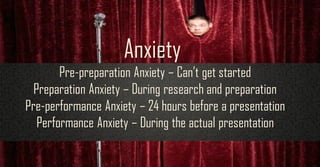
Anxiety
Pre-preparation Anxiety – Can’t get started
Preparation Anxiety – During research and preparation
Pre-performance Anxiety – 24 hours before a presentation
Performance Anxiety – During the actual presentation
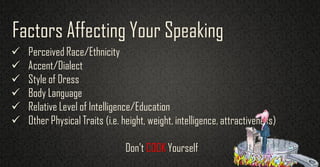
 Perceived Race/Ethnicity
 Accent/Dialect
 Style of Dress
 Body Language
 Relative Level of Intelligence/Education
 Other Physical Traits (i.e. height, weight, intelligence, attractiveness)
Don’t COOK Yourself
Factors Affecting Your Speaking
 Audience demographics
 Size
 Presentation space
 Audience’s current knowledge of topic
 Diversity
Influencing Factors
Tips And tricks For Better Public Speaking
Always give the audience something to take home.
Always provide something specific the audience can do almost immediately. No
matter how inspiring your message, every audience appreciates learning a
tangible way they can actually apply what they've learned to their own lives.
Inspiration is great, but application is everything: Never be afraid to say,
"Tonight, think of an employee who is really struggling--and then tomorrow, do
(this) and (this) to try to rescue them."
Don't defer answering questions
If a question pops up in the middle of your presentation, that's awesome:
Someone is listening! So seize the opportunity. If you would have addressed it
in a later slide, skip ahead. (If you've practiced skipping around, it won't throw
you.) The best presentations feel like conversations, even if one-sided, so
never ignore the opportunity to foster that sense of interaction. Never do
anything to disengage your audience.
Fuel your mental engine.
Let's start with some preparation tips. Dopamine and epinephrine help
regulate mental alertness. Both come from tyrosine, an amino acid found in
proteins. So make sure to include protein in the meal you eat before you need
to be at your best. And don't wait until the last minute: When you're really
nervous, the last thing you may want to do is eat.
Create two contingency plans.
If you're like me, "What if?"•is your biggest source of anxiety: What if your
PowerPoint presentation fails, someone constantly interrupts, or your opening
falls flat? Pick two of your biggest fears and create contingency plans. What
will you do if the projector fails? What will you do if the meeting runs long and
you have only a few minutes to speak? The effort won't be wasted because the
more you think through different scenarios, the better you can think on your
feet if something truly unexpected occurs.
Set a backup goal..
Say you're speaking to a civic group on behalf of a charity and you realize
your presentation is falling flat. In response people usually either try too hard
or basically give up. If your primary goal is to land a contract and you can tell
you won't succeed, shift to planting the seeds for another attempt down the
road. If you see you won't get what you really want, what can you accomplish?
Then, when the room doesn't go your way, you can stay positive, focused, and
on top of your speaking game.
Pause for 10 seconds.
Pause for two or three seconds and audiences assume you've lost your place;
five seconds, they think the pause is intentional; after 10 seconds even the
people texting can't help looking up. When you start speaking again, the
audience naturally assumes the pause was intentional ... and that you're a
confident and accomplished speaker. A poor speaker abhors a vacuum; only
confident speakers are secure with silence. Take one long pause to gather
your thoughts and the audience will automatically give you speaker bonus
points
Share one thing no one knows.
I've never heard someone say, "I was at this presentation the other day and
the guy's Gantt chart was amazing..."I have heard someone say, "Did you know
when you blush the lining of your stomach also turns red?" Find a surprising
fact or an unusual analogy that relates to your topic. Audiences love to cock
their heads and think, "Really? Wow..."
Don't make excuses.
Now let's look at a few things you should stop doing. Due to insecurity, many
speakers open with an excuse: "I didn't get much time to prepare"¦" or, "I'm
not very good at this." Excuses won't make your audience cut you any slack,
but they will make people think, "Then why are you wasting my time? "Do what
you need to do to ensure you don't need to make excuses.
Don't do your prep onstage.
Don't wait until you're onstage to check your mic, your lighting, your remote,
or your presentation. Do all that ahead of time. And if there are people running
some of those functions, talk to them about what to do if something fails. And
if something does fail, smile and try to look confident while you (or others)
take care of the problem. When things go wrong, what really matters is how
you react.
Focus on earning attention.
Now let's look at a few things to immediately start doing. Instead of playing the
"turn off your mobile devices" game, because no one will (and you'll just look
stodgy), focus on earning their complete attention. Make your presentation so
interesting, so entertaining, and so inspiring that people can't help but pay
attention. It's not the audience's job to listen; it's your job to make them want
to listen.
Who to Follow ?
“According to most studies,
people's number one fear
is public speaking. Number
two is death. Death is
number two. Does that
sound right? This means to
the average person, if you
go to a funeral, you're
better off in the casket than
doing the eulogy.”
“90% of how well the talk
will go is determined before
the speaker steps on the
platform.”
“It usually takes me more
than three weeks to
prepare a good impromptu
speech.”
“There are only two types
of speakers in the world.
1. The nervous and
2. Liars.”
“It usually takes me more
than three weeks to
prepare a good impromptu
speech.”
“There are only two types
of speakers in the world.
1. The nervous and
2. Liars.”
“It usually takes me more
than three weeks to
prepare a good impromptu
speech.”
“There are only two types
of speakers in the world.
1. The nervous and
2. Liars.”
Public speaking
Public speaking
Public speaking

Public speaking

  • 1.
    Public Speaking InAcademicals Area By: Masihullah Sabiry
  • 3.
    Determining Main Problemsin Public Speaking
  • 4.
    Anxiety Pre-preparation Anxiety –Can’t get started Preparation Anxiety – During research and preparation Pre-performance Anxiety – 24 hours before a presentation Performance Anxiety – During the actual presentation
  • 5.
     Perceived Race/Ethnicity Accent/Dialect  Style of Dress  Body Language  Relative Level of Intelligence/Education  Other Physical Traits (i.e. height, weight, intelligence, attractiveness) Don’t COOK Yourself Factors Affecting Your Speaking
  • 6.
     Audience demographics Size  Presentation space  Audience’s current knowledge of topic  Diversity Influencing Factors
  • 7.
    Tips And tricksFor Better Public Speaking
  • 8.
    Always give theaudience something to take home. Always provide something specific the audience can do almost immediately. No matter how inspiring your message, every audience appreciates learning a tangible way they can actually apply what they've learned to their own lives. Inspiration is great, but application is everything: Never be afraid to say, "Tonight, think of an employee who is really struggling--and then tomorrow, do (this) and (this) to try to rescue them."
  • 9.
    Don't defer answeringquestions If a question pops up in the middle of your presentation, that's awesome: Someone is listening! So seize the opportunity. If you would have addressed it in a later slide, skip ahead. (If you've practiced skipping around, it won't throw you.) The best presentations feel like conversations, even if one-sided, so never ignore the opportunity to foster that sense of interaction. Never do anything to disengage your audience.
  • 10.
    Fuel your mentalengine. Let's start with some preparation tips. Dopamine and epinephrine help regulate mental alertness. Both come from tyrosine, an amino acid found in proteins. So make sure to include protein in the meal you eat before you need to be at your best. And don't wait until the last minute: When you're really nervous, the last thing you may want to do is eat.
  • 11.
    Create two contingencyplans. If you're like me, "What if?"•is your biggest source of anxiety: What if your PowerPoint presentation fails, someone constantly interrupts, or your opening falls flat? Pick two of your biggest fears and create contingency plans. What will you do if the projector fails? What will you do if the meeting runs long and you have only a few minutes to speak? The effort won't be wasted because the more you think through different scenarios, the better you can think on your feet if something truly unexpected occurs.
  • 12.
    Set a backupgoal.. Say you're speaking to a civic group on behalf of a charity and you realize your presentation is falling flat. In response people usually either try too hard or basically give up. If your primary goal is to land a contract and you can tell you won't succeed, shift to planting the seeds for another attempt down the road. If you see you won't get what you really want, what can you accomplish? Then, when the room doesn't go your way, you can stay positive, focused, and on top of your speaking game.
  • 13.
    Pause for 10seconds. Pause for two or three seconds and audiences assume you've lost your place; five seconds, they think the pause is intentional; after 10 seconds even the people texting can't help looking up. When you start speaking again, the audience naturally assumes the pause was intentional ... and that you're a confident and accomplished speaker. A poor speaker abhors a vacuum; only confident speakers are secure with silence. Take one long pause to gather your thoughts and the audience will automatically give you speaker bonus points
  • 14.
    Share one thingno one knows. I've never heard someone say, "I was at this presentation the other day and the guy's Gantt chart was amazing..."I have heard someone say, "Did you know when you blush the lining of your stomach also turns red?" Find a surprising fact or an unusual analogy that relates to your topic. Audiences love to cock their heads and think, "Really? Wow..."
  • 15.
    Don't make excuses. Nowlet's look at a few things you should stop doing. Due to insecurity, many speakers open with an excuse: "I didn't get much time to prepare"¦" or, "I'm not very good at this." Excuses won't make your audience cut you any slack, but they will make people think, "Then why are you wasting my time? "Do what you need to do to ensure you don't need to make excuses.
  • 16.
    Don't do yourprep onstage. Don't wait until you're onstage to check your mic, your lighting, your remote, or your presentation. Do all that ahead of time. And if there are people running some of those functions, talk to them about what to do if something fails. And if something does fail, smile and try to look confident while you (or others) take care of the problem. When things go wrong, what really matters is how you react.
  • 17.
    Focus on earningattention. Now let's look at a few things to immediately start doing. Instead of playing the "turn off your mobile devices" game, because no one will (and you'll just look stodgy), focus on earning their complete attention. Make your presentation so interesting, so entertaining, and so inspiring that people can't help but pay attention. It's not the audience's job to listen; it's your job to make them want to listen.
  • 18.
  • 19.
    “According to moststudies, people's number one fear is public speaking. Number two is death. Death is number two. Does that sound right? This means to the average person, if you go to a funeral, you're better off in the casket than doing the eulogy.”
  • 20.
    “90% of howwell the talk will go is determined before the speaker steps on the platform.”
  • 21.
    “It usually takesme more than three weeks to prepare a good impromptu speech.” “There are only two types of speakers in the world. 1. The nervous and 2. Liars.”
  • 22.
    “It usually takesme more than three weeks to prepare a good impromptu speech.” “There are only two types of speakers in the world. 1. The nervous and 2. Liars.”
  • 23.
    “It usually takesme more than three weeks to prepare a good impromptu speech.” “There are only two types of speakers in the world. 1. The nervous and 2. Liars.”