THIS REPORT CONTAINS:
•Definitions of management
• Management: Arts or Science?
• Evolution of Management Theories
• Manager’s Functions, Roles, and
Skills
3.
OBJECTIVES:
• To explainthe various definitions of management and
highlight their common elements.
• To analyze whether management is considered an art, a
science, or both.
• To trace the evolution of management theories and their
impact on modern practices.
• To examine the functions, roles, and skills of managers as
essential foundations of effective management practice.
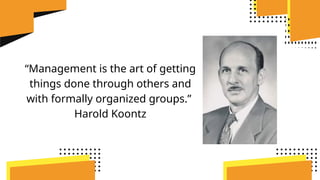
“Management is theart of getting
things done through others and
with formally organized groups.”
Harold Koontz
7.
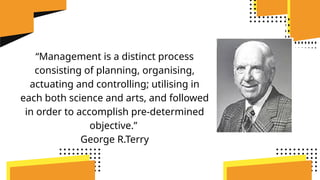
“Management is adistinct process
consisting of planning, organising,
actuating and controlling; utilising in
each both science and arts, and followed
in order to accomplish pre-determined
objective.”
George R.Terry
8.
Management is amultipurpose organ
that manage a business and manages
managers and manages workers and
work.”
Peter Drucker
9.
“Management is theart of getting things
done through people.” Mary Parker
Follett
10.
“Management is definedas the process
by which a cooperative group directs
action towards common goals.”
Joseph Massie
11.
“Management is asocial and technical process which utilizes,
resources, influences, human action and facilitates changes in
order to accomplish organizational goals.”
Theo Haimann & William Scott
12.
Thinker Key Ideaof Management Short explanation
Harold Koontz Art through organized groups
Management achieves goals by
working with and through formally
organized groups.
George R. Terry
A process (planning, organizing,
directing, controlling)
Management is systematic steps to
achieve goals.
Peter Drucker Multipurpose organ
Management manages business,
managers, workers, and work.
Mary Parker Follett
Art of getting things done through
people
Management achieves results by
guiding people.
oseph Massie Cooperative group action
Management directs group efforts
toward common goals.
Theo Haimann & William Scott Social + technical process
Management uses resources,
influences people, and adapts to
change for goals.
MANAGEMENT AS ART-ARTS MEANS THE
PRACTICAL APPLICATION OF KNOWLEDGE AND
SKILLS TO ACHIEVE THE DESIRED RESULTS. IT IS
PERSONAL APPLICATION OF KNOWLEDGE TO
ACHIEVE RESULTS. IT IS ATTAINED THROUGH STUDY,
OBSERVATION AND EXPERIENCE.
15.
THE ESSENTIAL FEATURESOF ART
ARE:
PERSONAL SKILLS -EVERY ARTIST HAS HIS WAY OF
WORKING. THE USE OF BASIC KNOWLEDGE VARIES
FROM INDIVIDUAL TO INDIVIDUAL
PERFECTION THROUGH PRACTICE -AS ARTS REQUIRE
NONSTOP PRACTICE TO GAIN MASTERY. BY
PERFORMING THE TASK AGAIN AND AGAIN, THE
ARTISTS GAIN PERFECTION THROUGH PRACTICE.
16.
MANAGEMENT AS SCIENCE-SCIENCE MEANS A
SYSTEMATIZED BODY OF KNOWLEDGE THAT CAN BE
ACQUIRED THROUGH OBSERVATION AND
EXPERIMENTATION. IT CONSISTS OF UNIVERSALLY
ACCEPTED PRINCIPLES THAT ESTABLISH A
RELATIONSHIP BETWEEN CAUSES AND THEIR
EFFECTS.
17.
THE ESSENTIAL FEATURESOF SCIENCE
ARE:
SYSTEMATIZED BODY OF KNOWLEDGE- SCIENCE IS A
SYSTEMATIC BODY OF KNOWLEDGE. ITS PRINCIPLES ARE
BASED ON A CAUSE-AND-EFFECT RELATIONSHIP
OBSERVATION AND EXPERIMENTS - ALL SCIENTIFIC
PRINCIPLES ARE FIRST DEVELOPED THROUGH
OBSERVATIONS AND THEN TESTED THROUGH REPEATED
EXPERIMENTATION UNDER CONTROLLED CONDITIONS.
WHAT IS MANAGEMENTTHEORY?
Management theories are collections of
ideas that influence how an organization,
business or team is guided and run.
Leaders in business management are
primarily responsible for laying out
strategies to help their teams meet their
goals.
20.
BENEFITS OF MANAGEMENTTHEORY
By studying established management theories managers
may be able to find ways to increase productivity and
improve their team members’ performance, simplify
decision making and increase collaboration.
Theories like the ones we’ll discuss in the next section may
also help leaders maintain objectivity, and make informed,
data-supported changes rather than relying exclusively on
their own judgment or preferences.
21.
EVEN THOUGH MANYMANAGEMENT
THEORIES ARE OLD, THEIR PRINCIPLES
REMAIN RELEVANT AND USEFUL IN TODAY’S
MODERN, TECH-DRIVEN BUSINESS WORLD.
HERE ARE 12 KEY THEORIES TO KNOW:
22.
1. SCIENTIFIC MANAGEMENT
THEORY
-FREDERICKTAYLOR, IN THE LATE 1800S,
INTRODUCED A SCIENTIFIC APPROACH TO
MANAGEMENT. HE BELIEVED THAT USING THE
SCIENTIFIC METHOD, SIMPLIFYING TASKS,
PROVIDING PROPER TRAINING, AND FOSTERING
COOPERATION BETWEEN SUPERVISORS AND
WORKERS COULD SIGNIFICANTLY INCREASE
PRODUCTIVITY.
23.
2. ADMINISTRATIVE MANAGEMENT
THEORY
-THIS19TH-CENTURY THEORY WAS DEVELOPED
BY MINING ENGINEER AND SENIOR EXECUTIVE
HENRI FAYOL, WHO BELIEVED THAT MANAGERS
SHOULD UTILIZE A SPECIFIC SET OF VALUES TO
GET THE MOST OUT OF THEIR WORKFORCE.
24.
FAYOL OUTLINED 14PRINCIPLES FOR MANAGERS TO
USE TO ORGANIZE AND INTERACT WITH THEIR TEAMS:
1. DIVISION OF WORK: DELEGATING TASKS TO TEAM MEMBERS
ALLOWS THEM TO FOCUS ON SPECIALIZED TASKS.
2. Authority and responsibility: A balance between authority
and responsibility is necessary for effective management.
3. Unity of command: Employees should receive direction from
a single supervisor.
4. Unity of direction: Employees working on the same project
should work towards the same objectives.
25.
FAYOL OUTLINED 14PRINCIPLES FOR MANAGERS TO
USE TO ORGANIZE AND INTERACT WITH THEIR TEAMS:
5. EQUITY: EVERYONE SHOULD BE TREATED EQUALLY AND WITH
KINDNESS.
6. Order: The right person should be paired with the right job to
improve productivity.
7. Discipline: Employees should follow rules and managers should
lead by example.
8. Initiative: Employees should be encouraged to develop and launch
initiatives.
9. Remuneration: Fair payment promotes productivity and loyalty.
10. AGILE MANAGEMENT: EMPHASIZES FLEXIBILITY, COLLABORATION,
AND CONTINUOUS IMPROVEMENT, PRIORITIZING CUSTOMER-
CENTRIC FOCUS AND ADAPTIVE PLANNING.
26.
FAYOL OUTLINED 14PRINCIPLES FOR MANAGERS TO
USE TO ORGANIZE AND INTERACT WITH THEIR TEAMS:
11. SCALAR CHAIN: A CLEAR HIERARCHY ENSURES EFFECTIVE
COMMUNICATION.
12. Subordination of interest: Organizational interests should be
prioritized over individual needs.
13. Esprit de corps: Teamwork and enthusiasm should be
encouraged and rewarded.
14. Centralization and decentralization: Decision-making authority
should be balanced between centralization and decentralization.
27.
3. BUREAUCRATIC MANAGEMENT
THEORY
-INCREATING HIS BUREAUCRATIC
MANAGEMENT THEORY, GERMAN SOCIOLOGIST
MAX WEBER THOUGHT THAT THE IDEAL
BUSINESS STRUCTURE WAS BASED ON A
HIERARCHY WITH A CLEAR CHAIN OF
COMMAND.
28.
HE ALSO BELIEVEDTHIS STRUCTURE SHOULD FEATURE:
A clear division of labor with specialized employees for each
task.
A hierarchal structure where clear communication, delegation
and responsibility are prioritized.
Worker selection based on education, their experience and
their technical skill alone.
Consistent regulations and rules where everyone knows what
is expected of them and their work.
29.
4. HUMAN RELATIONS
THEORY
-GEORGEELTON MAYO’S MANAGEMENT
THEORY SUGGESTS THAT EMPLOYEES ARE
MORE MOTIVATED BY PERSONAL
ATTENTION AND A SENSE OF BELONGING
THAN BY GOOD WORKING CONDITIONS OR
PAY.
30.
5. SYSTEMS MANAGEMENT
THEORY
-THESYSTEMS MANAGEMENT THEORY
EMPHASIZES THAT AN ORGANIZATION
FUNCTIONS BEST WHEN ALL ITS PARTS—
EMPLOYEES, DEPARTMENTS, AND BUSINESS
UNITS—WORK TOGETHER HARMONIOUSLY, WITH
COLLABORATION BETWEEN MANAGERS AND
UNITS PRIORITIZED FOR SUCCESS.
31.
6. CONTINGENCY MANAGEMENT
THEORY
-DEVELOPEDIN THE 1960S, THE FIEDLER’S CONTINGENCY
THEORY IS BASED ON THE BELIEF THAT MANAGERS NEED
TO BE FLEXIBLE, AS DIFFERENT SITUATIONS DEMAND
DIFFERENT LEADERSHIP TRAITS. RATHER THAN APPLYING
A SINGLE THEORY TO EVERY SITUATION IN EVERY
ORGANIZATION, VARIABLES LIKE THE ORGANIZATION’S
SIZE, TECHNOLOGY USED AND LEADERSHIP AT ALL
BUSINESS LEVELS SHOULD BE CONSIDERED.
32.
8. CLASSICAL MANAGEMENT
THEORY
-FOCUSINGEXCLUSIVELY ON THE ECONOMICS OF
WORKFORCE MANAGEMENT, CLASSICAL
MANAGEMENT THEORY TENDS TO VIEW
EMPLOYEES AS PARTS OF A MACHINE. THE
RATIONALE BEHIND THIS THEORY IS THAT THE
PHYSICAL NEEDS OF WORKERS CAN BE MET WITH
COMPENSATION, SO SOCIAL NEEDS OR JOB
SATISFACTION ARE NOT PRIORITIZED.
33.
9. MODERN MANAGEMENT
THEORY
-INSHARP CONTRAST TO THE CLASSICAL, THE
MODERN MANAGEMENT THEORY IS BUILT ON
THE IDEA THAT EMPLOYEES DON’T WORK FOR
MONEY ALONE, BUT ARE MOTIVATED BY
HAPPINESS, SATISFACTION AND WORK THAT
SUPPORTS THEIR LIFESTYLES.
34.
10. QUANTITATIVE MANAGEMENT
THEORY
-ITWAS DEVELOPED POST WORLD WAR II, RESULTING
FROM A NEED TO MAKE STRATEGIC AND TACTICAL
DECISIONS BACKED BY DATA.
-This approach to management prioritizes disciplined
thinking, and centers around finding an optimal
solution to a problem and focused decision making.
Mathematical models may be used to collect data to
assist in those decisions, coupled with scientific
reasoning strategies.
35.
11. HOLISTIC MANAGEMENT
THEORY
-SOMETIMESCALLED THE INTEGRAL THEORY OR THE
ORGANIZATIONS AS LEARNING SYSTEMS THEORY, THE
HOLISTIC MANAGEMENT THEORY IS BASED ON THE IDEA THAT
BUSINESSES ARE STRONGER WHEN ALL PARTS ARE
INTEGRATED AND WORKING TOGETHER.
-UNDER THIS THEORY, LEARNING AND CHANGE ARE THE
ORDER OF THE DAY, WITH AN EMPHASIS ON TEAMWORK,
INFORMATION SHARING AND EMPOWERMENT OF THE
INDIVIDUAL.
36.
12. KNOWLEDGE WORKER
THEORY
-DEVELOPEDBY PETER DRUCKER, THE KNOWLEDGE WORKER
MANAGEMENT THEORY BECAME POPULAR IN THE LATTER
HALF OF THE 20TH CENTURY AS ORGANIZATIONS BEGAN
INCORPORATING HIS IDEAS OF BALANCING BUSINESS NEEDS
WITH COMMUNITY.
-In his theory, the employee is seen as an asset, with skills
that must be managed and developed. Management is
responsible for training employees or providing learning
pathways through outside resources to close skill gaps.
WHAT IS A
MANAGER?
•Coordinates and oversees work of others to
achieve organizational goals.
• Not just about personal achievement but
helping others succeed.
• May perform duties beyond coordination.
39.
LEVELS OF
MANAGEMENT
1.First-line managers(supervisors) – lowest level,
oversee daily activities.
2.Middle managers – manage between first-line
and top managers.
3.Top managers – responsible for organization-
wide decisions, plans, and goals.
40.
CHANGING NATURE OF
WORK
•Nonmanagerial employees may take on some
managerial activities.
• Nonmanagerial jobs – work directly on tasks
without overseeing others
Examples include a variety of roles across different
departments, such as sales associates,
administrative assistants, accountants, and
production line workers.
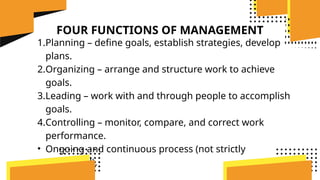
FOUR FUNCTIONS OFMANAGEMENT
1.Planning – define goals, establish strategies, develop
plans.
2.Organizing – arrange and structure work to achieve
goals.
3.Leading – work with and through people to accomplish
goals.
4.Controlling – monitor, compare, and correct work
performance.
• Ongoing and continuous process (not strictly
sequential).
MANAGEMENT SKILLS (ROBERTKATZ)
Three Essential Skills
1.Technical skills – job-specific knowledge and
techniques.
2.Human skills – ability to work well with
individuals and groups.
3.Conceptual skills – ability to think abstractly and
handle complex situations.
REFERENCES
Gautam, P. (n.d.).Definitions of management by various author. SlideShare.
Lorem ipsum dolor sit amet, consectetur adipiscing elit. Duis vel dolor ante. Nullam feugiat egestas eli
t et vehicula.
GeeksforGeeks. (2025, July 23). Nature of management as a science, art and profession.
GeeksforGeeks. Retrieved August 20, 2025, from
Lorem ipsum dolor sit amet, consectetur adipiscing elit. Duis vel dolor ante. Nullam feugiat egestas eli
t et vehicula.
DeVry University. (24 C.E., May 29). 12 Management theories and how they’re used. devry.edu.
Retrieved August 20, 2025, from
Lorem ipsum dolor sit amet, consectetur adipiscing elit. Duis vel dolor ante. Nullam feugiat egestas eli
t et vehicula.
Regala, R. R. (2021). Module in Organization and Management. Scribd. Retrieved August 20, 2025,
from
Lorem ipsum dolor sit amet, consectetur adipiscing elit. Duis vel dolor ante. Nullam feugiat egestas eli
Editor's Notes
#6 Emphasized the importance of collaboration of individuals to accomplish desired outcomes and tasks through the manager’s effective directing and motivation.
Art → Management requires skill, experience, and creativity.
Getting things done through others → A manager achieves goals by guiding and motivating people, not by doing everything alone.
Formally organised groups → Management works within an official structure (like departments, teams, or organizations) where roles and responsibilities are clearly defined.
#7 Management is a step-by-step process of planning, organizing, leading, and controlling work, using both knowledge and skill, to achieve set goals effectively.
Management is a process – It is not a one-time activity but a continuous cycle of actions.
Steps involved:
Planning – deciding what to do in advance.
Organising – arranging people, resources, and tasks to carry out the plan.
Actuating (leading/ directing) – motivating and guiding people to do the work.
Controlling – checking whether things are going as planned and correcting mistakes.
Science + Art – Management uses science (facts, rules, and systematic knowledge) but also requires art (creativity, skill, and experience) to handle people and situations.
Goal-oriented – The purpose of management is always to achieve specific, pre-decided objectives (like profit, growth, or efficiency).
#8 Management is responsible for guiding the business, the leaders, the employees, and the work itself so that everything functions together to achieve success.
Multipurpose organ → Management has many roles, not just one.
Manages the business → It ensures the whole organization runs smoothly toward its goals.
Manages managers → It coordinates and guides higher-level people so their decisions are aligned.
Manages workers → It leads, motivates, and supports employees.
Manages work → It ensures tasks and processes are done efficiently and effectively.
#9 Management means achieving goals effectively by working with and through people, rather than doing all the work alone.
Art → Management requires skill, creativity, and experience.
Getting things done → The goal of management is to achieve tasks and objectives.
Through people → Managers don’t do everything themselves; they achieve results by guiding, motivating, and coordinating people.
#10 Management is the process of guiding and coordinating a group of people to work together effectively toward shared goals.
Process → Management is continuous, not a one-time activity.
Cooperative group → It’s about people working together, not individually.
Directs action → Management provides guidance, direction, and coordination.
Common goals → The focus is on achieving shared objectives, not personal ones.
#11 Management is both a people-oriented and technical process that uses resources, guides people, and adapts to change in order to achieve organizational goals.
Social process → Management deals with people, relationships, and teamwork.
Technical process → It also involves methods, tools, systems, and techniques.
Utilizes resources → Uses money, materials, time, and people efficiently.
Influences human action → Motivates and guides people to perform.
Facilitates change → Helps organizations adapt to new situations and challenges.
Organizational goals → The ultimate aim is to achieve the objectives of the organization.
#39 First-line managers also listen to employee concerns and discuss them with mid-level management, who may take the concerns to top-level management. Many first-line managers perform duties like assigning tasks to their employees, maintaining the quality of production and supervising daily activities.
Roles for first-line managers typically involve interacting directly with employees to help them perform their duties successfully and create a work environment committed to following directions from upper management.
They are the connection between the administrative level and everyone else, and these managers often take information from top-level managers to discuss or teach to employees. The purpose of midlevel managers is to operate branches of a company to ensure the employees of each branch understand the overall goals they are trying to achieve. Typical duties include executing top-level plans, guiding first-line managers with advice and completing group performance evaluations.
These managers confirm that the company is meeting its long-term goals and growing at a steady pace. Their primary goals are typically to create a successful company that maximizes profit and has an excellent reputation. Top-level managers have the highest level of responsibility, authority and control in a company but often take suggestions or listen to concerns from other employees.
#46 Technical skills are the specialized knowledge and abilities required to perform specific tasks, often related to technology, science, or engineering
Conceptual skills are the abilities to understand and work with abstract ideas, complex situations, and the "big picture" of an organization. They involve thinking creatively, analyzing information, and developing strategic solutions. These skills are crucial for managers and leaders, especially at higher levels, as they enable effective planning, decision-making, and problem-solving.