Physics Today
Commentary: Bringing science’s value to the US Congress
Reba Bandyopadhyay
Citation: Physics Today 69(9), 10 (2016); doi: 10.1063/PT.3.3280
View online: http://dx.doi.org/10.1063/PT.3.3280
View Table of Contents: http://scitation.aip.org/content/aip/magazine/physicstoday/69/9?ver=pdfcov
Published by the AIP Publishing
Reuse of AIP Publishing content is subject to the terms at: https://publishing.aip.org/authors/rights-and-permissions. Download to IP: 24.250.153.210 On: Thu, 01 Sep 2016
14:20:24
10 PHYSICS TODAY | SEPTEMBER 2016
READERS’ FORUM
Many scientists, dedicated to the ex-
pansion of the frontiers of human knowl-
edge, believe that the importance of basic
science is self-evident and that this work
is worthy of federal financial support. In
my interactions with members of Con-
gress on both sides of the aisle, I have
been encouraged to find that the support
for basic science research in many fields,
including physics, is largely bipartisan,
and that policymakers across the politi-
cal spectrum understand the value of
science and technology to our economy
and to America’s place in the world.
However, there are many competing de-
mands on the ever more constrained
federal budget. As Vice President Joe
Biden has said, “Show me your budget
and I will tell you what you value.”
In this climate of constricted funding,
it is crucial that we scientists make the
case for supporting fundamental re-
search by directly engaging with our
elected officials. One of the happiest dis-
coveries I made during my year in the
Senate as the American Physical Society
(APS) 2014–15 Congressional fellow was
that a lot more discussion of science
occurs in the halls of Congress than I
expected. In particular, it was fantastic
to see how many scientists from a wide
range of disciplines communicated with
their representatives by presenting their
work at briefings and events or by visit-
ing the offices of their legislators to
demonstrate the impact of federal invest-
ment on their work. Science needs more
of you to join in these outreach efforts!
We must do a better job of preparing
scientists to engage in the work of sci-
ence advocacy. I frequently witnessed
scientists speaking about their research
to an audience of congressional staff in
the same way that they would speak at a
specialized conference or to an upper-
level class; they focused on specific and
often technical details rather than pre-
senting the broader picture of the im-
portance and impact of their work. And
although researchers nearly always
mentioned the name of their home insti-
tution, they often forgot to mention the
source of their research funding—even
when speaking to the people who set the
budget and write the checks!
I think many scientists shy away from
active advocacy for science because they
are unfamiliar with policymaking and
do not know how to effectively commu-
nicate with a very different audience in
an environment foreign to them.
In fact, the policymaking process ac-
tually has much in common with the
scientific process. In physics we have
overarching goals of solving fundamen-
tal problems and answering questions
about the nature of the universe. We pur-
sue those goals in incremental steps
along a winding path. We refine mea-
surements, revise hypotheses, improve
techniques. We often encounter dead
ends that force us to backtrack or start
over. As we learn more, new questions
arise, add to our knowledge, and alter
the path. We work in teams, with col-
leagues and competitors likewise tweak-
ing and methodically pushing toward
the goal. External factors, such as new
people, ideas, technologies, and tech-
niques, open up new possibilities. And
once in a great while, in a eureka mo-
ment, we are able to verify a long-held
hypothesis, discover something unex-
pected, or have an insight that alters our
understanding of the physical universe.
Making policy is surprisingly similar.
Elected officials come into office with big
ideas and policies that they would like to
see enacted. But because of the way the
federal government is structured, no one
person can make a major policy change
by fiat. Policymakers, too, have to work
incrementally—whether tweaking lan-
guage in bills, revising regulations, or
fine-tuning agency policies within the
broad structure authorized by Congress.
That process, too, is full of twists and
turns, with procedural delays, hurdles
that can block a painstakingly developed
bill from becoming law, and legislative
and administration turnover.
To develop ideas into bills that stand
a chance of passing, legislators must
form coalitions and garner the support
of constituents and relevant advocacy
Bringing science’s value to
the US Congress
I
n the study of current problems in physics and
other sciences, one concern is often omitted:
How do we ensure continued federal support for
fundamental scientific research? Much of our work
depends on such support. More than 50% of all basic
research performed in the US is funded by the federal
government.
Commentary
Lettersandcommentaryareencouraged
and should be sent by email to
ptletters@aip.org (using your surname
as the Subject line), or by standard mail
to Letters, PHYSICS TODAY, American
Center for Physics, One Physics Ellipse,
College Park, MD 20740-3842. Please
includeyourname,work affiliation, mailing address, email
address, and daytime phone number on your letter and
attachments. You can also contact us online at
http://contact.physicstoday.org. We reserve the right to
edit submissions.
CONTACT
PHYSICS
TODAY
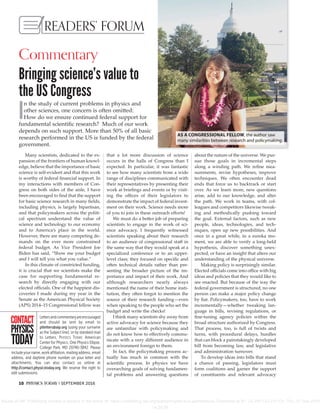
AS A CONGRESSIONAL FELLOW, the author saw
many similarities between research and policymaking.
Reuse of AIP Publishing content is subject to the terms at: https://publishing.aip.org/authors/rights-and-permissions. Download to IP: 24.250.153.210 On: Thu, 01 Sep 2016
14:20:24
SEPTEMBER 2016 | PHYSICS TODAY 11
organizations. Whatever their long-term
strategy may be, outside events can
drastically reshape their policy work.
Yet, as with the scientific eureka mo-
ment, occasionally the timing is right,
the momentum has built, and a major
policy change—the creation of a new
program, a fundamental restructuring of
an institution, or a substantial budget
shift—becomes possible.
So perhaps we scientists should under-
stand better than most what the process of
making policy entails. We can see how
it, like science, is a long-term effort over
which no one has complete control, which
requires teamwork, and whose success
relies on the active and sustained partic-
ipation of many individuals.
Of course, the money that is available
for conducting basic research is pri-
marily spent on the research itself, leav-
ing relatively little to spend on public
relations. But we do have another asset:
intelligent, thoughtful, dedicated people.
We are our own greatest resource for ex-
plaining to policymakers why the nation
should invest in research, especially on
the types of work that might not pay off
for decades but on which our modern
society is now based. It is up to us to
make the case for science.
Some readers may be skeptical about
how much influence we can have. Yet I
have learned that government, espe-
cially Congress, is a surprisingly per-
sonal endeavor. Even in a country of
more than 320 million people, personal
communications can make the differ-
ence. People who get into politics and
policy—elected officials and staff alike—
are driven at least in part by the desire to
help their constituents and the country.
They are people people.
Members of Congress and their staff,
who are critical gatekeepers, only rarely
have a scientific or technological back-
ground. However, they are generally
smart, engaged individuals who think
science is really cool. But if you commu-
nicate with them only by discussing the
technical details of your research, their
eyes may glaze over, just like physicists’
generally do at the technical details of
policy development and legislation. In-
stead, we need to convey our passion for
science, explain the big-picture impor-
tance of our work, and tell our personal
stories about the effect science policies
and budgets have on our research. Al-
though that form and level of communi-
cation is not always the most comfortable
for scientists, it is absolutely essential.
Furthermore, in the Senate I saw how
important it is for policymakers not just
to hear from the most senior people—
university administrators, government
relations professionals from academic
and scientific societies, heads of industry.
Those people are heard from routinely,
and policymakers know what they are
likely to want. In my experience, the peo-
ple who make the greatest impression
are the everyday folks, the people on the
ground doing the work. In science, those
are the students, postdocs, rank-and-file
faculty, and researchers driven by enthu-
siasm and a thirst for understanding.
So this is a call to all of you, junior and
senior, students and faculty, in academia
and in industry, to step up to the plate.
APS, the American Institute of Physics
(which publishes PHYSICS TODAY), the
American Astronomical Society, and the
American Association for the Advance-
ment of Science all have resources that
can help.
Write or call your members of Con-
gress to express your opinions on bud-
gets and bills that affect scientific research.
Invite them to your labs when they are in
their home districts and show them what
you do. Visit Washington. Talk with them
and their staff in person. Personalize your
advocacy. Explain why you wanted to
pursue your research, how it holds your
interest, and how it motivates you to
work long hours, often for less money
than you could make in other jobs.
Legislators and their staff members
may not understand the technical details
and the fundamental insights of your
work, but they will understand that
you—and by extension other scientists—
believe strongly in the value of basic re-
search. Show them that physics is not
an abstract dry pursuit of unintelligible
things; share your passion for the disci-
pline. You will make an impression.
Science doesn’t speak for itself. We
must speak for it.
The views and opinions expressed here are
entirely my own and should not be construed
to represent those of the American Associa-
tion for the Advancement of Science, the
American Physical Society, or NSF.
Reba Bandyopadhyay
(reba@alum.mit.edu)
American Association for
the Advancement of Science
Science & Technology Policy Fellowship
Program
Washington, DC
25 mm2
x 500 μm
11.2 μs peaking time
P/B Ratio: 20000/1
125 eV FWHM
Energy (keV)
Counts
SDD Spectrum
5.9
keV
55
Fe
6.4
keV
Chooseyourconfiguration
OEM Components
Detector System
Count Rate >1,000,000 CPS
FAST SDD®
Experimenter’s Kit
Resolution vs Peaking Time
Peaking Time (μs)
0 1 2 3 4 5
Resolution(eVFWHM@5.9keV)
180
170
160
150
140
130
120
Standard SDD
25 mm2
Resolution
Peaking
Time
125 eV FWHM 4 μs
130 eV FWHM 1 μs
140 eV FWHM 0.2 μs
160 eV FWHM 0.05 μs
FAST SDD®
Complete Spectrometer
®
www.amptek.com
AMPTEK Inc.
Reuse of AIP Publishing content is subject to the terms at: https://publishing.aip.org/authors/rights-and-permissions. Download to IP: 24.250.153.210 On: Thu, 01 Sep 2016
14:20:24

PT.3.3280

  • 1.
    Physics Today Commentary: Bringingscience’s value to the US Congress Reba Bandyopadhyay Citation: Physics Today 69(9), 10 (2016); doi: 10.1063/PT.3.3280 View online: http://dx.doi.org/10.1063/PT.3.3280 View Table of Contents: http://scitation.aip.org/content/aip/magazine/physicstoday/69/9?ver=pdfcov Published by the AIP Publishing Reuse of AIP Publishing content is subject to the terms at: https://publishing.aip.org/authors/rights-and-permissions. Download to IP: 24.250.153.210 On: Thu, 01 Sep 2016 14:20:24
  • 2.
    10 PHYSICS TODAY| SEPTEMBER 2016 READERS’ FORUM Many scientists, dedicated to the ex- pansion of the frontiers of human knowl- edge, believe that the importance of basic science is self-evident and that this work is worthy of federal financial support. In my interactions with members of Con- gress on both sides of the aisle, I have been encouraged to find that the support for basic science research in many fields, including physics, is largely bipartisan, and that policymakers across the politi- cal spectrum understand the value of science and technology to our economy and to America’s place in the world. However, there are many competing de- mands on the ever more constrained federal budget. As Vice President Joe Biden has said, “Show me your budget and I will tell you what you value.” In this climate of constricted funding, it is crucial that we scientists make the case for supporting fundamental re- search by directly engaging with our elected officials. One of the happiest dis- coveries I made during my year in the Senate as the American Physical Society (APS) 2014–15 Congressional fellow was that a lot more discussion of science occurs in the halls of Congress than I expected. In particular, it was fantastic to see how many scientists from a wide range of disciplines communicated with their representatives by presenting their work at briefings and events or by visit- ing the offices of their legislators to demonstrate the impact of federal invest- ment on their work. Science needs more of you to join in these outreach efforts! We must do a better job of preparing scientists to engage in the work of sci- ence advocacy. I frequently witnessed scientists speaking about their research to an audience of congressional staff in the same way that they would speak at a specialized conference or to an upper- level class; they focused on specific and often technical details rather than pre- senting the broader picture of the im- portance and impact of their work. And although researchers nearly always mentioned the name of their home insti- tution, they often forgot to mention the source of their research funding—even when speaking to the people who set the budget and write the checks! I think many scientists shy away from active advocacy for science because they are unfamiliar with policymaking and do not know how to effectively commu- nicate with a very different audience in an environment foreign to them. In fact, the policymaking process ac- tually has much in common with the scientific process. In physics we have overarching goals of solving fundamen- tal problems and answering questions about the nature of the universe. We pur- sue those goals in incremental steps along a winding path. We refine mea- surements, revise hypotheses, improve techniques. We often encounter dead ends that force us to backtrack or start over. As we learn more, new questions arise, add to our knowledge, and alter the path. We work in teams, with col- leagues and competitors likewise tweak- ing and methodically pushing toward the goal. External factors, such as new people, ideas, technologies, and tech- niques, open up new possibilities. And once in a great while, in a eureka mo- ment, we are able to verify a long-held hypothesis, discover something unex- pected, or have an insight that alters our understanding of the physical universe. Making policy is surprisingly similar. Elected officials come into office with big ideas and policies that they would like to see enacted. But because of the way the federal government is structured, no one person can make a major policy change by fiat. Policymakers, too, have to work incrementally—whether tweaking lan- guage in bills, revising regulations, or fine-tuning agency policies within the broad structure authorized by Congress. That process, too, is full of twists and turns, with procedural delays, hurdles that can block a painstakingly developed bill from becoming law, and legislative and administration turnover. To develop ideas into bills that stand a chance of passing, legislators must form coalitions and garner the support of constituents and relevant advocacy Bringing science’s value to the US Congress I n the study of current problems in physics and other sciences, one concern is often omitted: How do we ensure continued federal support for fundamental scientific research? Much of our work depends on such support. More than 50% of all basic research performed in the US is funded by the federal government. Commentary Lettersandcommentaryareencouraged and should be sent by email to ptletters@aip.org (using your surname as the Subject line), or by standard mail to Letters, PHYSICS TODAY, American Center for Physics, One Physics Ellipse, College Park, MD 20740-3842. Please includeyourname,work affiliation, mailing address, email address, and daytime phone number on your letter and attachments. You can also contact us online at http://contact.physicstoday.org. We reserve the right to edit submissions. CONTACT PHYSICS TODAY AS A CONGRESSIONAL FELLOW, the author saw many similarities between research and policymaking. Reuse of AIP Publishing content is subject to the terms at: https://publishing.aip.org/authors/rights-and-permissions. Download to IP: 24.250.153.210 On: Thu, 01 Sep 2016 14:20:24
  • 3.
    SEPTEMBER 2016 |PHYSICS TODAY 11 organizations. Whatever their long-term strategy may be, outside events can drastically reshape their policy work. Yet, as with the scientific eureka mo- ment, occasionally the timing is right, the momentum has built, and a major policy change—the creation of a new program, a fundamental restructuring of an institution, or a substantial budget shift—becomes possible. So perhaps we scientists should under- stand better than most what the process of making policy entails. We can see how it, like science, is a long-term effort over which no one has complete control, which requires teamwork, and whose success relies on the active and sustained partic- ipation of many individuals. Of course, the money that is available for conducting basic research is pri- marily spent on the research itself, leav- ing relatively little to spend on public relations. But we do have another asset: intelligent, thoughtful, dedicated people. We are our own greatest resource for ex- plaining to policymakers why the nation should invest in research, especially on the types of work that might not pay off for decades but on which our modern society is now based. It is up to us to make the case for science. Some readers may be skeptical about how much influence we can have. Yet I have learned that government, espe- cially Congress, is a surprisingly per- sonal endeavor. Even in a country of more than 320 million people, personal communications can make the differ- ence. People who get into politics and policy—elected officials and staff alike— are driven at least in part by the desire to help their constituents and the country. They are people people. Members of Congress and their staff, who are critical gatekeepers, only rarely have a scientific or technological back- ground. However, they are generally smart, engaged individuals who think science is really cool. But if you commu- nicate with them only by discussing the technical details of your research, their eyes may glaze over, just like physicists’ generally do at the technical details of policy development and legislation. In- stead, we need to convey our passion for science, explain the big-picture impor- tance of our work, and tell our personal stories about the effect science policies and budgets have on our research. Al- though that form and level of communi- cation is not always the most comfortable for scientists, it is absolutely essential. Furthermore, in the Senate I saw how important it is for policymakers not just to hear from the most senior people— university administrators, government relations professionals from academic and scientific societies, heads of industry. Those people are heard from routinely, and policymakers know what they are likely to want. In my experience, the peo- ple who make the greatest impression are the everyday folks, the people on the ground doing the work. In science, those are the students, postdocs, rank-and-file faculty, and researchers driven by enthu- siasm and a thirst for understanding. So this is a call to all of you, junior and senior, students and faculty, in academia and in industry, to step up to the plate. APS, the American Institute of Physics (which publishes PHYSICS TODAY), the American Astronomical Society, and the American Association for the Advance- ment of Science all have resources that can help. Write or call your members of Con- gress to express your opinions on bud- gets and bills that affect scientific research. Invite them to your labs when they are in their home districts and show them what you do. Visit Washington. Talk with them and their staff in person. Personalize your advocacy. Explain why you wanted to pursue your research, how it holds your interest, and how it motivates you to work long hours, often for less money than you could make in other jobs. Legislators and their staff members may not understand the technical details and the fundamental insights of your work, but they will understand that you—and by extension other scientists— believe strongly in the value of basic re- search. Show them that physics is not an abstract dry pursuit of unintelligible things; share your passion for the disci- pline. You will make an impression. Science doesn’t speak for itself. We must speak for it. The views and opinions expressed here are entirely my own and should not be construed to represent those of the American Associa- tion for the Advancement of Science, the American Physical Society, or NSF. Reba Bandyopadhyay (reba@alum.mit.edu) American Association for the Advancement of Science Science & Technology Policy Fellowship Program Washington, DC 25 mm2 x 500 μm 11.2 μs peaking time P/B Ratio: 20000/1 125 eV FWHM Energy (keV) Counts SDD Spectrum 5.9 keV 55 Fe 6.4 keV Chooseyourconfiguration OEM Components Detector System Count Rate >1,000,000 CPS FAST SDD® Experimenter’s Kit Resolution vs Peaking Time Peaking Time (μs) 0 1 2 3 4 5 Resolution(eVFWHM@5.9keV) 180 170 160 150 140 130 120 Standard SDD 25 mm2 Resolution Peaking Time 125 eV FWHM 4 μs 130 eV FWHM 1 μs 140 eV FWHM 0.2 μs 160 eV FWHM 0.05 μs FAST SDD® Complete Spectrometer ® www.amptek.com AMPTEK Inc. Reuse of AIP Publishing content is subject to the terms at: https://publishing.aip.org/authors/rights-and-permissions. Download to IP: 24.250.153.210 On: Thu, 01 Sep 2016 14:20:24