PSYCHOPHARMACOLOGY
Psychopharmacology is the study of the effects of drugs on the nervous
system and therefore on behavior.
 It is derived from the Greek word Pharmakon meaning drug.
Drug effects are the changes one can observe in an organism’s physiological
processes and behavior.
For ex- the effects of morphine, heroin, and other opiates include decreased
sensitivity to pain, slowing of the digestive system, sedation, muscular
relaxation, cells of the body, constriction of the pupils, and euphoria.
The sites of action of drugs are the points at which molecules of drugs interact
with molecules located on or in cells of the these cells body, thus affecting
some biochemical processes of these cells.
For example, the sites of action of the opiates are specialized receptors
situated in the membrane of certain neurons. When molecules of opiates
attach to and activate these receptors, the drugs alter the activity of these
neurons and produce their effects.
PRINCIPLES OF PSYCHOPHARMACOLOGY
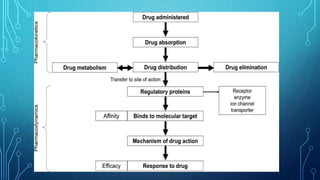
• Pharmacokinetics - The process by which drugs are absorbed,
distributed within the body, metabolized, and excreted is referred to as
pharmacokinetics.
• Pharmacodynamics studies the biological and physiological effects of
drugs on an organism.
• Both pharmacodynamics and pharmacokinetics together influence
factors such as dosing, drug benefits, and adverse effects.
• Pharmacodynamics places particular emphasis on dose-response
relationships, which are the relationships between the concentration of
a drug and its effect, whether negative or positive, upon the organism.
ROUTES OF DRUG ADMINISTRATION
The fastest route is intravenous (IV) injection. The drug immediately enters the
bloodstream, and it reaches the brain within a few seconds. The disadvantages of IV
injections are the increased care and skill they require in comparison to most other
forms of injection as the entire dose reaches the bloodstream at once. If an animal is
especially sensitive to the drug, there may be little time to administer another drug to
counteract.
Intraperitoneal (IP) injection is rapid, but not as rapid as an IV injection. The drug is
injected through the abdominal wall into the peritoneal cavity—the space that
surrounds the stomach, intestines, liver, and other abdominal organs.
Intramuscular (IM) injection is made directly into a large muscle, such as those
found in the upper arm, thigh, or buttocks. The drug is absorbed into the bloodstream
through the capillaries that supply the muscle. If very slow absorption is desirable,
the drug can be mixed with another drug (such as ephedrine) that constricts blood
vessels and retards the flow of blood through the muscle.
Subcutaneous injection - A drug can also be injected into the space beneath
the skin. A subcutaneous injection is useful only if small amounts of drug need
to be administered, because large amounts would be painful.
Oral administration –Administration of substance into the mouth so that it is
swallowed. It is the most common form of administering medicinal drugs to
humans.
 Sublingual Administration- administration of certain drugs can be
accomplished by placing them beneath the tongue. The drug is absorbed into
the bloodstream by the capillaries that supply the mucous membrane that
lines the mouth.
Drugs can also be administered at the opposite end of the digestive tract, in
the form of suppositories - Intrarectal administration
The lungs provide another route for drug administration: inhalation. Nicotine,
cocaine, and marijuana are usually smoked. In addition, drugs used to treat
lung disorders are often inhaled in the form of a vapor or fine mist. The route
from the lungs to the brain is very short, and drugs administered this way have
• Some drugs can be absorbed directly through the skin, so they can be given
by means of topical administration.
• Insufflation – drugs that are sniffed come into contact with the nasal mucosa.
This route delivers the drug to the brain very rapidly. Sniffing is not the same
as inhalation; when powdered cocaine is sniffed, it ends up in the mucous
membrane of the nasal passages, not in the lungs.
• Intracerebral administration - Some drugs cannot cross the blood-brain
barrier. If these drugs are to reach the brain, they must be injected directly
into the brain or into the cerebrospinal fluid in the brain's ventricular system.
• Intracerebroventricular administration - To achieve a widespread distribution
of a drug in the brain, a researcher will get past the blood-brain barrier by
injecting the drug into a cerebral ventricle. The drug is then absorbed into the
brain tissue, where it can exert its effects. This route is used very rarely in
humans—primarily to deliver antibiotics directly to the brain to treat certain
types of infections.
• Distribution of drugs within the body - drugs exert their effects only when they
reach their sites of action. In the case of drugs that affect behavior, most of
these sites are located ON or IN particular cells in the central nervous
system.
• the differences in the routes of drug administration vary only in the rate at
which a drug reaches the blood plasma (except for intracerebral and
intracerebroventicular)
• Several factors determine the rate at which a drug in the bloodstream
reaches sites of action within the brain.
• The first is lipid solubility- The blood-brain barrier isa barrier only for water-
soluble molecules. Molecules that are soluble in lipids pass through the cells
that line the capillaries in the central nervous system, and they rapidly
distribute themselves throughout the brain.
• Inactivation and Excretion
• Drugs do not remain in the body indefinitely. Many are deactivated by
enzymes, and all are eventually excreted, primarily by the kidneys.
• The liver plays an especially active role in enzymatic deactivation of
drugs, but some deactivating enzymes are also found in the blood and
the brain that destroy some drugs.
• In some cases enzymes transform molecules of a drug into other
forms that themselves are biologically active.
• Occasionally, the transformed molecules is even moreactive than the
one that is administered. In such cases the effects of a drug canhave
a very long duration.
DRUG EFFECTIVENESS
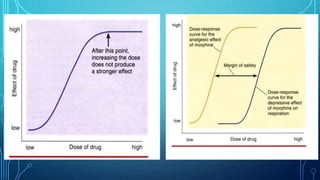
• Drugs vary widely in their effectiveness. A small dose of a relatively
effective drug can equal or exceed the effects of larger amounts of a
relatively ineffective drug. The best way to measure the effectiveness of
a drug is to plot a dose-response curve. To do this, subjects are given
various doses of a drug, usually defined as milligrams of drug per
kilogram.
• Most drugs have more than one effect. Opiates such as morphine and
codeine produce analgesia (reduced sensitivity to pain),but they also
depress the activity of neurons in the medulla that control heart rate and
respiration. A physician who prescribes an opiate to relieve a pain wants
to administer a dose that is large enough to produce analgesia but not
enough to depress heart rate and respiration—effects that could be
fatal.
•
Therapeutic Index
• One measure of a margin of safety is its therapeutic index. This measure
is obtained by administering varying doses of the drug to a group of
laboratory animals such as mice.
• Two numbers are obtained: the dose that produces the desired effects in
50 percent of the animals and the dose that produces toxic effects in 50
percent of the animals.
• The therapeutic index is the ratio of these two numbers.
• The lower the therapeutic index, the more care must be taken in
prescribing the drug.
• Why do drugs vary in their effectiveness?
1. Two drugs with same effects may differ in their effectiveness as they may have
different sites of action.
2. Drugs vary in their effectiveness also because of their affinity with their site of action.
Drugs vary widely in their affinity for the molecules to which they attach—the
readiness with which the two molecules join together. A drug with a high affinity will
produce effects at a relatively low concentration, whereas one with a low affinity must
be administered in relatively high doses. Thus, even two drugs with identical sites of
action can vary widely in their effectiveness if they have different affinities for their
binding sites.
• In addition, because most drugs have multiple effects, a drug can have high affinities
for some of its sites of action and low affinities for others.
• The most desirable drug has a high affinity for sites of action that produce therapeutic
effects and a low affinity for sites affinity of action that produce toxic side effects. One of
the goals of research by drug companies is to find chemicals with just this pattern of
EFFECTS OF REPEATED ADMINISTRATION
• Often, when a drug is administered repeatedly, its effects will not remain constant.
In most cases its effects will diminish—a phenomenon known as tolerance. In other
cases a drug becomes more and more effective—a phenomenon known as
sensitization.
• And once a person has taken a drug regularly enough to develop tolerance, that
individual will suffer withdrawal symptoms if he or she suddenly stops taking the
drug.
• Withdrawal symptoms are primarily the opposite of the effects of the drug itself.
• Tolerance is the result of the attempt to compensate for the effects of the drug.
• There are several types of compensatory mechanisms. The first compensatory
mechanism involves a decrease in the effectiveness of binding of drug molecules
with receptor.
• Either the receptors become less sensitive to the drug or the receptors decrease in
number.
• many drugs have several different sites of action and thus produce several
different effects. This means that some of the effects of a drug may show
tolerance but others may not.
• Sensitization is the exact opposite of tolerance: Repeated doses of a drug
produce larger and larger effects. Sensitization is less common than tolerance.
PLACEBO EFFECTS
• A placebo is an innocuous substance that has no specific physiological
effect. The placebo comes from the Latin placere, “to please.”
• If a person thinks that a placebo has a physiological effect, then
administration of the placebo may actually produce that effect.
• When experimenters want to investigate the behavioral effects of drugs
in humans, they must use control groups whose members receive
placebos, or they cannot be sure that the behavioral effects they
observe were caused by specific effects of the drug.
• Even if the substance you inject is innocuous, the experience
of receiving the injection would activate the autonomic nervous
system, causethe secretion of stress hormones, and have
other physiological effects.
• If we want toknow what the behavioral effects of a drug are,
we must compare the drug-treatedanimals with other animals
who receive a placebo, administered in exactly the same way
as the drug.
HOW DRUGS WORK
• Most drugs that affect behavior do so by affecting synaptic
transmission.
• Drugs that affect synaptic transmission are classified into two general
categories.
• Those that block or inhibit the postsynaptic effects are called
antagonists.
• Those that facilitate them are called agonists.
EFFECTS ON PRODUCTION OF
NEUROTRANSMITTERS
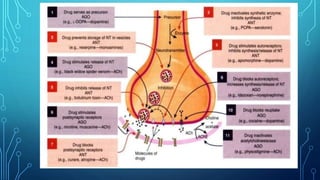
• The first step is the synthesis of the neurotransmitter from its
precursors. In some cases the rate of synthesis and release of a
neurotransmitter is increased when a precursor is administered;
in these cases the precursor itself serves as an agonist.
• The steps in the synthesis of neurotransmitters are controlled by
enzymes. Therefore, if a drug inactivates one of these enzymes,
it will prevent the neurotransmitter from being produced. Such a
drug serves as an antagonist.
EFFECTS ON STORAGE AND RELEASE OF
NEUROTRANSMITTERS
• The storage of neurotransmitters in vesicles is accomplished by
transporter molecules.

• The transporter molecules are located in the membrane of synaptic
vesicles, and their action is to pump molecules of the neurotransmitter
across the membrane, filling the vesicles
• Molecules of the drug bind with a particular site on the transporter and
inactivate it. Because the synaptic vesicles remain empty, nothing is
released when the vesicles eventually rupture against the presynaptic
membrane.
• Some drugs act as antagonists by preventing the release of
neurotransmitters from the terminal button. They do so by
deactivating the proteins that cause synaptic vesicles to fuse with
the presynaptic membrane and expel their contents into the
synaptic cleft.
• Other drugs have just the opposite effect: They bind with these
proteins and directly trigger the release of the neurotransmitter.
EFFECTS ON RECEPTORS
• Once a neurotransmitter is released, it must stimulate the postsynaptic
receptors. Some drugs bind with these receptors, just as the
neurotransmitter does. Once a drug has bound with the receptor, it
can serve as either an agonist or an antagonist.
• A drug that mimics the effects of a neurotransmitter acts as a direct
agonist.
• Molecules of the drug attach to the binding site to which the
neurotransmitter normally attaches. This binding causes ion channels
controlled by the receptor to open, just as they do when the
neurotransmitter is present.
• Drugs that bind with postsynaptic receptors can also serve as antagonists.
Molecules of such drugs bind with the receptors but do not open the ion
channel. Because they occupy the receptor’s binding site, they prevent the
neurotransmitter receptor from opening the ion channel. These drugs are
called direct antagonist antagonists.
• Molecules of the neurotransmitter bind with one site, and other substances
(such as neuromodulators and various drugs) bind with the others.
• Binding of a drug molecule with one of these alternative sites is referred to
as noncompetitive binding, because the molecule does not compete with
molecules of the neurotransmitter for the same binding site.
• If a drug attaches to one of these alternative sites and prevents the ion
channel from opening, the drug is said to be an indirect antagonist.
• If a drug attaches to one of the alternative sites and facilitates the
opening of the ion channel, it is said to be an indirect agonists.
• the presynaptic membranes of some neurons contain autoreceptors
that regulate the amount of neurotransmitter that is released.
• Because stimulation of these receptors causes less neurotransmitter
to be released, drugs that selectively activate presynaptic receptors
act as antagonists.
• Drugs that block presynaptic autoreceptors have the opposite effect:
They increase the release of the neurotrransmitter acting as agonists.
EFFECTS ON REUPTAKE OR DESTRUCTION OF
NEUROTRANSMITTER
• Drugs can interfere with either of the processes of Reuptake or
Destruction of neurotransmitters.
• In the first case molecules of the drug attach to the transporter
molecules that are responsible for reuptake and inactivate them,
thus blocking reuptake.
• In the second case, molecules of the drug bind with the enzyme
that normally destroys the neurotransmitter and prevents the
enzymes from working. they serve as agonists.
NEUROTRANSMITTERS AND
NEUROMODULATORS
• In the brain most synaptic communication is accomplished by two
neurotransmitters: one with excitatory effects (glutamate) and one
with inhibitory effects (GABA).
• Another inhibitory neurotransmitter, glycine, is found in the spinal
cord and lower brain stem.
• All the other neurotransmitters have modulating effects rather than
information-transmitting effects. They tend to activate or inhibit
entire circuits of neurons that are involved in particular brain
functions.
• Acetylcholine activates the cerebral cortex and facilitates learning
• Norepinephrine increases vigilance and enhances readiness to
act when a signal is detected.
• Serotonin suppresses certain categories of species-typical
behaviors and reduces the likelihood that the animals act
impulsively
• Dopamine in some regions of the brain generally activates
voluntary movements but does not specify which movements will
occur.
• In other regions secretion of dopamine reinforces ongoing
behaviors and makes them more likely to occur at a later time.
• Particular drugs can selectively affect neurons that secrete
ACETYLCHOLINE
• This neurotransmitter was the first to be discovered as it is present
outside the CNS too.
• The axons and terminal buttons of acetylcholinergic neurons are
distributed widely throughout the brain.
• The acetylcholinergic neurons located in the dorsolateral pons are
responsible for eliciting most of the characteristics of REM sleep.
• Those located in the basal forebrain are involved in activating the
cerebral cortex and facilitating learning, especially perceptual
learning.
• Those located in the medial septum control the electrical of the
hippocampus and modulate its functions, which include the formation
• Two drugs, botulinum toxin and the venom of the black widow spider, affect the release
of acetylcholine.
• Botulinum toxin - a highly potent poison, that impacts the release of Ach. A dilute solution
of botulinum toxin is injected into people’s facial muscles to stop muscular contractions
causing wrinkles.
• Black widow spider venom stimulates the release of ACh.
• ACh is deactivated by the enzyme acetylcholinesterase (AChE), which is present in the
postsynaptic membrane.
• Drugs that deactivate AChE are used for several purposes. For example, a hereditary
disorder called myasthenia gravis is caused by an attack of a immune system against
acetylcholine receptors located on skeletal muscles. The person becomes weaker and
weaker as the muscles become less responsive to the neurotransmitter. If the person is
given an AChE inhibitor such as neostigmine, the person will regain some strength,
because the acetylcholine that is released has a moreprolonged effect on the remaining
receptors.
• There are two different types of ACh receptors—one ionotropic and
one metabotropic.
• The ionotropic ACh receptor is stimulated by Nicotine, a drug found
in tobacco leaves.
• The metabotropic ACh receptor is stimulated by muscarine, a drug
found in the poison mushroom Amanita muscaria.
• Consequently, these two ACh receptors are referred to as nicotinic
receptors and muscarinic receptors, respectively.
• Two different drugs block them - atropine, blocks muscarinic
receptors. Many years ago, women put drops containing this drug
into their eyes to block the effects of acetylcholine on the pupil and
make the pupils dilate. This was done as a beauty routine.
AMINO ACIDS
• amino acids are molecules that combine to form proteins.
• investigators suspect that at least eight amino acids may serve as
neurotransmitters in the mammalian central nervous system.
• three of them are especially important because they are the most common
neurotransmitters in the CNS: glutamate, GABA and glycine.
• Both glutamate and GABA are found in very simple organisms
• They producing postsynaptic potentials by activating postsynaptic receptors.
• they also have direct excitatory effects (glutamic acid) and inhibitory effects
(GABA) on axons;
• they raise or lower the threshold of excitation, thus affecting the rate at which
action potentials occur.
GLUTAMATE
• Investigators have discovered four types of glutamate receptors. Three of
these receptors are ionotropic - the NMDA receptor, the AMPA receptor,
and the kainate receptor, and the other one is the Metabotropic glutamate
receptor.
• NMDA receptor - A specialized glutamate receptor that controls calcium
channel, that is normally blocked by Mg2+ ions; has several other binding
sites.
• AMPA receptors - an ionotropic glutamate receptor that controls a sodium
channel, stimulated by AMPA.
• Kainate receptor - an ionotropic glutamate receptor that controls a sodium
channel, stimulated by Kainic acid
• Metabotropic glutamate receptor - A category of metabotropic receptors
GABA
• GABA is an inhibitory neurotransmitter, and it appears to have a widespread
distribution throughout the brain and spinal cord. Two GABA receptors have been
identified: GABAA and GABAB
• The GABAA receptor is ionotropic and controls a chloride channel; the GABAB
receptor is metabotropic and controls a potassium channel
• Through excitatory synapses neurons would excite their neighbors, which would
then excite their neighbors, which would then excite the originally active neurons
and so on
• An inhibitory influence is supplied by GABA secreting neurons, which are present
in large numbers in the brain.
• Some investigators believe that one of the causes of epilepsy is an abnormality in
the biochemistry of neurons or in GABA receptors.
• Like NMDA receptors, receptors are complex; they contain at
least five different binding sites.
• The primary binding site is, of course, for GABA.
• A second site on the GABA receptor binds with a class of
tranquilizing drugs called the benzodiazepines.,which are used to
reduce anxiety, promote sleep, reduce seizure activity, and
produce muscle relaxation.
• The third site binds with barbiturates.
• The fourth site binds with various steroids, including some
steroids used to produce general anesthesia.
• The fifth site binds with picrotoxin, a poison found in an East
Indian shrub.
• GABAB metabotropic receptor, serves as both a postsynaptic receptor
and a presynaptic autoreceptor.

PSYCHOPHARMACOLOGY.pptx

  • 1.
  • 2.
    Psychopharmacology is thestudy of the effects of drugs on the nervous system and therefore on behavior.  It is derived from the Greek word Pharmakon meaning drug. Drug effects are the changes one can observe in an organism’s physiological processes and behavior. For ex- the effects of morphine, heroin, and other opiates include decreased sensitivity to pain, slowing of the digestive system, sedation, muscular relaxation, cells of the body, constriction of the pupils, and euphoria. The sites of action of drugs are the points at which molecules of drugs interact with molecules located on or in cells of the these cells body, thus affecting some biochemical processes of these cells. For example, the sites of action of the opiates are specialized receptors situated in the membrane of certain neurons. When molecules of opiates attach to and activate these receptors, the drugs alter the activity of these neurons and produce their effects.
  • 3.
    PRINCIPLES OF PSYCHOPHARMACOLOGY •Pharmacokinetics - The process by which drugs are absorbed, distributed within the body, metabolized, and excreted is referred to as pharmacokinetics. • Pharmacodynamics studies the biological and physiological effects of drugs on an organism. • Both pharmacodynamics and pharmacokinetics together influence factors such as dosing, drug benefits, and adverse effects. • Pharmacodynamics places particular emphasis on dose-response relationships, which are the relationships between the concentration of a drug and its effect, whether negative or positive, upon the organism.
  • 5.
    ROUTES OF DRUGADMINISTRATION The fastest route is intravenous (IV) injection. The drug immediately enters the bloodstream, and it reaches the brain within a few seconds. The disadvantages of IV injections are the increased care and skill they require in comparison to most other forms of injection as the entire dose reaches the bloodstream at once. If an animal is especially sensitive to the drug, there may be little time to administer another drug to counteract. Intraperitoneal (IP) injection is rapid, but not as rapid as an IV injection. The drug is injected through the abdominal wall into the peritoneal cavity—the space that surrounds the stomach, intestines, liver, and other abdominal organs. Intramuscular (IM) injection is made directly into a large muscle, such as those found in the upper arm, thigh, or buttocks. The drug is absorbed into the bloodstream through the capillaries that supply the muscle. If very slow absorption is desirable, the drug can be mixed with another drug (such as ephedrine) that constricts blood vessels and retards the flow of blood through the muscle.
  • 6.
    Subcutaneous injection -A drug can also be injected into the space beneath the skin. A subcutaneous injection is useful only if small amounts of drug need to be administered, because large amounts would be painful. Oral administration –Administration of substance into the mouth so that it is swallowed. It is the most common form of administering medicinal drugs to humans.  Sublingual Administration- administration of certain drugs can be accomplished by placing them beneath the tongue. The drug is absorbed into the bloodstream by the capillaries that supply the mucous membrane that lines the mouth. Drugs can also be administered at the opposite end of the digestive tract, in the form of suppositories - Intrarectal administration The lungs provide another route for drug administration: inhalation. Nicotine, cocaine, and marijuana are usually smoked. In addition, drugs used to treat lung disorders are often inhaled in the form of a vapor or fine mist. The route from the lungs to the brain is very short, and drugs administered this way have
  • 7.
    • Some drugscan be absorbed directly through the skin, so they can be given by means of topical administration. • Insufflation – drugs that are sniffed come into contact with the nasal mucosa. This route delivers the drug to the brain very rapidly. Sniffing is not the same as inhalation; when powdered cocaine is sniffed, it ends up in the mucous membrane of the nasal passages, not in the lungs. • Intracerebral administration - Some drugs cannot cross the blood-brain barrier. If these drugs are to reach the brain, they must be injected directly into the brain or into the cerebrospinal fluid in the brain's ventricular system. • Intracerebroventricular administration - To achieve a widespread distribution of a drug in the brain, a researcher will get past the blood-brain barrier by injecting the drug into a cerebral ventricle. The drug is then absorbed into the brain tissue, where it can exert its effects. This route is used very rarely in humans—primarily to deliver antibiotics directly to the brain to treat certain types of infections.
  • 8.
    • Distribution ofdrugs within the body - drugs exert their effects only when they reach their sites of action. In the case of drugs that affect behavior, most of these sites are located ON or IN particular cells in the central nervous system. • the differences in the routes of drug administration vary only in the rate at which a drug reaches the blood plasma (except for intracerebral and intracerebroventicular) • Several factors determine the rate at which a drug in the bloodstream reaches sites of action within the brain. • The first is lipid solubility- The blood-brain barrier isa barrier only for water- soluble molecules. Molecules that are soluble in lipids pass through the cells that line the capillaries in the central nervous system, and they rapidly distribute themselves throughout the brain.
  • 9.
    • Inactivation andExcretion • Drugs do not remain in the body indefinitely. Many are deactivated by enzymes, and all are eventually excreted, primarily by the kidneys. • The liver plays an especially active role in enzymatic deactivation of drugs, but some deactivating enzymes are also found in the blood and the brain that destroy some drugs. • In some cases enzymes transform molecules of a drug into other forms that themselves are biologically active. • Occasionally, the transformed molecules is even moreactive than the one that is administered. In such cases the effects of a drug canhave a very long duration.
  • 10.
    DRUG EFFECTIVENESS • Drugsvary widely in their effectiveness. A small dose of a relatively effective drug can equal or exceed the effects of larger amounts of a relatively ineffective drug. The best way to measure the effectiveness of a drug is to plot a dose-response curve. To do this, subjects are given various doses of a drug, usually defined as milligrams of drug per kilogram. • Most drugs have more than one effect. Opiates such as morphine and codeine produce analgesia (reduced sensitivity to pain),but they also depress the activity of neurons in the medulla that control heart rate and respiration. A physician who prescribes an opiate to relieve a pain wants to administer a dose that is large enough to produce analgesia but not enough to depress heart rate and respiration—effects that could be fatal.
  • 11.
  • 12.
    Therapeutic Index • Onemeasure of a margin of safety is its therapeutic index. This measure is obtained by administering varying doses of the drug to a group of laboratory animals such as mice. • Two numbers are obtained: the dose that produces the desired effects in 50 percent of the animals and the dose that produces toxic effects in 50 percent of the animals. • The therapeutic index is the ratio of these two numbers. • The lower the therapeutic index, the more care must be taken in prescribing the drug.
  • 13.
    • Why dodrugs vary in their effectiveness? 1. Two drugs with same effects may differ in their effectiveness as they may have different sites of action. 2. Drugs vary in their effectiveness also because of their affinity with their site of action. Drugs vary widely in their affinity for the molecules to which they attach—the readiness with which the two molecules join together. A drug with a high affinity will produce effects at a relatively low concentration, whereas one with a low affinity must be administered in relatively high doses. Thus, even two drugs with identical sites of action can vary widely in their effectiveness if they have different affinities for their binding sites. • In addition, because most drugs have multiple effects, a drug can have high affinities for some of its sites of action and low affinities for others. • The most desirable drug has a high affinity for sites of action that produce therapeutic effects and a low affinity for sites affinity of action that produce toxic side effects. One of the goals of research by drug companies is to find chemicals with just this pattern of
  • 14.
    EFFECTS OF REPEATEDADMINISTRATION • Often, when a drug is administered repeatedly, its effects will not remain constant. In most cases its effects will diminish—a phenomenon known as tolerance. In other cases a drug becomes more and more effective—a phenomenon known as sensitization. • And once a person has taken a drug regularly enough to develop tolerance, that individual will suffer withdrawal symptoms if he or she suddenly stops taking the drug. • Withdrawal symptoms are primarily the opposite of the effects of the drug itself. • Tolerance is the result of the attempt to compensate for the effects of the drug. • There are several types of compensatory mechanisms. The first compensatory mechanism involves a decrease in the effectiveness of binding of drug molecules with receptor. • Either the receptors become less sensitive to the drug or the receptors decrease in number.
  • 15.
    • many drugshave several different sites of action and thus produce several different effects. This means that some of the effects of a drug may show tolerance but others may not. • Sensitization is the exact opposite of tolerance: Repeated doses of a drug produce larger and larger effects. Sensitization is less common than tolerance.
  • 16.
    PLACEBO EFFECTS • Aplacebo is an innocuous substance that has no specific physiological effect. The placebo comes from the Latin placere, “to please.” • If a person thinks that a placebo has a physiological effect, then administration of the placebo may actually produce that effect. • When experimenters want to investigate the behavioral effects of drugs in humans, they must use control groups whose members receive placebos, or they cannot be sure that the behavioral effects they observe were caused by specific effects of the drug.
  • 17.
    • Even ifthe substance you inject is innocuous, the experience of receiving the injection would activate the autonomic nervous system, causethe secretion of stress hormones, and have other physiological effects. • If we want toknow what the behavioral effects of a drug are, we must compare the drug-treatedanimals with other animals who receive a placebo, administered in exactly the same way as the drug.
  • 18.
    HOW DRUGS WORK •Most drugs that affect behavior do so by affecting synaptic transmission. • Drugs that affect synaptic transmission are classified into two general categories. • Those that block or inhibit the postsynaptic effects are called antagonists. • Those that facilitate them are called agonists.
  • 19.
    EFFECTS ON PRODUCTIONOF NEUROTRANSMITTERS • The first step is the synthesis of the neurotransmitter from its precursors. In some cases the rate of synthesis and release of a neurotransmitter is increased when a precursor is administered; in these cases the precursor itself serves as an agonist. • The steps in the synthesis of neurotransmitters are controlled by enzymes. Therefore, if a drug inactivates one of these enzymes, it will prevent the neurotransmitter from being produced. Such a drug serves as an antagonist.
  • 20.
    EFFECTS ON STORAGEAND RELEASE OF NEUROTRANSMITTERS • The storage of neurotransmitters in vesicles is accomplished by transporter molecules. • The transporter molecules are located in the membrane of synaptic vesicles, and their action is to pump molecules of the neurotransmitter across the membrane, filling the vesicles • Molecules of the drug bind with a particular site on the transporter and inactivate it. Because the synaptic vesicles remain empty, nothing is released when the vesicles eventually rupture against the presynaptic membrane.
  • 21.
    • Some drugsact as antagonists by preventing the release of neurotransmitters from the terminal button. They do so by deactivating the proteins that cause synaptic vesicles to fuse with the presynaptic membrane and expel their contents into the synaptic cleft. • Other drugs have just the opposite effect: They bind with these proteins and directly trigger the release of the neurotransmitter.
  • 22.
    EFFECTS ON RECEPTORS •Once a neurotransmitter is released, it must stimulate the postsynaptic receptors. Some drugs bind with these receptors, just as the neurotransmitter does. Once a drug has bound with the receptor, it can serve as either an agonist or an antagonist. • A drug that mimics the effects of a neurotransmitter acts as a direct agonist. • Molecules of the drug attach to the binding site to which the neurotransmitter normally attaches. This binding causes ion channels controlled by the receptor to open, just as they do when the neurotransmitter is present.
  • 23.
    • Drugs thatbind with postsynaptic receptors can also serve as antagonists. Molecules of such drugs bind with the receptors but do not open the ion channel. Because they occupy the receptor’s binding site, they prevent the neurotransmitter receptor from opening the ion channel. These drugs are called direct antagonist antagonists. • Molecules of the neurotransmitter bind with one site, and other substances (such as neuromodulators and various drugs) bind with the others. • Binding of a drug molecule with one of these alternative sites is referred to as noncompetitive binding, because the molecule does not compete with molecules of the neurotransmitter for the same binding site. • If a drug attaches to one of these alternative sites and prevents the ion channel from opening, the drug is said to be an indirect antagonist.
  • 24.
    • If adrug attaches to one of the alternative sites and facilitates the opening of the ion channel, it is said to be an indirect agonists. • the presynaptic membranes of some neurons contain autoreceptors that regulate the amount of neurotransmitter that is released. • Because stimulation of these receptors causes less neurotransmitter to be released, drugs that selectively activate presynaptic receptors act as antagonists. • Drugs that block presynaptic autoreceptors have the opposite effect: They increase the release of the neurotrransmitter acting as agonists.
  • 25.
    EFFECTS ON REUPTAKEOR DESTRUCTION OF NEUROTRANSMITTER • Drugs can interfere with either of the processes of Reuptake or Destruction of neurotransmitters. • In the first case molecules of the drug attach to the transporter molecules that are responsible for reuptake and inactivate them, thus blocking reuptake. • In the second case, molecules of the drug bind with the enzyme that normally destroys the neurotransmitter and prevents the enzymes from working. they serve as agonists.
  • 27.
    NEUROTRANSMITTERS AND NEUROMODULATORS • Inthe brain most synaptic communication is accomplished by two neurotransmitters: one with excitatory effects (glutamate) and one with inhibitory effects (GABA). • Another inhibitory neurotransmitter, glycine, is found in the spinal cord and lower brain stem. • All the other neurotransmitters have modulating effects rather than information-transmitting effects. They tend to activate or inhibit entire circuits of neurons that are involved in particular brain functions. • Acetylcholine activates the cerebral cortex and facilitates learning
  • 28.
    • Norepinephrine increasesvigilance and enhances readiness to act when a signal is detected. • Serotonin suppresses certain categories of species-typical behaviors and reduces the likelihood that the animals act impulsively • Dopamine in some regions of the brain generally activates voluntary movements but does not specify which movements will occur. • In other regions secretion of dopamine reinforces ongoing behaviors and makes them more likely to occur at a later time. • Particular drugs can selectively affect neurons that secrete
  • 29.
    ACETYLCHOLINE • This neurotransmitterwas the first to be discovered as it is present outside the CNS too. • The axons and terminal buttons of acetylcholinergic neurons are distributed widely throughout the brain. • The acetylcholinergic neurons located in the dorsolateral pons are responsible for eliciting most of the characteristics of REM sleep. • Those located in the basal forebrain are involved in activating the cerebral cortex and facilitating learning, especially perceptual learning. • Those located in the medial septum control the electrical of the hippocampus and modulate its functions, which include the formation
  • 30.
    • Two drugs,botulinum toxin and the venom of the black widow spider, affect the release of acetylcholine. • Botulinum toxin - a highly potent poison, that impacts the release of Ach. A dilute solution of botulinum toxin is injected into people’s facial muscles to stop muscular contractions causing wrinkles. • Black widow spider venom stimulates the release of ACh. • ACh is deactivated by the enzyme acetylcholinesterase (AChE), which is present in the postsynaptic membrane. • Drugs that deactivate AChE are used for several purposes. For example, a hereditary disorder called myasthenia gravis is caused by an attack of a immune system against acetylcholine receptors located on skeletal muscles. The person becomes weaker and weaker as the muscles become less responsive to the neurotransmitter. If the person is given an AChE inhibitor such as neostigmine, the person will regain some strength, because the acetylcholine that is released has a moreprolonged effect on the remaining receptors.
  • 31.
    • There aretwo different types of ACh receptors—one ionotropic and one metabotropic. • The ionotropic ACh receptor is stimulated by Nicotine, a drug found in tobacco leaves. • The metabotropic ACh receptor is stimulated by muscarine, a drug found in the poison mushroom Amanita muscaria. • Consequently, these two ACh receptors are referred to as nicotinic receptors and muscarinic receptors, respectively. • Two different drugs block them - atropine, blocks muscarinic receptors. Many years ago, women put drops containing this drug into their eyes to block the effects of acetylcholine on the pupil and make the pupils dilate. This was done as a beauty routine.
  • 32.
    AMINO ACIDS • aminoacids are molecules that combine to form proteins. • investigators suspect that at least eight amino acids may serve as neurotransmitters in the mammalian central nervous system. • three of them are especially important because they are the most common neurotransmitters in the CNS: glutamate, GABA and glycine. • Both glutamate and GABA are found in very simple organisms • They producing postsynaptic potentials by activating postsynaptic receptors. • they also have direct excitatory effects (glutamic acid) and inhibitory effects (GABA) on axons; • they raise or lower the threshold of excitation, thus affecting the rate at which action potentials occur.
  • 33.
    GLUTAMATE • Investigators havediscovered four types of glutamate receptors. Three of these receptors are ionotropic - the NMDA receptor, the AMPA receptor, and the kainate receptor, and the other one is the Metabotropic glutamate receptor. • NMDA receptor - A specialized glutamate receptor that controls calcium channel, that is normally blocked by Mg2+ ions; has several other binding sites. • AMPA receptors - an ionotropic glutamate receptor that controls a sodium channel, stimulated by AMPA. • Kainate receptor - an ionotropic glutamate receptor that controls a sodium channel, stimulated by Kainic acid • Metabotropic glutamate receptor - A category of metabotropic receptors
  • 34.
    GABA • GABA isan inhibitory neurotransmitter, and it appears to have a widespread distribution throughout the brain and spinal cord. Two GABA receptors have been identified: GABAA and GABAB • The GABAA receptor is ionotropic and controls a chloride channel; the GABAB receptor is metabotropic and controls a potassium channel • Through excitatory synapses neurons would excite their neighbors, which would then excite their neighbors, which would then excite the originally active neurons and so on • An inhibitory influence is supplied by GABA secreting neurons, which are present in large numbers in the brain. • Some investigators believe that one of the causes of epilepsy is an abnormality in the biochemistry of neurons or in GABA receptors.
  • 35.
    • Like NMDAreceptors, receptors are complex; they contain at least five different binding sites. • The primary binding site is, of course, for GABA. • A second site on the GABA receptor binds with a class of tranquilizing drugs called the benzodiazepines.,which are used to reduce anxiety, promote sleep, reduce seizure activity, and produce muscle relaxation. • The third site binds with barbiturates. • The fourth site binds with various steroids, including some steroids used to produce general anesthesia. • The fifth site binds with picrotoxin, a poison found in an East Indian shrub.
  • 36.
    • GABAB metabotropicreceptor, serves as both a postsynaptic receptor and a presynaptic autoreceptor.