1
                                Seminole State College
                                       1Course
                                             Syllabus
                                  General Psychology 2012
                                         Spring 2013
                                Sanford/Lake Mary Campus, L310
                                  Tuesday 6:30 p.m. – 9:15 p.m.


John Antony Philcox, M.A., CCJAP
e-mail: PHILCOXJ@seminolestate.edu
Office Hours: By Appointment

Department: Social Science
Course Name: General Psychology                    Course Number: PSY 2012
Class Number: 2587         Credit Hours: 3         Contact Hours: 3
Prerequisite/Corequisite: ENC 1011

Required Texts and Materials: The Science of Psychology: An Appreciative View with Connect,
                                      2nd Edition – Laura A. King, McGraw Hill Publishers
                                                           ISBN 978-0-07-353206-6
Catalog Description: This is an introductory course which surveys the field of psychology and basic
principles and concepts utilized to understand human behavior. The major areas of study include
development, learning, perception, motivation, emotions, personality, abnormal behavior,
psychotherapy and testing measurements. This course partially satisfies the writing requirement of
S.B.E. 6A-10.030.
Sakai Enhanced

GRADING:
Grades will be determined by performance in the following areas:
   • Three Exams plus the Final Exam
   • Quizzes
   • Homework Assignments
   • Connect Learnsmart Modules
   • Class Participation and Attendance
   • Bonus Papers
2

       GRADING SCALE                         CALCULATING YOUR SEMESTER AVERAGE
       90% and above A                       Exams (includes final) 1 – 4    45%
       80 – 89%      B                       Homework Assignments            15%
       70 – 79%      C                       Attendance, Class Participation 15%
       60 – 69%      D                       Connect Learnsmart Modules      25%
       59% and below F

McGraw-Hill’s CONNECT will be utilized as part of this course.
Connect is a diagnostic adaptive software tool. There will be weekly
“Connect” assignments that correspond with the chapters we are
covering. Please note this is 25% of your grade.
Measurable Course Objectives:
     1. Demonstrate comprehension of the quantitative and qualitative research techniques by
     which knowledge is discovered and organized in the discipline and by which research is
     conducted.
     2. Recognize and identify definitions and examples of the major concepts and theories of
     the discipline.
     3. Apply those concepts and theories in the analysis of real life situations.
     4. Demonstrate knowledge of the topics listed in the course outline.
     5. Demonstrate proficiency in Library research skills appropriate of psychology.

Course Outline:
1. History
2. Methods and Statistics
3. Biological Foundations
4. Human Development
5. Sensation and Perception
5. Learning and Memory
6. States of Consciousness, Intelligence and Cognition
7. Motivation and Emotion
8. Personality
9. Tests and Measurements
10. Abnormal Behavior and Treatments

Course Policies

Class Participation - A lot of what you will learn in this course will be from what you experience in
class and your interaction with others. Coming and going out of the classroom is disruptive and
disrespectful to your fellow students as well as the professor. Your participation in this class will
enhance your learning and greatly contribute to the learning of others.

Attendance – Seminole State College recognizes the correlation between attendance and both student
retention and achievement. Students must be enrolled before they can attend class. Students are
expected to attend all class sessions and activities for which they are registered. Any class session or
3
activity missed, regardless of cause, reduces the opportunity of learning and may adversely affect a
student's achievement in the course. A student who is absent from class 10 percent of the scheduled
class time is subject to be withdrawn without warning by the instructor. A student may not be re-
admitted to the class once withdrawn.
A student who has to be absent because of jury duty or court-mandated appearance needs to contact the
instructor in advance of the absence in order that a plan for making up work missed can be made.
When observance of religious holidays of students' own faith interferes with admission and
registration; with attendance in class, class activities, examinations and official ceremonies; and with
class work assignments, students are required to notify instructors, counselors or other appropriate
personnel in advance of such absences.
I will keep track of your attendance through two means: calling roll at the beginning of class and a sign
in sheet. Please remember to sign in. Your signature is dual verification that you were present in class.
It is your responsibility to get class notes and other class information from another student if you miss
a class. The better attendance a student has, the higher their grade is. Points will be deducted for
coming late and leaving early. If you are tardy, that is you arrive over the 6:30 p.m. hour, and you
were not present for roll-call, you will be marked absent. If you leave early you will be marked absent
for the class. Come to class!!!!!!!
View complete policy from the college catalog at:
http://www.seminolestate.edu/catalog/studentinfo/academic_policies/attendance.htm
Emergency Conditions – In case of emergency conditions (such as tropical storms, hurricanes, power
outages, etc), verify the college is open and classes are being held by calling 407.708.2290 or
407.708.4722. The Seminole State homepage will also feature updated announcements
(http://www.seminolestate.edu/).

Instructor Availability - If at anytime you wish to discuss any issue related to the class with me,
please do not hesitate to contact me by e-mail. I am very willing to set up an appointment with you.
Please come to me as soon as you have a necessary and pertinent need, do not wait until the last minute
and it is too late for you to make this class a rewarding and enjoyable experience. Your suggestions
and ideas are encouraged and welcomed, both in class and outside of class.

College Withdrawal Procedure – Timelines and details are cited in the current catalog. The deadline
for withdrawal is March 19, 2013. For further information visit the following link:
http://www.seminolestate.edu/catalog/calendar/college/

Cell Phones/Pagers/Blackberries/Computers – Students may use their laptop or “mini-computer’
(smart phone) during class to take notes or to access the Internet for research. A student who uses this
freedom to “surf the web” may be asked to leave the class for that day or to turn off their laptop or
phone. No texting during class sessions. During a testing situation, if a cell phone or pager vibrates
or is audible, the student’s quiz, test, or examination will be collected and the student will be asked to
leave without an option for completion.
Student Code of Conduct It is the responsibility of a student to observe campus rules and regulations
and to help maintain appropriate conditions in the classroom, on the campus, and in the community.
The Student Code of Conduct is a statement of Seminole State’s expectations regarding student
standards of conduct, both academic and non-academic. It is the student’s responsibility to read the
Code of Conduct and follow its expectations. The Student Code of Conduct can be found at
http://www.seminolestate.edu/catalog/studentinfo/code-of-conduct/code-of-conduct.htm
4
Academic Integrity – As a member of the Seminole State College community, a student is expected
to be honest in all of his or her academic coursework and activities. Academic dishonesty such as
cheating of any kind of examinations, course assignments, projects, plagiarism, misrepresentation, and
the unauthorized possession of examinations or other course related materials, is prohibited.
Plagiarism is the deliberate use and appropriation of another’s work without identifying the source and
trying to pass off such work as the student’s own. Anyone who shares his or her work for the purpose
of cheating is subject to the same penalties as the student who commits the act. The college has a
program that identifies and compares papers with familiar sources and material. Plagiarism is a
growing problem and students may receive an “F” for the course if plagiarism is discovered.
Accommodation for Special Needs – Seminole State College abides by Section 504 of the
Rehabilitation Act of 1973 and the Americans with Disabilities Act (ADA), which stipulates that no
student shall be denied the benefits of an education 'solely by reason of a handicap.' Disabilities
covered by law include, but are not limited to psychiatric impairments, learning disabilities and
hearing, sight or mobility impairments. If you have a disability that may have some impact on your
work in this class and for which you may require accommodations, contact the Disability Support
Services Office (DSS) to facilitate the accommodation process.
Contacts for the DSS Office are:
Dr. Geraldine Perez , Director, S/LM Campus, Room S-002, 407.708.2109
Elyse Jacobs, Altamonte Campus, Room ALT 107, 407.404.6005
Tiffany Myrick, Heathrow Campus, Room HEA 214, 407.708.4440
Louise Friderici, Oviedo Campus, Room OVF 102-D, 407.971.5114

Grading and Evaluation Criteria
There will be quizzes, three exams, a final, weekly homework assignments, connect learnsmart
modules, and bonus papers. The lowest exam grade will be dropped. This does not include the final.
If you miss a quiz and or exam you will receive a zero. There will be no make up exams or quizzes.
The final examination in this course is MANDATORY. Any student not completing the final exam
will receive a zero which will be added into the overall grade.

Final Grades will be based on a point accumulation basis. Students will earn points by way of
homework assignments, exams, quizzes, bonus papers, class participation, connect learnsmart
modules, and other various assignments. Points will be converted into a percentage score, which will
result in your final grade. All assignments and exams will be discussed ahead of time so there will be
ample time for preparation. There will be a penalty for late work. For each day that the assignment is
late a 10% reduction in points will be assessed.
5
INTERNET RESEARCH STATEMENT: Because of the variety of sources, ease of publication,
lack of central control and proliferation of commercial information on the free Internet, it is often hard
to tell if the information is reliable. Many sites contain research and information of high quality.
However, unlike traditional print publications or library-based electronic resources, there is usually no
process of peer review, nor is there an editor verifying the accuracy of information presented on the
Internet. There are an increasing number of sites containing information that may be incomplete,
anonymously written, out-of-date, biased, fraudulent, or whose content may not be factual. Students
should, therefore, use caution in use of the free Internet for their research needs. For academic topics
that are addressed in scholarly literature, use of electronic databases or visiting the library may better
meet your needs.

NOTE: This syllabus and outline may be altered, at the instructor’s discretion, during the
course of the semester. Students are responsible for informing themselves of changes
announced. The information contained herein is your responsibility.
6
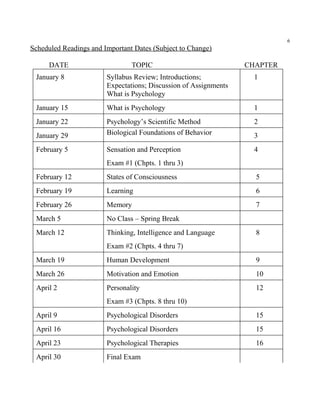
Scheduled Readings and Important Dates (Subject to Change)

      DATE                      TOPIC                             CHAPTER
 January 8              Syllabus Review; Introductions;             1
                        Expectations; Discussion of Assignments
                        What is Psychology
 January 15             What is Psychology                          1
 January 22             Psychology’s Scientific Method              2
 January 29             Biological Foundations of Behavior          3
 February 5             Sensation and Perception                    4
                        Exam #1 (Chpts. 1 thru 3)
 February 12            States of Consciousness                     5
 February 19            Learning                                    6
 February 26            Memory                                      7
 March 5                No Class – Spring Break
 March 12               Thinking, Intelligence and Language         8
                        Exam #2 (Chpts. 4 thru 7)
 March 19               Human Development                           9
 March 26               Motivation and Emotion                      10
 April 2                Personality                                 12
                        Exam #3 (Chpts. 8 thru 10)
 April 9                Psychological Disorders                     15
 April 16               Psychological Disorders                     15
 April 23               Psychological Therapies                     16
 April 30               Final Exam
7

Psych Syllabus

  • 1.
    1 Seminole State College 1Course Syllabus General Psychology 2012 Spring 2013 Sanford/Lake Mary Campus, L310 Tuesday 6:30 p.m. – 9:15 p.m. John Antony Philcox, M.A., CCJAP e-mail: PHILCOXJ@seminolestate.edu Office Hours: By Appointment Department: Social Science Course Name: General Psychology Course Number: PSY 2012 Class Number: 2587 Credit Hours: 3 Contact Hours: 3 Prerequisite/Corequisite: ENC 1011 Required Texts and Materials: The Science of Psychology: An Appreciative View with Connect, 2nd Edition – Laura A. King, McGraw Hill Publishers ISBN 978-0-07-353206-6 Catalog Description: This is an introductory course which surveys the field of psychology and basic principles and concepts utilized to understand human behavior. The major areas of study include development, learning, perception, motivation, emotions, personality, abnormal behavior, psychotherapy and testing measurements. This course partially satisfies the writing requirement of S.B.E. 6A-10.030. Sakai Enhanced GRADING: Grades will be determined by performance in the following areas: • Three Exams plus the Final Exam • Quizzes • Homework Assignments • Connect Learnsmart Modules • Class Participation and Attendance • Bonus Papers
  • 2.
    2 GRADING SCALE CALCULATING YOUR SEMESTER AVERAGE 90% and above A Exams (includes final) 1 – 4 45% 80 – 89% B Homework Assignments 15% 70 – 79% C Attendance, Class Participation 15% 60 – 69% D Connect Learnsmart Modules 25% 59% and below F McGraw-Hill’s CONNECT will be utilized as part of this course. Connect is a diagnostic adaptive software tool. There will be weekly “Connect” assignments that correspond with the chapters we are covering. Please note this is 25% of your grade. Measurable Course Objectives: 1. Demonstrate comprehension of the quantitative and qualitative research techniques by which knowledge is discovered and organized in the discipline and by which research is conducted. 2. Recognize and identify definitions and examples of the major concepts and theories of the discipline. 3. Apply those concepts and theories in the analysis of real life situations. 4. Demonstrate knowledge of the topics listed in the course outline. 5. Demonstrate proficiency in Library research skills appropriate of psychology. Course Outline: 1. History 2. Methods and Statistics 3. Biological Foundations 4. Human Development 5. Sensation and Perception 5. Learning and Memory 6. States of Consciousness, Intelligence and Cognition 7. Motivation and Emotion 8. Personality 9. Tests and Measurements 10. Abnormal Behavior and Treatments Course Policies Class Participation - A lot of what you will learn in this course will be from what you experience in class and your interaction with others. Coming and going out of the classroom is disruptive and disrespectful to your fellow students as well as the professor. Your participation in this class will enhance your learning and greatly contribute to the learning of others. Attendance – Seminole State College recognizes the correlation between attendance and both student retention and achievement. Students must be enrolled before they can attend class. Students are expected to attend all class sessions and activities for which they are registered. Any class session or
  • 3.
    3 activity missed, regardlessof cause, reduces the opportunity of learning and may adversely affect a student's achievement in the course. A student who is absent from class 10 percent of the scheduled class time is subject to be withdrawn without warning by the instructor. A student may not be re- admitted to the class once withdrawn. A student who has to be absent because of jury duty or court-mandated appearance needs to contact the instructor in advance of the absence in order that a plan for making up work missed can be made. When observance of religious holidays of students' own faith interferes with admission and registration; with attendance in class, class activities, examinations and official ceremonies; and with class work assignments, students are required to notify instructors, counselors or other appropriate personnel in advance of such absences. I will keep track of your attendance through two means: calling roll at the beginning of class and a sign in sheet. Please remember to sign in. Your signature is dual verification that you were present in class. It is your responsibility to get class notes and other class information from another student if you miss a class. The better attendance a student has, the higher their grade is. Points will be deducted for coming late and leaving early. If you are tardy, that is you arrive over the 6:30 p.m. hour, and you were not present for roll-call, you will be marked absent. If you leave early you will be marked absent for the class. Come to class!!!!!!! View complete policy from the college catalog at: http://www.seminolestate.edu/catalog/studentinfo/academic_policies/attendance.htm Emergency Conditions – In case of emergency conditions (such as tropical storms, hurricanes, power outages, etc), verify the college is open and classes are being held by calling 407.708.2290 or 407.708.4722. The Seminole State homepage will also feature updated announcements (http://www.seminolestate.edu/). Instructor Availability - If at anytime you wish to discuss any issue related to the class with me, please do not hesitate to contact me by e-mail. I am very willing to set up an appointment with you. Please come to me as soon as you have a necessary and pertinent need, do not wait until the last minute and it is too late for you to make this class a rewarding and enjoyable experience. Your suggestions and ideas are encouraged and welcomed, both in class and outside of class. College Withdrawal Procedure – Timelines and details are cited in the current catalog. The deadline for withdrawal is March 19, 2013. For further information visit the following link: http://www.seminolestate.edu/catalog/calendar/college/ Cell Phones/Pagers/Blackberries/Computers – Students may use their laptop or “mini-computer’ (smart phone) during class to take notes or to access the Internet for research. A student who uses this freedom to “surf the web” may be asked to leave the class for that day or to turn off their laptop or phone. No texting during class sessions. During a testing situation, if a cell phone or pager vibrates or is audible, the student’s quiz, test, or examination will be collected and the student will be asked to leave without an option for completion. Student Code of Conduct It is the responsibility of a student to observe campus rules and regulations and to help maintain appropriate conditions in the classroom, on the campus, and in the community. The Student Code of Conduct is a statement of Seminole State’s expectations regarding student standards of conduct, both academic and non-academic. It is the student’s responsibility to read the Code of Conduct and follow its expectations. The Student Code of Conduct can be found at http://www.seminolestate.edu/catalog/studentinfo/code-of-conduct/code-of-conduct.htm
  • 4.
    4 Academic Integrity –As a member of the Seminole State College community, a student is expected to be honest in all of his or her academic coursework and activities. Academic dishonesty such as cheating of any kind of examinations, course assignments, projects, plagiarism, misrepresentation, and the unauthorized possession of examinations or other course related materials, is prohibited. Plagiarism is the deliberate use and appropriation of another’s work without identifying the source and trying to pass off such work as the student’s own. Anyone who shares his or her work for the purpose of cheating is subject to the same penalties as the student who commits the act. The college has a program that identifies and compares papers with familiar sources and material. Plagiarism is a growing problem and students may receive an “F” for the course if plagiarism is discovered. Accommodation for Special Needs – Seminole State College abides by Section 504 of the Rehabilitation Act of 1973 and the Americans with Disabilities Act (ADA), which stipulates that no student shall be denied the benefits of an education 'solely by reason of a handicap.' Disabilities covered by law include, but are not limited to psychiatric impairments, learning disabilities and hearing, sight or mobility impairments. If you have a disability that may have some impact on your work in this class and for which you may require accommodations, contact the Disability Support Services Office (DSS) to facilitate the accommodation process. Contacts for the DSS Office are: Dr. Geraldine Perez , Director, S/LM Campus, Room S-002, 407.708.2109 Elyse Jacobs, Altamonte Campus, Room ALT 107, 407.404.6005 Tiffany Myrick, Heathrow Campus, Room HEA 214, 407.708.4440 Louise Friderici, Oviedo Campus, Room OVF 102-D, 407.971.5114 Grading and Evaluation Criteria There will be quizzes, three exams, a final, weekly homework assignments, connect learnsmart modules, and bonus papers. The lowest exam grade will be dropped. This does not include the final. If you miss a quiz and or exam you will receive a zero. There will be no make up exams or quizzes. The final examination in this course is MANDATORY. Any student not completing the final exam will receive a zero which will be added into the overall grade. Final Grades will be based on a point accumulation basis. Students will earn points by way of homework assignments, exams, quizzes, bonus papers, class participation, connect learnsmart modules, and other various assignments. Points will be converted into a percentage score, which will result in your final grade. All assignments and exams will be discussed ahead of time so there will be ample time for preparation. There will be a penalty for late work. For each day that the assignment is late a 10% reduction in points will be assessed.
  • 5.
    5 INTERNET RESEARCH STATEMENT:Because of the variety of sources, ease of publication, lack of central control and proliferation of commercial information on the free Internet, it is often hard to tell if the information is reliable. Many sites contain research and information of high quality. However, unlike traditional print publications or library-based electronic resources, there is usually no process of peer review, nor is there an editor verifying the accuracy of information presented on the Internet. There are an increasing number of sites containing information that may be incomplete, anonymously written, out-of-date, biased, fraudulent, or whose content may not be factual. Students should, therefore, use caution in use of the free Internet for their research needs. For academic topics that are addressed in scholarly literature, use of electronic databases or visiting the library may better meet your needs. NOTE: This syllabus and outline may be altered, at the instructor’s discretion, during the course of the semester. Students are responsible for informing themselves of changes announced. The information contained herein is your responsibility.
  • 6.
    6 Scheduled Readings andImportant Dates (Subject to Change) DATE TOPIC CHAPTER January 8 Syllabus Review; Introductions; 1 Expectations; Discussion of Assignments What is Psychology January 15 What is Psychology 1 January 22 Psychology’s Scientific Method 2 January 29 Biological Foundations of Behavior 3 February 5 Sensation and Perception 4 Exam #1 (Chpts. 1 thru 3) February 12 States of Consciousness 5 February 19 Learning 6 February 26 Memory 7 March 5 No Class – Spring Break March 12 Thinking, Intelligence and Language 8 Exam #2 (Chpts. 4 thru 7) March 19 Human Development 9 March 26 Motivation and Emotion 10 April 2 Personality 12 Exam #3 (Chpts. 8 thru 10) April 9 Psychological Disorders 15 April 16 Psychological Disorders 15 April 23 Psychological Therapies 16 April 30 Final Exam
  • 7.