OPERANT
CONDITIONING
Done by:
Kyra Maxime
Leah Ramkissoon
Victoria Boodhoo
Joshua Hoskins
PSYC1002
OBJECTIVES
Define the term “operant conditioning”.
Identify the consequences of operant conditioning.
Understand the types of reinforcement (Negative and Positive).
Explain what is the Premack Principle.
Discuss what is meant by the term ‘shaping’.
2
What is Operant Conditioning?
Operant conditioning, as defined
by B.F. Skinner (1938), is a type of
learning where behavior is
strengthened or weakened by the
consequences that follow it.
In this process, behaviors are
shaped through reinforcement or
punishment, leading to the
formation of new behaviors or the
extinction of existing ones.
CONSEQUENCES
1.Behavior Modification:
Operant conditioning
techniques are widely used
in behavior modification
programs for both humans
and animals.
2. Education and Training:
Operant conditioning
principles are employed in
educational settings to
reinforce desired behaviors
and discourage undesirable
ones.
3. Psychological Disorders:
Maladaptive behaviors in
psychological disorders can be
understood and treated using
operant conditioning
techniques.
4. Organizational Behavior:
Operant conditioning
principles are also
applicable in organizational
behavior, where managers
use reinforcement
strategies to motivate
employees and shape
workplace behaviors.
5. Social Learning:
Social learning theory,
developed by Albert
Bandura, incorporates
operant conditioning
principles alongside
observational learning.
REINFORCEMENTS
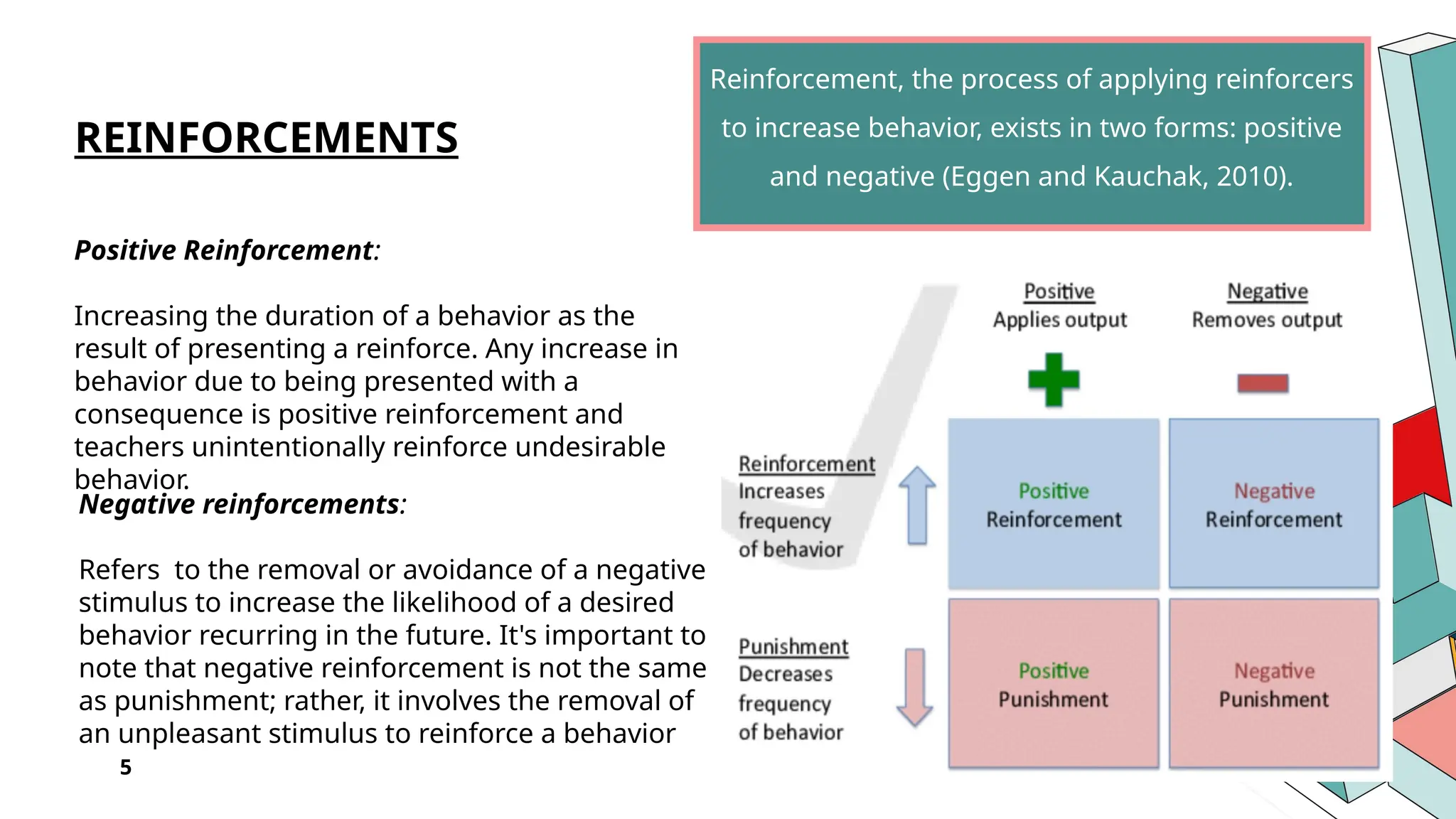
Reinforcement, the process of applying reinforcers
to increase behavior, exists in two forms: positive
and negative (Eggen and Kauchak, 2010).
5
Positive Reinforcement:
Increasing the duration of a behavior as the
result of presenting a reinforce. Any increase in
behavior due to being presented with a
consequence is positive reinforcement and
teachers unintentionally reinforce undesirable
behavior.
Negative reinforcements:
Refers to the removal or avoidance of a negative
stimulus to increase the likelihood of a desired
behavior recurring in the future. It's important to
note that negative reinforcement is not the same
as punishment; rather, it involves the removal of
an unpleasant stimulus to reinforce a behavior
6
Extinction
Refers to the gradual weakening and eventual disappearance of a previously learned
behavior when reinforcement or punishment is no longer provided for that behavior.
Essentially, extinction occurs when the response that was previously reinforced or
punished no longer results in the expected outcome.
Satiation
Refers to a decrease in the effectiveness of a reinforcer due to its excessive or repeated
presentation. Essentially, when a reinforcer is provided too frequently or in large
quantities, it loses its ability to motivate or reinforce behavior.
PREMACK PRINCIPLE
 This theory was developed by David Premack who established his
theory through experiments on rats, children, and later
chimpanzees.
 According to the Premack principle, any Response A can reinforce
any other Response B if A has a higher independent rate than B.
 The Premack principle, also known as the relativity theory of
reinforcement and the differential-probability hypothesis, holds that
a more desirable activity can be used to reinforce a less desirable
one.
 This theory demonstrates reinforcer relativity, in which the relative
probabilities of responses can have a greater impact than
preference.
 Applying the Premack Principle entails setting up the environment
WHAT IS SHAPING?
8
 Eggen and Kauchac (2010) defines shaping as “the process of
reinforcing successive approximations of a desired behavior”.
 In operant conditioning, shaping is a useful strategy that
facilitates learning through positive reinforcement.
Examples of Shaping:
 Training your dog to sit or fetch a ball.
 Teaching your child to clean up their room.
 Learning to play an instrument.
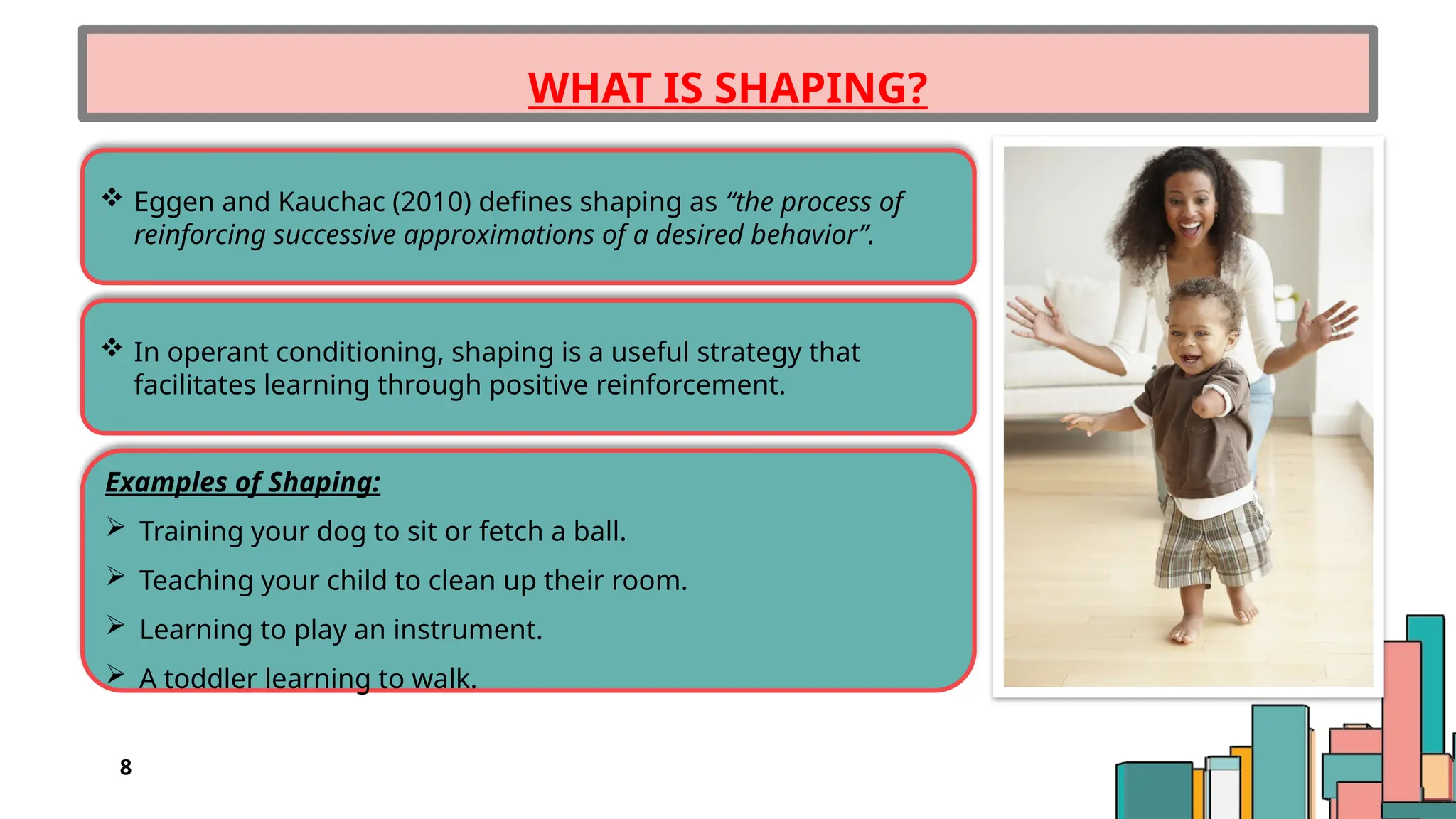
 A toddler learning to walk.
REVIEW:
OPERANT CONDITIONING
REFERENCES
Bandura, A. (1969). *Principles of Behavior
Modification.* Holt, Rinehart and Winston.
Bandura, A. (1977). *Social Learning
Theory.* General Learning Press.
Eggen, P. & Kauchak, D. (2010). Educational
Psychology. Pearson.
Herrod, J. L., Snyder, S. K., Hart, J. B.,
Frantz, S. J., & Ayres, K. M. (2022).
Applications of the Premack Principle: A
Review of the Literature. Behavior
Modification, 47(1), 219–246.
https://doi.org/10.1177/014544552210852
49
Luthans, F. (2004). *Organizational
Behavior.* McGraw-Hill Education.
Nickerson, C. (2022, January 12). What Is
the Premack Principle? Definition and
Examples - Simply Psychology.
Www.simplypsychology.org.
https://www.simplypsychology.org/premac
k-principle.html
Skinner, B.F. (1938). *The Behavior of
Organisms: An Experimental Analysis.*
Appleton-Century-Crofts.
Skinner, B.F. (1953). *Science and Human
Behavior.* Free Press.

PSYC1002 Operant Conditioning.pptx the pp

  • 1.
    OPERANT CONDITIONING Done by: Kyra Maxime LeahRamkissoon Victoria Boodhoo Joshua Hoskins PSYC1002
  • 2.
    OBJECTIVES Define the term“operant conditioning”. Identify the consequences of operant conditioning. Understand the types of reinforcement (Negative and Positive). Explain what is the Premack Principle. Discuss what is meant by the term ‘shaping’. 2
  • 3.
    What is OperantConditioning? Operant conditioning, as defined by B.F. Skinner (1938), is a type of learning where behavior is strengthened or weakened by the consequences that follow it. In this process, behaviors are shaped through reinforcement or punishment, leading to the formation of new behaviors or the extinction of existing ones.
  • 4.
    CONSEQUENCES 1.Behavior Modification: Operant conditioning techniquesare widely used in behavior modification programs for both humans and animals. 2. Education and Training: Operant conditioning principles are employed in educational settings to reinforce desired behaviors and discourage undesirable ones. 3. Psychological Disorders: Maladaptive behaviors in psychological disorders can be understood and treated using operant conditioning techniques. 4. Organizational Behavior: Operant conditioning principles are also applicable in organizational behavior, where managers use reinforcement strategies to motivate employees and shape workplace behaviors. 5. Social Learning: Social learning theory, developed by Albert Bandura, incorporates operant conditioning principles alongside observational learning.
  • 5.
    REINFORCEMENTS Reinforcement, the processof applying reinforcers to increase behavior, exists in two forms: positive and negative (Eggen and Kauchak, 2010). 5 Positive Reinforcement: Increasing the duration of a behavior as the result of presenting a reinforce. Any increase in behavior due to being presented with a consequence is positive reinforcement and teachers unintentionally reinforce undesirable behavior. Negative reinforcements: Refers to the removal or avoidance of a negative stimulus to increase the likelihood of a desired behavior recurring in the future. It's important to note that negative reinforcement is not the same as punishment; rather, it involves the removal of an unpleasant stimulus to reinforce a behavior
  • 6.
    6 Extinction Refers to thegradual weakening and eventual disappearance of a previously learned behavior when reinforcement or punishment is no longer provided for that behavior. Essentially, extinction occurs when the response that was previously reinforced or punished no longer results in the expected outcome. Satiation Refers to a decrease in the effectiveness of a reinforcer due to its excessive or repeated presentation. Essentially, when a reinforcer is provided too frequently or in large quantities, it loses its ability to motivate or reinforce behavior.
  • 7.
    PREMACK PRINCIPLE  Thistheory was developed by David Premack who established his theory through experiments on rats, children, and later chimpanzees.  According to the Premack principle, any Response A can reinforce any other Response B if A has a higher independent rate than B.  The Premack principle, also known as the relativity theory of reinforcement and the differential-probability hypothesis, holds that a more desirable activity can be used to reinforce a less desirable one.  This theory demonstrates reinforcer relativity, in which the relative probabilities of responses can have a greater impact than preference.  Applying the Premack Principle entails setting up the environment
  • 8.
    WHAT IS SHAPING? 8 Eggen and Kauchac (2010) defines shaping as “the process of reinforcing successive approximations of a desired behavior”.  In operant conditioning, shaping is a useful strategy that facilitates learning through positive reinforcement. Examples of Shaping:  Training your dog to sit or fetch a ball.  Teaching your child to clean up their room.  Learning to play an instrument.  A toddler learning to walk.
  • 9.
  • 10.
    REFERENCES Bandura, A. (1969).*Principles of Behavior Modification.* Holt, Rinehart and Winston. Bandura, A. (1977). *Social Learning Theory.* General Learning Press. Eggen, P. & Kauchak, D. (2010). Educational Psychology. Pearson. Herrod, J. L., Snyder, S. K., Hart, J. B., Frantz, S. J., & Ayres, K. M. (2022). Applications of the Premack Principle: A Review of the Literature. Behavior Modification, 47(1), 219–246. https://doi.org/10.1177/014544552210852 49 Luthans, F. (2004). *Organizational Behavior.* McGraw-Hill Education. Nickerson, C. (2022, January 12). What Is the Premack Principle? Definition and Examples - Simply Psychology. Www.simplypsychology.org. https://www.simplypsychology.org/premac k-principle.html Skinner, B.F. (1938). *The Behavior of Organisms: An Experimental Analysis.* Appleton-Century-Crofts. Skinner, B.F. (1953). *Science and Human Behavior.* Free Press.