Ofcom's second public service broadcasting review Phase 2: Preparing for the digital future 25 September 2008
Audiences should have a choice of providers  Audiences value the BBC  But they also want PSB alternatives to complement the BBC  Stakeholder support Enhances reach and impact Valuable as an end in itself in news and current affairs Valuable to audiences, who are willing to pay
The current model of ITV1 provision is broken Current costs soon exceed benefits 2009 2010 2011 ITV Wales Costs > benefits During 2009 ITV Plc Costs > benefits Before 2012 stv Costs > benefits  2009 - 2010 Post 2012: UTV & GMTV:  Benefits>costs  Five:  Small net benefits 1 2 3 4 Licence handback becomes a rational option for ITV Plc
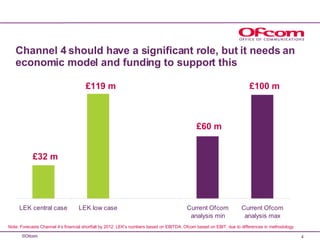
Channel 4 should have a significant role, but it needs an economic model and funding to support this  Note: Forecasts Channel 4’s financial shortfall by 2012. LEK's numbers based on EBITDA. Ofcom based on EBIT, due to differences in methodology £32 m £60 m £100 m £119 m
Estimated funding gap - after 2012 considerable uncertainty £330- 420 m £185 m £145 - 235m Total funding of £330 - £420m per annum may be needed by 2012
Institutions and competition should play important roles Reach Values Independence Flexibility Transparency Efficiency Benefits  Institutions Competition
Long term models for PSB in the future need refining 2. BBC only 1. Evolution 3. BBC/Channel 4 4. Broad competitive funding
All funding options identified in Phase 1 remain credible Regulatory assets Direct public funding Licence fee BBC assets  Levy schemes
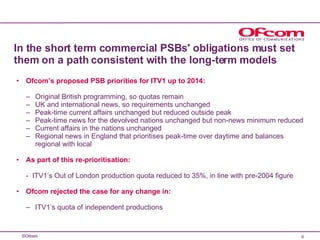
In the short term commercial PSBs' obligations must set them on a path consistent with the long-term models Ofcom’s   proposed PSB priorities for ITV1 up to 2014: Original British programming, so quotas remain  UK and international news, so requirements unchanged Peak-time current affairs unchanged but reduced outside peak Peak-time news for the devolved nations unchanged but non-news minimum reduced Current affairs in the nations unchanged Regional news in England that prioritises peak-time over daytime and balances regional with local As part of this re-prioritisation: -  ITV1’s Out of London production quota reduced to 35%, in line with pre-2004 figure  Ofcom rejected the case for any change in: ITV1’s quota of independent productions
In the short term commercial PSBs' obligations must set them on a path consistent with the long-term models five’s role in PSB  up to 2014: -Original production quota fixed at 50%   -News and current affairs unchanged   -New commitment by five to enhanced delivery of children’s programmes
Our core principles for the future  BBC  remains the cornerstone of PSC Audiences should have a  choice of providers  in most areas of PSC TV  remains essential, but PSC should be delivered across platforms Content for the  devolved nations  remains essential – particularly news Institutional & competitive funding  could play important future complementary roles Channel 4  needs a new economic model to deliver its future public service contribution ITV1 and Five  retain important PSC roles up to 2014 with re-prioritised focus After 2014, the case for  obligations on ITV1 & Five  is more evenly balanced Most of the Phase 1  funding sources  are credible - a mix may be needed in future

PSB Phase 2 presentation

  • 1.
    Ofcom's second publicservice broadcasting review Phase 2: Preparing for the digital future 25 September 2008
  • 2.
    Audiences should havea choice of providers Audiences value the BBC But they also want PSB alternatives to complement the BBC Stakeholder support Enhances reach and impact Valuable as an end in itself in news and current affairs Valuable to audiences, who are willing to pay
  • 3.
    The current modelof ITV1 provision is broken Current costs soon exceed benefits 2009 2010 2011 ITV Wales Costs > benefits During 2009 ITV Plc Costs > benefits Before 2012 stv Costs > benefits 2009 - 2010 Post 2012: UTV & GMTV: Benefits>costs Five: Small net benefits 1 2 3 4 Licence handback becomes a rational option for ITV Plc
  • 4.
    Channel 4 shouldhave a significant role, but it needs an economic model and funding to support this Note: Forecasts Channel 4’s financial shortfall by 2012. LEK's numbers based on EBITDA. Ofcom based on EBIT, due to differences in methodology £32 m £60 m £100 m £119 m
  • 5.
    Estimated funding gap- after 2012 considerable uncertainty £330- 420 m £185 m £145 - 235m Total funding of £330 - £420m per annum may be needed by 2012
  • 6.
    Institutions and competitionshould play important roles Reach Values Independence Flexibility Transparency Efficiency Benefits Institutions Competition
  • 7.
    Long term modelsfor PSB in the future need refining 2. BBC only 1. Evolution 3. BBC/Channel 4 4. Broad competitive funding
  • 8.
    All funding optionsidentified in Phase 1 remain credible Regulatory assets Direct public funding Licence fee BBC assets Levy schemes
  • 9.
    In the shortterm commercial PSBs' obligations must set them on a path consistent with the long-term models Ofcom’s proposed PSB priorities for ITV1 up to 2014: Original British programming, so quotas remain UK and international news, so requirements unchanged Peak-time current affairs unchanged but reduced outside peak Peak-time news for the devolved nations unchanged but non-news minimum reduced Current affairs in the nations unchanged Regional news in England that prioritises peak-time over daytime and balances regional with local As part of this re-prioritisation: - ITV1’s Out of London production quota reduced to 35%, in line with pre-2004 figure Ofcom rejected the case for any change in: ITV1’s quota of independent productions
  • 10.
    In the shortterm commercial PSBs' obligations must set them on a path consistent with the long-term models five’s role in PSB up to 2014: -Original production quota fixed at 50% -News and current affairs unchanged -New commitment by five to enhanced delivery of children’s programmes
  • 11.
    Our core principlesfor the future BBC remains the cornerstone of PSC Audiences should have a choice of providers in most areas of PSC TV remains essential, but PSC should be delivered across platforms Content for the devolved nations remains essential – particularly news Institutional & competitive funding could play important future complementary roles Channel 4 needs a new economic model to deliver its future public service contribution ITV1 and Five retain important PSC roles up to 2014 with re-prioritised focus After 2014, the case for obligations on ITV1 & Five is more evenly balanced Most of the Phase 1 funding sources are credible - a mix may be needed in future