How can you determine whether
something is an element or not?
They are all listed on the periodic table.
ELEMENT SONG
1. Pure substance
– Made of only 1 type
of particle
– Ex: copper wire only
has copper atoms
2. Can’t be separated
into simpler
substances by
chemical or physical
means
3. Each has a unique
set of properties
– Called characteristic
properties
– Can be physical or
chemical
4. Classified by their
properties
1. Metals
2. Nonmetals
3. Metalloids
Elements
Metals
Nonmetals
Metalloids
Develop the concept map by adding
info. about metals, nonmetals, &
metalloids
METALS
•Shiny
•Good conductors
•Malleable
•Ductile
•Ex: gold, silver,
copper
NONMETALS
•Dull (no shine)
•Poor conductors
•At room temp, only a
few are solids that are
brittle
•Most are gases
•Ex: hydrogen,
oxygen, helium
METALLOIDS
•Characteristics of
metals and nonmetals
•Semiconductors
•Ex: silicon, germanium
Use placement on the Periodic
Table to classify elements
• Do you know any compounds?
• How are they different from elements?
• Characteristics
1. Found in nature more often than pure elements
2. Have more than one element
3. Elements are chemically bonded to each other
– Mg + O2 makes MgO
4. Pure substances that occur in fixed ratios by mass
– 1g H to 8g of O in every water molecule
5. Can’t be separated by physical means
6. Have their own unique set of properties
CLASSIFICATION OF MATTER
Mixtures
• 2 or more substances that are not chemically
bonded
– So diff parts keep their own properties
• Ex:
– pizza
– granite
– Kool-aid
– Brass
– Jello
• Parts do not occur in a definite ratio
– Compare the 2 pepperoni pizzas
Mixtures
• Can be physically separated by
1. Distillation
2. Magnet
3. Centrifuge
4. Filtration
5. Evaporation
ELEMENTS COMPOUNDS MIXTURES
Mixtures
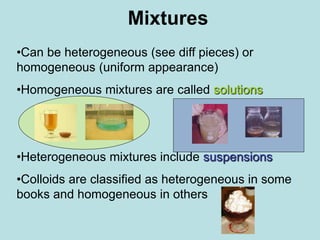
•Can be heterogeneous (see diff pieces) or
homogeneous (uniform appearance)
•Homogeneous mixtures are called solutions
•Heterogeneous mixtures include suspensions
•Colloids are classified as heterogeneous in some
books and homogeneous in others
Solutions – look the same throughout
• From Chem4kids
• How much solute can
dissolve in water?
• Solubility graph can tell you
1. Most compounds show
a(n) ________ in
solubility as temp. inc.
2. Which compound shows
the greatest increase in
solubility as temp inc?
3. Which compound(s)
actually dec in solubility
as temp inc.?
4. How much potassium
nitrate will dissolve in
100 ml of water at 40oC?
5. How much sodium
nitrate will dissolve in
100 ml of water at 90oC?
Solubility Graph
1.Which compound
shows the greatest
increase in solubility as
temp inc?
2.Which compound(s)
actually decrease in
solubility as temp inc.?
3.Which compound has
the highest solubility at
58oC?
Fill-in the Venn
diagram with
characteristics.
•Do not settle out
•Pass thru filter
paper
•Settle out on standing
•Separate w/filter paper
•Largest particle size (seen)
•Ex: blood, muddy water,
Italian salad dressing
•Scatter
light
•Don’t scatter light/
light passes right thru
•Smallest solute
particles
•mixtures
•Medium particle
size
•Don’t easily pour
•Ex: Jell-o, fog,
milk, mayo,
whipped cream
•Ex:
Kool-
aid, salt
water,
brass
Can pour
some

PS elements compounds mixtures.ppt

  • 2.
    How can youdetermine whether something is an element or not? They are all listed on the periodic table. ELEMENT SONG
  • 3.
    1. Pure substance –Made of only 1 type of particle – Ex: copper wire only has copper atoms 2. Can’t be separated into simpler substances by chemical or physical means
  • 4.
    3. Each hasa unique set of properties – Called characteristic properties – Can be physical or chemical 4. Classified by their properties 1. Metals 2. Nonmetals 3. Metalloids Elements Metals Nonmetals Metalloids
  • 5.
    Develop the conceptmap by adding info. about metals, nonmetals, & metalloids METALS •Shiny •Good conductors •Malleable •Ductile •Ex: gold, silver, copper NONMETALS •Dull (no shine) •Poor conductors •At room temp, only a few are solids that are brittle •Most are gases •Ex: hydrogen, oxygen, helium METALLOIDS •Characteristics of metals and nonmetals •Semiconductors •Ex: silicon, germanium
  • 6.
    Use placement onthe Periodic Table to classify elements
  • 7.
    • Do youknow any compounds? • How are they different from elements? • Characteristics 1. Found in nature more often than pure elements 2. Have more than one element 3. Elements are chemically bonded to each other – Mg + O2 makes MgO 4. Pure substances that occur in fixed ratios by mass – 1g H to 8g of O in every water molecule 5. Can’t be separated by physical means 6. Have their own unique set of properties
  • 8.
  • 9.
    Mixtures • 2 ormore substances that are not chemically bonded – So diff parts keep their own properties • Ex: – pizza – granite – Kool-aid – Brass – Jello • Parts do not occur in a definite ratio – Compare the 2 pepperoni pizzas
  • 10.
    Mixtures • Can bephysically separated by 1. Distillation 2. Magnet 3. Centrifuge 4. Filtration 5. Evaporation
  • 11.
  • 12.
    Mixtures •Can be heterogeneous(see diff pieces) or homogeneous (uniform appearance) •Homogeneous mixtures are called solutions •Heterogeneous mixtures include suspensions •Colloids are classified as heterogeneous in some books and homogeneous in others
  • 13.
    Solutions – lookthe same throughout • From Chem4kids • How much solute can dissolve in water? • Solubility graph can tell you 1. Most compounds show a(n) ________ in solubility as temp. inc. 2. Which compound shows the greatest increase in solubility as temp inc? 3. Which compound(s) actually dec in solubility as temp inc.? 4. How much potassium nitrate will dissolve in 100 ml of water at 40oC? 5. How much sodium nitrate will dissolve in 100 ml of water at 90oC?
  • 14.
    Solubility Graph 1.Which compound showsthe greatest increase in solubility as temp inc? 2.Which compound(s) actually decrease in solubility as temp inc.? 3.Which compound has the highest solubility at 58oC?
  • 15.
    Fill-in the Venn diagramwith characteristics.
  • 16.
    •Do not settleout •Pass thru filter paper •Settle out on standing •Separate w/filter paper •Largest particle size (seen) •Ex: blood, muddy water, Italian salad dressing •Scatter light •Don’t scatter light/ light passes right thru •Smallest solute particles •mixtures •Medium particle size •Don’t easily pour •Ex: Jell-o, fog, milk, mayo, whipped cream •Ex: Kool- aid, salt water, brass Can pour some