Proxy Design Pattern
Class Ambassador
Sameer Singh Rathoud
About presentation
This presentation provide information to understand proxy design pattern, it’s
structure and it’s implementation.
I have tried my best to explain the concept in very simple language.

The programming language used for implementation is c#. But any one from
different programming background can easily understand the implementation.
Definition
Provide a surrogate or placeholder for another object to control access to it.
A proxy, in its most general form, is a class functioning as an interface to
something else.
http://en.wikipedia.org/wiki/Proxy_pattern

Proxy pattern is a structural design pattern.
Motivation and Intent
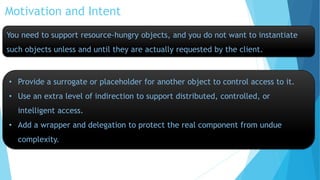
You need to support resource-hungry objects, and you do not want to instantiate

such objects unless and until they are actually requested by the client.

• Provide a surrogate or placeholder for another object to control access to it.
• Use an extra level of indirection to support distributed, controlled, or
intelligent access.

• Add a wrapper and delegation to protect the real component from undue
complexity.
Structure
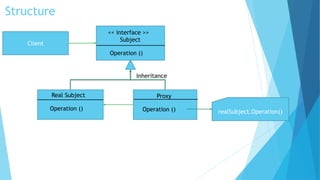
<< interface >>
Subject

Client

Operation ()

Inheritance
Real Subject
Operation ()

Proxy
Operation ()

realSubject.Operation()
Participants in structure
• Subject (interface): is a interface implemented by real subject, but proxy should also
implement this interface, so that where ever real subject is used, there proxy can be used.
• Proxy:
• Maintain the reference of the real subject, so that it can be accessed through proxy.

• Implements the same interface implemented by real subject, so that it can be used as
substitute of real subject.
• Control access to the real subject and responsible for its creation and deletion.

• Can have other responsibilities depends on the proxy.
• Real Subject: The real logic that the proxy represents.
• Client: The user of the proxy design pattern.
Collaborations
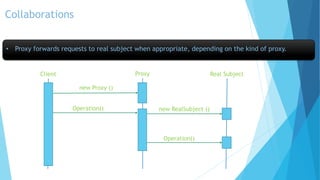
• Proxy forwards requests to real subject when appropriate, depending on the kind of proxy.

Proxy

Client

Real Subject

new Proxy ()
Operation()

new RealSubject ()

Operation()
Types
• Remote proxies: are responsible for encoding a request and its arguments and for sending the
encoded request to the real subject in a different address space.
• Virtual proxies: creates expensive objects on demand.
• Protection proxies: controls access to the original object. Protection proxies are useful when
objects should have different access rights.
Implementation (C#)
Subject (Interface)
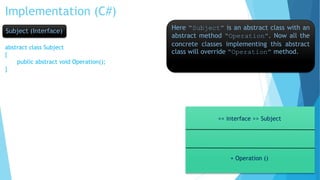
abstract class Subject
{
public abstract void Operation();
}

Here “Subject” is an abstract class with an
abstract method “Operation”. Now all the
concrete classes implementing this abstract
class will override “Operation” method.

<< interface >> Subject

+ Operation ()
Implementation (C#)

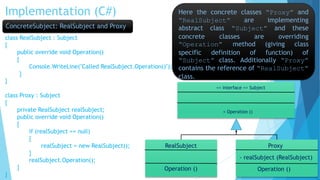
Here the concrete classes “Proxy” and
“RealSubject”
are
implementing
ConcreteSubject: RealSubject and Proxy
abstract class “Subject” and these
concrete
classes
are
overriding
class RealSubject : Subject
“Operation”
method (giving class
{
public override void Operation()
specific definition of function) of
{
“Subject” class. Additionally “Proxy”
Console.WriteLine("Called RealSubject.Operation()"); contains the reference of “RealSubject”
}
class.
}

<< interface >> Subject

class Proxy : Subject
{
private RealSubject realSubject;
public override void Operation()
{
if (realSubject == null)
{
realSubject = new RealSubject();
}
realSubject.Operation();
}
}

+ Operation ()

RealSubject

Proxy
- realSubject (RealSubject)

Operation ()

Operation ()
Implementation (C#)
Client
class Client
{
static void Main(string[] args)
{
Proxy proxy = new Proxy();
proxy.Operation();
}
}

For using proxy pattern the client has to
create a “Proxy” reference and this
reference is used to call the “Operation”.
Example
A smart reference is a replacement for a bare pointer that performs additional actions when an
object is accessed. Typical uses include
• counting the number of references to the real object so that it can be freed automatically when
there are no more references.
• loading a persistent object into memory when it's first referenced.

• checking that the real object is locked before it's accessed to ensure that no other object can
change it.
A check or an bank draft is another example of proxy pattern. Here check represents the fund in the
account. A check can be used for making purchases and it is controlling the fund in the account.
End of Presentation . . .

Proxy design pattern (Class Ambassador)

  • 1.
    Proxy Design Pattern ClassAmbassador Sameer Singh Rathoud
  • 2.
    About presentation This presentationprovide information to understand proxy design pattern, it’s structure and it’s implementation. I have tried my best to explain the concept in very simple language. The programming language used for implementation is c#. But any one from different programming background can easily understand the implementation.
  • 3.
    Definition Provide a surrogateor placeholder for another object to control access to it. A proxy, in its most general form, is a class functioning as an interface to something else. http://en.wikipedia.org/wiki/Proxy_pattern Proxy pattern is a structural design pattern.
  • 4.
    Motivation and Intent Youneed to support resource-hungry objects, and you do not want to instantiate such objects unless and until they are actually requested by the client. • Provide a surrogate or placeholder for another object to control access to it. • Use an extra level of indirection to support distributed, controlled, or intelligent access. • Add a wrapper and delegation to protect the real component from undue complexity.
  • 5.
    Structure << interface >> Subject Client Operation() Inheritance Real Subject Operation () Proxy Operation () realSubject.Operation()
  • 6.
    Participants in structure •Subject (interface): is a interface implemented by real subject, but proxy should also implement this interface, so that where ever real subject is used, there proxy can be used. • Proxy: • Maintain the reference of the real subject, so that it can be accessed through proxy. • Implements the same interface implemented by real subject, so that it can be used as substitute of real subject. • Control access to the real subject and responsible for its creation and deletion. • Can have other responsibilities depends on the proxy. • Real Subject: The real logic that the proxy represents. • Client: The user of the proxy design pattern.
  • 7.
    Collaborations • Proxy forwardsrequests to real subject when appropriate, depending on the kind of proxy. Proxy Client Real Subject new Proxy () Operation() new RealSubject () Operation()
  • 8.
    Types • Remote proxies:are responsible for encoding a request and its arguments and for sending the encoded request to the real subject in a different address space. • Virtual proxies: creates expensive objects on demand. • Protection proxies: controls access to the original object. Protection proxies are useful when objects should have different access rights.
  • 9.
    Implementation (C#) Subject (Interface) abstractclass Subject { public abstract void Operation(); } Here “Subject” is an abstract class with an abstract method “Operation”. Now all the concrete classes implementing this abstract class will override “Operation” method. << interface >> Subject + Operation ()
  • 10.
    Implementation (C#) Here theconcrete classes “Proxy” and “RealSubject” are implementing ConcreteSubject: RealSubject and Proxy abstract class “Subject” and these concrete classes are overriding class RealSubject : Subject “Operation” method (giving class { public override void Operation() specific definition of function) of { “Subject” class. Additionally “Proxy” Console.WriteLine("Called RealSubject.Operation()"); contains the reference of “RealSubject” } class. } << interface >> Subject class Proxy : Subject { private RealSubject realSubject; public override void Operation() { if (realSubject == null) { realSubject = new RealSubject(); } realSubject.Operation(); } } + Operation () RealSubject Proxy - realSubject (RealSubject) Operation () Operation ()
  • 11.
    Implementation (C#) Client class Client { staticvoid Main(string[] args) { Proxy proxy = new Proxy(); proxy.Operation(); } } For using proxy pattern the client has to create a “Proxy” reference and this reference is used to call the “Operation”.
  • 12.
    Example A smart referenceis a replacement for a bare pointer that performs additional actions when an object is accessed. Typical uses include • counting the number of references to the real object so that it can be freed automatically when there are no more references. • loading a persistent object into memory when it's first referenced. • checking that the real object is locked before it's accessed to ensure that no other object can change it. A check or an bank draft is another example of proxy pattern. Here check represents the fund in the account. A check can be used for making purchases and it is controlling the fund in the account.
  • 13.