Pattern

Structural Pattern
Warm-up
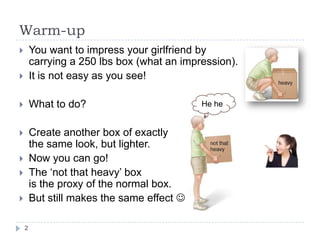
       You want to impress your girlfriend by
        carrying a 250 lbs box (what an impression).
       It is not easy as you see!

       What to do?                         He he


       Create another box of exactly
        the same look, but lighter.
       Now you can go!
       The ‘not that heavy’ box
        is the proxy of the normal box.
       But still makes the same effect 

    2
Another Example –                     This time Serious

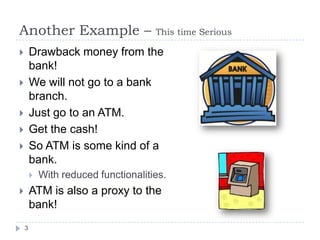
       Drawback money from the
        bank!
       We will not go to a bank
        branch.
       Just go to an ATM.
       Get the cash!
       So ATM is some kind of a
        bank.
           With reduced functionalities.
       ATM is also a proxy to the
        bank!
    3
Proxy Pattern
       Proxy pattern comes into play when we have
        HeavyWeight objects and
           We want to implement a simpler version of a
            HeavyWeight object.
           We don’t need the whole functionality of the HeavyWeight
            object.
           We want to limit the access to the HeavyWeight object.
       Because there may be a time-delay or complex
        mechanism in creating instances of HeavyWeight
        objects.
       Proxy pattern is also known as «surrogate».
           Means to put something into place of another
    4
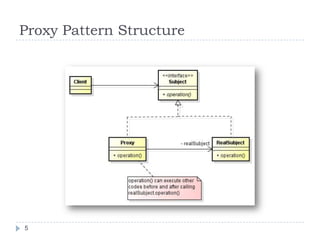
Proxy Pattern Structure


5
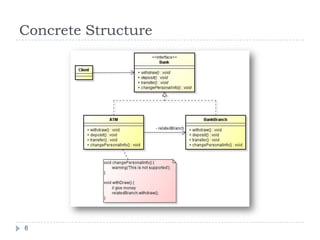
Concrete Structure


6
Participants
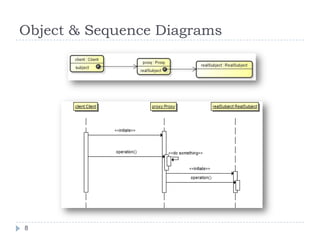
       Subject (Bank)
           The common interface for the proxy and the real subject
       Real Subject (Bank Branch)
           The concrete subject that implements the interface.
       Proxy (ATM)
           Provides the same interface as Real Subject (or a subset)
           Maintains a reference to the Real Subject
           Since it doesnot have all the data as Real Subject (a
            lightweight), it can do many things faster than Real
            Subject.
           Then invokes Real Subject (if needed).

    7
Object & Sequence Diagrams


8
Consequences
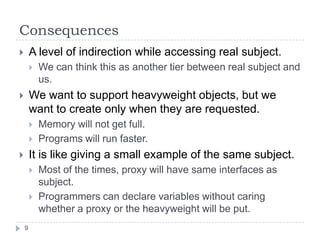
       A level of indirection while accessing real subject.
           We can think this as another tier between real subject and
            us.
       We want to support heavyweight objects, but we
        want to create only when they are requested.
           Memory will not get full.
           Programs will run faster.
       It is like giving a small example of the same subject.
           Most of the times, proxy will have same interfaces as
            subject.
           Programmers can declare variables without caring
            whether a proxy or the heavyweight will be put.
    9
Disadvantages
    Do you think of any disadvantages?
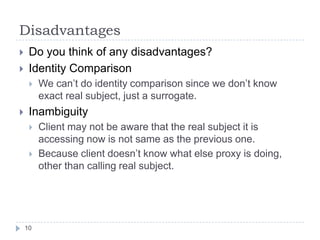
    Identity Comparison
        We can’t do identity comparison since we don’t know
         exact real subject, just a surrogate.
    Inambiguity
        Client may not be aware that the real subject it is
         accessing now is not same as the previous one.
        Because client doesn’t know what else proxy is doing,
         other than calling real subject.


    10
Variants
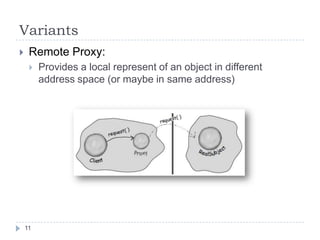
    Remote Proxy:
        Provides a local represent of an object in different
         address space (or maybe in same address)


    11
Variants – cont’d
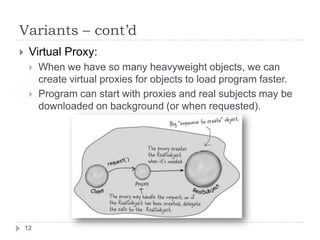
    Virtual Proxy:
        When we have so many heavyweight objects, we can
         create virtual proxies for objects to load program faster.
        Program can start with proxies and real subjects may be
         downloaded on background (or when requested).


    12
Variants – cont’d
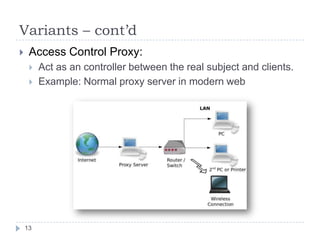
    Access Control Proxy:
        Act as an controller between the real subject and clients.
        Example: Normal proxy server in modern web


    13
Variants – cont’d
    Smart Reference Proxy:
        Provides additional actions whenever a real subject is
         referenced.
            Counting the number of accesses
            Locking it so that only one object can change at a time.
            Deleting an object after a certain number of accesses.
    Cache Proxy:
        Provides temporary storage of results of the expensive
         target operations.
        Make some certain operations faster!


    14
Relation with Other Patterns
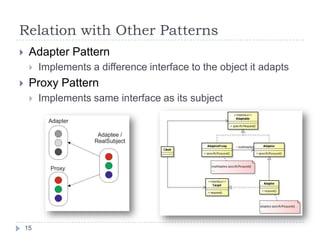
    Adapter Pattern
        Implements a difference interface to the object it adapts
    Proxy Pattern
        Implements same interface as its subject


    15
Relation with Other Patterns – cont’d
    Decorator Pattern vs Proxy Pattern
        Both patterns describe a level of indirection to an object
        Implementations of both keeps a reference to another
         object
        But they are intended for different purposes
            Decorator is adding more responsibilities to the object while
             decorating
            Proxy is controlling access to it


    16
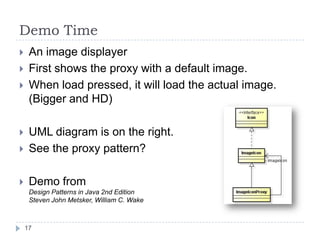
Demo Time
    An image displayer
    First shows the proxy with a default image.
    When load pressed, it will load the actual image.
     (Bigger and HD)

    UML diagram is on the right.
    See the proxy pattern?

    Demo from
     Design Patterns in Java 2nd Edition
     Steven John Metsker, William C. Wake


    17
Thanks


         Questions?

18
References
    GoF Design Patterns Book
    The ‘not that strong’ man: http://www.revolutionhealth.com/articles/proper-lifting-
     technique/hw206944
    The impressed girl: http://www.shutterstock.com/pic-10016596/stock-photo-surprised-
     girl-pointing-at-copy-space-portrait-of-a-beautiful-young-business-woman-looking-
     up.html
    The bank: http://chinarsuvidhaacenter.org/
    The ATM Machine: http://www.clipartheaven.com/show/clipart/money/atm-gif.html
    Variant images: O’Reilly Head First Design Patterns book
    Access Control Proxy image: http://www.democracybroadcastingnews.com/?p=12329
    http://www.site.uottawa.ca:4321/oose/index.html#proxy
    Anti-pattern from: The patterns handbook: techniques, strategies, and
     applications By Linda Rising (google books has this book)
    http://blog.decayingcode.com/post/anti-pattern-god-object.aspx
    http://www.oodesign.com/proxy-pattern.html
    http://www.javacamp.org/designPattern/proxy.html
    Demo from book: http://www.informit.com/store/product.aspx?isbn=0321333020
    19
Bonus: Introducing Anti-Patterns
    Anti-patterns are a way of making the things wrong.
    Remember Edison?
        Tried hundreds of possible materials for flament till
         building the first electric light.
        At each failure, he knows what he shouldn’t do next time!
    Designs may end up with an anti-pattern by:
        Developer or designer’s not knowing better
        Not having sufficient experience for specific problems
        Or applying a perfectly good pattern in the wrong context.
    One example is «God Object»
        An object that knows too much or does too much
        Result of a mis-use of facade pattern

    20

Proxy Pattern

  • 1.
  • 2.
    Warm-up  You want to impress your girlfriend by carrying a 250 lbs box (what an impression).  It is not easy as you see!  What to do? He he  Create another box of exactly the same look, but lighter.  Now you can go!  The ‘not that heavy’ box is the proxy of the normal box.  But still makes the same effect  2
  • 3.
    Another Example – This time Serious  Drawback money from the bank!  We will not go to a bank branch.  Just go to an ATM.  Get the cash!  So ATM is some kind of a bank.  With reduced functionalities.  ATM is also a proxy to the bank! 3
  • 4.
    Proxy Pattern  Proxy pattern comes into play when we have HeavyWeight objects and  We want to implement a simpler version of a HeavyWeight object.  We don’t need the whole functionality of the HeavyWeight object.  We want to limit the access to the HeavyWeight object.  Because there may be a time-delay or complex mechanism in creating instances of HeavyWeight objects.  Proxy pattern is also known as «surrogate».  Means to put something into place of another 4
  • 5.
  • 6.
  • 7.
    Participants  Subject (Bank)  The common interface for the proxy and the real subject  Real Subject (Bank Branch)  The concrete subject that implements the interface.  Proxy (ATM)  Provides the same interface as Real Subject (or a subset)  Maintains a reference to the Real Subject  Since it doesnot have all the data as Real Subject (a lightweight), it can do many things faster than Real Subject.  Then invokes Real Subject (if needed). 7
  • 8.
  • 9.
    Consequences  A level of indirection while accessing real subject.  We can think this as another tier between real subject and us.  We want to support heavyweight objects, but we want to create only when they are requested.  Memory will not get full.  Programs will run faster.  It is like giving a small example of the same subject.  Most of the times, proxy will have same interfaces as subject.  Programmers can declare variables without caring whether a proxy or the heavyweight will be put. 9
  • 10.
    Disadvantages  Do you think of any disadvantages?  Identity Comparison  We can’t do identity comparison since we don’t know exact real subject, just a surrogate.  Inambiguity  Client may not be aware that the real subject it is accessing now is not same as the previous one.  Because client doesn’t know what else proxy is doing, other than calling real subject. 10
  • 11.
    Variants  Remote Proxy:  Provides a local represent of an object in different address space (or maybe in same address) 11
  • 12.
    Variants – cont’d  Virtual Proxy:  When we have so many heavyweight objects, we can create virtual proxies for objects to load program faster.  Program can start with proxies and real subjects may be downloaded on background (or when requested). 12
  • 13.
    Variants – cont’d  Access Control Proxy:  Act as an controller between the real subject and clients.  Example: Normal proxy server in modern web 13
  • 14.
    Variants – cont’d  Smart Reference Proxy:  Provides additional actions whenever a real subject is referenced.  Counting the number of accesses  Locking it so that only one object can change at a time.  Deleting an object after a certain number of accesses.  Cache Proxy:  Provides temporary storage of results of the expensive target operations.  Make some certain operations faster! 14
  • 15.
    Relation with OtherPatterns  Adapter Pattern  Implements a difference interface to the object it adapts  Proxy Pattern  Implements same interface as its subject 15
  • 16.
    Relation with OtherPatterns – cont’d  Decorator Pattern vs Proxy Pattern  Both patterns describe a level of indirection to an object  Implementations of both keeps a reference to another object  But they are intended for different purposes  Decorator is adding more responsibilities to the object while decorating  Proxy is controlling access to it 16
  • 17.
    Demo Time  An image displayer  First shows the proxy with a default image.  When load pressed, it will load the actual image. (Bigger and HD)  UML diagram is on the right.  See the proxy pattern?  Demo from Design Patterns in Java 2nd Edition Steven John Metsker, William C. Wake 17
  • 18.
    Thanks Questions? 18
  • 19.
    References  GoF Design Patterns Book  The ‘not that strong’ man: http://www.revolutionhealth.com/articles/proper-lifting- technique/hw206944  The impressed girl: http://www.shutterstock.com/pic-10016596/stock-photo-surprised- girl-pointing-at-copy-space-portrait-of-a-beautiful-young-business-woman-looking- up.html  The bank: http://chinarsuvidhaacenter.org/  The ATM Machine: http://www.clipartheaven.com/show/clipart/money/atm-gif.html  Variant images: O’Reilly Head First Design Patterns book  Access Control Proxy image: http://www.democracybroadcastingnews.com/?p=12329  http://www.site.uottawa.ca:4321/oose/index.html#proxy  Anti-pattern from: The patterns handbook: techniques, strategies, and applications By Linda Rising (google books has this book)  http://blog.decayingcode.com/post/anti-pattern-god-object.aspx  http://www.oodesign.com/proxy-pattern.html  http://www.javacamp.org/designPattern/proxy.html  Demo from book: http://www.informit.com/store/product.aspx?isbn=0321333020 19
  • 20.
    Bonus: Introducing Anti-Patterns  Anti-patterns are a way of making the things wrong.  Remember Edison?  Tried hundreds of possible materials for flament till building the first electric light.  At each failure, he knows what he shouldn’t do next time!  Designs may end up with an anti-pattern by:  Developer or designer’s not knowing better  Not having sufficient experience for specific problems  Or applying a perfectly good pattern in the wrong context.  One example is «God Object»  An object that knows too much or does too much  Result of a mis-use of facade pattern 20