Proxy Pattern/C# Core 2
System.Reflection.DispatchProxy
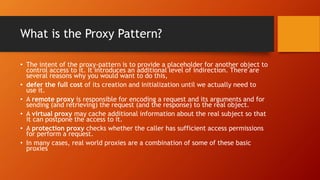
What is the Proxy Pattern?
‱ The intent of the proxy-pattern is to provide a placeholder for another object to
control access to it. It introduces an additional level of indirection. There are
several reasons why you would want to do this,
‱ defer the full cost of its creation and initialization until we actually need to
use it.
‱ A remote proxy is responsible for encoding a request and its arguments and for
sending (and retrieving) the request (and the response) to the real object.
‱ A virtual proxy may cache additional information about the real subject so that
it can postpone the access to it.
‱ A protection proxy checks whether the caller has sufficient access permissions
for perform a request.
‱ In many cases, real world proxies are a combination of some of these basic
proxies
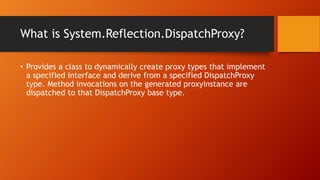
What is System.Reflection.DispatchProxy?
‱ Provides a class to dynamically create proxy types that implement
a specified interface and derive from a specified DispatchProxy
type. Method invocations on the generated proxyinstance are
dispatched to that DispatchProxy base type.
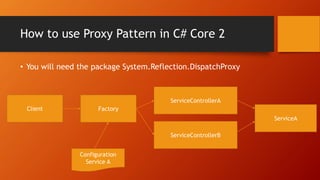
How to use Proxy Pattern in C# Core 2
‱ You will need the package System.Reflection.DispatchProxy
ServiceControllerA
Client Factory
ServiceControllerB
ServiceA
Configuration
Service A
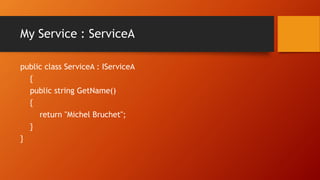
My Service : ServiceA
public class ServiceA : IServiceA
{
public string GetName()
{
return "Michel Bruchet";
}
}
My two controllers : Controller A and B
public class ControllerA : IServiceA
{
public string GetName()
{
return new ServiceA().GetName();
}
}
My two Classes Proxy
public class ClassProxyA : System.Reflection.DispatchProxy
{
protected override object Invoke(MethodInfo targetMethod, object[] args)
{
return new ControllerA().GetName();
}
}
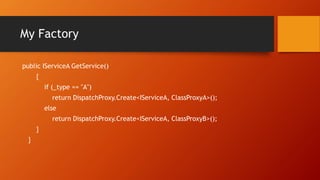
My Factory
public IServiceA GetService()
{
if (_type == "A")
return DispatchProxy.Create<IServiceA, ClassProxyA>();
else
return DispatchProxy.Create<IServiceA, ClassProxyB>();
}
}
My Client
static void Main(string[] args)
{
var factory = new MyClassFactory("A");
var name = factory.GetName();
Console.Write($"hello {name}");
}

Proxy pattern

  • 1.
    Proxy Pattern/C# Core2 System.Reflection.DispatchProxy
  • 2.
    What is theProxy Pattern? ‱ The intent of the proxy-pattern is to provide a placeholder for another object to control access to it. It introduces an additional level of indirection. There are several reasons why you would want to do this, ‱ defer the full cost of its creation and initialization until we actually need to use it. ‱ A remote proxy is responsible for encoding a request and its arguments and for sending (and retrieving) the request (and the response) to the real object. ‱ A virtual proxy may cache additional information about the real subject so that it can postpone the access to it. ‱ A protection proxy checks whether the caller has sufficient access permissions for perform a request. ‱ In many cases, real world proxies are a combination of some of these basic proxies
  • 3.
    What is System.Reflection.DispatchProxy? ‱Provides a class to dynamically create proxy types that implement a specified interface and derive from a specified DispatchProxy type. Method invocations on the generated proxyinstance are dispatched to that DispatchProxy base type.
  • 4.
    How to useProxy Pattern in C# Core 2 ‱ You will need the package System.Reflection.DispatchProxy ServiceControllerA Client Factory ServiceControllerB ServiceA Configuration Service A
  • 5.
    My Service :ServiceA public class ServiceA : IServiceA { public string GetName() { return "Michel Bruchet"; } }
  • 6.
    My two controllers: Controller A and B public class ControllerA : IServiceA { public string GetName() { return new ServiceA().GetName(); } }
  • 7.
    My two ClassesProxy public class ClassProxyA : System.Reflection.DispatchProxy { protected override object Invoke(MethodInfo targetMethod, object[] args) { return new ControllerA().GetName(); } }
  • 8.
    My Factory public IServiceAGetService() { if (_type == "A") return DispatchProxy.Create<IServiceA, ClassProxyA>(); else return DispatchProxy.Create<IServiceA, ClassProxyB>(); } }
  • 9.
    My Client static voidMain(string[] args) { var factory = new MyClassFactory("A"); var name = factory.GetName(); Console.Write($"hello {name}"); }