

Case study
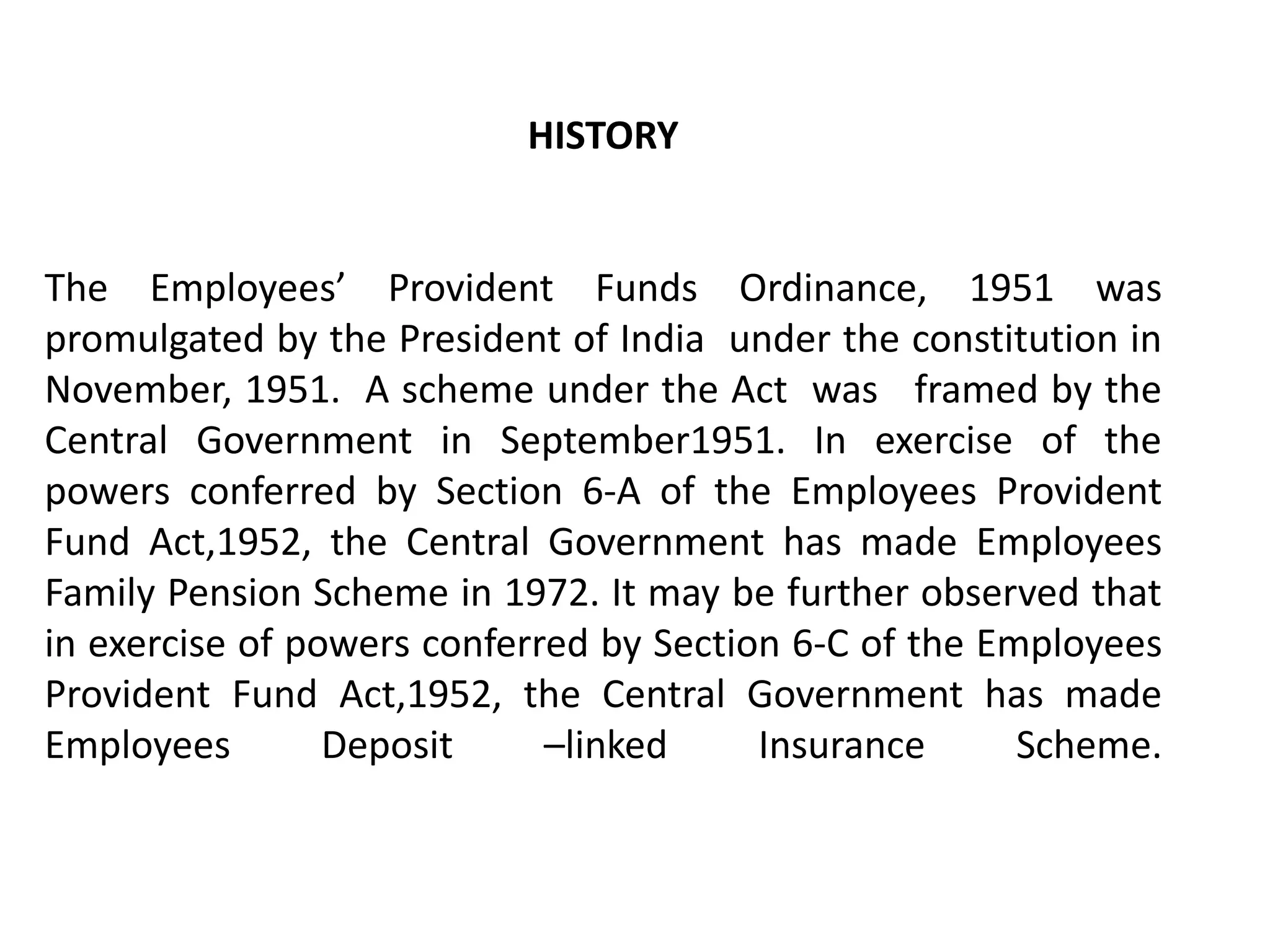
HISTORY
The Employees’ Provident Funds Ordinance, 1951 was
promulgated by the President of India under the constitution in
November, 1951. A scheme under the Act was framed by the
Central Government in September1951. In exercise of the
powers conferred by Section 6-A of the Employees Provident
Fund Act,1952, the Central Government has made Employees
Family Pension Scheme in 1972. It may be further observed that
in exercise of powers conferred by Section 6-C of the Employees
Provident Fund Act,1952, the Central Government has made
Employees Deposit –linked Insurance Scheme.
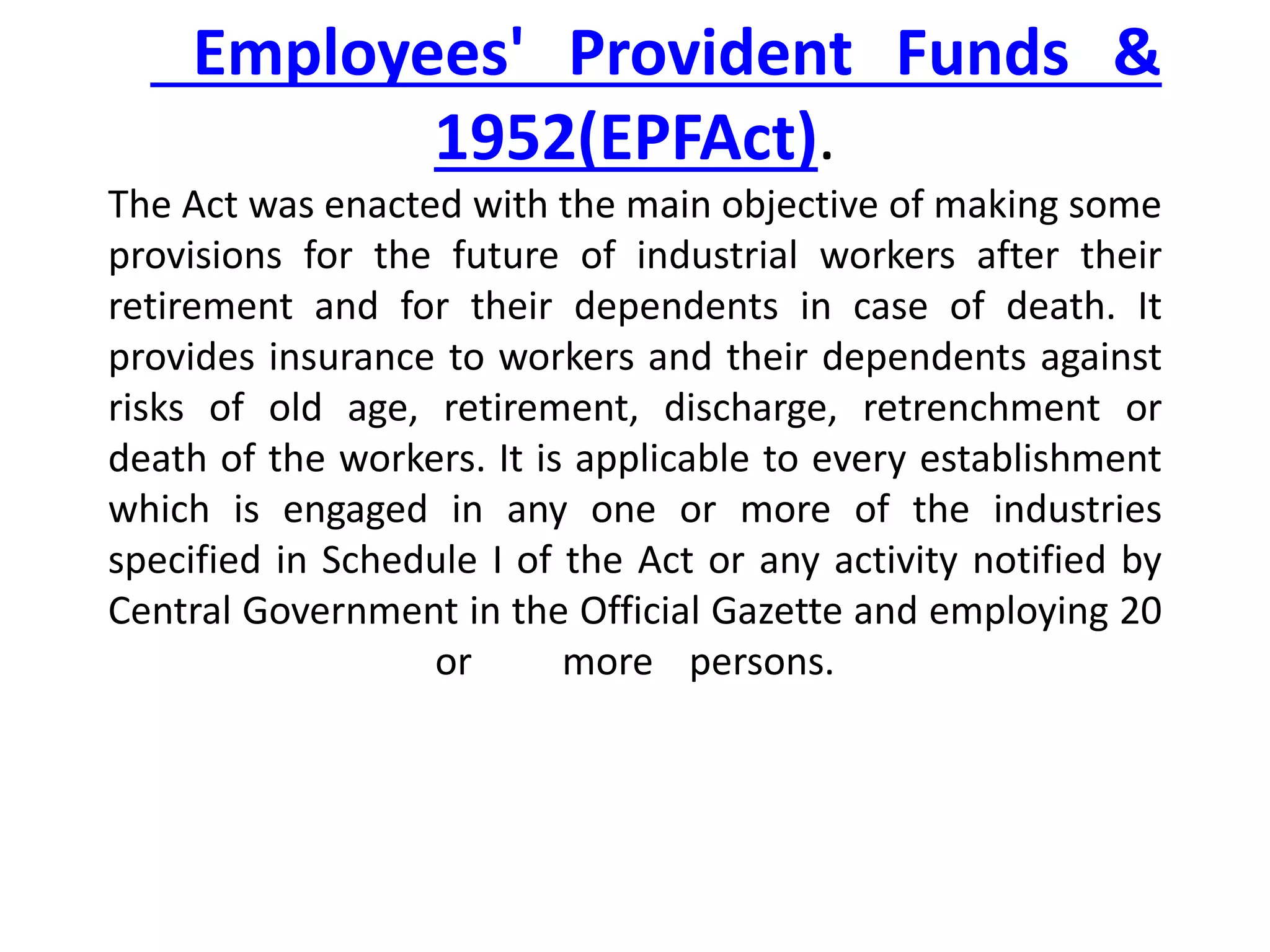
Employees' Provident Funds &
1952(EPFAct).
The Act was enacted with the main objective of making some
provisions for the future of industrial workers after their
retirement and for their dependents in case of death. It
provides insurance to workers and their dependents against
risks of old age, retirement, discharge, retrenchment or
death of the workers. It is applicable to every establishment
which is engaged in any one or more of the industries
specified in Schedule I of the Act or any activity notified by
Central Government in the Official Gazette and employing 20
or more persons.
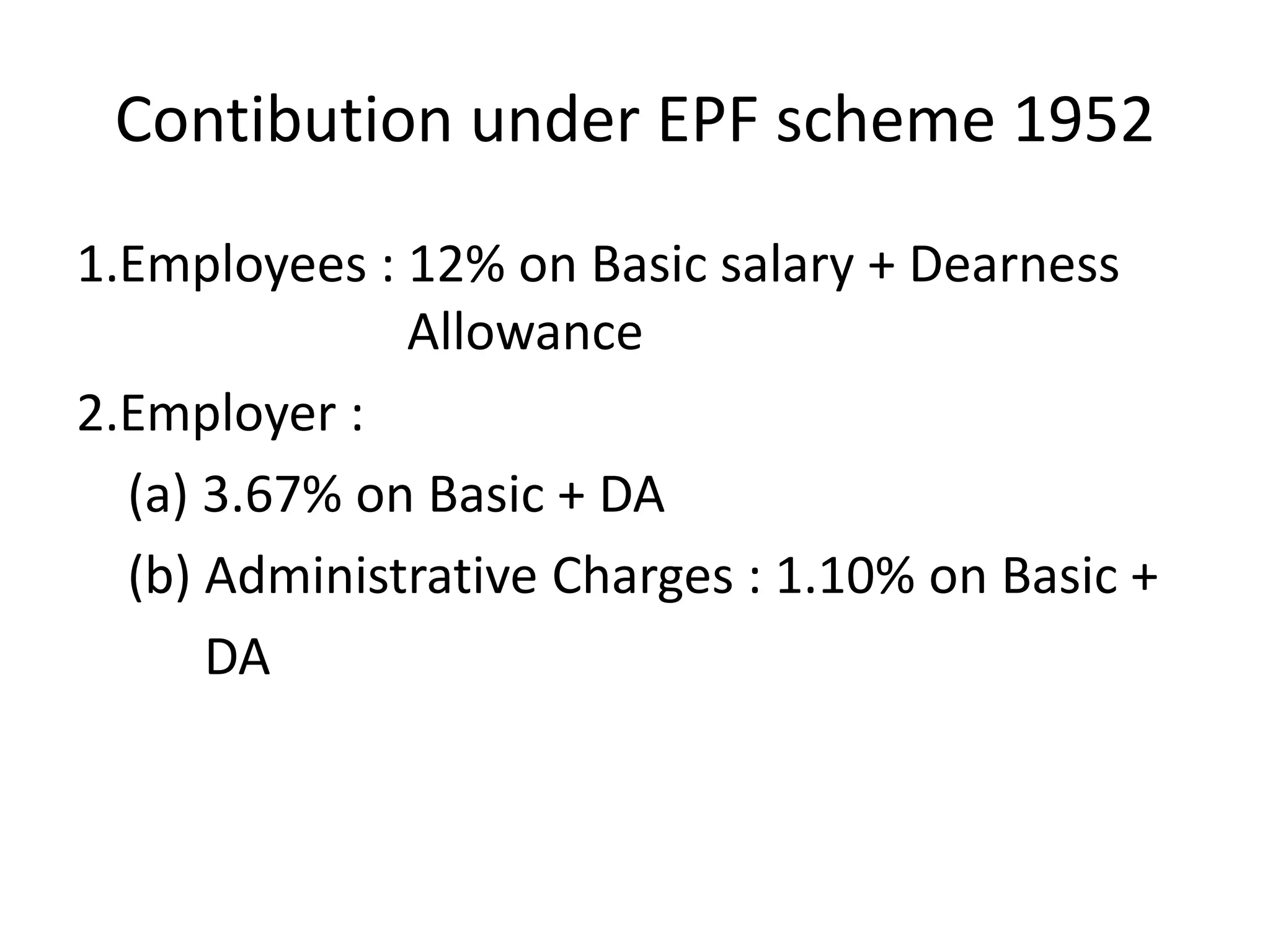
Contibution under EPF scheme 1952
1.Employees : 12% on Basic salary + Dearness
Allowance
2.Employer :
(a) 3.67% on Basic + DA
(b) Administrative Charges : 1.10% on Basic +
DA
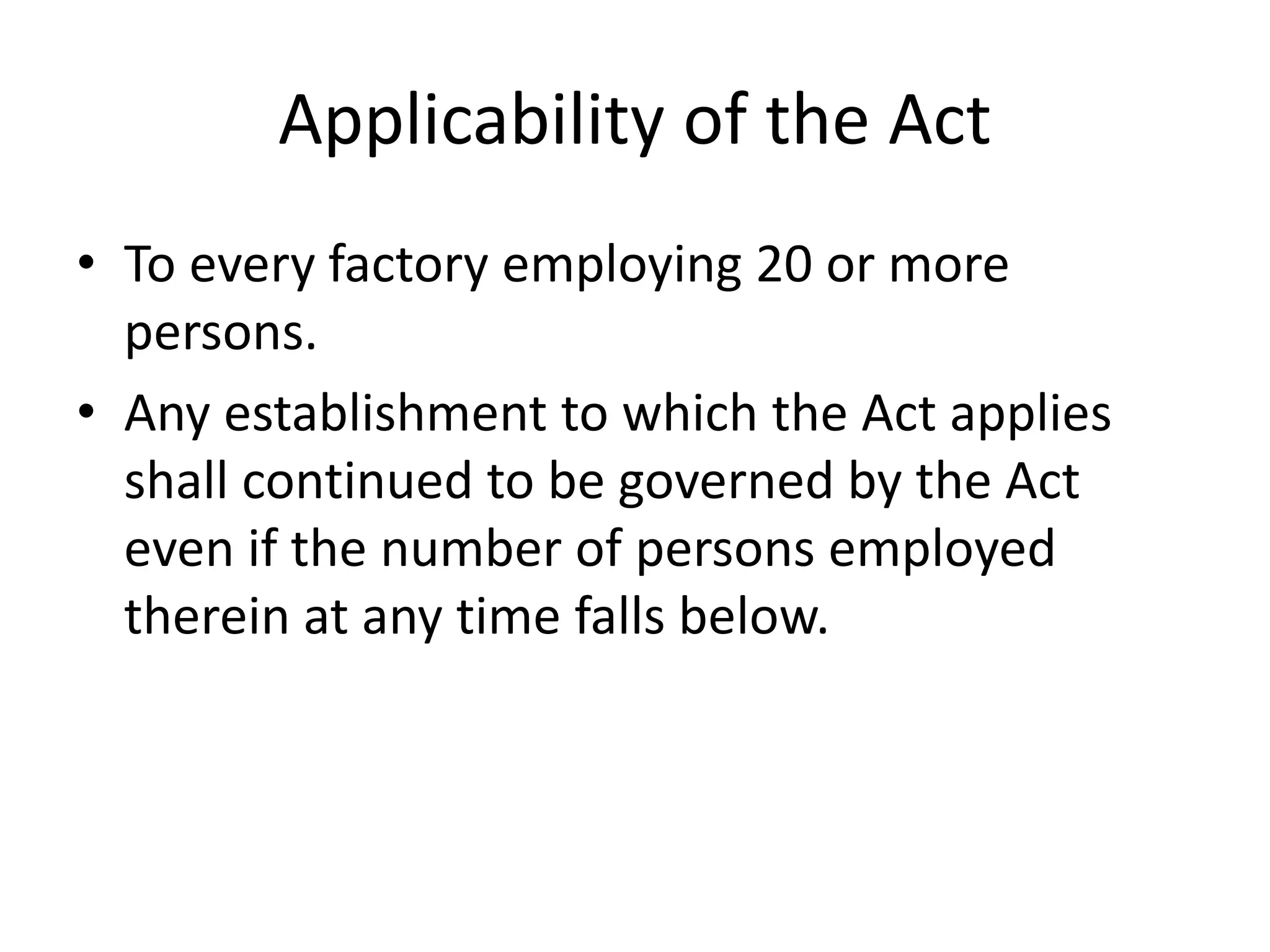
Applicability of the Act
• To every factory employing 20 or more
persons.
• Any establishment to which the Act applies
shall continued to be governed by the Act
even if the number of persons employed
therein at any time falls below.
WITHDRAWAL
COMPLETE WITHDRAWL
•Migrate from India to abroad for permanent settlement
•Retrenched
•Completes 15 years of members
•Suffering from any severe disease
PARTIAL WITHDRAWAL
•Construction of house
•Illness
•Marriage
•Higher education of children
•Payment of life insurance premium
•Purchase of share
Employees' Provident Fund Organisation (EPFO)
EPFO is one of the largest provident fund institutions in the world in terms of
members and volume of financial transactions that it has been carrying on. It
is an autonomous tripartite body under the control of Ministry of Labour with
its head office in New Delhi. It aims to extend the reach and quality of publicly
managed old-age income security programs through its consistent efforts and
ever-improving standards of compliance and benefit delivery system to its
members. This way it seeks to contribute to the economic and social well-
being of the country.
The Act aims to provide for institution of provident funds, family pension
funds and deposit linked insurance funds for the employees in the factories
and other establishments. Accordingly, three schemes are in operation under
the Act. These schemes taken together provide to the employees an old age
and survivorship benefits, a long term protection and security to the
employee and after his death to his family members, and timely advances
including advances during sickness and for the purchase/ construction of a
dwelling house during the period of membership. These three schemes are as
follows:-
Employees' Provident Fund Scheme, 1952
Employees' Deposit Linked Insurance Scheme, 1976
Employees' Pension Scheme, 1995 (replacing the Employees' Family Pension
Scheme, 1971)
Authorities for hearing and deciding
claims and complaints
• The appropriate government may,by
notification, appoint such officers, not below
the rank of a Labour Officer, as it thinks fit to
be the authorities for the purpose of hearing
and deciding claims and complaints.
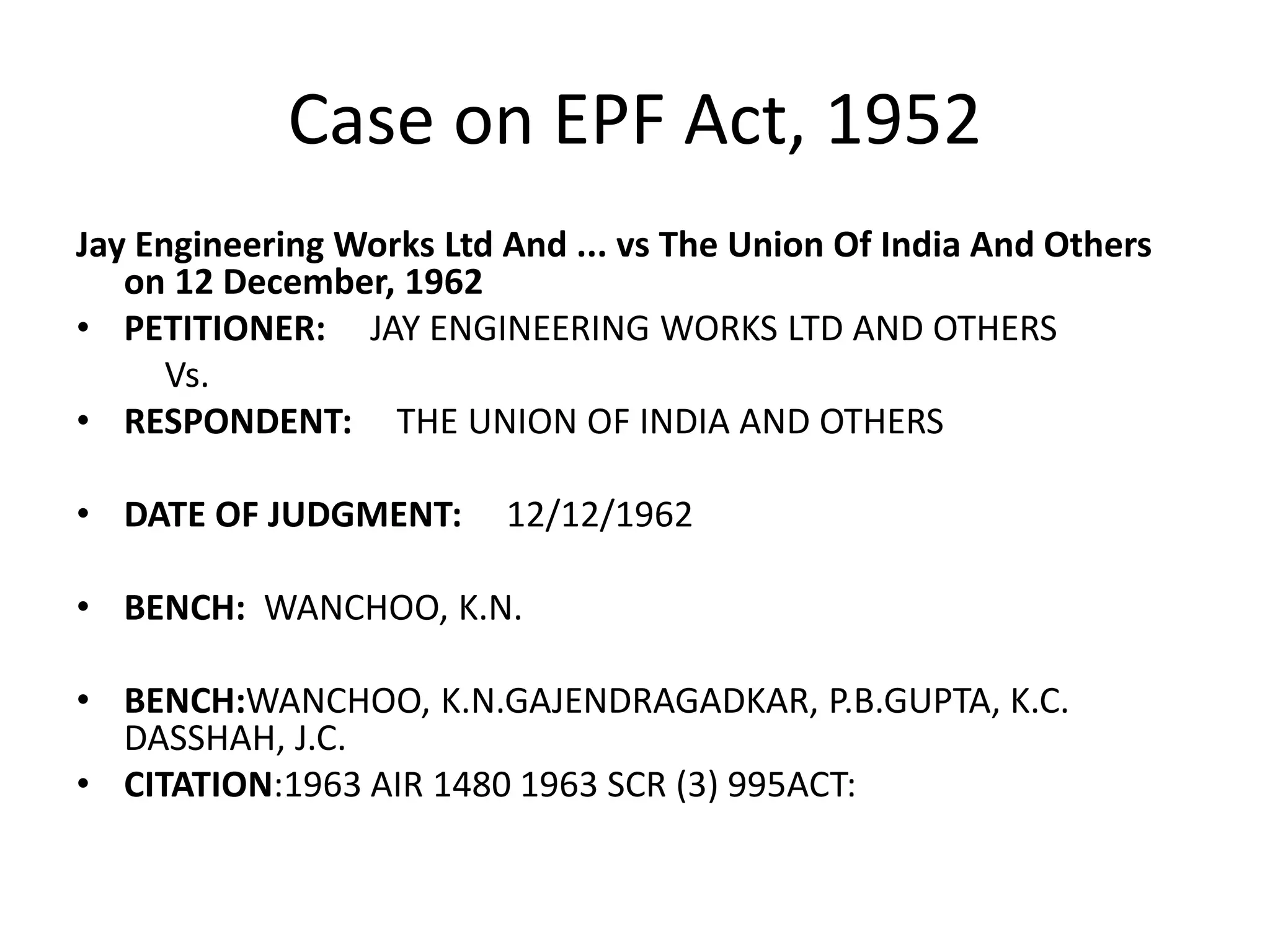
Case on EPF Act, 1952
Jay Engineering Works Ltd And ... vs The Union Of India And Others
on 12 December, 1962
• PETITIONER: JAY ENGINEERING WORKS LTD AND OTHERS
Vs.
• RESPONDENT: THE UNION OF INDIA AND OTHERS
• DATE OF JUDGMENT: 12/12/1962
• BENCH: WANCHOO, K.N.
• BENCH:WANCHOO, K.N.GAJENDRAGADKAR, P.B.GUPTA, K.C.
DASSHAH, J.C.
• CITATION:1963 AIR 1480 1963 SCR (3) 995ACT:
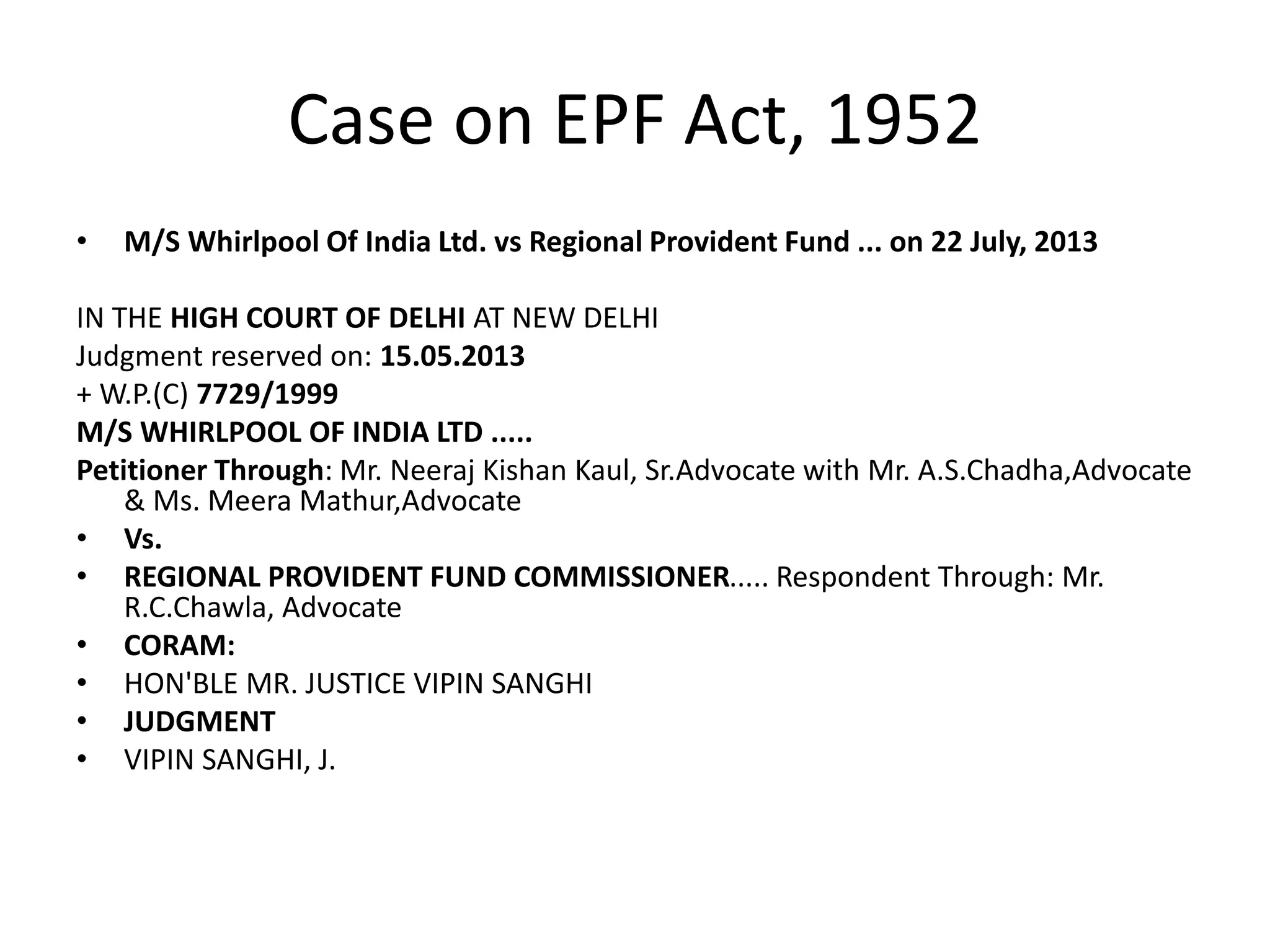
Case on EPF Act, 1952
• M/S Whirlpool Of India Ltd. vs Regional Provident Fund ... on 22 July, 2013
IN THE HIGH COURT OF DELHI AT NEW DELHI
Judgment reserved on: 15.05.2013
+ W.P.(C) 7729/1999
M/S WHIRLPOOL OF INDIA LTD .....
Petitioner Through: Mr. Neeraj Kishan Kaul, Sr.Advocate with Mr. A.S.Chadha,Advocate
& Ms. Meera Mathur,Advocate
• Vs.
• REGIONAL PROVIDENT FUND COMMISSIONER..... Respondent Through: Mr.
R.C.Chawla, Advocate
• CORAM:
• HON'BLE MR. JUSTICE VIPIN SANGHI
• JUDGMENT
• VIPIN SANGHI, J.
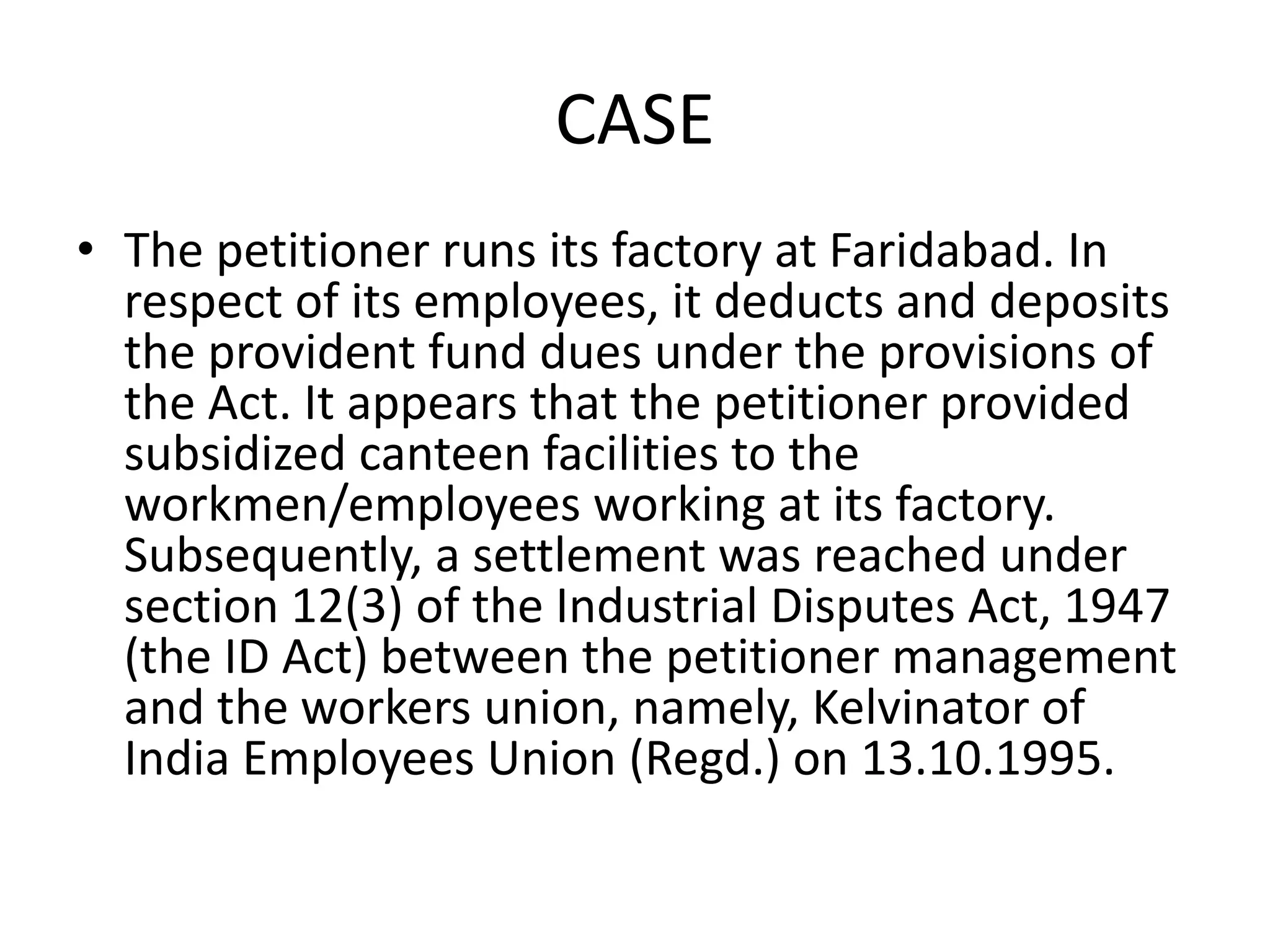
CASE
• The petitioner runs its factory at Faridabad. In
respect of its employees, it deducts and deposits
the provident fund dues under the provisions of
the Act. It appears that the petitioner provided
subsidized canteen facilities to the
workmen/employees working at its factory.
Subsequently, a settlement was reached under
section 12(3) of the Industrial Disputes Act, 1947
(the ID Act) between the petitioner management
and the workers union, namely, Kelvinator of
India Employees Union (Regd.) on 13.10.1995.
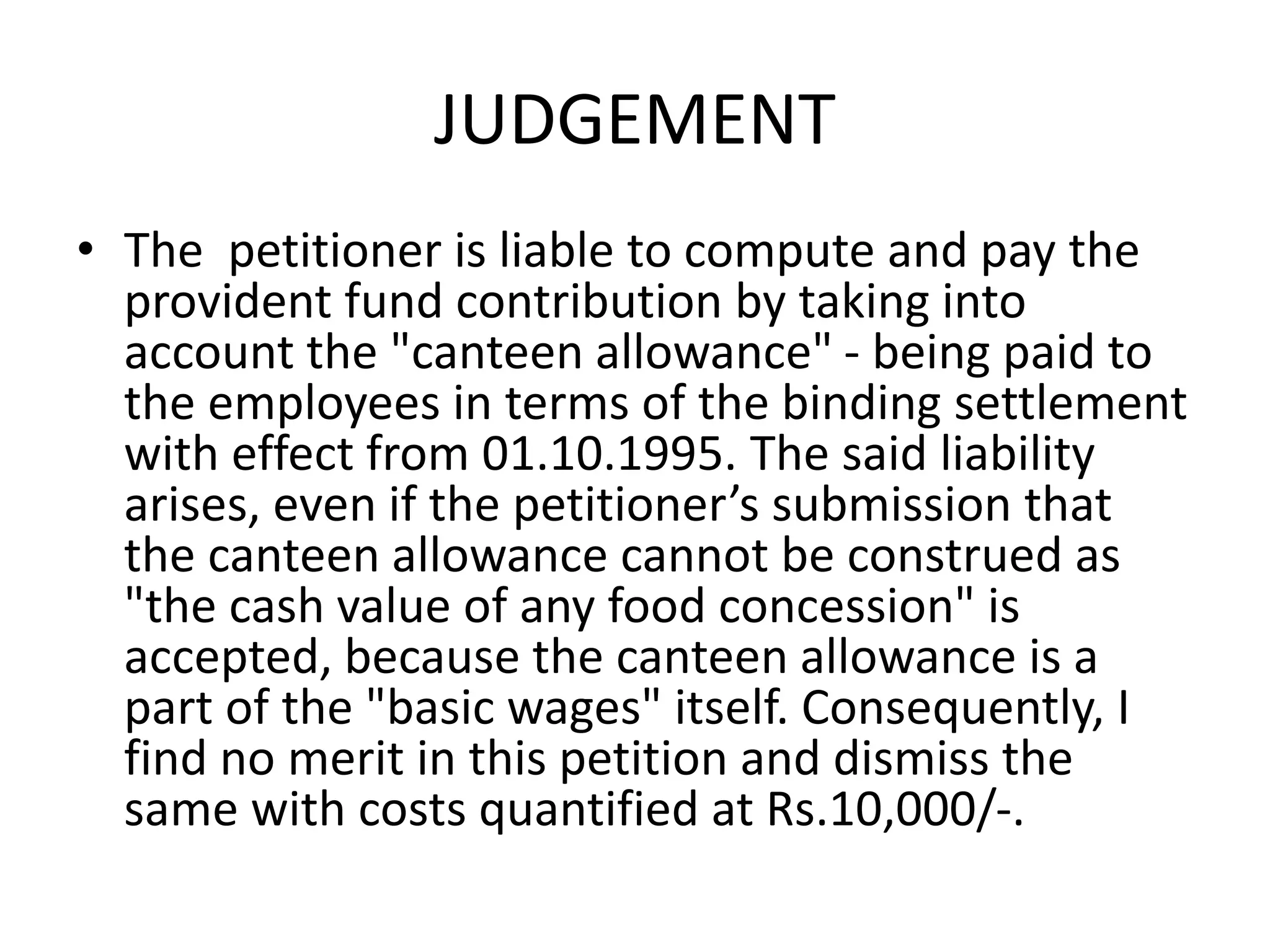
JUDGEMENT
• The petitioner is liable to compute and pay the
provident fund contribution by taking into
account the "canteen allowance" - being paid to
the employees in terms of the binding settlement
with effect from 01.10.1995. The said liability
arises, even if the petitioner’s submission that
the canteen allowance cannot be construed as
"the cash value of any food concession" is
accepted, because the canteen allowance is a
part of the "basic wages" itself. Consequently, I
find no merit in this petition and dismiss the
same with costs quantified at Rs.10,000/-.
Provident Fund Act

Provident Fund Act

  • 1.
  • 2.
    HISTORY The Employees’ ProvidentFunds Ordinance, 1951 was promulgated by the President of India under the constitution in November, 1951. A scheme under the Act was framed by the Central Government in September1951. In exercise of the powers conferred by Section 6-A of the Employees Provident Fund Act,1952, the Central Government has made Employees Family Pension Scheme in 1972. It may be further observed that in exercise of powers conferred by Section 6-C of the Employees Provident Fund Act,1952, the Central Government has made Employees Deposit –linked Insurance Scheme.
  • 3.
    Employees' Provident Funds& 1952(EPFAct). The Act was enacted with the main objective of making some provisions for the future of industrial workers after their retirement and for their dependents in case of death. It provides insurance to workers and their dependents against risks of old age, retirement, discharge, retrenchment or death of the workers. It is applicable to every establishment which is engaged in any one or more of the industries specified in Schedule I of the Act or any activity notified by Central Government in the Official Gazette and employing 20 or more persons.
  • 4.
    Contibution under EPFscheme 1952 1.Employees : 12% on Basic salary + Dearness Allowance 2.Employer : (a) 3.67% on Basic + DA (b) Administrative Charges : 1.10% on Basic + DA
  • 5.
    Applicability of theAct • To every factory employing 20 or more persons. • Any establishment to which the Act applies shall continued to be governed by the Act even if the number of persons employed therein at any time falls below.
  • 6.
    WITHDRAWAL COMPLETE WITHDRAWL •Migrate fromIndia to abroad for permanent settlement •Retrenched •Completes 15 years of members •Suffering from any severe disease PARTIAL WITHDRAWAL •Construction of house •Illness •Marriage •Higher education of children •Payment of life insurance premium •Purchase of share
  • 7.
    Employees' Provident FundOrganisation (EPFO) EPFO is one of the largest provident fund institutions in the world in terms of members and volume of financial transactions that it has been carrying on. It is an autonomous tripartite body under the control of Ministry of Labour with its head office in New Delhi. It aims to extend the reach and quality of publicly managed old-age income security programs through its consistent efforts and ever-improving standards of compliance and benefit delivery system to its members. This way it seeks to contribute to the economic and social well- being of the country.
  • 8.
    The Act aimsto provide for institution of provident funds, family pension funds and deposit linked insurance funds for the employees in the factories and other establishments. Accordingly, three schemes are in operation under the Act. These schemes taken together provide to the employees an old age and survivorship benefits, a long term protection and security to the employee and after his death to his family members, and timely advances including advances during sickness and for the purchase/ construction of a dwelling house during the period of membership. These three schemes are as follows:- Employees' Provident Fund Scheme, 1952 Employees' Deposit Linked Insurance Scheme, 1976 Employees' Pension Scheme, 1995 (replacing the Employees' Family Pension Scheme, 1971)
  • 9.
    Authorities for hearingand deciding claims and complaints • The appropriate government may,by notification, appoint such officers, not below the rank of a Labour Officer, as it thinks fit to be the authorities for the purpose of hearing and deciding claims and complaints.
  • 10.
    Case on EPFAct, 1952 Jay Engineering Works Ltd And ... vs The Union Of India And Others on 12 December, 1962 • PETITIONER: JAY ENGINEERING WORKS LTD AND OTHERS Vs. • RESPONDENT: THE UNION OF INDIA AND OTHERS • DATE OF JUDGMENT: 12/12/1962 • BENCH: WANCHOO, K.N. • BENCH:WANCHOO, K.N.GAJENDRAGADKAR, P.B.GUPTA, K.C. DASSHAH, J.C. • CITATION:1963 AIR 1480 1963 SCR (3) 995ACT:
  • 11.
    Case on EPFAct, 1952 • M/S Whirlpool Of India Ltd. vs Regional Provident Fund ... on 22 July, 2013 IN THE HIGH COURT OF DELHI AT NEW DELHI Judgment reserved on: 15.05.2013 + W.P.(C) 7729/1999 M/S WHIRLPOOL OF INDIA LTD ..... Petitioner Through: Mr. Neeraj Kishan Kaul, Sr.Advocate with Mr. A.S.Chadha,Advocate & Ms. Meera Mathur,Advocate • Vs. • REGIONAL PROVIDENT FUND COMMISSIONER..... Respondent Through: Mr. R.C.Chawla, Advocate • CORAM: • HON'BLE MR. JUSTICE VIPIN SANGHI • JUDGMENT • VIPIN SANGHI, J.
  • 12.
    CASE • The petitionerruns its factory at Faridabad. In respect of its employees, it deducts and deposits the provident fund dues under the provisions of the Act. It appears that the petitioner provided subsidized canteen facilities to the workmen/employees working at its factory. Subsequently, a settlement was reached under section 12(3) of the Industrial Disputes Act, 1947 (the ID Act) between the petitioner management and the workers union, namely, Kelvinator of India Employees Union (Regd.) on 13.10.1995.
  • 13.
    JUDGEMENT • The petitioneris liable to compute and pay the provident fund contribution by taking into account the "canteen allowance" - being paid to the employees in terms of the binding settlement with effect from 01.10.1995. The said liability arises, even if the petitioner’s submission that the canteen allowance cannot be construed as "the cash value of any food concession" is accepted, because the canteen allowance is a part of the "basic wages" itself. Consequently, I find no merit in this petition and dismiss the same with costs quantified at Rs.10,000/-.

Editor's Notes

  • #14 http://indiankanoon.org/doc/91103343/