Prototype & Test Phases
In Designing Solutions
Introduction
Let's delve into the pivotal stages of creating and validating solutions within the
development lifecycle.
Importance of Prototype and Test phases in solution design:
These phases play a crucial role in ensuring that the final product meets user needs and
functions effectively.
Objectives of both phases:
The Prototype Phase focuses on creating tangible representations, while the Test Phase aims
to validate the effectiveness and functionality of the prototype.
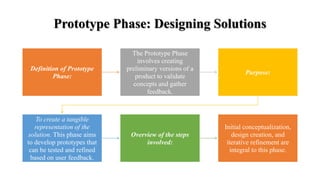
Prototype Phase: Designing Solutions
Definition of Prototype
Phase:
The Prototype Phase
involves creating
preliminary versions of a
product to validate
concepts and gather
feedback.
Purpose:
To create a tangible
representation of the
solution. This phase aims
to develop prototypes that
can be tested and refined
based on user feedback.
Overview of the steps
involved:
Initial conceptualization,
design creation, and
iterative refinement are
integral to this phase.
Overview of Prototype Phase
• Key objectives:
Iterative development, design validation, feedback incorporation.
The Prototype Phase focuses on refining ideas, validating designs, and
integrating stakeholder feedback.
• Importance of prototyping:
Minimizing risks, refining concepts, gaining stakeholder feedback.
Prototyping minimizes the risk of investing in an unsuitable solution and
allows for early validation of design concepts.
Methods within Prototype Phase
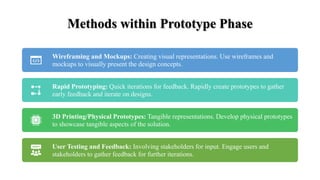
Wireframing and Mockups: Creating visual representations. Use wireframes and
mockups to visually present the design concepts.
Rapid Prototyping: Quick iterations for feedback. Rapidly create prototypes to gather
early feedback and iterate on designs.
3D Printing/Physical Prototypes: Tangible representations. Develop physical prototypes
to showcase tangible aspects of the solution.
User Testing and Feedback: Involving stakeholders for input. Engage users and
stakeholders to gather feedback for further iterations.
Test Phase: Validating Solutions
Definition of Test Phase:
The Test Phase involves evaluating the prototype's functionality, usability, and effectiveness.
Purpose:
To validate the effectiveness and functionality of the prototype. This phase aims to ensure that
the prototype functions as intended and meets user needs.
Overview of the steps involved:
Usability testing, functionality assessment, and error identification are central to this phase.
Overview of Test Phase
Key objectives:
Ensuring functionality, assessing usability, identifying flaws.
The Test Phase focuses on ensuring the prototype's functionality, assessing its usability, and
identifying potential flaws.
Importance of testing:
Ensuring user satisfaction, minimizing errors, refining the solution.
Testing ensures that the final solution meets user expectations and minimizes errors before
deployment.
Methods within Test Phase
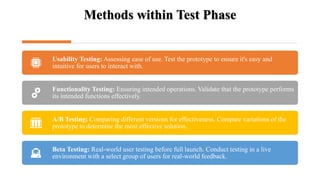
Usability Testing: Assessing ease of use. Test the prototype to ensure it's easy and
intuitive for users to interact with.
Functionality Testing: Ensuring intended operations. Validate that the prototype performs
its intended functions effectively.
A/B Testing: Comparing different versions for effectiveness. Compare variations of the
prototype to determine the most effective solution.
Beta Testing: Real-world user testing before full launch. Conduct testing in a live
environment with a select group of users for real-world feedback.
Comparison: Prototype vs. Test Phase
Side-by-side comparison of
objectives, methods, and
outcomes of both phases:
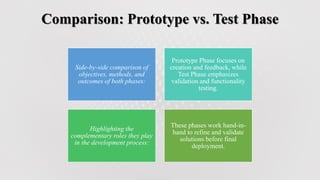
Prototype Phase focuses on
creation and feedback, while
Test Phase emphasizes
validation and functionality
testing.
Highlighting the
complementary roles they play
in the development process:
These phases work hand-in-
hand to refine and validate
solutions before final
deployment.
Conclusion
Recap of the Prototype
and Test phases:
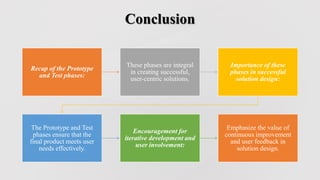
These phases are integral
in creating successful,
user-centric solutions.
Importance of these
phases in successful
solution design:
The Prototype and Test
phases ensure that the
final product meets user
needs effectively.
Encouragement for
iterative development and
user involvement:
Emphasize the value of
continuous improvement
and user feedback in
solution design.

Prototype & Testing.pptx

  • 1.
    Prototype & TestPhases In Designing Solutions
  • 2.
    Introduction Let's delve intothe pivotal stages of creating and validating solutions within the development lifecycle. Importance of Prototype and Test phases in solution design: These phases play a crucial role in ensuring that the final product meets user needs and functions effectively. Objectives of both phases: The Prototype Phase focuses on creating tangible representations, while the Test Phase aims to validate the effectiveness and functionality of the prototype.
  • 3.
    Prototype Phase: DesigningSolutions Definition of Prototype Phase: The Prototype Phase involves creating preliminary versions of a product to validate concepts and gather feedback. Purpose: To create a tangible representation of the solution. This phase aims to develop prototypes that can be tested and refined based on user feedback. Overview of the steps involved: Initial conceptualization, design creation, and iterative refinement are integral to this phase.
  • 4.
    Overview of PrototypePhase • Key objectives: Iterative development, design validation, feedback incorporation. The Prototype Phase focuses on refining ideas, validating designs, and integrating stakeholder feedback. • Importance of prototyping: Minimizing risks, refining concepts, gaining stakeholder feedback. Prototyping minimizes the risk of investing in an unsuitable solution and allows for early validation of design concepts.
  • 5.
    Methods within PrototypePhase Wireframing and Mockups: Creating visual representations. Use wireframes and mockups to visually present the design concepts. Rapid Prototyping: Quick iterations for feedback. Rapidly create prototypes to gather early feedback and iterate on designs. 3D Printing/Physical Prototypes: Tangible representations. Develop physical prototypes to showcase tangible aspects of the solution. User Testing and Feedback: Involving stakeholders for input. Engage users and stakeholders to gather feedback for further iterations.
  • 6.
    Test Phase: ValidatingSolutions Definition of Test Phase: The Test Phase involves evaluating the prototype's functionality, usability, and effectiveness. Purpose: To validate the effectiveness and functionality of the prototype. This phase aims to ensure that the prototype functions as intended and meets user needs. Overview of the steps involved: Usability testing, functionality assessment, and error identification are central to this phase.
  • 7.
    Overview of TestPhase Key objectives: Ensuring functionality, assessing usability, identifying flaws. The Test Phase focuses on ensuring the prototype's functionality, assessing its usability, and identifying potential flaws. Importance of testing: Ensuring user satisfaction, minimizing errors, refining the solution. Testing ensures that the final solution meets user expectations and minimizes errors before deployment.
  • 8.
    Methods within TestPhase Usability Testing: Assessing ease of use. Test the prototype to ensure it's easy and intuitive for users to interact with. Functionality Testing: Ensuring intended operations. Validate that the prototype performs its intended functions effectively. A/B Testing: Comparing different versions for effectiveness. Compare variations of the prototype to determine the most effective solution. Beta Testing: Real-world user testing before full launch. Conduct testing in a live environment with a select group of users for real-world feedback.
  • 9.
    Comparison: Prototype vs.Test Phase Side-by-side comparison of objectives, methods, and outcomes of both phases: Prototype Phase focuses on creation and feedback, while Test Phase emphasizes validation and functionality testing. Highlighting the complementary roles they play in the development process: These phases work hand-in- hand to refine and validate solutions before final deployment.
  • 10.
    Conclusion Recap of thePrototype and Test phases: These phases are integral in creating successful, user-centric solutions. Importance of these phases in successful solution design: The Prototype and Test phases ensure that the final product meets user needs effectively. Encouragement for iterative development and user involvement: Emphasize the value of continuous improvement and user feedback in solution design.