Presentation 4


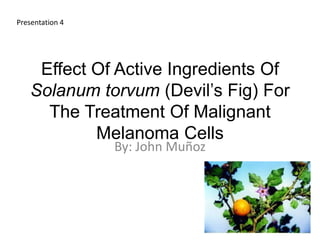
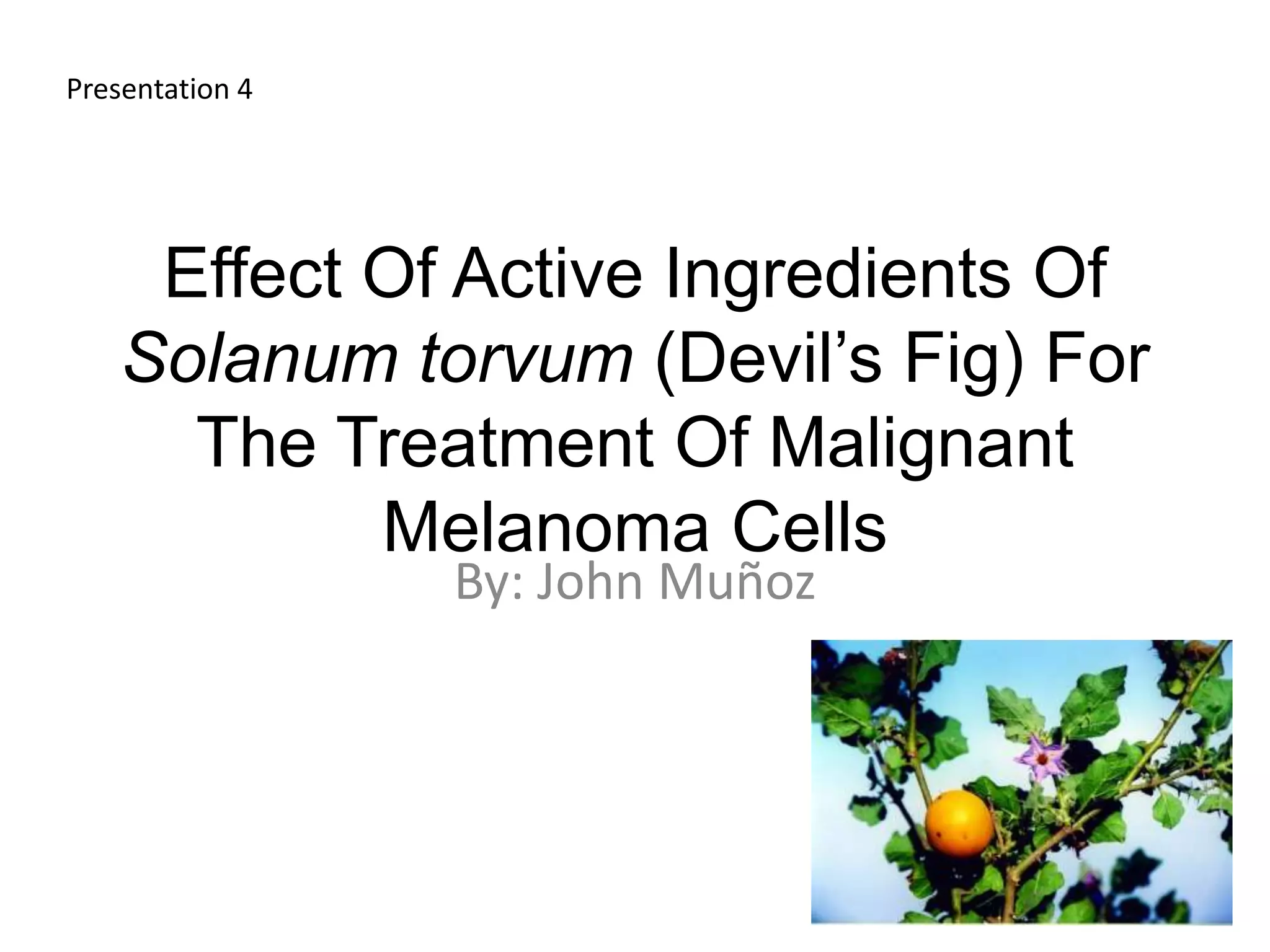
     Effect Of Active Ingredients Of
    Solanum torvum (Devil’s Fig) For
      The Treatment Of Malignant
            Melanoma Cells
                 By: John Muñoz
What is Solanum torvum?
• A plant with a height of two to three meters
  with a base of five centimeters.
• A shrub usually found in the tropics. Highly
  toxic and destructive weed when mature.
  On the other hand, the immature fruit is
  used for consumption in different
  countries.
• Other uses of the plant are for treatment of
  diabetes and diverse skin diseases.
What is epithelial cancer?
• Epithelial cancer is a dangerous disease if
  not detected in time, and treated, could
  possibly lead to death. There are three types
  of skin cancers:
  – Basal carcinoma cancer: which starts in the base
    cells of the epidermis and moves down.
  – Squamous cell carcinoma: affecting the
    squamous cells (top cells of the epidermis).
  – Malignant melanoma: is the third type of epithelial
    cancer and the most dangerous since it can
    spread through the body of the individual, usually
    taking root in overgrown moles.
Problem
• Is there an Active ingredient in the extract
  of Solanum torvum for the treatment of
  Malignant melanoma cancer cells?
Hypothesis
• The diverse active ingredients in the plant
  extract of the Solanum torvum, lead for the
  future treatment of Malignant melanoma
  without exposing the patient to severe side
  effects.
Methodology
• The chemical base of the Solanum torvum will be revised for
  the possible active ingredients of the plant.
• The extract will be made of all components of the specimen:
  leaves, roots, and fruit (immature and ripe).
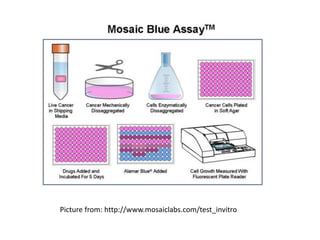
• Using the extracts I will observe quantitatively, in vitro, the
  effect of them in the cancer cells’ growth. Using the method of
  Mosaic Blue Assay.
• My control group will be a group of Malignant melanoma cells
  growing without the addition of the extracts.
• The experimental group will be Malignant melanoma cells
  growing in the Mosaic Blue Assay treated with the extracts of
  each extract.
• Analyze the results in the growth of the cells
Analyze the results
• I will be checking the growth of the cells with
  a florescent plate reader that activates with
  the dye used in the Mosaic Blue Array.
• Then I will compare the different components
  of the plant. Which extract worked best and
  why and the active ingredient of the extract.
Picture from: http://www.mosaiclabs.com/test_invitro
Reference
Mosaic Laboratories [internet]. [2010] Lake Forest (CA):
Mosaic Laboratories; [cited 2012 July 5] Available in:
http://www.mosaiclabs.com/pics/tests/blue-array.jpg

Philippines medicinal plants [internet]. [2012]
Philippines medicinal plants; [cited 2012 July 5] Available in:
http://www.stuartxchange.com/TandangAso.html

American Cancer Society [internet]. [2012]
American Cancer Society [cited 2012 July 6] Available in:
http://www.cancer.org/Cancer/CancerCauses/SunandUVExposure/skin-cancer-facts

MedicineNet.com [internet]. [N/A]
MedicineNet.com [cited 2012 July 6] Available in:
http://www.medicinenet.com/melanoma/article.htm

United States Department of Agriculture [internet]. [N/A]
United Stated Department of Agriculture [cited 2012 July 7] Available in:
http://plants.usda.gov/java/profile?symbol=SOTO4
QUESTIONS?

Proposal number 4

  • 1.
    Presentation 4 Effect Of Active Ingredients Of Solanum torvum (Devil’s Fig) For The Treatment Of Malignant Melanoma Cells By: John Muñoz
  • 2.
    What is Solanumtorvum? • A plant with a height of two to three meters with a base of five centimeters. • A shrub usually found in the tropics. Highly toxic and destructive weed when mature. On the other hand, the immature fruit is used for consumption in different countries. • Other uses of the plant are for treatment of diabetes and diverse skin diseases.
  • 3.
    What is epithelialcancer? • Epithelial cancer is a dangerous disease if not detected in time, and treated, could possibly lead to death. There are three types of skin cancers: – Basal carcinoma cancer: which starts in the base cells of the epidermis and moves down. – Squamous cell carcinoma: affecting the squamous cells (top cells of the epidermis). – Malignant melanoma: is the third type of epithelial cancer and the most dangerous since it can spread through the body of the individual, usually taking root in overgrown moles.
  • 4.
    Problem • Is therean Active ingredient in the extract of Solanum torvum for the treatment of Malignant melanoma cancer cells?
  • 5.
    Hypothesis • The diverseactive ingredients in the plant extract of the Solanum torvum, lead for the future treatment of Malignant melanoma without exposing the patient to severe side effects.
  • 6.
    Methodology • The chemicalbase of the Solanum torvum will be revised for the possible active ingredients of the plant. • The extract will be made of all components of the specimen: leaves, roots, and fruit (immature and ripe). • Using the extracts I will observe quantitatively, in vitro, the effect of them in the cancer cells’ growth. Using the method of Mosaic Blue Assay. • My control group will be a group of Malignant melanoma cells growing without the addition of the extracts. • The experimental group will be Malignant melanoma cells growing in the Mosaic Blue Assay treated with the extracts of each extract. • Analyze the results in the growth of the cells
  • 7.
    Analyze the results •I will be checking the growth of the cells with a florescent plate reader that activates with the dye used in the Mosaic Blue Array. • Then I will compare the different components of the plant. Which extract worked best and why and the active ingredient of the extract.
  • 8.
  • 9.
    Reference Mosaic Laboratories [internet].[2010] Lake Forest (CA): Mosaic Laboratories; [cited 2012 July 5] Available in: http://www.mosaiclabs.com/pics/tests/blue-array.jpg Philippines medicinal plants [internet]. [2012] Philippines medicinal plants; [cited 2012 July 5] Available in: http://www.stuartxchange.com/TandangAso.html American Cancer Society [internet]. [2012] American Cancer Society [cited 2012 July 6] Available in: http://www.cancer.org/Cancer/CancerCauses/SunandUVExposure/skin-cancer-facts MedicineNet.com [internet]. [N/A] MedicineNet.com [cited 2012 July 6] Available in: http://www.medicinenet.com/melanoma/article.htm United States Department of Agriculture [internet]. [N/A] United Stated Department of Agriculture [cited 2012 July 7] Available in: http://plants.usda.gov/java/profile?symbol=SOTO4
  • 10.