o Ultra-short acting non-barbiturate injectable anesthetic with a wide margin of
safety given IV for INDUCTION and short-term MAINTENANCE of GA in small
animals, small ruminants, exotic mammals and neonates of domestic species.
NON-BARBITUARTES INJECTABLE ANESTHETICS
ALKYL PHENOLS
(PROPOFOL)
Dr Warson Monsang
o it is administered as an IV-BOLUS followed by a CRI (continuous rate infusion) to treat
STATUS EPILEPTICUS in dogs and cats that do not respond to DIAZEPAM and
PHENOBARBITAL.
o propofol should be given IV-slowly over a period of 1-2 mins, until the desired
anesthetic level is reached. IM-injection may cause mild sedation and ataxia but does not
induce anesthesia because the drug is metabolized very rapidly.
(Do not give propofol too slowly, as this can cause paradoxic excitement, making the
patient difficult to handle).
o propofol is highly protein bound, and therefore should be used with caution in patients
with significant ‘HYPOPROTEINEMIA’ .
o Propofol does not affect HEPATIC and RENAL functions
o It can be used for long term sedation and anaesthesia in intensive care patients, as it
does not alter adrenocortical function.
o It reduces the intraocular pressure (IOP) hence can be used in patients undergoing
intraocular procedures (EYE SURGERY).
o Propofol is a good induction agent for CAESARIAN SECTION in dogs and cats. It
reported that the puppies were bright and the mother was alert enough to care the
puppies immediately following recovery.
o It is a safe anesthetic in BRACHYCEPHALIC breeds of dogs.
MODE of action & Pharmacology –
-PROPOFOL has a chemical structure unlike that of other injectable and
preanesthetic agents.
- it is minimally water soluble and is available in an egg-lecithin, glycerin, and
soyabean oil acqueous emulsion at a concentration of 10 mg/ml. Although it has
a MILKY APPEARANCE, it is the sole EXCEPTION to the general rule that milky
liquids should never be given Intravenously (IV).
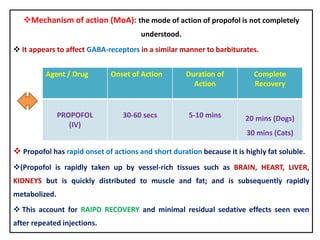
Mechanism of action (MoA): the mode of action of propofol is not completely
understood.
 It appears to affect GABA-receptors in a similar manner to barbiturates.
 Propofol has rapid onset of actions and short duration because it is highly fat soluble.
(Propofol is rapidly taken up by vessel-rich tissues such as BRAIN, HEART, LIVER,
KIDNEYS but is quickly distributed to muscle and fat; and is subsequently rapidly
metabolized.
 This account for RAIPD RECOVERY and minimal residual sedative effects seen even
after repeated injections.
Agent / Drug Onset of Action Duration of
Action
Complete
Recovery
PROPOFOL
(IV)
30-60 secs 5-10 mins 20 mins (Dogs)
30 mins (Cats)
EFFECTS OF PROPOFOL ON MAJOR ORGAN SYSTEMS
1. CENTRAL NERVOUS SYTEM (CNS):
- dose-dependent CNS depression (ranging from sedation and to
unconsciousness)
NOTE: propofol is not an ANALGESIC.
2. CARDIOVASCULAR SYTEM (CVS):
– causes CARDIAC DEPRESSION (produces bradycardia, decreased cardiac output,
decreased cardiac resistance and transient hypotension).
3. RESPIRATORY SYSTEM:
- propofol is a potent RESPIRATORY DEPRESSANT
 High doses or rapid injection may cause significant respiratory depression, including
APNEA.
To lessen this effect, the initial dose or bolus should be given gradually over 1-2
mins, monitor the respiratory rate and depth carefully within first few mins after
injection.
OTHER EFFECTS OF BARBITURATES:
1. MUSCLE TWITCHING: some dogs exhibit muscle twitching during induction.
2. Propofol produces GOOD MUSCLE RELAXATION.
3. LIVER and KIDNEY – because metabolism of propofol is rapid, it is relatively safe
and effective in animals with liver and kidney diseases.
4. Appetite stimulant – propofol is an appetite stimulant at low dose.
5. ANTI-EMETIC PROPERTIES
6. Propofol decreases the intra-cranial (ICP) and intra-ocular pressures (IOP).
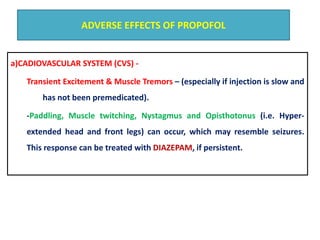
ADVERSE EFFECTS OF PROPOFOL
a)CADIOVASCULAR SYSTEM (CVS) -
Transient Excitement & Muscle Tremors – (especially if injection is slow and
has not been premedicated).
-Paddling, Muscle twitching, Nystagmus and Opisthotonus (i.e. Hyper-
extended head and front legs) can occur, which may resemble seizures.
This response can be treated with DIAZEPAM, if persistent.
b) RESPIRATORY SYSTEM (RS) -
APNEA – (particularly after rapid injection or high doses administration).
- If APNEA persists for more than 1-2 mins after administration, or if PULSE OXIMETRY
shows oxygen saturation to be less than 95%, the patient should be intubated and
ventilated.
b) CARDIOVASCULAR SYSTEM (CVS) -
HYPOTENSION – (short duration in animals with normal cardiovascular function; but in
some patients may be significant or prolonged).
NOTE: Therefore, Propofol should be given cautiously to animals with pre-existing
hypotension, such as patients in SHOCK or those that have blood loss or
DEHYDRATION)
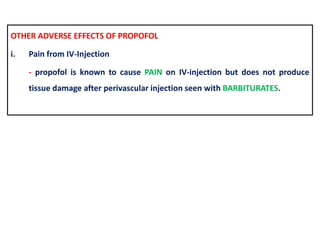
OTHER ADVERSE EFFECTS OF PROPOFOL
i. Pain from IV-Injection
- propofol is known to cause PAIN on IV-injection but does not produce
tissue damage after perivascular injection seen with BARBITURATES.
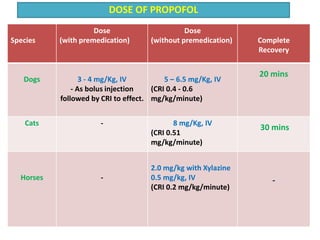
DOSE OF PROPOFOL
Species
Dose
(with premedication)
Dose
(without premedication) Complete
Recovery
Dogs 3 - 4 mg/Kg, IV
- As bolus injection
followed by CRI to effect.
5 – 6.5 mg/Kg, IV
(CRI 0.4 - 0.6
mg/kg/minute)
20 mins
Cats - 8 mg/Kg, IV
(CRI 0.51
mg/kg/minute)
30 mins
Horses -
2.0 mg/kg with Xylazine
0.5 mg/kg, IV
(CRI 0.2 mg/kg/minute)
-
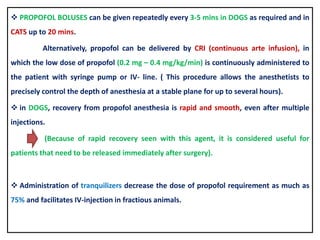
 PROPOFOL BOLUSES can be given repeatedly every 3-5 mins in DOGS as required and in
CATS up to 20 mins.
Alternatively, propofol can be delivered by CRI (continuous arte infusion), in
which the low dose of propofol (0.2 mg – 0.4 mg/kg/min) is continuously administered to
the patient with syringe pump or IV- line. ( This procedure allows the anesthetists to
precisely control the depth of anesthesia at a stable plane for up to several hours).
 in DOGS, recovery from propofol anesthesia is rapid and smooth, even after multiple
injections.
(Because of rapid recovery seen with this agent, it is considered useful for
patients that need to be released immediately after surgery).
 Administration of tranquilizers decrease the dose of propofol requirement as much as
75% and facilitates IV-injection in fractious animals.
HANDLING AND STORAGE OF PROPOFOL
-One significant DISADVANTAGE of propofol is poor storage characteristic of this agent.
Because the product contains soyabean oil, egg lecithin and glycerol, it will support
bacterial growth.
- Ampoules and bottles should be handled carefully in aseptic manner; and if possible the
unused product be discarded within 6 hours of opening to avoid contamination.
(un-opened shelf-life is approx 3 years).
- Refrigeration may be preferable to storage at room temperature.
- the cost of propofol induction in DOGS is approximately 4 times that of ketamine-
diazepam and 2 times that of thiopental.

Propofol anesthetics

  • 1.
    o Ultra-short actingnon-barbiturate injectable anesthetic with a wide margin of safety given IV for INDUCTION and short-term MAINTENANCE of GA in small animals, small ruminants, exotic mammals and neonates of domestic species. NON-BARBITUARTES INJECTABLE ANESTHETICS ALKYL PHENOLS (PROPOFOL) Dr Warson Monsang
  • 2.
    o it isadministered as an IV-BOLUS followed by a CRI (continuous rate infusion) to treat STATUS EPILEPTICUS in dogs and cats that do not respond to DIAZEPAM and PHENOBARBITAL. o propofol should be given IV-slowly over a period of 1-2 mins, until the desired anesthetic level is reached. IM-injection may cause mild sedation and ataxia but does not induce anesthesia because the drug is metabolized very rapidly. (Do not give propofol too slowly, as this can cause paradoxic excitement, making the patient difficult to handle). o propofol is highly protein bound, and therefore should be used with caution in patients with significant ‘HYPOPROTEINEMIA’ .
  • 3.
    o Propofol doesnot affect HEPATIC and RENAL functions o It can be used for long term sedation and anaesthesia in intensive care patients, as it does not alter adrenocortical function. o It reduces the intraocular pressure (IOP) hence can be used in patients undergoing intraocular procedures (EYE SURGERY). o Propofol is a good induction agent for CAESARIAN SECTION in dogs and cats. It reported that the puppies were bright and the mother was alert enough to care the puppies immediately following recovery. o It is a safe anesthetic in BRACHYCEPHALIC breeds of dogs.
  • 4.
    MODE of action& Pharmacology – -PROPOFOL has a chemical structure unlike that of other injectable and preanesthetic agents. - it is minimally water soluble and is available in an egg-lecithin, glycerin, and soyabean oil acqueous emulsion at a concentration of 10 mg/ml. Although it has a MILKY APPEARANCE, it is the sole EXCEPTION to the general rule that milky liquids should never be given Intravenously (IV).
  • 5.
    Mechanism of action(MoA): the mode of action of propofol is not completely understood.  It appears to affect GABA-receptors in a similar manner to barbiturates.  Propofol has rapid onset of actions and short duration because it is highly fat soluble. (Propofol is rapidly taken up by vessel-rich tissues such as BRAIN, HEART, LIVER, KIDNEYS but is quickly distributed to muscle and fat; and is subsequently rapidly metabolized.  This account for RAIPD RECOVERY and minimal residual sedative effects seen even after repeated injections. Agent / Drug Onset of Action Duration of Action Complete Recovery PROPOFOL (IV) 30-60 secs 5-10 mins 20 mins (Dogs) 30 mins (Cats)
  • 6.
    EFFECTS OF PROPOFOLON MAJOR ORGAN SYSTEMS 1. CENTRAL NERVOUS SYTEM (CNS): - dose-dependent CNS depression (ranging from sedation and to unconsciousness) NOTE: propofol is not an ANALGESIC.
  • 7.
    2. CARDIOVASCULAR SYTEM(CVS): – causes CARDIAC DEPRESSION (produces bradycardia, decreased cardiac output, decreased cardiac resistance and transient hypotension). 3. RESPIRATORY SYSTEM: - propofol is a potent RESPIRATORY DEPRESSANT  High doses or rapid injection may cause significant respiratory depression, including APNEA. To lessen this effect, the initial dose or bolus should be given gradually over 1-2 mins, monitor the respiratory rate and depth carefully within first few mins after injection.
  • 8.
    OTHER EFFECTS OFBARBITURATES: 1. MUSCLE TWITCHING: some dogs exhibit muscle twitching during induction. 2. Propofol produces GOOD MUSCLE RELAXATION. 3. LIVER and KIDNEY – because metabolism of propofol is rapid, it is relatively safe and effective in animals with liver and kidney diseases. 4. Appetite stimulant – propofol is an appetite stimulant at low dose. 5. ANTI-EMETIC PROPERTIES 6. Propofol decreases the intra-cranial (ICP) and intra-ocular pressures (IOP).
  • 9.
    ADVERSE EFFECTS OFPROPOFOL a)CADIOVASCULAR SYSTEM (CVS) - Transient Excitement & Muscle Tremors – (especially if injection is slow and has not been premedicated). -Paddling, Muscle twitching, Nystagmus and Opisthotonus (i.e. Hyper- extended head and front legs) can occur, which may resemble seizures. This response can be treated with DIAZEPAM, if persistent.
  • 10.
    b) RESPIRATORY SYSTEM(RS) - APNEA – (particularly after rapid injection or high doses administration). - If APNEA persists for more than 1-2 mins after administration, or if PULSE OXIMETRY shows oxygen saturation to be less than 95%, the patient should be intubated and ventilated. b) CARDIOVASCULAR SYSTEM (CVS) - HYPOTENSION – (short duration in animals with normal cardiovascular function; but in some patients may be significant or prolonged). NOTE: Therefore, Propofol should be given cautiously to animals with pre-existing hypotension, such as patients in SHOCK or those that have blood loss or DEHYDRATION)
  • 11.
    OTHER ADVERSE EFFECTSOF PROPOFOL i. Pain from IV-Injection - propofol is known to cause PAIN on IV-injection but does not produce tissue damage after perivascular injection seen with BARBITURATES.
  • 12.
    DOSE OF PROPOFOL Species Dose (withpremedication) Dose (without premedication) Complete Recovery Dogs 3 - 4 mg/Kg, IV - As bolus injection followed by CRI to effect. 5 – 6.5 mg/Kg, IV (CRI 0.4 - 0.6 mg/kg/minute) 20 mins Cats - 8 mg/Kg, IV (CRI 0.51 mg/kg/minute) 30 mins Horses - 2.0 mg/kg with Xylazine 0.5 mg/kg, IV (CRI 0.2 mg/kg/minute) -
  • 13.
     PROPOFOL BOLUSEScan be given repeatedly every 3-5 mins in DOGS as required and in CATS up to 20 mins. Alternatively, propofol can be delivered by CRI (continuous arte infusion), in which the low dose of propofol (0.2 mg – 0.4 mg/kg/min) is continuously administered to the patient with syringe pump or IV- line. ( This procedure allows the anesthetists to precisely control the depth of anesthesia at a stable plane for up to several hours).  in DOGS, recovery from propofol anesthesia is rapid and smooth, even after multiple injections. (Because of rapid recovery seen with this agent, it is considered useful for patients that need to be released immediately after surgery).  Administration of tranquilizers decrease the dose of propofol requirement as much as 75% and facilitates IV-injection in fractious animals.
  • 14.
    HANDLING AND STORAGEOF PROPOFOL -One significant DISADVANTAGE of propofol is poor storage characteristic of this agent. Because the product contains soyabean oil, egg lecithin and glycerol, it will support bacterial growth. - Ampoules and bottles should be handled carefully in aseptic manner; and if possible the unused product be discarded within 6 hours of opening to avoid contamination. (un-opened shelf-life is approx 3 years). - Refrigeration may be preferable to storage at room temperature. - the cost of propofol induction in DOGS is approximately 4 times that of ketamine- diazepam and 2 times that of thiopental.