Prophetic
Medicine &
Herbalism
“The son of Adam does not fill any vessel worse than his stomach.
It is sufficient for the son of Adam to eat a few mouthfuls, to keep him
going. If he must do that (fill his stomach), then let him fill one third
with food, one third with drink and one third with air.” Prophet
Muhammed PBUH.
Narrated by: al-Tirmidhi (1381), Ibn Maajah (3349).
OnIslam.net Website
1435 AH / 2014 AC
www.onislam.net
© OnIslam.net website 1435 AH / 2014 AC
All rights reserved. No part of this publication may be reproduced,
stored in a retrieval system, or transmitted in any form or by any
means, electronic, mechanical, photocopying, recording or otherwise,
without written permission from OnIslam.net website.
www.onislam.net
- 3 -
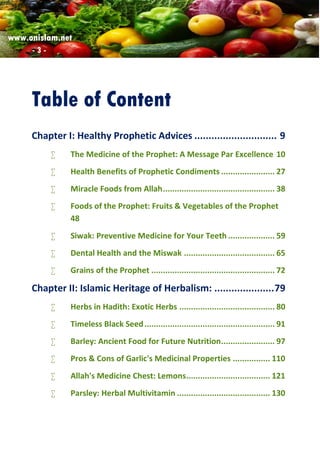
Table of Content
Chapter I: Healthy Prophetic Advices ............................. 9
 The Medicine of the Prophet: A Message Par Excellence 10
 Health Benefits of Prophetic Condiments ....................... 27
 Miracle Foods from Allah................................................ 38
 Foods of the Prophet: Fruits & Vegetables of the Prophet
48
 Siwak: Preventive Medicine for Your Teeth .................... 59
 Dental Health and the Miswak ....................................... 65
 Grains of the Prophet ..................................................... 72
Chapter II: Islamic Heritage of Herbalism: .....................79
 Herbs in Hadith: Exotic Herbs ......................................... 80
 Timeless Black Seed........................................................ 91
 Barley: Ancient Food for Future Nutrition....................... 97
 Pros & Cons of Garlic's Medicinal Properties ................ 110
 Allah's Medicine Chest: Lemons.................................... 121
 Parsley: Herbal Multivitamin ........................................ 130
www.onislam.net
Healthy
Prophetic
Advices - 4 -
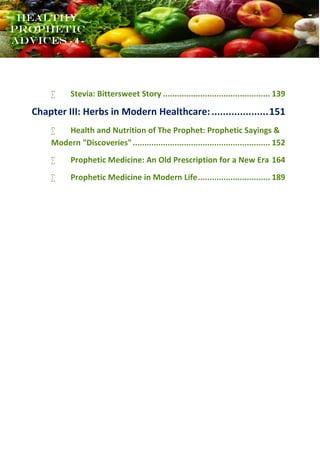
 Stevia: Bittersweet Story .............................................. 139
Chapter III: Herbs in Modern Healthcare:....................151
 Health and Nutrition of The Prophet: Prophetic Sayings &
Modern "Discoveries"........................................................... 152
 Prophetic Medicine: An Old Prescription for a New Era 164
 Prophetic Medicine in Modern Life............................... 189
www.onislam.net
- 5 -
Introduction
Praise be to Allah.
We thank Him, the
Most High, and seek
His Help and
Forgiveness. We
seek refuge in Allah
from the evils within
ourselves and that of bad deeds.
He whom Allah guides, is truly guided, and
whom Allah leaves to stray, none can guide
him. We bear witness that there is no god but
Allah and that Muhammad is His final Prophet
(Peace and Blessings be Upon Him). We ask
Allah to bless our Prophet Muhammad, his
family, his Companions, and all his followers,
from the beginning of his call to the Day of
Judgment.
www.onislam.net
Healthy
Prophetic
Advices - 6 -
Prophetic Medicine simply refers to the
actions done and thought said by the Prophet
Muhammed with regards to sickness,
treatment, nutrition, and hygiene. It is distinct
from Islamic medicine, in that the latter is a
broader category encompassing a variety of
medical practices rooted in the Ancient
civilizations of the Muslim nations which
influenced Mediveval Islamic Medical sciences.
Prophetic medical traditions exhort humans
to not simply stop at following Muhammad's
teachings, but encourage them to search for
cures as well. The literature of Prophetic
medicine thus occupies a symbolic role in the
elucidation of Islamic identity as constituted by
a particular set of relationships to science,
medicine, technology and nature.
Ibn Abbas has also narrated that Prophet
Mohammad (peace be upon him) said: “There
www.onislam.net
- 7 -
are two blessings which many people lose:
(They are) health and free time for doing
good.” (Al-Bukhari).
Prophet Muhammed PBUH had a firm belief
in the existence of a cause and a cure for
every disease and that was described in many
prophetic hadiths such as: “Make use of
medical treatment, for Allah has not made a
disease without appointing a remedy for it,
with the exception of one disease, namely old
age.” Narrated by: Abu Dawud, Sunan Abu
Dawud.
About 50 hadiths on specific ailments and
their remedies have been grouped together
under the Chapter called Kitab-al-Tibb of well-
known collections of hadith by Bukhari,
Muslim, Abu Dawud, Tirmidhi, and others.
In addition of those, more than 300 hadiths
referred to hygiene, cleanliness, habit of eating
www.onislam.net
Healthy
Prophetic
Advices - 8 -
and drinking. All these prophetic hadiths, which
number about 400, constitute the Prophetic
Medicine, and can be found together in the
classical books of Ibn al-Qayyim Aljouzi (8th
Century AD), Abu Nu’aim (5th Century AD),
Abu Abd-Allah al-Dhahbi (8th Century AD), and
Abu Bakar Ibn al-Sani (4th century AD).
In light of this, OnIslam.net is glad to
present this book, whose contents are based
mainly on articles and features provided by
reputed doctors and health specialists, to help
both Muslims and non-Muslims, understand the
concepts of Prophetic healthy advices and its
relation with herbs.
We ask Allah Almighty to guide us all to
what is best in this world and in the Hereafter,
Ameen.
www.onislam.net
- 9 -
Chapter I: Healthy Prophetic
Advices
Salman reported, The Messenger of Allah, peace and
blessings of Allāh be on him, said "The blessing of
food is the washing of hands before it, and the
washing of hands after it."
www.onislam.net
Healthy
Prophetic
Advices - 10 -
The Medicine of the Prophet: A Message Par
Excellence1
The traditions
(sunnah) of the
Prophet
Muhammad (may
the peace and
blessings of Allah
be upon him) are
rich in advice and
instructions on
such matters as
hygiene,
sanitation, and
treatment of
1
This article is an edited version of a chapter from a book by the
author entitled “Medicinal Plants in the Traditions of Prophet
Muhammad.” It was submitted by Dr. M. Iqtedar Husain Farooqi and
published with his permission.
www.onislam.net
- 11 -
disease through the use of medication.
Referred to as Al-Tibb Al-Nabawi (prophetic
medicine) by Muslims the world over, about 50
prophetic traditions on specific ailments and
their remedies have been grouped together
under the chapter referred to as Kitab-al-Tibb
(the book of medicine) in the well-known
collections of Hadith (prophetic sayings) by
Bukhari, Muslim, Abu Dawud, At-Tirmidhi, and
more.
Also, more than 300 traditions on aspects of
hygiene, cleanliness, habit of eating and
drinking, etc. find mention in these same
collections. All these traditions, which number
about 400, constitute what is referred to as
prophetic medicine, and can be found together
in the classical books of Ibn al-Qayyim Aljouzi
www.onislam.net
Healthy
Prophetic
Advices - 12 -
(8th century Hijrah), Abu Nu`aim (5th century
Hijrah), Abu Abdullah al-Dhahbi (8th century
Hijrah), and Abu Bakr ibn al-Sani (4th century
Hijrah). Most of these original Arabic treatises
have been translated into English and other
languages.
Islamic Foundations of Well-Being
The Prophet Muhammad laid down the
foundation for a social order in which every
member of society was advised to maintain a
healthy life, physically, psychologically, and
spiritually. No aspect of life was to be
disregarded.
In the opinion of Douglas Guthrie (A History of
Medicine, 1945), great advances in medicine
made by Muslims during the Middle Ages were
www.onislam.net
- 13 -
mainly due to the impact of the traditions of
the Prophet Muhammad. Guthrie writes, “Had
not the Prophet Muhammad himself said, ‘O
Servant of God, use medicine, because God
hath not created a pain without a remedy for
it’”? Guthrie failed to quote the source of this
important prophetic saying, but it is obvious
that he was referring to the famous hadith
from Tirmidhi (one of the six most important
collections of prophetic traditions).
As a matter of fact, there are several such
sayings in which the Prophet laid great stress
on medicine and discouraged seeking help
through amulets, relics, and charms. For
instance, the Prophet once said, “There is a
remedy for every malady and when the
remedy is applied to the disease, it is cured.”
www.onislam.net
Healthy
Prophetic
Advices - 14 -
This and several such hadiths have been
described in Bukhari, Muslim, and Abu Dawud.
Once the Prophet was asked by one of his
companions, “Is there any good in medicine?”
To this he emphatically replied, “Yes.” As a
result, Islamic teachings make it the duty of
every society or group of people to conduct
research and discover the remedy for diseases
that afflict human beings. The concept of
incurable diseases is thus alien to Islam.
Changing Age-Old Attitudes
There were several occasions when the
Prophet visited the sick, and after enquiring
about the ailments advised to take the
medicine prescribed from experienced
physicians. On several occasions he advised
www.onislam.net
- 15 -
the sick to approach Harith bin Kalda, a well-
known Jewish physician of Thaqif (a place near
Madinah, Saudi Arabia where the Prophet
resided at the time). On one particular
occasion the Prophet visited Sa`d ibn Abi
Waqqas who had suffered a heart attack.
When the Prophet placed his hand on the chest
of Sa`d he felt great relief, but the Prophet
cautioned him and said, “You’ve had a heart
attack and therefore should consult Harith Bin
Kalda, who is the expert physician.” It is these
and many other similar occasions that greatly
changed the attitude of the Arabs towards
diseases. Arabs, during the pre-Islamic period,
depended mainly on invoking supernatural aid
or different deities for the treatment of
disease.
www.onislam.net
Healthy
Prophetic
Advices - 16 -
The Prophet Muhammad, realizing the
consequences of infectious epidemics, advised
his companions that, “When you hear about a
break of plague in any area, do not enter there
and when it has broken in a land where you
are, then do not run way from it (and thus
spread it elsewhere).” On the basis of this
hadith, Muslims considered precaution and
vigilance against infectious epidemics as the
command of God.
The Prophet also opposed charms and
incantations as a form of remedy for diseases.
On some occasions, however, when physical
remedy (medicine) was not available, he
allowed, mainly for psychological reasons, the
recitation of an incantation that has definite
meaning. He also declared the victims of
epidemics such as cholera and the plague as
www.onislam.net
- 17 -
martyrs. This was a great consolation for those
who suffered from it and realized the fatal
consequences.
The Prophet always cautioned physicians to
take extreme care in treating their patients
and warned those not well-versed in the skill of
medicine not to attempt treating the ill lest
they might be held responsible for any
complications. Quackery is, therefore,
forbidden in Islamic medical ethics.
The Prophet Muhammad advised his followers
to always care for their health, and whenever
they were ill, whether seriously or otherwise,
consoled them and told them not to feel that
they were victims of the wrath of Allah.
“Disease,” he said, “is not the wrath of Allah,
because Prophets also suffered great pains,
www.onislam.net
Healthy
Prophetic
Advices - 18 -
much greater than ordinary people.” Imagine
what a solace these sayings would have
provided to the followers of Islam.
Hope as Medicine
There are many Prophetic hadiths in Bukhari,
Muslim and others that show that people were
accustomed to go to the Prophet regularly and
tell him about their ailments. He would advise
them to resort to medicine first and then pray
to God to get rid of the disease. On several
occasions he would himself suggest certain
medicines. For instance, in case of loss of
appetite he frequently advised his followers to
take talbina, a preparation made from barley.
For constipation he used to recommend the
use of senna.
www.onislam.net
- 19 -
He was also in favor of regular use of honey for
keeping fit. Similarly, for different ailments he
would advise the use of olives, black cumin,
chicory, endive fenugreek, ginger, marjoram,
saffron, vinegar, and watercress. Hadiths on
these medicines and others show the concern
of the Prophet for the welfare and good health
of his followers. For even apparently small
matters like drinking water, eating food, and
keeping clean and tidy he also gave advice. He
is noted to have said, “Cleanliness is half of
faith.”
Some of the hadiths on black cumin, senna,
and watercress are very thought provoking.
For instance, the Prophet is reported to have
said that, “Black cumin is a remedy for every
disease except death.” The Prophet expressed
www.onislam.net
Healthy
Prophetic
Advices - 20 -
similar views on the efficacy of senna and
cress.
The style and language of these hadiths are a
clear indication of the fact that the Prophet
placed great stress on medicines. These
hadiths also put emphasis on confidence
building of the ill towards their diseases and
agonies suffered. Very rational advice was
given that none should be disheartened by the
intensity and duration of the disease because
remedies have been provided by nature. They
were also advised not to be afraid of
impending death.
Once during the time of the Prophet, a person
committed suicide as he could not bear the
agony of his disease. The Prophet condemned
the act and refused to participate in the last
www.onislam.net
- 21 -
rites. Thus, hopelessness, despondency,
dejection and frustration on account of serious
disease and pain are against the spirit and
tenets of Islamic medical ethics, as shown by
the tradition of the Prophet.
Charms and Incantations: A Thing of the
Past
There are several authentic hadiths, according
to which people were said to come to the
Prophet for spiritual remedies for their illnesses
and that of their kith and kin. The Prophet, of
course, prayed for them, but only after
suggesting remedies in the form of medicines.
Often he would advise the patients to consult
the best physician in the area. On one occasion
a lady came to the Prophet with her child who
was bleeding because of a throat infection. He
www.onislam.net
Healthy
Prophetic
Advices - 22 -
admonished her and advised her to treat the
disease by using the extract of costus and
pseudo-saffron.
Similarly, once his wife complained of an
abscess on her finger. The Prophet suggested
an application of sweet flag on the fingers and
then asked her to pray to Allah for recovery.
There was also an occasion when a scorpion bit
the Prophet himself. He immediately asked for
hot water to which salt was added. The hot
solution was poured on his bitten fingers while
he recited Qur’anic verses.
These occasions and Prophetic hadiths led
Muslims to believe in the rationale of using
medicine rather than resorting to charms and
incantations. On several occasions he exhorted
them not to depend on supernatural methods
www.onislam.net
- 23 -
of healing. He is also reported to have said,
“charm is nothing but a work of Satan.”
The Human Prophet
Although the Prophet on one hand gave
suitable advice to his followers on earthly
affairs when such situations were brought to
his attention, on the other hand he tried his
best to create confidence in themselves so that
they could act according to their own
experience and opinions. Once, while
withdrawing his advice given earlier on the
cross pollination of date palm he said,
“Whenever I command you to do something
related to religion, do obey. And if I command
you something about earthly matters, act on
your own (experience) and (do remember) I
am a human being.”
www.onislam.net
Healthy
Prophetic
Advices - 24 -
Putting Prophetic Medicine Into
Perspective
In recent years, several books on prophetic
medicine have been published, particularly in
India and Pakistan, which do not project the
true essence of the Prophet’s message. For
instance, the author of a recently published
book entitled Tibbe Nabwi Aur Jadid Science
(Prophetic Medicine and Modern Science),
claims that Prophetic treatment of heart attack
by eating seven dates, as was suggested to
Sa`d ibn Abi Waqqas, should still be preferred
over modern by-pass surgery for the disease,
provided people have faith in the treatment of
the Prophet. The learned author failed to
understand that the Prophet, while suggesting
to Sa`d to take dates as temporary relief, also
www.onislam.net
- 25 -
advised him to consult the expert physician
Harith bin Kalda for treatment.
As a matter of fact, it is not desirable to
consider the Prophet’s traditions on medicine
as similar to the prescription of a physician. In
this connection, the opinion of Ibn Khaldun
(14th century AD) is highly relevant and
realistic. He says, “The Prophet’s mission was
to make known to us the prescription of the
Divine Law and not to instruct us in medicine
of the common practice of ordinary life”
(Muqqaddima). In his opinion, even very
authentic hadiths cannot be taken as a mere
medicinal prescription, which is the duty of an
experienced physician.
He says, however, that “with sincere faith, one
may derive from them [hadiths] great
www.onislam.net
Healthy
Prophetic
Advices - 26 -
advantage though this forms no part of
medicine as it is properly called.” To emphasize
his point of view, Ibn Khaldun refers to
occasions when the Prophet tried to create
confidence in his followers by advising them to
take their own judgments in worldly affairs.
Prophetic medicine is a message par
excellence. It is an advice to keep a healthy
body and soul and to have faith in both
physical and spiritual treatment. It is a
command to us to strive hard to find newer
medicines and newer remedies. It is a warning
to those who consider diseases as the will of
God for which no remedy is needed. It is an
admonition for us to keep away from so-called
spiritual treatment based on superstitions like
sorcery, amulets, and charms.
www.onislam.net
- 27 -
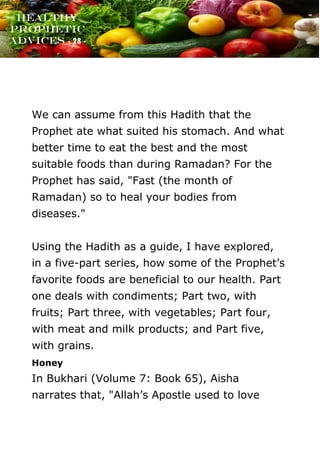
Health Benefits of Prophetic Condiments1
The Prophet’s
favorite
condiments were
honey, olive oil,
salt, and vinegar.
The Qur’an
(2:168) says, "Yea
people: eat of
what is on earth,
lawful and
wholesome." According to Muslim, Allah’s
Messenger said, "The stomach is the central
basin of the body, and the veins are connected
to it. When the stomach is healthy, it passes
on its condition to the veins, and in turn the
veins will circulate the same; and when the
stomach is putrescence, the veins will absorb
such putrescence and issue the same."
1
By Karima Burns.
www.onislam.net
Healthy
Prophetic
Advices - 28 -
We can assume from this Hadith that the
Prophet ate what suited his stomach. And what
better time to eat the best and the most
suitable foods than during Ramadan? For the
Prophet has said, "Fast (the month of
Ramadan) so to heal your bodies from
diseases."
Using the Hadith as a guide, I have explored,
in a five-part series, how some of the Prophet’s
favorite foods are beneficial to our health. Part
one deals with condiments; Part two, with
fruits; Part three, with vegetables; Part four,
with meat and milk products; and Part five,
with grains.
Honey
In Bukhari (Volume 7: Book 65), Aisha
narrates that, "Allah's Apostle used to love
www.onislam.net
- 29 -
sweet edible things and honey." He also
attributed many healing powers to honey. The
Holy Qur’an (16:69) says, "From its [the bee’s]
belly, comes forth a drink of varying colors
wherein is a cure for people. Surely there is a
sign for those who would give thought."
Honey is not just a sugar, but also a complex
combination of enzymes, organic acids, esters,
antibiotic agents, trace minerals, and yet
unidentified components! One pound of honey
contains 1.4 grams of protein, 23 milligrams of
calcium, 73 milligrams of phosphorus, 4.1
milligrams of iron, 1 milligram of niacin and 16
milligrams of vitamin C. Honey has been
attributed externally with healing wounds and
burns, and making the skin supple and
smooth. Internally, honey is a cure-all, with
www.onislam.net
Healthy
Prophetic
Advices - 30 -
specific benefits for the digestive system and
as a tonic for general health and well-being.
Olive Oil
The Prophet also advised us to, "Use olive oil
as a food and ointment for it comes from a
blessed tree" (Tirmidi). In Crete, a recent
study showed that even though 90% of
Cretans consume an average of 60-70 pounds
of oil a year per person, the incidence of
coronary disease is very low compared to other
countries.
Everyone knows that animal fats contain
saturated fatty acids that vertically increase
blood cholesterol levels. But mono-unsaturated
fatty acids, like olive oil, control LDL levels
while raising HDL levels. In fact, no other
www.onislam.net
- 31 -
naturally produced oil has as large an amount
of monounsaturated fatty acids (mainly oleic
acid) as olive oil.
Olive oil also contains vitamins E and K, and
polyphenols, which provide a defense
mechanism that delays aging and prevents
carcinogenesis, atherosclerosis, liver disorders,
and inflammations. Oleates in the oil also
promote bone formation in children and protect
the bones of the elderly. Even The Journal of
the National Cancer Institute reported that
olive oil offers strong protection in the fight
against breast cancer.
Salt
Contrary to popular modern belief, salt is also
a beneficial condiment. The Prophet said, "Salt
is the master of your food. God sent down four
www.onislam.net
Healthy
Prophetic
Advices - 32 -
blessings from the sky - fire, water, iron and
salt" (Ibn Maja). UNICEF reports that the body
needs only minute amounts of iodine (from
iodized salt) to function properly. Yet, a lack of
the nutrient causes various disorders, from
stunted growth to cretinism, a most serious
condition.
Even mild deficiency produces mental
impairment. Studies estimate that children
living in iodine- deficient areas forfeit up to 10
to 15 IQ points.
Doctors often recommend replacing water and
salt lost during exercise and when working
outside in jobs such as agriculture. Increased
salt intakes have been used successfully to
combat Chronic Fatigue Syndrome as well.
Dramatic deficiencies or "excessive" sodium
www.onislam.net
- 33 -
intakes have been associated with other
conditions and diseases such as stomach
cancer. Testing the salinity of perspiration has
proven to be a good test for cystic fibrosis. The
most talked-about effect of salt is the
association of dietary sodium and elevated
blood pressures (hypertension). However, the
American Society published a good overview of
recent scientific evidence as a supplement to
The American Journal of Clinical Nutrition for
Clinical Nutrition in February 1997, and the
Medical Journal of Australia reviewed that
debate earlier this year. They found that the
kidneys efficiently process this "excess" sodium
in healthy people.
In fact, in cases of hypotension, genetic factors
explain a quarter to a half of blood pressure
variability – five times more than
www.onislam.net
Healthy
Prophetic
Advices - 34 -
environmental factors such as stress, physical
activity/exercise, smoking and, of course, diet.
Among dietary risk factors, obesity is generally
recognized as the most important followed by
excess alcohol consumption and then salt
intake.
In May 1998, JAMA published a large meta-
analysis confirming a 1996 study and
documenting, as well, a series of adverse
changes to blood chemistry among those
placed on low-sodium diets in clinical trials. All
told, there have been six clinical trials, five of
which were limited to randomized controlled
trials. These provide consistent evidence of
only a minor blood pressure response to a
restriction of dietary sodium.
Vinegar
www.onislam.net
- 35 -
The Prophet has also called vinegar a "blessed
seasoning" (Muslim). Modern science has
confirmed that it indeed does have many
"blessings." A recent book called, simply,
Vinegar talks about many ways in which
vinegar benefits our health, and cites
numerous scientific proofs of this claim.
However, vinegar "miracles" were known even
before the time of the Prophet (SAW).
The first-century Greek doctor Dioscorides,
who traveled widely with the Roman army, was
a careful observer of the medicine of his time.
In his writings, he describes the use of a
substance he calls 'oxymel,' or sour honey, for
arthritis-like pains.
Over the centuries, oxymel – a combination of
apple cider vinegar and honey – has been
www.onislam.net
Healthy
Prophetic
Advices - 36 -
widely used to dissolve painful calcium
deposits in the body, and for other health
problems such as hay fever. This is because
apple cider vinegar is nutrient-rich, including
amino acids, enzymes, manganese,
magnesium, potassium, and silicon. It
improves metabolism and can counteract the
effects of excess lactic acid in the bloodstream
released during exercise and stress.
It has also been used as a tonic to help those
with arthritis, blood pressure, cholesterol,
colds, constipation, cramps, diabetes, diarrhea,
indigestion, muscle stiffness, and sore throat.
In his over 300-page book Vinegar, D.
Lawrence cites over 100 studies in praise of
the condiment.
www.onislam.net
- 37 -
Many more claims of vinegar’s benefits are
documented in respected journals like Science
Digest, The Pharmacological Basis of
Therapeutics and The Journal of the American
Medical Association.
Perhaps, though, the most important thing we
can learn from Prophetic nutrition is
moderation. As we sort through the wisdoms of
Prophetic nutrition in our attempt to reconcile
them with modern "science," we must always
remember what the Qur’an (20:8 1) says, “Eat
of the good things We have provided for your
sustenance, but commit no excess therein."
www.onislam.net
Healthy
Prophetic
Advices - 38 -
Miracle Foods from Allah1
The Qur'an (Surat Al-A'raf: 7:160) says,
"Eat of the good foods We have provided for
you."
The question may arise: if Allah has provided
us with so many good foods, why are so many
people starving and many more suffering from
malnutrition?
The answer may lie in our ignorance of the
abundance that has been sent to us by Allah.
We have been
blessed with
many "miracle
foods" that
provide us with
incredible
1
By Karima Burns.
www.onislam.net
- 39 -
amounts of concentrated nutrition and healing
and are also affordable. Many of these foods
can be grown or found in any environment.
The modern market, however, is marketing
many of them as "super foods," and in the
process, charging many times their actual
costs, which creates the illusion that healthy
eating is expensive.
On the other hand, there are agencies that are
exploring the possibility of providing some of
these "super foods" to supply nutrition to
poverty stricken areas of the world. The Qur'an
hints at some of these secrets when it says, "It
is He who has made the sea subject... that ye
may seek (thus) of the bounty of Allah" (Surat
Yunus: 10:14), and "From within their bodies,
a drink of varying colors comes. Wherein is
www.onislam.net
Healthy
Prophetic
Advices - 40 -
healing for me: Verily this is a sign for those
who give thought" (Surat An-Nahl: 16:69).
In fact, most super foods are readily found in
nature and require minimal planting or
harvesting. Some of the most readily available
are bee pollen, spirulina (algae), kelp, royal
jelly, honey, wheat grass, flax seeds, and
alfalfa and other sprouts. Among herbs that
have been taken as sustenance foods is
marshmallow root, used by the Chinese,
Assyrians, Egyptians, and Greeks in times of
famine.
These "miracle foods" are readily available
sources of food for countries that are plagued
by famine and malnutrition, and they can be
used to give a nutritional boost to people who
have adequate nutrition, are fasting, or are
www.onislam.net
- 41 -
suffering from a chronic illness. Many, such as
bee pollen and algae, are used across species
lines so we are not inventing the idea of super
foods - we are simply rediscovering them.
It is best to consume super foods regularly, to
self-harvest them, or to buy them from a
reputable source that does not alter them by
extracting substances from them or adding to
them (e.g., by making them into a health drink
with fructose and other additives). The
following is a list of some "miracle foods":
1. Spirulina (Blue Green Algae): Blue Green
Algae is the superior form of spirulina;
however, they are both essentially the
same thing - algae that survives in hot
sunny climates and is thought by many to
www.onislam.net
Healthy
Prophetic
Advices - 42 -
be the solution to world hunger. Algae
produce twenty times as much protein as
soybeans. Furthermore, it contains many
nutrients not found in any other single
food source such as gamma-linoleic acid,
vitamin B-12, iron, essential amino acids,
chlorophyll, RNA, DNA, and phycocyanin
(a substance that has increased the life
span in lab rats). Algae curb the appetite,
reduce cholesterol levels, and aid in
mineral absorption. You can harvest it at
any natural water source (within specific
guidelines only - not all algae is edible) or
you can buy it in capsule or powder form.
www.onislam.net
- 43 -
2. Kelp: Kelp is another type of seaweed
and can be eaten raw, cooked, whole or
chopped. It comes as a liquid, powder or
dried. Used as a salt substitute to provide
iodine as well as sodium, it contains
many minerals and vitamins in
concentrate, especially B vitamins. It is
beneficial to brain tissue, sensory nerves,
the skin, nails, and blood vessels.
3. Honey: Comprised of 35% protein and
containing half of all the amino acids the
body needs, honey also has many other
essential nutrients such as B-complex
and vitamins C, D and E.
4. Bee-Pollen: The powder produced by the
anthers of flowers and collected by bees,
www.onislam.net
Healthy
Prophetic
Advices - 44 -
bee pollen contains 15% protein, B-
complex vitamins, vitamin C, amino
acids, essential fatty acids, enzymes,
carotene, calcium, copper, iron,
magnesium, potassium, and plant sterols.
It has an anti-microbial effect on the
body and strengthens the immune
system.
5. Royal Jelly: A combination of honey and
pollen that is refined inside the nurse bee
and secreted, this substance provides the
benefits of both pollen and honey plus a
high concentration of pantothenic acid
(vitamin B).
www.onislam.net
- 45 -
6. Wheat Grass: Research shows that one
pound of wheat grass is equal in nutrients
and vitamin content to twenty-five
pounds of choice vegetables. It is a living
food that provides a powerhouse of
nutrition available to all, and it helps in
the elimination of cancerous growths.
Produced by sprouting wheat berries, one
of the cheapest grains on the market,
wheat grass can be grown easily on trays
with a little water in only three days time
from "planting" to "harvest." Whole-
wheat berries (before they become flour)
are sold for about 15 cents a pound.
Twenty-five pounds worth of wheat
www.onislam.net
Healthy
Prophetic
Advices - 46 -
berries could supply a family with meals
for almost a year.
7. Alfalfa: Often used for livestock, alfalfa's
benefits for human consumption are
largely ignored. In fact, in some areas,
valuable alfalfa is fed to livestock while
neighboring people search for nutrition in
their own food. Its roots, which grow
nearly 10 feet underground, may account
for the fact that it is one of the most
mineral-dense foods around. It contains
ALL of the known vitamins and most
minerals such as calcium, magnesium,
phosphorus, potassium, and chlorophyll.
www.onislam.net
- 47 -
Allah has provided us with many more "miracle
foods." Many of the tonic herbs fall into this
category as well as many fruits such as acerola
berries, and vegetables such as sprouts.
Everyone should partake of these miracle
foods, easily found or cultivated throughout
the earth, that Allah has sent us for nutrition
and healing. The Qur'an (Surat Al
InshiraH: 94:5) says, "Verily, with every
difficulty there is relief."
www.onislam.net
Healthy
Prophetic
Advices - 48 -
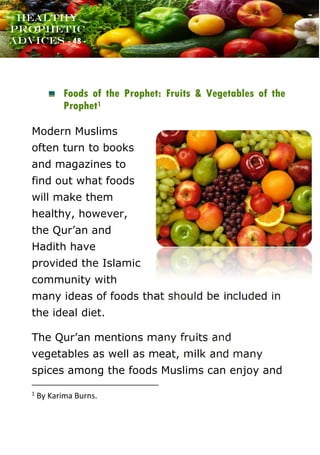
Foods of the Prophet: Fruits & Vegetables of the
Prophet1
Modern Muslims
often turn to books
and magazines to
find out what foods
will make them
healthy, however,
the Qur’an and
Hadith have
provided the Islamic
community with
many ideas of foods that should be included in
the ideal diet.
The Qur’an mentions many fruits and
vegetables as well as meat, milk and many
spices among the foods Muslims can enjoy and
1
By Karima Burns.
www.onislam.net
- 49 -
thrive on. Among some of the fruits and
vegetables mentioned in the Qur’an and Hadith
are melons, grapes, citrus, squash, figs and
dates.
The Qur’an (Surat Ar-Rahman: 55:68) says
that "fruits, palm trees and pomegranates"
were provided for our nourishment. Bukhari
states that Melon was among one of the fruits
most often eaten by the prophet (PBUH).
In fact, melon is one of the best
recommendations for health the prophet
(PBUH) has given us. Melon is one of the few
fruits and vegetables rich in both vitamin C and
Beta-Carotene. In addition, half a melon
contains 825 milligrams of potassium (24% of
the USRDA). The body uses potassium to help
eliminate excess sodium, which in large
amounts can cause blood pressure to rise, says
www.onislam.net
Healthy
Prophetic
Advices - 50 -
Dr. George Webb, an associate professor of
physiology and biophysics at the University of
Vermont College of Medicine.
Factually, in an international study of more
than 10,000 people, researchers found that
those with the highest potassium levels had
the lowest blood pressures. In addition,
potassium helps keep the body's LDL
(dangerous cholesterol) from sticking to the
artery walls. Melons also provide a very rare
nutrient called folate, a B vitamin, which is
essential in combating birth defects and heart
disease.
Prevention's New Foods for Healing Guide
mentions a study of almost 4,000 mothers that
revealed that those who got enough folate
were 60% less likely to have children with
brain and spinal cord defects.
www.onislam.net
- 51 -
Additionally, men can benefit from folate too.
Folate controls the levels of a chemical called
"homocysteine" in the body, which when
allowed to exist in excess can contribute to
artery clogging and thus heart disease.
Citrus is also a favored fruit of the Qur’an and
Hadith. The prophet has said, "The parable of a
believer who reads the Qur’an regularly is like
that of a citrus it has a good taste and a good
fragrance". Similarly, just as the Qur’an will
provide a healthy spiritual life, the citrus fruits
can provide a healthy physical life for the
believer.
In reality, all citrus is packed with many
valuable nutrients. Most famous of these is
vitamin C. Vitamin C is famed for its powerful
antioxidant properties (meaning that it disarms
www.onislam.net
Healthy
Prophetic
Advices - 52 -
powerful oxygen molecules in the body that
contribute to cancer and heart disease).
The body also uses vitamin C to manufacture
collagen; the substance that glues cells
together and is essential for healing. A large
lemon contains about 75 percent of the USRDA
of vitamin C.
In addition, substances dubbed limonene and
limonese have been found to block some of
the cellular changes that can lead to cancer.
Oranges are perhaps the most universally
known sources of vitamin C (117 percent of
the USRDA), yet, fruits like the kiwi and
acerola berry contain more vitamin C than an
orange, and researchers have found that
although oranges are a valuable source of
vitamin C that this vitamin accounts for only
www.onislam.net
- 53 -
about 15% of the total healing activity in an
orange.
Oranges actually have much more to offer.
Hesperidin, found in oranges has been found
by Brazilian researchers to stop inflammation
without damaging the stomach lining as aspirin
can. Oranges also contain limonene, which
according to Michael Gould, a professor of
human oncology at the University of Wisconsin
Medical School "cause cancer cells to self-
destruct."
In the Medicine of the Prophet it is also
mentioned that God's Messenger (PBUH) loved
grapes and melons. Although alcohol is
forbidden, the Qur’an mentions grapes alone
six times. Grape juice has recently been found
to be an important source of flavanoids that
can lower risk for cancer, lower cholesterol,
www.onislam.net
Healthy
Prophetic
Advices - 54 -
prevent hardening of the arteries and fight
heart disease.
In 1996 scientists noticed that although the
French ate four times as much butter and lard
as Americans and had higher cholesterol and
blood pressure that they had two and a half
times less incidences of heart attacks.
The general public was thrilled when the
conclusion was finally made that the flavanoids
in red wine were responsible. However,
Muslims can now celebrate over the recent
finding that grape juice contains the same
flavanoids and nutrients as red wine (in about
half the concentration) with none of the
undesired side effects of alcohol.
Squash is among the vegetables mentioned by
the prophet. A Hadith from Bukhari quotes that
www.onislam.net
- 55 -
Ibn Malik said, "A tailor invited the Prophet to
a meal that he had prepared, and I went along
with the Prophet. The tailor presented barley
bread and soup containing gourd and cured
meat.
I saw the Prophet picking the pieces of gourd
from around the dish, and since then I have
kept on liking gourd." Dexter L. Morris, MD,
PhD, vice chairman and associate professor in
the department of emergency medicine at the
University of Northern Carolina School of
Medicine says that "Squash and gourd contain
such a rich array of vitamins and minerals and
other compounds that scientists have just
begun to map its healing power."
However, they have managed to come to at
least a few conclusions and one is that squash
is one of the richest sources of vitamin C and
www.onislam.net
Healthy
Prophetic
Advices - 56 -
beta-carotene (25% and 66% respectively).
Scientists have found that people who have
more vitamin C in the diets over time have
fewer lung ailments as the vitamin gets
transported to the lining of the lung as serves
as an antioxidant there.
Even dried fruits are beneficial according to the
Qur’an and Hadith. The Prophet (PBUP)
mentioned figs and then stated, "If I had to
mention a fruit that descended from paradise I
would say this is it because the paradisiacal
fruits do not have pits...eat from these fruits
for they prevent hemorrhoids, prevent piles
and help gout." (Bukhari)
Figs are a top source of fiber, as well as
potassium and vitamin B6. Fiber results in
bulkier stools, which lessen the incidence of
constipation, hemorrhoids and colon cancer.
www.onislam.net
- 57 -
Fiber also lowers cholesterol and the risk of
heart disease. Just one fig provides 20% of the
USRDA of fiber.
A Harvard University study of 43,757 men
ages 40 to 75 found that those who got the
most fiber had about half the risk of getting a
heart attack as those who got the least.
Furthermore, men who added just 10 grams of
fiber a day to their diet (6 figs) lowered their
incidence of heart disease by 30%.
This could also be why fibrous dates are
another favored food of the Prophet who said,
"Whoever takes seven 'Ajwa dates in the
morning will not be effected by magic or
poison on that day." (Bukhari) The Prophet
also said, "There is a tree among the trees
which is similar to a Muslim (in goodness), and
that is the date palm tree."
www.onislam.net
Healthy
Prophetic
Advices - 58 -
As Muslims we are wise to include these foods
in our diet. Allah has blessed us with many
good foods and in the Qur’an (Surat Al-A'raf:
7:160) it says "Eat of the good foods We have
provided for you."
www.onislam.net
- 59 -
Siwak: Preventive Medicine for Your Teeth
One of the best
ways to protect
one’s teeth is the
siwak, which was
mentioned in
several sayings
of Prophet
Muhammad
(PBUH).
Siwak are the
wicks that are
used to rub
inside the mouth,
and they get their name from the Arabic word
“yudlik,” which can be roughly translated to
mean “massage” (i.e., massage the inside of
the mouth). It means more than “tooth brush.”
The best type of siwak is that which comes
from the araak tree. The siwak of the Prophet
(PBUH) was from that tree. The siwak is a
www.onislam.net
Healthy
Prophetic
Advices - 60 -
natural twig fortified with natural minerals that
help clean the teeth, other inhibitors that
prevent gums from bleeding, cleaning agents
that kill microbes and germs and a scent that
gives breath a naturally fresh smell. The siwak
is an ideal, natural brush that has been
endowed with more than any artificial
toothpaste could ever have.
Like a toothbrush, the wicks on the siwak clean
between the teeth and do not break under any
amount of pressure; rather, they are flexible
and strong. The small wicks bend to the
appropriate shape to get plaque and leftover
food out from in between teeth while avoiding
any damage to the gums.
The Prophet (PBUH) taught us more than
1,400 years ago to use the siwak to clean our
www.onislam.net
- 61 -
teeth and mouth and give it a nice scent. Anas
quoted the Prophet (PBUH) as saying:
“Whenever the Angel Gabriel would visit me,
he would advise me to use the siwak.”
The leftovers of food found between teeth
provide an excellent environment for the
festering of millions of bacteria, which can lead
to painful and bloody gum disease and cysts.
In the worst cases, there can be inflammation
of the jawbones.
Bacteria also produce damaging enzymes that
eat away at the calcium of the teeth, which
causes cavities. In severe cases, the bacteria
produce gases that emit nasty stenches from
the mouth. Recent studies have found that
siwak has natural minerals that kill microbes
and germs and remove plaque.
www.onislam.net
Healthy
Prophetic
Advices - 62 -
The Prophet (PBUH) used to rub the siwak over
his tongue, teeth and gums. Abu Musa Al-
Ash’ari said, “I visited the Prophet, peace be
upon him, and the siwak was at the edge of his
tongue.”
Chemical Breakdown of a Siwak
Siwak has 19 beneficial ingredients in it. Most
important among them are:
 Antibacterial acidic inhibitors that fight decay
and diarrhea. They are natural disinfectants
and can be used to stop bleeding. They
disinfect the gums and teeth and close any
microscopic cuts that may have existed in the
gums. On first usage, the siwak will taste
harsh, and maybe even burn, because of a
mustard-like substance found in it, but this is
the ingredient that fights decay in the mouth
and kills germs.
www.onislam.net
- 63 -
 Minerals such as sodium chloride, potassium,
sodium bicarbonate and calcium oxides. These
clean the teeth. For instance, the American
Dental Association considers sodium
bicarbonate to be a preferred ingredient in
toothpastes.
 Natural scented oils that taste and smell nice,
give the mouth a nice smell. They make up
about 1% of the siwak.
 Enzymes that prevent the buildup of plaque
that causes gum disease. Plaque is also the no.
1 cause of premature loss of teeth.
 Anti-decay and anti-germ ingredients that act
as a penicillin of sorts, decreasing the amount
of bacteria in the mouth, which means cleaner
teeth and cleaner air when breathing through
the mouth.
Some researchers have found that tooth decay
is rapid when a dry brush is used, and that
wetting one’s toothbrush mitigates the
damage. So the siwak should be dampened
before usage. If there is no alternative, one’s
saliva will suffice to dampen the stick. Siwak
www.onislam.net
Healthy
Prophetic
Advices - 64 -
also has chemicals that cause the mouth to
produce extra saliva, which is the mouth’s
organic defense and cleaning mechanism.
www.onislam.net
- 65 -
Dental Health and the Miswak1
"Good dental health is more than the absence
of disease or tooth
decay in your
mouth," says David
Kennedy, DDS and
author of How to
Save Your
Teeth (Kennedy,
pg.3). "It is an
integral part of
your well being.
People with
exceptionally
healthy bodies
usually have
healthy teeth and gums." Teeth are also a
blessing from Allah. It is said that, "If the eyes
are a window to the soul then the mouth is the
doorway to the body" (Stay, p.5).
1
By Laylah Al-Husaini.
www.onislam.net
Healthy
Prophetic
Advices - 66 -
Teeth play an important function in the
digestive process. They are important in
helping people to speak and in upholding one's
facial structure. Without teeth, nobody would
be able to say anything comprehendible, if at
all. Without teeth you would have to swallow
your food without being able to chew it first,
which is unhealthy for the digestive system.
However, despite their important functions,
teeth are the least cared for part of the body.
But, cleaning one's teeth does not have to be
complicated. Eating unprocessed food and
staying away from sugary sweets are simple
keys to good dental health.
Caries, or dental decay, is the most common
disease affecting the teeth. People eating large
amounts of processed foods or sweets and
www.onislam.net
- 67 -
then forgetting - or not wanting - to brush
their teeth afterwards, end up causing easily
avoidable decaying of the teeth. While chewing
food, small pieces tend to become stuck to the
surface of the teeth, as well as in between
them.
Leaving those pieces there for a long period of
time causes the food to go bad, which in turn
attracts bacteria that dig holes in the teeth.
Most people do not realize the damage that is
being done until the tooth is already decayed
and must be pulled out by a dentist.
In addition, poor dental health also leads to
bad breath and many other diseases, including
malocclusion, periodontal diseases or even oral
cancer.
www.onislam.net
Healthy
Prophetic
Advices - 68 -
David Kennedy documents that the devastating
effects of sweet-rich diets were documented as
early as 1938. In many industrialized
countries, dental decay is becoming less
common due to renewed awareness and efforts
towards dental health. However, in the
developing world, where previously many
people were free of dental decay, it is
becoming increasingly common (Kennedy, pg.
10).
Dr. Weston Price, a dentist, set out on a world
expedition to discover why, as a general rule,
societies untouched by modern civilization had
excellent teeth, whereas civilized societies had
comparatively poor teeth. He compiled a
photographic record of his travels and
concluded that diet - not poor brushing habits,
was the culprit (Kennedy, p.2). However,
www.onislam.net
- 69 -
proper care of the teeth was the second most
influential factor in people with healthy teeth.
According to researchers, the people with the
best teeth are not those who have the fanciest
sonic toothbrushes - but those who use their
toothbrushes regularly and after each snack
and meal. In fact, ancient cultures and
developing nations lacked the technology to
create such machines for the teeth, yet there
have always been reliable ways to clean them.
American Indians used fresh bark from
the prickly ash tree to clean their teeth. The
sap from this tree kills bacteria. Mojave Desert
Indians used twigs from the cresotebush and
rural villagers in India used the neem tree.
www.onislam.net
Healthy
Prophetic
Advices - 70 -
Muslims use what is called a miswak. A
miswak, or siwak, is a small stick with which
the teeth are rubbed and cleaned. The end is
shaped into a brush through biting or chewing,
which serve to separate the fibers and release
the healing herbal powers of the twig. Some
advantages of the miswak are that is does not
require toothpaste, water or a special area to
use it, and may be easily carried in one's purse
or pocket. It is also disposable and
biodegradable - therefore, it is the ultimate
environmentally safe toothbrush. Some people
even believe it works better than a toothbrush.
Nevertheless, a more compelling reason to use
the miswak is that it is Sunnah to do so. Abu
Hurairah reported that Prophet Mohammad
(PBUH) said, "Were it not that I might
overburden believers, I would have ordered
www.onislam.net
- 71 -
them to use the miswak at every prayer"
(Imam Muslim, Vol. 1).
According to researchers, it is this regular
cleaning of the teeth, along with a proper diet,
that makes the difference between healthy and
unhealthy teeth.
Keeping your teeth clean is as important
Islamically as it is medically. It is as difficult to
envision speaking to Allah (through prayer)
with bad breath and dirty teeth as it is to
envision speaking to a friend when you are
suffering from bad breath and dirty teeth.
The Prophet himself (PBUH), used to use
the miswak before every prayer (Sahih Muslim,
Vol.1). Modern science suggests we would do
well to follow his example.
www.onislam.net
Healthy
Prophetic
Advices - 72 -
Grains of the Prophet1
There is a famous
Hadith reported by Abu
Hurairah that, "Allah
never inflicts a disease
unless he makes a
cure for it..." (Sahih
Bukhari).
While some of us may assume that this cure is
always in the form of a medicine or herbs, the
Hadith does not state that. Two of the greatest
cures Allah has given us for heart disease are
foods that the Prophet (PBUH) ate: whole
wheat and barley.
Both of them provide multiple benefits in the
fight against heart disease as they both lower
1
By Karima Burns.
www.onislam.net
- 73 -
cholesterol, increase proper elimination of
wastes by the body, facilitate proper blood
clotting, and improve general circulation and
cellular health. When Sahl bin Sad was asked,
"Did Allah's Apostle ever eat white flour?" he
replied, "Allah's Apostle never saw white flour
[from the time] Allah sent him as an Apostle
till He took him unto Him."
Modern science has long been against
processed breads, even when they are
supposedly "enriched." E. Cheraskin, in his
book Diet and Disease, compares enriching
white flour with "robbing someone in a dark
alley of their clothes and wallet, and then
giving them back their underclothes and bus
money to get home."
In addition to the fact that white flour has no
nutritional value, it can leech vitamins and
www.onislam.net
Healthy
Prophetic
Advices - 74 -
minerals from the body as well. This is because
nutrient-void foods do not supply all of the
nutrients that are needed for their digestion;
hence, they must take the nutrients that are
lacking from the body. White flour can even
mimic white sugar, creating problems for the
hypoglycemic or diabetic person (Pritchard,
Healing with Whole Foods).
According to nutritionists Jean Anderson and
Barbara Deskin, whole-wheat flour, high in
protein and fiber, is far superior in nutrition to
white flour. Whole grain wheat contains a large
amount of Vitamin E, mostly concentrated in
its germ layer.
Research on the Vitamin E found in wheat
discovered that of 31,000 people studied,
those who ate whole wheat bread had a much
lower risk of heart disease than those who ate
www.onislam.net
- 75 -
white bread. Michael H. Davidson, MD,
president of the Chicago Center for Clinical
Research, says that this is because the Vitamin
E in wheat causes the liver to produce less
cholesterol. He found that subjects in his study
who consumed ½-cup of wheat germ daily for
14 weeks saw their cholesterol levels drop by
seven percent.
Although wheat has undeniable health
benefits, we need to be aware of the dangers
of its overuse. Eaten daily, whole wheat can be
detrimental to the health as it causes bloating
in many people and often encourages the
growth of unfriendly (candida albicanus)
bacteria in the colon. It can also encourage
weight gain and cause allergic reactions in
many people when overeaten.
www.onislam.net
Healthy
Prophetic
Advices - 76 -
It is revealing that Prophet Muhammad (PBUP)
did not indulge in regular wheat consumption,
but ate instead mostly barley and bread made
from barley flour. Abu Hazim narrated (in
Sahih Bukhari) that he asked the Prophet
(PBUH), "Did you use to sift barley flour?" The
Prophet answered, "No, but we used to blow
off the husk (of the barley)." Barley is so easily
digested that the Prophet even recommended
that barley soup (talbinah) be used for all
stomach ailments (Sahih Bukhari). Possessing
even more health benefits than wheat, barley
is extremely high in calcium and protein, and is
far less allergenic. It does not encourage
bloating or unhealthy bacterial growth;
therefore, while wheat is healthful, barley is
better for daily consumption.
www.onislam.net
- 77 -
One of the richest sources of tocotrienols,
powerful antioxidants that help reduce damage
to the body from dangerous oxygen molecules
called free radicals, barley also reduces the
body's production of cholesterol in the liver.
David Jenkins, MD, professor of nutritional
sciences at the University of Toronto says,
“Tocotrienols are potentially more powerful
antioxidants than other chemical versions of
vitamin E.” Barley is also a lot more affordable
than most vitamin E supplements on the
market.
Furthermore, it contains lignana, found to
prevent tiny blood clots from forming –
perhaps providing a similar benefit to the
recently popular “daily dose of aspirin” against
heart disease. Just one-half cup of barley
contains half the daily requirement for
selenium in the diet and almost twenty-percent
www.onislam.net
Healthy
Prophetic
Advices - 78 -
of the USRDA (Recommended Daily Allowance)
of Vitamin E. Both of these have been found to
be powerful allies in the fight against cancer.
Barley also contains beta-glucan, a type of
soluble fiber that forms a gel in the small
intestine to which cholesterol binds and is then
excreted from the body. This gel forming
action also prevents constipation and colon
cancer. To get barley's healing benefits, it is
recommended by health experts that it be
eaten in the same way that the Prophet
(PBUH) did. Hulled barley (the husk loosely
intact or “blown off”) is superior to processed
barley which has been cleaned and scrubbed
more than five times to create a quicker-
cooking version that lacks most of barley's
healthful fiber, minerals and thiamin.
www.onislam.net
- 79 -
Chapter II: Islamic Heritage
of Herbalism:
Jabir reported, The Messenger of Allah, peace and
blessings of Allah be on him, said: "When you go to
sleep, put out the lamp and shut the doors and cover
the mouths of water-skins and cover food and drink."
www.onislam.net
Healthy
Prophetic
Advices - 80 -
Herbs in Hadith: Exotic Herbs
Black Seed
The Prophet (PBUH)
said, "If my
community had only
known what there is
in fenugreek they
would have paid its
weight in gold."
When considering
the value of herbs, it is not their cost or exotic
quality that matters as much as their
versatility. Many herbs have been used
historically as "cure-alls" or potent "tonic
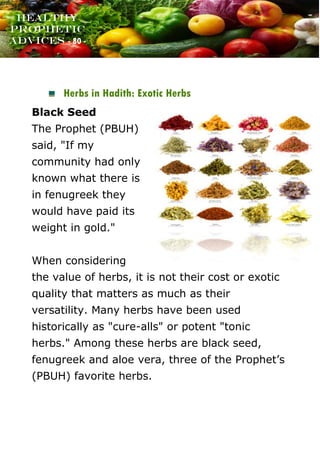
herbs." Among these herbs are black seed,
fenugreek and aloe vera, three of the Prophet's
(PBUH) favorite herbs.
www.onislam.net
- 81 -
Bukhari reports that the Prophet (PBUH)
recommended that we "use black seed
regularly because it has a cure for every
disease except death." The magazine Food
Chemistry found black seed to be high in
protein, carbohydrates, essential fatty acids,
vitamins A, B1, B2, C and niacin as well as
calcium, potassium and iron. These are the
very nutrients that modern science has found
that we most lack. We are encouraged to drink
milk for calcium, to take supplements for EFA's
(Essential Fatty Acids), and to consume niacin
pills to lower our cholesterol; however, black
seed can provide many of these same benefits.
It also provides many of the same nutrients
that the FDA recommends to help prevent
disease and slow down the aging process.
www.onislam.net
Healthy
Prophetic
Advices - 82 -
Dr. Michael Tierra, author of Planetary
Herbology, also found black seed to be high in
the above nutrients. In addition, he found a
remarkable number of sterols, especially beta-
sitosterol, which is known to have anti-
carcinogenic properties. The Journal of
American Scientists reports that black seed has
a number of useful properties such as
antihistamine, antioxidant, antibiotic,
antimycotic and broncho-dilating effects.
These findings possibly explain its long history
as a lung tonic. Black seed has been used for
almost 3,000 years to clear up blockages and
phlegm in the lungs, asthma and asthma
attacks, and stuffy or runny noses with colds.
Allah's Messenger (PBUH), in fact, used to soak
20 seeds wrapped in a linen cloth in water
overnight, and place drops of this solution into
www.onislam.net
- 83 -
his nostrils to relieve congestion and head
colds the following morning (Al-Akili, Medicine
of the Prophet).
Another famous use of black seed is for
digestive problems - to "dry up" a soggy
stomach, ease colic pain, expel intestinal
worms, and remove wind and bloating in the
intestines caused by eating wheat bread. The
warmth of black seed also increases the flow of
all fluids in the body including blood, urine, a
nursing mother's milk and weak or halted
menses.
Black seed ointment is also useful for all kinds
of ailments where a topical application is
indicated including warts, skin allergies, insect
bites, baldness and gray hair. In fact, black
www.onislam.net
Healthy
Prophetic
Advices - 84 -
seed has been classified by many modern
scientists as a "tonic herb" or "cure all."
Dr. Peter Schleicher, an immunologist in
Germany, has found that black seed contains
the valuable unsaturated fatty acids, Linoleic
(which stabilizes the cell membranes) and
Gammalinolen. Also, the Prostaglandin in black
seeds has the effect of inhibiting inflammation.
This combination halts immune reactions and
the start of many chronic illnesses like eczema,
asthma and even cancer.
Fenugreek
Fenugreek is another herb that was favored by
the Prophet (PBUH) and herbalists for
thousands of years. Qasim bin Abdur-Rahman
narrated that the Prophet said, "Mix fenugreek
www.onislam.net
- 85 -
in your medicines." It is also related in the
collection of Hadith that the Prophet visited
one of his blessed companions, Sa'ad bin Abi
Waqqass, who had contracted an illness during
his stay in Mecca, and then requested that a
physician examine him. After a diagnosis was
made, the Prophet (PBUH) said, "He will be
fine. Give him the soup of a concoction of
dates and fenugreek."
Fenugreek seeds have been found by
laboratory tests to be very high in a number of
nutrients, most notably fixed oils, which are
comparable to the beneficial cod liver oil and
other therapeutic oils that contain high
amounts of vitamin A and choline. For this
reason, fenugreek is often used to lower blood
cholesterol and provide strength to the body
systems, particularly the heart, lungs and
www.onislam.net
Healthy
Prophetic
Advices - 86 -
digestive system. These same ingredients
oxidize to produce the distinctive smell one
acquires when drinking fenugreek tea.
The trigonelline in the seeds has been proven
to have a hypoglycemic effect on rats, and has
long been a favorite for anyone suffering from
hypoglycemia and diabetes as well as fatigue.
Fenugreek also contains saponins and
sapogenins, which are materials essential for
the synthesis of steroid hormones and related
drugs, giving it the same potential as wild yam
has recently become popular for - as a natural
estrogen replacement therapy. For this same
reason, fenugreek has been used historically
for a multitude of female complaints - from
halting painful menses to promoting lactation
in new mothers.
www.onislam.net
- 87 -
Fenugreek is also high in minerals and
proteins, making it a valuable skin conditioner
when the seeds are soaked and applied to the
skin. The proteins in fenugreek are also high in
lysine, tryptophan, fats, phosphorus and iron.
For this reason, fenugreek is often used to
combat anemia. The seeds also have a unique
ability to bulk up when added to liquid so the
tea is often drank unstrained as a remedy
against constipation, urine retention and
candida albicanas.
Aloe
Aloe vera is another very useful and favorite
herb of the Prophet (PBUH). Qays bin Rafi al-
Qatsi narrates that God's messenger (PBUH)
said, "Aloes and watercress are a sure cure for
illness." In fact, in some areas of the world
www.onislam.net
Healthy
Prophetic
Advices - 88 -
such as South America, aloe vera is still used
as an "all-purpose" cure. In some homes, it is
the ONLY herb used - for all illnesses.
One of its unique qualities is that you do not
have to cook or prepare it for internal or
external applications, because it comes from
the leaves as a ready-made gel that can be
mixed with water and consumed OR applied
directly to the skin from the cut leaves. In this
sense, aloe vera is one of the most useful
plants to have around the house. Its only
drawbacks are that it is usually too strong for
children, or pregnant or nursing women to take
internally, and the taste is quite offensive. In
some cases, people have had skin reactions to
the plant as well, indicating that although it is
useful, it should be used with caution.
www.onislam.net
- 89 -
Aloe vera is most famous in the Western world
for its external uses, particularly in treating
kitchen burns, acne and wounds from injuries
or surgery. In fact, documented cases of
radiation burn victims in Japan showed that
aloe healed the burns more rapidly than any
other method. The mucilage in aloe, which
contains mucopolysaccharides, is largely
responsible for aloe's healing action both on
burns and wounds. In fact, these
polysaccharides show similar action as
hyaluronic acid in lab tests. Aloe works most
effectively when it is taken directly from the
growing plant as it is sterile and will not
contaminate a burn or wound with bacteria.
Aloe also contains varying amounts of
anthraquinone glucosides, which have bitter
gripping cathartic principles. This explains its
www.onislam.net
Healthy
Prophetic
Advices - 90 -
long history of internal uses as a colon cleanser
and detoxification herb. It has also been used
to open obstructions in internal organs,
particularly the liver. In fact, aloe's mucilage
provides a unique soothing effect to the
digestive system along with a cleansing effect
from the polysaccharides.
We are wise to use these herbs that Allah has
provided, remembering that, "For every
malady Allah created, He also created its cure
(and he who) acquires such knowledge shall
benefit from it and one who ignores it will
forgo such benefit" (Sahih Bukhari).
www.onislam.net
- 91 -
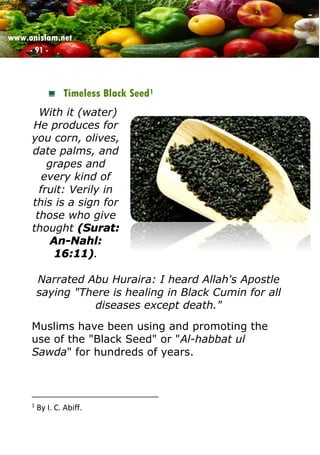
Timeless Black Seed1
With it (water)
He produces for
you corn, olives,
date palms, and
grapes and
every kind of
fruit: Verily in
this is a sign for
those who give
thought (Surat:
An-Nahl:
16:11).
Narrated Abu Huraira: I heard Allah's Apostle
saying "There is healing in Black Cumin for all
diseases except death."
Muslims have been using and promoting the
use of the "Black Seed" or "Al-habbat ul
Sawda" for hundreds of years.
1
By I. C. Abiff.
www.onislam.net
Healthy
Prophetic
Advices - 92 -
Black seed has also been in use worldwide for
over 3,000 years. However, many Muslims do
not realize that black seed is not only a
prophetic herb, but it also holds a unique place
in the medicine of the Prophet.
Black seed is mentioned along with many other
natural cures in the Hadith (sayings of the
Prophet Mohammad [PBUH]) and in the
Qur'an. However, many herbs and natural
cures in the Hadith and Qur'an are simply
"mentioned" briefly, leaving the bulk of the
descriptive narrative up to later Islamic
scholars such as Ibn Sina or Ibn Rushd.
Black seed is one of the few that is said to
"cure all diseases except death." It is unique in
that it was not used profusely before the
Prophet Mohammad who made its use popular,
and it is one of the few herbs that is described
in great detail in the Hadith with recipes and
instructions on usage actually being found in
the Hadith themselves. Last, but not least,
black seed has been studied by Muslims and
non-Muslims alike.
www.onislam.net
- 93 -
Although there were more than 400 herbs in
use before the Prophet Mohammad and
recorded in the herbals of Galen and
Hippocrates, black seed was not one of the
most popular remedies of the time. Because of
the way Islam has spread, the usage and
popularity of black seed is widely known as a
"remedy of the Prophet".
In fact, a large part of this herbal preparation's
popularity is based on the teachings of the
Prophet. The Prophet not only mentioned the
usefulness of black seed in his teachings, but
also gave specific instructions on how to
prepare the seed for medical use.
"The Prophet's Medicine" is a collection of
Hadith that instruct Muslims on the subject of
sickness or medical treatment. Since the black
seed is mentioned so prominently in these
writings, all eminent and famous hakims of the
past and present have written on the medicinal
benefits and healing properties of "kulunji."
In reality, since it was made popular in the
7th Century, there has not been a period in
www.onislam.net
Healthy
Prophetic
Advices - 94 -
Muslim history when the use of it was ever
stopped. At all times the seed was utilized with
the belief and faith that benefits will be derived
from practicing the Holy Prophet's Sunnah
(Hana, 2001).
The black seed (nigella sativa) is an example
of a prophetic remedy that has been studied
extensively by both Muslims and non-
Muslims. Nigella sativa has been used since
antiquity by Asian herbalists and pharmacists,
and was used by the Romans for culinary
purposes.
The name nigella comes from the Latin
word nigellus, meaning black. Nigella sativa
are small matte black grains with a rough
surface and an oily white interior, similar to
onion seeds. The seeds have little bouquet,
though when rubbed, their aroma resembles
oregano.
They have a slightly bitter, peppery flavor and
a crunchy texture. The seeds may be used
www.onislam.net
- 95 -
whole or ground and are usually fried or
roasted before use (they are easily crushed in
a mortar). However, although the seeds have
been used for thousands of years in the
kitchen, they have also been useful in the
pharmacy.
Modern Studies
Ahmad Akhtar studied the effects of the black
seed on nematoce worm infections in children
(Akhtar, 1999). The black seeds contain over
100 valuable components. Black seed is also a
significant source of fatty acids, proteins,
carbohydrates and other vitamins and
minerals.
The seeds are rich in sterols, especially beta-
sitosterol, which is known to have anti
carcinogenic activity (Tierra). The seeds are
also known to repel certain insects and can be
used in the same way as mothballs.
Black seed is also used in India as a spice and
condiment and occasionally in Europe as both
a pepper substitute and a spice. It is widely
www.onislam.net
Healthy
Prophetic
Advices - 96 -
used in Indian cuisine, particularly in mildly
braised lamb dishes such as korma. It is also
added to vegetables and dhal dishes as well as
to chutneys. The seeds are sprinkled on naan
(bread) before baking and to some Garam
Masala and Panch Phoran mixtures.
The Indians also use black seed medicinally as
a carminative and stimulant, and to treat
indigestion and bowel complaints. It is also
used to induce post uterine contractions and
promote lactation.
Despite the cure-all benefits of black seed, it
must still be used with wisdom and caution.
"The seed yields a volatile oil containing
melanthin, nigilline, damascene and tannin.
Melanthin is toxic in large dosages and nigilline
is paralytic, so the spice must be used in
moderation (the epicenter).
www.onislam.net
- 97 -
Barley: Ancient Food for Future Nutrition1
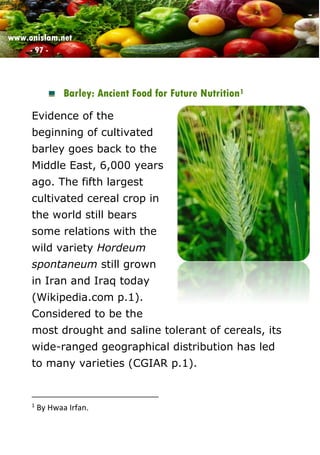
Evidence of the
beginning of cultivated
barley goes back to the
Middle East, 6,000 years
ago. The fifth largest
cultivated cereal crop in
the world still bears
some relations with the
wild variety Hordeum
spontaneum still grown
in Iran and Iraq today
(Wikipedia.com p.1).
Considered to be the
most drought and saline tolerant of cereals, its
wide-ranged geographical distribution has led
to many varieties (CGIAR p.1).
1
By Hwaa Irfan.
www.onislam.net
Healthy
Prophetic
Advices - 98 -
While an international consortium of scientists
focus a multimillion-dollar effort into gathering
local Afghanistan seeds to revamp their
agriculture, many Afghanis can be found eating
‘grass bread'.
The ancient grass barley is no longer available
due to environmental conditions making food a
scarce commodity. The consortium will re-
introduce barley and other cereals including
genetically ‘improved' seeds, but it is the hardy
barley that would provide the most benefit
right now (ICARDA p.1, 2).
Barley in Islamic Literature
Viewed as the only vegetation on earth that
can become a sole source of nutrition from
birth to old age, scholars of hadiths (prophetic
sayings) have understood barley to be very
www.onislam.net
- 99 -
nutritious, beneficial in coughs and
inflammation of the stomach, and to have the
ability to expel toxins from the body and act as
a good diuretic.
At least twenty-one hadiths recommend sattoo
(powdered barley). Talbina is a meal made
from satoo, formed by adding milk and honey
to the dried barley powder. The Prophet
Muhammad (peace be upon him)
recommended talbina for the sick and grieving
(Khan p.1). He is quoted as saying, “At-talbina
gives rest to the heart of the patient and
makes it active and relieves some of his sorrow
and grief” (Bukhari 7:71#593).
According to Ibn al-Qayyim, barley water using
five times the amount of water as barley,
should be boiled until the contents reduce to
www.onislam.net
Healthy
Prophetic
Advices - 100 -
three-quarters. This milky mixture is a thirst
quencher.
While for Firdous Al-Hikmat, a suspension
prepared from one part barley and 15 parts
water until the volume is reduced to two-thirds
after boiling is beneficial (Khan p.1-3). The
Japanese drank the pure juice from young
barley leaves in powdered form for a number
of years (Hagiwara p.4). Science has proven
the benefits of all of this and more.
Rediscovering Barley in Modern Research
Like most major crops grown today in the U.S.,
barley originated from the Middle East; and
like most Western countries, barley is grown
for animal feed with the high quality barley
reserved for the production of beer and other
alcoholic beverages (Levin p.1). Saudi Arabia is
www.onislam.net
- 101 -
the world's largest feed barley importer (Lee
p.3).
As a food, barley's long list of benefits include:
18 amino acids of which eight are the essential
amino acids that the human body cannot
produce, sodium, potassium, calcium,
magnesium antioxidants, glucan, iron, copper,
phosphorus, manganese, zinc, beta carotene,
vitamins B1, B2, B6, C, folic acid and
pantothenic acid. It also contains amylase,
dextrin, phospholipids, maltose, glucose,
sulfur, niacin and protein (herbsrainbear.com
p.1).
Dr. Howard Lutz of the Institute of
Preventative Medicine in Washington is amazed
at the properties of this grass. He referred to it
as “…the most incredible product of this
decade. It improves stamina, sexual energy,
www.onislam.net
Healthy
Prophetic
Advices - 102 -
clarity of thought and reduces addiction to
things that are bad for you.”
Now maybe one can better understand why the
Prophet (peace be upon him) advised its
consumption for the sick and grieving. After
all, it is at these times that one's poor appetite
can encourage further illness or even cause
one to seek satisfaction from harmful
substances. If one's mind is clear, one is also
better able to respect the cycle of life.
Dr. Yoshihide Hagiwara, a plant geneticist who
became disillusioned with the side effects of
modern drugs, researched 150 types of barley
over a 15-year period. Hagiwara, working at
the Office of Science and Technology and
Japan Food Analysis Center, discovered that
the high organic sodium content of barley
keeps calcium in solution form in the
www.onislam.net
- 103 -
bloodstream and it actually dissolves calcium
deposits in the joints.
Barley also replaces the organic sodium of the
stomach lining, which assists digestion by
improving the hydrochloric acid in the
stomach. The enzyme superoxide dismutase,
SOD, was isolated from barley and has been
found to be a powerful antioxidant that
protects the cells against the disease-causing
free radicals that destroy healthy cells
(Wheatgrass.com p.1, 2).
With no known contraindications, barley has
been a remedy for indigestion, diarrhea, and
inflammatory conditions of the stomach and
bowels. The soothing effect on the digestive
tract originates from the grain itself when the
husk is removed (Yahoo p.1).
www.onislam.net
Healthy
Prophetic
Advices - 104 -
Fresh Barley, Powdered Barley, Barley
Juice and Barley Soup!
Hazim asked Sahl, “Did you use white flour
during the lifetime of the Prophet?” Sahl
replied, “No.” Hazim asked, “Did you use to sift
barley flour?” He said, “No, but we used to
blow off the husk (of the barley)” (Bukhari
7:65 #321).
This shows knowledge of how best to get the
benefits from barley. As a slow digesting food,
it is recommended during the fasts of Ramadan
when one's diet should differ from one's
normal diet in simplicity.
In traditional Chinese herbal medicine, the
dried or germinated shoots of the common
variety, Hordeum vulgare, are used to improve
poor digestion as the result of a weak spleen
www.onislam.net
- 105 -
and abdomen, anorexia and abdominal
distension.
Combined with hawthorn fruit, it stops milk
secretions and painful breasts and is thus not
recommended for lactating women. It is also ill
advised for pregnant women as it promotes
contractions. It is of benefit, however, during
the process of childbirth (Reid p.136).
Barley water using 3 tablespoons of barley
boiled in 3 cups of water for one hour and then
strained and cooled is placed on the face as a
skin freshener, meanwhile cleansing and
softening normal skin. After rinsing, any left
over water can be refrigerated. Drinking barley
water clears the skin.
Honey and orange juice can be added to make
it more palatable (herbsrainbear p.1, 2). Added
www.onislam.net
Healthy
Prophetic
Advices - 106 -
to diluted cow's milk, it becomes a nutritional
drink for young children (Yahoo p.1).
Biologist Yasno Hotta of the University of
California identified P4D1 in barley, which has
a strong action on human DNA. PD41
suppresses and cures cell death and delays
aging as well as curing pancreatitis, stomatitis
(inflammation of the oral cavity), dermatitis,
lacerations of the stomach and duodenum.
He also found barley water or juice to be
stronger than steroid drugs with fewer side
effects. Dr. Hagiwara found damaged DNA
repaired itself quickly when barley juice was
added. The high chlorophyll content in barley
neutralizes and removes toxins from the body.
Experiments show chlorophyll to be similar to
human hemoglobin and when given to anemic
www.onislam.net
- 107 -
animals, the red blood cell count returned to
normal within 4 -5 days of administration
(Hagiwara p.5, 6).
Today, the US Department of Agriculture's
Plant Genome Research Program is trying to
map 40 countries. It's sub-project, the North
American Barley Genome Mapping Project
using 50 scientists and 26 universities and
federal laboratories in the US and Canada,
means to identify the genes of barley as it is
viewed as an economically important crop
(ehpnet p.1, 2).
In terms of crop improvements, plant scientist
Dr. A. Rafiq Islam of Australia has produced a
hybrid of wheat and barley in wheat
cytoplasm. His stocks have been utilized in 200
laboratories around the world for the mapping
of protein and isozyme genes and he is
currently researching into the water and saline
tolerant genes found in the wild variety only
www.onislam.net
Healthy
Prophetic
Advices - 108 -
found in the Middle East in order to improve
wheat (adelaide p.1).
The variety ‘Rihane 03' is produced by ICARDA
and is grown over 200,000 hectares in Iraq
due to increased yield. This could contradict
the aim to collect the wild variety as opposed
to the ‘pedigree' varieties grown in developed
countries (CGIAR p.2).
Would it not be more profitable to look at
improved means of sustainable farming
practices? Otherwise it would seem that we
stand to lose the heritage of Hordeum
spontaneum. With famine and war everywhere,
this provides the immediate answer to
appropriate food aid preventing disease and
malnutrition.
www.onislam.net
- 109 -
In addition, as an introduced crop where food
is scarce, barley could act as an important
source of food providing an economic base
beneficial to both humans and animals. It is
only global food politics that prevents the best
use of the world's natural resources and the
world's most nutritional plant.
Barley Soup – Yemen
1 cup dried barley, ½ cup dried lentils, 6 cups
of water, 3 small diced onions, 2 tablespoons
olive oil, 1 tsp. tumeric, ½ tsp. ground black
pepper, 1 cup of cooked chickpeas.
Fry onions in hot olive oil until golden.
Combine in a saucepan with all the other
ingredients except for the chickpeas and bring
to a boil. Reduce the heat and simmer for 1 -
1½ hours stirring occasionally. Add chickpeas
near the end of cooking time. Bon appetite!
www.onislam.net
Healthy
Prophetic
Advices - 110 -
Pros & Cons of Garlic's Medicinal Properties1
Garlic, despite its
offensive odor, has
remained a part of the
domestic arena with
properties established
in traditional and
holistic healing
practices. Natural
healers know that
garlic is a powerful
medicine.
Recently, however, modern medicine has also
studied garlic as more and more bacteria
become increasingly resistant against man-
made antibiotics. In their studies, scientists
1
By Hwaa Irfan.
www.onislam.net
- 111 -
have found that garlic is indeed a powerful
healer but that it does not come without some
dangers and side-effects. Natural healers are
aware of these side effects as well and often
take them into consideration when suggesting
garlic as a medicine.
The scent of garlic is one of its potentially
harmful side-effects. Scent has a powerful but
subtle affect on the mind-body relationship.
The Prophet Mohammad (PBUH) once informed
his followers: "Whoever has eaten [garlic]
should not approach the mosque" (Sahih
Bukhari 7:65 #362). At first this might seem
like a personal request, but when one looks
deeper, a larger picture can be seen through
vibrational medicine.
Within the subtle energies of the human body,
the odor of garlic blocks the throat, abdominal
www.onislam.net
Healthy
Prophetic
Advices - 112 -
and base chakras. Chakras are energy centers
in the body. All things being related, when the
throat chakra is blocked there is an inability to
express oneself emotionally.
When the abdominal chakra is blocked there is
a sense of self-affliction with psychosomatic
illnesses. Awakened, there is an ability to
master one’s desires followed by increased
intuition. Pertaining to the environment of the
mosque, the odor would disturb one’s intent
and affect one’s ability to submit in prayer.
The base chakra is concerned with the sense of
being grounded. It influences the lower
extremities as used in sujud (prostration),
especially the thigh muscles and tissues and
the circulation in the feet. When one isn’t
grounded, there are hidden fears and an
inability to focus on important issues.
www.onislam.net
- 113 -
When this chakra is awakened, one is calm and
more able to initiate spiritual practices. If one’s
mind is agitated in the state of prayer, then
the act of prayer becomes purely physical.
Therefore, the unity in congregational prayer
becomes disturbed on an energy level.
As such, the sulfur content in garlic interferes
with vibrational healing remedies and methods
(Gurudas, p.62, 63). Fortunately there is a
quick cure for this odor: chewing a sprig of
parsley can eliminate any odor before visiting
the mosque.
Medical science has also found a reason,
however, why the odor of garlic is unpleasant
and sometimes harmful. On the physiological
level, when garlic is crushed, the sudden air
exposure activates the enzyme allinase, which
forms allicin (Gislason, p.3).
www.onislam.net
Healthy
Prophetic
Advices - 114 -
Allicin is the principle aromatic property in
garlic that contains the sulfur containing
terpene, the source of the odor. The process of
cooking destroys the allinase. The sulfur in
allicin releases bile from the gall bladder and
decreases cholesterol in the liver
(Indiantimes.com p.1).
Allicin destroys the hydrogen required by
bacteria and interferes with the DNA
polymerases needed for the replication of
bacterial chromosomes (Healthology, p.2).
When there is deficiency of iron in the blood,
the sulfur interferes with vibrational medicine
due to the sulfuric interaction with the
ammonia in the skin (Gurudas, p.63).
Even though, this interaction with the skin can
sometimes prove useful as well. Dr. Ronald
Cutler and his team at the University of East
London developed a cream containing allicin in
www.onislam.net
- 115 -
a stable but odorless form. Tested against 30
different samples of Staphylococcus aureus
taken from patients, the extract killed all
samples of the bacteria.
Dr. Jaya Prakash of the National University of
Health Sciences in Illinois, U.S., also found
allicin affective against the bacteria
enterococci, now resistant against the
antibiotic vancomycin (Reuters, p.1, 2).
Further laboratory studies have shown garlic
capable of preventing the growth of 23
organisms. Two of these are campylobacter
and helicobacter. Campylobacter and
helicobacter are animal pathogens that have
become human gastrointestinal pathogens.
Campylobacter causes acute gastroenteritis
and is viewed as a precursor to acute
neurological diseases. It affects the young who
www.onislam.net
Healthy
Prophetic
Advices - 116 -
may be exposed to contaminated animal
products and water. Helicobacter causes
chronic gastritis and has a role in the formation
of peptic ulcers (Perez, p.1).
They have become increasingly resistant to
antibiotics and made research on natural
remedies imperative (MRC, p.2). Evidence
shows that garlic supports the development of
the natural bacterial flora whilst killing
pathogenic organisms.
Countless Components & Benefits
Another of garlic’s many components is
selenium. However, the amount of selenium is
dependent on where the garlic is grown.
Selenium is a part of the enzyme gluthathione
peroxidase, which helps to detoxify the body
by converting the hydrogen produced from
www.onislam.net
- 117 -
white blood cells fighting foreign substances
into water. Selenium is effective in destroying
the chronic yeast infection caused by the
fungus candida albicans (Healthology, p.2).
Professor Cywes of the South African Red
Cross Hospital discovered a very serious case
of candida infection when he operated on a
baby. The infection had spread throughout the
length of the esophagus and gastro-intestinal
tract.
By agitating, centrifuging and finally
supernating crushed garlic in some water; they
were able to clear the infection by adding the
garlic solution to the baby’s milk. The infection
was eliminated within 48 hours. The solution
was the equivalent to a bulb and a half of
garlic daily (MRC, p.1).
www.onislam.net
Healthy
Prophetic
Advices - 118 -
The anti-clotting component in garlic, ajoene,
is not present in preparations like garlic oil and
tablets. It is released in the process of
ingesting freshly crushed garlic (Gisalon, p.3).
By preventing blood clotting, which builds-up
plaque, one prevents the hardening of arteries
that contribute to heart disease (Indiantimes,
p.1).
However, anyone who takes blood-thinning
drugs like Ticlopidine and Coumadin should
avoid garlic, as a reaction occurs between
these drugs and garlic –causing excessive
bleeding to occur (Healthology, p. 1,2).
Thirty years of research has shown garlic to be
effective in reducing cholesterol levels. Fresh
garlic oxidizes blood fats that would otherwise
increase the risk of heart disease and is
affective in cancer prevention (HRF, p.2). A
1994 study of 41,000 women who consumed a
www.onislam.net
- 119 -
weekly serving of garlic demonstrated a 35%
decrease in the risk of colon cancer (HRF, p.2).
Garlic is known to reduce systolic blood
pressure and lower the blood sugar. However,
this means that garlic would not be the herb of
choice for many hypoglycemics (those who
suffer from low blood sugar).
Like all herbs, therapeutic amounts on
personal biochemistry, contrary to mass-
produced drugs. For instance, those with
sensitive stomachs may not be able to tolerate
raw garlic.
In Germany, herbs are sold for therapeutic use
and are under obligatory standardization. The
German Commission determined that 4000mcg
of allicin is the equivalent of the required
therapeutic dose (Healthology, p.2).
www.onislam.net
Healthy
Prophetic
Advices - 120 -
The virtues of garlic do not outweigh the
disadvantages. Both aspects have a place in
the scheme of things. However, like most
things, one has to recognize how and when
best to use it.
www.onislam.net
- 121 -
Allah's Medicine Chest: Lemons1
Lemons are just one
example of the
simple bounties
Allah has provided
us with. Although
they may just be a
"customary fruit,"
they contain
flavanoids, which
are often referred
to as 'natures
biological
modifiers,' because
of their ability to modify the body's reactions to
other compounds such as: allergens, viruses
and carcinogens.
Lemons are usually known for their high
content of Vitamin C - four times higher than
that of oranges. Hungarian scientist, Albert
Szent-Gyorgi, uncovered a synergy between
1
By Hwaa Irfan.
www.onislam.net
Healthy
Prophetic
Advices - 122 -
pure vitamin C and a then unidentified co-
factor in the peels of lemons and called the
resulting compound Vitamin P.
Still known as such, Vitamin P particularly
benefits the capillaries by reducing pain and
improving blood circulation. It also heals
cataracts, decreases bile production, alleviates
herpes and lowers blood cholesterol levels
(Murray, p. 1).
Other important properties of lemons are their
mineral contents. They contain 48.3%
potassium, which nourishes the brain and
nerve cells; 29.9% calcium, which builds
strong bones and teeth; and 4.4% magnesium,
which in conjunction with calcium, plays an
important part in the formation of albumen in
the blood.
www.onislam.net
- 123 -
In addition to their nutritional benefits, the
smell and the taste of lemons can help fuel a
general release of stress. In aromatherapy,
lemon oil is used as a muscle relaxant and a
skin and circulation stimulant. Rubbed on the
face, lemons open up the pores releasing heat
and refreshing the skin.
Lemons have other therapeutic effects on the
body as well. Drinking lemon juice helps
cleanse the lymphatic system, invigorate skin
tissue and increase the blood flow (Gurudas, p.
167). This might be one reason for the
popularity of lemonade on a hot, sticky day.
Eaten during pregnancy, lemons help build the
developing baby's bones. Lemons also aid in
the digestion of heavy meals by producing the
www.onislam.net
Healthy
Prophetic
Advices - 124 -
necessary enzymes and in the assimilation of
protein, calcium, zinc and vitamins.
Lemons also have cholesterol-lowering
properties, thus preventing hair loss and even
causing hair regeneration. They counteract
cases of anxiety and depression; stimulate the
liver and the gall bladder, causing a release in
congestion; stimulate the formation of valuable
leukocytes in the fight against viral and
infectious diseases; drain excess water in
cases of water retention; reduce uric acid; and
stimulate the lymphatic system in cases of
cellulite and obesity (Gurudas, p. 168).
In order to fully benefit from their effects,
lemons should be consumed without sugar.
Otherwise the negative effects of the sugar
(such as lowering immunity, interfering with
digestion and leeching vitamins and minerals
www.onislam.net
- 125 -
from the system) may outweigh their beneficial
effects.
The limonenes and liminoids in lemons, and
other citrus fruits, increase the activity of
enzymes that detoxify certain carcinogens.
These alkaloids bind mutated cells and help the
body to eliminate them before they become
carcinogenic (Messina p.2).
Health Tips
 To relieve a cold and sore throat, mix a
teaspoon of honey and the juice of one lemon,
in a glass of water and drink every two hours.
Another family remedy, which I use frequently,
is a clove of crushed garlic, mixed with half a
lemon and sweetened with honey. This usually
clears up anything I may be "coming down
with" by the time Fajr prayer arrives.
www.onislam.net
Healthy
Prophetic
Advices - 126 -
 For cystitis, to acidify the urine and to stop
bladder infections, drink a glass of cherry juice,
lemon juice and water on an hourly basis at
the first sign of infection (Stein, p.169).
 For fevers, hot water and lemon juice will
support and speed up the fevering process,
helping the body fight-off infections or toxins.
Without the fever, the immune system has
fewer ways to combat the disease. However, if
there are bowel problems this should be
avoided (Stein, p. 169).
 For children, rub the body with two halves of a
lemon to open the pores of the skin and
release the body heat.
 To help proper assimilation of calcium and
other minerals, or for leg cramps, sip a warm
glass of water with a teaspoon of lemon juice
(Stein, p.238).
 As a mouthwash, lemons are more natural
then fluoride and effective in removing plaque.
They also whiten and strengthen tooth enamel
(Gurudas, p.167).
www.onislam.net
- 127 -
 For diphtheria, use pure lemon juice every
hour as a gargle and swallow some until it cuts
loose the false membrane in the throat.
 One tablespoon of pure lemon juice before
each meal relieves asthma, (Kloss, p.660).
 In cases of excessive menstruation, the juice
of 3-4 lemons a day will help.
Cooking Tips
With an increase in low-fat cooking, lemons
have become more popular in the West,
because of their ability to add sparkle and
freshness to dishes. Lemons add a clean, yet
complex flavor to dishes that were previously
laden with salt or fat.
Lemons, which cleanse the system, can replace
vinegar, which opposes the action of gastric
juices.
www.onislam.net
Healthy
Prophetic
Advices - 128 -
Homemade Mayonnaise
Slowly pour corn oil, a beaten egg and a pinch
of salt to the juice of half a lemon. This makes
one small jar, which can be added as a sauce
to other recipes.
Lemon Zest
After lemons are washed and dried, use a
grater to remove the outer yellow layer of the
peel. This "zest" can be placed in a freezer for
future use (Vegetarian Times, p.6).
Preserved Lemons
This is a Middle Eastern recipe used to flavor
chicken dishes, stews and salads. Wash the
lemons well and cut them into quarters (but
www.onislam.net
- 129 -
not all the way through) or in half if you are
using limes. Put them in a wide necked jar
(preferably glass or clay). Press the lemons
down with a weight and add salt and water.
The salted juices preserve the peels, which will
soften and mellow in a month. The juice can be
used for seasoning (Roden, p.63).
Remember that Allah (SWT) gave us
everything we may need. We merely adapt
that bounty to the times by making new
discoveries or rediscovering old applications.
www.onislam.net
Healthy
Prophetic
Advices - 130 -
Parsley: Herbal Multivitamin1
"It is Allah Who
made out of the
things He
created, some
things to give
you shade; of
the hills He
made some for
your shelter;
He made you
garments to
protect you from heat, and coats of mail to
protect you from your (mutual) violence. Thus
does He complete His favors on you that ye
may bow to His Will (in Islam)." (Surat An-
Nahl: 16:81).
1
By Nora Belfedal.
www.onislam.net
- 131 -
Allah has always provided us with trees for
shelter, plants for nourishment, and flowers for
healing. He also says, "O men! Eat the lawful
and good things out of what is in the earth,
and do not follow the footsteps of the Shaitan;
surely he is your open enemy." (Surat Al-
Baqara: 2:168).
Parsley is one example of these "lawful and
good things" that is easily accessible and easy
to use. Because it exists all over the world and
grows in mostly every climate, parsley is too
often underestimated. Cheap and easy to
cultivate (it can be planted twice a year) it is
usually used as a garnish in Western
restaurants.
However, Muslims long ago discovered that
this plant might contain some benefits beyond
www.onislam.net
Healthy
Prophetic
Advices - 132 -
just decorating the dinner table. Perhaps this is
because parsley is an indigenous herb in
Middle Eastern cuisine.
Originally from Sardaigne, it is also
called Petroselimum Sativum from the Greek
word Petrosolinon, which means "leaves of
rocks." Although modern science can
distinguish up to 40 varieties of parsley, only
two are widely used in the kitchen: the curled-
leaf and plain-leaf (or Italian) parsley.
The flat-leafed (or Italian) parsley looks like
the Chinese cilantro to some people, so it is
important to properly identify the herb
(Alternet.org). New parsley has been recently
found (1978) in the sea as well. It is called sea
parsley and resembles red seaweed. This new
sea-parsley contains almost as many vitamins
www.onislam.net
- 133 -
and amino acids as earth parsley
(Collabo.com).
Hippocrates once has said, "May your diet be
your medicine." Today many herbalists around
the world recommend parsley as one of these
medicinal foods and as a revitalizing spring
tonic. "In addition to providing essential
nutrients, it balances the energy of the organs
improving their ability to assimilate and utilize
nutrients," writes Dr Gillian McKeith in her
book Living for Health (McKeith, p.21).
According to U.S. Department of Agriculture
(USDA) statistics, one cup of minced parsley
contains more beta-carotene than a large
carrot, almost twice as much vitamin C as an
orange, more calcium than a cup of milk, and
20 times as much iron as one serving of liver
(Hurley).
www.onislam.net
Healthy
Prophetic
Advices - 134 -
"Parsley is just like an immune-enhancing
multivitamin and mineral complex in green
plant form," writes McKeith (McKeith, pg.4).
She compiled the following list of all the
vitamins and minerals parsley contains:
1. Vitamin A or beta-carotene: used for
improving night vision and healthy skin.
2. All B Vitamins, especially B2, which is
required for the use of oxygen and amino
acids; B3, which is necessary for cell
respiration and helps in the release of
energy; and B9, which is a DNA
synthesizer.
www.onislam.net
- 135 -
3. Vitamin C: protects body against
pollutants and helps synthesizing
neurotransmitters.
4. Vitamin E: powerful antioxidant and
protects cells from ageing.
5. Vitamin K: used to control blood clotting
and synthesize liver proteins.
6. Iron: needed for the production of
hemoglobin and for energy.
7. Manganese: helps the body to utilize
vitamin C, produces sex hormones and
breast milk.
8. Potassium: needed for growth, building
muscles and nerve transmission.
www.onislam.net
Healthy
Prophetic
Advices - 136 -
9. Zinc: necessary for immune system
function and protects against skin
problems like acne.
10.Calcium: necessary for strong bones,
teeth and hair (note that dried parsley
contains more calcium than the fresh
plant).
Parsley is also very abundant in fibers and
chlorophyll, which purify, stop the spread of
bacteria and help to increase immune
response. It also contains many other
important nutrients such as: lysine, glutamine,
and vanadium (anyvitamins.com and
aprifel.com).
The Prophet Mohammad (PBUH) said, "There is
no disease that Allah has created, except that
www.onislam.net
- 137 -
He has also created its treatment" (Bukhari).
Indeed, through the ages, parsley has been
used to treat several diseases such as cough,
hair growth, arthritis and rheumatism. "It has
helped in passing all stones in bladder
infections," writes Varro E. Tyler, in his
book Herbs of Choice (Tyler, p.76).
Furthermore, parsley is a cleansing agent for
the kidneys, liver and bladder and has a
draining effect on cellulites. For women, it
ameliorates estrogen production, nourishes the
blood of the uterus and assists women with
menstruation issues such as PMS and
menopause.
Although it is an important herb for women,
pregnant women should not use it, for it may
bring on early labor by stimulating uterine
www.onislam.net
Healthy
Prophetic
Advices - 138 -
contractions. Nursing women should also avoid
it as it may dry up milk (allheath.com).
Finally, parsley also has uses around the
home. It can keep a room smelling fresh and
clean. When a person is frying food, a branch
of parsley in the oil will keep the smell of the
oil from spreading throughout the house. In
this way parsley can assist Muslims in not only
being healthy, but in maintaining a clean home
as well.
www.onislam.net
- 139 -
Stevia: Bittersweet Story1
Stevia is an herb
that holds promise
as a non-caloric,
natural sweetener.
Though it may not
yet be swirling
around in your
coffee or tea,
stevia has been
used as a healing herb in South America for
hundreds of years. Stevia is steeped in folklore
and immersed in controversy.
Stevia is a member of the chrysanthemum
family of plants. Originally, stevia grew wild in
the highland regions of Northern Paraguay and
Southern Brazil. The Guarani Indians used it
1
By Stephanie Rose Bird.
www.onislam.net
Healthy
Prophetic
Advices - 140 -
since ancient times. Spanish and Portuguese
farmers cultivated it. The late 19th century
doctor, Moises Santiago Bertoni, was the first
Westerner to discover it and champion its use.
Its scientific name, Stevia rebuadiani Bertoni,
was punned in honor of Rebuadi, a Paraguayan
chemist, and Dr. Moises Santiago Bertoni.
Stevia grows in China, Japan and other Asian
countries, South America, India, Europe and
the United States.
What Makes Stevia Different from Other
Sweeteners
In the past, natural products such as honey,
sugar and maple syrup were our primary
sweeteners; today, the sugar shelves are
crowded with both natural and synthetic
products. Sweet ‘n Low ™ (saccharin),
www.onislam.net
- 141 -
NutraSweet and Equal ™ (aspartame) and
Splenda ™ (sucralose) are the industry giants.
Sweet ‘n Low ™ is labeled with warnings
because it causes cancer in laboratory animals,
while NutraSweet ™ has been under close
scrutiny by consumers and the FDA for years.
Drs. Richard and Rachel Heller, authors of The
Carbohydrate Addicts Life Span
Program assert, “The sweetness of sugar
substitutes can falsely signal [to the] body that
a 'sweet meal' is coming and excess insulin
may be released so as to handle the expected
onslaught of high caloric foods.
When no carbohydrates are forthcoming, the
high levels of insulin that remain can easily
lead to increases in cravings, weight-gain and
associated health risks.” (Heller, R. 2000).
www.onislam.net
Healthy
Prophetic
Advices - 142 -
The Hellers contend that sugar substitutes are
addictive. Another disturbing finding points to
a carbohydrate, insulin and fat connection.
There are indications that excessive amounts
of insulin in the bloodstream cause us to store
more fat and crave starches, snack foods and
sweets-this, of course, delivers a double
whammy for weight-watchers.
Linda and Bill Bonvie, investigative reporters
and vocal proponents of Stevia, point out that
75% of all non-drug related consumer
complaints are concerning aspartame.
Dizziness, headaches, seizures and multiple
sclerosis-like symptoms have all been
reported, yet the FDA will not take action
against the aspartame manufacturer.
The relationship between consumers, the FDA,
artificial sweeteners and the naturally sweet
www.onislam.net
- 143 -
herb Stevia is intense. Some people prefer
Stevia to artificial sweeteners because it is
natural. Stevia also has health benefits. It
contains vitamins and minerals and it has been
used to treat indigestion, tooth decay and skin
disorders.
Stevia in the Midst of Trade Wars
Stevia has enjoyed widespread use in Japan
and a few other countries since the early
1970s. In Japan, there is a multimillion-dollar
market for stevia, with a 41% market share of
the sweetener industry. It is used in Japan in
ice cream, candies, pickles and soft drinks
(Bonvie, L; Bonvie, B, 1996).
Initially there was a great deal of enthusiasm
for Stevia within tea manufacturing
corporations in the United States. Thomas J.
Lipton ™; Celestial Seasonings™; Traditional
Medicinals™ and smaller companies added
www.onislam.net
Healthy
Prophetic
Advices - 144 -
Stevia to certain blends, which presumably
sold well.
In the 1980s, representatives from an
anonymous firm lodged a trade complaint with
the FDA against the importation and use of
Stevia (Bonvie, L; Bonvie, B, 1998). Though
Stevia had been health tested internationally
for over 50 years, in 1991 the herb was placed
on “import alert” (No: 45-06, May 17, 1991).
A virtual banishing of Stevia in the United
States followed. In 1994, the FDA was forced
to modify its alert because of the DSHEA
(Dietary Supplement Health and Education
Act). This act allows Stevia to be sold as a
dietary supplement (Bonvie, L; Bonvie, B,
1996).
www.onislam.net
- 145 -
The United States government continues to
restrict its use in teas and other food products.
It cannot be sold in the sugar or artificial sugar
section of the supermarket. Stevia
manufacturers cannot package the herb with
imagery that suggests that it is a sweetener for
coffee and such, though it is. Apparently, the
FDA still believes Stevia is an “unsafe food
additive” and a potential health threat (Bonvie,
L; Bonvie, B, 1996).
In 1997, reports that Stevia is a potential
cause of hypoglycemia (low blood sugar)
circulated as a result of the graduate work of
Brazilian Maurio Alvarez. Alvarez believes his
study was taken out of context (Bonvie, L;
Bonvie, B, 1998).
To this day, no scientific test has demonstrated
that Stevia poses any health threats. The Herb
www.onislam.net
Healthy
Prophetic
Advices - 146 -
Research Foundation (HRF), America’s
foremost source of accurate, science-based
information on the health benefits and safety
of herbs and dedicated to responsible informed
self-care with medicinal plants, put out a very
strong endorsement for Stevia.
“The FDA took action against Stevia, not based
on any proclamation by the FDA toxicologist or
consumer complaints, but because of a
complaint from a company that didn’t want
Stevia on the market.” This statement was
made by Robert S. McCaleb, founder and
director of HRF.
McCaleb is an internationally recognized
authority on scientific and regulatory issues
affecting herbs.
Common Forms of Stevia
www.onislam.net
- 147 -
You will have to look long and hard to find
Stevia even at large health food markets such
as Whole Foods. It might be found near
additives such as enzymes, brewers yeast or
even protein powders, though clearly it
belongs on the shelves with sweeteners. Here
are the common forms of Stevia sold in the
US:
Dried Leaves: Pulverized leaves, sold by the
pound or as a tea. The leaves are green
making them useful to blend into homemade
remedies and personal tea blends. The leaves
have a flavor (which some find offensive)
similar to anise, fennel or licorice. Leaf powder
is estimated to be 30 times sweeter than
sugar. (Bonvie, L; Bonvie, B, 1996).
Liquid
One form of the liquiliquefied Steviad is an
extract concentrated black liquid, resulting
www.onislam.net
Healthy
Prophetic
Advices - 148 -
from boiling the leaves in water. This type is
black. Clear liquid extracts are also available,
readymade by various manufacturers.
Liquefied Stevia extract is estimated to be 70
times sweeter than sugar. (Bonvie, L; Bonvie,
B, 1996) (Most liquid forms of Stevia are best
avoided by Muslims as they are formed by
using alcohol).
Extract Powder
For those seeking convenience, the extract powder is
the best choice. The power is isolated compounds of the
naturally sweet constituents in Stevia, Rebaudioside A
and Stevioside, sold as a white powder in packets
similar to the new sweetening product, Splenda ™ and
the other packaged sweeteners.
The white powder is estimated to be 300 times sweeter
than sugar and heat stable to 198 degrees Celsius (388
degrees Fahrenheit) (Bonvie, L; Bonvie, B, 1996).
Pros & Cons of Stevia
Cons:
 Some manufacturers adulterate Stevia with other
products, even sugar.
www.onislam.net
- 149 -
 Some customers have complained that Stevia causes
headaches and tastes awful [Amazon.com customer
reviews of ‘The Stevia Cookbook’ (Sahelian, R; Gates, D,
1999)].
 No conclusive reports on safety.
 Not regulated as a food, but rather as a supplement.
 Not always clear how to use it to replace sugar or sugar
substitutes.
 Difficult to use for baking, does not react as with other
leaveners nor does it caramelize.
Pros:
 Nutritious; contains vitamins and minerals.
 Shown to attack plaque, improving oral hygiene and
health.
 Safe to use for diabetes, obesity and those with high
blood pressure.
 You can grow it yourself.
 Contains no calories.
 Has no impact on blood sugar.
 All natural.
Conclusion
 Anything in excess is toxic.
 Read labels carefully. Make sure that if the product is
enhanced it is enhanced with substances you approve
of. Some Stevia powders contain fiber that quickly acts
www.onislam.net
Healthy
Prophetic
Advices - 150 -
as a strong laxative if combined with coffee (a known
laxative).
 Buy from reputable sources, as prices vary widely from
manufacturer to manufacturer.
 Allergists suggest adding new substances, even natural
ones, to the diet slowly and watching carefully for any
unusual or troubling symptoms.
 Stay tuned for more about Stevia.
www.onislam.net
- 151 -
Chapter III: Herbs in Modern
Healthcare:
Ibn 'Abbas (may Allah be pleased with them)
reported: Messenger of Allah said, "Do not drink in
one gulp like a camel, but in two or three (gulps).
Mention the Name of Allah (i.e., say Bismillah) when
you start drinking and praise Him (i.e., say Al-hamdu
lillah) after you have finished (drinking)." [At-
Tirmidhi].
www.onislam.net
Healthy
Prophetic
Advices - 152 -
Health and Nutrition of The Prophet: Prophetic
Sayings & Modern "Discoveries"1
A tradition states,
“There are no new
ideas, just new
people to discover
them." It is, in fact,
amazing to find how
many "modern
discoveries" have
already been
written about in the
Qur’an or Hadith.
There are a number
of words of advice
and nutritional habits of the prophet (PBUH)
that have substantial support in recent
scientific literature. Among this advice is that
we should eat whole foods, we should combine
1
By Karima Burns.
www.onislam.net
- 153 -
foods properly, we should eat foods in their
seasons, and we should not drink with meals.
In Sahih Al-Bukhari, a number of examples can
be found showing how carefully the prophet
combined foods. One hadith relates, "A man
from among the Companions of the Prophet
(PBUH) said, ‘The Prophet (PBUH) forbade
(mixing) unripe dates and dried dates, and
(mixing) raisins and dried dates. Aisha, (may
Allah be pleased with her), related that, "The
Apostle of Allah (PBUH) used to eat melon with
fresh dates, and he used to say, ‘The heat of
the one is broken by the coolness of the other,
and the coolness of the one by the heat of the
other.’ He was also said to have never
combined fish and milk.
www.onislam.net
Healthy
Prophetic
Advices - 154 -
Modern science supports these habits by
informing us that the combination of foods we
eat and the order in which we eat them are
very important factors in health. "Recently," it
has been found that foods require different
digestive processes in the body; thus, they are
most easily digested when combined properly.
Modern scientists say that improper food
combinations can cause a person to
inadequately digest their food, which can
create imbalances in PH levels, improper
absorption of nutrients, constipation or other
digestive troubles. Dr. Ted Morter, in Your
Health... Your Choice, advises us to not eat
fresh fruit with any other food, even dried fruit,
since it is a pre-digested food that moves
straight through the stomach and into the
intestines. When it is eaten with any other
www.onislam.net
- 155 -
food, it ferments itself and anything else that is
in the stomach.
The second advice given by Dr. Morter in his
book is that we should start each meal off with
something raw. The reason is that raw foods
contain the enzymes we need to digest our
food. His third rule of food combining is to
avoid mixing protein and starches. We may eat
starches with vegetables or vegetables with
meat, but we should do our best to avoid
combining starches and proteins. The reason is
that proteins and starches require completely
different environments for digestion.
Proteins need a more acidic environment while
carbohydrates and starches can be digested
much more quickly. When a person combines
them, neither food has the ideal environment.
www.onislam.net
Healthy
Prophetic
Advices - 156 -
Furthermore, a protein meal takes up to five
hours for the body to digest so it should be the
last meal of the day when your body is not
digesting other foods as well.
Improper food combining will not cause a
person to become immediately sick, but it will
prevent what they are eating from being
digested and utilized to the best of its ability,
which means they will need to eat more food
to get additional nutrients.
Modern allergists also advise against improper
food combining and tell us that many
combinations can create synergistic allergic
reactions. In the book The Whole Way to
Allergy Relief and Prevention, Dr. Krohn
advises us not to combine milk with chocolate,
www.onislam.net
- 157 -
mint, or fish; corn and bananas; beef and
yeast; eggs and apples; or cola and chocolate.
The hadith provide numerous examples of the
respect the prophet had for the purity and
value of water, and relate that he did not drink
while eating a meal. Sahih Bukhari relates
that, "The Apostle of Allah (PBUH) came out
from the valley of a mountain... there were
some dried dates on a shield before us. We
called him and he ate with us. He did not touch
water.” Experts in the field of food combining
inform us that water impedes the digestive
process in the stomach when eaten within a
half hour of a meal.
The Qur’an (Surat Al-Baqara: 2:168) advises
us, "Ye People, eat of what is on earth, lawful
and wholesome." In the time of the prophet,
www.onislam.net
Healthy
Prophetic
Advices - 158 -
the choices of food were simply related to
whether a food was halal or haram. However,
in modern times we have many more choices.
Many people have difficulty understanding
what "whole" foods are because so few people
actually eat whole foods. As few as two
hundred years ago, everyone consumed whole
foods because they did not have processed
foods as an option. In 1940, about 80% of the
nation consumed whole foods.
Abram Hoffer, MD, and Morton Walker, DPM,
report in their book, Putting it all Together:
The New Orthomolecular Nutrition, that today,
only 25% of the population actually eat "whole
foods."
A whole food is merely a food that has retained
its original constituents. An apple is a whole
www.onislam.net
- 159 -
food and applesauce made from fresh apples
at home in a grinder is a whole food. However,
applesauce ground and cooked by machines,
and then separated to create a better texture
and supplemented with sugar and color is not a
whole food. Wheat Berries are a whole food;
therefore, flour made from pure ground wheat
berries containing bran is a whole food. Flour
made by removing the bran and germ, and
then bleaching the final product (white flour) is
not a whole food.
Even some popular "health food" items fall into
the category of processed partial foods rather
than whole foods. This list includes rice cakes,
granola bars, pretzels, turkey and tofu hot
dogs, whole grain cereals, and frozen juices.
These so called "health foods" are only a
fraction more nutritious than their mainstream
processed counterparts.
It is important to eat whole foods (grains,
vegetables and fruits) because they contain all
the nutrients that we need to thrive as human
www.onislam.net
Healthy
Prophetic
Advices - 160 -
beings in their natural form. The more we
change them from their original state, the less
benefit we get from them.
With new vitamins and minerals being
discovered every year, it is increasingly
obvious that Allah’s "Mother Nature" is way
ahead of us, and we are not qualified to
duplicate His process through our efforts to
"enrich" processed foods in laboratories.
Bernard Jensen, in his book, Chemistry of Man
says, "Natural foods contain all the vitamins
that have been and will be discovered."
This apparent fact should make it obvious that
the only way we can guarantee we are getting
all of our nutrients is to get them from whole
foods. Attempting to build our health any other
way is to merely make an educated guess.
Furthermore, it does not make sense to eat
devitalized foods, and then spend time and
money buying vitamins and supplements, and
following various health programs.
www.onislam.net
- 161 -
In fact, processed foods actually have the
ability to leech nutrients from the system. E.
Cheraskin, in his book Diet and Disease,
reports that laboratory tests indicate that
processed foods do not have enough vitamins
and minerals to help in their own assimilation.
Pasta, for instance, does not have sufficient
amounts of vitamins, enzymes or even fiber to
aid in the digestive process.
Manufacturers claim their products contain
high nutritious value, but they can only claim
that by adding synthetic vitamins and minerals
that are not useful to the human body to them.
The elements that comprise organic minerals
are loosely held together so that when they
enter the body, they can easily be assimilated.
However, the constituent parts of inorganic
minerals are held together by bonds that are
so tight that the body cannot easily break
them apart; therefore, we rarely benefit from
their consumption.
www.onislam.net
Healthy
Prophetic
Advices - 162 -
The Qur’an (Surat Taha: 20:81) also advises
us to, "Eat of the good things We have
provided for your sustenance, but commit no
excess therein." The Prophet himself was
always known to eat fruits and vegetables
grown in the region in which he lived and in
season (Al-Akili, Medicine of the Prophet).
Donald Lepore, a nutritionist and author of the
book The Ultimate Healing System, has found
in his allergy relief therapies that, "God did not
permit foods that are antagonistic to man’s
existence to be grown in the area of
consumption."
We can often avoid most of our problems by
simply eating foods that are grown nearby and
in season. Bernard Jensen, in his book
Chemistry of Man, reports that unripe or
imported produce, often found in grocery
stores, is lacking in natural sodium among
other things.
www.onislam.net
- 163 -
Furthermore, he has found that the chemistry
of barley, for instance, warms the blood and is
thus appropriate for winter months, but is not
as advisable as a regular summer food unless
there is a "cold" illness involved.
As you read through Qur’an and the Hadith,
and compare them to modern scientific
"discoveries," you will find again and again that
Qur’anic and prophetic wisdoms are being
rediscovered.
This is, perhaps, one of the best reasons to
refer to Qur’an and the Hadith as not only the
starting point for all knowledge, but as a
"double-check" system for what we find in
secular literature as well.
www.onislam.net
Healthy
Prophetic
Advices - 164 -
Prophetic Medicine: An Old Prescription for a New
Era1
A genre of medical
writing intended
as an alternative
to the exclusively
Greek-based
medical systems
derived from
Galen was that
called at-tibb an-
nabawi or
"Prophetic
Medicine."
The authors were clerics, rather than
physicians, who advocated traditional medicine
as mentioned in the Qur'an and as practiced
during the life of Prophet Muhammad. It
concerned the medical ideas assimilated from
Hellenistic society, thereby producing a guide
to medical therapy acceptable to the religious.
1
By Hossam Arafa.
www.onislam.net
- 165 -
Therapy consisted of diet and simple
medications (particularly honey), bloodletting
and cauterization, but no surgery. Topics
covered included fevers, leprosy, plague,
poisonous bites, protection from night-flying
insects, protection against the evil eye, rules
for coitus eruptus, theories of embryology,
proper conduct of physicians, and treatment of
minor illnesses such as headaches, nosebleeds,
cough and colic. It was prohibited to drink wine
or use soporific drugs as medicaments.
The treatises also provided numerous prayers
and pious invocations to be used by the devout
patient, with the occasional amulet and
talisman, as they were particularly popular
between the 13th and 15th centuries. Some are
still available today in modern prints.
www.onislam.net
Healthy
Prophetic
Advices - 166 -
In contrast to many writers on this topic, the
historian and theologian adh-Dhahabi, who
died in 1348 (748 H), keenly attempted to
combine the traditional medicine of Arabia and
the revelations of the Prophet Muhammad with
the ideas and terminology from the Greek-
based system. He frequently cited Hippocrates
and Galen as well as medieval Islamic
physicians.
On the other hand, the popular treatise by the
religious scholar Jalal ad-Din as-Suyuti, who
died in 1505 (911 H), was based almost
exclusively upon what was known of medical
practices during the time of the Prophet. It was
derived from the Qur'an, traditions of the
Prophet known as Hadith, and the practices of
the early Muslim community.
www.onislam.net
- 167 -
Although a considerable number of Prophetic
Medicine treatises were written, we do not
have the name of any medical practitioner
known for practicing this type of medicine. The
reason for this, of course, may well be that our
written sources are for the most part skewed
towards the Greek-based system and have
omitted details of other practices.
The treatises on Prophetic Medicine appear to
have been addressed to the same audience as
the Islamic tracts on the plague. Both types of
writings were especially popular in the 13th and
14th centuries, and later.
The plague tracts have as their primary focus
the collection and interpretation of various
hadiths that were considered relevant to the
www.onislam.net
Healthy
Prophetic
Advices - 168 -
concept of infection and the appropriate social
reaction to contagious diseases.
They also attempted to offer some medical
explanations and remedies for the plague, and
sometimes a historical documentation of the
plague up to that time. They, like the treatises
on Prophetic Medicine, were mainly written by
religious scholars, although a few were
composed by writers trained both as physicians
and theologians.
Most Commonly Documented Prophetic Remedies:
Henna
Henna (scientifically known as lawsonia
inermis) has been well known for a long time
in the Muslim world. It is extensively grown in
www.onislam.net
- 169 -
India and Sudan, and is used mainly for
cosmetic purposes.
The plant is sometimes called the "Magic Plant"
because it has a great healing effect, contains
many healing substances like tannine and
other glue-like substances, and it has an anti-
microbial and an anti-viral effect.
It is natural, inexpensive, and has no known
side effects when taken orally.
Indications for its use are as follows:
Burns: It is very effective when applied to a
first or second degree burn. It: -reduces pain.
-reduces fluid loss from the burn site, which is
important if the area is large. -has an anti-
microbial effect, and so reduces the risk of
infection. -sticks on the wound site until
healing is complete. -is easy to apply either in
www.onislam.net
Healthy
Prophetic
Advices - 170 -
paste or powder form. -is inexpensive and
easily available.
Healing Properties: Henna promotes wound
healing, especially chronic wounds and ulcers.
The main cause of this is not known, but it
may be its nourishing effect on the wound and
its anti-microbial properties.
Anti-Hemorrhage Effect: Henna has proven
to be efficient in the management of nose
bleeding (epistaxis), providing a long-lasting
cure. One dose is generally sufficient. It is
more successful than cauterization, which
normally has to be repeated and cannot
guarantee that there will not be a recurrence
of bleeding.
www.onislam.net
- 171 -
The only side effect of henna here is that it can
cause slight sneezing. Henna can be used at
other sites like a bleeding duodenal ulcer or
oesophageal varicose veins, with no known
side effects. Its anti-bleeding effect may be
due to its coagulation or local burning
properties.
Anti-Viral Effect: Henna has an anti-viral
effect. This is evident in its treatment of warts
(particularly those that are resistant to liquid
nitrogen treatment), Herpes Simplex (applied
as a powder, it dries the vesicles at the site,
prevents ulceration and crust formation, and
prevents secondary infection). This benefit of
henna is very promising, and should be
explored further. It can also be used to treat
AIDS.
www.onislam.net
Healthy
Prophetic
Advices - 172 -
Onion seed or hibat al-barakah (Nigella sativa)
This plant is found throughout India in the
form of bushes, with blue flowers, that reach a
height of approximately half a meter. It
originally came from Turkey and Italy, and was
brought to India by physicians to be cultivated.
The seeds are black and triangular in shape,
have a strong pungent smell, and contain a
considerable amount of oil.
It is incorrect that Arabs learnt about its
benefits from Greeks because, before the
advent of Islam, there is no record of its use.
Its therapeutic use was initiated after Prophet
Muhammad (PBUH) mentioned its efficacy and
its potential to cure. Abu Hurayrah states, "I
have heard the Messenger of Allah (PBUH) say
www.onislam.net
- 173 -
that there is cure for every disease in black
seeds except death."
Khalid Ibn Sa`ad states that he was traveling
with Ghalib Ibn Jabr when he (Ghalib) fell ill
during the journey. Ibn Abi Ateeq (nephew of
Ayesha) came to meet us. On seeing the
distressed one, he took five or seven black
seeds, ground them, mixed them in olive oil
and dropped them into both his (Ghalib's)
nostrils. Ghalib Ibn Jabr became healthy with
this treatment.
Aisha told us that the Prophet Muhammad
(PBUH) stated that there is cure in black seeds
for all ailments except sam. I asked him,
"What is sam?" He said, "Death."
Chemical Composition: The seeds contain
1.5 % volatile oil and 37.5 % non-volatile oil.
In addition to this albumen, sugar, organic
www.onislam.net
Healthy
Prophetic
Advices - 174 -
acids, glucoside, melanthin, metarbin and
bitter substances are also found. The glucoside
is toxic in nature; hence its consumption in
large doses and for a prolonged period may be
harmful.
Its therapeutic uses are as follows:
-Zahbi stated that it removes the obstruction
of any part of the body, expels the gases and
strengthens the stomach. -It is emmenagogue,
lactogogue and a diuretic. -It is an anti-
helminthic, if taken with vinegar and useful
with chronic colds. -Its inhalation is beneficial
in the treatment of common colds. -Its oil is
effective with alopecia (hair loss). -Half a
teaspoon, if boiled in water, is helpful for
asthma and alleviates the toxic effects of bee
and wasp stings. -Continuous use of the seeds
is effective for mad dog bites. -Paralysis, facial
www.onislam.net
- 175 -
palsy, migraine, amnesia and palpitations are
also ailments which benefit from it. -It can also
be used as an expectorant and antipyretic. -It
normalizes the secretions of the stomach and
pancreas. This is very effective in the
treatment of Diabetes Mellitus. -It expels
stones in the kidney and bladder if taken with
honey. -It is effective in jaundice when taken
with milk. -Its powder, when taken with water,
is good for hemorrhoids. -If black seeds are
boiled in vinegar and then applied to the teeth
and gums, it reduces inflammation and pain of
the gums. -It is also reported that its fine
powder is effective if applied in the early
stages of cataracts. -Black seed is also used for
skin disorders. -The oil is also effective in
earache.
Olives
www.onislam.net
Healthy
Prophetic
Advices - 176 -
The olive, a sign of peace and friendship
throughout the world, is described in the Holy
Qur'an in Surat At-Teen.
Found extensively in Asia Minor, Palestine,
Greece, Portugal, Spain, Turkey, Italy, North
Africa, Algeria, Tunisia, the state of California
in America, Mexico, Peru and southern
Australia, the olive plant stretches up to three
meters in height. Its leaves are bright green
and very attractive; and its fruits are bright
bluish or violet in color.
Although olives consumed straight from the
plant are very nutritious, they are not usually
eaten due to their metallic taste. A pickled
version is consumed largely in Europe.
Olives are preserved in vinegar and imported
from Spain, Italy, France, Turkey and Greece,
www.onislam.net
- 177 -
and are favored in Europe and Arab countries.
Olive oil is a good preservative for other foods
such as sardines and other fish.
The use of olives goes back to ancient times.
Vessels full of olive oil have been found,
among other articles, during the excavation of
ancient Egyptian graves. According to the
scholars of Hadith, when the Great Flood
subsided, the first thing to be seen on the
earth was an olive tree.
According to Tirmidhi and Ibn Majah, Sayyid
Al-Ansari narrated that the Prophet (PBUH)
said, "Eat olive oil and massage it over your
bodies since it is a holy (mubarak) tree."
According to Ibn Al-Juzi, Zanbi, Alqama Ibn
Amir narrated that the Prophet (PBUH) said,
"There is olive oil for you; eat it, massage it
www.onislam.net
Healthy
Prophetic
Advices - 178 -
over your body, since it is effective for
hemorrhoids." Basoor reported that Aqba Ibn
Amir narrated that the Prophet (PBUH) stated,
"You have the olive oil from this Holy
(mubarak) tree; treat yourself with this, since
it cures the anal fissure." Abu Na'im reported
that Abu Hurayrah narrated that the Prophet
(PBUH) stated, "Eat the olive oil and apply it
(locally), since there is cure for seventy
diseases in it, [and] one of them is leprosy."
Composition: Olive oil has a place in
pharmacology in the U.S.A. and Britain. Both
of these countries have attributed prime
importance to olive oil in the treatment of
various ailments, and have fixed standard
parameters to evaluate its purity.
It contains palmatic acid, oleic acid, linoleic
acid, steanic acid, myristic acid and glycerides.
www.onislam.net
- 179 -
In this case, it is not dissolved in water but in
alcohol, ether, chloroform and liquid paraffin.
The adulterant very often used in the olive oils
found on the market is the seeds of the tea
plant, arachis oil. Sometimes machine gun oil
and refined machine oil are also found in it.
According to Ibn Al-Qayyim, the red colored oil
is better than the blackish one. Its therapeutic
uses are: -It gives exuberance to the facial
complexion. -Prevention against poisons. -
Regulates the digestive process. -Expels
intestinal parasites. -A good tonic, making the
hair healthy, shiny and makes it stronger. Adds
luster. -A massage of olive oil with ordinary
salt over the gums is a remedy for several
diseases of the gums and teeth. -Local
application of olive oil or the water extracted
www.onislam.net
Healthy
Prophetic
Advices - 180 -
from the crushed olive oil leaves is effective on
boils, rashes and itching. -Chronic ulcers and
boils, which are difficult to heal, are healed
with olive oil when applied locally.
According to Zahbi, it strengthens the hair and
body; hence can be used as a good tonic and
for delaying the aging process. -It helps raise a
low libido. -A combination of normal saline and
olive oil is highly effective in burns. -A soak of
olive leaves in water is effective against mouth
and lip ulcers, and dermatitis due to allergies. -
The concentrated watery solution of the extract
of olive leaves and fruits is very effective
against dental cavities and leukoplaquea in the
mouth.
This solution is applied along with vinegar for
alopecia to enhance hair growth. -It is also
stated that the local application of this extract
www.onislam.net
- 181 -
removes the scars of small pox and boils. -
Ground olive seeds mixed with butter is
effective on brittle nails. -Pickles prepared from
olives are a good appetizer, and stop
constipation. -Its crushed leaves can be
applied locally to check excessive perspiration.
-The water extracted from the leaves along
with honey is used for ear drops and is
effective in various ear ailments. The oil
procured by burning the wood of the olive
branch is effective against all fungal infections,
e.g., ringworm, tenia, versicolor in addition to
eczema, psoriasis, dandruff and alopecia.
Applying olive oil on the scalp is highly
effective against dandruff. -It causes hair
growth and reduces hair loss. The application
of olive oil in the eyes relieves inflammation. -
A massage of olive oil all over the body tones
www.onislam.net
Healthy
Prophetic
Advices - 182 -
up the muscles and organs, and relieves
muscular pain. -Some physicians also advocate
a massage of olive oil for epilepsy. -It relieves
the sciatica and arthritis.
Ointment prepared from olive oil has very good
healing agents:
-It heals the sinuses and fistuli very quickly. -If
taken internally, 25ml of olive oil mixed with
250ml of barley water is highly effective
against chronic constipation. -It is a good
diuretic; hence is used in ascites. -It removes
kidney stones. -In view of the research carried
out in the U.S. and Britain, one concludes that
it is good nourishment, particularly for kidney
ailments where an intake of nitrogen
containing protein is contraindicated. -We
mentioned already that the Prophet (PBUH)
stated that it is a good remedy for anal fissure.
www.onislam.net
- 183 -
Hence, patients were advised to take two
spoonfuls of olive oil at bedtime and an
ointment was applied on the fissure locally
before sleeping and in the morning. The
ointment is prepared from eight spoonfuls of
olive oil and two spoonfuls of ground henna
leaves. -Its combination with other prescribed
drugs of Prophetic Medicine is a good remedy
for psoriasis and eczema. -The impressions of
several doctors practicing in Middle East and
North Africa reveal that gastro-intestinal
cancer is not detected among those who are
used to consuming olive oil. Japanese doctors
also endorse this, and have the opinion that
olive oil prevents the incidence of cancer in the
gastro-intestinal tract.
Siwak & Dental Hygiene
www.onislam.net
Healthy
Prophetic
Advices - 184 -
A variety of oral hygiene measures have been
performed since the dawn of time. This has
been verified by various excavations
throughout the world where toothpicks, chew-
sticks, twigs, linen strips, birds' feathers,
animal bones and porcupine quills were
recovered.
Those that originated from plants, although
primitive, represent a transitional step towards
the modern toothbrush. About 17 different
plants have been used as natural instruments
of oral hygiene.
The most widely used twig since early times is
the Siwak or Miswak. The stick is obtained
from a plant called salvadore persica that
grows around Makkah and in the Middle East in
general.
www.onislam.net
- 185 -
Although there is no reference to the use of
the siwak in the Qur'an, there are several
hadiths mentioning the benefits of siwak in
maintaining oral hygiene; hence, it has been
used widely among Muslims since the Prophet
Muhammad (PBUH). In this respect, our
Prophet (PBUH) can be considered among the
first dental instructors of proper oral hygiene.
Composition: Salvadora persica is a small
tree or shrub with a crooked trunk that is
seldom more than one foot in diameter. It has
scabrous and cracked bark, and is whitish with
pendulous branches. The root bark is light
brown and the inner surfaces are white. It has
an odor like cress, and its taste is warm and
pungent
www.onislam.net
Healthy
Prophetic
Advices - 186 -
To ascertain its chemical composition, the air-
dried stem bark of salvadora persica was
extracted with 80% alcohol and then ether,
and underwent exhaustive chemical
procedures which indicated that it is composed
of trim ethylamine, an alkaloid which may be
salvadorine, chlorides, high amounts of fluoride
and silica, sulfur, Vitamin C and small
quantities of tannins, saponins, fiavenoids
andsterols.
Repeated use of siwak during the day produces
an unusually high level of oral cleanliness. It
has been proven that plaque is formed
immediately after eating. After 24 hours, it
starts to act on the teeth. However, it can be
eliminated through meticulous tooth-brushing.
Proper oral hygiene should be taught by
dentists, but it requires a person's time and
www.onislam.net
- 187 -
dexterity. Among those Muslims who ritually
practice the use of siwak, rigid oral hygiene by
a dentist may not be required.
Siwak and other twigs can be effective in
removing soft oral deposits. They can even be
promoted as effective instruments in oral
health and dental programs for the population
at large.
There is evidence that salvadora persica
contains antibacterial properties. Some other
components are astringents, detergents and
abrasives. These properties encourage some
toothpaste laboratories (Beckenham, UK,
Sarakan Ltd.) to incorporate powdered stems
and/or root material of salvadora persica in
their products. Although commercial powders
may be highly efficient in plaque removal, their
www.onislam.net
Healthy
Prophetic
Advices - 188 -
use has been shown in a survey to cause a
high incidence of gingivitis. Plaque eradication
is essential, but it should not be in a manner
that creates negative side effects for other
tissues.
In conclusion, siwak and powdered siwak are
excellent tools for oral cleanliness. They are
highly recommended in preventive dental
health programs in Muslim countries.
Recommendations should be made to
manufacturers of toothpaste to include the
powdered form of siwak in an abrasive form of
toothpaste.
www.onislam.net
- 189 -
Prophetic Medicine in Modern Life1
610 AD
Allah’s
Messenger said,
“The stomach is
the central
basin of the
body, and the
veins are
connected to it.
When the
stomach is
healthy, it
passes on its
condition to
veins, and in turn the veins will circulate the
same and when the stomach is putrescence,
the veins will absorb such putrescence and
issue the same” - Hadith of the Prophet
Muhammad (PBUH).
1999 AD
1
By Karima Burns.
www.onislam.net
Healthy
Prophetic
Advices - 190 -
“The diet of the future will not be designed to
lose weight, but to cheat death. Within the
next few years, scientists hope to meld
increasing knowledge about the genetic
makeup of the human body with the equally
promising use of food as medicine to customize
diets that can forestall, treat or even prevent
disease.” - The Los Angeles Times
Aisha used to recommend At-Talbina for the
sick and for such a person as grieved over a
dead person. She used to say, "I heard Allah's
Apostle saying, 'At-Talbina’ gives rest to the
heart of the patient and makes it active and
relieves some of his sorrow and grief. " In fact,
the Prophet used to “prescribe” food for
ailments even more than he prescribed herbs
or medicines.
The Prophet used everything from barley soup
to honey to camel’s milk to heal his followers
and advised them to eat certain foods to
prevent or cure other ailments. In fact, food is
one of the oldest and most respected healing
www.onislam.net
- 191 -
tools available to man. Even the first fruits of
paradise - the apple and/or the pomegranate -
have hundreds of curative properties (Yeager,
p.21). The Chinese and Indian healers have
used the properties of food to heal for
thousands of years.
Modern science is now “discovering” the power
that food has. Bookshelves at the store are
filled with books on Ayurvedic medicine, books
like Eat Right 4 Your Type, hundreds of books
on how to detoxify your body using diet and an
equal number of books touting certain ways of
eating such as macrobiotic or vegan as a “cure
all” for any disease. Other books give specific
recipes or lists of foods that cure various
diseases.
The Los Angeles Times reported a few years
ago that, “...some experts are already
espousing the medicinal power of certain foods
to some patients. They are advising
menopausal women to drink soy milk, which is
thought to ease hot flashes and other
symptoms. They are suggesting fish high in
www.onislam.net
Healthy
Prophetic
Advices - 192 -
omega-3 oils, like salmon, herring and
mackerel, to patients at risk of cardiovascular
disease or breast cancer. And for men fearing
prostate cancer, they are advising consumption
of more tomato-based products, such as
spaghetti sauce--because tomatoes are high in
lycopene, thought to reduce the risk of this
disease” (Cimons).
In reality, healing with food is one of the oldest
methods of healing known to man and is not a
“new” concept in any way. It is also one of the
most economical and globally available
methods of healing known to man. The Prophet
Muhammad (PBUH) used it more than a
thousand years ago and even a thousand years
before him the Chinese used it.
In fact, in areas where medicine and herbs are
not available, food can provide a solution to
many medical problems. In many developing
countries where people cannot afford to buy
medicines, traditional healers commonly hand
www.onislam.net
- 193 -
out prescriptions in terms of berries or cups of
oats.
In the book, Smoothies for Life, the following
recipe is given for preventing osteoporosis:
Smoothie
1 cup nonfat yogurt
1/2 cup nonfat milk
1/4 cup pitted dates
1 frozen banana
3 tablespoons of tahini
Add a sprig of mint, blend together and drink.
Dates and Tahini are credited with giving this
nutritious shake a big calcium boost. In fact,
foods like humus, zaatar or anything else with
a large proportion of tahini or sesame seeds
will help prevent osteoporosis.
In the book, Ayurvedic Cooking for
Westerners, Amadea Morningstar gives the
following recipe to heal candida and depression
stemming from such a condition:
www.onislam.net
Healthy
Prophetic
Advices - 194 -
Minestrone Soup
2/3 cup dried mung beans, navy beans and
chick peas
8 cups water
1 bay leaf
Cook the beans until done (soak overnight
first).
Wash and chop:
2 potatoes
1 carrot
3 inches of leek
2 stalks of celery
1 cup of fresh green vegetables
Add these vegetables to the pot with the beans
and:
1 cup rose petal tomato sauce
1/2 cup white basmati rice
1 tsp. salt
2 tsp. sweet basil
1/2 tsp. dried thyme
Simmer for 45 minutes and serve.
www.onislam.net
- 195 -
In the book, New Foods for Healing, the editors
of Prevention Magazine list recipes for almost
every disease including the following recipe for
high cholesterol:
Oatmeal-Apricot Cookies
2/3 cup dried apricots, coarsely chopped
1/3 cup boiling water
1 cup packed light-brown sugar
1/4 cup unsalted butter at room temperature
1/4 cup fat-free egg substitute
1 1/2 tsp. vanilla
1/2 cup unbleached all-purpose flour
1 tsp. ground cinnamon
1 tsp. baking soda
1/4 tsp. salt
2 1/2 cups oats
Combine the apricots in the food processor
with the water until well-blended. Add this to
the sugar and butter in another bowl. Add the
egg substitute and vanilla. Beat. Add the rest
of the ingredients except the oats and mix
www.onislam.net
Healthy
Prophetic
Advices - 196 -
again. Sprinkle the oats over the mix, stirring.
Bake at 350.
The key in this recipe is, of course, the oats.
Oat bran and oatmeal, in fact, are still the
most popular ways to lower cholesterol. Some
doctors even recommend that taking 1/2 cup
of oat bran a day will cure cholesterol
(Kowalski).
In Healing with Whole Foods, Paul Pitchford
gives lists of foods that help to cure various
diseases along with helpful recipes such as the
following dish for diabetics:
Millet with Onions
2 cups millet, soaked
1/2 onion, diced
2 carrots, diced
1/4 cup hijiki, soaked and cut
6 cups water
1/2 tsp. sea salt
Toasted sesame seeds
www.onislam.net
- 197 -
Layer vegetables in order given. Add millet,
water and salt. Cover Bring to a boil. Reduce
heat to low. Simmer 30 minutes. Stir and
served sprinkled with sesame seeds.
The secret to this recipe is the millet, a very
inexpensive and common grain.
Yuhanna bin Masawayh (known in the West as
Mesue), an accomplished Arabophon
pharmacist, said, “A physician who can cure by
using only diet without drugs, is the most
successful and skilled of all physicians.” This is
certainly true if you are on a budget, are
taking medications that may interfere with
herbs, you want to seek a simpler solution, you
want to minimize side effects, or you live in a
country where many things are unavailable.
Certainly food should be considered a very real
alternative to importing special medicines and
herbs or taking risky medicines
www.onislam.net
Healthy
Prophetic
Advices - 198 -
** The following website has a partial list of
some foods and diets that cure
illness: http://www.curezone.com/foods/

Prophetic Medicine & Herbalism

  • 1.
    Prophetic Medicine & Herbalism “The sonof Adam does not fill any vessel worse than his stomach. It is sufficient for the son of Adam to eat a few mouthfuls, to keep him going. If he must do that (fill his stomach), then let him fill one third with food, one third with drink and one third with air.” Prophet Muhammed PBUH. Narrated by: al-Tirmidhi (1381), Ibn Maajah (3349). OnIslam.net Website 1435 AH / 2014 AC
  • 2.
    www.onislam.net © OnIslam.net website1435 AH / 2014 AC All rights reserved. No part of this publication may be reproduced, stored in a retrieval system, or transmitted in any form or by any means, electronic, mechanical, photocopying, recording or otherwise, without written permission from OnIslam.net website.
  • 3.
    www.onislam.net - 3 - Tableof Content Chapter I: Healthy Prophetic Advices ............................. 9  The Medicine of the Prophet: A Message Par Excellence 10  Health Benefits of Prophetic Condiments ....................... 27  Miracle Foods from Allah................................................ 38  Foods of the Prophet: Fruits & Vegetables of the Prophet 48  Siwak: Preventive Medicine for Your Teeth .................... 59  Dental Health and the Miswak ....................................... 65  Grains of the Prophet ..................................................... 72 Chapter II: Islamic Heritage of Herbalism: .....................79  Herbs in Hadith: Exotic Herbs ......................................... 80  Timeless Black Seed........................................................ 91  Barley: Ancient Food for Future Nutrition....................... 97  Pros & Cons of Garlic's Medicinal Properties ................ 110  Allah's Medicine Chest: Lemons.................................... 121  Parsley: Herbal Multivitamin ........................................ 130
  • 4.
    www.onislam.net Healthy Prophetic Advices - 4-  Stevia: Bittersweet Story .............................................. 139 Chapter III: Herbs in Modern Healthcare:....................151  Health and Nutrition of The Prophet: Prophetic Sayings & Modern "Discoveries"........................................................... 152  Prophetic Medicine: An Old Prescription for a New Era 164  Prophetic Medicine in Modern Life............................... 189
  • 5.
    www.onislam.net - 5 - Introduction Praisebe to Allah. We thank Him, the Most High, and seek His Help and Forgiveness. We seek refuge in Allah from the evils within ourselves and that of bad deeds. He whom Allah guides, is truly guided, and whom Allah leaves to stray, none can guide him. We bear witness that there is no god but Allah and that Muhammad is His final Prophet (Peace and Blessings be Upon Him). We ask Allah to bless our Prophet Muhammad, his family, his Companions, and all his followers, from the beginning of his call to the Day of Judgment.
  • 6.
    www.onislam.net Healthy Prophetic Advices - 6- Prophetic Medicine simply refers to the actions done and thought said by the Prophet Muhammed with regards to sickness, treatment, nutrition, and hygiene. It is distinct from Islamic medicine, in that the latter is a broader category encompassing a variety of medical practices rooted in the Ancient civilizations of the Muslim nations which influenced Mediveval Islamic Medical sciences. Prophetic medical traditions exhort humans to not simply stop at following Muhammad's teachings, but encourage them to search for cures as well. The literature of Prophetic medicine thus occupies a symbolic role in the elucidation of Islamic identity as constituted by a particular set of relationships to science, medicine, technology and nature. Ibn Abbas has also narrated that Prophet Mohammad (peace be upon him) said: “There
  • 7.
    www.onislam.net - 7 - aretwo blessings which many people lose: (They are) health and free time for doing good.” (Al-Bukhari). Prophet Muhammed PBUH had a firm belief in the existence of a cause and a cure for every disease and that was described in many prophetic hadiths such as: “Make use of medical treatment, for Allah has not made a disease without appointing a remedy for it, with the exception of one disease, namely old age.” Narrated by: Abu Dawud, Sunan Abu Dawud. About 50 hadiths on specific ailments and their remedies have been grouped together under the Chapter called Kitab-al-Tibb of well- known collections of hadith by Bukhari, Muslim, Abu Dawud, Tirmidhi, and others. In addition of those, more than 300 hadiths referred to hygiene, cleanliness, habit of eating
  • 8.
    www.onislam.net Healthy Prophetic Advices - 8- and drinking. All these prophetic hadiths, which number about 400, constitute the Prophetic Medicine, and can be found together in the classical books of Ibn al-Qayyim Aljouzi (8th Century AD), Abu Nu’aim (5th Century AD), Abu Abd-Allah al-Dhahbi (8th Century AD), and Abu Bakar Ibn al-Sani (4th century AD). In light of this, OnIslam.net is glad to present this book, whose contents are based mainly on articles and features provided by reputed doctors and health specialists, to help both Muslims and non-Muslims, understand the concepts of Prophetic healthy advices and its relation with herbs. We ask Allah Almighty to guide us all to what is best in this world and in the Hereafter, Ameen.
  • 9.
    www.onislam.net - 9 - ChapterI: Healthy Prophetic Advices Salman reported, The Messenger of Allah, peace and blessings of Allāh be on him, said "The blessing of food is the washing of hands before it, and the washing of hands after it."
  • 10.
    www.onislam.net Healthy Prophetic Advices - 10- The Medicine of the Prophet: A Message Par Excellence1 The traditions (sunnah) of the Prophet Muhammad (may the peace and blessings of Allah be upon him) are rich in advice and instructions on such matters as hygiene, sanitation, and treatment of 1 This article is an edited version of a chapter from a book by the author entitled “Medicinal Plants in the Traditions of Prophet Muhammad.” It was submitted by Dr. M. Iqtedar Husain Farooqi and published with his permission.
  • 11.
    www.onislam.net - 11 - diseasethrough the use of medication. Referred to as Al-Tibb Al-Nabawi (prophetic medicine) by Muslims the world over, about 50 prophetic traditions on specific ailments and their remedies have been grouped together under the chapter referred to as Kitab-al-Tibb (the book of medicine) in the well-known collections of Hadith (prophetic sayings) by Bukhari, Muslim, Abu Dawud, At-Tirmidhi, and more. Also, more than 300 traditions on aspects of hygiene, cleanliness, habit of eating and drinking, etc. find mention in these same collections. All these traditions, which number about 400, constitute what is referred to as prophetic medicine, and can be found together in the classical books of Ibn al-Qayyim Aljouzi
  • 12.
    www.onislam.net Healthy Prophetic Advices - 12- (8th century Hijrah), Abu Nu`aim (5th century Hijrah), Abu Abdullah al-Dhahbi (8th century Hijrah), and Abu Bakr ibn al-Sani (4th century Hijrah). Most of these original Arabic treatises have been translated into English and other languages. Islamic Foundations of Well-Being The Prophet Muhammad laid down the foundation for a social order in which every member of society was advised to maintain a healthy life, physically, psychologically, and spiritually. No aspect of life was to be disregarded. In the opinion of Douglas Guthrie (A History of Medicine, 1945), great advances in medicine made by Muslims during the Middle Ages were
  • 13.
    www.onislam.net - 13 - mainlydue to the impact of the traditions of the Prophet Muhammad. Guthrie writes, “Had not the Prophet Muhammad himself said, ‘O Servant of God, use medicine, because God hath not created a pain without a remedy for it’”? Guthrie failed to quote the source of this important prophetic saying, but it is obvious that he was referring to the famous hadith from Tirmidhi (one of the six most important collections of prophetic traditions). As a matter of fact, there are several such sayings in which the Prophet laid great stress on medicine and discouraged seeking help through amulets, relics, and charms. For instance, the Prophet once said, “There is a remedy for every malady and when the remedy is applied to the disease, it is cured.”
  • 14.
    www.onislam.net Healthy Prophetic Advices - 14- This and several such hadiths have been described in Bukhari, Muslim, and Abu Dawud. Once the Prophet was asked by one of his companions, “Is there any good in medicine?” To this he emphatically replied, “Yes.” As a result, Islamic teachings make it the duty of every society or group of people to conduct research and discover the remedy for diseases that afflict human beings. The concept of incurable diseases is thus alien to Islam. Changing Age-Old Attitudes There were several occasions when the Prophet visited the sick, and after enquiring about the ailments advised to take the medicine prescribed from experienced physicians. On several occasions he advised
  • 15.
    www.onislam.net - 15 - thesick to approach Harith bin Kalda, a well- known Jewish physician of Thaqif (a place near Madinah, Saudi Arabia where the Prophet resided at the time). On one particular occasion the Prophet visited Sa`d ibn Abi Waqqas who had suffered a heart attack. When the Prophet placed his hand on the chest of Sa`d he felt great relief, but the Prophet cautioned him and said, “You’ve had a heart attack and therefore should consult Harith Bin Kalda, who is the expert physician.” It is these and many other similar occasions that greatly changed the attitude of the Arabs towards diseases. Arabs, during the pre-Islamic period, depended mainly on invoking supernatural aid or different deities for the treatment of disease.
  • 16.
    www.onislam.net Healthy Prophetic Advices - 16- The Prophet Muhammad, realizing the consequences of infectious epidemics, advised his companions that, “When you hear about a break of plague in any area, do not enter there and when it has broken in a land where you are, then do not run way from it (and thus spread it elsewhere).” On the basis of this hadith, Muslims considered precaution and vigilance against infectious epidemics as the command of God. The Prophet also opposed charms and incantations as a form of remedy for diseases. On some occasions, however, when physical remedy (medicine) was not available, he allowed, mainly for psychological reasons, the recitation of an incantation that has definite meaning. He also declared the victims of epidemics such as cholera and the plague as
  • 17.
    www.onislam.net - 17 - martyrs.This was a great consolation for those who suffered from it and realized the fatal consequences. The Prophet always cautioned physicians to take extreme care in treating their patients and warned those not well-versed in the skill of medicine not to attempt treating the ill lest they might be held responsible for any complications. Quackery is, therefore, forbidden in Islamic medical ethics. The Prophet Muhammad advised his followers to always care for their health, and whenever they were ill, whether seriously or otherwise, consoled them and told them not to feel that they were victims of the wrath of Allah. “Disease,” he said, “is not the wrath of Allah, because Prophets also suffered great pains,
  • 18.
    www.onislam.net Healthy Prophetic Advices - 18- much greater than ordinary people.” Imagine what a solace these sayings would have provided to the followers of Islam. Hope as Medicine There are many Prophetic hadiths in Bukhari, Muslim and others that show that people were accustomed to go to the Prophet regularly and tell him about their ailments. He would advise them to resort to medicine first and then pray to God to get rid of the disease. On several occasions he would himself suggest certain medicines. For instance, in case of loss of appetite he frequently advised his followers to take talbina, a preparation made from barley. For constipation he used to recommend the use of senna.
  • 19.
    www.onislam.net - 19 - Hewas also in favor of regular use of honey for keeping fit. Similarly, for different ailments he would advise the use of olives, black cumin, chicory, endive fenugreek, ginger, marjoram, saffron, vinegar, and watercress. Hadiths on these medicines and others show the concern of the Prophet for the welfare and good health of his followers. For even apparently small matters like drinking water, eating food, and keeping clean and tidy he also gave advice. He is noted to have said, “Cleanliness is half of faith.” Some of the hadiths on black cumin, senna, and watercress are very thought provoking. For instance, the Prophet is reported to have said that, “Black cumin is a remedy for every disease except death.” The Prophet expressed
  • 20.
    www.onislam.net Healthy Prophetic Advices - 20- similar views on the efficacy of senna and cress. The style and language of these hadiths are a clear indication of the fact that the Prophet placed great stress on medicines. These hadiths also put emphasis on confidence building of the ill towards their diseases and agonies suffered. Very rational advice was given that none should be disheartened by the intensity and duration of the disease because remedies have been provided by nature. They were also advised not to be afraid of impending death. Once during the time of the Prophet, a person committed suicide as he could not bear the agony of his disease. The Prophet condemned the act and refused to participate in the last
  • 21.
    www.onislam.net - 21 - rites.Thus, hopelessness, despondency, dejection and frustration on account of serious disease and pain are against the spirit and tenets of Islamic medical ethics, as shown by the tradition of the Prophet. Charms and Incantations: A Thing of the Past There are several authentic hadiths, according to which people were said to come to the Prophet for spiritual remedies for their illnesses and that of their kith and kin. The Prophet, of course, prayed for them, but only after suggesting remedies in the form of medicines. Often he would advise the patients to consult the best physician in the area. On one occasion a lady came to the Prophet with her child who was bleeding because of a throat infection. He
  • 22.
    www.onislam.net Healthy Prophetic Advices - 22- admonished her and advised her to treat the disease by using the extract of costus and pseudo-saffron. Similarly, once his wife complained of an abscess on her finger. The Prophet suggested an application of sweet flag on the fingers and then asked her to pray to Allah for recovery. There was also an occasion when a scorpion bit the Prophet himself. He immediately asked for hot water to which salt was added. The hot solution was poured on his bitten fingers while he recited Qur’anic verses. These occasions and Prophetic hadiths led Muslims to believe in the rationale of using medicine rather than resorting to charms and incantations. On several occasions he exhorted them not to depend on supernatural methods
  • 23.
    www.onislam.net - 23 - ofhealing. He is also reported to have said, “charm is nothing but a work of Satan.” The Human Prophet Although the Prophet on one hand gave suitable advice to his followers on earthly affairs when such situations were brought to his attention, on the other hand he tried his best to create confidence in themselves so that they could act according to their own experience and opinions. Once, while withdrawing his advice given earlier on the cross pollination of date palm he said, “Whenever I command you to do something related to religion, do obey. And if I command you something about earthly matters, act on your own (experience) and (do remember) I am a human being.”
  • 24.
    www.onislam.net Healthy Prophetic Advices - 24- Putting Prophetic Medicine Into Perspective In recent years, several books on prophetic medicine have been published, particularly in India and Pakistan, which do not project the true essence of the Prophet’s message. For instance, the author of a recently published book entitled Tibbe Nabwi Aur Jadid Science (Prophetic Medicine and Modern Science), claims that Prophetic treatment of heart attack by eating seven dates, as was suggested to Sa`d ibn Abi Waqqas, should still be preferred over modern by-pass surgery for the disease, provided people have faith in the treatment of the Prophet. The learned author failed to understand that the Prophet, while suggesting to Sa`d to take dates as temporary relief, also
  • 25.
    www.onislam.net - 25 - advisedhim to consult the expert physician Harith bin Kalda for treatment. As a matter of fact, it is not desirable to consider the Prophet’s traditions on medicine as similar to the prescription of a physician. In this connection, the opinion of Ibn Khaldun (14th century AD) is highly relevant and realistic. He says, “The Prophet’s mission was to make known to us the prescription of the Divine Law and not to instruct us in medicine of the common practice of ordinary life” (Muqqaddima). In his opinion, even very authentic hadiths cannot be taken as a mere medicinal prescription, which is the duty of an experienced physician. He says, however, that “with sincere faith, one may derive from them [hadiths] great
  • 26.
    www.onislam.net Healthy Prophetic Advices - 26- advantage though this forms no part of medicine as it is properly called.” To emphasize his point of view, Ibn Khaldun refers to occasions when the Prophet tried to create confidence in his followers by advising them to take their own judgments in worldly affairs. Prophetic medicine is a message par excellence. It is an advice to keep a healthy body and soul and to have faith in both physical and spiritual treatment. It is a command to us to strive hard to find newer medicines and newer remedies. It is a warning to those who consider diseases as the will of God for which no remedy is needed. It is an admonition for us to keep away from so-called spiritual treatment based on superstitions like sorcery, amulets, and charms.
  • 27.
    www.onislam.net - 27 - HealthBenefits of Prophetic Condiments1 The Prophet’s favorite condiments were honey, olive oil, salt, and vinegar. The Qur’an (2:168) says, "Yea people: eat of what is on earth, lawful and wholesome." According to Muslim, Allah’s Messenger said, "The stomach is the central basin of the body, and the veins are connected to it. When the stomach is healthy, it passes on its condition to the veins, and in turn the veins will circulate the same; and when the stomach is putrescence, the veins will absorb such putrescence and issue the same." 1 By Karima Burns.
  • 28.
    www.onislam.net Healthy Prophetic Advices - 28- We can assume from this Hadith that the Prophet ate what suited his stomach. And what better time to eat the best and the most suitable foods than during Ramadan? For the Prophet has said, "Fast (the month of Ramadan) so to heal your bodies from diseases." Using the Hadith as a guide, I have explored, in a five-part series, how some of the Prophet’s favorite foods are beneficial to our health. Part one deals with condiments; Part two, with fruits; Part three, with vegetables; Part four, with meat and milk products; and Part five, with grains. Honey In Bukhari (Volume 7: Book 65), Aisha narrates that, "Allah's Apostle used to love
  • 29.
    www.onislam.net - 29 - sweetedible things and honey." He also attributed many healing powers to honey. The Holy Qur’an (16:69) says, "From its [the bee’s] belly, comes forth a drink of varying colors wherein is a cure for people. Surely there is a sign for those who would give thought." Honey is not just a sugar, but also a complex combination of enzymes, organic acids, esters, antibiotic agents, trace minerals, and yet unidentified components! One pound of honey contains 1.4 grams of protein, 23 milligrams of calcium, 73 milligrams of phosphorus, 4.1 milligrams of iron, 1 milligram of niacin and 16 milligrams of vitamin C. Honey has been attributed externally with healing wounds and burns, and making the skin supple and smooth. Internally, honey is a cure-all, with
  • 30.
    www.onislam.net Healthy Prophetic Advices - 30- specific benefits for the digestive system and as a tonic for general health and well-being. Olive Oil The Prophet also advised us to, "Use olive oil as a food and ointment for it comes from a blessed tree" (Tirmidi). In Crete, a recent study showed that even though 90% of Cretans consume an average of 60-70 pounds of oil a year per person, the incidence of coronary disease is very low compared to other countries. Everyone knows that animal fats contain saturated fatty acids that vertically increase blood cholesterol levels. But mono-unsaturated fatty acids, like olive oil, control LDL levels while raising HDL levels. In fact, no other
  • 31.
    www.onislam.net - 31 - naturallyproduced oil has as large an amount of monounsaturated fatty acids (mainly oleic acid) as olive oil. Olive oil also contains vitamins E and K, and polyphenols, which provide a defense mechanism that delays aging and prevents carcinogenesis, atherosclerosis, liver disorders, and inflammations. Oleates in the oil also promote bone formation in children and protect the bones of the elderly. Even The Journal of the National Cancer Institute reported that olive oil offers strong protection in the fight against breast cancer. Salt Contrary to popular modern belief, salt is also a beneficial condiment. The Prophet said, "Salt is the master of your food. God sent down four
  • 32.
    www.onislam.net Healthy Prophetic Advices - 32- blessings from the sky - fire, water, iron and salt" (Ibn Maja). UNICEF reports that the body needs only minute amounts of iodine (from iodized salt) to function properly. Yet, a lack of the nutrient causes various disorders, from stunted growth to cretinism, a most serious condition. Even mild deficiency produces mental impairment. Studies estimate that children living in iodine- deficient areas forfeit up to 10 to 15 IQ points. Doctors often recommend replacing water and salt lost during exercise and when working outside in jobs such as agriculture. Increased salt intakes have been used successfully to combat Chronic Fatigue Syndrome as well. Dramatic deficiencies or "excessive" sodium
  • 33.
    www.onislam.net - 33 - intakeshave been associated with other conditions and diseases such as stomach cancer. Testing the salinity of perspiration has proven to be a good test for cystic fibrosis. The most talked-about effect of salt is the association of dietary sodium and elevated blood pressures (hypertension). However, the American Society published a good overview of recent scientific evidence as a supplement to The American Journal of Clinical Nutrition for Clinical Nutrition in February 1997, and the Medical Journal of Australia reviewed that debate earlier this year. They found that the kidneys efficiently process this "excess" sodium in healthy people. In fact, in cases of hypotension, genetic factors explain a quarter to a half of blood pressure variability – five times more than
  • 34.
    www.onislam.net Healthy Prophetic Advices - 34- environmental factors such as stress, physical activity/exercise, smoking and, of course, diet. Among dietary risk factors, obesity is generally recognized as the most important followed by excess alcohol consumption and then salt intake. In May 1998, JAMA published a large meta- analysis confirming a 1996 study and documenting, as well, a series of adverse changes to blood chemistry among those placed on low-sodium diets in clinical trials. All told, there have been six clinical trials, five of which were limited to randomized controlled trials. These provide consistent evidence of only a minor blood pressure response to a restriction of dietary sodium. Vinegar
  • 35.
    www.onislam.net - 35 - TheProphet has also called vinegar a "blessed seasoning" (Muslim). Modern science has confirmed that it indeed does have many "blessings." A recent book called, simply, Vinegar talks about many ways in which vinegar benefits our health, and cites numerous scientific proofs of this claim. However, vinegar "miracles" were known even before the time of the Prophet (SAW). The first-century Greek doctor Dioscorides, who traveled widely with the Roman army, was a careful observer of the medicine of his time. In his writings, he describes the use of a substance he calls 'oxymel,' or sour honey, for arthritis-like pains. Over the centuries, oxymel – a combination of apple cider vinegar and honey – has been
  • 36.
    www.onislam.net Healthy Prophetic Advices - 36- widely used to dissolve painful calcium deposits in the body, and for other health problems such as hay fever. This is because apple cider vinegar is nutrient-rich, including amino acids, enzymes, manganese, magnesium, potassium, and silicon. It improves metabolism and can counteract the effects of excess lactic acid in the bloodstream released during exercise and stress. It has also been used as a tonic to help those with arthritis, blood pressure, cholesterol, colds, constipation, cramps, diabetes, diarrhea, indigestion, muscle stiffness, and sore throat. In his over 300-page book Vinegar, D. Lawrence cites over 100 studies in praise of the condiment.
  • 37.
    www.onislam.net - 37 - Manymore claims of vinegar’s benefits are documented in respected journals like Science Digest, The Pharmacological Basis of Therapeutics and The Journal of the American Medical Association. Perhaps, though, the most important thing we can learn from Prophetic nutrition is moderation. As we sort through the wisdoms of Prophetic nutrition in our attempt to reconcile them with modern "science," we must always remember what the Qur’an (20:8 1) says, “Eat of the good things We have provided for your sustenance, but commit no excess therein."
  • 38.
    www.onislam.net Healthy Prophetic Advices - 38- Miracle Foods from Allah1 The Qur'an (Surat Al-A'raf: 7:160) says, "Eat of the good foods We have provided for you." The question may arise: if Allah has provided us with so many good foods, why are so many people starving and many more suffering from malnutrition? The answer may lie in our ignorance of the abundance that has been sent to us by Allah. We have been blessed with many "miracle foods" that provide us with incredible 1 By Karima Burns.
  • 39.
    www.onislam.net - 39 - amountsof concentrated nutrition and healing and are also affordable. Many of these foods can be grown or found in any environment. The modern market, however, is marketing many of them as "super foods," and in the process, charging many times their actual costs, which creates the illusion that healthy eating is expensive. On the other hand, there are agencies that are exploring the possibility of providing some of these "super foods" to supply nutrition to poverty stricken areas of the world. The Qur'an hints at some of these secrets when it says, "It is He who has made the sea subject... that ye may seek (thus) of the bounty of Allah" (Surat Yunus: 10:14), and "From within their bodies, a drink of varying colors comes. Wherein is
  • 40.
    www.onislam.net Healthy Prophetic Advices - 40- healing for me: Verily this is a sign for those who give thought" (Surat An-Nahl: 16:69). In fact, most super foods are readily found in nature and require minimal planting or harvesting. Some of the most readily available are bee pollen, spirulina (algae), kelp, royal jelly, honey, wheat grass, flax seeds, and alfalfa and other sprouts. Among herbs that have been taken as sustenance foods is marshmallow root, used by the Chinese, Assyrians, Egyptians, and Greeks in times of famine. These "miracle foods" are readily available sources of food for countries that are plagued by famine and malnutrition, and they can be used to give a nutritional boost to people who have adequate nutrition, are fasting, or are
  • 41.
    www.onislam.net - 41 - sufferingfrom a chronic illness. Many, such as bee pollen and algae, are used across species lines so we are not inventing the idea of super foods - we are simply rediscovering them. It is best to consume super foods regularly, to self-harvest them, or to buy them from a reputable source that does not alter them by extracting substances from them or adding to them (e.g., by making them into a health drink with fructose and other additives). The following is a list of some "miracle foods": 1. Spirulina (Blue Green Algae): Blue Green Algae is the superior form of spirulina; however, they are both essentially the same thing - algae that survives in hot sunny climates and is thought by many to
  • 42.
    www.onislam.net Healthy Prophetic Advices - 42- be the solution to world hunger. Algae produce twenty times as much protein as soybeans. Furthermore, it contains many nutrients not found in any other single food source such as gamma-linoleic acid, vitamin B-12, iron, essential amino acids, chlorophyll, RNA, DNA, and phycocyanin (a substance that has increased the life span in lab rats). Algae curb the appetite, reduce cholesterol levels, and aid in mineral absorption. You can harvest it at any natural water source (within specific guidelines only - not all algae is edible) or you can buy it in capsule or powder form.
  • 43.
    www.onislam.net - 43 - 2.Kelp: Kelp is another type of seaweed and can be eaten raw, cooked, whole or chopped. It comes as a liquid, powder or dried. Used as a salt substitute to provide iodine as well as sodium, it contains many minerals and vitamins in concentrate, especially B vitamins. It is beneficial to brain tissue, sensory nerves, the skin, nails, and blood vessels. 3. Honey: Comprised of 35% protein and containing half of all the amino acids the body needs, honey also has many other essential nutrients such as B-complex and vitamins C, D and E. 4. Bee-Pollen: The powder produced by the anthers of flowers and collected by bees,
  • 44.
    www.onislam.net Healthy Prophetic Advices - 44- bee pollen contains 15% protein, B- complex vitamins, vitamin C, amino acids, essential fatty acids, enzymes, carotene, calcium, copper, iron, magnesium, potassium, and plant sterols. It has an anti-microbial effect on the body and strengthens the immune system. 5. Royal Jelly: A combination of honey and pollen that is refined inside the nurse bee and secreted, this substance provides the benefits of both pollen and honey plus a high concentration of pantothenic acid (vitamin B).
  • 45.
    www.onislam.net - 45 - 6.Wheat Grass: Research shows that one pound of wheat grass is equal in nutrients and vitamin content to twenty-five pounds of choice vegetables. It is a living food that provides a powerhouse of nutrition available to all, and it helps in the elimination of cancerous growths. Produced by sprouting wheat berries, one of the cheapest grains on the market, wheat grass can be grown easily on trays with a little water in only three days time from "planting" to "harvest." Whole- wheat berries (before they become flour) are sold for about 15 cents a pound. Twenty-five pounds worth of wheat
  • 46.
    www.onislam.net Healthy Prophetic Advices - 46- berries could supply a family with meals for almost a year. 7. Alfalfa: Often used for livestock, alfalfa's benefits for human consumption are largely ignored. In fact, in some areas, valuable alfalfa is fed to livestock while neighboring people search for nutrition in their own food. Its roots, which grow nearly 10 feet underground, may account for the fact that it is one of the most mineral-dense foods around. It contains ALL of the known vitamins and most minerals such as calcium, magnesium, phosphorus, potassium, and chlorophyll.
  • 47.
    www.onislam.net - 47 - Allahhas provided us with many more "miracle foods." Many of the tonic herbs fall into this category as well as many fruits such as acerola berries, and vegetables such as sprouts. Everyone should partake of these miracle foods, easily found or cultivated throughout the earth, that Allah has sent us for nutrition and healing. The Qur'an (Surat Al InshiraH: 94:5) says, "Verily, with every difficulty there is relief."
  • 48.
    www.onislam.net Healthy Prophetic Advices - 48- Foods of the Prophet: Fruits & Vegetables of the Prophet1 Modern Muslims often turn to books and magazines to find out what foods will make them healthy, however, the Qur’an and Hadith have provided the Islamic community with many ideas of foods that should be included in the ideal diet. The Qur’an mentions many fruits and vegetables as well as meat, milk and many spices among the foods Muslims can enjoy and 1 By Karima Burns.
  • 49.
    www.onislam.net - 49 - thriveon. Among some of the fruits and vegetables mentioned in the Qur’an and Hadith are melons, grapes, citrus, squash, figs and dates. The Qur’an (Surat Ar-Rahman: 55:68) says that "fruits, palm trees and pomegranates" were provided for our nourishment. Bukhari states that Melon was among one of the fruits most often eaten by the prophet (PBUH). In fact, melon is one of the best recommendations for health the prophet (PBUH) has given us. Melon is one of the few fruits and vegetables rich in both vitamin C and Beta-Carotene. In addition, half a melon contains 825 milligrams of potassium (24% of the USRDA). The body uses potassium to help eliminate excess sodium, which in large amounts can cause blood pressure to rise, says
  • 50.
    www.onislam.net Healthy Prophetic Advices - 50- Dr. George Webb, an associate professor of physiology and biophysics at the University of Vermont College of Medicine. Factually, in an international study of more than 10,000 people, researchers found that those with the highest potassium levels had the lowest blood pressures. In addition, potassium helps keep the body's LDL (dangerous cholesterol) from sticking to the artery walls. Melons also provide a very rare nutrient called folate, a B vitamin, which is essential in combating birth defects and heart disease. Prevention's New Foods for Healing Guide mentions a study of almost 4,000 mothers that revealed that those who got enough folate were 60% less likely to have children with brain and spinal cord defects.
  • 51.
    www.onislam.net - 51 - Additionally,men can benefit from folate too. Folate controls the levels of a chemical called "homocysteine" in the body, which when allowed to exist in excess can contribute to artery clogging and thus heart disease. Citrus is also a favored fruit of the Qur’an and Hadith. The prophet has said, "The parable of a believer who reads the Qur’an regularly is like that of a citrus it has a good taste and a good fragrance". Similarly, just as the Qur’an will provide a healthy spiritual life, the citrus fruits can provide a healthy physical life for the believer. In reality, all citrus is packed with many valuable nutrients. Most famous of these is vitamin C. Vitamin C is famed for its powerful antioxidant properties (meaning that it disarms
  • 52.
    www.onislam.net Healthy Prophetic Advices - 52- powerful oxygen molecules in the body that contribute to cancer and heart disease). The body also uses vitamin C to manufacture collagen; the substance that glues cells together and is essential for healing. A large lemon contains about 75 percent of the USRDA of vitamin C. In addition, substances dubbed limonene and limonese have been found to block some of the cellular changes that can lead to cancer. Oranges are perhaps the most universally known sources of vitamin C (117 percent of the USRDA), yet, fruits like the kiwi and acerola berry contain more vitamin C than an orange, and researchers have found that although oranges are a valuable source of vitamin C that this vitamin accounts for only
  • 53.
    www.onislam.net - 53 - about15% of the total healing activity in an orange. Oranges actually have much more to offer. Hesperidin, found in oranges has been found by Brazilian researchers to stop inflammation without damaging the stomach lining as aspirin can. Oranges also contain limonene, which according to Michael Gould, a professor of human oncology at the University of Wisconsin Medical School "cause cancer cells to self- destruct." In the Medicine of the Prophet it is also mentioned that God's Messenger (PBUH) loved grapes and melons. Although alcohol is forbidden, the Qur’an mentions grapes alone six times. Grape juice has recently been found to be an important source of flavanoids that can lower risk for cancer, lower cholesterol,
  • 54.
    www.onislam.net Healthy Prophetic Advices - 54- prevent hardening of the arteries and fight heart disease. In 1996 scientists noticed that although the French ate four times as much butter and lard as Americans and had higher cholesterol and blood pressure that they had two and a half times less incidences of heart attacks. The general public was thrilled when the conclusion was finally made that the flavanoids in red wine were responsible. However, Muslims can now celebrate over the recent finding that grape juice contains the same flavanoids and nutrients as red wine (in about half the concentration) with none of the undesired side effects of alcohol. Squash is among the vegetables mentioned by the prophet. A Hadith from Bukhari quotes that
  • 55.
    www.onislam.net - 55 - IbnMalik said, "A tailor invited the Prophet to a meal that he had prepared, and I went along with the Prophet. The tailor presented barley bread and soup containing gourd and cured meat. I saw the Prophet picking the pieces of gourd from around the dish, and since then I have kept on liking gourd." Dexter L. Morris, MD, PhD, vice chairman and associate professor in the department of emergency medicine at the University of Northern Carolina School of Medicine says that "Squash and gourd contain such a rich array of vitamins and minerals and other compounds that scientists have just begun to map its healing power." However, they have managed to come to at least a few conclusions and one is that squash is one of the richest sources of vitamin C and
  • 56.
    www.onislam.net Healthy Prophetic Advices - 56- beta-carotene (25% and 66% respectively). Scientists have found that people who have more vitamin C in the diets over time have fewer lung ailments as the vitamin gets transported to the lining of the lung as serves as an antioxidant there. Even dried fruits are beneficial according to the Qur’an and Hadith. The Prophet (PBUP) mentioned figs and then stated, "If I had to mention a fruit that descended from paradise I would say this is it because the paradisiacal fruits do not have pits...eat from these fruits for they prevent hemorrhoids, prevent piles and help gout." (Bukhari) Figs are a top source of fiber, as well as potassium and vitamin B6. Fiber results in bulkier stools, which lessen the incidence of constipation, hemorrhoids and colon cancer.
  • 57.
    www.onislam.net - 57 - Fiberalso lowers cholesterol and the risk of heart disease. Just one fig provides 20% of the USRDA of fiber. A Harvard University study of 43,757 men ages 40 to 75 found that those who got the most fiber had about half the risk of getting a heart attack as those who got the least. Furthermore, men who added just 10 grams of fiber a day to their diet (6 figs) lowered their incidence of heart disease by 30%. This could also be why fibrous dates are another favored food of the Prophet who said, "Whoever takes seven 'Ajwa dates in the morning will not be effected by magic or poison on that day." (Bukhari) The Prophet also said, "There is a tree among the trees which is similar to a Muslim (in goodness), and that is the date palm tree."
  • 58.
    www.onislam.net Healthy Prophetic Advices - 58- As Muslims we are wise to include these foods in our diet. Allah has blessed us with many good foods and in the Qur’an (Surat Al-A'raf: 7:160) it says "Eat of the good foods We have provided for you."
  • 59.
    www.onislam.net - 59 - Siwak:Preventive Medicine for Your Teeth One of the best ways to protect one’s teeth is the siwak, which was mentioned in several sayings of Prophet Muhammad (PBUH). Siwak are the wicks that are used to rub inside the mouth, and they get their name from the Arabic word “yudlik,” which can be roughly translated to mean “massage” (i.e., massage the inside of the mouth). It means more than “tooth brush.” The best type of siwak is that which comes from the araak tree. The siwak of the Prophet (PBUH) was from that tree. The siwak is a
  • 60.
    www.onislam.net Healthy Prophetic Advices - 60- natural twig fortified with natural minerals that help clean the teeth, other inhibitors that prevent gums from bleeding, cleaning agents that kill microbes and germs and a scent that gives breath a naturally fresh smell. The siwak is an ideal, natural brush that has been endowed with more than any artificial toothpaste could ever have. Like a toothbrush, the wicks on the siwak clean between the teeth and do not break under any amount of pressure; rather, they are flexible and strong. The small wicks bend to the appropriate shape to get plaque and leftover food out from in between teeth while avoiding any damage to the gums. The Prophet (PBUH) taught us more than 1,400 years ago to use the siwak to clean our
  • 61.
    www.onislam.net - 61 - teethand mouth and give it a nice scent. Anas quoted the Prophet (PBUH) as saying: “Whenever the Angel Gabriel would visit me, he would advise me to use the siwak.” The leftovers of food found between teeth provide an excellent environment for the festering of millions of bacteria, which can lead to painful and bloody gum disease and cysts. In the worst cases, there can be inflammation of the jawbones. Bacteria also produce damaging enzymes that eat away at the calcium of the teeth, which causes cavities. In severe cases, the bacteria produce gases that emit nasty stenches from the mouth. Recent studies have found that siwak has natural minerals that kill microbes and germs and remove plaque.
  • 62.
    www.onislam.net Healthy Prophetic Advices - 62- The Prophet (PBUH) used to rub the siwak over his tongue, teeth and gums. Abu Musa Al- Ash’ari said, “I visited the Prophet, peace be upon him, and the siwak was at the edge of his tongue.” Chemical Breakdown of a Siwak Siwak has 19 beneficial ingredients in it. Most important among them are:  Antibacterial acidic inhibitors that fight decay and diarrhea. They are natural disinfectants and can be used to stop bleeding. They disinfect the gums and teeth and close any microscopic cuts that may have existed in the gums. On first usage, the siwak will taste harsh, and maybe even burn, because of a mustard-like substance found in it, but this is the ingredient that fights decay in the mouth and kills germs.
  • 63.
    www.onislam.net - 63 - Minerals such as sodium chloride, potassium, sodium bicarbonate and calcium oxides. These clean the teeth. For instance, the American Dental Association considers sodium bicarbonate to be a preferred ingredient in toothpastes.  Natural scented oils that taste and smell nice, give the mouth a nice smell. They make up about 1% of the siwak.  Enzymes that prevent the buildup of plaque that causes gum disease. Plaque is also the no. 1 cause of premature loss of teeth.  Anti-decay and anti-germ ingredients that act as a penicillin of sorts, decreasing the amount of bacteria in the mouth, which means cleaner teeth and cleaner air when breathing through the mouth. Some researchers have found that tooth decay is rapid when a dry brush is used, and that wetting one’s toothbrush mitigates the damage. So the siwak should be dampened before usage. If there is no alternative, one’s saliva will suffice to dampen the stick. Siwak
  • 64.
    www.onislam.net Healthy Prophetic Advices - 64- also has chemicals that cause the mouth to produce extra saliva, which is the mouth’s organic defense and cleaning mechanism.
  • 65.
    www.onislam.net - 65 - DentalHealth and the Miswak1 "Good dental health is more than the absence of disease or tooth decay in your mouth," says David Kennedy, DDS and author of How to Save Your Teeth (Kennedy, pg.3). "It is an integral part of your well being. People with exceptionally healthy bodies usually have healthy teeth and gums." Teeth are also a blessing from Allah. It is said that, "If the eyes are a window to the soul then the mouth is the doorway to the body" (Stay, p.5). 1 By Laylah Al-Husaini.
  • 66.
    www.onislam.net Healthy Prophetic Advices - 66- Teeth play an important function in the digestive process. They are important in helping people to speak and in upholding one's facial structure. Without teeth, nobody would be able to say anything comprehendible, if at all. Without teeth you would have to swallow your food without being able to chew it first, which is unhealthy for the digestive system. However, despite their important functions, teeth are the least cared for part of the body. But, cleaning one's teeth does not have to be complicated. Eating unprocessed food and staying away from sugary sweets are simple keys to good dental health. Caries, or dental decay, is the most common disease affecting the teeth. People eating large amounts of processed foods or sweets and
  • 67.
    www.onislam.net - 67 - thenforgetting - or not wanting - to brush their teeth afterwards, end up causing easily avoidable decaying of the teeth. While chewing food, small pieces tend to become stuck to the surface of the teeth, as well as in between them. Leaving those pieces there for a long period of time causes the food to go bad, which in turn attracts bacteria that dig holes in the teeth. Most people do not realize the damage that is being done until the tooth is already decayed and must be pulled out by a dentist. In addition, poor dental health also leads to bad breath and many other diseases, including malocclusion, periodontal diseases or even oral cancer.
  • 68.
    www.onislam.net Healthy Prophetic Advices - 68- David Kennedy documents that the devastating effects of sweet-rich diets were documented as early as 1938. In many industrialized countries, dental decay is becoming less common due to renewed awareness and efforts towards dental health. However, in the developing world, where previously many people were free of dental decay, it is becoming increasingly common (Kennedy, pg. 10). Dr. Weston Price, a dentist, set out on a world expedition to discover why, as a general rule, societies untouched by modern civilization had excellent teeth, whereas civilized societies had comparatively poor teeth. He compiled a photographic record of his travels and concluded that diet - not poor brushing habits, was the culprit (Kennedy, p.2). However,
  • 69.
    www.onislam.net - 69 - propercare of the teeth was the second most influential factor in people with healthy teeth. According to researchers, the people with the best teeth are not those who have the fanciest sonic toothbrushes - but those who use their toothbrushes regularly and after each snack and meal. In fact, ancient cultures and developing nations lacked the technology to create such machines for the teeth, yet there have always been reliable ways to clean them. American Indians used fresh bark from the prickly ash tree to clean their teeth. The sap from this tree kills bacteria. Mojave Desert Indians used twigs from the cresotebush and rural villagers in India used the neem tree.
  • 70.
    www.onislam.net Healthy Prophetic Advices - 70- Muslims use what is called a miswak. A miswak, or siwak, is a small stick with which the teeth are rubbed and cleaned. The end is shaped into a brush through biting or chewing, which serve to separate the fibers and release the healing herbal powers of the twig. Some advantages of the miswak are that is does not require toothpaste, water or a special area to use it, and may be easily carried in one's purse or pocket. It is also disposable and biodegradable - therefore, it is the ultimate environmentally safe toothbrush. Some people even believe it works better than a toothbrush. Nevertheless, a more compelling reason to use the miswak is that it is Sunnah to do so. Abu Hurairah reported that Prophet Mohammad (PBUH) said, "Were it not that I might overburden believers, I would have ordered
  • 71.
    www.onislam.net - 71 - themto use the miswak at every prayer" (Imam Muslim, Vol. 1). According to researchers, it is this regular cleaning of the teeth, along with a proper diet, that makes the difference between healthy and unhealthy teeth. Keeping your teeth clean is as important Islamically as it is medically. It is as difficult to envision speaking to Allah (through prayer) with bad breath and dirty teeth as it is to envision speaking to a friend when you are suffering from bad breath and dirty teeth. The Prophet himself (PBUH), used to use the miswak before every prayer (Sahih Muslim, Vol.1). Modern science suggests we would do well to follow his example.
  • 72.
    www.onislam.net Healthy Prophetic Advices - 72- Grains of the Prophet1 There is a famous Hadith reported by Abu Hurairah that, "Allah never inflicts a disease unless he makes a cure for it..." (Sahih Bukhari). While some of us may assume that this cure is always in the form of a medicine or herbs, the Hadith does not state that. Two of the greatest cures Allah has given us for heart disease are foods that the Prophet (PBUH) ate: whole wheat and barley. Both of them provide multiple benefits in the fight against heart disease as they both lower 1 By Karima Burns.
  • 73.
    www.onislam.net - 73 - cholesterol,increase proper elimination of wastes by the body, facilitate proper blood clotting, and improve general circulation and cellular health. When Sahl bin Sad was asked, "Did Allah's Apostle ever eat white flour?" he replied, "Allah's Apostle never saw white flour [from the time] Allah sent him as an Apostle till He took him unto Him." Modern science has long been against processed breads, even when they are supposedly "enriched." E. Cheraskin, in his book Diet and Disease, compares enriching white flour with "robbing someone in a dark alley of their clothes and wallet, and then giving them back their underclothes and bus money to get home." In addition to the fact that white flour has no nutritional value, it can leech vitamins and
  • 74.
    www.onislam.net Healthy Prophetic Advices - 74- minerals from the body as well. This is because nutrient-void foods do not supply all of the nutrients that are needed for their digestion; hence, they must take the nutrients that are lacking from the body. White flour can even mimic white sugar, creating problems for the hypoglycemic or diabetic person (Pritchard, Healing with Whole Foods). According to nutritionists Jean Anderson and Barbara Deskin, whole-wheat flour, high in protein and fiber, is far superior in nutrition to white flour. Whole grain wheat contains a large amount of Vitamin E, mostly concentrated in its germ layer. Research on the Vitamin E found in wheat discovered that of 31,000 people studied, those who ate whole wheat bread had a much lower risk of heart disease than those who ate
  • 75.
    www.onislam.net - 75 - whitebread. Michael H. Davidson, MD, president of the Chicago Center for Clinical Research, says that this is because the Vitamin E in wheat causes the liver to produce less cholesterol. He found that subjects in his study who consumed ½-cup of wheat germ daily for 14 weeks saw their cholesterol levels drop by seven percent. Although wheat has undeniable health benefits, we need to be aware of the dangers of its overuse. Eaten daily, whole wheat can be detrimental to the health as it causes bloating in many people and often encourages the growth of unfriendly (candida albicanus) bacteria in the colon. It can also encourage weight gain and cause allergic reactions in many people when overeaten.
  • 76.
    www.onislam.net Healthy Prophetic Advices - 76- It is revealing that Prophet Muhammad (PBUP) did not indulge in regular wheat consumption, but ate instead mostly barley and bread made from barley flour. Abu Hazim narrated (in Sahih Bukhari) that he asked the Prophet (PBUH), "Did you use to sift barley flour?" The Prophet answered, "No, but we used to blow off the husk (of the barley)." Barley is so easily digested that the Prophet even recommended that barley soup (talbinah) be used for all stomach ailments (Sahih Bukhari). Possessing even more health benefits than wheat, barley is extremely high in calcium and protein, and is far less allergenic. It does not encourage bloating or unhealthy bacterial growth; therefore, while wheat is healthful, barley is better for daily consumption.
  • 77.
    www.onislam.net - 77 - Oneof the richest sources of tocotrienols, powerful antioxidants that help reduce damage to the body from dangerous oxygen molecules called free radicals, barley also reduces the body's production of cholesterol in the liver. David Jenkins, MD, professor of nutritional sciences at the University of Toronto says, “Tocotrienols are potentially more powerful antioxidants than other chemical versions of vitamin E.” Barley is also a lot more affordable than most vitamin E supplements on the market. Furthermore, it contains lignana, found to prevent tiny blood clots from forming – perhaps providing a similar benefit to the recently popular “daily dose of aspirin” against heart disease. Just one-half cup of barley contains half the daily requirement for selenium in the diet and almost twenty-percent
  • 78.
    www.onislam.net Healthy Prophetic Advices - 78- of the USRDA (Recommended Daily Allowance) of Vitamin E. Both of these have been found to be powerful allies in the fight against cancer. Barley also contains beta-glucan, a type of soluble fiber that forms a gel in the small intestine to which cholesterol binds and is then excreted from the body. This gel forming action also prevents constipation and colon cancer. To get barley's healing benefits, it is recommended by health experts that it be eaten in the same way that the Prophet (PBUH) did. Hulled barley (the husk loosely intact or “blown off”) is superior to processed barley which has been cleaned and scrubbed more than five times to create a quicker- cooking version that lacks most of barley's healthful fiber, minerals and thiamin.
  • 79.
    www.onislam.net - 79 - ChapterII: Islamic Heritage of Herbalism: Jabir reported, The Messenger of Allah, peace and blessings of Allah be on him, said: "When you go to sleep, put out the lamp and shut the doors and cover the mouths of water-skins and cover food and drink."
  • 80.
    www.onislam.net Healthy Prophetic Advices - 80- Herbs in Hadith: Exotic Herbs Black Seed The Prophet (PBUH) said, "If my community had only known what there is in fenugreek they would have paid its weight in gold." When considering the value of herbs, it is not their cost or exotic quality that matters as much as their versatility. Many herbs have been used historically as "cure-alls" or potent "tonic herbs." Among these herbs are black seed, fenugreek and aloe vera, three of the Prophet's (PBUH) favorite herbs.
  • 81.
    www.onislam.net - 81 - Bukharireports that the Prophet (PBUH) recommended that we "use black seed regularly because it has a cure for every disease except death." The magazine Food Chemistry found black seed to be high in protein, carbohydrates, essential fatty acids, vitamins A, B1, B2, C and niacin as well as calcium, potassium and iron. These are the very nutrients that modern science has found that we most lack. We are encouraged to drink milk for calcium, to take supplements for EFA's (Essential Fatty Acids), and to consume niacin pills to lower our cholesterol; however, black seed can provide many of these same benefits. It also provides many of the same nutrients that the FDA recommends to help prevent disease and slow down the aging process.
  • 82.
    www.onislam.net Healthy Prophetic Advices - 82- Dr. Michael Tierra, author of Planetary Herbology, also found black seed to be high in the above nutrients. In addition, he found a remarkable number of sterols, especially beta- sitosterol, which is known to have anti- carcinogenic properties. The Journal of American Scientists reports that black seed has a number of useful properties such as antihistamine, antioxidant, antibiotic, antimycotic and broncho-dilating effects. These findings possibly explain its long history as a lung tonic. Black seed has been used for almost 3,000 years to clear up blockages and phlegm in the lungs, asthma and asthma attacks, and stuffy or runny noses with colds. Allah's Messenger (PBUH), in fact, used to soak 20 seeds wrapped in a linen cloth in water overnight, and place drops of this solution into
  • 83.
    www.onislam.net - 83 - hisnostrils to relieve congestion and head colds the following morning (Al-Akili, Medicine of the Prophet). Another famous use of black seed is for digestive problems - to "dry up" a soggy stomach, ease colic pain, expel intestinal worms, and remove wind and bloating in the intestines caused by eating wheat bread. The warmth of black seed also increases the flow of all fluids in the body including blood, urine, a nursing mother's milk and weak or halted menses. Black seed ointment is also useful for all kinds of ailments where a topical application is indicated including warts, skin allergies, insect bites, baldness and gray hair. In fact, black
  • 84.
    www.onislam.net Healthy Prophetic Advices - 84- seed has been classified by many modern scientists as a "tonic herb" or "cure all." Dr. Peter Schleicher, an immunologist in Germany, has found that black seed contains the valuable unsaturated fatty acids, Linoleic (which stabilizes the cell membranes) and Gammalinolen. Also, the Prostaglandin in black seeds has the effect of inhibiting inflammation. This combination halts immune reactions and the start of many chronic illnesses like eczema, asthma and even cancer. Fenugreek Fenugreek is another herb that was favored by the Prophet (PBUH) and herbalists for thousands of years. Qasim bin Abdur-Rahman narrated that the Prophet said, "Mix fenugreek
  • 85.
    www.onislam.net - 85 - inyour medicines." It is also related in the collection of Hadith that the Prophet visited one of his blessed companions, Sa'ad bin Abi Waqqass, who had contracted an illness during his stay in Mecca, and then requested that a physician examine him. After a diagnosis was made, the Prophet (PBUH) said, "He will be fine. Give him the soup of a concoction of dates and fenugreek." Fenugreek seeds have been found by laboratory tests to be very high in a number of nutrients, most notably fixed oils, which are comparable to the beneficial cod liver oil and other therapeutic oils that contain high amounts of vitamin A and choline. For this reason, fenugreek is often used to lower blood cholesterol and provide strength to the body systems, particularly the heart, lungs and
  • 86.
    www.onislam.net Healthy Prophetic Advices - 86- digestive system. These same ingredients oxidize to produce the distinctive smell one acquires when drinking fenugreek tea. The trigonelline in the seeds has been proven to have a hypoglycemic effect on rats, and has long been a favorite for anyone suffering from hypoglycemia and diabetes as well as fatigue. Fenugreek also contains saponins and sapogenins, which are materials essential for the synthesis of steroid hormones and related drugs, giving it the same potential as wild yam has recently become popular for - as a natural estrogen replacement therapy. For this same reason, fenugreek has been used historically for a multitude of female complaints - from halting painful menses to promoting lactation in new mothers.
  • 87.
    www.onislam.net - 87 - Fenugreekis also high in minerals and proteins, making it a valuable skin conditioner when the seeds are soaked and applied to the skin. The proteins in fenugreek are also high in lysine, tryptophan, fats, phosphorus and iron. For this reason, fenugreek is often used to combat anemia. The seeds also have a unique ability to bulk up when added to liquid so the tea is often drank unstrained as a remedy against constipation, urine retention and candida albicanas. Aloe Aloe vera is another very useful and favorite herb of the Prophet (PBUH). Qays bin Rafi al- Qatsi narrates that God's messenger (PBUH) said, "Aloes and watercress are a sure cure for illness." In fact, in some areas of the world
  • 88.
    www.onislam.net Healthy Prophetic Advices - 88- such as South America, aloe vera is still used as an "all-purpose" cure. In some homes, it is the ONLY herb used - for all illnesses. One of its unique qualities is that you do not have to cook or prepare it for internal or external applications, because it comes from the leaves as a ready-made gel that can be mixed with water and consumed OR applied directly to the skin from the cut leaves. In this sense, aloe vera is one of the most useful plants to have around the house. Its only drawbacks are that it is usually too strong for children, or pregnant or nursing women to take internally, and the taste is quite offensive. In some cases, people have had skin reactions to the plant as well, indicating that although it is useful, it should be used with caution.
  • 89.
    www.onislam.net - 89 - Aloevera is most famous in the Western world for its external uses, particularly in treating kitchen burns, acne and wounds from injuries or surgery. In fact, documented cases of radiation burn victims in Japan showed that aloe healed the burns more rapidly than any other method. The mucilage in aloe, which contains mucopolysaccharides, is largely responsible for aloe's healing action both on burns and wounds. In fact, these polysaccharides show similar action as hyaluronic acid in lab tests. Aloe works most effectively when it is taken directly from the growing plant as it is sterile and will not contaminate a burn or wound with bacteria. Aloe also contains varying amounts of anthraquinone glucosides, which have bitter gripping cathartic principles. This explains its
  • 90.
    www.onislam.net Healthy Prophetic Advices - 90- long history of internal uses as a colon cleanser and detoxification herb. It has also been used to open obstructions in internal organs, particularly the liver. In fact, aloe's mucilage provides a unique soothing effect to the digestive system along with a cleansing effect from the polysaccharides. We are wise to use these herbs that Allah has provided, remembering that, "For every malady Allah created, He also created its cure (and he who) acquires such knowledge shall benefit from it and one who ignores it will forgo such benefit" (Sahih Bukhari).
  • 91.
    www.onislam.net - 91 - TimelessBlack Seed1 With it (water) He produces for you corn, olives, date palms, and grapes and every kind of fruit: Verily in this is a sign for those who give thought (Surat: An-Nahl: 16:11). Narrated Abu Huraira: I heard Allah's Apostle saying "There is healing in Black Cumin for all diseases except death." Muslims have been using and promoting the use of the "Black Seed" or "Al-habbat ul Sawda" for hundreds of years. 1 By I. C. Abiff.
  • 92.
    www.onislam.net Healthy Prophetic Advices - 92- Black seed has also been in use worldwide for over 3,000 years. However, many Muslims do not realize that black seed is not only a prophetic herb, but it also holds a unique place in the medicine of the Prophet. Black seed is mentioned along with many other natural cures in the Hadith (sayings of the Prophet Mohammad [PBUH]) and in the Qur'an. However, many herbs and natural cures in the Hadith and Qur'an are simply "mentioned" briefly, leaving the bulk of the descriptive narrative up to later Islamic scholars such as Ibn Sina or Ibn Rushd. Black seed is one of the few that is said to "cure all diseases except death." It is unique in that it was not used profusely before the Prophet Mohammad who made its use popular, and it is one of the few herbs that is described in great detail in the Hadith with recipes and instructions on usage actually being found in the Hadith themselves. Last, but not least, black seed has been studied by Muslims and non-Muslims alike.
  • 93.
    www.onislam.net - 93 - Althoughthere were more than 400 herbs in use before the Prophet Mohammad and recorded in the herbals of Galen and Hippocrates, black seed was not one of the most popular remedies of the time. Because of the way Islam has spread, the usage and popularity of black seed is widely known as a "remedy of the Prophet". In fact, a large part of this herbal preparation's popularity is based on the teachings of the Prophet. The Prophet not only mentioned the usefulness of black seed in his teachings, but also gave specific instructions on how to prepare the seed for medical use. "The Prophet's Medicine" is a collection of Hadith that instruct Muslims on the subject of sickness or medical treatment. Since the black seed is mentioned so prominently in these writings, all eminent and famous hakims of the past and present have written on the medicinal benefits and healing properties of "kulunji." In reality, since it was made popular in the 7th Century, there has not been a period in
  • 94.
    www.onislam.net Healthy Prophetic Advices - 94- Muslim history when the use of it was ever stopped. At all times the seed was utilized with the belief and faith that benefits will be derived from practicing the Holy Prophet's Sunnah (Hana, 2001). The black seed (nigella sativa) is an example of a prophetic remedy that has been studied extensively by both Muslims and non- Muslims. Nigella sativa has been used since antiquity by Asian herbalists and pharmacists, and was used by the Romans for culinary purposes. The name nigella comes from the Latin word nigellus, meaning black. Nigella sativa are small matte black grains with a rough surface and an oily white interior, similar to onion seeds. The seeds have little bouquet, though when rubbed, their aroma resembles oregano. They have a slightly bitter, peppery flavor and a crunchy texture. The seeds may be used
  • 95.
    www.onislam.net - 95 - wholeor ground and are usually fried or roasted before use (they are easily crushed in a mortar). However, although the seeds have been used for thousands of years in the kitchen, they have also been useful in the pharmacy. Modern Studies Ahmad Akhtar studied the effects of the black seed on nematoce worm infections in children (Akhtar, 1999). The black seeds contain over 100 valuable components. Black seed is also a significant source of fatty acids, proteins, carbohydrates and other vitamins and minerals. The seeds are rich in sterols, especially beta- sitosterol, which is known to have anti carcinogenic activity (Tierra). The seeds are also known to repel certain insects and can be used in the same way as mothballs. Black seed is also used in India as a spice and condiment and occasionally in Europe as both a pepper substitute and a spice. It is widely
  • 96.
    www.onislam.net Healthy Prophetic Advices - 96- used in Indian cuisine, particularly in mildly braised lamb dishes such as korma. It is also added to vegetables and dhal dishes as well as to chutneys. The seeds are sprinkled on naan (bread) before baking and to some Garam Masala and Panch Phoran mixtures. The Indians also use black seed medicinally as a carminative and stimulant, and to treat indigestion and bowel complaints. It is also used to induce post uterine contractions and promote lactation. Despite the cure-all benefits of black seed, it must still be used with wisdom and caution. "The seed yields a volatile oil containing melanthin, nigilline, damascene and tannin. Melanthin is toxic in large dosages and nigilline is paralytic, so the spice must be used in moderation (the epicenter).
  • 97.
    www.onislam.net - 97 - Barley:Ancient Food for Future Nutrition1 Evidence of the beginning of cultivated barley goes back to the Middle East, 6,000 years ago. The fifth largest cultivated cereal crop in the world still bears some relations with the wild variety Hordeum spontaneum still grown in Iran and Iraq today (Wikipedia.com p.1). Considered to be the most drought and saline tolerant of cereals, its wide-ranged geographical distribution has led to many varieties (CGIAR p.1). 1 By Hwaa Irfan.
  • 98.
    www.onislam.net Healthy Prophetic Advices - 98- While an international consortium of scientists focus a multimillion-dollar effort into gathering local Afghanistan seeds to revamp their agriculture, many Afghanis can be found eating ‘grass bread'. The ancient grass barley is no longer available due to environmental conditions making food a scarce commodity. The consortium will re- introduce barley and other cereals including genetically ‘improved' seeds, but it is the hardy barley that would provide the most benefit right now (ICARDA p.1, 2). Barley in Islamic Literature Viewed as the only vegetation on earth that can become a sole source of nutrition from birth to old age, scholars of hadiths (prophetic sayings) have understood barley to be very
  • 99.
    www.onislam.net - 99 - nutritious,beneficial in coughs and inflammation of the stomach, and to have the ability to expel toxins from the body and act as a good diuretic. At least twenty-one hadiths recommend sattoo (powdered barley). Talbina is a meal made from satoo, formed by adding milk and honey to the dried barley powder. The Prophet Muhammad (peace be upon him) recommended talbina for the sick and grieving (Khan p.1). He is quoted as saying, “At-talbina gives rest to the heart of the patient and makes it active and relieves some of his sorrow and grief” (Bukhari 7:71#593). According to Ibn al-Qayyim, barley water using five times the amount of water as barley, should be boiled until the contents reduce to
  • 100.
    www.onislam.net Healthy Prophetic Advices - 100- three-quarters. This milky mixture is a thirst quencher. While for Firdous Al-Hikmat, a suspension prepared from one part barley and 15 parts water until the volume is reduced to two-thirds after boiling is beneficial (Khan p.1-3). The Japanese drank the pure juice from young barley leaves in powdered form for a number of years (Hagiwara p.4). Science has proven the benefits of all of this and more. Rediscovering Barley in Modern Research Like most major crops grown today in the U.S., barley originated from the Middle East; and like most Western countries, barley is grown for animal feed with the high quality barley reserved for the production of beer and other alcoholic beverages (Levin p.1). Saudi Arabia is
  • 101.
    www.onislam.net - 101 - theworld's largest feed barley importer (Lee p.3). As a food, barley's long list of benefits include: 18 amino acids of which eight are the essential amino acids that the human body cannot produce, sodium, potassium, calcium, magnesium antioxidants, glucan, iron, copper, phosphorus, manganese, zinc, beta carotene, vitamins B1, B2, B6, C, folic acid and pantothenic acid. It also contains amylase, dextrin, phospholipids, maltose, glucose, sulfur, niacin and protein (herbsrainbear.com p.1). Dr. Howard Lutz of the Institute of Preventative Medicine in Washington is amazed at the properties of this grass. He referred to it as “…the most incredible product of this decade. It improves stamina, sexual energy,
  • 102.
    www.onislam.net Healthy Prophetic Advices - 102- clarity of thought and reduces addiction to things that are bad for you.” Now maybe one can better understand why the Prophet (peace be upon him) advised its consumption for the sick and grieving. After all, it is at these times that one's poor appetite can encourage further illness or even cause one to seek satisfaction from harmful substances. If one's mind is clear, one is also better able to respect the cycle of life. Dr. Yoshihide Hagiwara, a plant geneticist who became disillusioned with the side effects of modern drugs, researched 150 types of barley over a 15-year period. Hagiwara, working at the Office of Science and Technology and Japan Food Analysis Center, discovered that the high organic sodium content of barley keeps calcium in solution form in the
  • 103.
    www.onislam.net - 103 - bloodstreamand it actually dissolves calcium deposits in the joints. Barley also replaces the organic sodium of the stomach lining, which assists digestion by improving the hydrochloric acid in the stomach. The enzyme superoxide dismutase, SOD, was isolated from barley and has been found to be a powerful antioxidant that protects the cells against the disease-causing free radicals that destroy healthy cells (Wheatgrass.com p.1, 2). With no known contraindications, barley has been a remedy for indigestion, diarrhea, and inflammatory conditions of the stomach and bowels. The soothing effect on the digestive tract originates from the grain itself when the husk is removed (Yahoo p.1).
  • 104.
    www.onislam.net Healthy Prophetic Advices - 104- Fresh Barley, Powdered Barley, Barley Juice and Barley Soup! Hazim asked Sahl, “Did you use white flour during the lifetime of the Prophet?” Sahl replied, “No.” Hazim asked, “Did you use to sift barley flour?” He said, “No, but we used to blow off the husk (of the barley)” (Bukhari 7:65 #321). This shows knowledge of how best to get the benefits from barley. As a slow digesting food, it is recommended during the fasts of Ramadan when one's diet should differ from one's normal diet in simplicity. In traditional Chinese herbal medicine, the dried or germinated shoots of the common variety, Hordeum vulgare, are used to improve poor digestion as the result of a weak spleen
  • 105.
    www.onislam.net - 105 - andabdomen, anorexia and abdominal distension. Combined with hawthorn fruit, it stops milk secretions and painful breasts and is thus not recommended for lactating women. It is also ill advised for pregnant women as it promotes contractions. It is of benefit, however, during the process of childbirth (Reid p.136). Barley water using 3 tablespoons of barley boiled in 3 cups of water for one hour and then strained and cooled is placed on the face as a skin freshener, meanwhile cleansing and softening normal skin. After rinsing, any left over water can be refrigerated. Drinking barley water clears the skin. Honey and orange juice can be added to make it more palatable (herbsrainbear p.1, 2). Added
  • 106.
    www.onislam.net Healthy Prophetic Advices - 106- to diluted cow's milk, it becomes a nutritional drink for young children (Yahoo p.1). Biologist Yasno Hotta of the University of California identified P4D1 in barley, which has a strong action on human DNA. PD41 suppresses and cures cell death and delays aging as well as curing pancreatitis, stomatitis (inflammation of the oral cavity), dermatitis, lacerations of the stomach and duodenum. He also found barley water or juice to be stronger than steroid drugs with fewer side effects. Dr. Hagiwara found damaged DNA repaired itself quickly when barley juice was added. The high chlorophyll content in barley neutralizes and removes toxins from the body. Experiments show chlorophyll to be similar to human hemoglobin and when given to anemic
  • 107.
    www.onislam.net - 107 - animals,the red blood cell count returned to normal within 4 -5 days of administration (Hagiwara p.5, 6). Today, the US Department of Agriculture's Plant Genome Research Program is trying to map 40 countries. It's sub-project, the North American Barley Genome Mapping Project using 50 scientists and 26 universities and federal laboratories in the US and Canada, means to identify the genes of barley as it is viewed as an economically important crop (ehpnet p.1, 2). In terms of crop improvements, plant scientist Dr. A. Rafiq Islam of Australia has produced a hybrid of wheat and barley in wheat cytoplasm. His stocks have been utilized in 200 laboratories around the world for the mapping of protein and isozyme genes and he is currently researching into the water and saline tolerant genes found in the wild variety only
  • 108.
    www.onislam.net Healthy Prophetic Advices - 108- found in the Middle East in order to improve wheat (adelaide p.1). The variety ‘Rihane 03' is produced by ICARDA and is grown over 200,000 hectares in Iraq due to increased yield. This could contradict the aim to collect the wild variety as opposed to the ‘pedigree' varieties grown in developed countries (CGIAR p.2). Would it not be more profitable to look at improved means of sustainable farming practices? Otherwise it would seem that we stand to lose the heritage of Hordeum spontaneum. With famine and war everywhere, this provides the immediate answer to appropriate food aid preventing disease and malnutrition.
  • 109.
    www.onislam.net - 109 - Inaddition, as an introduced crop where food is scarce, barley could act as an important source of food providing an economic base beneficial to both humans and animals. It is only global food politics that prevents the best use of the world's natural resources and the world's most nutritional plant. Barley Soup – Yemen 1 cup dried barley, ½ cup dried lentils, 6 cups of water, 3 small diced onions, 2 tablespoons olive oil, 1 tsp. tumeric, ½ tsp. ground black pepper, 1 cup of cooked chickpeas. Fry onions in hot olive oil until golden. Combine in a saucepan with all the other ingredients except for the chickpeas and bring to a boil. Reduce the heat and simmer for 1 - 1½ hours stirring occasionally. Add chickpeas near the end of cooking time. Bon appetite!
  • 110.
    www.onislam.net Healthy Prophetic Advices - 110- Pros & Cons of Garlic's Medicinal Properties1 Garlic, despite its offensive odor, has remained a part of the domestic arena with properties established in traditional and holistic healing practices. Natural healers know that garlic is a powerful medicine. Recently, however, modern medicine has also studied garlic as more and more bacteria become increasingly resistant against man- made antibiotics. In their studies, scientists 1 By Hwaa Irfan.
  • 111.
    www.onislam.net - 111 - havefound that garlic is indeed a powerful healer but that it does not come without some dangers and side-effects. Natural healers are aware of these side effects as well and often take them into consideration when suggesting garlic as a medicine. The scent of garlic is one of its potentially harmful side-effects. Scent has a powerful but subtle affect on the mind-body relationship. The Prophet Mohammad (PBUH) once informed his followers: "Whoever has eaten [garlic] should not approach the mosque" (Sahih Bukhari 7:65 #362). At first this might seem like a personal request, but when one looks deeper, a larger picture can be seen through vibrational medicine. Within the subtle energies of the human body, the odor of garlic blocks the throat, abdominal
  • 112.
    www.onislam.net Healthy Prophetic Advices - 112- and base chakras. Chakras are energy centers in the body. All things being related, when the throat chakra is blocked there is an inability to express oneself emotionally. When the abdominal chakra is blocked there is a sense of self-affliction with psychosomatic illnesses. Awakened, there is an ability to master one’s desires followed by increased intuition. Pertaining to the environment of the mosque, the odor would disturb one’s intent and affect one’s ability to submit in prayer. The base chakra is concerned with the sense of being grounded. It influences the lower extremities as used in sujud (prostration), especially the thigh muscles and tissues and the circulation in the feet. When one isn’t grounded, there are hidden fears and an inability to focus on important issues.
  • 113.
    www.onislam.net - 113 - Whenthis chakra is awakened, one is calm and more able to initiate spiritual practices. If one’s mind is agitated in the state of prayer, then the act of prayer becomes purely physical. Therefore, the unity in congregational prayer becomes disturbed on an energy level. As such, the sulfur content in garlic interferes with vibrational healing remedies and methods (Gurudas, p.62, 63). Fortunately there is a quick cure for this odor: chewing a sprig of parsley can eliminate any odor before visiting the mosque. Medical science has also found a reason, however, why the odor of garlic is unpleasant and sometimes harmful. On the physiological level, when garlic is crushed, the sudden air exposure activates the enzyme allinase, which forms allicin (Gislason, p.3).
  • 114.
    www.onislam.net Healthy Prophetic Advices - 114- Allicin is the principle aromatic property in garlic that contains the sulfur containing terpene, the source of the odor. The process of cooking destroys the allinase. The sulfur in allicin releases bile from the gall bladder and decreases cholesterol in the liver (Indiantimes.com p.1). Allicin destroys the hydrogen required by bacteria and interferes with the DNA polymerases needed for the replication of bacterial chromosomes (Healthology, p.2). When there is deficiency of iron in the blood, the sulfur interferes with vibrational medicine due to the sulfuric interaction with the ammonia in the skin (Gurudas, p.63). Even though, this interaction with the skin can sometimes prove useful as well. Dr. Ronald Cutler and his team at the University of East London developed a cream containing allicin in
  • 115.
    www.onislam.net - 115 - astable but odorless form. Tested against 30 different samples of Staphylococcus aureus taken from patients, the extract killed all samples of the bacteria. Dr. Jaya Prakash of the National University of Health Sciences in Illinois, U.S., also found allicin affective against the bacteria enterococci, now resistant against the antibiotic vancomycin (Reuters, p.1, 2). Further laboratory studies have shown garlic capable of preventing the growth of 23 organisms. Two of these are campylobacter and helicobacter. Campylobacter and helicobacter are animal pathogens that have become human gastrointestinal pathogens. Campylobacter causes acute gastroenteritis and is viewed as a precursor to acute neurological diseases. It affects the young who
  • 116.
    www.onislam.net Healthy Prophetic Advices - 116- may be exposed to contaminated animal products and water. Helicobacter causes chronic gastritis and has a role in the formation of peptic ulcers (Perez, p.1). They have become increasingly resistant to antibiotics and made research on natural remedies imperative (MRC, p.2). Evidence shows that garlic supports the development of the natural bacterial flora whilst killing pathogenic organisms. Countless Components & Benefits Another of garlic’s many components is selenium. However, the amount of selenium is dependent on where the garlic is grown. Selenium is a part of the enzyme gluthathione peroxidase, which helps to detoxify the body by converting the hydrogen produced from
  • 117.
    www.onislam.net - 117 - whiteblood cells fighting foreign substances into water. Selenium is effective in destroying the chronic yeast infection caused by the fungus candida albicans (Healthology, p.2). Professor Cywes of the South African Red Cross Hospital discovered a very serious case of candida infection when he operated on a baby. The infection had spread throughout the length of the esophagus and gastro-intestinal tract. By agitating, centrifuging and finally supernating crushed garlic in some water; they were able to clear the infection by adding the garlic solution to the baby’s milk. The infection was eliminated within 48 hours. The solution was the equivalent to a bulb and a half of garlic daily (MRC, p.1).
  • 118.
    www.onislam.net Healthy Prophetic Advices - 118- The anti-clotting component in garlic, ajoene, is not present in preparations like garlic oil and tablets. It is released in the process of ingesting freshly crushed garlic (Gisalon, p.3). By preventing blood clotting, which builds-up plaque, one prevents the hardening of arteries that contribute to heart disease (Indiantimes, p.1). However, anyone who takes blood-thinning drugs like Ticlopidine and Coumadin should avoid garlic, as a reaction occurs between these drugs and garlic –causing excessive bleeding to occur (Healthology, p. 1,2). Thirty years of research has shown garlic to be effective in reducing cholesterol levels. Fresh garlic oxidizes blood fats that would otherwise increase the risk of heart disease and is affective in cancer prevention (HRF, p.2). A 1994 study of 41,000 women who consumed a
  • 119.
    www.onislam.net - 119 - weeklyserving of garlic demonstrated a 35% decrease in the risk of colon cancer (HRF, p.2). Garlic is known to reduce systolic blood pressure and lower the blood sugar. However, this means that garlic would not be the herb of choice for many hypoglycemics (those who suffer from low blood sugar). Like all herbs, therapeutic amounts on personal biochemistry, contrary to mass- produced drugs. For instance, those with sensitive stomachs may not be able to tolerate raw garlic. In Germany, herbs are sold for therapeutic use and are under obligatory standardization. The German Commission determined that 4000mcg of allicin is the equivalent of the required therapeutic dose (Healthology, p.2).
  • 120.
    www.onislam.net Healthy Prophetic Advices - 120- The virtues of garlic do not outweigh the disadvantages. Both aspects have a place in the scheme of things. However, like most things, one has to recognize how and when best to use it.
  • 121.
    www.onislam.net - 121 - Allah'sMedicine Chest: Lemons1 Lemons are just one example of the simple bounties Allah has provided us with. Although they may just be a "customary fruit," they contain flavanoids, which are often referred to as 'natures biological modifiers,' because of their ability to modify the body's reactions to other compounds such as: allergens, viruses and carcinogens. Lemons are usually known for their high content of Vitamin C - four times higher than that of oranges. Hungarian scientist, Albert Szent-Gyorgi, uncovered a synergy between 1 By Hwaa Irfan.
  • 122.
    www.onislam.net Healthy Prophetic Advices - 122- pure vitamin C and a then unidentified co- factor in the peels of lemons and called the resulting compound Vitamin P. Still known as such, Vitamin P particularly benefits the capillaries by reducing pain and improving blood circulation. It also heals cataracts, decreases bile production, alleviates herpes and lowers blood cholesterol levels (Murray, p. 1). Other important properties of lemons are their mineral contents. They contain 48.3% potassium, which nourishes the brain and nerve cells; 29.9% calcium, which builds strong bones and teeth; and 4.4% magnesium, which in conjunction with calcium, plays an important part in the formation of albumen in the blood.
  • 123.
    www.onislam.net - 123 - Inaddition to their nutritional benefits, the smell and the taste of lemons can help fuel a general release of stress. In aromatherapy, lemon oil is used as a muscle relaxant and a skin and circulation stimulant. Rubbed on the face, lemons open up the pores releasing heat and refreshing the skin. Lemons have other therapeutic effects on the body as well. Drinking lemon juice helps cleanse the lymphatic system, invigorate skin tissue and increase the blood flow (Gurudas, p. 167). This might be one reason for the popularity of lemonade on a hot, sticky day. Eaten during pregnancy, lemons help build the developing baby's bones. Lemons also aid in the digestion of heavy meals by producing the
  • 124.
    www.onislam.net Healthy Prophetic Advices - 124- necessary enzymes and in the assimilation of protein, calcium, zinc and vitamins. Lemons also have cholesterol-lowering properties, thus preventing hair loss and even causing hair regeneration. They counteract cases of anxiety and depression; stimulate the liver and the gall bladder, causing a release in congestion; stimulate the formation of valuable leukocytes in the fight against viral and infectious diseases; drain excess water in cases of water retention; reduce uric acid; and stimulate the lymphatic system in cases of cellulite and obesity (Gurudas, p. 168). In order to fully benefit from their effects, lemons should be consumed without sugar. Otherwise the negative effects of the sugar (such as lowering immunity, interfering with digestion and leeching vitamins and minerals
  • 125.
    www.onislam.net - 125 - fromthe system) may outweigh their beneficial effects. The limonenes and liminoids in lemons, and other citrus fruits, increase the activity of enzymes that detoxify certain carcinogens. These alkaloids bind mutated cells and help the body to eliminate them before they become carcinogenic (Messina p.2). Health Tips  To relieve a cold and sore throat, mix a teaspoon of honey and the juice of one lemon, in a glass of water and drink every two hours. Another family remedy, which I use frequently, is a clove of crushed garlic, mixed with half a lemon and sweetened with honey. This usually clears up anything I may be "coming down with" by the time Fajr prayer arrives.
  • 126.
    www.onislam.net Healthy Prophetic Advices - 126-  For cystitis, to acidify the urine and to stop bladder infections, drink a glass of cherry juice, lemon juice and water on an hourly basis at the first sign of infection (Stein, p.169).  For fevers, hot water and lemon juice will support and speed up the fevering process, helping the body fight-off infections or toxins. Without the fever, the immune system has fewer ways to combat the disease. However, if there are bowel problems this should be avoided (Stein, p. 169).  For children, rub the body with two halves of a lemon to open the pores of the skin and release the body heat.  To help proper assimilation of calcium and other minerals, or for leg cramps, sip a warm glass of water with a teaspoon of lemon juice (Stein, p.238).  As a mouthwash, lemons are more natural then fluoride and effective in removing plaque. They also whiten and strengthen tooth enamel (Gurudas, p.167).
  • 127.
    www.onislam.net - 127 - For diphtheria, use pure lemon juice every hour as a gargle and swallow some until it cuts loose the false membrane in the throat.  One tablespoon of pure lemon juice before each meal relieves asthma, (Kloss, p.660).  In cases of excessive menstruation, the juice of 3-4 lemons a day will help. Cooking Tips With an increase in low-fat cooking, lemons have become more popular in the West, because of their ability to add sparkle and freshness to dishes. Lemons add a clean, yet complex flavor to dishes that were previously laden with salt or fat. Lemons, which cleanse the system, can replace vinegar, which opposes the action of gastric juices.
  • 128.
    www.onislam.net Healthy Prophetic Advices - 128- Homemade Mayonnaise Slowly pour corn oil, a beaten egg and a pinch of salt to the juice of half a lemon. This makes one small jar, which can be added as a sauce to other recipes. Lemon Zest After lemons are washed and dried, use a grater to remove the outer yellow layer of the peel. This "zest" can be placed in a freezer for future use (Vegetarian Times, p.6). Preserved Lemons This is a Middle Eastern recipe used to flavor chicken dishes, stews and salads. Wash the lemons well and cut them into quarters (but
  • 129.
    www.onislam.net - 129 - notall the way through) or in half if you are using limes. Put them in a wide necked jar (preferably glass or clay). Press the lemons down with a weight and add salt and water. The salted juices preserve the peels, which will soften and mellow in a month. The juice can be used for seasoning (Roden, p.63). Remember that Allah (SWT) gave us everything we may need. We merely adapt that bounty to the times by making new discoveries or rediscovering old applications.
  • 130.
    www.onislam.net Healthy Prophetic Advices - 130- Parsley: Herbal Multivitamin1 "It is Allah Who made out of the things He created, some things to give you shade; of the hills He made some for your shelter; He made you garments to protect you from heat, and coats of mail to protect you from your (mutual) violence. Thus does He complete His favors on you that ye may bow to His Will (in Islam)." (Surat An- Nahl: 16:81). 1 By Nora Belfedal.
  • 131.
    www.onislam.net - 131 - Allahhas always provided us with trees for shelter, plants for nourishment, and flowers for healing. He also says, "O men! Eat the lawful and good things out of what is in the earth, and do not follow the footsteps of the Shaitan; surely he is your open enemy." (Surat Al- Baqara: 2:168). Parsley is one example of these "lawful and good things" that is easily accessible and easy to use. Because it exists all over the world and grows in mostly every climate, parsley is too often underestimated. Cheap and easy to cultivate (it can be planted twice a year) it is usually used as a garnish in Western restaurants. However, Muslims long ago discovered that this plant might contain some benefits beyond
  • 132.
    www.onislam.net Healthy Prophetic Advices - 132- just decorating the dinner table. Perhaps this is because parsley is an indigenous herb in Middle Eastern cuisine. Originally from Sardaigne, it is also called Petroselimum Sativum from the Greek word Petrosolinon, which means "leaves of rocks." Although modern science can distinguish up to 40 varieties of parsley, only two are widely used in the kitchen: the curled- leaf and plain-leaf (or Italian) parsley. The flat-leafed (or Italian) parsley looks like the Chinese cilantro to some people, so it is important to properly identify the herb (Alternet.org). New parsley has been recently found (1978) in the sea as well. It is called sea parsley and resembles red seaweed. This new sea-parsley contains almost as many vitamins
  • 133.
    www.onislam.net - 133 - andamino acids as earth parsley (Collabo.com). Hippocrates once has said, "May your diet be your medicine." Today many herbalists around the world recommend parsley as one of these medicinal foods and as a revitalizing spring tonic. "In addition to providing essential nutrients, it balances the energy of the organs improving their ability to assimilate and utilize nutrients," writes Dr Gillian McKeith in her book Living for Health (McKeith, p.21). According to U.S. Department of Agriculture (USDA) statistics, one cup of minced parsley contains more beta-carotene than a large carrot, almost twice as much vitamin C as an orange, more calcium than a cup of milk, and 20 times as much iron as one serving of liver (Hurley).
  • 134.
    www.onislam.net Healthy Prophetic Advices - 134- "Parsley is just like an immune-enhancing multivitamin and mineral complex in green plant form," writes McKeith (McKeith, pg.4). She compiled the following list of all the vitamins and minerals parsley contains: 1. Vitamin A or beta-carotene: used for improving night vision and healthy skin. 2. All B Vitamins, especially B2, which is required for the use of oxygen and amino acids; B3, which is necessary for cell respiration and helps in the release of energy; and B9, which is a DNA synthesizer.
  • 135.
    www.onislam.net - 135 - 3.Vitamin C: protects body against pollutants and helps synthesizing neurotransmitters. 4. Vitamin E: powerful antioxidant and protects cells from ageing. 5. Vitamin K: used to control blood clotting and synthesize liver proteins. 6. Iron: needed for the production of hemoglobin and for energy. 7. Manganese: helps the body to utilize vitamin C, produces sex hormones and breast milk. 8. Potassium: needed for growth, building muscles and nerve transmission.
  • 136.
    www.onislam.net Healthy Prophetic Advices - 136- 9. Zinc: necessary for immune system function and protects against skin problems like acne. 10.Calcium: necessary for strong bones, teeth and hair (note that dried parsley contains more calcium than the fresh plant). Parsley is also very abundant in fibers and chlorophyll, which purify, stop the spread of bacteria and help to increase immune response. It also contains many other important nutrients such as: lysine, glutamine, and vanadium (anyvitamins.com and aprifel.com). The Prophet Mohammad (PBUH) said, "There is no disease that Allah has created, except that
  • 137.
    www.onislam.net - 137 - Hehas also created its treatment" (Bukhari). Indeed, through the ages, parsley has been used to treat several diseases such as cough, hair growth, arthritis and rheumatism. "It has helped in passing all stones in bladder infections," writes Varro E. Tyler, in his book Herbs of Choice (Tyler, p.76). Furthermore, parsley is a cleansing agent for the kidneys, liver and bladder and has a draining effect on cellulites. For women, it ameliorates estrogen production, nourishes the blood of the uterus and assists women with menstruation issues such as PMS and menopause. Although it is an important herb for women, pregnant women should not use it, for it may bring on early labor by stimulating uterine
  • 138.
    www.onislam.net Healthy Prophetic Advices - 138- contractions. Nursing women should also avoid it as it may dry up milk (allheath.com). Finally, parsley also has uses around the home. It can keep a room smelling fresh and clean. When a person is frying food, a branch of parsley in the oil will keep the smell of the oil from spreading throughout the house. In this way parsley can assist Muslims in not only being healthy, but in maintaining a clean home as well.
  • 139.
    www.onislam.net - 139 - Stevia:Bittersweet Story1 Stevia is an herb that holds promise as a non-caloric, natural sweetener. Though it may not yet be swirling around in your coffee or tea, stevia has been used as a healing herb in South America for hundreds of years. Stevia is steeped in folklore and immersed in controversy. Stevia is a member of the chrysanthemum family of plants. Originally, stevia grew wild in the highland regions of Northern Paraguay and Southern Brazil. The Guarani Indians used it 1 By Stephanie Rose Bird.
  • 140.
    www.onislam.net Healthy Prophetic Advices - 140- since ancient times. Spanish and Portuguese farmers cultivated it. The late 19th century doctor, Moises Santiago Bertoni, was the first Westerner to discover it and champion its use. Its scientific name, Stevia rebuadiani Bertoni, was punned in honor of Rebuadi, a Paraguayan chemist, and Dr. Moises Santiago Bertoni. Stevia grows in China, Japan and other Asian countries, South America, India, Europe and the United States. What Makes Stevia Different from Other Sweeteners In the past, natural products such as honey, sugar and maple syrup were our primary sweeteners; today, the sugar shelves are crowded with both natural and synthetic products. Sweet ‘n Low ™ (saccharin),
  • 141.
    www.onislam.net - 141 - NutraSweetand Equal ™ (aspartame) and Splenda ™ (sucralose) are the industry giants. Sweet ‘n Low ™ is labeled with warnings because it causes cancer in laboratory animals, while NutraSweet ™ has been under close scrutiny by consumers and the FDA for years. Drs. Richard and Rachel Heller, authors of The Carbohydrate Addicts Life Span Program assert, “The sweetness of sugar substitutes can falsely signal [to the] body that a 'sweet meal' is coming and excess insulin may be released so as to handle the expected onslaught of high caloric foods. When no carbohydrates are forthcoming, the high levels of insulin that remain can easily lead to increases in cravings, weight-gain and associated health risks.” (Heller, R. 2000).
  • 142.
    www.onislam.net Healthy Prophetic Advices - 142- The Hellers contend that sugar substitutes are addictive. Another disturbing finding points to a carbohydrate, insulin and fat connection. There are indications that excessive amounts of insulin in the bloodstream cause us to store more fat and crave starches, snack foods and sweets-this, of course, delivers a double whammy for weight-watchers. Linda and Bill Bonvie, investigative reporters and vocal proponents of Stevia, point out that 75% of all non-drug related consumer complaints are concerning aspartame. Dizziness, headaches, seizures and multiple sclerosis-like symptoms have all been reported, yet the FDA will not take action against the aspartame manufacturer. The relationship between consumers, the FDA, artificial sweeteners and the naturally sweet
  • 143.
    www.onislam.net - 143 - herbStevia is intense. Some people prefer Stevia to artificial sweeteners because it is natural. Stevia also has health benefits. It contains vitamins and minerals and it has been used to treat indigestion, tooth decay and skin disorders. Stevia in the Midst of Trade Wars Stevia has enjoyed widespread use in Japan and a few other countries since the early 1970s. In Japan, there is a multimillion-dollar market for stevia, with a 41% market share of the sweetener industry. It is used in Japan in ice cream, candies, pickles and soft drinks (Bonvie, L; Bonvie, B, 1996). Initially there was a great deal of enthusiasm for Stevia within tea manufacturing corporations in the United States. Thomas J. Lipton ™; Celestial Seasonings™; Traditional Medicinals™ and smaller companies added
  • 144.
    www.onislam.net Healthy Prophetic Advices - 144- Stevia to certain blends, which presumably sold well. In the 1980s, representatives from an anonymous firm lodged a trade complaint with the FDA against the importation and use of Stevia (Bonvie, L; Bonvie, B, 1998). Though Stevia had been health tested internationally for over 50 years, in 1991 the herb was placed on “import alert” (No: 45-06, May 17, 1991). A virtual banishing of Stevia in the United States followed. In 1994, the FDA was forced to modify its alert because of the DSHEA (Dietary Supplement Health and Education Act). This act allows Stevia to be sold as a dietary supplement (Bonvie, L; Bonvie, B, 1996).
  • 145.
    www.onislam.net - 145 - TheUnited States government continues to restrict its use in teas and other food products. It cannot be sold in the sugar or artificial sugar section of the supermarket. Stevia manufacturers cannot package the herb with imagery that suggests that it is a sweetener for coffee and such, though it is. Apparently, the FDA still believes Stevia is an “unsafe food additive” and a potential health threat (Bonvie, L; Bonvie, B, 1996). In 1997, reports that Stevia is a potential cause of hypoglycemia (low blood sugar) circulated as a result of the graduate work of Brazilian Maurio Alvarez. Alvarez believes his study was taken out of context (Bonvie, L; Bonvie, B, 1998). To this day, no scientific test has demonstrated that Stevia poses any health threats. The Herb
  • 146.
    www.onislam.net Healthy Prophetic Advices - 146- Research Foundation (HRF), America’s foremost source of accurate, science-based information on the health benefits and safety of herbs and dedicated to responsible informed self-care with medicinal plants, put out a very strong endorsement for Stevia. “The FDA took action against Stevia, not based on any proclamation by the FDA toxicologist or consumer complaints, but because of a complaint from a company that didn’t want Stevia on the market.” This statement was made by Robert S. McCaleb, founder and director of HRF. McCaleb is an internationally recognized authority on scientific and regulatory issues affecting herbs. Common Forms of Stevia
  • 147.
    www.onislam.net - 147 - Youwill have to look long and hard to find Stevia even at large health food markets such as Whole Foods. It might be found near additives such as enzymes, brewers yeast or even protein powders, though clearly it belongs on the shelves with sweeteners. Here are the common forms of Stevia sold in the US: Dried Leaves: Pulverized leaves, sold by the pound or as a tea. The leaves are green making them useful to blend into homemade remedies and personal tea blends. The leaves have a flavor (which some find offensive) similar to anise, fennel or licorice. Leaf powder is estimated to be 30 times sweeter than sugar. (Bonvie, L; Bonvie, B, 1996). Liquid One form of the liquiliquefied Steviad is an extract concentrated black liquid, resulting
  • 148.
    www.onislam.net Healthy Prophetic Advices - 148- from boiling the leaves in water. This type is black. Clear liquid extracts are also available, readymade by various manufacturers. Liquefied Stevia extract is estimated to be 70 times sweeter than sugar. (Bonvie, L; Bonvie, B, 1996) (Most liquid forms of Stevia are best avoided by Muslims as they are formed by using alcohol). Extract Powder For those seeking convenience, the extract powder is the best choice. The power is isolated compounds of the naturally sweet constituents in Stevia, Rebaudioside A and Stevioside, sold as a white powder in packets similar to the new sweetening product, Splenda ™ and the other packaged sweeteners. The white powder is estimated to be 300 times sweeter than sugar and heat stable to 198 degrees Celsius (388 degrees Fahrenheit) (Bonvie, L; Bonvie, B, 1996). Pros & Cons of Stevia Cons:  Some manufacturers adulterate Stevia with other products, even sugar.
  • 149.
    www.onislam.net - 149 - Some customers have complained that Stevia causes headaches and tastes awful [Amazon.com customer reviews of ‘The Stevia Cookbook’ (Sahelian, R; Gates, D, 1999)].  No conclusive reports on safety.  Not regulated as a food, but rather as a supplement.  Not always clear how to use it to replace sugar or sugar substitutes.  Difficult to use for baking, does not react as with other leaveners nor does it caramelize. Pros:  Nutritious; contains vitamins and minerals.  Shown to attack plaque, improving oral hygiene and health.  Safe to use for diabetes, obesity and those with high blood pressure.  You can grow it yourself.  Contains no calories.  Has no impact on blood sugar.  All natural. Conclusion  Anything in excess is toxic.  Read labels carefully. Make sure that if the product is enhanced it is enhanced with substances you approve of. Some Stevia powders contain fiber that quickly acts
  • 150.
    www.onislam.net Healthy Prophetic Advices - 150- as a strong laxative if combined with coffee (a known laxative).  Buy from reputable sources, as prices vary widely from manufacturer to manufacturer.  Allergists suggest adding new substances, even natural ones, to the diet slowly and watching carefully for any unusual or troubling symptoms.  Stay tuned for more about Stevia.
  • 151.
    www.onislam.net - 151 - ChapterIII: Herbs in Modern Healthcare: Ibn 'Abbas (may Allah be pleased with them) reported: Messenger of Allah said, "Do not drink in one gulp like a camel, but in two or three (gulps). Mention the Name of Allah (i.e., say Bismillah) when you start drinking and praise Him (i.e., say Al-hamdu lillah) after you have finished (drinking)." [At- Tirmidhi].
  • 152.
    www.onislam.net Healthy Prophetic Advices - 152- Health and Nutrition of The Prophet: Prophetic Sayings & Modern "Discoveries"1 A tradition states, “There are no new ideas, just new people to discover them." It is, in fact, amazing to find how many "modern discoveries" have already been written about in the Qur’an or Hadith. There are a number of words of advice and nutritional habits of the prophet (PBUH) that have substantial support in recent scientific literature. Among this advice is that we should eat whole foods, we should combine 1 By Karima Burns.
  • 153.
    www.onislam.net - 153 - foodsproperly, we should eat foods in their seasons, and we should not drink with meals. In Sahih Al-Bukhari, a number of examples can be found showing how carefully the prophet combined foods. One hadith relates, "A man from among the Companions of the Prophet (PBUH) said, ‘The Prophet (PBUH) forbade (mixing) unripe dates and dried dates, and (mixing) raisins and dried dates. Aisha, (may Allah be pleased with her), related that, "The Apostle of Allah (PBUH) used to eat melon with fresh dates, and he used to say, ‘The heat of the one is broken by the coolness of the other, and the coolness of the one by the heat of the other.’ He was also said to have never combined fish and milk.
  • 154.
    www.onislam.net Healthy Prophetic Advices - 154- Modern science supports these habits by informing us that the combination of foods we eat and the order in which we eat them are very important factors in health. "Recently," it has been found that foods require different digestive processes in the body; thus, they are most easily digested when combined properly. Modern scientists say that improper food combinations can cause a person to inadequately digest their food, which can create imbalances in PH levels, improper absorption of nutrients, constipation or other digestive troubles. Dr. Ted Morter, in Your Health... Your Choice, advises us to not eat fresh fruit with any other food, even dried fruit, since it is a pre-digested food that moves straight through the stomach and into the intestines. When it is eaten with any other
  • 155.
    www.onislam.net - 155 - food,it ferments itself and anything else that is in the stomach. The second advice given by Dr. Morter in his book is that we should start each meal off with something raw. The reason is that raw foods contain the enzymes we need to digest our food. His third rule of food combining is to avoid mixing protein and starches. We may eat starches with vegetables or vegetables with meat, but we should do our best to avoid combining starches and proteins. The reason is that proteins and starches require completely different environments for digestion. Proteins need a more acidic environment while carbohydrates and starches can be digested much more quickly. When a person combines them, neither food has the ideal environment.
  • 156.
    www.onislam.net Healthy Prophetic Advices - 156- Furthermore, a protein meal takes up to five hours for the body to digest so it should be the last meal of the day when your body is not digesting other foods as well. Improper food combining will not cause a person to become immediately sick, but it will prevent what they are eating from being digested and utilized to the best of its ability, which means they will need to eat more food to get additional nutrients. Modern allergists also advise against improper food combining and tell us that many combinations can create synergistic allergic reactions. In the book The Whole Way to Allergy Relief and Prevention, Dr. Krohn advises us not to combine milk with chocolate,
  • 157.
    www.onislam.net - 157 - mint,or fish; corn and bananas; beef and yeast; eggs and apples; or cola and chocolate. The hadith provide numerous examples of the respect the prophet had for the purity and value of water, and relate that he did not drink while eating a meal. Sahih Bukhari relates that, "The Apostle of Allah (PBUH) came out from the valley of a mountain... there were some dried dates on a shield before us. We called him and he ate with us. He did not touch water.” Experts in the field of food combining inform us that water impedes the digestive process in the stomach when eaten within a half hour of a meal. The Qur’an (Surat Al-Baqara: 2:168) advises us, "Ye People, eat of what is on earth, lawful and wholesome." In the time of the prophet,
  • 158.
    www.onislam.net Healthy Prophetic Advices - 158- the choices of food were simply related to whether a food was halal or haram. However, in modern times we have many more choices. Many people have difficulty understanding what "whole" foods are because so few people actually eat whole foods. As few as two hundred years ago, everyone consumed whole foods because they did not have processed foods as an option. In 1940, about 80% of the nation consumed whole foods. Abram Hoffer, MD, and Morton Walker, DPM, report in their book, Putting it all Together: The New Orthomolecular Nutrition, that today, only 25% of the population actually eat "whole foods." A whole food is merely a food that has retained its original constituents. An apple is a whole
  • 159.
    www.onislam.net - 159 - foodand applesauce made from fresh apples at home in a grinder is a whole food. However, applesauce ground and cooked by machines, and then separated to create a better texture and supplemented with sugar and color is not a whole food. Wheat Berries are a whole food; therefore, flour made from pure ground wheat berries containing bran is a whole food. Flour made by removing the bran and germ, and then bleaching the final product (white flour) is not a whole food. Even some popular "health food" items fall into the category of processed partial foods rather than whole foods. This list includes rice cakes, granola bars, pretzels, turkey and tofu hot dogs, whole grain cereals, and frozen juices. These so called "health foods" are only a fraction more nutritious than their mainstream processed counterparts. It is important to eat whole foods (grains, vegetables and fruits) because they contain all the nutrients that we need to thrive as human
  • 160.
    www.onislam.net Healthy Prophetic Advices - 160- beings in their natural form. The more we change them from their original state, the less benefit we get from them. With new vitamins and minerals being discovered every year, it is increasingly obvious that Allah’s "Mother Nature" is way ahead of us, and we are not qualified to duplicate His process through our efforts to "enrich" processed foods in laboratories. Bernard Jensen, in his book, Chemistry of Man says, "Natural foods contain all the vitamins that have been and will be discovered." This apparent fact should make it obvious that the only way we can guarantee we are getting all of our nutrients is to get them from whole foods. Attempting to build our health any other way is to merely make an educated guess. Furthermore, it does not make sense to eat devitalized foods, and then spend time and money buying vitamins and supplements, and following various health programs.
  • 161.
    www.onislam.net - 161 - Infact, processed foods actually have the ability to leech nutrients from the system. E. Cheraskin, in his book Diet and Disease, reports that laboratory tests indicate that processed foods do not have enough vitamins and minerals to help in their own assimilation. Pasta, for instance, does not have sufficient amounts of vitamins, enzymes or even fiber to aid in the digestive process. Manufacturers claim their products contain high nutritious value, but they can only claim that by adding synthetic vitamins and minerals that are not useful to the human body to them. The elements that comprise organic minerals are loosely held together so that when they enter the body, they can easily be assimilated. However, the constituent parts of inorganic minerals are held together by bonds that are so tight that the body cannot easily break them apart; therefore, we rarely benefit from their consumption.
  • 162.
    www.onislam.net Healthy Prophetic Advices - 162- The Qur’an (Surat Taha: 20:81) also advises us to, "Eat of the good things We have provided for your sustenance, but commit no excess therein." The Prophet himself was always known to eat fruits and vegetables grown in the region in which he lived and in season (Al-Akili, Medicine of the Prophet). Donald Lepore, a nutritionist and author of the book The Ultimate Healing System, has found in his allergy relief therapies that, "God did not permit foods that are antagonistic to man’s existence to be grown in the area of consumption." We can often avoid most of our problems by simply eating foods that are grown nearby and in season. Bernard Jensen, in his book Chemistry of Man, reports that unripe or imported produce, often found in grocery stores, is lacking in natural sodium among other things.
  • 163.
    www.onislam.net - 163 - Furthermore,he has found that the chemistry of barley, for instance, warms the blood and is thus appropriate for winter months, but is not as advisable as a regular summer food unless there is a "cold" illness involved. As you read through Qur’an and the Hadith, and compare them to modern scientific "discoveries," you will find again and again that Qur’anic and prophetic wisdoms are being rediscovered. This is, perhaps, one of the best reasons to refer to Qur’an and the Hadith as not only the starting point for all knowledge, but as a "double-check" system for what we find in secular literature as well.
  • 164.
    www.onislam.net Healthy Prophetic Advices - 164- Prophetic Medicine: An Old Prescription for a New Era1 A genre of medical writing intended as an alternative to the exclusively Greek-based medical systems derived from Galen was that called at-tibb an- nabawi or "Prophetic Medicine." The authors were clerics, rather than physicians, who advocated traditional medicine as mentioned in the Qur'an and as practiced during the life of Prophet Muhammad. It concerned the medical ideas assimilated from Hellenistic society, thereby producing a guide to medical therapy acceptable to the religious. 1 By Hossam Arafa.
  • 165.
    www.onislam.net - 165 - Therapyconsisted of diet and simple medications (particularly honey), bloodletting and cauterization, but no surgery. Topics covered included fevers, leprosy, plague, poisonous bites, protection from night-flying insects, protection against the evil eye, rules for coitus eruptus, theories of embryology, proper conduct of physicians, and treatment of minor illnesses such as headaches, nosebleeds, cough and colic. It was prohibited to drink wine or use soporific drugs as medicaments. The treatises also provided numerous prayers and pious invocations to be used by the devout patient, with the occasional amulet and talisman, as they were particularly popular between the 13th and 15th centuries. Some are still available today in modern prints.
  • 166.
    www.onislam.net Healthy Prophetic Advices - 166- In contrast to many writers on this topic, the historian and theologian adh-Dhahabi, who died in 1348 (748 H), keenly attempted to combine the traditional medicine of Arabia and the revelations of the Prophet Muhammad with the ideas and terminology from the Greek- based system. He frequently cited Hippocrates and Galen as well as medieval Islamic physicians. On the other hand, the popular treatise by the religious scholar Jalal ad-Din as-Suyuti, who died in 1505 (911 H), was based almost exclusively upon what was known of medical practices during the time of the Prophet. It was derived from the Qur'an, traditions of the Prophet known as Hadith, and the practices of the early Muslim community.
  • 167.
    www.onislam.net - 167 - Althougha considerable number of Prophetic Medicine treatises were written, we do not have the name of any medical practitioner known for practicing this type of medicine. The reason for this, of course, may well be that our written sources are for the most part skewed towards the Greek-based system and have omitted details of other practices. The treatises on Prophetic Medicine appear to have been addressed to the same audience as the Islamic tracts on the plague. Both types of writings were especially popular in the 13th and 14th centuries, and later. The plague tracts have as their primary focus the collection and interpretation of various hadiths that were considered relevant to the
  • 168.
    www.onislam.net Healthy Prophetic Advices - 168- concept of infection and the appropriate social reaction to contagious diseases. They also attempted to offer some medical explanations and remedies for the plague, and sometimes a historical documentation of the plague up to that time. They, like the treatises on Prophetic Medicine, were mainly written by religious scholars, although a few were composed by writers trained both as physicians and theologians. Most Commonly Documented Prophetic Remedies: Henna Henna (scientifically known as lawsonia inermis) has been well known for a long time in the Muslim world. It is extensively grown in
  • 169.
    www.onislam.net - 169 - Indiaand Sudan, and is used mainly for cosmetic purposes. The plant is sometimes called the "Magic Plant" because it has a great healing effect, contains many healing substances like tannine and other glue-like substances, and it has an anti- microbial and an anti-viral effect. It is natural, inexpensive, and has no known side effects when taken orally. Indications for its use are as follows: Burns: It is very effective when applied to a first or second degree burn. It: -reduces pain. -reduces fluid loss from the burn site, which is important if the area is large. -has an anti- microbial effect, and so reduces the risk of infection. -sticks on the wound site until healing is complete. -is easy to apply either in
  • 170.
    www.onislam.net Healthy Prophetic Advices - 170- paste or powder form. -is inexpensive and easily available. Healing Properties: Henna promotes wound healing, especially chronic wounds and ulcers. The main cause of this is not known, but it may be its nourishing effect on the wound and its anti-microbial properties. Anti-Hemorrhage Effect: Henna has proven to be efficient in the management of nose bleeding (epistaxis), providing a long-lasting cure. One dose is generally sufficient. It is more successful than cauterization, which normally has to be repeated and cannot guarantee that there will not be a recurrence of bleeding.
  • 171.
    www.onislam.net - 171 - Theonly side effect of henna here is that it can cause slight sneezing. Henna can be used at other sites like a bleeding duodenal ulcer or oesophageal varicose veins, with no known side effects. Its anti-bleeding effect may be due to its coagulation or local burning properties. Anti-Viral Effect: Henna has an anti-viral effect. This is evident in its treatment of warts (particularly those that are resistant to liquid nitrogen treatment), Herpes Simplex (applied as a powder, it dries the vesicles at the site, prevents ulceration and crust formation, and prevents secondary infection). This benefit of henna is very promising, and should be explored further. It can also be used to treat AIDS.
  • 172.
    www.onislam.net Healthy Prophetic Advices - 172- Onion seed or hibat al-barakah (Nigella sativa) This plant is found throughout India in the form of bushes, with blue flowers, that reach a height of approximately half a meter. It originally came from Turkey and Italy, and was brought to India by physicians to be cultivated. The seeds are black and triangular in shape, have a strong pungent smell, and contain a considerable amount of oil. It is incorrect that Arabs learnt about its benefits from Greeks because, before the advent of Islam, there is no record of its use. Its therapeutic use was initiated after Prophet Muhammad (PBUH) mentioned its efficacy and its potential to cure. Abu Hurayrah states, "I have heard the Messenger of Allah (PBUH) say
  • 173.
    www.onislam.net - 173 - thatthere is cure for every disease in black seeds except death." Khalid Ibn Sa`ad states that he was traveling with Ghalib Ibn Jabr when he (Ghalib) fell ill during the journey. Ibn Abi Ateeq (nephew of Ayesha) came to meet us. On seeing the distressed one, he took five or seven black seeds, ground them, mixed them in olive oil and dropped them into both his (Ghalib's) nostrils. Ghalib Ibn Jabr became healthy with this treatment. Aisha told us that the Prophet Muhammad (PBUH) stated that there is cure in black seeds for all ailments except sam. I asked him, "What is sam?" He said, "Death." Chemical Composition: The seeds contain 1.5 % volatile oil and 37.5 % non-volatile oil. In addition to this albumen, sugar, organic
  • 174.
    www.onislam.net Healthy Prophetic Advices - 174- acids, glucoside, melanthin, metarbin and bitter substances are also found. The glucoside is toxic in nature; hence its consumption in large doses and for a prolonged period may be harmful. Its therapeutic uses are as follows: -Zahbi stated that it removes the obstruction of any part of the body, expels the gases and strengthens the stomach. -It is emmenagogue, lactogogue and a diuretic. -It is an anti- helminthic, if taken with vinegar and useful with chronic colds. -Its inhalation is beneficial in the treatment of common colds. -Its oil is effective with alopecia (hair loss). -Half a teaspoon, if boiled in water, is helpful for asthma and alleviates the toxic effects of bee and wasp stings. -Continuous use of the seeds is effective for mad dog bites. -Paralysis, facial
  • 175.
    www.onislam.net - 175 - palsy,migraine, amnesia and palpitations are also ailments which benefit from it. -It can also be used as an expectorant and antipyretic. -It normalizes the secretions of the stomach and pancreas. This is very effective in the treatment of Diabetes Mellitus. -It expels stones in the kidney and bladder if taken with honey. -It is effective in jaundice when taken with milk. -Its powder, when taken with water, is good for hemorrhoids. -If black seeds are boiled in vinegar and then applied to the teeth and gums, it reduces inflammation and pain of the gums. -It is also reported that its fine powder is effective if applied in the early stages of cataracts. -Black seed is also used for skin disorders. -The oil is also effective in earache. Olives
  • 176.
    www.onislam.net Healthy Prophetic Advices - 176- The olive, a sign of peace and friendship throughout the world, is described in the Holy Qur'an in Surat At-Teen. Found extensively in Asia Minor, Palestine, Greece, Portugal, Spain, Turkey, Italy, North Africa, Algeria, Tunisia, the state of California in America, Mexico, Peru and southern Australia, the olive plant stretches up to three meters in height. Its leaves are bright green and very attractive; and its fruits are bright bluish or violet in color. Although olives consumed straight from the plant are very nutritious, they are not usually eaten due to their metallic taste. A pickled version is consumed largely in Europe. Olives are preserved in vinegar and imported from Spain, Italy, France, Turkey and Greece,
  • 177.
    www.onislam.net - 177 - andare favored in Europe and Arab countries. Olive oil is a good preservative for other foods such as sardines and other fish. The use of olives goes back to ancient times. Vessels full of olive oil have been found, among other articles, during the excavation of ancient Egyptian graves. According to the scholars of Hadith, when the Great Flood subsided, the first thing to be seen on the earth was an olive tree. According to Tirmidhi and Ibn Majah, Sayyid Al-Ansari narrated that the Prophet (PBUH) said, "Eat olive oil and massage it over your bodies since it is a holy (mubarak) tree." According to Ibn Al-Juzi, Zanbi, Alqama Ibn Amir narrated that the Prophet (PBUH) said, "There is olive oil for you; eat it, massage it
  • 178.
    www.onislam.net Healthy Prophetic Advices - 178- over your body, since it is effective for hemorrhoids." Basoor reported that Aqba Ibn Amir narrated that the Prophet (PBUH) stated, "You have the olive oil from this Holy (mubarak) tree; treat yourself with this, since it cures the anal fissure." Abu Na'im reported that Abu Hurayrah narrated that the Prophet (PBUH) stated, "Eat the olive oil and apply it (locally), since there is cure for seventy diseases in it, [and] one of them is leprosy." Composition: Olive oil has a place in pharmacology in the U.S.A. and Britain. Both of these countries have attributed prime importance to olive oil in the treatment of various ailments, and have fixed standard parameters to evaluate its purity. It contains palmatic acid, oleic acid, linoleic acid, steanic acid, myristic acid and glycerides.
  • 179.
    www.onislam.net - 179 - Inthis case, it is not dissolved in water but in alcohol, ether, chloroform and liquid paraffin. The adulterant very often used in the olive oils found on the market is the seeds of the tea plant, arachis oil. Sometimes machine gun oil and refined machine oil are also found in it. According to Ibn Al-Qayyim, the red colored oil is better than the blackish one. Its therapeutic uses are: -It gives exuberance to the facial complexion. -Prevention against poisons. - Regulates the digestive process. -Expels intestinal parasites. -A good tonic, making the hair healthy, shiny and makes it stronger. Adds luster. -A massage of olive oil with ordinary salt over the gums is a remedy for several diseases of the gums and teeth. -Local application of olive oil or the water extracted
  • 180.
    www.onislam.net Healthy Prophetic Advices - 180- from the crushed olive oil leaves is effective on boils, rashes and itching. -Chronic ulcers and boils, which are difficult to heal, are healed with olive oil when applied locally. According to Zahbi, it strengthens the hair and body; hence can be used as a good tonic and for delaying the aging process. -It helps raise a low libido. -A combination of normal saline and olive oil is highly effective in burns. -A soak of olive leaves in water is effective against mouth and lip ulcers, and dermatitis due to allergies. - The concentrated watery solution of the extract of olive leaves and fruits is very effective against dental cavities and leukoplaquea in the mouth. This solution is applied along with vinegar for alopecia to enhance hair growth. -It is also stated that the local application of this extract
  • 181.
    www.onislam.net - 181 - removesthe scars of small pox and boils. - Ground olive seeds mixed with butter is effective on brittle nails. -Pickles prepared from olives are a good appetizer, and stop constipation. -Its crushed leaves can be applied locally to check excessive perspiration. -The water extracted from the leaves along with honey is used for ear drops and is effective in various ear ailments. The oil procured by burning the wood of the olive branch is effective against all fungal infections, e.g., ringworm, tenia, versicolor in addition to eczema, psoriasis, dandruff and alopecia. Applying olive oil on the scalp is highly effective against dandruff. -It causes hair growth and reduces hair loss. The application of olive oil in the eyes relieves inflammation. - A massage of olive oil all over the body tones
  • 182.
    www.onislam.net Healthy Prophetic Advices - 182- up the muscles and organs, and relieves muscular pain. -Some physicians also advocate a massage of olive oil for epilepsy. -It relieves the sciatica and arthritis. Ointment prepared from olive oil has very good healing agents: -It heals the sinuses and fistuli very quickly. -If taken internally, 25ml of olive oil mixed with 250ml of barley water is highly effective against chronic constipation. -It is a good diuretic; hence is used in ascites. -It removes kidney stones. -In view of the research carried out in the U.S. and Britain, one concludes that it is good nourishment, particularly for kidney ailments where an intake of nitrogen containing protein is contraindicated. -We mentioned already that the Prophet (PBUH) stated that it is a good remedy for anal fissure.
  • 183.
    www.onislam.net - 183 - Hence,patients were advised to take two spoonfuls of olive oil at bedtime and an ointment was applied on the fissure locally before sleeping and in the morning. The ointment is prepared from eight spoonfuls of olive oil and two spoonfuls of ground henna leaves. -Its combination with other prescribed drugs of Prophetic Medicine is a good remedy for psoriasis and eczema. -The impressions of several doctors practicing in Middle East and North Africa reveal that gastro-intestinal cancer is not detected among those who are used to consuming olive oil. Japanese doctors also endorse this, and have the opinion that olive oil prevents the incidence of cancer in the gastro-intestinal tract. Siwak & Dental Hygiene
  • 184.
    www.onislam.net Healthy Prophetic Advices - 184- A variety of oral hygiene measures have been performed since the dawn of time. This has been verified by various excavations throughout the world where toothpicks, chew- sticks, twigs, linen strips, birds' feathers, animal bones and porcupine quills were recovered. Those that originated from plants, although primitive, represent a transitional step towards the modern toothbrush. About 17 different plants have been used as natural instruments of oral hygiene. The most widely used twig since early times is the Siwak or Miswak. The stick is obtained from a plant called salvadore persica that grows around Makkah and in the Middle East in general.
  • 185.
    www.onislam.net - 185 - Althoughthere is no reference to the use of the siwak in the Qur'an, there are several hadiths mentioning the benefits of siwak in maintaining oral hygiene; hence, it has been used widely among Muslims since the Prophet Muhammad (PBUH). In this respect, our Prophet (PBUH) can be considered among the first dental instructors of proper oral hygiene. Composition: Salvadora persica is a small tree or shrub with a crooked trunk that is seldom more than one foot in diameter. It has scabrous and cracked bark, and is whitish with pendulous branches. The root bark is light brown and the inner surfaces are white. It has an odor like cress, and its taste is warm and pungent
  • 186.
    www.onislam.net Healthy Prophetic Advices - 186- To ascertain its chemical composition, the air- dried stem bark of salvadora persica was extracted with 80% alcohol and then ether, and underwent exhaustive chemical procedures which indicated that it is composed of trim ethylamine, an alkaloid which may be salvadorine, chlorides, high amounts of fluoride and silica, sulfur, Vitamin C and small quantities of tannins, saponins, fiavenoids andsterols. Repeated use of siwak during the day produces an unusually high level of oral cleanliness. It has been proven that plaque is formed immediately after eating. After 24 hours, it starts to act on the teeth. However, it can be eliminated through meticulous tooth-brushing. Proper oral hygiene should be taught by dentists, but it requires a person's time and
  • 187.
    www.onislam.net - 187 - dexterity.Among those Muslims who ritually practice the use of siwak, rigid oral hygiene by a dentist may not be required. Siwak and other twigs can be effective in removing soft oral deposits. They can even be promoted as effective instruments in oral health and dental programs for the population at large. There is evidence that salvadora persica contains antibacterial properties. Some other components are astringents, detergents and abrasives. These properties encourage some toothpaste laboratories (Beckenham, UK, Sarakan Ltd.) to incorporate powdered stems and/or root material of salvadora persica in their products. Although commercial powders may be highly efficient in plaque removal, their
  • 188.
    www.onislam.net Healthy Prophetic Advices - 188- use has been shown in a survey to cause a high incidence of gingivitis. Plaque eradication is essential, but it should not be in a manner that creates negative side effects for other tissues. In conclusion, siwak and powdered siwak are excellent tools for oral cleanliness. They are highly recommended in preventive dental health programs in Muslim countries. Recommendations should be made to manufacturers of toothpaste to include the powdered form of siwak in an abrasive form of toothpaste.
  • 189.
    www.onislam.net - 189 - PropheticMedicine in Modern Life1 610 AD Allah’s Messenger said, “The stomach is the central basin of the body, and the veins are connected to it. When the stomach is healthy, it passes on its condition to veins, and in turn the veins will circulate the same and when the stomach is putrescence, the veins will absorb such putrescence and issue the same” - Hadith of the Prophet Muhammad (PBUH). 1999 AD 1 By Karima Burns.
  • 190.
    www.onislam.net Healthy Prophetic Advices - 190- “The diet of the future will not be designed to lose weight, but to cheat death. Within the next few years, scientists hope to meld increasing knowledge about the genetic makeup of the human body with the equally promising use of food as medicine to customize diets that can forestall, treat or even prevent disease.” - The Los Angeles Times Aisha used to recommend At-Talbina for the sick and for such a person as grieved over a dead person. She used to say, "I heard Allah's Apostle saying, 'At-Talbina’ gives rest to the heart of the patient and makes it active and relieves some of his sorrow and grief. " In fact, the Prophet used to “prescribe” food for ailments even more than he prescribed herbs or medicines. The Prophet used everything from barley soup to honey to camel’s milk to heal his followers and advised them to eat certain foods to prevent or cure other ailments. In fact, food is one of the oldest and most respected healing
  • 191.
    www.onislam.net - 191 - toolsavailable to man. Even the first fruits of paradise - the apple and/or the pomegranate - have hundreds of curative properties (Yeager, p.21). The Chinese and Indian healers have used the properties of food to heal for thousands of years. Modern science is now “discovering” the power that food has. Bookshelves at the store are filled with books on Ayurvedic medicine, books like Eat Right 4 Your Type, hundreds of books on how to detoxify your body using diet and an equal number of books touting certain ways of eating such as macrobiotic or vegan as a “cure all” for any disease. Other books give specific recipes or lists of foods that cure various diseases. The Los Angeles Times reported a few years ago that, “...some experts are already espousing the medicinal power of certain foods to some patients. They are advising menopausal women to drink soy milk, which is thought to ease hot flashes and other symptoms. They are suggesting fish high in
  • 192.
    www.onislam.net Healthy Prophetic Advices - 192- omega-3 oils, like salmon, herring and mackerel, to patients at risk of cardiovascular disease or breast cancer. And for men fearing prostate cancer, they are advising consumption of more tomato-based products, such as spaghetti sauce--because tomatoes are high in lycopene, thought to reduce the risk of this disease” (Cimons). In reality, healing with food is one of the oldest methods of healing known to man and is not a “new” concept in any way. It is also one of the most economical and globally available methods of healing known to man. The Prophet Muhammad (PBUH) used it more than a thousand years ago and even a thousand years before him the Chinese used it. In fact, in areas where medicine and herbs are not available, food can provide a solution to many medical problems. In many developing countries where people cannot afford to buy medicines, traditional healers commonly hand
  • 193.
    www.onislam.net - 193 - outprescriptions in terms of berries or cups of oats. In the book, Smoothies for Life, the following recipe is given for preventing osteoporosis: Smoothie 1 cup nonfat yogurt 1/2 cup nonfat milk 1/4 cup pitted dates 1 frozen banana 3 tablespoons of tahini Add a sprig of mint, blend together and drink. Dates and Tahini are credited with giving this nutritious shake a big calcium boost. In fact, foods like humus, zaatar or anything else with a large proportion of tahini or sesame seeds will help prevent osteoporosis. In the book, Ayurvedic Cooking for Westerners, Amadea Morningstar gives the following recipe to heal candida and depression stemming from such a condition:
  • 194.
    www.onislam.net Healthy Prophetic Advices - 194- Minestrone Soup 2/3 cup dried mung beans, navy beans and chick peas 8 cups water 1 bay leaf Cook the beans until done (soak overnight first). Wash and chop: 2 potatoes 1 carrot 3 inches of leek 2 stalks of celery 1 cup of fresh green vegetables Add these vegetables to the pot with the beans and: 1 cup rose petal tomato sauce 1/2 cup white basmati rice 1 tsp. salt 2 tsp. sweet basil 1/2 tsp. dried thyme Simmer for 45 minutes and serve.
  • 195.
    www.onislam.net - 195 - Inthe book, New Foods for Healing, the editors of Prevention Magazine list recipes for almost every disease including the following recipe for high cholesterol: Oatmeal-Apricot Cookies 2/3 cup dried apricots, coarsely chopped 1/3 cup boiling water 1 cup packed light-brown sugar 1/4 cup unsalted butter at room temperature 1/4 cup fat-free egg substitute 1 1/2 tsp. vanilla 1/2 cup unbleached all-purpose flour 1 tsp. ground cinnamon 1 tsp. baking soda 1/4 tsp. salt 2 1/2 cups oats Combine the apricots in the food processor with the water until well-blended. Add this to the sugar and butter in another bowl. Add the egg substitute and vanilla. Beat. Add the rest of the ingredients except the oats and mix
  • 196.
    www.onislam.net Healthy Prophetic Advices - 196- again. Sprinkle the oats over the mix, stirring. Bake at 350. The key in this recipe is, of course, the oats. Oat bran and oatmeal, in fact, are still the most popular ways to lower cholesterol. Some doctors even recommend that taking 1/2 cup of oat bran a day will cure cholesterol (Kowalski). In Healing with Whole Foods, Paul Pitchford gives lists of foods that help to cure various diseases along with helpful recipes such as the following dish for diabetics: Millet with Onions 2 cups millet, soaked 1/2 onion, diced 2 carrots, diced 1/4 cup hijiki, soaked and cut 6 cups water 1/2 tsp. sea salt Toasted sesame seeds
  • 197.
    www.onislam.net - 197 - Layervegetables in order given. Add millet, water and salt. Cover Bring to a boil. Reduce heat to low. Simmer 30 minutes. Stir and served sprinkled with sesame seeds. The secret to this recipe is the millet, a very inexpensive and common grain. Yuhanna bin Masawayh (known in the West as Mesue), an accomplished Arabophon pharmacist, said, “A physician who can cure by using only diet without drugs, is the most successful and skilled of all physicians.” This is certainly true if you are on a budget, are taking medications that may interfere with herbs, you want to seek a simpler solution, you want to minimize side effects, or you live in a country where many things are unavailable. Certainly food should be considered a very real alternative to importing special medicines and herbs or taking risky medicines
  • 198.
    www.onislam.net Healthy Prophetic Advices - 198- ** The following website has a partial list of some foods and diets that cure illness: http://www.curezone.com/foods/