Report Provided By
Geraldton Property Inspections
33 Simpson Street, Geraldton, WESTERN AUSTRALIA, 6530, Australia
P 1300994578
info@geraldtonpropertyinspections.com.au
www.geraldtonpropertyinspections.com.au
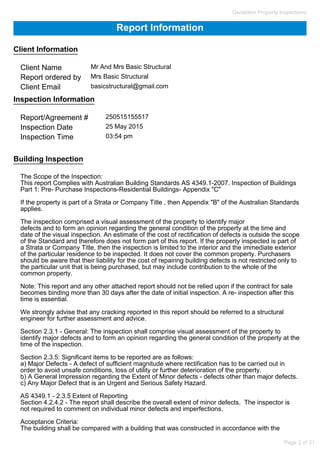
Property Address
33 Structural Street, Structuralville, WA, 6530, Australia
Geraldton Property Inspections
Page 1 of 31
Report Information
Client Information
Inspection Information
Building Inspection
Geraldton Property Inspections
Client Name Mr And Mrs Basic Structural
Report ordered by Mrs Basic Structural
Client Email basicstructural@gmail.com
Report/Agreement # 250515155517
Inspection Date 25 May 2015
Inspection Time 03:54 pm
The Scope of the Inspection:
This report Complies with Australian Building Standards AS 4349.1-2007. Inspection of Buildings
Part 1: Pre- Purchase Inspections-Residential Buildings- Appendix "C"
If the property is part of a Strata or Company Title , then Appendix "B" of the Australian Standards
applies.
The inspection comprised a visual assessment of the property to identify major
defects and to form an opinion regarding the general condition of the property at the time and
date of the visual inspection. An estimate of the cost of rectification of defects is outside the scope
of the Standard and therefore does not form part of this report. If the property inspected is part of
a Strata or Company Title, then the inspection is limited to the interior and the immediate exterior
of the particular residence to be inspected. It does not cover the common property. Purchasers
should be aware that their liability for the cost of repairing building defects is not restricted only to
the particular unit that is being purchased, but may include contribution to the whole of the
common property.
Note: This report and any other attached report should not be relied upon if the contract for sale
becomes binding more than 30 days after the date of initial inspection. A re- inspection after this
time is essential.
We strongly advise that any cracking reported in this report should be referred to a structural
engineer for further assessment and advice.
Section 2.3.1 - General: The inspection shall comprise visual assessment of the property to
identify major defects and to form an opinion regarding the general condition of the property at the
time of the inspection.
Section 2.3.5: Significant items to be reported are as follows:
a) Major Defects - A defect of sufficient magnitude where rectification has to be carried out in
order to avoid unsafe conditions, loss of utility or further deterioration of the property.
b) A General Impression regarding the Extent of Minor defects - defects other than major defects.
c) Any Major Defect that is an Urgent and Serious Safety Hazard.
AS 4349.1 - 2.3.5 Extent of Reporting
Section 4.2.4.2 - The report shall describe the overall extent of minor defects. The inspector is
not required to comment on individual minor defects and imperfections.
Acceptance Criteria:
The building shall be compared with a building that was constructed in accordance with the
Page 2 of 31
Areas to be Inspected and Restrictions
Geraldton Property Inspections
generally accepted practice at the time of construction and which has been maintained such that
there has been no significant loss of strength and serviceability.
Special Requirements
Unless stated otherwise in the report It is acknowledged that there are no special requirements
placed on this inspection that are outside the scope of the abovementioned Australian Standard.
Changes to the Inspection Agreement
Unless stated otherwise in the report It is acknowledged that if any inspection agreement is in
place in respect to this inspection, no changes have been made between the scope of that
agreement (if applicable) and the scope of this inspection report.
Limitations
This report is limited to a visual inspection of areas where safe and reasonable access is
available and access permitted on the date and at the time of inspection. The Inspection will be
carried out in accordance with AS4349.1-2007
The purpose of the inspection is to provide advice to a prospective purchaser regarding the
condition of the property at the date and time of inspection.
Areas for Inspection shall cover all safe and accessible areas. It does not purport to be geological
as to foundation integrity or soil conditions, engineering as to structural, nor does it cover the
condition of electrical, plumbing, gas or
motorised appliances. It is strongly recommended that an appropriately qualified contractor check
these services prior to purchase. As a matter of course, and in the interests of safety, all
prospective purchasers should have an electrical report carried out by a suitably qualified
contractor. This report is limited to (unless otherwise noted) the main structure on the site and any
other building, structure or outbuilding within 30m of the main structure and within the site
boundaries including fences.
Safe and Reasonable Access
Only areas to which safe and reasonable access is available were inspected. The Australian
Standard 4349.1 defines reasonable access as "areas where safe, unobstructed access “ is
provided and the minimum clearances specified below are available, or where these clearances
are not available, areas within the inspector's unobstructed line of sight and within arm's length.
Reasonable access does not include removing screws and bolts to access covers. Reasonable
access does not include the use of destructive or invasive inspection methods and does not
include cutting or making access traps or moving heavy furniture, floor coverings or stored goods.
Roof Interior- Access opening = 400 x 500 mm - Crawl Space = 600 x 600mm - Height accessible
from a 3.6m ladder.
Roof Exterior- Must be accessible from a 3.6m ladder placed on the ground.
PLEASE REFER TO THE IMPORTANT INFORMATION SECTION AT THE END OF THIS
REPORT AS IT FORMS PART OF THIS INSPECTION REPORT
The Building and the site including fencing that is up to 30 meters from the building and within the
boundaries of the site. Where present and accessible, the Inspection shall include.
(a)The interior of the building.
(b) The roof space.
(c) The exterior of the building
(d) The sub-floor space
(e)The roof exterior
(f )The property within 30 m of the building subject to inspection.
Entering attics or roof voids that are heavily insulated can cause damage to the insulation and
attic framing. Attics with deep insulation cannot be safely inspected due to limited visibility of the
framing members upon which the inspector must walk. In such cases, the attic is only partially
accessed, thereby limiting the review of the attic area from the hatch area only. Inspectors will not
crawl the attic area when they believe it is a danger to them or that they might damage the attic
insulation or framing. There is a limited review of the attic area viewed from the hatch only in
these circumstances.
The roof covering will not be walked upon if in the opinion of the inspector it is not safe to do so.
Generally issues that prevent roof access include, access height over 3 metres, steep pitch,
wet/slippery surfaces, deteriorated covering. Not being able to walk a roof significantly limits our
Page 3 of 31
Areas where full Inspection Restricted
Geraldton Property Inspections
inspection which can result in hidden defects going undetected.
Only areas where safe and reasonable access is available were inspected. Access will not be
gained where there are safety concerns, obstructions or where the space to inspect is less than
the following: Roof Void access door must be at least 500 mm x 400 mm, reachable by a 3.6 m
ladder and within the roof void there is at least 600 mm x 600 mm crawl space. Safe access to
the roof void, the sub floor area and the roof cladding is at the inspector’s discretion.
Please refer to each individual area re sections that were incapable or being inspected.
PLEASE NOTE - Since a complete inspection of some areas listed through the report may not
have been physically possible (due to but not limited to - storage, furniture, beds, personal
belongings in cupboards and/or wardrobes, low clearance in sub floor or roof void areas, ducts
restricting access in sub floors or roof voids, plumbing restricting access in sub floor area, no
access doors or access doors too small to sub floor or roof void and the like; then it follows that
defects, timber pest activity and/or damage may exist in these areas and arrangements should be
attempted to have these areas inspected.
In some circumstances this will not be possible, for example a low sub floor or heating ducts
restricting access. To properly inspect these restricted areas, ducts and floor boards may need to
be removed, furniture moved, cupboards and wardrobes emptied which will be difficult to carry
out. Therefore, there will be an element of risk that defects/damage/termites/termite damage and
the like may exist in any physically or visually obstructed areas and only become apparent when
access is made available.
We do not guarantee in any way that there are or are not any defects, termite damage or live
termites in any areas not able to be inspected.
Page 4 of 31
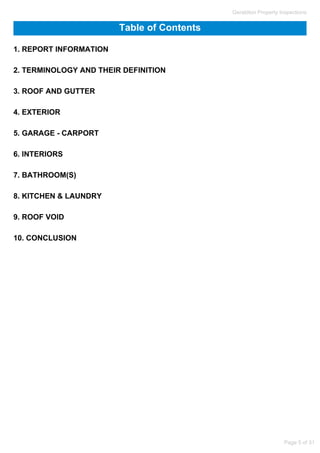
Table of Contents
1. REPORT INFORMATION
2. TERMINOLOGY AND THEIR DEFINITION
3. ROOF AND GUTTER
4. EXTERIOR
5. GARAGE - CARPORT
6. INTERIORS
7. BATHROOM(S)
8. KITCHEN & LAUNDRY
9. ROOF VOID
10. CONCLUSION
Geraldton Property Inspections
Page 5 of 31
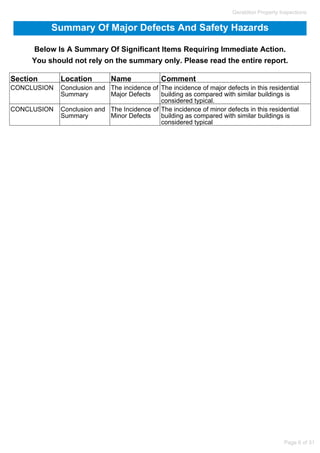
Summary Of Major Defects And Safety Hazards
Below Is A Summary Of Significant Items Requiring Immediate Action.
You should not rely on the summary only. Please read the entire report.
Geraldton Property Inspections
Section Location Name Comment
CONCLUSION Conclusion and
Summary
The incidence of
Major Defects
The incidence of major defects in this residential
building as compared with similar buildings is
considered typical.
CONCLUSION Conclusion and
Summary
The Incidence of
Minor Defects
The incidence of minor defects in this residential
building as compared with similar buildings is
considered typical
Page 6 of 31
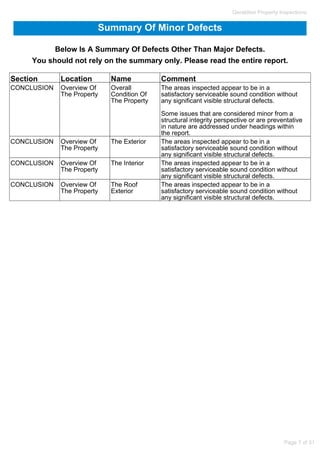
Summary Of Minor Defects
Below Is A Summary Of Defects Other Than Major Defects.
You should not rely on the summary only. Please read the entire report.
Geraldton Property Inspections
Section Location Name Comment
CONCLUSION Overview Of
The Property
Overall
Condition Of
The Property
The areas inspected appear to be in a
satisfactory serviceable sound condition without
any significant visible structural defects.
Some issues that are considered minor from a
structural integrity perspective or are preventative
in nature are addressed under headings within
the report.
CONCLUSION Overview Of
The Property
The Exterior The areas inspected appear to be in a
satisfactory serviceable sound condition without
any significant visible structural defects.
CONCLUSION Overview Of
The Property
The Interior The areas inspected appear to be in a
satisfactory serviceable sound condition without
any significant visible structural defects.
CONCLUSION Overview Of
The Property
The Roof
Exterior
The areas inspected appear to be in a
satisfactory serviceable sound condition without
any significant visible structural defects.
Page 7 of 31
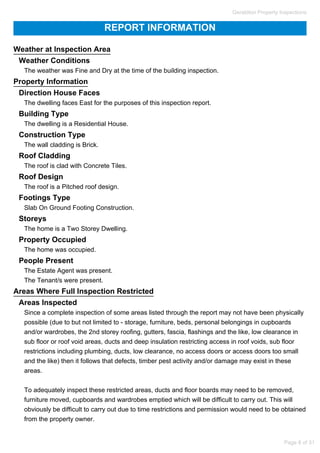
REPORT INFORMATION
Weather at Inspection Area
Weather Conditions
The weather was Fine and Dry at the time of the building inspection.
Property Information
Direction House Faces
The dwelling faces East for the purposes of this inspection report.
Building Type
The dwelling is a Residential House.
Construction Type
The wall cladding is Brick.
Roof Cladding
The roof is clad with Concrete Tiles.
Roof Design
The roof is a Pitched roof design.
Footings Type
Slab On Ground Footing Construction.
Storeys
The home is a Two Storey Dwelling.
Property Occupied
The home was occupied.
People Present
The Estate Agent was present.
The Tenant/s were present.
Areas Where Full Inspection Restricted
Areas Inspected
Since a complete inspection of some areas listed through the report may not have been physically
possible (due to but not limited to - storage, furniture, beds, personal belongings in cupboards
and/or wardrobes, the 2nd storey roofing, gutters, fascia, flashings and the like, low clearance in
sub floor or roof void areas, ducts and deep insulation restricting access in roof voids, sub floor
restrictions including plumbing, ducts, low clearance, no access doors or access doors too small
and the like) then it follows that defects, timber pest activity and/or damage may exist in these
areas.
To adequately inspect these restricted areas, ducts and floor boards may need to be removed,
furniture moved, cupboards and wardrobes emptied which will be difficult to carry out. This will
obviously be difficult to carry out due to time restrictions and permission would need to be obtained
from the property owner.
Geraldton Property Inspections
Page 8 of 31
This Firm DOES NOT GUARANTEE IN ANY WAY that there ARE OR ARE NOT any defects,
termite damage or live termites in any areas NOT ABLE to be inspected.
Note: To obtain a full understanding of the report findings, it is essential you read the entire
inspection report, including the information sections at the end of this report and I encourage you
to call me if you have any queries at all before purchasing the inspected dwelling.
Building Exterior
Building Interior
Garage
Roof Exterior
Area Where Inspection Was Restricted
Building Interior
Garage
Roof Exterior
Areas Not Inspected
Roof Void
Site
Apparent Concealment of possible defects
Were apparent Concealments seen
No apparent concealing of defects visible.
inspection Agreement
Were there any changes to the inspection agreement
No
Geraldton Property Inspections
Page 9 of 31
TERMINOLOGY AND THEIR DEFINITION
Glossary of Terms
Glossary of Terms
ACCESSIBLE AREA - An area of the site where sufficient, safe and reasonable access is available
to allow inspection within the scope of the inspection. ACCESS HOLE - Access hole An opening in
flooring or ceiling pr other part of a structure to allow for entry to carry out an inspection.
AGG LINE - A perforated pipe (usually covered with a geo-textile fabric) laid behind retaining walls
and other areas to catch seeping stormwater. APPEARANCE DEFECT - Fault or deviation from
the intended appearance of a building element.
ARCHITRAVE - moulding surrounding a door or window opening to cover the join between the
frame and the wall finish.
BALUSTRADE - A series of vertical members supporting a handrail of a stair, landing, platform or
bridge.
BEARER - A sub-floor structural timber member which supports the floor joists. BRICK VENEER -
A method of construction in which a single leaf of non-load bearing wall of brickwork is tied to a
timber or metal framed load bearing structure to form the external enclosure.
BUILDING ELEMENT - Portion of a building that, by itself or in combination with other such parts,
fulfills a characteristic function.
CEMENT - A finely ground inorganic powder that, mixed with water, binds an aggregate / sand
mixture into a hard concrete or mortar within a few days. CLIENT - The person or other entity for
whom the inspection is being carried out. CONCRETE - A conglomerated artificial stone made by
mixing in specified proportions cement, water and aggregates and pouring the mixture into
prepared forms to set and harden.
CORNICE - A moulding placed at the junction between a wall and ceiling.
DAMP- PROOF COURSE (DPC) - A continuous layer of an impervious material placed in a
masonry wall or between a floor and wall to prevent the upward or downward migration of
moisture.
DEFECT - Fault or deviation from the intended condition of a material, assembly or component.
DEFLECTION - Has a wavy appearance, causes the feeling of going up or down to these areas
stated, lips in concrete surfaces at their joints.
EAVES - The lower part of a roof that overhangs the walls.
FASCIA - A metal profile, which is fixed to the lower ends of rafters and usually supports the
guttering.
FOOTING - That part of a construction designed to transfer loads to the supporting foundation,
usually constructed of reinforced concrete to support base brickwork.
FOUNDATION - The natural or built-up formation of soil, sub-soil or rock upon which a building or
structure is supported.
FOUNDATION DOOR ENTRY - The door or cover access point into a dwellings sub floor area.
GABLE - The vertical triangular end of a building with a pitched roof, between the rafters from
eaves level to the apex (ridge). It may be formed in brickwork or timber framed and clad with
weatherboards.
Geraldton Property Inspections
Page 10 of 31
GAUGE - An indicating device usually in brickwork setting out the number of bricks to a certain
measurement. E.g. 7 brick courses per 600mm in height. This gauge is adjusted to suit the brick
and the site conditions.
GOING - In a stair the horizontal distance from the face of one riser to that of the next.
HANGING BEAM - A beam above the ceiling used to support ceiling joists.
HEAD - The upper horizontal member at the top of an opening or frame.
HEADER - A brick laid with its greatest dimension across a wall usually used to tie two skins
together or under a door sill or window.
HEARTH - The floor of a fireplace and immediately adjacent area.
HINDERED ACCESS - The inability to access this area stated in this report.
HIP ROOF - A roof which is pyramidal in shape with sloping surfaces and level edges all round.
INSPECTION - Close and careful scrutiny of a building carried out without dismantling, in order to
arrive at a reliable conclusion as to the condition of the building.
INSPECTOR - Person of organisation responsible for carrying out the inspection.
JOIST - A timber or steel beam supported by a bearer which the flooring is fixed directly to.
LIMITATION - Any factor that prevents full or proper inspection of the building. LINTEL - A
horizontal supporting member spanning over a window or door opening. A "gal-lintel" is a steel
lintel used to support brickwork over an opening. MANHOLE ENTRY - The entry into the roof loft
area by the removal of a ceiling cover or an internal wall doorway.
MAJOR DEFECT - A defect of sufficient magnitude where rectification has to be carried out in
order to avoid unsafe conditions, loss of utility or further deterioration of the property.
MINOR DEFECT - A defect other than a major defect.
MORTAR - A mixing of bush sand (white or yellow), cement (grey or off-white) and water for
brickwork. Usually at the rate of 6 part sand to one part cement (by volume) and if required one
part lime. Can have a flush, raked or round finish. NEWEL POST - A post at the top or bottom of a
stair flight to support the handrail and/or winders in the stair treads.
PARAPET - A low wall to protect the edge of a roof, balcony or terrace. Many shops have a
parapet at the front of the building for signage.
PARTICLE BOARD - A flat floor sheeting of good dimensional stability made from wood flakes and
synthetic resin / binder under heat and pressure. Can be produced with decorative elements for
joinery work.
PELMET - A built-in head to a window to conceal the curtain rod or to a sliding door to conceal the
tracks. Usually made of wood.
PERP - A vertical joint in masonry construction.
PITCH ROOF - The ratio of the height to span, usually measured in degrees. POINTING - The
completion of jointing between ridge or hip tiles with a matching colour after bedding of tiles or
troweling of mortar into joints after bricks have been laid to touch up.
QUAD MOULDING - A moulding with a cross-section of a quadrant of a circle used to cover joints
often in eaves or at junctions of walls and/or ceilings. RAFTER - A sloping member in a roof
providing the principal structural support for the roofing material.
RAFTER (COMMON) - A rafter spanning the full distance from the eaves to the ridge. RAFTER
(HIP) - A rafter forming the hip at the external line of intersection of two roof surfaces. Jack rafters
meet against it.
Geraldton Property Inspections
Page 11 of 31
RAFTER (JACK) - A rafter between a ridge and a valley or a hip rafter and the eave. RAKED
JOINT - A brick joint raked out by the bricklayer for a key for plaster or as a decorative finish.
RENDER - The covering of a brick wall with one or more coats of cement mortar consisting of
Sydney Sand, cement and plasterers clay.
RIDGE - The highest part (apex) of a roof, which is usually a horizontal line. RISER - The vertical
face of a step in a stair flight.
SERVICEABILITY DEFECT - Fault or deviation from the intended serviceability performance of a
building element.
SEPARATION - Gapping formed between the two surfaces stated.
SIGNIFICANT ITEM - An item that is to be reported in accordance with the scope of the inspection.
SKEW NAILING - The driving of nails at an oblique angle often in different directions to improve
the strength of a joint of fixing.
SKIRTING - A wooden board fixed to the bottom of a wall at the junction of the floor to prevent
damage to the wall or to conceal small gaps.
SLIP JOINT - A joint designed to allow movement between two members usually in the form of two
layers of sheet metal with grease installed on top of a brick wall prior to installation of a concrete
slab.
SOFFIT/EAVES - The underside of a slab or an eave.
SOLDIER COURSE - A course of brickwork laid on its end.
SPROCKET - A framing timber used in eaves construction.
STRETCHER BOND - The most common masonry bond in Australia in which all bricks are laid
with half overlaps and not using half bricks or cross bonds. STRUCTURAL ELEMENT - Physically
distinguishable part of a structure:
NOTE: For example a wall, column, beam or connection points.
TERRAZZO - A material consisting of irregular marble or stone fragments set in a matrix of cement
and mechanically abraded and polished after casting to produce a smooth hard surface.
THRESHOLD - The step or sill at an external door of usually timber tile or brickwork.
TOUGHENED GLASS - Glass made by rapidly cooling the glass to make it shatter into small
pieces when broken for safety, It usually cannot be cut and needs to be made to order to size. It is
unlike laminated glass which is made from layers of glass with silicon between to crack only when
broken for safety and can easily be cut on site.
UNDERPINNING - The construction of new footings or concrete piers under an existing footing to
prevent its collapse or failure.
VALLEY - The meeting line of two inclined roof surfaces at a re-entrant angle. VALLEY SERIES
TRUSSES - A series of timber roof Trusses that form the valley within a hip roof construction.
WEEP HOLES - Vertical joints or perpends in brickwork left open above the flashing line to allow
water from behind the wall to escape.
PLUMBING AND DRAINAGE TERMS
ABSORPTION TRENCH - A trench, pit or well excavated from permeable ground filled with broken
stone, bricks or large granular materials and covered with earth to dispose of the discharge from a
septic tank, sullage system or stormwater by absorption into the ground.
Geraldton Property Inspections
Page 12 of 31
GULLY TRAP (GT) - An assembly in a sanitary drainage system, consisting of a trap and other
fittings. Also called
GULLY. JUNCTION (PIPE) - A pipe fitting incorporating one or more branched. MANHOLE - A
large chamber or opening on a drain, sewer or equipment to permit access for inspection, testing
or clearance if obstruction.
STACK - A vertical sanitary drainage pipe, including offsets, which extends more than one story in
height.
SULLAGE - Domestic waste water other than from soil fixtures.
SUMP - A pit at or below the lowest point of a structure to collect unwanted water and facilitate its
removal, usually by means if a
SUMP PUMP. Also called DRAIN PIT. TRAP - a) A fitting usually in the shape of the letter P or S
which retains water to form a "water seal" so as to prevent the passage if gases or foul air into the
building. b) A fitting for the interception of silt, acids, grease, oils or fats.
BOUNDARY TRAP - A trap in the property service drain, usually near the boundary if a property
and below the lowest inlet, to prevent the entry of air or gases from the sewer into property service
drain. Also called INTERCEPTOR TRAP.
GREASE TRAP - A device in the shape if a box with baffle plates to slow the flow of liquid waste
and prevent the passage if greasy substance into the drainage system. Also called GREASE
INTERCEPTOR TRAP. P-TRAP - A trap in which the inlet leg is vertical and the outer leg inclined
below the horizontal to specified limits, with or without inspection opening at the lowest point.
S-TRAP - A trap in which the outer leg is vertical and parallel with the inlet leg, with or without
inspection opening at the lowest point.
SILT TRAP - A trap containing a removable container for the collection if silt, sand or grit.
VALVE - A device for the control of liquid or gas flow, having an aperture which can be wholly or
partially closed by a plate, disc, door, gate, piston, plug ball r the flexing if a diaphragm.
FLOAT VALVE - A valve actuated by a float (floating ball) to control the flow of liquid, used in tanks
or cisterns to maintain a minimum water level. Also referred to as
FLOATING BALL VALVE. FLUSH VALVE - A control devise for water flow at mains pressure to a
WC pan; used instead of a cistern.
MIXING VALVE - A valve which is designed to mix separate supplies of hot and cold water and
direct the maximum.
PRESSURE REDUCING VALVE - A valve designed to reduce or limit the pressure of a fluid to a
predetermined valve in the downstream side. Also called PRESSURE LIMITING VALVE.
PRESSURE RELIEF VALVE - A spring-loaded or weight-controlled automatic valve to limit the
build-up of pressure in pipe work, fittings or vessels by discharging excessive pressure to the
atmosphere.
STOP VALVE - A valve, such as a gate valve, which can be operated to stop flow in a pipeline.
Also known as ISOLATING VALVE.
TEMPERATURE RELIEF - A temperature activated valve to relieve excess pressure in water
heaters in the event of a thermostat failure and overheating. VENT (VENT PIPE) - A pipe provided
to limit pressure fluctuations within a discharge pipe system by the induction or discharge of air
and/or to facilitate the discharge of gases.
Geraldton Property Inspections
Page 13 of 31
ROOF AND GUTTER
Roof Covering
Roof Covering Type
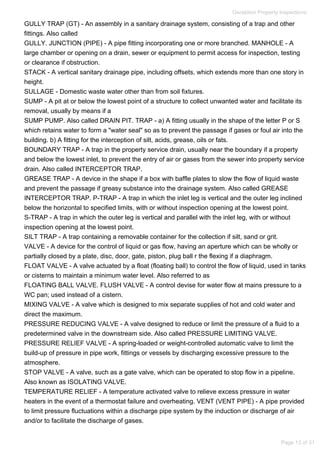
The roof is of concrete tiles.
Overall Condition
Not inspected as too high to reach by ladder
Geraldton Property Inspections
Page 14 of 31
EXTERIOR
Weep Holes and Ventilation
Findings
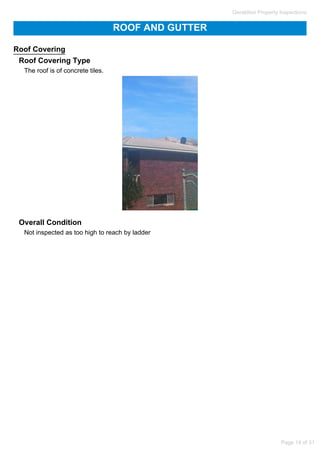
The vents are unobstructed.
Exterior Walls
Exterior Wall Material
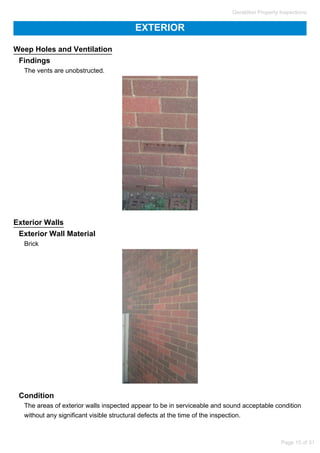
Brick
Condition
The areas of exterior walls inspected appear to be in serviceable and sound acceptable condition
without any significant visible structural defects at the time of the inspection.
Geraldton Property Inspections
Page 15 of 31
GARAGE - CARPORT
Garaging
Type
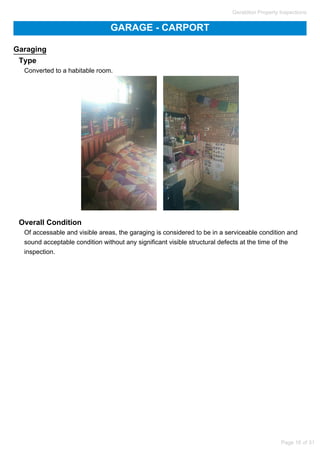
Converted to a habitable room.
Overall Condition
Of accessable and visible areas, the garaging is considered to be in a serviceable condition and
sound acceptable condition without any significant visible structural defects at the time of the
inspection.
Geraldton Property Inspections
Page 16 of 31
INTERIORS
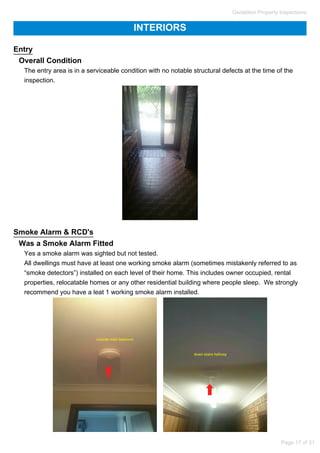
Entry
Overall Condition
The entry area is in a serviceable condition with no notable structural defects at the time of the
inspection.
Smoke Alarm & RCD's
Was a Smoke Alarm Fitted
Yes a smoke alarm was sighted but not tested.
All dwellings must have at least one working smoke alarm (sometimes mistakenly referred to as
“smoke detectors”) installed on each level of their home. This includes owner occupied, rental
properties, relocatable homes or any other residential building where people sleep. We strongly
recommend you have a leat 1 working smoke alarm installed.
Geraldton Property Inspections
Page 17 of 31
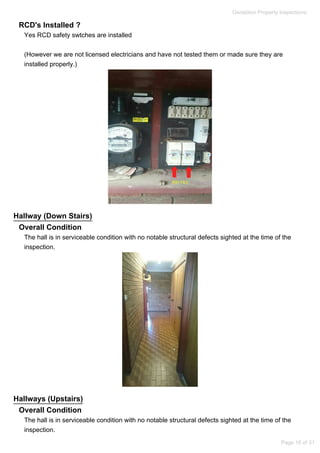
RCD's Installed ?
Yes RCD safety swtches are installed
(However we are not licensed electricians and have not tested them or made sure they are
installed properly.)
Hallway (Down Stairs)
Overall Condition
The hall is in serviceable condition with no notable structural defects sighted at the time of the
inspection.
Hallways (Upstairs)
Overall Condition
The hall is in serviceable condition with no notable structural defects sighted at the time of the
inspection.
Geraldton Property Inspections
Page 18 of 31
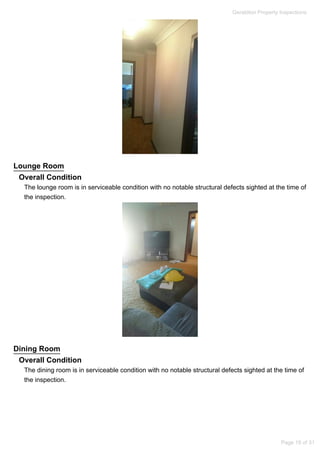
Lounge Room
Overall Condition
The lounge room is in serviceable condition with no notable structural defects sighted at the time of
the inspection.
Dining Room
Overall Condition
The dining room is in serviceable condition with no notable structural defects sighted at the time of
the inspection.
Geraldton Property Inspections
Page 19 of 31
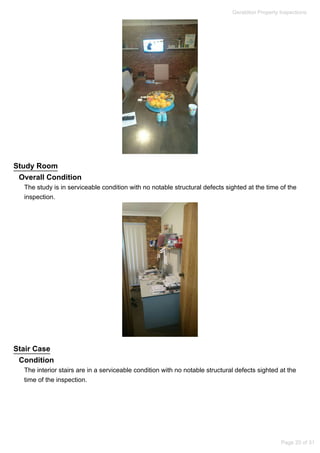
Study Room
Overall Condition
The study is in serviceable condition with no notable structural defects sighted at the time of the
inspection.
Stair Case
Condition
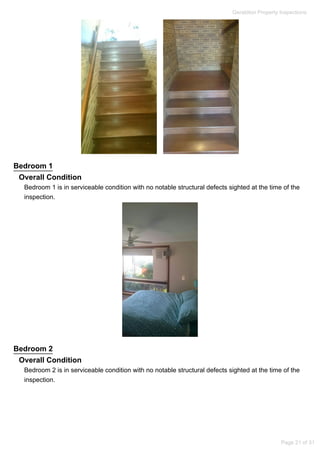
The interior stairs are in a serviceable condition with no notable structural defects sighted at the
time of the inspection.
Geraldton Property Inspections
Page 20 of 31
Bedroom 1
Overall Condition
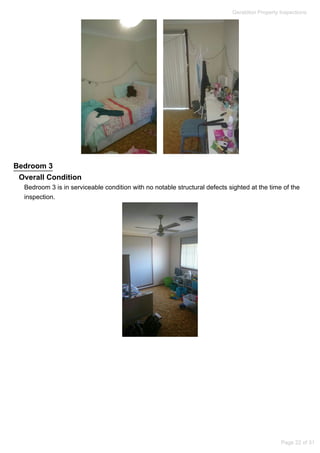
Bedroom 1 is in serviceable condition with no notable structural defects sighted at the time of the
inspection.
Bedroom 2
Overall Condition
Bedroom 2 is in serviceable condition with no notable structural defects sighted at the time of the
inspection.
Geraldton Property Inspections
Page 21 of 31
Bedroom 3
Overall Condition
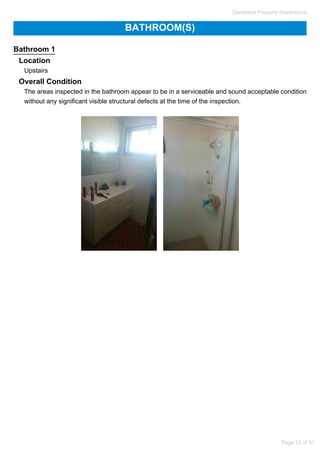
Bedroom 3 is in serviceable condition with no notable structural defects sighted at the time of the
inspection.
Geraldton Property Inspections
Page 22 of 31
BATHROOM(S)
Bathroom 1
Location
Upstairs
Overall Condition
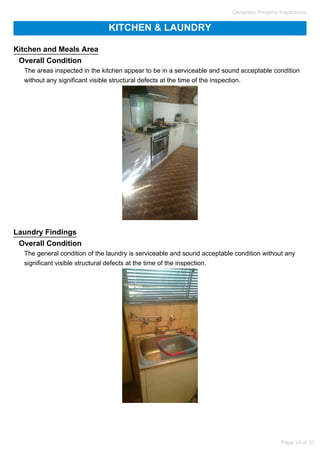
The areas inspected in the bathroom appear to be in a serviceable and sound acceptable condition
without any significant visible structural defects at the time of the inspection.
Geraldton Property Inspections
Page 23 of 31
KITCHEN & LAUNDRY
Kitchen and Meals Area
Overall Condition
The areas inspected in the kitchen appear to be in a serviceable and sound acceptable condition
without any significant visible structural defects at the time of the inspection.
Laundry Findings
Overall Condition
The general condition of the laundry is serviceable and sound acceptable condition without any
significant visible structural defects at the time of the inspection.
Geraldton Property Inspections
Page 24 of 31
ROOF VOID
Roof Void Findings
Restricted Areas
The roof void could not be inspected due to - No entry point/door - I recommend installing an
access point so easy access can be made to carry out an inspection.
Geraldton Property Inspections
Page 25 of 31
CONCLUSION
Conclusion and Summary
The incidence of Major Defects
The incidence of major defects in this residential building as compared with similar buildings is
considered typical.
The Incidence of Minor Defects
The incidence of minor defects in this residential building as compared with similar buildings is
considered typical
Overview Of The Property
Overall Condition Of The Property
The areas inspected appear to be in a satisfactory serviceable sound condition without any
significant visible structural defects.
Some issues that are considered minor from a structural integrity perspective or are preventative in
nature are addressed under headings within the report.
The Exterior
The areas inspected appear to be in a satisfactory serviceable sound condition without any
significant visible structural defects.
The Interior
The areas inspected appear to be in a satisfactory serviceable sound condition without any
significant visible structural defects.
The Roof Exterior
The areas inspected appear to be in a satisfactory serviceable sound condition without any
significant visible structural defects.
Geraldton Property Inspections
Page 26 of 31
TERMS AND CONDITIONS
The purpose of the inspection is to identify the major defects and safety hazards associated with
the property at the time of the inspection. The inspection and reporting is limited to a visual
assessment of the building members in accord with appendix c AS4349.1-2007
Please note: This is a general appraisal only and cannot be relied on its own - Read the report in
its entirety.
This summary is supplied to allow a quick and superficial overview of the inspection results. This
summary is not the report and cannot be relied upon on its own. This summary must be read in
conjunction with the full report and not in isolation from the report. If there should happen to be any
discrepancy between anything in the report and anything in this summary, the information in the
report shall override that in this summary.
Definitions
High: The frequency and/or magnitude of defects are beyond the inspector’s expectations when
compared to similar buildings of approximately the same age that have been reasonably well
maintained.
Typical: The frequency and/or magnitude of defects are consistent with the inspector’s
expectations when compared to similar buildings of approximately the same age which have been
reasonably well maintained.
Low: The frequency and/or magnitude of defects are lower than the inspector’s expectations when
compared to similar buildings of approximately the same age that have been reasonably well
maintained.
Above average: The overall condition is above that consistent with dwellings of approximately the
same age and construction. Most items and areas are well maintained and show a reasonable
standard of workmanship when compared with buildings of similar age and construction.
Average: The overall condition is consistent with dwellings of approximately the same age and
construction. There will be areas or items requiring some repair or maintenance.
Below average: The building and its parts show some significant defects and/or very poor non-
tradesman like workmanship and/or long term neglect and/or defects requiring major repairs or
reconstruction of major building elements.
Major defect: Is a defect requiring building works to avoid unsafe conditions, loss of function or
further worsening of the defective item.
Geraldton Property Inspections
Page 27 of 31
Minor defect: Any defect other than what is described as a major defect.
Accessible area: Is any area of the property and structures allowing the inspector safe and
reasonable access within the scope of the inspection.
Important advice
Note: In the case of strata and company title properties, the inspection is limited to the interior and
immediate exterior of the particular unit being inspected. The exterior above ground floor level is
not inspected. The complete inspection of other common property areas would be the subject of a
special-purpose inspection report which is adequately specified.
Trees: Where trees are too close to the house this could affect the performance of the footing as
the moisture levels change in the ground. A geo-technical inspection can determine the foundation
material and provide advice on the best course of action with regards to the trees.
Important information regarding the scope and limitations of the inspection and this report
Important information any person who relies upon the contents of this report does so
acknowledging that the following clauses, which define the scope and limitations of the inspection,
form an integral part of the report.
1)This report is not an all encompassing report dealing with the building from every aspect. It is a
reasonable attempt to identify any obvious or significant defects apparent at the time of the
inspection. Whether or not, a defect is considered significant or not depends too a large extent,
upon the age and type of the building inspected. This report is not a certificate of compliance with
the requirements of any act, regulation, ordinance or by-law. It is not a structural report. Should
you require any advice of a structural nature you should contact a structural engineer.
2)This is a visual inspection only limited to those areas and sections of the property fully accessible
and visible to the inspector on the date of inspection. The inspection did not include breaking apart,
dismantling, removing or moving objects including, but not limited to, foliage, mouldings, roof
insulation/ sisalation, floor or wall coverings, sidings, ceilings, floors, furnishings, appliances or
personal possessions. The inspector cannot see inside walls, between floors, inside skillion
roofing, behind stored goods in cupboards and other areas that are concealed or obstructed. The
inspector did not dig, gouge, force or perform any other invasive procedures. Visible timbers
cannot be destructively probed or hit without the written permission of the property owner.
3)This report does not and cannot make comment upon: Defects that may have been concealed;
the assessment or detection of defects (including rising damp and leaks) which may be subject to
the prevailing weather conditions; whether or not services have been used for some time prior to
the inspection and whether this will affect the detection of leaks or other defects (eg. In the case of
shower enclosures the absence of any dampness at the time of the inspection does not
necessarily mean that the enclosure will not leak); the presence or absence of timber pests; gas-
fittings; common property areas; environmental concerns; the proximity of the property to flight
paths, railways, or busy traffic; noise levels; health and safety issues; heritage concerns; security
concerns; fire protection; site drainage (apart from surface water drainage); swimming pools and
Geraldton Property Inspections
Page 28 of 31
spas (non-structural); detection and identification of illegal building work; detection and
identification of illegal plumbing work; durability of exposed finishes; neighborhood problems;
document analysis; electrical installation; any matters that are solely regulated by statute; any
area(s) or item(s) that could not be inspected by the consultant.
Accordingly this report is not a guarantee that defects and/or damage does not exist in any
inaccessible or partly inaccessible areas or sections of the property. (Nb: Such matters may upon
request be covered under the terms of a special-purpose property report.
4) Asbestos disclaimer:
No inspection for asbestos was carried out at the property and no report on the presence or
absence of asbestos is provided.
5) Mould (mildew and non-wood decay fungi) disclaimer:
Mildew and non wood decay fungi is commonly known as mould. However, mould and their spores
may cause health problems or allergic reactions such as asthma and dermatitis in some people.
No inspection for mould was carried out at the property and no report on the presence or absence
of mould is provided.
6) Magnesite flooring disclaimer:
No inspection for magnesite flooring was carried out at the property and no report on the presence
or absence of magnesite flooring is provided. You should ask the owner whether magnesite
flooring is present and/or seek advice from a structural engineer.
7) Estimating disclaimer:
No estimate is provided in this report. We strongly recommend you obtain quotes for repairs from
licensed tradesman accordingly,
Important disclaimer
Disclaimer of liability: -No liability shall be accepted on an account of failure of the report to notify
any problems in the area(s) or section(s) of the subject property physically inaccessible for
inspection, or to which access for inspection is denied by or to the inspector (including but not
limited to or any area(s) or section(s) so specified by the report).
Disclaimer of liability to third parties:
Compensation will only be payable for losses arising in contract or tort sustained by the client
named on the front of this report. Compensation is limited to the price of the report initially paid by
the claimant named in the report as the "CLIENT"
Other assessments recommended
Electrical installation:
Geraldton Property Inspections
Page 29 of 31
All electrical wiring, meter-box and appliances need to be checked by a qualified electrician. The
inspection of any electrical item is outside the scope of this report. It's recommended that a
licensed electrician be consulted for further advice.
Plumbing:
All plumbing needs to be inspected and reported on by a plumber. It's recommended that a
licensed plumber be consulted for further advice.
Hot water service:
All hot water services need to be inspected and reported on by a plumber and/or electrician. It's
recommended that a licensed plumber and/or electrician be consulted for further advice.
Gas:
All gas services need to be inspected and reported on by a gas plumber. It's recommended that a
licensed gas plumber be consulted for further advice.
Phone:
All phones, phone lines and outlets need to be inspected and reported on by a telecommunications
technician. It's recommended that a telecommunications technician be consulted for further advice.
Smoke detectors:
Australian standard as 3786 - Advises that smoke detectors are required for all buildings where
people sleep. It is recommended that an electrician be consulted to give advice on those installed
or install these detectors.
The septic tanks: Should be inspected by a licensed plumber.
Swimming pools: Swimming pools/spas are not part of the standard building report under
as4349.1-2007 And are not covered by this report. We strongly recommend a pool expert should
be consulted to examine the pool and the pool equipment and plumbing as well as the
requirements to meet the standard for pool fencing. Failure to conduct this inspection and put into
place the necessary recommendations could result in finds for non compliance under the
legislation.
Surface water drainage: The retention of water from surface run off could have an effect on the
foundation material which in turn could affect the footings to the house. Best practice is to monitor
the flow of surface water and storm water run off and have the water directed away from the house
or to storm water pipes by a licensed drainage plumber.
Terminology
The definitions below apply to the types of defects associated with individual items/parts or
Inspection areas.
Geraldton Property Inspections
Page 30 of 31
Damage: The building material or item has deteriorated or is not fit for its designed purpose.
Distortion, warping, twisting: The item has moved out of shape or moved from its position.
Water penetration, dampness: Moisture has gained access to unplanned and/or unacceptable
areas.
Material deterioration: The item is subject to one or more of the following defects; rusting, rotting,
Corrosion, decay.
Operational: The item or part does not function as expected.
Installation: The installation of an item is unacceptable, has failed or is absent.
Contact the inspector
Please feel free to contact the inspector who carried out this inspection. Often it is very difficult to
fully explain situations, problems, access difficulties, building faults or their importance in a manner
that is readily understandable by the reader. Should you have any difficulty in understanding
anything contained within this report then you should immediately contact the inspector and have
the matter explained to you. If you have any questions at all or require any clarification then
contact the inspector prior to acting on this report.
The overall condition of this building has been compared to similar constructed buildings of
approximately the same age where those buildings have had a maintenance program implemented
to ensure that the building members are still fit for purpose.
The incidence of major defects and minor and overall condition in this residential building as
compared with similar buildings is listed below.
The Inspection and Report was carried out by: Jason Nicholson
Contact the Inspector on: 1300994578
For and on Behalf of: Geraldton Property Inspections
Geraldton Property Inspections
Page 31 of 31

Property Inspection Report

  • 1.
    Report Provided By GeraldtonProperty Inspections 33 Simpson Street, Geraldton, WESTERN AUSTRALIA, 6530, Australia P 1300994578 info@geraldtonpropertyinspections.com.au www.geraldtonpropertyinspections.com.au Property Address 33 Structural Street, Structuralville, WA, 6530, Australia Geraldton Property Inspections Page 1 of 31
  • 2.
    Report Information Client Information InspectionInformation Building Inspection Geraldton Property Inspections Client Name Mr And Mrs Basic Structural Report ordered by Mrs Basic Structural Client Email basicstructural@gmail.com Report/Agreement # 250515155517 Inspection Date 25 May 2015 Inspection Time 03:54 pm The Scope of the Inspection: This report Complies with Australian Building Standards AS 4349.1-2007. Inspection of Buildings Part 1: Pre- Purchase Inspections-Residential Buildings- Appendix "C" If the property is part of a Strata or Company Title , then Appendix "B" of the Australian Standards applies. The inspection comprised a visual assessment of the property to identify major defects and to form an opinion regarding the general condition of the property at the time and date of the visual inspection. An estimate of the cost of rectification of defects is outside the scope of the Standard and therefore does not form part of this report. If the property inspected is part of a Strata or Company Title, then the inspection is limited to the interior and the immediate exterior of the particular residence to be inspected. It does not cover the common property. Purchasers should be aware that their liability for the cost of repairing building defects is not restricted only to the particular unit that is being purchased, but may include contribution to the whole of the common property. Note: This report and any other attached report should not be relied upon if the contract for sale becomes binding more than 30 days after the date of initial inspection. A re- inspection after this time is essential. We strongly advise that any cracking reported in this report should be referred to a structural engineer for further assessment and advice. Section 2.3.1 - General: The inspection shall comprise visual assessment of the property to identify major defects and to form an opinion regarding the general condition of the property at the time of the inspection. Section 2.3.5: Significant items to be reported are as follows: a) Major Defects - A defect of sufficient magnitude where rectification has to be carried out in order to avoid unsafe conditions, loss of utility or further deterioration of the property. b) A General Impression regarding the Extent of Minor defects - defects other than major defects. c) Any Major Defect that is an Urgent and Serious Safety Hazard. AS 4349.1 - 2.3.5 Extent of Reporting Section 4.2.4.2 - The report shall describe the overall extent of minor defects. The inspector is not required to comment on individual minor defects and imperfections. Acceptance Criteria: The building shall be compared with a building that was constructed in accordance with the Page 2 of 31
  • 3.
    Areas to beInspected and Restrictions Geraldton Property Inspections generally accepted practice at the time of construction and which has been maintained such that there has been no significant loss of strength and serviceability. Special Requirements Unless stated otherwise in the report It is acknowledged that there are no special requirements placed on this inspection that are outside the scope of the abovementioned Australian Standard. Changes to the Inspection Agreement Unless stated otherwise in the report It is acknowledged that if any inspection agreement is in place in respect to this inspection, no changes have been made between the scope of that agreement (if applicable) and the scope of this inspection report. Limitations This report is limited to a visual inspection of areas where safe and reasonable access is available and access permitted on the date and at the time of inspection. The Inspection will be carried out in accordance with AS4349.1-2007 The purpose of the inspection is to provide advice to a prospective purchaser regarding the condition of the property at the date and time of inspection. Areas for Inspection shall cover all safe and accessible areas. It does not purport to be geological as to foundation integrity or soil conditions, engineering as to structural, nor does it cover the condition of electrical, plumbing, gas or motorised appliances. It is strongly recommended that an appropriately qualified contractor check these services prior to purchase. As a matter of course, and in the interests of safety, all prospective purchasers should have an electrical report carried out by a suitably qualified contractor. This report is limited to (unless otherwise noted) the main structure on the site and any other building, structure or outbuilding within 30m of the main structure and within the site boundaries including fences. Safe and Reasonable Access Only areas to which safe and reasonable access is available were inspected. The Australian Standard 4349.1 defines reasonable access as "areas where safe, unobstructed access “ is provided and the minimum clearances specified below are available, or where these clearances are not available, areas within the inspector's unobstructed line of sight and within arm's length. Reasonable access does not include removing screws and bolts to access covers. Reasonable access does not include the use of destructive or invasive inspection methods and does not include cutting or making access traps or moving heavy furniture, floor coverings or stored goods. Roof Interior- Access opening = 400 x 500 mm - Crawl Space = 600 x 600mm - Height accessible from a 3.6m ladder. Roof Exterior- Must be accessible from a 3.6m ladder placed on the ground. PLEASE REFER TO THE IMPORTANT INFORMATION SECTION AT THE END OF THIS REPORT AS IT FORMS PART OF THIS INSPECTION REPORT The Building and the site including fencing that is up to 30 meters from the building and within the boundaries of the site. Where present and accessible, the Inspection shall include. (a)The interior of the building. (b) The roof space. (c) The exterior of the building (d) The sub-floor space (e)The roof exterior (f )The property within 30 m of the building subject to inspection. Entering attics or roof voids that are heavily insulated can cause damage to the insulation and attic framing. Attics with deep insulation cannot be safely inspected due to limited visibility of the framing members upon which the inspector must walk. In such cases, the attic is only partially accessed, thereby limiting the review of the attic area from the hatch area only. Inspectors will not crawl the attic area when they believe it is a danger to them or that they might damage the attic insulation or framing. There is a limited review of the attic area viewed from the hatch only in these circumstances. The roof covering will not be walked upon if in the opinion of the inspector it is not safe to do so. Generally issues that prevent roof access include, access height over 3 metres, steep pitch, wet/slippery surfaces, deteriorated covering. Not being able to walk a roof significantly limits our Page 3 of 31
  • 4.
    Areas where fullInspection Restricted Geraldton Property Inspections inspection which can result in hidden defects going undetected. Only areas where safe and reasonable access is available were inspected. Access will not be gained where there are safety concerns, obstructions or where the space to inspect is less than the following: Roof Void access door must be at least 500 mm x 400 mm, reachable by a 3.6 m ladder and within the roof void there is at least 600 mm x 600 mm crawl space. Safe access to the roof void, the sub floor area and the roof cladding is at the inspector’s discretion. Please refer to each individual area re sections that were incapable or being inspected. PLEASE NOTE - Since a complete inspection of some areas listed through the report may not have been physically possible (due to but not limited to - storage, furniture, beds, personal belongings in cupboards and/or wardrobes, low clearance in sub floor or roof void areas, ducts restricting access in sub floors or roof voids, plumbing restricting access in sub floor area, no access doors or access doors too small to sub floor or roof void and the like; then it follows that defects, timber pest activity and/or damage may exist in these areas and arrangements should be attempted to have these areas inspected. In some circumstances this will not be possible, for example a low sub floor or heating ducts restricting access. To properly inspect these restricted areas, ducts and floor boards may need to be removed, furniture moved, cupboards and wardrobes emptied which will be difficult to carry out. Therefore, there will be an element of risk that defects/damage/termites/termite damage and the like may exist in any physically or visually obstructed areas and only become apparent when access is made available. We do not guarantee in any way that there are or are not any defects, termite damage or live termites in any areas not able to be inspected. Page 4 of 31
  • 5.
    Table of Contents 1.REPORT INFORMATION 2. TERMINOLOGY AND THEIR DEFINITION 3. ROOF AND GUTTER 4. EXTERIOR 5. GARAGE - CARPORT 6. INTERIORS 7. BATHROOM(S) 8. KITCHEN & LAUNDRY 9. ROOF VOID 10. CONCLUSION Geraldton Property Inspections Page 5 of 31
  • 6.
    Summary Of MajorDefects And Safety Hazards Below Is A Summary Of Significant Items Requiring Immediate Action. You should not rely on the summary only. Please read the entire report. Geraldton Property Inspections Section Location Name Comment CONCLUSION Conclusion and Summary The incidence of Major Defects The incidence of major defects in this residential building as compared with similar buildings is considered typical. CONCLUSION Conclusion and Summary The Incidence of Minor Defects The incidence of minor defects in this residential building as compared with similar buildings is considered typical Page 6 of 31
  • 7.
    Summary Of MinorDefects Below Is A Summary Of Defects Other Than Major Defects. You should not rely on the summary only. Please read the entire report. Geraldton Property Inspections Section Location Name Comment CONCLUSION Overview Of The Property Overall Condition Of The Property The areas inspected appear to be in a satisfactory serviceable sound condition without any significant visible structural defects. Some issues that are considered minor from a structural integrity perspective or are preventative in nature are addressed under headings within the report. CONCLUSION Overview Of The Property The Exterior The areas inspected appear to be in a satisfactory serviceable sound condition without any significant visible structural defects. CONCLUSION Overview Of The Property The Interior The areas inspected appear to be in a satisfactory serviceable sound condition without any significant visible structural defects. CONCLUSION Overview Of The Property The Roof Exterior The areas inspected appear to be in a satisfactory serviceable sound condition without any significant visible structural defects. Page 7 of 31
  • 8.
    REPORT INFORMATION Weather atInspection Area Weather Conditions The weather was Fine and Dry at the time of the building inspection. Property Information Direction House Faces The dwelling faces East for the purposes of this inspection report. Building Type The dwelling is a Residential House. Construction Type The wall cladding is Brick. Roof Cladding The roof is clad with Concrete Tiles. Roof Design The roof is a Pitched roof design. Footings Type Slab On Ground Footing Construction. Storeys The home is a Two Storey Dwelling. Property Occupied The home was occupied. People Present The Estate Agent was present. The Tenant/s were present. Areas Where Full Inspection Restricted Areas Inspected Since a complete inspection of some areas listed through the report may not have been physically possible (due to but not limited to - storage, furniture, beds, personal belongings in cupboards and/or wardrobes, the 2nd storey roofing, gutters, fascia, flashings and the like, low clearance in sub floor or roof void areas, ducts and deep insulation restricting access in roof voids, sub floor restrictions including plumbing, ducts, low clearance, no access doors or access doors too small and the like) then it follows that defects, timber pest activity and/or damage may exist in these areas. To adequately inspect these restricted areas, ducts and floor boards may need to be removed, furniture moved, cupboards and wardrobes emptied which will be difficult to carry out. This will obviously be difficult to carry out due to time restrictions and permission would need to be obtained from the property owner. Geraldton Property Inspections Page 8 of 31
  • 9.
    This Firm DOESNOT GUARANTEE IN ANY WAY that there ARE OR ARE NOT any defects, termite damage or live termites in any areas NOT ABLE to be inspected. Note: To obtain a full understanding of the report findings, it is essential you read the entire inspection report, including the information sections at the end of this report and I encourage you to call me if you have any queries at all before purchasing the inspected dwelling. Building Exterior Building Interior Garage Roof Exterior Area Where Inspection Was Restricted Building Interior Garage Roof Exterior Areas Not Inspected Roof Void Site Apparent Concealment of possible defects Were apparent Concealments seen No apparent concealing of defects visible. inspection Agreement Were there any changes to the inspection agreement No Geraldton Property Inspections Page 9 of 31
  • 10.
    TERMINOLOGY AND THEIRDEFINITION Glossary of Terms Glossary of Terms ACCESSIBLE AREA - An area of the site where sufficient, safe and reasonable access is available to allow inspection within the scope of the inspection. ACCESS HOLE - Access hole An opening in flooring or ceiling pr other part of a structure to allow for entry to carry out an inspection. AGG LINE - A perforated pipe (usually covered with a geo-textile fabric) laid behind retaining walls and other areas to catch seeping stormwater. APPEARANCE DEFECT - Fault or deviation from the intended appearance of a building element. ARCHITRAVE - moulding surrounding a door or window opening to cover the join between the frame and the wall finish. BALUSTRADE - A series of vertical members supporting a handrail of a stair, landing, platform or bridge. BEARER - A sub-floor structural timber member which supports the floor joists. BRICK VENEER - A method of construction in which a single leaf of non-load bearing wall of brickwork is tied to a timber or metal framed load bearing structure to form the external enclosure. BUILDING ELEMENT - Portion of a building that, by itself or in combination with other such parts, fulfills a characteristic function. CEMENT - A finely ground inorganic powder that, mixed with water, binds an aggregate / sand mixture into a hard concrete or mortar within a few days. CLIENT - The person or other entity for whom the inspection is being carried out. CONCRETE - A conglomerated artificial stone made by mixing in specified proportions cement, water and aggregates and pouring the mixture into prepared forms to set and harden. CORNICE - A moulding placed at the junction between a wall and ceiling. DAMP- PROOF COURSE (DPC) - A continuous layer of an impervious material placed in a masonry wall or between a floor and wall to prevent the upward or downward migration of moisture. DEFECT - Fault or deviation from the intended condition of a material, assembly or component. DEFLECTION - Has a wavy appearance, causes the feeling of going up or down to these areas stated, lips in concrete surfaces at their joints. EAVES - The lower part of a roof that overhangs the walls. FASCIA - A metal profile, which is fixed to the lower ends of rafters and usually supports the guttering. FOOTING - That part of a construction designed to transfer loads to the supporting foundation, usually constructed of reinforced concrete to support base brickwork. FOUNDATION - The natural or built-up formation of soil, sub-soil or rock upon which a building or structure is supported. FOUNDATION DOOR ENTRY - The door or cover access point into a dwellings sub floor area. GABLE - The vertical triangular end of a building with a pitched roof, between the rafters from eaves level to the apex (ridge). It may be formed in brickwork or timber framed and clad with weatherboards. Geraldton Property Inspections Page 10 of 31
  • 11.
    GAUGE - Anindicating device usually in brickwork setting out the number of bricks to a certain measurement. E.g. 7 brick courses per 600mm in height. This gauge is adjusted to suit the brick and the site conditions. GOING - In a stair the horizontal distance from the face of one riser to that of the next. HANGING BEAM - A beam above the ceiling used to support ceiling joists. HEAD - The upper horizontal member at the top of an opening or frame. HEADER - A brick laid with its greatest dimension across a wall usually used to tie two skins together or under a door sill or window. HEARTH - The floor of a fireplace and immediately adjacent area. HINDERED ACCESS - The inability to access this area stated in this report. HIP ROOF - A roof which is pyramidal in shape with sloping surfaces and level edges all round. INSPECTION - Close and careful scrutiny of a building carried out without dismantling, in order to arrive at a reliable conclusion as to the condition of the building. INSPECTOR - Person of organisation responsible for carrying out the inspection. JOIST - A timber or steel beam supported by a bearer which the flooring is fixed directly to. LIMITATION - Any factor that prevents full or proper inspection of the building. LINTEL - A horizontal supporting member spanning over a window or door opening. A "gal-lintel" is a steel lintel used to support brickwork over an opening. MANHOLE ENTRY - The entry into the roof loft area by the removal of a ceiling cover or an internal wall doorway. MAJOR DEFECT - A defect of sufficient magnitude where rectification has to be carried out in order to avoid unsafe conditions, loss of utility or further deterioration of the property. MINOR DEFECT - A defect other than a major defect. MORTAR - A mixing of bush sand (white or yellow), cement (grey or off-white) and water for brickwork. Usually at the rate of 6 part sand to one part cement (by volume) and if required one part lime. Can have a flush, raked or round finish. NEWEL POST - A post at the top or bottom of a stair flight to support the handrail and/or winders in the stair treads. PARAPET - A low wall to protect the edge of a roof, balcony or terrace. Many shops have a parapet at the front of the building for signage. PARTICLE BOARD - A flat floor sheeting of good dimensional stability made from wood flakes and synthetic resin / binder under heat and pressure. Can be produced with decorative elements for joinery work. PELMET - A built-in head to a window to conceal the curtain rod or to a sliding door to conceal the tracks. Usually made of wood. PERP - A vertical joint in masonry construction. PITCH ROOF - The ratio of the height to span, usually measured in degrees. POINTING - The completion of jointing between ridge or hip tiles with a matching colour after bedding of tiles or troweling of mortar into joints after bricks have been laid to touch up. QUAD MOULDING - A moulding with a cross-section of a quadrant of a circle used to cover joints often in eaves or at junctions of walls and/or ceilings. RAFTER - A sloping member in a roof providing the principal structural support for the roofing material. RAFTER (COMMON) - A rafter spanning the full distance from the eaves to the ridge. RAFTER (HIP) - A rafter forming the hip at the external line of intersection of two roof surfaces. Jack rafters meet against it. Geraldton Property Inspections Page 11 of 31
  • 12.
    RAFTER (JACK) -A rafter between a ridge and a valley or a hip rafter and the eave. RAKED JOINT - A brick joint raked out by the bricklayer for a key for plaster or as a decorative finish. RENDER - The covering of a brick wall with one or more coats of cement mortar consisting of Sydney Sand, cement and plasterers clay. RIDGE - The highest part (apex) of a roof, which is usually a horizontal line. RISER - The vertical face of a step in a stair flight. SERVICEABILITY DEFECT - Fault or deviation from the intended serviceability performance of a building element. SEPARATION - Gapping formed between the two surfaces stated. SIGNIFICANT ITEM - An item that is to be reported in accordance with the scope of the inspection. SKEW NAILING - The driving of nails at an oblique angle often in different directions to improve the strength of a joint of fixing. SKIRTING - A wooden board fixed to the bottom of a wall at the junction of the floor to prevent damage to the wall or to conceal small gaps. SLIP JOINT - A joint designed to allow movement between two members usually in the form of two layers of sheet metal with grease installed on top of a brick wall prior to installation of a concrete slab. SOFFIT/EAVES - The underside of a slab or an eave. SOLDIER COURSE - A course of brickwork laid on its end. SPROCKET - A framing timber used in eaves construction. STRETCHER BOND - The most common masonry bond in Australia in which all bricks are laid with half overlaps and not using half bricks or cross bonds. STRUCTURAL ELEMENT - Physically distinguishable part of a structure: NOTE: For example a wall, column, beam or connection points. TERRAZZO - A material consisting of irregular marble or stone fragments set in a matrix of cement and mechanically abraded and polished after casting to produce a smooth hard surface. THRESHOLD - The step or sill at an external door of usually timber tile or brickwork. TOUGHENED GLASS - Glass made by rapidly cooling the glass to make it shatter into small pieces when broken for safety, It usually cannot be cut and needs to be made to order to size. It is unlike laminated glass which is made from layers of glass with silicon between to crack only when broken for safety and can easily be cut on site. UNDERPINNING - The construction of new footings or concrete piers under an existing footing to prevent its collapse or failure. VALLEY - The meeting line of two inclined roof surfaces at a re-entrant angle. VALLEY SERIES TRUSSES - A series of timber roof Trusses that form the valley within a hip roof construction. WEEP HOLES - Vertical joints or perpends in brickwork left open above the flashing line to allow water from behind the wall to escape. PLUMBING AND DRAINAGE TERMS ABSORPTION TRENCH - A trench, pit or well excavated from permeable ground filled with broken stone, bricks or large granular materials and covered with earth to dispose of the discharge from a septic tank, sullage system or stormwater by absorption into the ground. Geraldton Property Inspections Page 12 of 31
  • 13.
    GULLY TRAP (GT)- An assembly in a sanitary drainage system, consisting of a trap and other fittings. Also called GULLY. JUNCTION (PIPE) - A pipe fitting incorporating one or more branched. MANHOLE - A large chamber or opening on a drain, sewer or equipment to permit access for inspection, testing or clearance if obstruction. STACK - A vertical sanitary drainage pipe, including offsets, which extends more than one story in height. SULLAGE - Domestic waste water other than from soil fixtures. SUMP - A pit at or below the lowest point of a structure to collect unwanted water and facilitate its removal, usually by means if a SUMP PUMP. Also called DRAIN PIT. TRAP - a) A fitting usually in the shape of the letter P or S which retains water to form a "water seal" so as to prevent the passage if gases or foul air into the building. b) A fitting for the interception of silt, acids, grease, oils or fats. BOUNDARY TRAP - A trap in the property service drain, usually near the boundary if a property and below the lowest inlet, to prevent the entry of air or gases from the sewer into property service drain. Also called INTERCEPTOR TRAP. GREASE TRAP - A device in the shape if a box with baffle plates to slow the flow of liquid waste and prevent the passage if greasy substance into the drainage system. Also called GREASE INTERCEPTOR TRAP. P-TRAP - A trap in which the inlet leg is vertical and the outer leg inclined below the horizontal to specified limits, with or without inspection opening at the lowest point. S-TRAP - A trap in which the outer leg is vertical and parallel with the inlet leg, with or without inspection opening at the lowest point. SILT TRAP - A trap containing a removable container for the collection if silt, sand or grit. VALVE - A device for the control of liquid or gas flow, having an aperture which can be wholly or partially closed by a plate, disc, door, gate, piston, plug ball r the flexing if a diaphragm. FLOAT VALVE - A valve actuated by a float (floating ball) to control the flow of liquid, used in tanks or cisterns to maintain a minimum water level. Also referred to as FLOATING BALL VALVE. FLUSH VALVE - A control devise for water flow at mains pressure to a WC pan; used instead of a cistern. MIXING VALVE - A valve which is designed to mix separate supplies of hot and cold water and direct the maximum. PRESSURE REDUCING VALVE - A valve designed to reduce or limit the pressure of a fluid to a predetermined valve in the downstream side. Also called PRESSURE LIMITING VALVE. PRESSURE RELIEF VALVE - A spring-loaded or weight-controlled automatic valve to limit the build-up of pressure in pipe work, fittings or vessels by discharging excessive pressure to the atmosphere. STOP VALVE - A valve, such as a gate valve, which can be operated to stop flow in a pipeline. Also known as ISOLATING VALVE. TEMPERATURE RELIEF - A temperature activated valve to relieve excess pressure in water heaters in the event of a thermostat failure and overheating. VENT (VENT PIPE) - A pipe provided to limit pressure fluctuations within a discharge pipe system by the induction or discharge of air and/or to facilitate the discharge of gases. Geraldton Property Inspections Page 13 of 31
  • 14.
    ROOF AND GUTTER RoofCovering Roof Covering Type The roof is of concrete tiles. Overall Condition Not inspected as too high to reach by ladder Geraldton Property Inspections Page 14 of 31
  • 15.
    EXTERIOR Weep Holes andVentilation Findings The vents are unobstructed. Exterior Walls Exterior Wall Material Brick Condition The areas of exterior walls inspected appear to be in serviceable and sound acceptable condition without any significant visible structural defects at the time of the inspection. Geraldton Property Inspections Page 15 of 31
  • 16.
    GARAGE - CARPORT Garaging Type Convertedto a habitable room. Overall Condition Of accessable and visible areas, the garaging is considered to be in a serviceable condition and sound acceptable condition without any significant visible structural defects at the time of the inspection. Geraldton Property Inspections Page 16 of 31
  • 17.
    INTERIORS Entry Overall Condition The entryarea is in a serviceable condition with no notable structural defects at the time of the inspection. Smoke Alarm & RCD's Was a Smoke Alarm Fitted Yes a smoke alarm was sighted but not tested. All dwellings must have at least one working smoke alarm (sometimes mistakenly referred to as “smoke detectors”) installed on each level of their home. This includes owner occupied, rental properties, relocatable homes or any other residential building where people sleep. We strongly recommend you have a leat 1 working smoke alarm installed. Geraldton Property Inspections Page 17 of 31
  • 18.
    RCD's Installed ? YesRCD safety swtches are installed (However we are not licensed electricians and have not tested them or made sure they are installed properly.) Hallway (Down Stairs) Overall Condition The hall is in serviceable condition with no notable structural defects sighted at the time of the inspection. Hallways (Upstairs) Overall Condition The hall is in serviceable condition with no notable structural defects sighted at the time of the inspection. Geraldton Property Inspections Page 18 of 31
  • 19.
    Lounge Room Overall Condition Thelounge room is in serviceable condition with no notable structural defects sighted at the time of the inspection. Dining Room Overall Condition The dining room is in serviceable condition with no notable structural defects sighted at the time of the inspection. Geraldton Property Inspections Page 19 of 31
  • 20.
    Study Room Overall Condition Thestudy is in serviceable condition with no notable structural defects sighted at the time of the inspection. Stair Case Condition The interior stairs are in a serviceable condition with no notable structural defects sighted at the time of the inspection. Geraldton Property Inspections Page 20 of 31
  • 21.
    Bedroom 1 Overall Condition Bedroom1 is in serviceable condition with no notable structural defects sighted at the time of the inspection. Bedroom 2 Overall Condition Bedroom 2 is in serviceable condition with no notable structural defects sighted at the time of the inspection. Geraldton Property Inspections Page 21 of 31
  • 22.
    Bedroom 3 Overall Condition Bedroom3 is in serviceable condition with no notable structural defects sighted at the time of the inspection. Geraldton Property Inspections Page 22 of 31
  • 23.
    BATHROOM(S) Bathroom 1 Location Upstairs Overall Condition Theareas inspected in the bathroom appear to be in a serviceable and sound acceptable condition without any significant visible structural defects at the time of the inspection. Geraldton Property Inspections Page 23 of 31
  • 24.
    KITCHEN & LAUNDRY Kitchenand Meals Area Overall Condition The areas inspected in the kitchen appear to be in a serviceable and sound acceptable condition without any significant visible structural defects at the time of the inspection. Laundry Findings Overall Condition The general condition of the laundry is serviceable and sound acceptable condition without any significant visible structural defects at the time of the inspection. Geraldton Property Inspections Page 24 of 31
  • 25.
    ROOF VOID Roof VoidFindings Restricted Areas The roof void could not be inspected due to - No entry point/door - I recommend installing an access point so easy access can be made to carry out an inspection. Geraldton Property Inspections Page 25 of 31
  • 26.
    CONCLUSION Conclusion and Summary Theincidence of Major Defects The incidence of major defects in this residential building as compared with similar buildings is considered typical. The Incidence of Minor Defects The incidence of minor defects in this residential building as compared with similar buildings is considered typical Overview Of The Property Overall Condition Of The Property The areas inspected appear to be in a satisfactory serviceable sound condition without any significant visible structural defects. Some issues that are considered minor from a structural integrity perspective or are preventative in nature are addressed under headings within the report. The Exterior The areas inspected appear to be in a satisfactory serviceable sound condition without any significant visible structural defects. The Interior The areas inspected appear to be in a satisfactory serviceable sound condition without any significant visible structural defects. The Roof Exterior The areas inspected appear to be in a satisfactory serviceable sound condition without any significant visible structural defects. Geraldton Property Inspections Page 26 of 31
  • 27.
    TERMS AND CONDITIONS Thepurpose of the inspection is to identify the major defects and safety hazards associated with the property at the time of the inspection. The inspection and reporting is limited to a visual assessment of the building members in accord with appendix c AS4349.1-2007 Please note: This is a general appraisal only and cannot be relied on its own - Read the report in its entirety. This summary is supplied to allow a quick and superficial overview of the inspection results. This summary is not the report and cannot be relied upon on its own. This summary must be read in conjunction with the full report and not in isolation from the report. If there should happen to be any discrepancy between anything in the report and anything in this summary, the information in the report shall override that in this summary. Definitions High: The frequency and/or magnitude of defects are beyond the inspector’s expectations when compared to similar buildings of approximately the same age that have been reasonably well maintained. Typical: The frequency and/or magnitude of defects are consistent with the inspector’s expectations when compared to similar buildings of approximately the same age which have been reasonably well maintained. Low: The frequency and/or magnitude of defects are lower than the inspector’s expectations when compared to similar buildings of approximately the same age that have been reasonably well maintained. Above average: The overall condition is above that consistent with dwellings of approximately the same age and construction. Most items and areas are well maintained and show a reasonable standard of workmanship when compared with buildings of similar age and construction. Average: The overall condition is consistent with dwellings of approximately the same age and construction. There will be areas or items requiring some repair or maintenance. Below average: The building and its parts show some significant defects and/or very poor non- tradesman like workmanship and/or long term neglect and/or defects requiring major repairs or reconstruction of major building elements. Major defect: Is a defect requiring building works to avoid unsafe conditions, loss of function or further worsening of the defective item. Geraldton Property Inspections Page 27 of 31
  • 28.
    Minor defect: Anydefect other than what is described as a major defect. Accessible area: Is any area of the property and structures allowing the inspector safe and reasonable access within the scope of the inspection. Important advice Note: In the case of strata and company title properties, the inspection is limited to the interior and immediate exterior of the particular unit being inspected. The exterior above ground floor level is not inspected. The complete inspection of other common property areas would be the subject of a special-purpose inspection report which is adequately specified. Trees: Where trees are too close to the house this could affect the performance of the footing as the moisture levels change in the ground. A geo-technical inspection can determine the foundation material and provide advice on the best course of action with regards to the trees. Important information regarding the scope and limitations of the inspection and this report Important information any person who relies upon the contents of this report does so acknowledging that the following clauses, which define the scope and limitations of the inspection, form an integral part of the report. 1)This report is not an all encompassing report dealing with the building from every aspect. It is a reasonable attempt to identify any obvious or significant defects apparent at the time of the inspection. Whether or not, a defect is considered significant or not depends too a large extent, upon the age and type of the building inspected. This report is not a certificate of compliance with the requirements of any act, regulation, ordinance or by-law. It is not a structural report. Should you require any advice of a structural nature you should contact a structural engineer. 2)This is a visual inspection only limited to those areas and sections of the property fully accessible and visible to the inspector on the date of inspection. The inspection did not include breaking apart, dismantling, removing or moving objects including, but not limited to, foliage, mouldings, roof insulation/ sisalation, floor or wall coverings, sidings, ceilings, floors, furnishings, appliances or personal possessions. The inspector cannot see inside walls, between floors, inside skillion roofing, behind stored goods in cupboards and other areas that are concealed or obstructed. The inspector did not dig, gouge, force or perform any other invasive procedures. Visible timbers cannot be destructively probed or hit without the written permission of the property owner. 3)This report does not and cannot make comment upon: Defects that may have been concealed; the assessment or detection of defects (including rising damp and leaks) which may be subject to the prevailing weather conditions; whether or not services have been used for some time prior to the inspection and whether this will affect the detection of leaks or other defects (eg. In the case of shower enclosures the absence of any dampness at the time of the inspection does not necessarily mean that the enclosure will not leak); the presence or absence of timber pests; gas- fittings; common property areas; environmental concerns; the proximity of the property to flight paths, railways, or busy traffic; noise levels; health and safety issues; heritage concerns; security concerns; fire protection; site drainage (apart from surface water drainage); swimming pools and Geraldton Property Inspections Page 28 of 31
  • 29.
    spas (non-structural); detectionand identification of illegal building work; detection and identification of illegal plumbing work; durability of exposed finishes; neighborhood problems; document analysis; electrical installation; any matters that are solely regulated by statute; any area(s) or item(s) that could not be inspected by the consultant. Accordingly this report is not a guarantee that defects and/or damage does not exist in any inaccessible or partly inaccessible areas or sections of the property. (Nb: Such matters may upon request be covered under the terms of a special-purpose property report. 4) Asbestos disclaimer: No inspection for asbestos was carried out at the property and no report on the presence or absence of asbestos is provided. 5) Mould (mildew and non-wood decay fungi) disclaimer: Mildew and non wood decay fungi is commonly known as mould. However, mould and their spores may cause health problems or allergic reactions such as asthma and dermatitis in some people. No inspection for mould was carried out at the property and no report on the presence or absence of mould is provided. 6) Magnesite flooring disclaimer: No inspection for magnesite flooring was carried out at the property and no report on the presence or absence of magnesite flooring is provided. You should ask the owner whether magnesite flooring is present and/or seek advice from a structural engineer. 7) Estimating disclaimer: No estimate is provided in this report. We strongly recommend you obtain quotes for repairs from licensed tradesman accordingly, Important disclaimer Disclaimer of liability: -No liability shall be accepted on an account of failure of the report to notify any problems in the area(s) or section(s) of the subject property physically inaccessible for inspection, or to which access for inspection is denied by or to the inspector (including but not limited to or any area(s) or section(s) so specified by the report). Disclaimer of liability to third parties: Compensation will only be payable for losses arising in contract or tort sustained by the client named on the front of this report. Compensation is limited to the price of the report initially paid by the claimant named in the report as the "CLIENT" Other assessments recommended Electrical installation: Geraldton Property Inspections Page 29 of 31
  • 30.
    All electrical wiring,meter-box and appliances need to be checked by a qualified electrician. The inspection of any electrical item is outside the scope of this report. It's recommended that a licensed electrician be consulted for further advice. Plumbing: All plumbing needs to be inspected and reported on by a plumber. It's recommended that a licensed plumber be consulted for further advice. Hot water service: All hot water services need to be inspected and reported on by a plumber and/or electrician. It's recommended that a licensed plumber and/or electrician be consulted for further advice. Gas: All gas services need to be inspected and reported on by a gas plumber. It's recommended that a licensed gas plumber be consulted for further advice. Phone: All phones, phone lines and outlets need to be inspected and reported on by a telecommunications technician. It's recommended that a telecommunications technician be consulted for further advice. Smoke detectors: Australian standard as 3786 - Advises that smoke detectors are required for all buildings where people sleep. It is recommended that an electrician be consulted to give advice on those installed or install these detectors. The septic tanks: Should be inspected by a licensed plumber. Swimming pools: Swimming pools/spas are not part of the standard building report under as4349.1-2007 And are not covered by this report. We strongly recommend a pool expert should be consulted to examine the pool and the pool equipment and plumbing as well as the requirements to meet the standard for pool fencing. Failure to conduct this inspection and put into place the necessary recommendations could result in finds for non compliance under the legislation. Surface water drainage: The retention of water from surface run off could have an effect on the foundation material which in turn could affect the footings to the house. Best practice is to monitor the flow of surface water and storm water run off and have the water directed away from the house or to storm water pipes by a licensed drainage plumber. Terminology The definitions below apply to the types of defects associated with individual items/parts or Inspection areas. Geraldton Property Inspections Page 30 of 31
  • 31.
    Damage: The buildingmaterial or item has deteriorated or is not fit for its designed purpose. Distortion, warping, twisting: The item has moved out of shape or moved from its position. Water penetration, dampness: Moisture has gained access to unplanned and/or unacceptable areas. Material deterioration: The item is subject to one or more of the following defects; rusting, rotting, Corrosion, decay. Operational: The item or part does not function as expected. Installation: The installation of an item is unacceptable, has failed or is absent. Contact the inspector Please feel free to contact the inspector who carried out this inspection. Often it is very difficult to fully explain situations, problems, access difficulties, building faults or their importance in a manner that is readily understandable by the reader. Should you have any difficulty in understanding anything contained within this report then you should immediately contact the inspector and have the matter explained to you. If you have any questions at all or require any clarification then contact the inspector prior to acting on this report. The overall condition of this building has been compared to similar constructed buildings of approximately the same age where those buildings have had a maintenance program implemented to ensure that the building members are still fit for purpose. The incidence of major defects and minor and overall condition in this residential building as compared with similar buildings is listed below. The Inspection and Report was carried out by: Jason Nicholson Contact the Inspector on: 1300994578 For and on Behalf of: Geraldton Property Inspections Geraldton Property Inspections Page 31 of 31