INTRODUCTI
ON
• Delivering aspeech
can be nerve‑wracking.
• Proper stance and
stage behavior help
build credibility.
• Effective delivery
reduces signs of
3.
TECHNIQUES BEFORE THE
PRESENTATION
•Watch great speakers for
inspiration.
• Observe gestures, facial
expressions, pacing, and eye
contact.
• Prepare a memorable opening
statement.
• Highlight at least three points you
want the audience to remember.
4.
On the Dayof the
Speech
• Arrive early to familiarize
yourself with the venue.
• Check all equipment
beforehand.
• Approach the podium slowly
and calmly.
• Stand straight, relax, and
wait for audience readiness.
• Move toward the audience
to create positivity.
5.
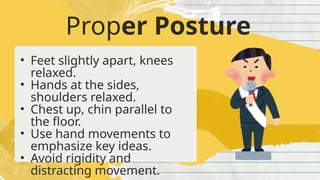
Proper Posture
• Feetslightly apart, knees
relaxed.
• Hands at the sides,
shoulders relaxed.
• Chest up, chin parallel to
the floor.
• Use hand movements to
emphasize key ideas.
• Avoid rigidity and
distracting movement.
6.
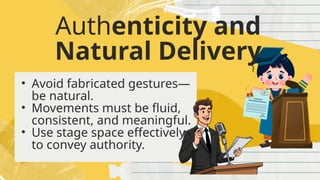
Authenticity and
Natural Delivery
•Avoid fabricated gestures—
be natural.
• Movements must be fluid,
consistent, and meaningful.
• Use stage space effectively
to convey authority.
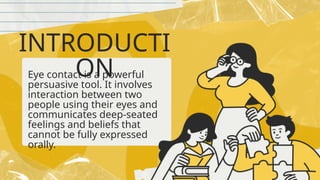
INTRODUCTI
ON
Eye contact isa powerful
persuasive tool. It involves
interaction between two
people using their eyes and
communicates deep-seated
feelings and beliefs that
cannot be fully expressed
orally.
10.
BENEFITS OF USINGEYE
CONTACT
Transforms the
audience into active
participants
Gives the speaker a
significant amount of
authority
Boosts the speaker’s
confidence and comfort
11.
BENEFITS OF USINGEYE
CONTACT
When you initiate eye
contact, the audience feels
more included in the
presentation. They are
encouraged to engage,
participate, and pay
attention.
EYE CONTACT TRANSFORMS
YOUR AUDIENCE
12.
BENEFITS OF USINGEYE
CONTACT
Your audience can gauge
your mastery of the topic by
your confidence in looking at
them. Avoiding eye contact
may signal uncertainty or
unpreparedness. Sufficient
eye contact assures the
audience that you are
credible and believable.
EYE CONTACT GIVES
AUTHORITY
13.
BENEFITS OF USINGEYE
CONTACT
A confident speaker can look
at the audience without
showing nervousness. Eye
contact reassures listeners
that you will guide them
clearly through the
presentation. A self-assured
stance and demeanor can
make the audience feel
welcome.
EYE CONTACT BOOSTS YOUR
CONFIDENCE
14.
Ways to ImproveEye Contact
• Focus and take aim: Stay
aware and do not let your
mind wander.
• Look directly at your
audience to show sincerity.
• Avoid squinting, blinking
too much, or looking down.
• Aim to make others believe
in what you are saying.
15.
Ways to ImproveEye Contact
• When you look straight
into the eyes of your
audience, you show
assertiveness and
confidence. Eye contact
helps establish a
connection and
encourages your audience
BE CONFIDENT
16.
Ways to ImproveEye Contact
Skim through the
audience’s faces while
talking to gauge their
reactions. Their facial
expressions—nodding,
frowning, widening eyes—
signal how they
understand your message.
PRACTICE TRANSFORMATIVE
DIALOGUE
17.
Ways to ImproveEye Contact
Be sensitive to your
audience’s reactions,
especially when topics are
unusual or controversial.
Respond immediately if
they look confused,
suspicious, or unsure.
BE SENSITIVE
18.
Ways to ImproveEye Contact
While you should look
directly at your audience,
avoid staring for too long.
Break eye contact naturally
to prevent discomfort. Use
sustained but not excessive
eye contact.
STOP STARING