What is considered as beautiful?
Do colors really matter?
What comprises a great leader?
Which is the best toothpaste?
Detecting
Propaganda
 What is propaganda?
It is a sustained, organized campaign to influence
others to accept a decision. It makes use of the
technique known as “the big lie”.
There is a good propaganda, too, such as when a
campaign is organized to get the public drive safely or
to help prevent fires, etc.
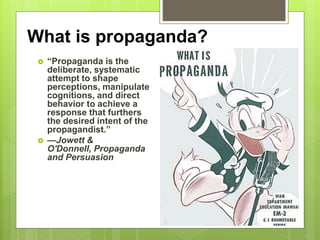
What is propaganda?
 “Propaganda is the
deliberate, systematic
attempt to shape
perceptions, manipulate
cognitions, and direct
behavior to achieve a
response that furthers
the desired intent of the
propagandist.”
 —Jowett &
O'Donnell, Propaganda
and Persuasion
Government propaganda
Purpose of Propaganda
to influence
people's
opinions
actively
appeal to one's
emotions
Five characteristics of propaganda
 Propaganda is in the eye
of the beholder.
 “I’m persuading. The
other guy is using
propaganda.”
 Propaganda has a
strong ideological bent.
 example: PETA
 Propaganda is
institutional in nature. It
is practiced by organized
groups
 governments,
corporations, social
movements, special
interests
 Propaganda relies on
mass persuasion
 television, radio,
Internet, billboards
 Propaganda tends to
rely on ethically
suspect methods of
influence.
 deception, distortion,
misrepresentation, or
suppression of
information.
Propaganda Tricks
 Name Calling—”get personal”
 Hasty/False Generalization—sweeping statements
without basis
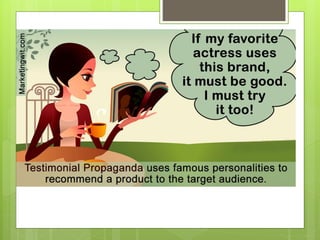
 Testimonials—prominent and much-admired persons
 Bandwagon—appeals to your desire to belong to the
group
 Transfer—makes you accept a person, idea or thing
by showing that it is related to other persons.
 Card Stacking—deliberately withholding information
Propaganda.pptx
Propaganda.pptx
Propaganda.pptx
Propaganda.pptx
Propaganda.pptx
Propaganda.pptx
Propaganda.pptx
Propaganda.pptx
Propaganda.pptx
Propaganda.pptx
Propaganda.pptx
Propaganda.pptx
Propaganda.pptx
Propaganda.pptx

Propaganda.pptx

  • 2.
    What is consideredas beautiful?
  • 3.
  • 4.
    What comprises agreat leader?
  • 5.
    Which is thebest toothpaste?
  • 6.
    Detecting Propaganda  What ispropaganda? It is a sustained, organized campaign to influence others to accept a decision. It makes use of the technique known as “the big lie”. There is a good propaganda, too, such as when a campaign is organized to get the public drive safely or to help prevent fires, etc.
  • 7.
    What is propaganda? “Propaganda is the deliberate, systematic attempt to shape perceptions, manipulate cognitions, and direct behavior to achieve a response that furthers the desired intent of the propagandist.”  —Jowett & O'Donnell, Propaganda and Persuasion
  • 8.
  • 11.
    Purpose of Propaganda toinfluence people's opinions actively appeal to one's emotions
  • 12.
    Five characteristics ofpropaganda  Propaganda is in the eye of the beholder.  “I’m persuading. The other guy is using propaganda.”  Propaganda has a strong ideological bent.  example: PETA  Propaganda is institutional in nature. It is practiced by organized groups  governments, corporations, social movements, special interests  Propaganda relies on mass persuasion  television, radio, Internet, billboards  Propaganda tends to rely on ethically suspect methods of influence.  deception, distortion, misrepresentation, or suppression of information.
  • 13.
    Propaganda Tricks  NameCalling—”get personal”  Hasty/False Generalization—sweeping statements without basis  Testimonials—prominent and much-admired persons  Bandwagon—appeals to your desire to belong to the group  Transfer—makes you accept a person, idea or thing by showing that it is related to other persons.  Card Stacking—deliberately withholding information