Lighting

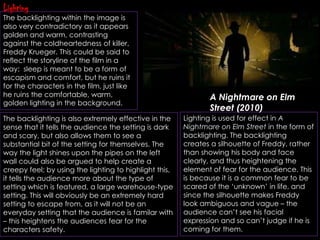
The backlighting within the image is
also very contradictory as it appears
golden and warm, contrasting
against the coldheartedness of killer,
Freddy Krueger. This could be said to
reflect the storyline of the film in a
way; sleep is meant to be a form of
escapism and comfort, but he ruins it
for the characters in the film, just like
he ruins the comfortable, warm,
golden lighting in the background.

The backlighting is also extremely effective in the
sense that it tells the audience the setting is dark
and scary, but also allows them to see a
substantial bit of the setting for themselves. The
way the light shines upon the pipes on the left
wall could also be argued to help create a
creepy feel; by using the lighting to highlight this,
it tells the audience more about the type of
setting which is featured, a large warehouse-type
setting. This will obviously be an extremely hard
setting to escape from, as it will not be an
everyday setting that the audience is familar with
– this heightens the audiences fear for the
characters safety.

A Nightmare on Elm
Street (2010)
Lighting is used for effect in A
Nightmare on Elm Street in the form of
backlighting. The backlighting
creates a silhouette of Freddy, rather
than showing his body and face
clearly, and thus heightening the
element of fear for the audience. This
is because it is a common fear to be
scared of the ‘unknown’ in life, and
since the silhouette makes Freddy
look ambiguous and vague – the
audience can’t see his facial
expression and so can’t judge if he is
coming for them.
Lighting

The blue lighting
could also be said
to remind the
audience of
lightning; a
dangerous and
powerful natural
element. Esther is
also dangerous and
powerful as an
antagonist, since
she is disguised as a
child and so is able
to worm her way
into families and
destroy them. As
well as this, her
evilness comes
naturally to her,
shown by the
lighting and it’s
similarities to
lightning.

Orphan

The lighting used in this still from Orphan is available
lighting. The blue tint within this lighting reflects Esther’s
coldheartedness and twisted facial expression. Blue is a
common shade used when it comes to lighting in horror
films, as it is cold and bleak – just like the antagonists
which feature.
The lighting reflects the change in character in Esther;
throughout Orphan, ambient and artificial lighting are
used. These are the two types of common lighting which
feature in everyday life, and so work in order to create
realism for the audience. However, the change in colour
of the lighting reflects that Esther isn’t pretending to be
an innocent little girl anymore; her true colours, which are
extremely dark, are showing.
Lighting

Profile lighting is
used in order to tell
the audience more
about the character
of slasher
antagonist, Michael
Myers. Since he is
hiding behind a
mask, it could be
said that the profile
lighting reflects the
two sides of
Michael; the
masked, and
unmasked. The
audience never get
to see the
unmasked Michael
Myers in Halloween,
just like they are
unable to see the
right-hand side of his
face in the image.

Around Michael is artificial lighting,
which creates the profile lighting
effect upon his face. The artificial
lighting around him is not
particularly as bright as you’d
expect, showing the audience that
he has a dark, horrific presence
about himself. It also hints he kills
any form of life around his vacinity,
since light is supposed to represent
joy and life (i.e. The ressurection).

Halloween
(1978)
Even though the dark right hand side of his face, due to
profile lighting, tells the audience that Michael has a
dark side, the use of profile lighting almost creates an
air of mystery about him. Since it is a more unusual form
of lighting to feature, it could be argued that Michael is
a more unusual antagonist than other slasher films –
even though he kills his sister on halloween eve, nobody
generally knows what his motives are for wanting to kill
Laurie Strode, since she isn’t promiscous (as his sister,
and many other teenage characters in slashers are).

Prop

  • 1.
    Lighting The backlighting withinthe image is also very contradictory as it appears golden and warm, contrasting against the coldheartedness of killer, Freddy Krueger. This could be said to reflect the storyline of the film in a way; sleep is meant to be a form of escapism and comfort, but he ruins it for the characters in the film, just like he ruins the comfortable, warm, golden lighting in the background. The backlighting is also extremely effective in the sense that it tells the audience the setting is dark and scary, but also allows them to see a substantial bit of the setting for themselves. The way the light shines upon the pipes on the left wall could also be argued to help create a creepy feel; by using the lighting to highlight this, it tells the audience more about the type of setting which is featured, a large warehouse-type setting. This will obviously be an extremely hard setting to escape from, as it will not be an everyday setting that the audience is familar with – this heightens the audiences fear for the characters safety. A Nightmare on Elm Street (2010) Lighting is used for effect in A Nightmare on Elm Street in the form of backlighting. The backlighting creates a silhouette of Freddy, rather than showing his body and face clearly, and thus heightening the element of fear for the audience. This is because it is a common fear to be scared of the ‘unknown’ in life, and since the silhouette makes Freddy look ambiguous and vague – the audience can’t see his facial expression and so can’t judge if he is coming for them.
  • 2.
    Lighting The blue lighting couldalso be said to remind the audience of lightning; a dangerous and powerful natural element. Esther is also dangerous and powerful as an antagonist, since she is disguised as a child and so is able to worm her way into families and destroy them. As well as this, her evilness comes naturally to her, shown by the lighting and it’s similarities to lightning. Orphan The lighting used in this still from Orphan is available lighting. The blue tint within this lighting reflects Esther’s coldheartedness and twisted facial expression. Blue is a common shade used when it comes to lighting in horror films, as it is cold and bleak – just like the antagonists which feature. The lighting reflects the change in character in Esther; throughout Orphan, ambient and artificial lighting are used. These are the two types of common lighting which feature in everyday life, and so work in order to create realism for the audience. However, the change in colour of the lighting reflects that Esther isn’t pretending to be an innocent little girl anymore; her true colours, which are extremely dark, are showing.
  • 3.
    Lighting Profile lighting is usedin order to tell the audience more about the character of slasher antagonist, Michael Myers. Since he is hiding behind a mask, it could be said that the profile lighting reflects the two sides of Michael; the masked, and unmasked. The audience never get to see the unmasked Michael Myers in Halloween, just like they are unable to see the right-hand side of his face in the image. Around Michael is artificial lighting, which creates the profile lighting effect upon his face. The artificial lighting around him is not particularly as bright as you’d expect, showing the audience that he has a dark, horrific presence about himself. It also hints he kills any form of life around his vacinity, since light is supposed to represent joy and life (i.e. The ressurection). Halloween (1978) Even though the dark right hand side of his face, due to profile lighting, tells the audience that Michael has a dark side, the use of profile lighting almost creates an air of mystery about him. Since it is a more unusual form of lighting to feature, it could be argued that Michael is a more unusual antagonist than other slasher films – even though he kills his sister on halloween eve, nobody generally knows what his motives are for wanting to kill Laurie Strode, since she isn’t promiscous (as his sister, and many other teenage characters in slashers are).