CSE: Introduction to Prolog
AJAYSING ,
JUNAID,
AKASH,
CSE Dept,
SSGMCE,SHEGAON
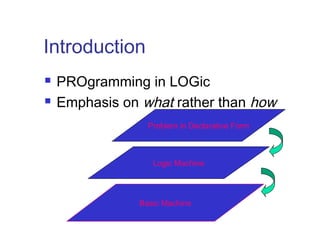
Introduction
 PROgramming in LOGic
 Emphasis on what rather than how
Basic Machine
Logic Machine
Problem in Declarative Form
Prolog’s strong and weak
points
 Assists thinking in terms of objects and
entities
 Not good for number crunching
 Useful applications of Prolog in
 Expert Systems (Knowledge
Representation and Interencing)
 Natural Language Processing
 Relational Databases
A Typical Prolog program
Compute_length ([],0).
Compute_length ([Head|Tail], Length):-
Compute_length (Tail,Tail_length),
Length is Tail_length+1.
High level explanation:
The length of a list is 1 plus the length of the
tail of the list, obtained by removing the first
element of the list.
This is a declarative description of the
computation.
Fundamentals
(absolute basics for writing
Prolog Programs)
Facts
 John likes Mary
 like(john,mary)
 Names of relationship and objects must begin
with a lower-case letter.
 Relationship is written first (typically the
predicate of the sentence).
 Objects are written separated by commas
and are enclosed by a pair of round brackets.
 The full stop character ‘.’ must come at the
end of a fact.
More facts
Predicate Interpretation
valuable(gold) Gold is valuable.
owns(john,gold) John owns gold.
father(john,mary) John is the father of
Mary
gives (john,book,mary) John gives the book to
Mary
 Questions based on facts
 Answered by matching
Two facts match if their predicates are same
(spelt the same way) and the arguments each
are same.
 If matched, prolog answers yes, else no.
 No does not mean falsity.
Questions
Prolog does theorem proving
 When a question is asked, prolog tries
to match transitively.
 When no match is found, answer is no.
 This means not provable from the given
facts.
Variables
 Always begin with a capital letter
 ?- likes (john,X).
 ?- likes (john, Something).
 But not
 ?- likes (john,something)
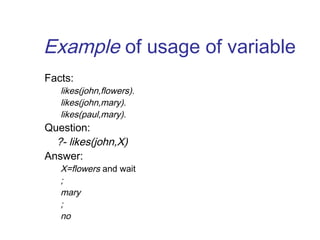
Example of usage of variable
Facts:
likes(john,flowers).
likes(john,mary).
likes(paul,mary).
Question:
?- likes(john,X)
Answer:
X=flowers and wait
;
mary
;
no
Conjunctions
 Use ‘,’ and pronounce it as and.
 Example
 Facts:

likes(mary,food).

likes(mary,tea).

likes(john,tea).

likes(john,mary)
 ?-

likes(mary,X),likes(john,X).

Meaning is anything liked by Mary also liked by John?
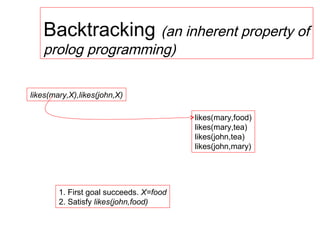
Backtracking (an inherent property of
prolog programming)
likes(mary,X),likes(john,X)
likes(mary,food)
likes(mary,tea)
likes(john,tea)
likes(john,mary)
1. First goal succeeds. X=food
2. Satisfy likes(john,food)
Backtracking (continued)
Returning to a marked place and trying to resatisfy is
called Backtracking
likes(mary,X),likes(john,X)
likes(mary,food)
likes(mary,tea)
likes(john,tea)
likes(john,mary)
1. Second goal fails
2. Return to marked place
and try to resatisfy the first goal
Backtracking (continued)
likes(mary,X),likes(john,X)
likes(mary,food)
likes(mary,tea)
likes(john,tea)
likes(john,mary)
1. First goal succeeds again, X=tea
2. Attempt to satisfy the likes(john,tea)
Backtracking (continued)
likes(mary,X),likes(john,X)
likes(mary,food)
likes(mary,tea)
likes(john,tea)
likes(john,mary)
1. Second goal also suceeds
2. Prolog notifies success and waits for a reply
Rules
 Statements about objects and their
relationships
 Expess
 If-then conditions

I use an umbrella if there is a rain

use(i, umbrella) :- occur(rain).
 Generalizations

All men are mortal

mortal(X) :- man(X).
 Definitions

An animal is a bird if it has feathers

bird(X) :- animal(X), has_feather(X).
Syntax
 <head> :- <body>
 Read ‘:-’ as ‘if’.
 E.G.
 likes(john,X) :- likes(X,cricket).
 “John likes X if X likes cricket”.
 i.e., “John likes anyone who likes cricket”.
 Rules always end with ‘.’.
Another Example
sister_of (X,Y):- female (X),
parents (X, M, F),
parents (Y, M, F).
X is a sister of Y is
X is a female and
X and Y have same parents
Question Answering in presence
of rules
 Facts
 male (ram).
 male (shyam).
 female (sita).
 female (gita).
 parents (shyam, gita, ram).
 parents (sita, gita, ram).
Question Answering: Y/N type: is sita the
sister of shyam?
female(sita)
parents(sita,M,F) parents(shyam,M,F)
parents(sita,gita,ram)
parents(shyam,gita,ram)
success
?- sister_of (sita, shyam)
Question Answering: wh-type: whose
sister is sita?
female(sita)
parents(sita,M,F) parents(Y,M,F)
parents(sita,gita,ram)
parents(Y,gita,ram)
Success
Y=shyam
parents(shyam,gita,ram)
?- ?- sister_of (sita, X)
Exercise
1. From the above it is possible for
somebody to be her own sister. How
can this be prevented?
References:-
 http://book.simply-
logical.space/part_i.html#a_brief_introd
uction_to_clausal_logic
Thank you!!!

Prolog

  • 1.
    CSE: Introduction toProlog AJAYSING , JUNAID, AKASH, CSE Dept, SSGMCE,SHEGAON
  • 2.
    Introduction  PROgramming inLOGic  Emphasis on what rather than how Basic Machine Logic Machine Problem in Declarative Form
  • 3.
    Prolog’s strong andweak points  Assists thinking in terms of objects and entities  Not good for number crunching  Useful applications of Prolog in  Expert Systems (Knowledge Representation and Interencing)  Natural Language Processing  Relational Databases
  • 4.
    A Typical Prologprogram Compute_length ([],0). Compute_length ([Head|Tail], Length):- Compute_length (Tail,Tail_length), Length is Tail_length+1. High level explanation: The length of a list is 1 plus the length of the tail of the list, obtained by removing the first element of the list. This is a declarative description of the computation.
  • 5.
    Fundamentals (absolute basics forwriting Prolog Programs)
  • 6.
    Facts  John likesMary  like(john,mary)  Names of relationship and objects must begin with a lower-case letter.  Relationship is written first (typically the predicate of the sentence).  Objects are written separated by commas and are enclosed by a pair of round brackets.  The full stop character ‘.’ must come at the end of a fact.
  • 7.
    More facts Predicate Interpretation valuable(gold)Gold is valuable. owns(john,gold) John owns gold. father(john,mary) John is the father of Mary gives (john,book,mary) John gives the book to Mary
  • 8.
     Questions basedon facts  Answered by matching Two facts match if their predicates are same (spelt the same way) and the arguments each are same.  If matched, prolog answers yes, else no.  No does not mean falsity. Questions
  • 9.
    Prolog does theoremproving  When a question is asked, prolog tries to match transitively.  When no match is found, answer is no.  This means not provable from the given facts.
  • 10.
    Variables  Always beginwith a capital letter  ?- likes (john,X).  ?- likes (john, Something).  But not  ?- likes (john,something)
  • 11.
    Example of usageof variable Facts: likes(john,flowers). likes(john,mary). likes(paul,mary). Question: ?- likes(john,X) Answer: X=flowers and wait ; mary ; no
  • 12.
    Conjunctions  Use ‘,’and pronounce it as and.  Example  Facts:  likes(mary,food).  likes(mary,tea).  likes(john,tea).  likes(john,mary)  ?-  likes(mary,X),likes(john,X).  Meaning is anything liked by Mary also liked by John?
  • 13.
    Backtracking (an inherentproperty of prolog programming) likes(mary,X),likes(john,X) likes(mary,food) likes(mary,tea) likes(john,tea) likes(john,mary) 1. First goal succeeds. X=food 2. Satisfy likes(john,food)
  • 14.
    Backtracking (continued) Returning toa marked place and trying to resatisfy is called Backtracking likes(mary,X),likes(john,X) likes(mary,food) likes(mary,tea) likes(john,tea) likes(john,mary) 1. Second goal fails 2. Return to marked place and try to resatisfy the first goal
  • 15.
  • 16.
  • 17.
    Rules  Statements aboutobjects and their relationships  Expess  If-then conditions  I use an umbrella if there is a rain  use(i, umbrella) :- occur(rain).  Generalizations  All men are mortal  mortal(X) :- man(X).  Definitions  An animal is a bird if it has feathers  bird(X) :- animal(X), has_feather(X).
  • 18.
    Syntax  <head> :-<body>  Read ‘:-’ as ‘if’.  E.G.  likes(john,X) :- likes(X,cricket).  “John likes X if X likes cricket”.  i.e., “John likes anyone who likes cricket”.  Rules always end with ‘.’.
  • 19.
    Another Example sister_of (X,Y):-female (X), parents (X, M, F), parents (Y, M, F). X is a sister of Y is X is a female and X and Y have same parents
  • 20.
    Question Answering inpresence of rules  Facts  male (ram).  male (shyam).  female (sita).  female (gita).  parents (shyam, gita, ram).  parents (sita, gita, ram).
  • 21.
    Question Answering: Y/Ntype: is sita the sister of shyam? female(sita) parents(sita,M,F) parents(shyam,M,F) parents(sita,gita,ram) parents(shyam,gita,ram) success ?- sister_of (sita, shyam)
  • 22.
    Question Answering: wh-type:whose sister is sita? female(sita) parents(sita,M,F) parents(Y,M,F) parents(sita,gita,ram) parents(Y,gita,ram) Success Y=shyam parents(shyam,gita,ram) ?- ?- sister_of (sita, X)
  • 23.
    Exercise 1. From theabove it is possible for somebody to be her own sister. How can this be prevented?
  • 24.
  • 25.