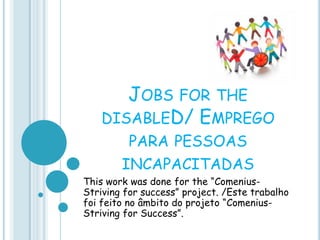
JOBS FOR THE
DISABLED/ EMPREGO
PARA PESSOAS
INCAPACITADAS
This work was done for the “Comenius-
Striving for success” project. /Este trabalho
foi feito no âmbito do projeto “Comenius-
Striving for Success”.
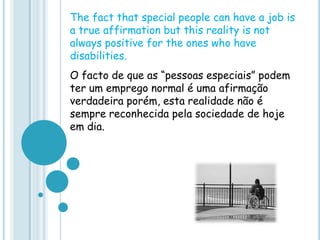
The fact that special people can have a job is
a true affirmation but this reality is not
always positive for the ones who have
disabilities.
O facto de que as “pessoas especiais” podem
ter um emprego normal é uma afirmação
verdadeira porém, esta realidade não é
sempre reconhecida pela sociedade de hoje
em dia.
The access to employment of people with
disabilities depends on a set factors/O
acesso a emprego de pessoas com
incapacidades depende de vários factores:
Job/
Emprego
Employment
incentives/
Incentivas de
trabalho
Sensitization/
Sensibilização
Education/
Ensino
Technical aids/
Ajudas técnicas
No
discrimination/
Acabar com a
discriminação
ADVANTAGES OF A SPECIAL PERSON/
VANTAGENS DE UMA PESSOA ESPECIAL:
 In Portugal the hiring of
a disabled person is
encouraged by funding
by the government.
 In many countries the
entrepreneurs can
choose by paying a
penalty instead of
employing the
percentage of disabled
workers required by the
law.
 Em Portugal, a
contratação de pessoas
com deficiência é
encorajada através de
incentivos financeiros
introduzidos pelo
governo.
 Em alguns países, os
empresários podem
optar por pagar uma
multa, em vez de
empregar a
percentagem
obrigatória de
trabalhadores com
deficiência.
 The concern of a firm
with its image is
increasing and one of
the ways to make this
happen is to hire an
incapacitated person.
 For companies that look
for ways to reduce
their tax burden, hiring
workers with disabilities
can offer a number of
important tax benefits.
 A preocupação com a
imagem pública das
empresas tem
aumentado e uma das
maneiras de esta
aumentar é contratando
uma pessoa
incapacitada.
 Para as empresas que
procuram formas de
reduzir sua carga
tributária, a
contratação de
trabalhadores com
deficiência pode
oferecer uma série de
benefícios fiscais
importantes.
The first thing that has to be made is
make people understand that being a
special person is not the same thing as
being a bad worker.
O primeiro passo a ser tomado é
fazer com que as pessoas percebam
que o facto de se ser uma pessoa
incapacitada não significa que se seja
um mau trabalhador.
There are many studies that say that less
than 2% of the people who send theirs
curricula to a job are not selected to the
interview. According to a lot of those studies
60 million people with disabilities in the
working age are unemployed and are the main
victims of poverty and social exclusion, which
today reaches about 18% of the European
population.
Vários estudos dizem que menos de 5% das
pessoas que portam incapacidades e enviam
o seu currículo não são chamados para a
entrevista de trabalho. Segundo alguns
desses estudos 60 milhões de pessoas com
deficiências na idade de trabalho são
desempregadas e são as principais vitimas
de pobreza e exclusão social, que hoje em
dia equivale a 18% da população Europeia.
MEASURES TAKEN TO MAKE DISABLED PEOPLE FEEL
COMFORTABLE WHILE WORKING/ MEDIDAS PARA QUE
AS PESSOAS INCAPACITADAS SE SINTAM
CONFORTÁVEIS DURANTE SEU TRABALHO:
 Measures that adjust
the workplace making it
more comfortable to
the person, for
example: adaptations to
machines or tools;
adaptations to the
timetable etc.
 Measures to sensitize
people to this cause, to
create more jobs
opportunities for the
disabled people.
 Medidas que modificam
o local de trabalho,
fazendo-o mais
confortável para a
pessoa, por exemplo:
adaptações às máquinas;
adaptações ao horário
de trabalho etc.
 Medidas feitas para
sensibilizar a sociedade
para esta causa com o
objetivo de criar mais
oferta de emprego.
 Measures that give
them the knowledge
they need to achieve a
certain kind of
competence and
qualifications required
to take advantage of
the jobs
opportunities.
 Medidas que dão o
conhecimento
necessário para
alcançar certas
competências e
qualificações
necessárias para
aproveitar a
oportunidades de
trabalho.
INTERVIEW
 Paula Cristina do Santos Amaral Henriques carries
a congenital physical disability in the hand, leg and
left foot. She is 32 years old, and, currently, she
works in her father’s bowling club and she is
responsible for the club’s marketing and outgoing.
She was born in Brazil and came to Portugal when she
was 17 years old where she remains until now. She
wears a prosthetic leg since he was 7 months old.
 Till what year did you study? Did you attend a
“special” school?
 I studied until the twelfth year, I didn’t attend any
special school.
 Did you feel comfortable in your school?
 When I was in Brazil, yes, I did, but then I came to
Portugal and everything changed.
INTERVIEW
 How old where you when you came to
Portugal?
 I was 17 years old.
 Did you feel any difference between Portugal
and Brazil? Which?
 Yes, I noticed some . When I lived in Brazil I
never felt any prejudice, however since I came
to Portugal things have changed. Soon after
landing, the prejudice began when a lady asked
me what was wrong in my arm and leg and I
answered, it was very awkward.
 How many jobs did you have?
 Only one, which is my current job.
INTERVIEW
 Do you think that your condition made your life
difficult? In what way?
 Not professionally, but in my personal life it did,
thanks to the prejudice of others.
 What was your dream profession? Did you follow
it? Why?
 Psychologist. I didn’t follow it. My experience in
school wasn’t great. I remember that when I was a
little girl I never wanted to go to school because
none of my schoolmates spoke to me because they
thought I was an “alien”.
 What is your current job?
 I work in my father’s bowling club. I am responsible
by the marketing and expenses of the club; it’s
almost like a manager.
INTERVIEW
 Considering your life experience, what would you
think is the hardest thing for a disabled person
when it comes to finding a job?
 Prejudice, the state provides support to companies
that hire people with disabilities, however people
have a lot of prejudice and they think that a disabled
person is not able to do what a non-disabled person
does.
 Do you receive any kind of “help/funding” by the
government?
 No, but when I want, for example, to buy a car or
make a loan I don’t pay taxes or interest.
 Why don´t you get any funding by the
government?
 The government says that my disability doesn’t
match the parameters required that to happen, after
that I didn’t try anymore.
INTERVIEW
 If you could change anything in the laws about the jobs
for the disabled ,what would you change?
 The law says that the companies have to hire disabled
people, and those people, just like the companies, have a
lot of tax benefits, so the law is ok, the only problem is
that the law isn’t followed through.
 Nowadays the disabled people’s employment is very
small, what do you think is the biggest obstacle to
overtake?
 It’s the prejudice.
 How do you think that could be done?
 Parents should teach their kids since young age there’s no
difference, to try to change the current way of thinking,
because in Portugal the prejudice with disabled people is
very big. When someone famous has some special condition
everyone is nice, but if it is an ordinary person, in the
same case, everything is different.
The end/ Fim

Projeto Comenius entrevista

  • 1.
    JOBS FOR THE DISABLED/EMPREGO PARA PESSOAS INCAPACITADAS This work was done for the “Comenius- Striving for success” project. /Este trabalho foi feito no âmbito do projeto “Comenius- Striving for Success”.
  • 2.
    The fact thatspecial people can have a job is a true affirmation but this reality is not always positive for the ones who have disabilities. O facto de que as “pessoas especiais” podem ter um emprego normal é uma afirmação verdadeira porém, esta realidade não é sempre reconhecida pela sociedade de hoje em dia.
  • 3.
    The access toemployment of people with disabilities depends on a set factors/O acesso a emprego de pessoas com incapacidades depende de vários factores: Job/ Emprego Employment incentives/ Incentivas de trabalho Sensitization/ Sensibilização Education/ Ensino Technical aids/ Ajudas técnicas No discrimination/ Acabar com a discriminação
  • 4.
    ADVANTAGES OF ASPECIAL PERSON/ VANTAGENS DE UMA PESSOA ESPECIAL:  In Portugal the hiring of a disabled person is encouraged by funding by the government.  In many countries the entrepreneurs can choose by paying a penalty instead of employing the percentage of disabled workers required by the law.  Em Portugal, a contratação de pessoas com deficiência é encorajada através de incentivos financeiros introduzidos pelo governo.  Em alguns países, os empresários podem optar por pagar uma multa, em vez de empregar a percentagem obrigatória de trabalhadores com deficiência.
  • 5.
     The concernof a firm with its image is increasing and one of the ways to make this happen is to hire an incapacitated person.  For companies that look for ways to reduce their tax burden, hiring workers with disabilities can offer a number of important tax benefits.  A preocupação com a imagem pública das empresas tem aumentado e uma das maneiras de esta aumentar é contratando uma pessoa incapacitada.  Para as empresas que procuram formas de reduzir sua carga tributária, a contratação de trabalhadores com deficiência pode oferecer uma série de benefícios fiscais importantes.
  • 6.
    The first thingthat has to be made is make people understand that being a special person is not the same thing as being a bad worker. O primeiro passo a ser tomado é fazer com que as pessoas percebam que o facto de se ser uma pessoa incapacitada não significa que se seja um mau trabalhador.
  • 7.
    There are manystudies that say that less than 2% of the people who send theirs curricula to a job are not selected to the interview. According to a lot of those studies 60 million people with disabilities in the working age are unemployed and are the main victims of poverty and social exclusion, which today reaches about 18% of the European population. Vários estudos dizem que menos de 5% das pessoas que portam incapacidades e enviam o seu currículo não são chamados para a entrevista de trabalho. Segundo alguns desses estudos 60 milhões de pessoas com deficiências na idade de trabalho são desempregadas e são as principais vitimas de pobreza e exclusão social, que hoje em dia equivale a 18% da população Europeia.
  • 8.
    MEASURES TAKEN TOMAKE DISABLED PEOPLE FEEL COMFORTABLE WHILE WORKING/ MEDIDAS PARA QUE AS PESSOAS INCAPACITADAS SE SINTAM CONFORTÁVEIS DURANTE SEU TRABALHO:  Measures that adjust the workplace making it more comfortable to the person, for example: adaptations to machines or tools; adaptations to the timetable etc.  Measures to sensitize people to this cause, to create more jobs opportunities for the disabled people.  Medidas que modificam o local de trabalho, fazendo-o mais confortável para a pessoa, por exemplo: adaptações às máquinas; adaptações ao horário de trabalho etc.  Medidas feitas para sensibilizar a sociedade para esta causa com o objetivo de criar mais oferta de emprego.
  • 9.
     Measures thatgive them the knowledge they need to achieve a certain kind of competence and qualifications required to take advantage of the jobs opportunities.  Medidas que dão o conhecimento necessário para alcançar certas competências e qualificações necessárias para aproveitar a oportunidades de trabalho.
  • 10.
    INTERVIEW  Paula Cristinado Santos Amaral Henriques carries a congenital physical disability in the hand, leg and left foot. She is 32 years old, and, currently, she works in her father’s bowling club and she is responsible for the club’s marketing and outgoing. She was born in Brazil and came to Portugal when she was 17 years old where she remains until now. She wears a prosthetic leg since he was 7 months old.  Till what year did you study? Did you attend a “special” school?  I studied until the twelfth year, I didn’t attend any special school.  Did you feel comfortable in your school?  When I was in Brazil, yes, I did, but then I came to Portugal and everything changed.
  • 11.
    INTERVIEW  How oldwhere you when you came to Portugal?  I was 17 years old.  Did you feel any difference between Portugal and Brazil? Which?  Yes, I noticed some . When I lived in Brazil I never felt any prejudice, however since I came to Portugal things have changed. Soon after landing, the prejudice began when a lady asked me what was wrong in my arm and leg and I answered, it was very awkward.  How many jobs did you have?  Only one, which is my current job.
  • 12.
    INTERVIEW  Do youthink that your condition made your life difficult? In what way?  Not professionally, but in my personal life it did, thanks to the prejudice of others.  What was your dream profession? Did you follow it? Why?  Psychologist. I didn’t follow it. My experience in school wasn’t great. I remember that when I was a little girl I never wanted to go to school because none of my schoolmates spoke to me because they thought I was an “alien”.  What is your current job?  I work in my father’s bowling club. I am responsible by the marketing and expenses of the club; it’s almost like a manager.
  • 13.
    INTERVIEW  Considering yourlife experience, what would you think is the hardest thing for a disabled person when it comes to finding a job?  Prejudice, the state provides support to companies that hire people with disabilities, however people have a lot of prejudice and they think that a disabled person is not able to do what a non-disabled person does.  Do you receive any kind of “help/funding” by the government?  No, but when I want, for example, to buy a car or make a loan I don’t pay taxes or interest.  Why don´t you get any funding by the government?  The government says that my disability doesn’t match the parameters required that to happen, after that I didn’t try anymore.
  • 14.
    INTERVIEW  If youcould change anything in the laws about the jobs for the disabled ,what would you change?  The law says that the companies have to hire disabled people, and those people, just like the companies, have a lot of tax benefits, so the law is ok, the only problem is that the law isn’t followed through.  Nowadays the disabled people’s employment is very small, what do you think is the biggest obstacle to overtake?  It’s the prejudice.  How do you think that could be done?  Parents should teach their kids since young age there’s no difference, to try to change the current way of thinking, because in Portugal the prejudice with disabled people is very big. When someone famous has some special condition everyone is nice, but if it is an ordinary person, in the same case, everything is different.
  • 15.