PROJECT SURATARAM
Clarencio Calagos Memorial School
of Fisheries
The logo
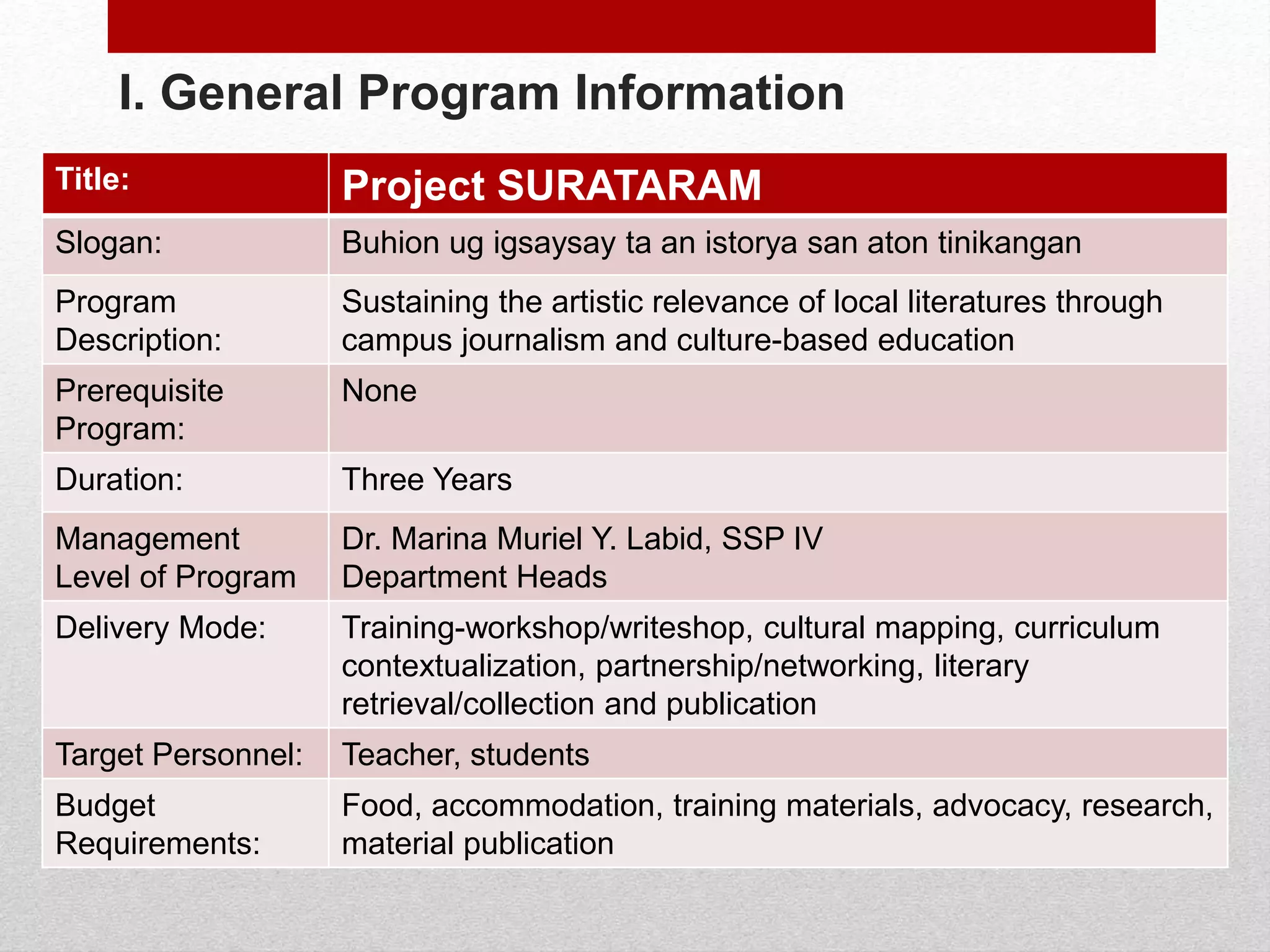
The Project SURATARAM logo
shows the strength of the Team to
empower its clienteles (teachers, students
and stakeholders) in creating informed,
innovative and skilled individuals who will
serve as instrument in the preservation
and production of contemporary
literature within the locality by providing
them the needed expertise anchored on
research, retrieval, criticism, creation and
contextualization.
The laurel represents the
proficiency in language as the effective
channel in preserving local literature by
means of the different forms of media
(print, broadcast, and social media) where the
generation of today are held responsible.
The Pencil serves as the shell and the
power in upholding the goal of the
Project SURATARAM.
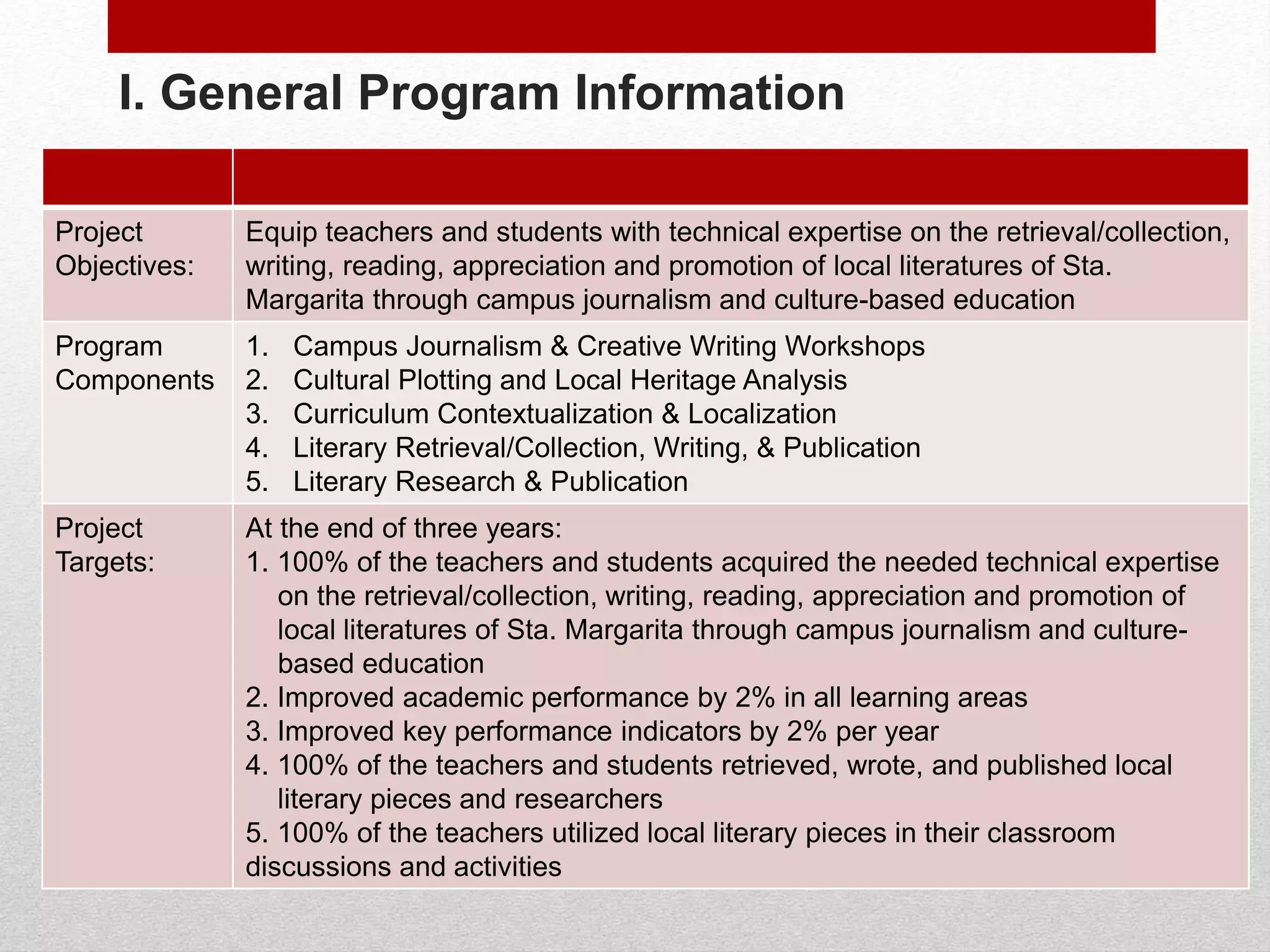
I. General Program Information
Title: Project SURATARAM
Slogan: Buhion ug igsaysay ta an istorya san aton tinikangan
Program
Description:
Sustaining the artistic relevance of local literatures through
campus journalism and culture-based education
Prerequisite
Program:
None
Duration: Three Years
Management
Level of Program
Dr. Marina Muriel Y. Labid, SSP IV
Department Heads
Delivery Mode: Training-workshop/writeshop, cultural mapping, curriculum
contextualization, partnership/networking, literary
retrieval/collection and publication
Target Personnel: Teacher, students
Budget
Requirements:
Food, accommodation, training materials, advocacy, research,
material publication
I. General Program Information
Project
Objectives:
Equip teachers and students with technical expertise on the retrieval/collection,
writing, reading, appreciation and promotion of local literatures of Sta.
Margarita through campus journalism and culture-based education
Program
Components
1. Campus Journalism & Creative Writing Workshops
2. Cultural Plotting and Local Heritage Analysis
3. Curriculum Contextualization & Localization
4. Literary Retrieval/Collection, Writing, & Publication
5. Literary Research & Publication
Project
Targets:
At the end of three years:
1. 100% of the teachers and students acquired the needed technical expertise
on the retrieval/collection, writing, reading, appreciation and promotion of
local literatures of Sta. Margarita through campus journalism and culture-
based education
2. Improved academic performance by 2% in all learning areas
3. Improved key performance indicators by 2% per year
4. 100% of the teachers and students retrieved, wrote, and published local
literary pieces and researchers
5. 100% of the teachers utilized local literary pieces in their classroom
discussions and activities
RATIONALE
II. RATIONALE
It is one of the school’s challenges to equip teachers and students with
technical expertise on the retrieval/collection, writing, reading, appreciation and
promotion of local literatures of Sta. Margarita through campus journalism and
culture-based education. The essence of the effect of the project goes beyond
retrieving, collecting, analyzing, writing, researching, appreciating, and
promoting. Behind all these is the development of the teachers’ effective
strategies in contextualizing and localizing the curriculum in their respective
classrooms, and the enhancement of the students’ learning skills.
Specifically, the project aims to commission teachers, students,
stakeholders and community in inculcating the paramount significance of local
literature in this part of archipelago. Local literature retrieval and
contextualization has been the goal of the K to 12 curriculum. Thus, it should
be given emphasis through increasing the training opportunities for teachers
towards literary criticism and analysis, campus journalism and creative writing;
empowering teachers to conduct researches on local literature; and reviving
local literature through producing and publishing contemporary local articles in
all forms of media (print, broadcast, and social media).
rationale
Educators are not the only ones who are benefited in this project. Students,
stakeholders and community are provided with awareness on the existing
local literature leading to the increase of people who are incline of enlivening
local literature through reading, storytelling, and writing.
Project SURATARAM was founded in 2004 as a best practice and
program of the school with the brilliant minds of Mr. Michael Jude T. Casaljay
and Mrs. Delia Collamat who have been school campus journalism
coordinators. It instigated with the promotion of campus journalism program
and later on widened its scope to local literature retrieval and creative writing.
For , SURAT ARAM has never failed to serve its purpose through bagging
numerous accolades and fishing strings of praises.
Creating this PROJECT SURATARAM encourages time-bounded
implementation of campus journalism, local literature retrieval and creative
writing. It promotes localization and contextualization which can uphold
effective classroom instruction following curriculum standards.
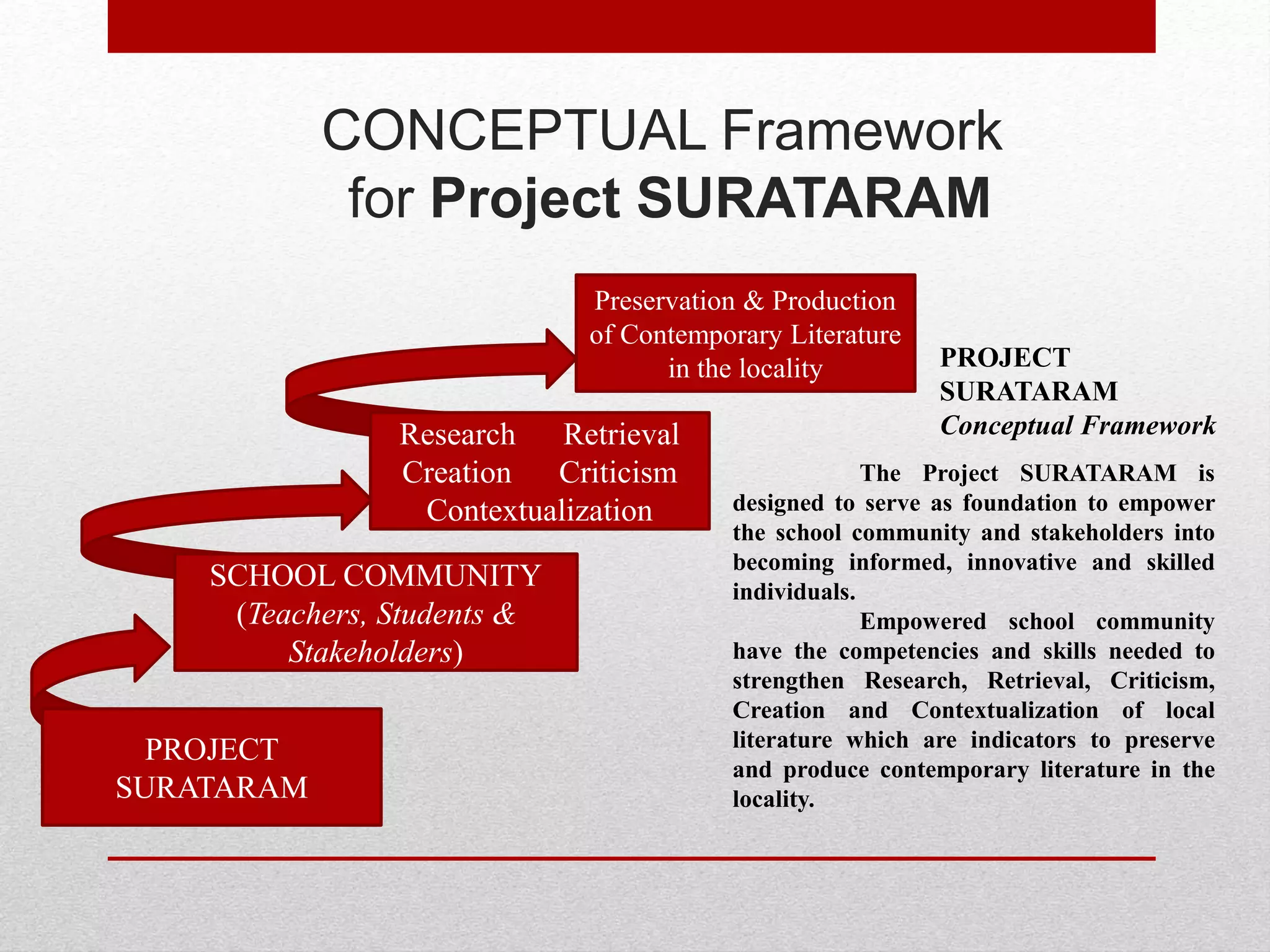
CONCEPTUAL Framework
for Project SURATARAM
Preservation & Production
of Contemporary Literature
in the locality
SCHOOL COMMUNITY
(Teachers, Students &
Stakeholders)
PROJECT
SURATARAM
Research Retrieval
Creation Criticism
Contextualization
The Project SURATARAM is
designed to serve as foundation to empower
the school community and stakeholders into
becoming informed, innovative and skilled
individuals.
Empowered school community
have the competencies and skills needed to
strengthen Research, Retrieval, Criticism,
Creation and Contextualization of local
literature which are indicators to preserve
and produce contemporary literature in the
locality.
PROJECT
SURATARAM
Conceptual Framework
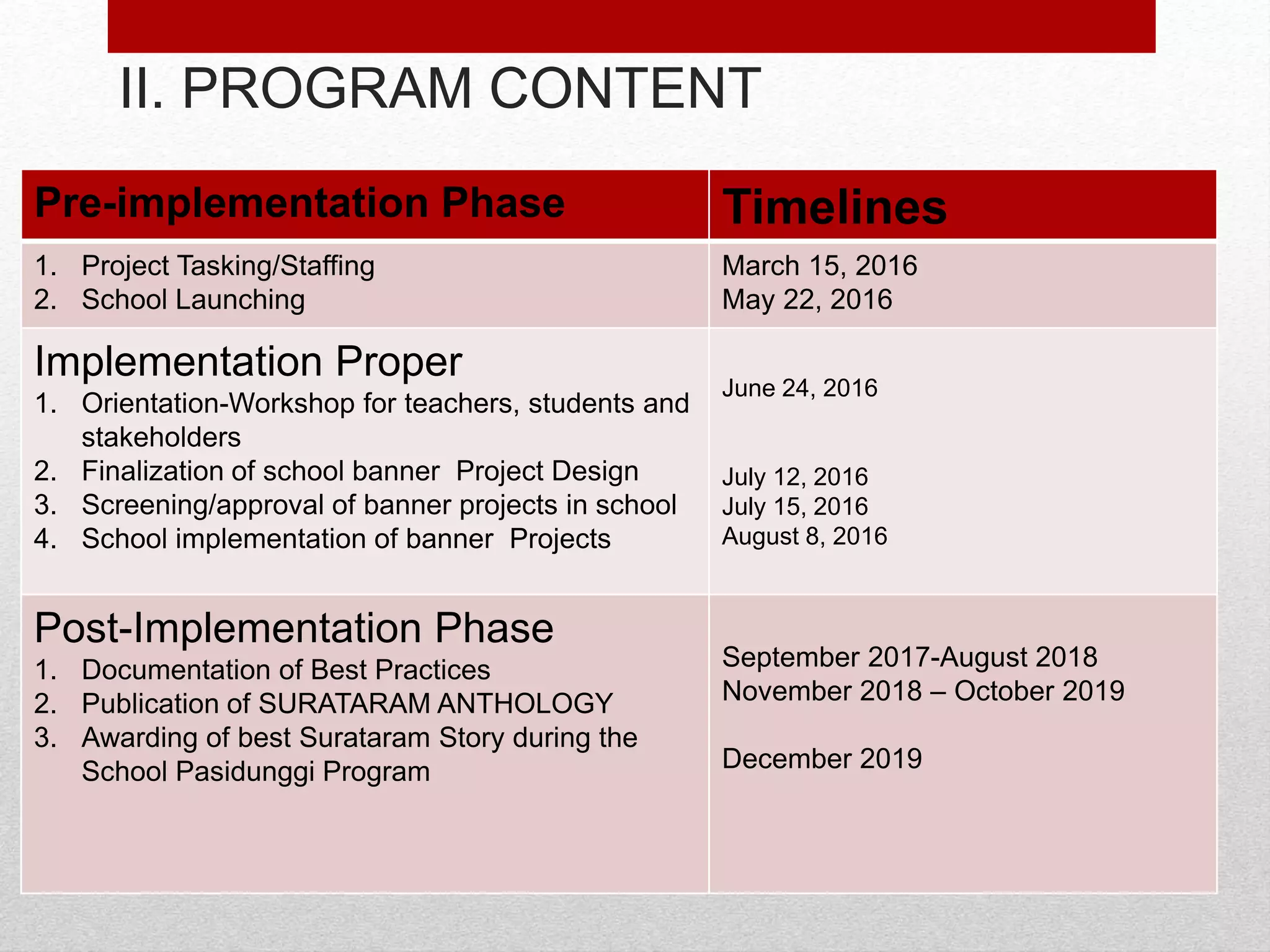
II. PROGRAM CONTENT
Pre-implementation Phase Timelines
1. Project Tasking/Staffing
2. School Launching
March 15, 2016
May 22, 2016
Implementation Proper
1. Orientation-Workshop for teachers, students and
stakeholders
2. Finalization of school banner Project Design
3. Screening/approval of banner projects in school
4. School implementation of banner Projects
June 24, 2016
July 12, 2016
July 15, 2016
August 8, 2016
Post-Implementation Phase
1. Documentation of Best Practices
2. Publication of SURATARAM ANTHOLOGY
3. Awarding of best Surataram Story during the
School Pasidunggi Program
September 2017-August 2018
November 2018 – October 2019
December 2019
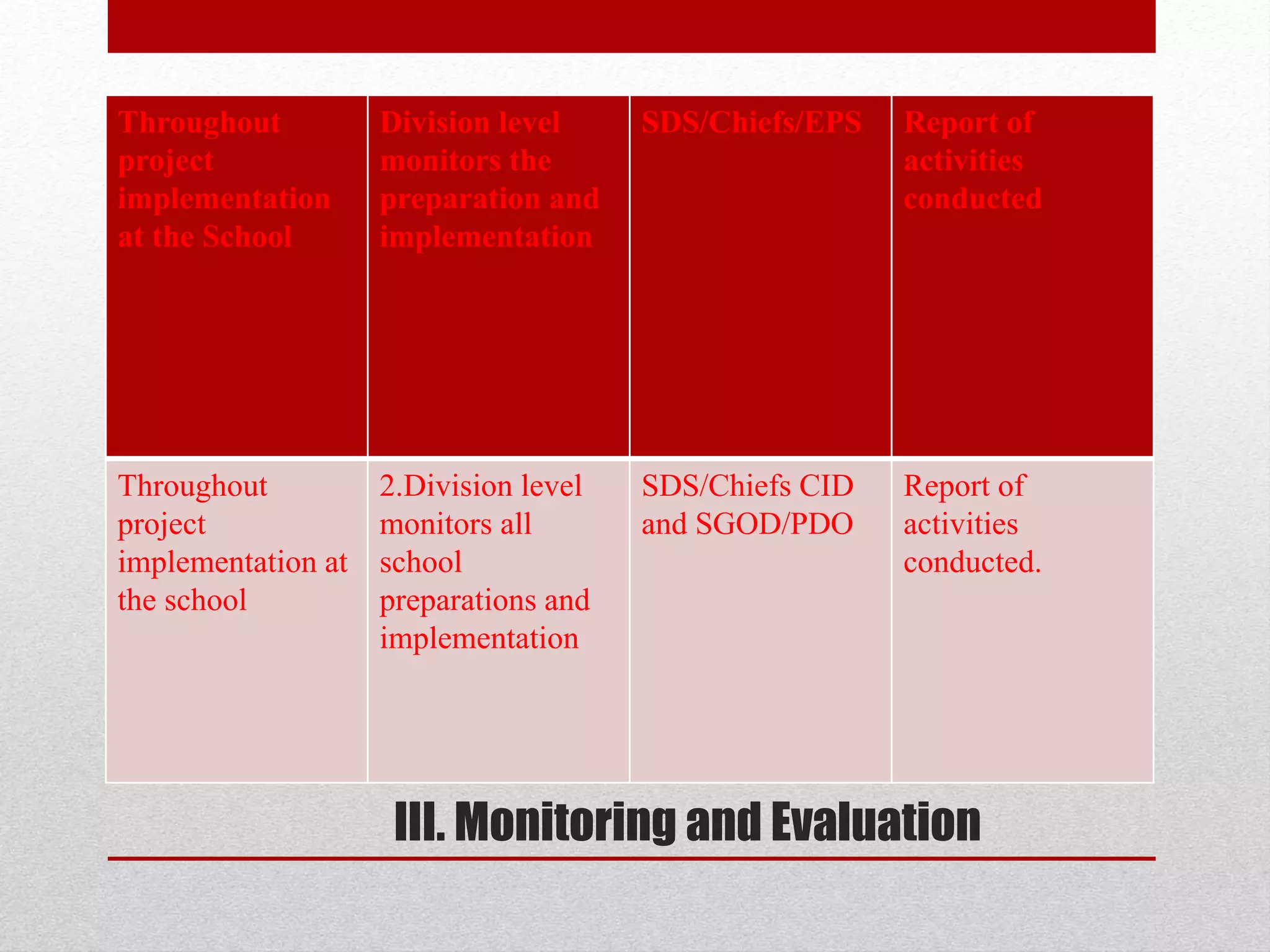
III. Monitoring and Evaluation
Throughout
project
implementation
at the School
Division level
monitors the
preparation and
implementation
SDS/Chiefs/EPS Report of
activities
conducted
Throughout
project
implementation at
the school
2.Division level
monitors all
school
preparations and
implementation
SDS/Chiefs CID
and SGOD/PDO
Report of
activities
conducted.
SUSTAINABILITY
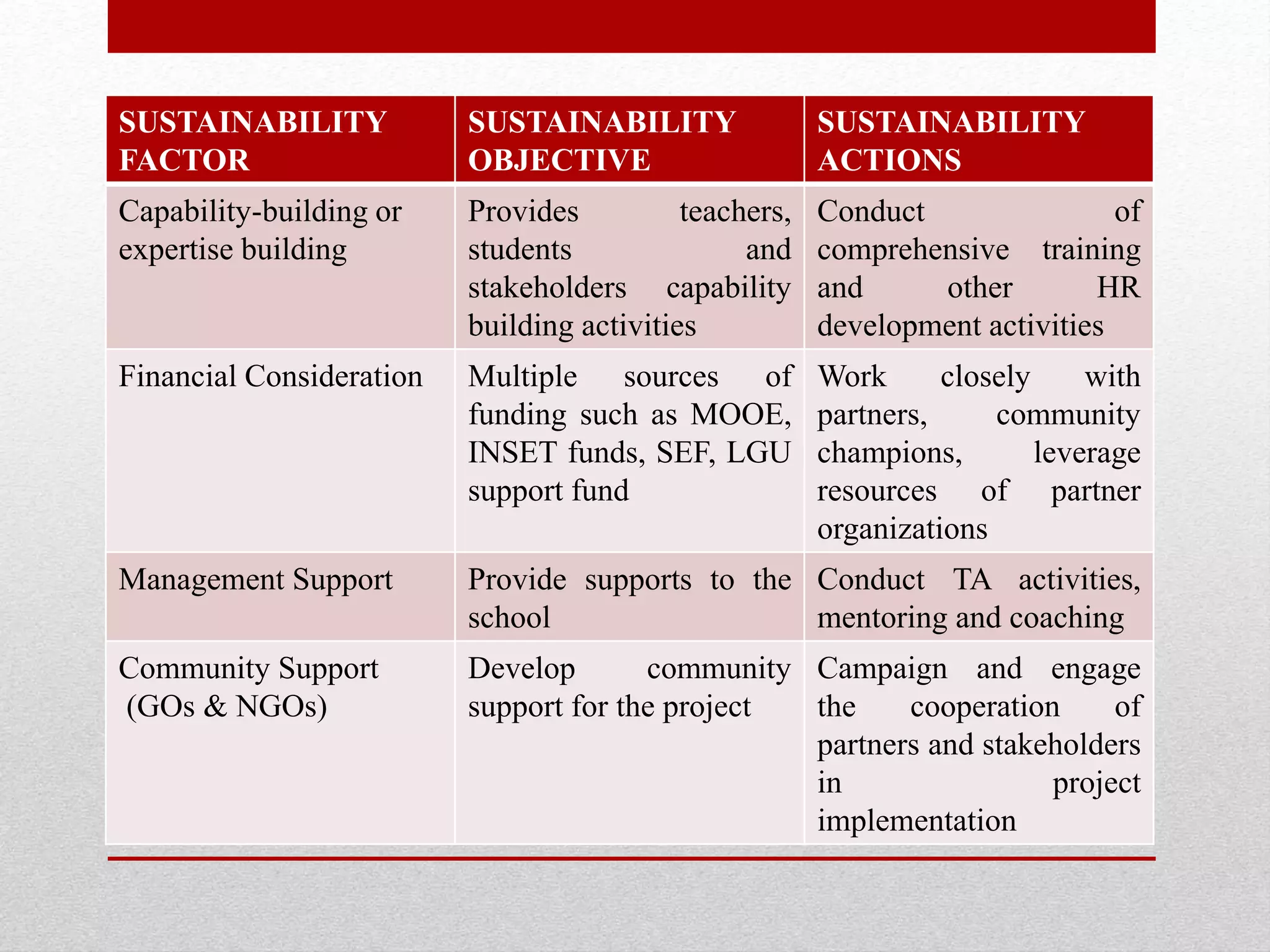
SUSTAINABILITY
FACTOR
SUSTAINABILITY
OBJECTIVE
SUSTAINABILITY
ACTIONS
Capability-building or
expertise building
Provides teachers,
students and
stakeholders capability
building activities
Conduct of
comprehensive training
and other HR
development activities
Financial Consideration Multiple sources of
funding such as MOOE,
INSET funds, SEF, LGU
support fund
Work closely with
partners, community
champions, leverage
resources of partner
organizations
Management Support Provide supports to the
school
Conduct TA activities,
mentoring and coaching
Community Support
(GOs & NGOs)
Develop community
support for the project
Campaign and engage
the cooperation of
partners and stakeholders
in project
implementation
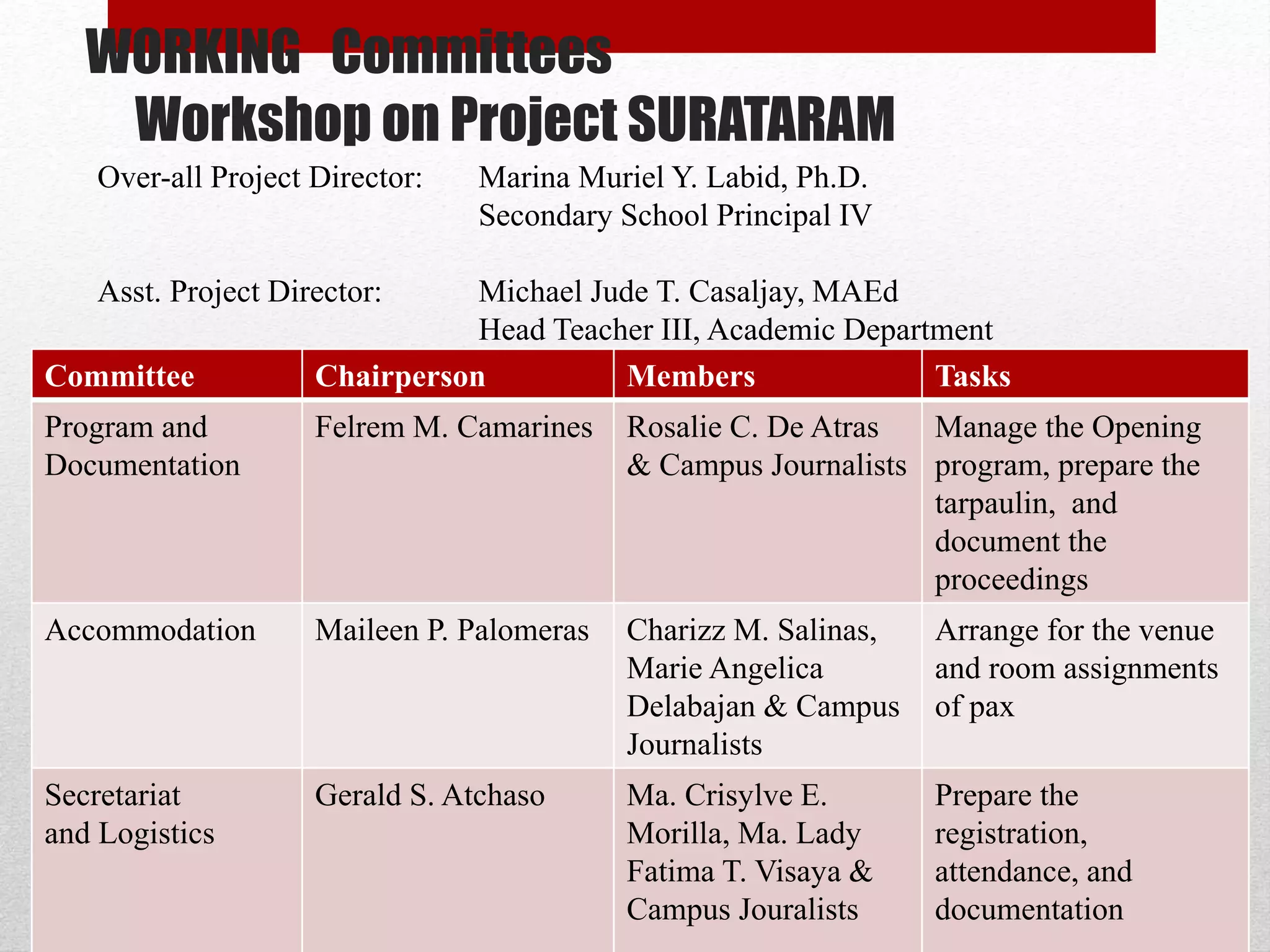
WORKING Committees
Workshop on Project SURATARAM
Committee Chairperson Members Tasks
Program and
Documentation
Felrem M. Camarines Rosalie C. De Atras
& Campus Journalists
Manage the Opening
program, prepare the
tarpaulin, and
document the
proceedings
Accommodation Maileen P. Palomeras Charizz M. Salinas,
Marie Angelica
Delabajan & Campus
Journalists
Arrange for the venue
and room assignments
of pax
Secretariat
and Logistics
Gerald S. Atchaso Ma. Crisylve E.
Morilla, Ma. Lady
Fatima T. Visaya &
Campus Jouralists
Prepare the
registration,
attendance, and
documentation
Over-all Project Director: Marina Muriel Y. Labid, Ph.D.
Secondary School Principal IV
Asst. Project Director: Michael Jude T. Casaljay, MAEd
Head Teacher III, Academic Department
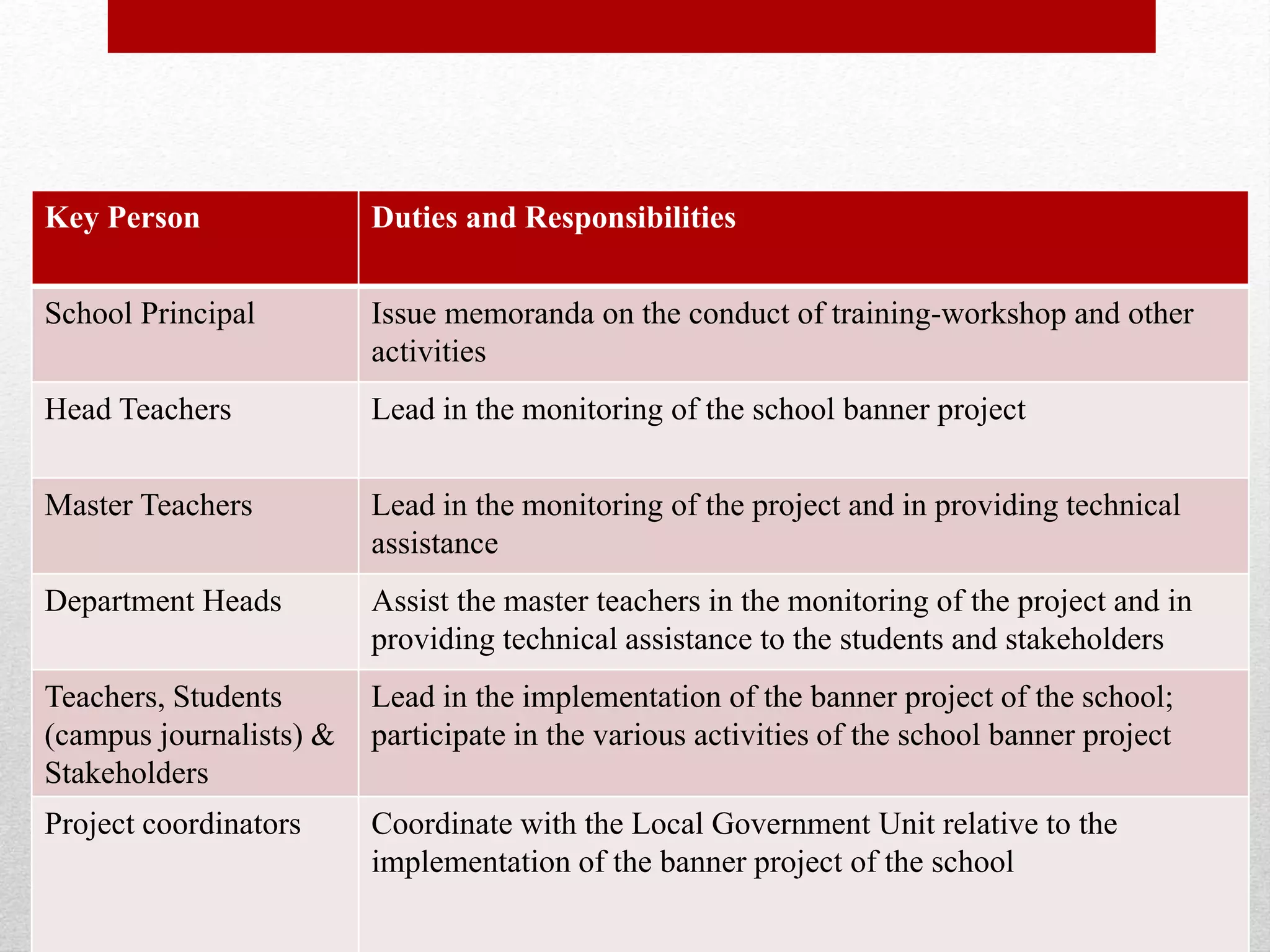
DUTIES AND RESPONSIBILITIES
Key Person Duties and Responsibilities
School Principal Issue memoranda on the conduct of training-workshop and other
activities
Head Teachers Lead in the monitoring of the school banner project
Master Teachers Lead in the monitoring of the project and in providing technical
assistance
Department Heads Assist the master teachers in the monitoring of the project and in
providing technical assistance to the students and stakeholders
Teachers, Students
(campus journalists) &
Stakeholders
Lead in the implementation of the banner project of the school;
participate in the various activities of the school banner project
Project coordinators Coordinate with the Local Government Unit relative to the
implementation of the banner project of the school

Project_Surataram.edited.pptx

  • 1.
    PROJECT SURATARAM Clarencio CalagosMemorial School of Fisheries
  • 2.
    The logo The ProjectSURATARAM logo shows the strength of the Team to empower its clienteles (teachers, students and stakeholders) in creating informed, innovative and skilled individuals who will serve as instrument in the preservation and production of contemporary literature within the locality by providing them the needed expertise anchored on research, retrieval, criticism, creation and contextualization. The laurel represents the proficiency in language as the effective channel in preserving local literature by means of the different forms of media (print, broadcast, and social media) where the generation of today are held responsible. The Pencil serves as the shell and the power in upholding the goal of the Project SURATARAM.
  • 3.
    I. General ProgramInformation Title: Project SURATARAM Slogan: Buhion ug igsaysay ta an istorya san aton tinikangan Program Description: Sustaining the artistic relevance of local literatures through campus journalism and culture-based education Prerequisite Program: None Duration: Three Years Management Level of Program Dr. Marina Muriel Y. Labid, SSP IV Department Heads Delivery Mode: Training-workshop/writeshop, cultural mapping, curriculum contextualization, partnership/networking, literary retrieval/collection and publication Target Personnel: Teacher, students Budget Requirements: Food, accommodation, training materials, advocacy, research, material publication
  • 4.
    I. General ProgramInformation Project Objectives: Equip teachers and students with technical expertise on the retrieval/collection, writing, reading, appreciation and promotion of local literatures of Sta. Margarita through campus journalism and culture-based education Program Components 1. Campus Journalism & Creative Writing Workshops 2. Cultural Plotting and Local Heritage Analysis 3. Curriculum Contextualization & Localization 4. Literary Retrieval/Collection, Writing, & Publication 5. Literary Research & Publication Project Targets: At the end of three years: 1. 100% of the teachers and students acquired the needed technical expertise on the retrieval/collection, writing, reading, appreciation and promotion of local literatures of Sta. Margarita through campus journalism and culture- based education 2. Improved academic performance by 2% in all learning areas 3. Improved key performance indicators by 2% per year 4. 100% of the teachers and students retrieved, wrote, and published local literary pieces and researchers 5. 100% of the teachers utilized local literary pieces in their classroom discussions and activities
  • 5.
  • 6.
    II. RATIONALE It isone of the school’s challenges to equip teachers and students with technical expertise on the retrieval/collection, writing, reading, appreciation and promotion of local literatures of Sta. Margarita through campus journalism and culture-based education. The essence of the effect of the project goes beyond retrieving, collecting, analyzing, writing, researching, appreciating, and promoting. Behind all these is the development of the teachers’ effective strategies in contextualizing and localizing the curriculum in their respective classrooms, and the enhancement of the students’ learning skills. Specifically, the project aims to commission teachers, students, stakeholders and community in inculcating the paramount significance of local literature in this part of archipelago. Local literature retrieval and contextualization has been the goal of the K to 12 curriculum. Thus, it should be given emphasis through increasing the training opportunities for teachers towards literary criticism and analysis, campus journalism and creative writing; empowering teachers to conduct researches on local literature; and reviving local literature through producing and publishing contemporary local articles in all forms of media (print, broadcast, and social media).
  • 7.
    rationale Educators are notthe only ones who are benefited in this project. Students, stakeholders and community are provided with awareness on the existing local literature leading to the increase of people who are incline of enlivening local literature through reading, storytelling, and writing. Project SURATARAM was founded in 2004 as a best practice and program of the school with the brilliant minds of Mr. Michael Jude T. Casaljay and Mrs. Delia Collamat who have been school campus journalism coordinators. It instigated with the promotion of campus journalism program and later on widened its scope to local literature retrieval and creative writing. For , SURAT ARAM has never failed to serve its purpose through bagging numerous accolades and fishing strings of praises. Creating this PROJECT SURATARAM encourages time-bounded implementation of campus journalism, local literature retrieval and creative writing. It promotes localization and contextualization which can uphold effective classroom instruction following curriculum standards.
  • 8.
    CONCEPTUAL Framework for ProjectSURATARAM Preservation & Production of Contemporary Literature in the locality SCHOOL COMMUNITY (Teachers, Students & Stakeholders) PROJECT SURATARAM Research Retrieval Creation Criticism Contextualization The Project SURATARAM is designed to serve as foundation to empower the school community and stakeholders into becoming informed, innovative and skilled individuals. Empowered school community have the competencies and skills needed to strengthen Research, Retrieval, Criticism, Creation and Contextualization of local literature which are indicators to preserve and produce contemporary literature in the locality. PROJECT SURATARAM Conceptual Framework
  • 9.
    II. PROGRAM CONTENT Pre-implementationPhase Timelines 1. Project Tasking/Staffing 2. School Launching March 15, 2016 May 22, 2016 Implementation Proper 1. Orientation-Workshop for teachers, students and stakeholders 2. Finalization of school banner Project Design 3. Screening/approval of banner projects in school 4. School implementation of banner Projects June 24, 2016 July 12, 2016 July 15, 2016 August 8, 2016 Post-Implementation Phase 1. Documentation of Best Practices 2. Publication of SURATARAM ANTHOLOGY 3. Awarding of best Surataram Story during the School Pasidunggi Program September 2017-August 2018 November 2018 – October 2019 December 2019
  • 10.
    III. Monitoring andEvaluation Throughout project implementation at the School Division level monitors the preparation and implementation SDS/Chiefs/EPS Report of activities conducted Throughout project implementation at the school 2.Division level monitors all school preparations and implementation SDS/Chiefs CID and SGOD/PDO Report of activities conducted.
  • 11.
  • 12.
    SUSTAINABILITY FACTOR SUSTAINABILITY OBJECTIVE SUSTAINABILITY ACTIONS Capability-building or expertise building Providesteachers, students and stakeholders capability building activities Conduct of comprehensive training and other HR development activities Financial Consideration Multiple sources of funding such as MOOE, INSET funds, SEF, LGU support fund Work closely with partners, community champions, leverage resources of partner organizations Management Support Provide supports to the school Conduct TA activities, mentoring and coaching Community Support (GOs & NGOs) Develop community support for the project Campaign and engage the cooperation of partners and stakeholders in project implementation
  • 13.
    WORKING Committees Workshop onProject SURATARAM Committee Chairperson Members Tasks Program and Documentation Felrem M. Camarines Rosalie C. De Atras & Campus Journalists Manage the Opening program, prepare the tarpaulin, and document the proceedings Accommodation Maileen P. Palomeras Charizz M. Salinas, Marie Angelica Delabajan & Campus Journalists Arrange for the venue and room assignments of pax Secretariat and Logistics Gerald S. Atchaso Ma. Crisylve E. Morilla, Ma. Lady Fatima T. Visaya & Campus Jouralists Prepare the registration, attendance, and documentation Over-all Project Director: Marina Muriel Y. Labid, Ph.D. Secondary School Principal IV Asst. Project Director: Michael Jude T. Casaljay, MAEd Head Teacher III, Academic Department
  • 14.
    DUTIES AND RESPONSIBILITIES KeyPerson Duties and Responsibilities School Principal Issue memoranda on the conduct of training-workshop and other activities Head Teachers Lead in the monitoring of the school banner project Master Teachers Lead in the monitoring of the project and in providing technical assistance Department Heads Assist the master teachers in the monitoring of the project and in providing technical assistance to the students and stakeholders Teachers, Students (campus journalists) & Stakeholders Lead in the implementation of the banner project of the school; participate in the various activities of the school banner project Project coordinators Coordinate with the Local Government Unit relative to the implementation of the banner project of the school