26th IPMA World Congress, Crete, Greece, 2012


       PROJECTS AND COMPLEXITY
                 Edited by Francesco Varanini, Walter Ginevri


                                           presented by
                               Livio Paradiso, co-author


Francesco Varanini, Independent Strategy Consultant, Digital Humanities Prof., Ethnographer, Writer
        Walter Ginevri, PMP, PgMP, Senior Consultant and Trainer, President of PMI NIC
          Diego Centanni, PMP, Project Manager Construction, Rotarian, Entrepreneur
                        Livio Paradiso, PMP, Manager of Project Managers
SUMMARY

•  Research group and aim

         •  Tags

      •  Highlights

    •  Working Tools
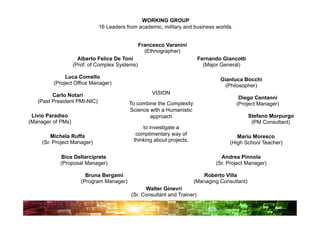
WORKING GROUP
                              16 Leaders from academic, military and business worlds.


                                                Francesco Varanini
                                                  (Ethnographer)
                     Alberto Felice De Toni                               Fernando Giancotti
                   (Prof. of Complex Systems)                               (Major General)

              Luca Comello                                                        Gianluca Bocchi
         (Project Office Manager)                                                   (Philosopher)
         Carlo Notari                                VISION
                                                                                         Diego Centanni
   (Past President PMI-NIC)               To combine the Complexity                     (Project Manager)
                                          Science with a Humanistic
 Livio Paradiso                                   approach                                     Stefano Morpurgo
(Manager of PMs)                                                                                (PM Consultant)
                                                to investigate a
         Michela Ruffa                       complimentary way of                        Mariu Moresco
     (Sr. Project Manager)                  thinking about projects.                  (High School Teacher)

            Bice Dellarciprete                                                    Andrea Pinnola
            (Proposal Manager)                                                  (Sr. Project Manager)

                        Bruna Bergami                                     Roberto Villa
                      (Program Manager)                                (Managing Consultant)
                                                 Walter Ginevri
                                           (Sr. Consultant and Trainer)
WHY TO LOOK AT A COMPLIMENTARY PROJECT POINT OF VIEW
                   From professional experience came some fact and hints


•  Some projects experience high change management rate over time,
   continuous re-scoping and re-planning. Traditional project management
   tools and methodologies increases re-planning and re-scoping costs.

•  Some useful techniques and tools exists to address some of the
   complexity issues, but without a deep problem understanding: Agile,
   Extreeme Programming, rolling wave planning, …

•  Complexity management is nowadays a general management issue


•  A complimentary way of thinking at projects can be both interesting and
   useful: as those problems arose from complexity issues,

   •  We started from complexity theory looking for relations with projects
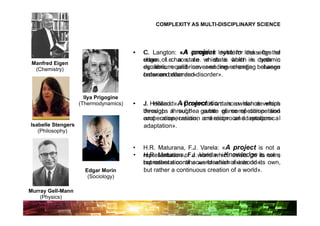
COMPLEXITY AS MULTI-DISCIPLINARY SCIENCE


                                       •    C. Langton: «A complex looks for looksedge the
                                                            A project system the for of
                                            chaos, ofi.e. a state which is which in dynamic
                                            edge        chaos, i.e. a state both is both in
 Manfred Eigen
  (Chemistry)                               equilibrium and never-ending change between
                                            dynamic equilibrium and never-ending change
                                            order andorder and disorder».
                                            between disorder».


                      Ilya Prigogine
                    (Thermodynamics)   •    J. Holland: «A Co-evolution is awhich develops
                                                Holland: « project is a dance dance which
                                            through a subtlea game of competition and
                                            develops through      subtle game of competition
                                            cooperation, creation and reciprocal adaptation».
                                            and cooperation, creation and reciprocal
Isabelle Stengers                           adaptation».
   (Philosophy)


                                       •    H.R. Maturana, F.J. Varela: «A project is not a
                                       •    H.R. Maturana, F.J. Varela: «Knowledge is own,
                                            representation of a world which exists on its not a
                                            but rather a continuous creation of a world». own,
                                            representation of a world which exists on its
                      Edgar Morin           but rather a continuous creation of a world».
                       (Sociology)

Murray Gell-Mann
    (Physics)
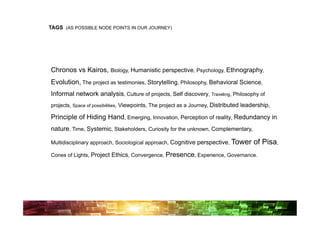
TAGS (AS POSSIBLE NODE POINTS IN OUR JOURNEY)


Chronos vs Kairos, Biology, Humanistic perspective, Psychology, Ethnography,
Evolution, The project as testimonies, Storytelling, Philosophy, Behavioral Science,
Informal network analysis, Culture of projects, Self discovery, Traveling, Philosophy of
projects, Space of possibilities, Viewpoints, The project as a Journey, Distributed leadership,

Principle of Hiding Hand, Emerging, Innovation, Perception of reality, Redundancy in
nature, Time, Systemic, Stakeholders, Curiosity for the unknown, Complementary,

Multidisciplinary approach, Sociological approach, Cognitive perspective, Tower        of Pisa,
Cones of Lights, Project Ethics, Convergence, Presence, Experience, Governance.
HIGHLIGHTS


• The Project as a journey
   –  The Pisa Tower project
   –  The “Principle of the hiding hand”
   –  Kronos vs. Kairos: the proper time for decision
      making
• The Project and the new organizational models
• The Project as a complex system
HIGHLIGHTS (CONT.)


• 7 Principles of Complexity explored
   from the Project Management perspective


• Project Management Tools,
   a complementary map for Project Managers
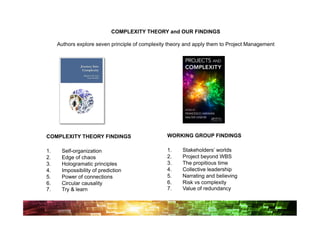
COMPLEXITY THEORY and OUR FINDINGS

      Authors explore seven principle of complexity theory and apply them to Project Management


COMPLEXITY THEORY FINDINGS                         WORKING GROUP FINDINGS

1.     Self-organization                           1.    Stakeholders’ worlds
2.     Edge of chaos                               2.    Project beyond WBS
3.     Hologramatic principles                     3.    The propitious time
4.     Impossibility of prediction                 4.    Collective leadership
5.     Power of connections                        5.    Narrating and believing
6.     Circular causality                          6.    Risk vs complexity
7.     Try & learn                                 7.    Value of redundancy
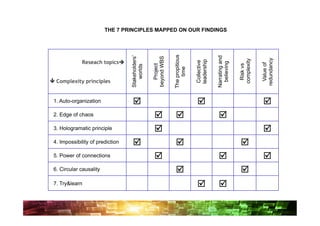
THE 7 PRINCIPLES MAPPED ON OUR FINDINGS


                                                               The propitious
                                  Stakeholders’


                                                                                              Narrating and
                                                  beyond WBS


                                                                                                                           redundancy
                                                                                                              complexity
              Reseach topics


                                                                                leadership
                                                                                 Collective


                                                                                                believing


                                                                                                                             Value of
                                                                                                               Risk vs
                                                    Project
                                     worlds


                                                                   time
 Complexity principles


 1. Auto-organization              þ                                            þ                                         þ
 2. Edge of chaos                                  þ            þ                            þ
 3. Hologramatic principle                         þ                                                                       þ
 4. Impossibility of prediction    þ                            þ                                            þ
 5. Power of connections                           þ                                          þ                           þ
 6. Circular causality                                           þ                                            þ
 7. Try&learn                                                                    þ            þ
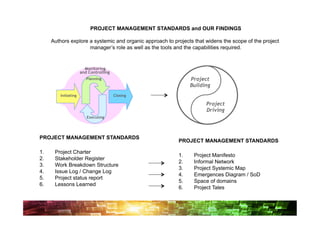
PROJECT MANAGEMENT STANDARDS and OUR FINDINGS

      Authors explore a systemic and organic approach to projects that widens the scope of the project
                      manager’s role as well as the tools and the capabilities required.


                         Monitoring
                       and Controlling
                          Planning                                                   Project
                                                                                     Building
          Initiating                     Closing

                                                                                               Project
                                                                                               Driving
                          Executing


PROJECT MANAGEMENT STANDARDS
                                                                               PROJECT MANAGEMENT STANDARDS

1.     Project Charter
                                                                               1.       Project Manifesto
2.     Stakeholder Register
                                                                               2.       Informal Network
3.     Work Breakdown Structure
                                                                               3.       Project Systemic Map
4.     Issue Log / Change Log
                                                                               4.       Emergences Diagram / SoD
5.     Project status report
                                                                               5.       Space of domains
6.     Lessons Learned
                                                                               6.       Project Tales


                Project Management and Complexity: a new field to explore for better performances
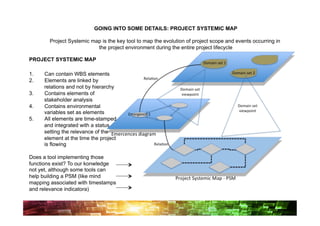
GOING INTO SOME DETAILS: PROJECT SYSTEMIC MAP

        Project Systemic map is the key tool to map the evolution of project scope and events occurring in
                           the project environment during the entire project lifecycle

PROJECT SYSTEMIC MAP

1.    Can contain WBS elements
2.    Elements are linked by
      relations and not by hierarchy
3.    Contains elements of
      stakeholder analysis
4.    Contains environmental
      variables set as elements
5.    All elements are time-stamped
      and integrated with a status
      setting the relevance of the
      element at the time the project
      is flowing

Does a tool implementing those
functions exist? To our konwledge
not yet, although some tools can
help building a PSM (like mind
mapping associated with timestamps
and relevance indicatora)


                 Project Management and Complexity: a new field to explore for better performances
A POSSIBLE FUTURE OF PROJECT MANAGEMENT


• The evolution of Project Management

    –  Enlarging the scope of project management to better take into
       account the environment surrounding the project.

    –  “Humanistic Project Management”, focused on strong
       integration of different disciplines.


• The evolution of the Project Manager

    –  Project Manager more as an integrator than as a specialist.

    –  Project Manager as a key actor in decision making process

    –  Project Manager as“Manager of the Future”.
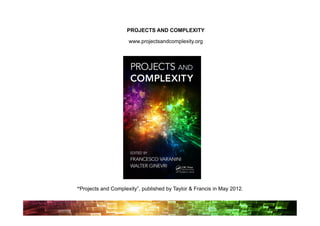
PROJECTS AND COMPLEXITY

                     www.projectsandcomplexity.org


“Projects and Complexity”, published by Taylor & Francis in May 2012.
Thank you.


     Please come to see us at the
        MEET THE AUTHOR
           special session


                                               LE
Livio Paradiso
B.U. Executive
Provisioning & Operations
Project Manager Coordinator

                                  I        M I
                               -S
Ph. [+39] 049 739 7883


                     C
Fax [+39] 02 3665 5654


                   A
Mobile [+39] 348 955 6078


             F
livio.paradiso@fastweb.it


FASTWEB S.p.A. - Via Longhin, 115 - 35129 Padova

Projects&Complexity : from theory to tools @ IPMA 2012

  • 1.
    26th IPMA WorldCongress, Crete, Greece, 2012 PROJECTS AND COMPLEXITY Edited by Francesco Varanini, Walter Ginevri presented by Livio Paradiso, co-author Francesco Varanini, Independent Strategy Consultant, Digital Humanities Prof., Ethnographer, Writer Walter Ginevri, PMP, PgMP, Senior Consultant and Trainer, President of PMI NIC Diego Centanni, PMP, Project Manager Construction, Rotarian, Entrepreneur Livio Paradiso, PMP, Manager of Project Managers
  • 2.
    SUMMARY •  Research groupand aim •  Tags •  Highlights •  Working Tools
  • 3.
    WORKING GROUP 16 Leaders from academic, military and business worlds. Francesco Varanini (Ethnographer) Alberto Felice De Toni Fernando Giancotti (Prof. of Complex Systems) (Major General) Luca Comello Gianluca Bocchi (Project Office Manager) (Philosopher) Carlo Notari VISION Diego Centanni (Past President PMI-NIC) To combine the Complexity (Project Manager) Science with a Humanistic Livio Paradiso approach Stefano Morpurgo (Manager of PMs) (PM Consultant) to investigate a Michela Ruffa complimentary way of Mariu Moresco (Sr. Project Manager) thinking about projects. (High School Teacher) Bice Dellarciprete Andrea Pinnola (Proposal Manager) (Sr. Project Manager) Bruna Bergami Roberto Villa (Program Manager) (Managing Consultant) Walter Ginevri (Sr. Consultant and Trainer)
  • 4.
    WHY TO LOOKAT A COMPLIMENTARY PROJECT POINT OF VIEW From professional experience came some fact and hints •  Some projects experience high change management rate over time, continuous re-scoping and re-planning. Traditional project management tools and methodologies increases re-planning and re-scoping costs. •  Some useful techniques and tools exists to address some of the complexity issues, but without a deep problem understanding: Agile, Extreeme Programming, rolling wave planning, … •  Complexity management is nowadays a general management issue •  A complimentary way of thinking at projects can be both interesting and useful: as those problems arose from complexity issues, •  We started from complexity theory looking for relations with projects
  • 5.
    COMPLEXITY AS MULTI-DISCIPLINARYSCIENCE •  C. Langton: «A complex looks for looksedge the A project system the for of chaos, ofi.e. a state which is which in dynamic edge chaos, i.e. a state both is both in Manfred Eigen (Chemistry) equilibrium and never-ending change between dynamic equilibrium and never-ending change order andorder and disorder». between disorder». Ilya Prigogine (Thermodynamics) •  J. Holland: «A Co-evolution is awhich develops Holland: « project is a dance dance which through a subtlea game of competition and develops through subtle game of competition cooperation, creation and reciprocal adaptation». and cooperation, creation and reciprocal Isabelle Stengers adaptation». (Philosophy) •  H.R. Maturana, F.J. Varela: «A project is not a •  H.R. Maturana, F.J. Varela: «Knowledge is own, representation of a world which exists on its not a but rather a continuous creation of a world». own, representation of a world which exists on its Edgar Morin but rather a continuous creation of a world». (Sociology) Murray Gell-Mann (Physics)
  • 6.
    TAGS (AS POSSIBLENODE POINTS IN OUR JOURNEY) Chronos vs Kairos, Biology, Humanistic perspective, Psychology, Ethnography, Evolution, The project as testimonies, Storytelling, Philosophy, Behavioral Science, Informal network analysis, Culture of projects, Self discovery, Traveling, Philosophy of projects, Space of possibilities, Viewpoints, The project as a Journey, Distributed leadership, Principle of Hiding Hand, Emerging, Innovation, Perception of reality, Redundancy in nature, Time, Systemic, Stakeholders, Curiosity for the unknown, Complementary, Multidisciplinary approach, Sociological approach, Cognitive perspective, Tower of Pisa, Cones of Lights, Project Ethics, Convergence, Presence, Experience, Governance.
  • 7.
    HIGHLIGHTS • The Project asa journey –  The Pisa Tower project –  The “Principle of the hiding hand” –  Kronos vs. Kairos: the proper time for decision making • The Project and the new organizational models • The Project as a complex system
  • 8.
    HIGHLIGHTS (CONT.) • 7 Principlesof Complexity explored from the Project Management perspective • Project Management Tools, a complementary map for Project Managers
  • 9.
    COMPLEXITY THEORY andOUR FINDINGS Authors explore seven principle of complexity theory and apply them to Project Management COMPLEXITY THEORY FINDINGS WORKING GROUP FINDINGS 1.  Self-organization 1.  Stakeholders’ worlds 2.  Edge of chaos 2.  Project beyond WBS 3.  Hologramatic principles 3.  The propitious time 4.  Impossibility of prediction 4.  Collective leadership 5.  Power of connections 5.  Narrating and believing 6.  Circular causality 6.  Risk vs complexity 7.  Try & learn 7.  Value of redundancy
  • 10.
    THE 7 PRINCIPLESMAPPED ON OUR FINDINGS The propitious Stakeholders’ Narrating and beyond WBS redundancy complexity Reseach topics leadership Collective believing Value of Risk vs Project worlds time  Complexity principles 1. Auto-organization þ þ þ 2. Edge of chaos þ þ þ 3. Hologramatic principle þ þ 4. Impossibility of prediction þ þ þ 5. Power of connections þ þ þ 6. Circular causality þ þ 7. Try&learn þ þ
  • 11.
    PROJECT MANAGEMENT STANDARDSand OUR FINDINGS Authors explore a systemic and organic approach to projects that widens the scope of the project manager’s role as well as the tools and the capabilities required. Monitoring and Controlling Planning Project Building Initiating Closing Project Driving Executing PROJECT MANAGEMENT STANDARDS PROJECT MANAGEMENT STANDARDS 1.  Project Charter 1.  Project Manifesto 2.  Stakeholder Register 2.  Informal Network 3.  Work Breakdown Structure 3.  Project Systemic Map 4.  Issue Log / Change Log 4.  Emergences Diagram / SoD 5.  Project status report 5.  Space of domains 6.  Lessons Learned 6.  Project Tales Project Management and Complexity: a new field to explore for better performances
  • 12.
    GOING INTO SOMEDETAILS: PROJECT SYSTEMIC MAP Project Systemic map is the key tool to map the evolution of project scope and events occurring in the project environment during the entire project lifecycle PROJECT SYSTEMIC MAP 1.  Can contain WBS elements 2.  Elements are linked by relations and not by hierarchy 3.  Contains elements of stakeholder analysis 4.  Contains environmental variables set as elements 5.  All elements are time-stamped and integrated with a status setting the relevance of the element at the time the project is flowing Does a tool implementing those functions exist? To our konwledge not yet, although some tools can help building a PSM (like mind mapping associated with timestamps and relevance indicatora) Project Management and Complexity: a new field to explore for better performances
  • 13.
    A POSSIBLE FUTUREOF PROJECT MANAGEMENT • The evolution of Project Management –  Enlarging the scope of project management to better take into account the environment surrounding the project. –  “Humanistic Project Management”, focused on strong integration of different disciplines. • The evolution of the Project Manager –  Project Manager more as an integrator than as a specialist. –  Project Manager as a key actor in decision making process –  Project Manager as“Manager of the Future”.
  • 14.
    PROJECTS AND COMPLEXITY www.projectsandcomplexity.org “Projects and Complexity”, published by Taylor & Francis in May 2012.
  • 15.
    Thank you. Please come to see us at the MEET THE AUTHOR special session LE Livio Paradiso B.U. Executive Provisioning & Operations Project Manager Coordinator I M I -S Ph. [+39] 049 739 7883 C Fax [+39] 02 3665 5654 A Mobile [+39] 348 955 6078 F livio.paradiso@fastweb.it FASTWEB S.p.A. - Via Longhin, 115 - 35129 Padova