SCHOOLBASED
ASSESSMENT
Project
2013-2014
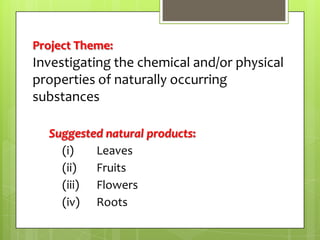
Project Theme:

Investigating the chemical and/or physical
properties of naturally occurring
substances
Suggested natural products:
(i)
Leaves
(ii)
Fruits
(iii) Flowers
(iv) Roots
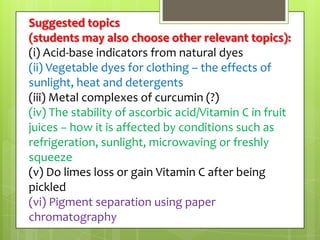
Suggested topics
(students may also choose other relevant topics):
(i) Acid-base indicators from natural dyes
(ii) Vegetable dyes for clothing – the effects of
sunlight, heat and detergents
(iii) Metal complexes of curcumin (?)
(iv) The stability of ascorbic acid/Vitamin C in fruit
juices – how it is affected by conditions such as
refrigeration, sunlight, microwaving or freshly
squeeze
(v) Do limes loss or gain Vitamin C after being
pickled
(vi) Pigment separation using paper
chromatography
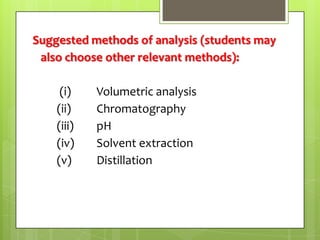
Suggested methods of analysis (students may
also choose other relevant methods):
(i)
(ii)
(iii)
(iv)
(v)

Volumetric analysis
Chromatography
pH
Solvent extraction
Distillation
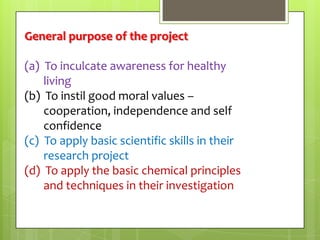
General purpose of the project
(a) To inculcate awareness for healthy
living
(b) To instil good moral values –
cooperation, independence and self
confidence
(c) To apply basic scientific skills in their
research project
(d) To apply the basic chemical principles
and techniques in their investigation
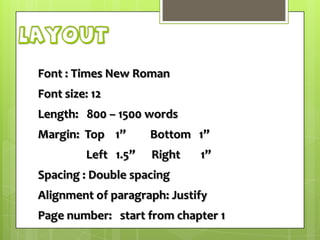
layout
Font : Times New Roman
Font size: 12
Length: 800 – 1500 words
Margin: Top 1”
Left 1.5”

Bottom 1”
Right

1”

Spacing : Double spacing

Alignment of paragraph: Justify
Page number: start from chapter 1
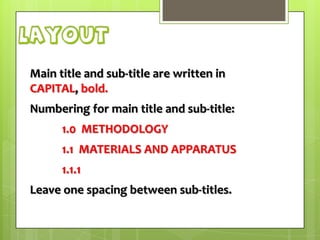
layout
Main title and sub-title are written in
CAPITAL, bold.
Numbering for main title and sub-title:
1.0 METHODOLOGY
1.1 MATERIALS AND APPARATUS
1.1.1

Leave one spacing between sub-titles.
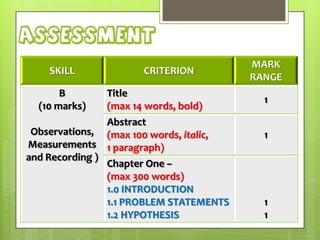
Assessment
SKILL
B
(10 marks)

CRITERION

Title
(max 14 words, bold)
Abstract
Observations, (max 100 words, italic,
Measurements 1 paragraph)
and Recording )
Chapter One –
(max 300 words)
1.0 INTRODUCTION
1.1 PROBLEM STATEMENTS
1.2 HYPOTHESIS

MARK
RANGE
1

1

1
1
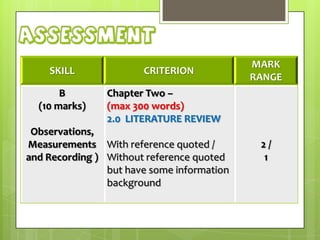
Assessment
SKILL
B
(10 marks)

CRITERION

MARK
RANGE

Chapter Two –
(max 300 words)
2.0 LITERATURE REVIEW

Observations,
Measurements With reference quoted /
and Recording ) Without reference quoted
but have some information
background

2/
1
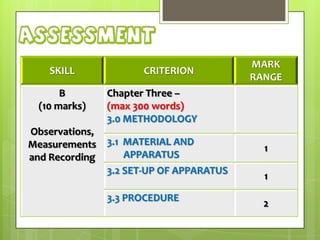
Assessment
SKILL
B
(10 marks)

Observations,
Measurements
and Recording

CRITERION

MARK
RANGE

Chapter Three –
(max 300 words)
3.0 METHODOLOGY
3.1 MATERIAL AND
APPARATUS
3.2 SET-UP OF APPARATUS
3.3 PROCEDURE

1
1
2
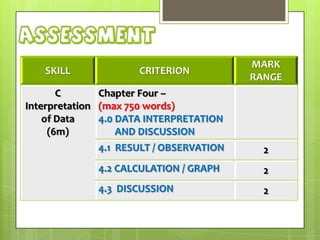
Assessment
SKILL

CRITERION

MARK
RANGE

C
Chapter Four –
Interpretation (max 750 words)
of Data
4.0 DATA INTERPRETATION
(6m)
AND DISCUSSION
4.1 RESULT / OBSERVATION

2

4.2 CALCULATION / GRAPH

2

4.3 DISCUSSION

2
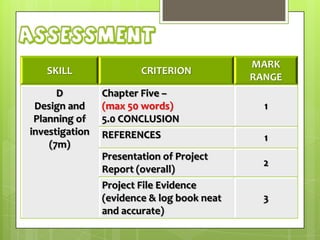
Assessment
SKILL
D
Design and
Planning of
investigation
(7m)

CRITERION

MARK
RANGE

Chapter Five –
(max 50 words)
5.0 CONCLUSION

1

REFERENCES

1

Presentation of Project
Report (overall)

2

Project File Evidence
(evidence & log book neat
and accurate)

3
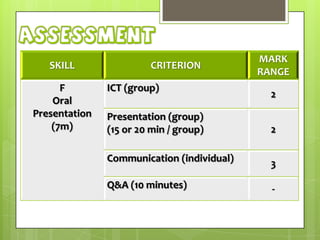
Assessment
SKILL
F
Oral
Presentation
(7m)

CRITERION
ICT (group)

MARK
RANGE
2

Presentation (group)
(15 or 20 min / group)

2

Communication (individual)

3

Q&A (10 minutes)

-
WRITING REPORT
Front page
Abstract
Chapter 1 – 5
Reference
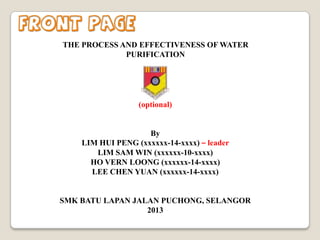
Front page
THE PROCESS AND EFFECTIVENESS OF WATER
PURIFICATION

(optional)

By
LIM HUI PENG (xxxxxx-14-xxxx) – leader
LIM SAM WIN (xxxxxx-10-xxxx)
HO VERN LOONG (xxxxxx-14-xxxx)
LEE CHEN YUAN (xxxxxx-14-xxxx)

SMK BATU LAPAN JALAN PUCHONG, SELANGOR
2013
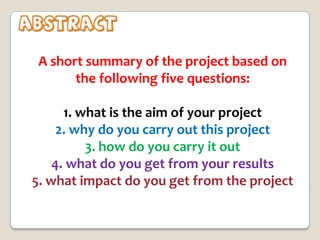
Abstract
A short summary of the project based on
the following five questions:
1. what is the aim of your project
2. why do you carry out this project
3. how do you carry it out
4. what do you get from your results
5. what impact do you get from the project
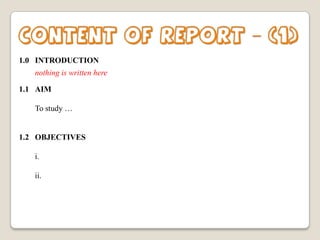
Content of report – (1)
1.0 INTRODUCTION
nothing is written here
1.1 AIM
To study …

1.2 OBJECTIVES
i.
ii.
Content of report – (1)
1.0 INTRODUCTION
nothing is written here
1.1 PROBLEM STATEMENTS
i. Does … ?
ii. Is the concentration …. ?

1.2 HYPOTHESIS
i.
ii. The concentration of ethanoic acid listed in the fact is true.
Content of report – (2)
With Reference Quoted
2.0

LITERATURE REVIEW

In Text:
The amount of benzoic acid consumed by
human is 10,00 tones / year [1]
In Reference:
1. New Strait Times ;18 July 2012 ; pg 8
Content of report – (3)
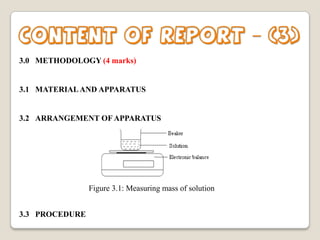
3.0 METHODOLOGY (4 marks)

3.1 MATERIAL AND APPARATUS

3.2 ARRANGEMENT OF APPARATUS

Figure 3.1: Measuring mass of solution
3.3 PROCEDURE
Content of report – (4)
4.0 DATA INTERPRETATION AND DISCUSSION (6 marks)
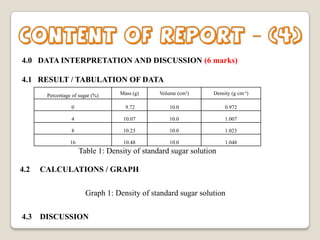
4.1 RESULT / TABULATION OF DATA
Percentage of sugar (%)

Mass (g)

Volume (cm³)

Density (g cm-³)

0

9.72

10.0

0.972

4

10.07

10.0

1.007

8

10.23

10.0

1.023

16

10.48

10.0

1.048

Table 1: Density of standard sugar solution
4.2

CALCULATIONS / GRAPH

Graph 1: Density of standard sugar solution
4.3

DISCUSSION
Content of report – (5)
5.0

CONCLUSION (1 mark)

Based on your data, give a short summary or
conclusion about your project with reference to
your problem statements.

Suggest specific changes that would improve the
investigation. Recommend relevant action or
research in the future findings.)
Reference
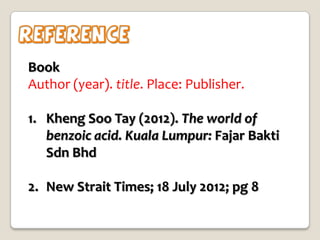
Book
Author (year). title. Place: Publisher.
1. Kheng Soo Tay (2012). The world of
benzoic acid. Kuala Lumpur: Fajar Bakti
Sdn Bhd
2. New Strait Times; 18 July 2012; pg 8
Reference
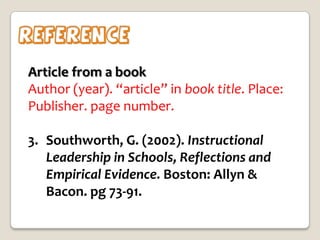
Article from a book
Author (year). “article” in book title. Place:
Publisher. page number.

3. Southworth, G. (2002). Instructional
Leadership in Schools, Reflections and
Empirical Evidence. Boston: Allyn &
Bacon. pg 73-91.
Reference
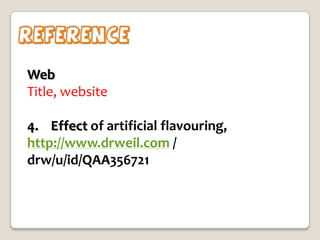
Web
Title, website
4. Effect of artificial flavouring,
http://www.drweil.com /
drw/u/id/QAA356721
SCHEDULE
OF PROJECT
2013 - 2014
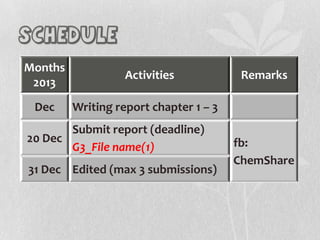
schedule
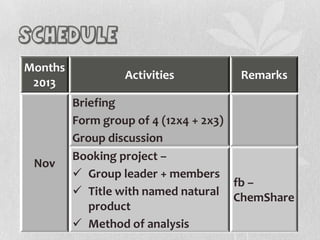
Months
2013

Nov

Activities

Remarks

Briefing
Form group of 4 (12x4 + 2x3)
Group discussion
Booking project –
 Group leader + members
fb –
 Title with named natural ChemShare
product
 Method of analysis
schedule
Months
2013
Dec

Activities

Remarks

Writing report chapter 1 – 3

Submit report (deadline)
20 Dec
G3_File name(1)
31 Dec Edited (max 3 submissions)

fb:
ChemShare
schedule
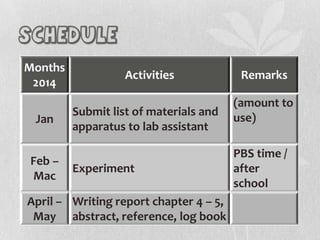
Months
2014
Jan
Feb –
Mac

Activities
Submit list of materials and
apparatus to lab assistant
Experiment

April – Writing report chapter 4 – 5,
May abstract, reference, log book

Remarks
(amount to
use)
PBS time /
after
school
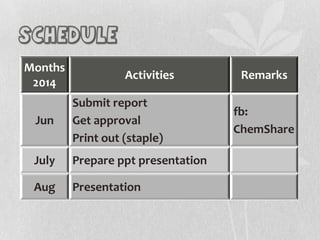
schedule
Months
2014

Activities

Jun

Submit report
Get approval
Print out (staple)

July

Prepare ppt presentation

Aug

Presentation

Remarks
fb:
ChemShare
Project_Chem2014

Project_Chem2014

  • 1.
  • 2.
    Project Theme: Investigating thechemical and/or physical properties of naturally occurring substances Suggested natural products: (i) Leaves (ii) Fruits (iii) Flowers (iv) Roots
  • 3.
    Suggested topics (students mayalso choose other relevant topics): (i) Acid-base indicators from natural dyes (ii) Vegetable dyes for clothing – the effects of sunlight, heat and detergents (iii) Metal complexes of curcumin (?) (iv) The stability of ascorbic acid/Vitamin C in fruit juices – how it is affected by conditions such as refrigeration, sunlight, microwaving or freshly squeeze (v) Do limes loss or gain Vitamin C after being pickled (vi) Pigment separation using paper chromatography
  • 4.
    Suggested methods ofanalysis (students may also choose other relevant methods): (i) (ii) (iii) (iv) (v) Volumetric analysis Chromatography pH Solvent extraction Distillation
  • 5.
    General purpose ofthe project (a) To inculcate awareness for healthy living (b) To instil good moral values – cooperation, independence and self confidence (c) To apply basic scientific skills in their research project (d) To apply the basic chemical principles and techniques in their investigation
  • 6.
    layout Font : TimesNew Roman Font size: 12 Length: 800 – 1500 words Margin: Top 1” Left 1.5” Bottom 1” Right 1” Spacing : Double spacing Alignment of paragraph: Justify Page number: start from chapter 1
  • 7.
    layout Main title andsub-title are written in CAPITAL, bold. Numbering for main title and sub-title: 1.0 METHODOLOGY 1.1 MATERIALS AND APPARATUS 1.1.1 Leave one spacing between sub-titles.
  • 8.
    Assessment SKILL B (10 marks) CRITERION Title (max 14words, bold) Abstract Observations, (max 100 words, italic, Measurements 1 paragraph) and Recording ) Chapter One – (max 300 words) 1.0 INTRODUCTION 1.1 PROBLEM STATEMENTS 1.2 HYPOTHESIS MARK RANGE 1 1 1 1
  • 9.
    Assessment SKILL B (10 marks) CRITERION MARK RANGE Chapter Two– (max 300 words) 2.0 LITERATURE REVIEW Observations, Measurements With reference quoted / and Recording ) Without reference quoted but have some information background 2/ 1
  • 10.
    Assessment SKILL B (10 marks) Observations, Measurements and Recording CRITERION MARK RANGE ChapterThree – (max 300 words) 3.0 METHODOLOGY 3.1 MATERIAL AND APPARATUS 3.2 SET-UP OF APPARATUS 3.3 PROCEDURE 1 1 2
  • 11.
    Assessment SKILL CRITERION MARK RANGE C Chapter Four – Interpretation(max 750 words) of Data 4.0 DATA INTERPRETATION (6m) AND DISCUSSION 4.1 RESULT / OBSERVATION 2 4.2 CALCULATION / GRAPH 2 4.3 DISCUSSION 2
  • 12.
    Assessment SKILL D Design and Planning of investigation (7m) CRITERION MARK RANGE ChapterFive – (max 50 words) 5.0 CONCLUSION 1 REFERENCES 1 Presentation of Project Report (overall) 2 Project File Evidence (evidence & log book neat and accurate) 3
  • 13.
    Assessment SKILL F Oral Presentation (7m) CRITERION ICT (group) MARK RANGE 2 Presentation (group) (15or 20 min / group) 2 Communication (individual) 3 Q&A (10 minutes) -
  • 14.
  • 15.
    Front page THE PROCESSAND EFFECTIVENESS OF WATER PURIFICATION (optional) By LIM HUI PENG (xxxxxx-14-xxxx) – leader LIM SAM WIN (xxxxxx-10-xxxx) HO VERN LOONG (xxxxxx-14-xxxx) LEE CHEN YUAN (xxxxxx-14-xxxx) SMK BATU LAPAN JALAN PUCHONG, SELANGOR 2013
  • 16.
    Abstract A short summaryof the project based on the following five questions: 1. what is the aim of your project 2. why do you carry out this project 3. how do you carry it out 4. what do you get from your results 5. what impact do you get from the project
  • 17.
    Content of report– (1) 1.0 INTRODUCTION nothing is written here 1.1 AIM To study … 1.2 OBJECTIVES i. ii.
  • 18.
    Content of report– (1) 1.0 INTRODUCTION nothing is written here 1.1 PROBLEM STATEMENTS i. Does … ? ii. Is the concentration …. ? 1.2 HYPOTHESIS i. ii. The concentration of ethanoic acid listed in the fact is true.
  • 19.
    Content of report– (2) With Reference Quoted 2.0 LITERATURE REVIEW In Text: The amount of benzoic acid consumed by human is 10,00 tones / year [1] In Reference: 1. New Strait Times ;18 July 2012 ; pg 8
  • 20.
    Content of report– (3) 3.0 METHODOLOGY (4 marks) 3.1 MATERIAL AND APPARATUS 3.2 ARRANGEMENT OF APPARATUS Figure 3.1: Measuring mass of solution 3.3 PROCEDURE
  • 21.
    Content of report– (4) 4.0 DATA INTERPRETATION AND DISCUSSION (6 marks) 4.1 RESULT / TABULATION OF DATA Percentage of sugar (%) Mass (g) Volume (cm³) Density (g cm-³) 0 9.72 10.0 0.972 4 10.07 10.0 1.007 8 10.23 10.0 1.023 16 10.48 10.0 1.048 Table 1: Density of standard sugar solution 4.2 CALCULATIONS / GRAPH Graph 1: Density of standard sugar solution 4.3 DISCUSSION
  • 22.
    Content of report– (5) 5.0 CONCLUSION (1 mark) Based on your data, give a short summary or conclusion about your project with reference to your problem statements. Suggest specific changes that would improve the investigation. Recommend relevant action or research in the future findings.)
  • 23.
    Reference Book Author (year). title.Place: Publisher. 1. Kheng Soo Tay (2012). The world of benzoic acid. Kuala Lumpur: Fajar Bakti Sdn Bhd 2. New Strait Times; 18 July 2012; pg 8
  • 24.
    Reference Article from abook Author (year). “article” in book title. Place: Publisher. page number. 3. Southworth, G. (2002). Instructional Leadership in Schools, Reflections and Empirical Evidence. Boston: Allyn & Bacon. pg 73-91.
  • 25.
    Reference Web Title, website 4. Effectof artificial flavouring, http://www.drweil.com / drw/u/id/QAA356721
  • 26.
  • 27.
    schedule Months 2013 Nov Activities Remarks Briefing Form group of4 (12x4 + 2x3) Group discussion Booking project –  Group leader + members fb –  Title with named natural ChemShare product  Method of analysis
  • 28.
    schedule Months 2013 Dec Activities Remarks Writing report chapter1 – 3 Submit report (deadline) 20 Dec G3_File name(1) 31 Dec Edited (max 3 submissions) fb: ChemShare
  • 29.
    schedule Months 2014 Jan Feb – Mac Activities Submit listof materials and apparatus to lab assistant Experiment April – Writing report chapter 4 – 5, May abstract, reference, log book Remarks (amount to use) PBS time / after school
  • 30.
    schedule Months 2014 Activities Jun Submit report Get approval Printout (staple) July Prepare ppt presentation Aug Presentation Remarks fb: ChemShare